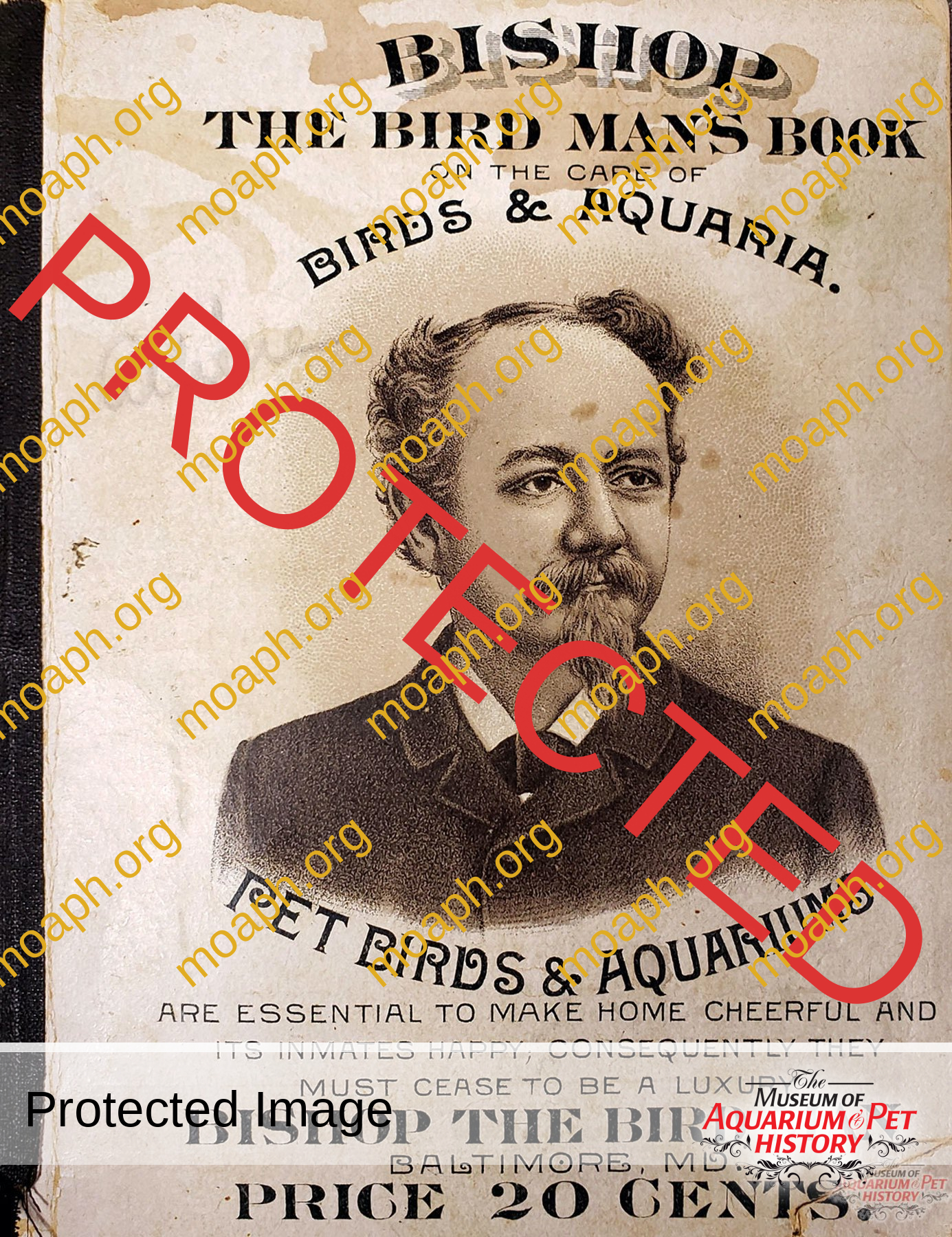
Photo of Henry Bishop featured in 1893 “Bishop the Bird Man’s Book on the Care of Birds & Aquaria”.

Photo of Henry Bishop featured in 1886 “Bishop the Bird Man’s Book on the Care of Birds & Aquaria”.
When I began work on this piece it appeared that it would be an easy, and rather straightforward, article to put together. Well, as it turned out, yes and no. The Columbus Aquarium part, which is further down was, with some noted caveats, not particularly problematic. The lead-in to it has proved to be one of those bumpy roads that can drive a writer a bit up the wall.
A few years back Gary Bagnall (hereafter Gary), the Founder/Director of MOAPH, and I had discussed putting together an article on the Columbus Aquarium. This “tank” had its premiere in a combination book/catalogue published in 1893 by Baltimore Maryland pet dealer Henry Bishop. Our idea kind of went nowhere at the time and some materials that had been gathered up were shelved to await their use in the future. The opening of the MOAPH has now presented an opportunity to revisit the project and a good time to dust them off and jump into the project. I had initially planned to do a lead in with some basic background information on Henry Bishop and his lengthy involvement in the pet industry. Here is where things got a bit bumpy. As additional materials on Bishop were unearthed it became obvious that he was not just another retailer/wholesaler of birds and goldfish (and other pets also) and all the necessary supplies for their maintenance. His business was widespread, and he sold and shipped his products all over the U.S., Canada, and Mexico. It also became obvious that in more current pet history related literature that Bishop has received comparatively little space (see for example Grier, 2006 and Klee, 2021). Unfortunately, now is not the time to address Bishop’s great contributions to the pet industry and hobby (and several other areas). But such a project is already in its early stages, and I hope to be able to present a good look at the man and his accomplishments in the not-too-distant future.
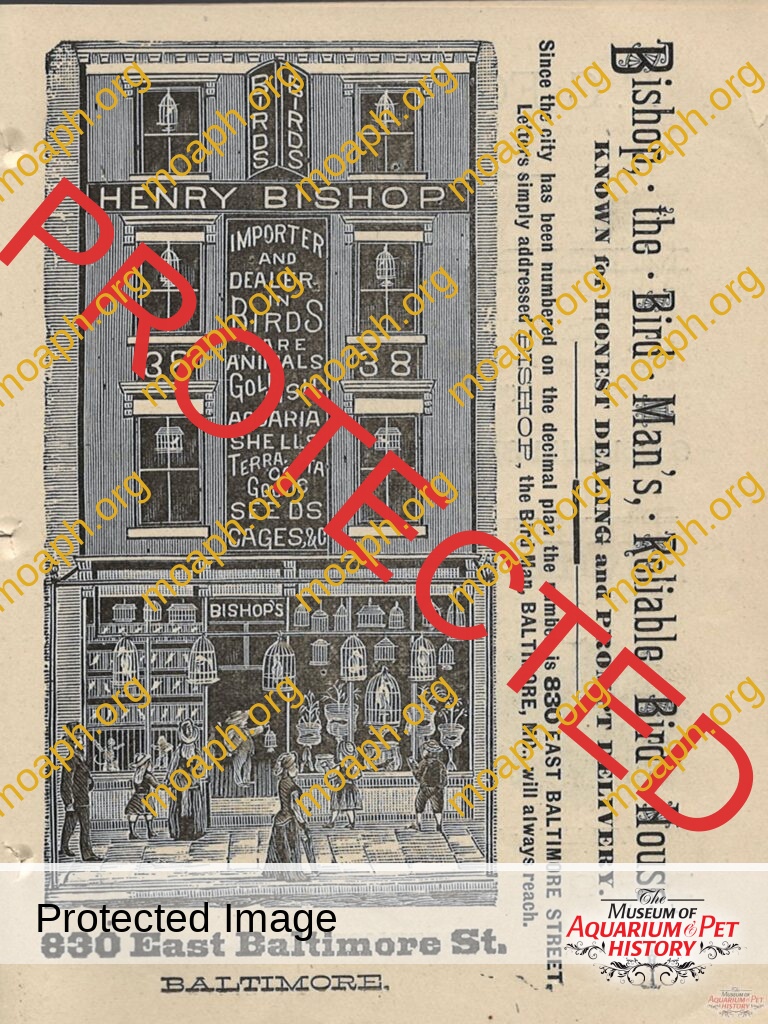
Photo of Henry Bishop’s Store front featured in 1886 catalog.
But, for now I would like to offer some short and very highly abbreviated comments on Henry Bishop (1847-1907). He was born in Germany, became an orphan at the age of four, whence he was raised by relatives who saw to his education. He was very interested in natural history, and this was to be a major factor in charting his life. At the age of 16 he signed on as a crew member on a steamer and headed for New York City. Subsequently, he served on several different ships for about six years on trips to Central America, Brazil, and various Caribbean islands in addition to other U.S. east coast destinations. It has been noted that during this time he used all opportunities to enhance his studies of natural history. In 1871 he was back in New York City and secured a job working for P.T. Barnum at his Hippodrome. He stayed with Barnum for about three years, and again, his interests in natural history were greatly rewarded by this position and the numerous individuals that he had access to during the time. On one road trip the Hippodrome appeared in Baltimore Maryland and Bishop was enchanted by the city and what it had to offer. In 1874, family in tow, he moved to Baltimore which would be his home for the rest of his life. In June of that year, he opened his first predominately bird store and it was basically all uphill from there expanding over the years to two stores selling birds and aquaria fishes and all the needed supplies. In addition, several buildings for maintaining and handling stock and the shipping were added to his business. I must here skip over many things including goldfish breeding pond management (at one time more than 35 acres), his outpourings of poetry, his song writing (and singing), his patent medicine side business, his hard work to help with the development of a zoo in Baltimore, etc., etc. I will finish this section with the following: Henry Bishop was twice blessed by the names he was known by. First, in living up to a phrase later memorialized by Mel Brooks, he found out “It’s good to be the king” – THE GOLDFISH KING. He was equally well known, in a phrase equally modern, as The Man – THE BIRD MAN, his obvious, and widely used favorite. Many try, with varying degrees of success, to become known as something special. Henry Bishop successfully became widely known under both monikers and thrived. Stay tuned. His life, and the thereafter, is a tale I wish to bring to you later.
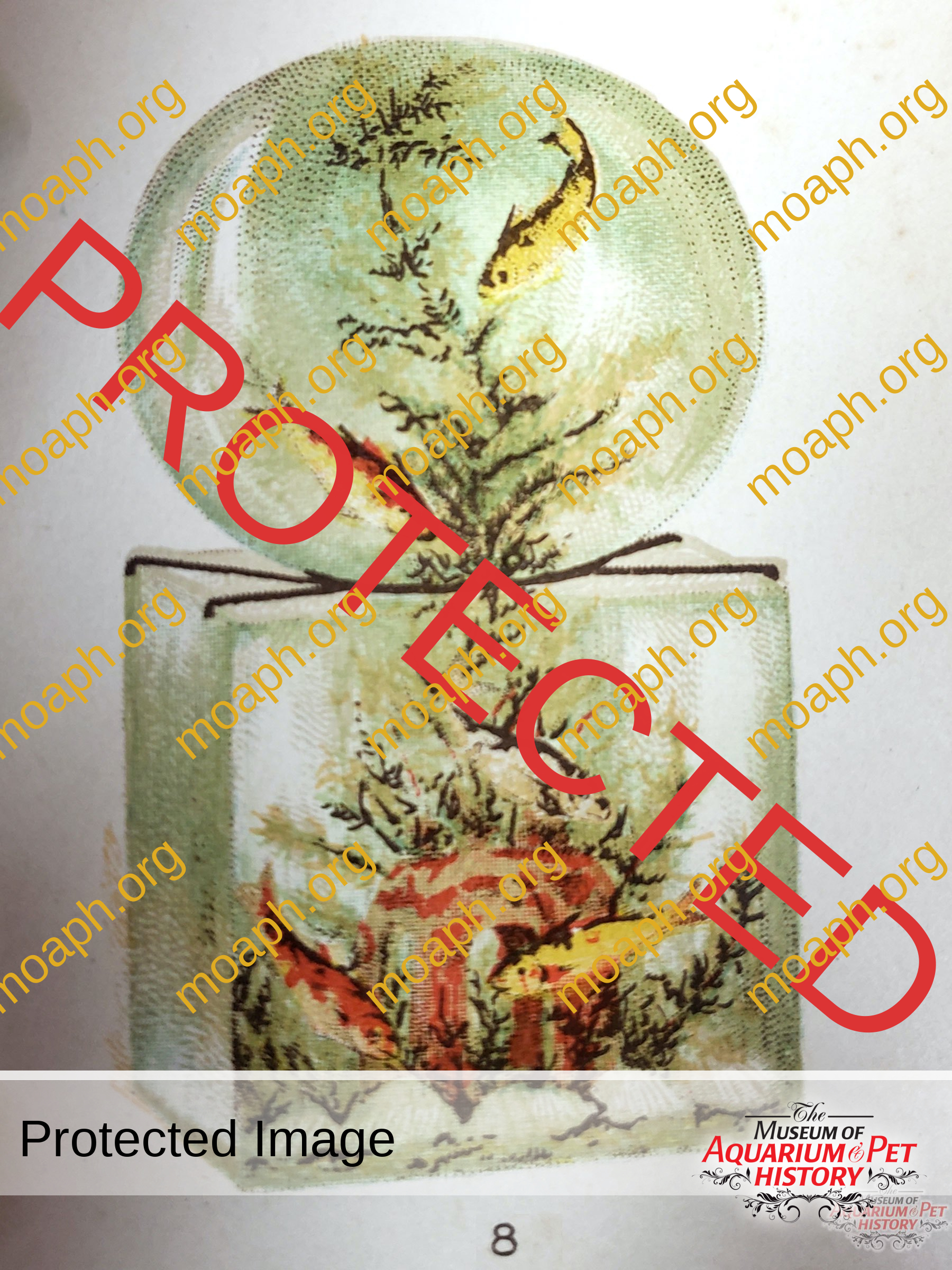
The Columbus Aquarium illustrated from Bishop’s 1893 Book/Catalog.
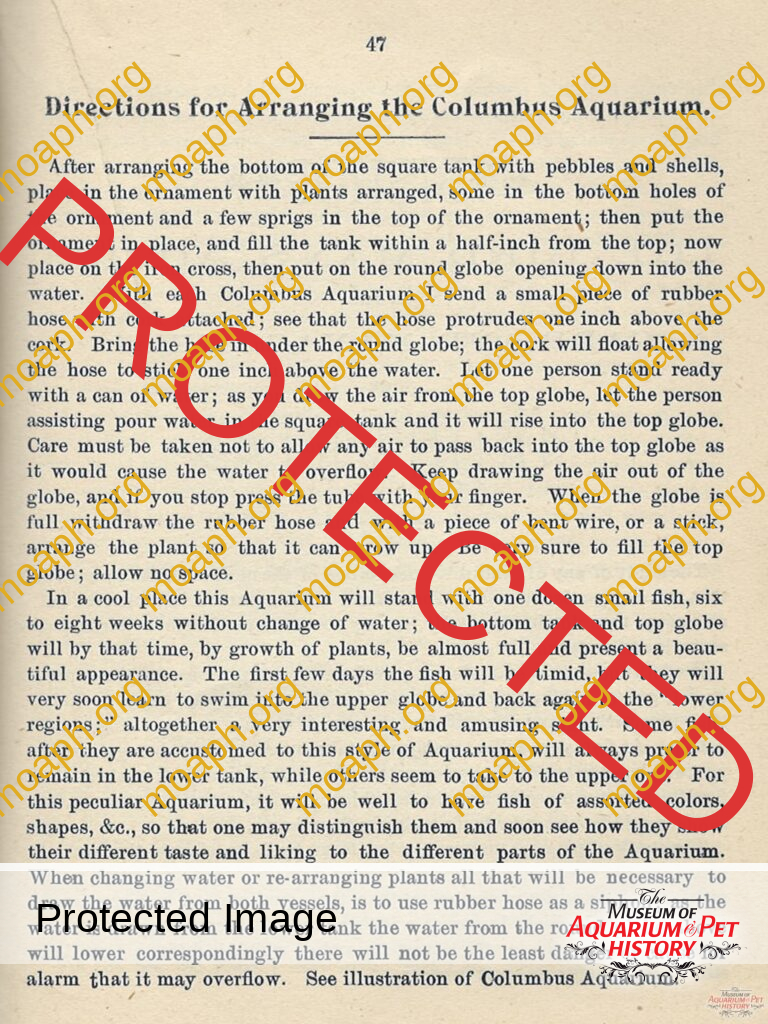
Directions for arranging the Columbus Aquarium from Bishop’s 1893 Book/Catalog.
And now for the Columbus Aquarium. In his 1893 book/catalog Bishop introduced this “…novel, new and beautiful…” product. No explanation is given for the name given is provided. But I tend to agree with Gary’s suggestion that it might have been named as an honor to the World’s Columbian Exposition (also know as the Chicago World’s Fair) taking place that year. It certainly would be fitting. In a try to offer some proof for this I went through a dozen or more electronic books on this event and using a wide variety of search terms could come up with nothing describing such an aquarium at the Exposition. Bishop held several patents on bird cage improvements but a patent search on him came up with nothing aquarium related. So, it comes to an educated guess regarding the name of the aquarium. Again, I think that Gary has nailed it.
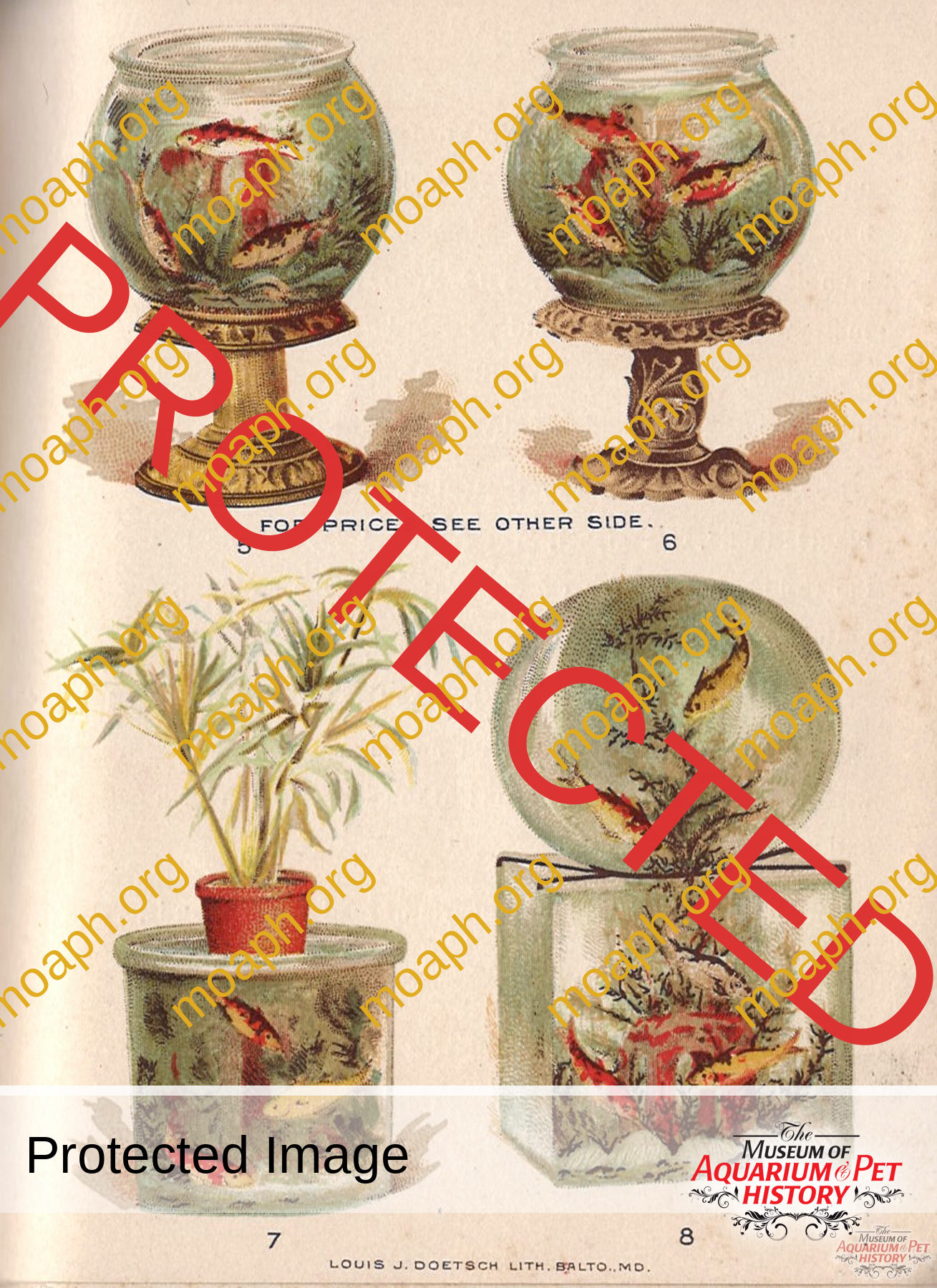
The page illustrating the Columbus Aquarium also shows other more standard types of vessels.
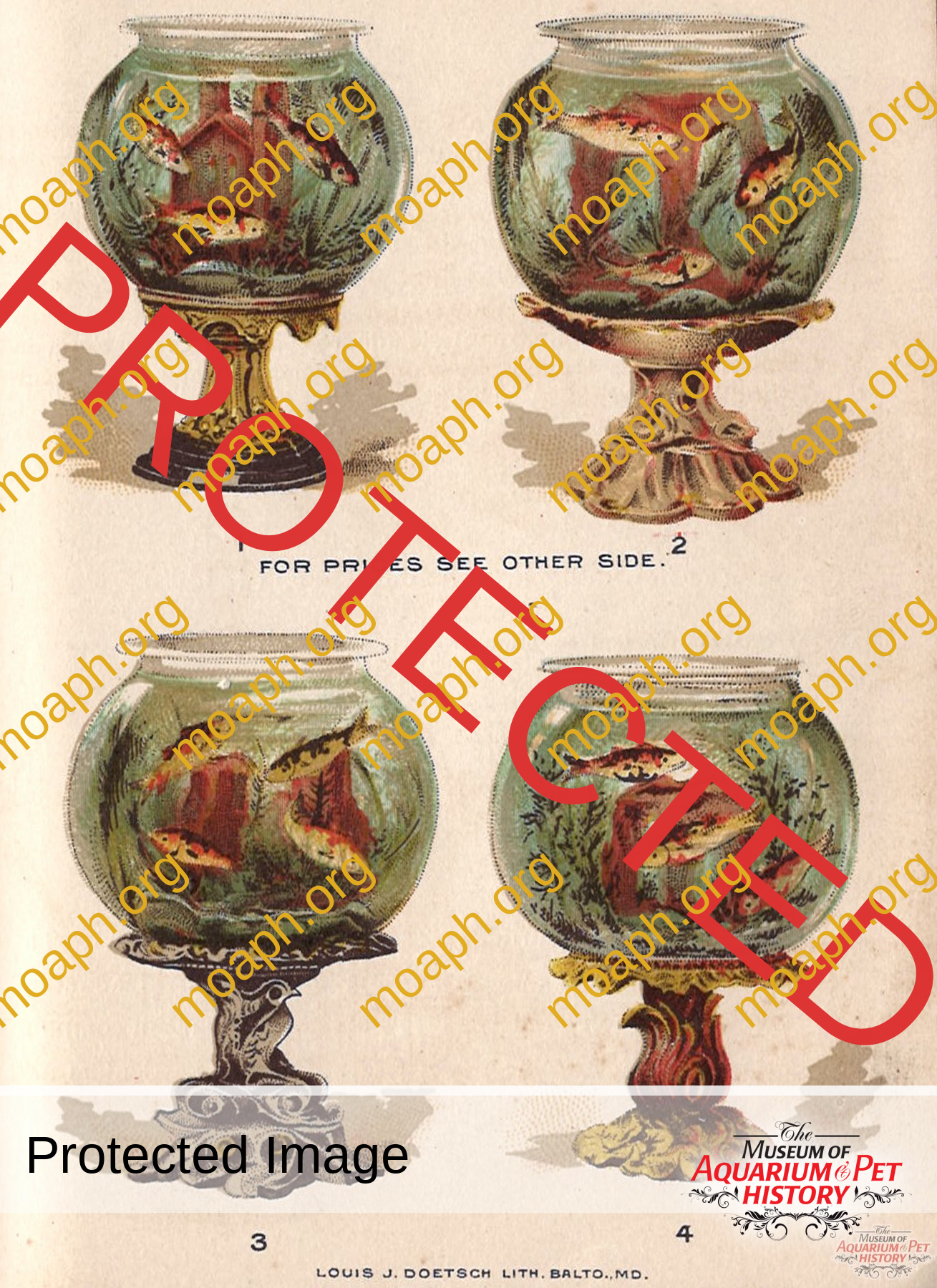
Other vessels sold by Henry Bishop featured in the catalog with the Columbus Aquarium.
The aquarium itself is best described as “interesting.” A color lithograph of the tank from the mentioned book/catalog is included here. My initial thought on the tank was “Huh? How do you do that?” Well, Bishop offers a quite lengthy explanation of how it is done with the two parts that hold a combined nine gallons of water. The first thing is that two people are needed. From there…. well, I will let you read Bishop’s instructions for yourself. Included herein is a full sheet with details on the aquarium which provides a good description and detailed directions for setting it up. It sounds like, well, and interesting adventure. That’s just to me, of course. The illustrated sheet was published after the 1893 publication and is undated. But, based on information it contains it was published prior to 1906. The price given for a single unit is also 50 cents more than that noted in the book.
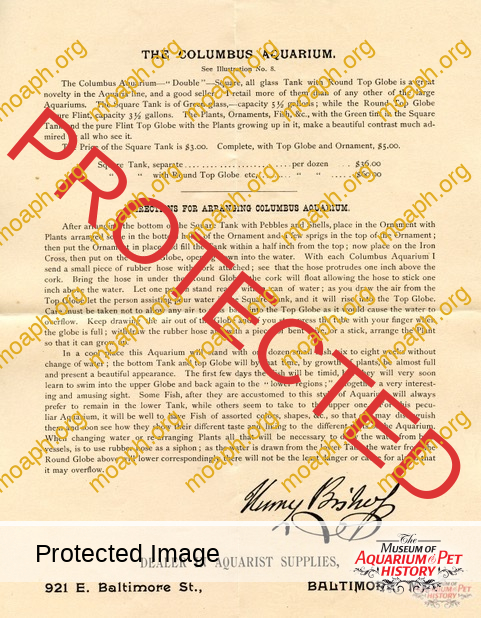
The later produces description, and instructions, for the Columbus Aquarium.
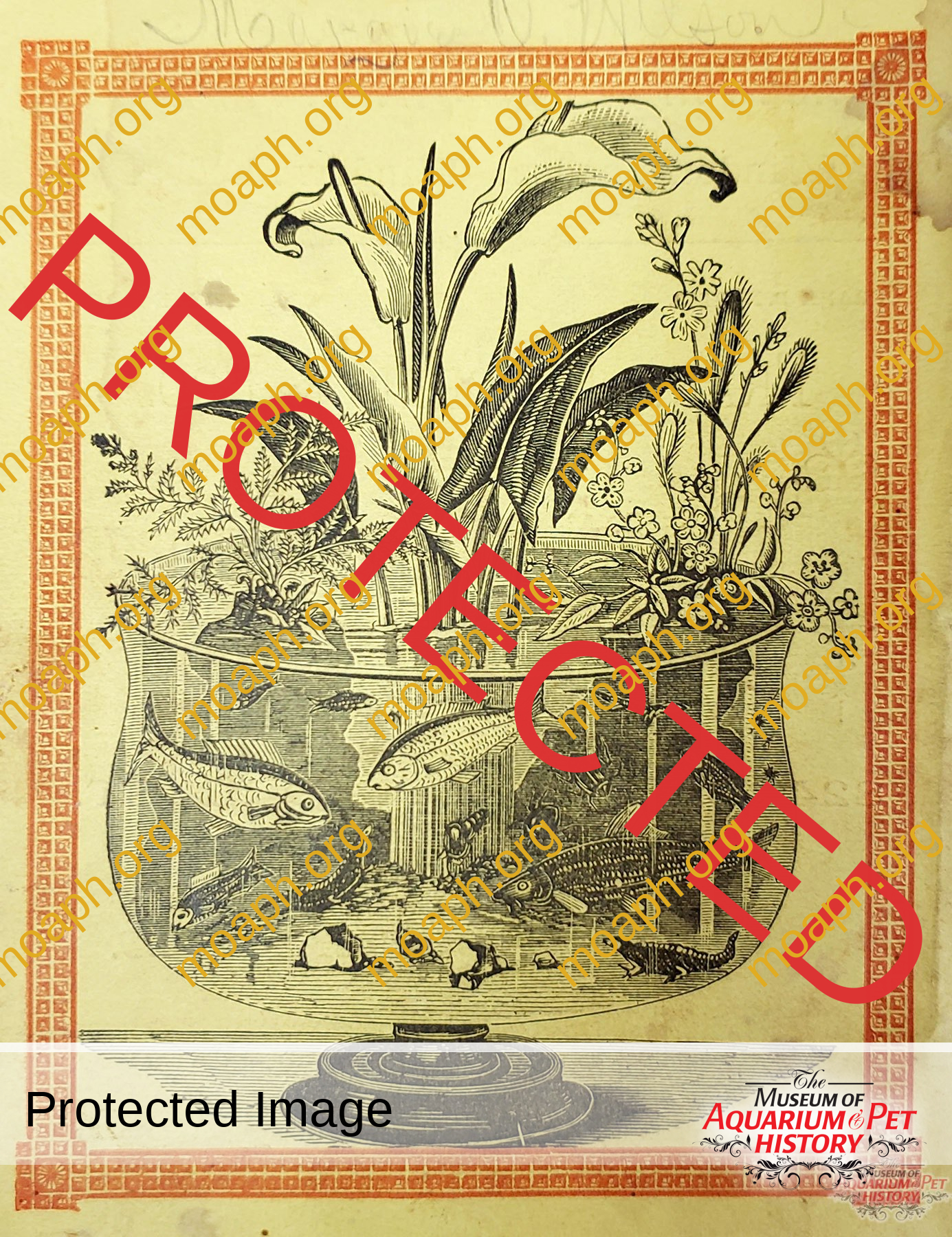
Aquarium featured in 1886 Henry Bishop Catalog.
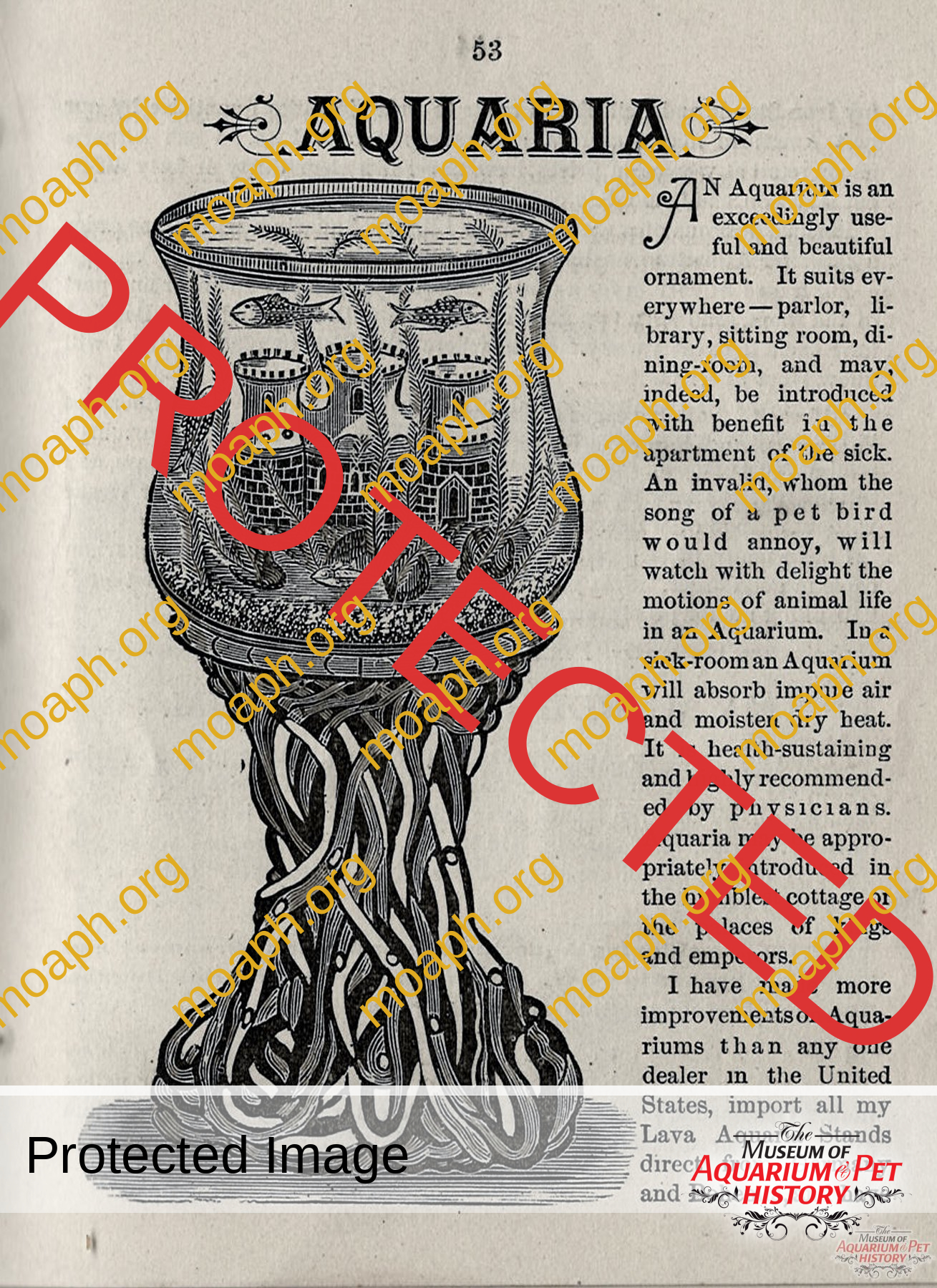
Drawing and description of Aquaria in Henry Bishop’s 1886 Catalog.
Gary says that he has never seen an example of this aquarium. If not him, who? If anyone reading this ever seen such a tank, please contact Gary or myself through the MOAPH. Thanks.
One last thought: In that the Museum has a dedicated YouTube channel, should one of these aquariums ever make it to the Museum I would suggest that Gary and a person of his choosing set up the tank, following Bishop’s 19th Century directions, on a live feed…no retakes please. I would love to see it and Gary should have the pleasure of doing so after such a long wait!
References and Suggested Reading
Bishop, H. 1886. Bishop, The Bird Man’s Book on the Care of Birds and Aquaria. Published by “Bishop, The Bird Man”, Baltimore, MD. 86 pp. [plus prolific unpaginated advertising for a variety of businesses].
Bishop, H. 1893. Bishop – The Bird Man’s Book on the Care of Birds & Aquaria. 80 pp. [Though informative, this is basically a book/catalogue].
Grier, K.C. 2007. Pets in America – A History [Soft-cover]. A Harvest Book, Harcourt, Inc. 496 pp.
Klee, A.J. 2003. Toy Fish – A History of the Aquarium Hobby in America – The First One-Hundred Years – Revised and Expanded Edition. Finley Aquatic Books. 204 pp. [Little on Bishop is offered and subsequent editions do not improve on this].
Klee, A. J. 2021. The Dawn of the Aquarium Hobby in America. Pages 1257-1293, (in Klee, A.J. 2003-2021. Essays in Aquarium Hobby History. AJK Productions, 1354 pp.) [In this essay Klee offers some good material on Bishop].