William Alford Lloyd: the Unpublished Letters of a Great Aquarium Pioneer
Even though in today’s world you can get almost anything while sitting comfortably in front of your computer, in many cases I still prefer doing things in person. This happens, for instance, when I conduct historical research in archives, libraries, and private collections. I like to touch and even smell old books and documents, establishing a sort of connection with them taking me back in time, something hard to explain in words and that probably only collectors like me can fully understand. Furthermore, every time I get the chance to talk to archivists and curators, I always discover new details on the history of the paper treasures I am studying.
In light of the above, you can imagine my excitement when the Historical Archive of the Zoological Station at Naples (Italy) granted me authorization to view some letters and postcards written to its founder and first director, Anton Dohrn (1840-1909), by the great aquarium pioneer William Alford Lloyd (1824-1880). I immediately realized this was a huge opportunity. The Zoological Station, in fact, had been preserving for more than a century the world’s largest collection of letters and postcards hand written by Lloyd, most of them unpublished as far as I know. Although in the 1990s, for reasons that nowadays it makes little sense to delve into, the Zoological Station “had to send” permanently a large part of the Lloyd collection to the Dohrn Foundation at the State Library of Munich, what remained at Naples (including the photocopies of the documents sent to Munich) has nonetheless a high historical value.
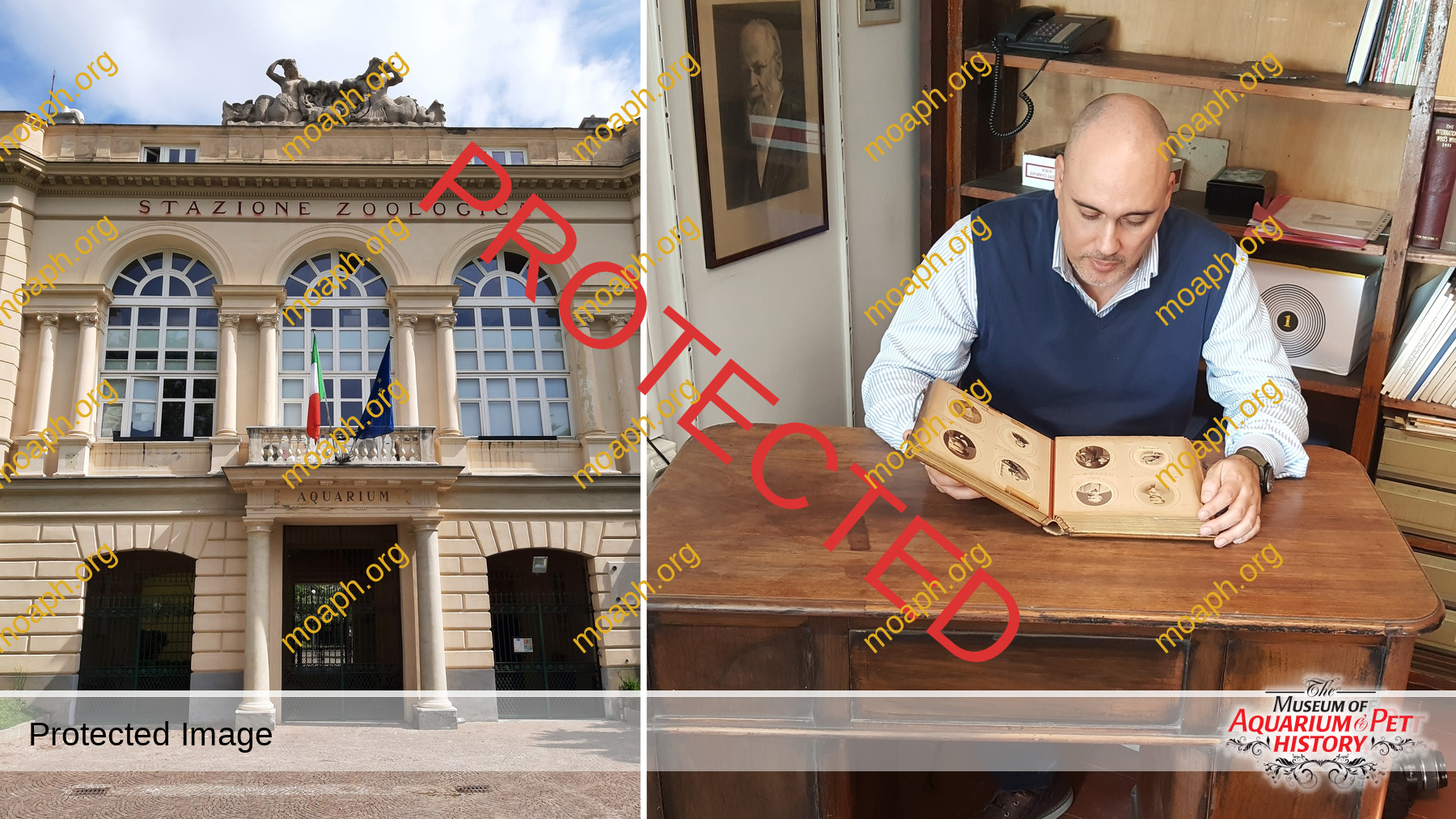
The author sitting at one of Anton Dohrn’s favorite desks.
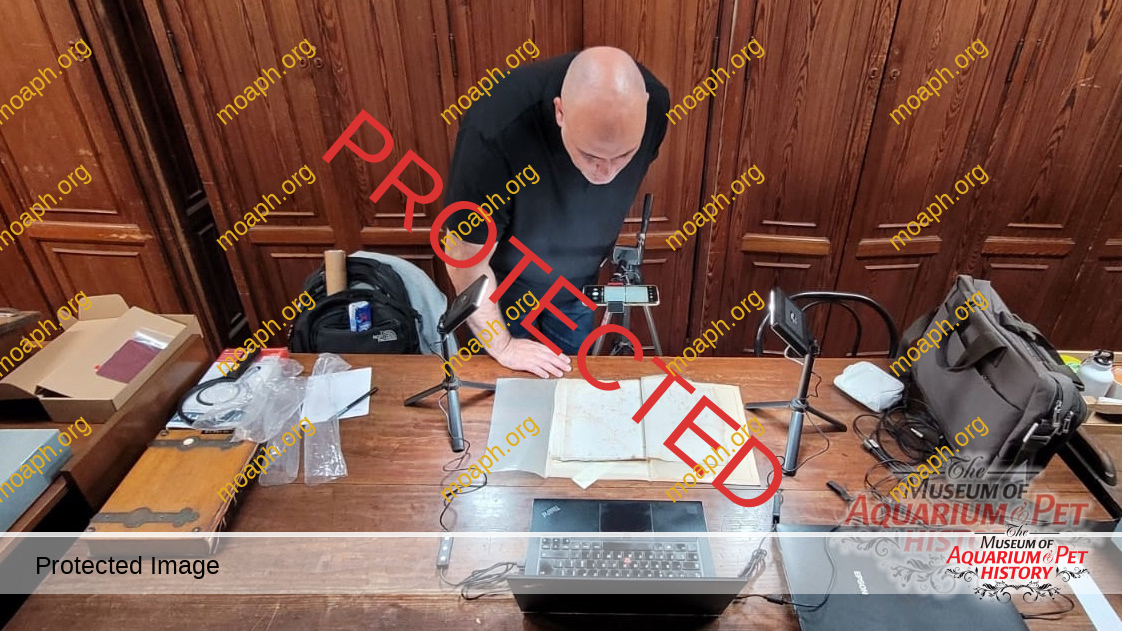
Doing research in the Historical Archive of the Zoological Station.
William Alford Lloyd needs no long introduction. As aquarium history enthusiasts well know, much has been written and said about him. The documents I’ve read, however, will give us new valuable insights into the last years of his private and professional life, probably the toughest ones for him and his family, as well as information and curiosities on the events of some public aquariums of the Victorian era. Lloyd himself, with his own words, will talk to us about his passion for aquariums, his achievements and fears, his recurrent financial troubles, his plans and hopes, and his family (wife Amelia, daughter Martha, and his beloved cat Mim).
Lloyd met Dohrn in the summer of 1867, while working as superintendent of the newborn Aquarium of the Hamburg Zoological Gardens. The director of the establishment asked him to help a young student who had come there to study the eggs of the Norwegian crab. The student eventually found a place in a room next to his office. His name was Anton Dohrn. Lloyd, already overwhelmed with commitments, reluctantly accepted, also because he didn’t get along with the researchers as they often conducted experiments on animals.
After a few days, while sitting in his workroom with the door open, the busy superintendent heard Dohrn whistling one of his favorite tunes. He got up from his chair and enquired if he knew the name of the tune. Dohrn confirmed that it was by Mendelssohn, a composer whose godson he was! This answer surprised and thrilled Lloyd, who immediately changed his attitude towards the young student. From that moment on, the two remained bound by a lifelong friendship, evidenced by the trust Dohrn demonstrated towards Lloyd when in 1872 asked him to become a corresponding supervisor for the installation of the circulating system and tanks at the Zoological Station with its public aquarium.
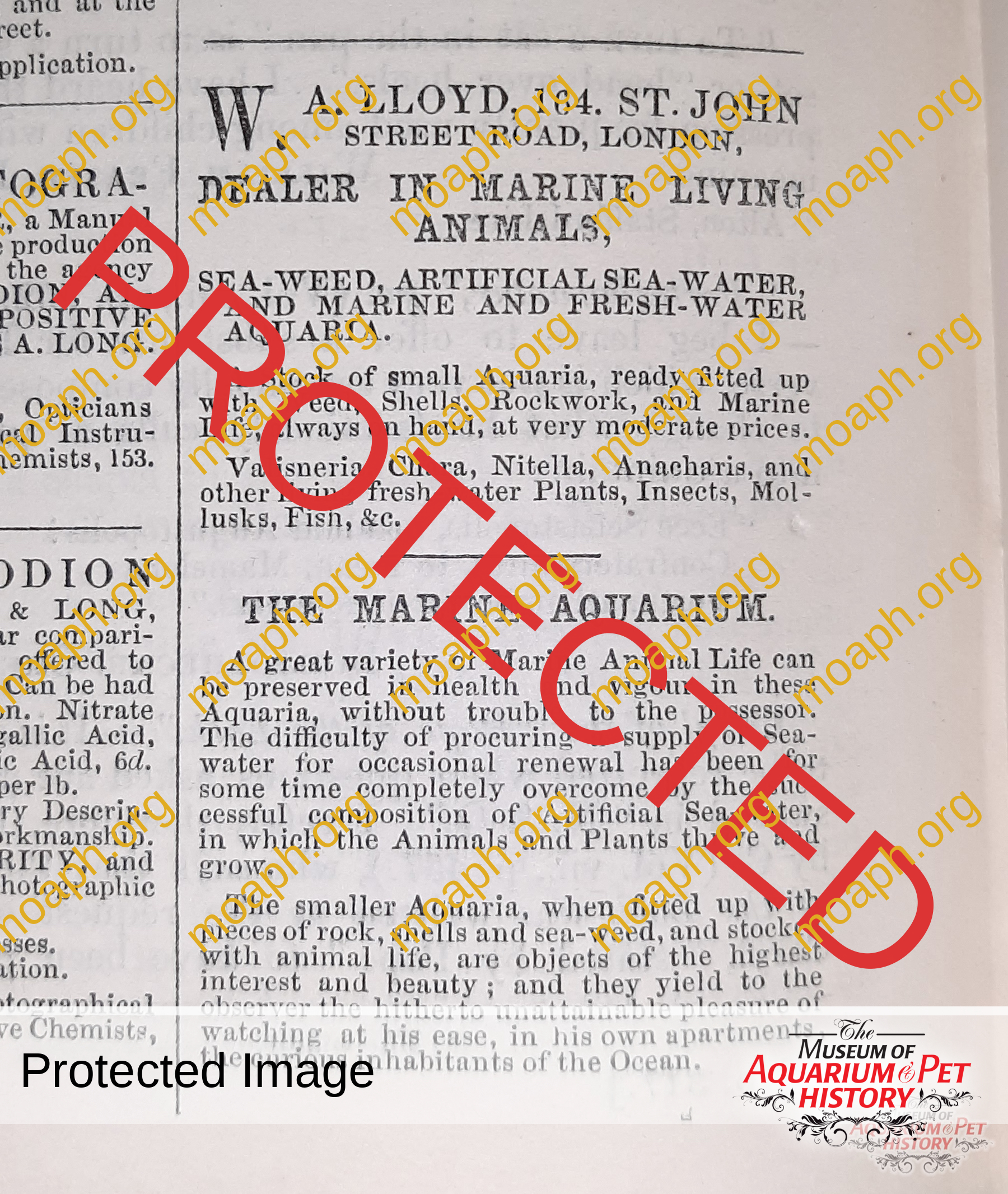
Lloyd opened the earliest aquarium shop in history. He started to advertise it in 1855 in the weekly periodical Notes and Queries. His first competitor in London was Thomas Hall, “dealer in Marine and Freshwater Stock, of Fountain Place, City Road.”
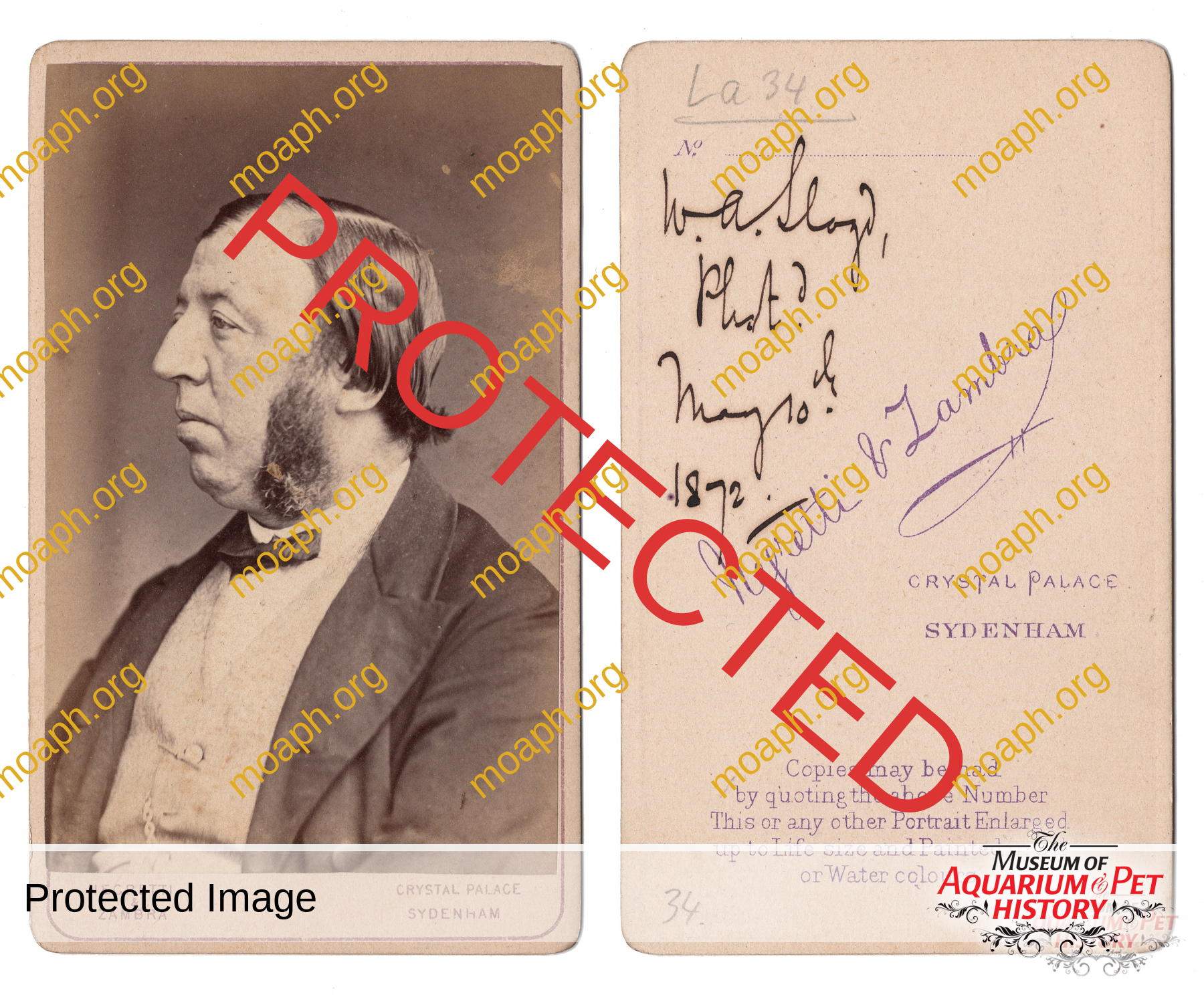
Lloyd in 1872. Signature and inscription on the backside of the photograph are by Lloyd. ©Stazione Zoologica Anton Dohrn, Archivio Storico (ASZN, La.34.).
Lloyd, who in 1869 had become superintendent of the Crystal Palace aquarium (Sydenham, London) thanks to his reputation as the most knowledgeable aquarist in Europe, was honored by the opportunity. In a letter to Dohrn dated May 6, 1872, he wrote:
“…I have this morning received your letter of the 4th of this month from Carlsruhe, and in answer I have to say that on Wednesday last May 1st I sent you a parcel by post, registered, to Stettin, according to your instructions, giving such information as I conceived would be serviceable to you, and offering any more if you wished to have it, and I now repeat my offer, as well as my offer to send you without cost, as far as I am concerned, any samples of materials, etc. In fact, pray consider me quite at your service for anything you want, and I will do for you all I can, as far as my time admits. What I sent you on the 1st took up all my leisure from April 10th till then, and I at the same time sent a short note to Naples, saying what I had done. As to pay, I am very much obliged to you for so kindly offering it to me, but I now, after your candid statements as to your means and objects, will not accept any, and I consider it a privilege to help you in any way, and I will in future do anything and everything in my power to assist you, and you, I am certain, will give me any help you can in a natural-history way. If however, you think I have helped you, will you please acknowledge as much to our Board, as the gentlemen composing it are pleased to give assistance to foreigners. There is one other thing you can do for me, if you like: You can trust me with a trifle of money I am collecting as a subscription to a worn-out English marine zoologist, who has long worked at Aquaria, and who is now dying of consumption, and he is also in very great poverty, living with his wife and three children in one small and unfurnished room, without the barest necessities of life, save what charity brings them. No ill-conduct of any kind has been the cause of this…”
Lloyd’s contribution was crucial, and the Naples aquarium had great success, to the point that it still exists today! For the Crystal Palace aquarium things didn’t work just as well. The decline in interest from the paying public hit this Aquarium hard in the summer of 1878, when a financial crisis affected the parent company which was unable to keep on paying Lloyd’s £400 annual salary. In a letter dated August 4, 1878, he wrote:
“…I have not heard from you for a long time. I hope you and Mrs Dohrn and your family are all quite well. I trust your institution, the Station, is still prospering and doing useful work. I am sorry to say that our Aquarium and the Crystal Palace generally, are paying so badly that retrenchments are so necessary that I can no longer afford to be retained, because our whole profits for last year were less than £10 (ten pounds). Consequently, I have to leave at the end of the present month, and after having worked so continuously, and so hard. I have to begin life all over again. But, fortunately, my health and good constitution enable me to work as hard as ever I did, and, especially during the last two years, I have, greatly added to my knowledge […] So can you do anything for me by way of recommending me to some similar institution as your own, or any other? You know I have done all I could for you and I am willing to do as much again, and I am so glad of the chance. Professor E. Ray Lankaster was here a short time ago, and he hinted to me rather than distinctly stated, that some kind of Station was intended, but he gave me no indication of where or when. I said the idea was “somewhat in the clouds”, then. If you could use your influence with him or with anyone, I should be much obliged […] P.S. My cat is alive, and well, and as handsome as ever, though she is rather thin and her black coat is rather thinner than it was. She will soon be twenty years old, and it is a great age for a Pussy. She is my constant companion on my study-table at home and if I lost her, I should mourn her as a true friend. Only people who are constantly in the society of such a faithful creature can know her real warmth, affection and knowledge…”

Lloyd in 1875, posing near the bust of the naturalist Edward Forbes. The inscription on the backside of the photograph is by Lloyd. ©Stazione Zoologica Anton Dohrn, Archivio Storico (ASZN, La.71.).

Lloyd’s “Jack Tank” at the Crystal Palace aquarium. A few years ago, a group of enthusiastic volunteers excavated and brought to light the remnants of this public aquarium, discovering also the remains of a small fish tank located in Lloyd’s workroom, likely the same tank depicted in this lithograph.
In 1878 Lloyd found a new post as superintendent of the Aston Aquarium at Birmingham, a spectacular Byzantine style building which opened on July 10, 1879. Besides supervising the construction of the giant underground reservoirs and the installation of the circulating system, for the design of this inland Aquarium he brought his extensive experience and the latest technology, planning to use six steam engines and two boilers for the continuous circulation of water, and a steam generator to provide electric light. The transportation of the seawater from the far coast would have been too expensive, therefore the marine show tanks were filled with artificial seawater mixed on the spot according to the “Schweitzer formula”. This was the first time a public aquarium in England used artificial seawater. Electric lights were placed above each aquarium to stimulate the seaweed growth. Further savings were to be made by only dimly illuminating the viewing gallery, anticipating the light from the tanks would also flood out from the front of the aquariums.
On December 28, 1878, Lloyd wrote:
“…I don’t know if you will be surprised to know that I have finally left the Crystal Palace, because it cannot any more afford to pay me, and I fear the whole place is going down fast. But I have obtained a situation at the Aston Aquarium, near Birmingham, in the very middle of England, and therefore where living marine animals will be the most curious. The place is now being built under my care, and it is about three times as large as the one at Crystal Palace, with all the known improvements up to the present time. About two-thirds will be marine, and one-third freshwater. We shall be using electricity for the illumination, etc, etc. This establishment may not take up all my time, so that I shall be glad to earn money in other ways, also, and this brings me to tell you why I write today. It is to say that in our English newspapers of this week, are accounts of a grand aquarium, marine and freshwater, to be erected, or being made, at Leipzig. So I thought you might have influence in remembering me to be consulted about it, as general advisor, in such manner that I might incorporate all the many improvements of which I am now master. Among others, I have succeeded now in the making of seawater in such an improved manner that it quite equals that brought from the sea, which saving in money-cost would be in such a place as Leipzig, very great indeed. At Aston we shall save by it £1200 – which would be still more in the middle of Germany. If you do not already know of these Leipzig Aqm. [Aquarium] people, will you please find out and write to them, about me? You might even write to Leipzig, even if you do not know the exact address, as a letter sent to a public body would be sure to be rightly delivered. We send you all manner of Christmas and New Year’s greetings to you and Mrs Dohrn and family. You will be sorry to know that my wife is ill, and has not been out of the house since last August. I am very anxious about her. […] I shall get all I can for you, as business, for the Aston Aquarium. […] My old cat Mim is still alive and well, and sends her love…”

Original letter dated December 28, 1878. Before reading and enjoying the content of Lloyd’s hand written letters, the author had to study and decipher Lloyd’s Victorian calligraphy. ©Stazione Zoologica Anton Dohrn, Archivio Storico (ASZN, A.1877/78.316.).
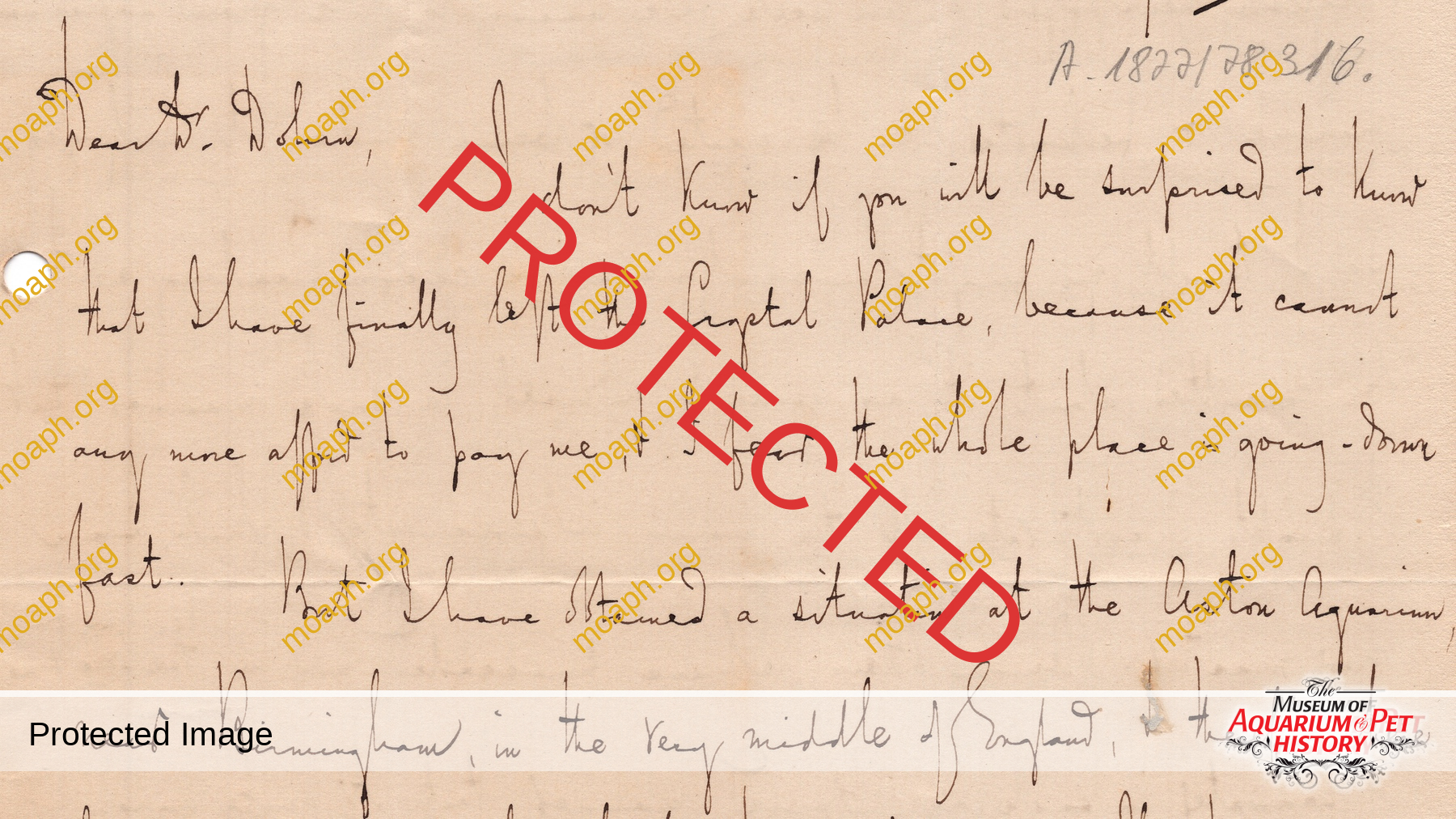
Close-up of the letter dated December 28, 1878: “…I don’t know if you will be surprised to know that I have finally left the Crystal Palace, because it cannot any more afford to pay me, and I fear the whole place is going down fast. But I have obtained a situation at the Aston Aquarium, near Birmingham, in the very middle of England…” ©Stazione Zoologica Anton Dohrn, Archivio Storico (ASZN, A.1877/78.316.).
The Aston Aquarium unfortunately didn’t last long, and six months after the opening Lloyd lost his job.
On August 21, 1879, he sent this long letter to Naples:
“…You and I have not had the pleasure of exchanging letters for a long while. I now write to say that I find myself out of employment, from no fault at all of my own, but only because of the circumstances surrounding things. The Crystal Palace, Aquarium and all, has so gone down, that it is almost in a state of bankruptcy, and everyone is being discharged from all departments. As for the Westminster Aquarium, it is that only by name, it being now only a Music Hall, as you may see by the annexed advertisement of this day’s date. [Newspaper cutting Daily Telegraph, Aug 21, 1879, p. 1] I have been, since leaving the Crystal Palace, engaged at Aston, near Birmingham, on an Aquarium, which is fine enough as to dimensions and construction, but, as usual, the people were in too great a hurry to earn money by it, and so opened it on the 10th of last month, July, before the place was ready to receive any marine animals, and even before the water was made – at least before five per cent was mixed, for, to save £1000 out of £1250 (which latter sum the seawater would have cost had so immense a quantity been obtained from the sea). I mixed the water artificially, charging nothing, however, for so doing, which I did simply and only to save my employer’s pockets. But, of course, time is needed for the operation – one month at least – and then more time for vegetation to grow before animals can be healthily maintained, otherwise the carbonic acid gas which they give out cannot be decomposed, it being poisonous to them. All this I carefully explained, as I did to the West. [Westminster] Aquarium people, but they would not listen, though I showed them the written admissions of Westminster expressing regret at not having taken my advice, as, had they done so, they would have saved money and reputation. However, the Birmingham people were as bad, and consequently confusion was the result, and there was the usual personally unpleasant consequences to me, and I came away. I have not left them yet, because I have an agreement lasting till next March, and money is owing to me, but as my position is a very unpleasant one, and I am anxious to leave, and this agreement can be easily broken-through. Indeed, I much fear that there is not much future for aquaria in Britain. Seeing therefore your splendid large building as it hangs represented in a photograph on the walls of my home, I have been thinking that possibly you, as my old friend of some years standing, might find me some place and appointment of work within its walls and if so aid me in only living and keeping my wife and daughter. My age is only 50, and I am as active and hard-working as ever, and you know what I can do in the work of biology, generally, and in all manner of other work. At page 16 of the enclosed newly issued pamphlet, you will see how earnest I am still in advancing the doctrine of Evolution. [Dohrn was a fervent defender of Darwin’s theories.] Remembering the very incipient condition in which I found aquarium science when I began it, 27 years ago, and how I have ever since worked on it, to bring it to its present state of comparative advancement, I think I deserve something by way of encouragement from the hands of those who can give it. I do not ask for charity, or for anything else than the permission to exchange my time and labours for a little money – not asking for much cash, but only enough to enable me still to work at the branch of science which I have taken-up, and which I should like to continue till I die. […] Early in this year, I had an application about an aquarium contemplated to be erected in Australia, and I immediately wrote, and sent out a large collection of aquarium literature, etc, but I have had no communication in return, up to now. So I am in a state of uncertainty on this. But now, please see what you can do for me in the way of employment, now that I am so much in need of it, remembering all I can do, and that, by industry and perseverance I have continued to be accepted as being at the head of my profession, and that I am as well able to work as ever, and to be very useful to you. I do not put forward, as any claim, that I assisted you when you wanted aid, I doing so merely for the pleasure of helping, which, indeed, I deemed a privilege and honour. But if you can now remember that fact in my favour, and return it in such a manner as I am indicating, I shall feel most grateful. I am quite well in health, much better than I have ever been, all the more so, because from the beginning of this year, I have discontinued all alcoholic drinks. Tobacco in any form, I have never taken. My wife has, I am glad to say, recovered from a long illness of a trying kind, of many months duration. My daughter is well, but not married. They both, and I too, send kindest regards to you and to Mrs Dohrn, whom we have not yet seen. How many children have you now? I regret to say that my dear old cat Mim died on June 28 last, aged 20. She was handsome and loving to the last. You remember having often mentioned her…”
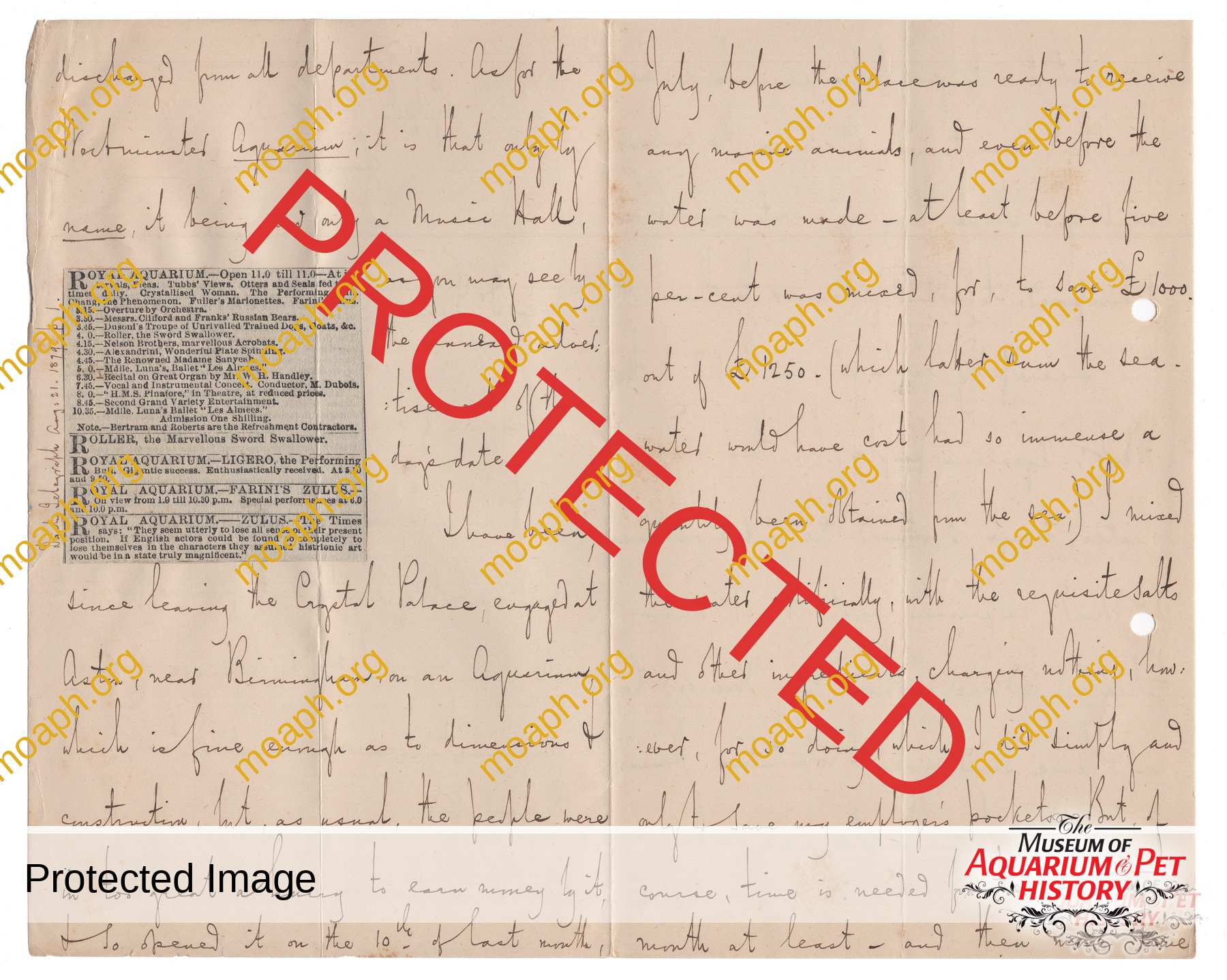
Two non-consecutive pages of the original letter dated August 21, 1879. ©Stazione Zoologica Anton Dohrn, Archivio Storico (ASZN, A.1879.313.).
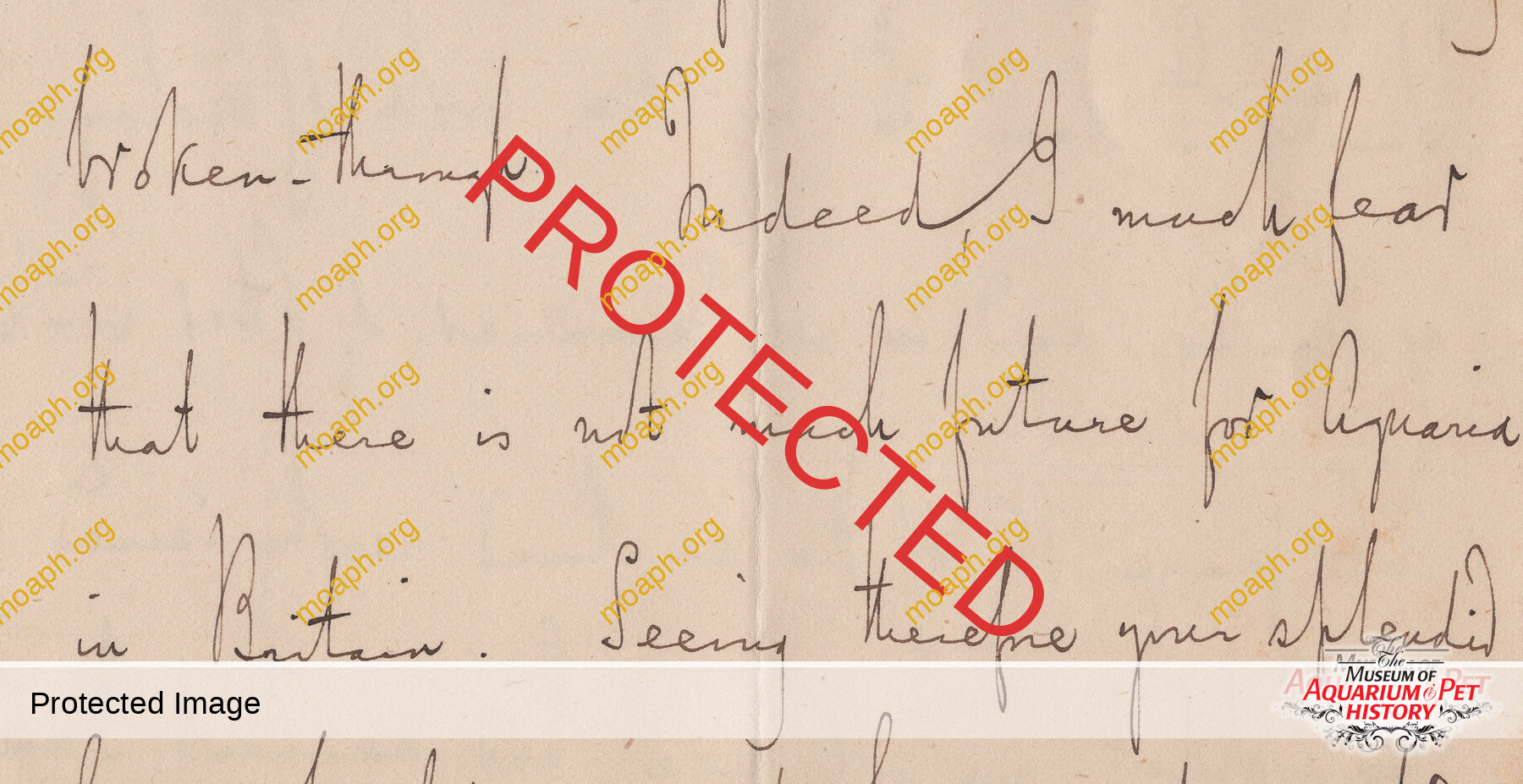
Close-up of the letter dated August 21, 1879: “…Indeed, I much fear that there is not much future for aquaria in Britain…” ©Stazione Zoologica Anton Dohrn, Archivio Storico (ASZN, A.1879.313.).
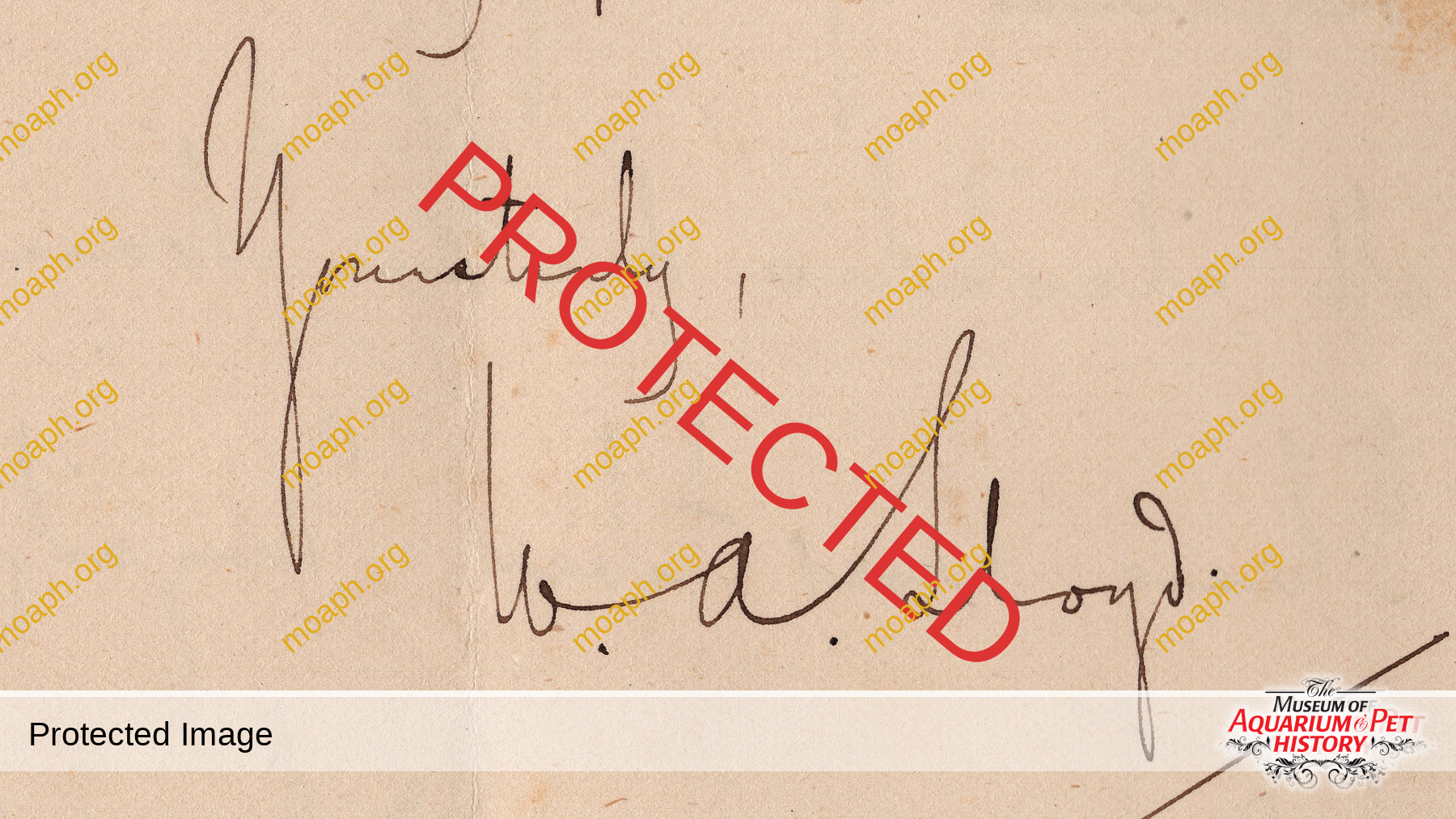
Lloyd’s signature. ©Stazione Zoologica Anton Dohrn, Archivio Storico (ASZN, A.1879.313.).
After the Aston aquarium bankruptcy, Lloyd found some part-time jobs at the Crystal Palace and with publishers Cassell & Company as a consultant. He also returned to work on his manuscript of a book – sadly never published – on the experiences he gained managing public aquariums. Times were very tough for Lloyd and his family.
On September 8, 1879, he wrote again about the intriguing project of a public aquarium in Australia:
“…Many thanks for your letter of Sept 1 and for your honest outspoken manner, and I quite see the truth of all you say. All you tell me, and which you have indicated I should keep to myself, and not make public, I will of course attend to. As you are so good, as to, of your own accord, and voluntarily, to say you consider you are indebted to me, and will send me what you can afford, I also plainly say that any such aid will be welcome, in my present circumstances, as I have been deprived of everything, all suddenly, and you and I are sufficiently of friends to have no secrets between us. So I tell you this plainly, as plainly as you have mentioned those many intentions of yours to me. You can, if you will, do for me some other favour. A gentleman: Augustus Radford Esq., Engineer in Chief’s Office, Adelaide, South Australia writes saying there is a contemplation of building a public aquarium at a watering place at Glenelg, on the sea coast near Adelaide, and he has asked me for information, all of which procurable in print, I have sent him and have been so painstaking that the postage has amounted to about £2 alone. I name this to indicate to you my anxiety in the thing. Now I have been thinking that you might materially assist me, and strengthen my hands, if you will at once write to this Mr Radford, saying what you know of me, and what I have done for you, and what you believe me capable of doing in Australia, where I am desirous of going myself and settling. As you may know, The Aquarium animals of Australia from fishes to zoophytes, are quite unknown in a living state, and a great field is before anyone who intends making an exhibition of them, both for scientific and popular purposes. The same great excitement which 25 years ago prevailed in England. So, pray say and do all you can for me, energetically. We all send our kindest regards to you all, Mrs Dohrn and you and your family. We are quite well. I am now very zealous to see myself in the Antipodes!…”
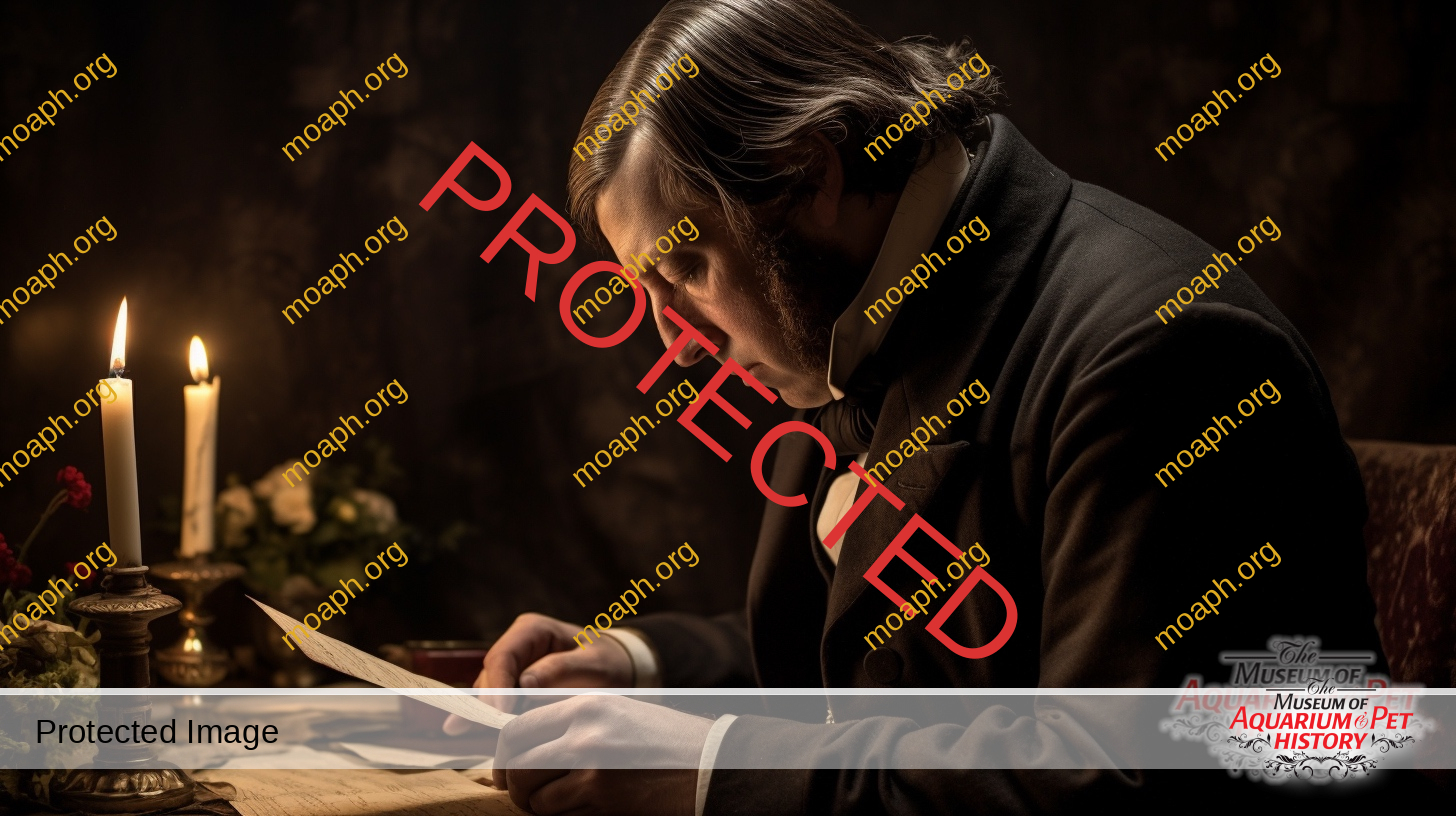
Color image of Lloyd generated through the AI Midjourney. The author imagined him while reading a letter he got from Dohrn.
Lloyd’s financial situation meanwhile worsened month after month, but despite that he never lost his enthusiasm when he wrote of aquariums and animals. He was the foremost professional aquarist of his time, but he always acted as a humble and passionate person moved by a genuine interest in the mysterious underwater world. Among the original hand written letters I read at the Historical Archive of the Zoological Station, the following was the last one sent to Dohrn. In spite of multiple years of friendship, Lloyd also started this letter, like all the others I have seen, with the respectful combination of words “Dear Dr. Dohrn”.
June 29, 1880:
“Dear Dr. Dohrn,
I have received from the German Consulate at Naples the sum of £15 which I consider a very kind and handsome present, and while I have written my official acknowledgement of it, I now send this to thank you, most heartily and warmly, for such an acceptable gift which I trust always to deserve by my future as well as by my past acts I hope you are doing well in all respects, as I am sure you deserve success. Where can one see any printed reports of any results you have attained? […] Literary work comes in pretty well, and this week I have been informed of an Aquarium on the Hampshire coast, and I trust that it is likely I may be there engaged. If so, I must try to do with less cost to circulate water and yet do so with no loss of effectiveness. As things now are, we are by comparison employing an elephant to pick-up a pin, and all the profit goes in manual attendance on steam machinery. And yet I do not in any way approve of not circulating water at night, as animals (all animals, man included) need oxygen at all times of night as well as by day. Have you heard of such a very extraordinary thing happening as the appearance of Medusae [Craspedacusta sowerbii] in freshwater? They have come in the water in which grows the plant Victoria Regia in our Botanic Gardens, Regent’s Park, London, and they are about half an inch in diameter. I shall go to see them on Thursday, this week. I believe they are new to science…”
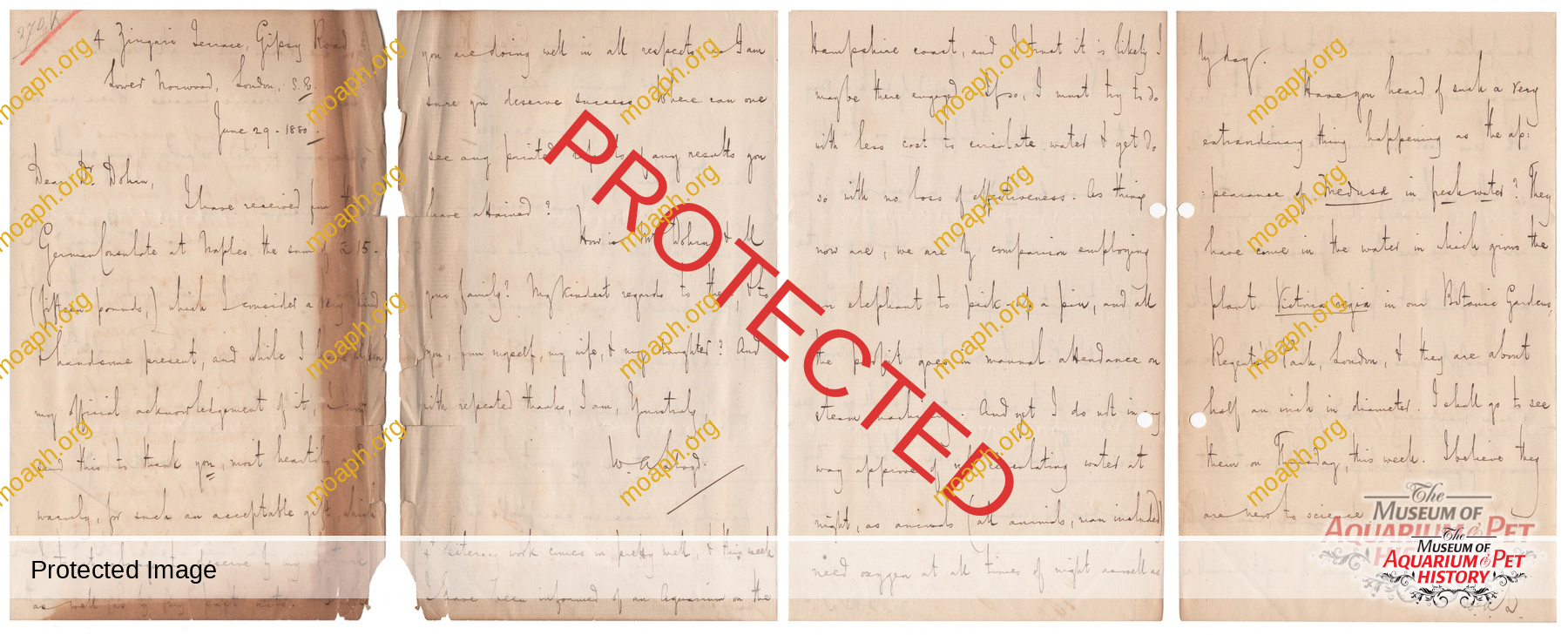
Original letter dated June 29, 1880. ©Stazione Zoologica Anton Dohrn, Archivio Storico (ASZN, A.1880.270.K.). These pages are more than 140 years old. Will our e-mails survive that long?
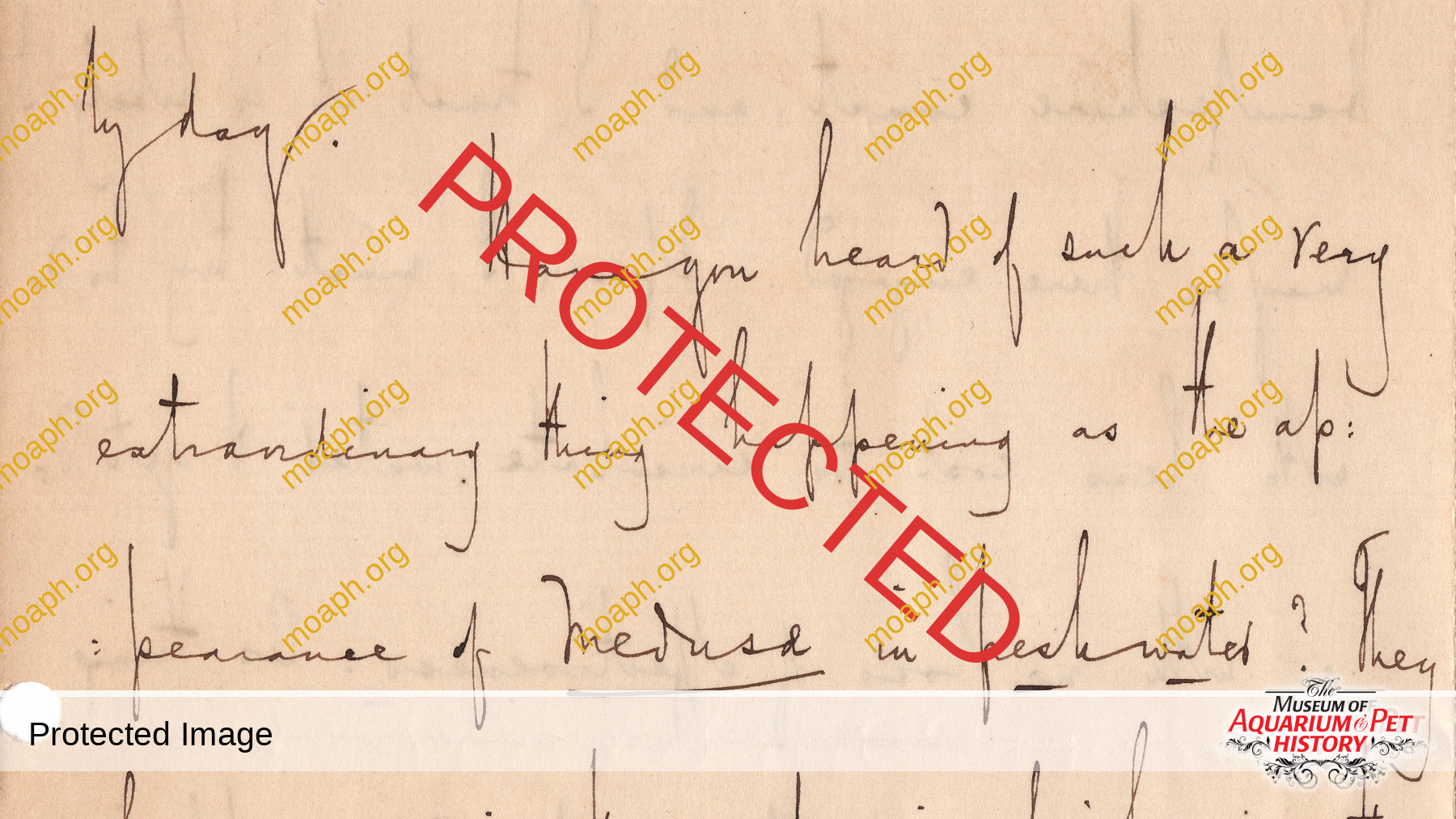
Close-up of the letter dated June 29, 1880: “…Have you heard of such a very extraordinary thing happening as the appearance of Medusae in freshwater?…” ©Stazione Zoologica Anton Dohrn, Archivio Storico (ASZN, A.1880.270.K.).
A few days after writing this letter, Lloyd died of a cerebral hemorrhage. His estate was valued at less than £400, and left to his wife Amelia who, after being a widow for twenty-six years, died in 1906 aged 83. Daughter Martha remained unmarried and cared for her mother until her death. Martha Lloyd died on April 25, 1932, aged 81.
William Alford Lloyd will be always remembered as the owner of the very first aquarium shop in history (a business venture which sadly ended too early), as well as the pioneer who published the earliest price lists, catalogs, and advertisings having to do with aquariums. Constantly supported by his wife Amelia, Lloyd worked hard and risked all to earn a solid reputation as the most reliable aquarium consultant of his day. Ups, downs, but undoubtedly he succeeded.