New Historic Book Series, Titled: Pet Keeping in 1797 Germany – Chapter 1 – Part 1
Chapter 1: Wiederfand (Found Again)
It wasn’t until the turn of the 19 to the 20th century at the earliest when people of scientific or hobbyist circles began to take interest in the historical development of the aquarium and terrarium science.
As early as May 3, 1882, the Thuringian association “AQUARIUM, Vereinigung der Naturfreunde zu Gotha” (AQUARIUM, Association of Nature Hobbyists in Gotha), the first German and oldest special aquarium association was formed. On September 7th, 1888, the “Verein der Aquarien und Terrarien Liebhaber” (Association of Aquarium and Terrarium Hobbyists) followed in Berlin. On January 16, 1891, their name changed to “TRITON, Verein für Aquarien-und Terrarienkunde”(TRITON, Association for Aquarium and Terrarium Studies). Over the years it became crucial for the development of the entire study beyond German borders.
On September 10th/11th, 1898, the “Verband Deutscher Vereine Für Aquarien und Terrarienkunde” (Coalition of German Associations for Aquarium and Terrarium Studies) was founded in Leipzig thanks to Johannes Peter (1860-1911). The association officially began its activity on January 1, 1899. At the turn of the century there were already 26 clubs in Germany. The first associations of aquarium and terrarium hobbyists had also been formed in Russia, Switzerland, the Czech Republic, the USA and other countries- partly under the leadership of Germans abroad and also in close contact with the “Triton” in Berlin.
In those years, a relatively wide-ranging group of enthusiasts had emerged, always connected through the exchange of ideas and experiences, who now looked back and tried to fathom the history of aquarium and terrarium science which had since become very popular.
At the turn of the century the number of journalistic sources was small compared to now. In trade magazines one read “Natur und Haus” (Nature and House) (19 years 1893-1911) as well as the “Blätter für Aquarien und Terrarienfreunde” (Books for Aquarium and Terrarium Hobbyists) which was renamed in 1902 to “ Blätter für Aquarien und Terrarienkunde” (Books for Aquarium and Terrarium Studies). A few specialist books were available, but now, due to its growing popularity, it seemed easy to begin to reconstruct and develop the field.
Historians soon came across a series of essays that seemed to point to the first starting points for keeping aquarium and terrarium animals in the private sector.
After discovering some publications in the 1854 and 1855 volumes of the widespread family magazine “Die Gartenlaube” (The Gazebo) that exclusively dealt with the care of sea animals as the oldest sources to date, the issue 19/volume 1856 was found on pages 252-256 from the essay published by Emil Adolf Rossmasler.
“Der See im Glase” (The Lake Behind the Glass)
This term was used for freshwater aquariums for nature hobbyists. Rossmasler notes this in his book published in 1857, “Das Susswasser-Aquarium” (The Freshwater Aquarium). Rossmalser became well known in the industry for his first article he wrote in the “Die Gartenlaube” (The Gazebo). Having established credibility from his piece in the “Gartenlaube” (Gazebo) he wrote a new essay called “Der See im Glase” (The Lake Behind the Glass). In this essay he described the freshwater aquarium from the perspective of the general nature hobbyist with special emphasis on the aquatic plants and small organisms of his local waters. This essay is considered, by historians, to be the “birth of the aquarium hobby”. His book, “Das Susswasser-Aquarium” (The Freshwater Aquarium) is thought to be the first German written piece on the matter. Emil Rossmassler was awarded the honorary nickname “Father of Aquarium Sciences” and in 1956 as part of the celebration for the ‘100th year of aquarium studies’ and the 150th year since his birth, that year became the ‘Rossmassler-jahr’ or Year of Rossmassler.
Aquarists today still use these texts from the ‘Gartenlaube’ (Gazebo). The publications are used as history for understanding the development of aquarium and terrarium sciences. The British were considered to be the creators of “keeping aquatic animals for private collectors” at that time. Many did not, however, account for the work of the Japanese and Chinese. The fact that aquarium keeping in Great Britain-due to its insular location-mainly concerned marine animals from the British coastal zones. This meant the Asian influence was initially of second importance.
This was the situation when I was privileged to see with my own eyes these oft-quoted and yet almost unknown essays from the “Gartenlaube” and Rossmasslers book, “Das Susswasser-Aquarium” in the first original text to read. It can be said straight away that new insights soon emerged when studying these sources, which almost inevitably stimulated further bibliophilic research.
Could Rossmassler really have been the first popular publicist in this area of scientific hobby? Although it seemed possible based on the results of the earlier chronological research outlined here, it was not necessarily the case. It seemed amazing to me that in his book he was able to describe a variety of aquarium shapes that could be found in homes of the middle class at the time. Rossmassler names suppliers for these aquariums and the procurement of aquatic plants and also describes himself as a beginner in the hobby. However, such words certainly do not create a new form of knowledge of nature, but rather show a great advocate, thus making him an enthusiastic promoter of the field. Emil Adolf Rossmassler was an idealist trying to grow the field of aquarium and terrarium science.
I now went on a systematic search for bibliophilic sources that might still exist somewhere, to the keeping of aquatic animals, especially fish and amphibians, as well as reptiles, which had been practiced by private enthusiasts on a noticeably broader basis even before Rossmassler. The comprehensive libraries of the Deutsches Museum, the Bavarian State library, the University and the State Zoological Collection were intended to answer the question for me. Since the year 1856 was already established and generally recognized as the oldest source through Rossmasslers essay, I was able to largely concentrate on the older literature when studying the encyclopedias, biographies, and zoological-botanical works and ignore newer works. This was not only a considerable relief to me, but was actually the most important prerequisite for achieving my desired goal.
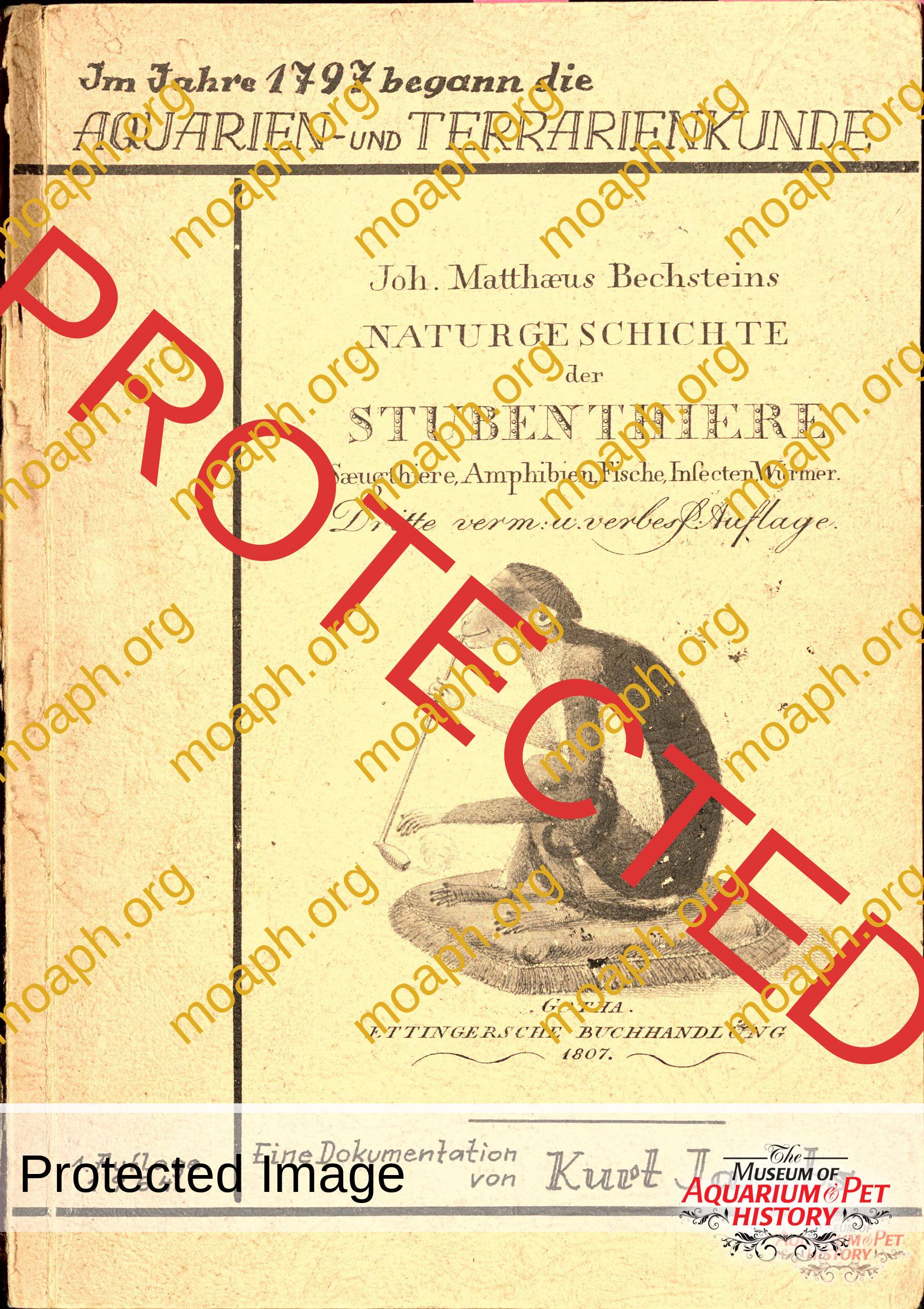
One of the mainstays of my research was the “Allgemeine Bucher-Lexikon” (General Book-Lexicon) by Wilhelm Heinsius, which is available at Deutsches Museum. In it I worked my way back from Rossmassler (November,1856), further and further into the past and the books that might need to be checked for my search. One day I came across the biography of the natural scientist Johannes Matthaeus Bechstein (1757-1822), whose work in many areas of zoology and botany was unknown to me at the time. The title of one of his books, “Naturgeschite der Stubenthieren,” (Natural History of Domestic Animals) caught my interest. Our aquarium and terrarium animals in particular are definitely “domestic animals” when seen through the eyes of a hobbyist. Maybe I found at least a clue for my further search in this book…
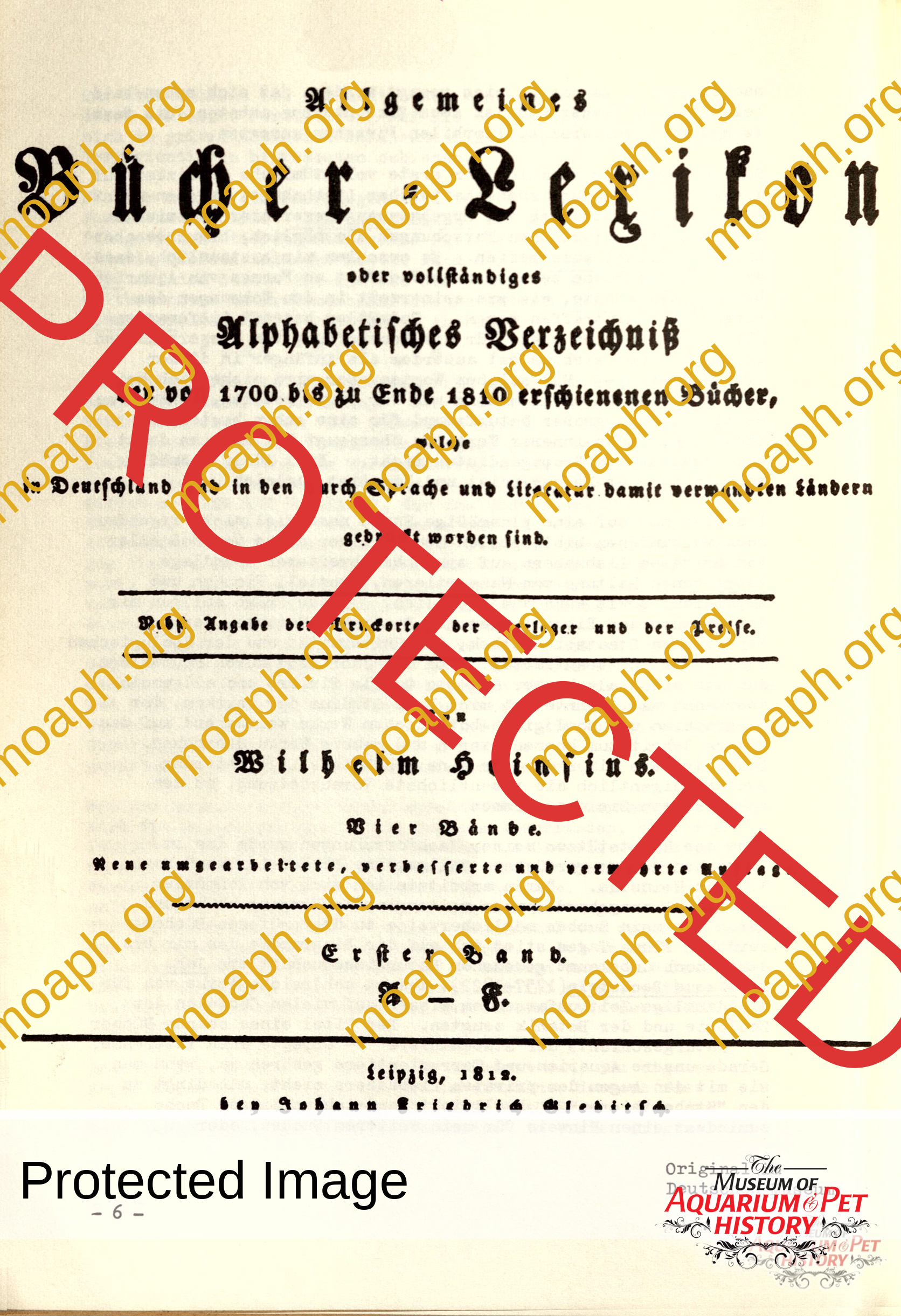
“Allgemeine Bucher-Lexikon” (General Book-Lexicon) by Wilhelm Heinsius, which is available at the Deutsches Museum.
…if Bechstein doesn’t mention these animals, then there is indirect evidence that Rossmassler could actually have been the first person to call on a larger scale for the vivarium hobby.
To say it in advance: I didn’t just find a reference, I had found the earliest work in the history of the vivarium that had long been suspected of existing!
Bechstein’s book, “Naturgeschichte der Stubenthiere” (Natural History of Domestic Animals), published in 1797 in the Ettinger bookstore in Gotha, proves that the keeping of fish, amphibians and reptiles in the area of private domestic animal husbandry ( definitely in the sense of today’s modern vivarium) is much older than was previously believed to be possible. If you want to start with the first publication of a book that deals with this hobby in more detail, then the year 1797 is the official birth of aquarium and terrarium science, at least in Germany, if not in general. In any case, old term comparable book publications from other countries have not yet been reported.
If we look at the development of aquarium and terrarium keeping, then historical clarity requires us to go back to the year 1797… the publication of Bechstein’s “Naturgeschichte der Stubenthiere” (Natural History of Domestic Animals)
And from this new basis of the year 1797, the guaranteed historical achievements of Bechstein and Rossmassler will now be given the meaningful and deserved appreciation of their work.
The book does not provide a comprehensive “history of aquarium and terrarium science”, but rather a presentation of the influence of these two great Germans on the early history of the hobby.
The eighteenth century is drawing to a close. A whole world seems to be in turmoil. The effects of the French Revolution of 1789 pushed Europe into a new war. Austria, Prussia, England, Holland and Spain united in the fight against the Reign of Terror in France. Poland was divided for the second time in 1793 and for the third time in 1795. Bonaparte’s star has risen. In 1796 he repeatedly defeated the Austrians in Italy, and in 1797 the very weakened Austria ceded Belgium to France in the Peace of Campo Formio against Venice. William III became King of Prussia in the same year.
Only a little impressed by this political turmoil, science goes its own way. In 1789, Bernard Germain Etienne de la Ville, Count of Lacepede (1756-1825) published his “Histoire naturelle des reptiles” (Natural History of Reptiles). In 1795, Georges Leopold Chretien Dagobert, Baron Von Cuvier (1769-1832), one of the most important ichthyologists of his time described dio mollusks (Invertebrate Animals) in the classic way. In 1796, the French professor of natural history and mineralogy Louis Jean Marie Daubention Daubenton, (1716-1799) created a zoological system. Pierre Antoine Latreille reports on his attempts to classify arthropods (spiders, crabs, insects, millipedes), their anatomy and evolutionary history.
Interest in what happens in nature has awakened among broad sections of the population. The number of pets has also increased significantly. In addition to the extremely useful animals that are used for human nutrition, we now find those whose keeping corresponds to an exclusive hobby. The posture of our feathered friends occupies a much preferred position. But the study of the diverse flora and fauna of inland water has long since transcended the boundaries of the study.
At first, far behind the preferred bird hobby, the small animals of the water, fish and amphibians, as well as the native reptiles, initially gained a modest share of people’s affection.
The days are long gone when, for example, the Goldfish was only a jewel in the courts of the princess. It still caused a stir in 1750 when the Franco-Indian company presented a goldfish as a gift to the Marquise de Pompadour. But now these wonderfully colorful fish swim in large sugar jars, porcelain containers, vats and small artificial ponds in the homes of the common man for the joy and edification of adults and for the instruction of children.
Around this time, Johann Matthaeus Bechstein, who later became Secret Chamber and Forestry Counselor, was teaching in Waltershausen in Thuringia at the “Öffentlichen Lehranstalt für Forst-und Jagdkunde” (Public School for Forestry and Hunting) overseen by Freigute Kemnak, which he founded in 1794. A series of extensive writings had already given him an outstanding position among teachers of natural sciences. Bechstein is considered an authority in many areas of forestry, and ornithology, and generally as a zoologist and botanist. His four-volume work, “Gemeinnützige Naturgeschichte Deutschlands aus allen drei Reichen der Natur” (Non-Profit Natural History of Germany from all Three Kingdoms of Nature), published in Leipzig between 1789 and 1795, characterizes him as a tireless observer who, thanks to his outstanding talent, knows how to draw sharp conclusions from what he observes.
Bechstein keeps a variety of animals, and in his study, in addition to birdcages, there are also containers made of glass, porcelain and earthenware with fish and amphibians, which are of great interest. So it comes as no surprise when in 1797 the Ettingereche bookstore in Gotha published a book written by Bechstein under the revealing title, “Naturgeschichte der Stubenthiere, Saugethiere, Amphibian, Fische, Insecten, Wurmer” (Natural History of Domestic Animals, Mammals, Amphibians, Fish, Insects, and Worms).
This book describes in detail all of the animals kept as domestic hobbyists during Bechstein’s time. Finally, there is a book about hobbyists during Bechstein’s time and a book in German for all those animal hobbyists who have long been concerned with keeping and observing previously somewhat unfamiliar pets. In this first early work of the vivarium, Bechstein provides, among other things, a practically complete description of all the fish, amphibians, and reptiles kept in homes for his time. 28 pages alone are dedicated to amphibians and reptiles, while few native fish and the goldfish with its varieties are discussed on the 10th page.
That means a great journalistic achievement! Although, according to Bechstein’s express advice, the book is not written for the scientist but for the enthusiast, the style corresponds entirely to the representations of modern vivarium. In addition to his own precise descriptions of the aquarium and terrarium animals he keeps, in which he also lists the crucial characteristics, according to the state of systematics at the time, he particularly quotes the systematics Marcus Elieser Bloch (1723-1799), Johann Georg Gmelin (1709-1755), Bernard Germain Etienne de la Ville, Count Lacepede (1756-1825) and Charles Linnaeus (1707-1778).
He works according to the same principles that have since then determined the development of aquarium and terrarium science as a serious hobby based on science. Bechstein’s descriptions of fish, amphibians and reptiles are so effective and timely that they can still exist today in the spirit of modern vivarium.
The fact that even at the time his book was published in 1797- the keeping and observation of aquarium and terrarium animals was by no means new, but could already look back on an obviously long tradition, is clear from some of the text. Perhaps the importance of this book was not properly assessed by earlier chroniclers because the technical terms Aquarium and Terrarium which were coined in much later decades, do not appear in it.
Instead, Bechstein speaks of “large sugar glasses, porcelain vessels, etc”. He even mentions the goldfish bell of unfortunate memory on page 324 and writes very sensibly, among other things: “one therefore likes to choose large glass balls which have an opening at the top that is wide enough for these animals to take a leisurely breath, but also such narrow ones that they don’t jump out…”
In the preface to the first edition of 1797 it also says: “I could cite here several experiences of how often natural history, which was otherwise so despised, found its way into some houses in this way and what beneficial influence it then had on the education of children”. For the species recorded, he first gives a general systematic description of appearance, body dimensions, color, etc, then he describes the biotopes, i.e the natural occurrences and the catch, and then goes on to the keeping and care by the hobbyist, describing reproduction and nutrition.
All of the explanations relating to the animals are-although they were written 60 years earlier- more precise than the later works by which were more in style of the entertaining “Gartenlaube” (Gazebo).
Emil Adolf Rossmassler, who, among other things, does not cite any of the important systematists. The section in the “Naturgeschichte der Stubenthiere” (Natural History of Domestic Animals) devoted by Bechstein to fish initially appears somewhat sparse. However, this impression changes when we read that, for example, under the heading “Der Goldkarpfen” (The Golden Carp) not only the simple goldfish, but also the fancy Veiltail Goldfish that were known at the time are discussed.
The fact that the third edition was published in 1807 testifies to the wide distribution of the book.
Given the detail with which Bechstein describes the species of fish, amphibians, and reptiles that are known to him and kept by enthusiasts, as well as the impression that, despite the popular nature of the presentation, his elaborations are nevertheless scientifically precise, he undoubtedly rightly deserves the honorary title in the eyes of history.
“Vater der Aquarien und Terrarienkunde” (Father of the Aquarium and Terrarium Studies).
All authors of previous fish books were either outspoken scientists or carried out their research from the perspective of commercial fish farming. Bechstein’s book is the first written by the collector for collectors.
Verbatim excerpts from this early work on aquarium and terrarium science will be presented in the further course of this work.
End of part one of chapter one