Barnum’s Sticklebacks
SMALLER THAN TOM THUMB; MORE BEAUTIFUL THAN A CIRCASSIAN LADY AND MORE EXCITING THAN “UNCLE TOM’S CABIN” – LADIES AND GENTLEMEN, P.T. BARNUM PRESENTS…“THE BREEDING STICKLEBACK.”
[Author’s Note: The above subtitle is, without question, a study in hyperbole – not to mention the lack of any reasonable sequentialness. But, hey, indelving into P.T., Barnum for some time his (and accompanying stable of writers) presentation style has rubbed off on me. Not an apology – just a statement.]
When P.T. Barnum’s American Museum, at the corner of Broadway and Ann Street in Manhattan (New York City), opened America’s first public aquarium (“The Grand Aquaria”) in September 1857, it was a big hit. I must note that this was not in 1856 as is often stated. I will be discussing this topic in depth in an article later this year on this website of the “Museum of Aquarium and Pet History” – MOAPH. It should also be noted here that at the time Barnum was not technically the owner of the facility – but he was the man behind the curtain, and it is convenient (and actually valid) to use his name.
Barnum’s aquarium, in the literature, is well known for highlighting various features over the years. Although they are obviously not fish the White Beluga whales which were exhibited are a prime example of this. Additionally, saltwater tropical fish (especially the angel fish) from the Gulf of Mexico and later Bermuda, the large brook trout, and seahorses, were among highlighted attractions over the years.
But in 1858 the aquarium was just the aquarium (but still an important and popular part of the museum). At this time the aquarium was under the direction and care of Henry D. Butler (one of the nominal owners of the museum) and happy fishes did for him what came naturally. As Spring arrived in the city the tanks containing native and local caught stickleback became alive with activity. Sticklebacks (see the Sidebar) are a nest building lot and nature took its course. An additional feature of these fish is during this time of reproduction the males take on beautiful multi-hued coloring of blues, greens and reds. Never one to pass on “something new” this quickly became a new and well-advertised attraction.
Sidebar
Stickleback species are members of the family Gasterosteidae. There are four species found in the state of New York. One of these is a freshwater species and is not seen in the vicinity of New York City. The others may be found in some freshwaters but are mainly encountered in marine or brackish environments. These other three are all found in the vicinity of the city and on Long Island.
- Brook stickleback – Culaea inconstans – Freshwater species.
- Three spined stickleback – Gasterosteus aculeatus.
- Four spined stickleback – Apeltes quadracus.
- Nine spined stickleback – Pungitius pungitius.
A.W. Roberts, who was an aquarist at Barnum’s Museum for several years, notes one nest building episode (with no living fry produced) taking place with the nine spined variety (Scientific American, May 1, 1880:279-280). But, based on this report by Roberts, and some additional sources, it appears that most of the successful aquarium spawnings of sticklebacks that took place were with the three spined variety (which at the time was considered under at least two scientific names).
Male sticklebacks construct their nests with plant material (fragments of leaf, roots, algae, etc.) held together with secretions from their body. Plants did not do well during the winter months at the museum and would need to be freshly collected during the spring. Roberts did report on an interesting situation that took place one year. I quote: “At one time I had a tank of sticklebacks at Barnum’s, the bottom of which consisted of plain sand. In this tank were a large number of ripe sticklebacks, but not a particle of nesting material. One morning, greatly to my surprise, I noticed in each of the lower corners of the tank a male in full color hovering over masses of brownish material, with that peculiar vibratory motion of the male stickleback when ventilating the eggs. On taking out one of the masses I discovered it to be composed of fine-cut chewing tobacco.” A visitor to the aquarium, being none too nice and possibly a bit disgusting, provided Roberts with an interesting little piece of aquarium observation.
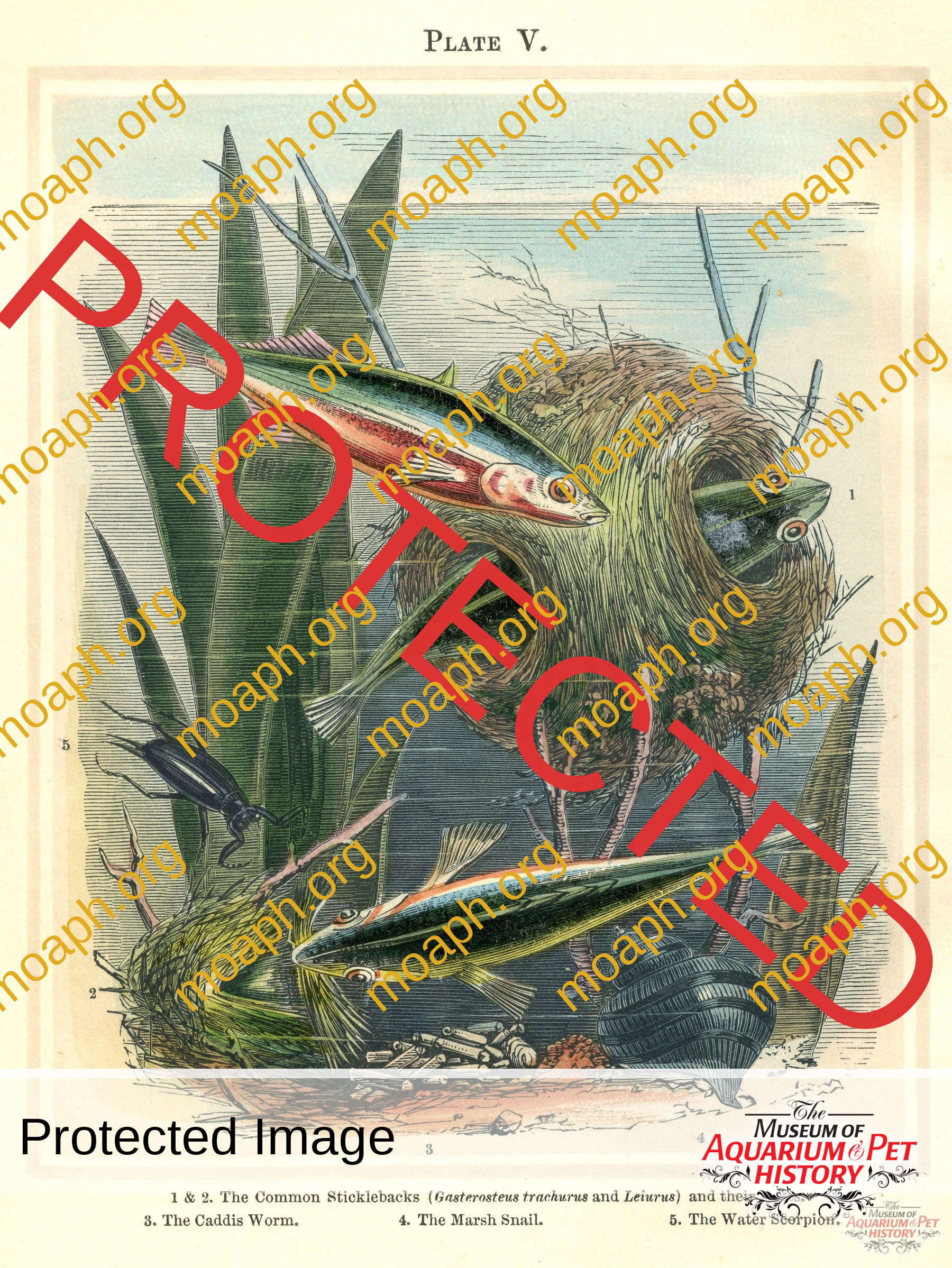
Color picture.
“The beautiful Frontispiece of sticklebacks from the British book “Ocean Gardens”. From the author’s collection.”
In the New York Times newspaper, the following advertisement was presented on page four of the April eighth edition: “Do Fishes Build Nests? – That charming little fish, the stickleback, does. You may see two of them now building nests in the aquaria at Barnum’s Museum.”
On April 10th, also in the Times, appeared the following in the large sized regular Barnum’s Museum advertisement (on page three): “A NEW FEATURE IN THE AQUARIA! The beautiful stickleback fish is now engaged in BUILDING HIS NEST IN THE WATER, a sight as beautiful as it is incredible and wonderful!” On page eight of the same edition appeared the following: “IT’S OVER! IT’S OVER! – The interesting spectacle of a fish building a nest is over! The little Sticklebacks in the Aquaria at Barnum’s Museum have finished their architectural labors. Their nests are finished. The spawn is deposited. The entrances are closed. Nature does the rest. Go and see how delighted they are.” These advertisements were not exclusive to the Times and appeared in other newspapers in the area. Barnum was a prolific advertiser. But herein I went for advertising in, as it is called, the newspaper of record.
Newspaper ads are neat and, in this case, supply some fascinating copy. But greater fame awaited the little sticklebacks. One way of advertising the wide variety of features used by Barnum was with large sized printed paper known as Broadsides. These were spread around town and attached to just about any place with wall space. On a visiting researcher visit to the wonderful Boston Athenaeum I was able to see one such presentation that announced in mostly large print the following: “MOST ASTONISHING PHENOMENON OF NATURE That fascinating little fish THE STICKLEBACK BUILDING HIS NEST!” Included was some advertising copy from another newspaper (The Daily Sun of April seventh) describing in flamboyant text the fish and its activities as follows: “Those who want to see a feverish, conceited little chap, ought to visit the Museum, and look among the Stickleback fish, in the Aquaria. They will observe a tiny, coxcomb of a husband, red in color and red in temper and about two inches long just beginning to get a nest ready for his wife to move into on the first of May. The anxiety of the case nearly drives the little fellow crazy. He dives head foremost into the pebbles and into the mess, as well as into the other fish, to extract any materials which suit, and at the rate he is going on, will have the brain fever if the job be not speedily finished. This UNIQUE SPECTACLE may be witnessed here in the GRAND AQUARIA or OCEAN AND RIVER GARDENS…”. No year is given in the material, but with the information at hand I have no problem in assigning this publication to April 1858. Also included was a good amount of information regarding the “GRAND AQUARIA.” This broadside measures 59 by 33 centimeters. Rounded off that is in U.S. terms 23.2 by 12.9 inches! Also included was a black and white wood engraving of a stickleback with a built nest and another in the act of building a nest. This picture was “adapted” from a color plate that is the frontispiece of an 1857 British book titled “River Gardens…” by H. Noel Humphreys. The uncredited use of such material was quite common in the U.S during the 19th century. Barnum did have at least one other use of the picture and I am fortunate to have a copy of this in my library. So, in a smaller format, I am able herein to provide a view of this illustration for your potential visual pleasure. Also present is a copy of the original color illustration from the Humphreys book.
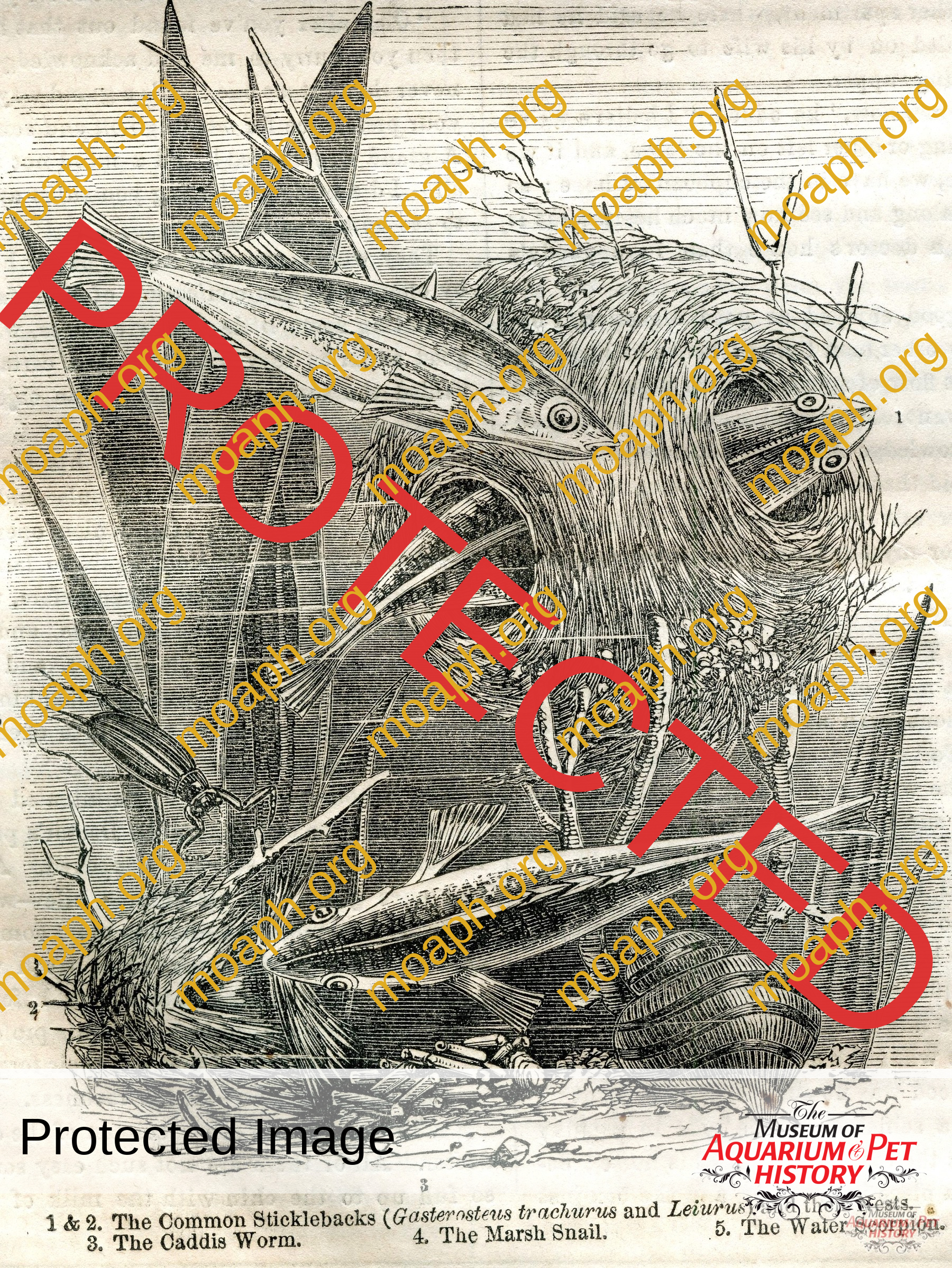
B&W picture.
“The Barnum “version” of the British illustration of sticklebacks. Both of the species names used are considered synonyms of G. aculeatus, so they are the same species that Barnum was spawning. From the author’s collection.
Note: The breeding of the sticklebacks was again highlighted in advertisements in the spring of 1859. They also became fish of some note at the Boston Aquarial Gardens which Henry D. Butler and James Ambrose Cutting opened in 1859.
One last note and observation will bring this little piece to its conclusion. Advertising, from the past, can be a very important tool towards building a history. But, well, advertising is advertising and has its limitations. It is wise, and ideal, to seek other sources for other views and/or confirmation of the advertising claims. With things Barnum this can be somewhat tricky. Barnum, and his writers, were known to “plant” information in newspapers on topics in a form that would make them appear to be “news” or observations of non-interested parties. Caveat lector! So go searching for other paths. To this end I would like to close with the following newspaper piece. It is a fragment of Editorial Correspondence from the April 14th, 1858, issue of the Daily Gazette in Davenport Iowa. It is signed “S”. In the piece S describes a trip to New York City that is being taken. Barnum’s museum has been a part of the itinerary. Some extracted quotes relevant to this article follow: “With no curiosities in the Museum was I better pleased than with the Aquaria…I watched them for more than an hour and returned another day to observe their habits. I was much interested in a little stickle-back that was preparing its nest and the ferocity with which it drove away all other fishes, especially the males of its own species. There is no better method of learning natural history than a close observation of these aquaria presents…” This seems to me pretty much like an independent observer arriving at the same conclusions presented by the advertising. P.T. Barnum would no doubt be proud!
ACKNOWLEDGEMENTS
My thanks to the Boston Athenaeum for hosting me as a visiting researcher and permission to present some of the information present on the mentioned Barnum Museum broadside.
And, as always – Thanks Aline.