
The Resurrection of the London Fancy Canary
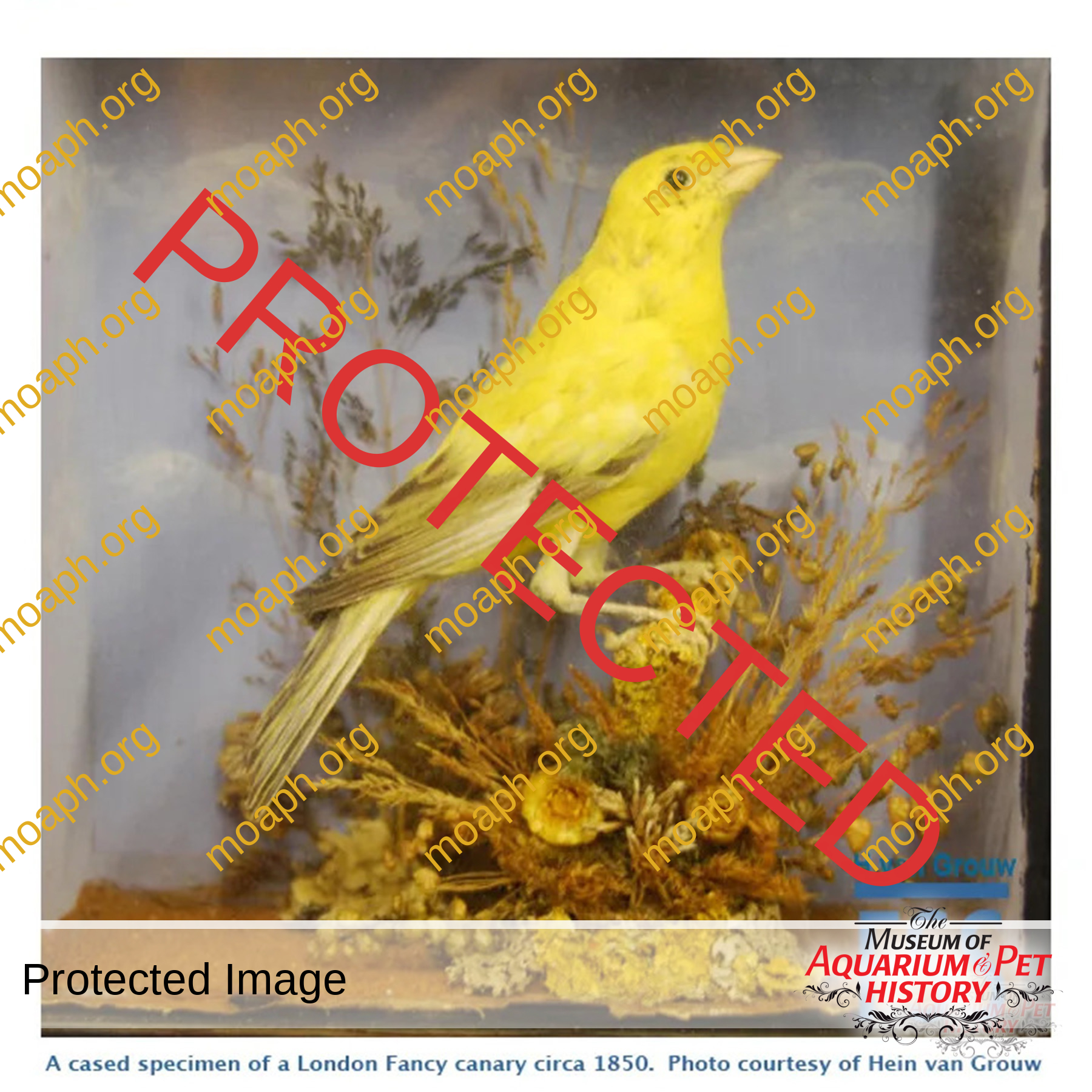
The London Fancy canary is nothing if not an enigma. Doubts have even been expressed as to whether this ancient breed did ever exist as a distinct breed of canary. Long since extinct, efforts have been made in recent years to resurrect the breed. These efforts may also have shed considerable light on the breed’s origins.
Evidence for the existence of the London Fancy comes from written accounts and some portraits of birds from the turn of the twentieth century and before. They show a bird that has very distinctive coloration: a yellow or white head and body with dark wings, tail, and legs. It is a very attractive-looking bird and unusual, even then, which is why it sold at a premium price. From the early accounts of this bird, it appears that some slight variegation was permissible on the back of the bird, and this is significant in terms of its modern equivalents. There are also some stuffed examples of the bird held in a well-known natural history museum in the UK. If there were many contemporary accounts of this bird, and more importantly its antecedents and the method of breeding, they have unfortunately been lost to history. The main source of literature rests with very old advertisements which is how we know that the birds were much sought after and so were sold at a much higher price than was the case for other canaries.
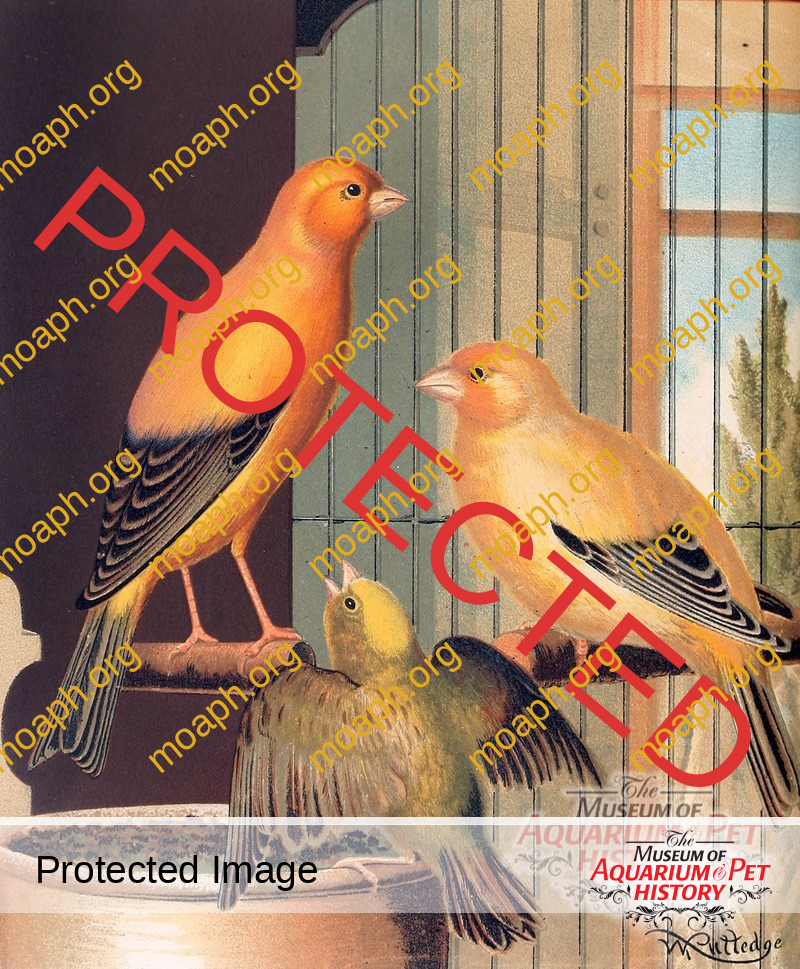
London fancy pair with youngster in juvenile plumage looking very much like a Lizard canary.

This appears to have been a color-fed example.
That there were canaries in the nineteenth century and before that conformed to the description of the London Fancy cannot be in doubt, there is more than enough evidence to support that, however, clearly, they were never numerous and for one reason or another, they died out as a breed at some time in the early twentieth century. So, what are the origins of this bird?
Let us jump forward over a hundred years to attempt to establish the answer to this question. In the 1990’s the late Bernard Howlett, a well-known breeder in the UK decided to attempt to resurrect the London Fancy. The descriptions of early examples of this breed led him to believe that the London fancy was closely aligned to the Lizard Canary, an ancient breed of canary. By crossing other canaries (green opals) with the lizard, he hoped to recreate examples of the London Fancy. By his own admittance, the results were disappointing, though he claims to have produced a few birds that closely resembled the original. More recently, the challenge has been taken up by a number of breeders on the mainland of Europe, and one in particular has been lauded as the true inspiration behind the resurrection of the breed. Jan Pieters, began showing birds at continental shows which certainly closely resembled portraits of the early London Fancy.

Lizard canary.
Questions began to be asked about the authenticity of these birds. Could they simply be variegated birds that had the same color patterns as the London Fancy? I myself had produced birds with such color patterning in the past but they were not London Fancy canaries. Defendants of the ‘new’ London Fancy birds then made the quite astonishing claim that Jan Pieters had somehow stumbled upon the London Fancy gene. This was an extremely unlikely event, especially given that there had been no known examples of the bird for over a hundred years. Very recently, Mr Pieters has enlightened the canary breeders of the world that in fact, his birds originate from crosses between ordinary canaries and lizard canaries. It was what Bernard Howlett had attempted years before and undoubtedly how the London Fancy birds of the nineteenth century were created. I do not wish readers to think that I am in any way demeaning the achievements of this breeder and maybe others, it remains a remarkable feat to be able to consistently produce young birds through generations that keep to the London fancy model. Having said that, it is also abundantly clear, that it is only a minority of the offspring bred each year that strictly adhere to the model. I mentioned earlier that in the nineteenth century, London Fancy Birds sold for a premium. Well, at the recent World Show, pairs of these birds were selling for two hundred euros, four times the price of a pair of lizard canaries.

The trait that the Lizard and London Fancy share is that they transform to varying extents in their second year. Both breeds are subject to a phenomenon known as ‘progressive greying’. This occurs when the melanin in the feathers of these birds is gradually lost and replaced by light-colored feathers. All canaries molt, and replace their feathers each year, but in their first year, canaries do not molt their flight feathers (wings and tails). For this reason, young birds are often known as ‘unflighted’ birds. With the Lizard, this can mean a lightening of the feathers generally and often the appearance of some white-tipped feathers on the wings and tail. In the London Fancy, the unflighted birds maintain their dark-colored wings and tails whilst the body and head feathers become yellow or white depending on the base color of the birds the lizard was crossed with. This leucism is not unusual in birds across many species, but with canaries, is generally confined to these two breeds.
The Lizard canary is thought to have been developed by the Huguenots and was brought to the UK when these people were persecuted for their religious beliefs on the continent of Europe. Whilst the Huguenots settled in London and the southeast of England, the Lizard canary spread throughout the land though their stronghold for many years was in Lancashire which is my place of birth. I personally have only had examples of them in the last few years. It is possibly the canary that is closest in coloration to the wild bird and is bred solely for its color, with emphasis placed on the lacings and striations or ‘spangles’ that appear on the back and flanks of the bird. They are a variegated variety, though the variegation is usually confined to the cap which in some examples is completely clear.

Broken cap Lizard canary.
The Lizard has quite a strong following now though there is a risk that more and more examples will be used in attempts to further recreate the London fancy, thus leading to a dilution in stocks of this ancient breed. The London Fancy has now been officially recognized as a distinct breed, though it should be noted that the adjudication for this bears no relation whatsoever to any scientific inquiry, and so in no way confirms that a distinct breed that reproduces itself over generations without back crosses to the Lizard actually exists. Future years will determine whether or not the London Fancy canary as a distinct breed has actually been resurrected as some people now claim. The fact that a breed that brought a premium when sold was allowed to die out, suggests that there may be problems maintaining the present stock. I hope that the current breeders are more successful than those of the nineteenth century.