Pet Keeping in 1797 Germany – Chapter 3 Part 1

This is a historical book written in 1797 about German pet keeping history, including keeping native fish in captivity. This reprint was privately published and edited by Kurt Jacobs, who wrote the seminal work “Livebearing Aquarium Fishes.”
Each month MOAPH will release one chapter translated into English.
Includes verbatim excerpts from the 1854, 1855 and 1856 editions of the Illustrated Family Magazine “Die Gartenlaube” (The Gazebo).
(III) Fish1
Includes verbatim excerpts from the 1854, 1855 and 1856 editions of the Illustrated Family Magazine “Die Gartenlaube” (The Gazebo).
Introduction
There are so few of them that there is no need to say anything about their general characteristics as house animals. It goes without saying that they have to be kept in water, just as they have to be given the food that is most appropriate to their nature. However, reproduction is not easy to achieve.
Der Wetterfisch (The Weather Fish)
Description:
In terms of shape, it is something in between a loach and an eel, and is usually 8, rarely is it 12 zoll2 (inches) or longer. He has six long whiskers on his upper lip and four shorter ones on his lower lip with spikes above his eyes.
There are at least 4 rays in the bone skin, 11 in the pectoral fin, 8 in the ventral and anal fins. 14 in the tail and 7 in the ray fin. The head is blunt and the mouth opening is elongated and each jaw is covered with 12 small pointed teeth, of which the third, fourth, and fifth protrude in front of the others and are provided with a nodule at the top. The tongue is small and pointed. The nostrils are closest to the eyes and a ray is visible above them. The eyes are black with golden rings, and the cheeks and the gills are yellow and decorated with dark brown spots. The neck is wide. The main color is black with yellow and brown stripes running along the sides. The orange belly is sprinkled with black dots. The dorsal, belly, and tail fins are spotted yellow and black. However, the anal fins and belly are predominantly pale in color.
Unique Qualities:
Can be found in almost all areas of Germany in waters with sandy and marshy bottoms. These creatures live such a tough life that they will drown themselves in the mud under the ice if there is little water left3.
He can make a loud noise. The change in weather has a great influence on him. When rain or thunderstorms are imminent, it always becomes restless, making the water cloudy and comes to the surface of the water which is abnormal since it normally always sits deep down on the ground.
For a long time, people have kept the Weather fish in a large sugar glass container, about a third of which is filled with mud and sand. It will last for many years if you provide it with fresh water and mud twice a week in summer and once in winter.
In winter it demands a heated room, but a place close to the window. From time to time he releases air bubbles through his anus, which blow away other poop through his mouth.
Presumably, since it is not provided with a swim bladder, it pushes the air drawn out of the water out through the anus, as in other species with a swim bladder4 it is usually expelled through the mouth.
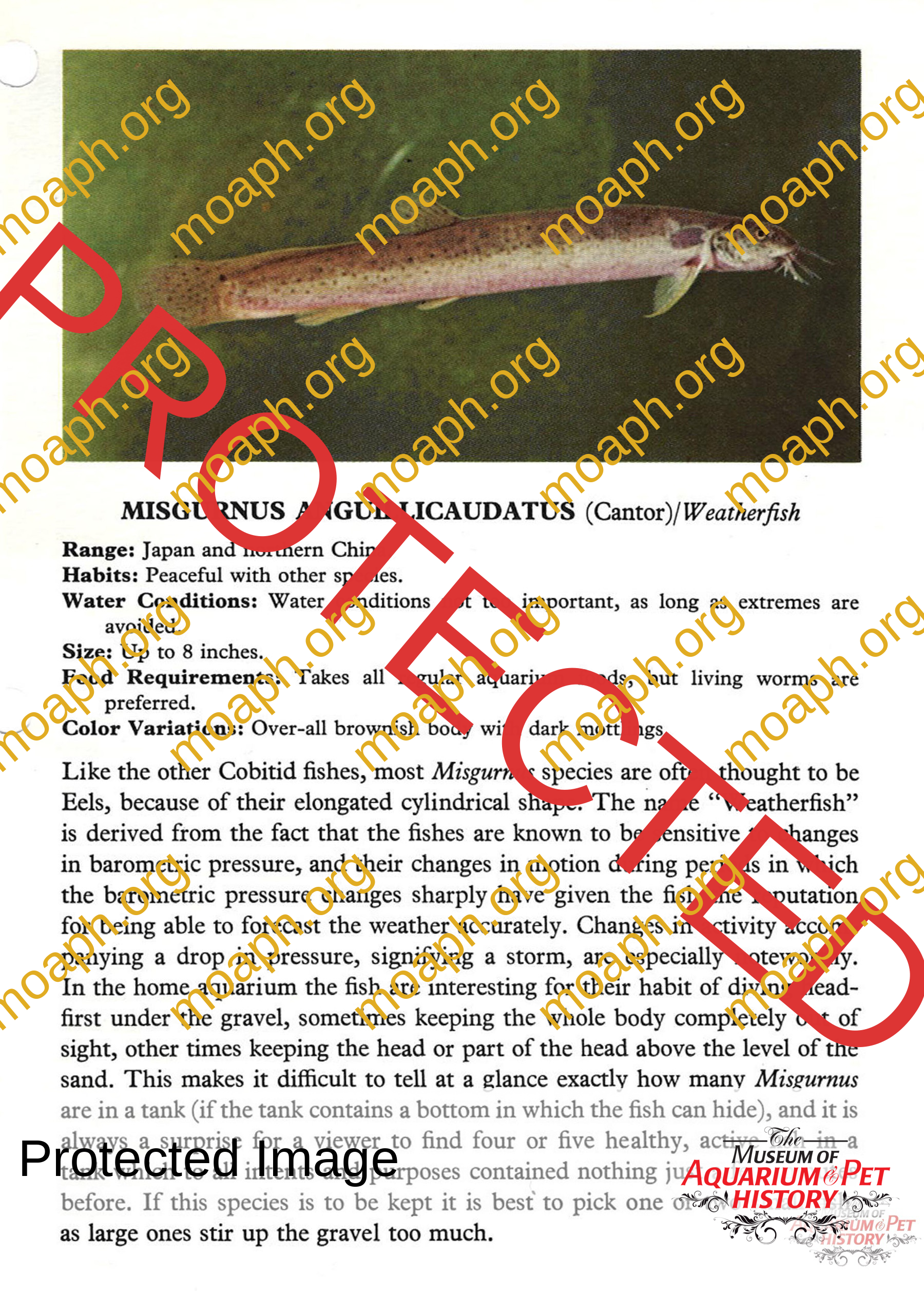
Weatherfish (Misgurnus anguillicaudatus) image and description from the MOAPH archives.
Der Goldkarpen (The Chinese Golden Carp)
Description:
An incredibly magnificent animal that flaunts the most beautiful colors. It comes from the rivers of Japan and China and has been kept in England since 1611, from whence it spread throughout Europe and is kept partly in ponds and basins in gardens, partly in glass or porcelain vessels in rooms as a feast for the eyes. This creature5 reaches a size of 12 to 14 inches and looks similar to the common carp.
The head is medium size, and the double and wide nostrils are not far from the eyes, which are black and golden yellow. The head has a ring at the top and is golden-colored on the sides, the gill cover consists of 2 leaves. The back is round, beautiful red, with various black spots on the sides, it is red with a gold sheen. The rump is covered with large scales, and near the lateral line has a straight direction near the back.
All fins are crimson red, and the tail has 16 rays in the pectoral fin, 9 in the ventral and anal fins, 27 in the caudal fin, and 20 in the dorsal fin.
Regarding the tails, these fishes are extremely variable, which is a consequence of their generally tamed condition, for these differences are only particularly noticeable in those that are kept in rooms and in small basins. Some are found with a dorsal fin or only one attachment, others without it; still others have split tails; some have short, others long pelvic fins.
The color is also very different. Some are completely morning red, others with black spots, and some even silver-colored. Regardless, they all share a magnificent golden shine and are sprinkled with golden sand, especially on the tail. Usually, they are blackish, then red, and with age, silver. In general, however, these things do not change according to certain permanent laws, as with all tame animals.

Shared with the museum by Lee Finley for his article “Goldfish – A Written and Visual Overview from the 1700s and Early 1800s.” Image originally from the book “A Genuine and Universal System of Natural History” by Carl Linnaeus and Ebenezer Silby, 1797-1798?
Oddities:
In summer you have to make sure that the beautiful colors and nice movements catch the eye. People therefore like to choose large glass balls that have an opening at the top that is wide enough for animals to breathe easily, but also so narrow that they do not jump out and die when no one is present. Others also use porcelain vessels. Here they are fed with small picked wafers, breadcrumbs, other leavened bread, dried and powdered eye yolks, pork, and snail blood, the latter of which is said to be their favorite food because of the slimy parts. They also pick up flies thrown in.
In summer they get fresh water twice a week and even more often in humid weather, but in winter they only need this once every 8 to 14 days. If you keep them in ponds with garden or bog soil, like the common carp, they do not need to be fed at all. But if the ground is sandy, they are fed with linseed cake, dung, and bread. They don’t eat in the winter.
They have good hearing, for they soon become acquainted with the voice of their feeder, and if they notice him in any way, they come to the surface of the water. In China, there is a pipe attached to every vessel in which they are kept, with which they call the women. Who enjoy them there just as they do here, to the surface of the vessel to be fed. Because you can easily damage them when taking them out of the jars, you use a small hair knife to do this. They like to look for shady places and because they lack a natural environment, one must try to provide them with something green that does not emit alkali. The small ones, which are much more lively than the large ones, are best chosen in containers, but you shouldn’t put too many in one, otherwise, they die easily.
The spawning season falls in May. The female lays many eggs on ground green grass and when there is nothing green in a container, green branches must be inserted at that time.
These fish are said to originally come from a lake far from a high mountain, called Theimking, near the city of Tohanghou in The-Kiang Province6.
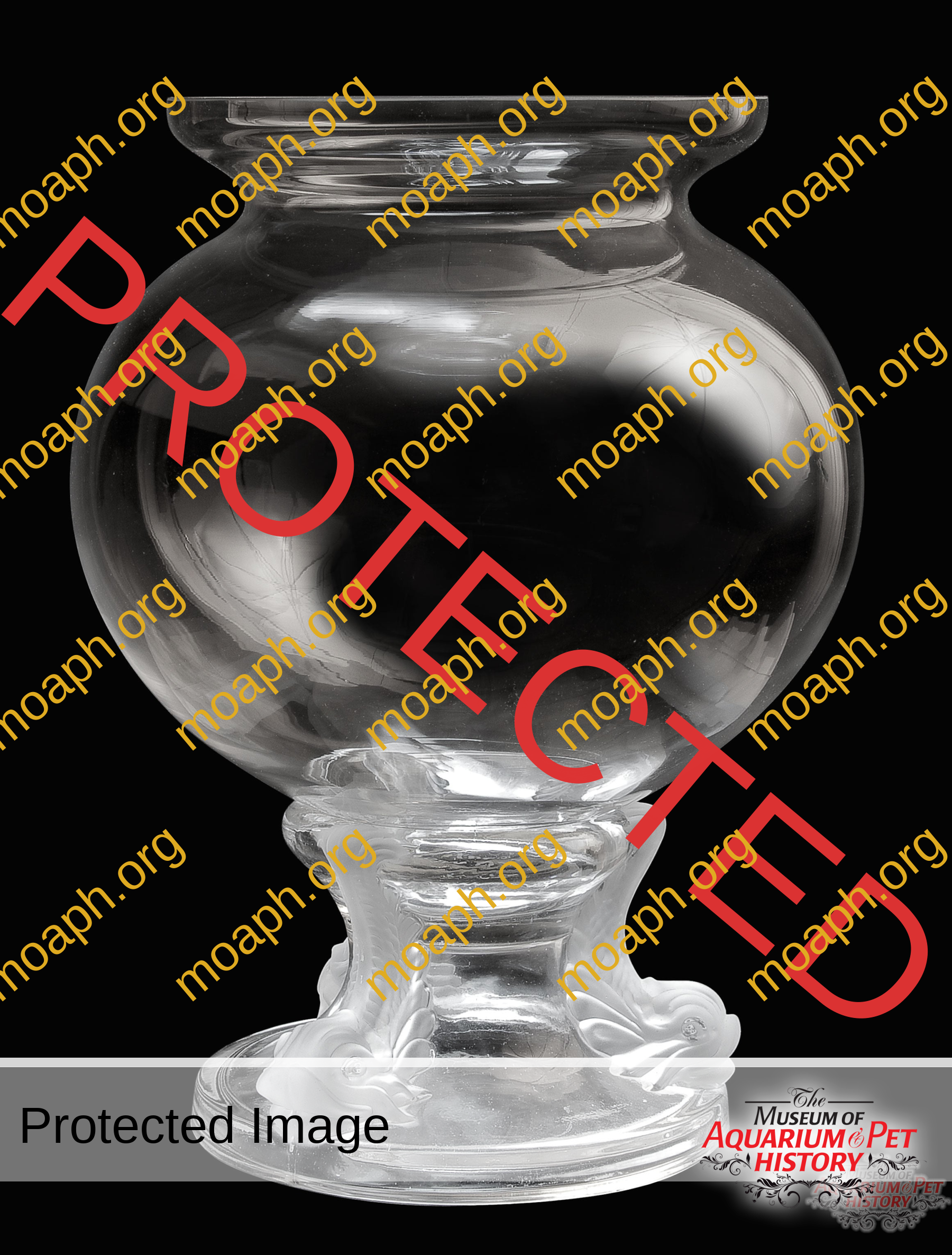
Glass footed Dolphin Fishbowl made by the Zoo Med Glassworks facility.
“Die Gartenlaube” (The Gazebo)
Illustrated Family Magazine
Which in the years 1854-1856 contributed to a considerable popularization of the aquarium hobby in the middle of the nineteenth century.
Description:
1854: Issue 33/ Page 392 under the heading “Leaves and Flowers” the essay “The Ocean on the Table”
1855: Issue 4/ Page 56 under the heading “Leaves and Flowers” a second treatise on “The Ocean on the Table”
1855: Issue 28/ Page 376 under the heading “Leaves and Flowers” a third essay on the topic “The Ocean on the Table”
1855: Issue 38/ Page 503-506 the essay “How to Keep the Ocean on the Table or the Marine Aquarium”
1856: Issue 19/Pages 252-256 Emil Adolf Rossmassler with the illustrated essay “The Lake behind the Glass”
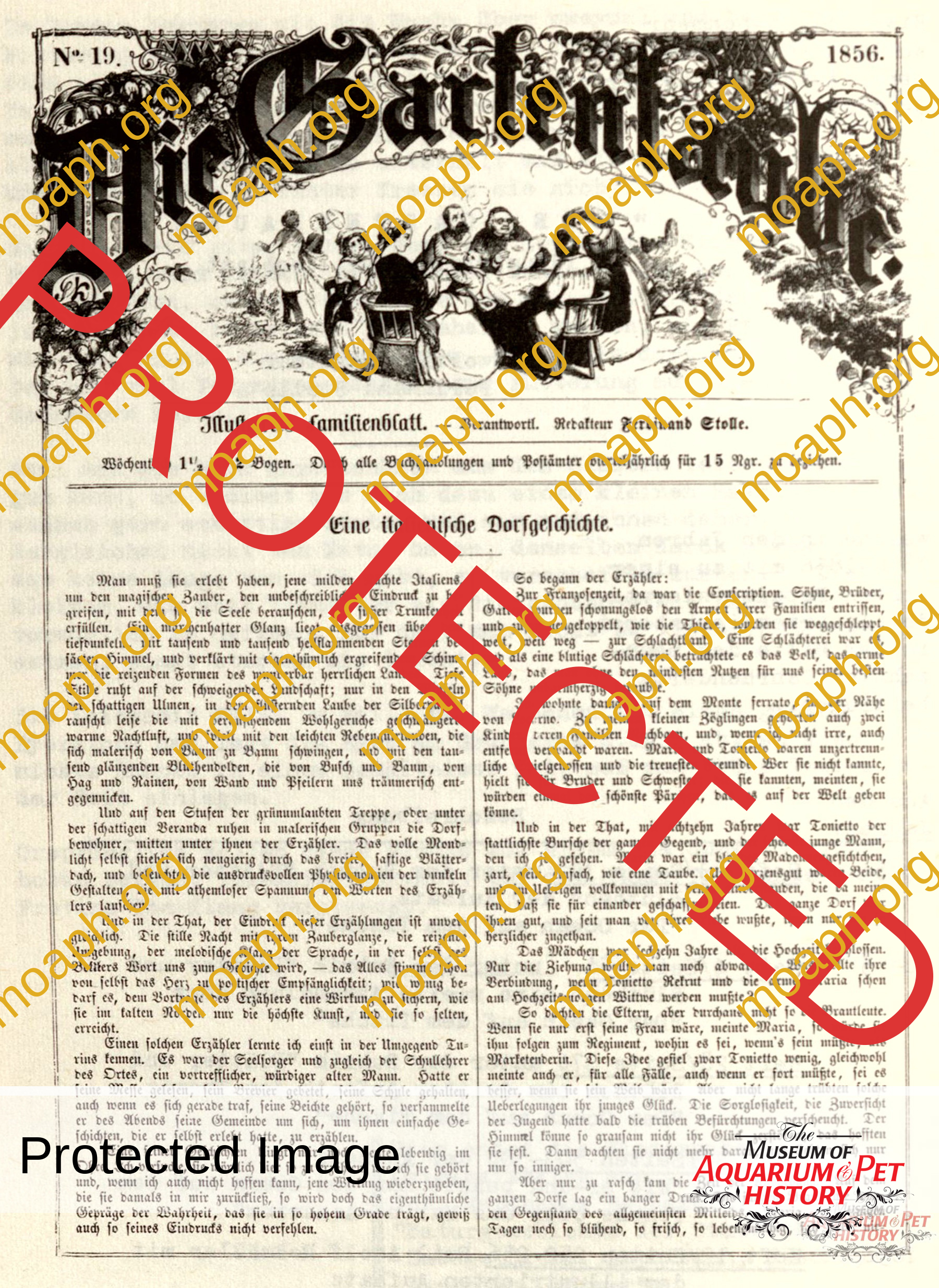
A page from Die Gartenlaube (The Gazebo), number 19, published in 1856. These pages (252-256) are some of the most quoted from Emil Adolf Rossmasslers essay “The Lake Behind the Glass.”
“Die Gartenlaube” (The Gazebo), 1854, issue 33, page 392:7
“Blätter und Blumen” (Leaves and Flowers)
The Ocean on the Table (Ocean auf dem Tische).
Over time, it will become more and more fashionable among educated families who don’t care about money to surround themselves not only with tasteful but also with scientific luxury. One of the newest decorations of the last type in England is the aquarium. The enlarged and scientifically constructed goldfish tureen, filled with life from the depths of the sea, which can now be studied on the table in all its depth. Most mysterious richness, and can be observed even while wearing a dressing gown and slippers! The Englishman Phillip Henry Gosse has now published a truly magnificent work under the title, “Aquarium or Revealing the Wonders of the Depths of the Sea”, in which he shows how such aquariums must be set up, kept, and studied and what strange creatures they are can observe their customs.
The principle on which the aquarium is based consists of the careful preservation of plants and animal life within the glass since the animals depend on the oxygen that the plants develop. Of course, with the living lake water, you also have to put some sand and stones in it for the convenience of life. In order to keep the inner wall of the glass vessel, which always tries to cover itself with myriads of small algae, a portion of small animals is introduced, which science calls “trochus”, and the English call “periwinks, slavies, and tops8. These “tops” constantly move around on the inner walls and use their fleshy, grater-like little proboscis to lick away everything at regular intervals everyday that would disturb the transparency. The tongue of this little cleanliness officer is like nature’s version of a broom or window rag and is described with great enthusiasm by Mr. Gosse.

Opening page to The Aquarium by Philip Henry Gosse.
Among the strange inhabitants of the seawater aquarium is the Cephalopod (Cephalopoda) or the Sepiola vulgaris9. At first, the little animal is extremely restless, but over time it assumes a calm position in the water, only to reveal what a rich life pulsates within it by its protruding eyes and by its thousands of suddenly changing colors. The colors appear in a variety of shapes and inks, some in black, others light, and sometimes coming in flake and ring shapes. It soon becomes clear that the color and its various forms depend on the mood of the animal. There is one floating calmly and thoughtlessly and therefore colorless. However, as soon as a potential new mate shoots over him, immediately his body is covered in the most beautiful purple, “like the cheek of a girl glowing with shame.” What touching love stories can be found in the depths of the sea! But of course, there are also cannibals among them, for example, the black goby, three inches long, existing in sand and swamp. Sometimes it shoots up, grabs its prey, and returns to the mud.
The Strawberry Crab (so-called because of its color) lazily climbs around on the sea plants, doing exactly the same movements as an orangutan. The sea mouse, which got the beautiful scientific name of the love goddess “Aphrodite”, is particularly interesting because of the liveliness with which it always blows around below, but even more so because of its beautiful color change. In artificial light it turns red and orange and during natural daylight, it is gray and blue. A closer examination of the construction of the sea mouse reveals a number of the strangest formations, among which the most remarkable is the nose or the respiratory process which is located in the tail. She always breathes out and breathes in water, like we breathe in air.
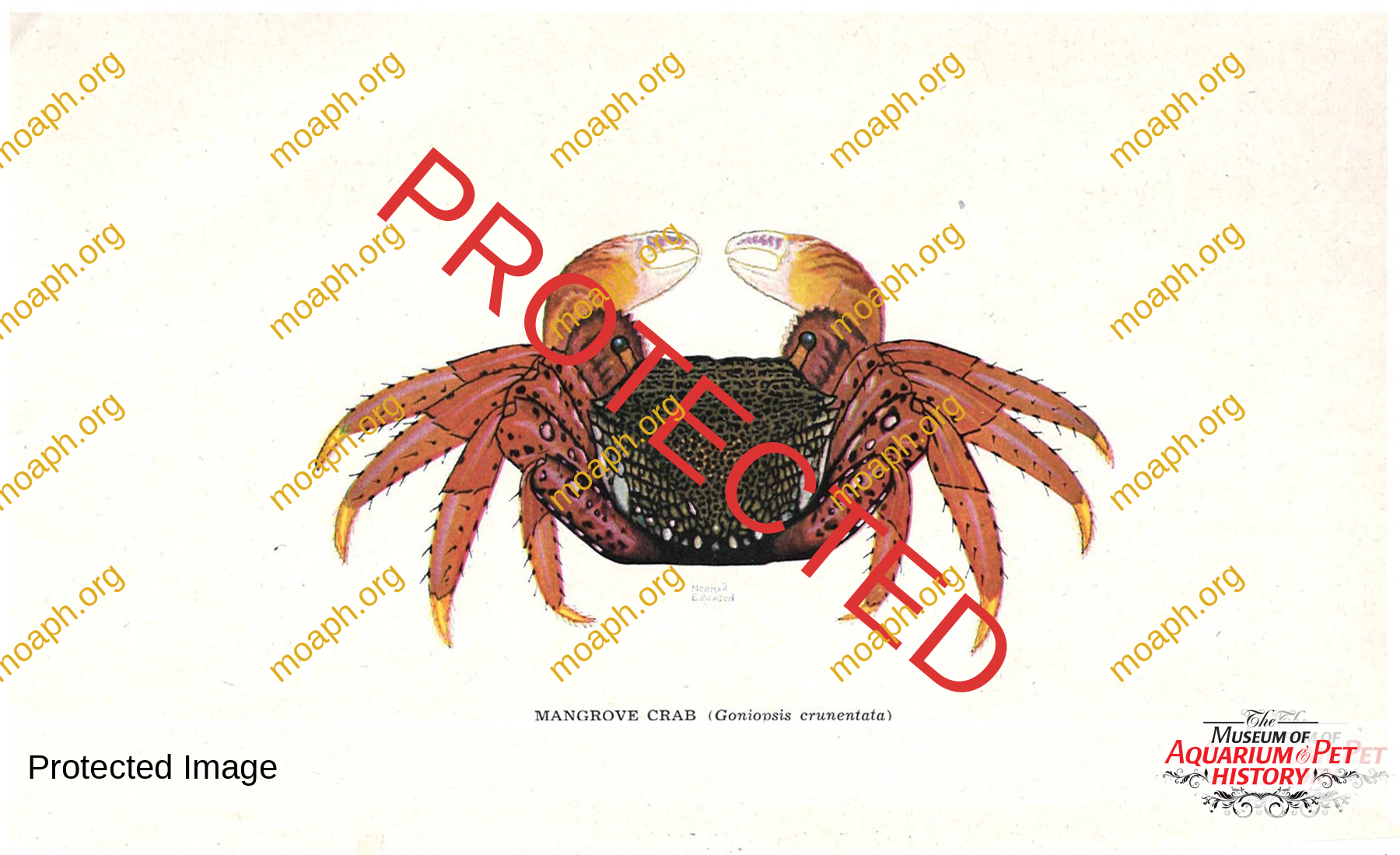
Mangrove Crab (Goniovsis crunentata) image from the MOAPH archives.
The “Soldier Crab” is also an interesting subject of the sea. She has no hard fur and no weapons, and since she likes to make herself comfortable, she moves into any home she finds empty, snail or shell. It’s fun when the castle 10 becomes too cramped for her and she looks for better apartments. On top of the soldier crab usually grows an anemone, a column-type plant animal, together with the Nercis bilineata, a beautiful colored worm which, when the soldier crab has caught something, shoots out from under it and actually snatches the food from under his nose without the real owner seeming to take it particularly badly. The worm, which seems to be unable to live anywhere in the open and cannot earn a living of its own, is one of the greatest delicacies for fish, which is why anglers and fishermen use it most successfully as bait. Man always finds him in the soldier crab’s apartments11.
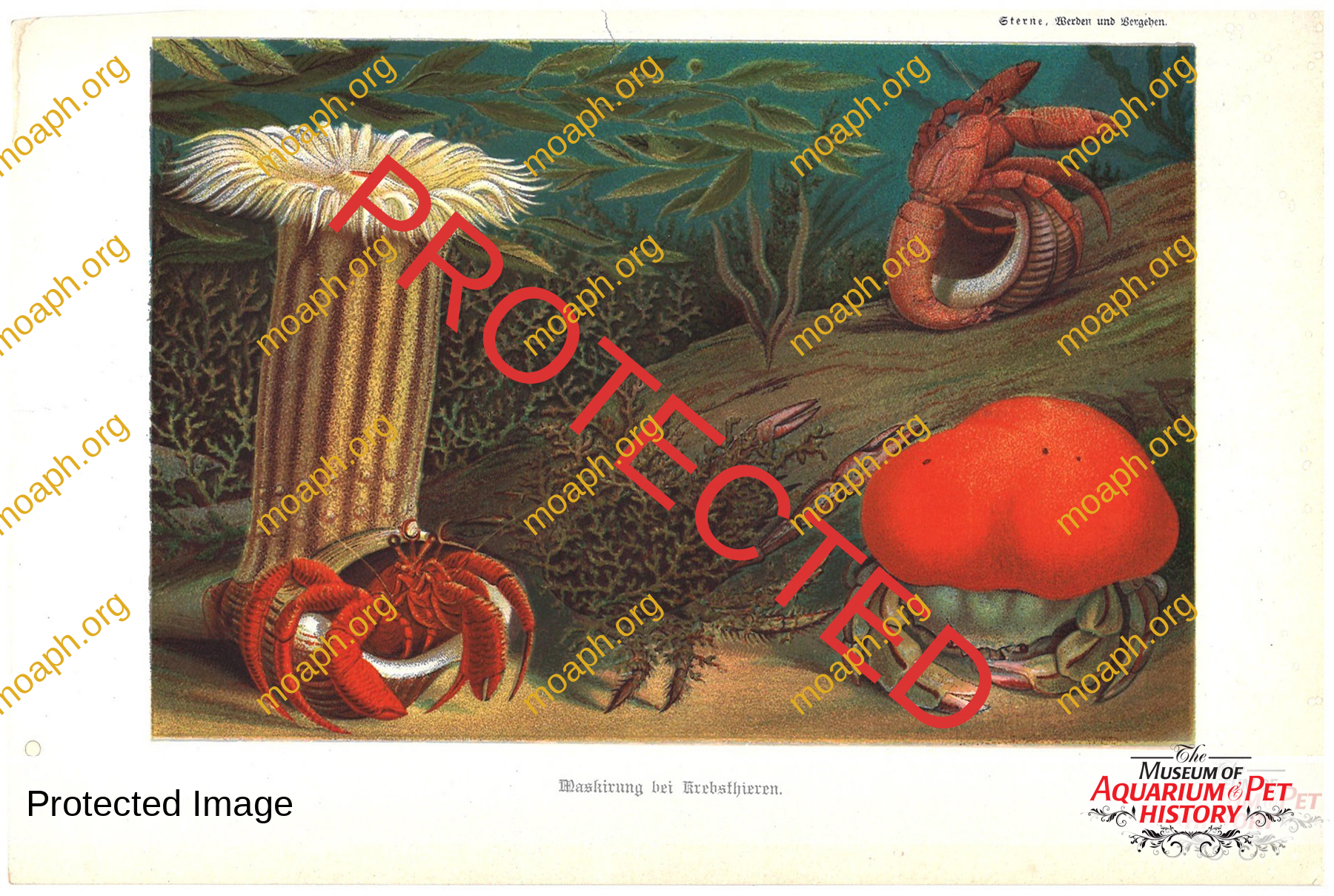
Image of a hermit crab from the MOAPH archives.
Among the plant animals, some species of ray clam seem to be true gymnastic artists, although as a rule, they lay around as if they had grown up. Mr Gosse once threw some species of the bulbous ray clam, the largest variety in their tribes, in a bowl. They do not like to be put into the air. While the family was sitting quietly at the table and not listening to anything being said, suddenly a terrible noise arose among the animals which was very similar to the rubbing and hitting of flintstones on each other. They sank and fought furiously among themselves, as if each wanted to maintain his own head, although not a single one had one. It was, in fact, the most headless upheaval.
In time, the depths of the sea, transparent on our table, will tell us many strange natural stories.
“Die Gartenlaube” (The Gazebo), 1855, issue 4, page 56:12
“Blätter und Blumen” (Leaves and Flowers)
“Der Ocean auf dem Tische” (The Ocean on the Table).
In an earlier issue, we spoke about the new scientific luxury item of the ocean water aquarium and its inhabitants. But where do you get fresh lake water every day in Leipzig, Dresden, Berlin, etc? People do it like the English and Scottish do. In these countries, marine aquariums with sea animals and sea plants have already become and are still becoming a very popular decoration in the drawing rooms of wealthy people.
According to Schweitzer’s analysis (in 1000 gran13) the lake water consists of 964.744 water, 27.059 chloride of sodium, 3.666 chloride of magnesium, 0.765 chloride of potassium, 0.29 bromide of magnesium, 2.295 sulfur magnesia, 1.407 lime sulfate and 3.033 carbonate of lime. The English chemist Gosse then put together artificial seawater without worrying about the small quantities of bromide, magnesium and carbonate of lime. These are not found at all in the water of the Mediterranean Sea. He also left out the lime sulfur (lime sulfate) because it wasn’t soluble and therefore, he assumed, could not be essential to water itself.
Therefore, he kept four ingredients, which he prepared in the following manner and composed common table salt 3 ½ ounces, Epsom Salt ¼ ounce, Chloride of Magnesium 200 gran (Troy unit of Measurement), Chloride of Potassium 40 gran (Troy unit of Measurement), plus 40 Quarts water. This is a good amount of seawater, sufficient for weeks for a smaller aquarium, and costs perhaps 4-5 sgr.14
“Die Gartenlaube” (The Gazebo), 1855, Issue 25, Page 376:15 “Blätter und Blumen” (Leaves and Flowers)
“Der Ocean auf dem Tische”16 (The Ocean on the Table):
How does one make artificial seawater? According to the old commandment in the Bible, “Rule over the earth and make her your servant” and in accordance with the demand made by Legel: “Nature has to surrender to man.” We have recently seriously started to research the inner workings of the Earth, not “Happy that it only shows us its outer shell.” Only the great Philistine Haller praised this happiness. Instead of just the shell, it’s better to have nothing. By the way, “nature has neither core nor shell, it is everything all at once,” as Goethe sang.
*Note from MOAPH: In summary, Philistine Haller exclaims that we, as scientists and nature hobbyists, should not tear the earth apart in our quest to understand nature and should be grateful for what we already understand.
One of the most interesting and richest conquests of science is the subjugated, earth-girding, ocean. The mysterious, wonderful life of its depths now shines in English and Scottish cleaning and visiting rooms. Between the brightly transparent crystal banks in front of us in upholstered and velvet chairs, the living, wandering plant animals bloom. We can see the sea anemones eating a piece of meat presented to them-perhaps they are carnivorous plants? We have the graceful movements and metamorphoses of shapes and colors of the zoophytes, the crustaceans, mollusks, and polyps, which have lived for thousands of years in dark, deep waters inaccessible to us, in all their peculiarity.
We have learned to produce the lake water artificially, to populate it with the necessary vegetation in glass vessels and then to settle the inhabitants of the depths in it, and to keep and care for them comfortably and as our house friends. First, how do you make artificial lake water? How does nature do it? With the help of chemistry, we are able to manufacture seawater faster and more precisely than nature. This below has the composition of the lake water which is slightly different in different places, according to Bibras17 precise investigations, a hundred parts18 each so:
He20 left sodium bromide, sulfuric acid of lime, and sulfuric acid of magnesia completely out of the picture, since the former is completely absent in the Mediterranean Sea and the other two components are only present in very small quantities, partly because of their insolubility in water they are not necessarily part of the quality of the seawater. The first gallon of this composed sea water cost him 5 1/4 pence, not even 5 Sgrs. The following day he filtered half of it through a sponge into a glass vessel and covered the bottom with washed stones from the seashore and a few stone fragments to which some maritime vegetation (“Ulva latissima“) had attached.
“I didn’t want to add animals straight away,” he writes, as I thought it was necessary for the water to first become a little more scattered sprouts of the Ulva and to provide some stock of plant food. This is also the order of the day. In nature, first plants, then animals. Soon the inner walls were covered with the sprouts of the Ulva, and bubbles of oxygen soon developed numerously under the influence of the sun’s rays. After a week I gave several species of zoophytes to the water (plant animals), consisting of species of Actinin, water plants, and animals. Bowerbankia, Cellularia, Balanus, Serpula, etc, as well as some red sea plants. The whole thing thrived and developed from day to day in the most joyful health and vigor. And I found many new inhabitants of the depths added. After 6 weeks I examined my artificial ocean on the table and its inhabitants carefully and found the latter all in excellent health. I could only not find a few Polyzoa, namely Crisen aculeata, Cellepora pamicosa, and Pedicellina belgica, although I believe that they had only retreated between the stones and rocks.
As far as the manufacture of artificial seawater is concerned, there can never be any difficulty with the help of a chemist. But, as a chemist assures me, you can make things very easy for yourself if you go about things the way nature does. What did nature make seawater from? Absolutely only from rock salt, and so he thinks that if, for example, you pour 96 1 ⁄ 2 tons of water into 3 1 ⁄ 2 tons of rock salt (or saline liquid from salt works), you will at least get quite good seawater. At least one can make this cheap experiment and then try to chemically and practically by introducing vegetable and animal life.
The first introduction of the necessary vegetable and animal inhabitants is likely to be the most difficult in Germany. But all that matters is overcoming this difficulty which can be easily overcome with a little money, interest, and scientific education. The first step would also prove to be very commercially worthwhile if capital, capacity, and taste were combined to import some marine aquariums from England and let their inhabitants reproduce and multiply until they were ready and made in different sizes depending on the beauty and rarity of its inhabitants, could be offered to the public for sale.
The sender of these lines, who lives in London, is welcome to contribute his part, and especially to provide advice and assistance to men of science and families who would like to introduce this most beautiful type of room decoration. My dear friend Mr. Ernst will certainly be happy to support the audience and forward them to me. Where my knowledge and goodwill are not enough, Professor Gosse is happy to help in Edinburgh21.
END OF PART 1
Translated version of the 1856, 19th issue of “Die Gartenlaube” (The Gazebo):
An Italian Village Story
You have to have experienced them, those mild Italian nights, to understand the magical charm, the indescribable impression with which they intoxicate the soul. A fairy-tale glow lies over the deep dark sky, strewn with a thousand shining stars, and illuminates the shapes of the magnificent land with a peculiarly moving shimmer. Deep stillness rests on the silent landscape; only in the tops of the shady elms, in the whispering bower of the sycamore poplar, does the warm night air rustle softly, enriched with an intoxicating scent. And plays with the garlands of vines, which swing picturesquely from tree to tree, and grow towards us dreamily with the thousand shining blossoms.
And the villagers sit in picturesque groups on the steps of the leaf-covered staircase or under the shady veranda, with the storyteller among them. The full moonlight shines curiously through the broad, lush leafy roof, illuminating the colorful figures who listen to the storyteller’s words with breathless excitement.
And indeed, the impression of these tales is incomparable. The silent night, with its magical glow, the charming surroundings, and the melodic sound of the language, all of this automatically tunes the heart to poetic receptivity; how little is needed to ensure that the storyteller’s performance has the kind of effect that only the highest art can achieve in the cold north.
I once met such a storyteller in the Turin area. He was the local pastor and teacher, a good, dignified old man. After he had said his mass, said his prayers, held his school and sometimes even heard a confession, he would gather his congregation around him in the evening to tell them simple stories that he had experienced himself.
One of his stories still rings in my ears today. I will try to tell it here in the same way as I heard it; and even if I cannot hope to reproduce the effect it had on me at the time, its peculiar nature will certainly not fail to make an impression.
In the French era, there was conscription. Sons, brothers, and husbands were ruthlessly torn from their poor families and rounded up, dragged away like animals, far, far away – to the slaughterhouse. It was a butchery, and the people, the poor country that was ruthlessly robbed of its best sons without the slightest benefit to us, regarded it as a bloody butchery.
At that time I lived in Monte Ferrato, near Locarno. Among my little children were also two children whose families were neighbors and, if I am not mistaken, distantly related. Maria and Tonietto were inseparable playmates and the most loyal of friends. Those who didn’t know them thought they were brother and sister; those who knew them thought they would one day be the most beautiful couple in the world.
And indeed, at the age of 18, Tonietto was the most handsome boy in the whole area and the most beautiful young man I had ever seen. Maria was a blonde Madonna, delicate, pure, simple, like a dove. And they were both kind-hearted and moreover in complete agreement with those who thought they were made for each other. The whole village was devoted to them. And since people knew of their love, they were all the more devoted to them.
The girl was 16 years old and the wedding was decided. They just wanted to wait for the wedding ceremony. What was the point of their union if Tonietto was to become a recruit and poor Maria had to become a widow on the morning of the wedding?
That’s what the parents thought, but not so the bride and groom. If only she were his wife first, Maria thought, she would follow the regiment wherever it went, even if it had to be as a sutler22.
Tonietto did not like this idea very much, but he also thought it would be better if she were his wife, even if he had to leave. But her young mind was not troubled by such considerations for long. The carefreeness and confidence of youth had soon chased away the foolish fears. Heaven could not so cruelly destroy their happiness, they firmly hoped. Then they thought no more of it and loved each other all the more dearly. But all too soon the time came for the draft. The whole village was under anxious pressure…
REFERENCES
1 MOAPH: Original text from Joh. Matthaeus Bechstein, “Natural History of House Animals, Mammals, Amphibians, Fish, Insects and Worms”, 1st edition 1797.
2 Zoll: An old measurement used in German-speaking countries. One zoll is equivalent to an inch.
3 Cobitis fossilils, Gmelin. Lin. Cyst. I. 3, p.1351, N.4. Blochs Fishe Deutschlands (Blochs Fish of Germany). I. S.216, Nr. I, Taf.31, Fig. I
4 Gas-filled organs that fish have as it regulates air in the water. Helps them to hover or be stationary without expending energy.
5 Cyprinus auratus, Gmelin. Lin. Sys. I, 3, p. 1418, n. 7. Blochs Fische Deutschlands (Blochs Fish of Germany ) (III.
- 132, Nr. 25, Taf. 93, 94. Fig.
6 MOAPH: Original text from Joh. Matthaeus Bechstein, “Natural History of House Animals, Mammals, Amphibians, Fish, Insects and Worms” 3rd edition 1807.
7 MOAPH: Publisher: Ernst Keil. Editor: Ferdinand Stolle
8 Old English nicknames for small edible snails
9 Unofficial name, the scientific name used today is Sepiola rondeletii (Bobtail squid)
10 MOAPH: A larger habitat/home often referred to as a castle due to its cultural significance in Germany
11 MOAPH: Referring to fishermen taking apart the Soldier Crab to get the worm.
12 MOAPH: Publisher: Ernst Keil. Editor: Ferdinand Stolle.
13 Note: Gran (Granum) = old apothecary weight = 0.06g — Ounce (lat.uncia)= previously in many countries both a weight and a part as well as a unit of measurement of very different value. In England, the handle pound was 16 ounces at the time, the Troy pound (for precious metals, but 12 heavier ounces. The Troy pound of 12 ounces is equal to 373.24g.
14 Term used to denote Shillings
15 MOAPH: Publisher: Ernst Keil. Editor: Ferdinand Stolle.
16 Compare Issue 4 of the Gazebo. We hereby expand and correct the initial suggestion given there, all the more because there has been interest in it and there were some misprints in it.
17 Ernst Von Bibra (1806-1878) was a German Natural History scientist and author.
18 MOAPH: written as a percentage out of 100 parts.
19 MOAPH: written as a percentage out of 100 parts. .
20 MOAPH: in this section ‘he’ refers to Ernst von Bibra, the chemist who created this artificial seawater
21 Kurt Jacobs- Ernst Keil was the publisher of the Illustrated family paper “Die Gartenlaube” (the Gazebo) who lived in Leipzig. Ferdinand Stolle was the editor of the same paper. Loth is a small trading weight in several northern European countries, including Germany at that time.
22 A sutler (from the Italian mercatante or mercadante, by-form of mercante ‘merchant’) is someone who accompanies military troops and supplies the soldiers with goods and services for their daily, private needs. The term comes from the medieval military.