
Floating Folk
Baderkinder and Bathing Beauties
Beginning in the 1860s, German factories began producing badekinder (bathing children). Of bisque or china, these unjointed figures typically portrayed a plump nude child, standing with legs slightly apart and arms bent up at the elbow. The purpose of some of the finest badekinder was to bathe or at least to bob about horizontally on the water’s surface. Badekinder were sold as bath toys and at seaside resorts where children could take their new little friends swimming in the sea or spa pool. As these bathing badekinder were just a fragile ceramic shell, striking a rock or edge of a porcelain bathtub, no doubt sank many of these swimmers. In the United States, badekinder are often referred to by doll collectors as “Frozen Charlottes” (or Frozen Charlies for the male counterpart), after an old American folk ballad relating the sad tale of Charlotte, a beautiful young woman who foolishly refuses to dress warmly for a sleigh ride to a Christmas Eve ball and consequently freezes to death.

Illustration 1
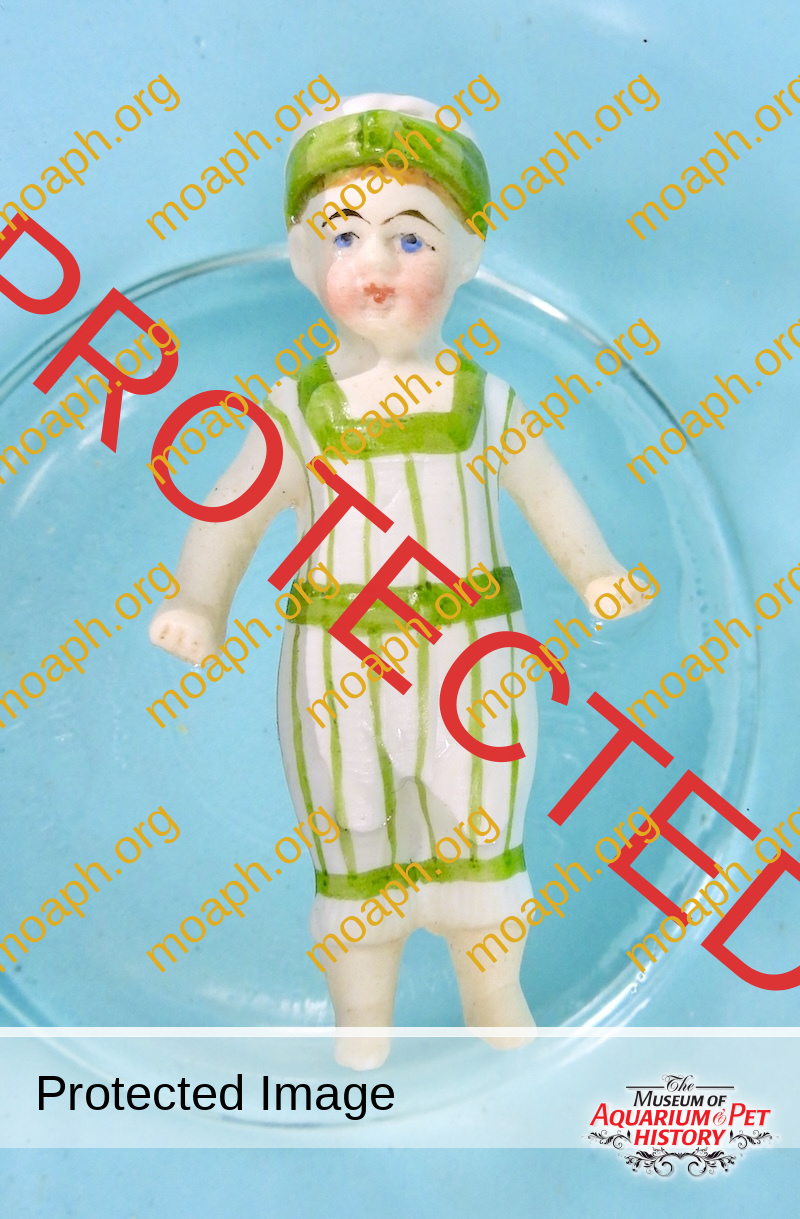
Illustration 2
The bisque boy in Illustration 1, frozen in the standard badekinder stance, is ready for the seaside in his molded white swimming trunks. Gently placed on the surface of a bowl of water, he bobs along on his back. Of excellent bisque, as are all the following examples, he is 3-3/8 inches tall and unmarked.
Dressed more demurely in a bathing suit that covers her knees and with her hair tucked into a bathing cap, the little bathing belle in Illustration 2 also can float on her back. She is 3 inches tall and marked “Dep” on her back; these initials could stand for “Deponiert” in German or “Depose” in French, either term indicating that the design has been registered.
In his boldly striped blue and white swimming trunks, the versatile boy in Illustrations 3a and 3b can float on either his belly or back, no doubt in part because he is frozen into a position more suitable for a swim, with his arms spread, his head lifted, and his pudgy legs slightly arched up behind him. He is beautifully modeled and decorated, from his slightly tousled short blond hair to his tiny toes. A sizable 4 inches long, he is unmarked.
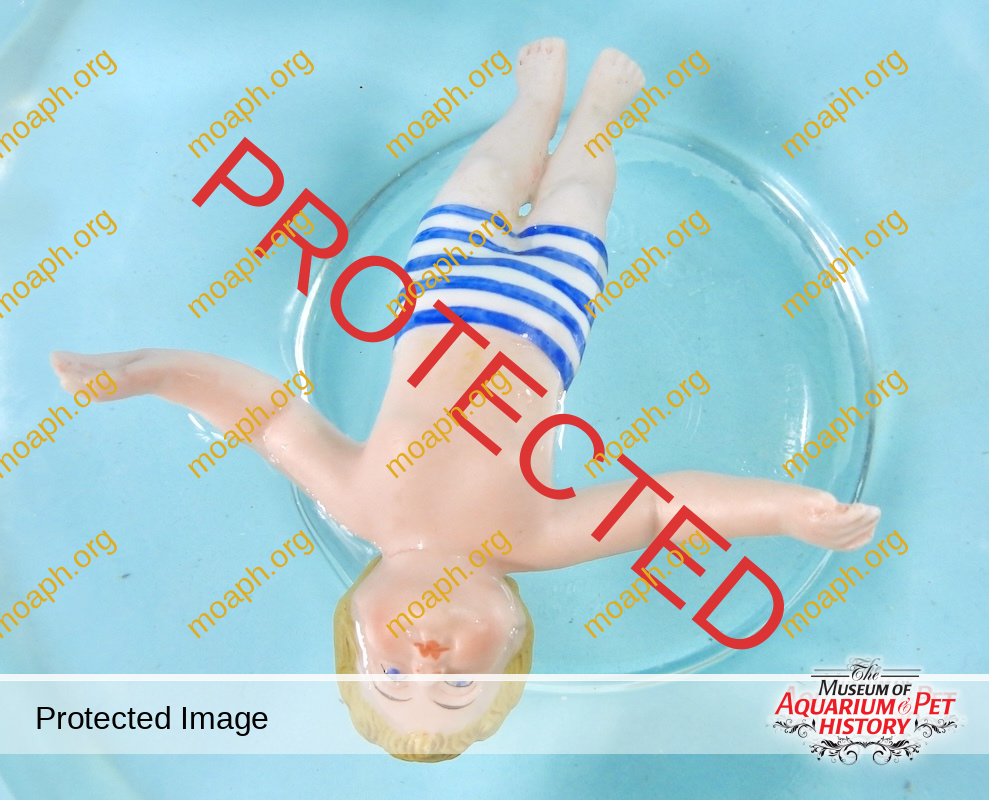
Illustration 3a

Illustration 3b
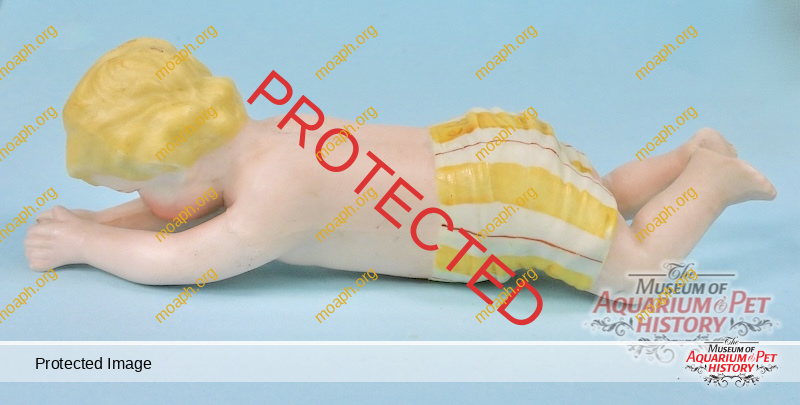
Illustration 4a

Illustration 4b
Even larger at 5 inches long, the bathing boy in Illustrations 4a and 4b is ready to ride the waves with his arms stretched out in front of him. This bobbing boy is also superbly sculpted and finished, but his delicately painted face is obscured by his arms. He is also incised “Dep” on the back of his jaunty yellow and red striped swimming trunks.
The floating femme in Illustration 5 is certainly more “dame” than “kinder.” She does the back float, showing off her fine swimming form in a dark orange tank suit and matching cap. Oddly, this orange color is cold-painted rather than fired in, making it susceptible to being washed away in the water. As shown in Illustration 6, she is incised on her back with the crowned intertwined “G” and “W” of Willam Goebel, as well as “X W” over “226,” and is further stamped “Bavaria” in black. The use of capital letters and the black “Bavaria” stamp are also typical of Goebel. This bathing beauty is 4.75 inches long.

Illustration 5
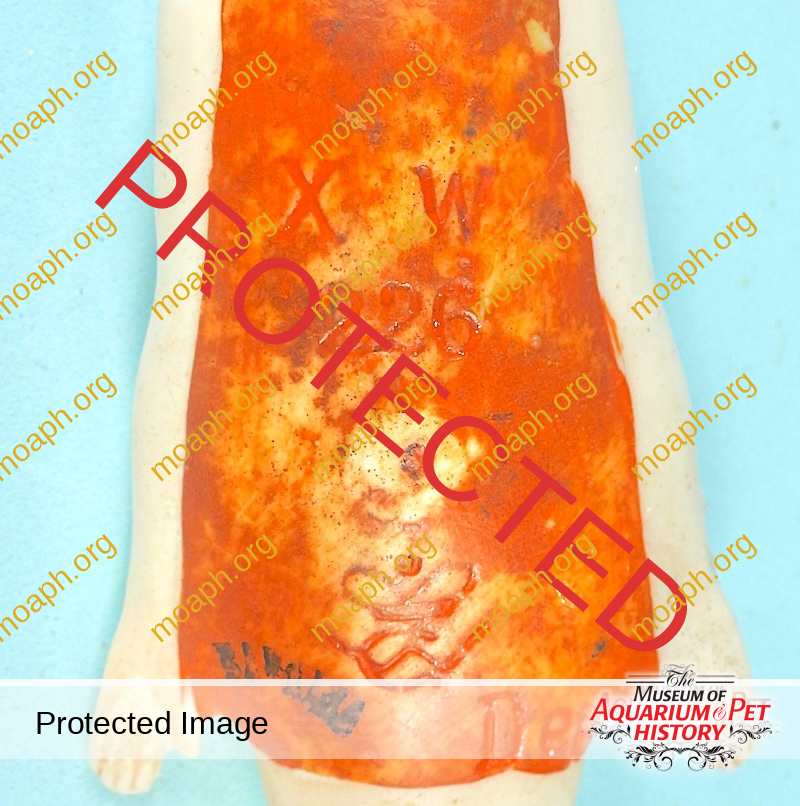
Illustration 6

Illustration 7
No doubt some aquarium enthusiast in the past may have added a bobbing badekinder or bathing belle to his or her aquarium decor, but were such floating folk ever specifically sold as aquarium ornaments? Illustration 7 is from an early Schmid’s Emporium of Pets catalog offering a fleet of floating fish bowl fancies. It describes, but does not picture, “Floating Boys,” one version selling for 20 cents each and the other selling for 50 cents. Were these badekinder of some kind? Until an actual image is found among the pages of an antique aquarium catalog, it appears we will just have to let the mystery be.