William Alford Lloyd: New Unpublished Letters Unveiled – Part 1
For more than a century, The Zoological Station at Naples (Italy) has preserved the world’s largest collection of letters and postcards handwritten by the greatest professional aquarist of the Victorian era, William Alford Lloyd (1824-1880). In a previous article of mine released on the MOAPH website in November 2023, I revealed several fascinating details provided on some of those paper treasures.
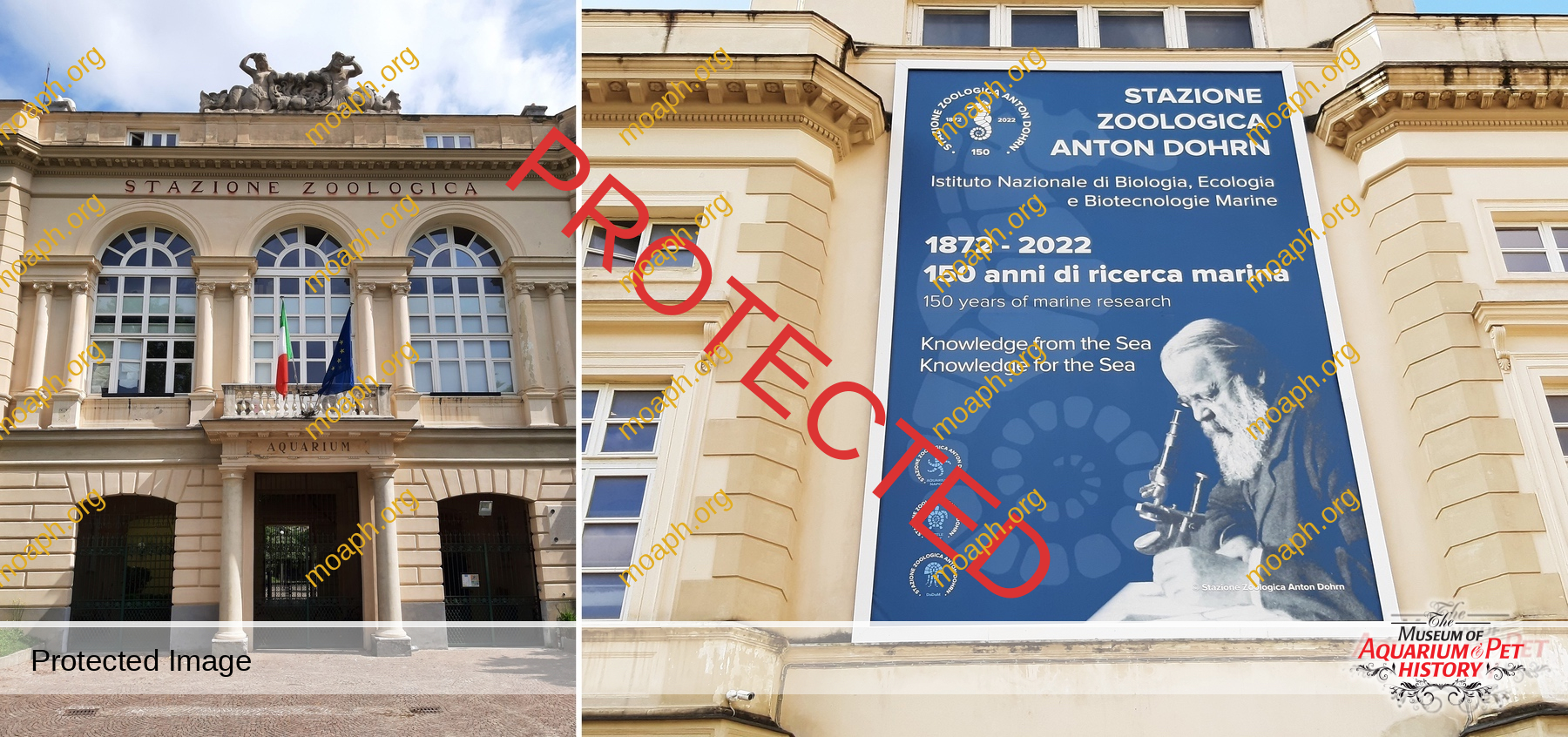
In 2022, the Zoological Station celebrated its 150th anniversary.
I said “some” because in the 1990s a large part of the original collection was sent permanently to the Bavarian State Library (Bayerische Staatbibliothek) in Munich. Recently, however, I was allowed to study and “decipher” those very documents located in Germany. We talk about more than 30 letters – all unpublished as far as I know – which Lloyd wrote to Anton Dohrn (1840-1909), founder and first director of the Zoological Station and Naples aquarium. They are dated from May 1872 to October 1877.
Deciphering Lloyd’s Victorian handwriting was pretty challenging, and it took 4 months – a real labor of love – but it was definitely worth it. These letters turned out to be extraordinary time capsules.
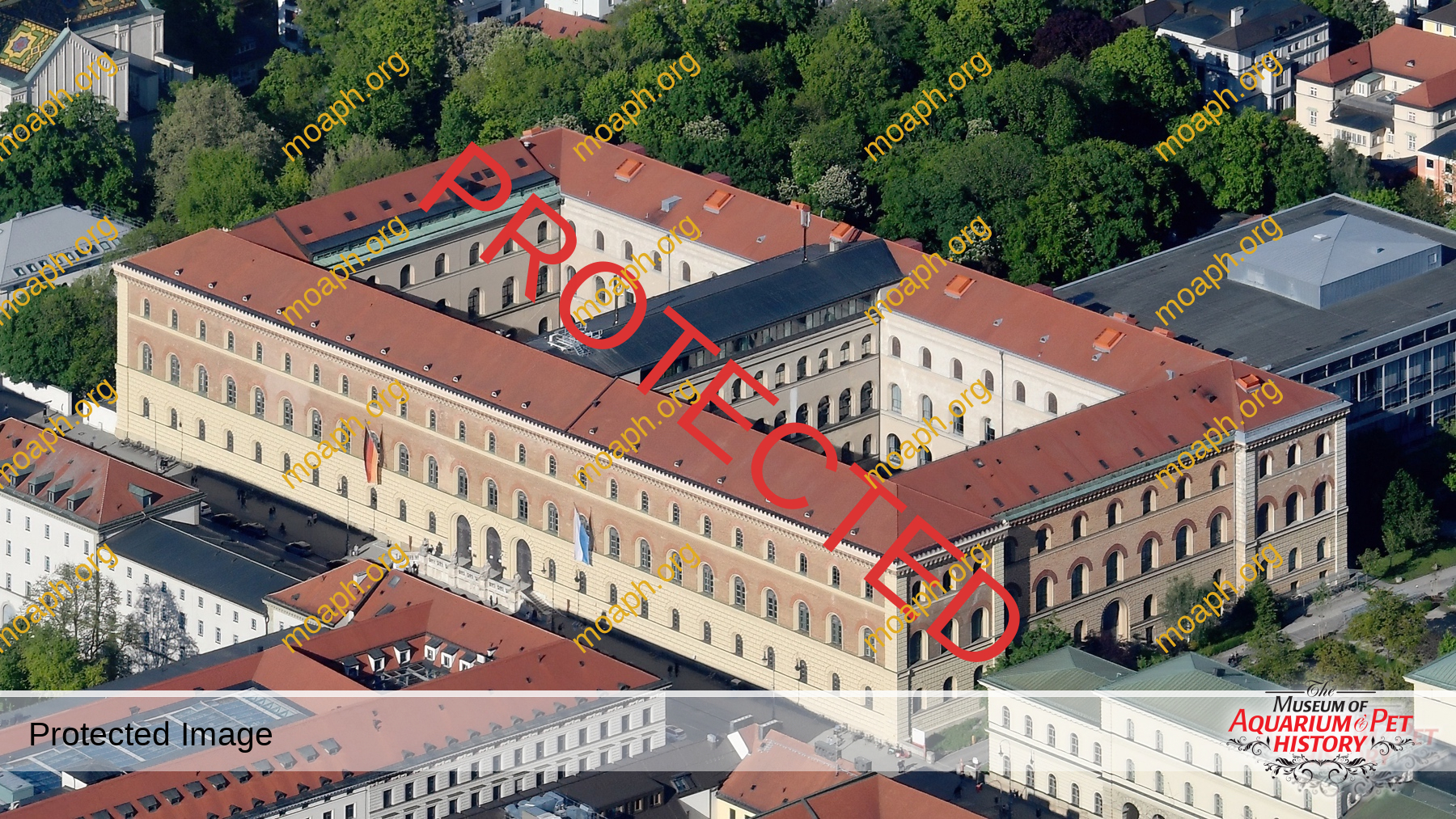
Founded in 1558 as the court library of Duke Albrecht V, the Bavarian State Library in Munich is one of Europe’s most important libraries. With its almost 11 million books, it ranks among the leading research libraries worldwide. The Bayerische Staatsbibliothek preserves one of the most important manuscript collections of the planet, as well as the largest collection of incunabula (books printed before the year 1501) worldwide. Its collection of historical prints before 1850 totals almost one million units.
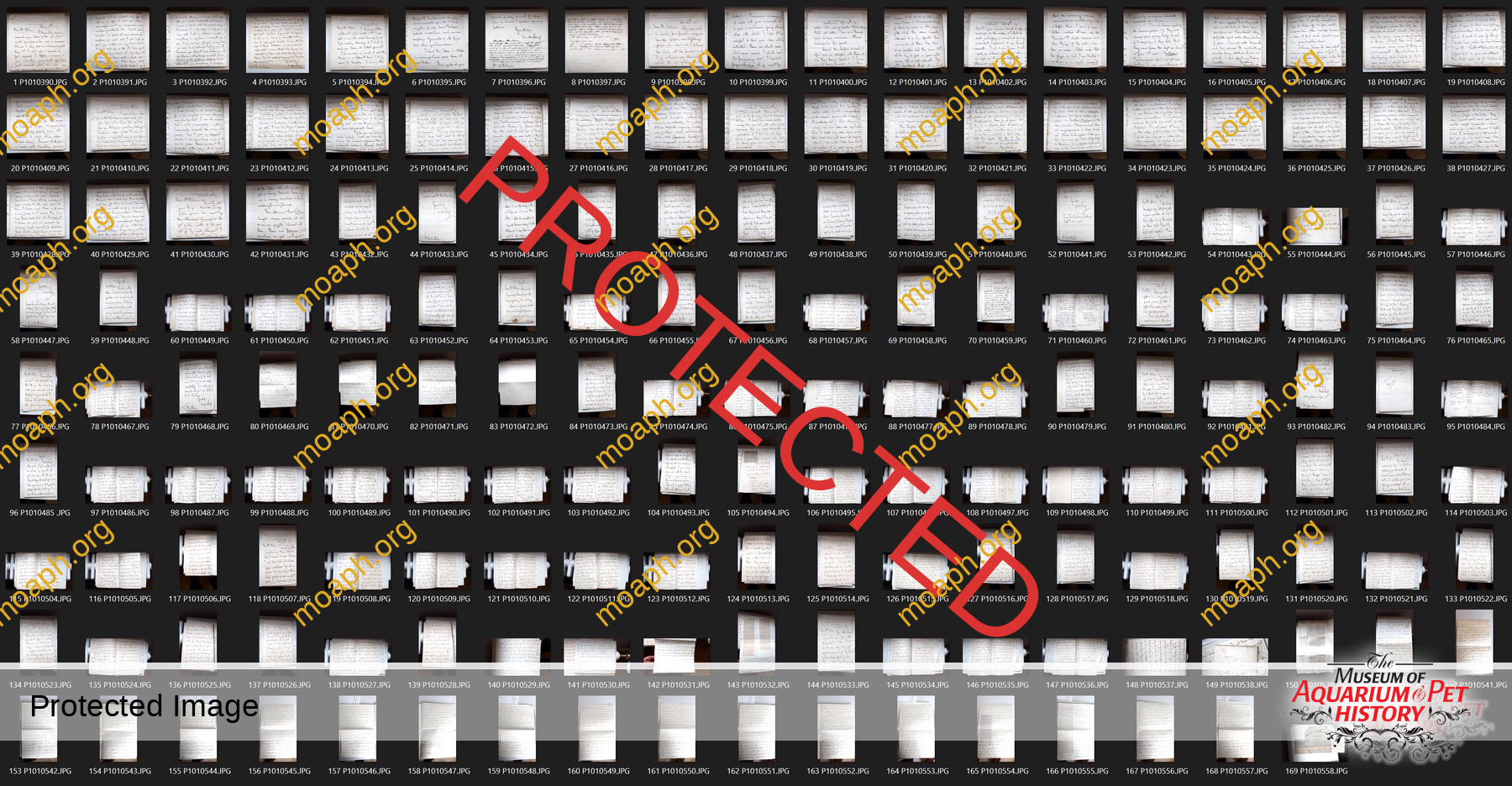
All the pages deciphered by the author.
To make what follows more understandable, it’s useful to remind our readers that in 1872 Dohrn asked Lloyd to become a corresponding supervisor for the design and construction of the Aquarium at the Zoological Station, which was opened to the public on January 26, 1874. Lloyd, who back then was superintendent at the Crystal Palace Aquarium (Sydenham, London), played a key role in Dohrn’s successful project. He also helped the German scientist to choose the best suppliers – all strictly British! – from whom to purchase engines, pumps, boilers, pipes, small fittings, and glass.
The two had a bond of mutual professional respect and genuine friendship. That’s why these letters are also full of Lloyd’s personal reflections and comments.
But now, once again, let’s give the floor to my Victorian hero.
February 4, 1873.
“All your work is coming to a finish – engines, pumps, pipes, small fittings, glass etc, etc and I believe the whole will be packed ready to go aboard one steamer by about the end of this month at latest.
I am now arranging to make out your accounts and to give a reckoning of my stewardship, with which I hope to be satisfied and that you also will be contented. Then we shall see about more cash I shall need. […]
Leete and Edwards strongly propose that in your own interest they should send out to Naples the same man who has made your engines and fitted them and all other parts of your circulating apparatus together, and they say he is well adapted to fit-up your whole place from A to Z. His name is Edward Digan, 33 years old, a very steady family man, not addicted to drink, and has before worked abroad. Terms £5.10.0 a week1, with travelling expenses extra, but use of Leete and Edwards’ tools not extra. He is a thorough good working mechanic. Please answer on this point.
Have the boilers arrived, and if so, are you satisfied with them and are they being fixed? I have now to pay freight, etc for them coming to £13.17.9, but in this sum there is insurance charged for twice by error, as the owners of the ship they were originally intended to go by effected their insurance, and then the other ship’s people did the same, but I shall try to get a part of the money 30/- or 40/- allowed. You will recollect that it is only by pre-payment of the freight of all your goods, that I got the vessel’s owners to take off 25 per cent in consideration of the scientific purpose in view, and that such freight comes to a considerable sum.
I have been to see about insurance of the glass and find I can do so by sea to Naples under the usual marine policy by steamer at ten per cent, on the value, such policy covering losses by sea, but not breakage, unless the ship be stranded, or burnt, or such. Now if we say the glass comes in round numbers to £700 (£677) then such partial insurance alone comes to £70 – a great amount. Be so kind as to clearly state what I shall do. If it were mine, I should pack it very strongly, and take the risk myself.
But I by no means desire to influence you in this matter, and I shall be most unhappy if accident of any accident happened, and you be not insured. I will do all I can, and will myself go on board ship, and see all is as right as it can be before the steamer goes. You will remember that the ordinary marine insurance on machinery is but a trifle: Thus, I paid for your boilers – value £200, only 35/8. Therefore I shall insure all the other things if the rate is like this, or even a little more. But the glass is what I am troubled at, at £70 is so much money for what is by no means absolute immunity from harm. […]
I am tonight writing to Goslett about extra strong packing for glass. [Alfred Goslett of Soho Square had been a renowned manufacturer of glass for greenhouses and conservatories since the late 1840s. He supplied the glass for the Crystal Palace Aquarium as well]. I am not well. Overmuch work has caused the involuntary muscles of my intestines to act irregularly and that affects my thinking faculties.”
MOAPH1: note on pre-decimal English currency: “£5.10.0” means 5 pounds, 10 shillings, 0 pence. “12 pence” (d) makes a shilling (s), and 20 shillings make a pound. “30/-” is 30 shillings, ie £1 and 10 shillings. “35/8” is 35 shillings and 8 pence.
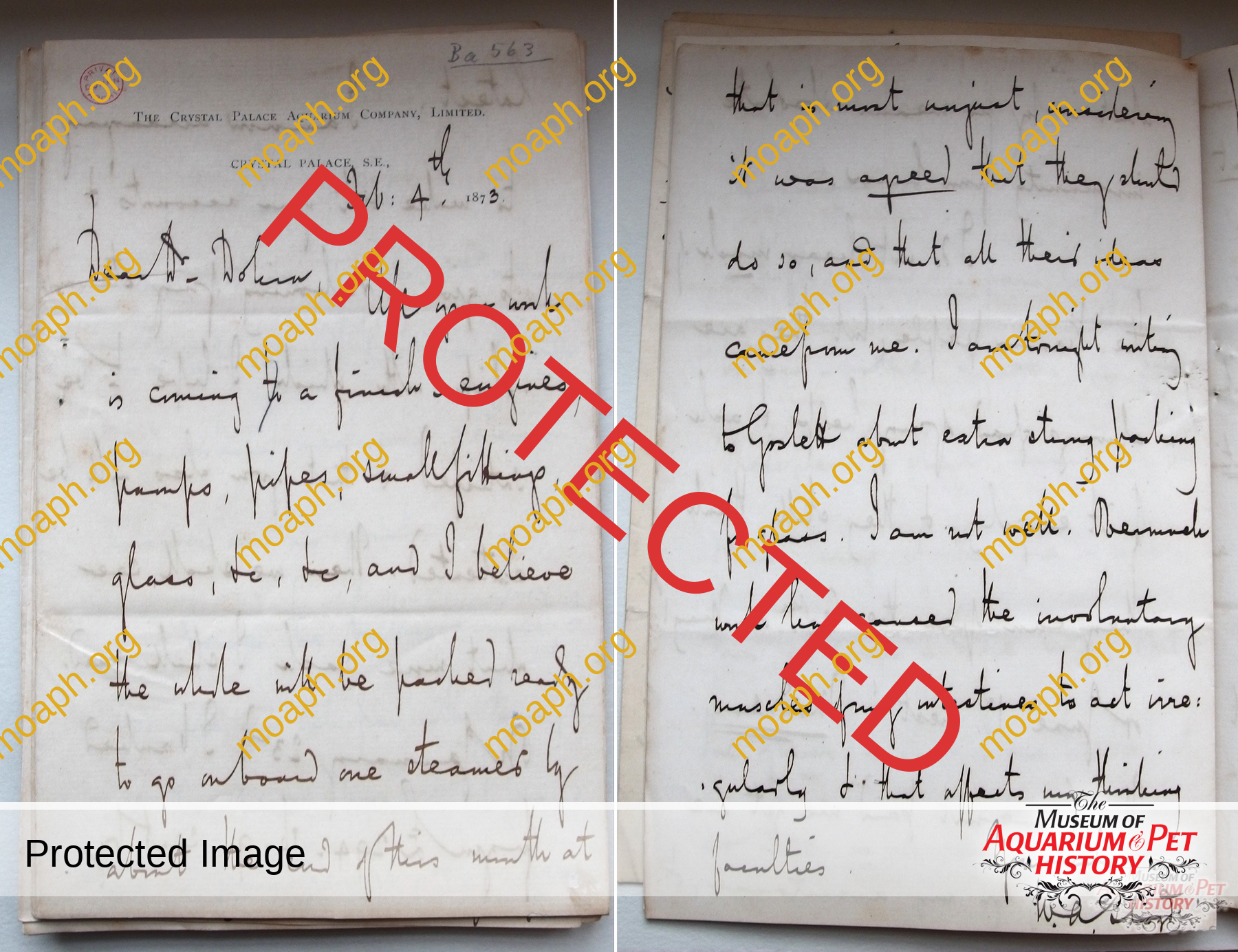
First and last page of the 12-page letter dated February 4, 1873. Notice the red stamp “Dohrn Privat Archiv” on the upper left of the first page. “Ba 563” written in pencil is, in addition, the reference number originally assigned to this document by the Zoological Station. ©Bayerische Staatsbibliothek.
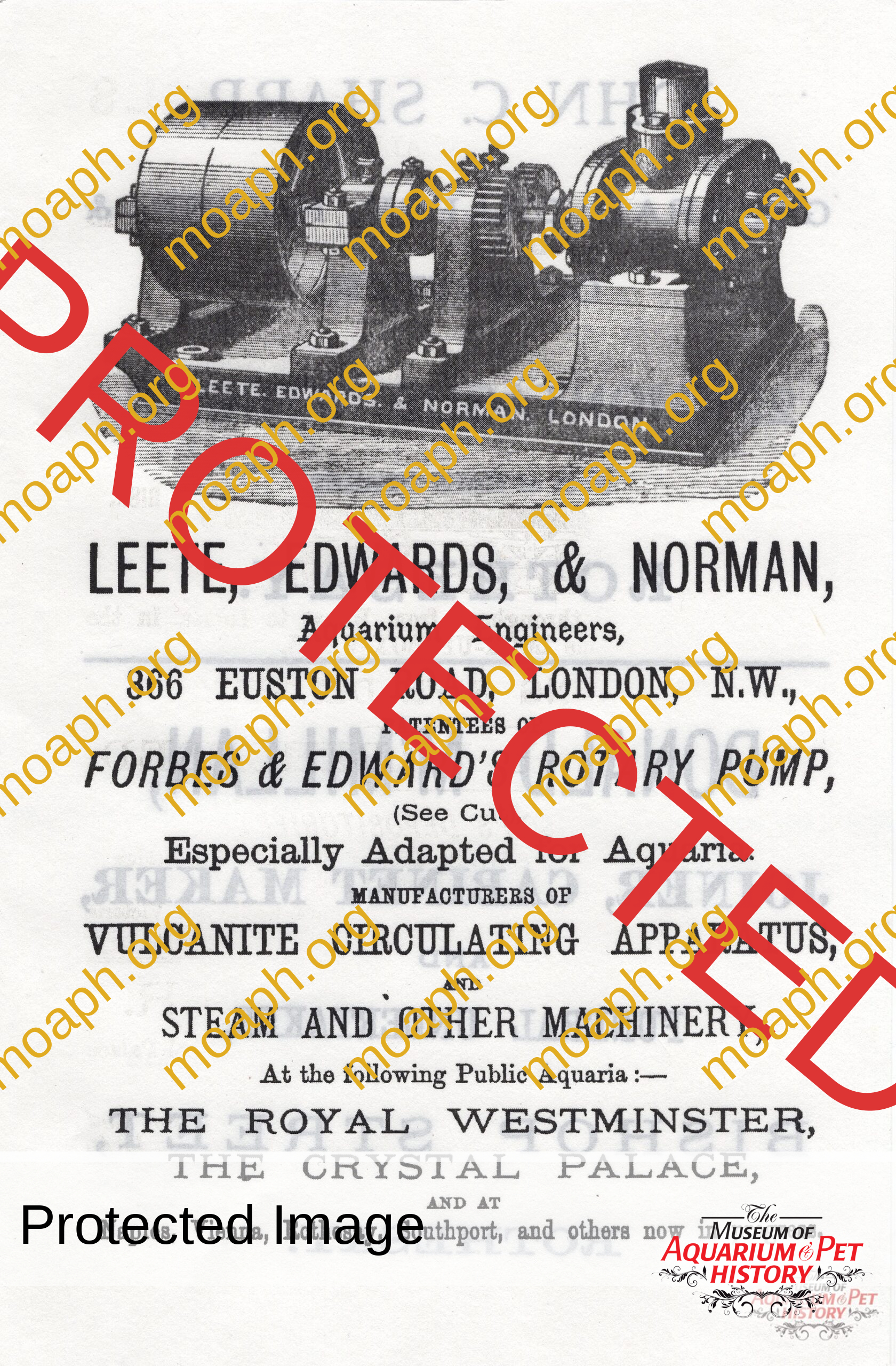
Leete, Edwards, & Norman advertising from the late 1870s. In those days, their popular rotary pumps were powered by steam engines.
March 5, 1873.
“…The glass, in 16 cases, weighing eight and a quarter tons (one ton English is 2240 pounds) is all packed and paid for, and the engines and most of the pipes are also packed. I saw the engines tried and worked successfully, and yesterday I similarly inspected the working of the pumps. Thus I give my personal attention to all your things, as far as it can be given. These pumps, and the remainder of the pipes will be packed by next Monday, and I have asked the shipping people to tell me by what vessel I had best forward all the goods really early next week. Leete and Edwards’ things will be in seven or eight cases, and will weigh about 3 1/2 tons. I have urged them by all means in my power and I believe they have done their best but with the best will I believe all such work presents hindrances which cannot be forseen. That L and E [Leete, Edwards & Norman] shall have no excuse for being slow, I have kept them well paid-up by successive cheques. They have asked me for another £100 tomorrow, but I shall give them only £50 and say all shall be handed them when everything is quite ready for shipment, so that will hurry matters. But at a little later period, they will leave one small and final arrangement to forward after the fitter is with you, and that will hinder nothing. I am doing all I can about the man, and he is preparing to come to you, and as we are here [the Crystal Palace Aquarium] having some changes made in our circulating system, I am having the same man to do them, by way of his learning, and preparing himself to serve you well. I am thus trying to forsee everything, and tomorrow I will go about the soft India rubber pipes, and use my own judgment as to quantity. You cannot do better than use our system here, with such soft pipes. You would have wasted much money had you done as you instructed L and E.
I am much pleased with your pumps, and they are so much better and larger than ours for the same money that we are thinking of having the same improvements here.
I hope you are fixing your boilers properly. I sent out drawings showing the manner of fixing them, in a parcel containing Gosse’s British Sea Anemones, which book you have not acknowledged receipt of, and I am uneasy, as it went in charge of the Captain of another ship than those in which the boilers were sent. I have been very anxious about insuring the glass, as the rate was so high, and yet, if broken the loss of property and time would be great. Gosletts advise me not to insure, as it can only smash if let fall from a great height, but am taking further advice from Pickernell you know, of course, that the first kindly found all your things at 25 per cent less than the usual freight, for pre-payment. So I trust you did not pay freight on the boilers. They also permit me to send, free of cost, one ton weight of sea-water on board each of four of their steamers to Naples and back for conveyance of Aqm [Aquarium] animals from you in a big cash and cover. One such cask went (for the second time) in the Latona [a steamer], some time ago, and she I expect is now at Naples. The first time she called, you were away, but Captain Winter will again call on you, and I trust you may be able to send us Aqm animals. I fancy some non-British large crabs would be well for a first trial, but use your own discretion. […] I am very anxious to compare your Mediterranean Actinia found list with Britain by Gosse’s book, and thus tell what to send you of these animals (when you are ready for them) and what I may expect from you. […]
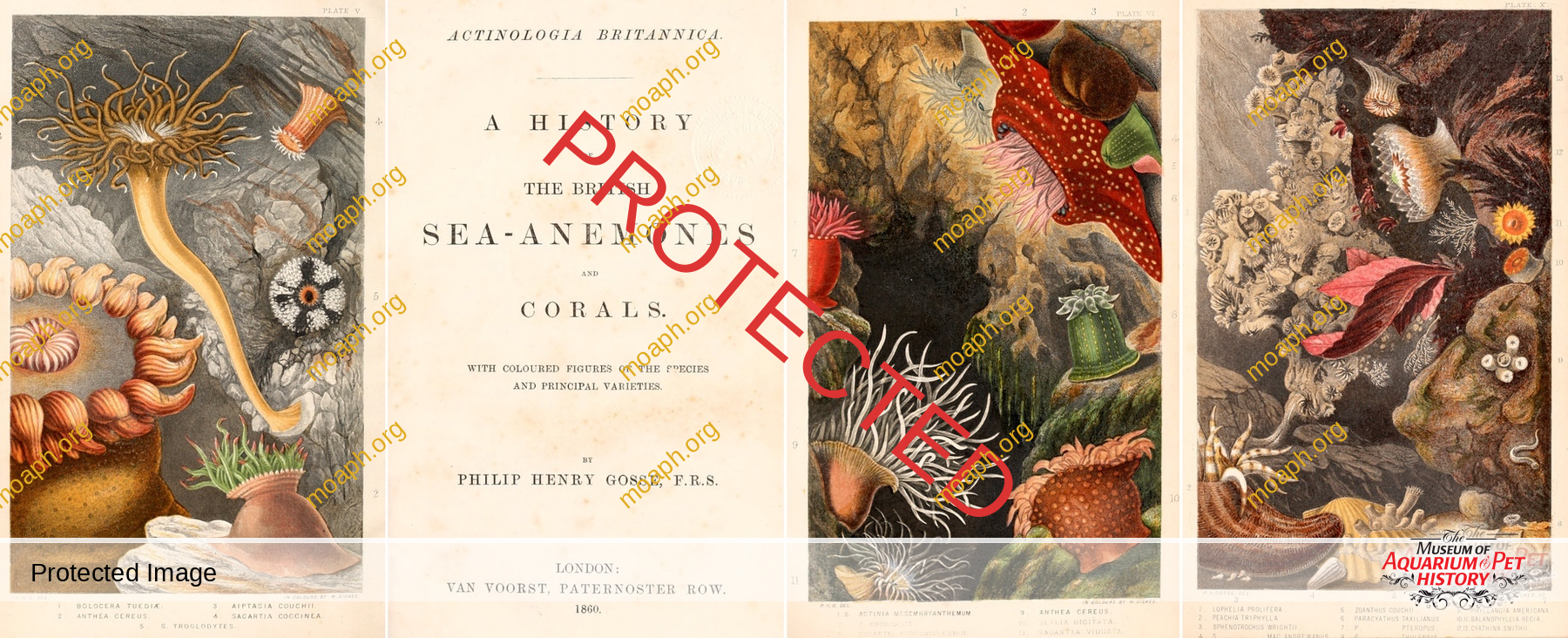
A few pages from the book A history of the British sea-anemones and corals by P.H. Gosse, 1860.
I am just as eager as ever to get new animals for our Aqm. […] Your Amphioxus [Branchiostoma lanceolatum] are all right, and I am very proud of them. These are the lowest fish in our collection here – our highest being Labrax, and our mortality is very small indeed. We do not obtain our success by dishonest means, as by cohabiting Reptilia, Aves, and Mammalia, as at Brighton and Berlin. We strictly and severely confine ourselves to non-lung healthy animals, from Sponges to Fishes, and I hope you will do the same, though the vulgar people – rich or poor – cannot see why I so object to lung-breathing animals. At Brighton they have Seals (Phoca) and otters (Lutra) and I believe Birds are coming. This is an insult to science. Certainly, all animals are interesting, but if words are to have definite meanings as expressive of ideas – such exhibitions should not be called Aquaria. An Aqm is an arrangement in which unchanged water is preserved in respirable condition for animals which respire it and therefore if one introduces animals for whom water is not a respiratory medium – but only a medium for motion, as Turtles (Chelonia) and the other animals I have named, their whole significance is lost, and we get Chaos back again. […]
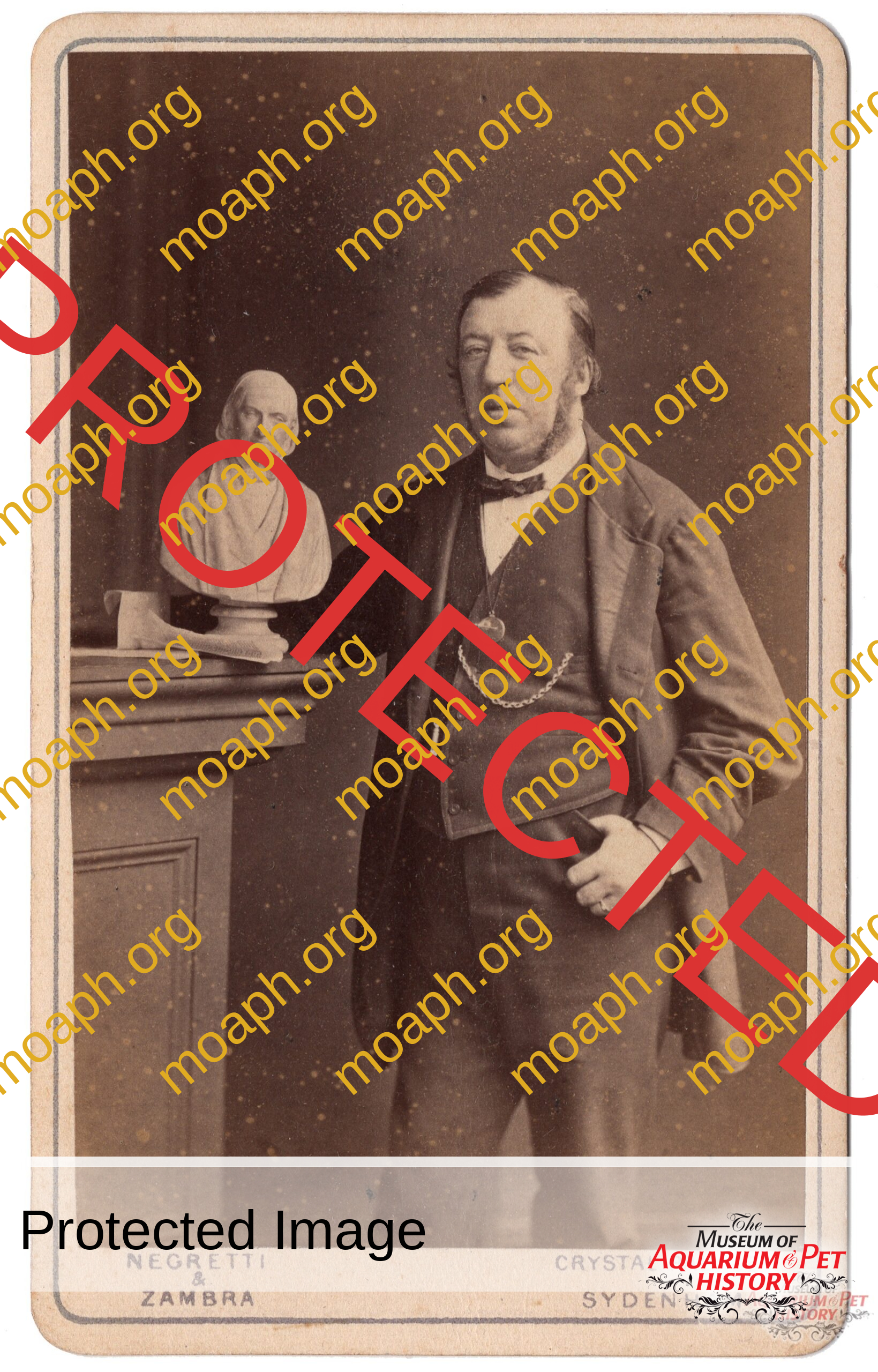
Lloyd in the 1870s, posing near the bust of the naturalist Edward Forbes. ©Stazione Zoologica Anton Dohrn, Archivio Storico (ASZN, 1.La.71.).
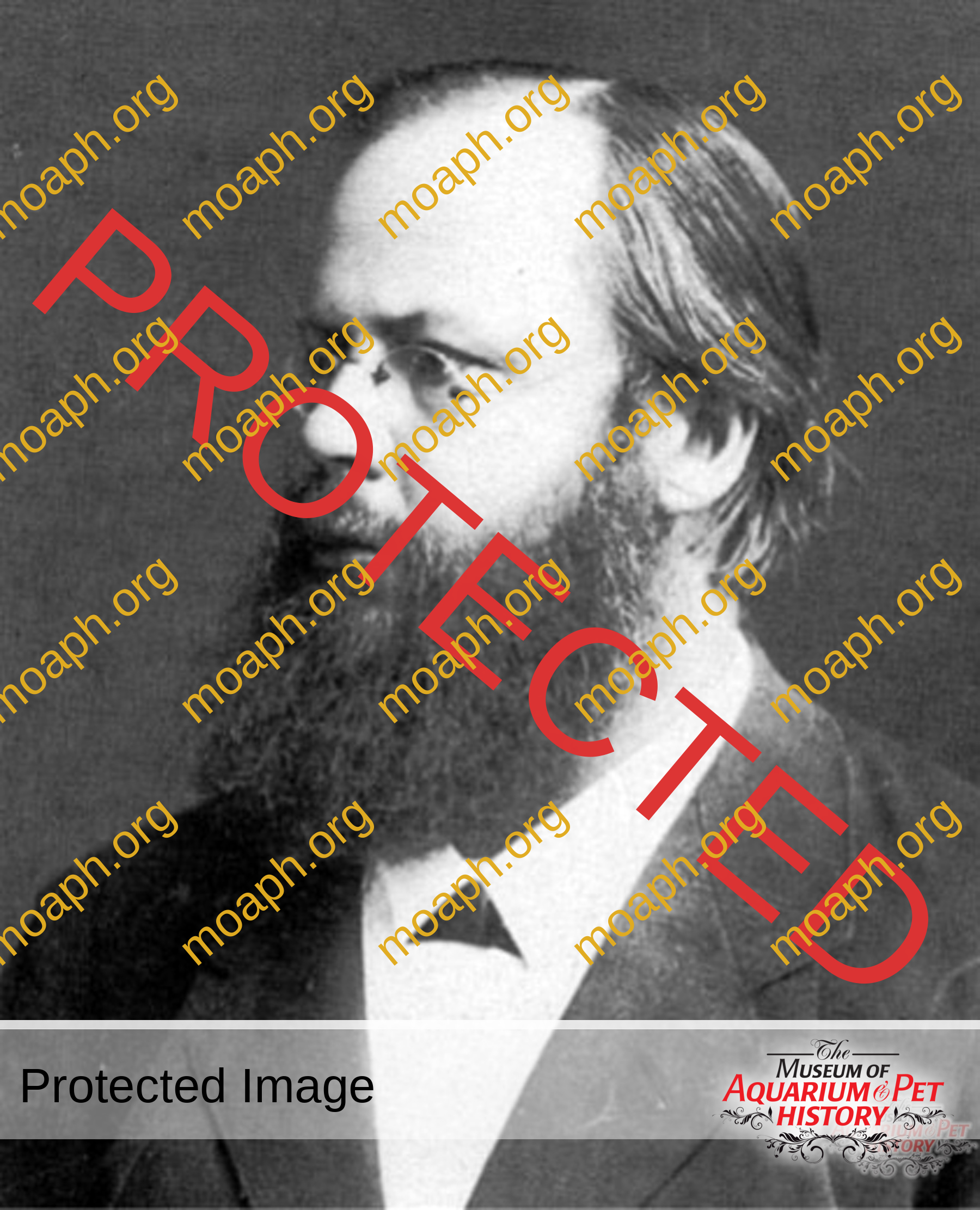
Felix Anton Dohrn came from a very different social background to Lloyd. He was born in Stettin (Prussian Province of Pomerania) into a wealthy middle-class family. His grandfather, Heinrich Dohrn, had made the family fortune by trading in sugar. Anton’s godfather was the popular Felix Mendelssohn, Lloyd’s favorite composer.
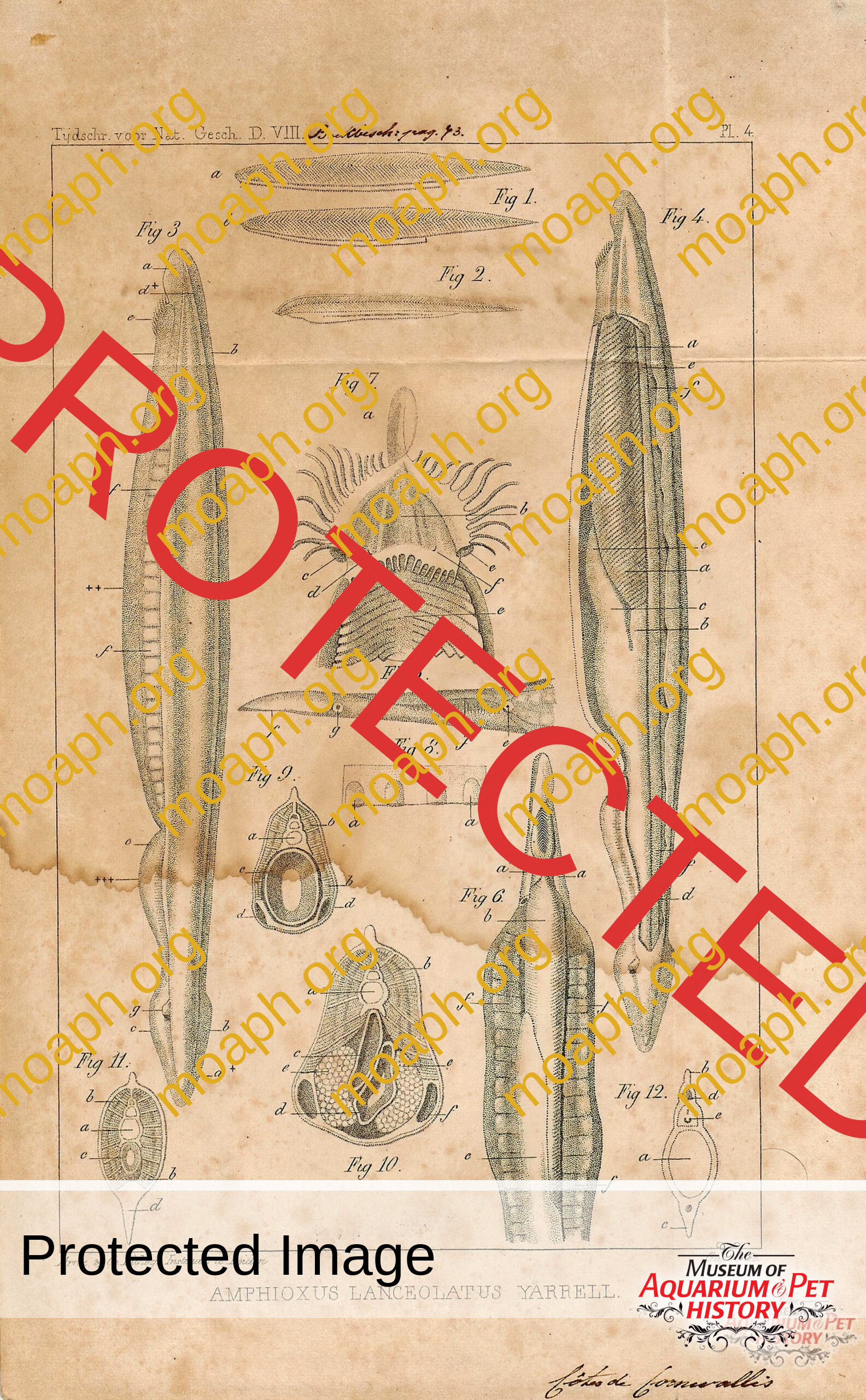
In the letter dated March 5, 1873, Lloyd wrote to Dohrn: “Your Amphioxus are all right, and I am very proud of them.” Lloyd received his five lancelets inside a registered letter from Naples to the Crystal Palace Aquarium! Dohrn used wet seaweed to keep them alive during the long journey. After being placed in running seawater, four of the five animals survived.
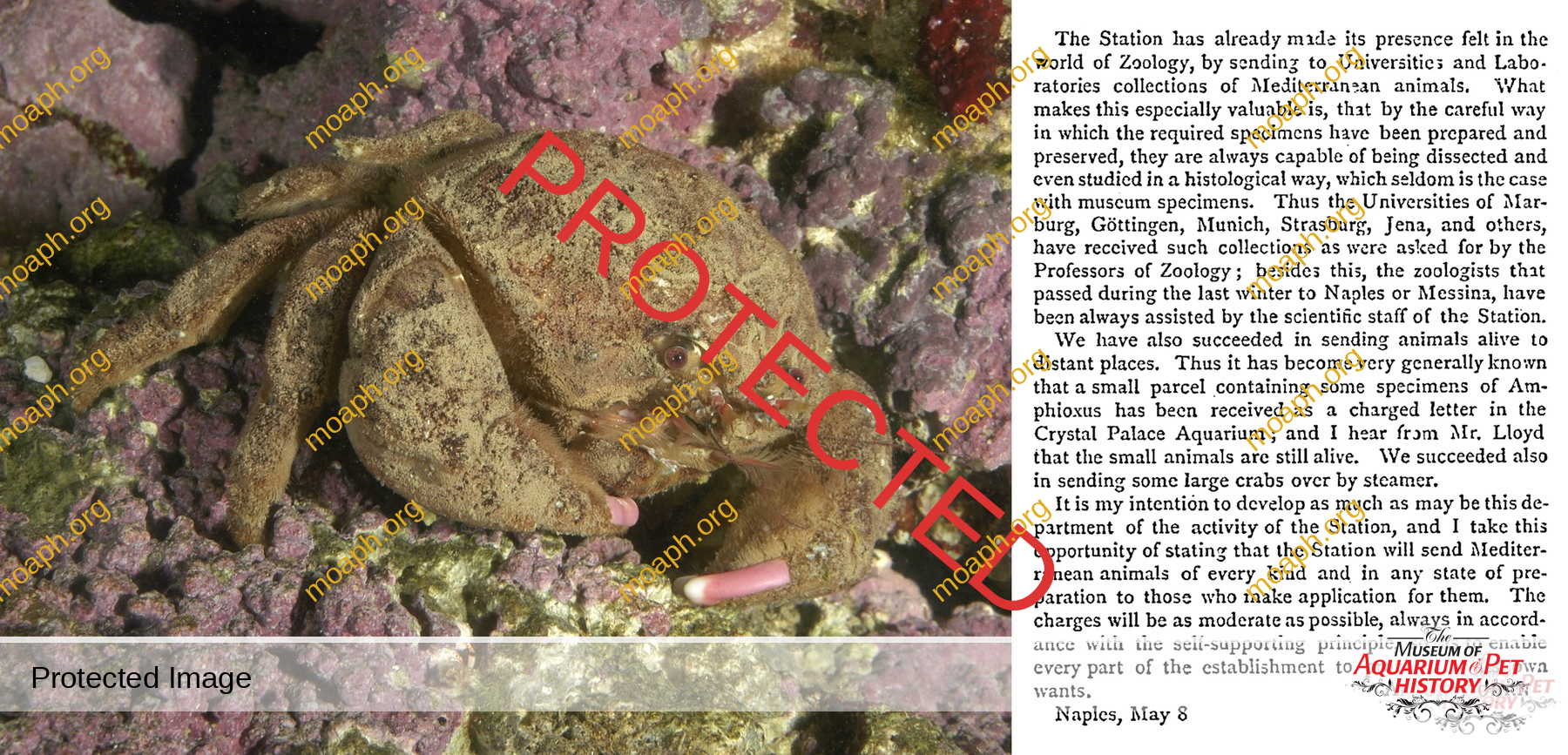
Dromia personata was one of the early live animals which Lloyd received by steamer from Dohrn. On the right, an excerpt from an article published by Nature in 1873.
The Brighton Aqm is not a success in spite of all that may be said, as the expenditure and mortality are both very large. About £80,000 to £100,000 have already been spent, and the company is asking for an Act of Parliament to raise £60,000 more. The first builder – Jackson – has an action at law (process) about to be brought against them for £30,000 and they have already lost £10,000 on another action, and another sum (I don’t know the amount) on a third action. All this spells RUIN.
Now I must work at my desk till midnight.
Note: In England blue ruin is doubly bad!”
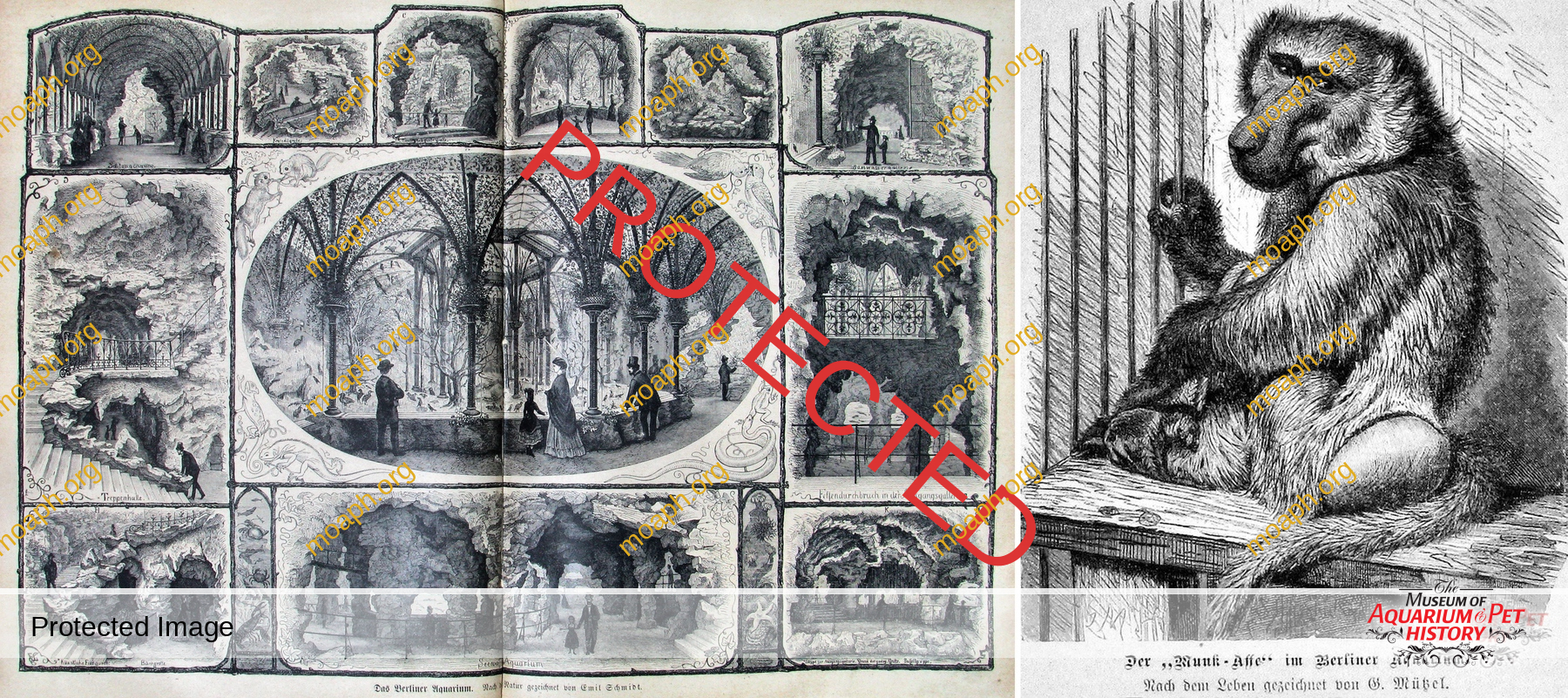
The Berlin aquarium (1869-1910).
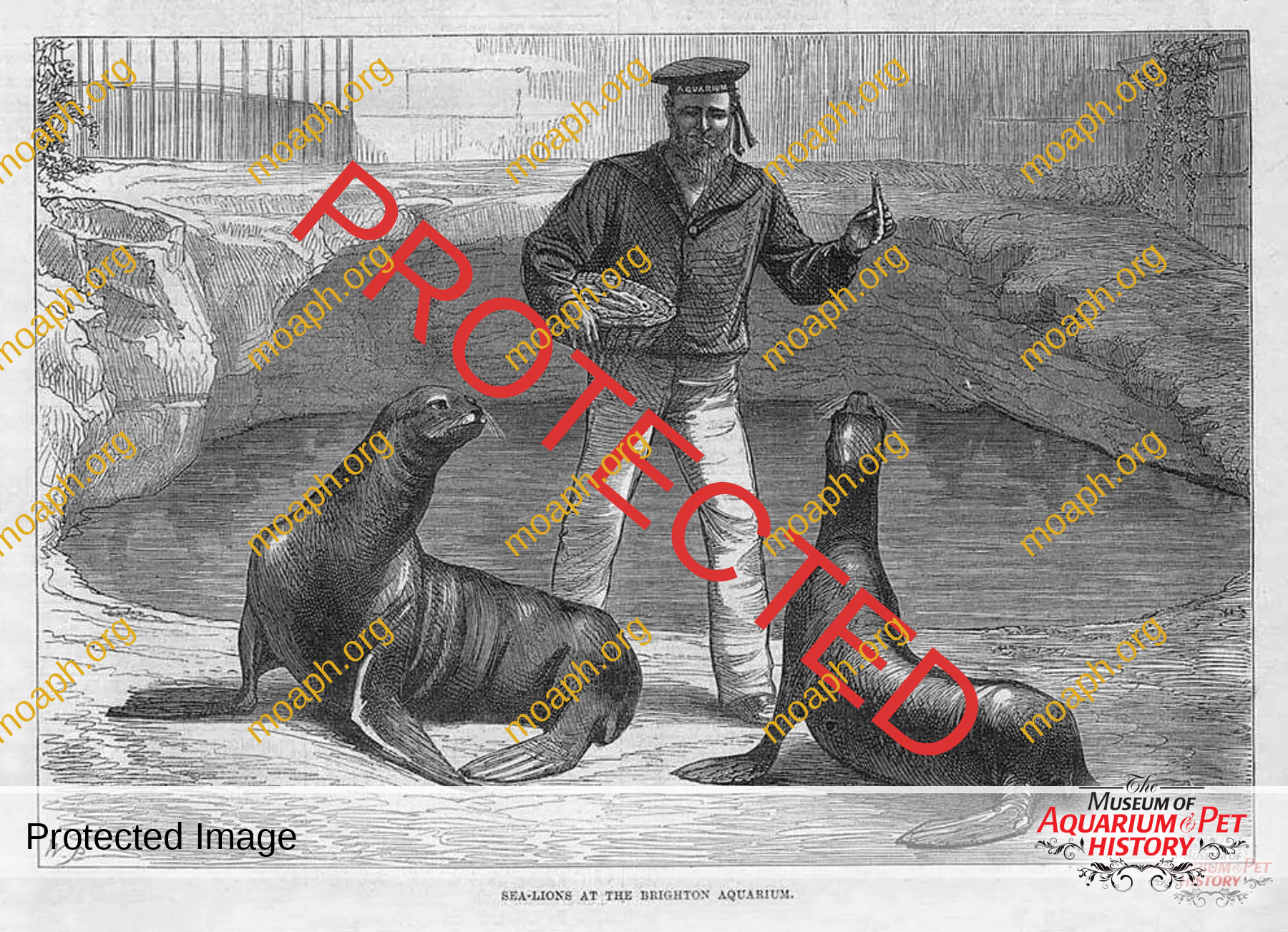
Sea lions at the Brighton aquarium. Picture from The Illustrated London News, 1877.
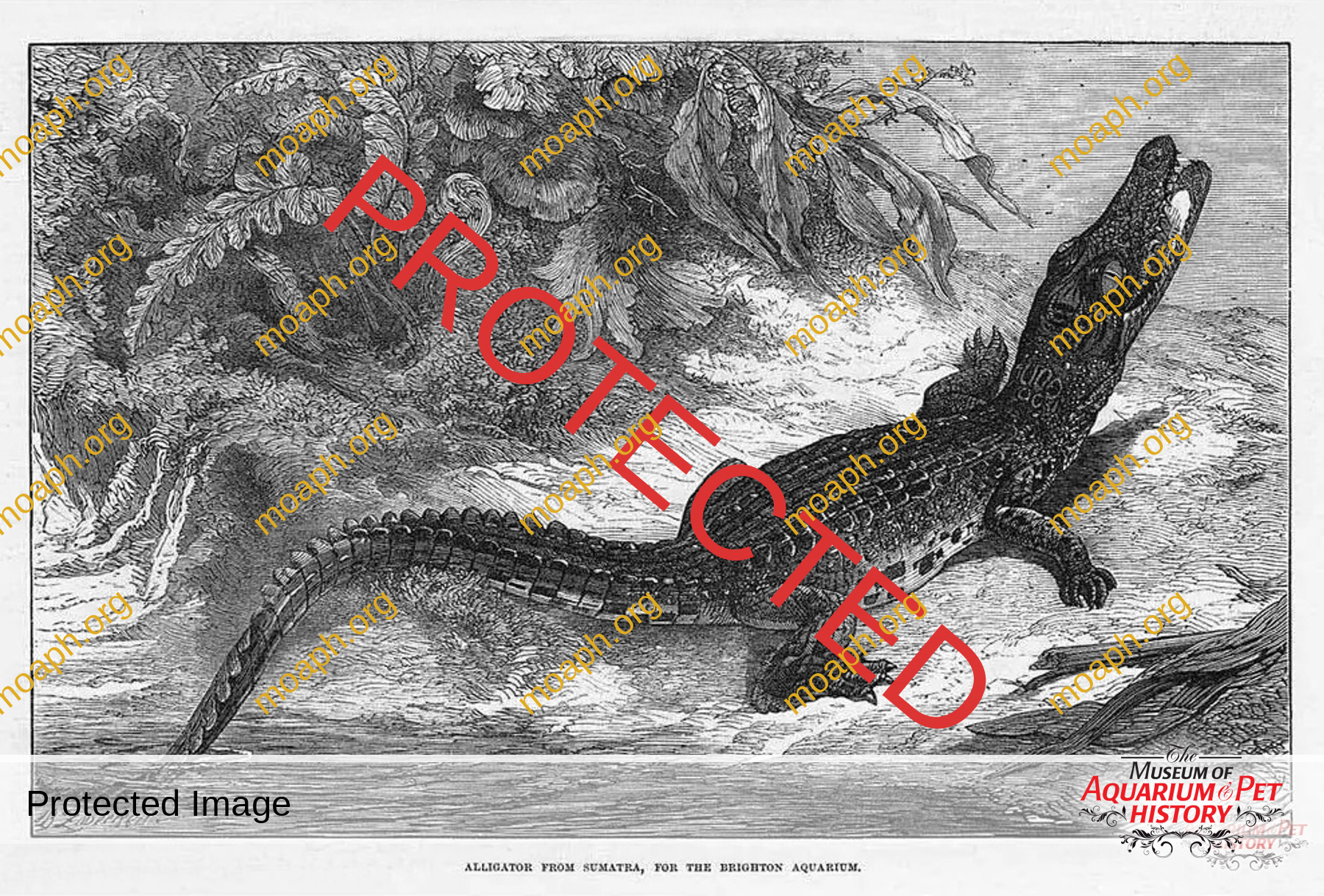
One of the two alligators collected for the Brighton aquarium. Picture from The Illustrated London News, 1877.

From left to right, pages 13, 14 and 20 of the long letter dated March 5, 1873. ©Bayerische Staatsbibliothek.
March 28, 1873.
“Nearly all your things – engines, pumps, pipes, glass etc went by the steamer ‘Aurora’ on the 18th of this month, and the rest will go by the next steamer. I am doing all I can for you and the fitter who will go out to you is being trained here by me in doing similar work in adding to our place.
This afternoon the Latona brought seven crabs, all alive, and we are greatly pleased with them. […] And the ship people said that as you did not know when the Latona came to Naples, there wasn’t time to send more animals. So will you please look out for the Aurora’s arrival, and send some things by her, as she has a similar cask to the Latona on board.”
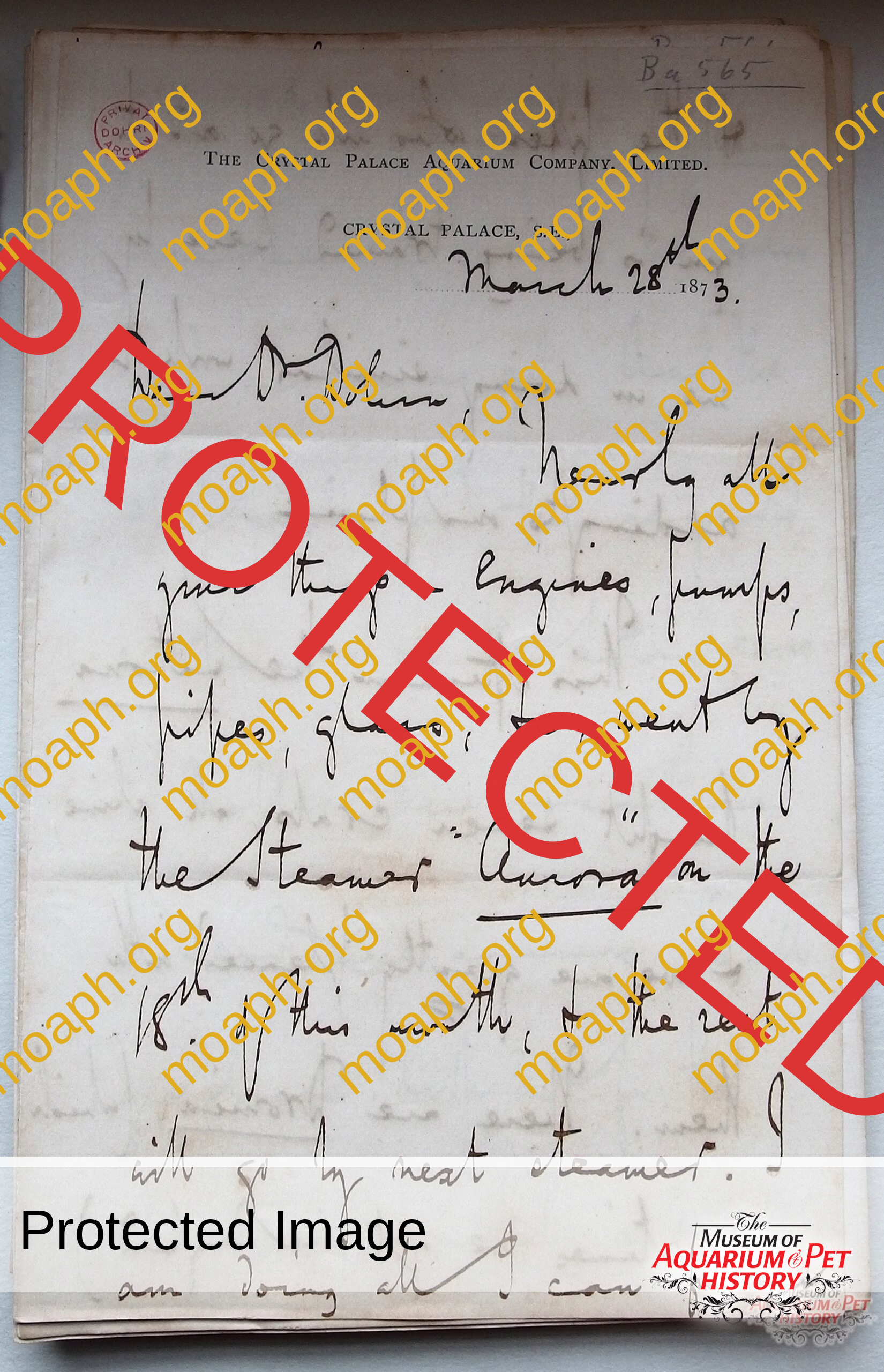
First page of the letter dated March 28, 1873. ©Bayerische Staatsbibliothek.

Victorian telegram. ©Bayerische Staatsbibliothek.
July 11, 1873.
“… I am glad Digan pleases you.
Send me more animals, and especially more of the Corals you once sent, all of which have been stolen from us. I am now protecting the tanks they and such things are placed in…”
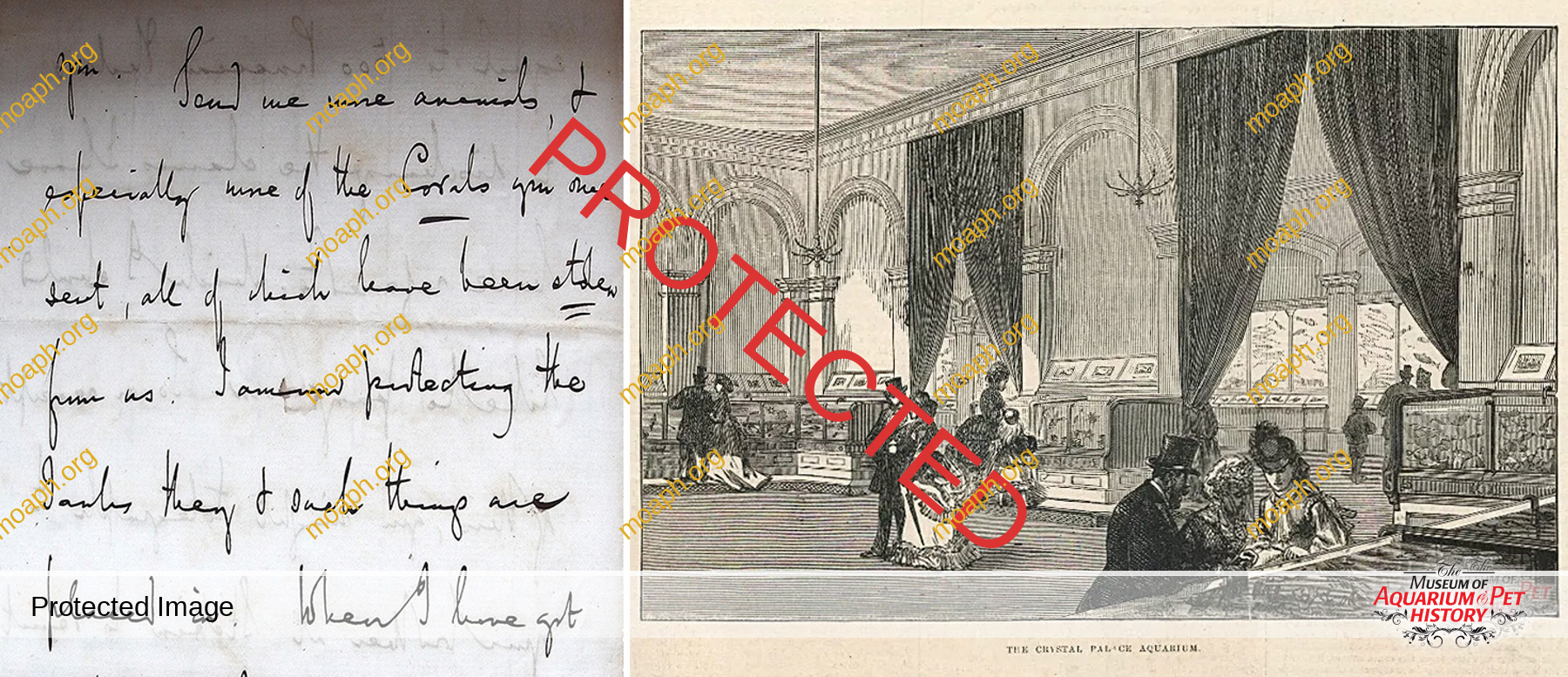
Close-up of page 4 of the letter dated July 11, 1873: “…Send me more animals, and especially more of the Corals you once sent, all of which have been stolen from us. I am now protecting the tanks they and such things are placed in…” ©Bayerische Staatsbibliothek. Right: the most popular illustration depicting the Crystal Palace Aquarium (Illustrated London News, December 30, 1871). This facility had both Regent’s Park-style table tanks, which were designed to be looked down upon, and large wall-mounted display tanks.
August 23, 1873.
“I have received your various letters which I will in detail answer on my return to London. I am writing this in the new Zoological Gardens of Frankfurt on the Maine, where I have been sent for to consult about a fine and large Aqm being now built here, and which I trust will be opened in Nov 1874.
I have heard from the glass people about the three new squares of glass you ask for, and which are now nearly ready, but they ask me whether you have not made a mistake about one piece, which you quote as 5 feet 4 inch by 5 feet 8 inch.
They however cannot find in your former order any piece of a size corresponding to this. They say that perhaps you mean: 72 inches by 64 inches.
Please say which is right, as if wrong it could not be easily altered…”
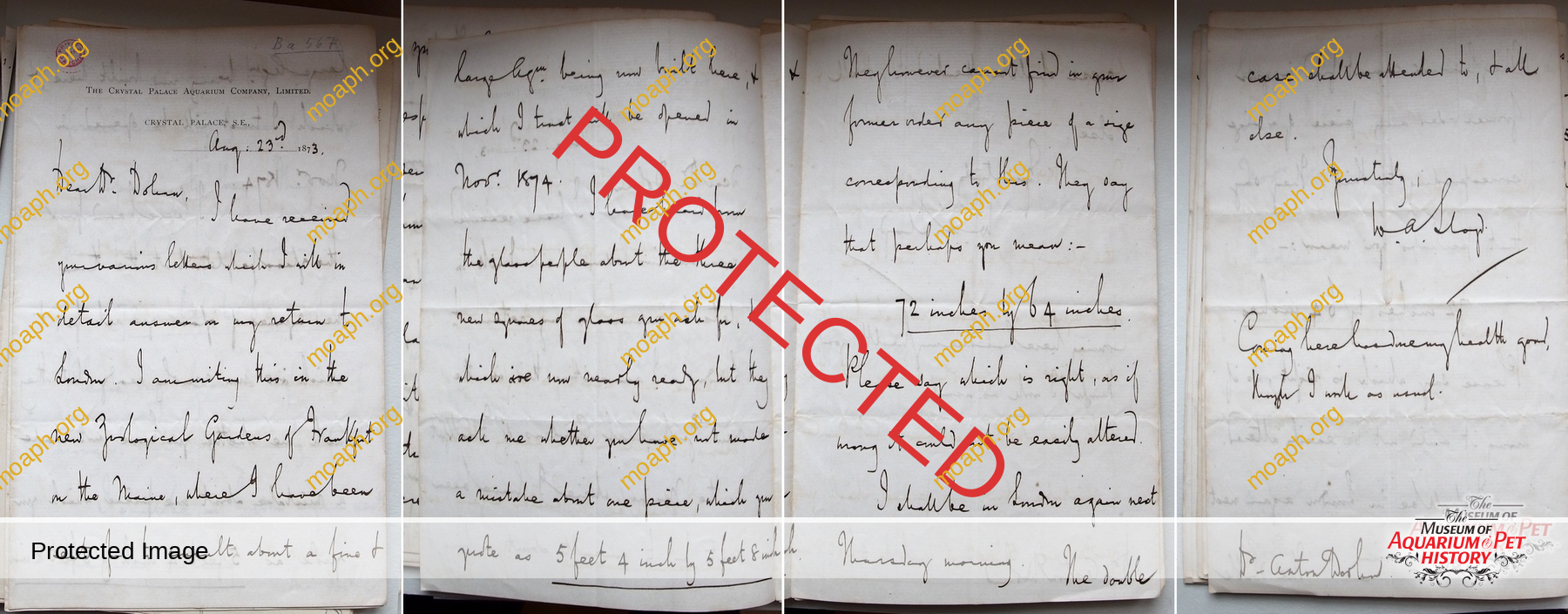
Letter dated August 23, 1873. ©Bayerische Staatsbibliothek.
September 3, 1873.
“I am now at home again, and shall be glad to see you, only give me notice by letter or telegram of the day and hour of your coming, that I may arrange not to be out.
I have very much to talk about and to consult you respecting, so give yourself time for me and don’t hurry away, and be to me what Professor Huxley called you in a letter of his which you shewed me [Victorian spelling of the verb “to show”] – a “whirlwind”!
I have not had any answer from you about an admeasurement of one sheet of glass. I greatly want this information, as I don’t want to waste your money.
Enclosed is a registered letter – so I also register mine and all I have sent you, or caused to be sent in my absence, has been similarly registered.
[Note after signature] You see by my handwriting in its want of neatness, that I am nervous and bothered and not well. Sorry you have been bad and hope the change to England may cure you.”
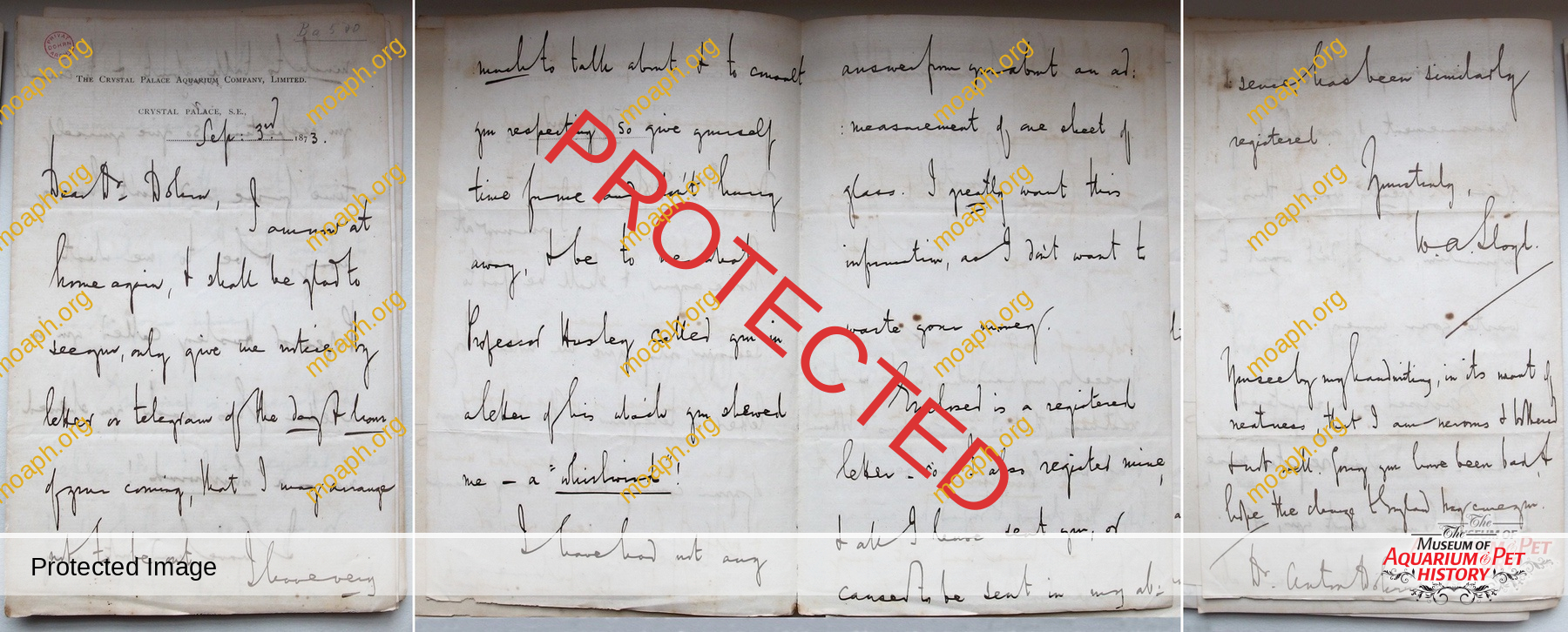
Letter dated September 3, 1873. ©Bayerische Staatsbibliothek.
September 13, 1873.
“… Last night came a telegram from Naples asking that the cutting of the glasses may be suspended till a letter with measurements arrives. I have therefore done what was necessary in the matter with Goslett.
I fear that my literary endeavours are too humble to be regarded in a very elevated light by great learned men in universities and other seats of learning but am earnestly trying (and with me earnestness means much) to make the book I am now doing in numbers for Cassell (and which at your recommendation I have made to assume an autobiographical form) be an eminently useful volume for all kinds of workers, even for such an establishment as yours will be at Naples. At first Cassell did not care about my manner, but as I went on and developed my plan he saw I was writing in an unusual manner, and he now is exceedingly anxious to have my manner.
But as I said before, I am timid, as I did not go to school, and had no collegiate advantage, I never even learned grammar…”

Close-up of page 6 from the letter dated September 13, 1873: “…I am timid, as I did not go to school, and had no collegiate advantage, I never even learned grammar…” ©Bayerische Staatsbibliothek.
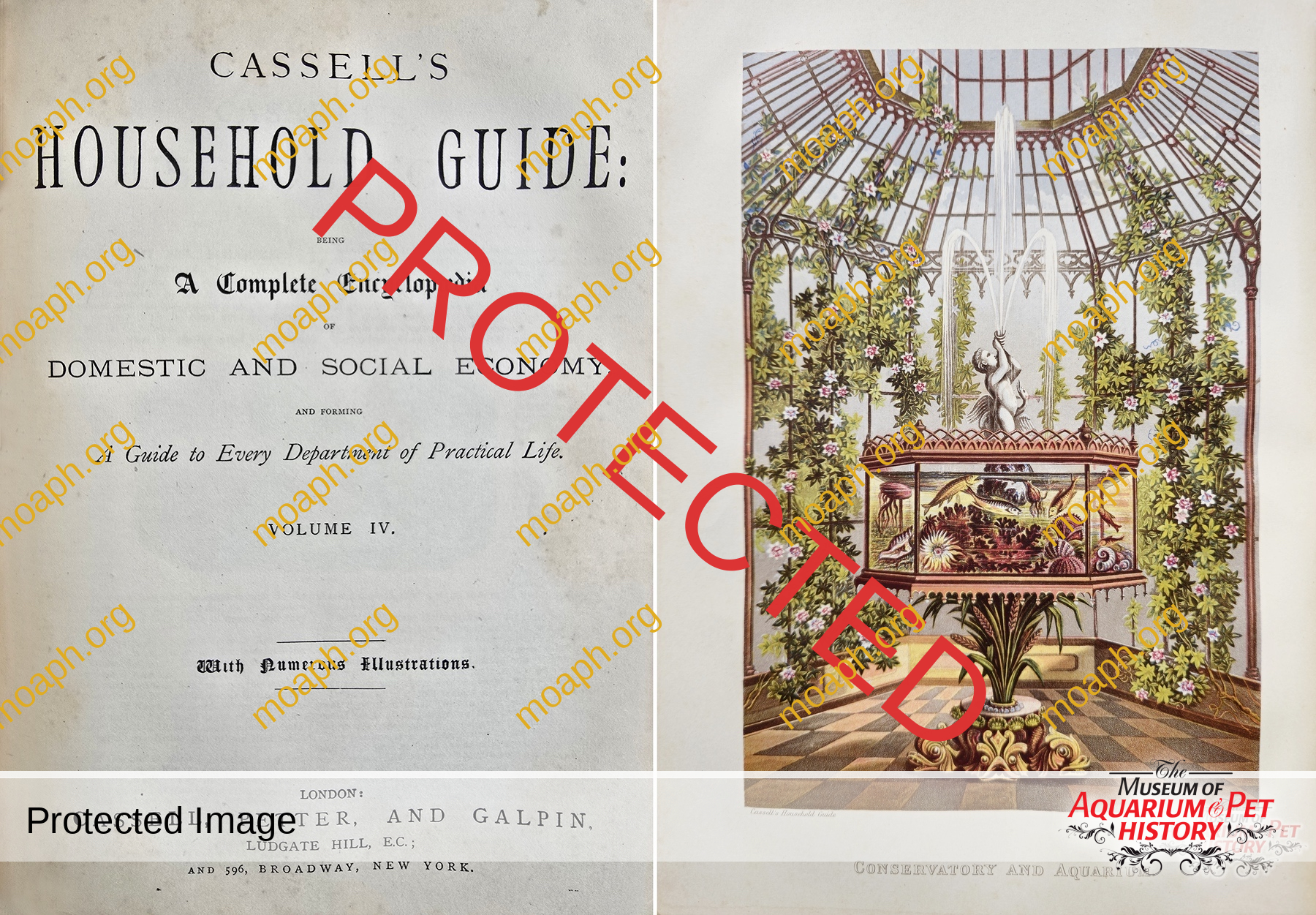
Despite the multiple financial ups and downs, the publishing house founded by John Cassell (1817-1865) was one of the most important of Victorian England. Lloyd published numerous articles in Cassell’s Popular Recreator, and after the Aston Aquarium bankruptcy he also worked for this publishing house as a consultant. This is the iconic illustration published in Volume IV of the popular Household Guide.
September 16, 1873.
“…I was much disappointed at not doing so the other day when you were here, but you seemed too unwell to converse. However, as you can talk to Ray Lankester, you can talk with me.
P.S. 3 pm. Just got a letter from the glass people in reference to the telegram from Naples to which I yesterday referred saying that the message came too late, as all the glass was cut save two pieces. So you had best arrange for other parts to fit the glass and not the glass to fit them.”
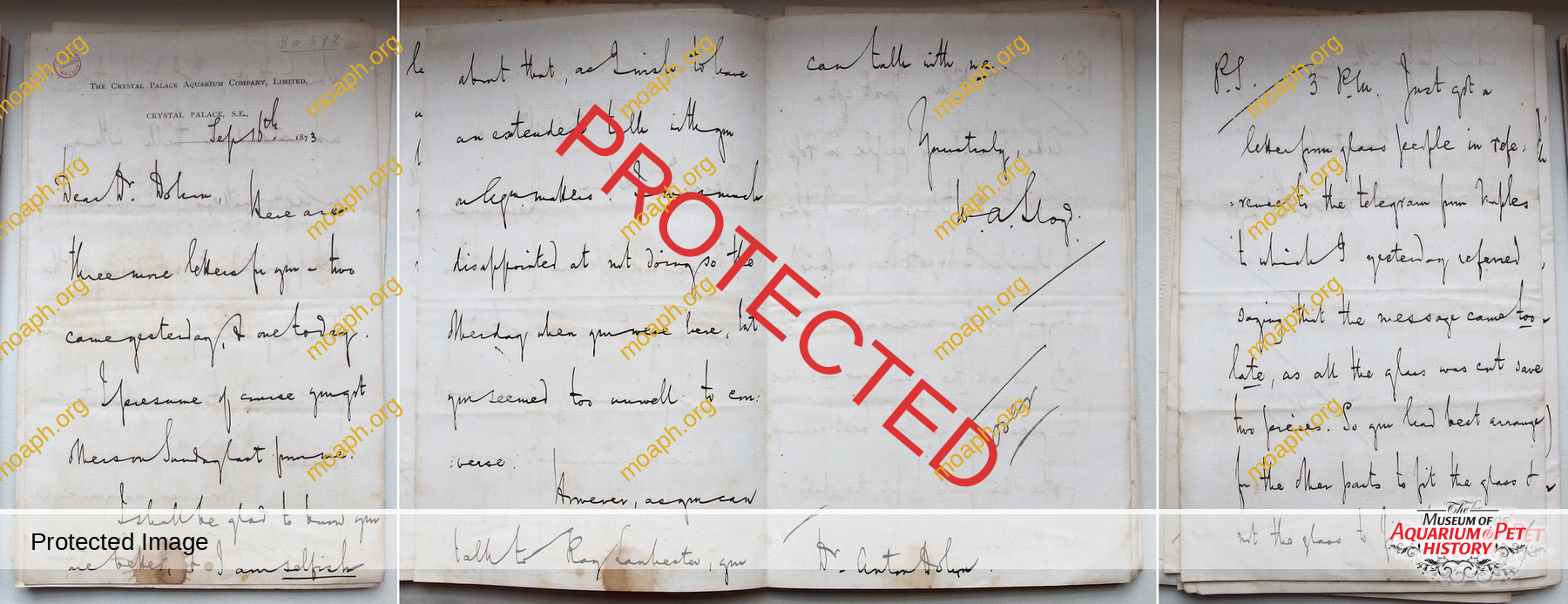
Letter dated September 16, 1873. ©Bayerische Staatsbibliothek.
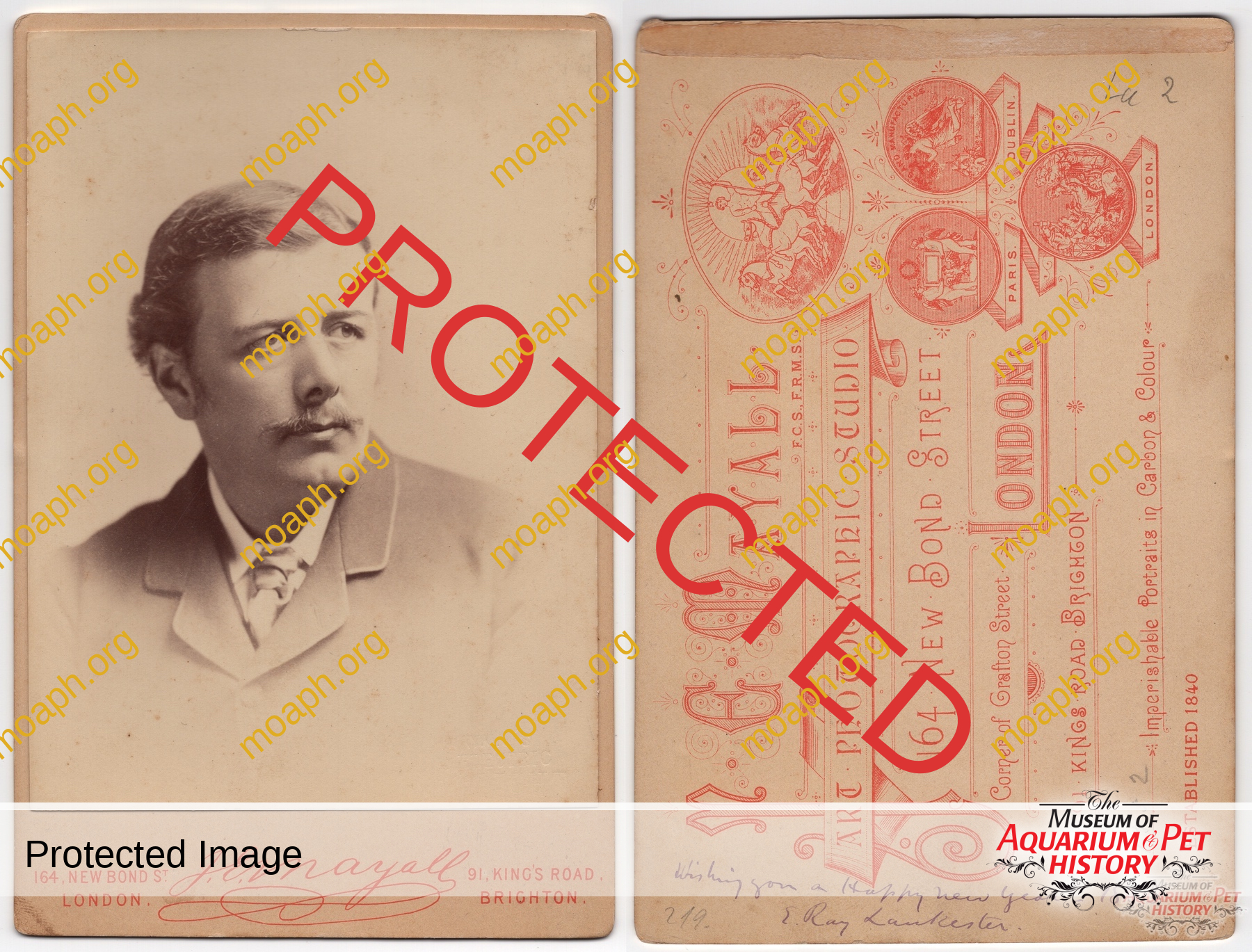
E. Ray Lankester (1847-1929), a British zoologist renowned for his research on annelids and arthropods, was one of the earliest scientists to take advantage of the services offered by the Zoological Station. He arrived there for the first time in October 1873. ©Stazione Zoologica Anton Dohrn, Archivio Storico (ASZN, 1.La.2.).
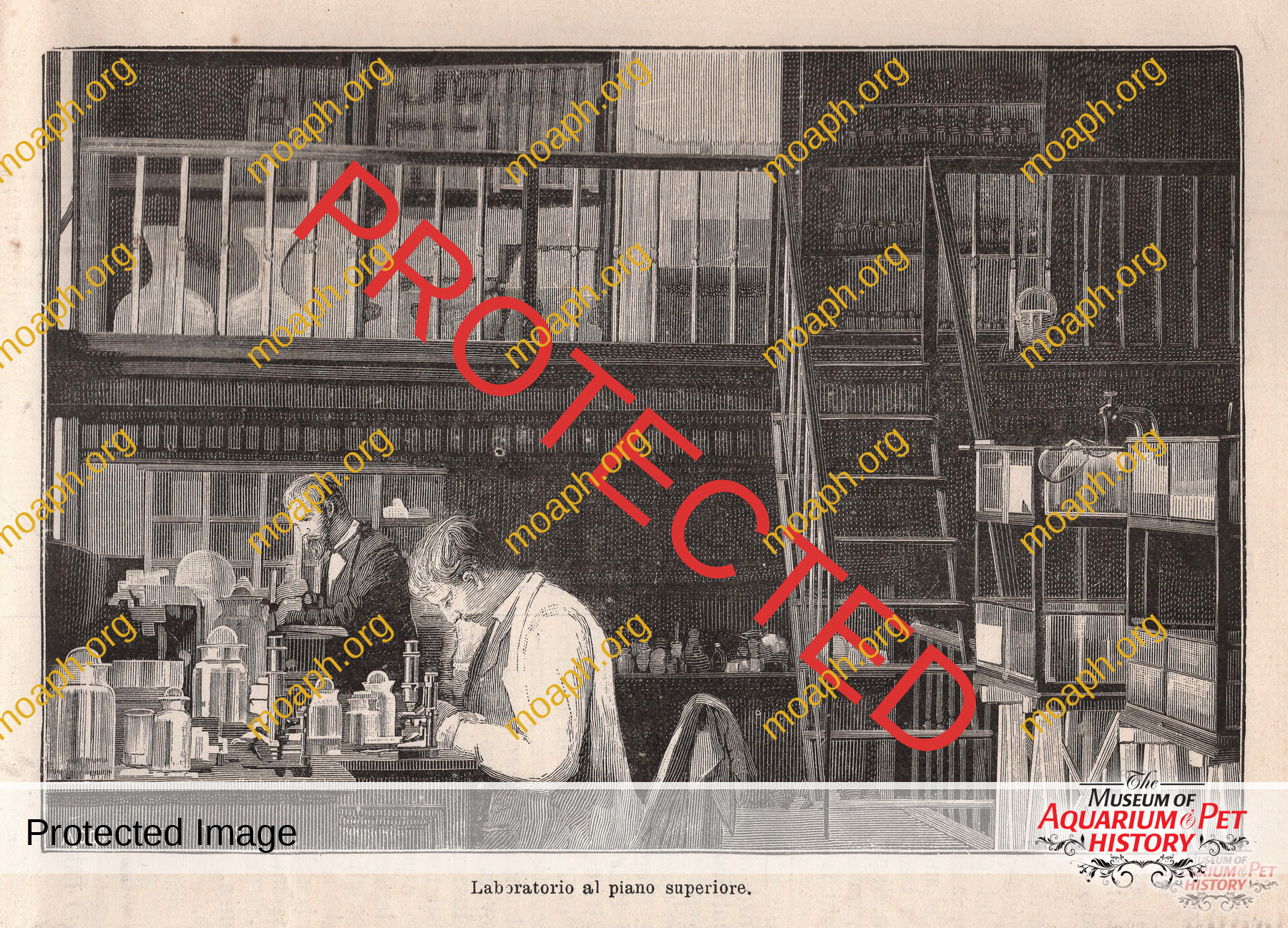
The Zoological Station was an independent research institute on marine biology that successfully experimented with the so-called “table system”, becoming quickly a mecca for researchers and scientists from all over the world, and a model to replicate on an international scale. This illustration published by the newspaper L’Illustrazione Italiana in 1886 (Vol. XIII, No. 51) depicts one of laboratories located on the upper floors.
September 19, 1873.
“Enclosed are letters. I will send them and this away tomorrow – Saturday – by the morn post. I also send you Goslett’s measurements of your glass. To be quite plain with you, I do not at all like this cutting-up, and I do not believe in its necessity, if you had but a competent theoretical engineer at Naples. […] If I add that I am anxious as you are to get all the monies I can to pay people, and so keep our credit good, it is merely to respect what you already know. So tell me all about all things. I assure you I m very honestly proud (not vain as you said the other day, A.D.) to be connected with this great “station” affair and it is natural that I should be so after all the struggles I have gone through for aquaria for twenty years. See the first number of my narrative enclosed.
As soon as I get a couple of hours, and I am in a good mood, I will send your lady a long letter and accompany it with a packet of printed and other matter. It will make her both laugh and think.”
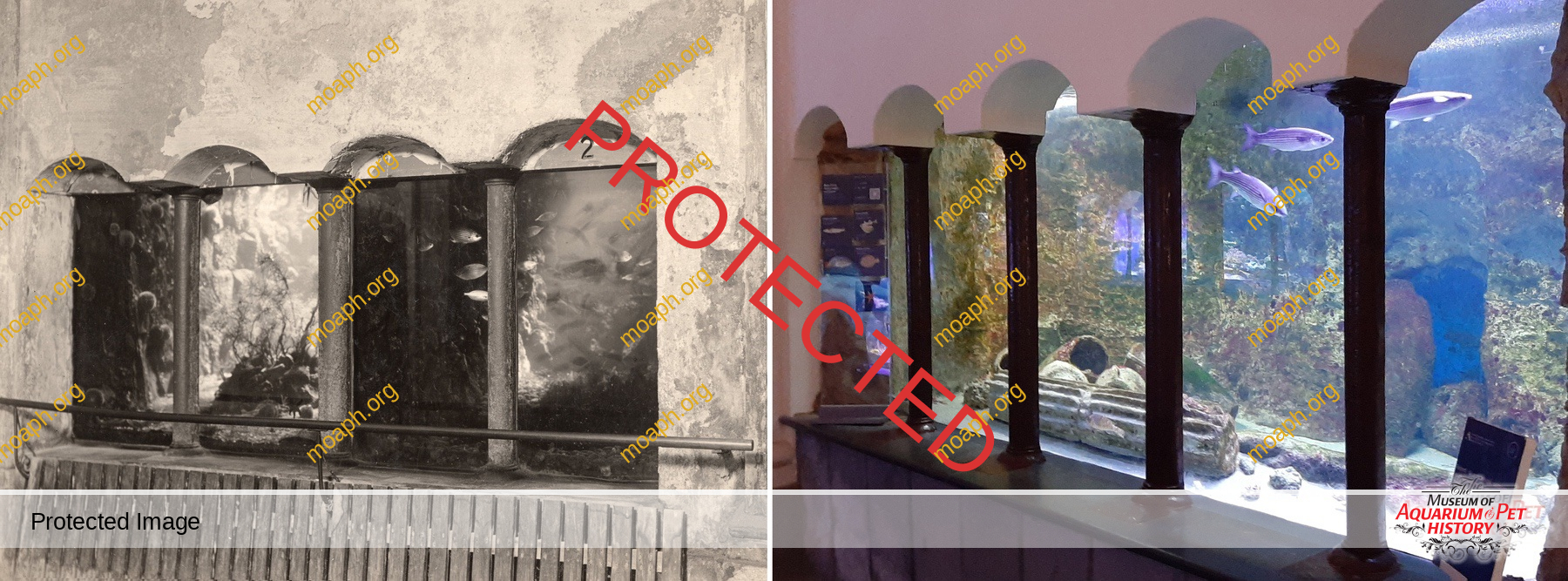
Tanks n. 1 and 2 at the Naples aquarium. Notice the sunlight coming from the skylights on the roof. ©Stazione Zoologica Anton Dohrn, Archivio Storico (ASZN, 1.Lb.6.1.22). On the right, the Aquarium as it looks today.
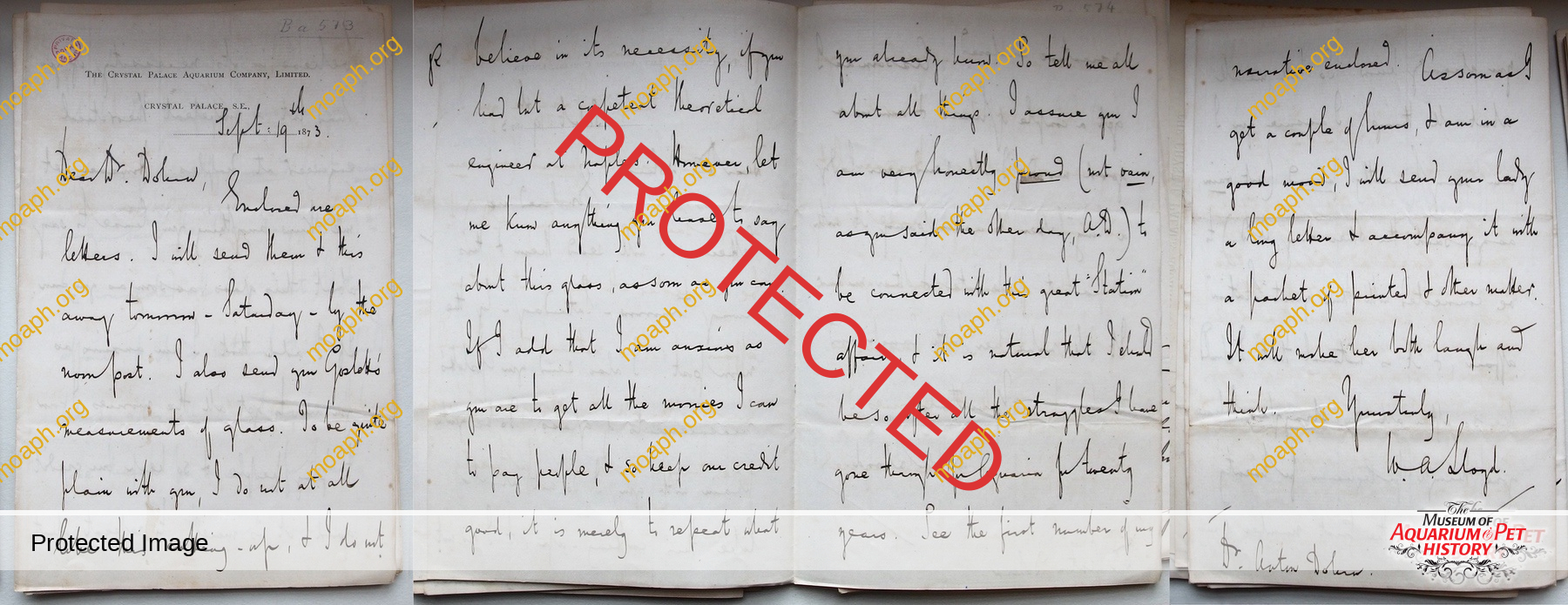
Letter dated September 19, 1873.
End of part 1.
Acknowledgements
Thanks to the following parties for their assistance: Andrea Travaglini – Archivio Storico Stazione Zoologica Anton Dohrn, and Maximilian Schreiber – Bayerische Staatsbibliothek.