
The Bengalese or Society Finch
In some peoples’ eyes, this is a rather nondescript little bird whose unmusical song, though not unpleasant to the ear, has none of the attraction of many of its cousins. Yet, it is a very popular choice of cage bird and is annually bred in very large numbers. Therein may be one of the reasons for its popularity, as it is a relatively free breeding bird. Also, it is possible to maintain these birds in small cages and they only require a fairly plain and meagre diet. It is also commonly used as a foster pair for birds that are rather more difficult to breed and has a reputation for its willingness to accept the young of most small seed eating birds. The bengalese is also used for exhibition purposes and there is a great deal of competition amongst breeders to produce birds that meet the requirement of the show judges.
It is with the question marks over the ancestry of this bird that the story of this little finch assumes something of special interest, for over many years, experts have disputed the origins of the bird.
Here I am not simply talking about the geographic location of the original wild bird, but whether or not it is a true bred species or a hybrid between at least two, though possibly more, related species. As to the first part of this question, you would be excused for thinking that the clue is in the name: Bengal is of course a part of India and one potential ancestor can certainly be found in the wild in that country. In the past some people have suggested that it was derived from a programme of hybridisation between the sharp tailed finch and the indian silverbill, but this is no longer believed to be the case. It could however also explain the misleading name, for if westerners when giving the bird a name believed that it originated from the indian silverbill, they might well apportion it a name from that region. From personal experience, I am able to confirm from personal experience, that the bengalese finch will readily breed with the indian silverbill, though as I sold the offspring, I have no personal record of whether the resulting hybrids were fertile. It is well documented that the bengalese will hybridise with several related species and produce some fertile hybrids.
However, the commonly held view is now that the bird is not a hybrid at all but a domesticated version of the white rumped munia. Certainly, even a cursory examination of the munia suggests that is the parent of a bengalese finch and it leaves you wondering just why there was ever any doubt about its parentage.
The likelihood is that the bird originated in China as a domesticated cage bird. The origins of this domestication go back many centuries and although the Chinese preference in modern times is to keep birds for their singing abilities, it is not impossible to believe that the first keepers of this bird saw its potential as a cage bird that could easily be bred in captivity and that could produce colour variants that would offer a particular attraction. As we shall see, the development of this bird really took off when it was traded with Japan, and it was the bird keepers of this country that established it as a popular cage bird.
There is long history in Japan of altering natural creatures for the satisfaction of their keepers. The Koi carp is perhaps the best-known example of this, where colour variations are the great attraction for their keepers. The bengalese finch offers not only some colour variations, but combinations of colour that are not entirely different from those displayed by the carp. It appears that the Japanese concentrated on producing the bird in its pure white form, as indeed they did with the Java sparrow which it is also thought to have transferred from China to Japan as a domesticated bird.
There have been some questions asked concerning the validity of this historical account, for during the period when the finch was said to have been traded from China to Japan, the Japanese followed a strict policy of isolationism. This meant that trade with overseas countries was strictly forbidden. However, there is a possibility that the bengalese finch was an item of illicit trade between sailors who may even have met in the seas between the two countries. There certainly appears to be evidence that a particular breed of parrot made the transition between the two countries at around the same time and probably in the same manner.
Restrictions on trade were lifted in Japan in the year 1854 and soon afterwards, the bengalese finch began to arrive in Europe, with the first birds acquired by the London Zoo in 1860. From then on, its willingness to breed and the expertise of European bird keepers ensured that its numbers grew exponentially. It soon became, not only a popular cage bird but a bird for competitive showing and it remains so to this day. There are now very many colour variations and indeed also a crested version of the bird. Perhaps because the bird can be bred with relative ease, it became commonplace for the birds to be shown as matched pairs. This is an added complication for the exhibiter as they need to find a pair of birds that look as close as possible to identical.
This is a bird that can be maintained in a relatively small cage, though it will also do well in an aviary, and with an appropriate diet, sufficient water and light, when presented with a nest box will readily produce offspring. The only real complication can be in sexing the birds, as the sexes are identical and can only be definitely sexed by DNA analysis or more simply by listening and watching for the song of the male bird.
The confusion caused by people misinterpreting the origins of this bird does not in any way detract from its attraction as a cage bird but does provide added interest to what is otherwise a very common and undemanding bird. At the moment, there has not been a move to substantially increase the size of the exhibition bird, and so, as long as this remains the case; I suspect that it will continue to remain a firm favourite with many fanciers.
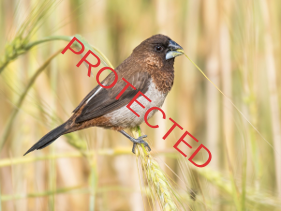
White rumped munia
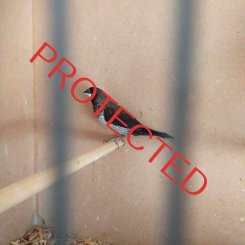
Normal bengalese finch
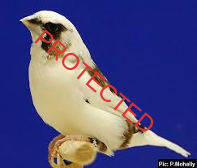
Chocolate and white bengalese finch

Crested bengalese finch