Chapter 15: Barn Door? No Obstacle! – Wilde Tiere Frei Haus (Wild Animals/Free Delivery)
Translated by Alex Haro

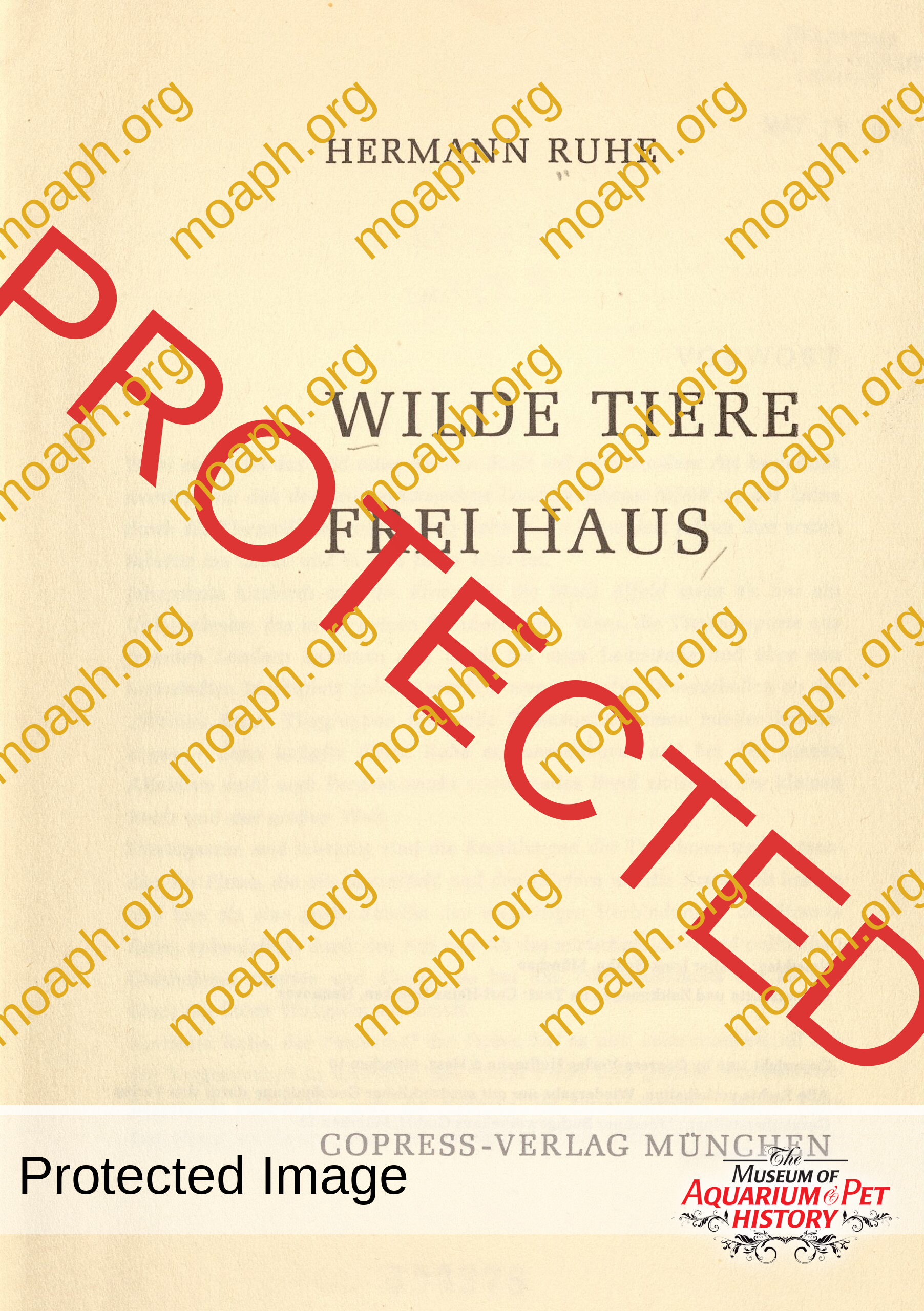
Starting in September 2024, the Museum of Aquarium and Pet History (MOAPH) started releasing a chapter a month on the translated autobiography Wilde Tiere Frei Haus (Wild Animals Free Delivery) by Hermann Ruhe.
Firma Ruhe (the Ruhe Company) was the name of an animal trading company based in Alfeld, Germany from 1860 until its official closure in 1993. During this time, they were world renowned for their importation and exportation of exotic animals and birds from all across the globe, even supplying many zoos as well as circuses. Having survived both world wars, Firma Ruhe continued to dominate the world of animal trading until the mid-20th century and is a testament to true determination and leadership.
Wilde Tiere Frei Haus (Wild Animals Free Delivery) also documents the plethora of adventures, failures and successes endured by all those a part of Firma Ruhe. Through Hermann Ruhe’s great storytelling, we are able to visualize and understand the world from the perspective of animal collectors navigating through some of the most difficult situations, often not knowing whether or not they would ever return home. His recollections provide a vivid portrayal of the challenges and triumphs faced by the company, and give readers a glimpse into the world of animal trading.
It seemed like a curse with the weather. For days it had been beautiful; now, just as the elephant transport arrived, it started snowing. I sent Sukla, an Indian trainer who had come with our newest import, with our tame female elephant ‘Birma’ to the train station to safely guide the arriving comrades through the city streets. Birma was experienced and gentle. If one of the generally young animals attempted to break ranks to the right or left, she nudged them back into line with gentle force. Sukla rode on Birma’s back because from there he could direct everything best.
As the animals entered Kalandstrasse, they were freezing miserably, although they had been covered with thick blankets up to their feet. They had walked correctly in the snow for quite a distance. I was at the train station and awaited the transport. It was almost 1:30 PM. In the wake of the elephants, my son Hermann, the schoolbag on his back, instead of going home for lunch, had followed them to the station…
Once he was already there, I immediately put him to use: “Go on—hurry back home, get the keys to the wine cellar and bring everything you find in terms of rum and cognac.” Hermann immediately set off willingly. Whenever he received a task, he beamed as always. He scurried to the chest in some corner of the hallway, fetched the keys, and dashed to the cellar, where he impressively showed his expert knowledge in picking out the right bottles and packing them into a round basket. Since the boy couldn’t carry it all by himself, I sent an animal keeper after him to help bring the bottles up.
Then we cooked a large kettle of light grog in the animal kitchen, which was served to the elephants in drinking buckets as hot as they could tolerate.
While the animals contentedly slurped down the warm brew, I said, “Hurry, hurry—rub them down quickly!” A rather unnecessary instruction, as my animal keepers knew just as well as I did that the animals needed to be dried off immediately to get warm again.
Although we were very attentive to the newly arrived animals, I did not miss the fact that Hermann made a grab into the so-called “elephant box,” a large wooden crate with a heavy lid that contained the elephants’ bread—stale white bread pieces that he particularly liked to eat.
“Have you lost your mind?” I said. “Your mother will scold you again later because you won’t eat anything at the table!”
Since we knew that my eldest frequently helped himself to the white bread as a ‘self-caterer,’ we no longer worried about his occasional lack of appetite. Even Sukla sometimes ate alone. Sukla would cook some Indian rice dishes by himself—mostly at night. At breakfast, he would only eat carefully with his fingers, as the boy described.
In the winter of the same year, a barter transport arrived from Russia, and I allowed Hermann to watch how it was unpacked. The transport was extensive and laborious to unpack. It was always my preference to be involved in the unpacking and setting up, whenever feasible, myself.
Without special supervision—all keepers were fully engaged—Hermann suddenly found himself alone in front of an enclosure where a Siberian ibex had just been placed. This ibex, a strong specimen, was in an enclosure with sides about 1.20 meters high made of solid, thick planks. Above that, there were stakes reaching up to about 2.50 meters.
The keepers had believed that the height of the enclosure would be more than sufficient for the ibex, which had already been fed, and now that other animals were unpacked, it was initially left to itself. Hermann stood by soulfully as the ibex attempted what seemed like a death-defying act of repeatedly jumping from one wall of the enclosure to another without touching the ground. It succeeded on the third try.
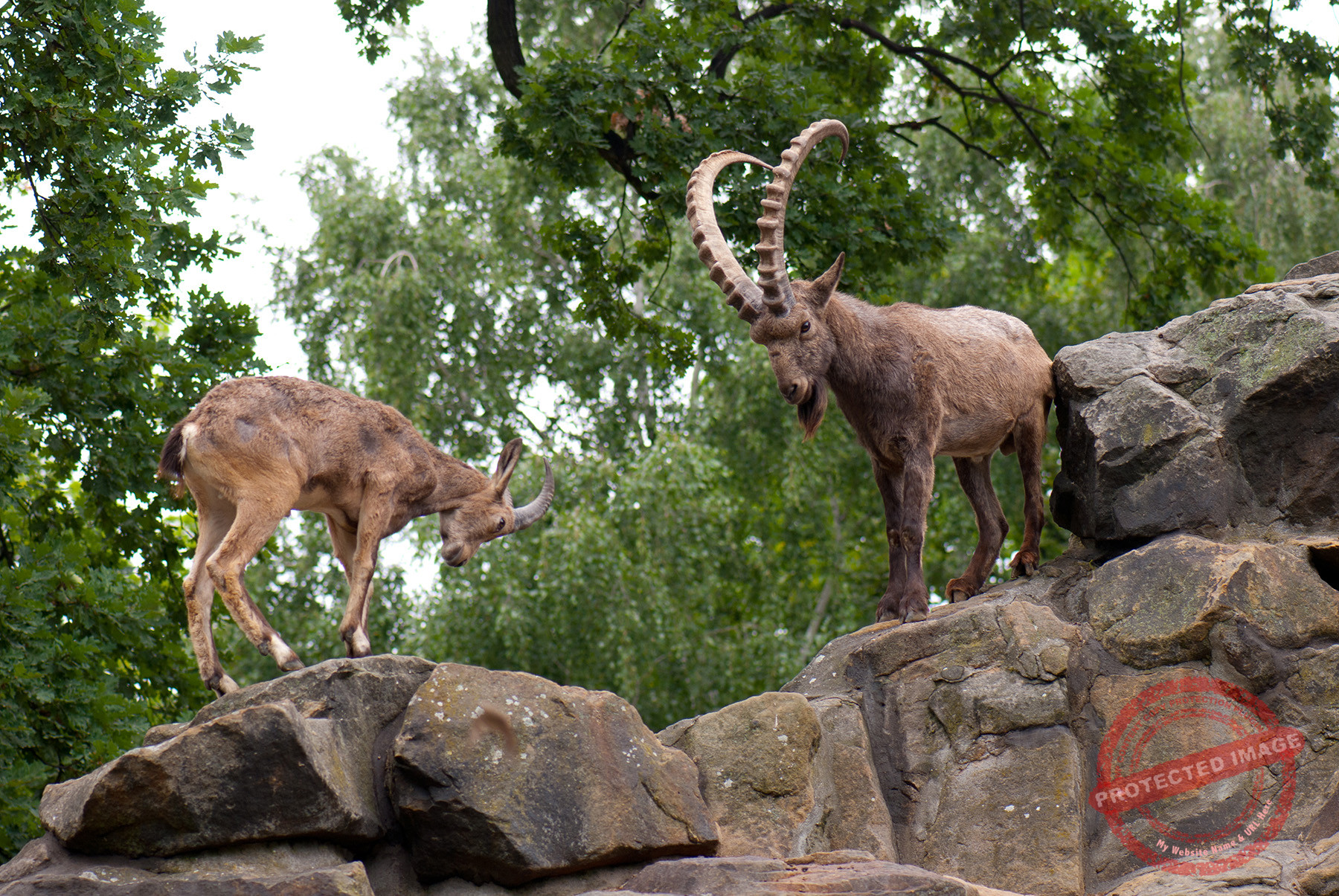
Quinet. Siberian Ibex.jpg. July 24, 2010. Photograph. Creative Commons Attribution 3.0. Wikimedia Commons. https://commons. wikimedia.org/wiki/File:Siberian_Ibex.jpg.
The ibex continued to leap from wall to wall without touching the ground, as if testing whether the walls were indeed high enough. It entered the open stall and came out again, then sprang up once more. Hermann watched intently, motionless, to see if it could make it—With every jump, the ibex undertook, it reached a little higher, aiming precisely at the rather narrow planks, never missing its step. Hermann found this quite impressive.
Soon, the ibex during its ring-around jumps reached a significant height, and unexpectedly, it cleared the two-and-a-half-meter barrier… Hermann ducked down, startled, ran off, and watched carefully from behind the next corner to see what would happen next. The animal dashed off in elegant strides through the courtyard, leaped over a wall—and vanished.
Only then did Hermann start yelling and screaming: “The ibex is gone!” But apart from Sukla, our Indian elephant handler, no one was in sight. Sukla was an excellent lasso thrower. Hermann had seen him throw the lasso several times, provided he returned to the property.
The runner went to fetch his lasso and dashed out of the gate. The ibex had crossed the street and was nibbling at the bark of a tree. Sukla positioned himself well, threw his lasso, and indeed, he caught the ibex by its horns.
This Siberian ibex was a very powerful animal! Despite being shorthanded, it dragged the Indian along, who alone couldn’t hold it back, continuing down the street before finally tiring.
In the end, a small puddle of water was Sukla’s downfall. It leaped over it elegantly, but the Indian plunged headfirst into the icy water. With a twist, the ibex turned slightly, and the lasso slipped off its bent horns. Off it went!
A few hours later, the ibex was seen again as it wandered around a house going through snow-covered brown coal shrubs. Some children nearby were building a snowman and shouted, “Mommy, look—a goat!”
That was the last time it was seen. I believe it’s understandable that the bitterness was not about Hermann, but about the keepers who had not thought through that the enclosure height was insufficient for such a vigorous animal.
The height of the enclosure proved insufficient and the planks at the top needed to be covered with a net or some type of sheeting. After all, it was not the first Siberian ibex to escape, as it eventually ate the brown coal shrubbery where it was last seen.
I felt compelled to set a reward, as the costs of alleged damages caused by the animal were mounting and becoming too much for me. Finally, a farmer, utterly frustrated, called out:
“The Ibex has been in my barn!”
We loaded our vehicle with the necessary capture equipment and headed his way. When we arrived at the farmer’s property, the ibex was no longer there. The farmer had closed the lower wings of the barn door, typical in northern Germany, but the upper doors, only about 2 meters high, posed no barrier to the ibex.
It took several more days before another farmer managed to lure the ibex into his barn. He thought to completely close the door so that we might finally retrieve the animal.
Since 1930, Karl Sembach had been with us in Alfeld, initially as an animal caretaker and, by 1932, was training a group of large carnivores. His role model for this work was August Mölker, who had trained animals in Alfeld between 1925 and 1927. Karl Sembach, known to us as ‘Charly’ (who later famously married Frieda Krone, daughter of the old circus director Krone, and now manages Circus Krone with her), was working on a lion act. His hybrid, a crossbreed between a lioness and a tiger father, was part of this act.
Every spare minute my chauffeur had, he used to watch Sembach at his training. The animal keepers often teased August Rasche: “Man, August, train the lions yourself! But you wouldn’t dare, would you?”
“What?” Rasche would drawl in his broad North German accent, feigning distrust, “I might, but I am now a chauffeur! There will be nothing more to it.”
Karl Sembach noticed August Rasche’s reluctance and discouraged him from ever entering the lion’s training cage, let alone handling them.
Rasche laughed, and thus a bet over a crate of beer came to be. Sembach, sensible enough not to engage in a highly risky experiment, pondered how he could get August Rasche into the cage without incident. “So,” he said, “you’ll first have to wear the same stuff I always wear.”
Rasche was given a blue suit that Sembach occasionally wore during training. Animals are known not just to recognize their trainer’s movements and voice but also his clothing and scent.
Sembach then gave further instructions: “Take this thick club, and just act natural. You always stay behind me—understand? If you can keep it up for ten minutes, you’ve won the crate of beer!”
By the time the head keeper Siegfried heard about this dangerous bet, it was too late to stop their performance. Rasche and Sembach were already standing by the cage door. “Man, August – stay out!” he shouted. “If anything goes wrong, the devil is loose!”
“This is just a trial,” Rasche said. And indeed, he went into the cage. The animals immediately sensed something was off, became restless, and absolutely refused to sit.
“Be careful,” Sembach whispered quietly. “Especially with that bastard…”
“I’m watching,” Rasche whispered back.
Siegfried and other animal keepers, who watched the spectacle, readied water hoses and long poles, preparing to intervene from outside if necessary. They were as sweaty as Sembach — Rasche eventually exclaimed, “Charly, it’s enough!”
The ten minutes were exactly up, Sembach instructed him to back out of the cage slowly, hand over hand until he reached the door of the cage. Rasche retreated, step by step following Sembach, covering his retreat.
“Got the door handle?” Sembach asked.
“Yes,” said Rasche. “All clear.”
“Then out!” ordered Sembach, and anticipating the animal’s reaction, he initially left the cage as well.
The moment the door slammed shut, the hybrid also moved from his spot, jumping down and landing at the door with a thud.
Sembach gave himself enough time to calm down, then he climbed into the cage, called the animals to order, and resumed his work. Rasche had won his crate of beer. The uproar that followed, which the head keeper Siegfried had pursued, wasn’t for nothing. As much as Rasche had proven his bravery by entering the lion’s cage, it was a clear demonstration that he lacked the necessary caution when it came to crawling creatures.
Sometime after Rasche’s dangerous bet had been carried out, a two-meter-long wire mesh snake from India arrived in Alfeld. It was in a railway wagon and had been transported from the train through the cold of the Weisse Erde (White Earth). When we unpacked it, the snake was ice cold.
Together with head keeper Siegfried, I considered what we should do. Placing it in warm water wasn’t advisable as the rapid warming might be too shocking for it.
I had heard from a snake dancer that a good way to gently warm up cold snakes was to place them in a pile of manure for a few hours. We decided to try this method.
As I emerged from the snake house, I saw my driver at the farmyard washing his car. “Come on, help me,” I shouted at Rasche, “we need to bring this dead snake to the dung heap.”
Rasche’s face was indescribable. He grimaced as if he had bitten into a sour pickle.
“Come on,” I encouraged him, “The snake is dead; there’s nothing to fear.”
Before he could gather himself, he almost had to be energized, and Siegfried laughed heartily at the situation. Finally, Rasche came closer.
With Rasche’s reluctant help, the “dead” snake was placed into the warm dung heap. He immediately ran off to wash his hands with the garden hose, and moments later, he was shuddering in disgust.
After four or five hours had passed, Siegfried looked into the dung heap. It was high time; the snake was already overly lively. Four or five men were needed to carry the twisting reptile back to the snake house. No one during this delicate task thought less of August Rasche, who had just returned from a trip and was driving into the farmyard, parking the car, and stepping out.
With eyes wide with shock, he watched as Siegfried struggled to restrain the snake they thought was dead to bring it back to the snake house. In an instant, Rasche was back in his car, slamming the door shut, firing up the engine, and heading out once again. “Oh my gosh,” he later vented to Siegfried, annoyed, “that beast was not dead at all! The boss should never have made me do that!” From that day on, Rasche was jokingly nicknamed “The Snake Killer” and he became notably more cautious.
In Alfeld, an old acquaintance of mine lived, who had become quite unpopular: my former natural science teacher Alois Brandmüller. My memories of him were not the fondest; he often made me uncomfortably sweaty as I sat at my desk in school, his teaching style oppressively direct.
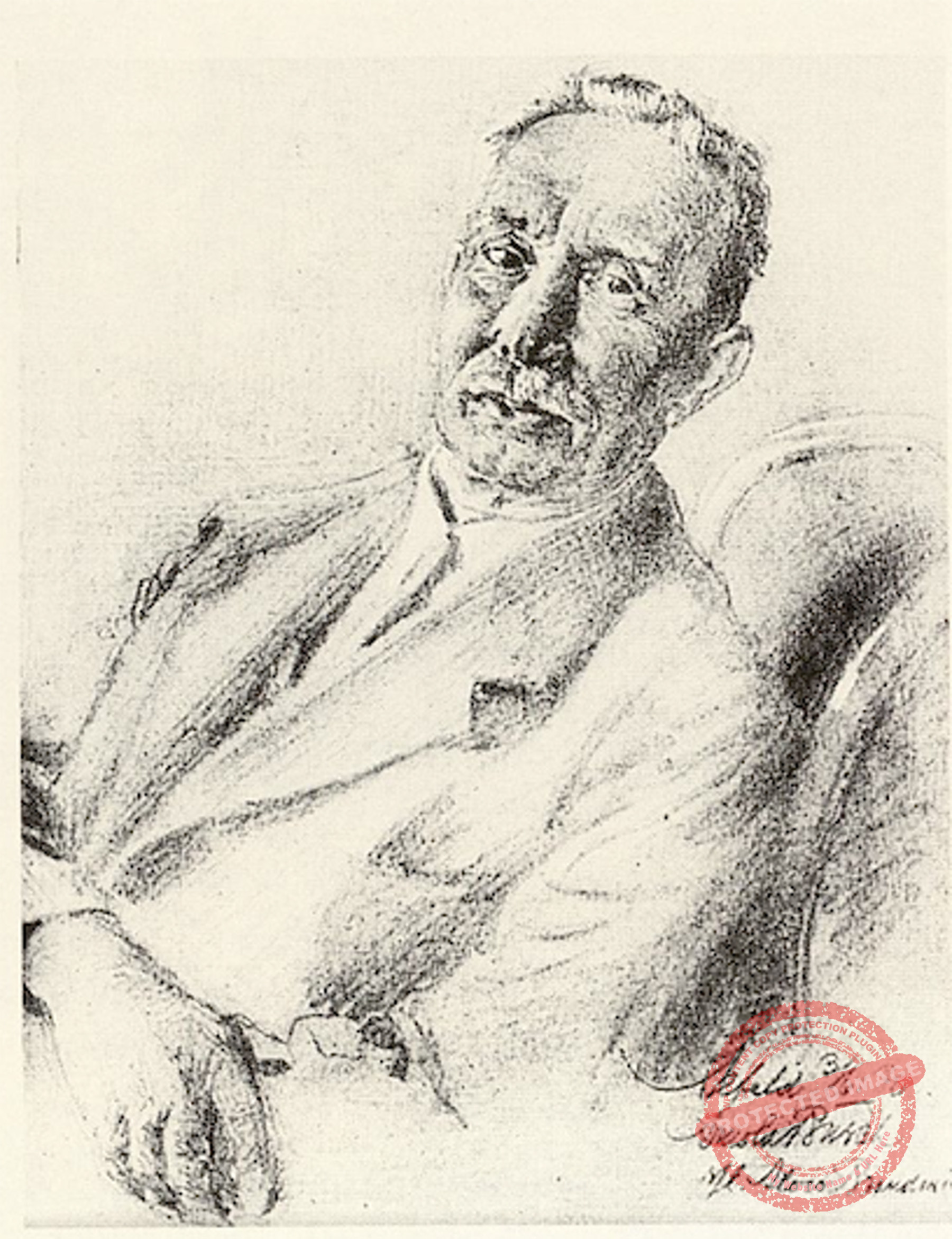
Alois Brandmüller, 1936, illustration by A. Busch, City of Alfeld Museum: Exotic Collection of Animals
However, the reason for his unpopularity among the animal keepers at the Weisse Erde (White Earth) had another root. Whenever one of our animals died, he was often involved. He was a passionate collector and taxidermist and had spent many years, alongside his teaching, building what would eventually become his life’s work—a legacy: the Alfeld Home Museum!
Alois Brandmüller wasn’t to blame for the keepers’ disdain. His appearance was unfortunately often associated with the death of an animal—maybe already sick for days or weeks. After decades, the teacher whom my father had known was finally able to open the doors of the museum. What he had created was recognized as excellent educational and visual material. He expertly arranged the taxidermy animals, grouped by continent, and sought to present them in lively, realistic settings in their native habitats.
Brandmüller should be considered one of the great idealists who devoted their lives to a selfless pursuit of an idea. That the city of Alfeld and its residents—ultimately including ourselves—eventually grew proud of him and the museum goes without saying.