Chapter 16: New! Even for Ruhe Alfeld – Wilde Tiere Frei Haus (Wild Animals/Free Delivery)
Translated by Alex Haro

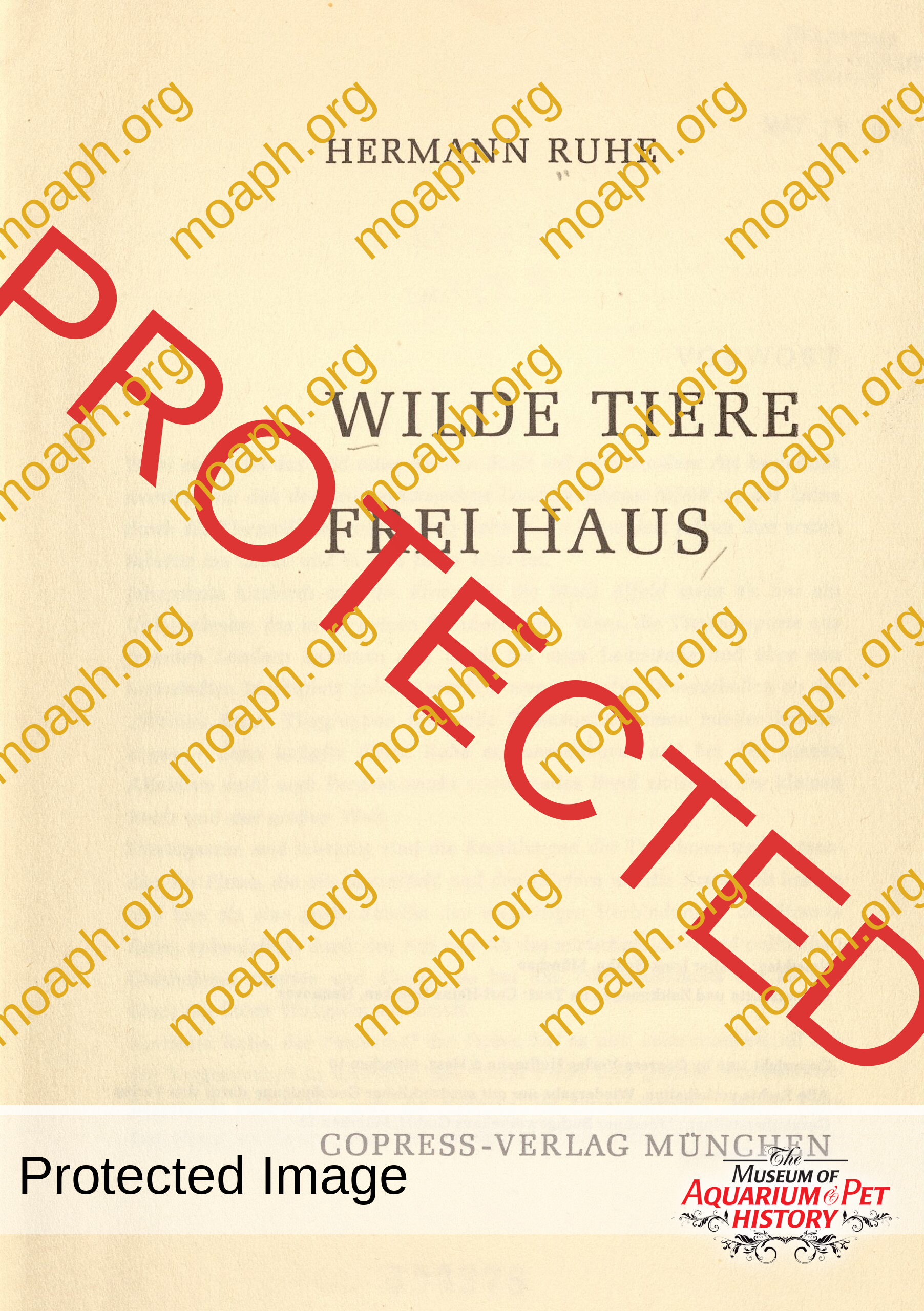
Starting in September 2024, the Museum of Aquarium and Pet History (MOAPH) started releasing a chapter a month on the translated autobiography Wilde Tiere Frei Haus (Wild Animals Free Delivery) by Hermann Ruhe.
Firma Ruhe (the Ruhe Company) was the name of an animal trading company based in Alfeld, Germany from 1860 until its official closure in 1993. During this time, they were world renowned for their importation and exportation of exotic animals and birds from all across the globe, even supplying many zoos as well as circuses. Having survived both world wars, Firma Ruhe continued to dominate the world of animal trading until the mid-20th century and is a testament to true determination and leadership.
Wilde Tiere Frei Haus (Wild Animals Free Delivery) also documents the plethora of adventures, failures and successes endured by all those a part of Firma Ruhe. Through Hermann Ruhe’s great storytelling, we are able to visualize and understand the world from the perspective of animal collectors navigating through some of the most difficult situations, often not knowing whether or not they would ever return home. His recollections provide a vivid portrayal of the challenges and triumphs faced by the company, and give readers a glimpse into the world of animal trading.
We were expecting an extensive shipment from South America. The Alfeld monkey house had been thoroughly heated. Everything was prepared for the arriving sloths; their cages were adjusted for humidity. The aviaries were cleaned and disinfected, the floors either sprinkled with sand or lined with linoleum, presenting themselves ready to receive the newcomers.
For the hummingbirds, the bird keeper always hung up small bottles, painted on the lower part to prevent algae growth, and filled with a mixture of meat broth, sugar water, and honey. Hummingbirds, being insectivores, live additionally on nectar from flowers. Since it is impossible in Europe to catch the amounts of insects they would need, we help by providing sugar water in feeder bottles that they can drink from while hovering in the air, their beaks dipping into the fluid from the bottles.
The flight cages of these beautiful South American birds had been laid out almost daily with fresh moss from the forest to maintain the natural humidity. Alder moss proved to be particularly well-suited for this.
The sloths were also well cared for. Moving these animals from their transport crates into their cages is a particularly strenuous task. They mostly hang belly-up on their perches, not as one might think, with their backs facing downward. Their incredible flexibility, contrary to what their name suggests, allows them to fully rotate their limbs backward.
A sloth is almost impossible to remove from its crate upon arrival. It grips onto every crevice so tightly, developing such strength that it cannot be detached. In the transport crate, there is a hanging bar provided for this very purpose.
In their natural habitat, these animals remain clinging to a branch until they have consumed all reachable foliage. Only when there is no more food within reach do they move to a new branch nearby, minimizing their movement due to their slow and cautious climbing nature. Due to their unique claw structure, they find it challenging to move on the ground. Species like the ‘two-toed sloths’ and ‘three-toed sloths,’ despite their lethargic nature, require an expert trapper for capture.
From South America, we received three remarkably fine specimens. Their diet during transit included a mix of beaten eggs, milk, and ant-covered twigs. This diet allowed them to feed naturally, as the mixture attracted ants that they could then lick off with their long tongues.
Lastly, there was a manatee from the lower Amazon basin, known locally as ‘Seekuh’( meaning sea cow), due to its grazing habits being similar to those of a cow but submerged underwater. It feeds on algae and seagrass, which we supplement with various types of vegetables that it readily accepts.
With another transport from Africa, a zebra that had been vigorously active in its crate arrived, having chewed and kicked against the wooden walls of its transport crate.
Releasing animals from their transport containers is an activity I often oversee, as it can be precarious, and typically only the most experienced handlers are involved. Newcomers are kept back until the animals are secured in their enclosures. Only then are they approached for feeding and watering.
Some animals, once the securing bolts are removed, will step out of their crates on their own.
Animals must often be pulled upwards out of the crate by a person standing above, as they cling tightly and are reluctant to leave their familiar confines. Other animals can be tempted out with some kind of treat. However, some are extremely reluctant to leave their usual enclosures, and if one becomes impatient, it can lead to the animals injuring themselves during their first step to freedom. This is especially dangerous for horned animals, as they can injure themselves if they spring out in fright and catch a horn.
Some explode out the moment the crate opens, like a cannon shot, and there are some tough cases that require hours of effort to coax out of their crates before they feel comfortable making their first step into their new home.
At the farm, animal crates were moved from the transport truck by our crane onto low roll carts and then pushed to their respective enclosures.
This transport from Africa also included a zebra that not only gnawed but also continuously kicked against the crate walls during its journey. Upon arrival in Alfeld, it was discovered to have sustained injuries to its legs, resulting in wickedly bad wounds and swollen joints. I had a large, flat crate made for it and placed it in the zebra enclosure lined with light metal sheeting and filled with soft mud, thinking this might serve as a natural habitat for healing. The zebra was left in this mud-filled crate and once it was settled, it showed evident signs of comfort and remained lying in the mud for ten days, which seemingly helped heal its injuries. Afterwards, it had slim limbs, free of fetters, and normally shaped ankles.
The currency situation was becoming more of an issue, highlighting the likelihood that we might soon face significant financial difficulties. Our trapping expeditions were made increasingly difficult each month due to the lack of foreign currency.
I would have faced severe penalties had I sent my travelers, as had been customary for decades, with 10,000 or 20,000 Marks in hand to distribute and exchange the money on the spot as needed. This practice was now completely abandoned. Future business would solely rely on barter trade with countries like India, Sumatra, and Australia.
The liaisons with South America, Africa, and European countries were well managed, demonstrating our prowess in bartering that we had been perfecting for over a decade, much like our successful trade arrangements with the Soviet Union. Whenever direct trade was not possible, my brother Heinz worked more intensively with Louis Ruhe Inc. in the United States, employing some of my Alfeld company staff part-time for the New York firm, which had been purely American and operating smoothly for almost fourteen years.
However, the acclimatization park in Cros de Cagnes under my current working conditions would no longer be viable, essentially rendering it useless to us. Basilewsky and another generous benefactor, Niezabitowska, wanted to construct a large park for us in Eastern Europe where we could host animals in a lush, free-range environment. Initially, this project aimed to bring together all the animals in Central Europe into a botanical garden, an endeavor that would soon face additional import restrictions—then what? My plan to move more animals from Cros de Cagnes to Germany was becoming increasingly constrained.
Basilewsky, who observed all these developments with great concern, also saw the end of our fruitful collaboration, which unfortunately was drawing to a close.
As this situation unfolded just before the dissolution of our collaboration with Cros de Cagnes, I was offered a deal by the Kludsky brothers’ circus from Görkau in the Komotau district of Czechoslovakia, offering their entire inventory of animals. The Kludsky family had long-standing business ties with my father; the circus had almost entirely sourced its animals from us.
Carl Kludsky, the eldest son and one of the best elephant and horse trainers in the circus world, found it difficult to decide to sell. The circus was too large for the current economic conditions within the circus industry, which had grown substantially. Additionally, the regional scope of his work across the Balkans and Austria no longer provided a viable opportunity to profitably continue the circus in its existing format.
The negotiations between us were lengthy. It was also a major decision for me to commit to this large venture as I had no desire to start a circus. Moreover, transporting animals quickly in such large numbers was no easy task. I finally decided to purchase when I confirmed that 16 elephants had been sold to the circus Amar Frères.
Before the rest of the eastern stock was sold, costs for feed, wages, and salaries amounted to more than 150,000 Marks—I had to be certain all business dealings were fully satisfactory.
Eventually, the entire troupe of two- and four-legged circus artists, along with their accompanying staff, truly in the full sense of the word, came over to us:
(before the comma is male and after the comma is female)
- 6,10 all sizes of elephants
- 9,0 grown lions, trained, with two beast wagons
- 3,6 tigers, trained, with two beast wagons
- 1,1 Bengal tiger with two young, with beast wagons
- 13,0 polar bears, trained, with two bear wagons
- 2,2 Chapman’s zebras
- 3,2 dromedaries
- and 41 animals consisting of ponies, zebras, mules, buffalo, sheep, monkeys, porcupines, and others.
In addition to the 16 elephants purchased, Circus Amar Frères transferred two beast groups1 and some horses to us. I directed these animals straight to France, while the rest of the stock taken over by my team at the German-Czech border was brought to Annaberg in the Ore Mountains.
MOAPH1: While the exact beasts are not known, in circuses, beasts are typically larger and more dangerous cats or animals.
I immediately sold some animals to Circus Barlay. The rest came to Alfeld. It is no wonder that my children were quite enchanted. The large transport arrived all at once, and a significant commotion arose in Alfeld. The Czech horsemen and animal handlers who came with them stayed later in Alfeld and married there. The horses, however, were a spectacle, doing experiments that had once caused quite a stir in a quiet traffic-less town like Alfeld. They arrived galloping, tethered only by a rope around their necks, six abreast, galloping at full stretch from the station through the entire town to Kalandstraße, where we were located.
The schoolteacher at the same time was José Smaha2, a native Hungarian. He was impeccably dressed from head to toe, and carried himself with such flawless manners that it was hard to imagine he had anything to do with animals. He was dark-haired with a piercing gaze that missed nothing, regarded as a commanding presence among the circus personnel, and he was deeply respected as an authority figure.
MOAPH2: Jose Smaha is a stage name, whose real name is Joszi Vinicky Sr.
José Smaha, from whom I acquired all the animals, had been a part of many circuses as a trainer. It was possible for him to assemble a beautiful 32-horse act that he had once showcased! Such a gigantic number made no sense for German circus conditions where the single rings were too tight for 32 horses.
Smaha then organized a parade in two sets of sixteen, where the horses ran in pairs, or in groups of four, eight, or all sixteen together—forming figures. His second highlight act showcased high discipline with an elephant and a horse: the elephant mimicking every step of the horse that Smaha rode, named Kassian, a spirited Arabian. The elephant was named Bhutan.
The most challenging part was ensuring enough movement space for the many trained horses, necessitating additional stables to be built to house them comfortably. By then, full of the hustle of circus life, it had become impossible to move all the horses sufficiently every day.
With enthusiasm, the local riders from the surrounding area took on the task of exercising the horses – at least over the weekend. So, on those days, entire groups of horses and riders trotted out of the gate, across the road, and onto the open fields.
Among the many spectators who joined the circus festivities were whole families. Another trainer named Bauer, who was working with elephants, joined, and a few weeks later, our old friend August Mölker with his beast acts came to enhance our offerings. Additional beast cages were set up in our meadows. In short, our location became a hub of bustling activity that we had never seen before.
The people who arrived with Circus Kludsky were so numerous that it was challenging to find them accommodation without interfering with our base operations. They had mostly brought their own caravans, which were systematically arranged in a row, ensuring that despite the chaotic appearance, there was order. To the locals of Alfeld, though it looked somewhat chaotic, it did not entirely displease them.
This entire experience was a wonderful thing for my children. Hermann, now 10, and Christel, who was 11 years old, were occasionally allowed to watch. There was so much supervision that they hardly found a chance to get into any real mischief.
Hermann, especially, was hardly away from the animals, particularly the horses Smaha had brought over. He befriended everyone and was often invited to meals, so much so that the family was sometimes shocked at how earthy he had become, saying, “You smell like a stable!” and “You’ve been eating garlic again!”
José Smaha affectionately called Hermann ‘kleinen deibel’ (little rascal). It was a term of endearment tinged with respectful paternal condescension. Sometimes he just called him ‘Junger Chaff’ (Young Chief)
This experienced schoolteacher once watched Hermann as he cautiously mounted a wild, unbridled colt, and rode it around the pasture next to the stables. Smaha could teach riding, but he discovered certain talents in Hermann and decided to give the boy more structured lessons, which I ultimately allowed. There was no harm done, and Hermann could only benefit from such a skilled teacher.
After both had initially learned the basics in the riding arena, Hermann was allowed to take part in Smaha’s advanced training on a horse named ‘Tetnepferd,’ leading the group in equestrian figures while riding.
Following that, Hermann immediately learned proper vaulting and artistic Cossack riding from Smaha. José Smaha was a fair but exceedingly strict instructor who allowed no mistakes. The horse Hermann rode wore a belt around its belly, fitted with solid leather handles. While the horse galloped, the boy had to run around its belly, dismount, and then perform what is known as the ‘scissors,’ where the rider switches from facing forward to backward, or vice versa, by swinging his legs over the horse’s back.
Hermann also had to learn to jump from a galloping or trotting horse, a skill I knew he was acquiring, but I never truly realized the extent of his progress.
It wasn’t expected that Smaha would take the matter so seriously. He considered Hermann to be very talented and taught him acrobatic riding through rigorous training. José did not go easy on his student; in fact, it could even happen that he lightly tapped him with the whip if things were not going well.
He was less patient with my daughter when it came to acrobatic riding, for which she proved unsuitable. Christel did learn to sit properly on a horse and to ride it without fault, but José said she did not have as much natural talent as my son.
Hermann watched with enthusiasm as Smaha trained a camel in advanced movements. The animal was called ‘Pascha’ and was later sold to Circus Barlay.
Another trainer joined us: Johannes Petersen, an animal trainer for elephants, camels, and cattle. Additionally, Petersen put together a promising act with elephants and zebras.
Never before had there been so much activity in our training halls—the front one was exclusively used for elephant, camel, and horse training. We even had to set up an additional training cage in the yard so that several trainers could work simultaneously.
Among other things, there was also a bear act in progress, involving more than a dozen bears that had to be housed in their cage wagons in one of the inner courtyards, as there wasn’t enough space otherwise. The two large transport wagons containing the polar bears—each housing several animals—were pushed together. The connecting doors were left open so that the bears had enough room to move around.
Once, one of the caretakers forgot to secure the pegs that connected the two wagons, and suddenly the large bears were roaming freely around the yard.
Strangely enough, nothing happened. The door to the large predator training hall, which happened to be empty at the time, was open. We managed to herd the bears peacefully into the hall, like a proper drive, without them putting up any resistance.
It was a special treat for Hermann when he was allowed to accompany the keeper into the meat refrigeration room, where the meat for the predators was stored, hanging from large iron hooks. The keeper cut up the chunks intended for feeding, often needing a saw to prevent the bones from splintering, as splinters could cause severe injuries to the predators—just as they could to any household or farm dog.
The icy-cold meat had to be held for a while. He knew very well that meat, when it comes directly from the cold storage room, should not be fed immediately, as lions or tigers cannot tolerate meat that is too cold and would become ill from it.
When the keeper was once again struggling alone with the large chunks, Hermann was allowed to cut boneless pieces of meat into cubes on the wooden table, which the trainers used as reward treats during training sessions. When the predators performed their tasks well, they received a reward bite presented on a wooden fork.
August Mölker, now a bit older in age, sometimes allowed my eldest son to carry his training props, pedestals, or parts of pyramids into the large training hall and set them up properly.
Mölker was putting together a tiger act, working with very young animals. Most of the time, his wife, who had once presented animals herself, sat in the training hall on a wicker chair, knitting or crocheting. While doing so, she kept a constant watch over the animals. Even if Mölker turned his back and something happened among the animals that he didn’t notice—she saw it immediately.
“Ali!” she would call out, or “Coral”
The young animals would flinch under her voice as if struck by a whip and obediently slink back to their places. They had great respect for Mrs. Mölker’s mezzo-soprano voice. She did not touch the animals; her voice alone was enough to bring them into line.
“All right, all right,” Mölker would then say soothingly to the young predators.
Watching Mölker at work was highly interesting. The tigers he was training were partly freshly imported or came from the offspring of various zoological gardens. They were six to seven months old when he started and were initially allowed into the training cage one by one, to play there undisturbed. Then, two tigers were brought into the cage for the first time together, followed by a third, fourth, fifth, and sixth over the next few days. In this way, the animals gradually got to know each other, became familiar with the training cage, and got used to each other.
Mölker sat in the middle on a stool and left the animals alone during the first month. He let them play and romp around. Then he began calling them from time to time. He kept throwing small pieces of meat onto their future spots until the animals got used to it and always returned to those spots.
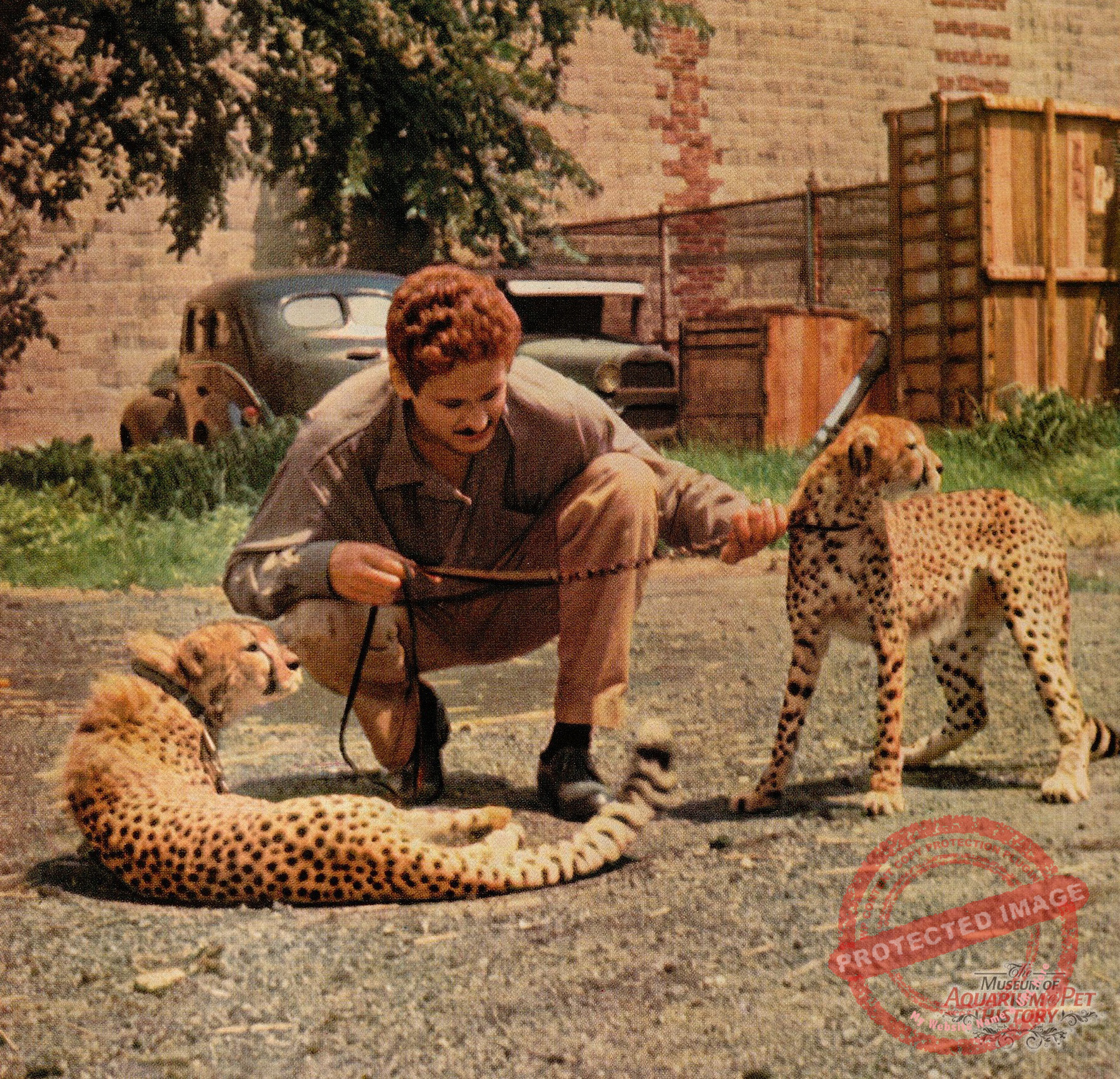
Heiner Ruhe, the author’s second-oldest son, on the ‘farm’ on Queens Boulevard with two tame cheetahs that came from Mogadishu in Italian Somaliland.
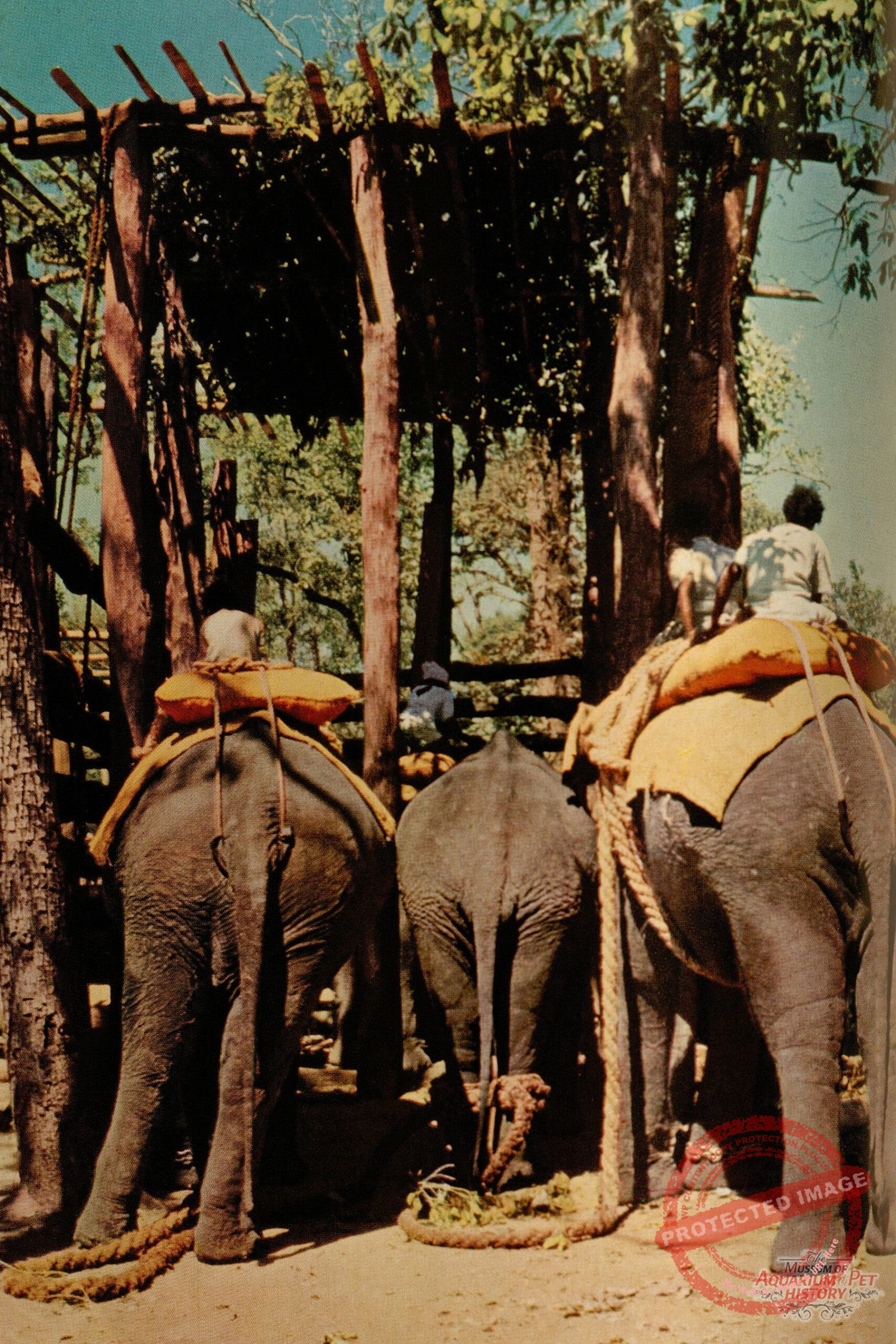
This photo was taken by Mrs. Liselotte Ruhe at an elephant-catching station in the state of Mysore in India. The approximately 18-year-old, newly caught bull elephant (center) is being brought into a corral, where he will first be accustomed to human proximity and touch. The mahout visible in the background is sitting on a bull elephant that has pulled the newcomer into the corral, while two female elephants (right and left) followed closely behind.
Even young predators go through a change of teeth. The animals have swollen cheeks from the toothache, develop diarrhea, and fever. It is difficult to start training at that time; however, Mölker was of the opinion that the act could only be successfully developed with patience, and a few days of rest wouldn’t make a difference.
It is well known how right he was! Hardly any other animal trainer managed, like him, to lie down, weaponless and without a whip, under a tower of wild animals, stretched out on a sofa in the arena. But he also knew his animals from their earliest days.
During this initial phase, he observed the character of his four-legged students. He noticed: this one likes to jump – that one doesn’t; this one frequently stands on its hind legs for fun – that one prefers to hiss.
After many weeks, the first pedestal was brought into the cage. That was the end of the workday for the time being. The animals were utterly confused with fear; anything new was something special and scared them. Nothing happened with the pedestal for days until the animals had gotten used to its sight. Then a second pedestal came in, days later a third, and so it continued until all the needed pedestals were inside the cage, and the animals, with the help of many pieces of meat, began to learn their tasks.
The more the act progressed, the more enjoyable it became to watch. However, it often resulted in quite comical scenes. When Mölker wanted to build a pyramid with the animals, each one had to know exactly where it should stand before the group work could begin. It looked downright grotesque when a high structure was created from large stands, with a lone tiger staring into the imaginary audience on the left upper side.
Then the second animal was added, then the third – and so, the pyramid gradually took shape. In the meantime, the tigers had grown, and by God, they were no longer little house cats!
While Mölker trained the nearly grown wild animals, Mrs. Mölker no longer sat calmly in the wicker chair. She stood by the grid of the training cage or walked around it. She carried a wooden fork with a long handle to be able to call the animals to order from outside. She watched like a hawk and noticed every bit of misbehavior.
When the wild animals sat on their pedestals and made themselves comfortable, arching their backs like cats, she was immediately there, poking their hindquarters with the wooden fork so that they would sit up straight and properly. The animals obeyed her right away!
“Watch out!” she would shout if any lion or tiger dared to sneak up on her husband from behind! Mölker would spin around in a flash, not just to call the animal to order, but also to punish it in this case. It is of utmost importance that an animal trainer never allows a wild animal to disobey. If he forgives something once without punishment, the animal will repeatedly show dangerous disobedience. It must learn to understand: There is only one master – and that is the trainer! There is only one will – and that is the will of the trainer! Even the most loving trainer is subject to this law.
Time passed, and the animal acts of various kinds, which had been developed over the past months, were ready for sale. First, I always had a private show to convince myself, then I could think about selling the animal acts.
We had some lightweight metal training cages made, slightly smaller than usual – and significantly lighter. With this, we aimed to ensure that the acts could also be performed on stages, for example in variety shows.
Some acts, along with the trainer, the wild animal wagons, and all the props, were sold to circus companies. Others I rented out on a fee-sharing basis, where the trainer received his salary from me. As I said, it varied.
A proper, mutually signed sales confirmation of an animal group looked something like this:
With reference to today’s discussion, I hereby confirm the sale to you, starting from Alfeld:
2 male, 3 female Bengal tigers, trained, with props, as currently used in Alfeld, at the price of…
The tiger group will be delivered to you within the next four weeks.
Along with the tiger group, I will hand over my trainer, Mr….
Upon transfer, he will be under your employment. Should I encounter any difficulties with Mr….
In the meantime, we will arrange for another trainer.
The purchase price will be settled as follows:
RM… upon delivery of the group,
RM… by no later than October 1, 1935.
The tiger group remains my property until full payment is made. You will continue to pay me a daily fee of RM 75 for each show day for the season (1935). The fee is to be settled monthly.
This was then signed by both parties and thus became binding.
In the employment contracts, I even included an explicit clause that freed me from any penalty if one of the trainers abandoned my animals, prematurely terminated the engagement, and thereby breached the contract. This clause proved to be extremely important.
A few experiences confirmed the usefulness of this clause. Most of the trainers I had to hire in addition, and whom I often didn’t know very well myself, usually had a young wife or girlfriend with them.
At the locations of their engagements, word naturally spread that other trainers, who were hired directly by the circus or variety show, received wages that were slightly higher than the salaries I paid to the trainers.
It sometimes happened that one of the young women said: “You must be crazy to work here for the paltry money Ruhe pays you!” – and the trainer listened to this talk, leaving my animals suddenly abandoned. Neither the woman nor the man considered that they were exchanging a secure salary for something so uncertain and dependent on chance as the circus industry.
Had I, on top of already suffering a great loss due to the trainer’s failure, also been required to pay a penalty, things would have looked bleak for me.
However, thanks to the clause, I retained the option to either assign the animals to a new trainer – or simply recall them back to Alfeld.
Once, however, I had bad luck, and I couldn’t find a new trainer quickly enough, so I had to dissolve a group of trained animals due to lack of space and sell them individually to zoos. A major loss, since a zoo can never pay the price that, for example, a circus would for trained animals.
In the end, only August Mölker and José Smaha remained working in Alfeld. Then Smaha also went back on the road. He had been in Alfeld, the small country town, for far too long; now he longed to be out in the world again.
With his elephant Bhutan and the horse Kasian, which I had rented to Circus Barlay, José joined the engagement to present these animals himself. Sometime later, while I was in Bad Kissingen3 for a health cure, Harry Piel called me to arrange a meeting. He stayed with me for an entire day to discuss a circus film project he was planning.
Even young predators go through a change of teeth. The animals have swollen cheeks from the toothache, develop diarrhea, and fever. It is difficult to start training at that time; however, Mölker was of the opinion that the act could only be successfully developed with patience, and a few days of rest wouldn’t make a difference.
It is well known how right he was! Hardly any other animal trainer managed, like him, to lie down, weaponless and without a whip, under a tower of wild animals, stretched out on a sofa in the arena. But he also knew his animals from their earliest days.
During this initial phase, he observed the character of his four-legged students. He noticed: this one likes to jump – that one doesn’t; this one frequently stands on its hind legs for fun – that one prefers to hiss.
After many weeks, the first pedestal was brought into the cage. That was the end of the workday for the time being. The animals were utterly confused with fear; anything new was something special and scared them. Nothing happened with the pedestal for days until the animals had gotten used to its sight. Then a second pedestal came in, days later a third, and so it continued until all the needed pedestals were inside the cage, and the animals, with the help of many pieces of meat, began to learn their tasks.
The more the act progressed, the more enjoyable it became to watch. However, it often resulted in quite comical scenes. When Mölker wanted to build a pyramid with the animals, each one had to know exactly where it should stand before the group work could begin. It looked downright grotesque when a high structure was created from large stands, with a lone tiger staring into the imaginary audience on the left upper side.
Then the second animal was added, then the third – and so, the pyramid gradually took shape. In the meantime, the tigers had grown, and by God, they were no longer little house cats!
While Mölker trained the nearly grown wild animals, Mrs. Mölker no longer sat calmly in the wicker chair. She stood by the grid of the training cage or walked around it. She carried a wooden fork with a long handle to be able to call the animals to order from outside. She watched like a hawk and noticed every bit of misbehavior.
When the wild animals sat on their pedestals and made themselves comfortable, arching their backs like cats, she was immediately there, poking their hindquarters with the wooden fork so that they would sit up straight and properly. The animals obeyed her right away!
“Watch out!” she would shout if any lion or tiger dared to sneak up on her husband from behind! Mölker would spin around in a flash, not just to call the animal to order, but also to punish it in this case. It is of utmost importance that an animal trainer never allows a wild animal to disobey. If he forgives something once without punishment, the animal will repeatedly show dangerous disobedience. It must learn to understand: There is only one master – and that is the trainer! There is only one will – and that is the will of the trainer! Even the most loving trainer is subject to this law.
Time passed, and the animal acts of various kinds, which had been developed over the past months, were ready for sale. First, I always had a private show to convince myself, then I could think about selling the animal acts.
We had some lightweight metal training cages made, slightly smaller than usual – and significantly lighter. With this, we aimed to ensure that the acts could also be performed on stages, for example in variety shows.
Some acts, along with the trainer, the wild animal wagons, and all the props, were sold to circus companies. Others I rented out on a fee-sharing basis, where the trainer received his salary from me. As I said, it varied.
A proper, mutually signed sales confirmation of an animal group looked something like this:
With reference to today’s discussion, I hereby confirm the sale to you, starting from Alfeld:
2 male, 3 female Bengal tigers, trained, with props, as currently used in Alfeld, at the price of…
The tiger group will be delivered to you within the next four weeks.
Along with the tiger group, I will hand over my trainer, Mr….
Upon transfer, he will be under your employment. Should I encounter any difficulties with Mr….
In the meantime, we will arrange for another trainer.
The purchase price will be settled as follows:
RM… upon delivery of the group,
RM… by no later than October 1, 1935.
The tiger group remains my property until full payment is made. You will continue to pay me a daily fee of RM 75 for each show day for the season (1935). The fee is to be settled monthly.
This was then signed by both parties and thus became binding.
In the employment contracts, I even included an explicit clause that freed me from any penalty if one of the trainers abandoned my animals, prematurely terminated the engagement, and thereby breached the contract. This clause proved to be extremely important.
A few experiences confirmed the usefulness of this clause. Most of the trainers I had to hire in addition, and whom I often didn’t know very well myself, usually had a young wife or girlfriend with them.
At the locations of their engagements, word naturally spread that other trainers, who were hired directly by the circus or variety show, received wages that were slightly higher than the salaries I paid to the trainers.
It sometimes happened that one of the young women said: “You must be crazy to work here for the paltry money Ruhe pays you!” – and the trainer listened to this talk, leaving my animals suddenly abandoned. Neither the woman nor the man considered that they were exchanging a secure salary for something so uncertain and dependent on chance as the circus industry.
Had I, on top of already suffering a great loss due to the trainer’s failure, also been required to pay a penalty, things would have looked bleak for me.
However, thanks to the clause, I retained the option to either assign the animals to a new trainer – or simply recall them back to Alfeld.
Once, however, I had bad luck, and I couldn’t find a new trainer quickly enough, so I had to dissolve a group of trained animals due to lack of space and sell them individually to zoos. A major loss, since a zoo can never pay the price that, for example, a circus would for trained animals.
In the end, only August Mölker and José Smaha remained working in Alfeld. Then Smaha also went back on the road. He had been in Alfeld, the small country town, for far too long; now he longed to be out in the world again.
With his elephant Bhutan and the horse Kasian, which I had rented to Circus Barlay, José joined the engagement to present these animals himself. Sometime later, while I was in Bad Kissingen3 for a health cure, Harry Piel called me to arrange a meeting. He stayed with me for an entire day to discuss a circus film project he was planning.
MOAPH3: A town situated in the Bavarian region of Germany
I advised him, among other things, to visit Director Barlay, who was on tour with his circus, to negotiate with him about José Smaha’s elephant, Bhutan.
Harry Piel rented the Sarrasani winter quarters in Dresden to shoot his unforgettable film Artisten (Artists), and one of the actors’ partners was – Bhutan!
There was no one who didn’t admire Harry Piel’s courage. He very skillfully befriended the bull elephant and tried to win him over with whole bunches of bananas, which he personally fed to the animal daily. Bhutan was so good-natured that Harry was successful.
The actor had to perform a leap from the circus dome onto the elephant’s tusks, a trick shot achieved by simply filming the scene in reverse: Harry lay on Bhutan’s tusks and was pulled up into the circus dome. Played backwards, this created the sensational shot of Harry Piel descending from the circus dome and landing on Bhutan’s tusks.
The elephant had another scene to perform: He had to smash through a heavy sliding door and trumpet loudly as he attacked an enemy.
Bhutan weighed about 8,000 kilograms. Taking him onto the stage during the premiere, as was originally planned when the actors took their bows, had to be canceled because the stage would have collapsed.
As far as I remember, Bhutan was the only trained bull elephant in Europe at that time who worked together with a horse. José Smaha referred to him as the most peaceful animal in the world.
Soon after, Smaha returned with the elephant and the horse to Circus Barlay, where the Hungarian also presented a large horse act.
When Hermann was allowed to visit Circus Barlay with some acquaintances of my mother, Smaha let him participate in the afternoon children’s show. Hermann was allowed to do vaulting and was, of course, very proud when he returned to Alfeld.
Barlay presented an elephant act during the performances. However, circus tradition and publicity dictate that the director must demonstrate dressage. Barlay couldn’t ride yet and was just learning – with José Smaha. When the Hungarian saw the boy, he said, “Well, it’s nice that you’re here, little devil. Now you can show the director what dressage is.”
Of course, the boy almost burst with pride when he was allowed, at Smaha’s command, to demonstrate a few dressage figures to the director. Barlay later told me about this incident himself, laughing, and said he enjoyed it. He wasn’t angry at all. By the way, he became an excellent rider.
At that time, I had so many animals in stock that I couldn’t accommodate them all, either in Alfeld or in the Zoo in Hanover. So, I also loaned animals of all kinds to circuses for their animal exhibitions, which were mostly held during the long intermission. The animals remained my property; I was merely entitled to a share of the animal exhibition’s earnings, while the circus kept the other part of the entrance fees and covered the feeding and transportation costs.
Circus Barlay took up winter quarters in Mannheim. One night, a telegram arrived: “Please come immediately, Bhutan has gone crazy, caretaker beaten half to death, we have to shoot him…”
That was quite a situation! In the very early hours of the morning, I set off with Director Heck, who happened to be with me in Hanover. When we arrived in Mannheim late in the morning, we found a whole crowd assembled.
The elephant had been housed in a stable building at the Mannheim slaughterhouse, which was no longer in use, as there was no other option. Circus Barlay used this stable and other buildings as winter quarters and had rented the entire space.
Bhutan had loosened the planks he was standing on and flung them out, then beaten a caretaker, whom he knew well, half to death with his trunk. The gate doors had also nearly fallen victim to his rampage. He was acting so wildly that it seemed as if the ceiling would come crashing down.
A unit of soldiers had been summoned, and two machine guns had been set up to prevent the elephant from breaking out too suddenly.
Bhutan was in rut, and when a bull elephant is in this state, which can be recognized by the secretion from the rut glands located between the eyes and ears, one must neither look at him nor touch him. In his terrible agitation, he had also, to make matters worse, broken one of his beautiful tusks.
If the external circumstances had been more favorable, and if he had been left completely alone for about a week in peace, perhaps everything would have turned out fine. However, being disturbed by his well-known caretaker, he became completely deranged.
Heinz Heck, Director Barlay, José Smaha, and I discussed what we should do. The police chief, who was personally present, was in favor of shooting the animal since the elephant posed a threat to the safety of Mannheim’s citizens if he were to break out. I was opposed and argued that the animal would surely calm down after a few days.
However, during another outburst, Bhutan behaved in such a way that even I began to realize there was nothing more we could do; it was already too late! The animal would no longer be usable in the circus or even in a zoo. Who among us could summon the courage to take on the responsibility of using the bull elephant again? No one could guarantee his harmlessness in the future.
With a heavy heart, Director Barlay, who had since become the owner of Bhutan, decided:
“He must be shot.”
Director Heck, whom we knew as an excellent marksman, took on the sad task of shooting the animal.
Bhutan, our good-natured giant from Alfeld, was dead. We all deeply regretted the loss of this magnificent elephant, who had shown unshakable calm in Harry Piel’s film.
When the giant lay still on the planks, José Smaha turned silently and walked away.
It was a time of elephant tragedies. In Hanover, there was Omar, also a bull elephant, who had already severely injured our elephant keeper Hesse in 1932. Omar had arrived at the Hanover Zoo in the mid- 1920s with one of the first shipments from my company.
In 1935, a catastrophe occurred with Omar. He had the best elephant keeper I could find for him: our Sukla. Due to Omar’s unpredictability, I repeatedly urged Sukla to exercise the utmost caution when dealing with the animal.
The Indian keeper likely had the most experience of all the elephant keepers, some of which came from his homeland, where he had practically grown up with elephants. However, none of this could prevent the catastrophe. Omar was in rut, with the dark fluid from his rut glands running down the sides of his head.
The attack came completely unexpectedly for Sukla, who was bending down to sweep up a pile of elephant dung. Omar knocked him over, pressed him against the bars of the enclosure, and drove his blunt tusks into his body.
Although the Indian keeper was immediately rushed to the Vincenz-Stift hospital in Hanover, a large medical facility, nothing could be done. He had already succumbed to his severe injuries on the way there.
Omar, who became calm again just a few days later, had to be moved to a different environment immediately. He was sent to the Leipzig Zoo, which had the largest and most modern elephant house, equipped with the necessary strong barriers for such cases – and for a long time, he behaved well again.
However, eventually, there was an incident with him in the Leipzig Zoo as well. Fortunately, it ended without serious consequences. Omar threw a female elephant into the deep ditch of the outdoor enclosure and stepped over her. Thankfully, no one was hurt as he stomped through the zoo, which was filled with people, and vented his anger only on a few trees.
With great skill, the keeper and the alerted zoo management gradually managed to lure Omar back into his indoor cage using treats.
Omar lived for another 20 years before passing away, leaving behind numerous offspring.