Chapter 20: Tanganyika Game LTD – Wilde Tiere Frei Haus (Wild Animals/Free Delivery)
Translated by Alex Haro
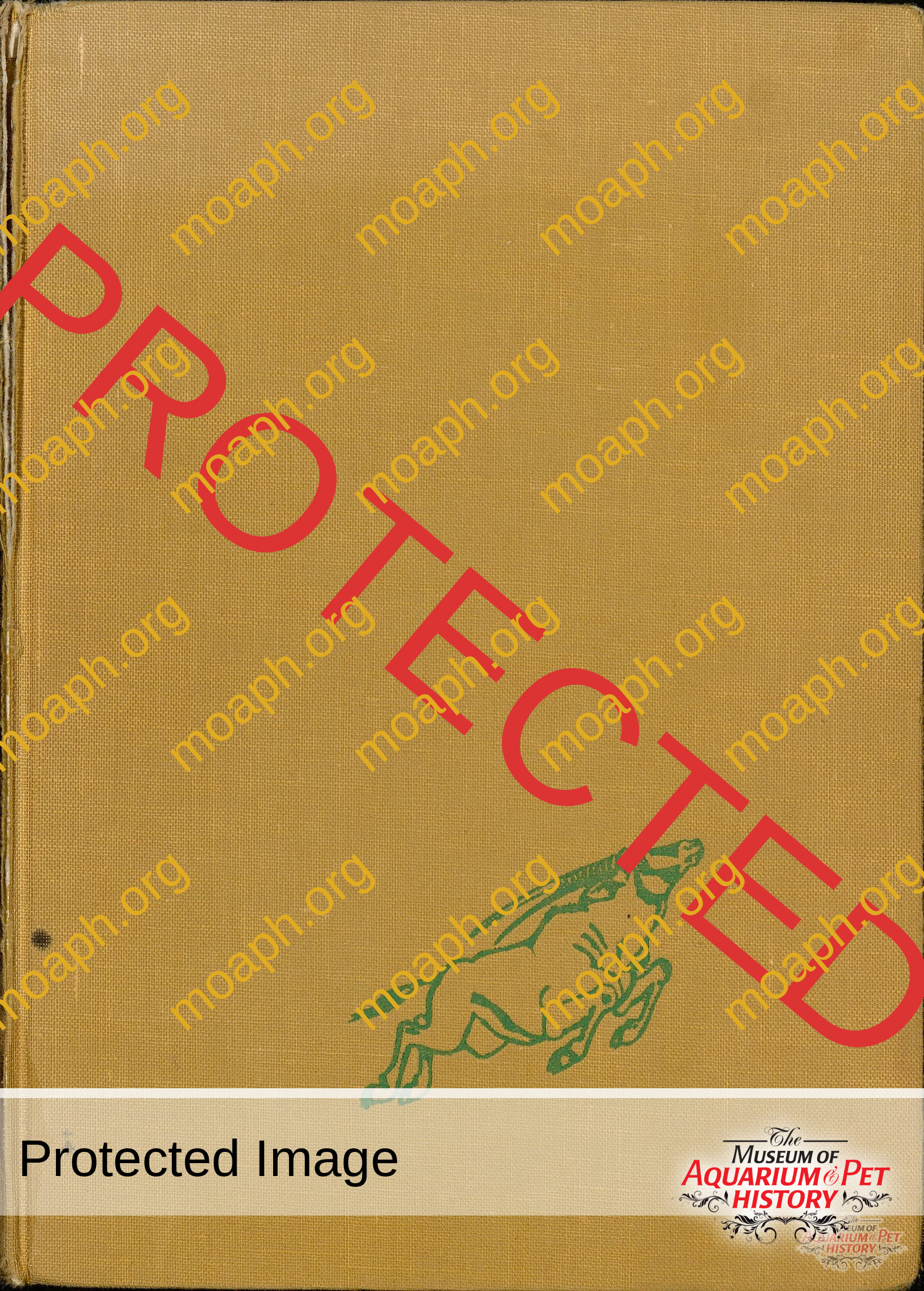
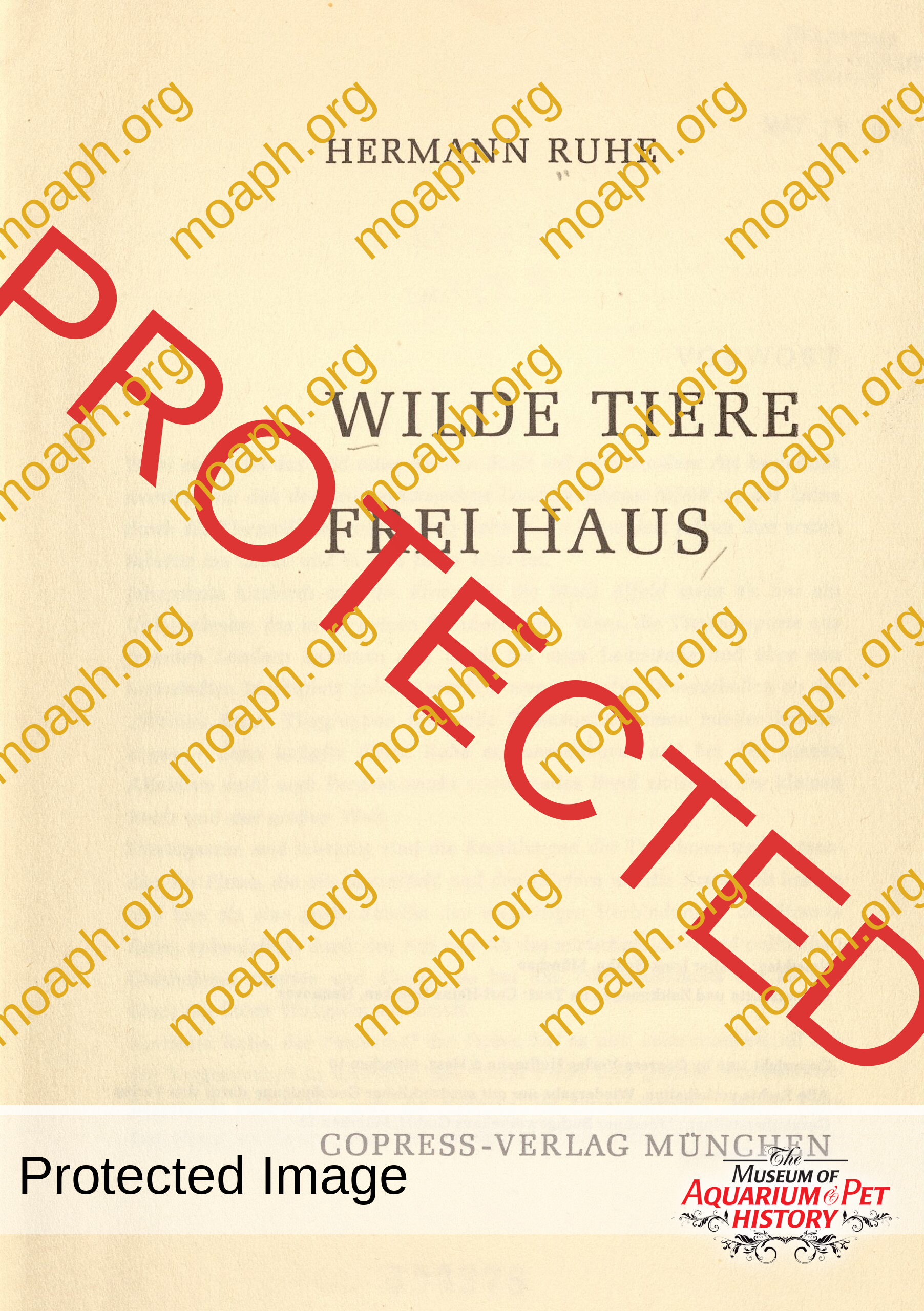
Starting in September 2024, the Museum of Aquarium and Pet History (MOAPH) started releasing a chapter a month on the translated autobiography Wilde Tiere Frei Haus (Wild Animals Free Delivery) by Hermann Ruhe.
Firma Ruhe (the Ruhe Company) was the name of an animal trading company based in Alfeld, Germany from 1860 until its official closure in 1993. During this time, they were world renowned for their importation and exportation of exotic animals and birds from all across the globe, even supplying many zoos as well as circuses. Having survived both world wars, Firma Ruhe continued to dominate the world of animal trading until the mid-20th century and is a testament to true determination and leadership.
Wilde Tiere Frei Haus (Wild Animals Free Delivery) also documents the plethora of adventures, failures and successes endured by all those a part of Firma Ruhe. Through Hermann Ruhe’s great storytelling, we are able to visualize and understand the world from the perspective of animal collectors navigating through some of the most difficult situations, often not knowing whether or not they would ever return home. His recollections provide a vivid portrayal of the challenges and triumphs faced by the company, and give readers a glimpse into the world of animal trading.
The corporation arranged bartering deals, purchases, and sales, but everything moved along rather sluggishly. I couldn’t get past the fact that my partner had no expertise whatsoever. He made an effort, but without experience, it just doesn’t work. Serious disagreements arose, but they were repeatedly postponed due to new investments and incoming shipments.
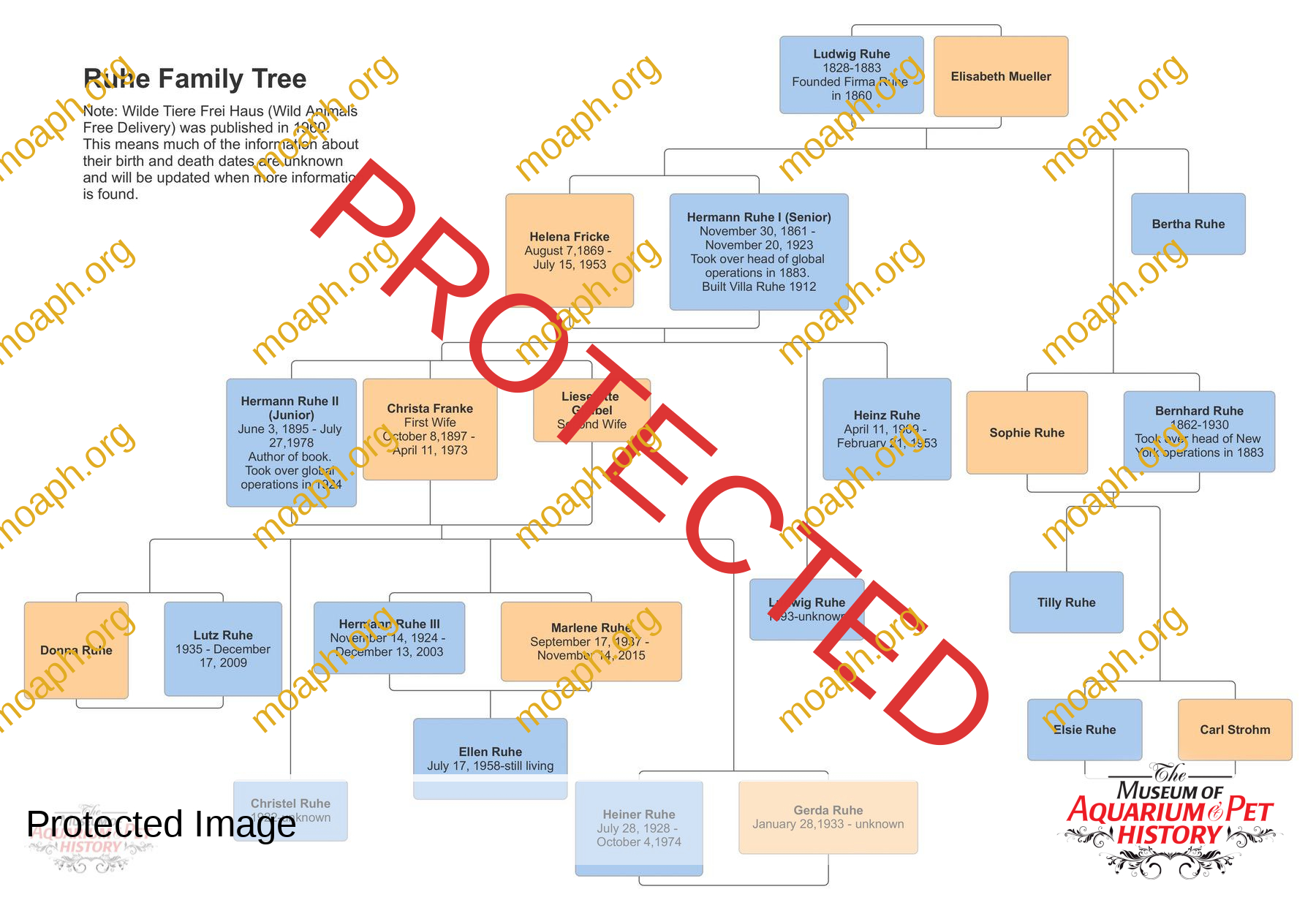
At the end of 1952, my brother Heinz returned to Alfeld from New York, gravely ill. We first brought him to a hospital in Gelsenkirchen, then to the Glotterbad Sanatorium, where the chief physician, a professor, was an old school friend of Heinz. During the war, my brother had been stationed in San Diego with his American unit and had apparently contracted an infection back then. He had to remain there for three years; it had been too much. His health deteriorated slowly, but with terrible inevitability. He had been in Germany for just under two months when, at the beginning of 1953, he passed away—at just 45 years old! It was a heavy blow for all of us to lose him so young. He was laid to rest in Alfeld.
When my marriage also fell apart, and on top of the never-ending problems with my corporation, I decided to take some time to distance myself from all the painful experiences of the past months and finally undertake one of the big trips that—if I may say so—I hadn’t been able to take all my life due to work.
In the fall of 1953, a conference of American zoo directors was held in Denver. I took my two sons, Hermann, who had since turned 29, and 25-year-old Heiner, with me.
After the conference, where I introduced my sons to the circle of American zoo directors, Heiner spent a quarter of a year as a volunteer at the St. Louis Zoo, while Hermann stayed with Louis Ruhe Inc. in New York. Afterward, Heiner was to move permanently to New York. By the end of 1954, I once again took over all of the animal trading business in Alfeld by myself—now with more experience! The significant losses from the dissolved corporation were offset by the fact that we were once again doing well in business.
Since few of my old travelers were still available, I decided to personally revisit the places of my earlier successes. In the winter, I traveled with Liselotte, my second wife, to East Africa, to the region that currently seemed the most interesting to me for new plans: Tanganyika. Above all, I wanted to visit the farms of Mr. Peters and Mr. de Beer and personally assess the possibilities offered by their capture licenses.
I thoroughly enjoyed the trip. It was my first sea voyage in very warm temperatures, and I must admit, I had never felt as hot as I did during the days when the steamer neared our final port, Mombasa, in Kenya. After all, the once slender young man, Hermann Ruhe, had now become a respectable man in his late fifties.
My son Hermann, who was already back in East Africa, was supposed to pick us up in Mombasa. On the way, he had a flat tire, and I had to wait with my wife at the scorching hot customs station for two hours! Only those who have experienced such heat can understand what that means.
Finally, Hermann arrived: dusty, hot, and dirty from changing the tire.
The next morning, we first drove through Tsavo Park, an expansive nature reserve, then through Voi to the border with Tanganyika, which is marked only by a sign, and finally to Moshi, to reach Arusha.
On this tour, we got a sense of the dust of African roads—but also of the immeasurable beauty of the land.
For the first time in my life, I saw African animals in the wild: giraffes, antelopes, graceful dik-diks, hornbills, bustards, and yes—even a few East African elephants of considerable size made an appearance.
In Arusha, I met Willy de Beer, the old Boer and experienced animal trapper from whom Mr. Peters had previously purchased our animals. A little correspondence and a few meetings conducted by Hermann had preceded this; now we quickly came to an agreement.
We founded Tanganyika Game Ltd. together. The decision came rather quickly for me, as the conditions for founding such a company with Mr. Peters were still unfortunately not in place.
Thus, it wasn’t the Dutchman, but Willy de Beer who became my business partner. With Mr. de Beer, we went on a trapping safari into the Masai steppe and took a trip to the famous Ngorongoro Crater, which, as is well known, is home to an abundance of animals. One could speak of thousands of wildebeest and zebras—enormous herds!
In our zoos, when wildebeest families are reunited after being separated during the calving season, there is always great concern that the fathers might kill their sons, the young bulls. Here in Africa, the natural habitat of these animals, I noticed that the bulls also separated themselves from the cows during calving season: while the wildebeest cows remained entirely on their own, hundreds of wildebeest bulls would gather together and trot to the watering holes.
What deeply impressed me was the realization that many animals—elephants, antelopes, zebras—live as loners in the steppe, outcasts who are either injured or too old to keep up with the usual pace of the herd. Even with minor injuries, some animals are no longer tolerated in the herd and are driven out, as they become easier prey for predators than the healthy, fast-moving herd.
On one of these tours in Tanganyika, I saw a mighty eland bull dragging itself to a thicket of reeds to spend the night there. Willy de Beer told me that these loners always do this because the noises that even lions can’t avoid making in the reed thicket serve as an early warning, allowing the bull to perhaps still find a way to defend itself until its wounds or illness heal. Old loners behave similarly: they prefer to face a natural death rather than be killed by a predator.
Additionally, I got the impression that all the antelopes here, in their natural freedom, behaved noticeably more nervously than I had ever imagined. How incredibly tame and trusting these same animals can become in a zoo with good care!
We accepted an invitation to the Momella farm on Mount Meru, whose farmhouse offers a magnificent view, with the roughly 6,000-meter-high Kibo and Mawenzi, the main peaks of Kilimanjaro, directly across—provided they aren’t hiding in the clouds.
We met the elderly owner of the farm, Mrs. Margarete Trappe, who was well-known in hunting circles. As a professional hunter, she had once guided many hunting guests and had even worked as a wildlife warden in the fight against native poachers. However, the farm itself was considered off-limits to any hunter. Although Mrs. Trappe always accompanied us with a rifle when we went on wildlife observation drives with the Land Rover, it was solely just in case.
One evening at the large Momella Lake and the nearby Kahn Lake, which also belonged to the farm, we observed a herd of elephants and several magnificent rhinoceroses. On another occasion, at midday, we saw giraffes, as well as an incredible number of bushbucks and waterbucks, whose appetites annually cause several of the farm’s cornfields to be lost. But this doesn’t change the fact that, even after the death of the elderly Mrs. Trappe, her son Rolf has maintained the same policy: no hunting is allowed at Momella!
On another trip to the Masai steppe, my wife had quite a dangerous experience.
We were camping in the wilderness, and Liselotte went off by herself for a moment. A few minutes later, she returned, looking somewhat disheveled—and as white as a sheet from shock, though she is usually very brave.
“What happened, Liselotte?” I asked.
“A snake…” she managed to say.
“Where?” asked Mr. de Beer, becoming instantly alert.
Liselotte pointed to a bush and followed behind Mr. de Beer and a boy who had armed himself with a thick club. I followed as well.
The snake was still there: a puff adder, perhaps the most venomous reptile imaginable. Liselotte, who had been right next to the snake, would likely have been dead if it had bitten her—especially since we didn’t have any serum with us.
The boy struck the snake, smashing its head. That was in the afternoon. By evening, the snake was still moving!
“A snake doesn’t die before the sun sets,” says an old proverb of the natives. When we checked again after nightfall, the puff adder was finally lying completely still. Willy de Beer told us that it is extremely rare nowadays to encounter a puff adder in the steppe. That’s also the reason why people no longer think to bring serum along on such trips.
On another occasion, Liselotte was out in the Land Rover with Mrs. de Beer and Hermann. Suddenly, they spotted a lone zebra foal standing in the middle of the steppe. It had likely become separated from the herd and didn’t know what to do. Hermann stopped the vehicle. As soon as the zebra noticed the car, it turned and galloped away. Liselotte jumped out of the vehicle, ran after it, and with a leap, threw her arms around the little animal’s neck.
By the time Hermann arrived, she was holding it tightly in her arms. Together, they managed to lift the zebra onto the rear bed of the Land Rover.
Proudly, the three of them drove off:
“We caught a zebra by hand—let someone try to match that…”
But their fun was short-lived. During the drive through the steppe, the zebra suddenly made a lively leap forward and happened to hit the door handle, which had a very simple mechanism. Off it went!
Hermann stopped for the second time, and in a flash, all three were out of the vehicle again. The young zebra tried to make a few clumsy turns—but eventually, they caught it again.
On the way back, my wife stayed in the rear part of the Land Rover, holding the zebra tight to prevent another escape attempt. The young animal soon became particularly tame on the farm of our Tanganyika Game Ltd.
After discussing all the construction plans and future business operations of our joint company with Mr. de Beer, it was time to think about the return journey.
What left the strongest impression on me from this visit to East Africa was the fact that the wild animals had to travel so far to find their scarce food. How much worse must it be during the dry season!
When the animals arrived in Europe after an average six-week transport—how wrong it was to overfeed them with excessive amounts of food!
They were bound to get colic and cramps if they were overfed before they were accustomed to abundant food!
From this experience, I later paid even more attention to the proper feeding of newly arrived animals at home than before. I also began advising my circus clients on the proper feeding of freshly imported animals, especially elephants. Only when the elephants had a lot of movement during training or work—if they were used as working elephants—could one soon afford to give them additional food.
My father used to say: “In Europe, it is rare for an animal to starve—but it has often been overfed to death!”
Before our return to Germany, we made an excursion to visit Mr. Carr Hartley, a well-known farmer and animal trapper in Kenya. Mr. Hartley owned a farm located in the then highly endangered Mau Mau region. We traveled to Rumuruti—without carrying any weapons! It was a strange feeling for us when we heard from Mr. Hartley that some of his relatives had been cruelly murdered by the Mau Mau. Out of caution, Mr. Hartley and his family relocated at night to sleep in a solid corrugated iron hut—to avoid arson, as his comfortable farmhouse was made of wood.
At Mr. Hartley’s farm, there were two white rhinoceroses! Some time earlier, he had captured them in what was British Sudan: a pair for himself and a pair for the Sudanese government. Although the animals were already quite large, they could still be described as relatively tame. Mr. Hartley could have sold them, but as he said: “I really have no idea how to pack them!”
We racked our brains together over what kind of transport crates might still be suitable for these creatures of immense physical strength. We couldn’t find a solution that would guarantee effective safety for all involved. That’s probably the reason why Mr. Hartley still has the valuable rhinos on his farm today.
These animals gave me the idea to have a pair of such rhinos captured myself!
The next day, we ventured on another excursion—this time to visit an English farmer, whose crossbreeding experiments we had heard about. In his pasture stood a tame Grevy’s zebra stallion—alongside eight spirited Arabian mares, and each of these mares had a foal, a little zebroid, young animals with lively temperaments!
“All eight are hereby bought, sir,” I said to our British host.
From Nairobi, we flew back via Cairo to visit the local zoo, which was filled with beautiful African animals that lived in such a pleasant climate that they didn’t need solid houses, just shade roofs. With the directors of the Cairo and the Alexandria Zoos, which I visited briefly, I discussed some interesting barter deals that were to be realized in the near future.
Many weeks later, my eight zebroids arrived in Germany in excellent condition. Despite their immense temperaments, they only had a few minor skin abrasions from the transport crates in which they had moved around vigorously.
The animals caused such a stir that they were immediately bought by a large circus, which intended to train them for liberty acts, showcasing them like horses—paired, in groups of four, six, or eight. The circus assigned one of its best animal trainers to this task, and he poured all of his ambition into shaping these headstrong animals into a beautiful act.
He was successful to the extent that the animals became arena-proof, meaning they no longer broke free. However, this success came at the cost of two hospital stays, as the trainer had been severely battered by kicks, trampled, and bitten.
An old rule says: Thoroughbred stallions must be allowed to blow off steam. But with these zebroids, the opposite was true. The more they moved, the more temperamental they became!
For two years, the trainer worked with unimaginable patience and personal dedication—until it became clear that, in the long run, it simply wouldn’t work. The zebroids even leapt into the audience! The circus had to reluctantly give up the attempt and gradually sold the animals to various zoos.
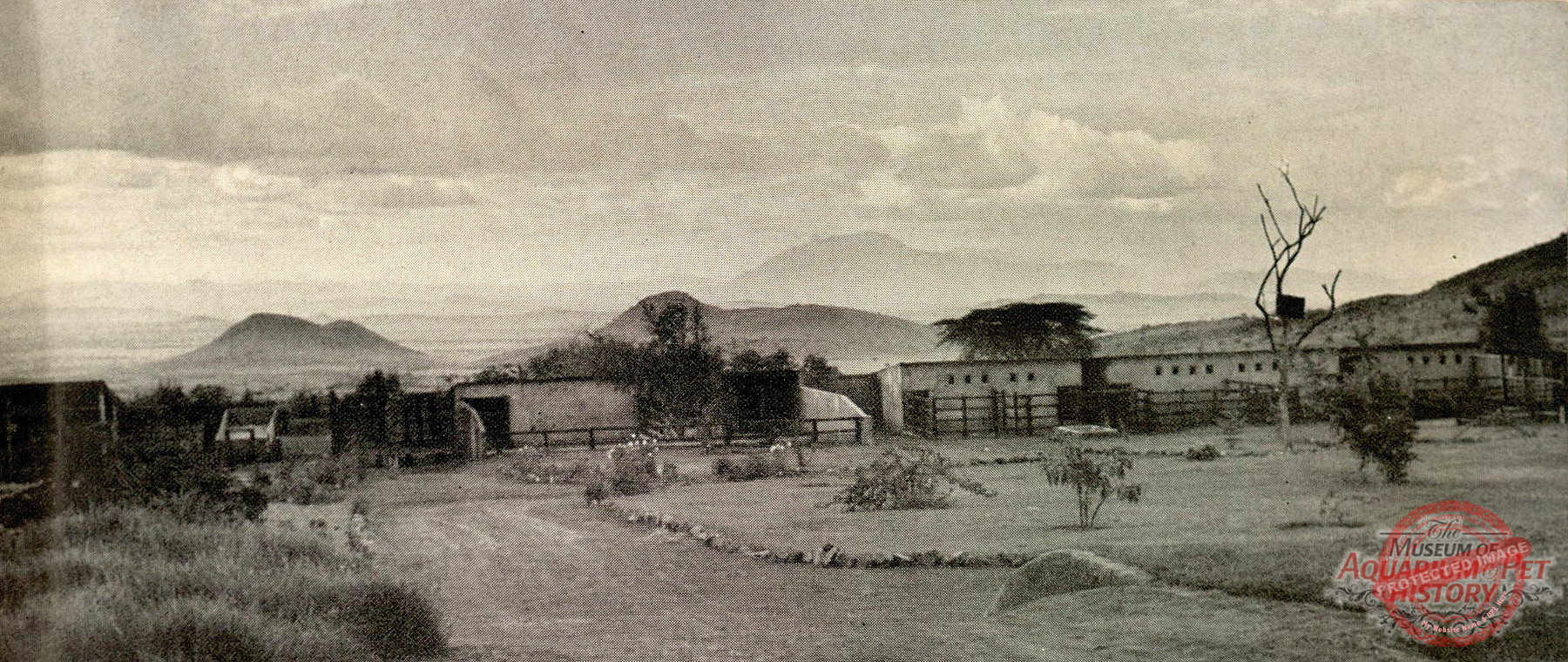
The animal farm of Tanganyika Game LTD: near Arusha at the foot of the 5000-meter-high Mt. Meru. Beyond the elephant enclosures, the view extends northwards across the border. The mountain in the background, about 200 km away, is in Kenya.
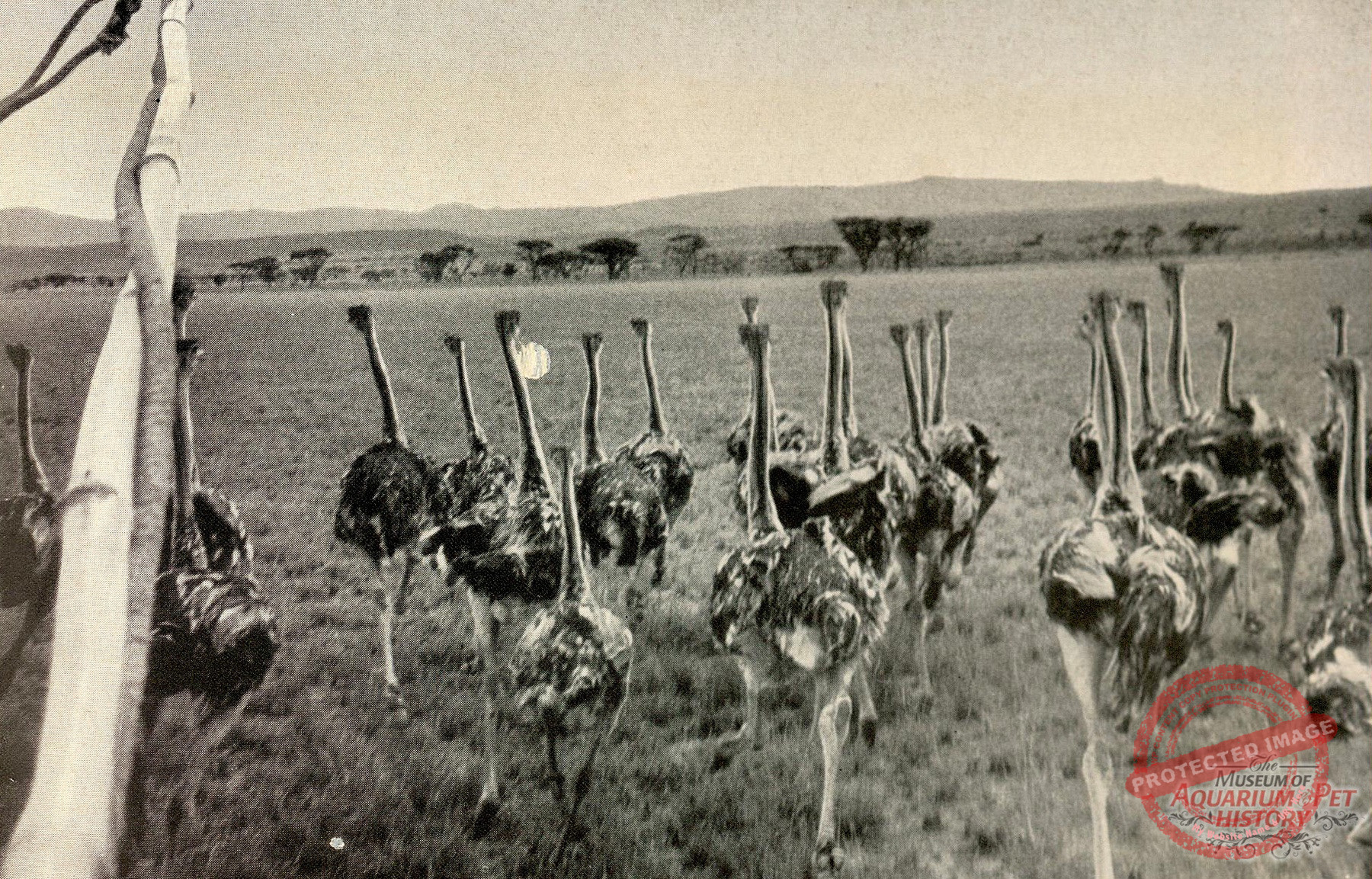
Ostrich capture in the Masai Steppe. The herd runs off excitedly with large, ground-covering strides, while the catcher sitting on the capture vehicle ‘aims’ with the loop of a bamboo pole.
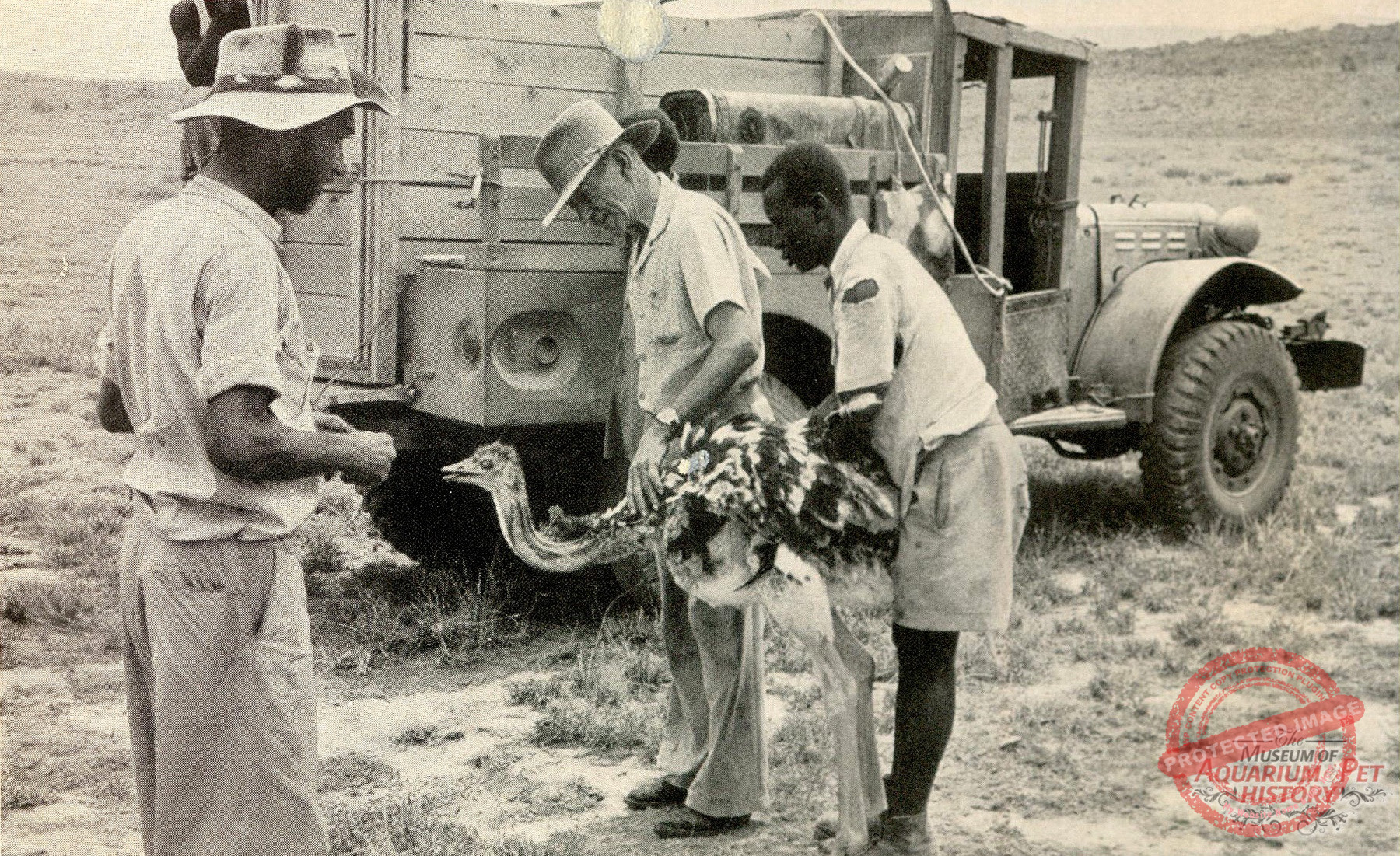
One of the ostriches has been caught from the herd. Before the animal is placed in a crate and loaded, efforts are first made to calm it down (center: Willy de Beer).
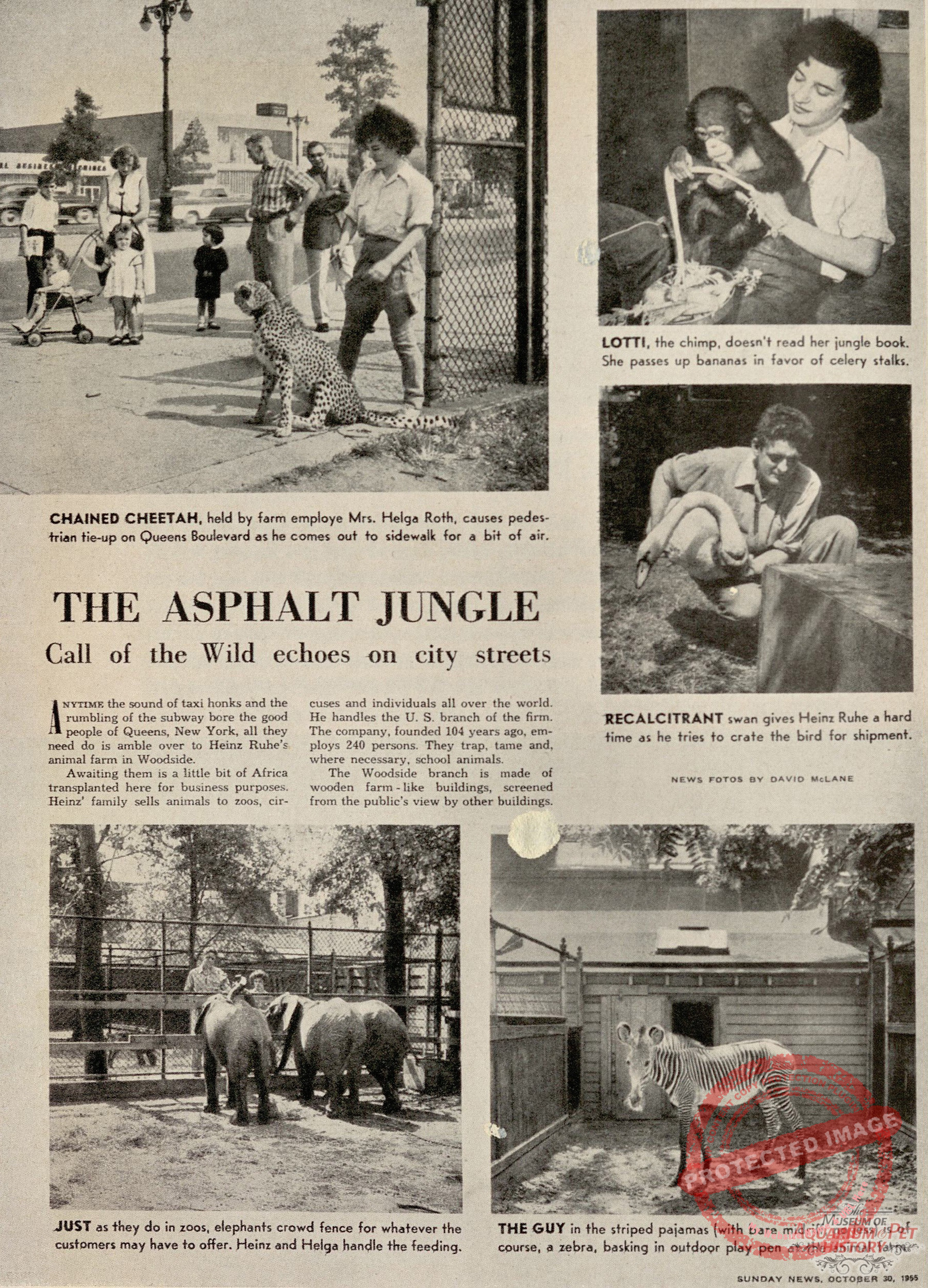
A page from the ‘Sunday News’ with a report about the ‘Farm’ on Queens Boulevard in Long Island. The text included the claim that the company Louis Ruhe Inc. was founded 104 years ago, though there was a small calculation
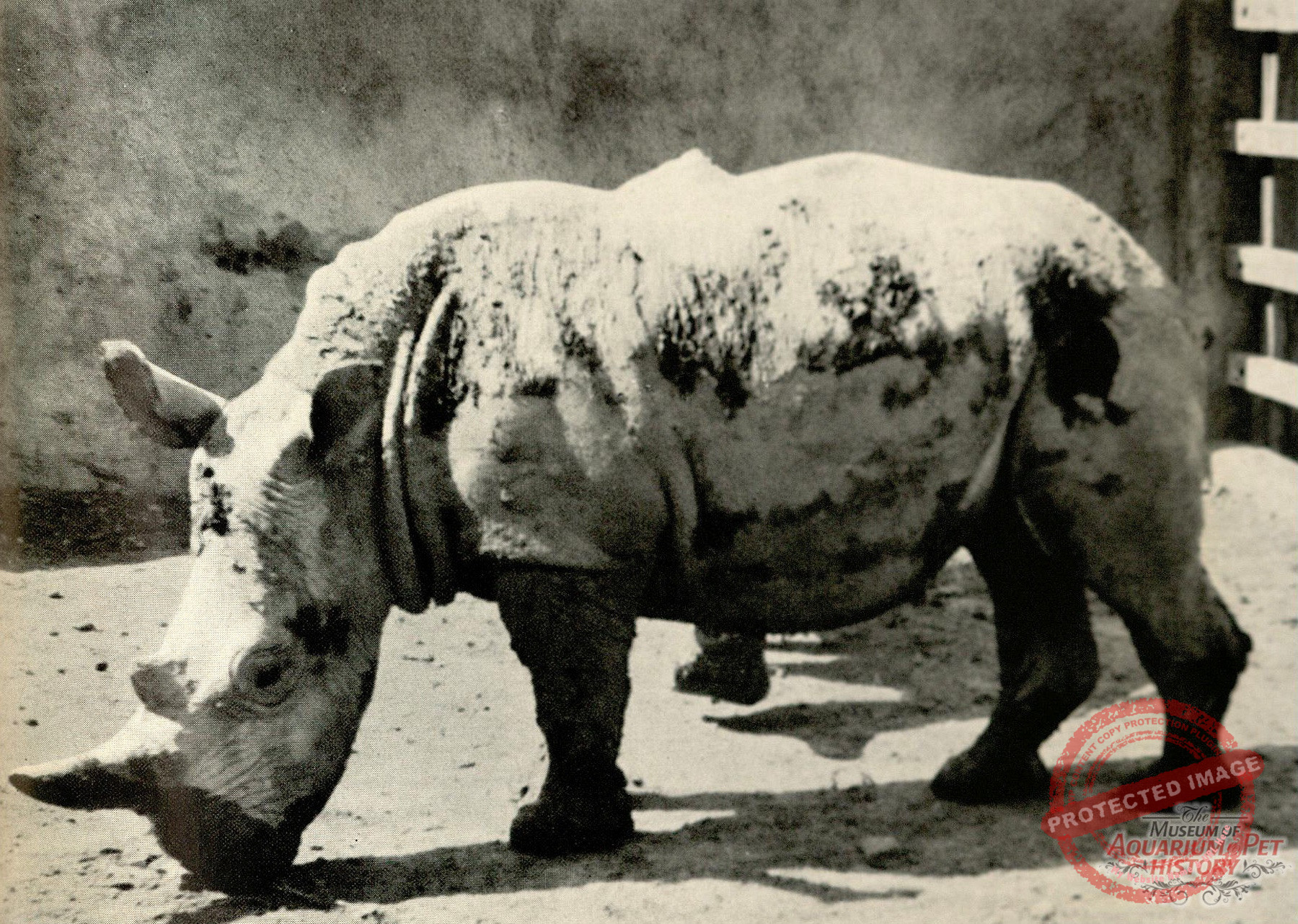
In Sudan, these two white rhinos were captured during a grueling expedition that lasted several weeks. At the animal camp in Arusha, they are awaiting their transport to the St. Louis Zoo in the USA.
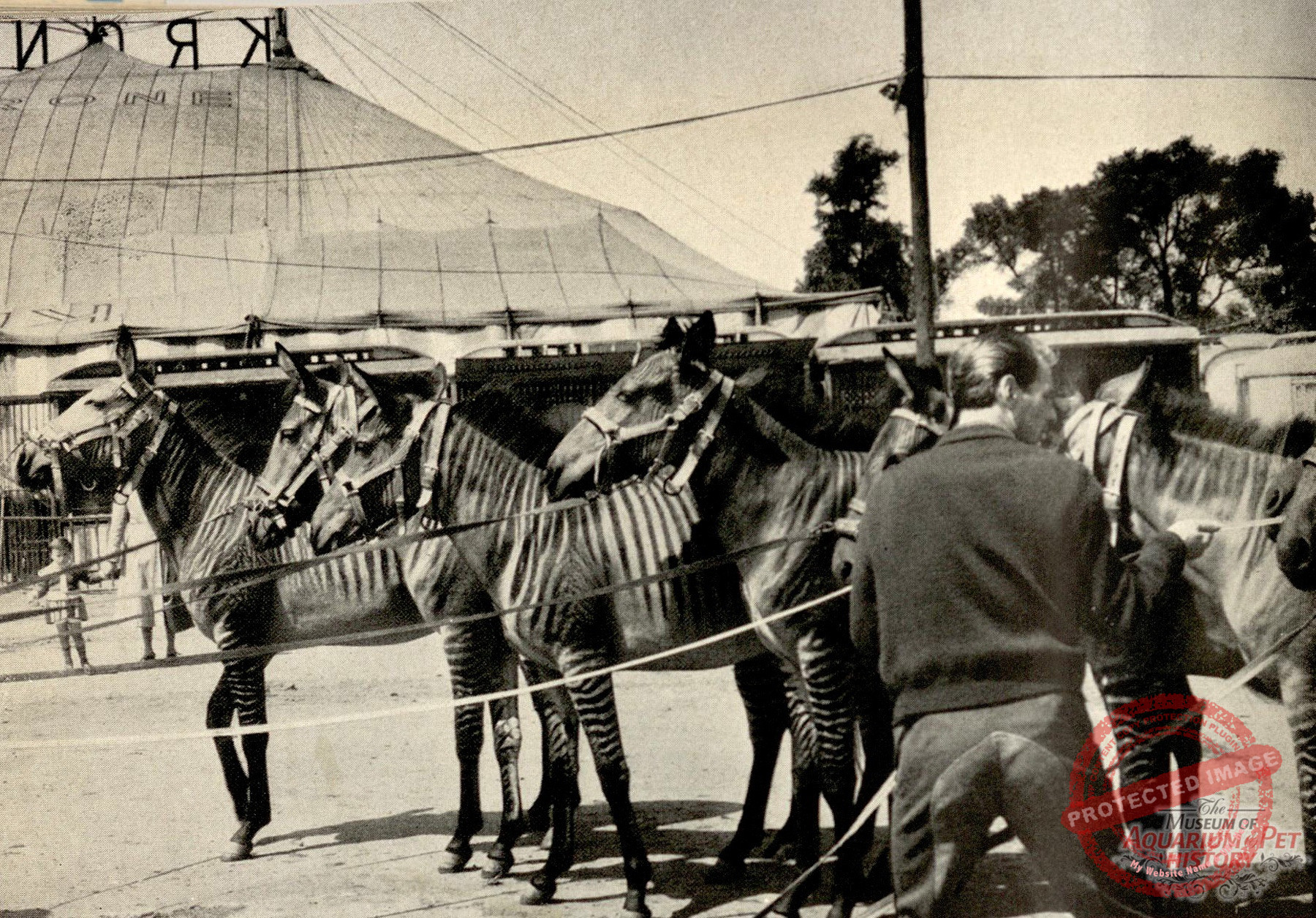
Eight zebroids (father: Grevy’s zebra stallion, mother: Arabian mares) at Circus Krone. Their trainer was hospitalized with bite injuries. After two years of patient work, the attempt to train the animals had to be abandoned.
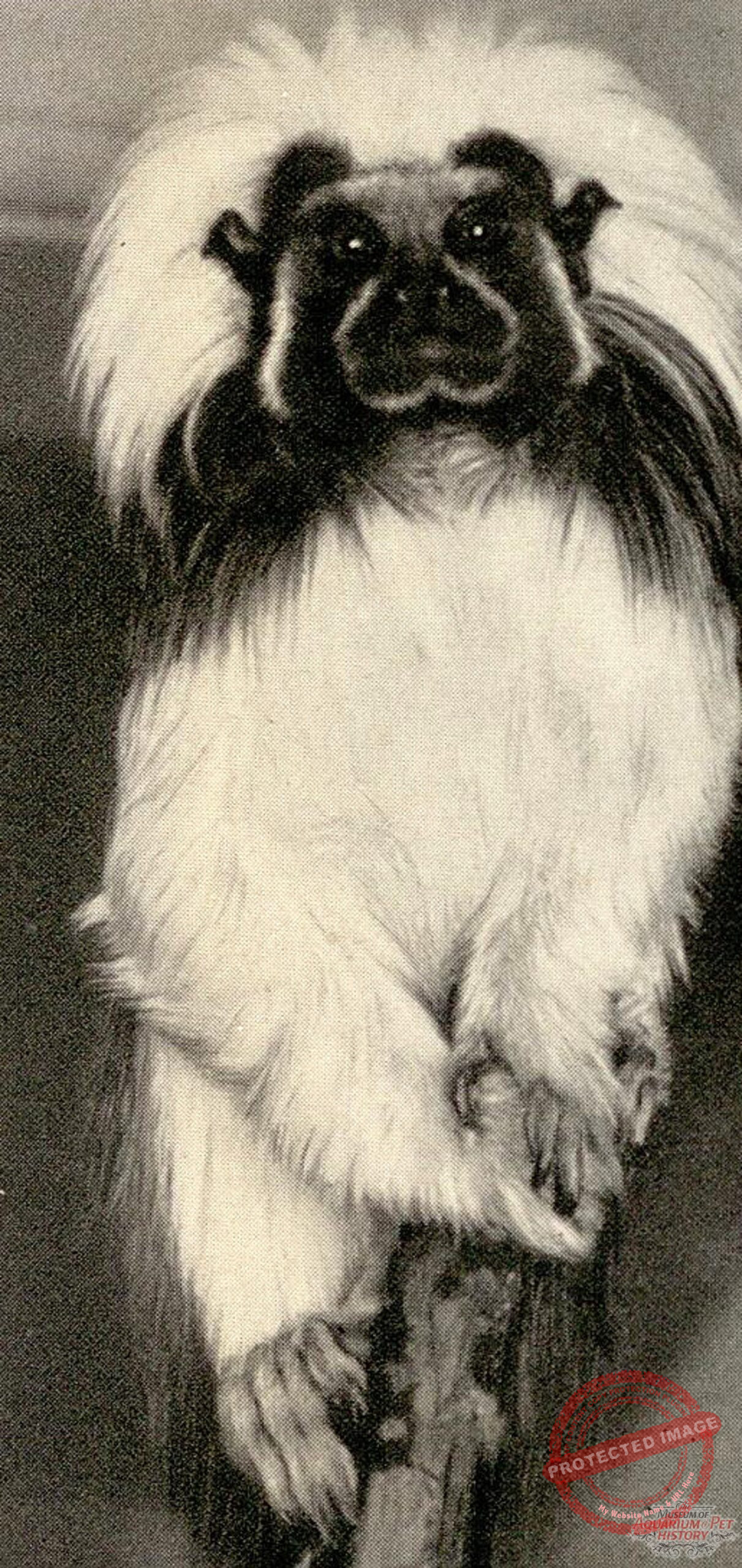
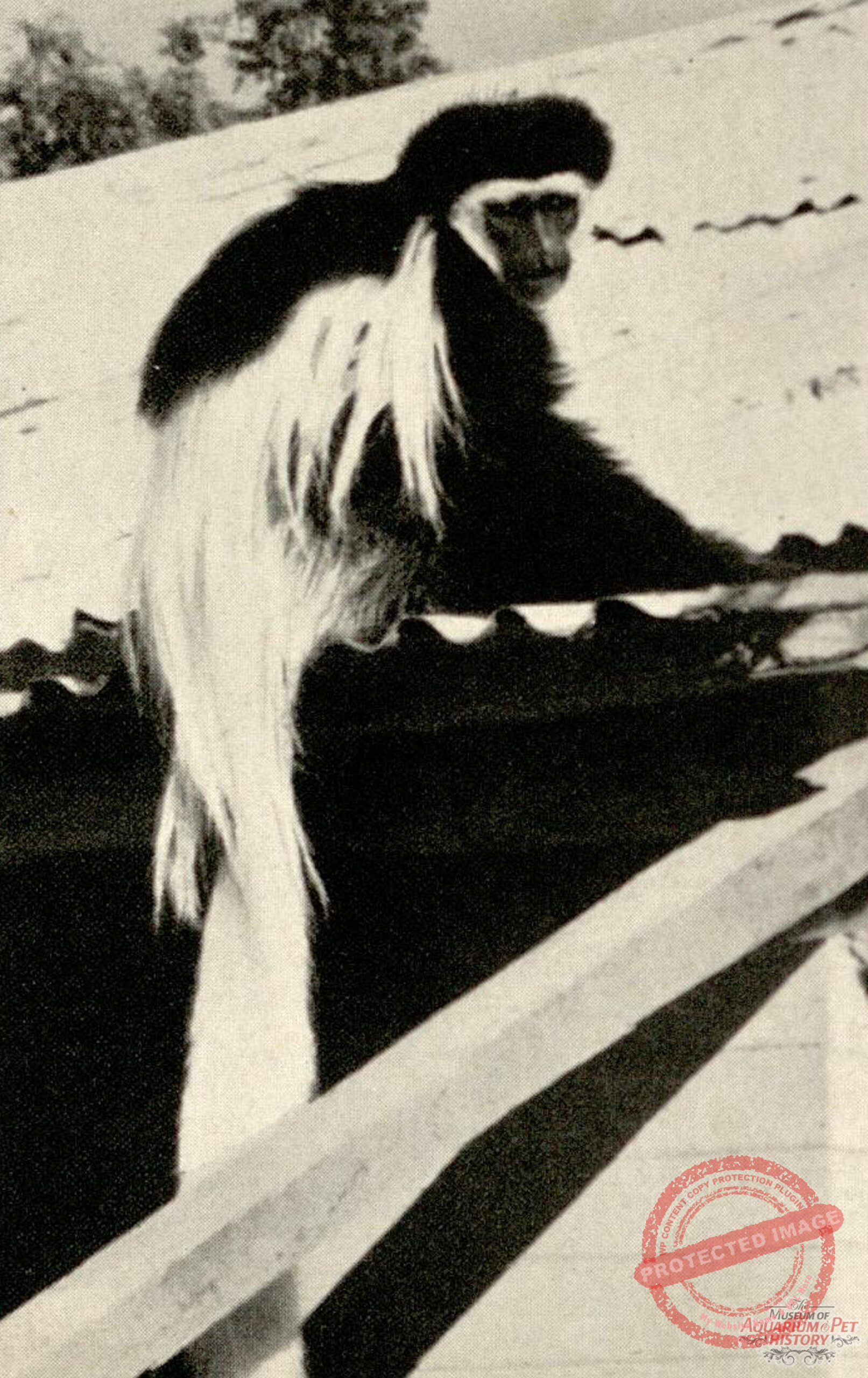
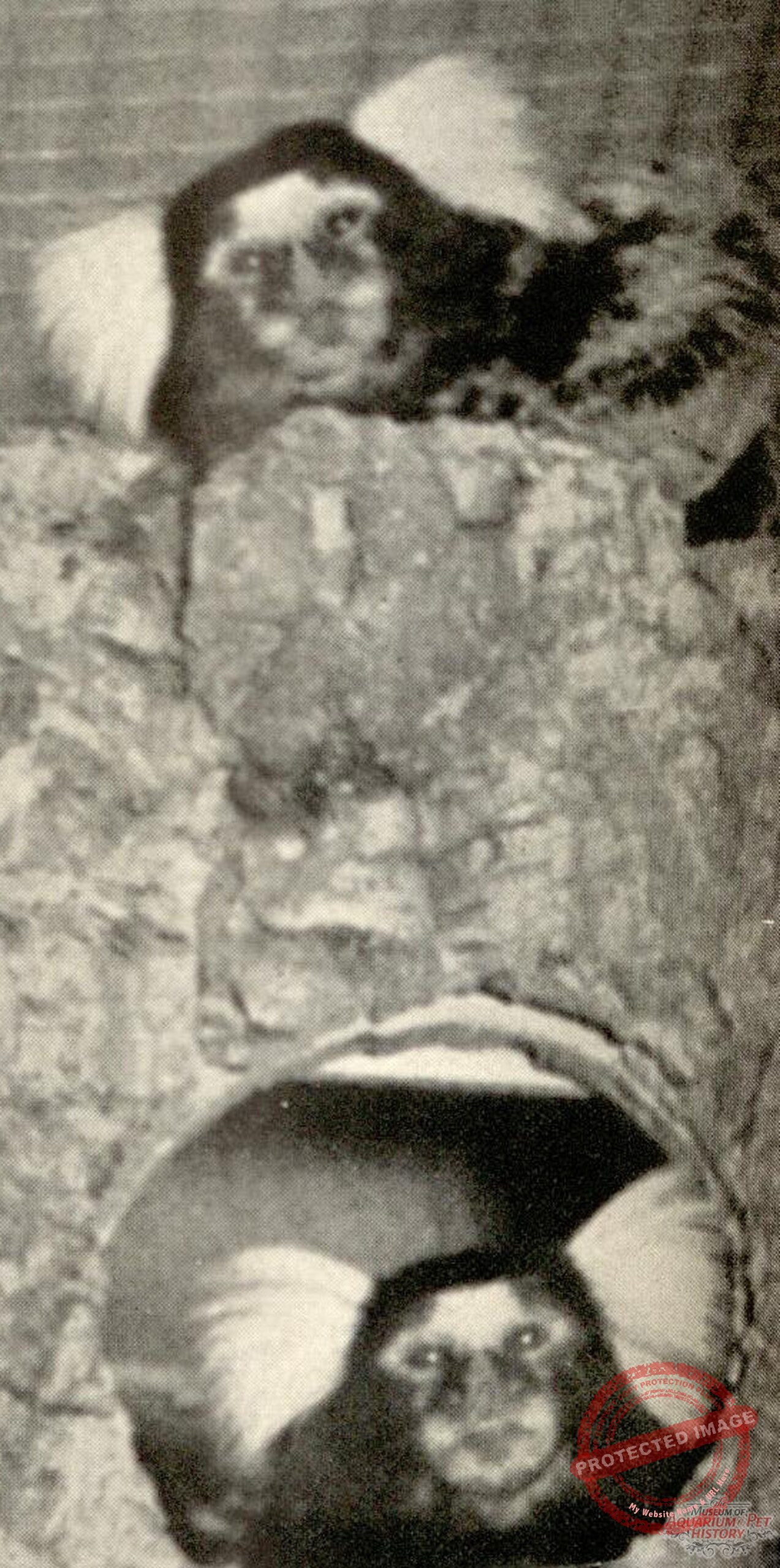
Three equally curious and precious monkeys. On the left, a South American pygmy marmoset, which grows to only about 30 cm in height; in the middle, a Colobus or Guereza monkey on the roof of the farmhouse near Arusha, measuring about 1 meter from head to tail; and on the right, two South American cotton-top tamarins, just under 25 cm tall, living in the tropical house in Hanover, like the pygmy marmoset.