That’s So Fetch! — When Women Wore Dog Collars

by | Aug 11, 2026

Picture this: You’re at home one afternoon and notice your dog sitting excitedly by the front door. Realizing its time for your daily scheduled walk, you slip on some stylish flats, an elegant coat, and briefly freshen up your makeup. You look over at Fido to confirm what he’s sporting that day and select a matching necklace from your jewelry box to complete the look.

But not just any necklace – a matching adjustable dog collar that compliments that of your dog. Clasping it around your neck and looking ever so chic, you’re ready to hit the town.

Although it may seem eccentric to some today, during the mid-20th century, fashion advertisers transformed dog accessories into symbols of femininity, luxury, and lifestyle identity by encouraging women to coordinate their appearance with their pets.

This article explores the historical origin of such trends and underlines how the love for pets manifested a unique fashion phenomenon.

From Utility to Luxury: A Brief History of Decorative Dog Collars
To understand where the concept of owner-pet matching accessories came from, it’s helpful to overview the broader history of dog collars and pet accessories in general. Some of the earliest recorded pet accessories originated with ancient Mesopotamians, Egyptians, and Greeks, but have been historically linked to regions all throughout the world.

According to Justyna Szymczak and Kristopher Fraser, however, it wasn’t until the Middle Ages that dog collars underwent their most stylish transformation. They explain that “Upper class women treated their dogs as literal accessories. Dog owners of the Middle Ages began using more quality and luxurious materials for dog collars, including leather, iron, and gemstones.”
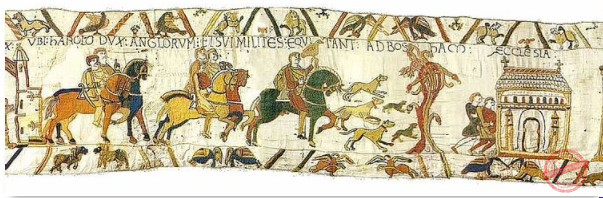
11th Century CE Bayeux Tapestry depicting collared hunting dogs
Credit: Wikimedia Commons and Dr. Joshua J. Mark
The Rise of The Pampered Pet: Victorian Pet Culture and Luxury Ownership
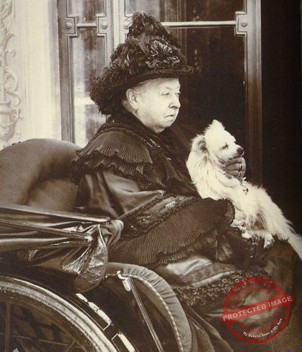
Queen Victoria, ruler of the United Kingdom from 1837 to 1901, owned dozens of dogs throughout her reign. Jacqueline Banerjee notes that the Queen’s “love of animals, and her appreciation of their different traits, were widely shared by her subjects. Few fashionable Victorian women were without a lapdog.”
“Queen Victoria with her beloved Pomeranian Turi”
Credit: Pomeranian.org
Viewed as cherished family members rather than purely working animals, dogs became symbols of wealth and class. As a part of Victorian fashion, dogs sported “bejeweled collars, embroidered coats, and silk leashes.” With the rise of dog shows and pedigreed breeds like Pomeranians and King Charles Spaniels, pampered companions evolved into extensions of their owner’s fashion.
Matching Fashion and Mid-Century Advertising
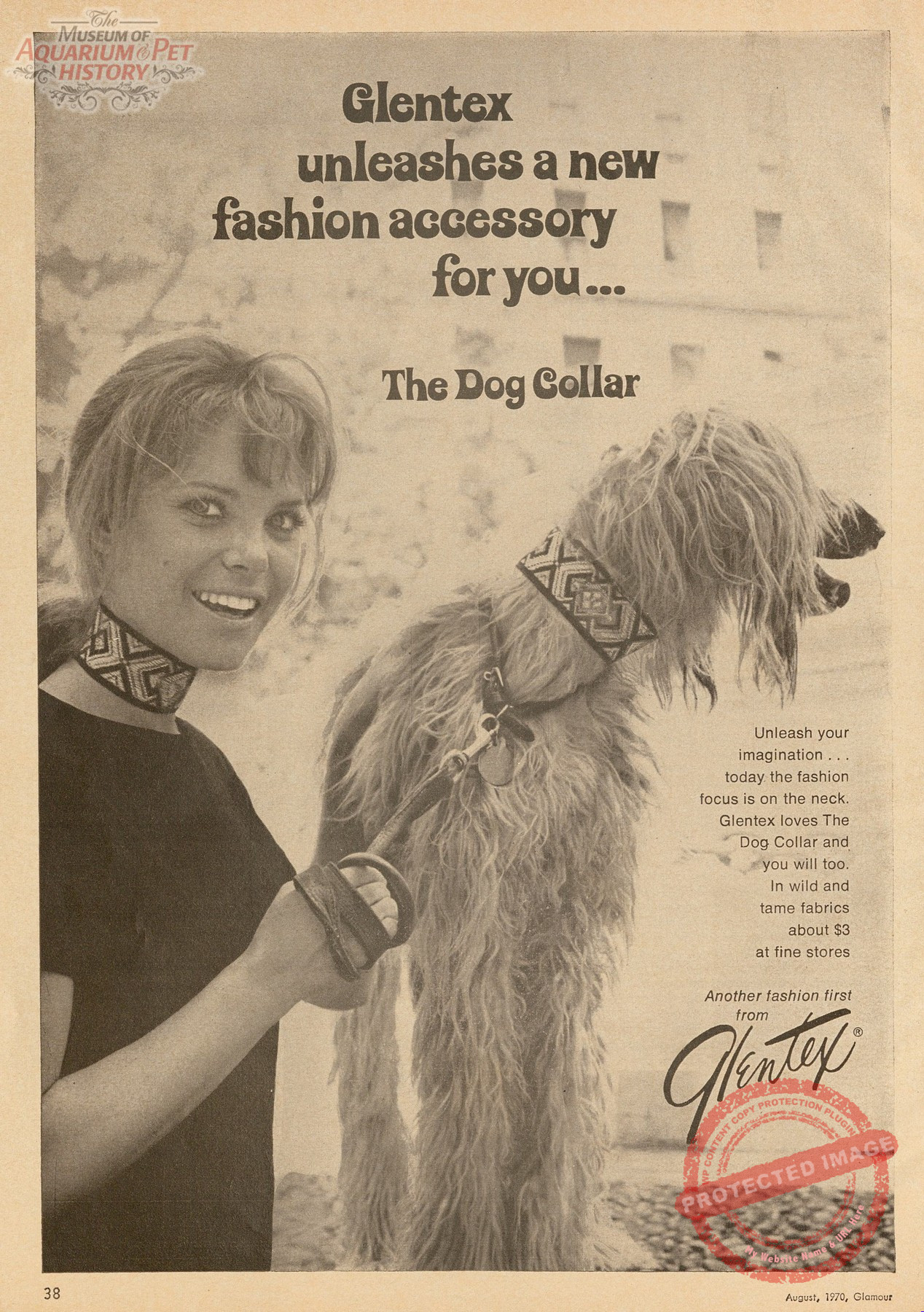
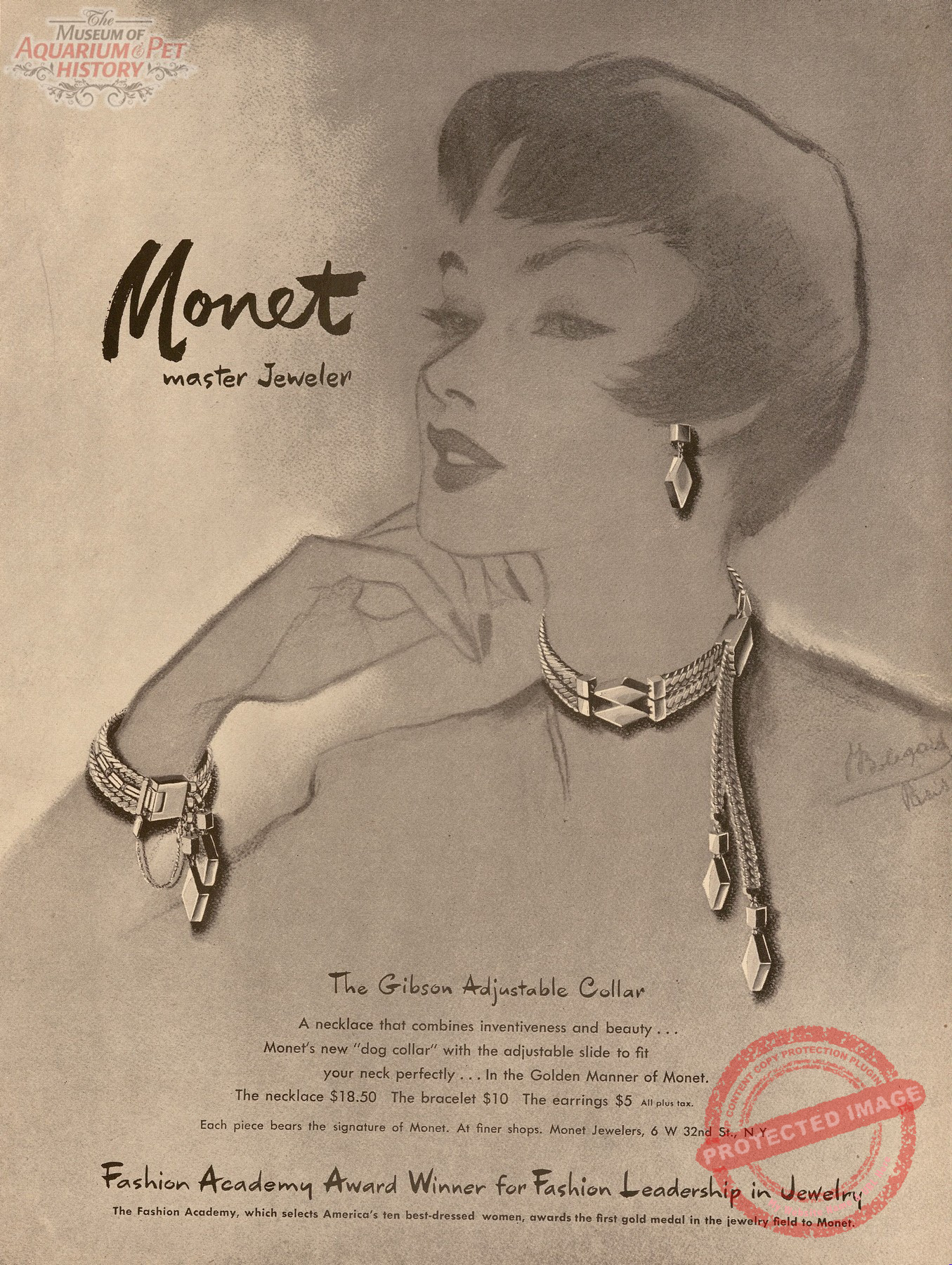
Mid-century fashion companies briefly blurred the line between pet accessories and women’s style by marketing dog collars as matching lifestyle adornments. The following images show how women’s fashion is borrowed from pet accessory language and normalizes collar imagery as glamorous rather than utilitarian. Further, department stores saw this as fashionable enough to advertise nationally.

A 1970 advertisement for in Glamour Magazine showcases a cheerful young woman matching her hound; both wear wide fabric collars that appear embroidered or beaded. The black and white image contrasts the decorative pieces and highlights their bohemian pattern. Clever wording encourages customers to “unleash” their imagination with the Glentex Dog Collar.
MOAPH collection
Similarly, Monet Master Jeweler advertises their Gibson Adjustable Collar as “a necklace that combines inventiveness and beauty.” The extravagant and eye-catching fine metal pops against a classy, illustrated woman to grasp readers’ attention. In addition to the collar, Monet also offers match bracelets and earrings.
MOAPH collection
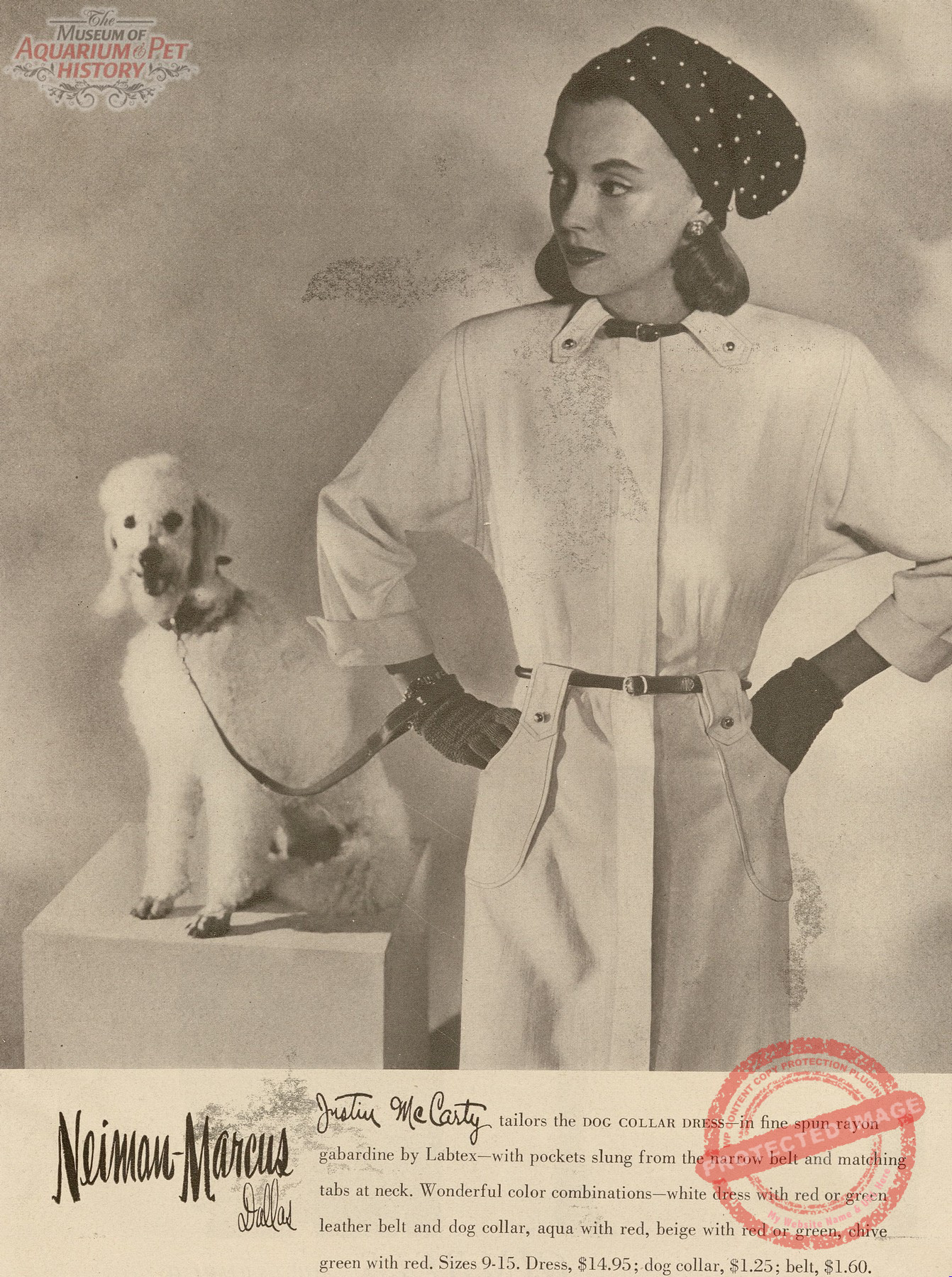
If dog collar necklaces aren’t enough, brands like Neiman-Marcus offer choices like the Dog Collar Dress; a chic rayon gabardine garment that features a belt to complement the leather collar neckline. Like Glentex, the image depicts a well-dressed woman with her equally elegant pooch.
MOAPH collection
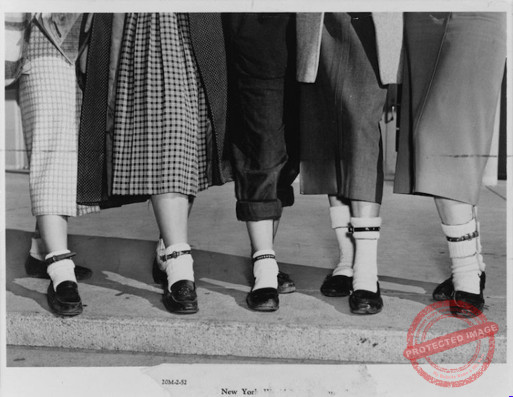
Dog collars weren’t only popular among adults, however. In the 1950s, teens donned the accessories on their ankles to communicate their love life with peers. Originally popularized out of the need for budget-friendly adornments, teenage girls would wear the collars either on their right or left ankle to indicate if they were single or taken. Janell Ereston notes how the meaning of each side differed depending on location, highlighting how the fad wasn’t limited to a single city or town.
Teenage girls wearing dog collars on their ankles (1953)
Image by Roger Higgins in the New York World-Telegram & Sun Newspaper Photograph Collection (Library of Congress public domain)
Speaking of making contemporary fashion affordable, dog collars have also made many appearances in the world of alternative style. Gothic and punk subcultures have incorporated them as DIY choker necklaces since the 1980s and 90s. Typically made of materials like PVC, rubber, or leather; such collars are often embellished with spikes, an interesting element tied to the protective dog gear of the past, but with a twist of social rebellion or broader non-conformity.
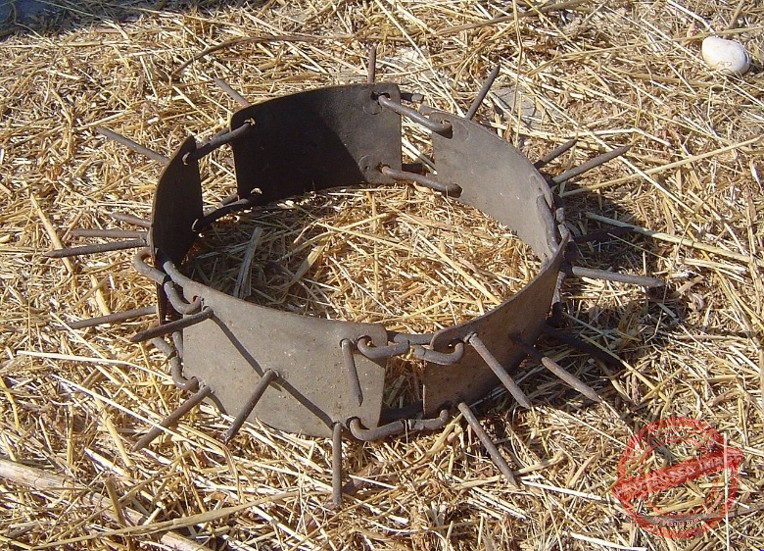
The wolf collar or “roccale” was a dog collar designed to protect livestock guardian dogs from neck bites.

Credit: Wikipedia – wolf collar

Spiked dog collars and chains are utilized as part of punk fashion.

Credit: Photo by Marc Arsenault and Cvlt Nation – Punk girl at Black Flag show in Albany, New York (1985)

Ultimately, these advertisements and the long history of various dog accessories make one thing apparent: pets, in one way or another, can be viewed as extensions of identity. What our pets wear, and in conjunction what we wear, whether matching or not, is telling of oneself.

Although designer and luxury brand matching collars from mid-century fashion columns have declined in popularity, wanting to match with one’s fluffy companion has certainly lived on. Boutique brands such as FriendshipCollar and Sassy Woof, among many others, continue to manufacture and sell dog collars with matching bracelets, bandannas, and t-shirts for their owners to wear.

References
Brewminate. “A Brief History of Ancient Dog Collars.” Accessed June 10, 2026. https://brewminate.com/a-brief-history-of-ancient-dog-collars/.

CVLT Nation. “Portraits of North American Punk Culture from the 80s & 90s.” Accessed June 15, 2026. https://cvltnation.com/portraits-of-north-american-punk-culture-from-the-80s-90s/.

Depth Dog Guide. “Dogs in the Victorian Era.” Accessed June 10, 2026. https://depthdogguide.com/dog-history/dogs-in-the-victorian-era/.

Dog House FMB. “Why Do People Wear Dog Collars? Unveiling the Reasons.” Accessed June 15, 2026. https://doghousefmb.com/why-do-people-wear-dog-collars-unveiling-the-reasons/.

Friendship Collar. “Dogs Collection.” Accessed June 10, 2026. https://friendshipcollar.com/collections/dogs/.

Janelle Reston. “Dog Collar Ankle Bracelets (1950s).” Accessed June 10, 2026. https://janellereston.wordpress.com/2018/04/02/dog-collar-ankle-bracelets-1950s/.

LoveDog. “The History of Dog Fashion.” Accessed June 10, 2026. https://lovedog.com/style-design/the-history-of-dog-fashion/.

Pomeranian.org. “Royalty and Pomeranians.” Accessed June 10, 2026. https://pomeranian.org/blog/royalty/.

Posh Puppy Boutique. “La Jeune Tulipe Diamond Dog Pet Collar – Exclusive to Posh Puppy Boutique.” Accessed June 10, 2026. https://www.poshpuppyboutique.com/products/la-jeune-tulipe-diamond-dog-pet-collar-exclusive-to-posh-puppy-boutique/.

The Victorian Web. “Pets.” Accessed June 10, 2026. https://victorianweb.org/history/animals/pets.html.

Wikipedia. “Wolf Collar.” Accessed June 15, 2026. https://en.wikipedia.org/wiki/Wolf_collar.