At the Dawn of Zen Aquascaping
Takashi Amano as Told by a Collector
The entrepreneur, professional photographer and aquascaping master Takashi Amano has been, without a shadow of a doubt, the Steve Jobs of the aquarium industry.
Born in Niigata city, Japan, in 1954, Amano nurtured four great passions from a young age: nature, aquariums, photography, and cycling. When he was in his 20s, he became a professional cyclist, and used to spend all his winnings on cameras and aquariums with plants.
In 1984, his great passion for the aquatic world led him to open Aqua Design Amano, his own shop of nature-inspired aquariums. Back then, planted tanks were usually set up by placing aquatic plants in an orderly manner, like one would do in a flower garden. It was the popular Dutch style. Amano, instead, embraced the Zen-inspired philosophy of “learn from nature, to create nature”, initiating actually a new era of our hobby and turning aquascaping into an art form. He brought into the aquarium the aesthetic principles of the Japanese culture, and some elements of traditional Japanese gardening as well.
The “Nature Aquarium” concept
Fascinated by the multiple planted aquariums on display, more and more customers started to patronize his shop, which in 1988 was relocated from the town of Terao to Maki. Among Japanese hobbyists, Amano was getting increasingly popular.

Takashi Amano in 2002. Photo taken by the author. On the right, Amano’s autograph.
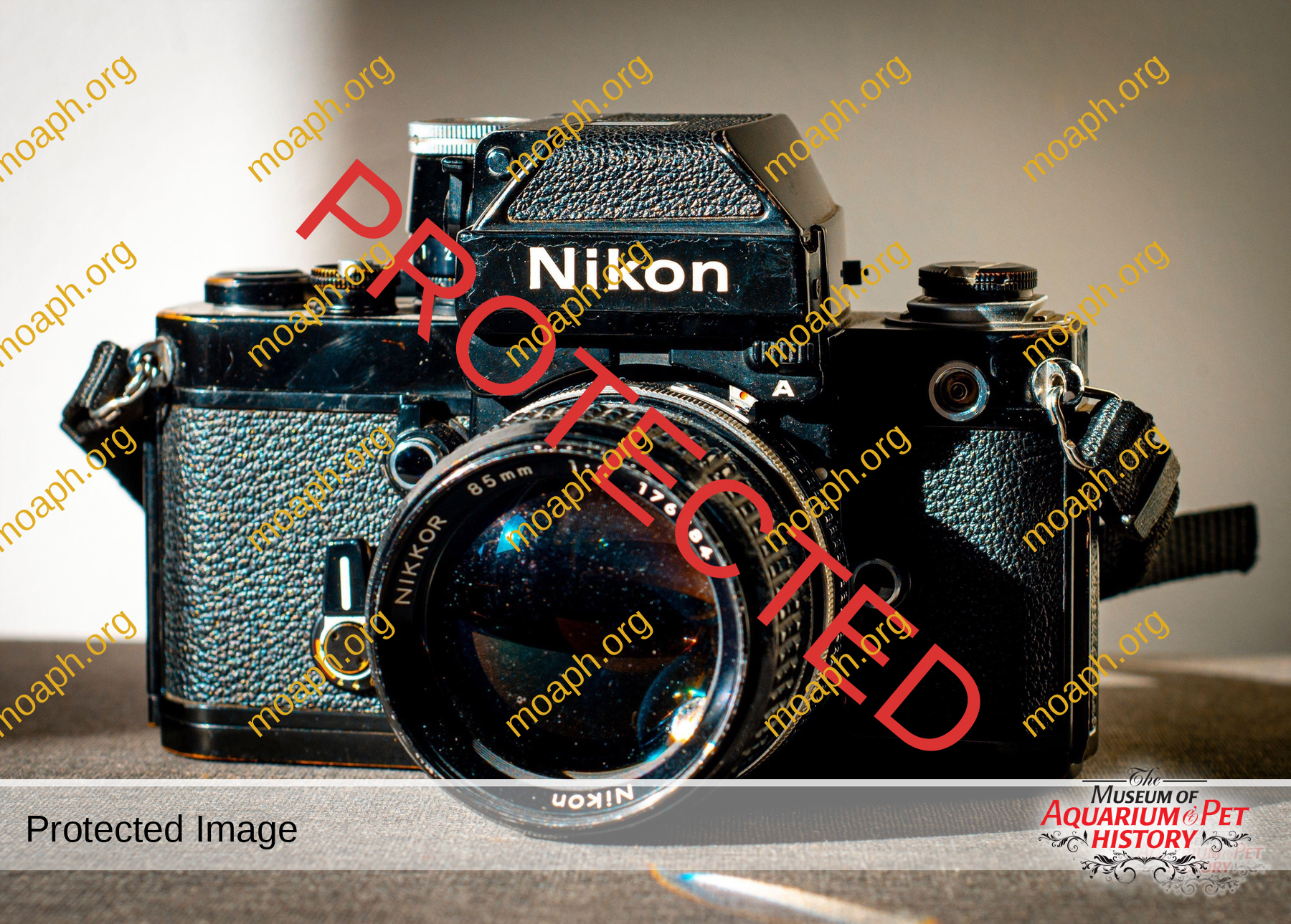
Amano bought his first reflex camera in 1974. It was a Nikon F2 Photomic.
He was a smart guy with countless ideas, always ready to experiment and to take on new challenges. Quite curious was the way he realized how crucial carbon dioxide was for the growth of aquatic plants. It happened due to his soft spot for whiskey and soda. One day, he tried to pour soda water (thus carbon dioxide) into one of his aquariums, and the idea worked. Supported by the injection of CO2, even the heliophytes such as Riccia and red stern species started to flourish.
Regarding the use of CO2, I have to point out that it wasn’t an Amano invention though, as some authors and Amano’s followers wrote multiple times. The benefits of carbon dioxide diffusion into an aquarium were already known. The German firm Hilena, for example, under Horst Kipper’s guidance produced carbon dioxide diffusers for aquariums as early as the 1970s.
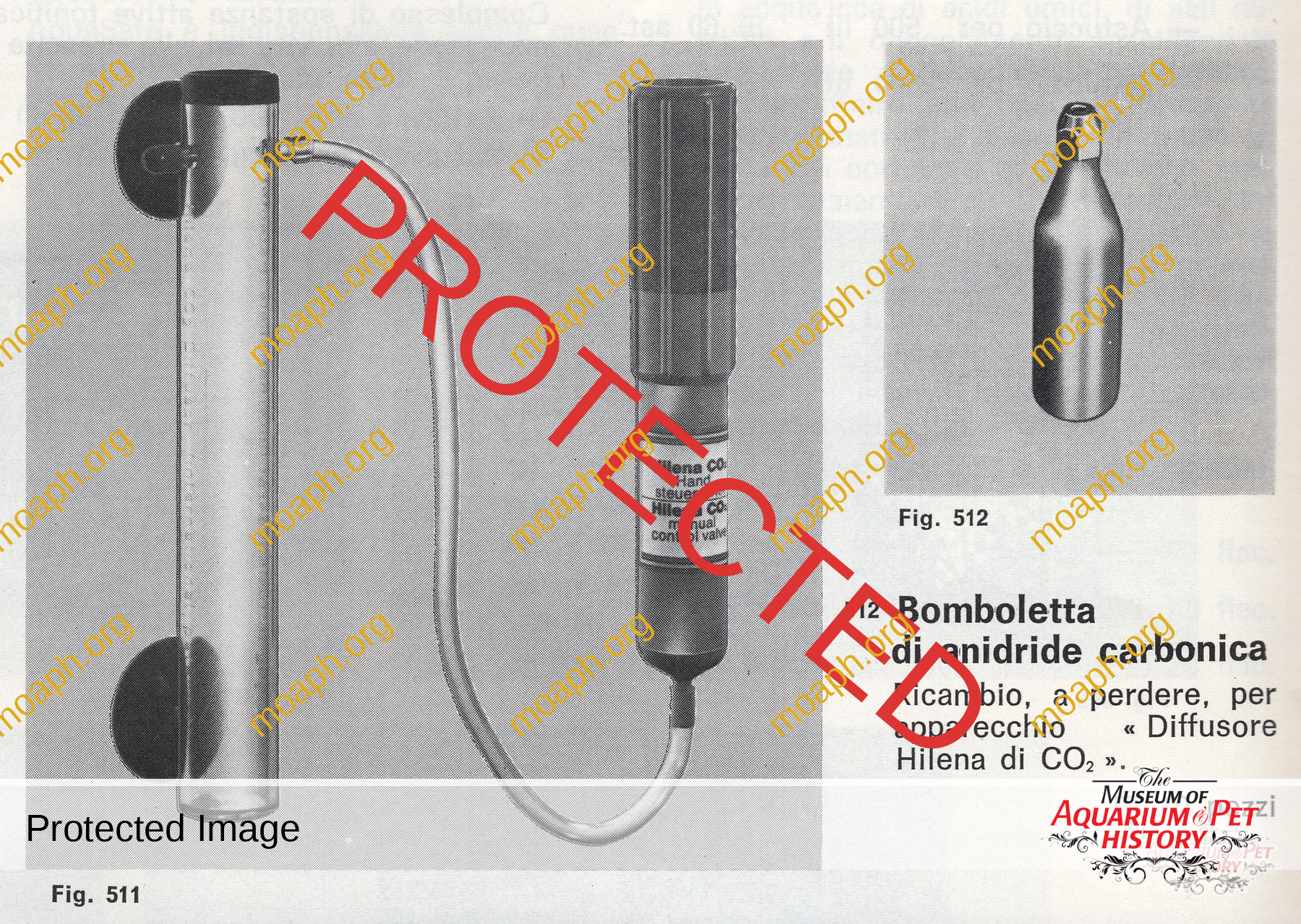
Carbon dioxide diffuser marketed by Hilena in the early 1970s.
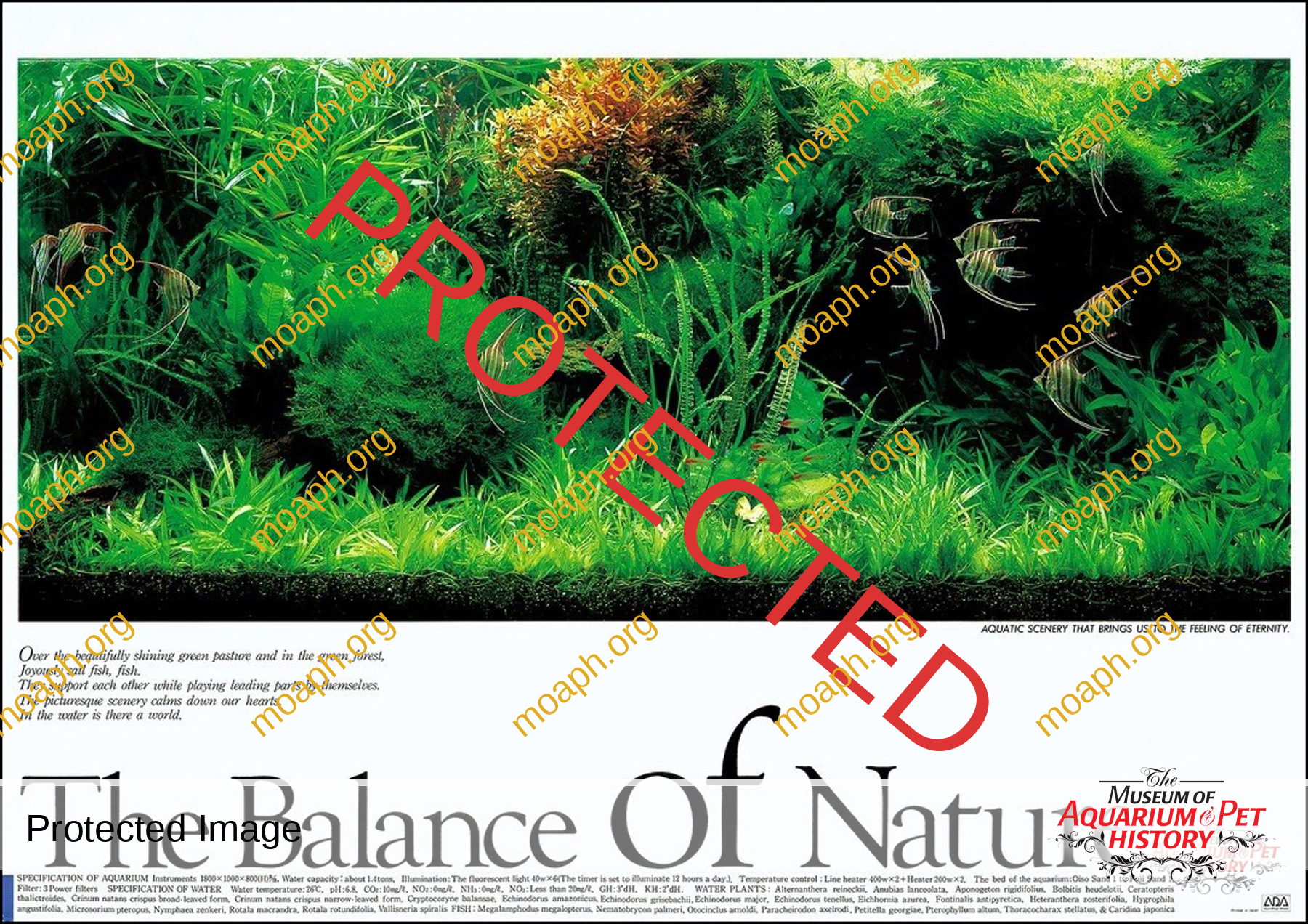
The 1988 poster titled “The Balance of Nature” cannot be missing in a collection of vintage items by ADA.
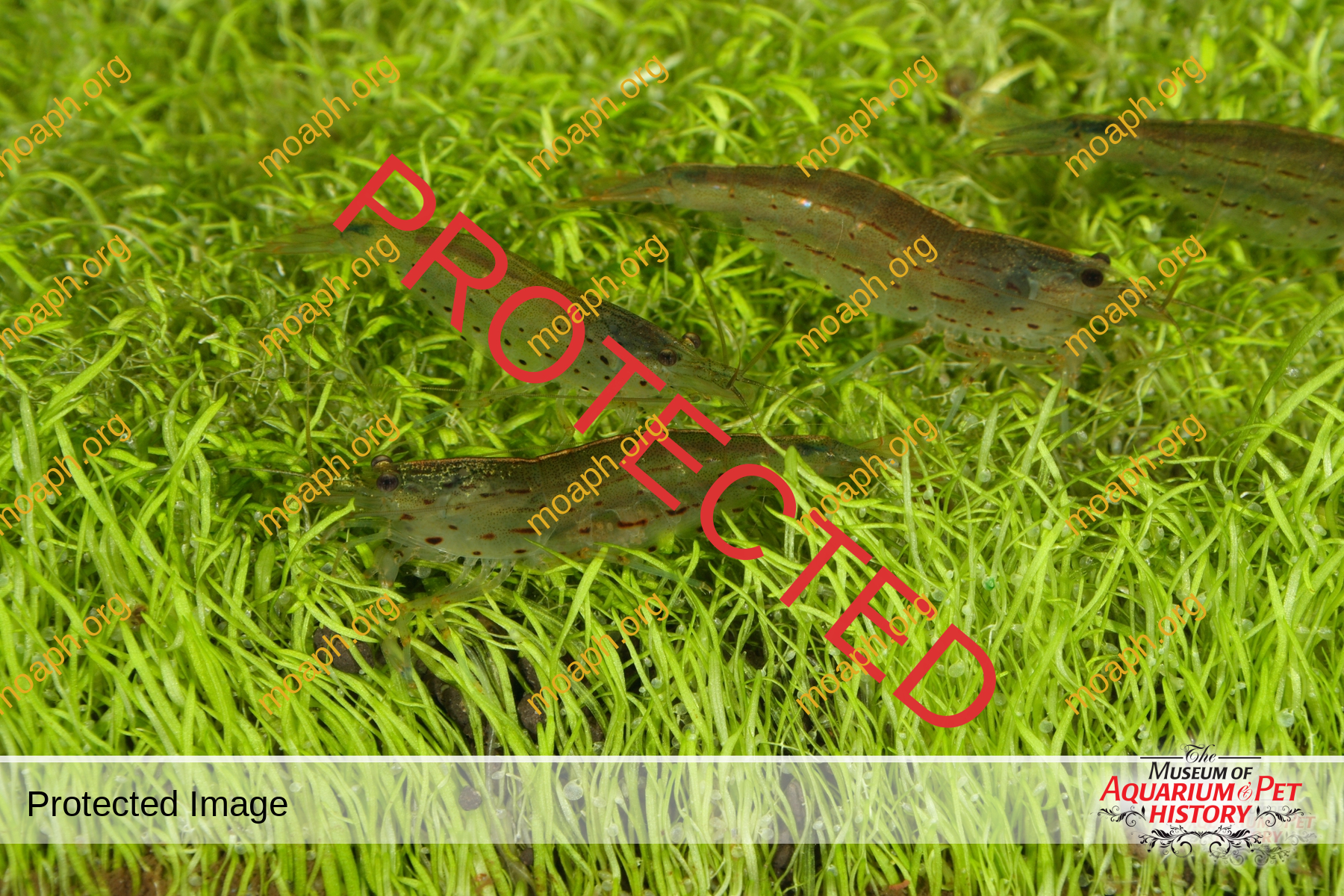
Caridina multidentata was introduced to the hobby by Amano in 1983. Commonly known as “Amano shrimp”, this efficient algae eater paved the way for a long series of shrimp species and other small freshwater crustaceans.
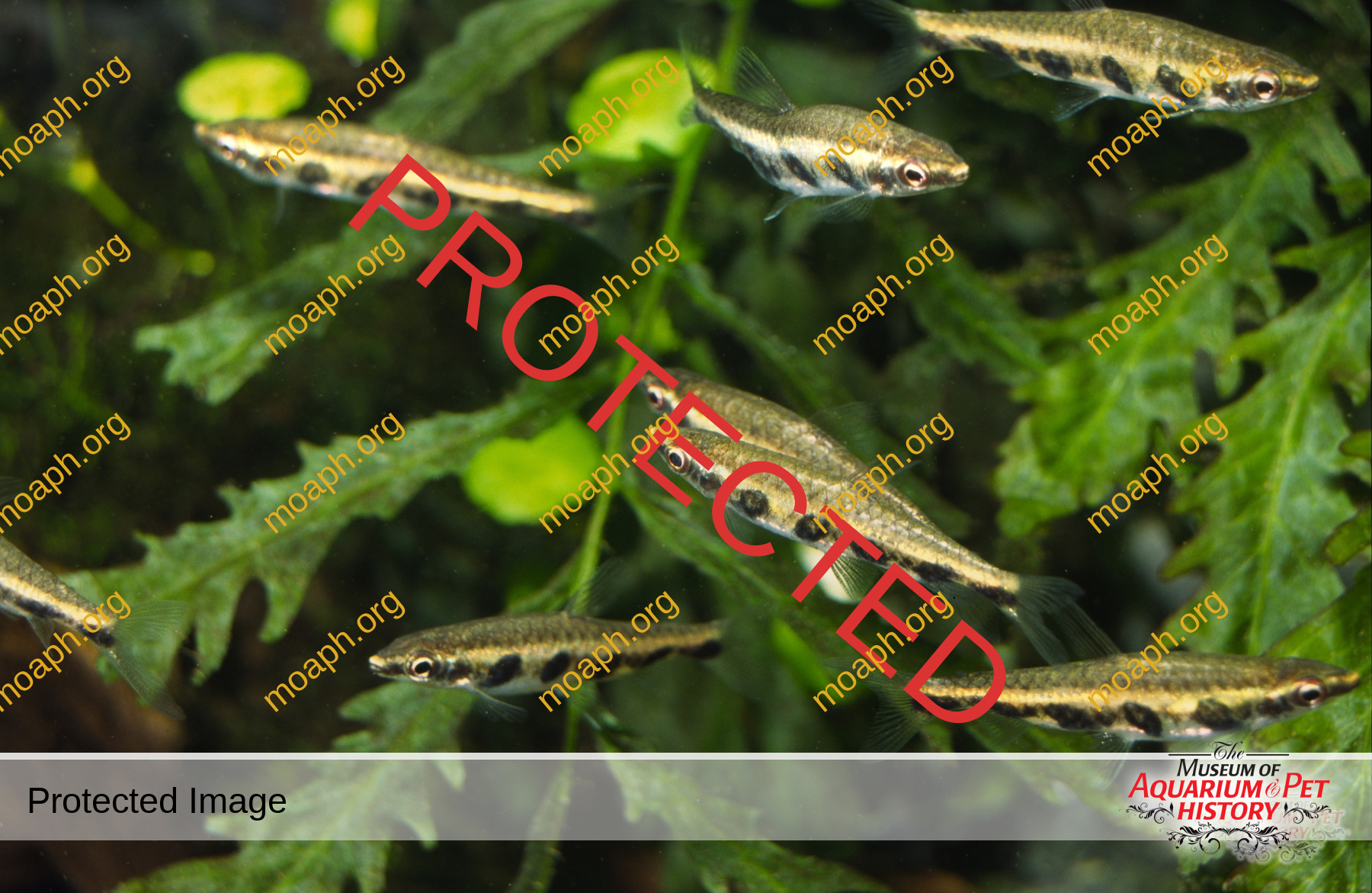
The pencilfish Nannostomus espei was common in Amano’s early aquascapes.
At the origins of Amano’s Nature Aquarium style and concept there was the Iwagumi, a layout (this term today is usually replaced by the trendier term “aquascape”) basically made of river stones and aquatic plants. Driftwood was another composition material which became popular in the hobby thanks to Amano, who soon started to attach moss and ferns to it in order to indicate the passage of time and to add depth to the layout. He took great inspiration from the underwater world, as one can easily suppose, as well as from particular terrestrial landscapes (mountains, forests, valleys, etc.) which he reimagined and replicated in the aquarium like nobody else did before.
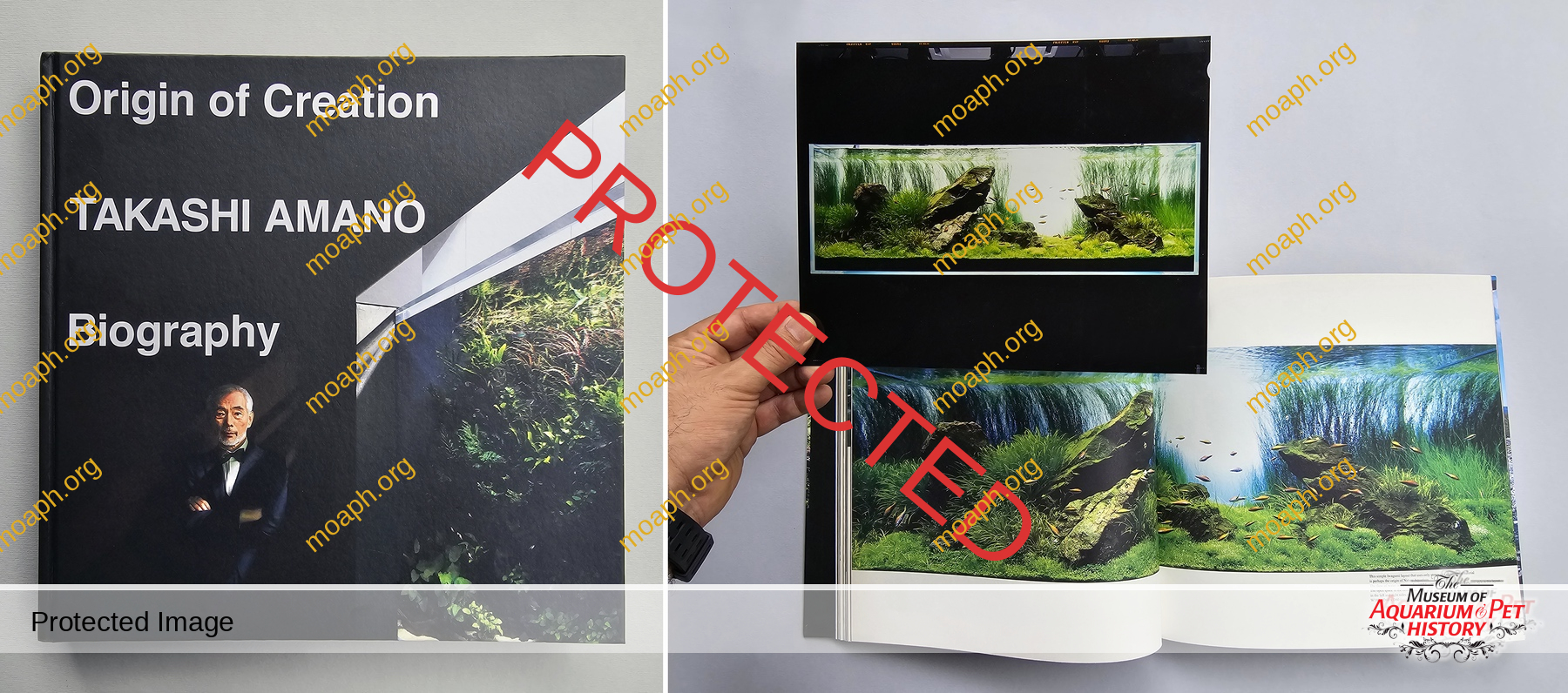
In his final book Origin of Creation (2015), Amano writes about the use of stones: “I came to understand the face and the voice of a stone. If I pick up a stone, it tells me how it should be placed. I don’t have to think about it. It’s simply a dialogue between a stone and myself.” The Iwagumi layout on the right was set up and photographed by Amano in 2003.
Vision
And 1984 was also the year when Amano developed his vision of a full-scale business and decided to use the official logo “ADA”. The company Aqua Design Amano Co., Ltd. was instead founded on April 21, 1992. The ADA brand was soon distinguished for its high-quality products with a minimalist yet functional design. In the 2015 book Origin of Creation – Takashi Amano biography, written with the help of his daughter Sayuri, Amano recalls: “I have been collecting antiques from all over the world since I was a teenager. Clocks, photographs, microscopes, glassware, and lamps are all among my collection. […] I despised the idea and the dull look of aquarium equipment that was nothing but just a poor life support system for fish. […] A tool that I make must be highly functional, beautifully designed and produced to please its users with an element of playfulness. As a principle, it must be an ultimate tool designed for nature aquariums. I pursued streamlined, simple beauty equipped with only necessary functions. I took away frills and added originality. I was aiming for refinement. However, functionality and sophisticated design alone do not produce an enticing tool. I must be infused with the passion of a craftsman. I wanted to produce a tool that lasted a lifetime instead of a cheap article of consumption. I insisted on handcrafted tools that were made one at a time by a craftsman, rather than mass-produced on a commercial basis.”
Back then, the aquarium industry was indeed plastic-addicted and already influenced by downward price logic. ADA acted as a voice out of the chorus, and began to manufacture high-end and stylish tools and accessories made of durable materials such as glass and stainless steel. ADA’s professional products, in many ways, strongly resembled the ones available in the early days of the hobby, as well as the traditional Japanese bonsai tools. The idea of uniting the whole aquarium system under a single design theme was quite revolutionary as well.
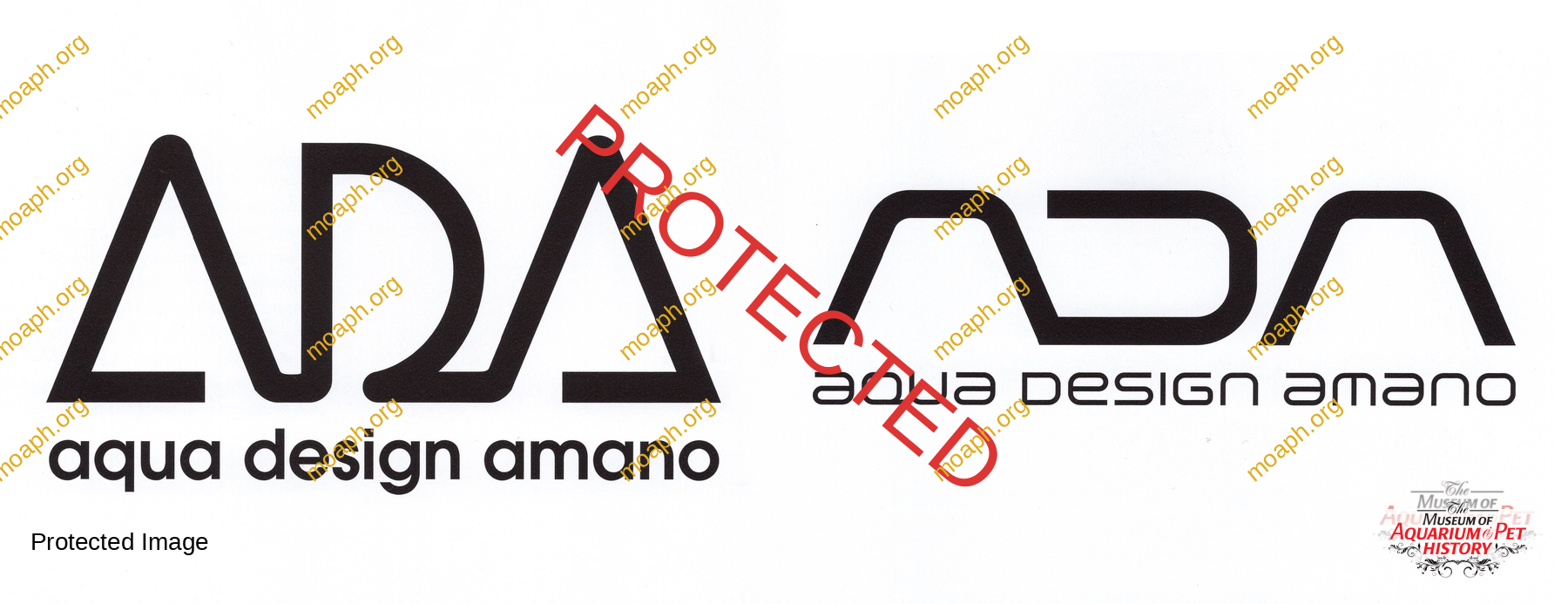
Based on the English font “Futura”, ADA’s first logo (1984-2010) makes a difference for collectors. The new logo (here on the right) has the same minimalist design, but nonetheless looks more innovative and futuristic.
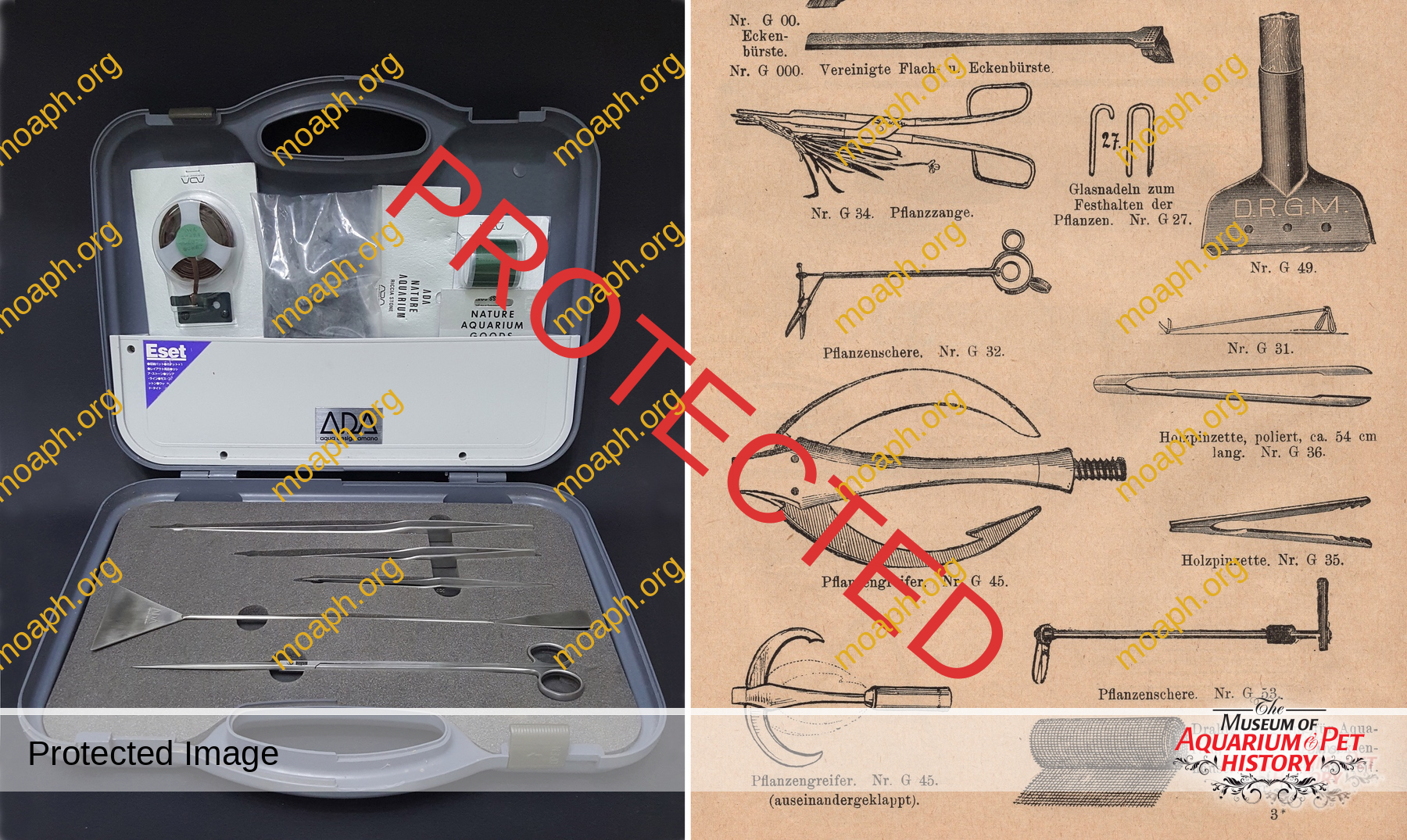
First release (old logo) of the popular ADA tool set. This vintage example from the author’s collection was used during a few workshops by Amano. On the right, an array of tools for the maintenance of aquarium plants available at the beginning of 20th century (A. Glaschker catalog, Germany).
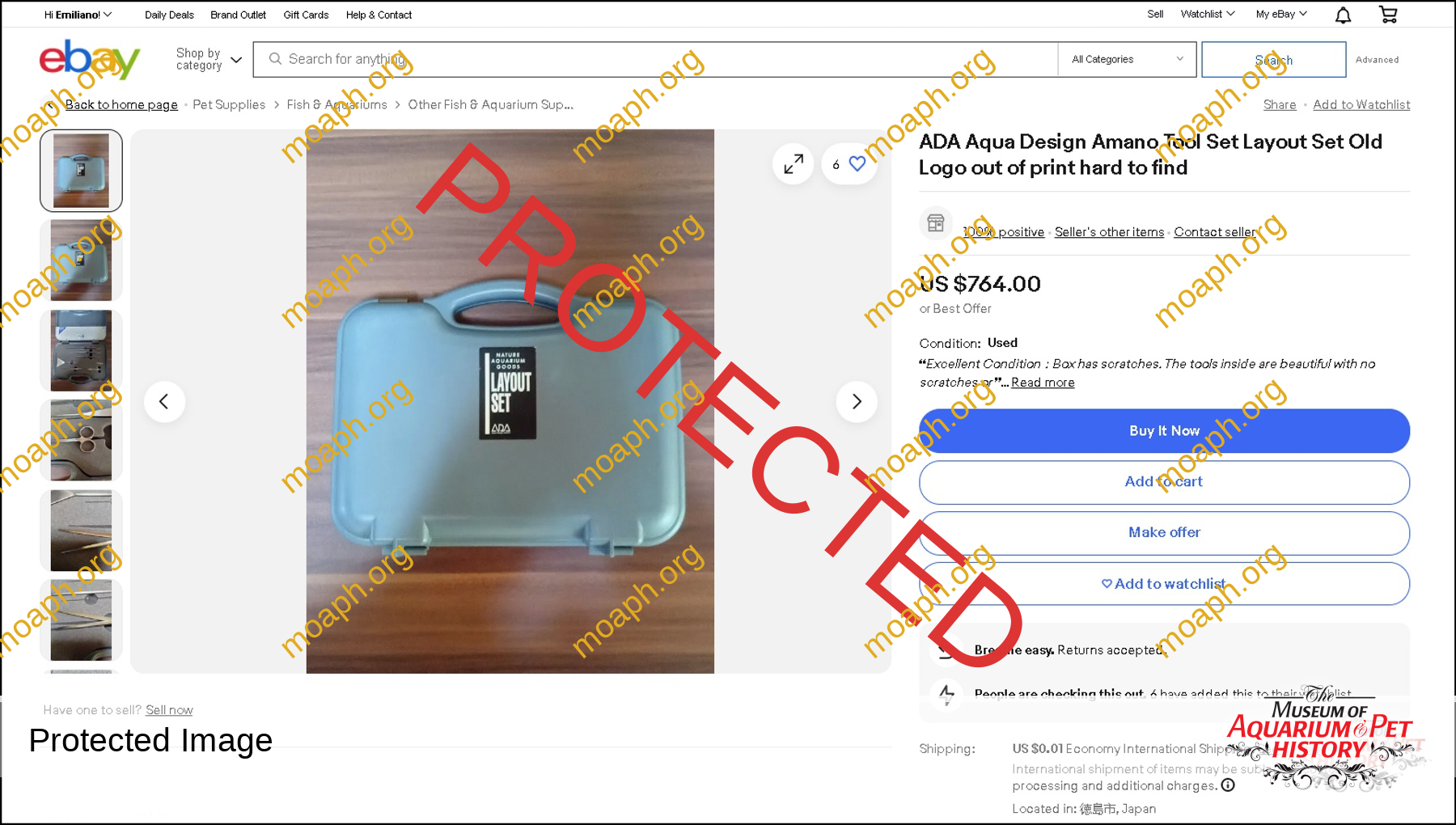
Vintage ADA tool set recently listed for sale on eBay.
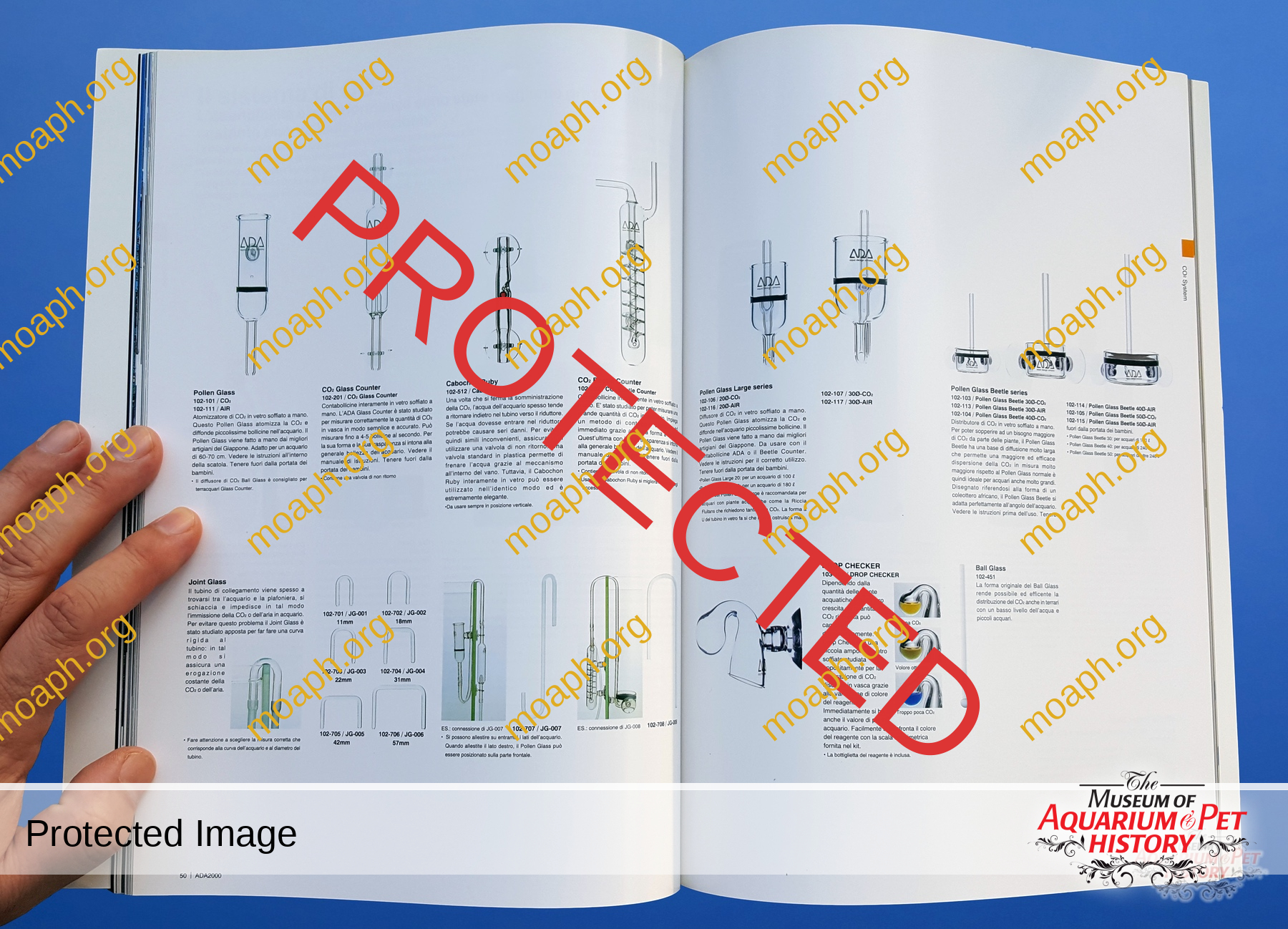
Glass accessories marketed by ADA at the turn of the century.
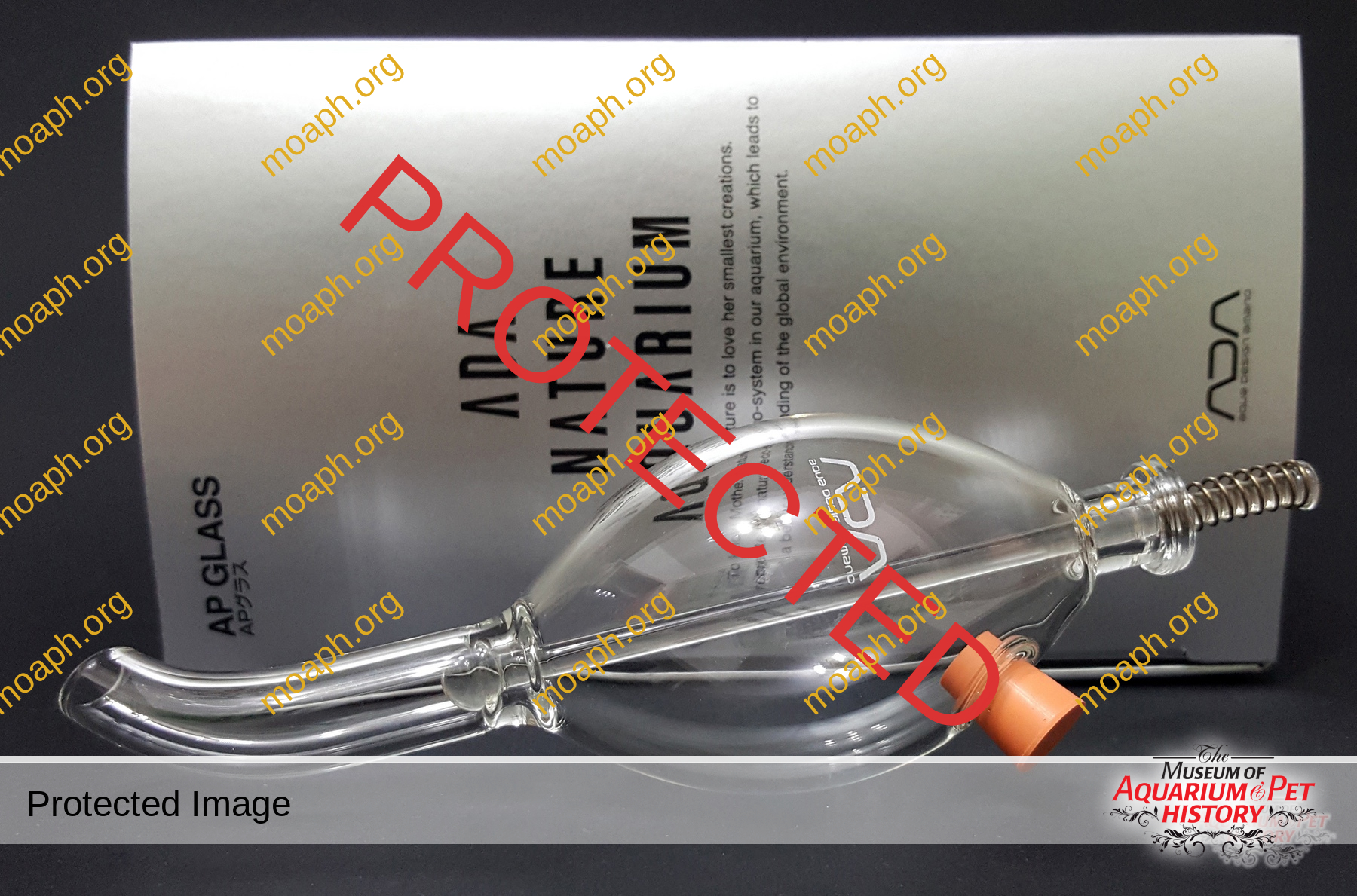
With the AP Glass, Amano demonstrated that even a fish food dispenser might be a design masterpiece. He originally designed it based on the size of his own hand. That’s why the earlier models are slightly larger than the later versions. The iconic line of packages made of silver and white boxes with a minimalist graphic was designed by Amano in 1993. The Japanese aquascaping master got an inspiration to make it from the packaging of cameras manufactured by the German brands Leica and Rollei.
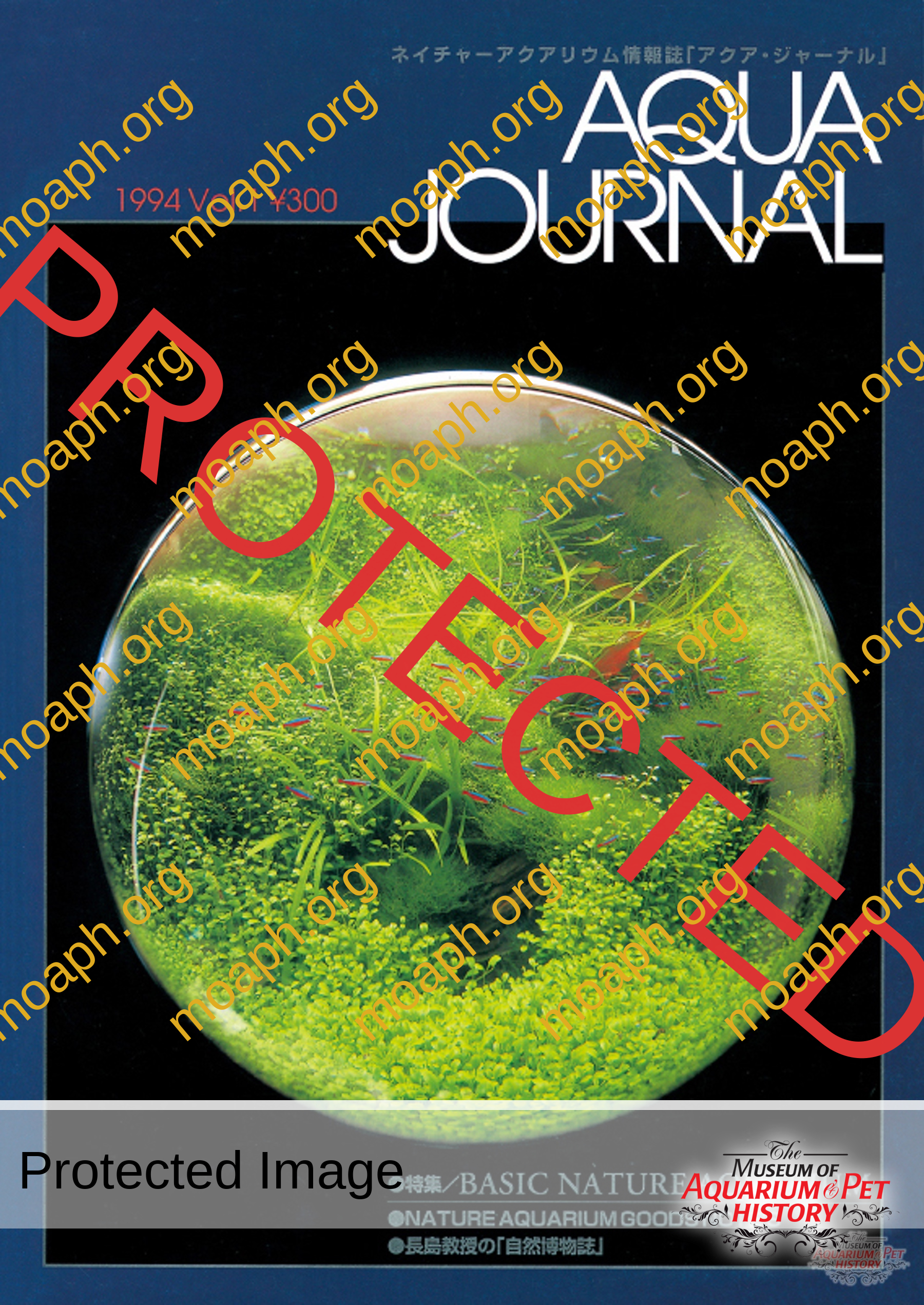
The first issue of the ADA magazine Aqua Journal was published in 1994.
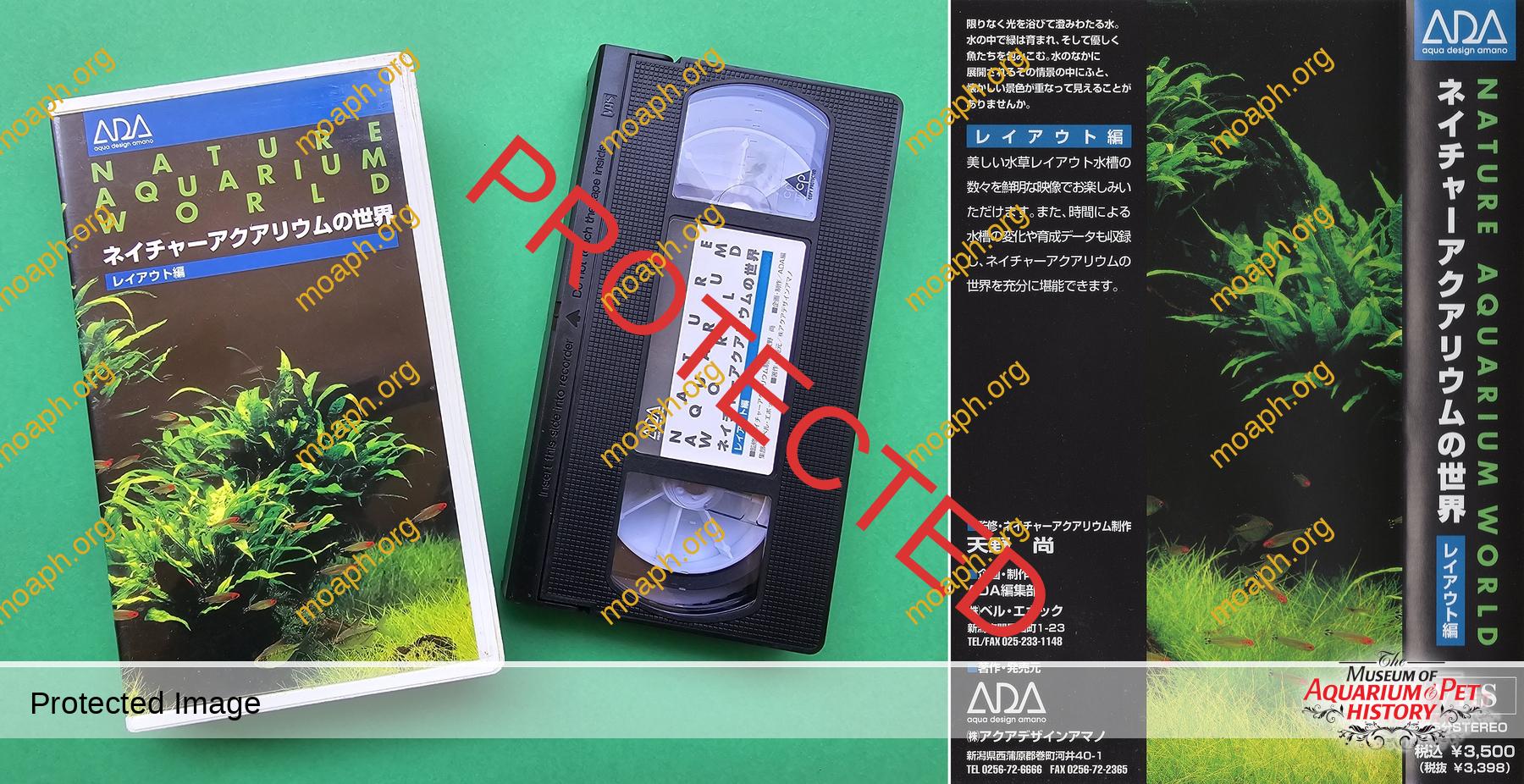
Released on VHS tape in 1990, Amano first video had a huge success.
Photography, a key for success
Amano was also a phenomenal aquarium photographer, an artist obsessed by perfection whose images spoke for themselves and brought him worldwide fame very quickly. His photographs of aquascapes were something never seen before in the hobby. They had a stunning depth of field and, despite the use of powerful studio strobes, very few or any issues of overexposure in the upper section of the frame.
Amano was a demanding leader, who expected that every magazine, product catalog, leaflet, poster, and book that left the company would be graphically dazzling as a small work of art. In order to achieve this goal, he even established a professional photo studio at ADA headquarters in Niigata, as well as an in-house publishing company.
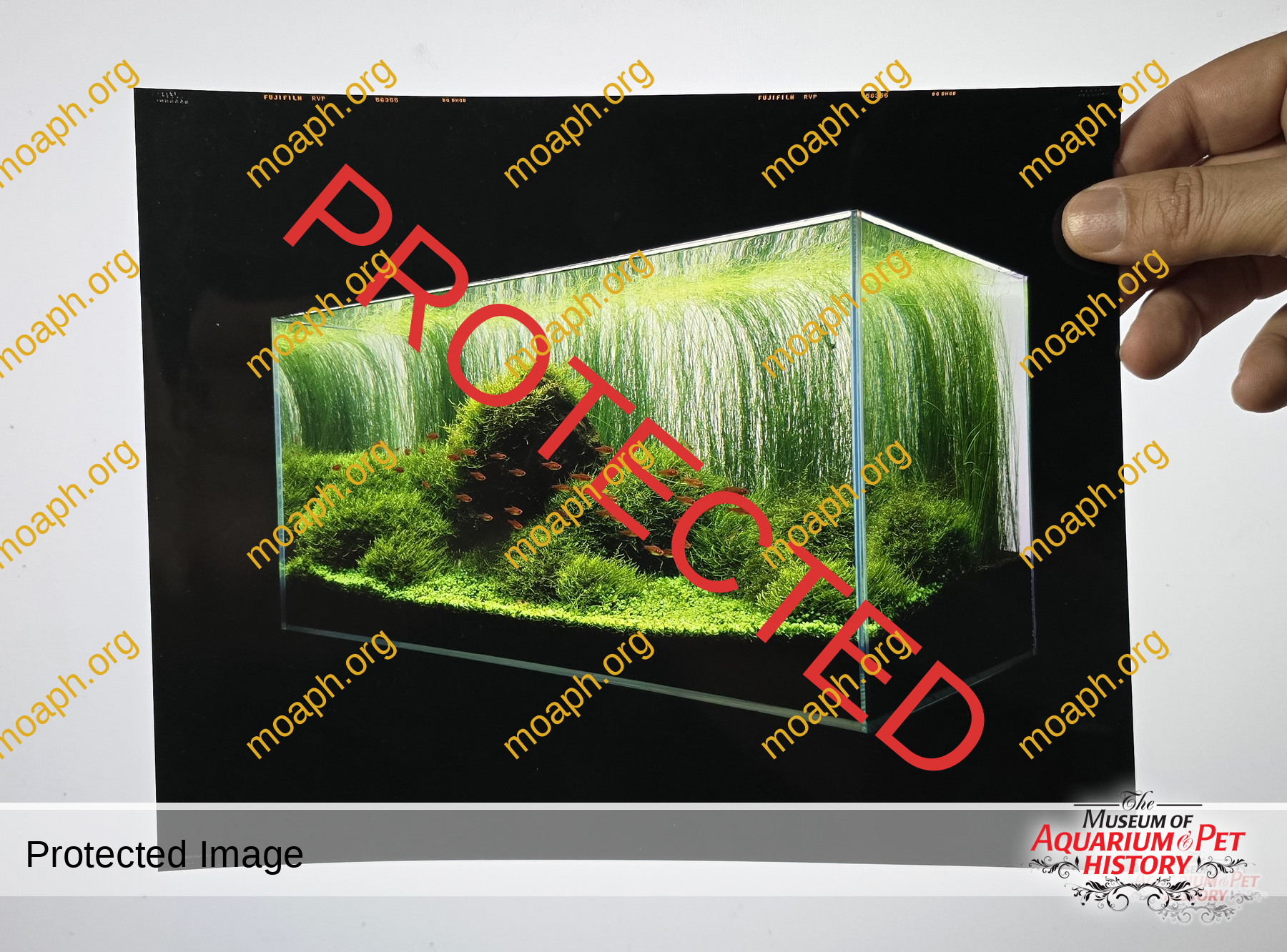
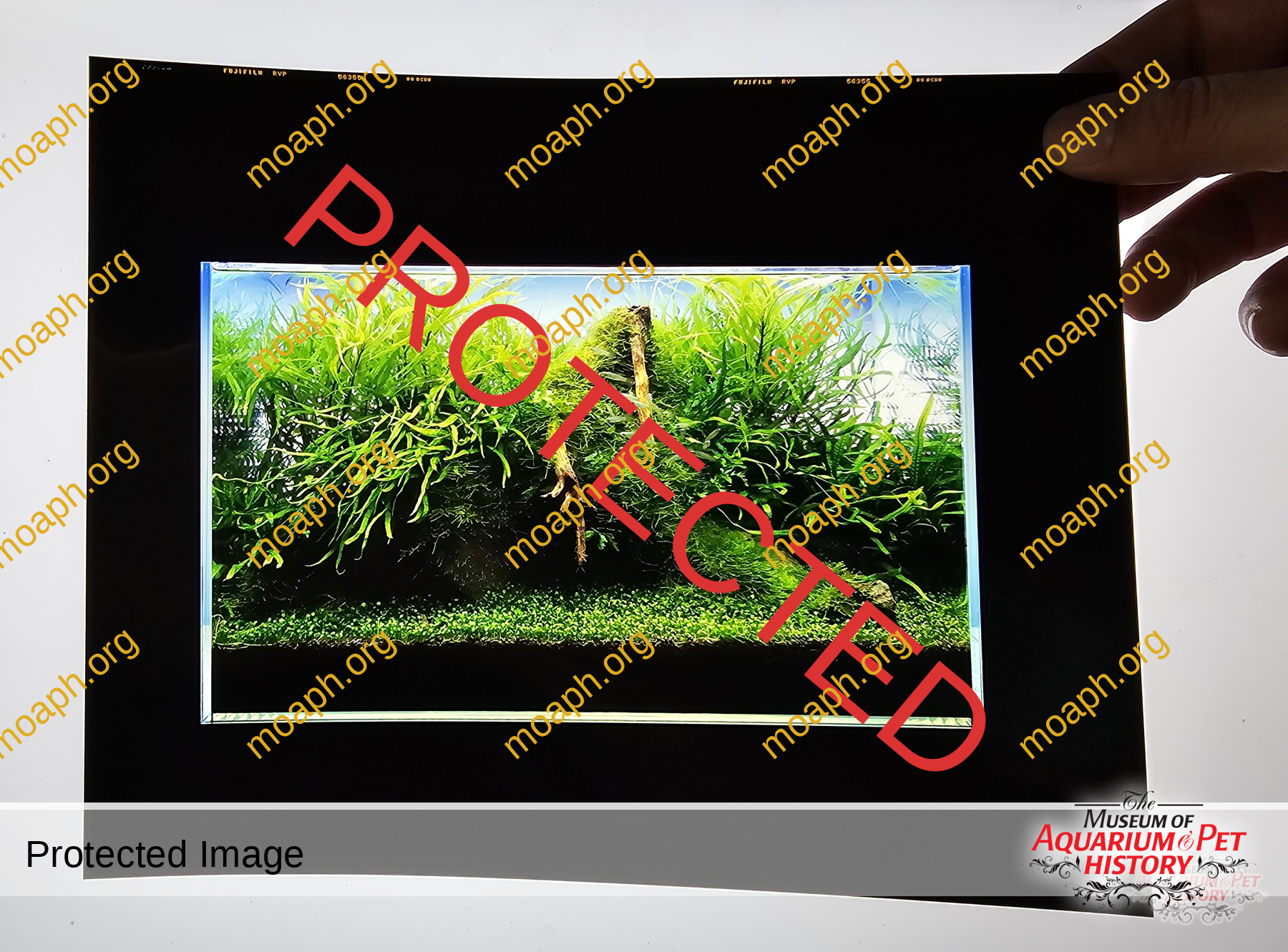
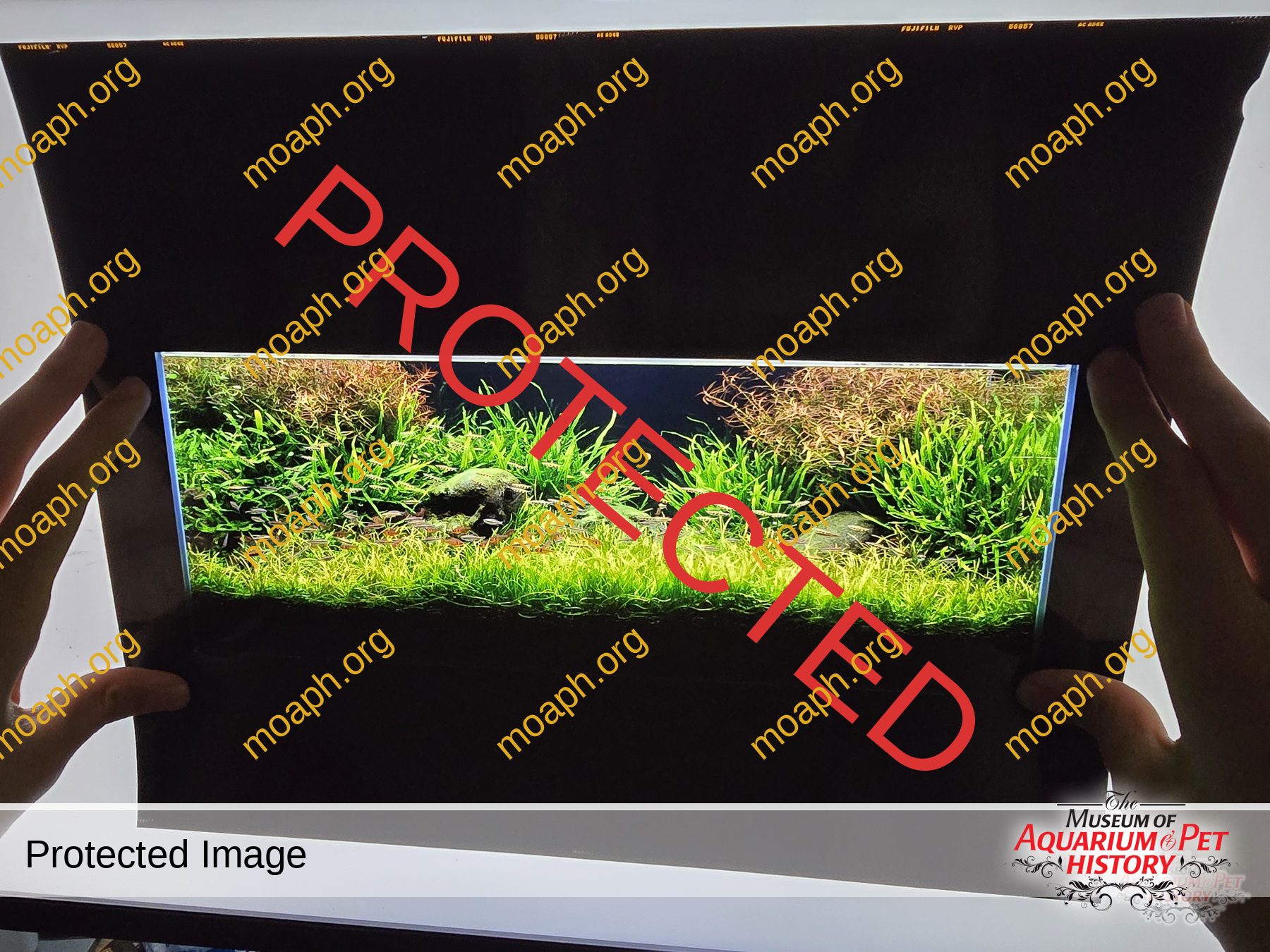
He kept on using film-based cameras even when the switch to digital cameras became the best option for practical reasons. The medium and large format slides he used were custom made by Fujifilm just for him and few other photographers in the entire world! I own some of them, and every time I show them to other fellow collectors, I say: “if you think they are large, try to imagine how big was the camera which housed them!”
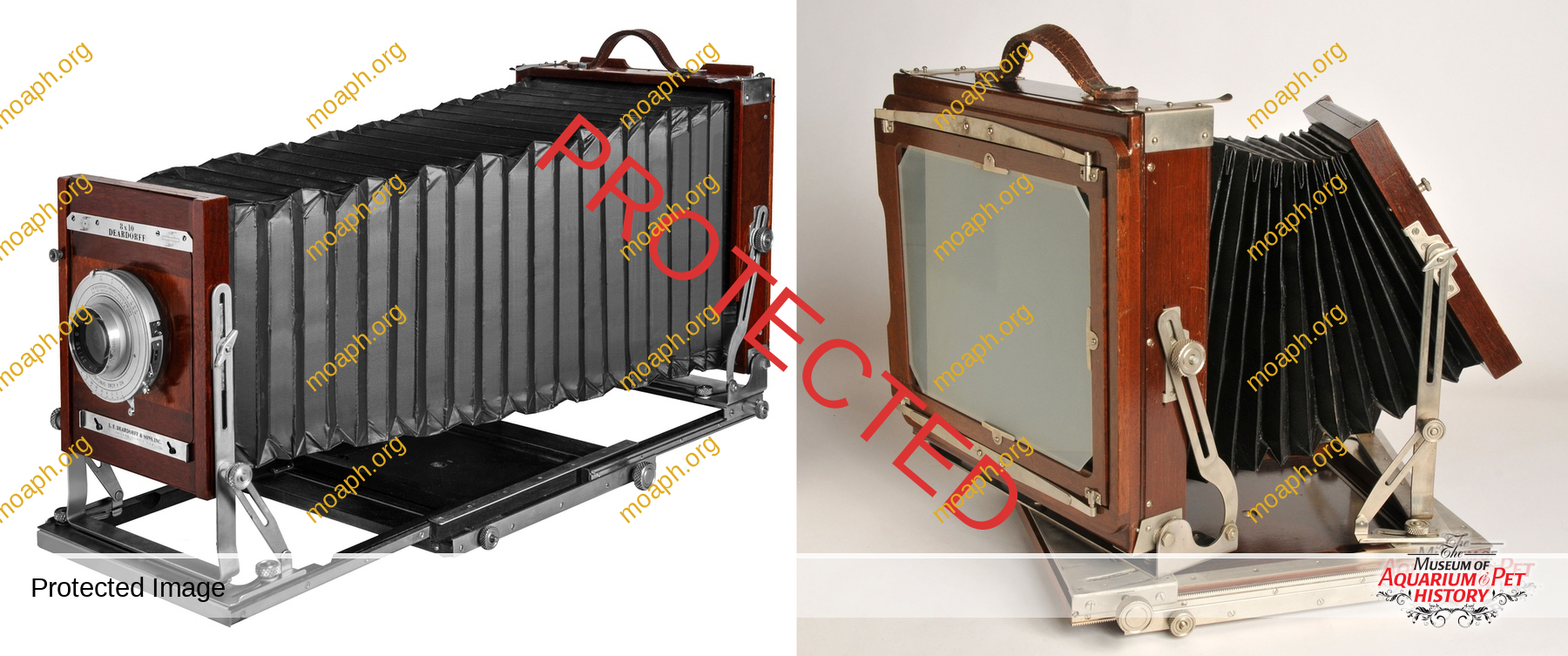
Deardorff 8X10 was Amano’s favorite large-format wooden camera.
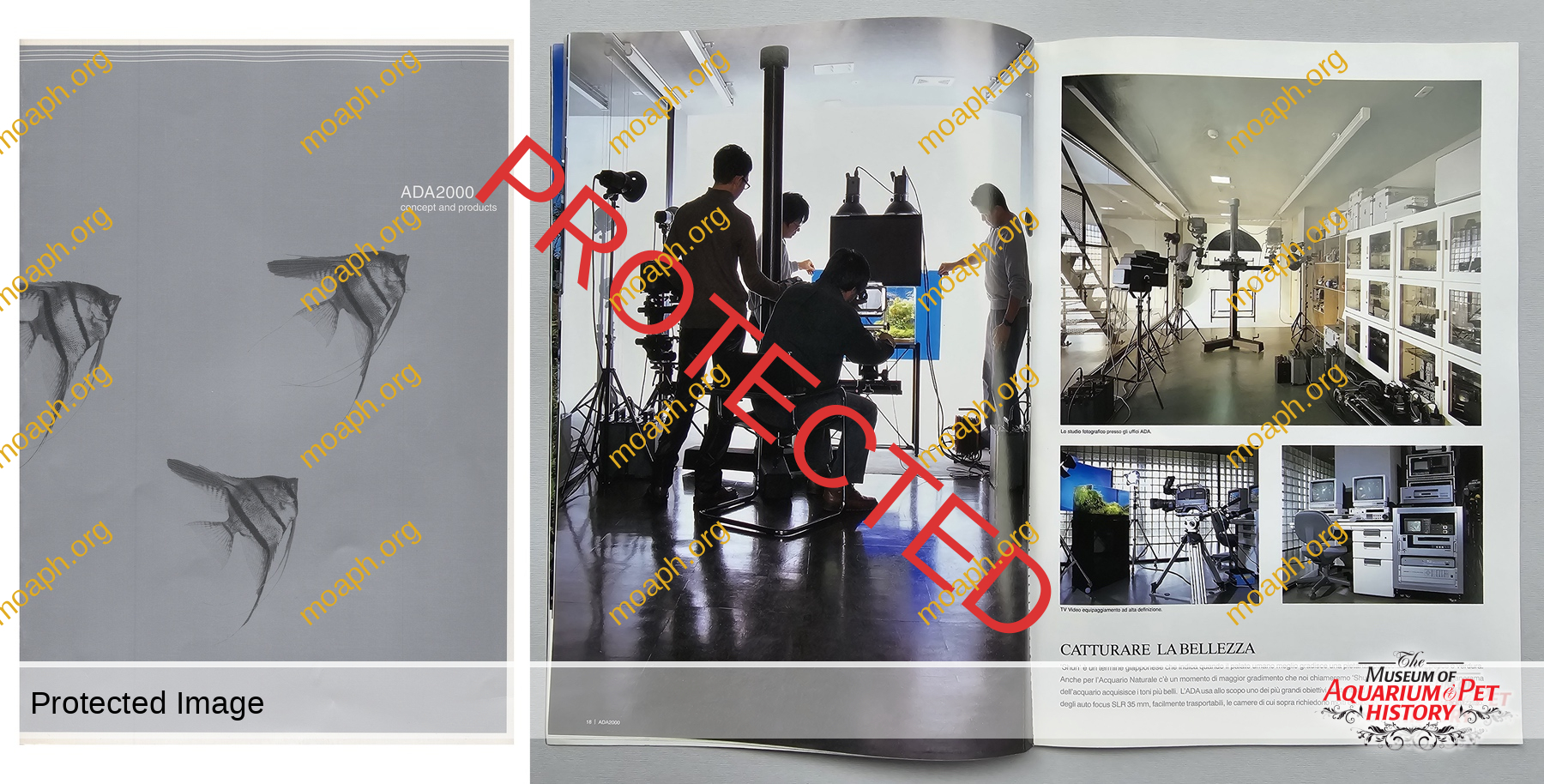
Amano was able to capture intricate details throughout the scene, from foreground to background, creating a sense of realism and immersion rarely achieved before. Images from ADA 2000 product catalog.
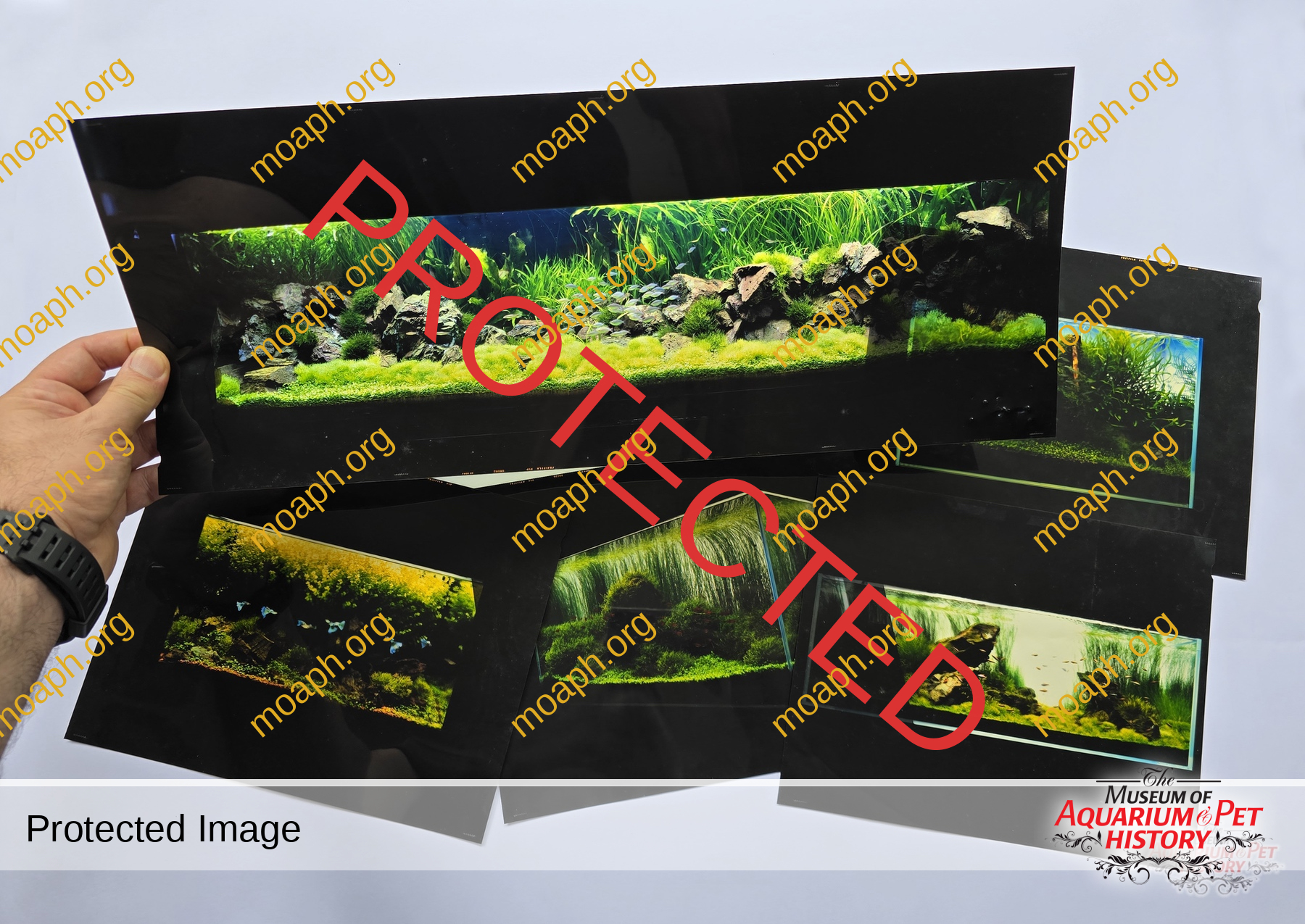
Amano’s large format slides depicting gorgeous aquascapes. Author’s private collection.
A case of serendipity complemented by sharp entrepreneurial insight
In its early years, ADA was active mostly in Japan. Things changed when an Italian entrepreneur decided to introduce its products and the concept of nature aquarium to the European market. This “modern Commodore Matthew Perry of the aquarium industry” wrote an important chapter of ADA’s history which few people know in detail. His name is Francesco Nardelli.
Nardelli first learned of ADA at the 1994 edition of Interzoo (Nuremberg, Germany). Back then, he was working as the exclusive distributor of Dupla products in Singapore and Southeast Asia. During the event, he spotted a book with a black cover in a hidden corner of the Dennerle booth: Glas no Naka no Daishizen (1992) by a certain Takashi Amano. Intrigued, he asked Ludwig Dennerle if he could take a look at it. After flipping through a few pages, it was love at first sight. Nardelli realized the huge potential of the Japanese company and couldn’t help but ask Dennerle to sell him that book. Dennerle, who had procured the book to study this new potential competitor, gave it to him as a gift.
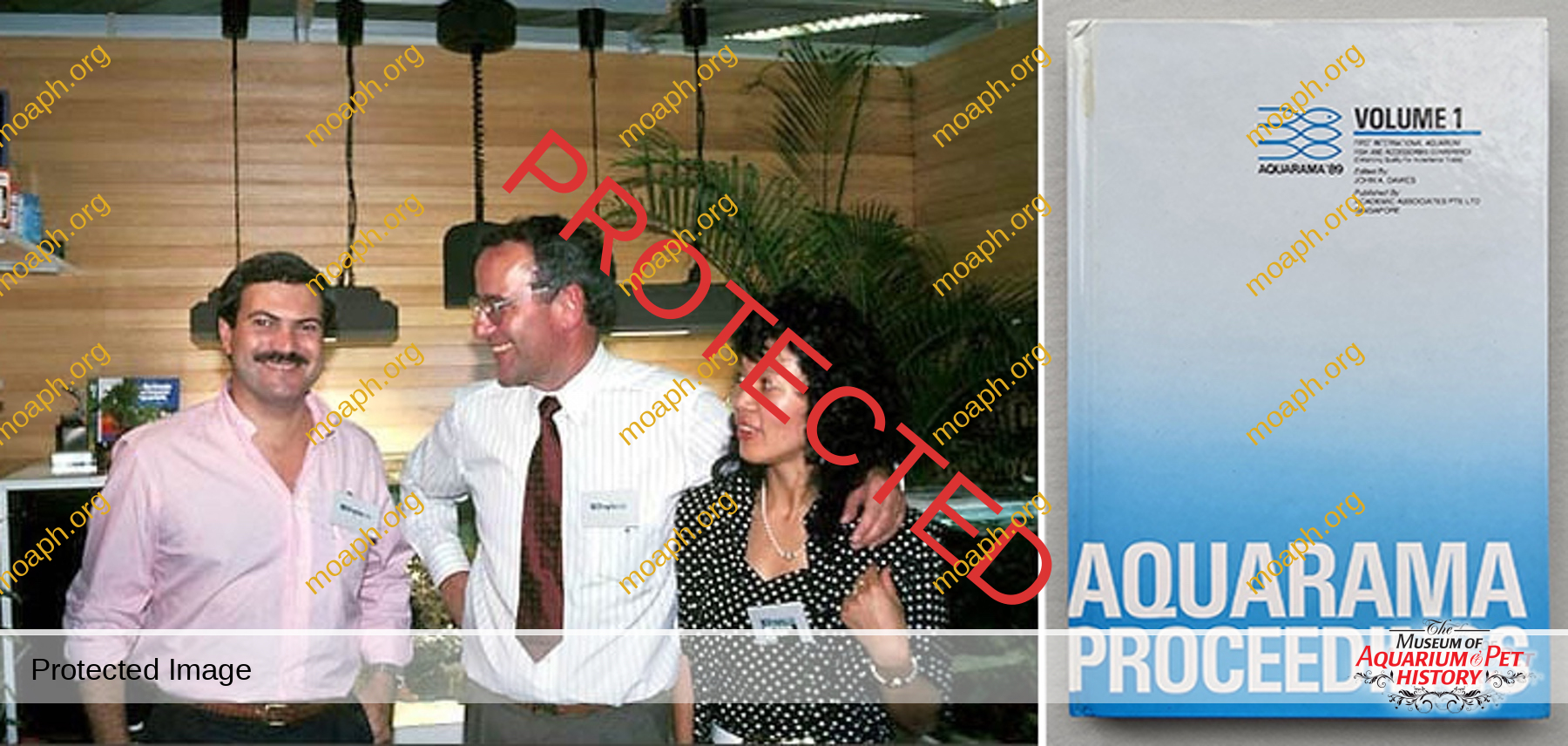
From left to right, Francesco Nardelli and Horst Kipper (founder of Dupla) with his wife at the first edition of Aquarama (Singapore), which was held in 1989. Nardelli represented Dupla back then, and also gave a talk titled “The road to a self-sustaining aquarium biotope”.
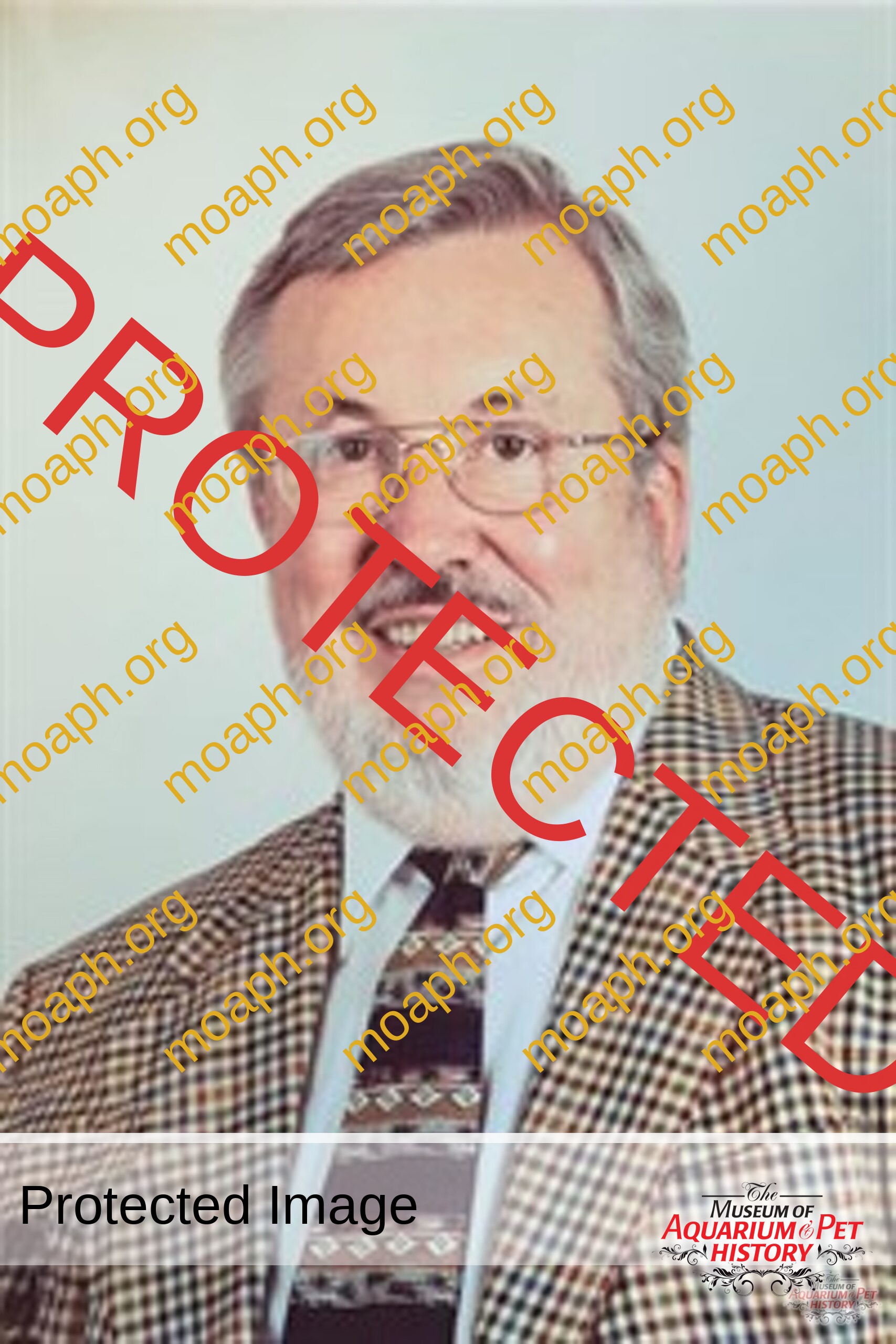
Ludwig Dennerle.
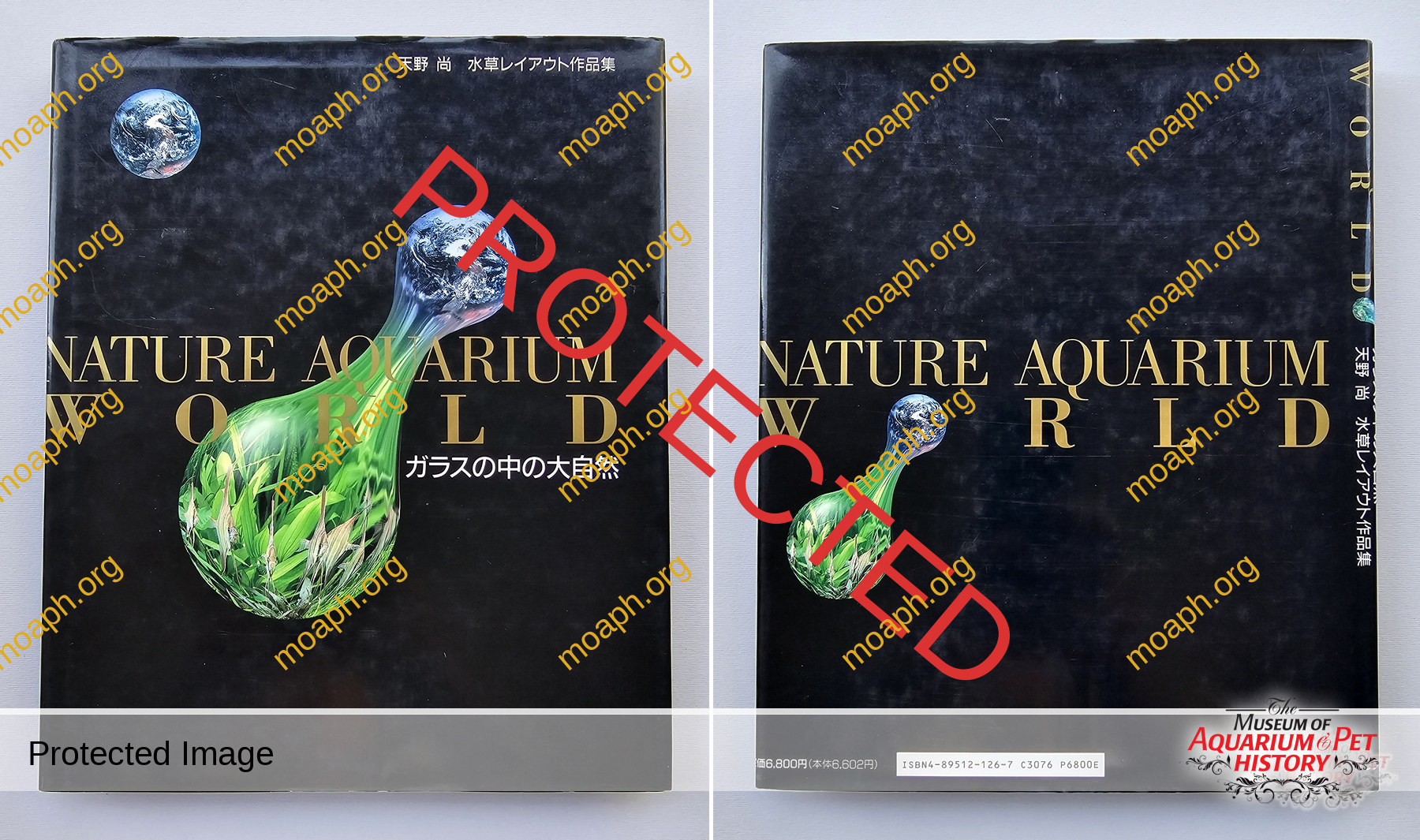
Glass No Naka no Daishizen was published in 1992. Translated into five languages, this amazing collection of Amano’s works launched the concept of nature aquarium to the world. This copy from the author’s collection belonged to Ludwig Dennerle and Francesco Nardelli.
Nardelli met Amano for the first time in December 1995 at the International Aqua Plant Summit held at ADA headquarters in Japan. Among the few Westerners who attended the event, there was also Holger Windeløv, founder of Tropica Aquarium Plants, one of the early plant suppliers of ADA. Right there, the Italian entrepreneur laid the foundation for a long-term business partnership which effectively made his companies (in chronological order: Aquageo, Nature Aquarium World, and ADA Europe) the exclusive distributors of ADA products for Italy (1997), and for the rest of Europe, starting with Germany (1998). During the Aqua Plant Summit, besides, the idea of a layout contest was discussed with all the participants.
I first encountered Nardelli in the late 1990s. He was looking for a skilled aquarium photographer, and back then I was one of the few options available in Italy! I quickly realized that Amano, of whom I had already heard, was very demanding even in selecting his business partners. Nardelli, in fact, in addition to being a professional of the aquarium industry, was also an internationally renowned naturalist and conservationist who lived unique experiences in the zoological field. Just consider that in 1972, when he was only 19 years old, he established a wild felids center near Rome, where he successfully bred several threatened species such as the red-shanked douc langur, the clouded leopard and, believe it or not, the snow leopard!
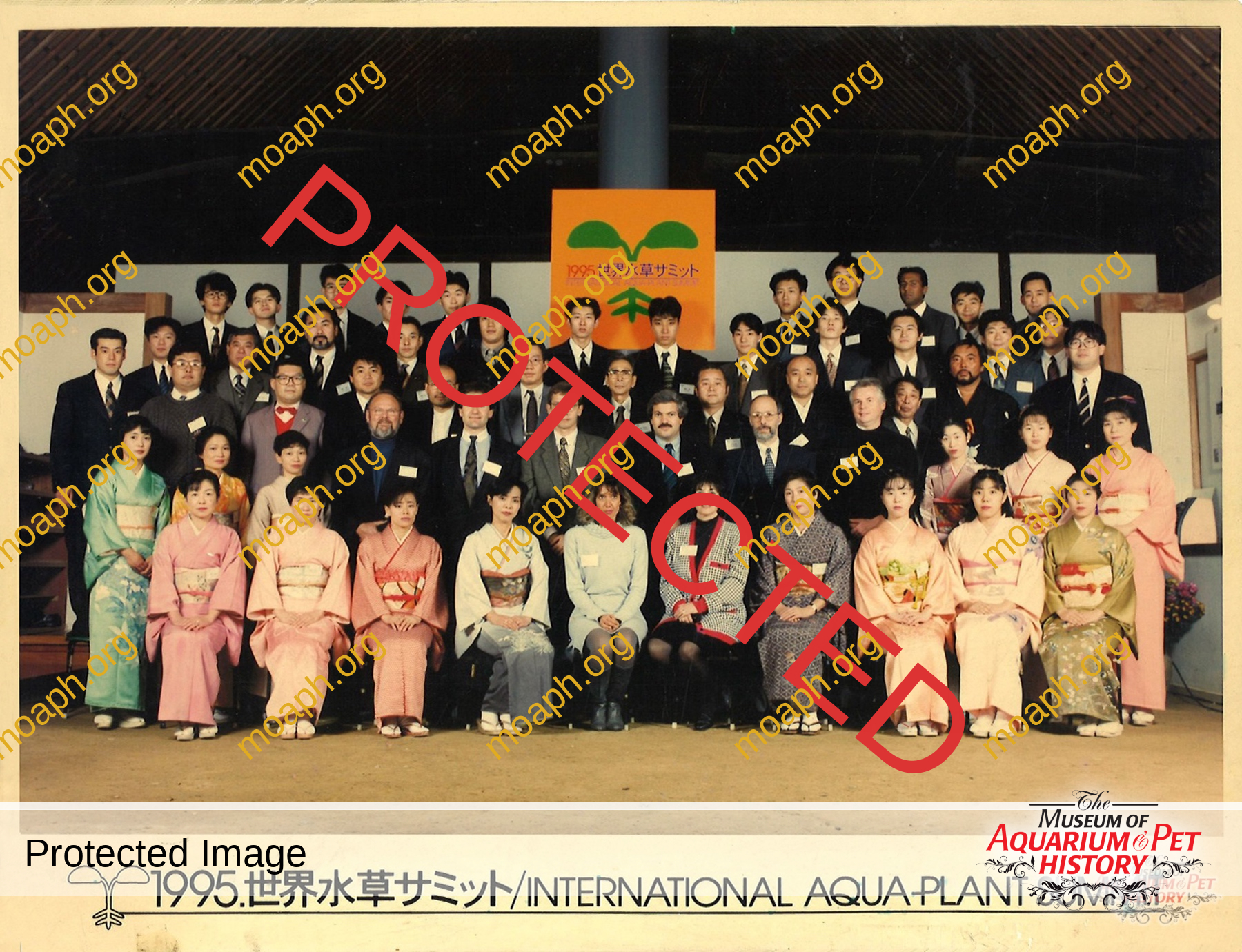
All the participants at the International Aqua Plant Summit held in 1995. Courtesy of Francesco Nardelli.
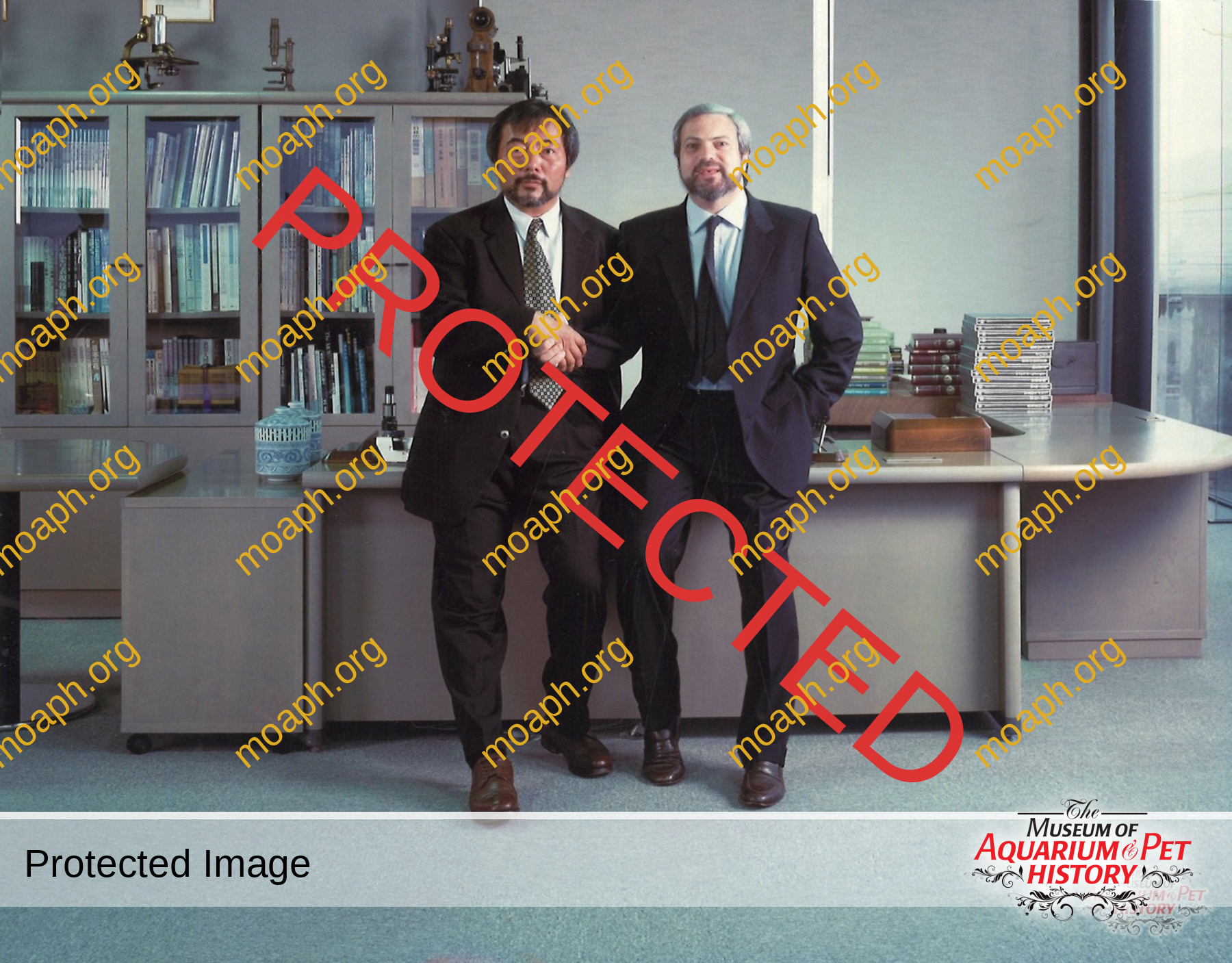
Amano and Nardelli at ADA headquarters. Courtesy of Francesco Nardelli.
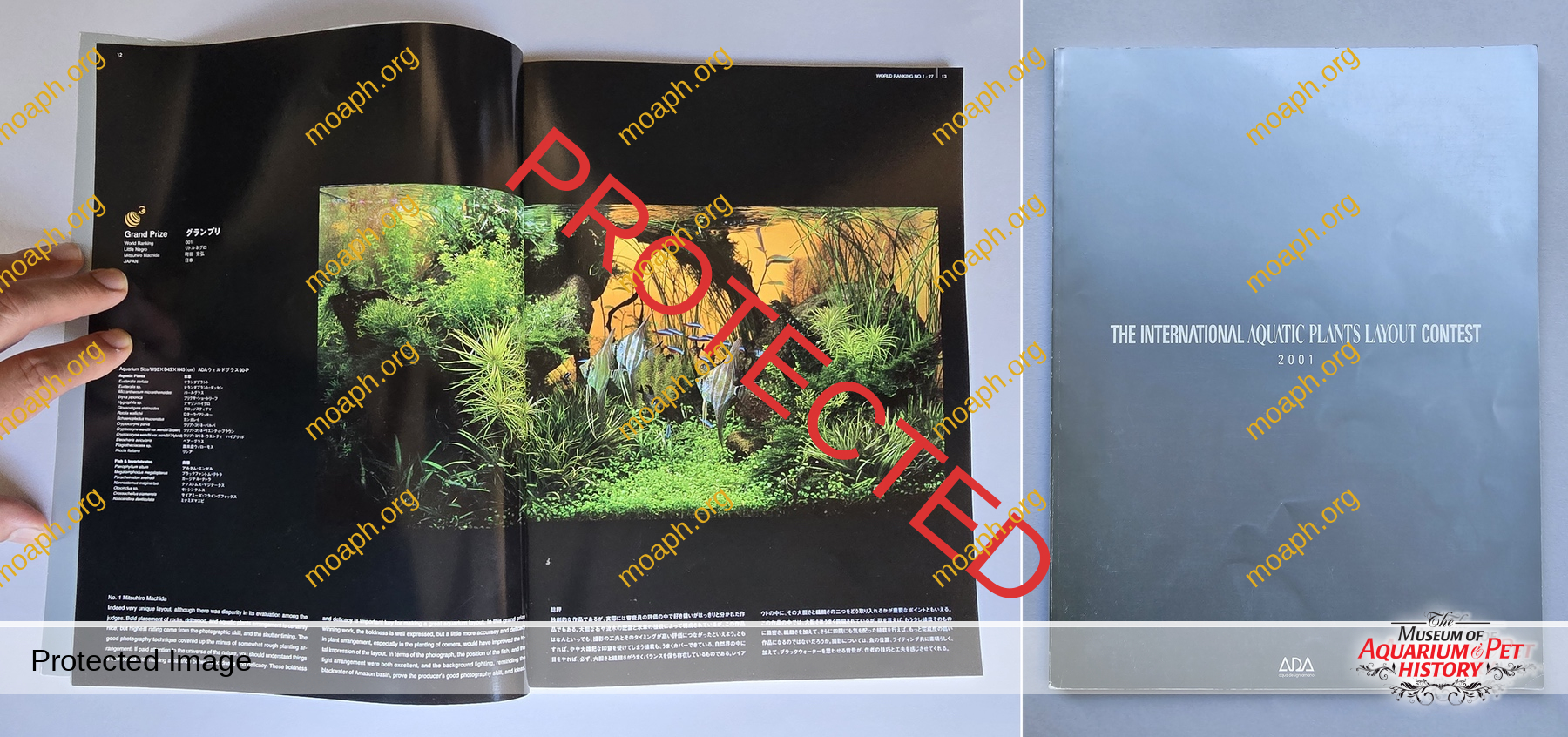
The first International Aquatic Plants Layout Contest took place in 2001. The booklet issued by ADA to commemorate that event is nowadays a rare collectible. Among 557 entries from 19 countries, the layout made by Mitsuhiro Machida (Japan) won the contest and a prize of a million yen. The Nature Aquarium Party held in conjunction with the contest became an annual event as well. Among the 17 judges (including Amano) of the event from all over the world, there were: Herbert R. Axelrod, Bernd Degen, Kaspar Horst, Francesco Nardelli, and Holger Windeløv.
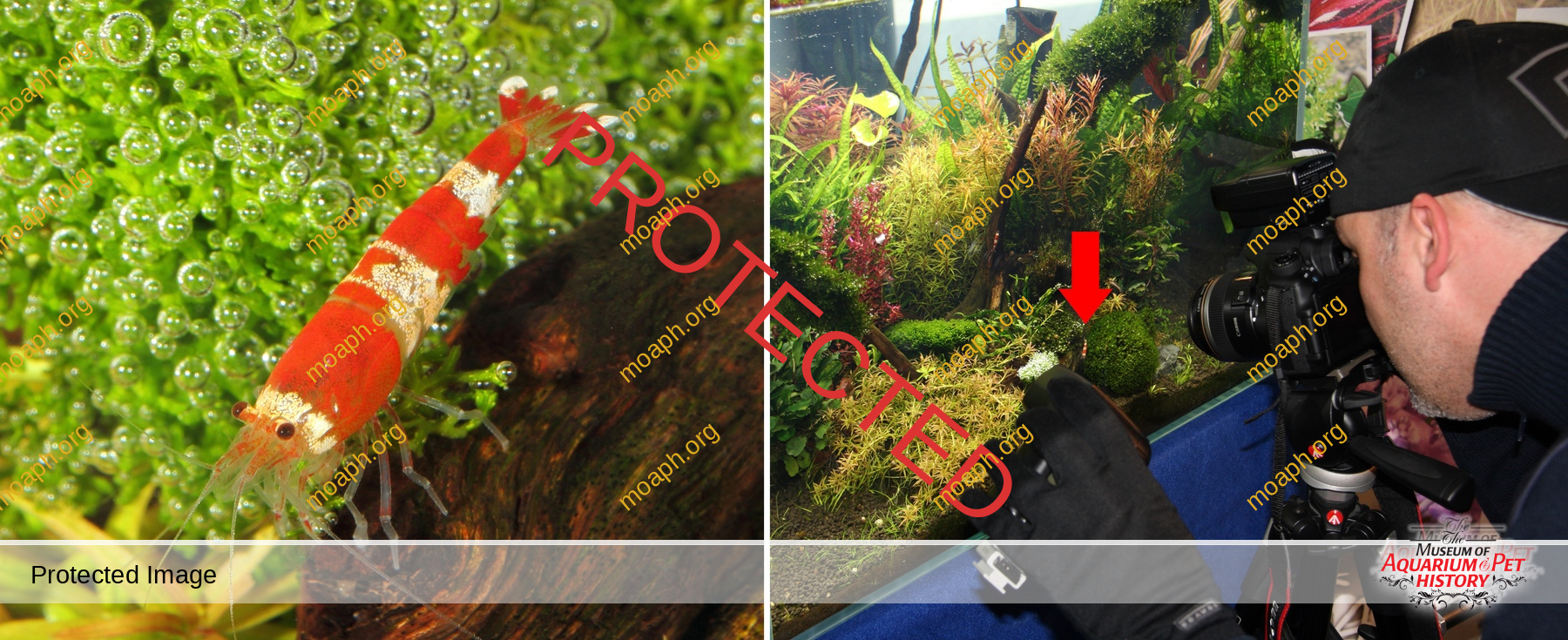
Amano was a source of inspiration for all the aquarium photography enthusiasts, including the author. He took this “hobby within a hobby” to another level.
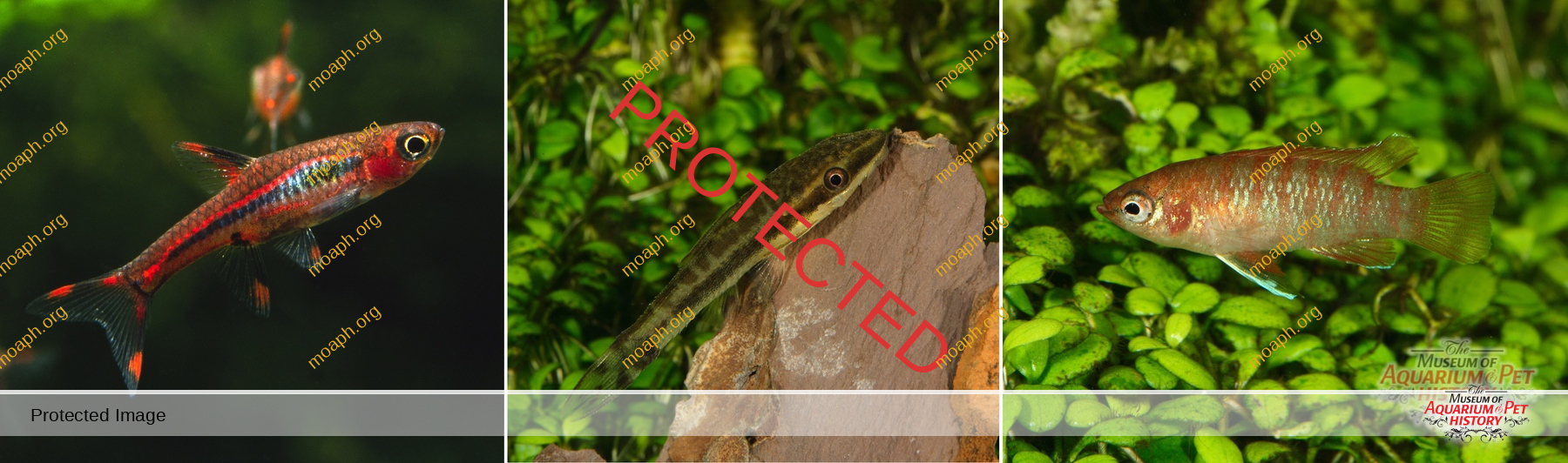
Amano and his company greatly contributed to making small size aquariums popular, and with them several tiny freshwater species once little known or overlooked by hobbyists.
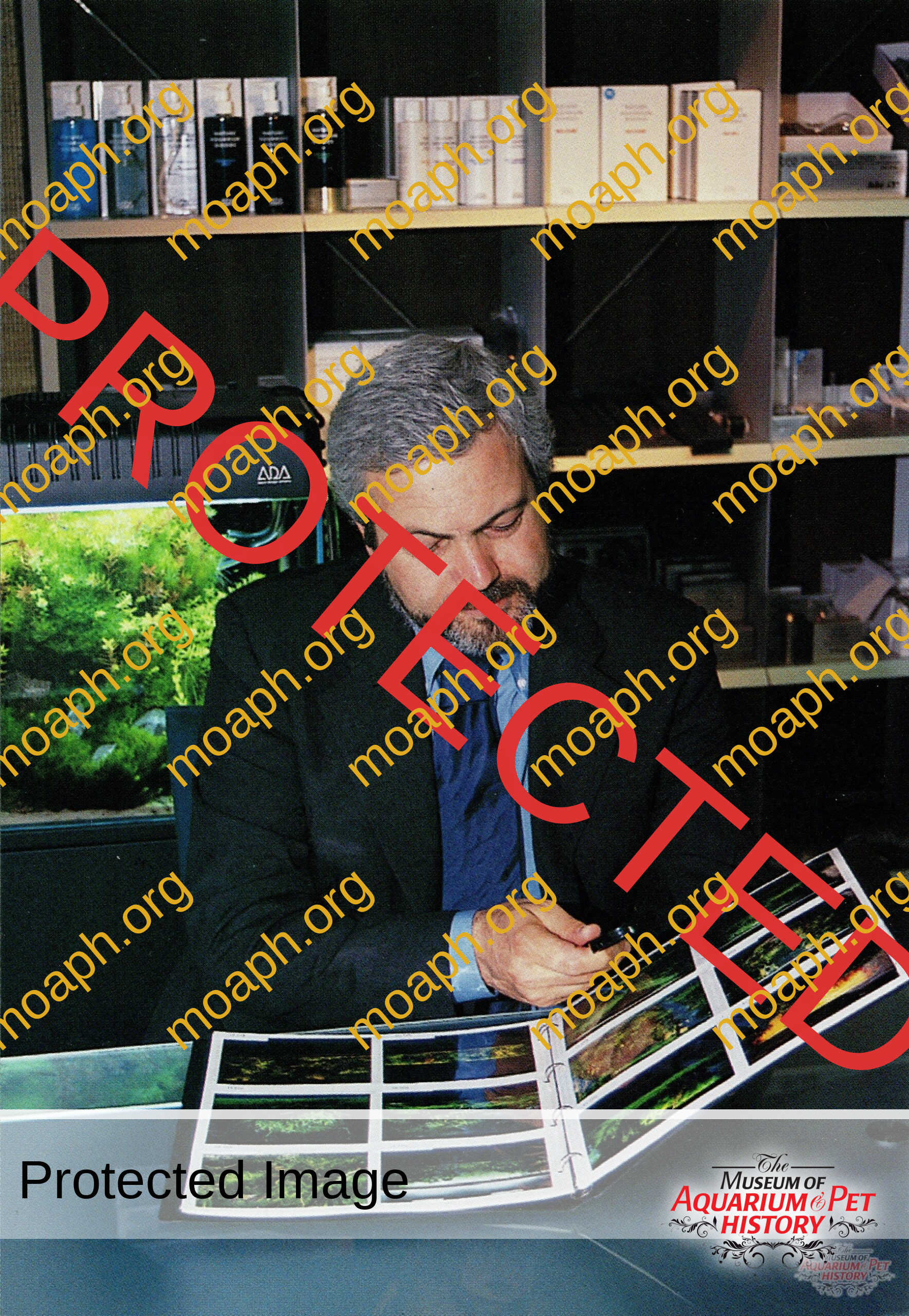
Francesco Nardelli while judging some of the photographs submitted by participants in the International Aquatic Plants Layout Contest. Photo taken by the author in 2001.
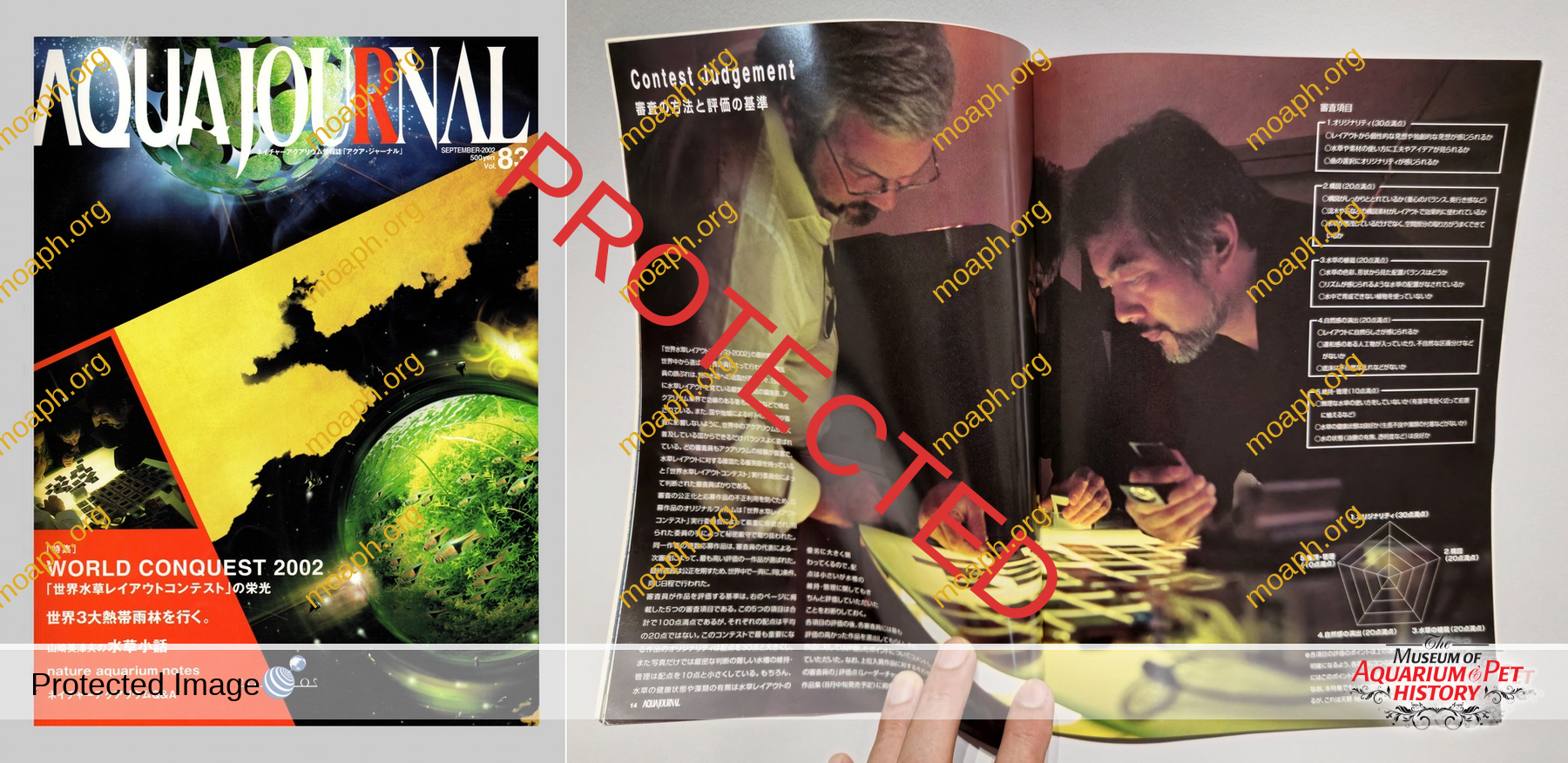
Nardelli, Giorgio Melandri (Hydra magazine) and Amano while judging some aquascapes for the second edition of the International Aquatic Plants Layout Contest.
Starting my collection of ADA’s early products and publications
In 1980, he became curator of Howletts and Port Lympne Zoo in Kent, England, where he supervised several breeding programs of critically endangered species like the lowland gorilla. Two years later, he conceived and directed the Sumatran Rhino Project, the first international program for the conservation of the Sumatran rhino. In 1987 he co-founded the Indonesian Rhino Foundation in Jakarta (Indonesia), a non-profit organization for the long-term conservation of rhinos in Southeast Asia. Nardelli, in short, had a truly remarkable resume.
The first time I visited him at his villa near Rome, I was blown away by the multiple aquascapes which he himself had set up thanks to the training courses attended in Japan. He had the best of the best: rare plants, freshwater fish never seen before, and a bunch of stylish products by ADA. In his library I found many interesting books about nature, including a first edition of Gorillas in the Mist by Dian Fossey, inscribed and signed by the late American primatologist during a day spent with Nardelli at Howletts.
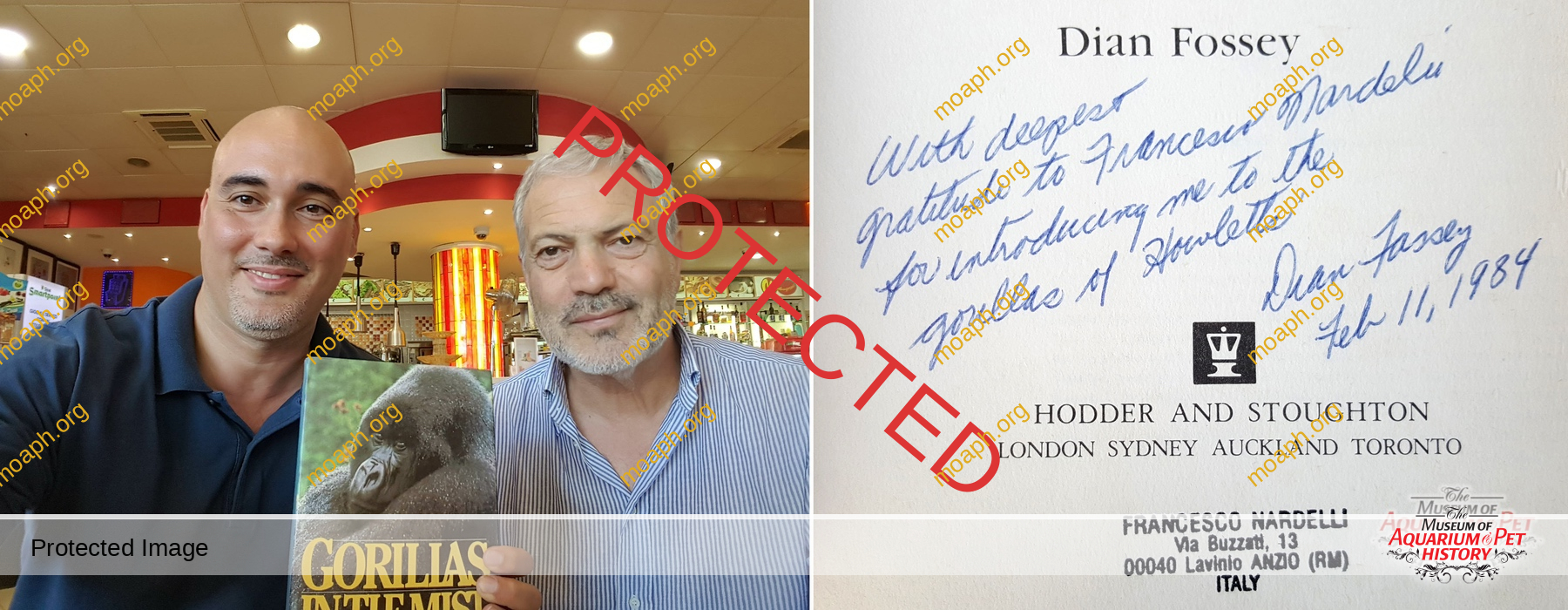
The author (left) with Francesco Nardelli.
Sensing the impact that ADA would have on the hobby, and facilitated by my friendship with Nardelli, I began collecting the early catalogs, books, magazines, brochures, gadgets, video cassettes, accessories, and tools released by the company. I also gathered some products that I knew would soon disappear from the market as odd or excessively expensive when compared with the actual benefits derived from their use.
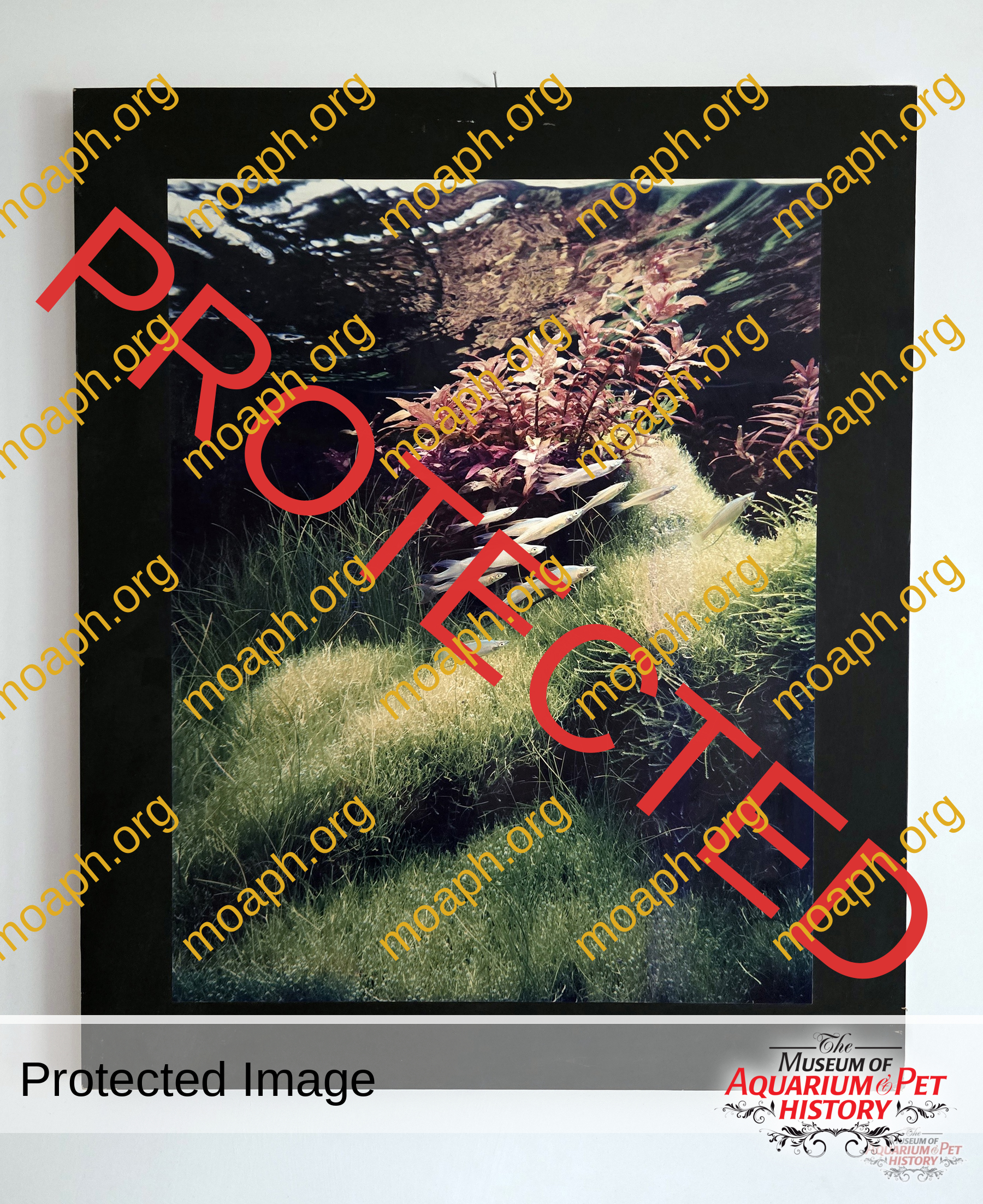
In 1996, the global market met ADA during the Interzoo (Nuremberg, Germany). This vintage photo panel was on display at ADA’s booth, and was used in later events such as Zoomark International 1997 (Milan, Italy), Aquarama 1997 (Singapore), and Interzoo 2000. Today, this veteran of the pet trade fairs rests in the author’s collection.
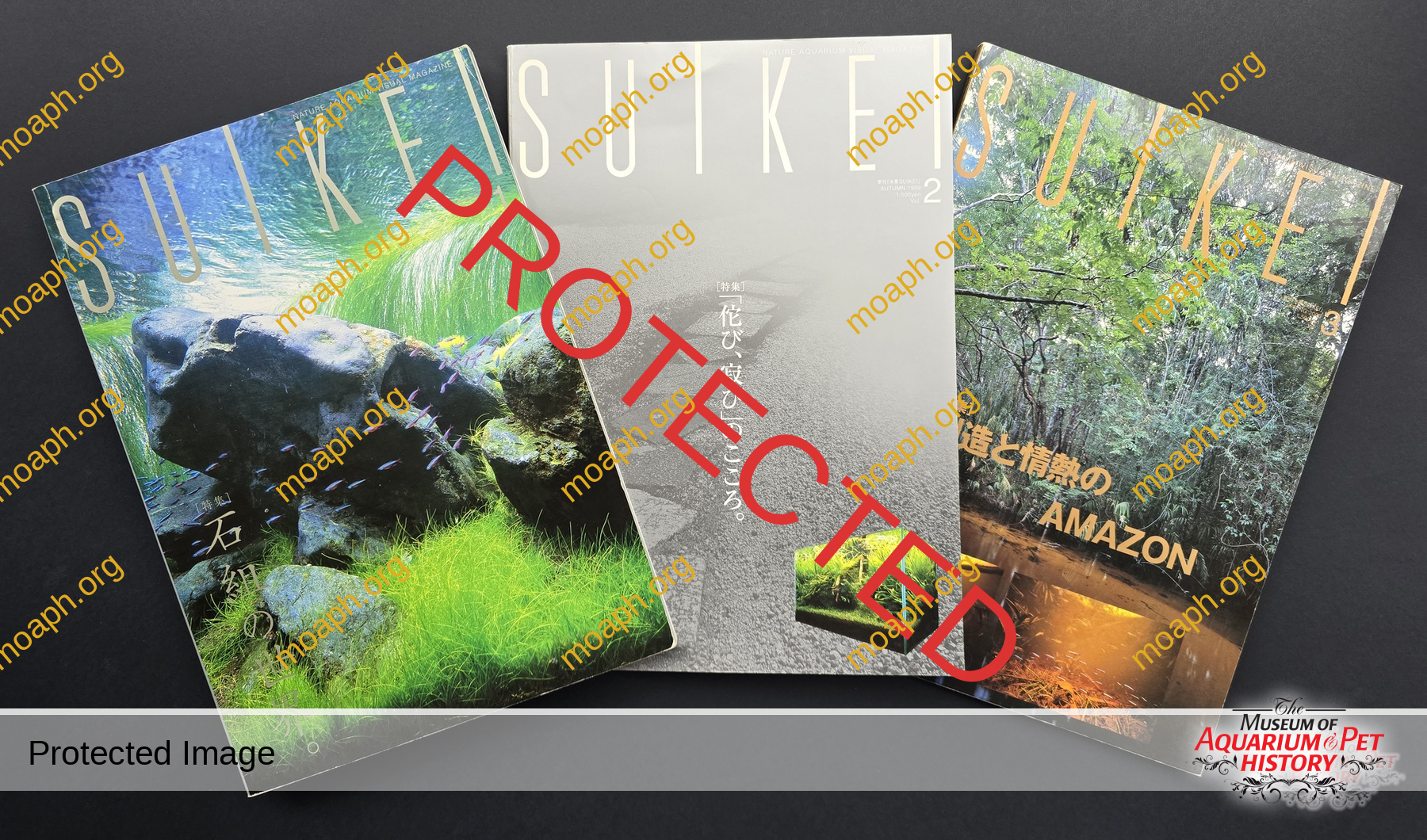
In 1999 ADA temporarily suspended the publication of the magazine Aqua Journal, and launched Suikei and Do!aqua. The short-lived quarterly magazine Suikei in particular was something never seen before in our hobby, a masterpiece of graphic quality in every sense. This picture shows the popular and sought-after Suikei trilogy.
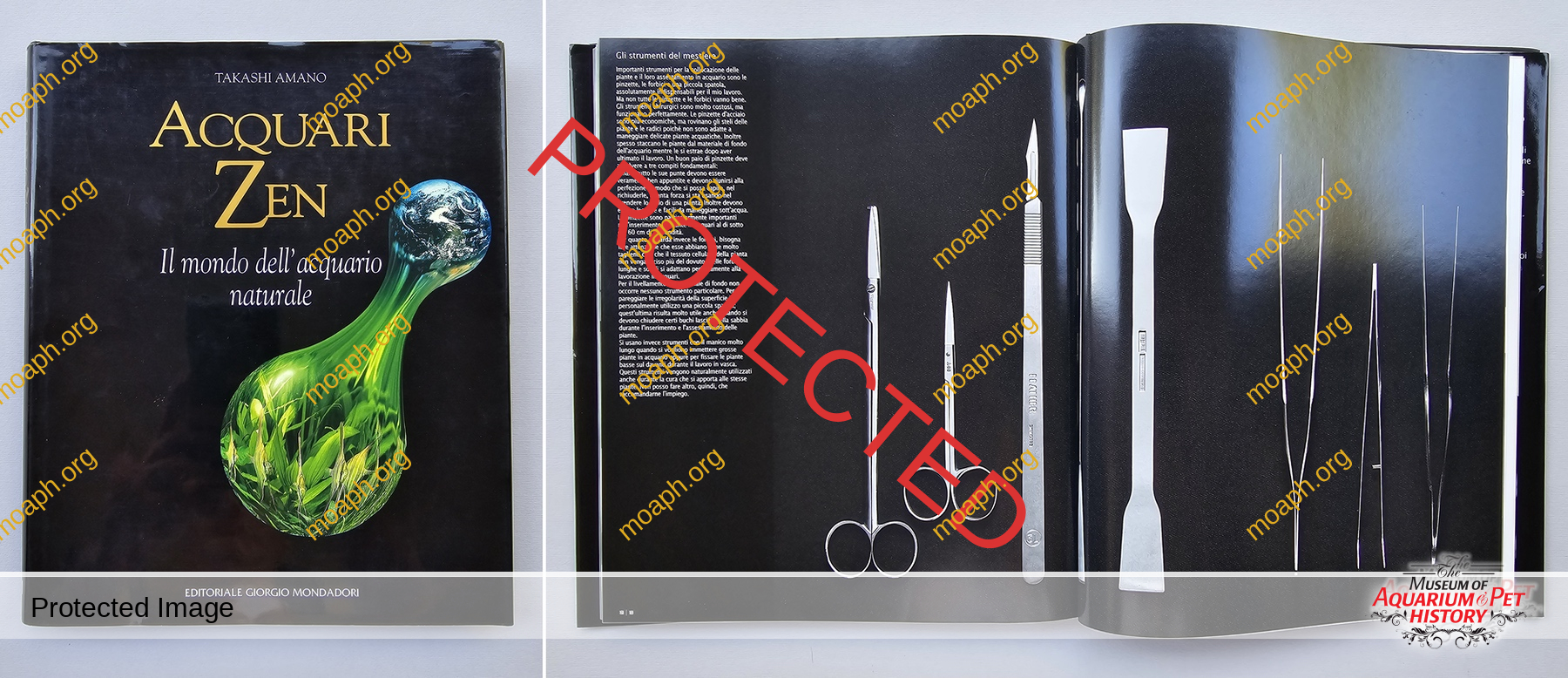
The Italian edition of Amano’s seminal book Glass no Naka no Daishizen was released in 1997.
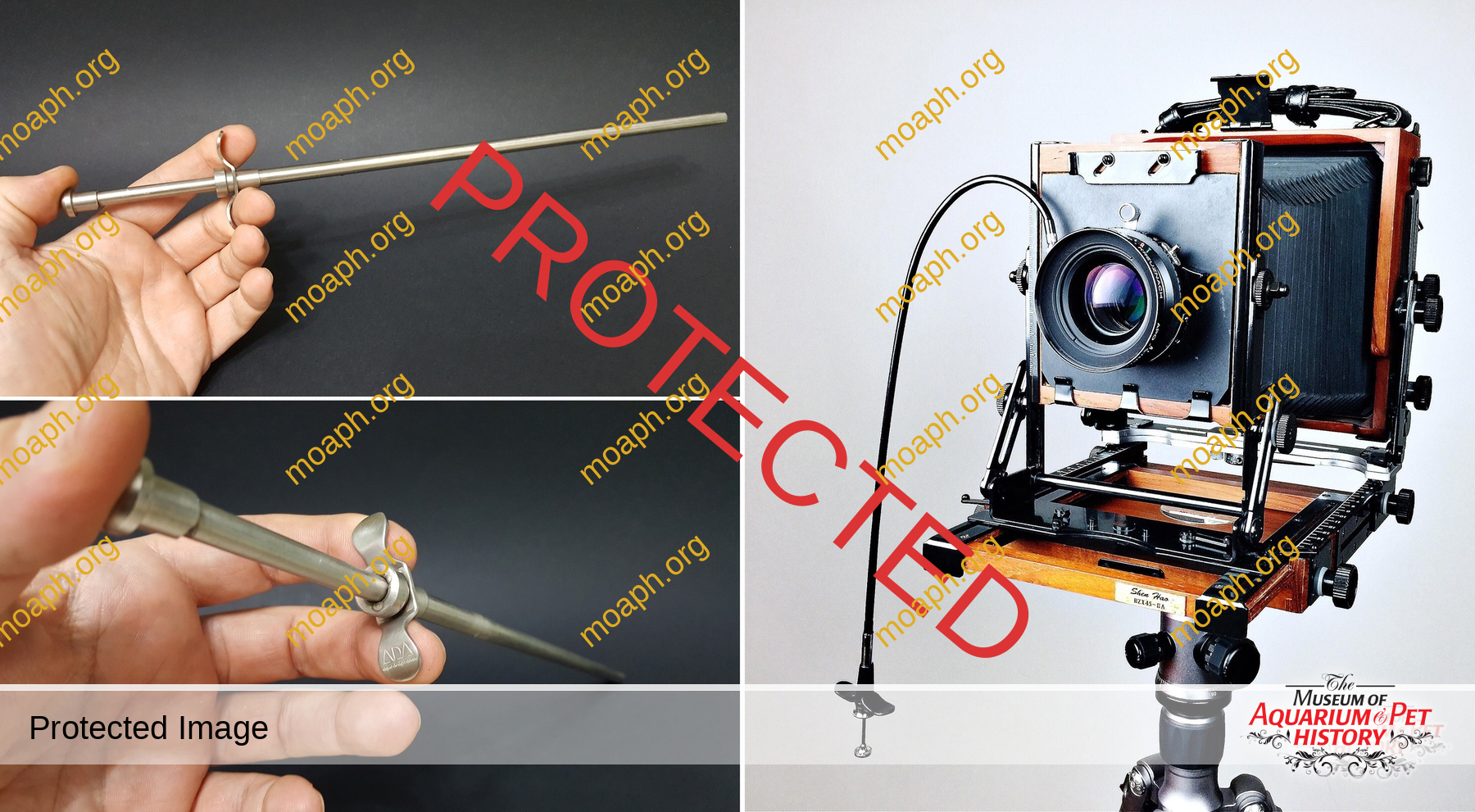
A weird tool specifically designed to insert ADA fertilizing sticks deeply into the substrate. Amano got an inspiration to make it from the remote shutter release of old large format cameras (right image). This explains the name “Bottom Release”.
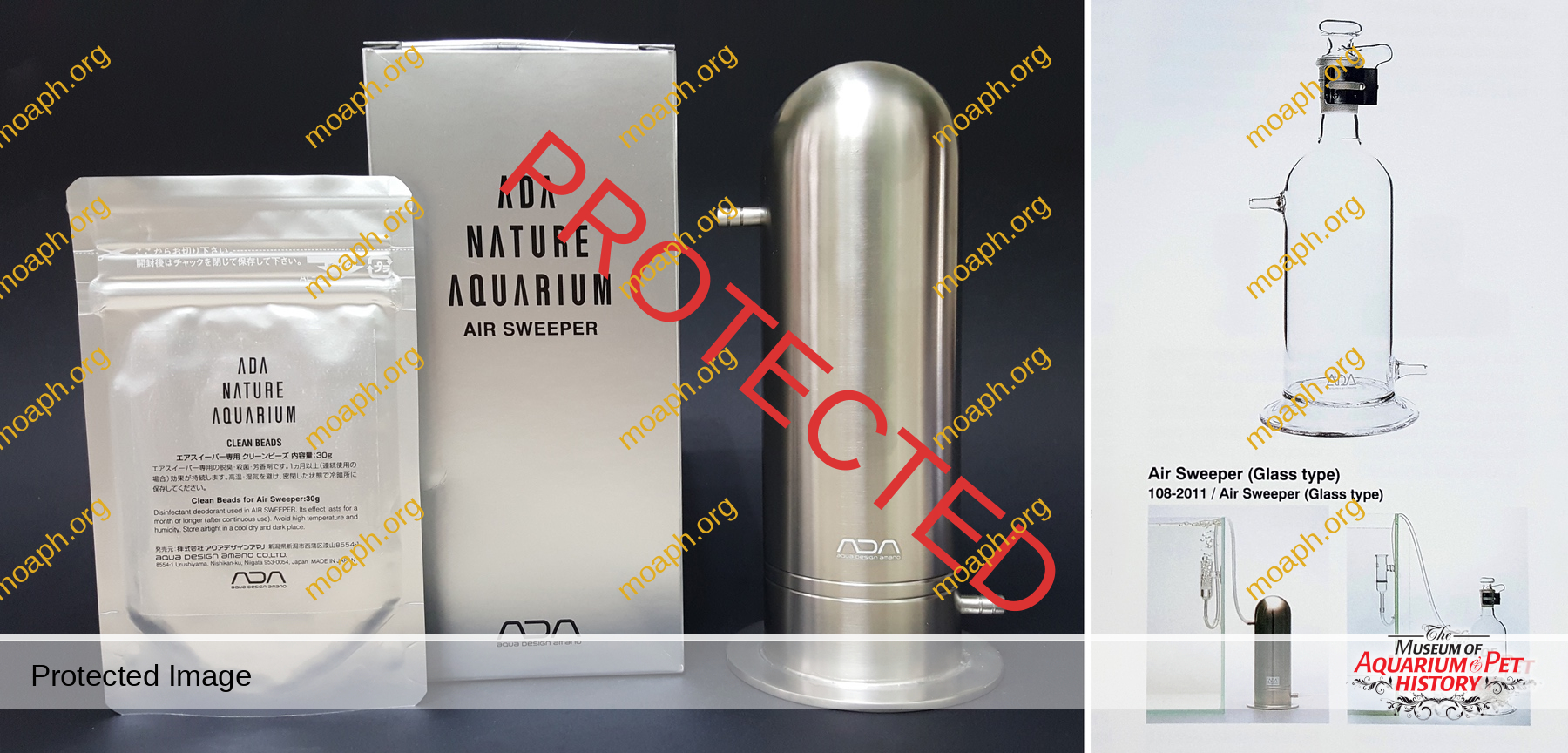
Probably one of the more “superfluous” (nonetheless very stylish at the same time) accessory manufactured by ADA. The Air Sweeper is a deodorant and sanitizer for aquariums, which until a few years ago also came in a glass version, the rarest and much sought-after by today’s collectors.
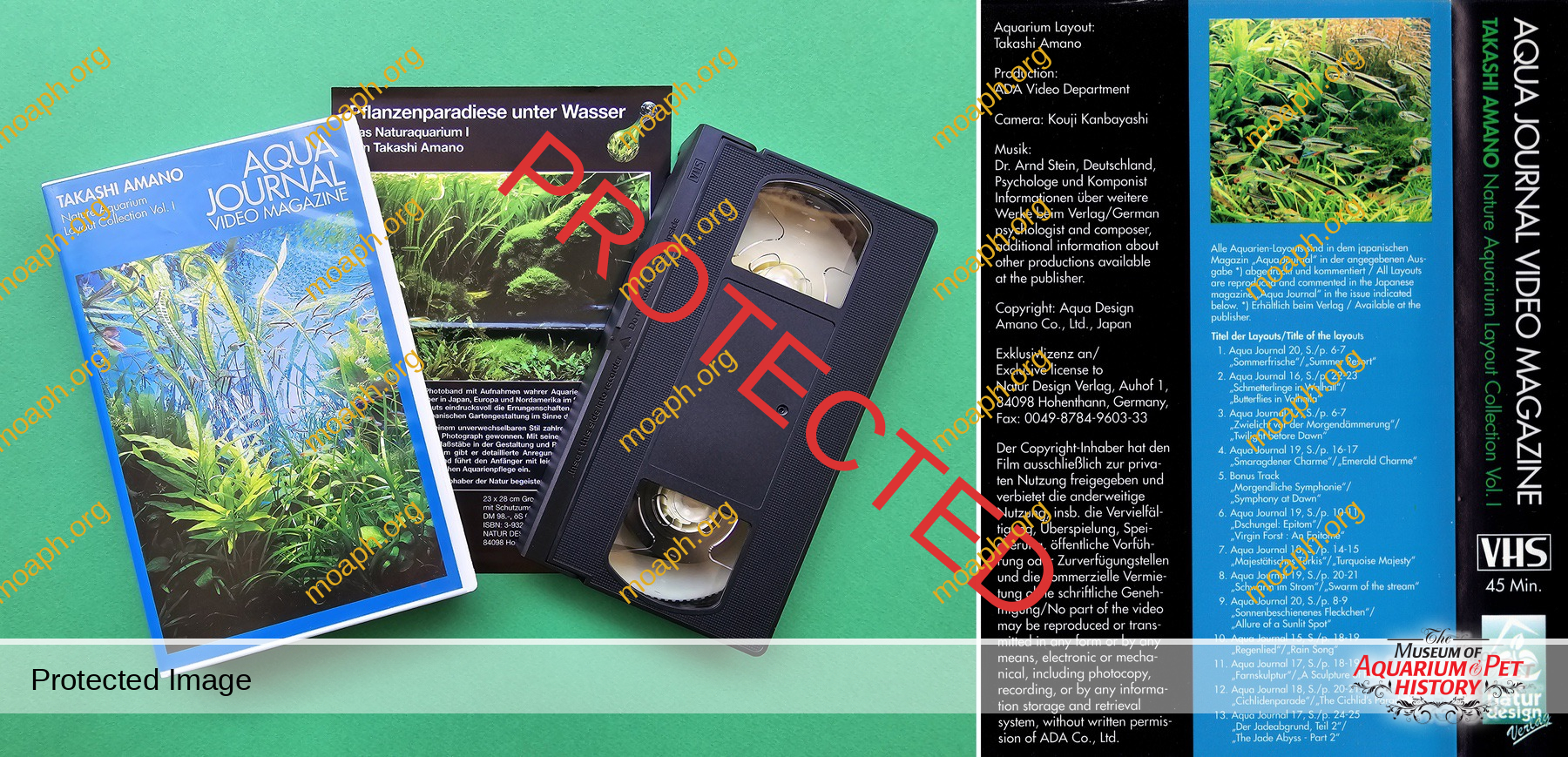
A collection of Amano’s best works released on VHS tape in the 1990s.
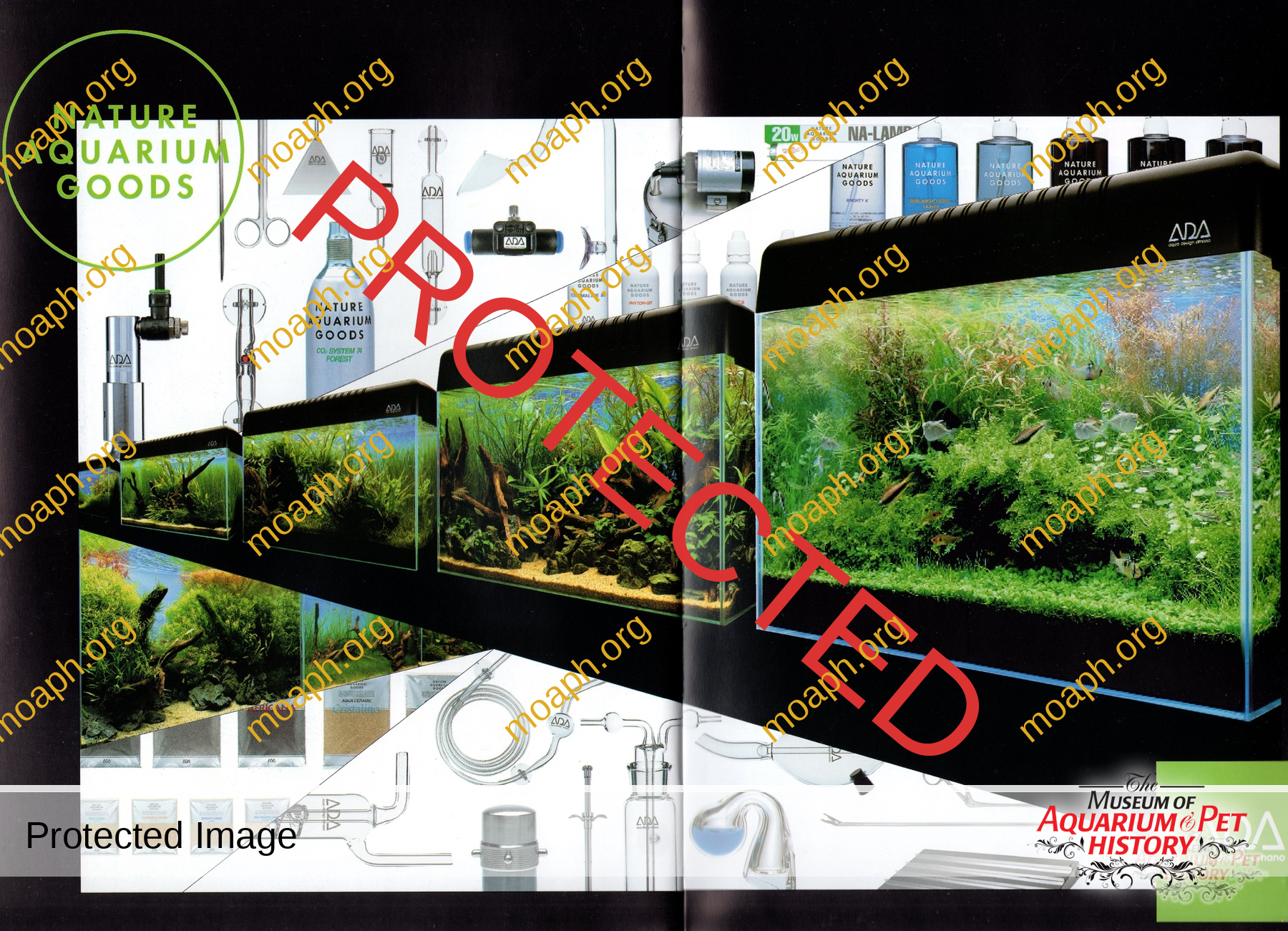
ADA Europe advertising published in 2005 in the Italian magazine Hydra (Vol. 5, No. 33).
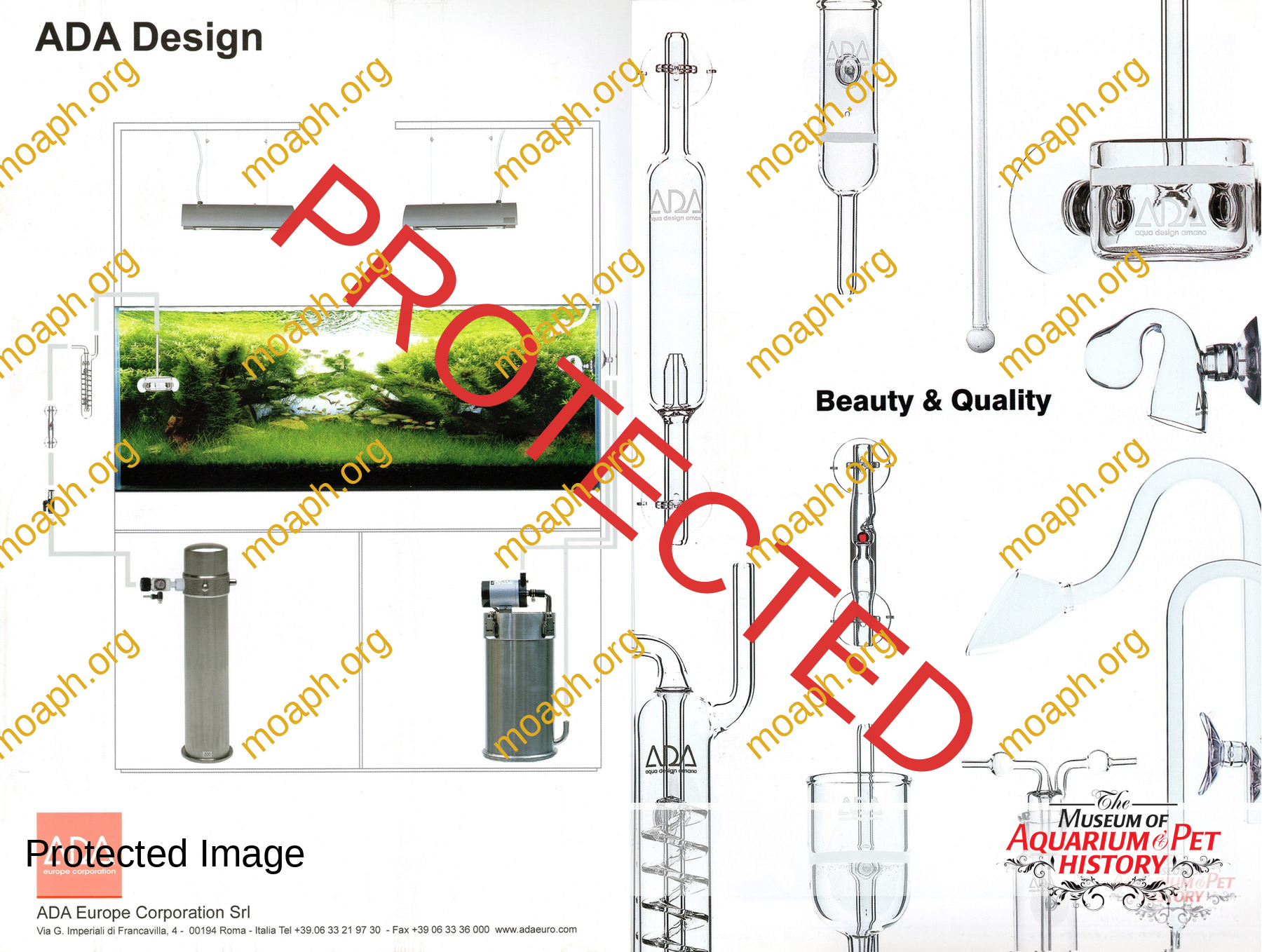
ADA Europe advertising published in 2002 in the Italian magazine Hydra (Vol. 2, No. 15).
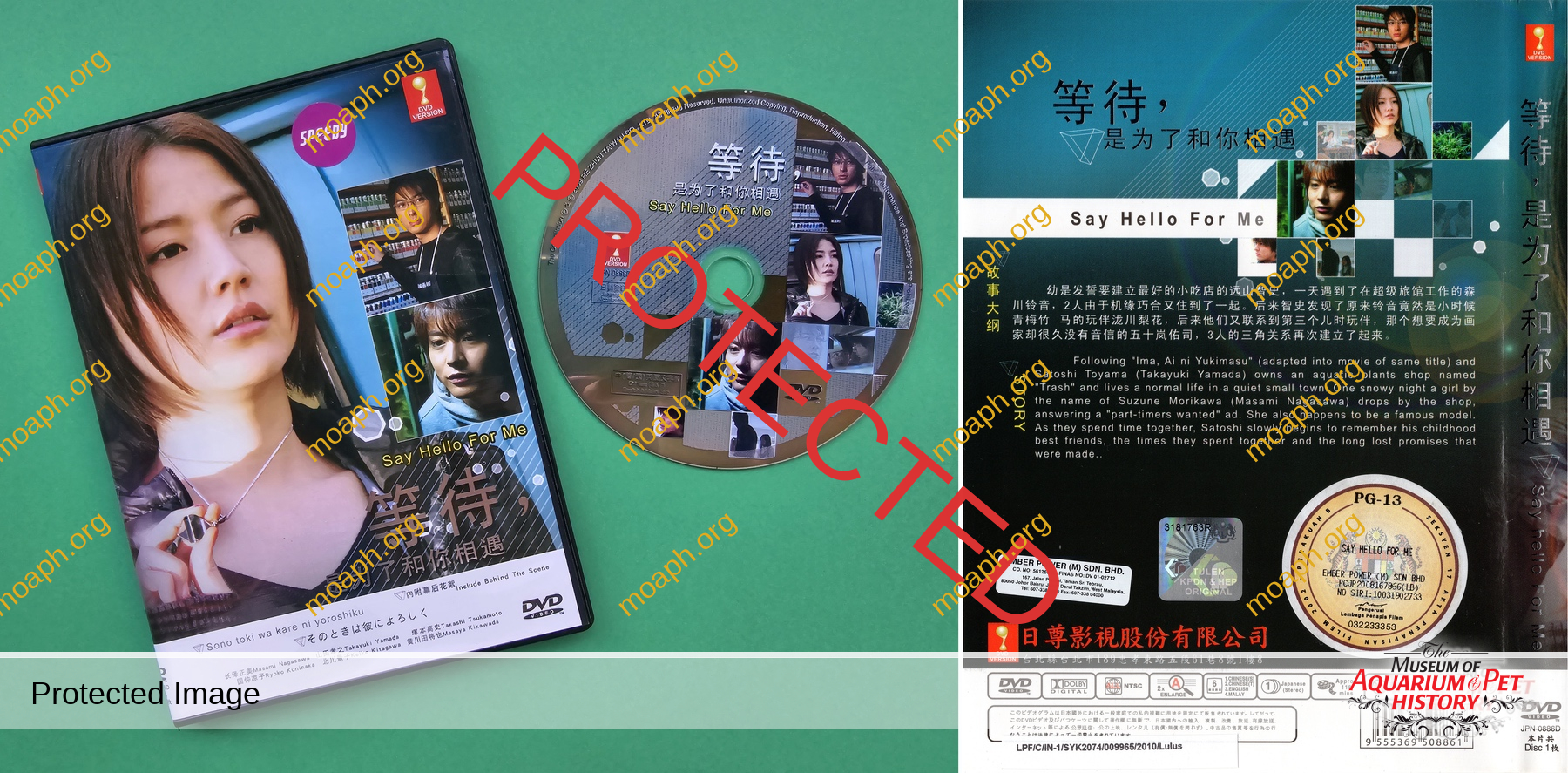
ADA supplied all the planted tanks for the 2007 movie Sono Toki wa Kare ni Yoroshiku (“Say hello for me”). Currently, the DVD of the movie is very hard to find.
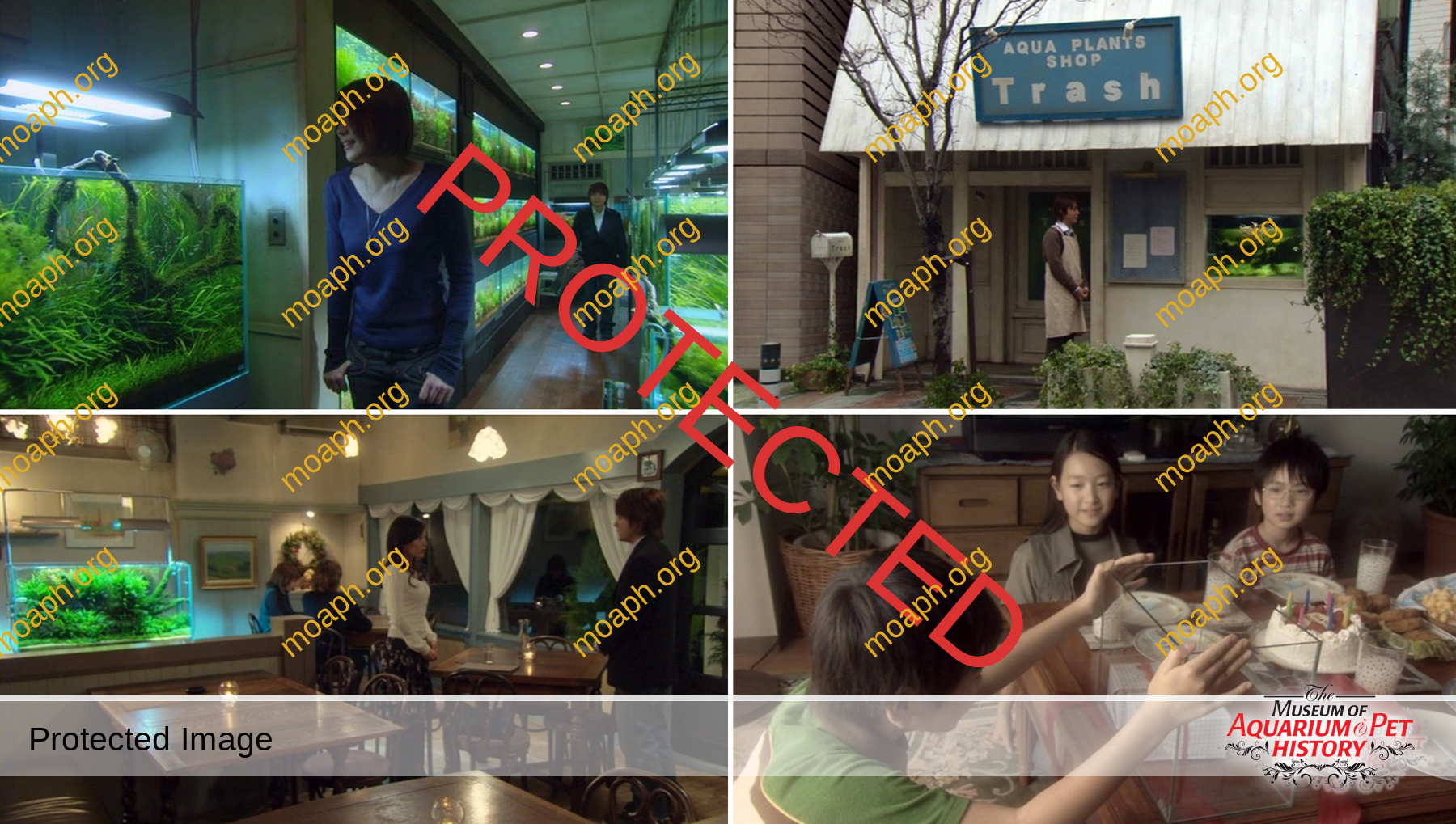
Frames from the movie Sono Toki wa Kare ni Yoroshiku.
Again thanks to Nardelli, I had the opportunity to meet “Amano-sensei” in person three times, as well as his ubiquitous right-hand man and interpreter, Nozomi Hayakawa. The first one was on September 29, 2002 during an aquascaping workshop held in Italy. He looked like exactly as I expected: an elegant, reserved, and serious Japanese gentleman. The language barrier and the limited time prevented us from getting to know each other better. However, I managed to get a few ADA products and publications autographed by him! Obviously, I wasn’t the only one overflowing with enthusiasm on seeing Amano in person. I must admit that on a few other occasions I had witnessed such excitement from an audience for a personality of the pre-social media aquarium industry. It was evident that, in the eyes of many people, Amano was a true superstar. Even before being actual or potential ADA customers, they were Amano’s fans and ardent followers of his aquascaping style and philosophy.
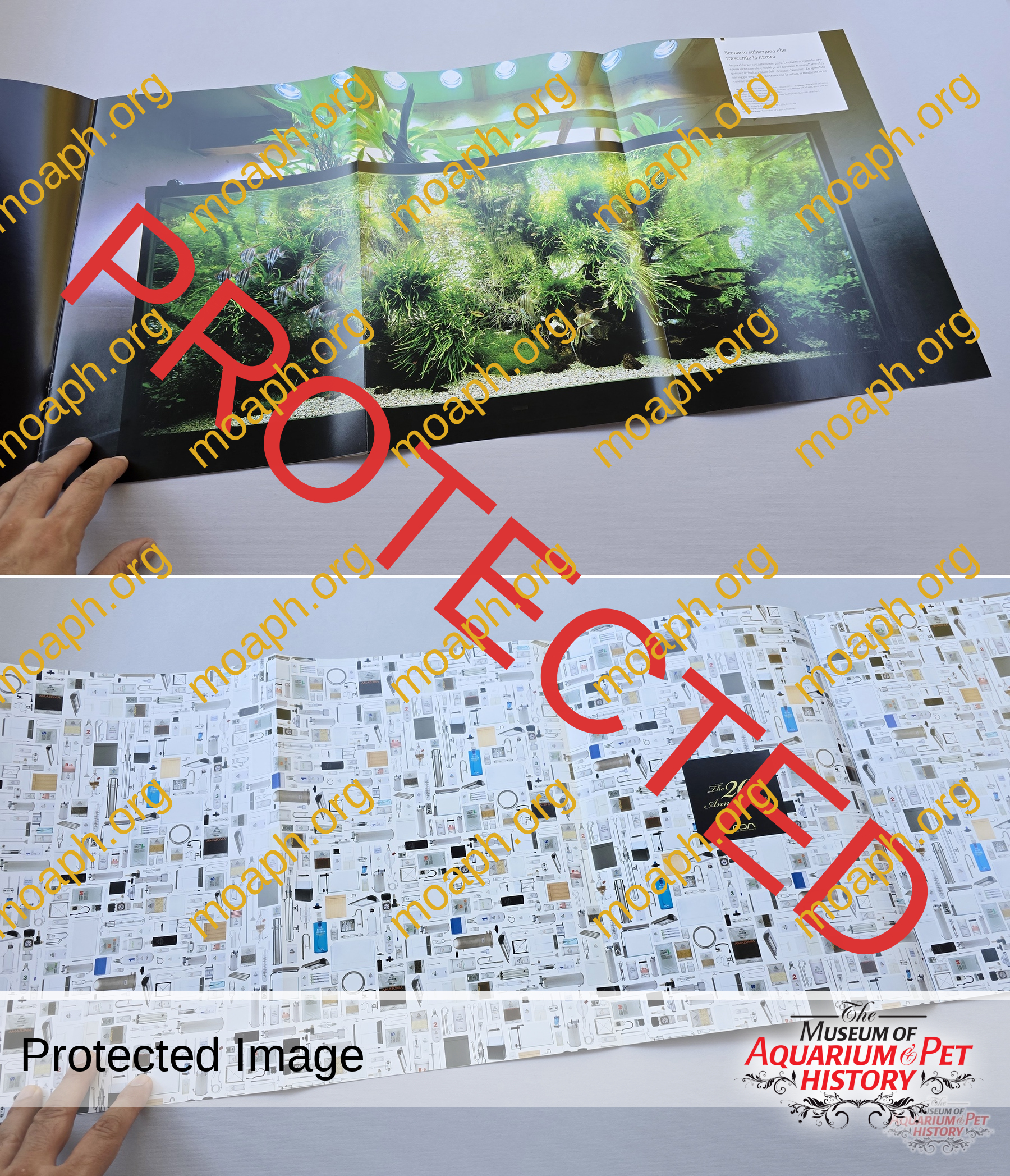
Published for ADA’s 20th anniversary (2012), this phenomenal large format brochure was available for free in ADA’s retailers. Among the multiple stunning images, it contains also a triple-page photograph of the four-meter long aquarium set up by Amano in his house in 2001. This huge tank quickly became famous and brought ADA a series of proposals to build other large aquariums, such as the Sumida Aquarium in Tokyo, and Florestas Submersas in Lisbon.
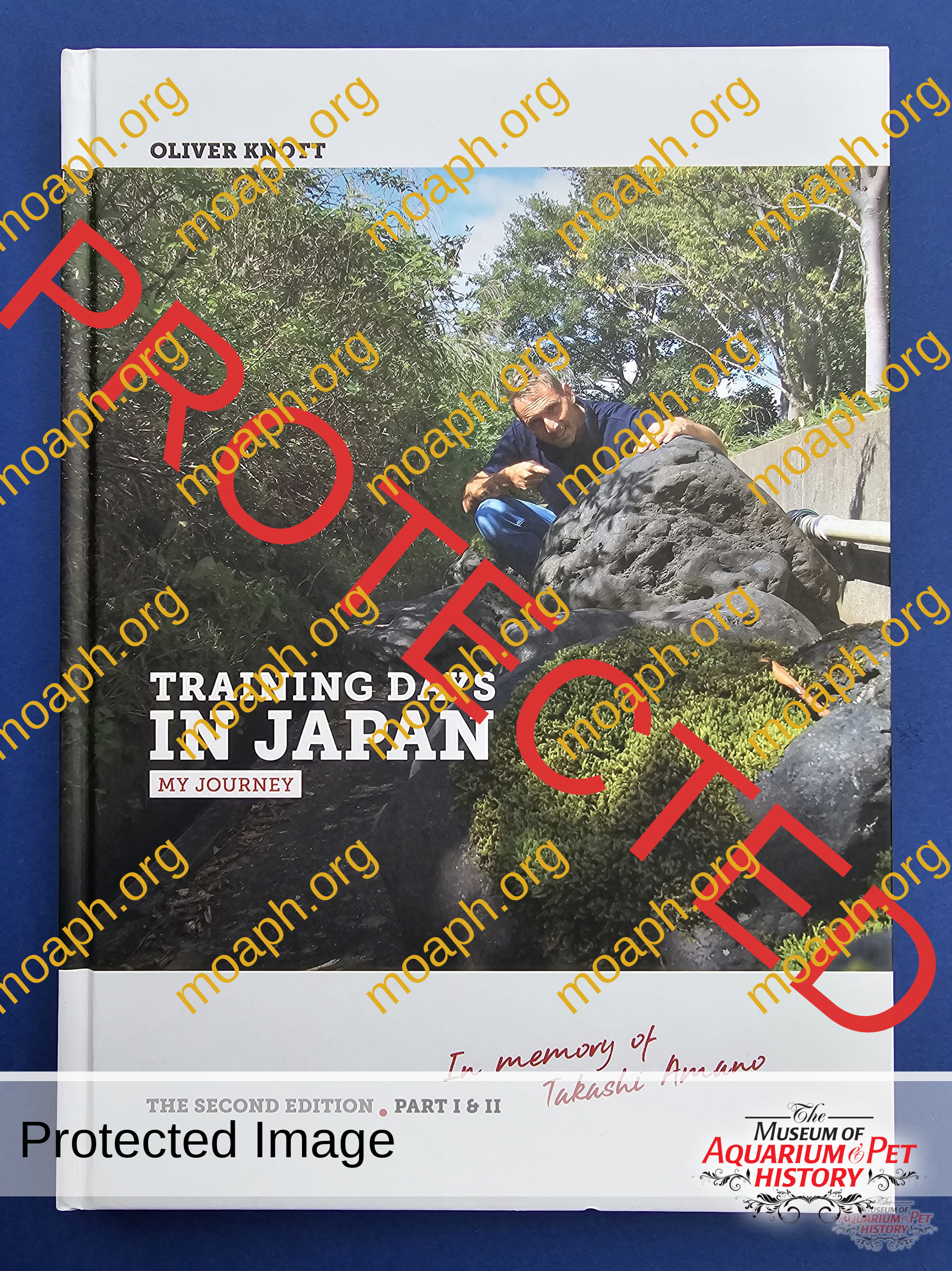
The book Training days in Japan – My Journey (2nd edition, 2017, Part I & II) by Oliver Knott is one of the best reads for delving into Amano’s life and the ADA world.
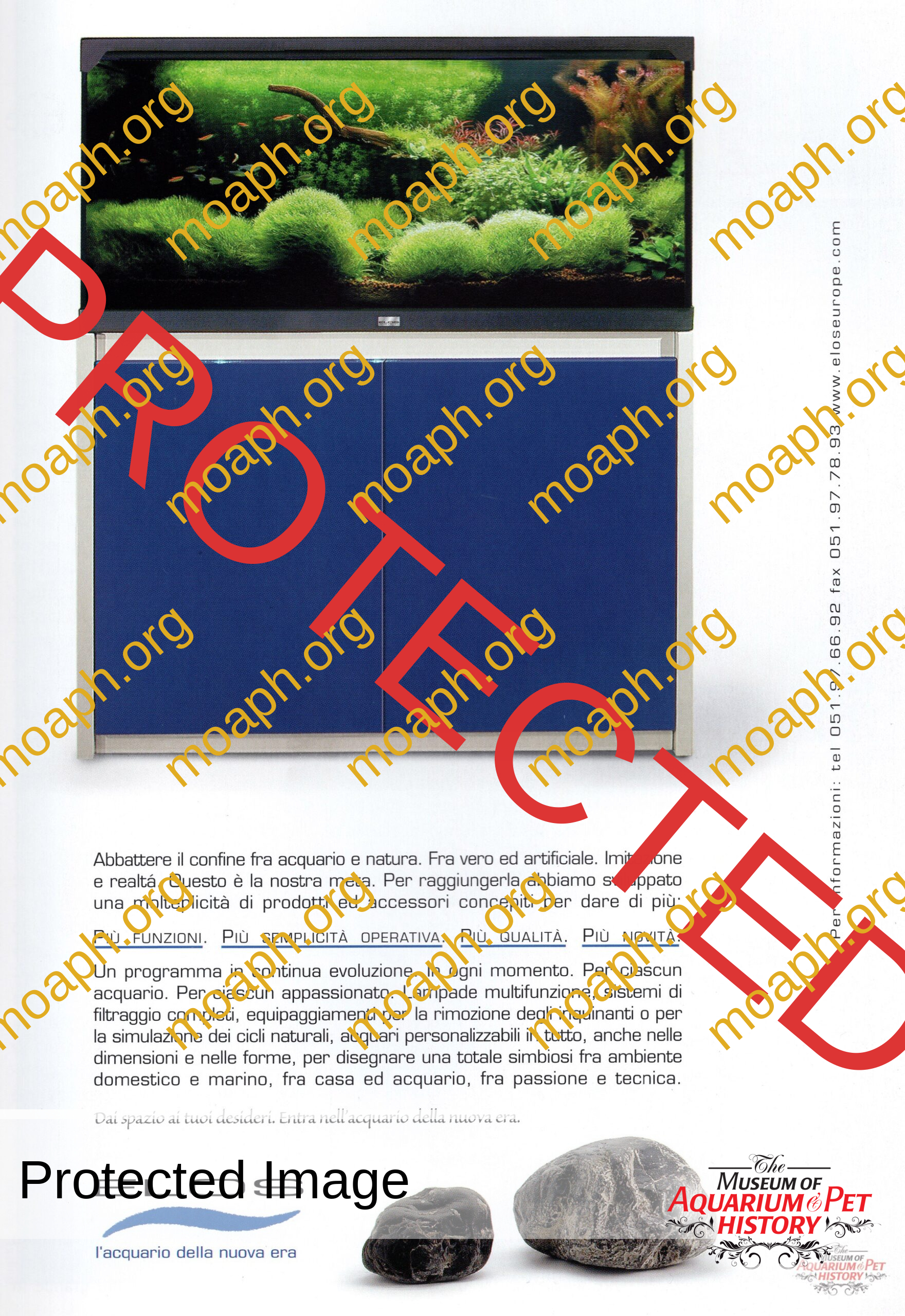
In the mid-2000s, the Italian company Elos became one of ADA’s main competitors in Europe. Advertising from Hydra magazine (2004, Vol. 4, No. 27).
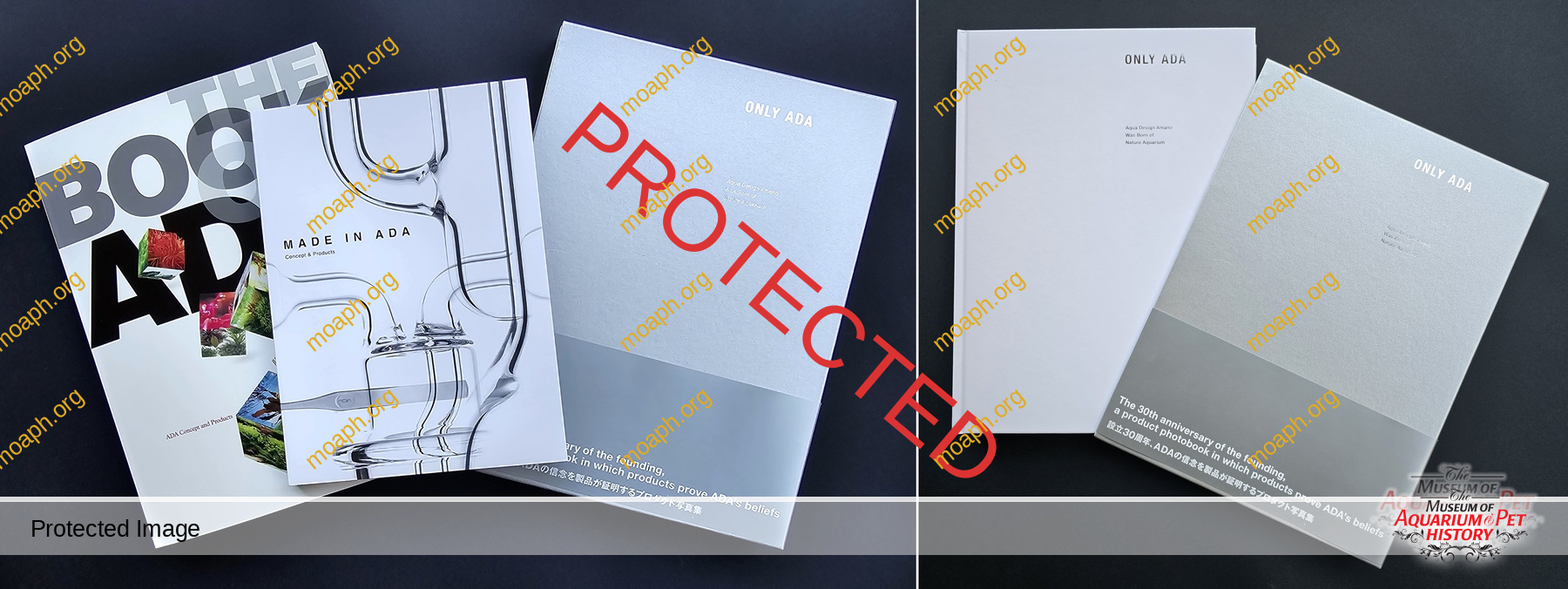
Three highly collectible design books summarizing ADA’s history and beliefs. The one entitled Only ADA, the latest, is already very hard to find.
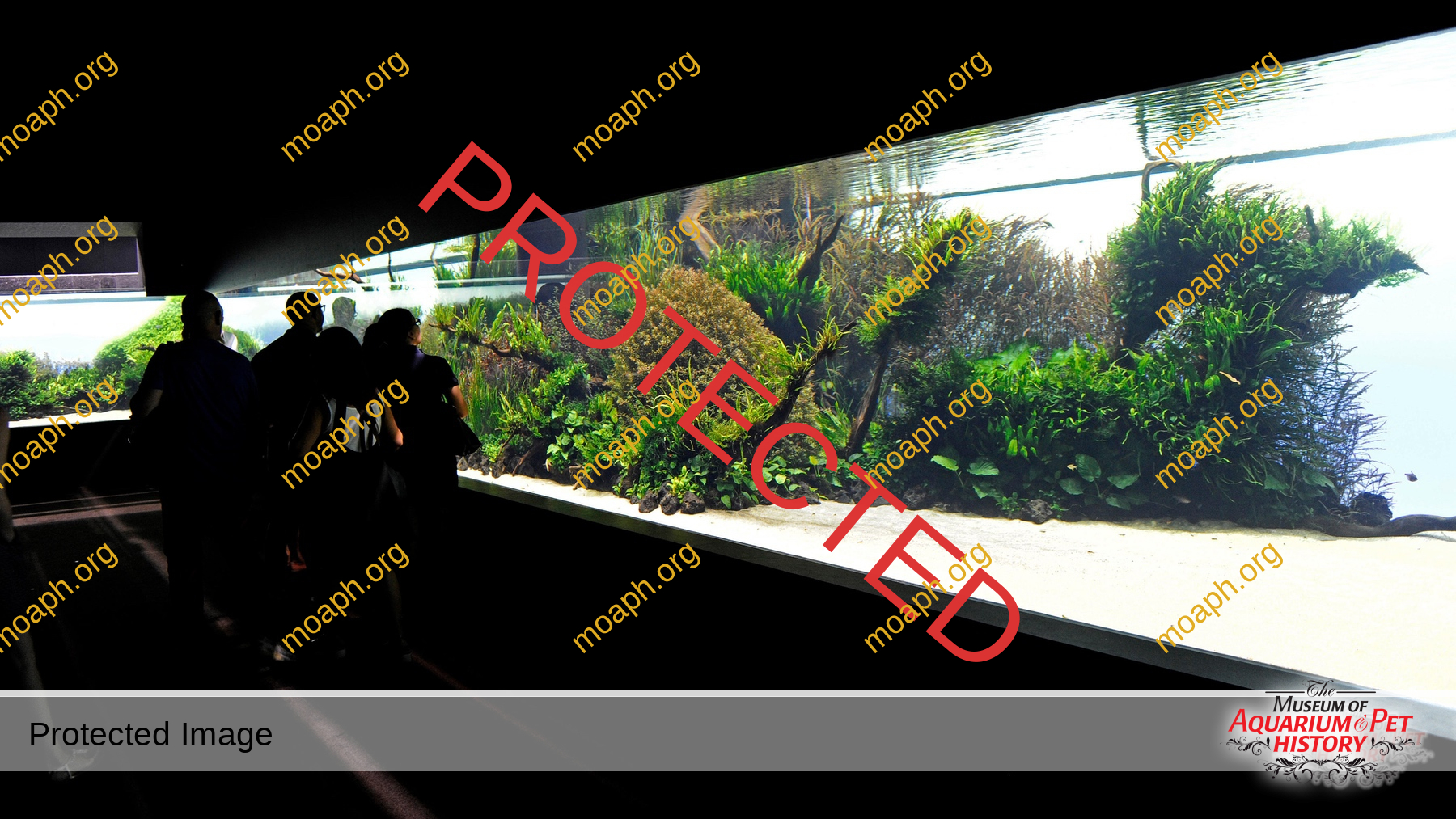
Florestas Submersas at Oceanário de Lisboa in Portugal was Amano’s last project. This U-shaped aquascape measures 40 meters (about 131 feet).
Holy Grail
Amano always wanted the highest standards for his customers, and sometimes he took this “commitment” – a very important word in Japanese culture – to the extreme. The “Cube Garden Excellent” is definitely one of the emblems of his constant pursuit of perfection in creating products. The story behind this small fish tank (L25xW20xH20 cm – L9.8”xW7.9”xH7.9”), which never went into a regular production, is almost a legend. At the end of the 1990s, Amano decided to produce the perfect aquarium using the clearest glass ever manufactured for the aquarium industry, a minimalist museum piece ready to go both on the Guinness World Record book and in the hands of ADA’s wealthiest customers.
In 2001, ADA advertised this crazy aquarium in the beautiful and rare “leaf catalog”. The price for the tank was 1,200,000 yen, which in 2001 amounted approximately to $9,900. As far as I know, only a couple of specimens were manufactured by hand before the project failed for technical reasons. A few years ago, I was so lucky to see a Cube Garden Excellent with my own eyes. Taking into account its small size, it has been one of the most expensive aquariums which I have ever come across in my career as a photographer and collector.
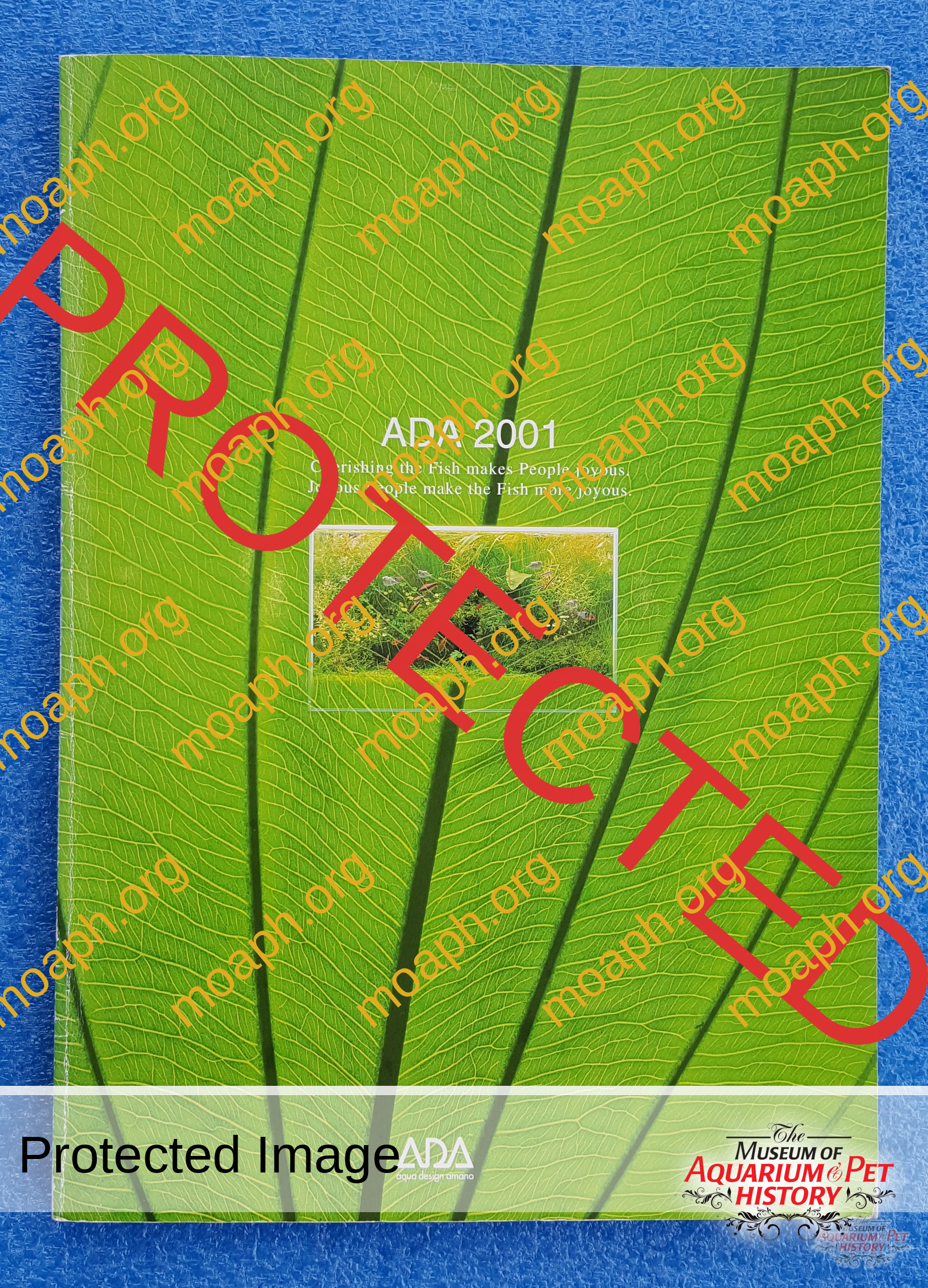
ADA “leaf catalog”, 2001. Its amazing cover is the result of a double-exposure photo taken by Amano.
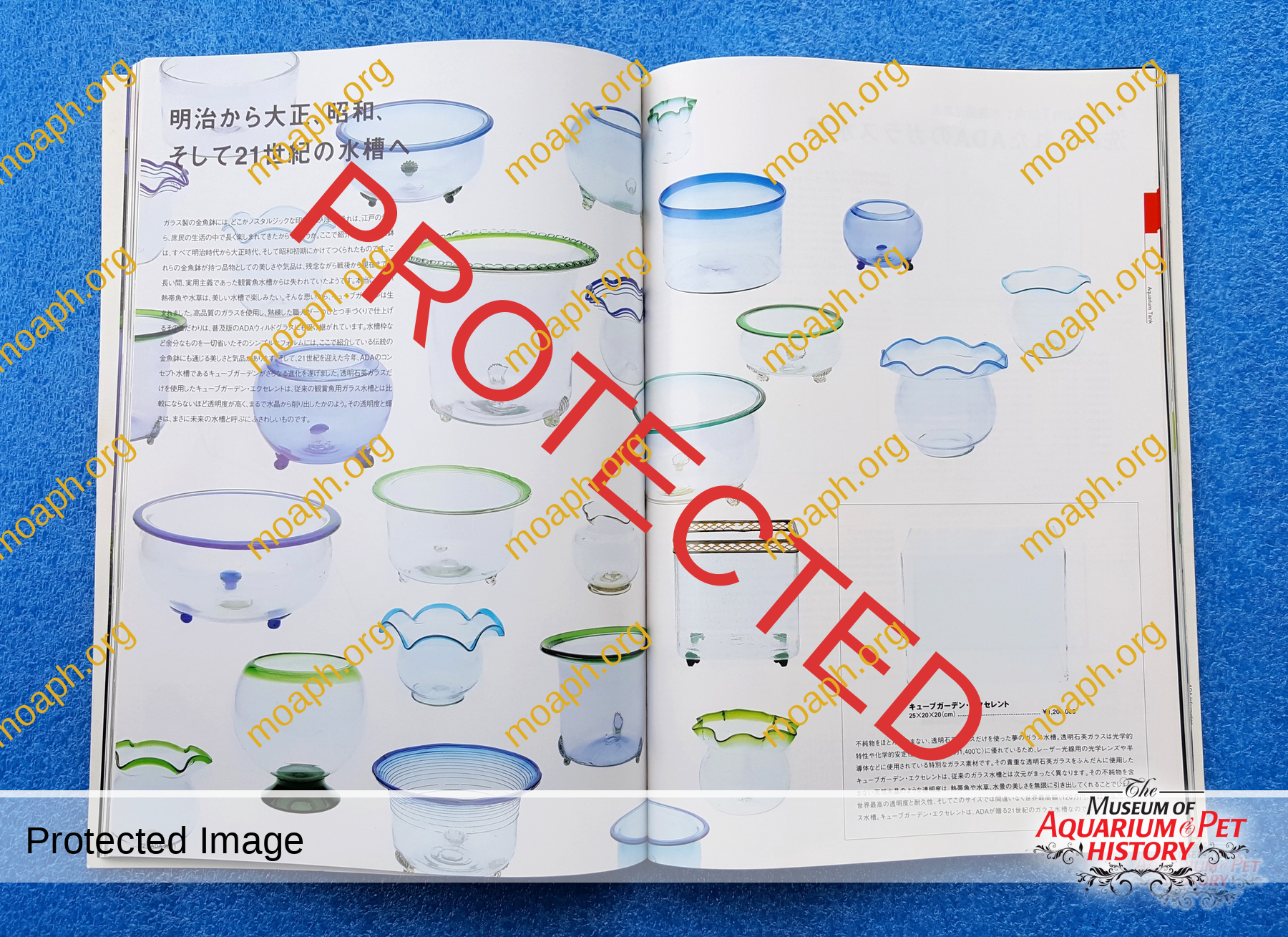
Pages 72 and 73 of the “leaf catalog” show Amano’s collection of antique Japanese fishbowls, plus the enigmatic Cube Garden Excellent with its crazy price in Japanese yen.
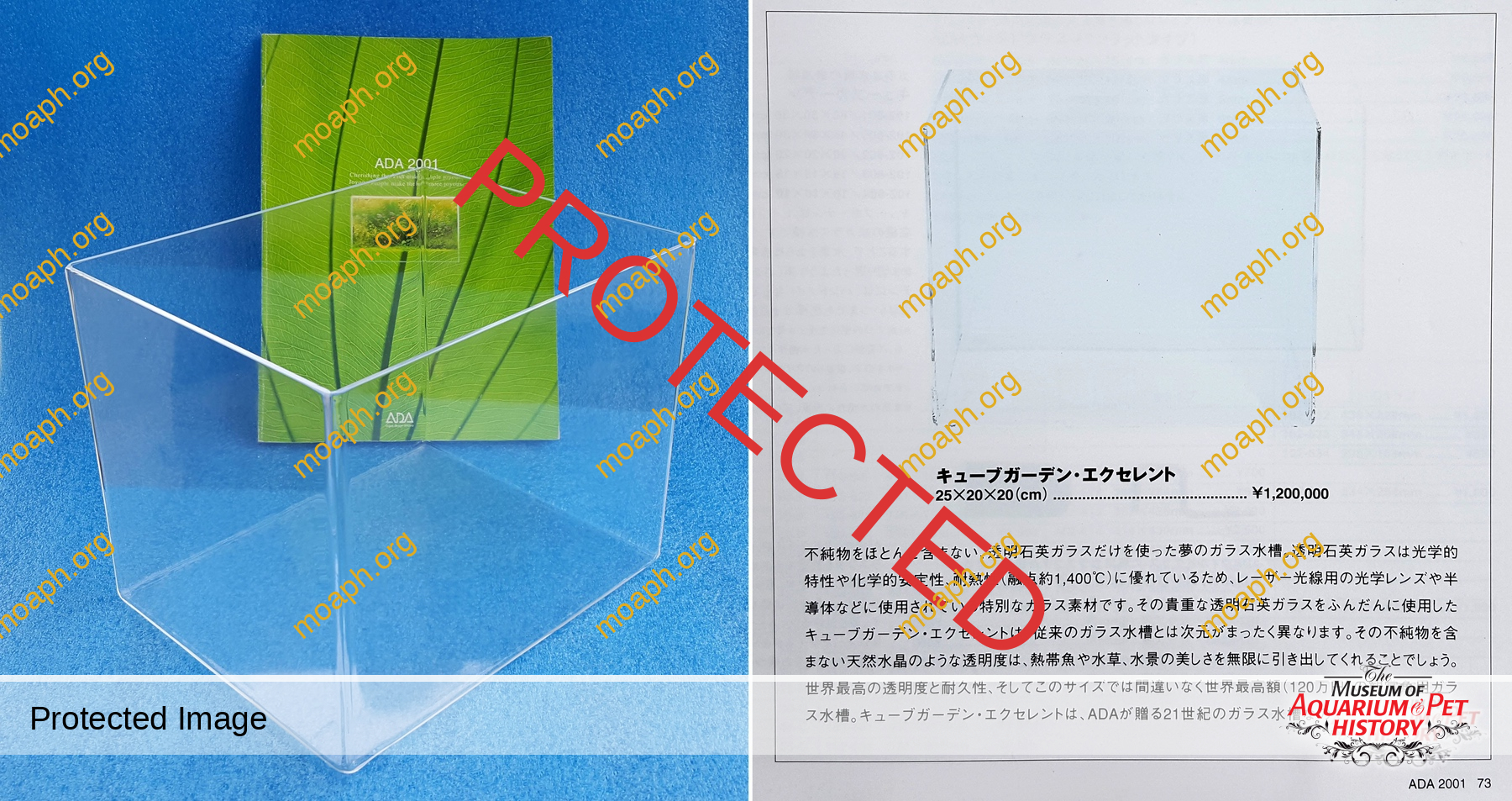
Cube Garden Excellent, the absolute Holy Grail.
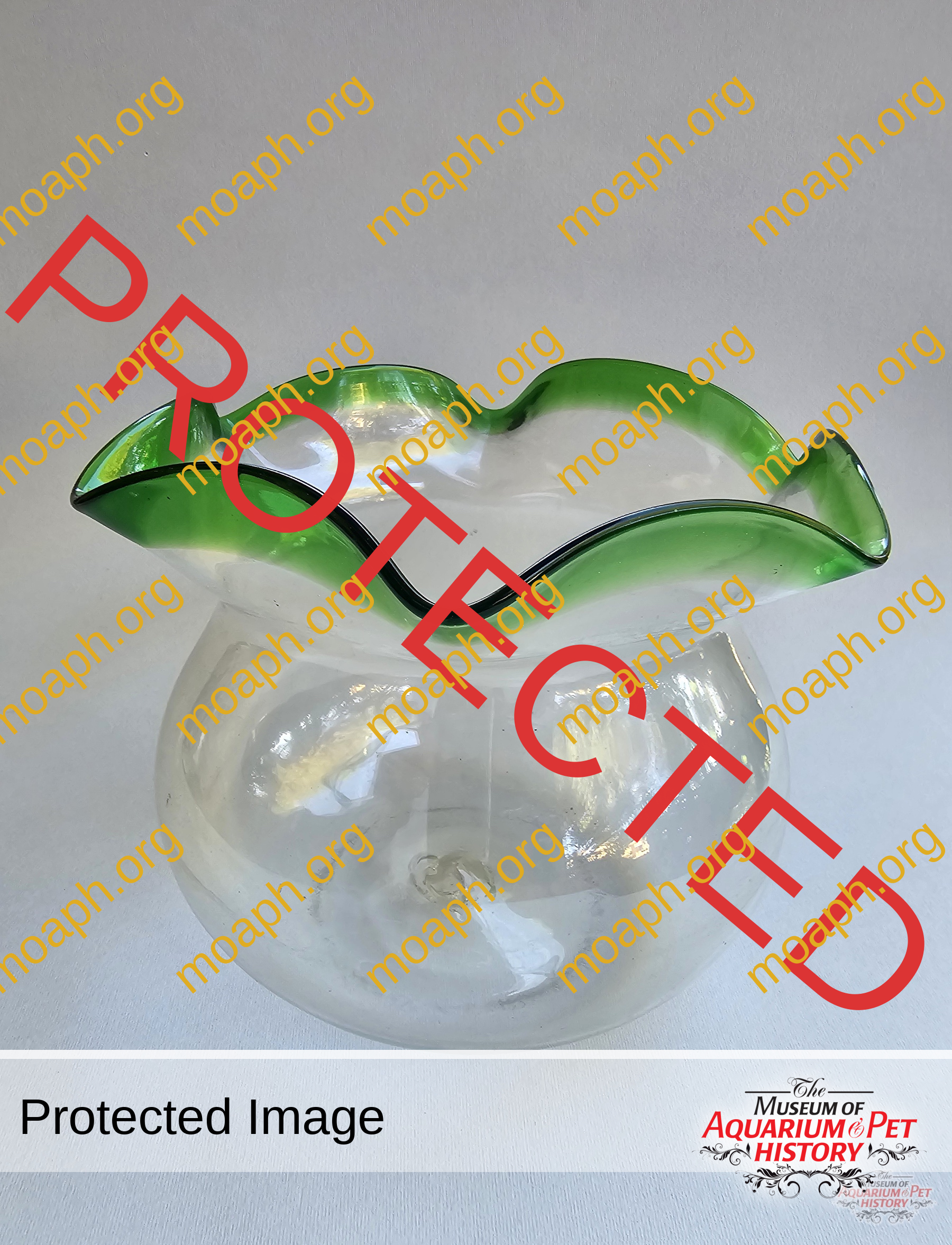
Although underrated by most of the collectors of aquarium antiques, Japanese fishbowls are wonderful pieces of art.
Takashi Amano, the visionary man who conceived amazing products such as this one-of-a-kind aquarium, sadly passed away in 2015. His company back then was already facing many competitors selling similar products at more affordable prices, as well as the widespread “new” trends such as the biotope aquarium that diverted the attention of numerous hobbyists from the original, more demanding Japanese aquascaping. Amano’s legacy, however, is strong and continues to guide his family business towards the future, with a keen eye to and for the past.