Beginnings: A Memoir of my Early Days in the Hobby
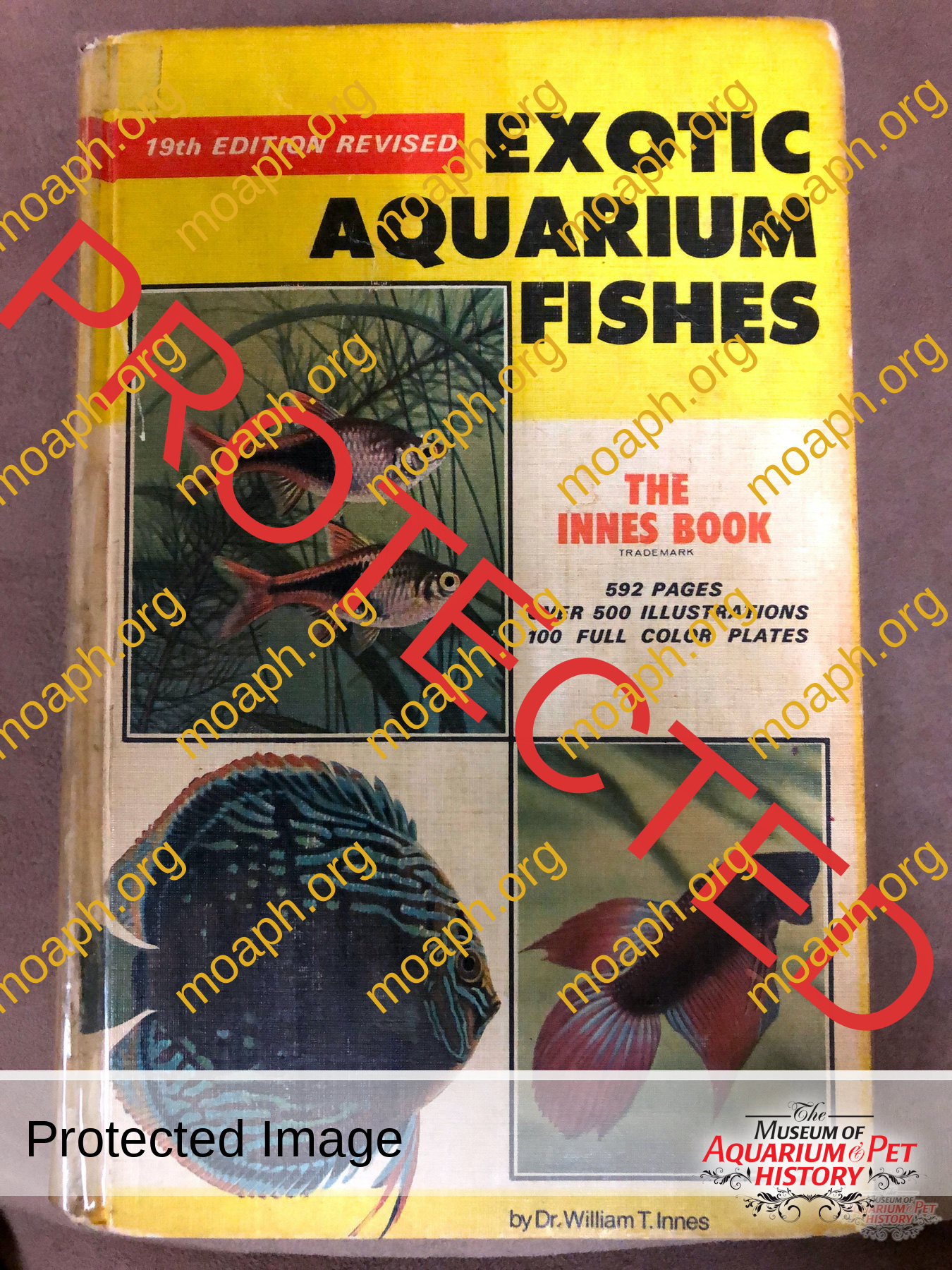
Exotic Aquarium Fishes 19th Edition Revised, the “yellow Metaframe edition”
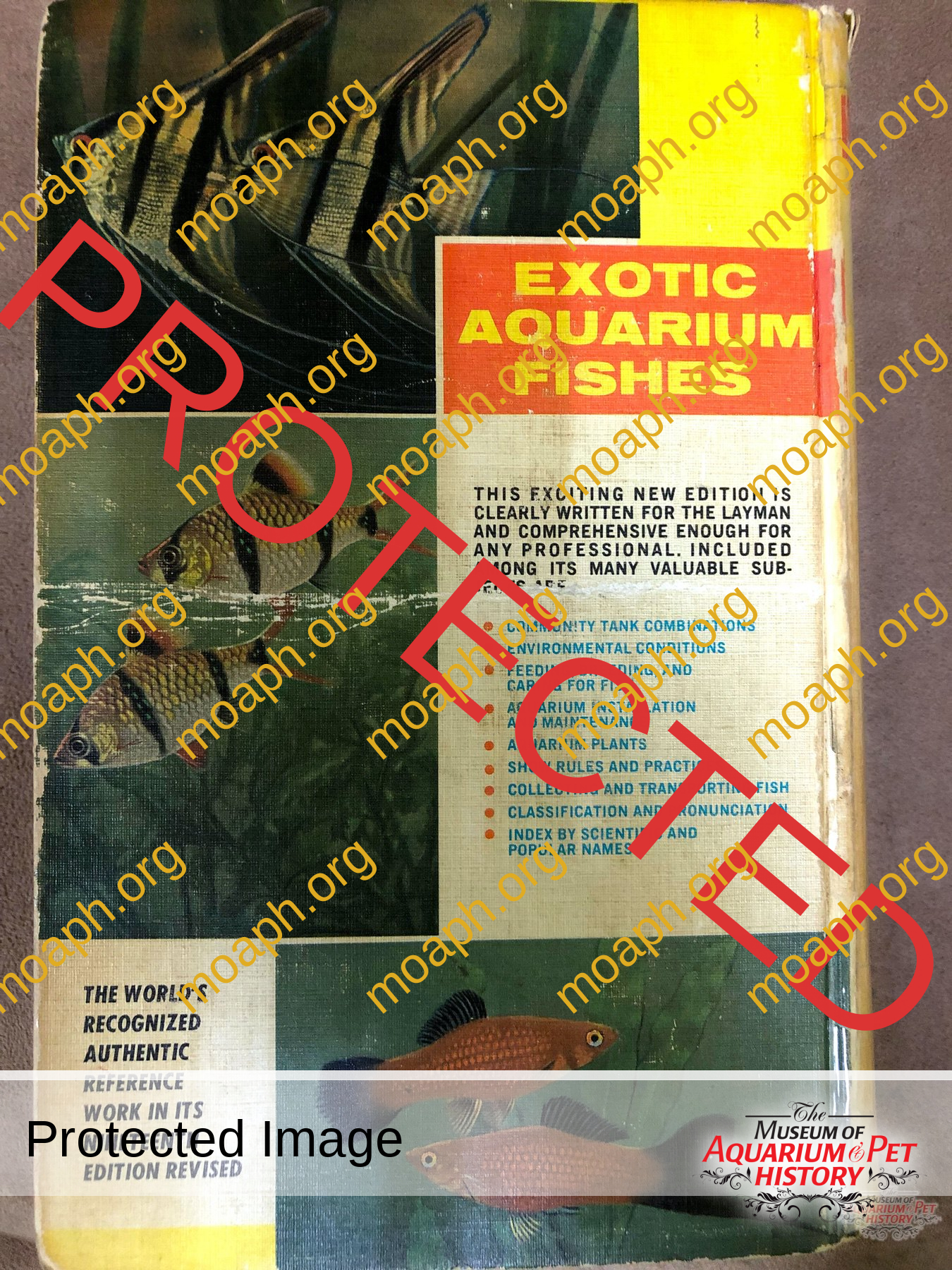
Back of the Innes book
My serious involvement in the tropical fish hobby began at the very non-serious age of about 12. It was during the 1965-66 academic year (sixth grade) at Our Lady of Sorrows (that is not a made-up name) grammar school that I made friends with Michael Graziano, who was to become a lifelong influence and friend.
You see, Mike not only went to school with me, but he lived up the block from me. So, naturally, we would spend a lot of time in each other’s homes. Well, Mike had his own room, and his parents let him keep five (!) tanks in it (the largest of which I now know to be called “20-gallon Highs” – he had two of these). Now, you have to imagine what it was like for a kid like me to see this. To begin with, I lived in a three-room basement apartment where my “bedroom” consisted of a convertible couch in the living room. The bathroom was in a common hallway outside the apartment. Therefore, Mike’s bedroom/fish room seemed very impressive to me – soon, I too wanted fish tanks (I knew that having my own room was out of the question).
When I told my parents I wanted a fish tank, they sort of indulged me like so many parents who simply sigh and regard it as another passing fancy that they have to temporarily put up with. However, my mother laid down one rule: no tanks in the apartment.” If I could find a space in the common hallway, and the landlady didn’t object, I could keep a fish tank or two.
I scouted the hallway and concluded that there was space for at least one small tank. While I remember that hallway as though it were only yesterday, I no longer recall exactly where I found the space for that first tank. But, suffice it to say that I was very happy to be able to join Mike as a fishkeeper.
Somehow, I saved up enough money to enable me to buy a 5 ½ gallon tank – that was the largest I could afford. The next stop would be the only pet shop within easy walking distance of where I lived – Coral Gables Pet Shop on Junction Boulevard (just north of 37th Avenue) in Jackson Heights (Queens). At that time, I had no idea that “Coral Gables” was a city in Florida – I thought it was just a reference to a fish house made of coral.
After buying the tank and glass thermometer (no filter, as I didn’t have enough money for that), I carried the tank home and filled it with water. From Mike, I learned that I had to wait a while before I put any fish in it. In the meantime, he and I enthusiastically discussed what fish I would buy for my new aquarium. Of course, this tank was of the then common stainless steel frame with slate bottom variety. Therefore, even without gravel, it didn’t look so bad to me because of the natural slate bottom.
My first tropical fish purchases were a pair of Zebra Danios (very inexpensive) and a pair of neons (slightly more expensive). Frankly, I don’t remember much about what I did with them, how long they lived, and so forth. I have a vague recollection of thinking they were just very pretty. Soon thereafter, I found a “10 gallon Long” that someone had placed next to their garbage cans. Wow! I found a spot for this in the hallway, and I bought some more Zebras.
By then, my interest was pretty much established. Mike and I would regularly walk to Coral Gables to look at the fish, buy live food, and an occasional magazine. Because of the ads in these magazines (Tropical Fish Hobbyist and The Aquarium), we learned of the Aquarium Stock Company in lower Manhattan. On some Saturdays, we would take the subway there. What a place! It was “Fish Heaven” – a store a whole block long, stocked with everything a budding aquarist could want.
We went to other places as well. You see, Mike’s parents, who were (are) very kind and lovely people, would take Mike and me (they also had a car!) to various other aquarium venues. I remember going to the Saxon Plastics manufacturing plant just off of Canal Street. This area apparently had a very of places that specialized in plastics, and Saxon further specialized in making aquarium products such as filters, feeding rings, breeding traps, etc. In those days, they would sell retail to people who could find their plant.
I also recall going to other small, dank, and dimly lit aquarium stores. Ah, I fondly remember the “smell” and “look” of those places, but, with the exception of the Nassau Pet Shop on Nassau Street (which was a short walk from the Aquarium Stock Company on Murray Street), I can’t remember the names of any of them. The Nassau Pet shop was the place famous for having a tank in the window which had a sign on it that boasted something to the effect that that particular aquarium had been set up since 1953 (or some such long-ago year) and had never had a water change! Back then, it was your claim to fame if you could achieve the mythical “balanced” aquarium in which fish and plants could live in perpetual harmony with any a further effort on the part of its owner.
The other thing Nassau Pet Shop was known for was its cheap prices for fish. Unlike the Aquarium Stock Company, Nassau’s tanks were unadorned – no gravel, plants, or ornaments – just fish. They didn’t have as wide a selection as Aquarium Stock, but they usually had all the more popular species.
By now, my interest in the hobby was fairly well fixed, but two other events cemented it. The first was a gift from Mike (although, knowing how generous his parents are, they were probably the ones who paid for it) on the occasion of my 14th birthday (or it could have been a Christmas present – it doesn’t matter which, because I was born on Christmas Day!) of a copy of William T. Innes’s classic book, Exotic Aquarium Fishes (it was the 19th Edition Revised, the so-called “yellow Metaframe edition” – I still have it). Well, before long, I had read it from cover to cover. Then, I reread it. I reread it again! Then I practically memorized all the fish “biographies.” Incidentally, it was this book that first gave rise to my lifelong interest in killifish. Upon seeing Dr. Innes’s color photo of a Blue Gularis, I became entranced over the fact that such a beautiful and exotic fish could exist, and be available to a hobbyist like me. Dr. Innes became one of my “idols,” and I have been an avid aquarium book reader ever since.
The second eventful moment came about at around the same time that I received the Innes book. It was then that I chanced to come across an article in The Aquarium magazine entitled, “the History of the Aquarium Hobby in America.” Its author was one Albert J. Klee. I was fascinated by it. It turned out that this article was just an installment of a history that was being serialized in the pages of The Aquarium (the venerable magazine that was founded by Dr. Innes, who had by then retired; its then-current Editor was none other than Klee himself). It was that series of articles that gave me an appreciation of the other facet of the aquarium hobby that would later play such an important role in my life – that of the so-called “organized hobby,” the clubs, and the people behind the hobby. Al Klee joined my pantheon of “idols” on the basis of that series of articles.
In the ensuing years, I continued to maintain aquariums wherever I lived. In fact, I cannot remember a time period when I did not maintain at least one aquarium. Of course, even after we moved to a “spacious” four-room apartment, I was not allowed to keep fish tanks in the apartment, and I always had to find space in either the common hallway or the basement. It was not until I got married and had my own apartment that I ever owned anything larger than a ten-gallon tank.
When I did get my own apartment (which had a spare bedroom), the first thing I did was go out and buy a 55 gallon aquarium. Boy, was I pleased with that! Eventually, I placed four smaller aquariums in this extra room. I had finally achieved something resembling Mike’s old bedroom.
A couple of years later, we bought a house with a large basement. Yes, a large basement that eventually came to be home to 80 *yeah, 80) aquariums, the largest of which was 125 gallons.
A few years after buying the house, I joined Greater City and – well, you know how the saying goes – “the rest is history!”