Book Review
The Lady And The Octopus: How Jeanne Villepreux-Power Invented Aquariums And Revolutionized Marine Biology by Danna Staaf. 2022 (Released on October 4). Carolrhoda Books. Hardcover, 136 pages. $27.99. (An eBook is also available).
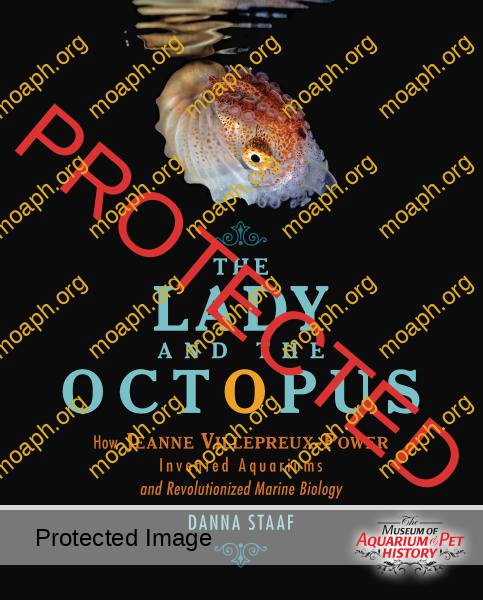
I will note right off, after reading this book, that I had been surprised that it is classified on the copyright page (and in available publisher’s information) as “Juvenile literature” aimed for an audience in the age range of 10 to 18 years (grade levels of from five to 12). Don’t let this put any of you “older” readers off. This book is an interesting, well written, and beautifully illustrated book worthy of being in the library of anyone with any interest in a not often covered topic dealing with early aquarium history. Granted, there is the rare comment that my “older” mind initially thought “why say that”, but these are rare, and I understand their inclusion in the text.
The book is divided into an Introduction followed by six Chapters and an Epilogue. Additionally, there are a dozen mostly one-page sidebars which cover a wide variety of material complementing the text. At the end of the text are an additional six sections: Author’s Note; Timeline (an interesting section covering important dates from 1793 (Jeanne’s parents wed) to 1997. This latter date is when a crater on the planet Venus was named to honor Jeanne; a short, but helpful Glossary; four pages of Source Notes; a four-page Bibliography done on a chapter-by-chapter basis and lastly a Further Reading page. A two-page Index and one page of Photo Acknowledgements end off the book.
I wish herein to make some comments specifically regarding the aquarium aspects of the text, in that these will be fitting for the source of this publication. But prior to this, a brief, and general overview of the book is warranted.
A lot is known about Jeanne Villepreux-Power. But there is also a lot of uncertainty in some areas of her life. Consequently, the author wisely notes that “…you’ll come across plenty of “maybes” and “probablys” to qualify educated guesses about Jeanne’s life.” To this may also be added a few “most likelys” and some “perhaps.” These situations are nicely discussed on the Sidebar page entitled “On Historical Accuracy.”
Jeanne Villepreux-Power (1794-1871) was born in rural Juillac, France, 280 miles south of Paris. In her youth, she learned sewing and embroidery skills and equally developed a love of nature and animals. She also learned to read and write, which was not overly common at the time. At the age of seventeen, she left home for Paris – on foot. It was an eventful trip, with a stopover in Orleans, but she eventually reached her goal. Her sewing skills landed her an assistant position in a millinery firm, and she became well known for her work. It was during this time that she met James Power, of Irish heritage, and a relationship developed. Jump ahead a couple of years (to 1818), and they were married in Messina, Sicily, where James’s business was based. From early on, Jeanne studied various animals ranging from caterpillars to tortoises to martins (a weasel family member). As time passed, her interests expanded, and from this point on, Jeanne’s life was to make some large changes, and her marine biological studies, aided by the Mediterranean Sea being literally across the street from her home, made this possible.
Although Jeanne studied many invertebrate ocean life forms, she is most well known for her groundbreaking (seabreaking?) studies on the Argonaut (this is the nautilus, an octopus of the genus Argonaut.). Jeanne studied, among other things, their anatomy, their shell making, reproduction, and regenerative powers. The outstanding and totally new methods that she used in her studies regarding these cephalopods were done on living specimens in a captive state. For these studies, she developed three different types of “cages.” At the time these studies were being done (from 1832 onward), the word aquarium was available in the English language, but it was always used in a horticultural sense. There is no known indication that it was used at that time for “glass boxes filled with water containing aquatic life forms.” But that is what Jeanne had, and she called them “cages.” In 1833 she invented two other types of cages. One was exactly that, and it was submerged in the sea water and populated with Argonauts and other life forms. The “bars” were close enough together to prevent the creatures from escaping but allowed a free flow through of water. A third type of “cage” was described as a small glass vessel that was submerged in the larger regular cage and was used to observe smaller life forms. In 1835 these “cages” received the Italian name of “Gabiole [or Gabioline] alla Power,” and in 1838, in London they became known as “Power Cages.” It is interesting to note that Richard Owen, who in 1858 championed Jeanne as the inventor of the aquarium (The Encyclopaedia Britannica, Eighth Ed., page 328), used the following terms in 1839 regarding her “cages”: molluscous vivarium and marine vivarium (Proceedings of the Zoological Society of London, January 8, pages 39, 41 and 48). The latter, which was used twice, is particularly interesting considering the date used. This exact term is seen in English literature of the middle 1850s. A review of literature during that intervening period (1839-1855’ish) could prove interesting.
The following considers only the above mentioned “glass boxes…”. The first concern is the definition of the word aquarium. In 1872 master aquarist and noted nitpicker William Alford Lloyd considered Madam Power who “…kept marine animals alive…” and the notion that she “invented aquaria.” But, in that she “…by her own showing, knew nothing of the employment of plants…” he dismissed her as the inventor. Why? Because to Lloyd, if both animals and plants were not kept in the glass box, there could be no “…compensating principle” (which is what later became known as the balanced aquarium), and therefore it was, to his mind, not an aquarium. (Official Hand-Book of the Marine Aquarium of the Crystal Palace Aquarium Company, Second Edition, page 11).
Going on the Internet, one can find numerous sites giving Jeanne credit for inventing the aquarium. Many of these are fairly straightforward but offer no questioning, or in-depth discussion, of the statement. Even some regularly published articles suffer the same fate. There is one duo of articles that I feel deserve mentioning. The first of these is “Jeanne Villepreux-Power, the “Mother” of the Aquarium” by aquarium historian Albert J. Klee, Ph.D. which was published in Modern Aquarium [Greater City Aquarium Society, NY], Volume 11, Number 8, October 2004, pages 7-8. (Available on-line at https://issuu.com/modernaquarium/docs/2004-10). The title pretty well says it all, but you might want to read the entire article to get the author’s full positive approach to the topic.
Fast forward to 2019. There is, of course, nothing that says an idea is forever. In February of that year, Klee published the following article: “Jeanne Villepreux-Power and the Myth of the Invention of the Aquarium” (Aquarium Hobby Historical Society of America, Facebook Files, February 16, 2019, pages 1070-1080) as a part of his irregularly expanding “Essays On Aquarium Hobby History” book. In this piece, Klee came up with several reasons that Jeanne does not deserve the title that he gave her in 2004. One of these is, in his own words is: “I will require that the invention of the aquarium and its development must proceed chronologically without interruption to arrive at how we use this word today.” (Emphasis his, page 1075). Now, of course, any historian can set their own rules. But this is one I would not choose to accept, and maybe in a bad pun, I consider that it does not hold water. In that this “requirement” would remove his previously given title to Jeanne, I will leave it at that. Should you wish to read his other considerations (including who he now so crowns), I have directed you to the article in which they appear.
If the last part of this review goes a little off track, I will offer my apology to the author of the book under consideration. But in my defense, I will say that her book made me think and made me want to learn more about Jeanne, her work, and her Power Cages (aka aquaria, in my opinion). Should (when?) I write another book I would be happy if I could potentially send readers off on similar paths. This book had an excitingly positive effect on me and I heartly recommend it to anyone reading this piece. I think that you might feel the same.
A last note: In returning to some of Jeanne’s original writings (pathways kindly provided by the author) I noted that most commonly she wrote under the name Jeannette Power. Why is this you might ask. Another reason for you to read the book. The author offers a nice “possibly”.
Notes
- To read about Danna Staaf, the author of the book covered above, check out her website at: Danna Staaf – Author: About
- The Association Jeanne Villepreux-Power maintains a committed website at the following address: Reception (jeanne-villepreux-power.org)
- My special thanks to Emiliano Spada. When I ran into a problem in machine translating the Italian words Gabiole and Gabioline he quickly came to my aid. He noted that the words are old Italian and stated that the first word means “small cages” and the second “very small cages.”