Candy, and Animals, and Trade Cards…Oh My! – A German Chocolate Company and the Proliferation of Animal Trade Cards
Few things in this world can collectively bring a smile to most anyone’s face, but chocolate and animals are likely at the top of that list. That combination is precisely what a German business ingeniously utilized in their advertising, not just to create striking product packaging, but also to promote sales by encouraging customers to collect trade cards. Although the tobacco and food industries had also been using the marketing strategy, Franz Stollwerck’s chocolate company was among the most popular candy companies to produce trade cards.1
The story of Stollwerck chocolate began in 1839 in Cologne, Germany, when Franz founded the company with the intention of producing miscellaneous candies, pastries, and cough drops. After decades of success, Franz passed away in 1876, leaving his legacy with his five sons (Abert Nicolaus, Peter Joseph, Heinrich, Ludwig, and Carl).2
With a booming market for chocolate and increased mechanization, the turn of the 20th century bolstered the company’s continued expansion, both in distribution and marketing. One promotion method, trade cards, was introduced to the company by Ludwig Stollwerck, who paid popular artists to create “miniature picture series” and collectors’ items to be sold with their candy products.2 The strategy proved prosperous, as Stollwerck popularity skyrocketed, selling over 50 million collectors’ items within three years of their launch.
Trade cards contained vibrant illustrations on a range of topics, and a series or set usually pertained to a theme, like sports, cars, or animals. Accompanying the illustrations were unique descriptions of the subject, often alongside or on the back of each card. The collection of sets became a favored hobby for many customers. As Emiliano Spada has highlighted in a previous MOAPH article about aquarium and aquatic life trade cards, the relationship between producers and consumers was symbiotic; the more chocolate people purchased, the more cards they collected.3
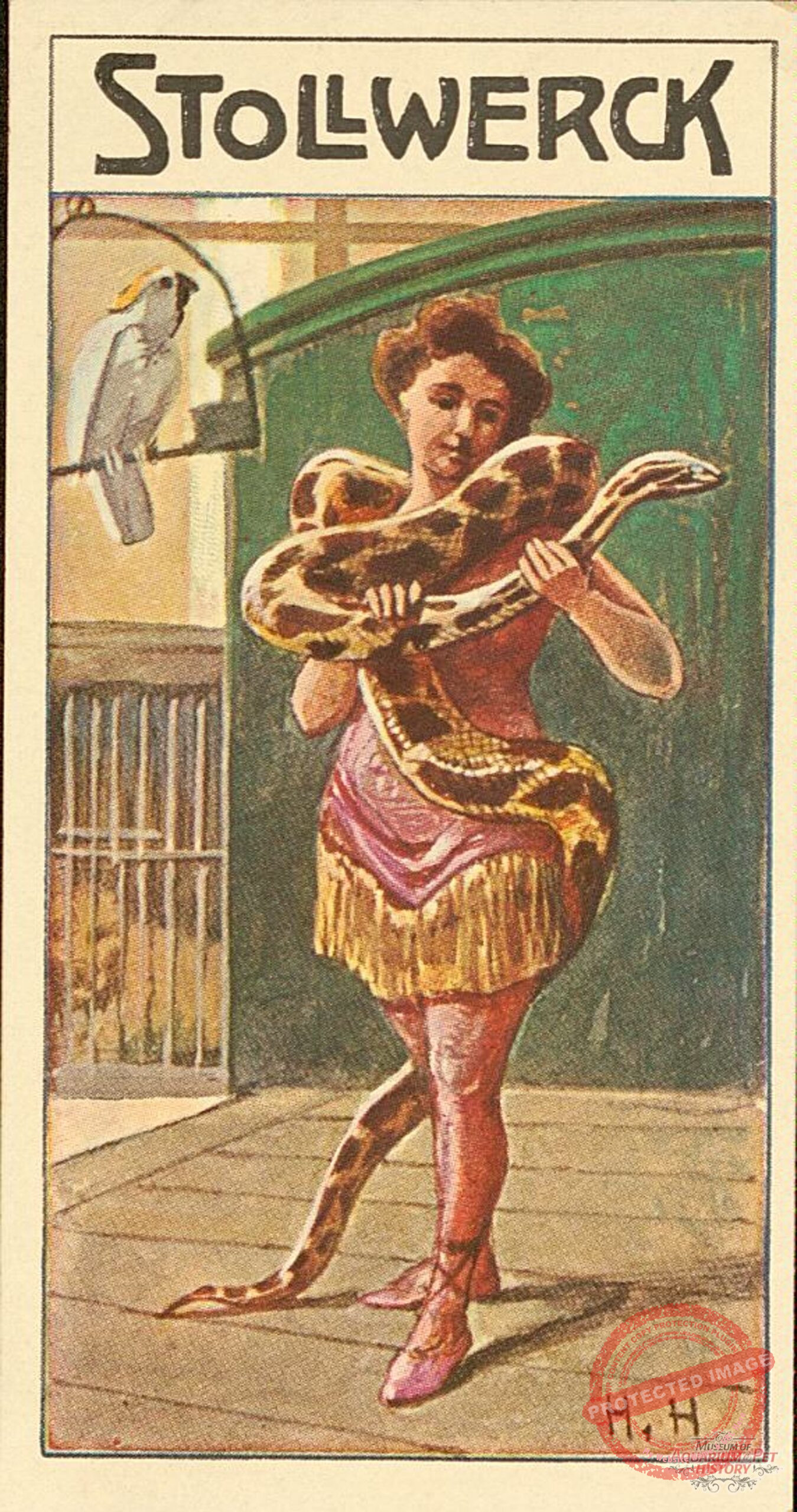
This trade card from Stollwerck highlights giant snakes. The front of the card depicts a young woman holding what appears to be a Boa Constrictor. The back of the card explains that snake charmers, often women, would carry large snakes to add a ‘wow factor’ to their performances, shocking the audience with their intimidating size.
Beyond their use in theatrical performance at fairs, the card provides educational information about the snakes. Some facts include where they originated, the climate in their native habitats, and how they feed. The card ultimately combines elements of art, entertainment, and teaching to promote the company’s Extra Smooth milk chocolate.
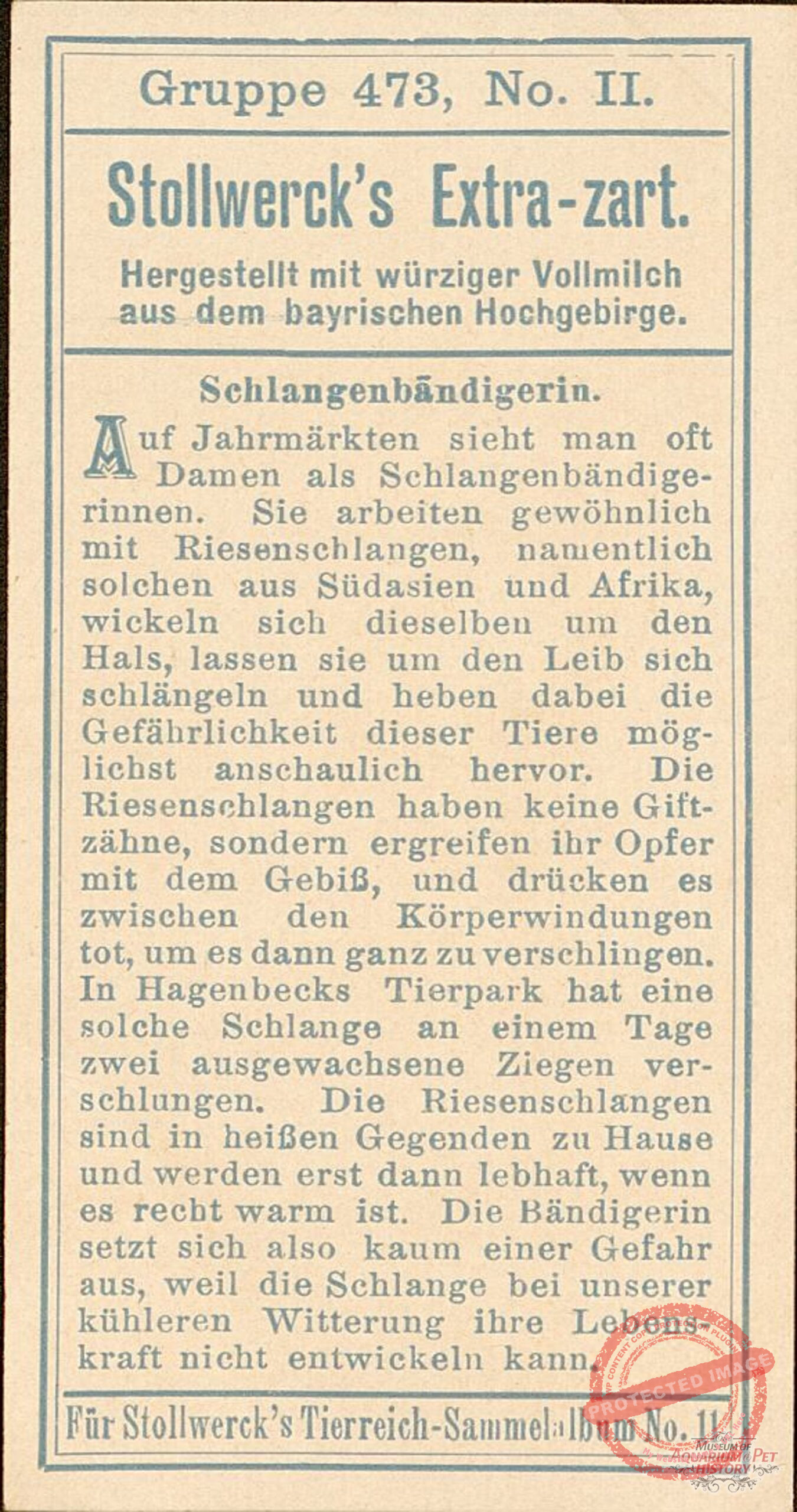
Group 473, No II. – Stollwerck’s extra smooth
Translation:
Stollwerck’s Extra Smooth.
Made with rich whole milk from the Bavarian Alps.
Snake Charmer.
At fairgrounds, one often sees women performing as snake charmers. They typically work with giant snakes—specifically those from South Asia and Africa—wrapping them around their necks and letting them coil around their bodies, all the while vividly demonstrating the dangerous nature of these creatures. These giant snakes possess no venom fangs; instead, they seize their prey with their jaws, crush it to death within the coils of their bodies, and then swallow it whole. At Hagenbeck’s Animal Park, one such snake once devoured two full-grown goats in a single day. Giant snakes are native to hot regions and only become active when the temperature is quite high. Consequently, the snake charmer faces little danger, as the snake cannot summon its full vitality in our cooler climate.
For Stollwerck Animal Kingdom Collectors Album No.11
Although Stollwerck’s production of trade cards trickled out during and after WWII, their unique illustrations and collectibles continue to float around, often sold between collectors on the internet. Similarly, the chocolate company still stands today, nearly 200 years later; a testament to the human love of candy, animals, and collecting.
For more Stollwerck trade cards and similar illustrations, check out the new ‘Trade Cards and Postcards’ section on the Museum of Aquarium and Pet History website.
References:
MOAPH1: https://prewarcards.com/2021/03/06/the-long-and-winding-road-of-stollwerck-chocolate-cards/
MOAPH2: https://www.referenceforbusiness.com/history2/77/Stollwerck-AG.html
MOAPH3: https://moaph.org/article-archives/aquarium-and-aquatic-life-trade-cards/