Chapter 1: The Good Old Days – Wilde Tiere Frei Haus (Wild Animals Free Delivery)


Starting in September 2024, the Museum of Animal and Pet History (MOAPH) will be releasing a chapter a month on the translated autobiography Wilde Tiere Frei Haus (Wild Animals Free Delivery) by Hermann Ruhe.
Firma Ruhe (the Ruhe Company) was the name of an animal trading company based in Alfeld, Germany from 1860 until its official closure in 1993. During this time, they were world renown for their importation and exportation of exotic animals and birds from all across the globe, even supplying many zoos as well as circuses. Having survived both world wars, Firma Ruhe continued to dominate the world of animal trading until the mid-20th century and is a testament to true determination and leadership.
Wilde Tiere Frei Haus also documents the plethora of adventures, failures and successes endured by all those a part of Firma Ruhe. Through Hermann Ruhe’s great storytelling, we are able to visualize and understand the world from the perspective of animal collectors navigating through some of the most difficult situations, often not knowing whether or not they would ever return home. His recollections provide a vivid portrayal of the challenges and triumphs faced by the company, and give readers a glimpse into the world of animal trading.

Vorwort (Foreword)
Rarely has the culture of a small town been influenced in such a special way than that of the Lower Saxon small town of Alfeld on the Leine1 by the animal trade company Ludwig Ruhe, which took its first steps into life and into a distant world a hundred years ago.
For decades, the company was more than just a business located in Alfeld. It was a place where animal transports arrived from foreign countries and were guided through the narrow Lein Street and all over the historic marketplace, a place where groups of animals for large circus companies left the equestrian halls at the “White Earth2” – it was in this small town that the Ruhe company created an invisible bond. Awakening a longing for distant places among the young people of Alfeld, between the small town and the big world.
Unforgotten are the stories of the animal catchers and collectors of the company, all of whom came from Alfeld and the villages around the district. They served and continue to serve here as a large family, unaffected by the ups and downs of economic and political events creating diverse connections all part of the Ruhe family. In this way, the animal trading company has conveyed a piece of the spirit of that world to this small town.
Hermann Ruhe, the senior head of the company, has now undertaken the task of rescuing all this from oblivion and presenting it to a surely very large and interested readership, which gives the company’s task of delivering “wild animals to your door” such an extraordinary charm. He has written a story that could not have been brought forth in a more meaningful way, both for the animal trading company and for all those whose hearts are connected to animals. It is an honor for me to give this book, written with so much love and understanding for all animals, its introduction to the public from the town of Alfeld.
The world looks different today than it did back when the founder’s first canary shipments went overseas. The habitat of the wild animal world is no longer the same either; it is becoming ever narrower due to advancing civilization. And yet, humanity’s love for animals has remained, and for many, it has even become stronger and more conscious.
In the new chapter of its history, the Ruhe company expects expanded responsibilities. The Alfeld-based animal trading company Ludwig Ruhe, in accordance with its tradition, will see it as its duty to remain involved in the preservation of diverse animal species, the “living soul” of the landscapes of our Earth, and in promoting the relationship between humans and animals in zoos and as environmentally friendly as possible in animal parks.
Alfeld, May 1960
Dr. Arthur Seigmund
City Director
MOAPH: 1 ‘the Leine’ is a river located in Lower Saxony, Germany.
MOAPH: 2 “Weissen Erde” (White Earth) was the name of an equestrian hall that specialized in showcasing circus animals in Alfeld.
Aus Der Guten Alten Zeit (From the Good Old Days)
Over the marketplace of the Lower Saxon town of Alfeld on the Leine, a table cart pulled by two horses rumbled in the autumn of 1902. The noise caused a curtain in the first floor of an old patrician house to be slightly pushed aside. An old lady took a look through her peephole and out stood a table cart carrying canary bird transport cages covered with sailcloth.
“Herman!” she called! I was sitting on the stairs, playing with a group of homemade and consequently quite surreal-looking sea lions, whom I was determined to teach to catch a ball.
From the back house, where my father’s office was located, a loud “I’ll be right there!” echoed. Father came to the front and stopped at the bottom of the stairs. “Yes, Mother?”
“Are they sleeping over there in America?” the old lady exclaimed. “Carl Reiche has already taken the third load to the train, and your brother Bernhard is telegraphing from New York, telling us to wait with the deliveries! What are we waiting for?” My grandmother, still slim and lively despite her seventy years, looked down at my father sternly. Father, very broad and very stately, looked up just as sternly. His mustache with the drooping ends covered half of his mouth. One could never really tell if he was smiling or not.
“He knows what he’s doing,” he answered calmly. “He’s in New York, not us. Since when have we feared the competition?”
“We will see,” said Grandmother curtly.
She turned away and disappeared into her kitchen. When she opened the door, the melodious singing of a trained bullfinch could be heard.
Father cast an interested glance at my sea lion assembly, shook his head, and went back to his office.
I had lost interest in my game. The conversation between the two adults occupied me too much to continue having the patience for my hopeless attempt at training the sea lions. I packed up the stuffed animals, took them to the nursery, and followed my grandmother.
On the large, spotless stove, several pots were bubbling; opposite, on the wall, hung a birdcage from which lively singing emanated. Outside, the weather was dreary October. Grandmother sat on a stone kitchen chair and knitted. In front of her lay an open book with a pencil. She had just set her knitting aside and was writing something in the book:
“Bullfinch No. 419 has whispered.”
“What did you write there?” I asked curiously. She repeated it to me. “He didn’t sing properly,” she continued. “In the middle, he stopped and started again from the beginning. He’s been doing that for days now. He needs to be worked on again!”
“Worked on again?” I asked, puzzled.
She looked at me thoughtfully. “I believe,” she said, “I need to tell you all sorts of things soon. You’re seven now. It’s time you start understanding the things related to your future profession.”
“I will be a circus trainer,” I said proudly.
“I don’t think you will,” Grandmother said unusually gently. “You won’t have any time for that at all.”
On that day in 1902, when the sky was filled with rain, my grandmother began, with the resolute determination (that was the main characteristic of her nature) to prepare me for my future profession: that of an importer and exporter of animals and birds from around the world.
It began with my grandfather, Ludwig Ruhe, developing a strong interest in a young lady named Elisabeth, the eldest daughter of his boss, the bird dealer Ludwig Müller from Grünenplan near Alfeld, and marrying her. The business of his father-in-law Müller needed men. Sons-in-law were welcome and were quickly integrated into the business operations. Before he knew it, the newlywed husband was captivated by the varied work of this peculiar trade.
Even back then, when Russia was still the main sales area for canaries and America only promised to become a new market, it was a purely seasonal business.
The interest of the Petersburg bourgeoisie and the upper classes in birds of all kinds was likely stirred by an old Russian custom, which Brehm3 reported in the previous century:
“During Lent, specifically on the Feast of the Annunciation of the Virgin Mary, which falls on March 25th in the Russian calendar, both the nobility and commoners, old and young, would go to the bird market. Everyone, depending on their means, would buy more or fewer freshly caught birds and, to the general jubilation of those present, set them free…”
This tradition undoubtedly referred to native bird species. This old Russian custom might have been rooted in the age-old debate over whether humans have the right to take away the outward freedom of other living beings—or not.
In any case, this might have been how people began to take an interest in various bird species, and over time, it led to a lively canary trade.
My grandfather supplied canaries to Russia and, in return, bought native birds there, such as the Russian Goldfinches (more vividly colored and coarser than their counterparts found in our forests) which he brought home to Alfeld and exported to America.
By the middle of the previous century, the canary trade was no longer new. As early as the 16th century, the first songbirds from the Canary Islands were said to have been brought initially to Cadiz on the Spanish southern coast, and then beyond Spain’s borders to other countries.
The popularity of the small, greenish-feathered bird spread very quickly, as its song was enjoyed and resonated through the bourgeois and patrician houses of the time.
The Spaniards were initially not interested in breeding. Instead, they repeatedly caught fresh birds from the Canary Islands, using a singing bird in the aviary4 as a decoy. This method seems to have been quite successful for them.
Professor Hugo Busch5 writes in his work, Von Tafelmachern und Vogel Händlern (Of Table Makers and Bird Dealers), about the subsequent development:
“When breeding also began in Spanish monasteries, a law was enacted prohibiting the export of females…”
MOAPH: 3 Alfred Edmund Brehm (1829-1884) was a German zoologist & writer best known forhis work “Brehms Tierleben” (Brehm’s Life of Animals).
MOAPH: 4 A large enclosure meant for keeping birds
MOAPH: 5 ‘Hugo Busch (1924-1971) was known for his contributions to the study of birds and wrote several books such as “Of Table Makers and Bird Dealers” or “Von Tafelmachern und Vogel Händlern”.
The Spanish wanted to preserve a kind of sales monopoly with this law. Clever traders, however, exploited the difficulty of gender determination—so this newly created law missed its purpose. Professor Busch further stated that Giovanni Pietro Olina, a Roman writer, already reported in 1622 about a Spanish ship that had been en route to Livorno, Italy, and was stranded in a severe storm. Onboard had been a large number of canary birds, which gained their freedom and established themselves on the island of Elba. As early as this time, Canary birds had reached Imst in South Tyrol (Austria). From there, European canary bird trade likely expanded further, achieving astonishing growth, while breeding in other regions was only established in 1874. In the geographic magazine of that year, Mr. Johann Ernst Fabris, who still used the old city spelling of “Imbst” rather than “Imst”, writes:
“If you don’t have canaries at home in Imbst, you can always find them at my place; besides my own commissions, I receive orders from friends. The birds are sold by the commission agents of the company for 25 to 40 kreuzers per piece6, depending on their quality. They are then shipped abroad. This merchandise, often carried by children, travels to Lübeck and then by sea. Upon arriving in Constantinople, the journey continues mostly overland. When they finally reach their destination, the merchants furnish their houses with rooms decorated with cages displaying these birds. A bird can fetch 8 to 9 rubles7in Petersburg and 10 to 12 guilders8in Constantinople…”
MOAPH: 6 25-40 Kreuzers would be around 68- 108 USD today.
MOAPH: 7 8-9 Rubles would be around 371-418 USD today.
MOAPH: 8 10-12 Guilders would be around 363-436 USD today
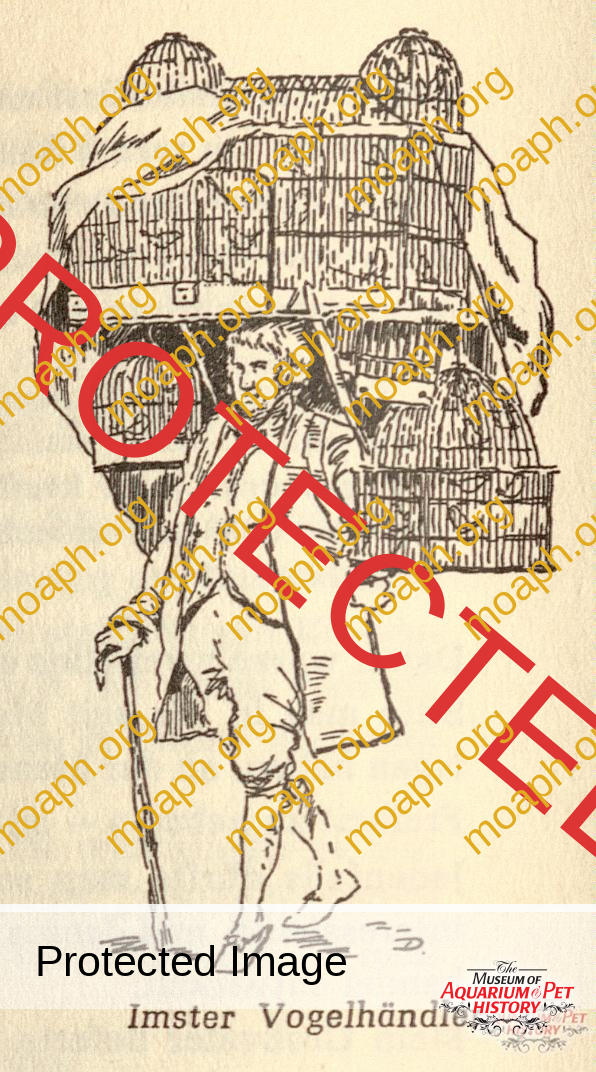
A bird handler from Imst.
It is believed that miners migrating from Imst brought canaries to Central Germany, mainly to the Harz region, where they began breeding them. In the 18th century, the canary bird trade flourished with England. However, there are differing opinions on whether the birds were imported from Germany to England at that time.
The once laborious transportation method is described in detail in the second half of the 19th century in “Brehm’s gefangene Vogel” (Brehm’s Captured Birds):
“As is still done today, the birds purchased from breeders were immediately placed in small wooden cages, known as Harz cages. These were then put onto a ‘Reff’, a wooden carrying frame, until a load of 160 to 170 cages was assembled. Back then, a day laborer would set out an hour before dawn, place the load on his back, walk a mile, then take a break and return, rest, eat, and cover the second mile, rest again, and only bring in the third mile in the evening, often at nightfall. The burden on the ‘carriers’ was not just the load’s weight, but the exertion caused by long distances, inclement weather, and strong winds. The load had a height of 1.50 meters, a width of 0.78 meters, a depth of 0.63 meters, and a weight of at least 100 pounds, demanding the entire strength of a man…”
Unfortunately, no precise report has survived detailing how my grandfather managed to transport these loads to the coastal harbors. It is known from my grandmother’s stories that he managed to transport the load on his own – putting the cages into the frame – though just barely managing half the load on his own.

A Canary Reff.
Based on old documents and my grandmother’s accounts, it is established that Ludwig Ruhe, my grandfather, separated from his father-in-law Müller’s business in the spring of 1860 and became self-employed. He was a freedom-loving man, whose generous entrepreneurial spirit no longer matched the modest stability of his father-in-law. In the spring of 1860, the trading company Ludwig Ruhe was founded – not yet officially registered, as the newly created commercial law code came into effect only in May of 1897.
Ludwig Ruhe utilized his independence. Soon he extended his business, which had previously been mainly focused on the Russian market, beyond the borders of Europe. Initially, his birds were transported by sailing ships. Naturally, there were considerable difficulties during these sea transports, which could escalate to fodder or water shortages, when “drivers” rebelled. Drinking water sometimes had to be supplemented by collecting rainwater during long sailing trips.
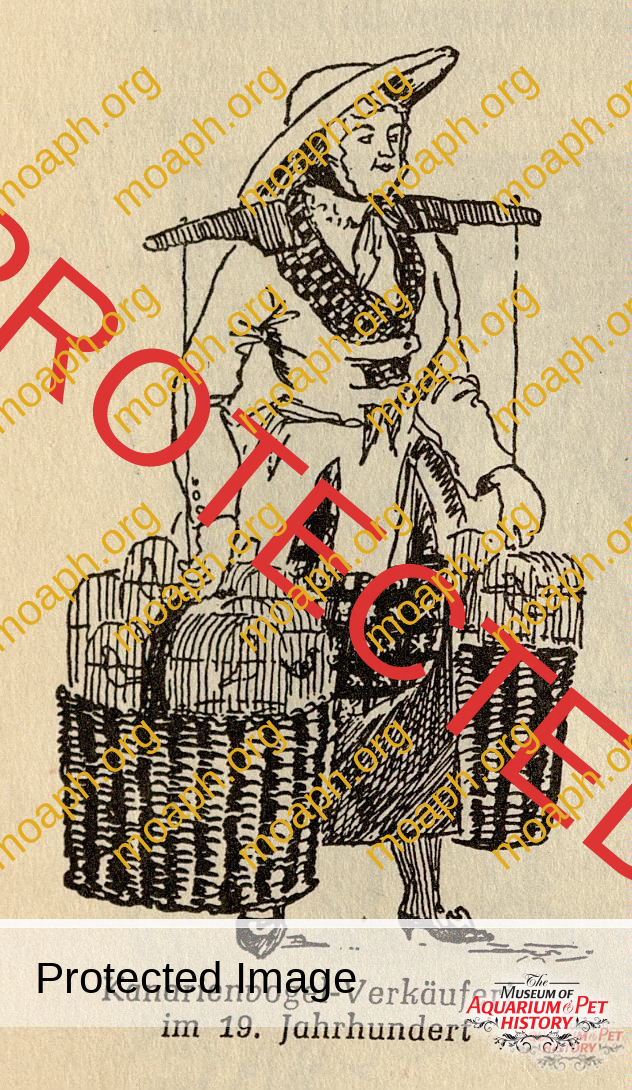
A Canary bird seller in the 1900s.
However, Ludwig Ruhe’s entrepreneurial spirit was not diminished. He soon succeeded in largely avoiding losses. Soon he organized transports to South America, especially to Chile and Peru. Usually, he traveled with three or four men, who took care of the birds. From the proceeds of the canary sales, he bought exotic birds in those countries and brought them back to Europe.
One of these trips in 1867 included his brother-in-law Hermann Müller. It was their first trip to America, which Hermann Müller unfortunately did not survive. The two men contracted typhoid fever, to which Hermann Müller fell victim. He was buried in Lima, the capital of Peru. This journey was also tough for my grandfather. Despite these sad experiences, he purchased exotic birds at every opportunity to bring them back to Europe. This, too, initially failed.
A storm drove the sailing ship, after it had already rounded South America and passed the eastern tip of Brazil, towards the northwest, through the Caribbean Sea into the Gulf of Mexico, until it—presumably by chance—reached the area of New Orleans. To finally bring his ship out of the storm, the captain steered the ship into the port.
Ludwig Ruhe, who had unexpectedly ended up here, went ashore and encountered so many European settlers who, like him, were very interested in canaries — it was so much like a piece of home for him — that he decided to open a small branch in New Orleans. He continued his journey overland to New York, only to immediately resell the birds he had purchased in South America and to buy new North American birds. With these North American birds, he returned to Europe: first Marseille, where he sold them to the firm Antonelli & Chevé. From this company, my grandfather purchased Senegal finches and sent them back to Germany. A complicated system, but he got used to thinking and acting quickly, and he decided to open a branch in New York the following year. On this trip, he took his brother-in-law August Merkel, who had married the youngest daughter of the company founder in Grünplan, and rented a store on Grand Street in midtown Manhattan.
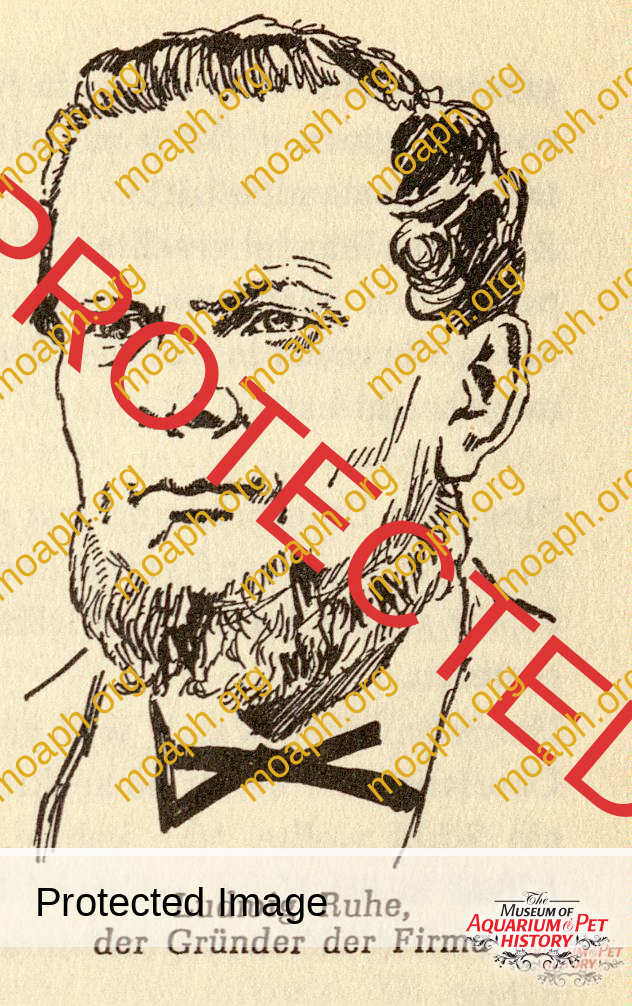
Ludwig Ruhe, the founder of the company.
Brother-in-law Merkel settled in New York with his family and stayed there for a few decades. Only at the age of sixty did he return home to settle down in Grünplan. The difficulty of transporting canaries by carriers became so tedious and time-consuming over time that Ludwig Ruhe moved to the town of Alfeld, about ten kilometers away, to be directly connected to a railway line.
At the marketplace, my grandfather bought the house where I spent my childhood: a former inn with many rooms and a hall, which he had rebuilt.
From then on, sales increased rapidly, although in the USA there was an export ban on native birds, and my grandfather had to find new return routes with his trained birds. At the same time, (it must have been around 1873) he dissolved the branch in New Orleans after several years of operation because he couldn’t find a truly reliable man to manage it faithfully.
Gradually, animals joined the bird trade: leopards, pairs of beautiful antelopes to monkeys, mandrills, and sea lions had all been acquired.
A brief interruption occurred when my grandfather died in 1883, just shy of 55 years old. But no one lost their heads. His two sons, Hermann, 22 years old, and Bernhard, 21 years old, were already actively working.
Hermann, my father, was just in the New York branch — after a crossing during which he had become seasick, he later no longer wanted to travel by ship. After returning immediately and taking over the business in Alfeld, Uncle Bernhard, who had already been living in the USA for a year, took over the management of the American branch.
My grandmother once told me: “Your father has inherited the spirit of enterprise from your grandfather, but Uncle Bernhard sometimes takes things a little too leisurely.”
Towards the end of the eighties, the competition between my father and the bird and animal trader Carl Reiche, who had already moved from Grünplan to Alfeld before us, became sharp. No wonder. “Man konnte sich bei hand in den Suppentopf schauen” (One could almost look into each other’s soup pot). They kept count of each other’s loads of canaries sent by rail and monitored each other’s bird and animal purchases.
At that time, Charly Reiche had already penetrated the animal trade more strongly than we did. He even got giraffes! Led through the middle of the small town, they caused a sensation among the citizens of Alfeld. In 1885, at the age of 55, Charly Reiche died, and his son Carl took over the business. But even Carl Reiche junior and young Hermann Ruhe gave each other no leeway.
Four years later, probably due to the personal youthful friendship of the two men, a sensible agreement was finally reached, which was met monthly and attested to the spirit of the former “royal merchants”9:
MOAPH: 9 The Royal Merchants were highly esteemed and influential traders in 12th-18th century European history. They were known for their integrity and reliability and contributed strongly to the commercial trade in Europe during that time.
Carl Reiche laid down the trade of canaries, and Hermann Ruhe laid down the trade of large animals. An exclusive trade law was agreed upon between the two competitors and adhered to by mutual agreement until the summer of 1900, as specified in the contract signed orally at the end of 1889.
Naturally, there were wild speculations about why the Reiche company gave up trading in canaries. In the magazine “St. Andreasberger Blätter für Kanarienzucht und Handel” (St. Andreasberg’s Journal for Canary Breeding and Trade) in issue No. 15 of the year 1890, it says:
“In 1885, Mr. Carl Reiche died, and in 1887, Mr. Heinrich Reiche passed away. His son, thus his cousin, the current owner Mr. C. Reiche, took over the business. However, the former had no inclination towards the canary trade, and consequently, the canary business in New York was abandoned at the end of 1889. As is well known, the company also deals significantly in animal trade and foreign birds, and this business continues under the old firm C. Reiche.”
At that time, it was likely that third parties would only benefit from the agreement made between the two major Alfeld traders if the actual situation became too well known. Therefore, it was not widely publicized.
Logically, the sales of the Reiche company in the animal trade had to be greater and thus more active, than my father’s in this respect. He still had to put much effort into his canary business to catch up to the Reiche’s.
My father now vigorously promoted the canary trade. Since 1870, there had been another branch that my grandfather had founded in London. There, Mr. Bodenstein sat as the representative of the house of Ruhe; he was one of the major buyers for specifically cheap female canaries.
There was a unique reason for why Mr.Bodenstein imported so many female canaries. In London, I believe in Whitechapel, every Sunday there was a bird market where the street peddlers sold canaries. These peddlers used a hand whistle to imitate the natural song of a canary, attracting a lot of attention from the passing crowd. Many people were convinced that they were buying a genuine singing bird and took advantage of the particularly cheap prices at these auctions.
The peddlers made good money with this trick. The fact that the bird did not sing later on, because it was actually a female, was indeed a small flaw, but not a significant one.
Most buyers had already become so accustomed to the bird that they would not have given it back themselves. Thus, there were relatively few disputes between the peddlers and their customers.
Mr. Bodenstein did not only import canaries from Alfeld for the London branch, he also sent exported English birds to Germany such as the Norwich canaries, Yorkshire canaries and the English ‘colored canaries’, which came by post via Hoek van Holland in boxes of 50 to 60 pieces to Alfeld.
Out of Belgium came the “Waterslagers,” (Belgian Waterslager). They were particularly large and very nicely formed birds however, they sang less.
All these, which first arrived in Alfeld, were then transported by train to the port and shipped to New York. In New York, the competitive struggle with the Reiche company for canaries ended. Carl Reiche had also closed his branch there after decades and devoted himself entirely to the animal trade.
In 1891, my father married. His chosen one, my mother, was named Helene Fricke, who at twenty-two years old, had astonishingly dark brown, warm eyes.
In 1893, my brother Ludwig was born, and in 1895, I was born. So far, everything was in order, except the business. My enterprising father was not content with it. He wanted to expand the company significantly.
Punctually after the expiration of the oral agreement with Carl Reiche, who had earned the nickname “Little Germany” in Alfeld due to his small stature, my father took up the animal trade business again. Extending the century-old agreement with the Alfeld competitor was not an option for him.
The business revived very quickly, and the scenes in our property on Alfeld’s market square became lively again. My father was tireless. He equipped animal collectors with cash and sent them to distant lands. The letters he received became more numerous and often bore colorful stamps and characters in foreign scripts.
There was always an increasingly busy life and activity not only in the farmyard, but also in my father’s office. Many people went in and out, including some strange visitors. Every now and then, guests — mostly customers — stayed for meals; sometimes they stayed for a few days to negotiate with my father.
When my grandmother tried to explain all these businesses, and somewhat complicated relationships to me, which I understood much better later on, I would sometimes ask something off-topic in the middle of her serious lecture, like: “Are sea lions actually predators, Grandma?”
“How do you come up with such an unusual question?” she replied, annoyed that I had interrupted her memories, which were her own life, with nonsense.
But she quickly realized that ‘history lessons’ were too much for her seven-year-old grandson and fetched me a plate of preserved lingonberries, for which I had a special likeness towards.
This mostly allowed her to diplomatically avoid answering one of my strange questions.