Chapter 12: The Most Expensive Lion of My Life – Wilde Tiere Frei Haus (Wild Animals/Free Delivery)
Translated by Alex Haro
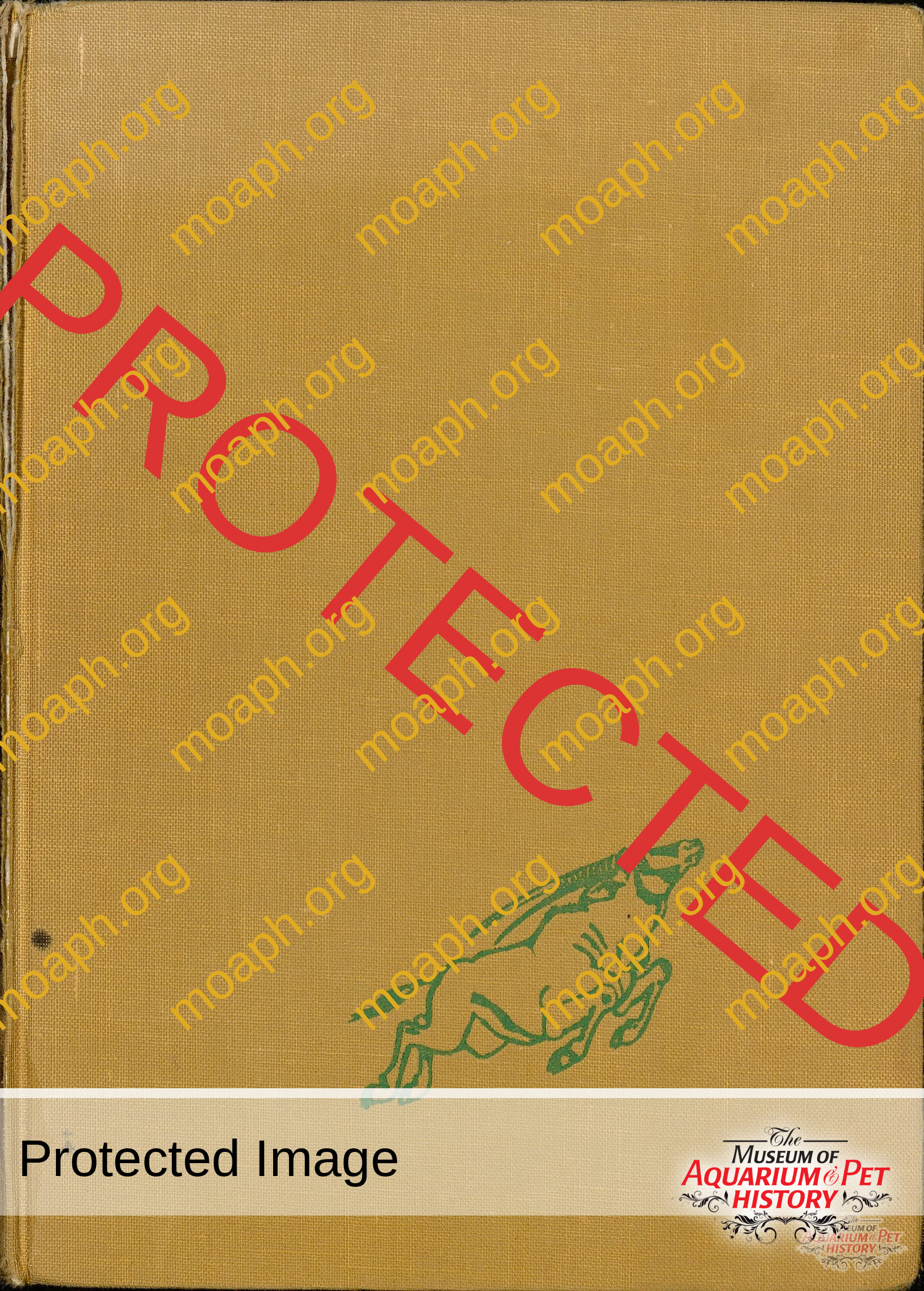
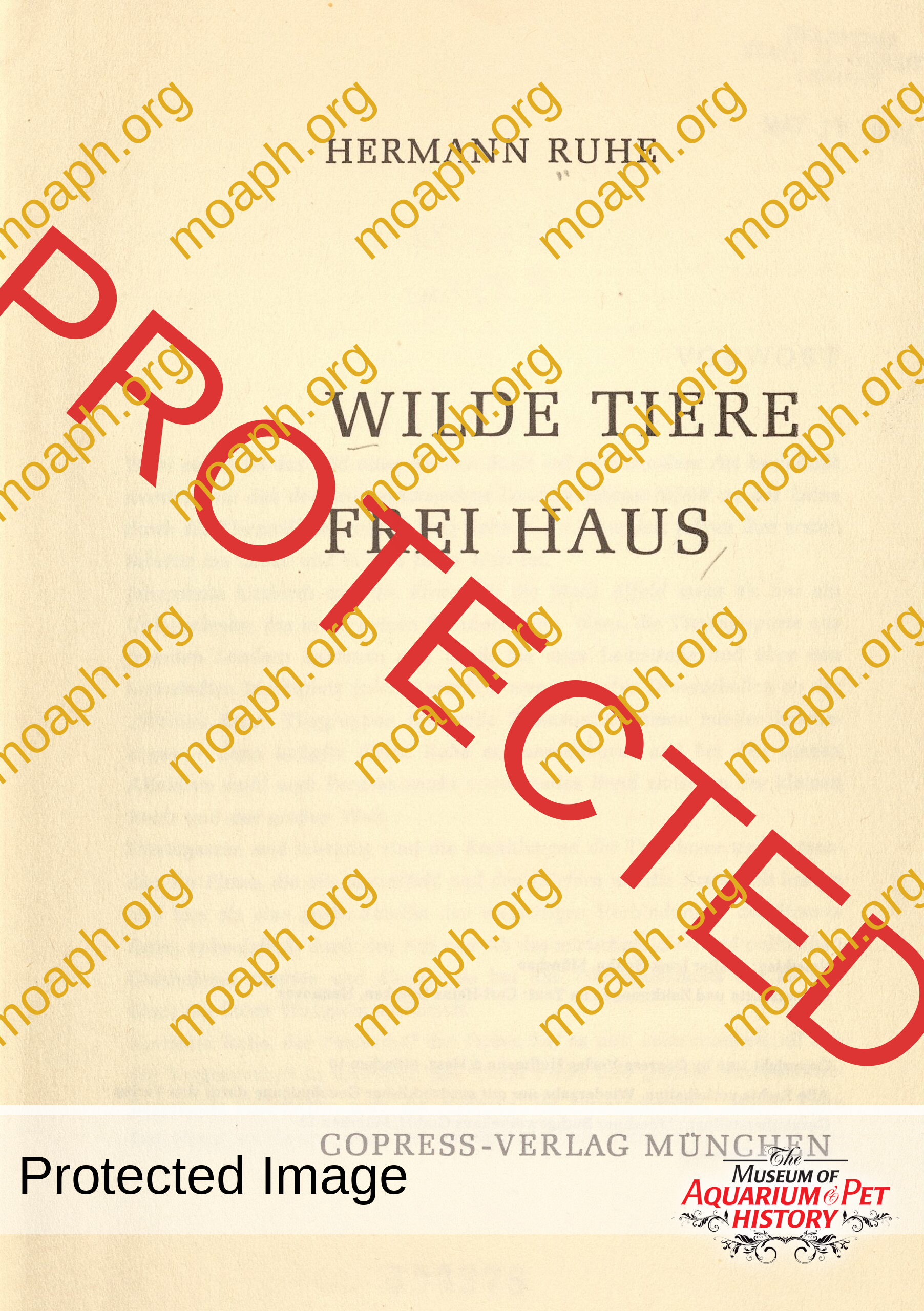
Starting in September 2024, the Museum of Aquarium and Pet History (MOAPH) will be releasing a chapter a month on the translated autobiography Wilde Tiere Frei Haus (Wild Animals Free Delivery) by Hermann Ruhe.
Firma Ruhe (the Ruhe Company) was the name of an animal trading company based in Alfeld, Germany from 1860 until its official closure in 1993. During this time, they were world renowned for their importation and exportation of exotic animals and birds from all across the globe, even supplying many zoos as well as circuses. Having survived both world wars, Firma Ruhe continued to dominate the world of animal trading until the mid-20th century and is a testament to true determination and leadership.
Wilde Tiere Frei Haus (Wild Animals Free Delivery) also documents the plethora of adventures, failures and successes endured by all those a part of Firma Ruhe. Through Hermann Ruhe’s great storytelling, we are able to visualize and understand the world from the perspective of animal collectors navigating through some of the most difficult situations, often not knowing whether or not they would ever return home. His recollections provide a vivid portrayal of the challenges and triumphs faced by the company, and give readers a glimpse into the world of animal trading.
Although the Abyssinian capture expeditions had proven to be extremely difficult, a new safari was organized at the end of the 1920s. Mr. Kreth and Dr. Havestadt went back to Abyssinia—this time for an especially large-scale capture expedition. In Addis Ababa, the necessary capture permits were also granted for a considerable number of animals.
The paperwork, as usual in Abyssinia, was endless. Once all the documents were gathered, the gentlemen, believing all potential issues had been cleared, set off on their journey. The cash that Kreth and Havestadt had taken with them for numerous possible expenses turned out to set a new record: It was 80,000 marks1!
MOAPH1: Equivalent to $328,000 today.
After much effort, the expedition succeeded in capturing a considerable number of particularly beautiful animals. So far, everything has gone wonderfully. But then a tragedy began!
On the return trip—the animals were to be loaded in Dire Daoua, as usual in Djibouti, after being acclimatized—the expedition had to pass through the district of the prince of the Galla, a particularly suspicious tribe. The prince suddenly forbade the passage through his territory and detained the camp of my expedition along with the freshly captured animals.
Uprisings were the order of the day in this area. However, what happened was not expected by Dr. Havestadt, Mr. Kreth, or any of the other companions. The Galla attacked and staged a bloody raid!
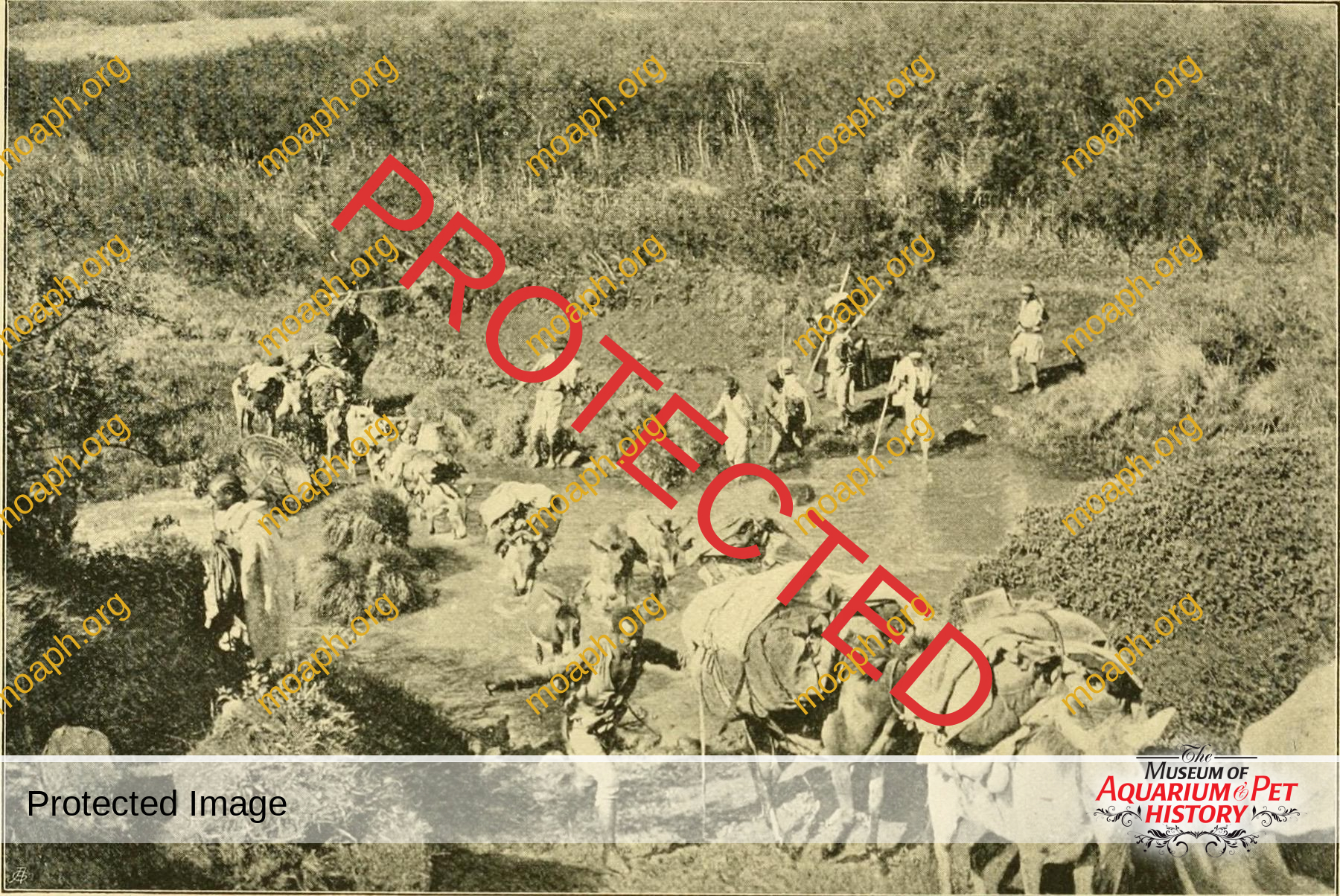
A Sporting Trip through Abyssinia by P. H. G. Powell-Cotton (1902). Wikimedia Commons, contributed by the University of Connecticut Libraries.
My travelers were in the embarrassing predicament of having to defend themselves in a foreign land, weapons in hand, and found themselves compelled to act as participants in a sort of “private war.”
So, there was only one option left to save their own skins: flight. It was no longer possible to save any of the equipment or the captured animals.
Even the government in Addis Ababa could do nothing about the already dire situation. Out of everything this journey should have yielded, what had remained, by sheer chance, was a young lion.
This was the most expensive lion I ever acquired. It cost 80,000 marks2! On top of that, it turned out that the animal was not even healthy.
MOAPH2:$359,766 today
During this unfortunate expedition, a small film was made. This film later—though only a few years later—recovered some of the losses when it was successfully sold as a cultural film3.
MOAPH3: Based on heavy research it is believed this is the film: “Im Schatten des Goldenes Lowens” (In the Shadow of the Golden Lion) by Jam Borgstadt (1934/35).
As quickly as one can make money in the animal trade, one can lose it just as fast!
Fortunately, I was able to make up for the loss in the same year, in which the business with New York achieved an absolute record turnover: I exported over 150,000 canaries!
In Cros de Cagnes, I met a gorilla and a chimpanzee, a peculiar pair, which I sold to a zoo in Chicago. The animals remained in Cros de Cagnes for a while for acclimatization. I had planned to fly them to the USA by Zeppelin.
However, that didn’t work out. Just as Eckener’s airship took off from Friedrichshafen with the apes on board, it developed an engine malfunction over France that required an emergency landing.
Basilewsky, who had brought the animals to Friedrichshafen and had followed the route of the Zeppelin, then drove by car to Cuers Pierrefeu near Toulon, where there was a French airship landing site. Indeed, the Zeppelin had already landed there.
I got quite a fright when Basilewsky arrived in Alfeld in the evening and told me that he had immediately picked up the animals and brought them back to Cros de Cagnes.
“The two are doing well,” said Basilewsky. “By the way, they seemed to be happy to see you when they arrived here again!”
But this did not solve the problem because the apes still needed to go to Chicago.
Basilewsky knew Dr. Eckener’s son, who had visited him a few times in Cros de Cagnes, and warmly envied him for his beautiful joyrides. When the Zeppelin started again, Basilewsky brought the gorilla and the chimpanzee back to Toulon. Only there did he learn that the airship would not be flying to America, but instead had to return to Friedrichshafen to replace an engine.
So Basilewsky unexpectedly had a wonderful experience: At the last moment before the departure, young Eckener pushed him into his cabin and locked him in, so as not to initially arouse the displeasure of his father, Dr. Eckener. Only when the ‘LZ 127’ was in the air was Basilewsky allowed to leave the cabin, and as a stowaway – without a passport, toothbrush, or money – he enjoyed the beautiful trip across the Alps to Friedrichshafen. The two monkeys were already back on board.
The stay in Friedrichshafen, which Basilewsky had feared would take a long time, was shorter than expected. Between Dr. Priemel, who had rushed in from the Frankfurt Zoo, and Dr. Wendnagel from the Basel Zoo, there was a competitive race: Both gentlemen wanted to settle the gorilla in their zoos; they were willing to go to the effort of waiting for a short time until the airship was airworthy again. To avoid upsetting any of the gentlemen, Basilewsky brought the apes to Alfeld and had them wait until their next journey with an airship, which would not take place until August 1929, to finally bring them to the United States.
Today, I have to say: It was a blessing that I was still so young back then! This business, with its unforeseen events, would have devoured me otherwise. So, I did the hard work absolutely cheerfully. I was so used to the variety of my daily routine that I no longer considered anything unusual, hardly any day without decisions to be made, many of which would have horrified a less experienced businessman.
The business also brought numerous travels; I especially had to travel to North America at least once or twice every year…
My little brother Heinz was in New York primarily involved in the animal trade and had become a good animal expert and impeccable salesman.
The first trips I took with him were through the United States; he also took him to a conference of American zoo directors. Heinz soon required little help; he did everything extremely skillfully, with such ease as if he had been in the animal trade for decades. His incredible agility sometimes made me feel a bit envious. He would have been a born diplomat!
I was happy that there was someone in New York who was not only interested in canaries, like my uncle Bernhard had been. Heinz developed an initiative that applied the highest bid principle to the animal trade.
Now, the telegrams from New York no longer said, as they did from Uncle Bernhard: “Wait for us” but rather “Where are you…?”
So, I had to urgently send out a new, large journey to Africa for restocking. This time, I decided to send Mr. Kreth on a new great journey: This time to Chad.
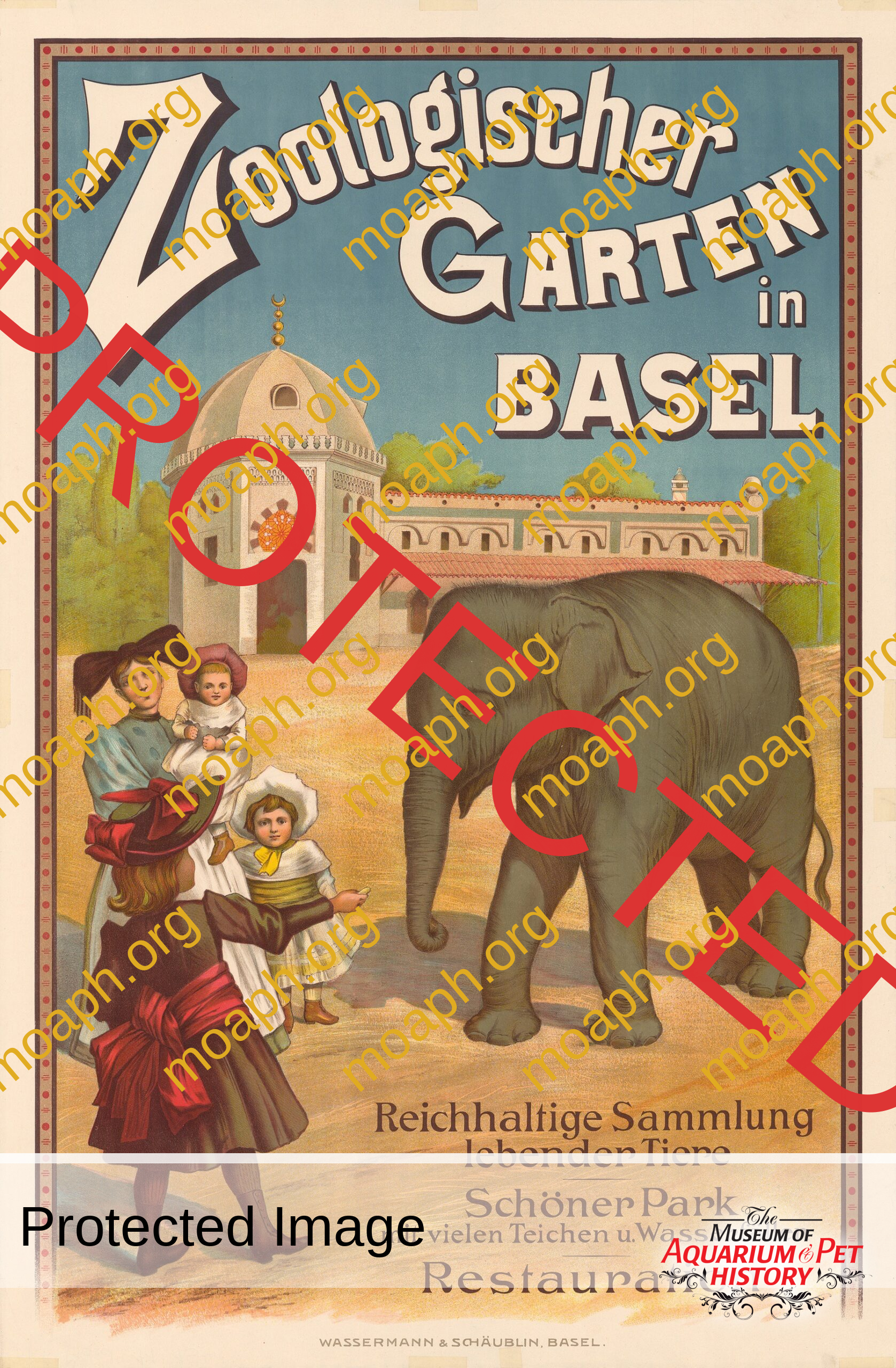
Basel Zoo (Switzerland) flyer: “Basel Zoo- Extensive Collection of Living Animals-Beautiful Park with many Ponds and Waterfalls-Restaurant”. Emil Beurmann (1900). Wikimedia Commons. Public domain.’
As a German, Kreth received the necessary exit permits from the formerly German territories in Africa, while Kreth acted as the expert for my company and the unofficial leader of the expedition. In the autumn of 1929, catching nets and equipment, tents, provisions, and other tropical equipment were loaded onto a truck in Alfeld, which was taken to Africa.
On the journey to Hamburg, the truck had an accident in Pattensen near Hanover, and a resident of the small town of Pattensen became a victim under very unfortunate circumstances.
After completing the sad formalities, the truck continued its journey to Hamburg, where it was loaded onto a ship to Duala, along with the expedition participants.
From Duala, the expedition traversed Cameroon eastward to Bangui on the Chari River. The accompanying truck soon broke down due to a broken axle and was sold on the spot; the second truck, which had been shown in Africa, held up much longer. But soon, the expedition had to return, and the luggage had to be transported by porters and draft animals to Fort Lamy and then to the southern end of Lake Chad. This was not so easy. Each participant’s luggage consisted of one Cubic meter of boxes with canned food, some weapons, and ammunition.
Additionally, Kreth brought along 150 crates of condensed milk for the nourishment of the animals to be captured and 20 crates of baby food, along with the necessary medications for humans and animals.
As long as Kreth and Démanche stayed in their respective capture camps, they had to hold regular consultation hours almost daily, as the widespread opinion was that every white person was a doctor. In the morning, they found a gathering of patients to whom they offered help wherever possible. During this time, Kreth realized that condensed milk and baby food were considered coveted trading items by the locals, even more than chicken, sheep, or goats.
When he received the first reports after many weeks, the expedition was already deeply engrossed in the capture work despite the many difficulties and numerous “incidents” that had occurred.
With the help of some eager Salamat Arabs4, 14 young elephants, 20 buffaloes, a few rhinoceroses, and seven giraffes were captured, along with a number of beautiful antelopes.
MOAPH4: An Arab descendant peoples found in Chad, Africa.
A problem of a special kind was the care of the freshly caught young elephants. As with motherless babies, the question arose of what such a young animal could consume after being separated from its mother.
Initially, Kreth tried diluted milk, similar to what is used for giraffes. But not all animals tolerated it well; it happened that one or another baby elephant got diarrhea—which is a serious condition for such a young animal.
Kreth, who had not yet cared for such young African elephants despite his many years of experience, thought that it had to be similar to raising a young child and tried feeding them oat gruel. As it turned out, this was the right approach, and the animals soon got used to it.
It was not so easy to build the necessary transport crates. A number of locals had to cut down trees and saw the logs into planks before any nails could even be driven in.
When the crates were finally ready, the retreat began, initially along the Chari River and then to Batangafo, which took 24 days. From here, the journey continued with 15 cars across the watershed of the Chari and Ubangi rivers to Bangui, where they were loaded onto a Congo steamer in two parts to Kinshasa, a little above the Congo Falls. The onward transport was by rail in two days to Matadi on the lower Congo, to the coast.
Mr. Katzenstein, who had already worked with my father, once again offered me a magnificent transport that he had put together at his collecting camp in South Africa: some rhinos, as well as zebras, antelopes, and rare birds—a fine selection of animals, which I naturally bought.
Carl Darnedde and Carl Eiffert ensured the supply of giraffes and further South African antelopes.
From Abyssinia, Carl Steininger returned to the Alfeldia camp from Dire Daoua, this time under many precautionary measures, having prepared a transport that included giraffes, oryx antelopes, small kudu antelopes, gray gazelles, giraffe gazelles, aardvarks, hamadryas baboons, and many types of splendid Abyssinian glossy starlings.
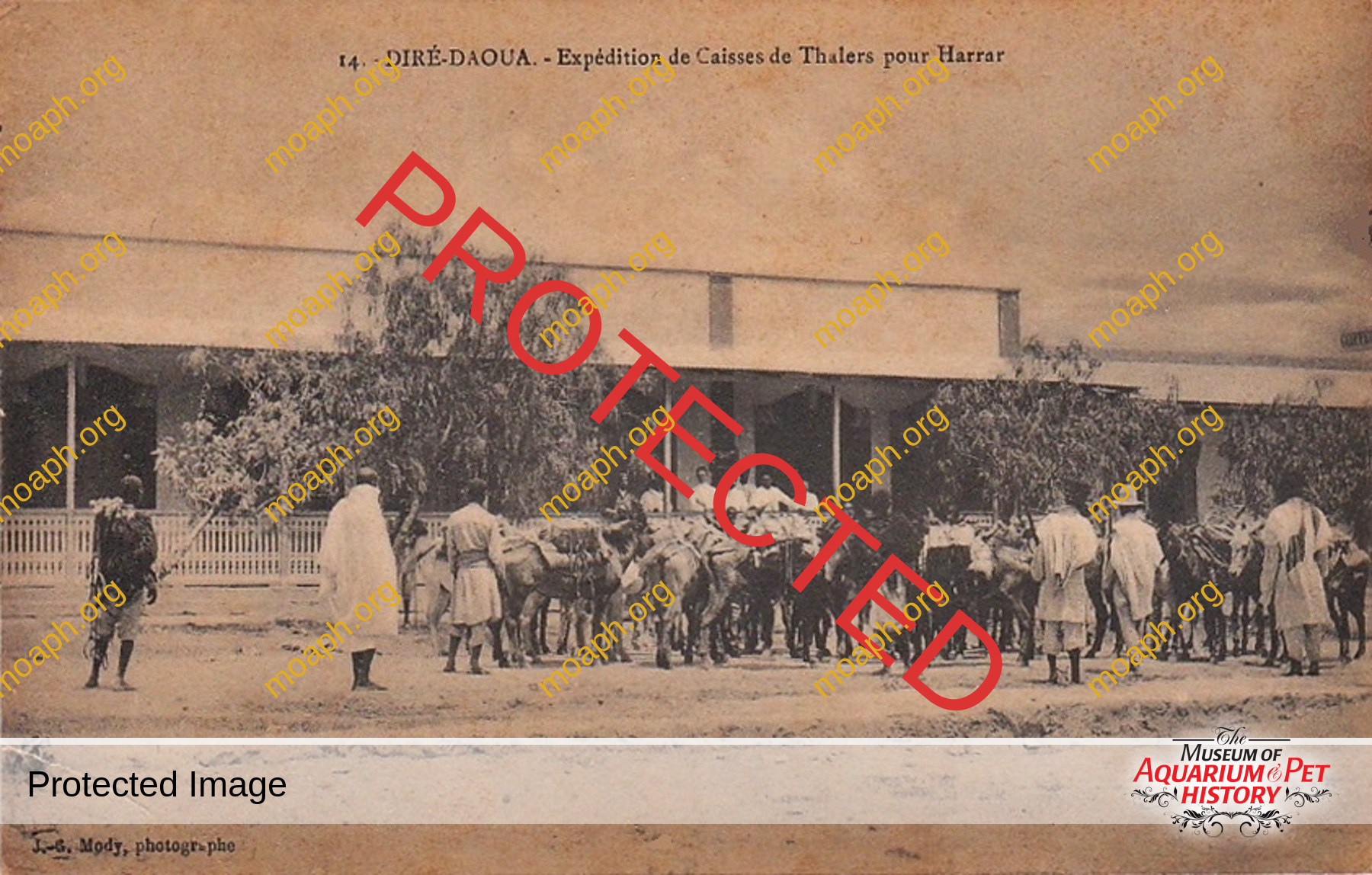
Shipment of thalers, Dire Daoua, circa 1908–1910. Postcard showing crates of Maria Theresa thalers being prepared for shipment by donkeys from Dire Dawa to Harrar. J.G. Mody. Wikimedia Commons. Public domain.
The Dutchman Albert Meems also undertook some new expeditions after India. He repeatedly brought back considerable quantities of beautiful animals: Indian elephants, Bengal tigers, antelopes, monkeys, snakes, and entire bird collections.
Karl Heck, who after his return from Africa undertook new excursions to Siam, Sumatra, and Java, to the cities of Bangkok, Palembang, Jakarta, Surabaya, and bought elephants, tigers, orangutans, gibbons, and other ape species as well as rare birds.
Otto Gräber, another one of my animal collectors, was also on the move. From Southwest Africa, where he chose Swakopmund5 and Walvis Bay6 as collection points, he transported eland antelopes, blue bucks, rare birds, and spectacled penguins (which can be kept better in zoos than Magellan penguins) to Alfeld.
MOAPH5: A town in Namibia
MOAPH6: A town in Namibia
Alfeld, New York, and Cros de Cagnes had no delivery difficulties. In the zoo park on the Riviera stood hippopotamuses, giraffes, young elephants, and also South American animals of many kinds.
I was constantly busy fulfilling all the wishes brought to the company by my clientele.
A new employee joined me: Mr. Waldvogel, who came to Alfeld from the school desk at just 20 years old, initially took over the position of my chief accountant. Although he had moved over to the animal trade from a completely different field, he worked so quickly that I did not hesitate to grant him power of attorney soon afterward.
Mr. Darnedde senior, having retired after his busy working life, had returned to his rest.
A significant task was entrusted to me: to participate in the design of the Zurich Zoo. It increasingly became necessary to submit models and proposals for the expansion or conversion of European zoos. A well-known architect and Director Aulmann from the Düsseldorf Zoo actively supported me in the planning. When the buildings of the Zurich Zoo were ready, I supplied the animals needed!
At the same time, my long-prepared “Show of the 1,000 Alligators” was finished, in which the Munich showman Gabriel was initially involved.
Gabriel was one of Germany’s most famous animal showmen and alligator owners. Later, he also owned some cinemas—as long as he lived, he remained loyal to his exhibitions at the Munich Oktoberfest. The Hippodrome7 belonged to him; there, he presented his large show every year. I often worked with him. I can vividly remember when a so-called “flap show” was performed with him and later in our show, the “Show of the 1,000 Alligators.” Gabriel introduced a sea elephant named “Goliath” at the Oktoberfest.
MOAPH7: A theater or performance venue
At the end of October, Gabriel paid a financial share—he had signed up for “1,000 alligators” and transferred the show exclusively to zoos for display. The particularly large reptiles were truly something special. It was not the “Show of the 1,000 Alligators” but amazingly the “Show of 2,000 Alligators”!
To house them over the winter in Cros de Cagnes, a very large heated pool was created in the open air. Moving the alligator show and transporting it from one exhibition site to another was no easy task. It is extremely difficult to get 1,000 sluggish, biting, and tail-wagging beasts into transport crates. The guards from Cros de Cagnes had, after the second winter stay, figured out how to almost effortlessly manage the packaging.
In spring, when I visited Cros de Cagnes, I met Dr. Lutz Heck and a number of rare antelopes in our acclimatization park. Dr. Heck wanted the animals, which did not thrive well in the Berlin climate, to take a “summer cure” with us, which was good for them.
When Dr. Lutz Heck from Berlin visited Cros de Cagnes again, he had become quite good friends with George Basilewsky and me—an opportunity arose to tease him thoroughly.
As the director of Germany’s largest zoo, he naturally wanted to be the first to inspect and be offered the best animals. Although he knew full well that Basilewsky was affiliated with my firm, he repeatedly tried to take advantage of Basilewsky’s personal connections in Marseille to buy animals “without Ruhe”. As a result, there were sometimes playful exchanges between us.
One morning, a telegram from Marseille arrived for me in Cros de Cagnes: “Offering a tapir for 1,800 marks – Chevé.”
“Now we can really have some fun with him,” I said to Basilewsky, and with thin pencil strokes, I changed the word “tapir” to “okapi” and the “1,800 marks” to “18,000 marks.” Lutz Heck, who had noticed the arrival of the telegram, soon came into the office.
We placed the telegram in such a way that he could read it from a distance. Basilewsky and I exchanged covert smiles as Lutz Heck craned his neck, suddenly became restless, and couldn’t hide his apparent excitement.
“Is something special happening?” he asked innocently.
“Something very special!” I said. “An okapi will arrive in Marseille tomorrow. We’ll have to go there.”
“I’ll come with you!” Dr. Heck immediately said. “Hold on,” I said. “They’re asking for 18,000 marks!”
“That’s an outrageously high price,” Heck replied, “but we’ll figure something out.”
I noticed that Basilewsky was beginning to feel uneasy. However, we let our Berlin friend dangle until just half an hour before departure to Marseille. Only then did I reveal to him that it had unfortunately been a mistake—the okapi was just a tapir.
“You scoundrel!” Lutz Heck cursed, but then he had to laugh, and we celebrated the prank together that evening with a good bottle of wine.
Despite everything, Lutz Heck was understandably disappointed. An okapi was a great rarity at the time, and the only specimen of this species, native to the Belgian Congo, could be found in the Antwerp Zoo.