Chapter 22 – The Punctual Zebra – Wilde Tiere Frei Haus (Wild Animals/Free Delivery)
Translated by Alex Haro
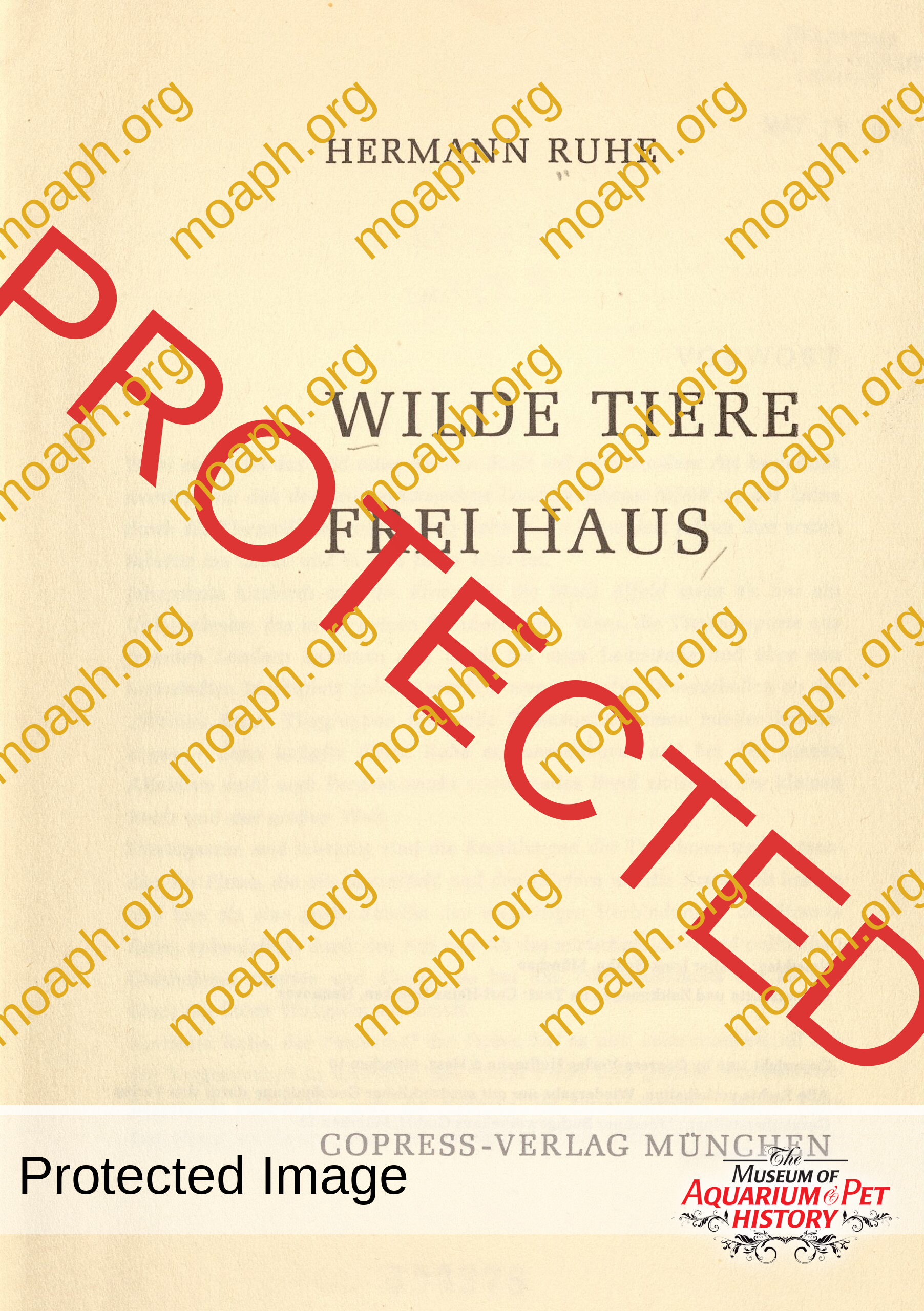
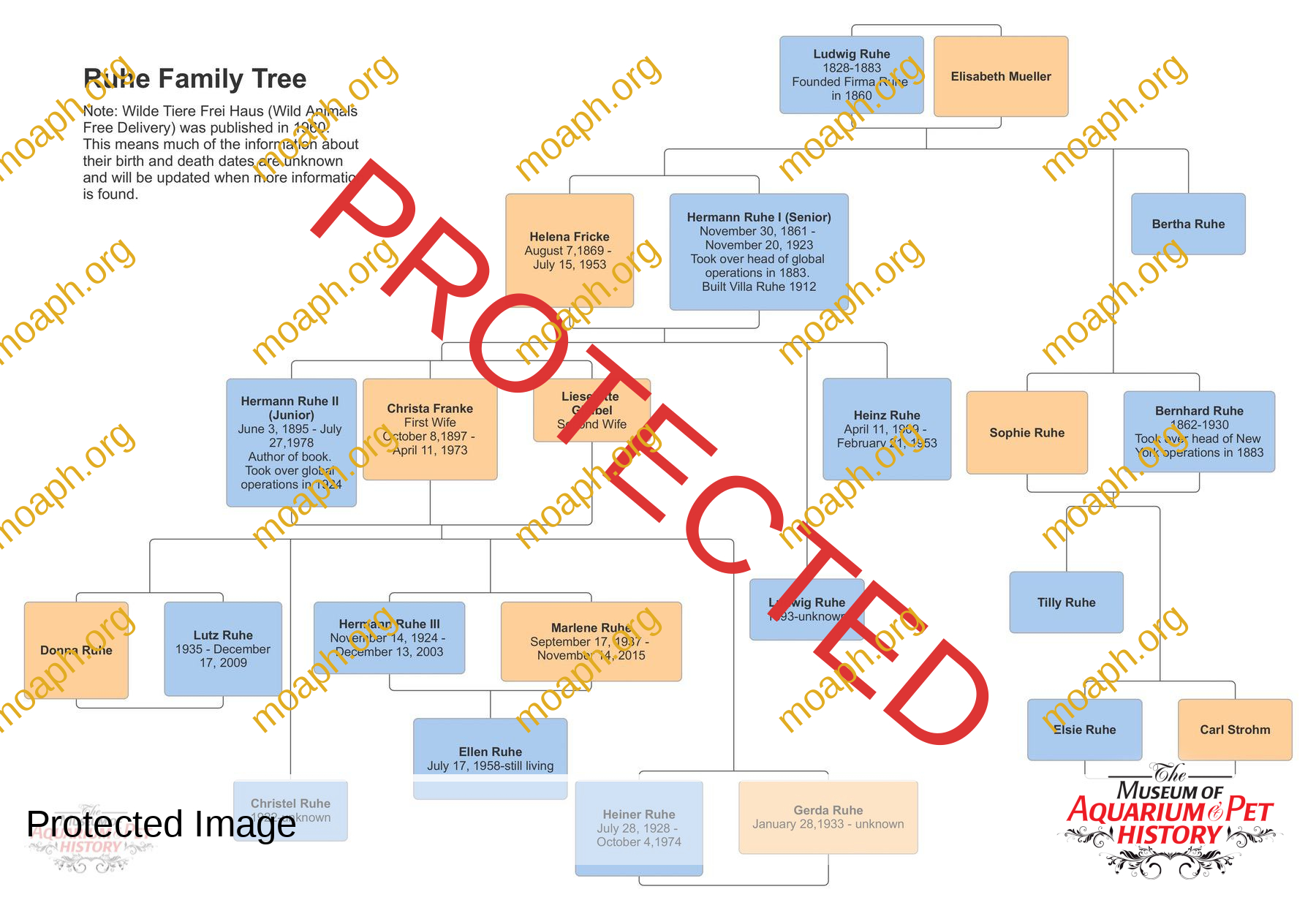
Starting in September 2024, the Museum of Aquarium and Pet History (MOAPH) started releasing a chapter a month on the translated autobiography Wilde Tiere Frei Haus (Wild Animals Free Delivery) by Hermann Ruhe.
Firma Ruhe (the Ruhe Company) was the name of an animal trading company based in Alfeld, Germany from 1860 until its official closure in 1993. During this time, they were world renowned for their importation and exportation of exotic animals and birds from all across the globe, even supplying many zoos as well as circuses. Having survived both world wars, Firma Ruhe continued to dominate the world of animal trading until the mid-20th century and is a testament to true determination and leadership.
Wilde Tiere Frei Haus (Wild Animals Free Delivery) also documents the plethora of adventures, failures and successes endured by all those a part of Firma Ruhe. Through Hermann Ruhe’s great storytelling, we are able to visualize and understand the world from the perspective of animal collectors navigating through some of the most difficult situations, often not knowing whether or not they would ever return home. His recollections provide a vivid portrayal of the challenges and triumphs faced by the company, and give readers a glimpse into the world of animal trading.
In 1956, I unfortunately lost a loyal employee: Dr. Steinmetz, the director of the ‘Ruhr Zoo’ in Gelsenkirchen, passed away. After trying out a few experiments with new employees, which failed, Alfred Glenewinkel himself took over the management of the zoo.
It wasn’t until the fall of 1956 that we were able to deliver the white rhinoceroses, captured in Sudan the previous spring and waiting for transport in Arusha, to St. Louis. The construction of the building where the animals were to be housed had been delayed for a year and a half! The animals had grown and had to be moved into the heaviest transport crates we had ever built in Arusha.
My eldest son and Anne, my daughter-in-law, brought this transport to the USA. The crossing was particularly bad; Anne experienced the Atlantic at its worst – with storms and rough seas. People and animals, everything on deck, often stood up to their waists in water from the waves crashing over the ship. Nevertheless, the transport arrived safely in America.
There was much to do in Arusha, New York, Alfeld, Gelsenkirchen, and Hannover. Questions and inquiries, buying, selling, and exchanging animals, construction in the zoos – all this filled the days from morning until night.
I had already passed my 60th birthday, and the non-stop work no longer came as easily to me as it did in earlier times.
Sometimes I wondered how quickly the many years had passed since I had been fooling around with the goldfish bowl’s water hose at the Alfeld marketplace. After the extensive work schedule of this year, it was quite a welcome change when I received a letter from our old friend David Hall in Addis Ababa:
“The Negus1 intends to establish a zoo. A visit would be highly recommended!”
MOAPH1: Meaning ‘King’ in Ethiopian Semitic languages
It was already my intention to get the Abyssinian business up and running again, as the transformation of the government there had made everything quite difficult. Strict veterinary regulations had come into force, and one now had to specifically apply for export permits. For a long time, I had not been able to obtain any animals from Ethiopia.
I combined the upcoming business opportunity with the much-needed relaxation and set off with my wife. The Suez Crisis was in full swing, but we made a stopover in Cairo to finalize a deal with the Giza Zoo, and then in Khartoum to pay some courtesy visits. I wanted to personally thank some government representatives in Sudan again for granting us the capture permit for the white rhinoceroses.
We then continued our flight to Addis Ababa, where we were welcomed by Undersecretary Hall. In the past, he had delivered our gifts to the Negus, such as Barsois and Great Danes, and in return, we had received beautiful Guereza monkey pelts as a gift from the emperor.
The Negus was on a foreign visit, but he had already discussed everything related to the planned zoo with his second son, the Duke of Harrar. The Duke received me in a two-hour audience, during which I learned more details about the project.
The Negus wanted to establish the planned facility as a private zoo. The necessary land was to be provided by the Empress. The Negus planned to take two years to complete the construction of the facilities and to equip the new zoo with animals from Europe, Asia, Africa, and South America.
In return, my company was to be granted permission to maintain a quarantine station in the new zoo for animals to be exported from Ethiopia free of charge. The personnel for this station was to be provided by Firma Ruhe; in the meantime, a few Somalis would be sent to Germany to receive thorough training at our two zoos.
After we had agreed that I would draft a contract proposal, I was already filled with enthusiasm for the new task, envisioning myself spending half a year working in Addis Ababa.
After completing the discussions and gathering as much detailed information as possible, we traveled by plane to Nairobi. The Tanganyika Game Ltd. farm near Arusha had developed into an exemplary facility since our last visit.
A few days after our arrival, we went on an elephant hunt with Willy de Beer. A number of dogs took part in the safari. The plan was for the dogs to distract the mother elephant once a young calf had been separated from her, so she wouldn’t be able to focus on what was happening to her calf.
Baby elephants tend to run directly under the belly of the mother. If the chase becomes too fast or the mother has to change direction, it can happen that she loses her calf at a full gallop. The baby will stand there, confused, and before the mother realizes what has happened, the calf is supposed to be caught with a lasso. Meanwhile, the dogs are supposed to stay with the mother, barking loudly to distract her and lead her away from the capture scene. Only once the calf is safely in the crate can the dogs be called back.
However, it often happens that the mother elephant chases after the captured vehicles and launches a full-scale attack at night to free her baby from the crate, which she can easily break apart with a single blow. There have even been instances where cars were seriously damaged during such attacks.
This time, things almost went wrong! After separating a young elephant from the herd and loading it into the capture crate, the mother immediately became angry and attacked the truck on which the crate was placed. Before the truck could even start moving, the elephant tried to sit on the flatbed, crushing it in an attempt to free her calf.
Animal catcher Piet, who had previously broken his collarbone while capturing the white rhinoceroses in Sudan and was a man with no nerves, was standing on the flatbed. As the mother elephant attempted to sit, he calmly plucked two tail hairs from her without flinching!
“Good heavens – are you crazy?” asked Willy de Beer, as we sped away at high speed, looking back.
“Why?” Piet asked with a laugh, triumphantly holding up the tail hairs, which the locals use to make lucky charm bracelets.
“I’ve never seen anything like that in my life,” Willy de Beer said to me.
“The boy has nerves of steel! But he’ll only do that until something goes wrong one day!”
As dangerous as the situation had seemed at first, I was thrilled to have experienced such an attack scene up close. However, this excitement was immediately overshadowed when an airmail letter from New York arrived at the farm with terrible news.
Lutz had brought a transport there. The ship had arrived Friday evening, but the cargo was not unloaded. Since the weekend break was strictly observed, the animals remained on the ship on Saturday, and Lutz went to the harbor again in the morning with Dr. Roth to take care of them.
The animals were not housed on deck but were loaded one level down, next to a row of cars. It was dark down there, and a spotlight had to be turned on to allow for feeding. The glaring light shone directly into Lutz’s eyes as he approached the animal crates.
What Lutz didn’t know was that the cars had been the only things unloaded on Friday night. Blinded by the spotlight, he misjudged the distance and fell three meters through an open hatch into the cargo hold below, landing unfortunately on the edge of a crate, hitting his back.
Dr. Roth, alerted by the short cry from my son, could do nothing but carefully lay the unconscious boy down and call for help. Lutz was immediately taken to the hospital on a stretcher, where a specialist determined, thankfully, that it wasn’t a spinal fracture, as initially feared. However—though this was bad enough—two vertebrae were fractured, and Lutz had to be encased in a cast.
The report that followed from New York two days later sounded a bit more hopeful. While there was no longer a threat to his life, it was still unclear whether Lutz would fully recover without any lasting damage.
We were only able to breathe a sigh of relief when the news came that, based on the healing process, caution would be necessary for a few years—but my son would make a full recovery!
Only then could we think about continuing our journey.
We continued our journey by flying to South Africa, where Mr. Katzenstein and Ernst Voss had previously worked. The zoos in Johannesburg and Pretoria, which we visited, offered something unusually beautiful: the abundance of flowers that filled the enclosures with such vibrant colors that one could almost overlook the animals living in large outdoor enclosures without buildings because of the magnificent blooms.
For the first time in many years, I saw Burchell’s zebras again, which are considered nearly extinct. They now live only in limited numbers in certain wildlife reserves. Their front legs are pure white and show no stripes. There were also mountain zebras, which have long disappeared from international trade, as well as entire collections of beautiful antelopes, hartebeests, and large kudus.
We had already encountered bad weather on the flight from Nairobi to South Africa, but the four-hour flight to Windhoek that we then took was even worse, despite departing at noon in bright sunshine. The shimmering heat over the rocky deserts and steppes caused such turbulence that at times we feared the wings wouldn’t withstand the shaking.
In Windhoek, we visited the son of our old friend Mätje, who, along with his brother-in-law Mr. Benson—whom I knew from the Hanover Hockey Club—owned a large department store. These two gentlemen helped us establish new connections, but the animal trade was too foreign for them. Furthermore, the situation had changed so much compared to earlier times that I was, unfortunately, unable to achieve much.
During a car tour into the interior of the country, we witnessed a tragic reality of the animal world. Massive kudu antelopes, weakened by weeks of absolute drought, were caught in the wires of low fences because they no longer had the strength to make the small jump needed to get over the fences due to their thirst. What would have been an effortless jump in the wet season now led to the agonizing death of these beautiful animals in the drought. It was a sad sight for me to see.
However, I did manage to secure one successful purchase. We visited the old animal catcher Christoff Schulze, who had previously managed the Hagenbeck farm in Tanganyika. The reunion was joyous, and Christoff Schulze promised me a delivery of several antelopes and zebras.
We planned to travel from Durban to Europe by ship. However, we could have spared ourselves the flight to Durban, because by that time, the Suez Canal had been completely closed to traffic, and the ship we boarded in Durban had to sail around the Cape and all the way up the West African coast!
The steamer, which would normally have sailed north along the East African coast, had already carried many animal transports on board—including ones from my company. During the long voyage, the loading officer, with whom I had plenty of time to chat, shared an interesting story with me:
On one of their trips, several animal transport crates were placed side by side on the forward deck, covered with a tarp but in such a way that the rear and front sides of the crates remained uncovered.
One of the zebras had a strange habit that puzzled both the transport attendants and the crew. Every afternoon, around 4:30 PM, the animal would suddenly start kicking and would pound its hooves against the rear planks of its crate until they splintered. The slats were replaced; the back one was moved to the front, and the front one to the back.
The next day, at about the same time, the zebra started up again, kicking until the rear panel was once more broken. Since there were no more slats to replace, one of the men hastily reinforced the crate with a few extra boards.
On the third day, around tea time—again around 4:30 PM—the sound of the zebra’s kicking, bum-bum-bum-bum, echoed across the forward deck once more. The situation began to seem mysterious. Why didn’t the zebra kick in the morning, at noon, or even later in the evening? Why only between 4 and 5 PM?
The transport attendants decided to stake out the scene the following day to figure out what might be going on. Nothing happened—until about 4:30 PM. At that moment, the shadow of a strap dangling from the tarp began to fall on the zebra’s hindquarters. The animal turned its head angrily, looking back, whinnied nervously, and started again at the dancing shadow on the back of its crate—and then started kicking!
One of the sailors pulled out his pocket knife, cut off the dangling piece of the strap, and—immediately—the zebra calmed down and was completely at ease!
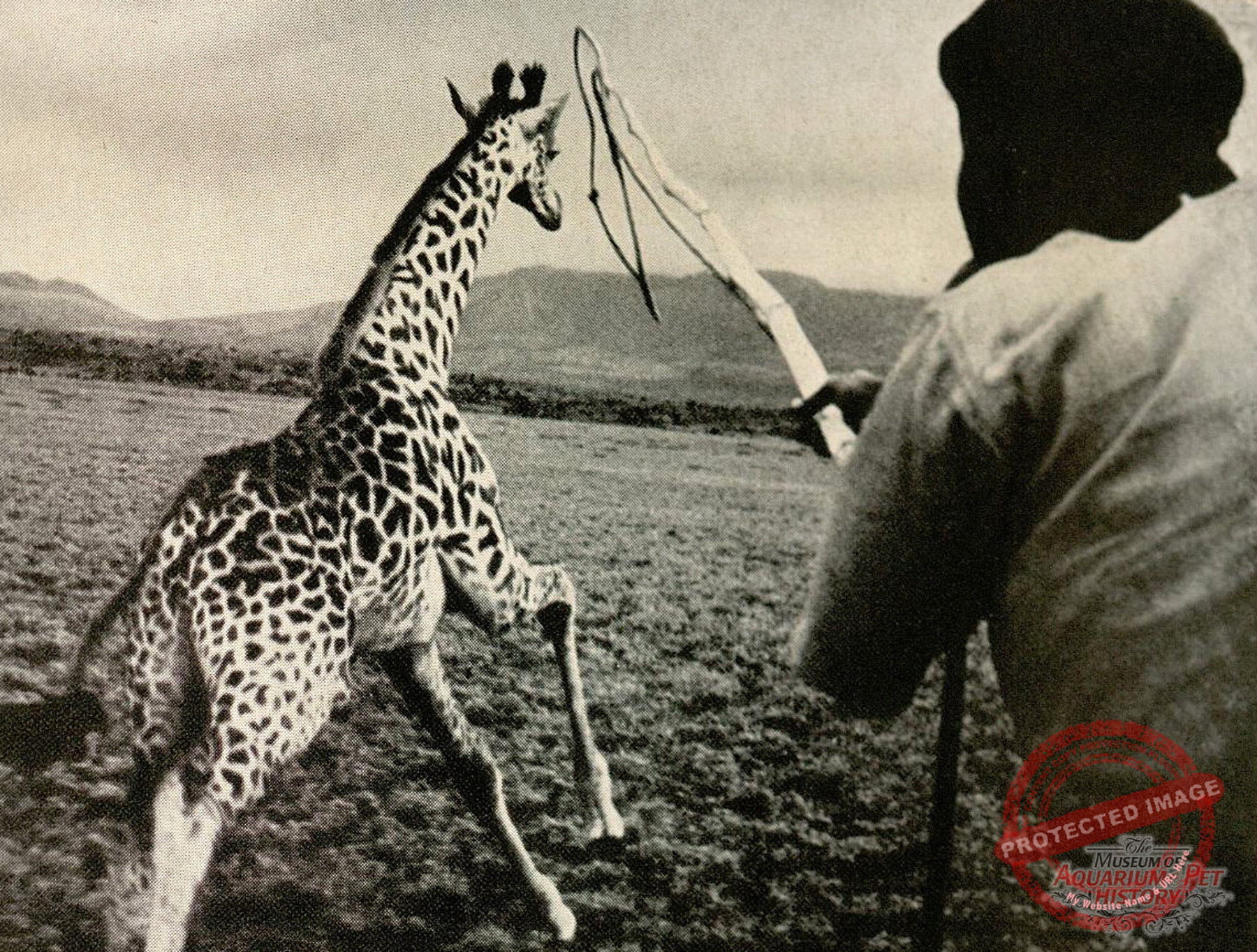
Capturing giraffes in the savanna. The catcher, strapped into a seat riveted onto the left fender of the capture vehicle, has extended the bamboo pole and aims at the giraffe’s head—a picture taken at about 70 km/h.
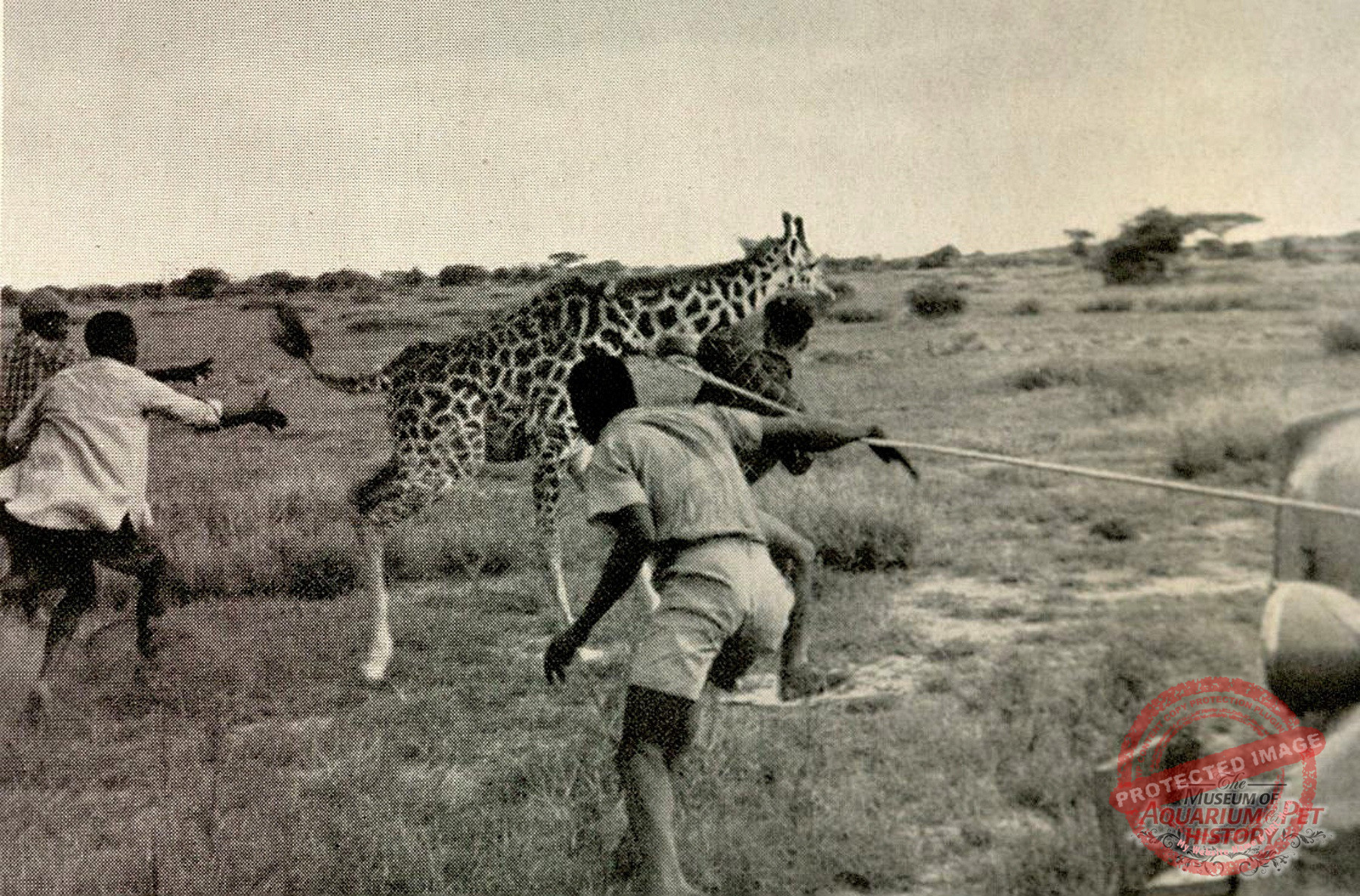
The capture vehicle has slowed down the giraffe, which now comes to a stop but must be restrained immediately. First, the tail must be grabbed and pulled down, as the animal would otherwise lash out dangerously.
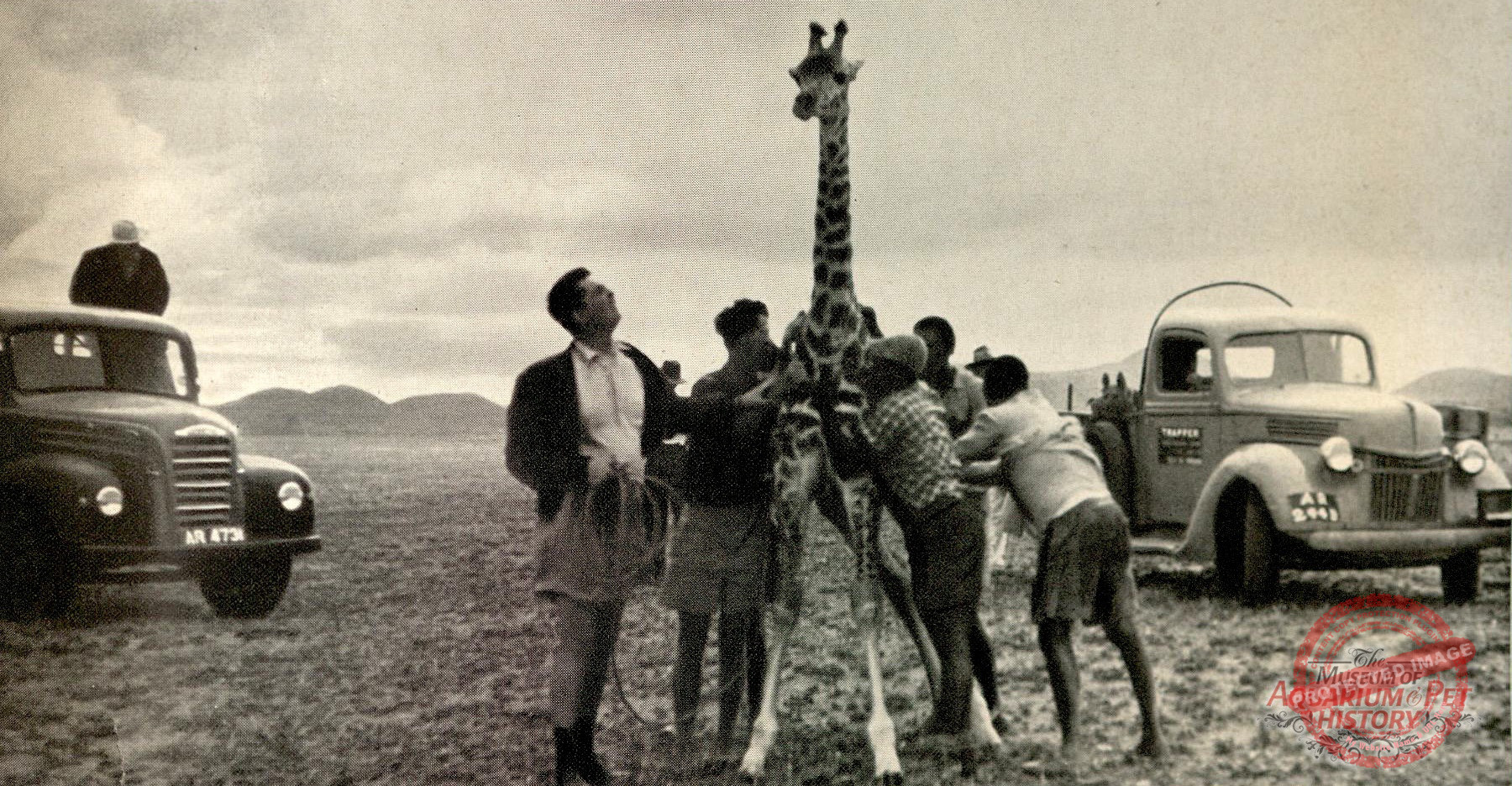
One person holds the giraffe’s tail, while the others quickly secure the noose, but they must hold the animal firmly until the tranquilizer bucket is brought and the fieldwork can begin. To the left of the animal, with white gloves, is Lutz Ruhe; the author stood below by the truck.
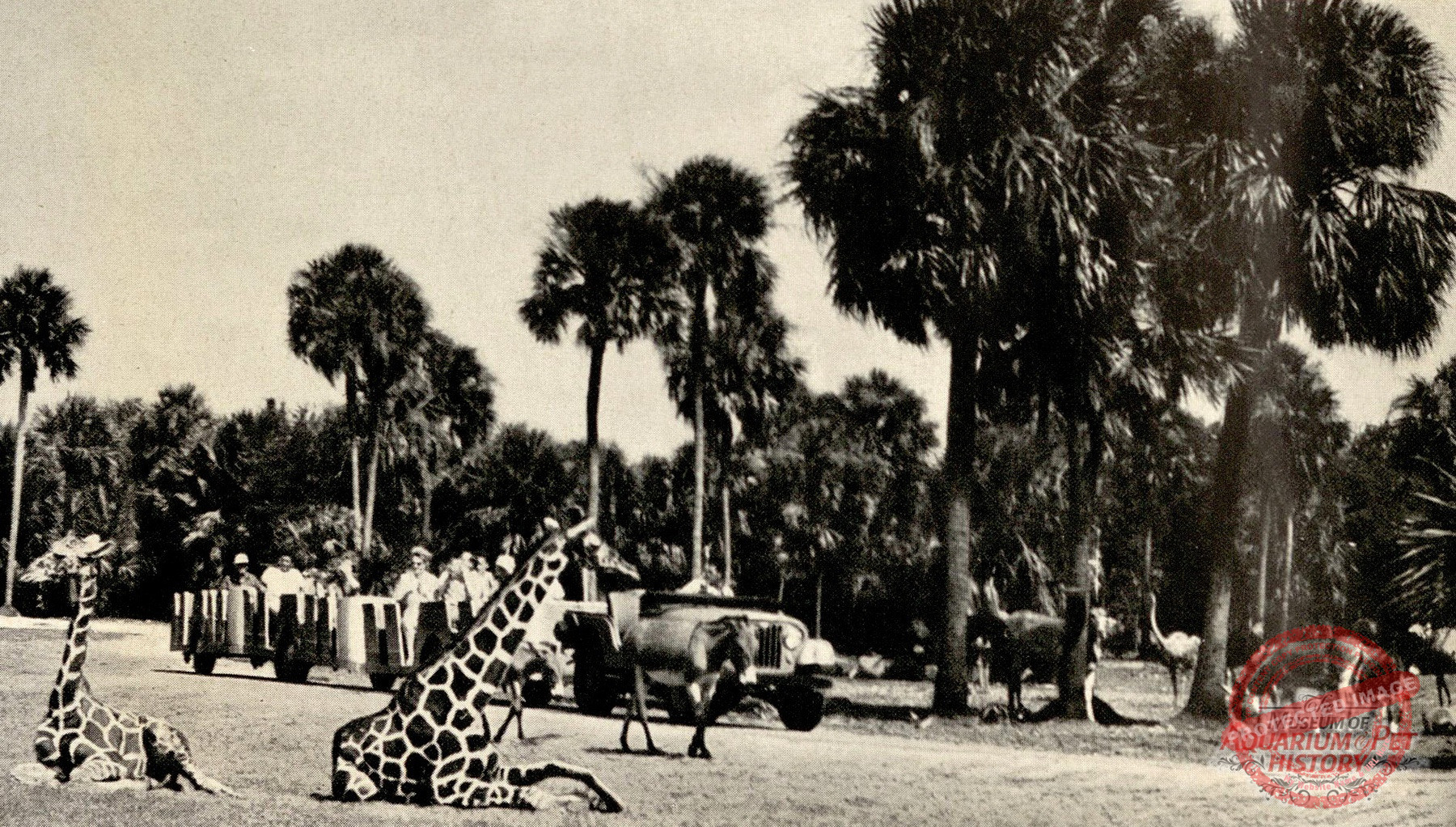
Socrates and two other giraffes were sold to Colorado Springs. The remaining 14 animals found a new home in the vast wildlife park ‘Africa in USA’ in Florida. The animals live peacefully together, separated by no fences, and one seriously wonders whether the people are observing the animals or the animals are observing the people.
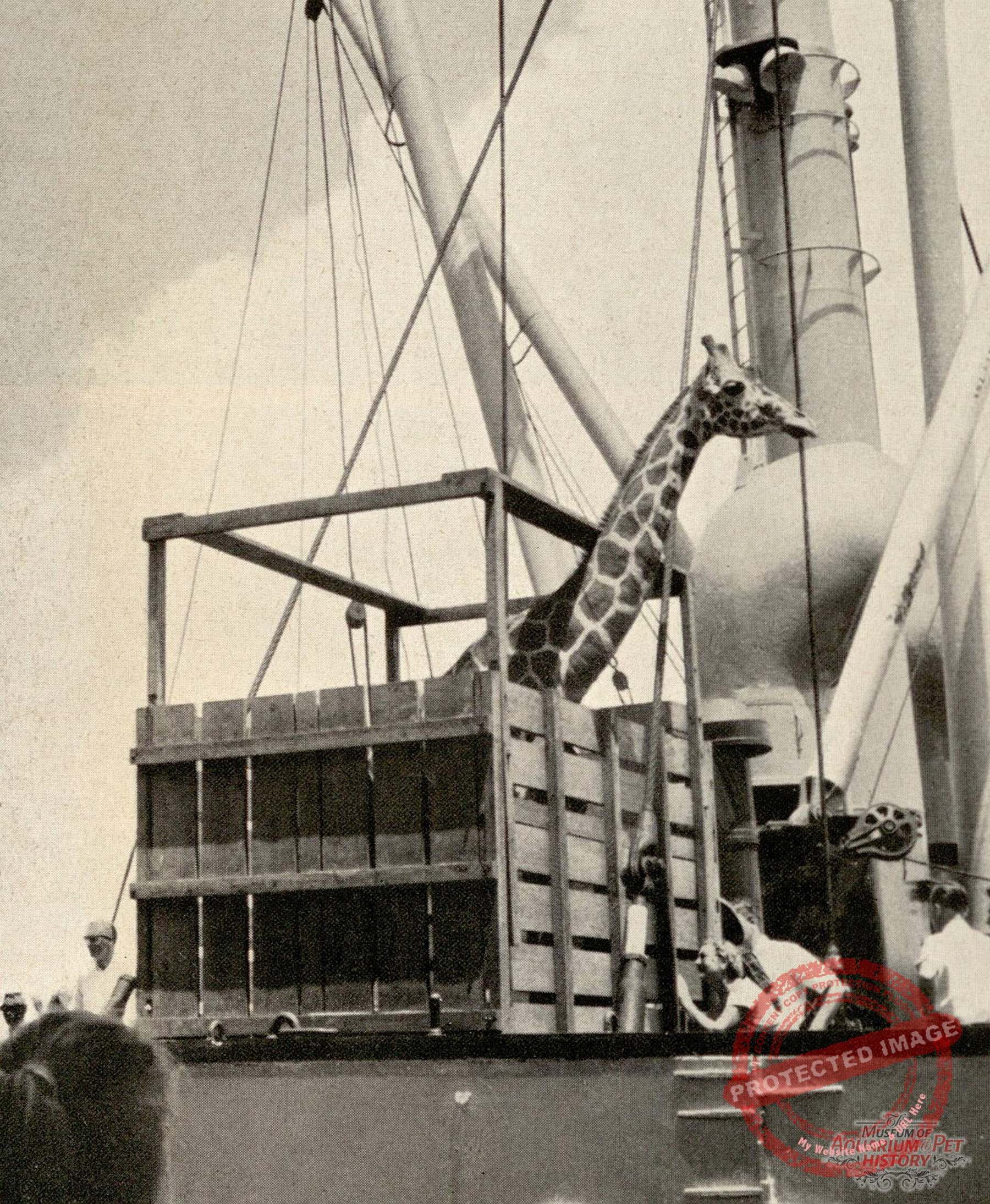
‘Socrates,’ one of the 17 animals shipped to New York—a 4.30 m tall giraffe bull—is hoisted along with its crate onto the freighter at the port of Mombasa on the Indian Ocean. The bottom of the crate aligns just below the ship’s gunwale.
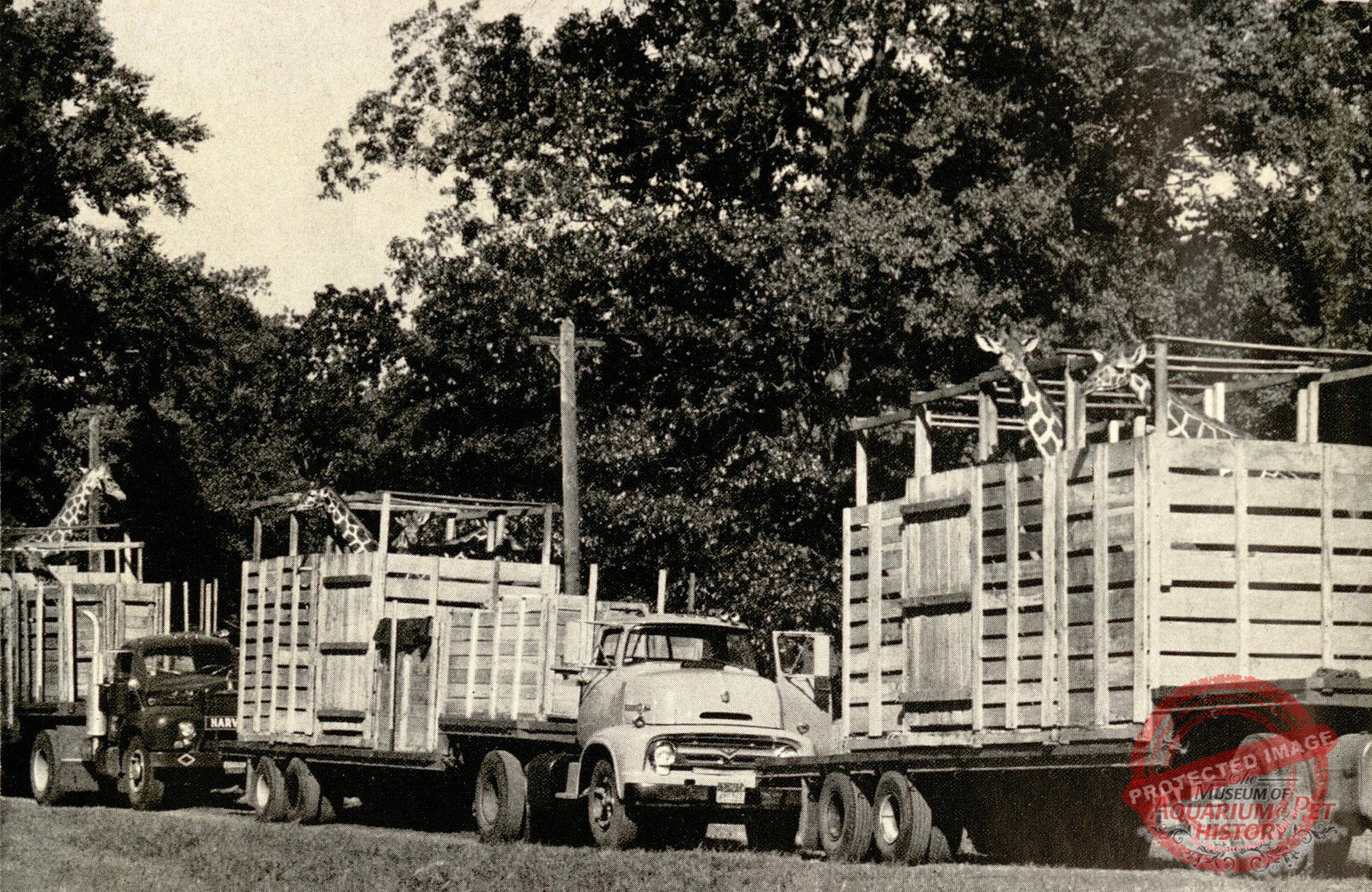
Upon arrival in the USA, the 17 giraffes are first transported on large flatbed trucks to the quarantine station (above), where they must stay for 14 days.
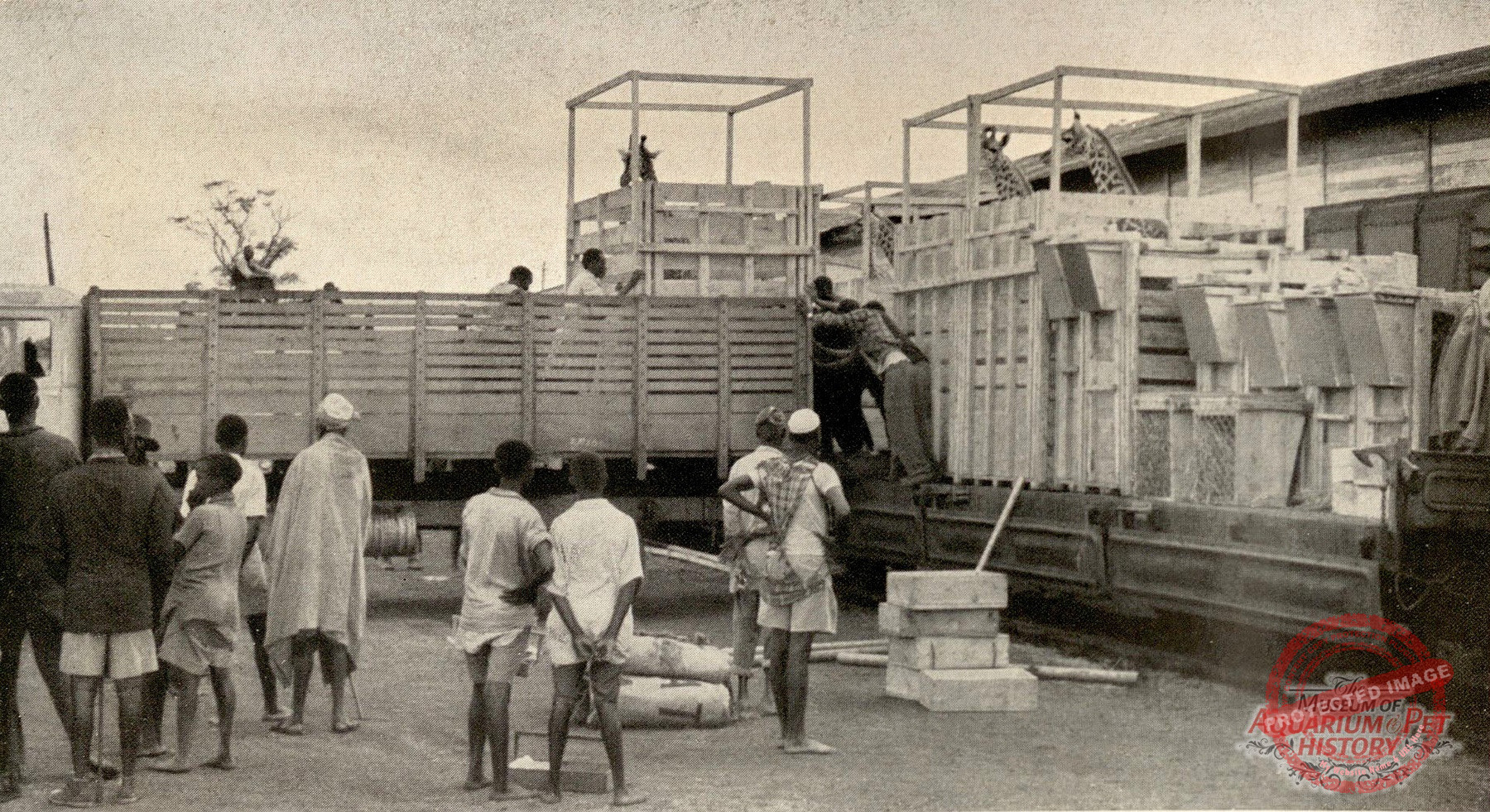
The largest giraffe transport ever sent to the USA, being loaded from the truck onto open railway cars covered with tarps during transit, at the Arusha station in Tanganyika.
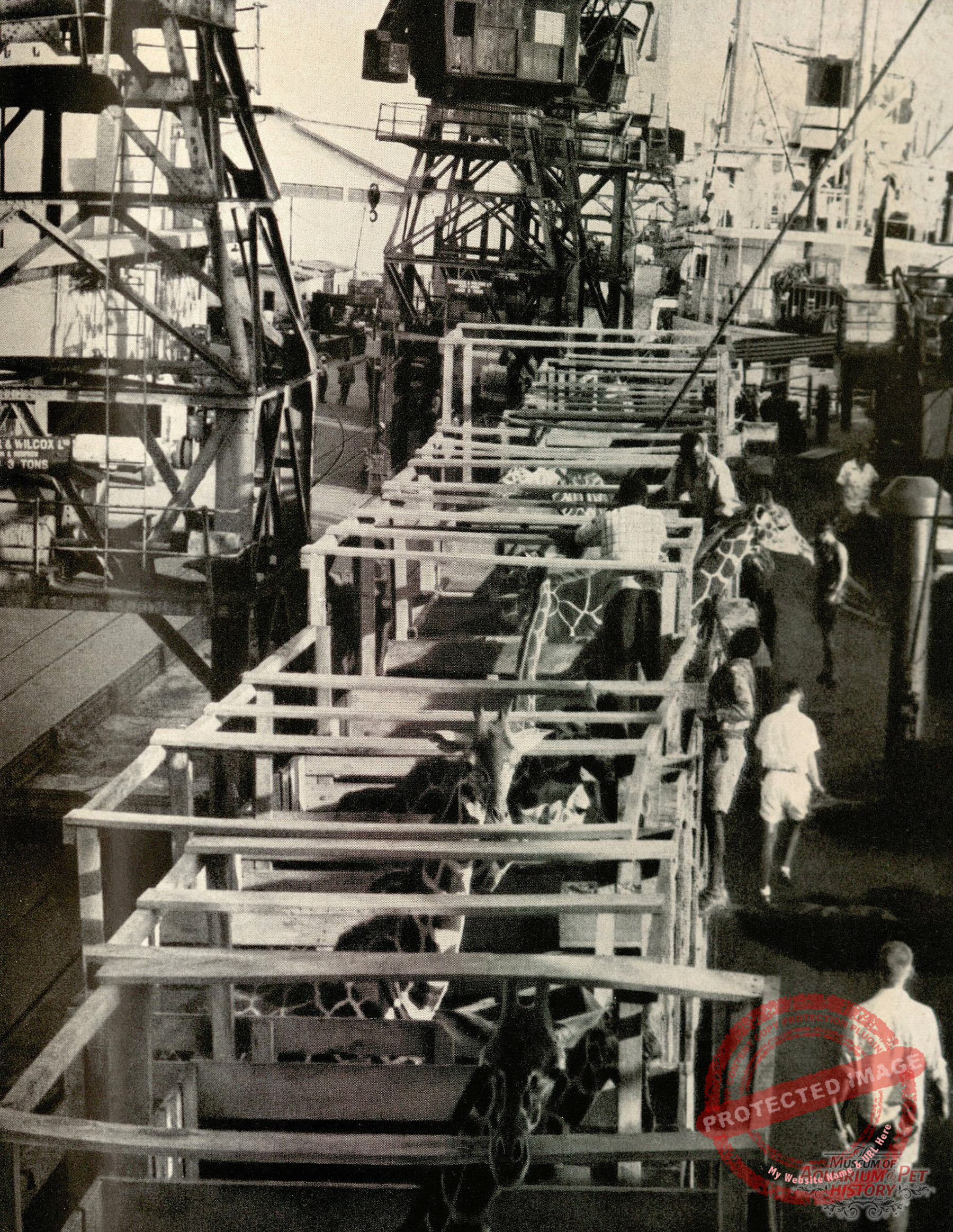
Before the ship’s carpenter modifies the animal crates and covers them with a tarpaulin, the many animals, who have been accustomed to the animal farm for weeks and are already well-used to human presence, stretch their necks.