Chapter 24: Hundred Year Old Ruhe-Alfred – Wilde Tiere Frei Haus (Wild Animals Free Delivery)
Translated by Alex Haro
Starting in September 2024, the Museum of Aquarium and Pet History (MOAPH) started releasing a chapter a month on the translated autobiography Wilde Tiere Frei Haus (Wild Animals Free Delivery) by Hermann Ruhe.
Firma Ruhe (the Ruhe Company) was the name of an animal trading company based in Alfeld, Germany from 1860 until its official closure in 1993. During this time, they were world renowned for their importation and exportation of exotic animals and birds from all across the globe, even supplying many zoos as well as circuses. Having survived both world wars, Firma Ruhe continued to dominate the world of animal trading until the mid-20th century and is a testament to true determination and leadership.
Wilde Tiere Frei Haus (Wild Animals Free Delivery) also documents the plethora of adventures, failures and successes endured by all those a part of Firma Ruhe. Through Hermann Ruhe’s great storytelling, we are able to visualize and understand the world from the perspective of animal collectors navigating through some of the most difficult situations, often not knowing whether or not they would ever return home. His recollections provide a vivid portrayal of the challenges and triumphs faced by the company, and give readers a glimpse into the world of animal trading.
Hermann wrote to me from Africa that Tanganyika Game Ltd. was expecting visitors: a North American film crew had announced their arrival. It wasn’t until a year and a half later that I saw these films, which were made for the Zoo Parade, a Sunday program on NBC in Chicago. One had to sincerely marvel at the skilled work of the cameraman; he had accomplished something that few before him had ever succeeded in doing.
To understand this, imagine the process of capturing a giraffe. The film team had chosen giraffe capture as their focus, using a medium-sized truck outfitted for the task. On the front fenders of the truck is a secure but uncomfortable seat with a backrest and two side supports, where the catcher sits strapped in.
The catcher holds a long bamboo pole, initially pointed backward, with a large looped rope attached to its end. When the giraffe is close enough, the catcher swings the pole forward, aiming to slip the loop over the giraffe’s head.
Once the loop is in place, the catcher pulls the pole back, automatically releasing it from the ropes so that the giraffe is now tethered to the vehicle by the rope, not held by the catcher. The truck then slows gradually, gently reducing the giraffe’s speed.
Next to the capture vehicle was the truck where the cameraman had established himself. Since the chase took place over uneven terrain, the camera couldn’t be fixed in place. Otherwise, the film would have shown the ground in one moment and nothing but sky the next. The cameraman had to carry the camera freely!
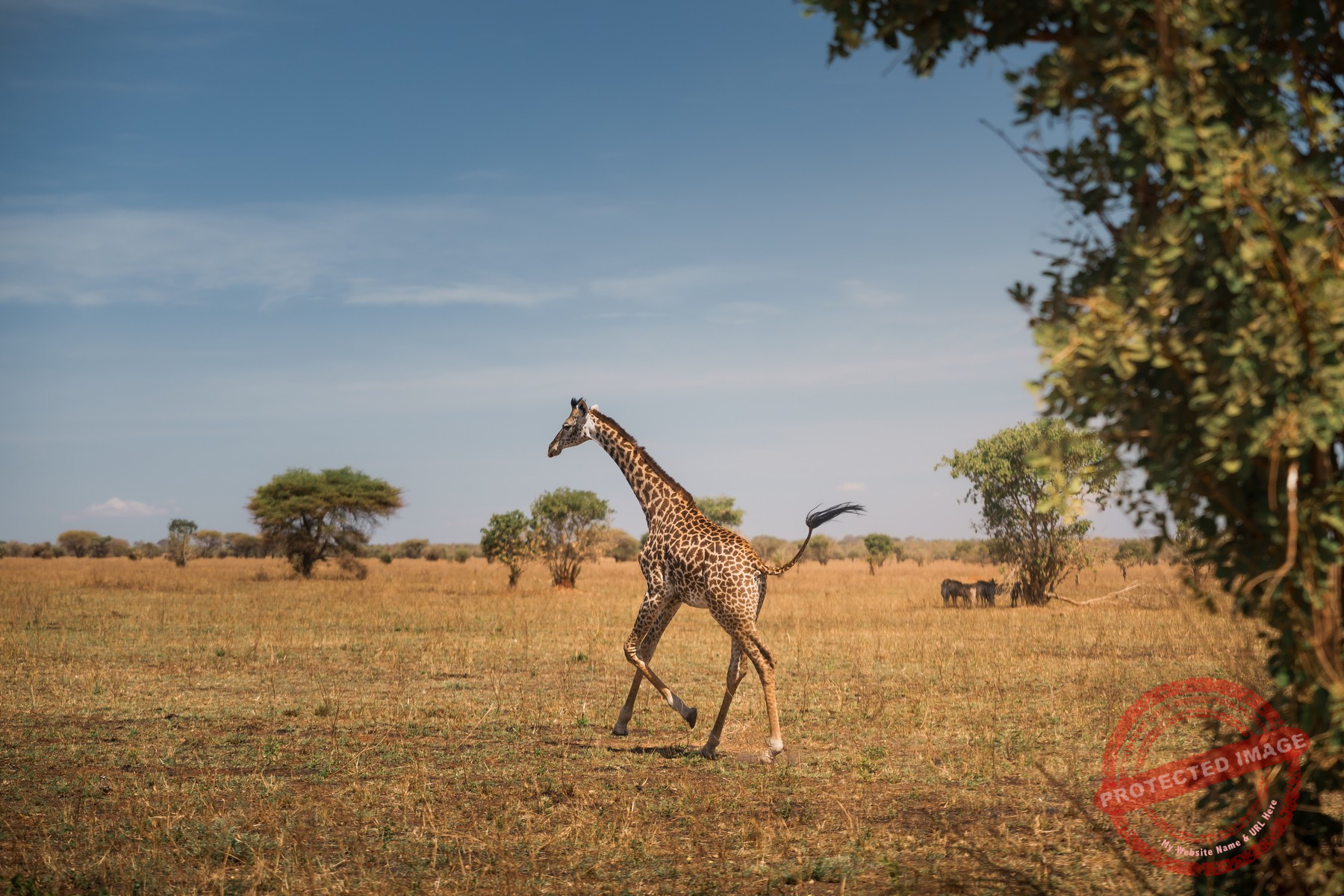
Giraffe running in Tanzania safari
What that means can only be understood by someone who has already raced over the open steppe in a capture vehicle at 80 km/h. On these vehicles, which have to endure incredible strains, there’s hardly anything left that doesn’t rattle after two minutes. Over boulders, through aardvark holes, and barely avoiding termite mounds by a hair’s breadth—that’s how it goes.
The animal, which is driven away from the herd at the start of the capture, dodges swiftly. The driver’s first reaction would be to instinctively yank the steering wheel in the new direction—an action that would end the chase and cause the vehicle to flip. For this reason, the steering wheel of the capture vehicle has such a large amount of play that the driver’s first reaction does nothing, reminding him of the danger. Only then does the steering engage, and the vehicle turns smoothly into the new direction.
For this reason, the steering wheel of the capture vehicle has a lot of slack, so when the driver first turns it, there’s no immediate response. This delay reminds the driver of the risks involved. Only after the initial play (refers to the loose movement or slack in the steering wheel before it actually engages and starts to turn the wheels) does the steering engage, allowing the vehicle to turn smoothly in the intended direction.
How often the capture vehicle chased after a giraffe or zebra, and how often the cameraman got a black eye from the camera, which, like the film vehicle, bounced up and down—I don’t know.
The two films were expertly made and showed all the phases of a fair, sporting, and humane animal capture, from loading the animals onto the truck, to transporting them to the camp near Arusha, and even to the point where the newly captured animals began taking food from human hands. One of the most touching scenes shows a large, freshly captured giraffe entering the enclosure, where it is warmly greeted by five or six of its fellow giraffes.
The news that reached me from Arusha at the end of 1958 was somewhat concerning, and I decided to fly there myself to get more detailed information. Once again, my wife accompanied me on the flight, which took us through Cairo, Khartoum, and Mogadishu in Italian Somaliland to Nairobi. We visited our business partners in Cairo and Khartoum and, in Mogadishu, one of our suppliers of giraffe gazelles and kudu antelopes, Signore Errico.
On the drive from Nairobi Airport to Arusha, Hermann verbally reported to me what I had already learned in writing. To my great regret, difficulties had arisen.
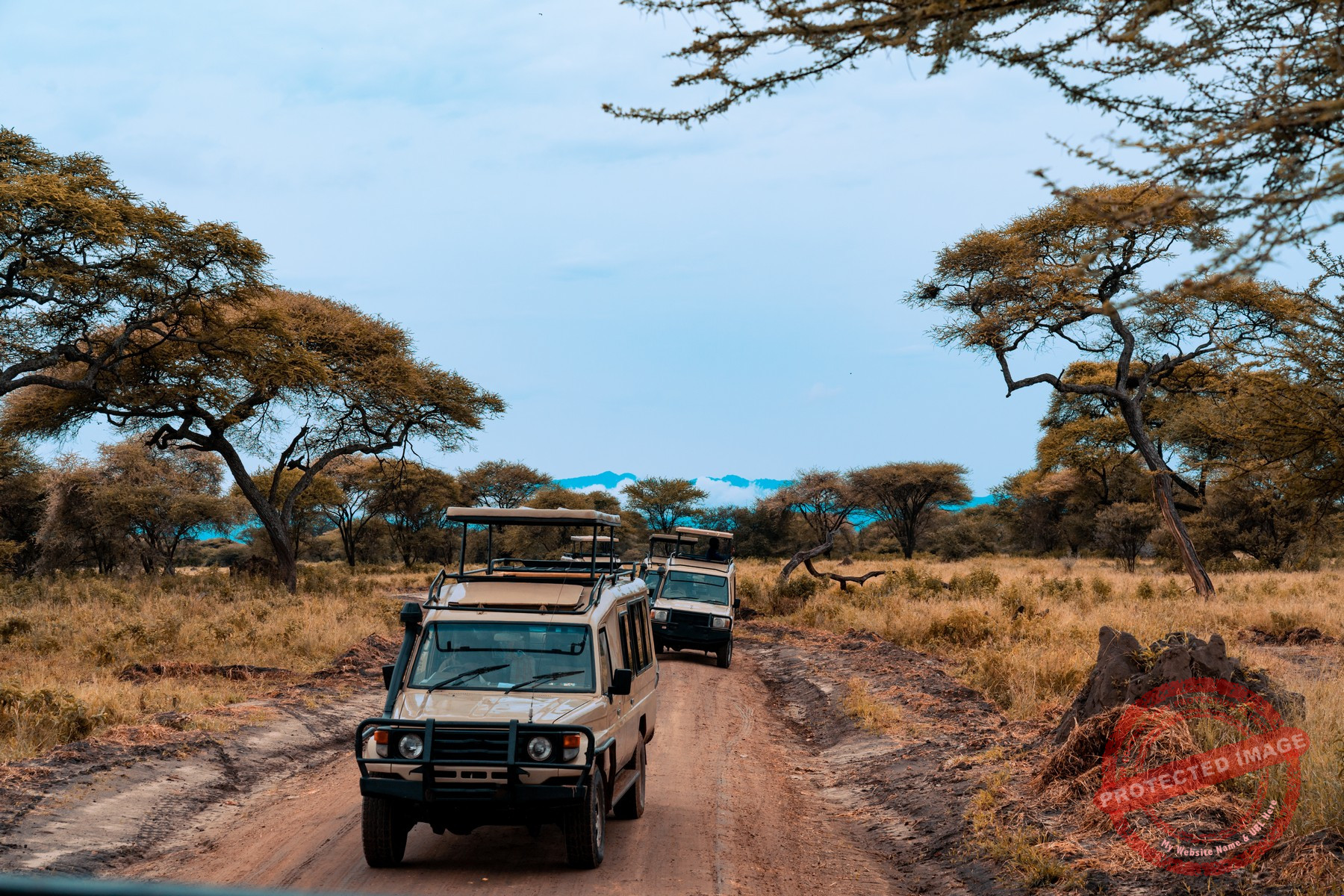
Modern day safari vehicles
The capture premiums (refers to the additional cost or payment required for capturing wild animals, often for purposes like trade, zoological collection, or relocation). for animals had been increased so much that we had to create new calculations in order to maintain the farm, which had initially been running exceptionally well. On top of that, export bans were being threatened! Additionally, as I was able to verify myself, the animal captures were becoming more complicated. The animals began retreating from human settlements, which were expanding further and further each month.
In the beginning, Willy de Beer had only needed to travel a few miles from the farm to capture giraffes. Now, he had to travel many kilometers just to spot giraffes in the distance—let alone capture them. At first, elephants or rhinos could be found as close as 30 or 40 kilometers from the farm, but now they had to travel up to 800 or even 1000 kilometers before even considering making capture preparations. There were even occasions when Willy de Beer returned home empty-handed after a 14-day capture safari.
Just last year, we had delivered a particularly large shipment of 17 giraffes to the USA. The largest bull, named “Socrates,” was 4.30 meters tall. Thirteen of the animals were destined for the zoo ‘Africa USA’ near Miami, Florida, a large artificial animal park through which visitors are taken by a small train. Before the train departs, all intermediate stations are notified by bell signals, and everything is ‘prepared’ for the visitors to this private enterprise. The remaining giraffes, including Socrates, had to be transferred three times during transport and were delivered to Colorado Springs near Denver.
Willy de Beer could still capture enough giraffes, zebras, and ostriches, but elephants, rhinos, hippos, and rare species of antelope were becoming increasingly scarce.
We held lengthy meetings and made several changes to ensure the continued profitability of Tanganyika Game Ltd. Hermann and Anne would stay in Arusha for a few more months, but then they would return home. The young couple had just welcomed the birth of a baby daughter.
The 99th year of the company L. Ruhe, Alfeld, once again brought with it a wealth of events.
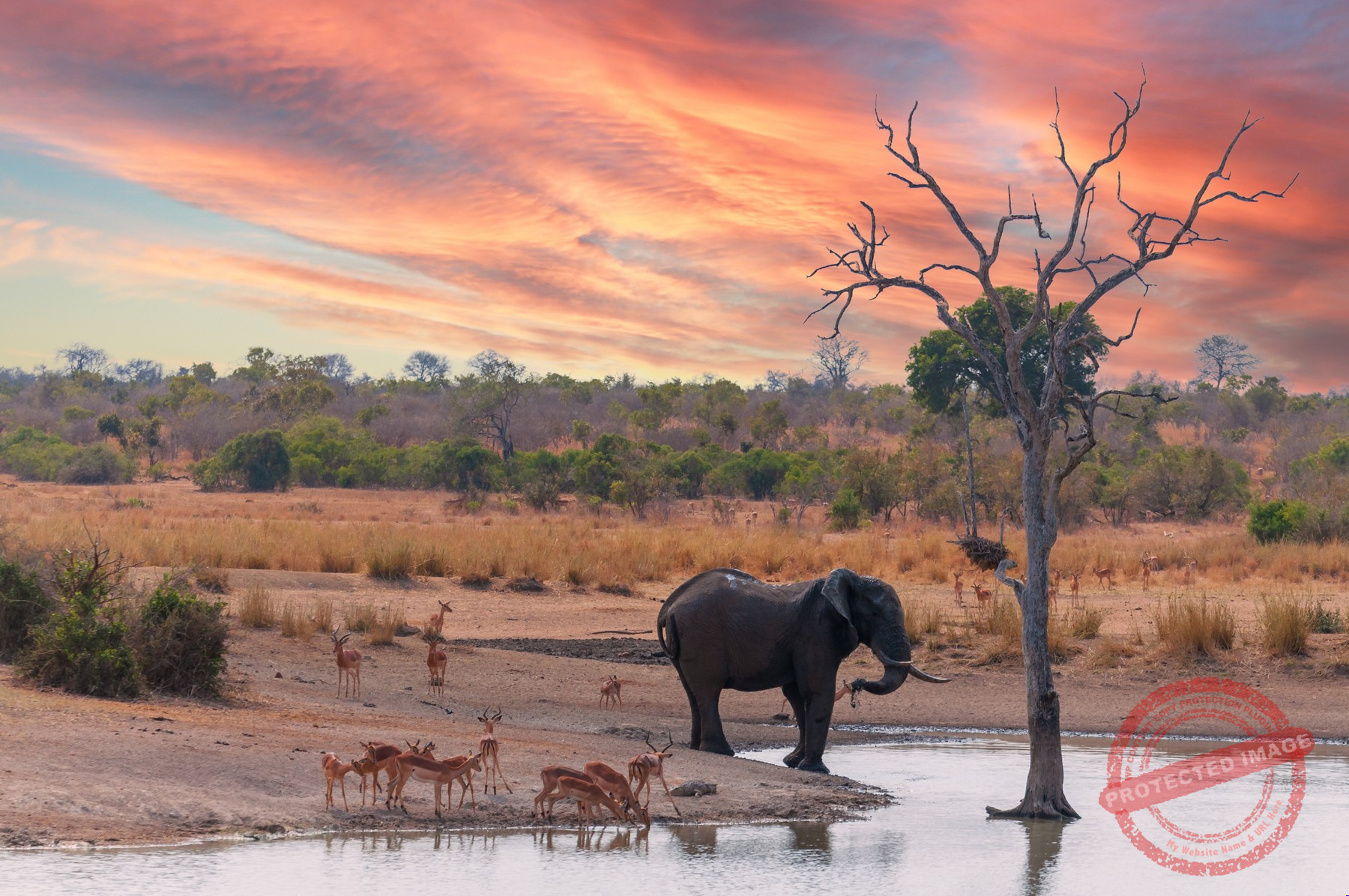
An elephant and impalas drinking water
First, something sad happened: my old, loyal employee Fritz Tegtmeyer passed away. Since the death of Chief Inspector Eiffert, he had continued to work tirelessly and diligently at the Hannover Zoo. If it weren’t for my family, I believe I would have sometimes felt a bit lonely. One by one, my old faithful companions were leaving.
In 1959, I sent the young zoologist Dr. Ernst Rühmekorf, who had been working at the Hannover Zoo for some time, to Arusha to retrieve an animal shipment that, despite all the difficulties in East Africa, was once again quite diverse.
I made good deals with the zoos in Rome, Barcelona, and Madrid; with the two Spanish zoos on a barter basis, since currency transactions with Spain were still quite complicated. Even two young gorillas arrived from Barcelona, and we named one Bobby—after the famous Berlin gorilla.
The barter deal with Prague, however, became a bit less significant, as the once-strong barter trade with Russia was beginning to resurface. Thanks to our good connections with the zoos of Berlin-Friedrichsfelde, Dresden, Leipzig, Halle, and Magdeburg, we were once again able to acquire many rare and valuable animals from Russia through trade.
There has always been, and still is, much to do. Inquiries from around the world need to be answered, and orders fulfilled. My salesmen are on the road; Lutz and Heiner, now both back in New York, are pursuing new plans, and Hermann has since returned to Alfeld with his family.
Now, we are celebrating the 100th anniversary of our old company, L. Ruhe-Alfeld. So much has happened since Ludwig Ruhe, my grandfather, became self-employed in the summer of 1860, and since the company passed to his sons Hermann and Bernhard after his early death—and so much has happened since I took over the business!
Although our company has not yet fully regained its former size after the severe decline during and after the war, the transition to a free economy, particularly due to the favorable currency situation, has paved the way for a full recovery.
The Ruhe company is handling an especially large number of major orders, which means that, in this anniversary year, we will see animal shipments arriving that will almost surpass those of the best years of the past.
How many challenges, how much patience, and what degree of love for animals has been required to steer our company through the severe turmoil of world events over the course of 100 years. But what would all the entrepreneurial spirit of the Ruhe family have been worth if the right employees had not stood by our side?
In our profession, love for animals has always taken precedence over business. The daily interaction with living beings—whether canaries or elephants—has instilled a love for animals in both myself and all our employees.
Today, there are hardly any losses to report during animal transports, which is a testament to the expertise of professional animal traders. The methods of capture have also changed; for a long time now, gentle capturing techniques have been adopted, and no animals are killed in order to capture others.
The future presents the global animal trade with significant and responsible challenges, especially now, when animals worldwide are at risk of disappearing due to technological advancements and space constraints. I welcome animal protection laws and regulations established by various governments, which have entrusted the professional animal trade to deliver legally captured animals to zoos around the world.
This is proof of the trust we enjoy globally, as evidenced by a project we received during this anniversary year. Its execution is only possible for a company with experienced employees, global connections, and facilities for capturing and quarantine.
This letter carries symbolic meaning; it is the business card of 100 years of tireless dedication to quality by three generations of the Ruhe family.
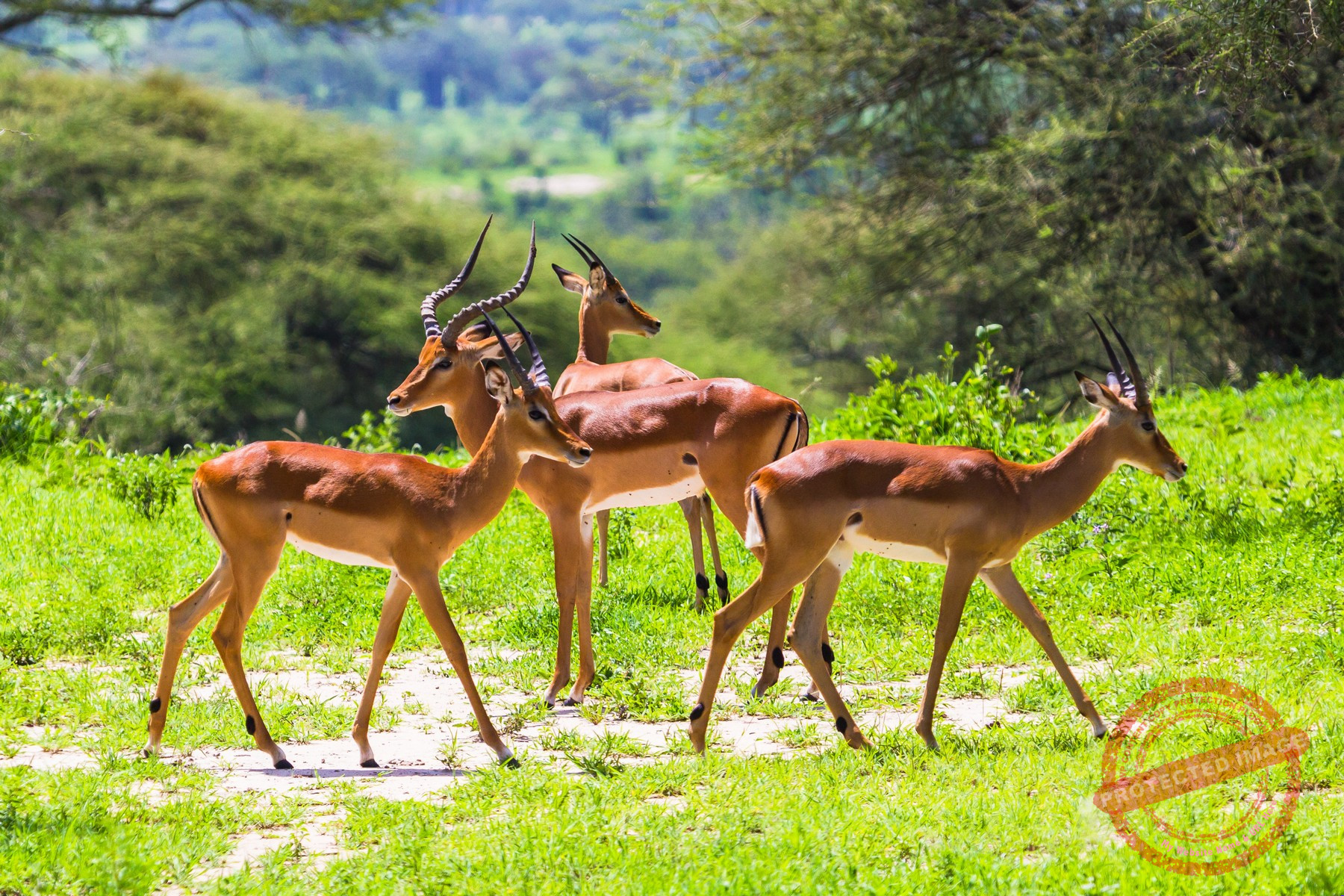
Gazelles in Tanzania
Smithsonian Institution
Office of Director
National Zoological Park
Washington 9 D.C.
February 2, 1960
Dear Mr. Ruhe,
We refer to the gazelles that President Eisenhower was gifted by the Tunisian government during his recent European goodwill tour. Your company has been selected to handle all transport and quarantine services from Tunisia to the National Zoological Park.
We are awaiting further information from the American envoy in Tunisia regarding the exact location of the gazelles, who is currently caring for them, and whom you must contact for the release of the animals. As soon as we hear more, we will notify you.
Your company was chosen because of its longstanding reputation and proven expertise in safely and efficiently conducting such transports and quarantine procedures. Naturally, the care of these animals—gifted by the Tunisian head of state to the President of the United States—carries a certain level of prestige. Personally, I feel highly honored that the President has chosen the National Zoological Park: Washington D.C as the home for these gazelles, and I hope you are equally aware of the honor that you have been selected to manage their transport and quarantine.
I am confident you will do everything in your power to ensure the animals arrive here safely.
Best wishes to you—we will do everything possible to support you in carrying out this assignment.
Yours sincerely,
Theodore H. Reed, DVM
Director
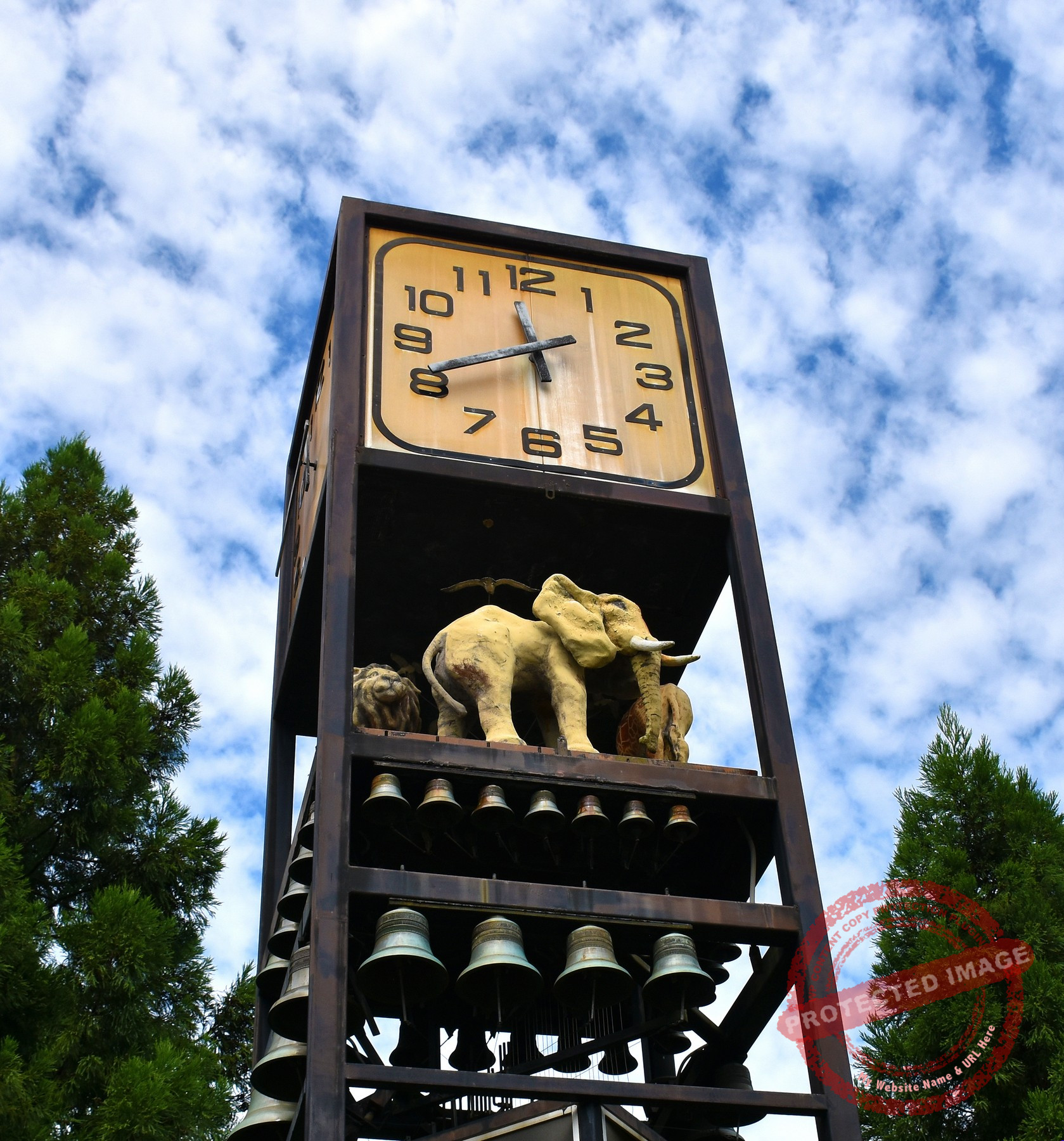
Clock Bell Tower at the National Zoo in Washington D.C.