Chapter 3: The Company Grows – Wilde Tiere Frei Haus (Wild Animals Free Delivery)

Starting in September 2024, the Museum of Aquarium and Pet History (MOAPH) will be releasing a chapter a month on the translated autobiography Wilde Tiere Frei Haus (Wild Animals Free Delivery) by Hermann Ruhe.
Firma Ruhe (the Ruhe Company) was the name of an animal trading company based in Alfeld, Germany from 1860 until its official closure in 1993. During this time, they were world renowned for their importation and exportation of exotic animals and birds from all across the globe, even supplying many zoos as well as circuses. Having survived both world wars, Firma Ruhe continued to dominate the world of animal trading until the mid-20th century and is a testament to true determination and leadership.
Wilde Tiere Frei Haus (Wild Animals Free Delivery) also documents the plethora of adventures, failures and successes endured by all those a part of Firma Ruhe. Through Hermann Ruhe’s great storytelling, we are able to visualize and understand the world from the perspective of animal collectors navigating through some of the most difficult situations, often not knowing whether or not they would ever return home. His recollections provide a vivid portrayal of the challenges and triumphs faced by the company, and give readers a glimpse into the world of animal trading.
On some Sundays, after dinner, my father used to get very excited as we would drive, with our coachman Vespermann, to Grünenplan to visit Uncle August Merkel. Merkel had taken over the New York branch in 1868 and had run it for a long time. Now, as a good sixty-year-old, he had returned to Grünenplan with his wife to spend his twilight years here. Most often, we would first stop at the Gasthof Lampe or have coffee at the Kurhaus; Uncle August would then provide supper.
His interest in the business was undiminished, and his first question to my father was always: “Well, Hermann, how is New York?”
On a Sunday in January 1905, the conversations between my father and August Merkel were particularly animated: “Uncle Bernhard, in agreement with Father, had purchased a farm outside of New York in the Queens district on Long Island!”
“Eventually, the store on Grand Street alone will no longer suffice,” my father said.
“That was to be expected,” replied Uncle Merkel. “I’m glad you found something suitable.”
I asked, “Does a lot need to be rebuilt, or are the farm’s stables suitable for the animals?”
“Some things have to be converted,” said Father. “But that should happen gradually. Of
course, some predator cages and a few aviaries have to be built; that is the most urgent.”
These tasks would be undertaken by our birdmen, who, as bricklayers or carpenters during their respective stays in New York, would carry them out.
The newly purchased property, the “Farm” – the name would remain until today – was located on Queens Boulevard, the future main street.
The main traffic artery through Long Island, amidst many other farms. The ‘Farm,’ as it became named, underwent some conversion with a caretaker’s apartment being created, and the stables converted to cages and enclosures. Some things had to be rebuilt to be able to house our elephants, antelopes, predators, and birds delivered to America. It was a rather large area and provided enough space to house all the animals. The American business was doing well, and Uncle Bernhard managed both the sales at the store on Grand Street, the pet shop, as well as the entire wholesale business – especially with our canaries. He did not think too highly of the animal trade, but he did not close himself off to the possibilities that lay in the development of this branch of business.
But his personal, great interest was and remained the canaries. The owners of retail stores from all parts of the United States came to him in New York to make their purchases on Grand Street and to place their orders, which were delivered wholesale by the dozen. Naturally, I was also involved in calculating the dozen prices of the canaries. Uncle Bernhard had no influence on the prices at which the retailers set their selling prices, especially since he also set up and equipped the respective retail stores. In one well-located store on 5th Avenue in New York, a good canary already costs fifteen dollars1!
MOAPH1: 15 USD in the early 1900s would equate to around $476 USD today.
Good songbirds were even much more expensive – except for the “stumpers,” those birds that, apart from their duller song, could not be valued as the best singers. They were sold for half or even a quarter of the price.
Uncle Bernhard and my father always attached great importance to a rich selection of songbirds. Thus, collections from insectivores arrived from India, which were particularly popular in the USA. Their collection name was Bareilly Vogel (Bareilly Birds). Among them were, in large quantities, those species later known under the terms of the best singers, Schamadrosseln (White-rumped Shama) and other Passerine birds, such as Bartvogel (Barbet) and Pittas (Pittidae).
From Australia, our animal collectors brought Reisenden Spitz Schwanz (Spotted Doves) and Lady Gould’s Amandine (Gouldian Finches), from South Africa Turacos, colorful Webervogel (Weaver birds), and Hahnenschweif Witwen (Long-tailed Paradise Whydahs).
All these birds, along with the canaries, enjoyed immense popularity among the many European immigrants in the United States and found a great market.
Uncle Merkel sometimes became a bit sentimental when he heard about the scope of today’s transports, which my father sent to America, for in addition to birds, more and more animals went from New York: elephants and tigers from India, lions, monkeys, and antelopes from Africa, pumas, llamas, jaguars, and rheas from South America.
Although we children were not usually allowed to interfere in the adults’ conversations, I risked asking a question on this Sunday in Grünenplan: America, our branch, and everything that was associated with it fascinated me.
“Are the canaries also shipped in reffs when they are sold?” I asked.
“In reffs?” said Father. “No, Hermann. Birds are not always bought at once until a reff is full. That makes it different. The birds come in boxes, as you know from the small wooden crates, which are made in different sizes, depending on the size, to accommodate six, twelve, or twenty-four birds together.”
“Oh, I see,” I said. “They are. Do they have those wire cages in America, too?”
“They are not wire cages,” corrected Father. “That is gauze. It is green and very fine. This makes the cages almost dark and keeps the canaries from scratching each other when they are in full song or in courtship.”
Such boxes were equipped with pingels or small cups for drinking water. Each pingel contained small sponges so that when the box was tipped, not all the water would spill out, and the moisture would remain in the sponges. The shipment was sent via express mail and delivered immediately upon arrival. The birds were then transferred to individual cages.
So, I learned one thing after another. Father took great care to clarify everything to me as best he could at my age, even though my interest in our trade business was admittedly a bit too much. “Children and animals should not be overwhelmed; they won’t benefit from it,” was his view.
That evening it was very late before we arrived in Alfeld again. While coachman Vespermann was unharnessing the horses, Ludwig and I were quickly sent to bed. School started early. Even the parents had had a tiring day. Father always received a lot of mail on Monday mornings, and Mother would take special care of the laundry room the next day, as it was laundry day. Mrs. Vespermann took command in the laundry room, and despite the housemaids, Mother had a lot to do on such days. Besides, one of our maids had just gotten married off to one of our bird keepers.
When I came home from school on Monday and finished eating, I first made my usual rounds in the yard. Mrs. Vespermann was still in the laundry room, the door was open. I didn’t have much time to lose as I had lots of homework to do. When I looked around a bit, I discovered the goldfish tanks, which Mr. Thiesemann, our former coachman, who had become a transport attendant for canaries, had filled with water after replacing the water hose.
I had the “right idea” and turned on the water tap. The hose slipped under the pressure of the jug and snaked around as it sprayed out, spilling its torrents over the cleanly laid pavement. Even the freshly cleaned windows of the back building got a splash.
“Damn troublemaker!” shouted Thiesemann, who came out from the front house. He went after me. I quickly dashed upstairs to Grandma’s living room – and was already gone in her big armchair.
“Thiesemann will beat me up,” I whispered to her as my pursuer was already knocking at the door.
He then stuck his head through the door: “Is Hermann here, Mrs. Ruhe?”
“Yes,” said my grandma dignifiedly. “And you remember not to hit my grandson!”
“But that rascal.”
“My grandson is not a rascal, and whatever he has done, I don’t care.”
“Yes, Mrs. Ruhe,” he replied respectfully, “but the goldfish.”
“That’s fine,” said Grandma impatiently, and he had no choice but to leave. “So,” said the old lady, “and now,” she paused. “Hermann. A. Ruhe is neither cowardly nor hides. Understand?”
“Coward?” I said in surprise as I appeared again. “I never thought of that, Grandma.”
“Hopefully, you’ll think about it in the future,” she said. “And be sure to leave the goldfish alone.”
“Are goldfish animals too?” I asked, quite shocked.
“Out with you,” she said energetically. “Do your homework!”
One afternoon, when I came home, I noticed that my parents were unusually silent at the table. Something must have happened.
“Is Grandma sick?” I asked cautiously.
“Grandma?” asked my mother. “Why do you ask?”
“I thought,” I said, “because it is so quiet today. I thought something might have happened.”
“Something has happened,” said Father very seriously. “But not to us, but to Uncle Bernhard in New York. He should know right away so that you can remember this thoroughly for the future when you will later run the business – later.”
Ludwig and I looked at our father. He spoke quite seriously but not as sternly as usual.
When the dishes were cleared away, my parents remained longer than usual at the table, and Father began to tell us what had happened.
A black panther, which had been delivered to New York, was sold to a buyer in Philadelphia. The farm had no railway connection, so the animal had to be brought on a wagon to Grand Street to be picked up by “American Express,” a transport company. Uncle Bernhard had the crate with the animal placed in the back corner of the pet shop. There, it was forgotten, and then it was left for pickup.
Unfortunately, just then, a woman with a six-year-old boy came into the shop to buy canary food. While she talked with the salesman, the boy roamed around the shop and curiously looked into every corner. Thus, he discovered the panther’s crate. It was so dark in the corner that the child probably didn’t see the panther right away. But he saw its glowing eyes – and moved closer. Besides, the boy bent down further and got close to the crate with his head.
A blood-curdling scream startled his mother, the salesman, and the other customers in the store. With one sharp paw swipe, the panther had struck the boy on the head through the iron bars – and scalped him!
“Scalped?” I asked in horror. “Does that really happen?” So far, I have only encountered this word in some Indian books.
“Sadly,” said Father, sighing. “This morning came the letter from Uncle Bernhard. The boy is at the hospital, and this terrible story will cost us a huge amount of money. Hopefully, the insurance will pay the damages! Thankfully, and for this, we have to thank god the boy is not dying. The doctor was quick.”
This event became an educational factor for my brother Ludwig and me. Whenever we became too curious around any animal cages, we were reminded of the black panther on Grand Street, and the impression that story made on me at the time has stayed with me throughout my life, especially since, as my father recounted, the insurance paid nothing.
“They took the position,” my father explained, “that the necessary safety measures had not been adhered to. There was thus a lack of due diligence.”
That didn’t mean much to my brother and me at the time, but the amount that this momentary carelessness ultimately cost did: 21,000 dollars2!
MOAPH2: $21,000 in 1907 would be in the range of $650,000-$700,000 today.
In the spring of 1907, my father had to travel to Antwerp. “Hermann—keep your wits about you!” He said to me before his departure. “Easter is not far off!”
“I’ll make it through, Papa,” I said. Then I waved after the carriage that took him to the train station.
Father wanted to meet Mr. Katzenstein in Antwerp, who was bringing him a shipment of animals from South Africa. Katzenstein was not employed by us, so he wasn’t one of our own agents. He was independent and occasionally offered animals to my father, who often brought them to Europe himself. Father had purchased the incoming shipment based on Katzenstein’s written offer. He knew that the dealer brought good animals and that he could be trusted with his offers. Only with his prices was my father not always in agreement.
“I’m sitting at the harbor,” recounted my father, “and waiting for the ship to be maneuvered to the dock. When suddenly, Carl Reiche appears beside me.”
My father had greeted the Alfeld competitor kindly, and Carl Reiche had sat down next to him.
“Are you waiting for a shipment, Carl?” my father had asked him.
“Yes,” was the answer. “There—with the ship. Katzenstein also made me an offer. I suggest we outbid each other mutually, shall we?” Extremely amazed and concerned, my father first swallowed hard. Together with Carl Reiche, he went to the ship after the transaction had been concluded.
“Hello, Mr. Ruhe!” Katzenstein had said and shook my father’s hand. “Good day, Mr. Reiche!” he then turned to the competitor.
“So, where are the animals?” asked Carl Reiche. “I’d like to take a look at them right away.”
Katzenstein had politely guided him to the animals and then returned to my father, who immediately confronted him: “Now tell me—what’s the meaning of this? You can’t just offer my animals to the competition again! Are you out of your mind?”
The dealer laughed. “Slowly, Mr. Ruhe. The animals belong to you, but I’d like to take the opportunity to show you that your accusations, with which you often harass me for my prices, were unjustified. Be careful—”
Carl Reiche came back. He began negotiating with Katzenstein and offered 15,000 Marks3 more than my father had paid for the transport. Carl Reiche was very unwilling when Katzenstein informed him that Mr. Ruhe had just purchased the transport sight unseen for a good price.
MOAPH3: 15,000 Mark from 1908-10 would be around $90,000-110,000 today.
When “Little Germany4” left disappointed, the South African supplier said: “You see, Mr. Ruhe? He offered 15,000 more—and you always claim that I’m too expensive.”
MOAPH4: A nickname given to Carl Reiche for his short stature.
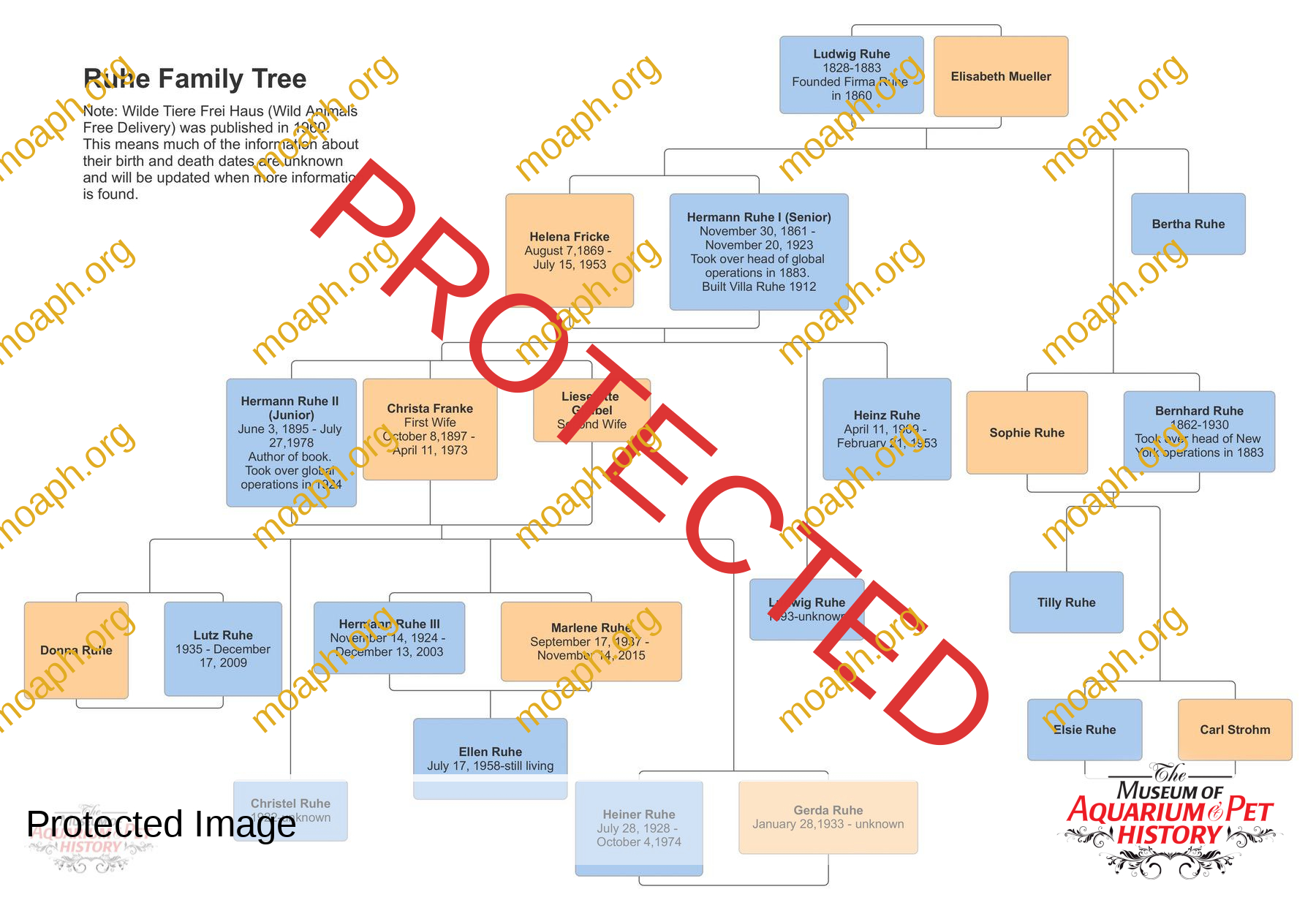
The year 1908 brought significant events. First, my brother Heinz was born, and second, the dissolution of the competitor company Carl Reiche was announced—and here’s why:
Reiche had not succeeded in getting one of his sons interested in the animal business. As extensive as his trade and circle of employees had been at the beginning of the 20th century, he was tired, weary of this peculiar business, a little war-weary, and felt that it had outlived its usefulness. He had found no successor—why should he still strain himself?
One of his sons became a naval officer, the other lived as a merchant in Hamburg, and both daughters got married—one to a Swede, the other to a doctor.
By 1909, the once large company was already in the process of dissolution when my father, after a conversation with the old friend and competitor, soon took over the rest and thus ended the company.
The animal trade C. Reiche was dissolved, and Carl Reiche devoted himself to a quieter occupation during this time, namely the management of shares in an ironworks company, which he owned, a career much more suited for him due to his deteriorating health.
The taken-over warehouse was still quite extensive; a few animals, some dozen birds, that was all. It was almost more important for my father that nearly all of Carl Reiche’s excellent old employees transferred to us. This included the accountant familiar with the exotic bird trade, our later authorized signatory Plawtizky, as well as experienced animal collectors who could not be easily deceived. Together with our own staff, my father had assembled a team that was quite impressive. Additionally, there was August Milte, the best animal keeper of his time, a specialist in antelopes and giraffes.
In November, the animal catchers and buyers, equipped with substantial funds, usually embarked on their long journeys. Their shipments typically arrived in April and had to be sold again by May, if possible, so that the many animals wouldn’t “eat us out of house and home.” Besides that, the space at the Weisse Erde (White Earth) was calibrated to a specific capacity that could not be exceeded. The basis of the collaboration between my father and our animal buyers was: absolute trust!
“In this industry, a high level of business acumen is the prerequisite for success. This level cannot be stressed enough,” my father often said, “in addition to trust, leniency, expertise—and the ability, not ubers Ohr hauen zu lassen5(to be hit behind the ears)!”
MOAPH5: An expression meaning to be manipulated.
This applied to all participants and was also drilled into me repeatedly. “If in our business a man’s word doesn’t hold as much value as a written contract, then we are not worthy of practicing our profession and are on the same level as a bad horse trader. A bad one, I say, because thankfully, there are also horse traders whose word does count!” Trust was everything, and this relationship of trust began with my father giving his buyers full authority, along with cash amounts that rarely fell below 20,000 Marks6—often much higher! With this money, the collectors not only had to purchase the animals but also pay for their food and transport, distribute tips, hand out ‘bribes’ where it was required by local customs, and similar expenses.
MOAPH6: 20,000 Marks is equivalent to $142,000-$150,000 USD today.
Even as a child, I did not find five-digit figures unusual, especially when my father informed me about the amounts he had given to various collectors—and that for the purchase, the money that was in the account.
My father’s business network kept growing; sales increased more and more; in the winter season with canaries and in early summer with exotic animals.
Our clientele—zoo directors from many countries, private owners, and circus proprietors—kept expanding. There were always resounding names among the buyers!
Particularly prominent guests in Alfeld were Sir David Ezra7from India, von Falz-Fein8, and others besides the many zoo and circus directors, frequently bearers of world-famous names.
MOAPH7: Sir David Ezra (1871-1947) was a prominent figure in the Jewish community in Calcutta, India. The Ezra family were well known merchants and philanthropists in the early 19th and 20th centuries.
MOAPH8: Friedrich von Falz Fein (1863-1920) was a landowner and conservationist in the Russian Empire. He was one of the pioneers who formed the Askania-Nova nature reserve in Southern Ukraine which included a zoo and a botanical garden.
These guests made my father think about finally building the Villa, which was started in 1913 and completed in 1914, when the big, three-story mansion with guest rooms, slightly sloping to the Weisse Erde (White Earth), arose. At the same time, Uncle Bernhard, in agreement with my father, purchased a four-story house on the Bowery in Manhattan. The old store on Grand Street was no longer sufficient to accommodate the vast quantities of canaries that were now being sent from Alfeld every year and sold in New York. Some renovations were necessary and were to be undertaken immediately.
This event was the last joy for my grandmother; she died shortly thereafter. The death of one of the closest people left a lasting impression on me. It was the first time I felt that a person is irreplaceable and how great the gap can be that such a loss tears open.
I took my work very seriously, started at the Alfeld Gymnasium, finished the “Einjährige9”, and then resumed school in Einbeck to attend the Obersekunda10. My brother Ludwig came at the same time, and had already been in Hanover, where he was to volunteer in a trading company. Then, he attended a trade school in Leipzig, followed by attendance at a trade school in Neuchâtel, Switzerland. In the spring of 1914, when the villa was finished, I had completed my studies and practiced with a veterinarian in Lausanne for a quarter of a year, mainly to practice using the French language.
MOAPH9: A required milestone in education allowing one to advance into the higher up schooling
MOAPH10: Corresponds to the 11th grade
In early summer, I returned to Alfeld to join my father’s company. At the same time, my brother Ludwig traveled to England, having completed his commercial training, to support Uncle Bernhard in New York.
Only now could I truly take possession of my new, beautiful room in the villa.
For the first time, I experienced a visit from Sir David Ezra from India, a wealthy magnate who maintained a large private zoo and was an enthusiastic bird lover. He brought his servants with him, and it happened to me that one early morning, I stumbled over an Indian man in the corridor of the first floor, who had laid himself down on the floor in front of the door to the visitor’s room to sleep there and simultaneously guard his master.
Von Falz-Fein was also introduced to me for the first time when he came to visit my father. His vast land holdings in Tauris in southern Russia consisted of an extensive agricultural operation. The estate, Askania Nova, had been purchased in the 19th century from its original owners, the Principality of Anhalt-Köthen. The Falz-Fein family made the estate profitable but expanded it considerably beyond the original area. As early as 1861, about 400,000 sheep were part of the Askania Nova holdings!
In addition to the agricultural work taken over from his father, which constituted an important factor in the then Tsarist economy, Friedrich von Falz-Fein had come into his own personal breakthrough: animals from all over the world were to be kept in Askania Nova. Within the grounds of Askania Nova, a private zoo was created, as well as a botanical garden, which was a sight in itself. The zoo housed more than half a hundred different species of mammals—mostly in multiple specimens—and nearly 500 different bird species from around the world!
The baron was a man of strong stature, with a clear gaze, a broad forehead, and a mustache above the upper lip. In the years when he often came to Alfeld, he was in his prime—in his forties. He usually wore simple but perfectly cut suits and dark ties. Over the vest, he wore a broad, gold chain. He did not smoke or drink any alcohol—at most, he drank a glass of light wine at a particularly festive meal.
My father often conversed with the baron—especially in agreement—on many views about animal care, feeding, and accommodation.
The baron became famous for his enormous aviaries, which gave the animals great freedom of movement, a luxury that state zoos with space constraints could rarely afford.
The baron had a peculiar habit that initially irritated my father: he ‘bargained’ with passion! This would not have been unusual. Unusual, however, was that with small animals, he always tried to push the prices down, sometimes with a parrot. He radiated joy when he managed to knock off five or even ten marks from my father—only to place the ten marks in the hand of the seller ten minutes later to buy a rare large bird for several thousand marks without hesitating to accept a word from the opposite party.
After my father had taken pleasure in this aspect of the baron’s character, he gradually had fun, almost as if it were a game, to join in, although he sometimes noticed that the baron was slowly moving away from animal husbandry and the pleasure he once had in animals.
The baron spoke several languages fluently, including, as was natural in a German family—German. The vast expanse of the southern Russian steppes appeared before him, even though he rarely left his homeland.
As a young man, he was almost the victim of an assassination attempt. A large amount of gunpowder had been placed in the fireplace of a room next to his bedroom, ignited at night with a fuse. The entire wing of the castle, in which these rooms were located, had been blown up. That the baron, although severely injured, could be rescued alive from the debris was due to a thick beam that had wedged itself over the head and foot of his bed and had thus kept the falling debris away from his body.
However, the baron rarely told of these things; most of the conversations naturally revolved around animals. The more extensive my father’s animal trade became, the more visitors came to Alfeld. Soon came the director of a zoo from the USA, then came the director of a wildlife park from South Africa.
My mother, who managed everything with the help of her household staff, completed her task calmly despite the six-year-old Heinz, who still needed supervision. Her always even-tempered demeanor was an ideal counterbalance for my recently easily irritable father.
“Those damned monkeys have escaped again!” I heard headkeeper Siegfried shout through the courtyard. “The boss will be angry again—come on, come on! Why don’t you watch better? I don’t understand how this could happen.”
A week earlier, three monkeys had dug up all the carrots in a neighboring garden, pulling them up one by one until eating them was no longer worthwhile. The result was that my father had to dig into his pocket and pay for the damages.
This time, it was much worse. The monkeys—two medium-sized baboons—climbed over the wall onto the street, crossed it, and were the first to land in our own villa, where they promptly destroyed a lot of flowerpots. Then they moved on to the large neighbor’s house, climbing through the windows, dismantling something like a bedstead in the rooms, while the frightened servants, little ones among them, fled with a heavy jug out the window into the garden.
When the jug shattered, they got frightened and fled out of the window into the garden.
The chase lasted several hours. Only a few particularly beautiful bananas in the headkeeper’s hand, which the monkeys loved tenderly, could finally lure them out of the attic and let themselves be captured and handled. My father paid for the damages. There were indeed insurance policies back then for the damages caused by the animals—but only if the necessary safety measures had been taken. Such incidents as broken windows and damages in the rooms and kitchens of the neighboring area were by no means included in the policy.
Two months later, an unfortunate accident occurred: a tiger escaped. One of the keepers noticed it first when the glowing eyes of the predator were seen on the roof of one of our stables. The man slowly and cautiously withdrew to call for help, which immediately was gathered. Everyone who could armed themselves with guns and poles.
The stable was surrounded, and then, as always, they tried—with kindness. The door to the training hall was opened, and delicious horse meat was placed nearby. Only then did an organized noise begin, driving the frightened animal—since the meat was temptingly visible—into the hall. As the tiger approached the meat, a transport cage was pulled up to a door, and finally, the animal was driven inside. In this way, it was possible to get it back into its cage from which it had escaped.
Another time, a keeper was injured on the arm by a blow from a paw, and a second keeper was knocked down by a bite. Such attacks by animals were not out of blind rage or malice but were often natural defensive movements triggered by too rapid or poorly coordinated movements while the food was being placed or the cage was being cleaned. Sometimes, it was simply a misunderstanding of the animals’ intentions and reactions by the keepers.
My father was always insured for such cases, but most often, he relied on the caution and not the unnecessary excitement that such incidents occasionally caused.
But there were also more cheerful stories.
When the returning animal collector, Mr. Kreth, arrived with a telegram from India, he reported something that was hard to believe. Kreth traveled back with Fritz Risch, who had gotten a bit drunk. Suddenly, he got a fit of rage, jumped overboard, reappeared from the water, and shouted at the top of his lungs, “I have to save old Ruhe!”
“Man overboard!” This signal stopped the ship, which immediately turned around. A few natives, who adored Risch, jumped in after him and fished our collector out of the water.
The next morning, Fritz Risch had slept off his intoxication as well as his fit of rage; he remembered absolutely nothing. The teasing began when Kreth had told the story on his visit back to Alfeld.
END OF CHAPTER 3