Chapter 6: Ruhe Senior is No More – Wilde Tiere Frei Haus (Wild Animals Free Delivery)

Starting in September 2024, the Museum of Aquarium and Pet History (MOAPH) will be releasing a chapter a month on the translated autobiography Wilde Tiere Frei Haus (Wild Animals Free Delivery) by Hermann Ruhe.
Firma Ruhe (the Ruhe Company) was the name of an animal trading company based in Alfeld, Germany from 1860 until its official closure in 1993. During this time, they were world renowned for their importation and exportation of exotic animals and birds from all across the globe, even supplying many zoos as well as circuses. Having survived both world wars, Firma Ruhe continued to dominate the world of animal trading until the mid-20th century and is a testament to true determination and leadership.
Wilde Tiere Frei Haus (Wild Animals Free Delivery) also documents the plethora of adventures, failures and successes endured by all those a part of Firma Ruhe. Through Hermann Ruhe’s great storytelling, we are able to visualize and understand the world from the perspective of animal collectors navigating through some of the most difficult situations, often not knowing whether or not they would ever return home. His recollections provide a vivid portrayal of the challenges and triumphs faced by the company, and give readers a glimpse into the world of animal trading.
My letters with reports of success were a comfort to my father, whose health began to deteriorate more and more. I read in my mother’s letters how worried she was about him: He was seriously ill.
It wasn’t easy for my father! In 1922, during my stay in Alfeld, we often sat together, the pencil in his hand, and we calculated and planned together. He often put down the pencil and said, “It just doesn’t add up.”
Even now, in the winter of 1922/23, letters from my father arrived in New York, from which it became clearly evident: Things really weren’t going well anymore! Inflation had reached a point where all efforts were in vain.
Finally, the saving idea came to me. I sent Father, for his canary transports that arrived in New York, to collect the payable dollars in cash through agents! By gaining the time to be able to exchange at the current rate within a day, the money retained more value. Otherwise, it had been the case that the amounts, during the days that passed from the money’s arrival at the Reichsbank until its payout in Alfeld, were only worth a fraction of their original value1 .
MOAPH1: Essentially by having money collected in cash in New York and exchanging it quickly at the current rate, they were able to retain more of its value. Otherwise, by the time the money made it through the banking system and was paid out, its value would have significantly decreased.
Mother was a practical-minded woman. She didn’t waste time losing her head. “Herman,” was the first thing she said to me after reporting Father’s death and the funeral, “Do you think you’ll be able to manage so many people?”
From my stately height, she looked up at me when I spoke: “You must promise me one thing: that you will never worry so much about business as your father did. That’s my job, and I will continue to run the company as if your father were still here.”
“It will be fine, Hermann,” she said and looked firmly into my eyes.
With that, the matter was settled for everyone, but I soon noticed that Mother was closely observing how things were going at work— she noticed the little things just the way Father had.
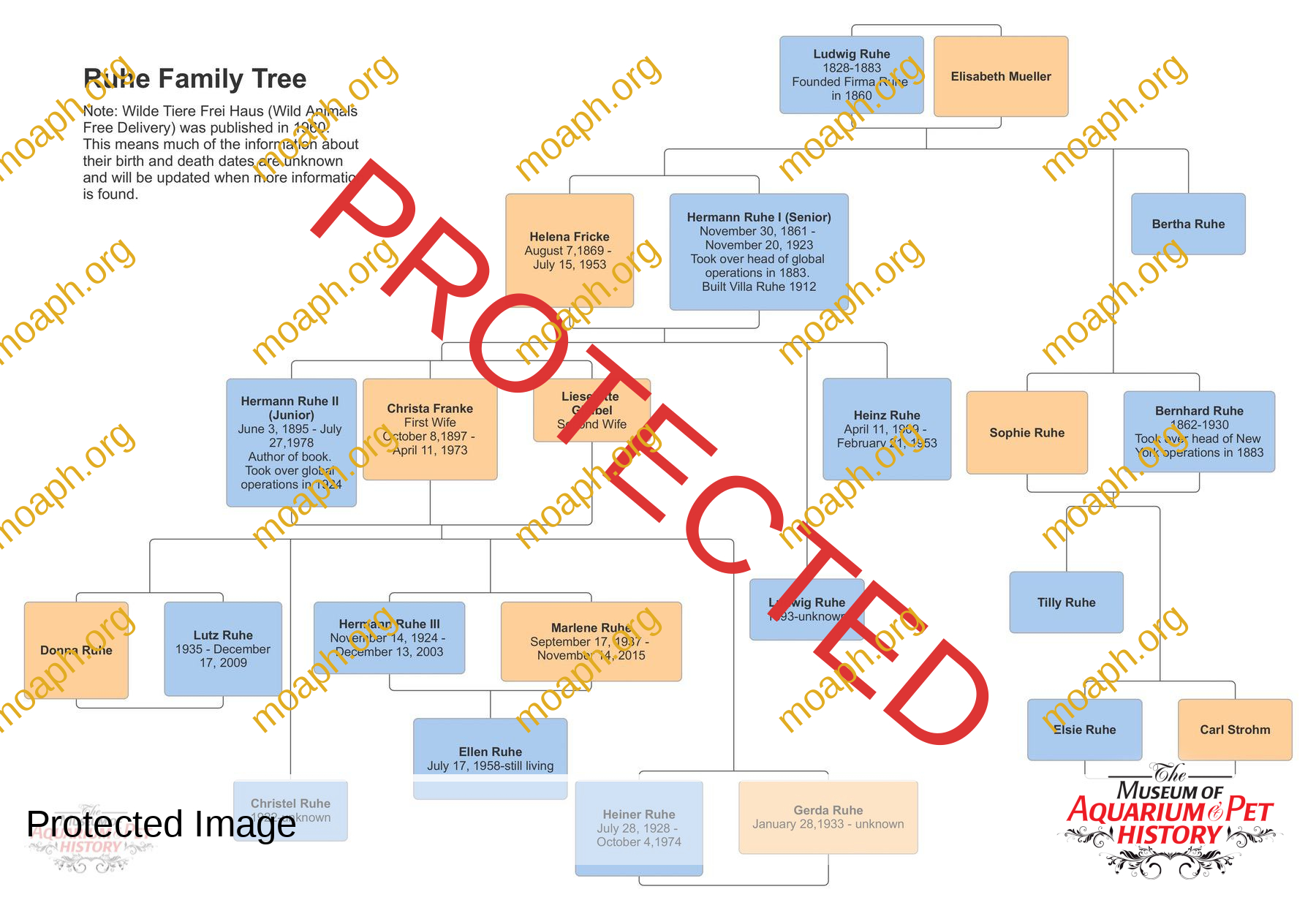
Ludwig returned to America. Unfortunately, he could not be as active under Uncle Bernhard’s guidance as it would have been good for him. But he had become an extraordinarily capable expert in canary breeding. It must have been due to unfortunate circumstances in the war, and especially with Uncle Bernhard’s view on the business, that Ludwig had no strong start and did not inherit a sense of entrepreneurship from our father. However, he was a great support for Uncle Bernhard’s efforts in the bird business.
In February 1924, my wife returned from New York, and we settled in the Alfelder Villa. Mother moved to the top floor. She left everything to me, even after the currency reform came into effect and the pension mark became a good means of payment, she didn’t worry about it.
Heinz Ruhe2, now 15, had attended the Alfelder school for a period before joining the business and was learning about commercial matters.
MOAPH2: Youngest brother of Hermann Ruhe.
But Heinz made me worried. He listlessly occupied himself with the shop, where he worked as an employee. He lacked enthusiasm for his work. When I took a trip to Hamburg, I took him with me.
That evening, when I came back to the Alfelder Villa late at night, Heinz was so caught up in his downheartedness that he suddenly burst into tears and immediately went to bed.
“Hey Hey” I said, “what happened, Heinz? Are you almost crying? What’s going on?”
“Oh, Hermann,” he sobbed, “I’m so unhappy in the office. I should have finished my high school diploma.”
“That’s no reason to cry,” I said. “Then you’ll just get your diploma! It wouldn’t hurt if you did an internship at an export firm in Hamburg for another year. After that, you can go to New York. Agreed?”
Heinz beamed, and as he returned to school, where he stayed until his high school graduation in Hildesheim. Meanwhile, I plunged myself even more into work.
Due to the shortened cash payment action, which my father had initiated in 1923 before his death, it was possible to purchase around 40,000 canaries despite the inflation.
These birds now represented the foundation for the start of work with the new money. I had sold them to America for good pension marks, and the birds were snatched from Uncle Bernhard’s hands in New York. He and Ludwig were in the business of satisfying the desires of American buyers, completely in their element, and even on the Bowery, they achieved high prices.
This branch of the company would soon flourish and grow; therefore, I had the fewest worries. Something else was a heavy blow to me.
From Ethiopia came the sad news that Hermann Windhorn, one of our best collectors, had died of typhoid fever after catching and capturing animals at our camp in Dire Daoua.
Hermann Windhorn was 59 years old when he was buried in Dire Daoua. He was the first collector after Kreth, who did not return home. Windhorn had helped in the occupation of Fritz Risch and a number of animal caretakers; they took care of his burial — then they brought the collected animals back to Alfeld.
Good advice was expensive. Hermann Windhorn had known the Empress of Ethiopia. She met with him several times and became someone who helped and supported him. With her assistance, many paths had been smoothed for him, and thus for us.
Hermann Windhorn had also been the one who had initially taken over the large collection at Dire Daoua and had been the one to set up the camp in Ethiopia after the war. This place had been founded by Dr. Vageler, a South West African3, and was located on the outskirts of Dire Daoua4. Within just a few weeks, the entire shipment was sold to zoological gardens in Germany, across Europe, and overseas. The customers were satisfied — and Mother was too.
MOAPH3: A ‘Southwest African’ in this case refers to Namibia, a German colony from 1884-1915.
MOAPH4: Dire Daoua is a city located in Ethiopia
She showed it to me in a touching way. One evening, she had a very special bottle of wine prepared, which I brought upstairs. “I’ve been mulling this over, Hermann,” she said, “I think we need to make a change. According to the will, I’m the executor, and your father had intended this when you were still children. But we need to come to a reasonable solution. I’ll be satisfied if my livelihood is secured, and you’ve already shown that you’ll manage it alone!”
Just a few days later, everything was perfect: Mother transferred her Alfelder business shares and her shares in the Louis Ruhe Inc. company in New York to me. I committed to paying her a lifelong pension, which she hadn’t expected that Father would have provided until now.
“So,” she said after everything had been spread out and sealed, “and now go back to your peace!” For the first time since Father’s death, she laughed as cheerfully as before.
The deeper I delved into business, the stronger my drive to fulfill my duties to not only keep the company going but to expand it with all my energy. Sometimes I spoke to Mr. Darnedde, our senior clerk, about projects, numbers, and everything related. His reports, which summed up the work of my father and the company, were always very informative.
One day he brought me a page covered in numbers. I cast a glance at the document, which I had intended to look at later in the evening, but the numbers fascinated me so much that I read it right away:
1860 to 1920: Average delivery of canaries, wild birds, budgerigars, and other exotic birds to America per year 100,000 pieces × 60 years = 6,000,000.
Feed at least 1 pound of beets = 6,000,000 pounds or 3,000 tons of beets.
A shipping crate = 17 cm long.
17 cm × 6,000,000 birds = Total length of the lined-up crates = 1,020 kilometers long!
A railway wagon is required to transport 2,000 birds by ship. Over the last 60 years, this would mean (and this figure also includes the supply wagons in the earlier years) that 3,000 wagons of birds were seen respectively: a train about 30 kilometers long5.
MOAPH5: About 18-19 miles
Animals from 1900 to 1924 (subtracting the years of the war):
yearly approx. 10 elephants = 200 elephants
yearly approx. 20 camels = 400 camels
yearly approx. 20 lions = 400 lions
yearly approx. 20 tigers = 400 tigers
yearly approx. 200 small mammals = 2000 small mammals
Lions and tigers eat an average of 12 pounds of meat daily during their three-month stay:
800 lions and tigers × 90 days × 12 pounds of meat = 864,000 pounds of meat.
The small mammals eat about 50 pounds of meat in the same period; therefore, an additional 1,000,000 pounds of meat.
“And who says that the animals don’t eat us out of our home,” said Mr. Darnedde.
The quantities of feed were not lost on me, they had to be factored into the sales price. However, in such a summary, the matter took on a different and quite interesting aspect.
One thing became clear to me from this presentation: I had to work tirelessly if I wanted to expand the business that my father had already built up so grandly, as I had planned.