History of the Red Canary
Man’s ability to control his/her environment has followed many diverse routes including shaping plants and animals. One of the more bizarre developments has been the urge to breed a ‘red’ canary.
The wild canary is a largely green little finch, but with domestication, there soon emerged a yellow variation and as this proved a more popular colour for those who wished to keep the bird as a cage bird, many examples of this colour were bred. In addition, there were some very attractive birds that were part green and part yellow which became known as ‘variegated’ birds. But it seems that whether it be in terms of the bird’s shape and size, or its colour some people always want more variety. Hence there developed a craze to produce a ‘red’ canary. I have apostrophized the word ‘red’ as some would claim that such a bird has never been produced and I hope to answer that question.
There were some very early examples of red canaries, but in each and every case, it was proven that these were fraudulent. They were produced by unscrupulous breeders or dealers who wished to make money from their birds. These birds had been dyed and either through bathing or moulting, the new owners were eventually disabused of the real value of their purchase.

Atlantic/Wild Canary (Serinus canaria)
From quite an early period in the development of the domestic canary, there had been attempts to breed this bird with some of its native cousins in the finch family. These hybrids are known as ‘mules’ and canaries appear to be ever willing to mate with whatever finch is put before them. It was seen therefore, that if fertile mules could be produced and many such examples proved to be infertile (hence the name), it might be possible to produce a strain of canaries possessing the genes to produce a ‘canary’ with abnormal colours in its make-up. To produce a bird with red colouration, the obvious bird with which to attempt this would be the bullfinch, however, this soon proved to be a fruitless endeavour as the male bullfinch is incapable of fertilising the hen canary and it is only in the male bird that the red colouring appears.
In the 1920s a German called Hans Duncker, a high school teacher, having an interest in genetics, decided to take up the challenge. He had formed a relationship with a canary breeder who had demonstrated that it was possible, through selective breeding and training, to alter the song of the canary. Duncker came to the conclusion that it should be possible to alter its colouration.
He was one of a group of enthusiasts who took up the challenge, some others were based in Germany, but the story takes us also to the USA and to the UK. But first we need to go back significantly in history. When the Spanish established an empire in South America, along with the vast amounts of gold and silver they repatriated, they also sent examples of the indigenous wildlife. Of these one was the red siskin, a bird then commonly found in countries such as Venezuela. The male bird of this type of finch has bright red plumage. It is not surprising that some early canary breeders should have been interested in hybridising this bird with their own birds and did succeed in breeding some birds with a distinctly orange ground colour. Not only that, but some of the offspring proved to be fertile and when bred back to a canary, produced young that retained the orange colouration when fed with extract from red peppers.
Duncker in collaboration with the local breeder of canaries engaged in some experimentation with this cross, but all they could produce were these coppery coloured birds. Even when they enrolled the services of a wealthy breeder of birds who invested large sums in establishing breeding accommodations and purchased large numbers of birds, they failed to do any better. Lots of other breeders around the world joined in the challenge and although Duncker was able to establish some new laws of inheritance which were of value to bird breeders, he ultimately failed in his quest. His later pro-Nazi party writings on eugenics led to his contribution to the quest for the red canary to be played down.
It was some time later when an English breeder of canaries (Gill), noticed that red siskins, if deprived of their normal diet, lost much of their red colouration that the answer to the puzzle was suddenly resolved. It had long been known that the feeding of plant matter that contained carotenoid would deepen the yellow of a canary giving it an orange hue. Red peppers had for some time been fed to a Norwich canary to gain that effect.
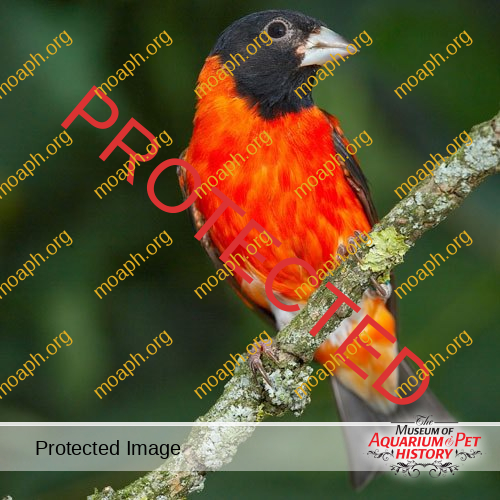
Red siskin (Caruelis cucullata)
But, it was much later that a dye derived from a form of shrimp, known as ‘carophyl’ when fed to hybrid-bred canaries turned their feathers quite red. This is the same substance that turns flamingoes a pink colour. It seems that the influence of the genes from the red siskin go some way, but not all the way, in converting the carophyl into a red feather colour, the yellow genes remain in the make up of the hybridised birds and this means that, as yet, no truly red canary has been developed. Carophyl fed to non-red factor canaries will only have the effect of turning the feathers an orange colour.
It is interesting to note that the canary used in these experiments was the roller canary and early examples of what became known as ‘red factor’ canaries were quite small birds, and far removed from the much larger birds that now represent the exhibition type of red canary.
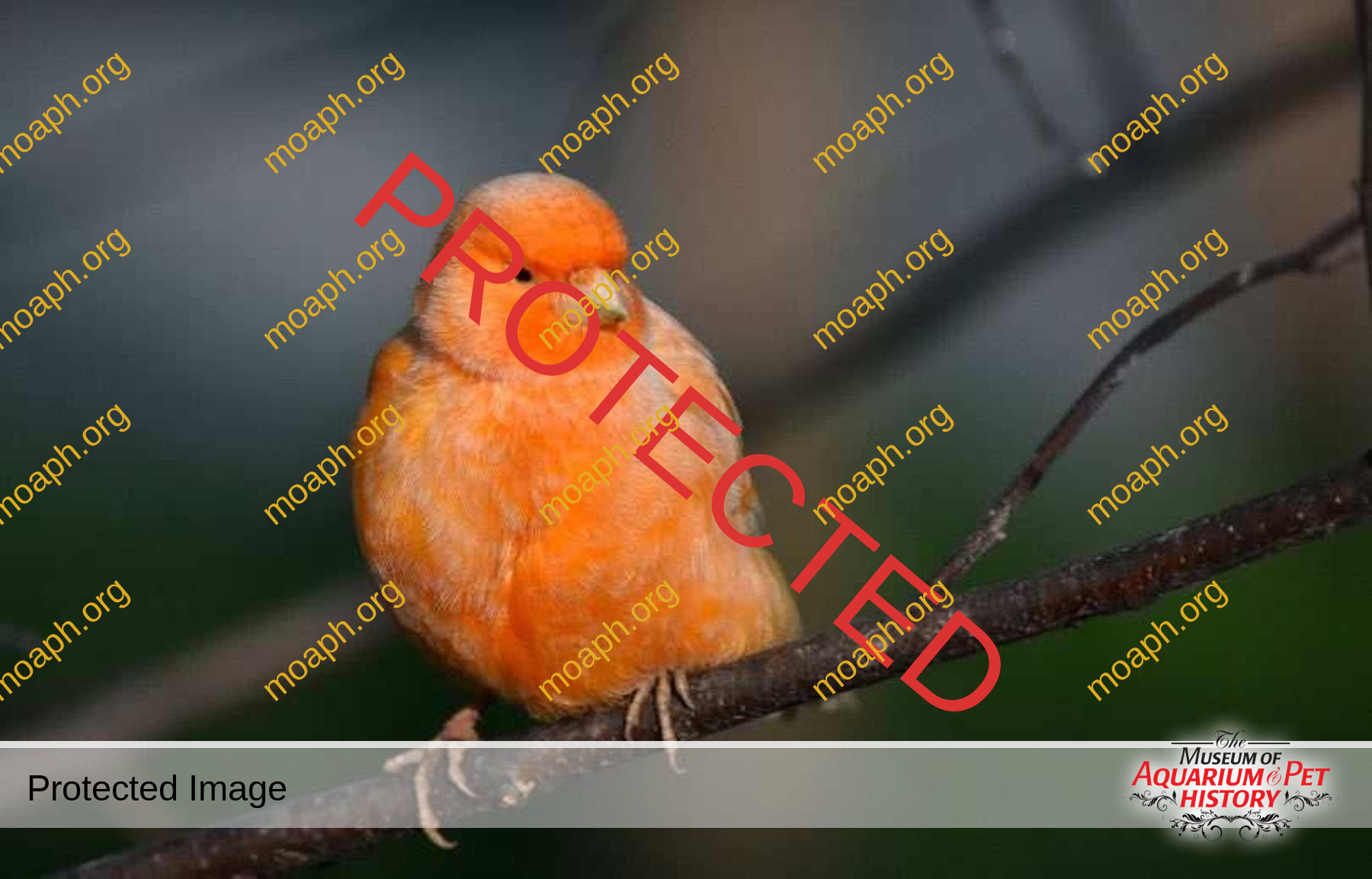
Red factor canary perching

Red factor canaries that have been colour-fed with carophyl.
Is this a case, and if so, the first instance we know of, of genetic modification? Well, in a sense yes, as through hybridisation, the genes of one bird, changed the nature of another. But later instances of where genes of one species were artificially introduced into the embryos of another species, are what are now considered to be instances of genetic modification. So, it is debatable whether canary breeders were actually the first to genetically modify a creature.
Tim Birkhead in his excellent book: The Red Canary, which actually deals with much more than this single topic, suggests that the red siskin is now extinct in the wild. Well, that is not the case and the bird can be found in Venezuela, Colombia and Trinidad and Tobago, but it is threatened. Having said that, it is frequently bred in captivity, including somewhat bizarrely, in some colour mutations, which usually reduce the influence of the red colouration (pastel birds). It was recently reported that the wild bird was increasingly under threat owing to people catching the birds to be sold to breeders attracted by a $400 price tag. This practise of over-stating the value of wild caught birds does nothing to enhance the reputation of conservation bodies, as cage bred examples are regularly sold for less than a quarter of that price and they might be expected to sell for more than wild caught birds.
I am not aware of anyone currently attempting to progress this project, and without some much more invasive form of genetic modification, it does not seem likely that a true red canary will ever emerge.