On the Track of What Might Well Be America’s First Aquarium Book
As I write this, the publication of the first two aquarium books in the United States has been documented (Finley, 2008). Both were published in 1858, and they are, in order of publication: “Life Beneath the Waters; or, The Aquarium in America” by Arthur M. Edwards; and “The Family Aquarium; or, Aqua Vivarium” by Henry D. Butler. Granted they were produced close to each other, but priority is priority. In this piece I am presenting some initial results of my investigations into a book that would have a date priority of 1857 and therefore become the first American published aquarium book. This book was apparently published by P.T. Barnum’s American Museum to coincide with the opening of the first public aquarium set up in the country (in 1857, not 1856 as is often stated). I say apparently in that I have not seen a copy of the publication and as far as I am able to ascertain this piece is the first mention of it in 166 years! So, I am on the edge here.
Quite a few years back while researching the early opening of Barnum’s aquarium I ran across a September 1857 ad for a magazine named “Life Illustrated” which noted the current issue having an article on “Ocean Life at Home.” This seemed promising, so looking for the magazine I went. It took a very long time before I finally located a library with the title listed among its holdings. This was the Lamont Library at Harvard University. They kindly accepted me as a visiting researcher, and I was able to get a copy of the article from an old microfilm roll containing the magazine. As is not uncommon with such items the copy was not ideal and some areas were difficult to impossible to read. But most of it was there. The hunt went on for a better copy. Time passed. Research continued. I was finally able to locate a library (Buffalo, New York, Public Library) that had bound issues of the magazine. They kindly provided me with a great PDF copy of the article from an original hard copy. I was finally able to read everything! I am very happy working from such copies. And then, after a year or so, guess what showed up one day on eBay? Well, copies be darned. I had invested so much time (pleasantly, I must add) with this publication that I just had to add an original copy of the issue containing the article to my library. As Picard would say “Make it so.” And it was.
Now, to the book. In the article the following is noted in upfront information regarding the new aquarium at the American Museum: “The proprietors have published a small pamphlet descriptive of the plan, and have very politely allowed us to present the readers of Life Illustrated with its principal features.” (Anonymous, 1857e). This was an exciting find, and I went looking for some type of confirmation/explanation for the comment. It, as it always seems to do, took some time but I was finally able to locate the following piece in an editorial comment column of a Buffalo, New York newspaper for October 1, 1857: “A New Pleasure.” – Such is the title to a neat, little pamphlet description of an Aquarium, with complimentary tickets of admission to Barnum’s Museum, New York, received from Messrs. Greenwood & Butler, proprietors. Of Course, those who visit the Metropolis will not neglect “Barnum’s Museum,” which is the best thing of the kind in the country.” (Anonymous, 1857h). Finally, I had two confirmatory mentions of the publication.
Now, regarding the publication: the word pamphlet as used today doesn’t really make one think of a book. But in times past the word was often used for what qualified as smaller books. Murray (2009) has discussed such items and noted that Barnum’s Museum would for some exhibits prepare an additional specifically aimed publication with more detail than that offered in their larger general catalogue. The price charged for these was minimal. Regarding one such publication she noted the following: “This “pamphlet” is in fact a small book of 38 pages.” There is no information as to how many pages this aquarium piece may have, but from available information there are four illustrations, which in a small sized book would probably take up a page each. In addition, the article adapted from the piece contains 2312 words, which though not excessive, is still reasonable in wordage.
I have looked far and wide in databases, on websites and talked with many people and have yet to find any trail or information leading towards a copy of this small book/pamphlet. I would be very interested in hearing from anyone who might have any comments regarding this.
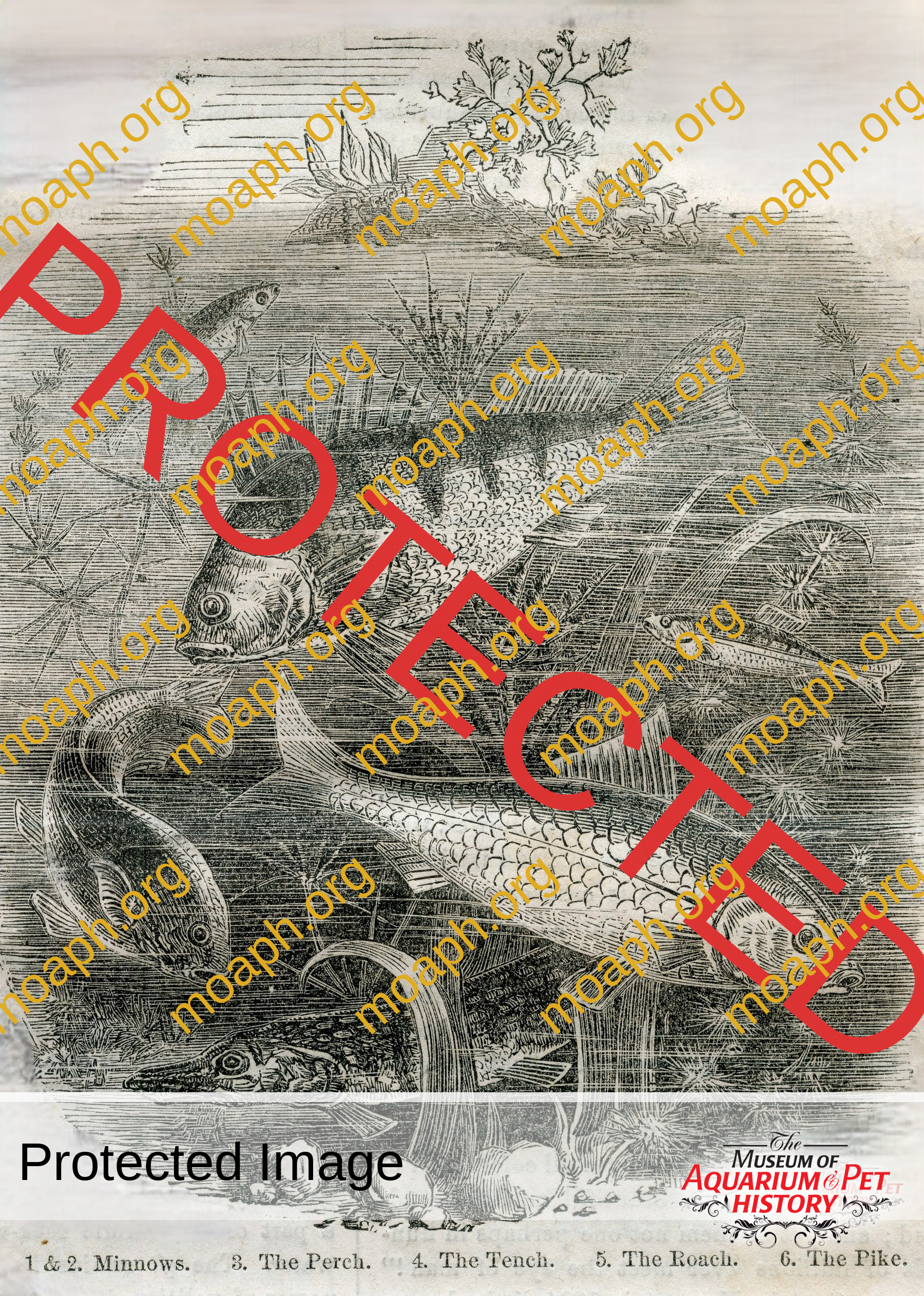
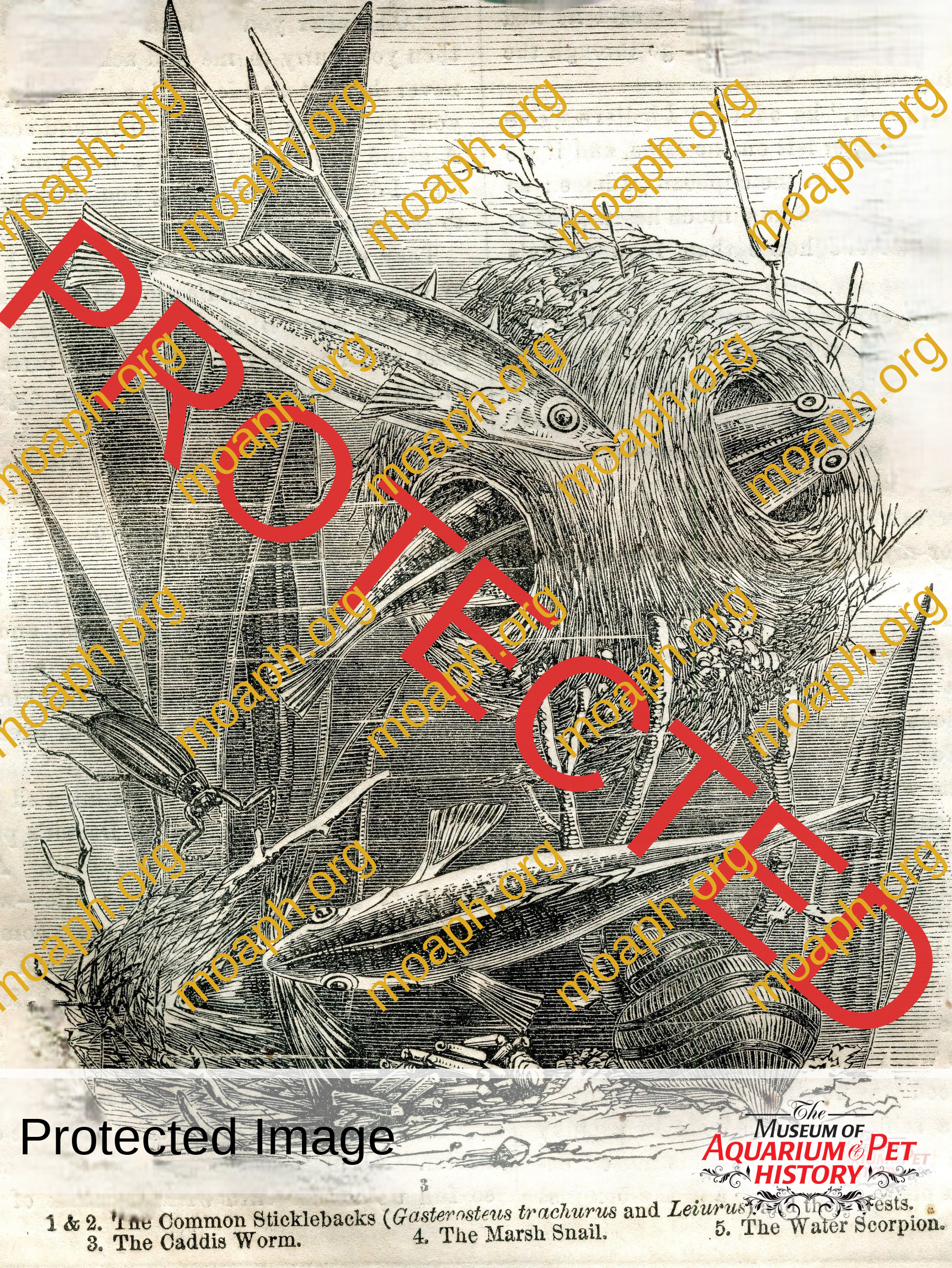
With the above in place, I now present for your possible interest the text of the “principal features” of the aquarium as they appeared in “Life Illustrated.” Attempting to cut and paste the text into a smooth reading style would be problematic, so I have worked to present the text spellings, punctuation, italicization, etc. exactly as they appear in the publication. The four illustrations that are present are included. A note needs to be made on the Byron quote heading off the text. This is not present in the “Life Illustrated” presentation. It is taken from the article which appears in the “New York Observer” (Anonymous, 1857f). In that the Byron quote has appeared previously in a U.K. aquarium-based article (Hall, 1856) I am adding it on the premise that it was probably used in the Barnum “pamphlet.” For more on this see the Discussion below. Following the piece, I will make some additional comments regarding the presented content.
A NEW PLEASURE.
THE AQUARIUM.
“ ’Tis said that Xerxes offered a reward
to those who could invent him a new pleasure.”
-Byron.
The Aquarium (or, as they sometimes call it, the Aqua-Vivarium), is simply a fish-globe on a comprehensive scale, and one in which the water is never changed, but is furnished with living plants as well as living animals, whose natural operations render that change superfluous! This fact enables the Aquarium to assume, in skillful hands, all of the multiplied beauties of the fresh-water pond we are familiar with, and of the “great deep” to which adventurers “go down in ships.” Hence it becomes an Ocean or a River Garden, according to its formation, and you have, as your taste may dictate, the designs and scenery of the bottom of the Atlantic, or those of the bed of the Hudson, with all the mysterious phenomena of nature accompanying life beneath the billows! There the finny tribe disport amid the coral grottoes, enjoy the cool arcades of oceanic vegetation, make affectionate advances in their mossy retreats, or wander through the water flower-beds where the purple and gold Laurencia, the brilliant blue Cadophorae, the glittering crimson Delesseria, the pearl-tinted Choudras, and the rosy-hued Coralline, presents an infinite variety of loveliness rivaled in novelty and gorgeous beauty by nothing in the way of the picturesque upon dry land.
A drowned fish led to the construction of the Aquarium! Strange as it may seem, for years the most civilized nations of the earth have, through ignorance of the great phenomena of animal life, derived pleasure from contemplating the drowning struggles of goldfish in globes, whose final suffocation is only prevented by frequent change of water. The experiment is easily tried. We have only to place a small fish in a basin of water out of the cistern, and wait for the result. It may struggle on for a few days, and then, being drowned, its body will rise to the top of the water as other drowned bodies do. Or place it in a vessel containing cold boiled water, which by boiling is deprived of oxygen, and even as the minutes pass, so quickly arrives the moment of its suffocation. And why? Because water in its natural state contains oxygen. This is exhausted by the animals which live in it, and is constantly replenished by showers or the leaves of growing plants. Now the cistern-water placed in the basin would contain this necessary gas, but not being replenished by rain or growing plants, this fish would exhaust the stock. As all animals take up oxygen and throw out carbonic acid gas, these fish, while consuming the life-giving principle, would be accumulating a sure poison and the result must be suffocation or death by drowning.
The Aquarium itself may be of sizes and kinds, from colossal and costly to the most simple and inexpensive. And yet each, by the exercise of judgment and refinement, may be made to form an attractive and interesting picture, more pleasing than a masterpiece of the Dutch school, particularly those of still life, in which the combination of colors forms the artist’s greatest merit, and without which dead game, cut vegetables, boiled lobsters, and the like, would have little to satisfy the educated eye of fastidious connoisseurs. The endless variety of colors of the animal flowers themselves — the graduating tints of red, brown, and green plants–the richly sea-tinted boulders and rock-work, and the bright sand and shingle forming the base of a marine vivarium, are the principal materials. Little swimming fish, bright serpulae, and molluscs, stand in place of the artist’s touches. The crystal water itself, transparent and thoroughly pellucid, gives to the whole the appearance of the most beautiful enamel. And yet (unlike the representations of life produced by the brush of the master, re-presenting at all times but the one idea that conceived it), the mimic rock-pool or coast scene is ever changing, as the animals expand or close, or the floating objects move or settle, as their nature prompts. These living pictures never satiate. Who can say the same of the most finished masterpiece of art? How often does the owner pass it by, long familiar with all its beauties and merits, as if it were but lumber encumbering the walls!
Before the Aquarium all other curiosities sink into objects of secondary interest. Beside it stands the crowd, lost in silent admiration of the wonders of the deep, contemplating in the little elegant madrepores or corals, the rise and progress of reefs and lands, extending for many hundreds of miles, all formed by the untiring labors of animals in themselves so insignificant as almost to be unnoticed, till subjected to a close and careful examination. There, too, spread out in a beautiful parterre, are animal flowers unnumbered. The sea-anemones of the coast alone furnish an endless variety, all borrowing the names of the flowers they resemble. There is the bellis, or daisy, with its variegated disc; the mesembryanthemum, or fig-marigold, rivaling the most elegant chrysanthemums of the garden; and the dianthus, or pink, the most beautiful of anemones – both the latter boasting almost all the colors of the rainbow. Then there are the antheas, or sea nettles (so-called because if rudely handled the tentacles raise a blister on the skin like that which a nettle produces), arrayed as it were in lilac shot silk, of such beauty and exquisite color as to leave Lyons, Spitalfields, and Coventry no hope of competition, and make many a fair visitor recall to mind that Solomon in all his glory was not arrayed so beautifully as these. There, too, are to be studied are the curious habits of the starfish, the serpulae, holothuriae, and echini, the sensitive variegated tubular-worms, the sea-cucumbers, and sea-urchins; the lobsters, crabs and prawns, and that efficient mower, with his scythe-like tongue, the delicate and fastidious periwinkle, whose presence is a necessary check on vegetable overgrowth in a well-stocked aquarium.
“I love clear-water, Jacob,” said Mr. Turnbull, “How many hours have I, when a boy on board ship, hung over the gunwale of a boat, lowered down in a calm, and watched the little floating objects in the dark-blue unfathomable water beneath me—objects of all sizes, of all colors, and of all shapes—all of them beautiful, and to be admired; and yet of them not one perhaps in a hundred of millions ever meet the eye of man!” So wrote Captain Marryat in 1834, little dreaming that in less than a quarter of a century those beautiful forms would be almost as familiar to the eye of the most delicate lady in the land, as they had been to the rough weather-beaten sailor in that passing day.
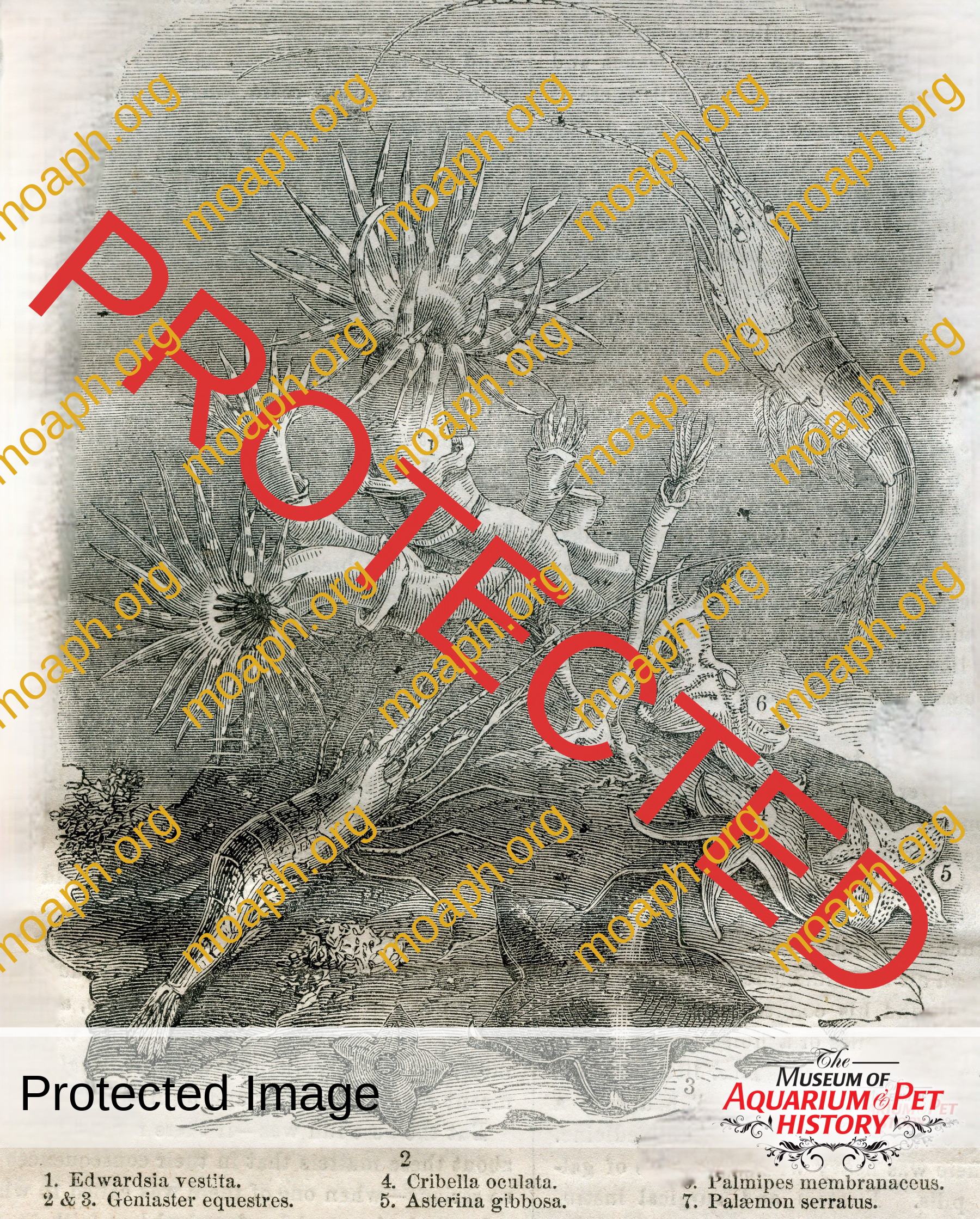
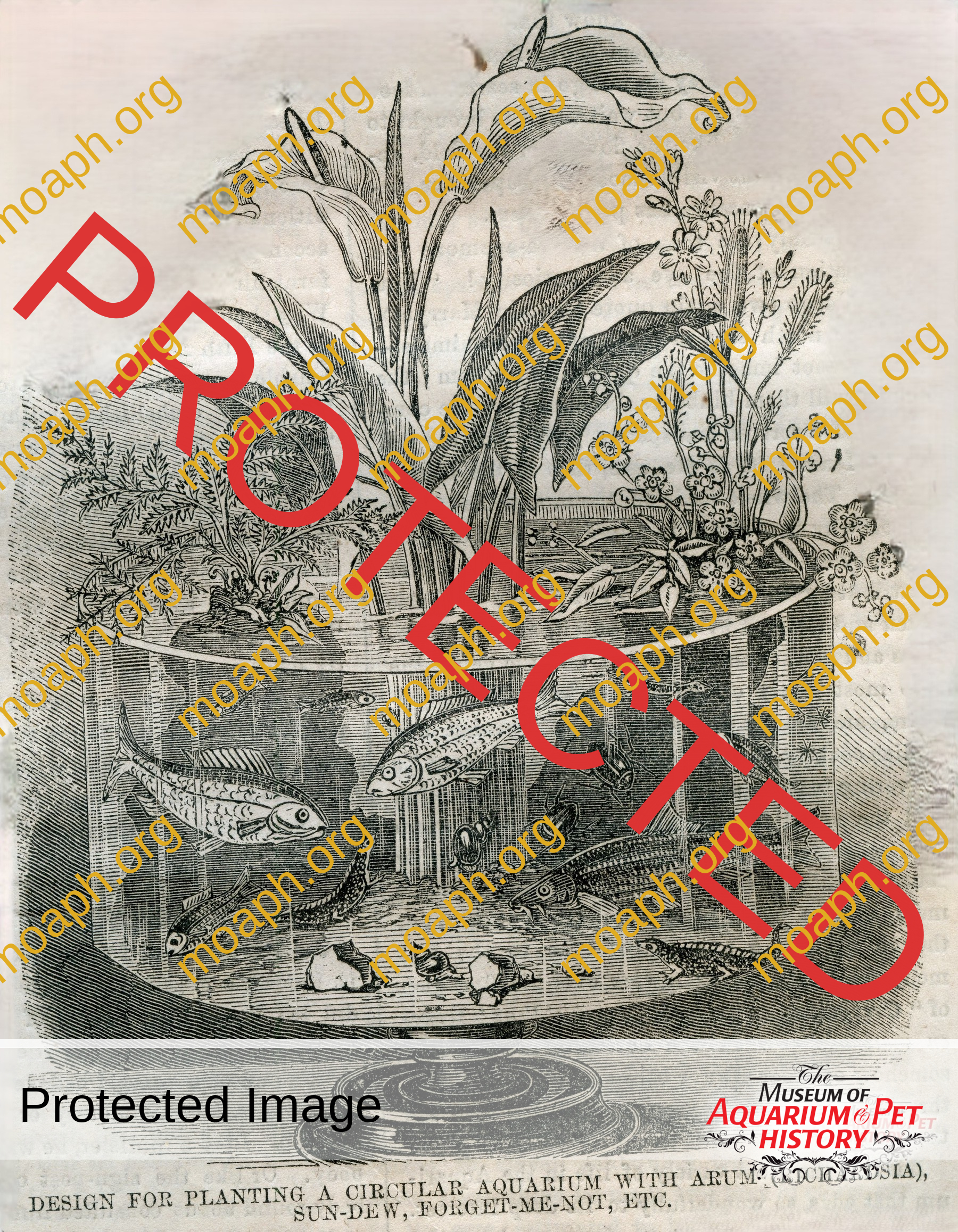
The Zoophytes (plant-like animals), and among them the sea anemones, attract as much attention in these aquaria as the fish. It is hard to say whether they are animals or flowers! They look and act like both. We know that they entrap their prey. We see them move from place to place. And yet they do not go in search of food as other animals do, but wait till it is brought to them, subsisting, like flowers of the field, apparently without visible food, only upon the element in which nature has placed them.
Is the only use then of the sea-anemone the gratification of the eye and curiosity? “You know, Jacob (we again quote Captain Marryat), that the north seas are full of these animals—you cannot imagine the quantity of them; the sailors call them blubbers, because they are composed of a sort of transparent jelly; but the real name, I am told, is Medusae, that is the learned name. The whale feeds on them, and that is the reason why the whale is found where they are.” But they are not only food for the whale, and thus contributory to human comfort; they are also eaten and relished by man himself, and the dianthus and gemmacea—the pink and the gem—the two most lovely of the species, says M. Dicquemare, are among the dainties of Spanish and Italian cookery, and, boiled in sea-water present “a shivering texture somewhat like calf’s-foot jelly, and the smell is somewhat like that of a warm crab or lobster.” They are then eaten with savory sauce. Mr. Gosse’s method of cooking them is simpler. He fried some in butter, and, though hesitating and doubtful as to the first mouthful, like a young novice over the first dish of ”Grenouilles en fricasée de poulet” or “frittes en marinade” — when the action of swallowing somehow or other always becomes reversed in the throat — he soon overcame his scruples and ate them with relish.
But it is the great variety of life in the Aquarium that adds so wonderfully to its deep interest. For this reason small fish are far more beautiful objects in an aquarium than those of larger growth. By means of fragments of granite, marble, hard stone, and yellow boulders or flints, a pleasing subaqueous landscape is produced, setting off to great advantage the delicate tints of the clean green plants. The latter have the roots, or lower parts of the stalks, where roots are not requisite, fastened to a stone of sufficient weight to keep the plants themselves in the bottom they are intended to occupy, and these must then be covered up and hidden by the shingle. Among these the fish gambol, and the combination is so beautiful that we realize at once the abode of Undine, while fancy peoples the fairy land before us with the warm hearts that “live under the waters cold.” The gold and silver fish, dace, Prussian carp, bleak, roach, and indeed the whole roach family, minnows, gudgeons, and bream, become happy denizens of the aquarium as well as eels and miller’s thumbs, or bullheads. Small perch only are admissible only where small fish dwell. The large perch must be kept with companions of his own size, for he has great relish for all fish that he can swallow. Small pike thrive very well, but they too must only keep such company as they are freely permitted to devour. The stickleback is very interesting from his pugnacity; but that very quality shuts him out from the very best society. It requires less oxygen than other fish, and is very tenacious of life. It loves to live in a crowd, and yet withal, like the minnow, the stickleback will recognize the hand that feeds it, and readily follows it for the food it knows to be forthcoming. It has more knowledge than most fish; and the male gives an example of wedded life which we may profit by. He builds a nest and when his house is ready he installs his mate into it. There is a score or more of these aquaria just being opened at Barnum’s Museum, New York, embracing a variety of fresh and saltwater crystal ponds, with a capacity each from ten to one hundred gallons. They are enclosed within walls of plate glass, and cover several hundred square feet of surface. In these aquaria the stickleback may be seen to perfection. Here she deposits her eggs, and during the whole period of incubation she guards the nest, aerates the water, and when the young are hatched, teaches them how to swim, with the same earnestness as a cat watches the first attempts of her kittens to run alone. In every little stickleback one male, by a coup d’épine, assumes the sovereignty. You easily recognize him. He is clothed in gold and purple.
The newt and eft, the frog and toad, are among the most amusing inmates of a fresh-water aquarium; but a merciful regard should be had for the two last, and when they cease to possess gills, they should be liberated, or they will die. This is not the case with the eft, though for amphibia generally the aquarium should be so furnished that a part of the mimic rock-work rises above the water. The eft retains its tail, and with it the power of volition in water, which enables it to rise to the surface to breathe, having accomplished which it descends at once to the bottom, as if struck by a blow, but speedily recovers, and till breathing time returns, remains actively employed in the water, when the same performance again takes place. The frog during the last weeks of his residence in confinement is the “Mr. Merryman” of the collection. No Grimaldi or Matthews can rival his gyrations. No funambulist or acrobat dare assume half his contortions. If he were not so common he would raise another fortune for Barnum, and make Tom Thumb hide his diminished head.
We have no space to go more into detail in the description of the aquarium; but a faint idea, additional, on the subject may be gathered from the accompanying plates. In London the nobility are furnishing their residences with parlor aquaria. Why should not the palatial homes of the affluent in the Fifth Avenue of New York, and the fashionable thoroughfares of Boston and Philadelphia be equally embellished with this drawing-room “romance of nature?” These “blossoms of the rivers” and seas may afford a world of domestic enjoyment. Every bit of weed and rock, every zoophyte, has its little history, to be pondered on and studied out. Until lately, the only mementos we could bring away of the storm or quiet in that “mighty deep,” to the mastery of which our country owes so much of life prosperity and greatness, were dried plants and beautiful shells, the least perishable of all the forms that inclose life. Our own, alas! soon mingles with the dust to which they are doomed to return, while the dwelling of the periwinkle and the limpet seems to endure for “ever.”
Discussion
My initial thoughts trended towards providing an in-depth review of the “Life Illustrated” presentation. But, as it stands, too many unanswerable questions block this approach. This being due to the fact that it is unknown what additional material might possibly be included in the “pamphlet.” Maybe it is little to nothing, But I will avoid treading and will offer some brief observations and thoughts as considerations for future discussions when a copy of the publication does come into the light of day.
THE BYRON QUOTE: As noted above I believe that this piece was probably published in the American Museum “pamphlet.” The quote is from Byron’s epic poem “Don Juan” which was published in sections between 1819 and 1824. It’s use as relating to aquariums was published in England by Mrs. S.C. Hall in May of 1856 in “The Art Journal.” This is an outstanding article that is a must read regarding early aquarium experiences.
THE ILLUSTRATIONS: Four illustrations, which are reproduced herein, were used in the “Life Illustrated” presentation. It is assumed that these were also used in the “pamphlet.” These illustrations are reproduced from the works of English author Henry Noel Humphreys. In 1857 he had two aquarium books published: “Ocean Gardens” and “River Gardens.” Later in the same year both volumes were combined and published under the name “Ocean and River Gardens.” These are beautifully illustrated with hand-colored illustrations. But, as fitting for the time uncolored engraved versions were adapted for use in a variety of other American publications which joined in heralding the “New Pleasure” (Anonymous, 1857 d,g,i and j) available to the American public. Barnum must have really enjoyed one of these – the design for a circular aquarium – as it was used for the frontispiece in the two editions of “An Illustrated Catalogue and Guide Book to Barnum’s American Museum.” Additionally, it would also turn up in seemingly unrelated places such as the frontispiece of the small 30-page Pamphlet/Booklet “History of Commodore Nutt,” which was published for the museum in 1862.
THE TEXT: This is worth an entire piece on its own. Basically, the text presented is liberally “adapted” [a kind word] from three aquarium-based articles that were published in England in March of 1857 (Anonymous, 1857 a, b, and c). Sections of text are reprinted in the Barnum piece sometimes with minor changes being made. The text is ripe for review and explanations of certain areas. The anonymous author of the English articles (my working assumption is that they are all written by the same author) references very little (that is also kind) and a good dissection of them (which I have already started) with overflow into the American Museum use of the work is considered a worthy project towards the early history of the aquarium in America.
This, for now, brings this little excursion in the combined histories of P.T. Barnum and the American aquarium experience to its close. But, hopefully it will be opened again…and in the near future. If this little piece helps bring to light the considered publication, I cannot emphasize how happy I would be. I just really want to see a copy of this! And, even with its faults, be able with exactness to proclaim it as America’s first aquarium book.
Post Script: This piece is being published on, or right around, my 81st birthday. Someone being aware of the book and letting me know would be offering me the very best present ever.
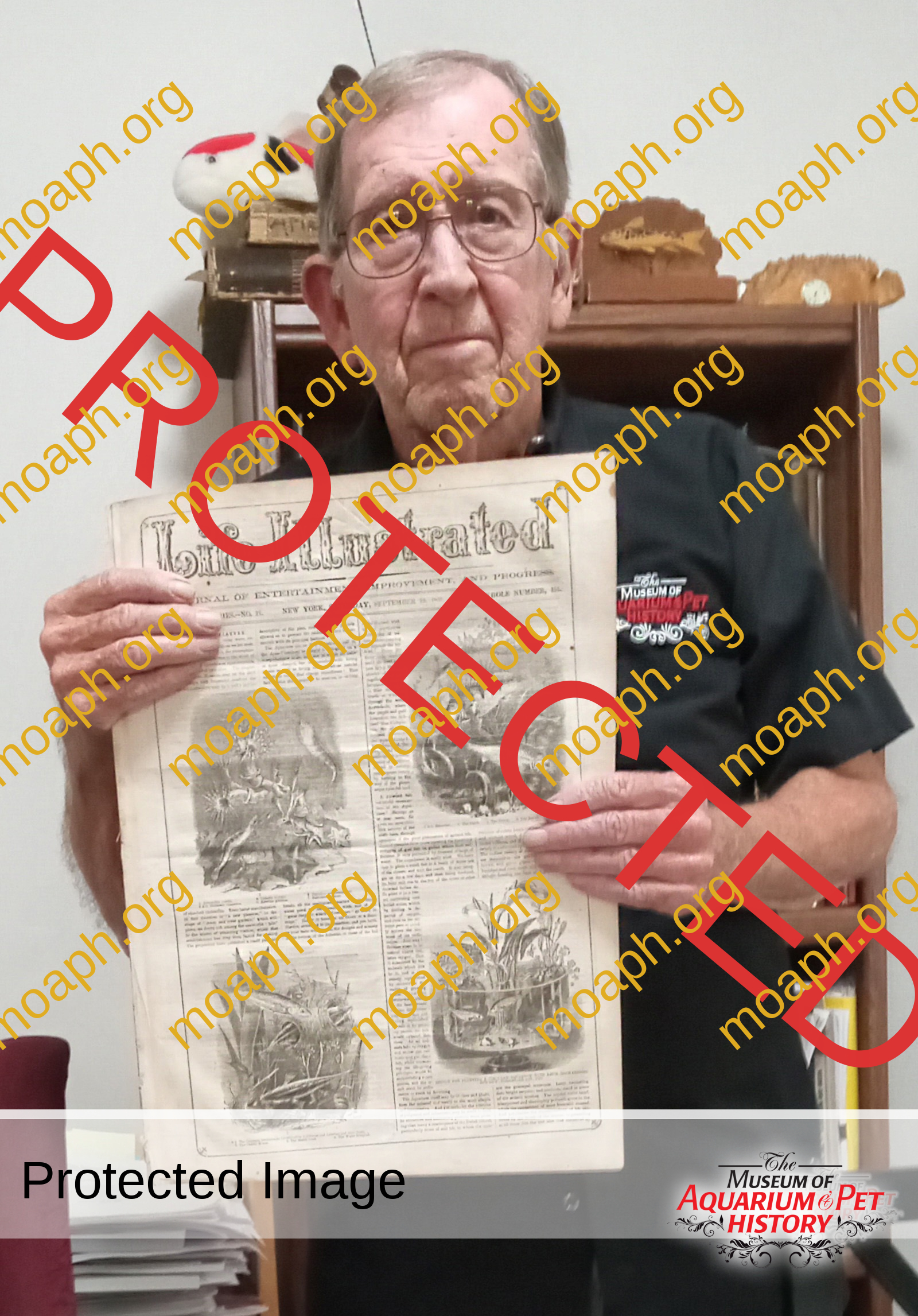
The author and his original copy of the 1857 “Life Illustrated.” Photo by Aline Finley
Acknowledgements
As always, thanks are due to parties that have, in one way or another, been helpful in the production and presentation of this article: The staff of the Buffalo, New York, Public Library and the Lamont Library at Harvard University; Mary Sears at the Ernst Mayr Library of Harvard University is always there to help with such projects; My sister, Carol Campagna, for help with some proofreading (although I will take blame for any oops); Meredith and Gary at MOAPH for putting up with me (especially this month); and always, Aline.
References
Anonymous. 1857a. What is an Aquarium, and What is a Vivarium? The Family Herald. Volume 14, Number 724, March 14: 732-733.
Anonymous. 1857b. Tanks and Sea Anemones. The Family Herald. Volume 14, Number 725, March 21: 749-750.
Anonymous. 1857c. The Fresh-Water Vivarium, its Principles and Stock. The Family Herald. Volume 14, Number 726, March 28: 765-766.
Anonymous. 1857d. A New Pleasure – The Aquarium or Aqua-Vivarium. Frank Leslie’s Illustrated Newspaper. Volume 4, Number 92, September 5: 219-220.
Anonymous. 1857e. Ocean Life in Miniature. Life Illustrated. Volume 4, N.S., Number 21, September 19: 161-162.
Anonymous. 1857f. A New Pleasure: The Aquarium. New York Observer and Chronicle [Newspaper]. September 24: 1-2.
Anonymous. 1857g. Aquaria. Ballou’s Pictorial Drawing-Room Companion. Volume 13, Issue 13, September 26: 197-198.
Anonymous. 1857h. “A New Pleasure.” Buffalo Express And Daily Democracy. [Newspaper]. October 1: 3.
Anonymous. 1857i. The Aquarium. “A New Pleasure.” American Agriculturist. Volume 16, Number 11, November: 256-258.
Anonymous [W.C. Cutter writing as Uncle Hiram]. 1857j. Uncle Hiram’s Pilgrimage [Part Nine]. Merry’s Museum and Parley’s Magazine. Volume 34, Number 11, November: 136-142.
Finley, L. 2008. Notes on Aquarium Catfishes in the 1800’s. Tropical Fish Hobbyist, Volume 56, Number 6: 52-54.
Hall, Mrs. S.C. 1856. A New Pleasure. The Marine Aquarium. The Art Journal. Volume 18, May 1: 145-147.
Murray, L.R. 2009. P.T. Barnum Presents: The Greatest Classroom on Earth! Historical Inquiry into the Role of Education in Barnum’s American Museum. Master’s Thesis, The University of Texas at Austin. August: 102 pages.