Scholze & Pötzschke Part 2: A Penthouse with a Glass Roof – Prominent Customers, the Turmoil of War, and a Second Splendid Catalog
Part 1 of this series focused on the beginnings for Berlin based animal importer, Scholze & Pötzschke (“Schopö”). Founded in 1905 when young aquarists Arthur Scholze and Paul Pötzschke took over Otto Preusse’s Aquarium Institute, Schopö grew from a modest retailer of aquariums, terrariums, plants, fish, birds, and supplies into a major international importer and wholesaler of exotic animals. By the years immediately preceding World War I, Schopö was selling more than a million aquarium fish annually and supplying private hobbyists, pet dealers, zoos, universities, and museums across Europe; its rapid expansion ultimately required the company to lease a vast 1,500-square-meter top-floor facility at Alexanderstrasse 12 (Alexander Street), setting the stage for the next phase of its history.
Part 2 of the series dives into the years Scholze & Pötzschke (i.e. Schopö) spent at their penthouse facility during and after World War I. The Nazi regime affected every aspect of life in Germany, and Schopö was not immune to this influence. Despite the political, economic, and social unrest happening during this era, read how the animal trade and one of the most renowned animal dealers managed to survive and thrive.
Beginning in September 1913, the animal-trading company now known to all its customers—and also to Berliners who had little to do with the keeping of exotic animals—as “Schopö” took up residence in its prestigious new penthouse premises. The old buildings, some of them dilapidated and long since outdated, had first given way to new commercial premises and were eventually joined by imposing department stores. Alexander Street became a popular promenade in the very heart of the rapidly expanding metropolis of Berlin. And so, in addition to its well-known and highly specialized customers, “Schopö” also attracted passersby who wandered into the premises more out of curiosity or by chance. To them, the business was like a little zoo. Although they generated no sales, these visitors—especially children—were tolerated, because they helped make the name “Schopö” known throughout Berlin and far beyond, telling everyone about the strange, dangerous, and bizarre animals that could be seen there. And more than one of them may have caught the bug and taken up the hobby after being captivated by the animals at “Schopö.”
Before the move, the company’s coffers had been well filled. Both the number of animals and the number of species in stock had grown enormously. Although the current green “Schopö” stock lists naturally always included the latest arrivals, Arthur Scholze and Paul Pötzschke wanted to present their rarities with brief species descriptions and, above all, beautiful illustrations. They therefore decided to publish a new catalog. Frank Fritzlen, an antiquarian who operates almost like a living encyclopedia of historical literature, established through painstaking detective work that this magnificent, landscape-format brochure, known as the “Toad Catalog,” must have appeared in early 1913. He demonstrated this by means of an advertisement placed by “Schopö” in issues 14 through 18 (April to May) of Blätter für Aquarien- und Terrarienkunde, which advertised the catalog as containing 236 pages, although it still listed the company’s old address, Alexanderstraße 27/28a. Fritzlen was able to substantiate this dating by examining additional advertisements in these issues of Blätter for various publications on the keeping of exotic animals whose dates of publication he knew. The cover of this second splendid catalog, designed by Curt Scholze, is rendered in shades of brown and shows three toads that cannot be identified more precisely. Two sit facing one another, while a third sits frontally between them.
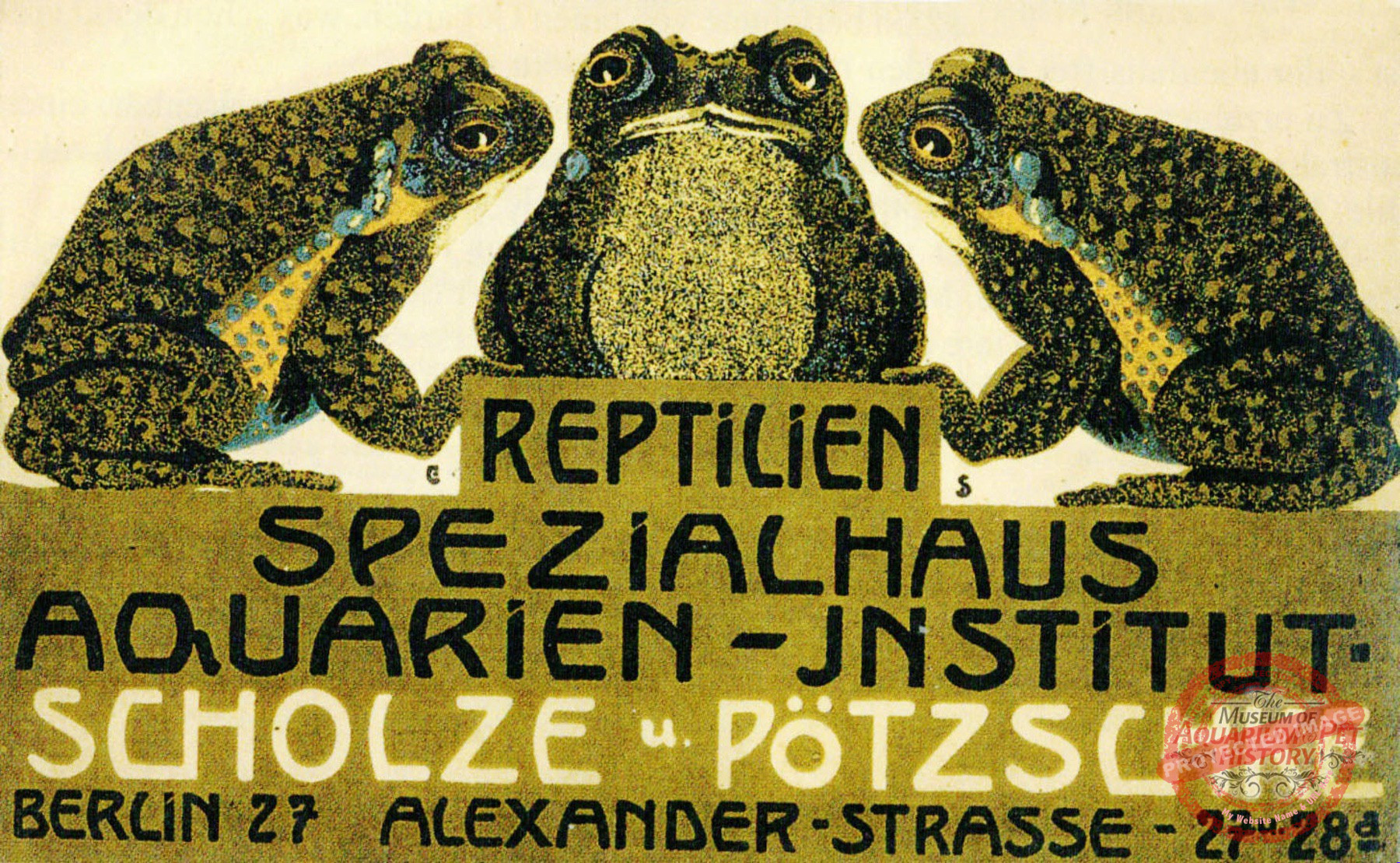
The second “Schopö” splendid catalog was also known as the “Toad Catalog.” According to Frank Fritzlen’s research, it must have been published in early 1913.
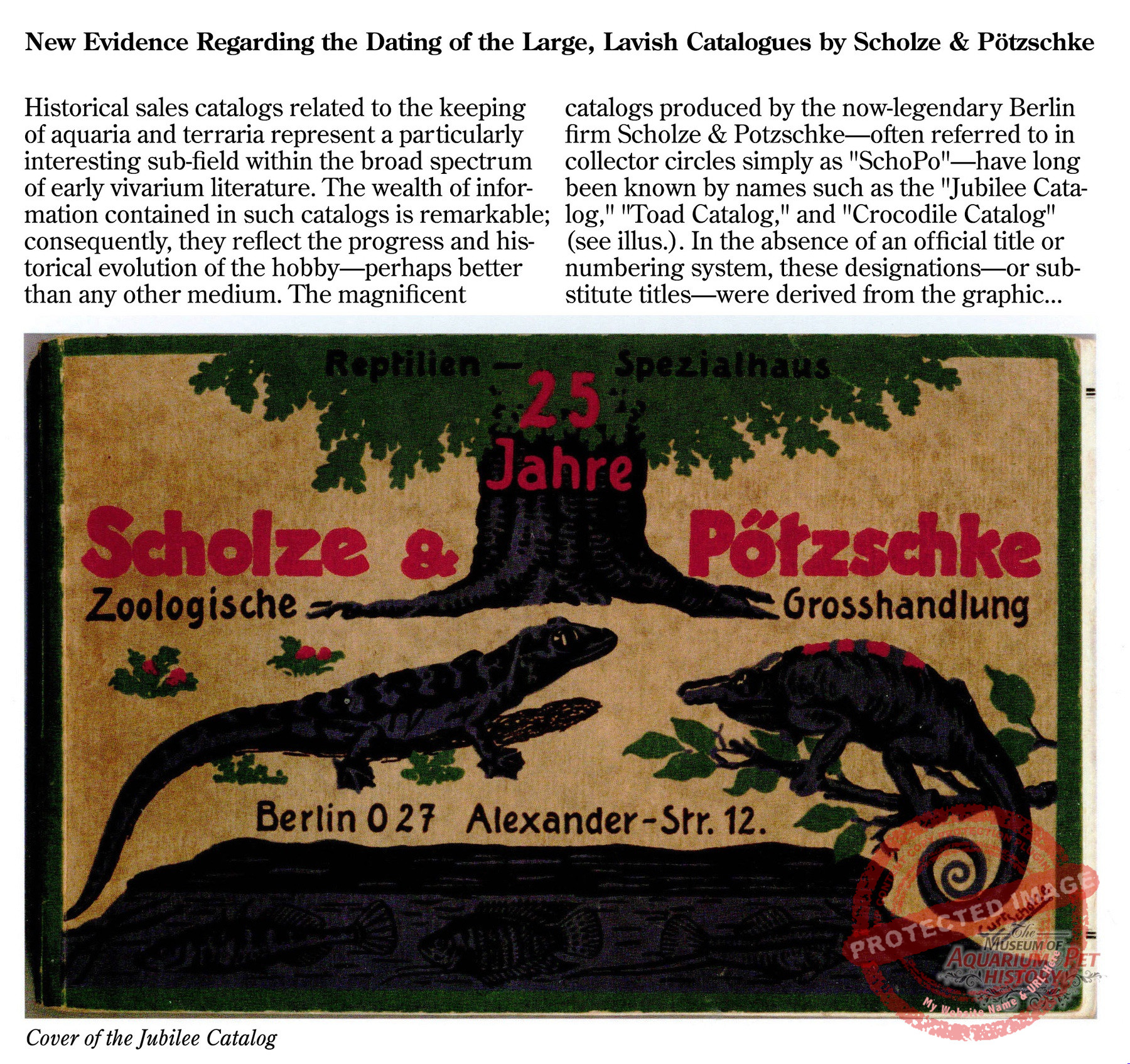
Title page of Frank Fritzlen’s article on the “Schopö” catalogs translated into English. The photo on this page is of the Scholze & Pötzschke 25th Anniversary Catalog, which was published in 1928 and features a chameleon and a gecko. Frank Fritzlen’s article was published in Zeitschrift für aquaristische Literatur 22 (2), 2020.
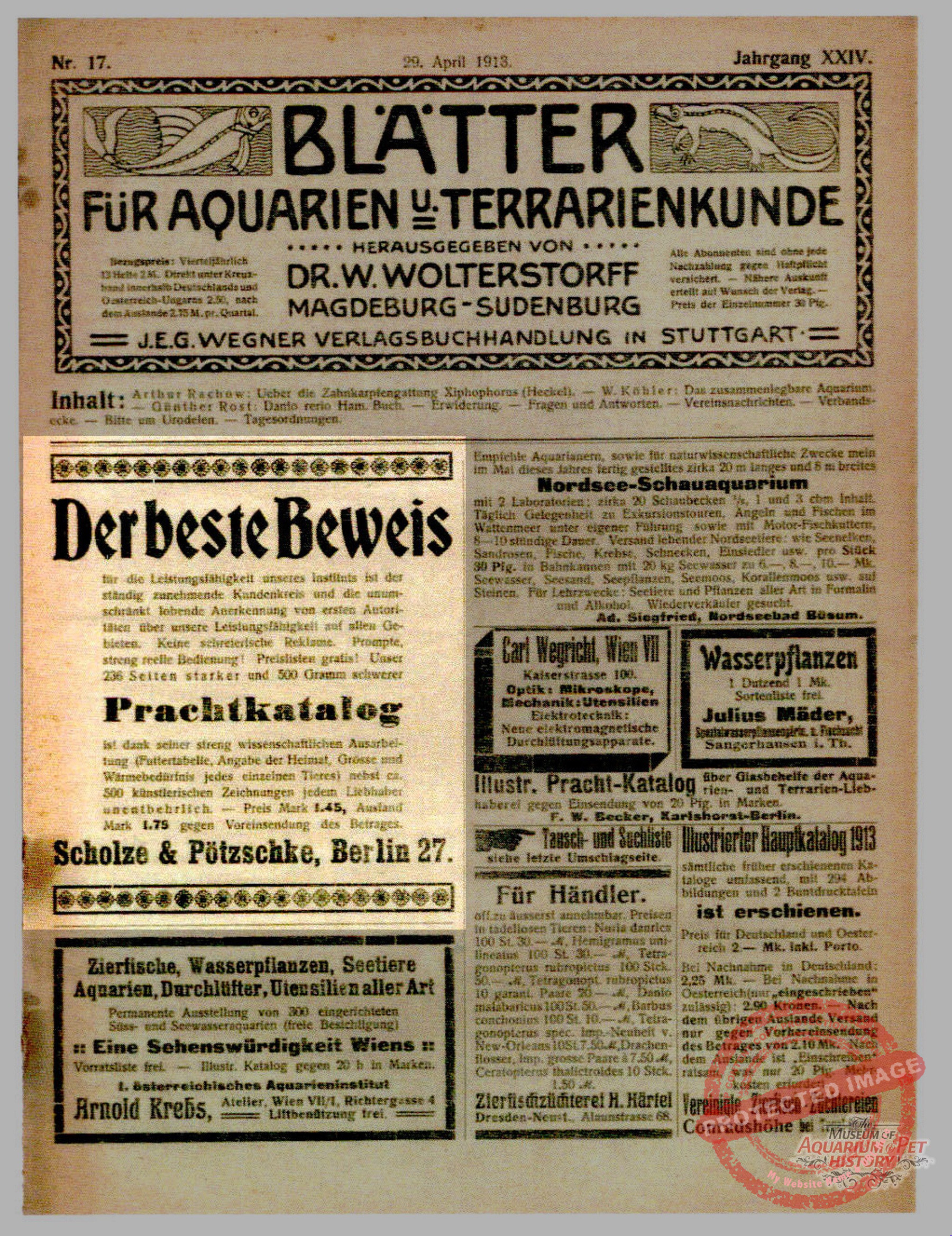
“Schopö” advertisement in Blätter für Aquarien- und Terrarienkunde, No. 17, dated April 29, 1913. The catalog is advertised, but the company’s old address is still given.
The two “animal entrepreneurs” had been counting above all on one circumstance that gave them the courage to invest in both the catalog and the remarkable new premises: in the very year the company moved, 1913, the newly constructed Aquarium at the Berlin Zoological Garden opened its doors. The renowned zoologist Dr. Oskar Heinroth, founder of the scientific discipline of animal behavior, had been planning and overseeing its construction since 1911. Now a synergy emerged: “Schopö” had facilities large enough to house the future inhabitants of the aquariums and terrariums of what was then the most modern public aquarium in the world during their quarantine period. “Schopö” supplied almost the entire animal collection of the Zoo Aquarium, as well as quite a number of its aquariums and terrarium enclosures.

To this day, the new “Schopö” company address from 1913 can still be found in the historical pages of the Berlin Address Book.
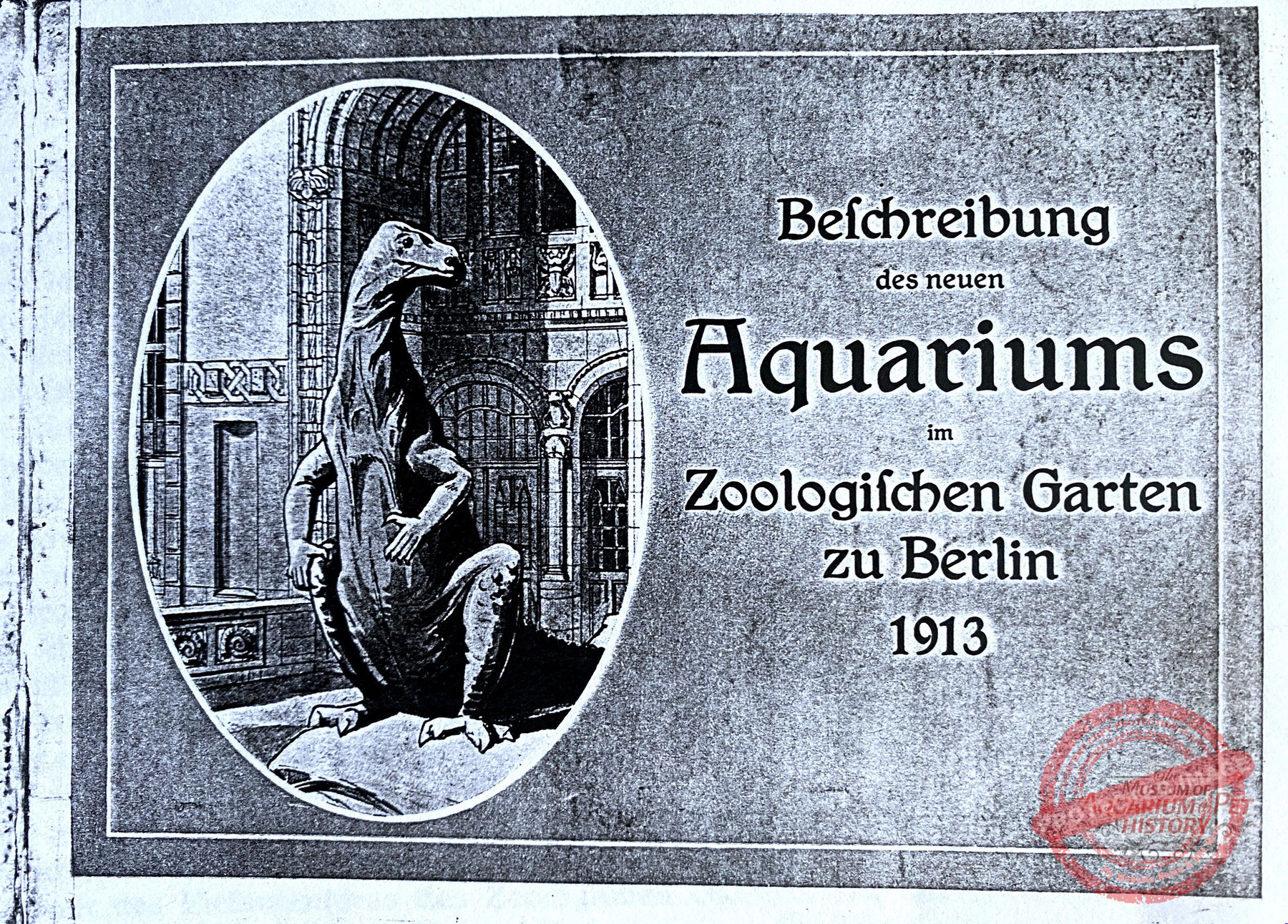
Title page of the first guide to the Berlin Aquarium, written by Dr. Oskar Heinroth.
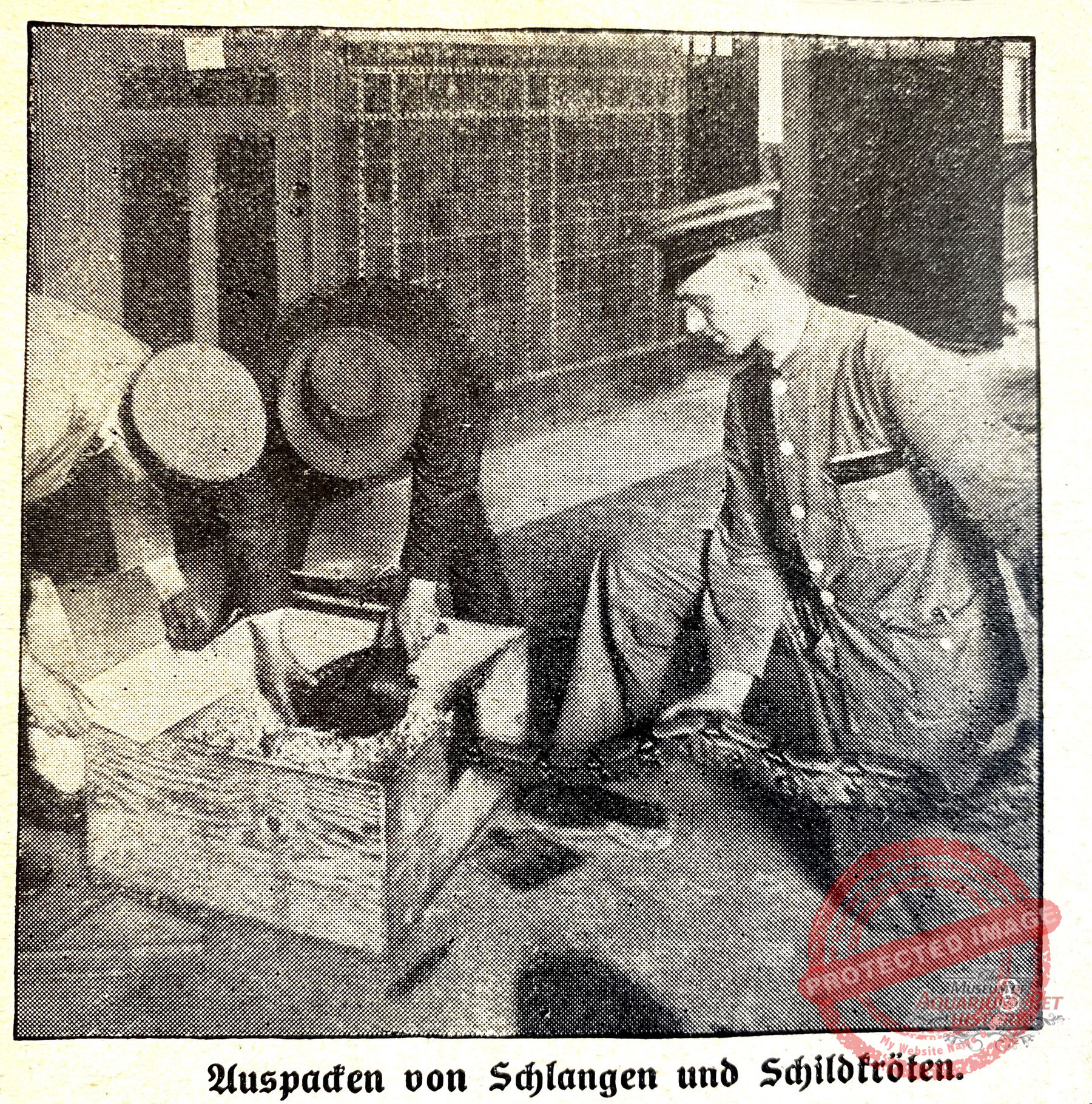
Keepers at the Berlin Aquarium unpacking a shipment of animals from “Schopö.”
Everything had to be finished and all the tanks stocked by August 13, 1913, because the official opening was scheduled for the 18th. Only through the tireless efforts of Arthur Scholze and Paul Pötzschke could this deadline be met. Berliners still remembered the old aquarium founded by Brehm on the famous boulevard “Unter den Linden1 ,” which had closed only shortly before. The new Zoo Aquarium now had to measure up against it. The competition had begun as early as the architectural tender, in which five prominent architects had been invited to submit designs for the project. Prof. K. Zaar, who was experienced in constructing animal houses, decorated both the exterior façade and the interior spaces of the Aquarium building in his design with sculptures, reliefs, paintings, mosaics, and ceramics created by Prof. H. Harder. The result was a pictorial impression of the fossil ancestors of the living creatures that would inhabit the building. It was therefore fitting that the construction contract went to the firm Zaar & Vaal. Once everything had been built and installed, the firm “Scholze & Pötzschke” was commissioned to fill all the enclosures according to the wishes of the zoological director, Dr. Oskar Heinroth. And they did an excellent job. The zoo administration and the crowds of visitors pouring through the doors were delighted.
MOAPH1: The name of the Berlin boulevard “Unter den Linden” can be translated as “Under the Linden Trees.” In 1647, Elector Friedrich Wilhelm had the riding path that Elector Johann Georg had laid out as early as 1573 expanded and developed into a proper, paved avenue. Two thousand linden trees and nut trees were planted along its center. It was not until the reign of the famous Frederick II that this Berlin street truly gained its international renown, thanks to the magnificent buildings he commissioned, including the Staatsoper Unter den Linden, Berlin’s renowned State Opera. The linden trees thus became a symbol of the splendid boulevard, famous throughout the world.
In the first aquarium guide, written by Oskar Heinroth, the many fish, amphibians, and reptiles supplied by the principal supplier, “Schopö,” are mentioned. Thus “Schopö,” already at that time the most important and largest import and export business dealing in cold-blooded vertebrates and much else besides, provided the foundation that enabled Berlin’s new Zoo Aquarium to become, in the very year of its opening, the most modern and species-rich public aquarium in the world. Supplier and customer alike—highly experienced practical specialists on the one hand and respected scientists on the other—dealt with one another as equals. As a result, not only were imported animals successfully kept and acclimated, but in many cases they were also bred. For the Zoo Aquarium, “Schopö” was also dealing in invertebrates for the first time, supplying the top floor of the building, which housed an exhibition of amphibians and invertebrates. Along with all kinds of insects, the first tarantulas, scorpions, and giant millipedes arrived in Berlin at that time.
The zoo’s then-director, Ludwig Heck, apparently wanted to curry favor2 with the famous herpetologist Georg Albert Boulenger at the British Museum of Natural History in London by asking him to send a particularly unusual reptile for the new Zoo Aquarium. Boulenger replied that he would first have to purchase it from “Schopö,” and asked Heck whether he had somehow fallen out with the owners. That was, of course, not the case. “Schopö” had quickly become an internationally respected institution. The company also made an effort to provide the locality data so important to zoologists working systematically whenever animals were sold.
MOAPH2: Curry favor means “to seek to gain favor by flattery or attention”. It’s origins are from a 14th century French satirical poem called Roman de Fauvel, in which the main character is a cunning and deceitful horse named Fauvel. In the story, corrupt nobles and clergy groom and flatter the horse to stay in power. The idiom was originally “to curry (groom) Fauvel”, and overtime evolved into the phrase “to curry favor”.
Soon afterward, another major event was on the horizon: the 25th anniversary of the by-then important Berlin aquarium and terrarium society “Triton,” which was to be celebrated with an impressive exhibition. By this time, both company owners had long since become members of the society and were planning an extensive corporate presentation by “Schopö” at the exhibition. The company’s main display area was supplemented by two additional rooms containing an exhibition of native fish, a display of teaching materials, and a presentation of the embryonic development of a kangaroo—an extraordinary scientific sensation at the time. This was possible because “Schopö” actually had kangaroos hopping freely around its business premises, and they were reproducing there as well.
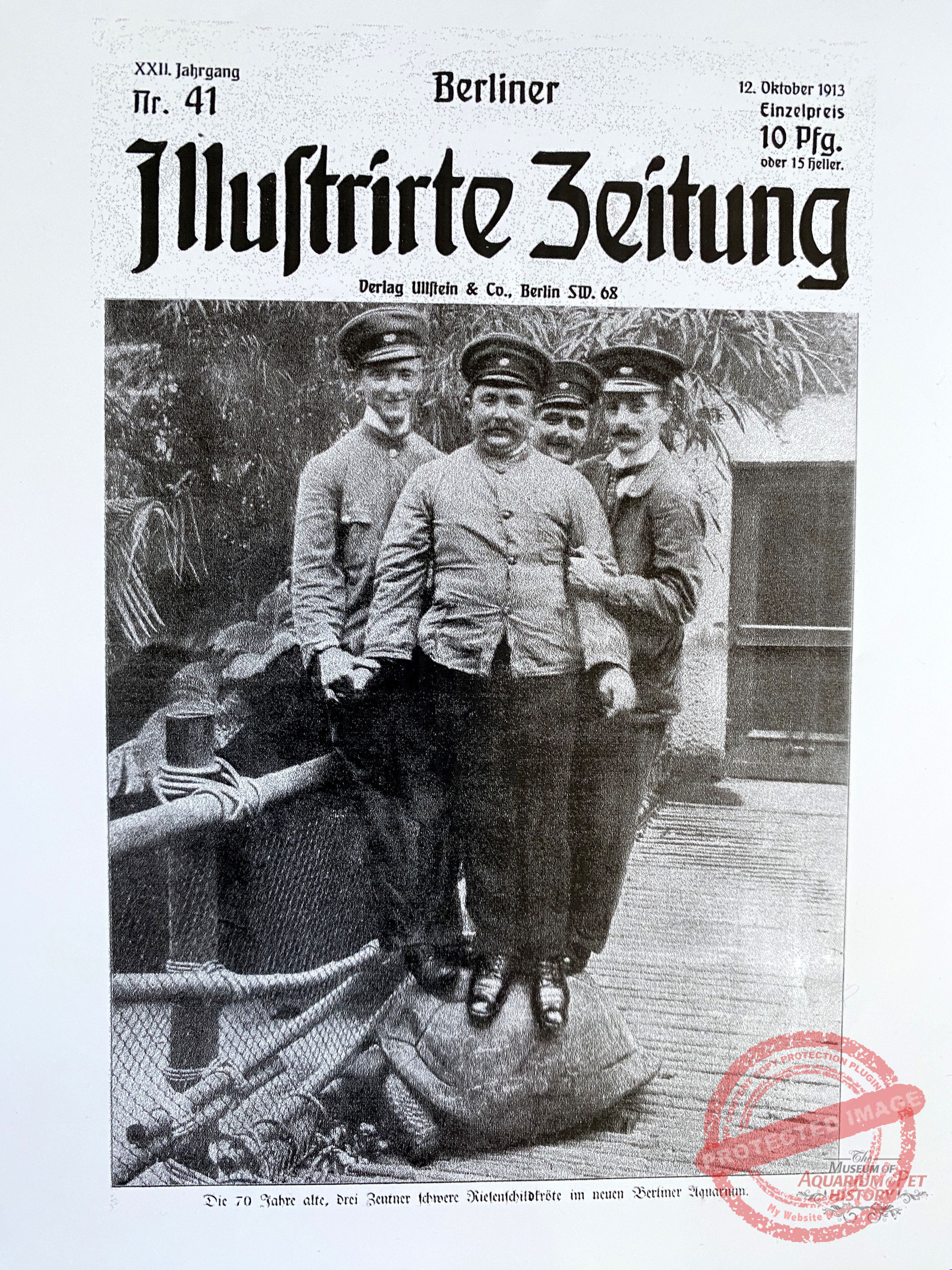
Publicity photographs were taken for the press on the occasion of the opening of the Berlin Aquarium in 1913 and subsequently published in newspapers. This photograph shows aquarium keepers standing on giant tortoises.
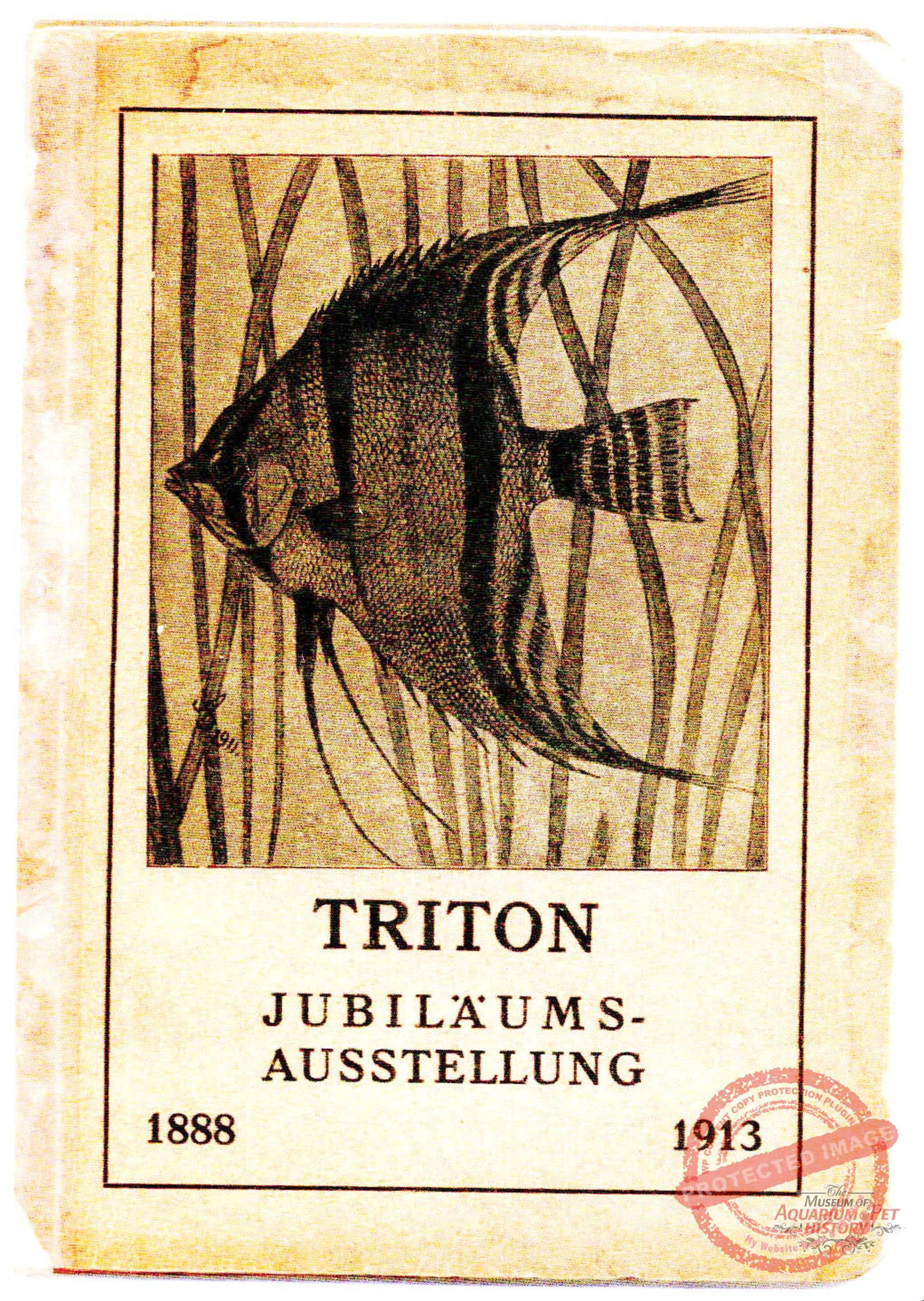
Also in 1913, the Berlin Aquarium and Terrarium Society “Triton” celebrated its 25th anniversary with an exhibition in which “Schopö” played a major role. Shown here is the title page of the exhibition catalog.
This, in turn, was possible because the animal dealers were now keeping large animals for zoos and circus showmen in their spacious facilities. At one time it might be an anteater, a cheetah, or an ostrich; at another, more than 30 kangaroos, one of which presumably had to serve as the subject of research into embryonic development. But the company had obtained reptilian rarities specifically for public aquariums and zoological displays, above all the Berlin one: Komodo dragons, Varanus komodensis, tuataras, Sphenodon punctatus, and various giant tortoises.
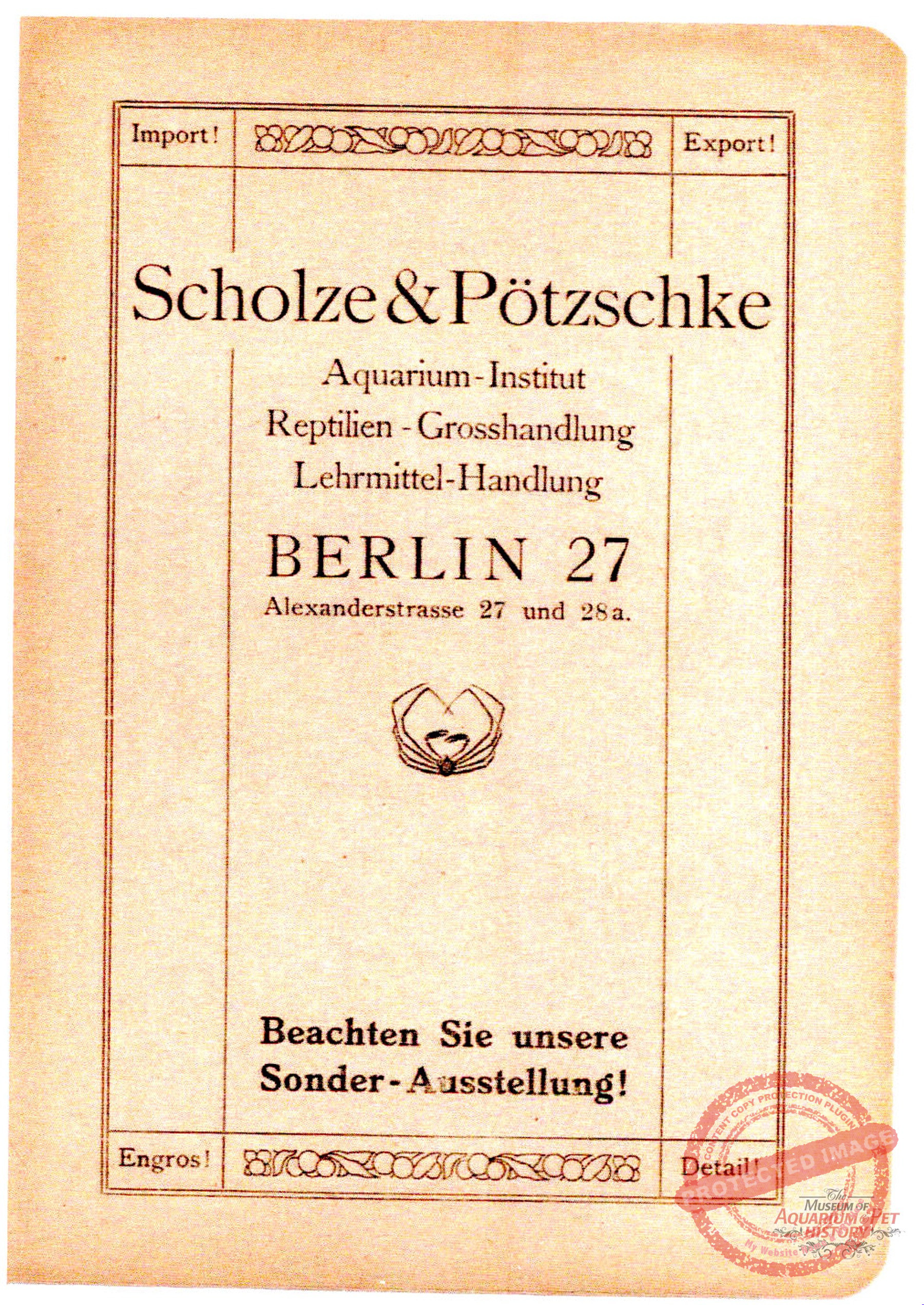
“Schopö” also placed a full-page advertisement in this catalog.
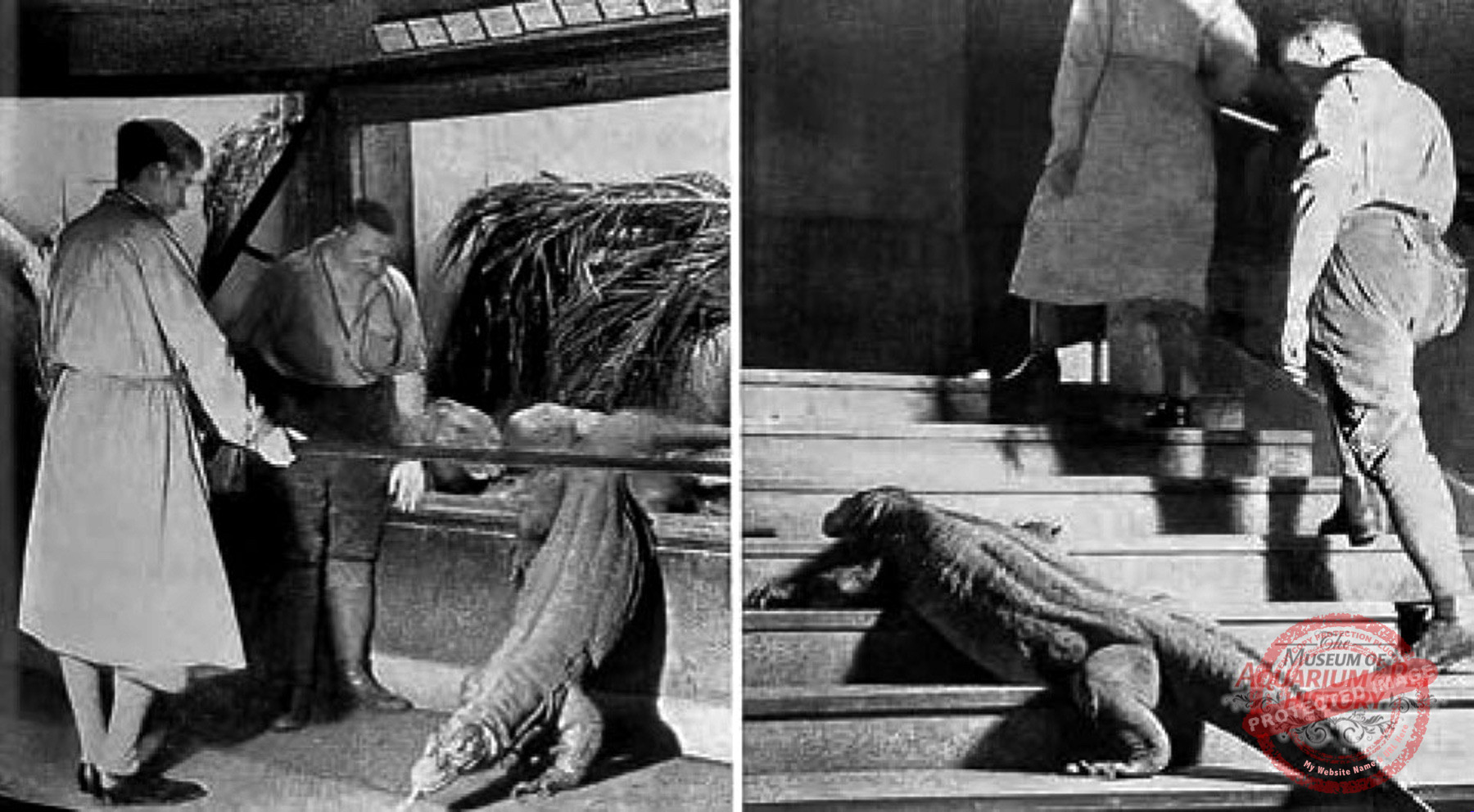
Komodo dragons, Varanus komodoensis, were among the rarities that “Schopö” imported for the Berlin Zoo Aquarium and other zoos. This specimen was named “Moritz” by the Berlin zoo keepers and was so tame that he would walk through the entire Aquarium building alongside his keepers, much like a dog.
During this period it had become fashionable among German showmen and circuses to exhibit adult crocodiles together with a group of young individuals and to spread the story that these were the parents and their offspring. Some of the famous families of the time, such as the Malfertheiners3, even claimed to have been the first breeders of crocodiles. Almost everyone who later recalled fascinating visits to the “Schopö” premises mentioned different animals that happened to be in quarantine at the time—gorillas, Eurasian otters, or leopards. The tame Komodo dragon who later became famous as a resident of the Berlin Zoo Aquarium was probably already tamed at “Schopö.” He was called “Moritz,” often walked through the rooms and up and down the steps of the Aquarium building together with his keeper, and lived until 1944.
MOAPH3: The Malferteiner family was a Thuringian family whose members were circus performers, traveling fairground entertainers, and animal trainers. Their descendants continue to run pet shops to this day.
Interestingly, by 1914 most of the animals exported by “Schopö” were going to Russia. These consisted in particular of canaries, which were being bred in large numbers in Germany, as well as aquarium fish originating from German breeding operations and countless newts and salamanders. Large numbers of large reptiles were also supplied to neighboring European countries, especially to their zoological gardens. On one occasion Oskar Heinroth4 received a shipment of 72 rattlesnakes at the Zoo Aquarium, although he had ordered only six—a transmission error. The surplus snakes were quickly placed with the company’s many other customers. Business was booming, and it seemed that things could hardly have been better.
MOAPH4: Oskar Heinroth was a zoologist with a doctorate who laid the foundations of ethology long before Nobel laureate Konrad Lorenz, who is often credited with being the first behavioral biologist. Heinroth was hired by Berlin Zoo director Ludwig Heck to help establish the Zoo Aquarium and was subsequently appointed its director.
On July 18, 1914, Austria-Hungary declared war on Serbia. On August 1, Germany entered the war, and because of its alliances, many other countries followed, so that World War I spread like wildfire. The war reduced all business relationships unrelated to the actual war economy to a minimum. Trade with enemy countries was prohibited. Paul Pötzschke was drafted as a soldier and sent to the Western Front at Verdun. This was the most terrible and deadliest sector of all the fronts in that seemingly endless war of trench warfare. I know this from the stories told by my grandfather, who was also at Verdun and lost a leg there after being wounded.
Throughout the war, until its end in the autumn of 1918, Arthur Scholze managed the entire “Schopö” business alone. It was a struggle, and the company just barely escaped bankruptcy. Arthur Scholze later spoke about this at a lecture given to the Berlin society “Triton.” He explained that he was able to continue supplying German customers only because some of the imported animals, which usually arrived at the port of Rotterdam (in Holland), were sold there immediately, allowing the company to use the dollar proceeds to meet domestic demand in Germany.
When Paul Pötzschke returned from the Western Front at the end of 1918, emaciated and weakened, the situation did not improve, because the years of the Great Depression and extremely high unemployment followed. People were struggling with existential problems and had little inclination for such things as aquariums and terrariums. Only the zoos, themselves forced to economize, remained more or less reliable buyers of animals.
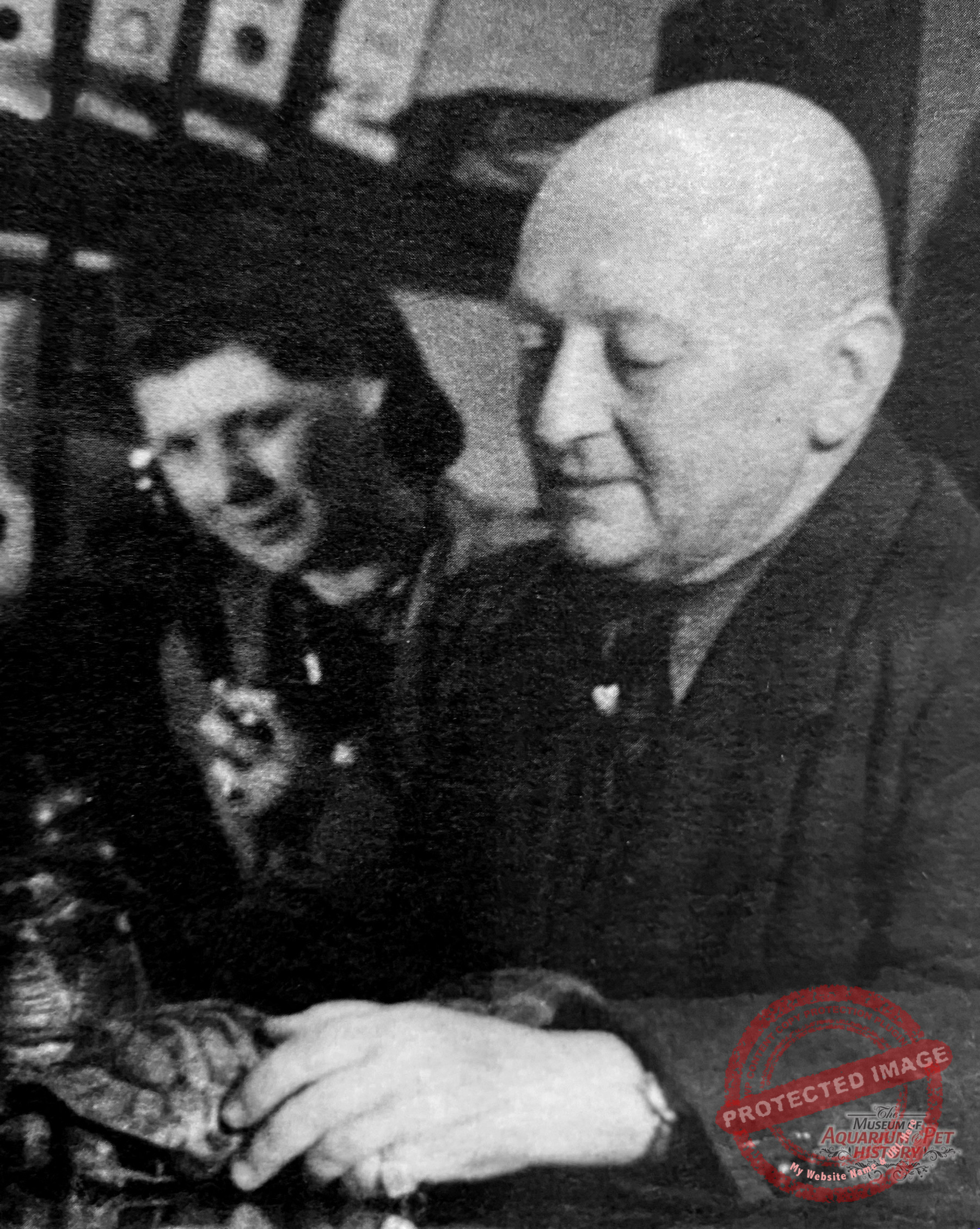
Paul Pötzschke, who had been drafted and sent to the front during World War I, returned emaciated but in good health.
Yet during the 1920s, under the Weimar Republic, Germany’s first democracy, other freedoms once again proved beneficial to the hobby. The new media emerging during this period and reaching virtually the entire population—radio, cinema, and an incredible number of specialized magazines, including publications devoted to the keeping of exotic animals—made possible a freer, education-oriented way of thinking and acting, even though money was tight. People wanted to treat themselves to something, and an aquarium, for example, was considerably less expensive than a piano, a gramophone, or eventually even a car.
The media transformed actors, musicians, and society figures who had previously been known only locally into celebrities known everywhere. People admired them and wanted to be like them. Many of these celebrities lived in Berlin or other major German cities and had brought a little piece of nature into their homes in the form of an aquarium. Who they were and what was published about these stars at the time will be the subject of a later article. In any case, people read these articles and acquired aquariums just like their idols. In this way, aquarium keeping flourished despite the economic crises.
When the Nazis established their dictatorship in Germany in 1933, many organizations and editorial offices, including those connected with the aquarium hobby, were brought under their control. But from their point of view, stimulating the economy was also important. Most of the aquarium fish that today form the standard assortment of pet stores were imported during the 1930s. “Schopö” benefited from this trend and returned to its former size, importance, and enormous turnover.
In Berlin, the Schopö penthouse business, with its many animals, had attained a status almost comparable to that of the zoo, whose admission tickets many people could no longer afford. “Schopö” was free. So people went to Alexander Street 12, took the passenger elevator upstairs, and allowed themselves to be transported into an exotic world. My friend Hans-Albert Pederzani was a regular visitor during this period and later became a student assistant at “Schopö.” In 1998, he wrote down his memories for my magazine. Here is an excerpt:
“I still remember exactly how, at the age of nine, I rode alone, without an adult accompanying me, in the small passenger elevator (there was a large freight elevator at the courtyard entrance) up to the fifth floor of the KJ Building, where the destination of my wishes and dreams awaited me. In the stairwell I was greeted by a tropical landscape—painted on the walls in oil paint. I hardly dared to open the door, but I soon forgot my shyness at the sight of all the wonders that awaited me inside. I was standing in the terrarium department, and all my expectations were surpassed: crocodiles, aquatic turtles, iguanas, giant snakes, chameleons, geckos—I knew all of them from the Berlin Aquarium, of course, but here you could actually buy the animals, if you had enough money. The contents of my wallet were just enough to purchase the magnificent catalog that had been published in 1928 to mark the company’s 25th anniversary.”
The first Prachtkatalog by “Schopö,” issued in 1909,was colloquially dubbed the “Crocodile Catalog”; the cover design was executed by Curt Scholze.
The next installment of this series of articles will deal exclusively with this catalog. It was the most magnificent of them all, once again illustrated with drawings and watercolors by Curt Scholze, who had also created the mural mentioned by Pederzani in the entrance hall. Above it, an inviting inscription read: “Nature offers us wonderful joys—happy is the person who engages with it.” But let us return to Pederzani’s impressions:
“A man in a white coat, who had emerged from the office area through a frosted-glass door, watched me and eventually spoke to me. He realized that I had acquired some specialized knowledge from my reading and led me from enclosure to enclosure without pressuring me to buy anything. He then escorted me past the cash desk through a broad passageway, where gravel was being packed into bags and full-glass tanks and other accessories were stacked all the way to the ceiling on wall shelves, and into the ornamental fish department. A humid warmth struck me. I stood at the end of four long rows of aquariums, plain sales tanks densely stocked with the finest-quality aquarium fish from renowned breeders. There were imports among them, too: leaf fish, Monocirrhus polyacanthus; butterflyfish, Panthodon buchholzi; archerfish, Toxotes jaculatrix; hatchetfish in several species; and countless characins, because tetras had just become fashionable. Two tanks contained Pterophyllum, with the two species then regarded as distinct, P. scalare and P. eimekei, kept strictly separate.”
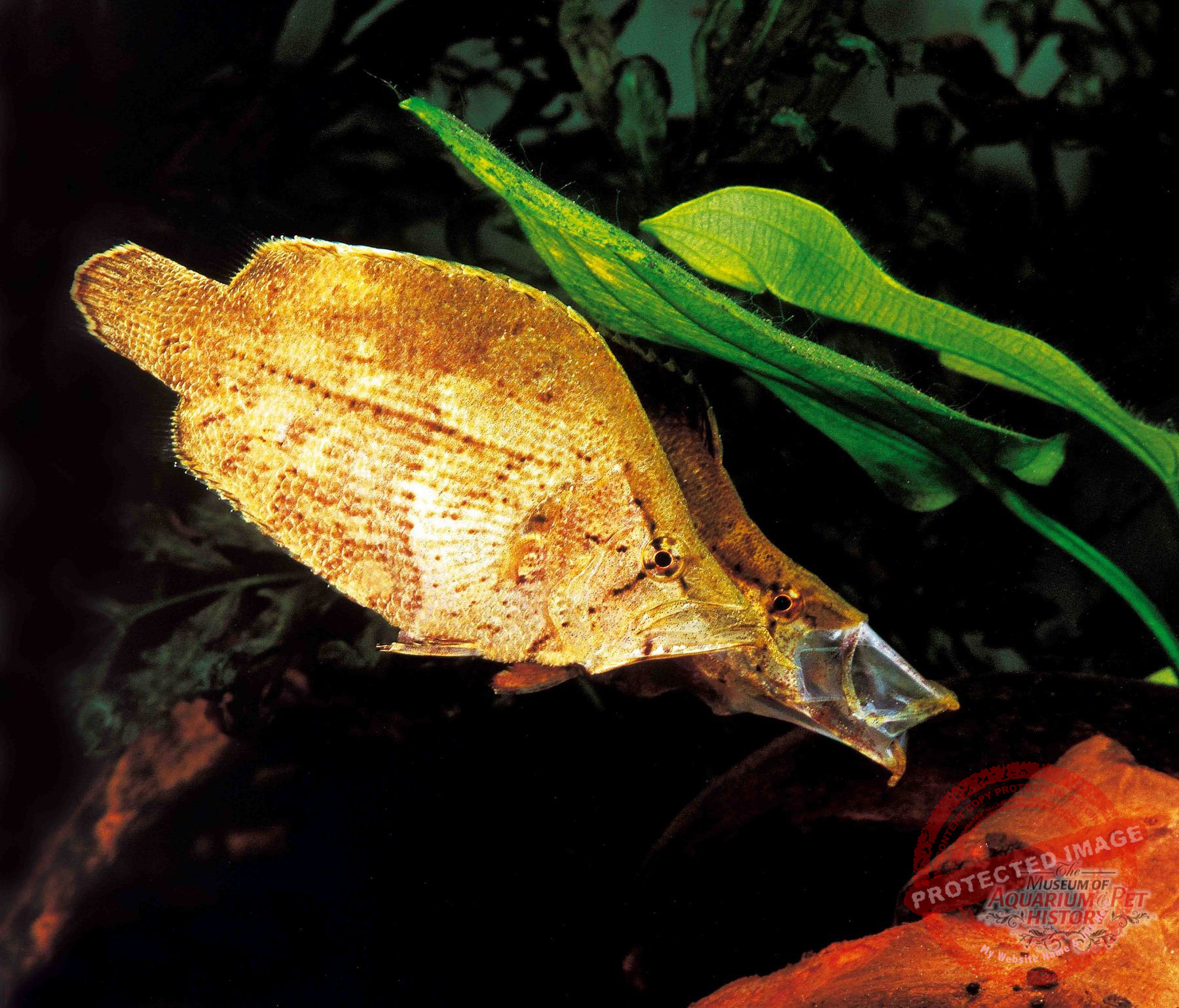
Pederzani had marveled at the leaf fish, Monocirrhus polyacanthus, at “Schopö.”
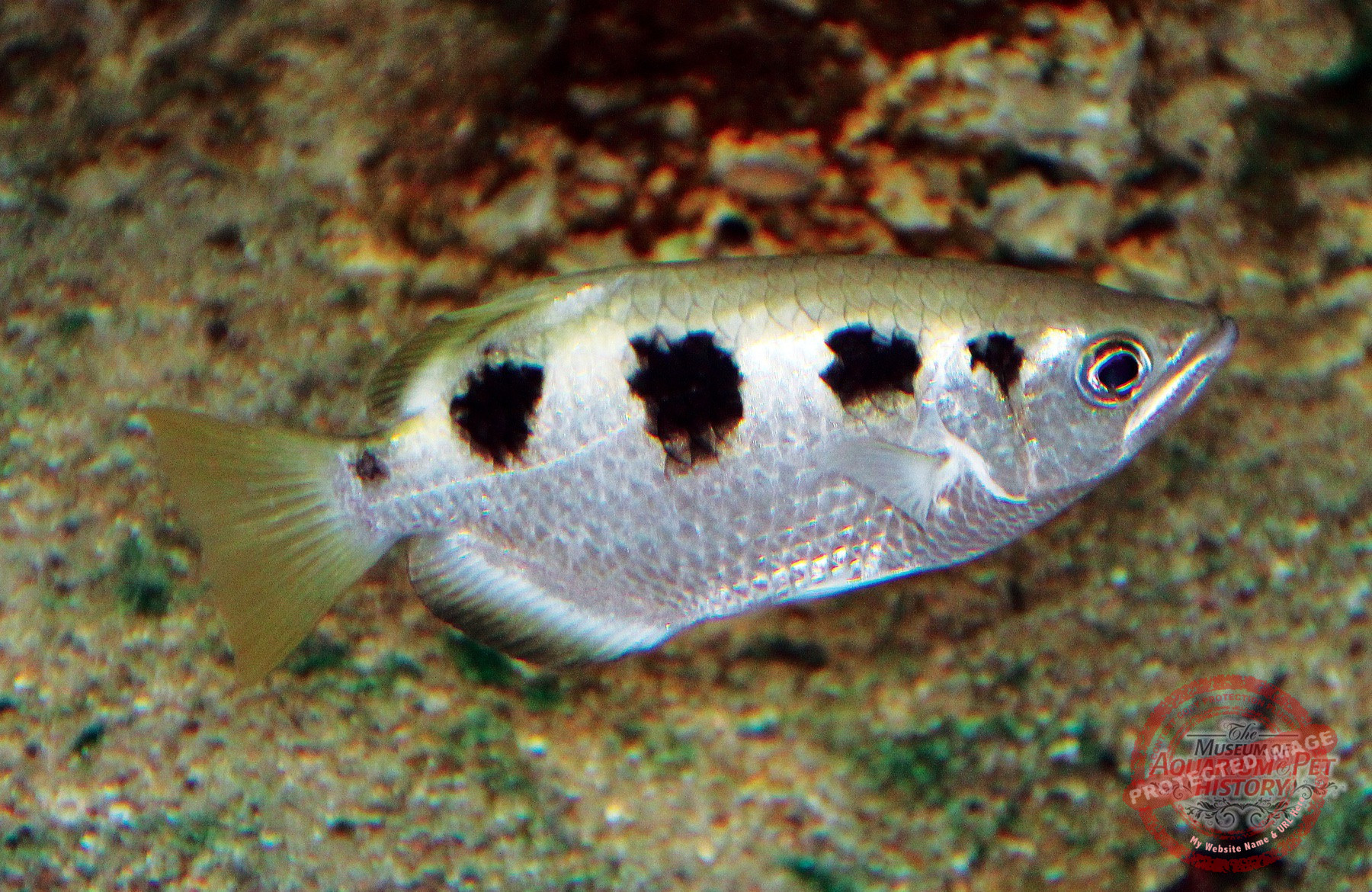
And also archerfish, Toxotes jaculatrix.
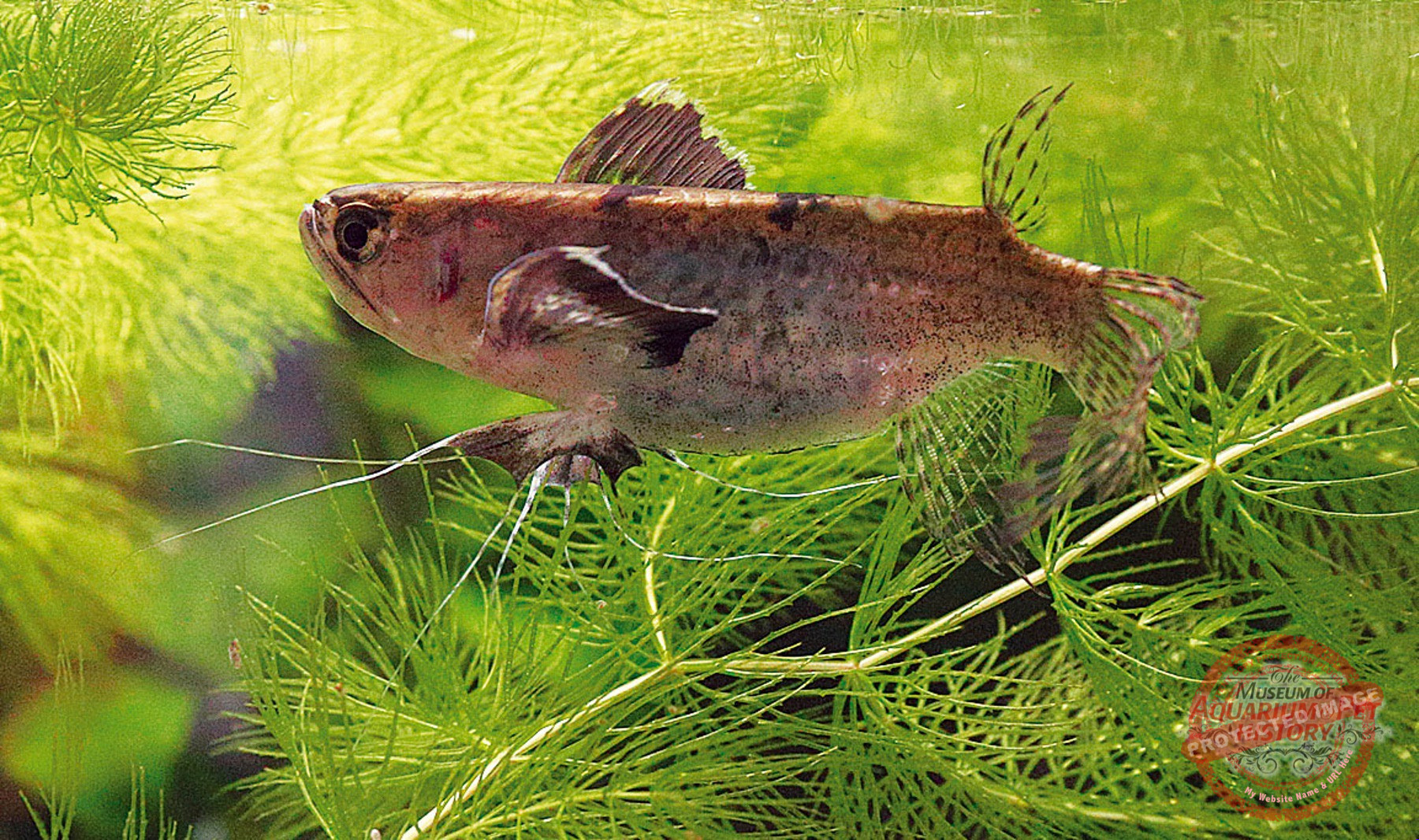
The same was true of butterflyfish, Pantodon buchholzi.
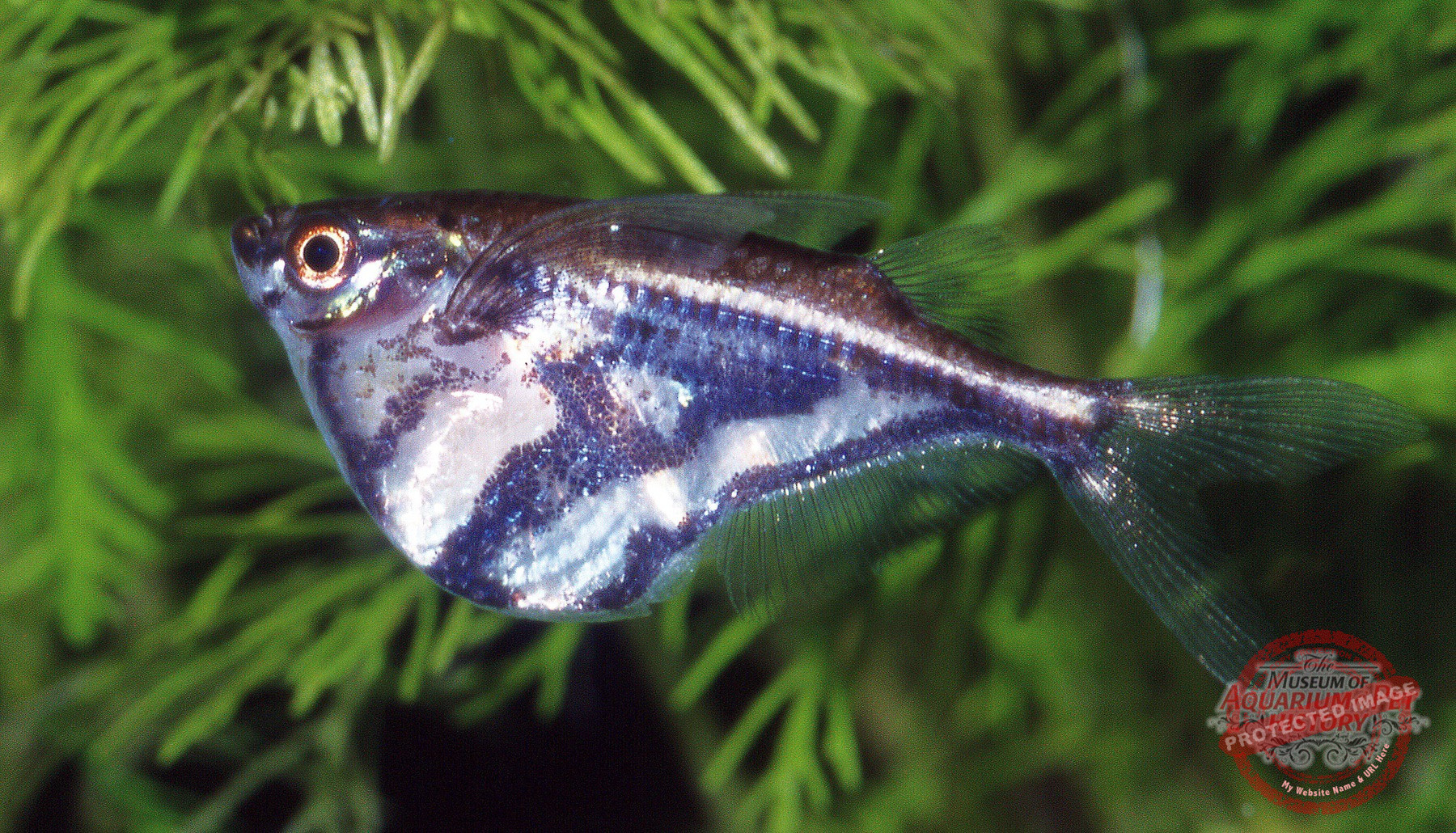
The striped hatchetfish, Carnegiella strigata, was also part of the assortment.
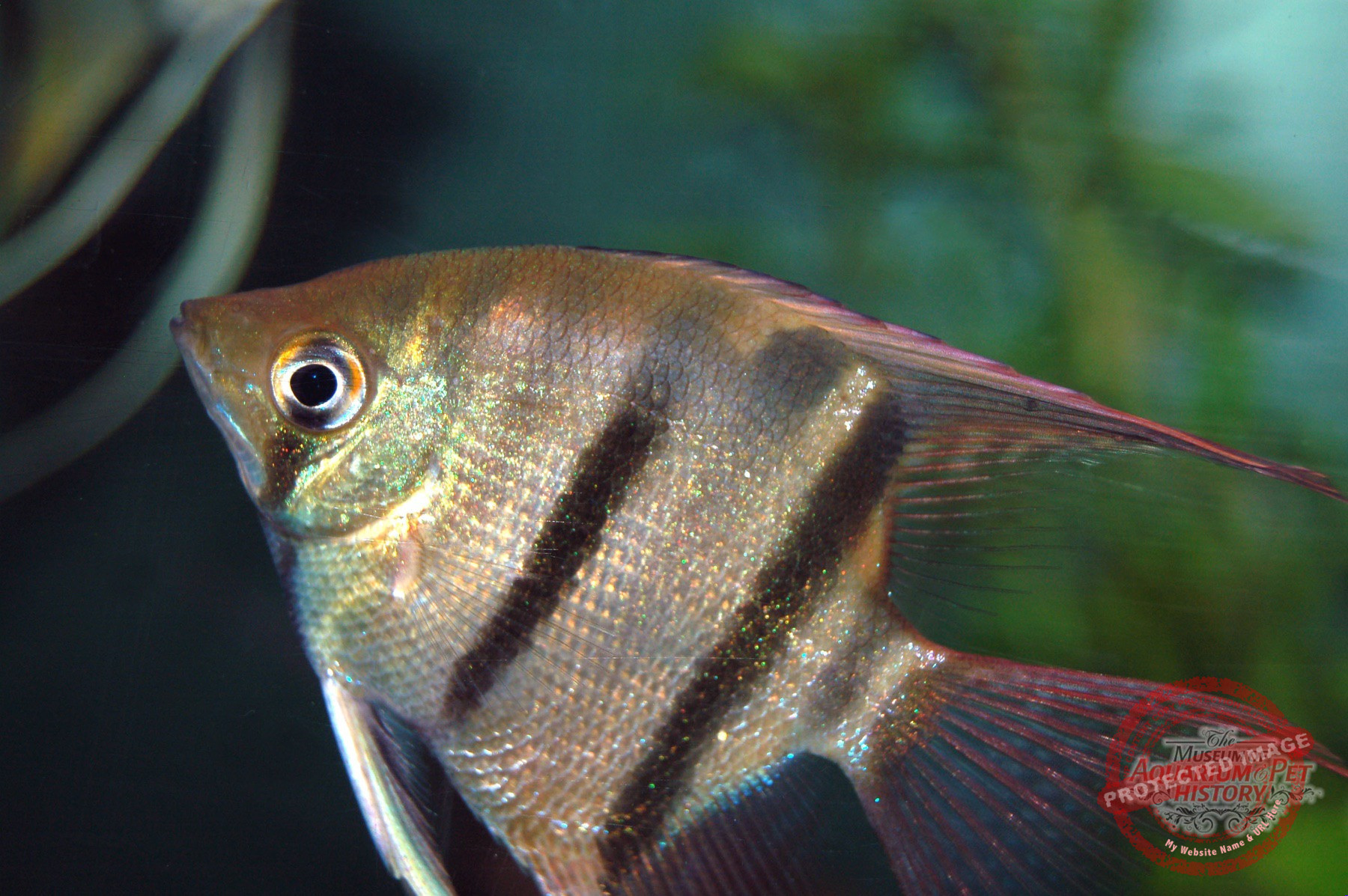
During the 1920s and 1930s, a small-growing, sharp-headed form of angelfish was regarded as a species in its own right and was offered by “Schopö” as Pterophyllum eimekei.
Pederzani’s account of his first visit to “Schopö” is extensive. Here is another passage:
“My companion—it was Arthur Scholze, one of the two bosses, as I learned much later—now left me, but not before pointing out a second, smaller room in the warm-water department. Here the tanks were planted and stocked with ‘Fundulen,’ as cyprinodontids5 were called in hobbyist circles at the time. They say memory embellishes the past, but I cannot be persuaded otherwise: I never again saw such magnificent representatives of the genus Aphyosemion, which has since been split into several genera. Two elderly gentlemen stood in a corner, deep in technical conversation. One of them pulled corked glass tubes from his waistcoat pockets and proudly displayed them. They contained ‘Fundulen’ eggs6 . He carried them next to his body ‘because the constant movement makes hatching easier.’ Yes, experts were constantly coming and going here. People met at Scholze & Pötzschke, sought advice, and exchanged experiences. I returned to the large room, crossed it, and opened the iron door to the cold-water department. Here, goldfish, orfe, and small carp for outdoor aquariums swam in concrete tanks. There were also thick bundles of Myroiphyllum and Lysimachia, one hundred stems to a bundle, and many other aquatic and marsh plants, as well as amphibians. Finally, I left paradise through the back door and ran down the stairs. In the courtyard stood delivery vans onto which transport containers of all kinds were being loaded. The crates were marked with the company logo ‘Sch&P.’ Vehicles carrying enormous, heavily packed fish cans came rolling in from the freight stations. Above all, however, Berlin’s zoological dealers were supplied with animals and merchandise from here, because the wholesale business was naturally the company’s principal source of income.”
MOAPH5: Cyprinodontid is the scientific name for pupfish, which is a group of killifish known for being found in extreme or isolated environments.
MOAPH6: Eggs of killifish species within the Pupfish group.
The outlook for “Schopö” was not bad despite the economic and political problems and the upheavals associated with them in Germany between 1930, when the company celebrated its 25th anniversary, and 1939, when World War II began. The keeping of exotic animals was a lucrative niche, politically neutral, and provided a form of entertainment that was needed in those times. Because of the generally accepted cult of personality practiced by the Nazi leaders, a wave of new names was bestowed upon streets, places, buildings, and landscapes. Unlike the many places named after leading Nazis, which reverted to their old names after 1945, there was one field of science in which the names assigned during that period would be preserved for eternity: botanical and zoological systematics.
Because most dead animals, as naturally occur in every form of animal keeping, were donated to the famous Berlin Natural History Museum whenever information about their locality was available, Arthur Scholze and Paul Pötzschke also had contact with the curators responsible for their respective animal groups. At that time, ichthyology was overseen by Paul Pappenheim and herpetology by Ernst Ahl. While Pappenheim was barely tolerated and had hardly any rights because of his Jewish grandmother, Ahl, who had been a loyal NSDAP7 member from the very beginning, exploited his position of dominance in all professional and private matters. He reserved the right to examine most newly arrived fish, amphibians, and reptiles and describe them as new species. Today we know that he was not particularly good at this. The later curator of ichthyology at the Berlin Natural History Museum, Dr. Hans-Joachim Paepke, a student of Sterba8, analyzed Ahl’s species descriptions and discovered that 74% of the 231 fish and 302 amphibians and reptiles he had described were synonyms of species that were already known.
MOAPH7: NSDAP stands for Nationalsozialistische Partei Deutschlands (National Socialist German Workers’ Party), which was referred to as the Nazi Party for short.
MOAPH8: Visit moaph.org to view the video released in August 2026 and an article released in July 2026 on Günther Sterba
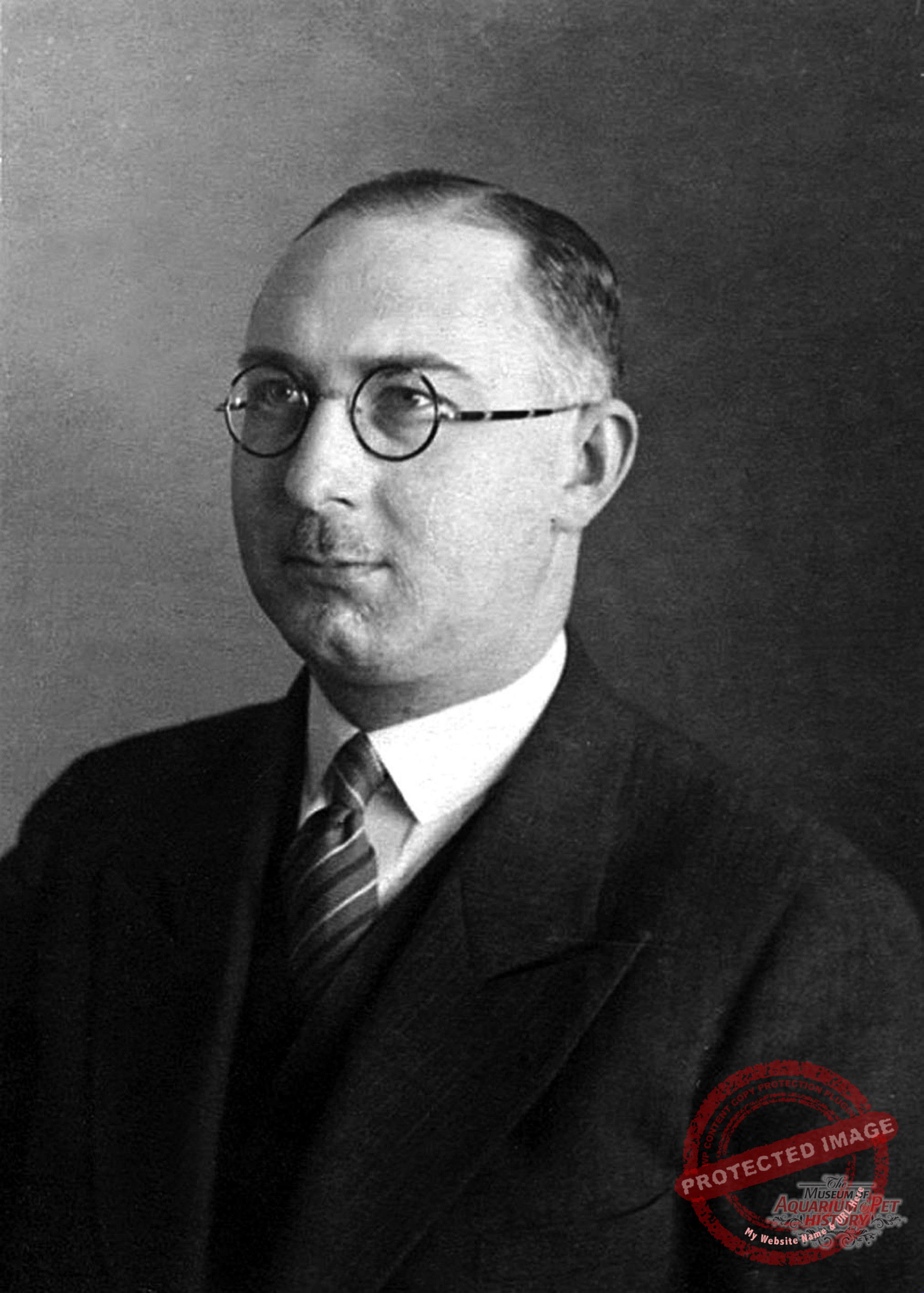
Ernst Ahl during his tenure as curator of herpetology at the Museum für Naturkunde in Berlin.
Ahl must actually have been quite wealthy, because the journal Das Aquarium, which he founded in 1927 and which continued to appear until 1934, was supported by his fellow party members to the extent that he was able to have it printed on fine glossy paper and designed in a modern style. Yet for some reason Ahl was always having financial difficulties, and shortly before the beginning of World War II he was expelled from the NSDAP. Not because he had ceased to be a loyal Nazi, but because he had failed to pay his membership dues. The same thing happened to him in several professional societies and organizations. Eventually, he was to be dismissed from the museum as an extremely unreliable curator, but he forestalled this by going to the war front, from which he never returned.
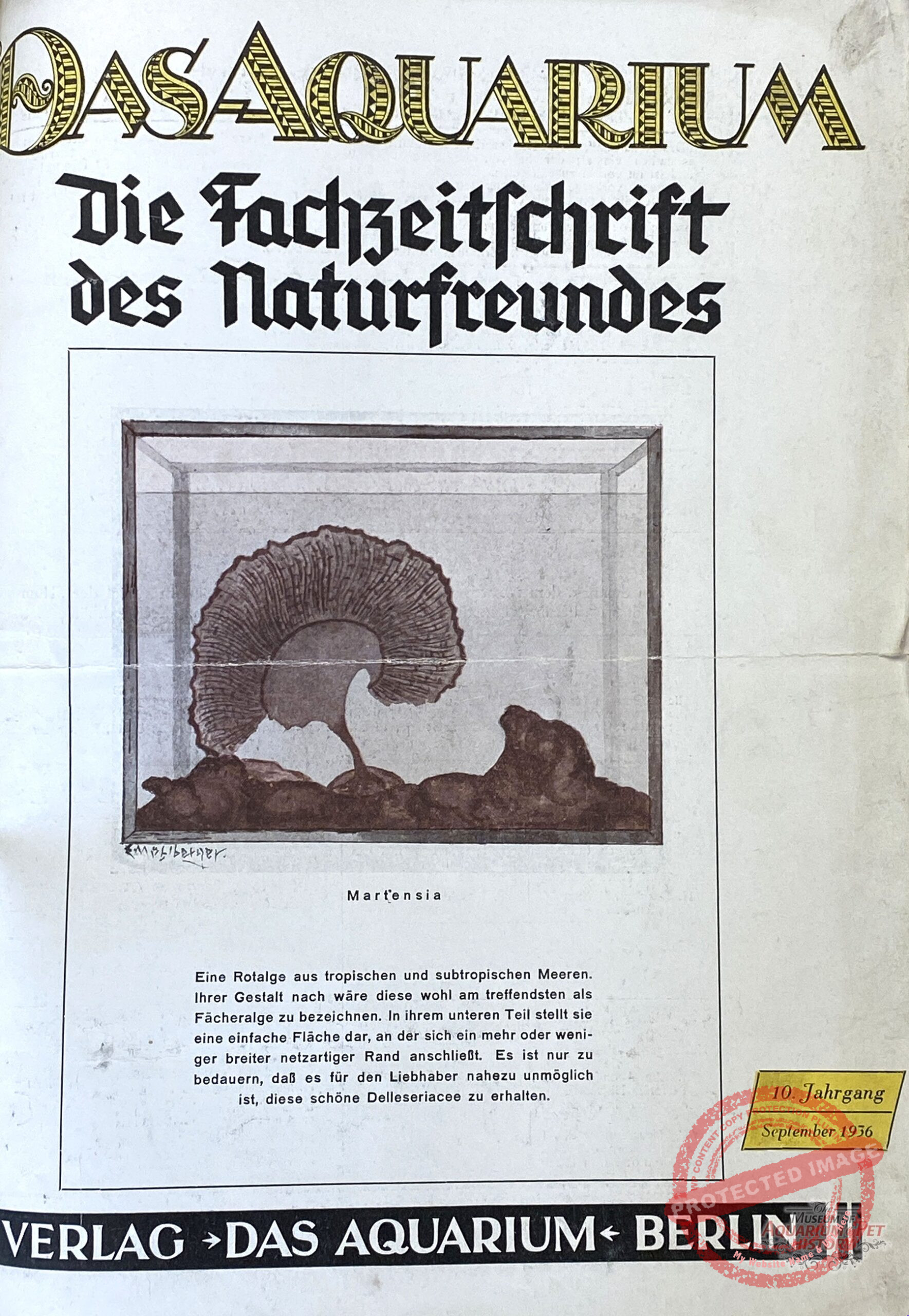
Title page of Ahl’s journal Das Aquarium.
In the years before that, however, Ahl was active in the aquarium hobby in many different ways. He knew perfectly well how lucrative a connection with the world’s largest and most important animal-trading company could be. And so he employed a trick to win the goodwill of the two “Schopö” owners and gain them as a source of new species. He first described an Astyanax species in honor of Paul Pötzschke as Astyanax poetzschkei, publishing it in a respected Berlin scientific journal: Ahl, E. (1932). “Beschreibung eines neuen Characiniden aus dem Amazonenstrom.” Sitzungsberichte der Gesellschaft Naturforschender Freunde zu Berlin, 1932 (1-3), 124-126. A short time later came a Hyphessobrycon species named by Ahl after Arthur Scholze as Hyphessobrycon scholzei: Ahl, E. (1937). “Zwei neue Süßwasserfische aus Südamerika”. Sitzungsberichte der Gesellschaft Naturforschender Freunde zu Berlin 1936 (8-10), 445-447. Although so many of the species scientifically described by Ahl were subsequently treated as synonyms and thus removed from the systematics as separate species, these two characin species remain valid to this day. Hyphessobrycon scholzei even has a certain significance in the aquarium hobby and is occasionally bred. The fact that, in Ahl’s descriptions of both characins, “Amazon Basin” was given rather generally as the terra typica suggests that the fish had been imported by “Schopö”; the collectors kept their precise localities secret as a trade secret. Not even the body length was given, although we know from later imports that Hyphessobrycon scholzei reaches approximately four centimeters.
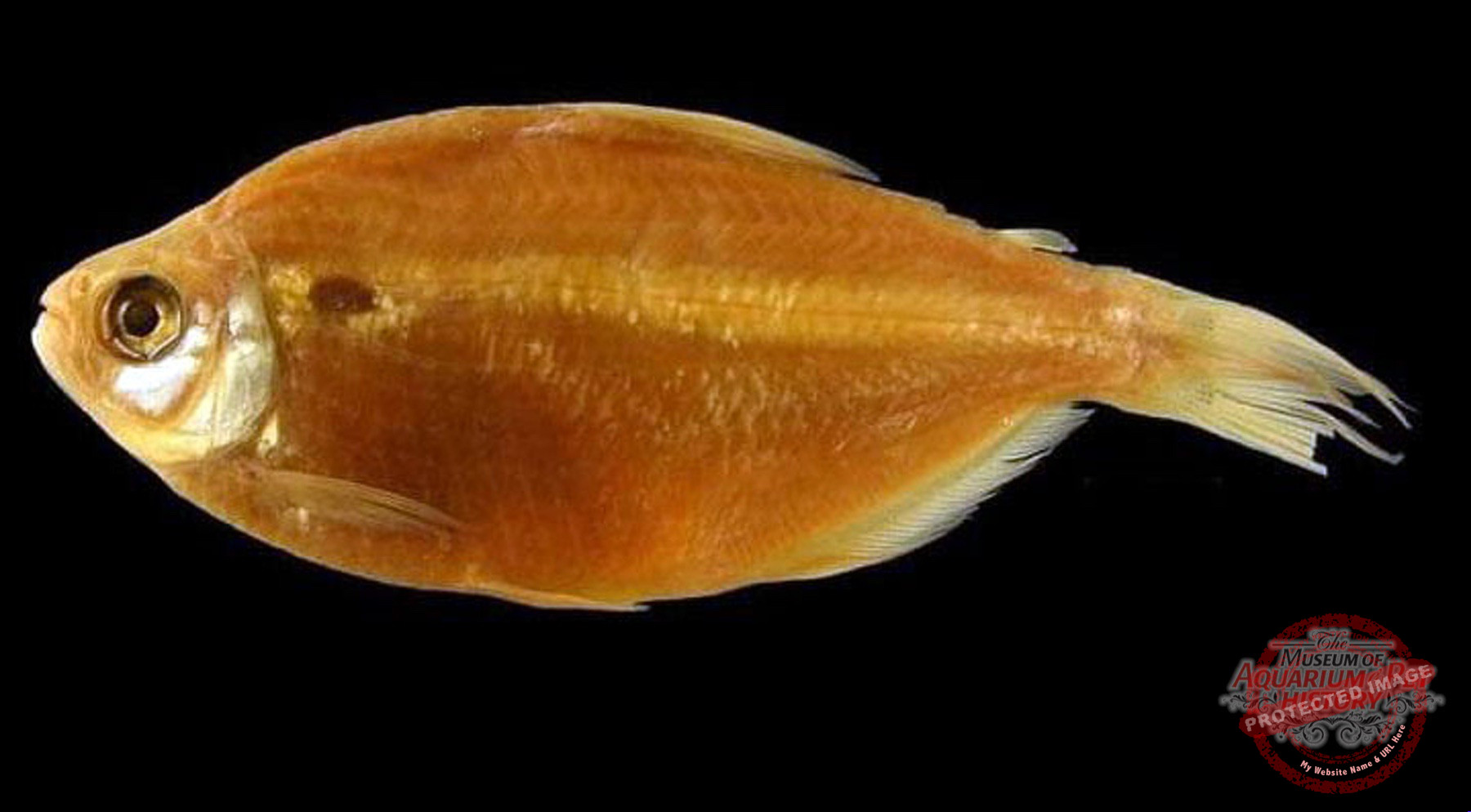
In 1932, Ahl described the characin species Astyanax poetzschkei in honor of Paul Pötzschke; shown here is a museum specimen.
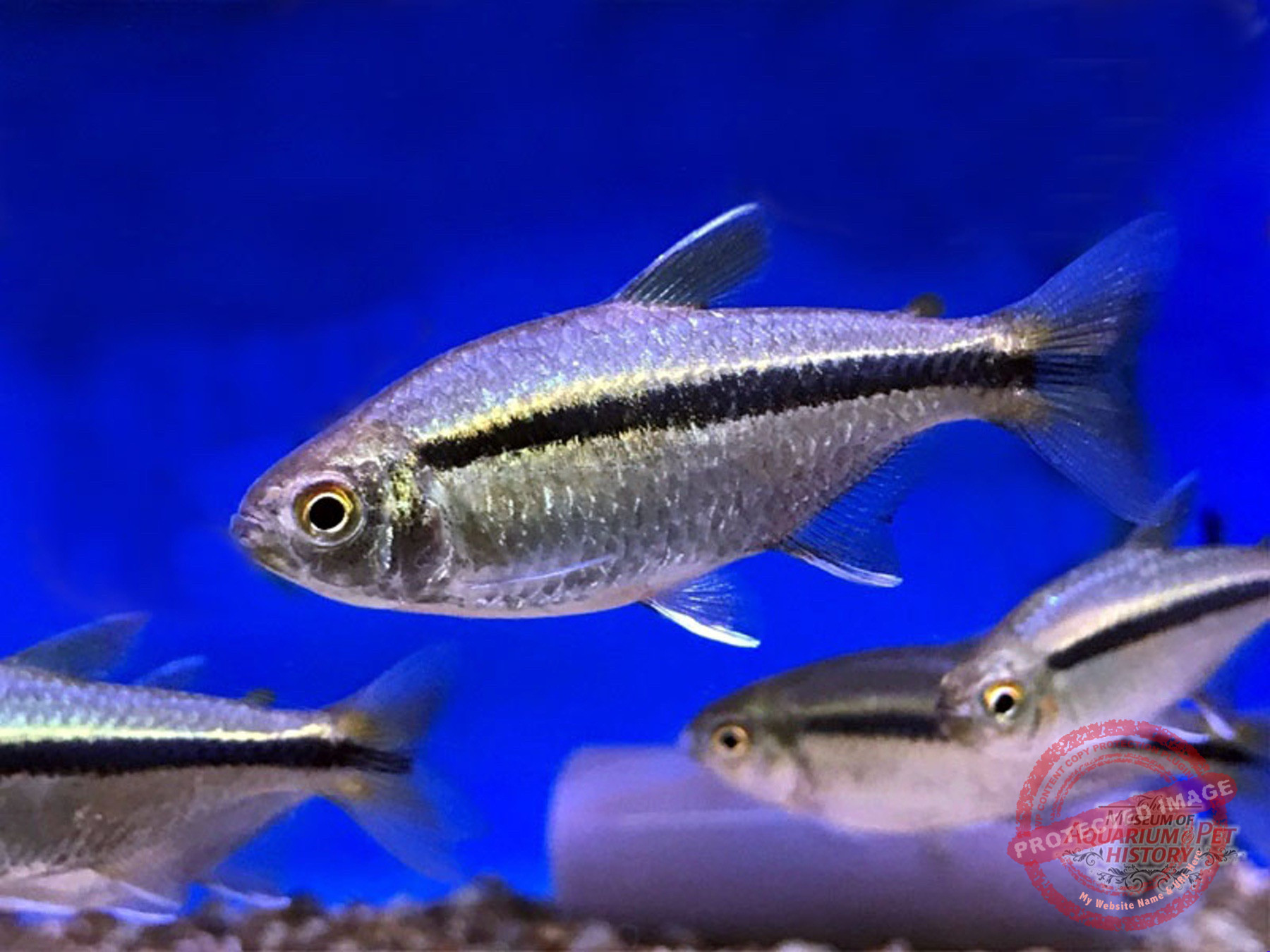
In 1936, this was followed by the characin Hyphessobrycon scholzei, named after Arthur Scholze. This species also found its way into the aquarium hobby.
Naturally, reports from that period, which I have brought together here from a variety of sources, are fascinating and exciting to read. But there is no better way to gain a feeling for the extraordinary diversity of “Schopö’s” offerings—and for the remarkable level of knowledge, the variety of technical equipment, decorations, live aquarium plants, foods, and so much more available at the time—than to do more than merely leaf through the catalog published for the company’s 25th anniversary. That is exactly what I will do for you, dear readers, in the next installment of this series of articles. You have every reason to look forward to it.