Song Canaries
All canaries are descendants of the little green serin, a songbird that Spanish sailors brought to Europe from the Azores, Madeira, and Canary Islands in the 15th-17th centuries. Keeping ornamental birds is not a new hobby, there were Egyptian, Roman, and Chinese bird keepers. Even Cleopatra kept birds! Oddly enough the islands for which our canaries are named, were themselves named for the number of large dogs (canines) kept by the inhabitants. These little green finches may not have offered much at first for their looks, but their songs sure garnered attention!

The early Spanish birds were quite expensive and it became fashionable in the courts of Spanish and English kings to breed these small birds. Many were given as special gifts in gilded cages. The story goes, when a Spanish ship was blown off course, these birds arrived in Italy, then moved on to Germany and the rest of Europe, some carried along in covered packs on the backs of Swiss traders. Spanish breeders and monks had closely guarded the secrets learned through years of trial and error, and had basically cornered the market so to speak, selling males and keeping the hens — but by the early 1900’s anyone could have a special soft singing “Chamber” bird — if they wanted to part with a week’s salary!
As canaries traveled across Europe and later to America, miners took their birds with them into the dark, damp mines, where the birds’ sensitive lungs and air sacs responded to toxic gases, and saved many a miner’s life. These birds became the miner’s cherished companions.
Song canaries are bred for their song, rather than color or type (shape, physical features). All male canaries sing, and some are virtuosos, but a song canary is bred for his refined song. Millions of years ago, evolution gave oscine birds an unique syrinx, a wonderful combination of 3 muscle pairs at the base of the throat, that can control and modulate voice, giving the bird’s voice box the incredible ability of a masterful musical instrument. Some song canaries can even sing two songs at the same time!
While all male Canaries sing, to entice a mate or protect his territory, it is those bred specifically for song that will deliver the greatest musical performance. The most popular are the German Roller, Belgian Waterslager, Russian Singer, Spanish Timbrado, and the American Singer.
The German Roller (also called Hartz, Harzer, or Harz Mountain canary) was bred into existence by breeders who lived in the Harz mountains of Germany. These song canaries were called edelroller or “noble roller,” illustrating their importance to their owners. In St. Andreasberg, rollers became an item of economic importance. Birds were trained with “tutor” birds, the notes of musical instruments, and mechanical “bird organs.” Only birds with the purest tones were kept. The most prized, called Campanini birds, were trained over several seasons by a master canary of their own species, and the best were almost above price. Competition was great and it was not unusual for a town to have 12 or more canary clubs with fierce competitions. Arguably, it is thought that almost all song canaries owe some of their song ancestry to the German Roller.
German Rollers are known for the depth of their soft vocalizations, called tours, and he sings all notes with a closed beak, which enhances the ideal “hollow” tone. Tours include flutes (think of an owl’s “who”), bell, hollow roll, and base (think of a cat’s purr) all sung in different combinations and tempos. Rollers can come in all colors or combinations (variegated): green, yellow, blue or white.
The Belgian Waterslager (Malinois) was developed in Belgium from German birds (and possibly the larger yellow Old Dutch variety), encouraged to sing enhanced watery notes, similar to dripping water or a babbling brook, with nightingale accents. The name “waterslag” means water beat. Early descriptions of birds with the watery songs date from the early 1700’s. The tours are shorter and more varied than the roller, cascading over a wider range from higher “steel” notes to the lower dripping water sound of the klok, sounding akin to the glug of water being released from a jug. The rollende and bollende are the bubbling water tours, but there are 14 different tours/ notes to be judged. Most tours are sung with beak closed but he may open his beak for pronunciation or to sing some of the higher notes. A bird with waterslager ancestry, if he does not sing water tours, is not considered a waterslager. A good waterslager will not be any other color than yellow (or white), but is allowed very small dark tick marks.
The Russian Singer, as you can guess, was developed in Russia, over the last 300 years, from the same bird ancestry that created the German Roller. Russian breeders were particularly taken with the birds’ skills in mimicry, and these canaries were said to learn and perfect the songs of native species. They were taken into the forests to learn to imitate the songs of wild birds such as siskins and various buntings. This earned them the nickname “Bunting Tuner.” Breeders used native birds, along with training aids such as pipe organs and flutes, to soften his song and develop the Russian Singer’s distinctive voice. Careful selection and breeding, plus training, produced a small, narrow bird who has a large voice and is able to learn to sing a cascade of piping notes.
The Spanish Timbrado is a relatively new member of the canary choir, established early in the 20th century. He has the loudest song of all the canaries, higher register and slightly metallic, but pleasant bell-like warble, consisting of 12 distinct notes. Hens of this variety are able to sing, but not as impressively as the males. Genetically, the Spanish birds are very close to the wild canary, and their song is said, by imaginative breeders, to contain the music – the “timbre,” hence the name – of Spanish castanets.
The American Singer is another newcomer. These birds were developed in the USA at a time when canaries reigned in popularity during the 1930s and 40s. It was originally a cross between the Border Canary with his louder, open beak chopping delivery, and the softer singing German Roller. It is now one of the most commonly kept canaries in the US. He combines good singing with a sleek body and robust health, making him easy to keep, giving his owner maximum song with minimum fuss. Reflecting their mixed ancestry, American Singers combine chops and rolls to great effect, giving light and shade to his performance by adjusting the volume up and down.
Luckily for us today, we no longer have to be a King or Queen to own one (or more) of these delightful songsters!
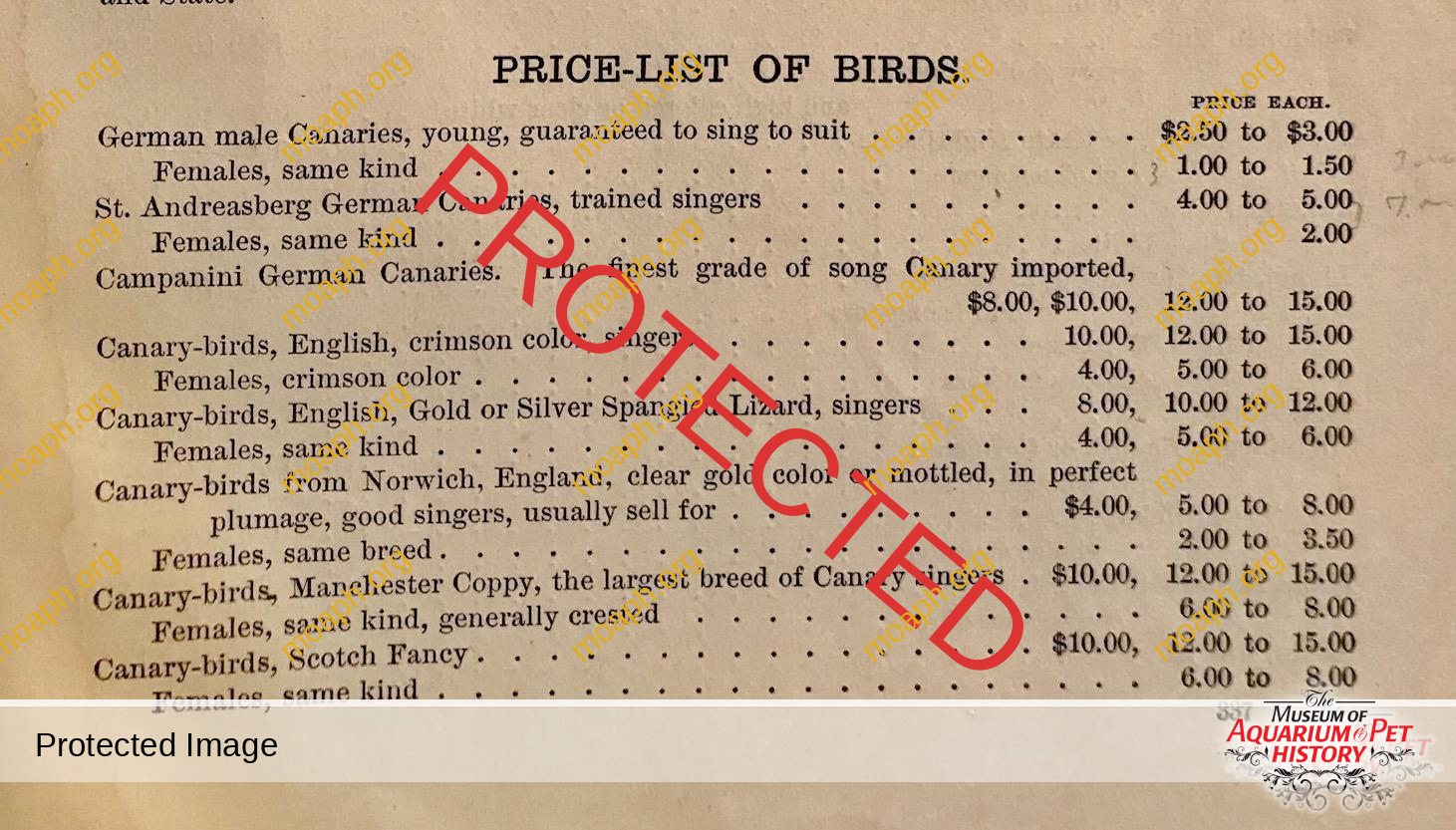
(At the height of a canary mania in the 1880’s, canaries were imported by the thousands, traveling aboard ships in racks of small cages. During one short period in 1882-83 some 120,000 canaries were imported from Germany, as many as 12,000 from St. Andreasberg alone, with New York as the primary market. The birds would travel from the “breeder-place” to enormous “bird-house” warehouses where selections were made; then travel by rail or mail to a seaport, frequently needing protection from thieves along the way. Often one man would be in charge of 5 crates with 30 rows of small cages, 7 high, thus 210 cages to each crate. He would be responsible for all aboard the ship: the seed, watering cans, and cleaning instruments; keeping the birds warm with hay or whatever he could find; securing the cages during heavy weather; protecting the birds from vermin that would as soon eat a bird as the seed; and giving the daily ration of seed and water to each bird! All this makes taking care our pets today seem easy! Amazingly from 1900-15 more than 3 million birds were imported, but as Americans started breeding more of their own canaries, less than a hundred years later in 1980, documents show only 17,000 canary imports.)
Price List from NY importer George H. Holden’s book, Canaries and Cage Birds, 1883