
Steampunk Bubbles
The very first heyday of technology in the aquarium hobby took place during the 1930s. Electrical service had finally arrived for the greater part of private homes and suppliers began marketing air pumps, air-driven filters, heaters and thermostats, light bulbs and reflectors which gradually became part of the basic equipment for the home aquarium making it more user-friendly.

A few ancestors of the modern air stone.
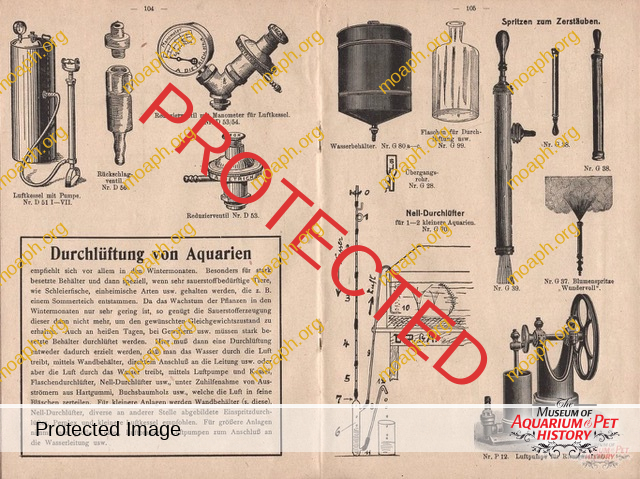
Array of mechanical devices in A. Glaschker catalog-1919
Up to then, the main methods for preventing deterioration of the water quality and providing basic conditions for the survival of the aquarium’s inhabitants were as follows:
- frequent water changes or continuous water recirculation;
- aeration by way of fountain or waterfall effects;
- aeration by way of a flow of air bubbles;
- heating by way of oil, kerosene or alcohol lamps.
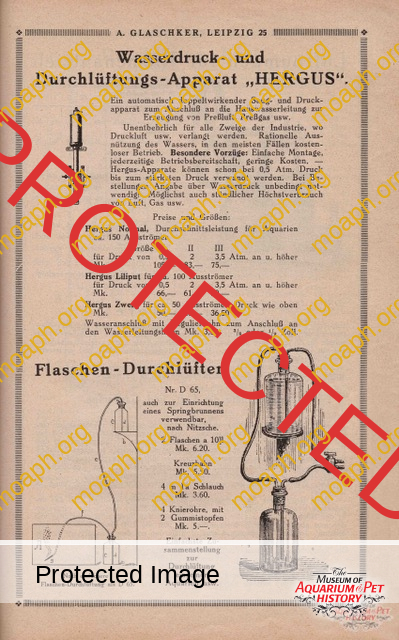
Hergus Water Driven Device
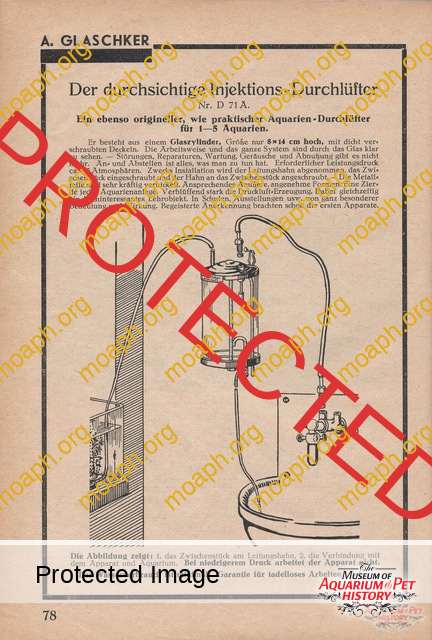
Another water driven device of yersteryear-by A. Glaschker
To do all that, the earliest generations of aquarists used physical labor and good will (or faithful servants!), hydraulic techniques and mechanical paraphernalia today much sought after by collectors even to the point that in some cases these objects are considered to be authentic “holy grails”. In this article I’m going to describe some devices that have always fascinated me because of their steampunk design.
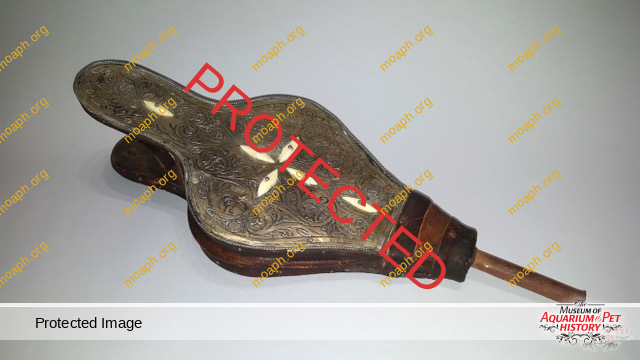
Bellows-photo by E. Spada

A. Glaschker Company-Founded in 1875 in Leipzig

Mürrle Aeration System
Let’s start with the very common bellows. Thanks to Albert J. Klee’s books we know that the first aquarist to use this everyday device to aerate a group of tanks during the Victorian era was Dr. Robert Ball (1802-1857) at the small Dublin aquarium. It was 1854.
Two years later Baron Jules Cloquet (1778-1883), an eminent French doctor, did the same but also improved the end of the aeration line through a wire-gauze that generated very small air bubbles. The story of air stones really started thanks to him.
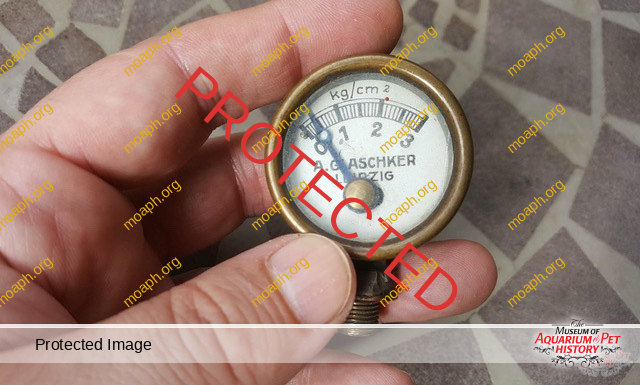
A. Glaschker Pressure Gauge
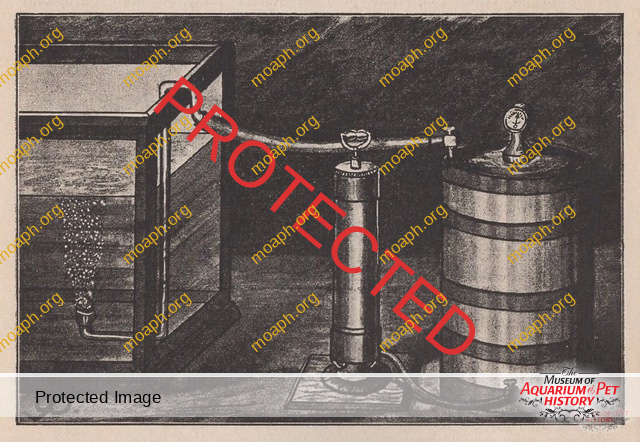
Bicycle Pump and Pressure Tank in Use
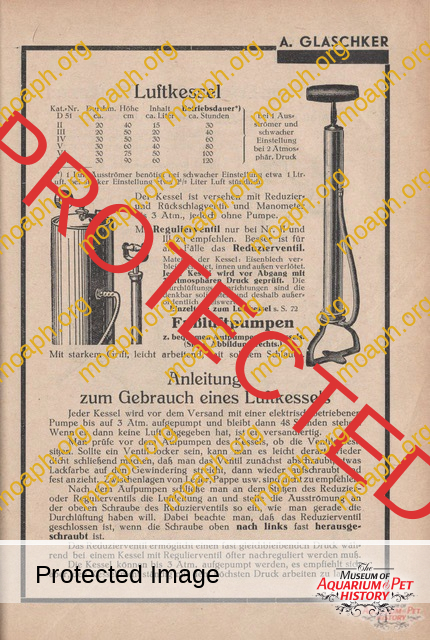
Bicycle Pump and Canister-A. Glaschker Catalog
Towards the end of 19th century came the widespread use of canisters filled with compressed air by way of common bicycle pumps. The higher quality models were equipped with a pressure gauge, a valve regulating the flow of air coming from the bicycle pump and one for that directed at the aquarium. Although it was necessary to manually refill the canisters every time the air was exhausted, they were practical and effective aeration devices, regularly marketed by the most important German suppliers of aquarium equipment such as A. Glaschker (Leipzig) and Emil Reichelt (Berlin).

Emil Reichelt Catalog 1909-1910
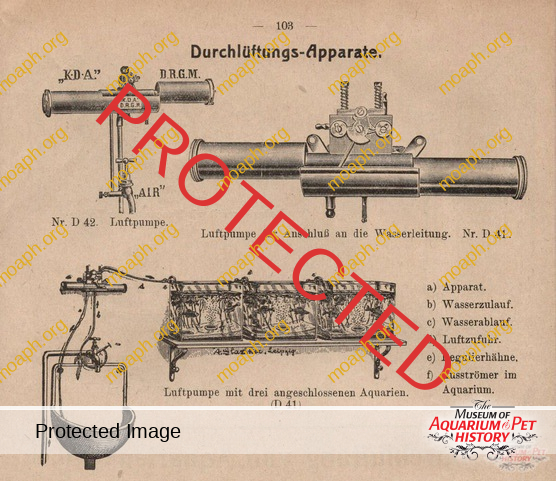
A. Glaschker Catalog-1919
The principal behind their functioning was then used to manufacture (or simply to plan and patent, without a subsequent production) various models of shipping containers with integrated aeration systems, and two models of “balloon aerators” as well. Light and easy to transport when deflated, the balloon aerators were a pretty good option for small aquariums, demonstrating themselves very useful at fairs, open air markets and aquarium exhibits, but also for the steps involved in transporting fish.
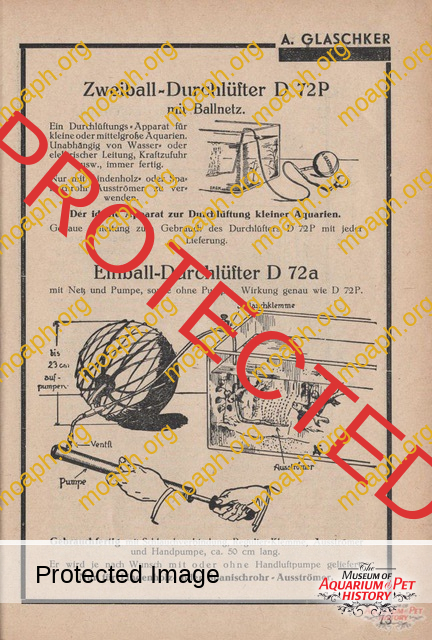
Balloon Aeration Devices

Emil Reichelt ad from 1908
But now we come to some double-acting air pumps that have become a true and real obsession for many collectors specialized in aquarium paraphernalia, the pump from Kindel or K.D.A. (Kindelsche Durchlüftungs Apparat) and the WISA. The principle behind the functioning of both was the same, taking advantage of the water pressure to obtain a flow of air for one or more aquariums. It recalls what was theorized and put into practice by the Englishman George Hurwood (1798-1864), a civil engineer who in 1855 invented that which Klee has defined as the first aquarium pump in history (in that case a single-acting pump).
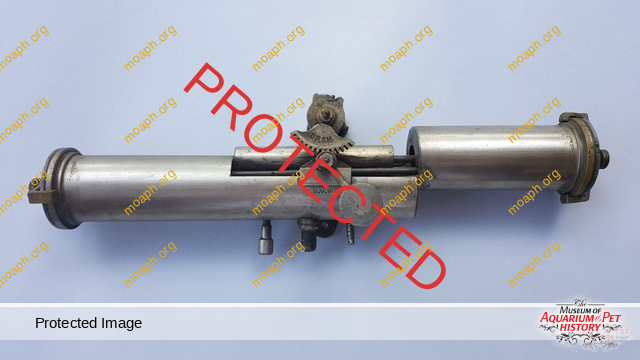
K.D.A-Front
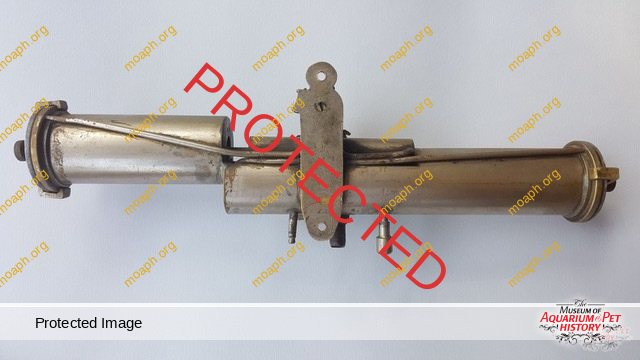
K.D.A.-Back

WISA-Front
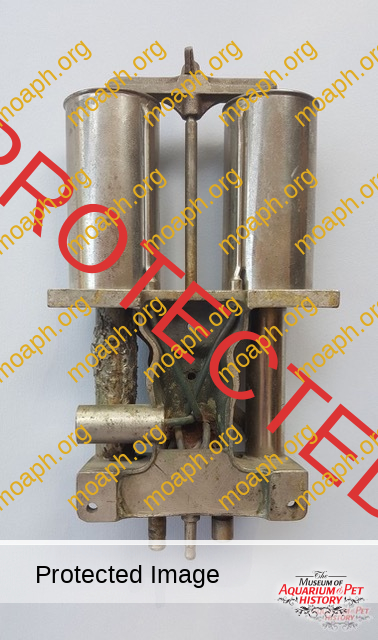
WISA-Back
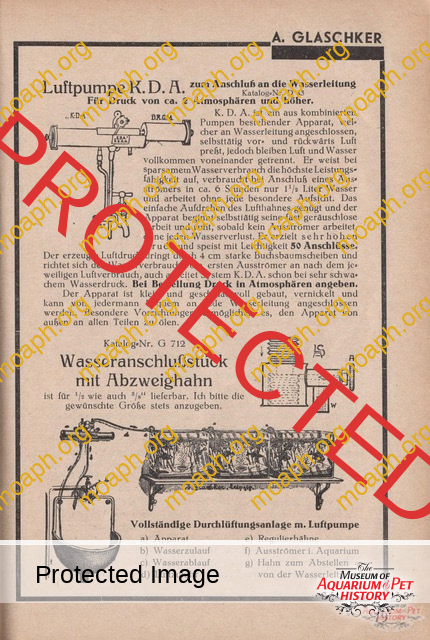
The rarest is without a doubt the K.D.A., a powerful and reliable German device appeared on the market in 1908. Hobbyists usually attached this pump to a wooden base and then hung it on a wall. The connection to an ordinary faucet fixture was a simple procedure and the K.D.A. automatically started to work when the water tap was turned on. It was capable on producing air for many fish tanks simultaneously, according to some catalogs from that period up to 100 air outlets if the water pressure was high enough! In the case of a single air outlet, the water consumption stated by manufacturer and suppliers was more than acceptable, 1-1.5 liters in a span of 6-8 hours of operation. Seeing that I’m not 100% convinced, one day I would like to personally verify that data by using my K.D.A., but I can never find the time to pick up it from the bank vault where it is entrusted!

Technical drawing of a K.D.A-found in book Manutenzion e Funzionamento by Felice Supino (1926)

Closeup of K.D.A Air Pump
Making this little mechanical jewel (14.4x3x4.3 inches) even more amazing there was its capacity to stop automatically in case of an obstruction in the aeration line, thereby interrupting the consumption of water and then to restart once the problem was fixed. The K.D.A. was among the first air pumps to be industrially produced and sold in the United States and the old continent for the aquarium trade, it was simple to install and required only to be oiled periodically.
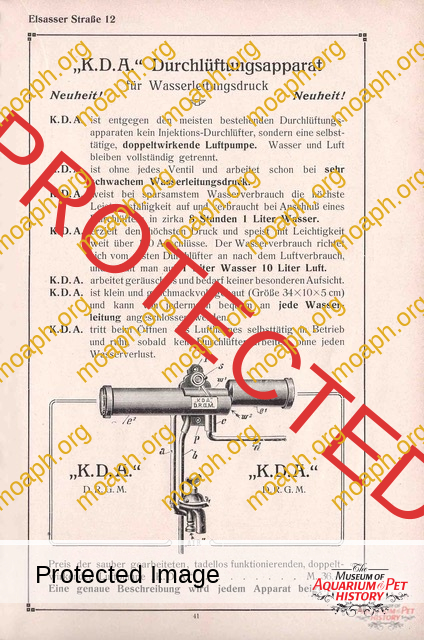
K.D.A in Emil Reichelt Catalog (1909-1910)
K.D.A working on three fish tanks
The WISA, unmistakable for its vertical design (5×2.3×9.6 inches), had the same success and a very long commercial life (about it I have found ads in magazines from 1950s!). During its late production years it was available in two different models that, depending on the amount of water pressure, had a yield of 20-210 liters of air per hour and 70-700 liters of air per hour. This steampunk device was certified by the German mark DRGM (Deutsches Reich Gebrauchsmuster) like the K.D.A., but also protected by the very expensive DRP patent (Deutches Reichspatent).

The first electric WISA for aquariums.

Closeup of a WISA air pump.
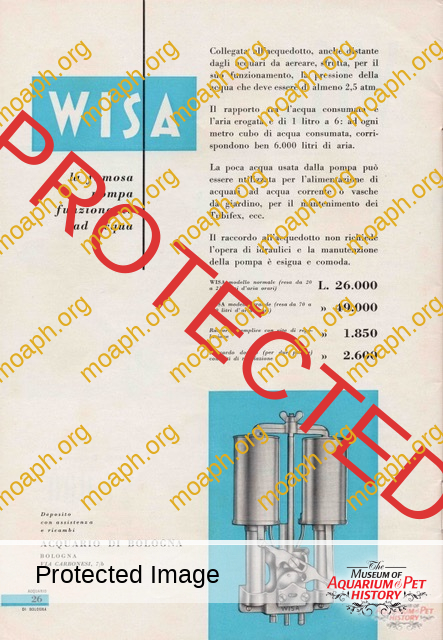
WISA in Acquario di Bologna Catalog (early 1950s)

WISA in A. Glaschker Catalog
In 1913 the K.D.A. was beeing sold in the United States for around $ 9. Besides this device, in the same year the General Aquarium Company of Philadelphia advertised at roughly double the price another water-powered air pump, the “Little Wonder” made by the Bishop-Babcock-Becker Company of Cleveland. I’m still looking for a sample of this mysterious pump proudly made in the USA, but in the meantime I have found a few traces of its existence and developed the idea that it was originally manufactured for use in other industrial fields.
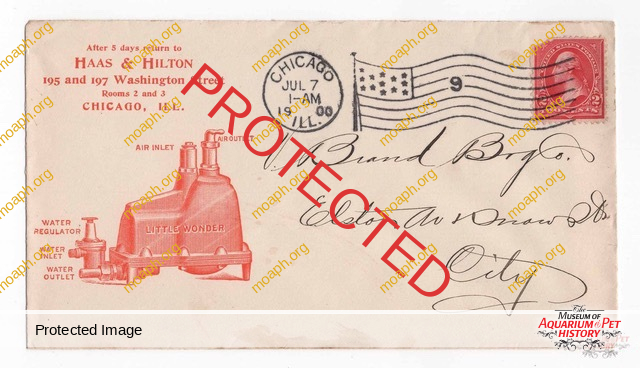
“Little Wonder” Stamp on Envelope
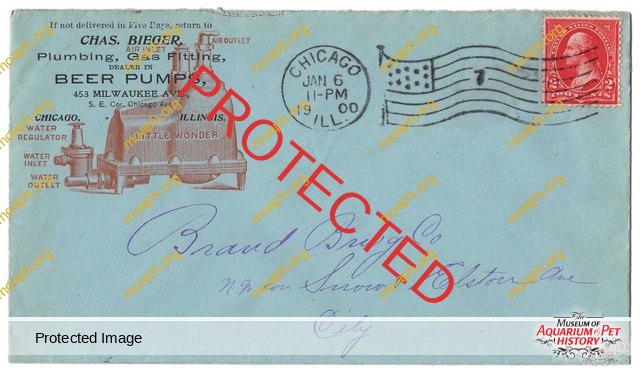
“Little Wonder” Stamp on Envelope
The unstoppable passage of time has also made very rare the mechanical air pumps manufactured by the German company Hubertus Raab in 3 different models: single-cylinder, two-cylinder and a combined water and air pump. These devices, easy to find for example in the A. Glaschker catalogs in which however there are no references to the manufacturer’s name, in order to work needed the continuous thrust from a hot-air engine (or from an electric engine) by way of a drive belt. In late 1800s the most important German manufacturers of hot-air engines were Louis Heinrici and the aforementioned Raab, two companies much prized also for their fabulous parlor aquariums considered nowadays as true works of art.
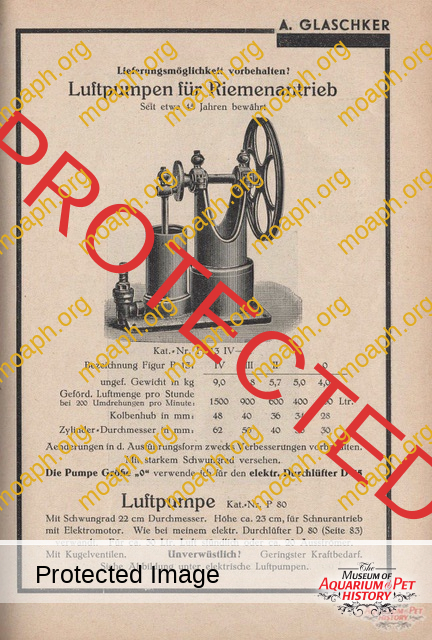
Mechanical Air Pump by Hubertus Raab
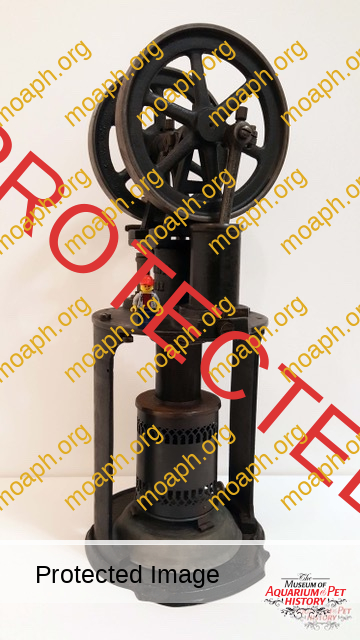
Louis Heinrici Two Cylinder Hot Air Engine
The images selected for this article come from my collection and depict also other ingenious non-electric devices of yesteryear intended to produce a flow of bubbles in the aquarium, some of which are water-driven just like the K.D.A. and the WISA. To succeed in finding them today outside the circle of top collectors is quite difficult since their appearance is not immediately recognizable as aquarium related, especially when they completely lack any manufacturer trade mark or model name. Online sellers most of the time consider them as laboratory instruments or as items of a similar nature, therefore they usually create listings full of wrong keywords and unhelpful descriptions. However I don’t give up and never stop searching, because as they used to say in my part of the world a long time ago… gutta cavat lapidem.