William Alford Lloyd: New Unpublished Letters Unveiled – Part 2
The 1870s were a golden decade for the risky business of public aquariums in Great Britain, and the variety of the collection had always been a crucial point for the financial sustainability of these establishments. Providing other entertainments such as restaurants, spectacles, and concerts, as Crystal Palace and Brighton did, was equally important, even though in some cases these other things to do and to see dangerously overshadowed the aquarium, becoming de facto the main business.
A constant inflow of new “star animals” really made a difference. A notable example was the live octopus exhibited at the Crystal Palace Aquarium under Lloyd’s supervision. Thanks also to the success of Victor Hugo’s novel Toilers of the Sea (1866), which features a dramatic battle between a man and a giant octopus, the “devil fish” created a true sensation and attracted a plethora of visitors.
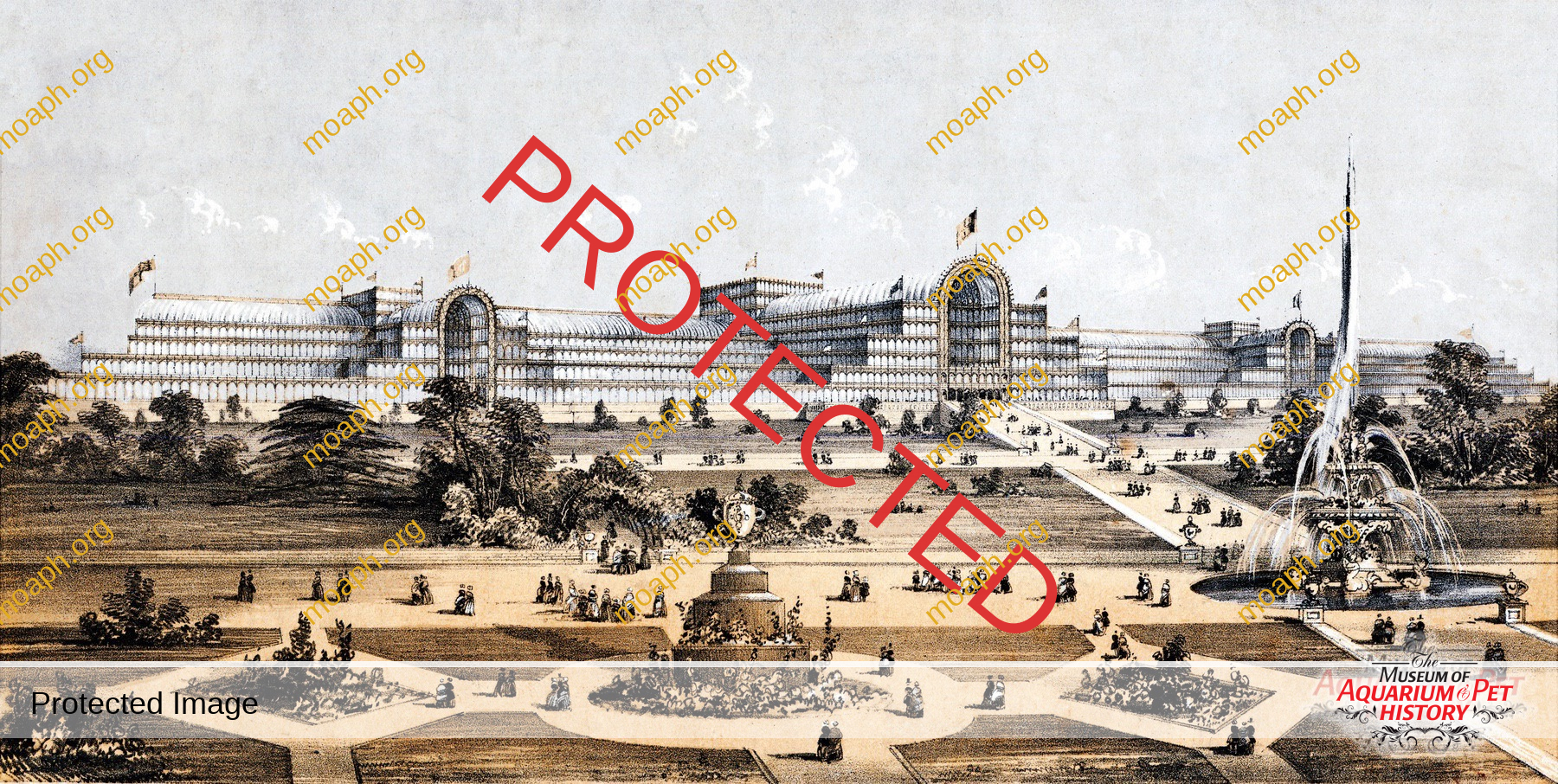
The Crystal Palace was a cast iron and plate glass structure, originally built in Hyde Park, London, to house the Great Exhibition of 1851. After the event, the facility was relocated to an open area of South London known as Penge Place. It was rebuilt at the top of Penge Peak next to Sydenham Hill, where it stood from June 1854 until its destruction by fire in November 1936. This illustration depicts the latter building in South London.
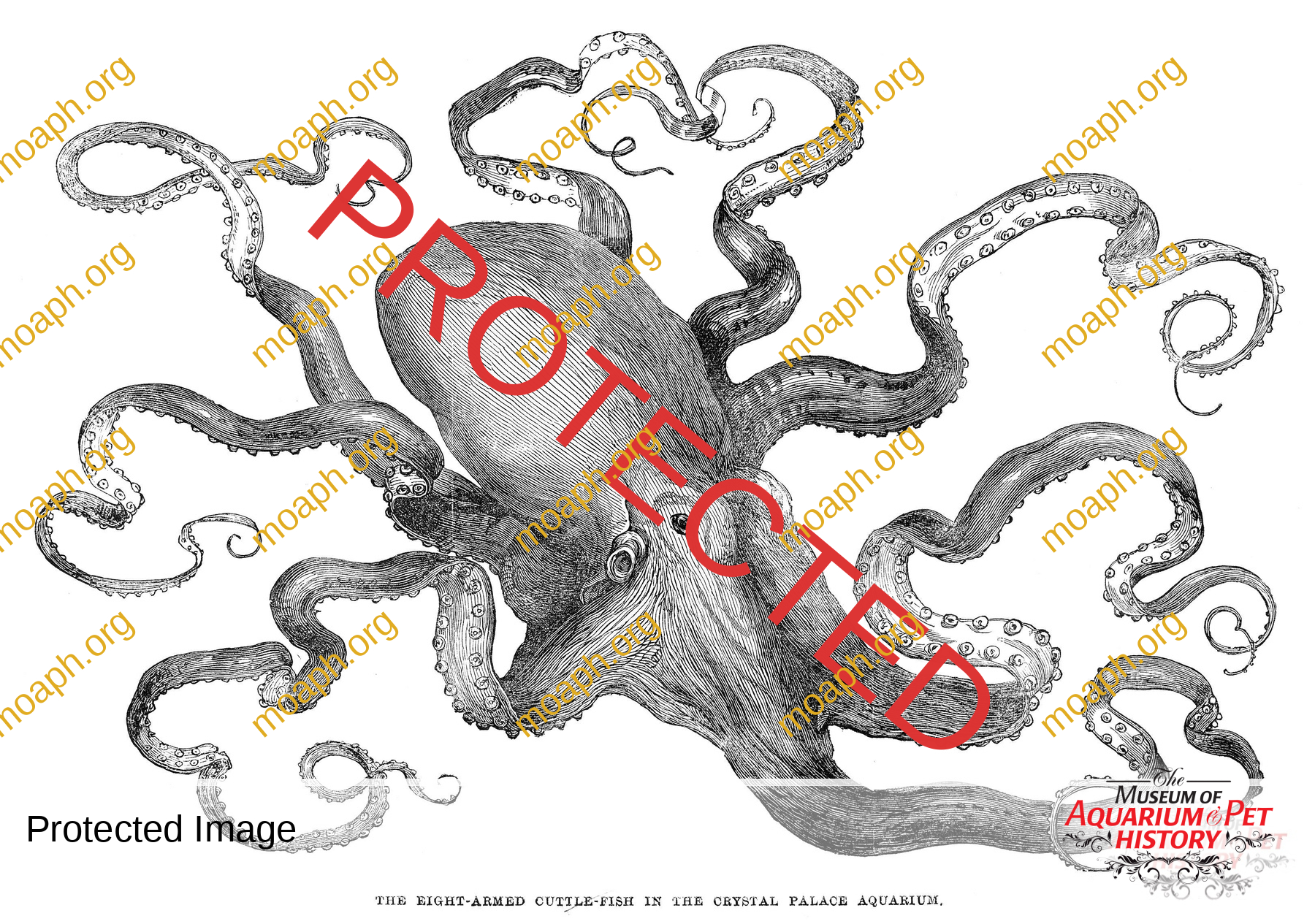
The “terrifying” octopus at the Crystal Palace Aquarium. Image from The Illustrated London News, 1871.
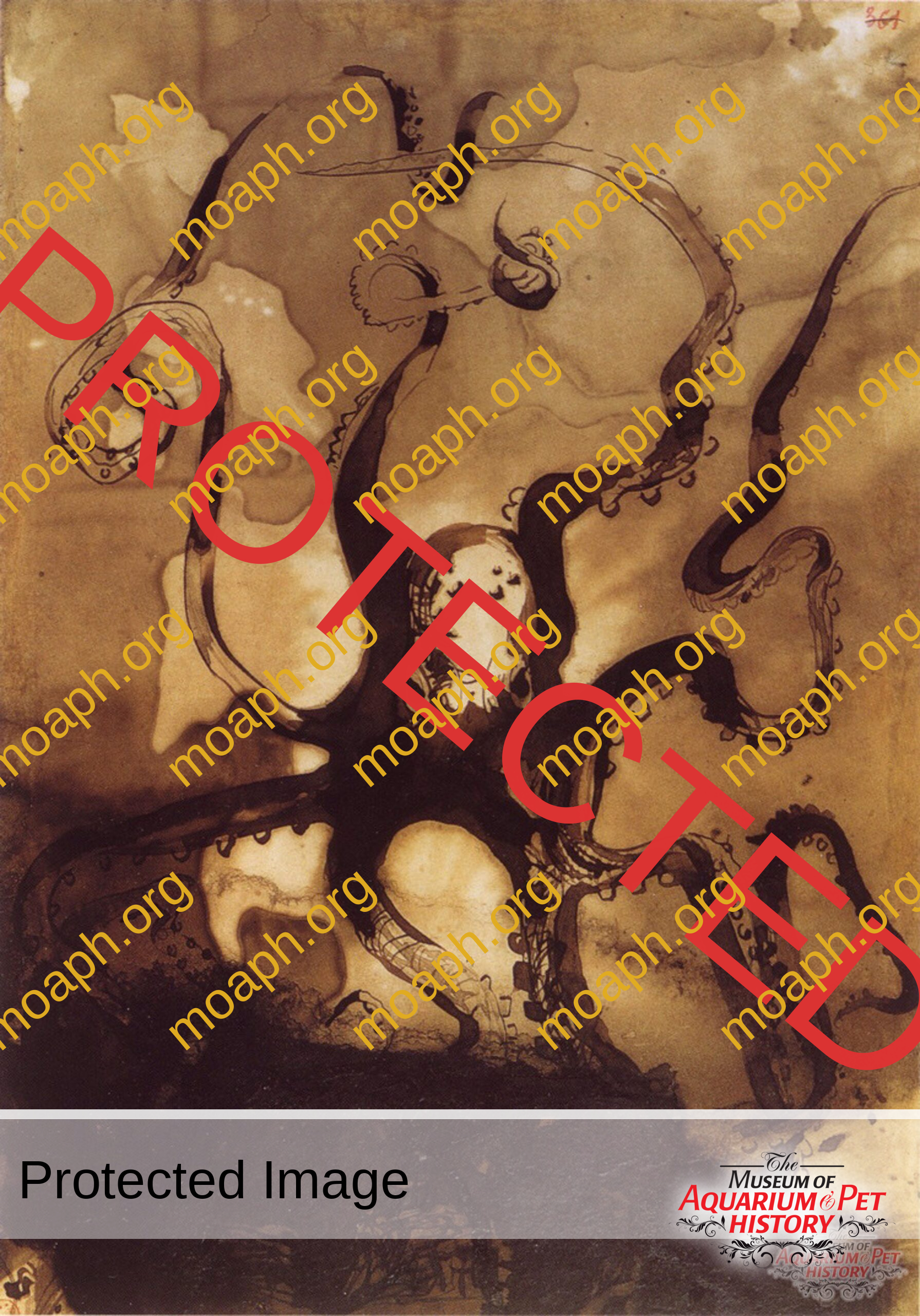
Victor Hugo’s painting, 1866.
Lloyd obtained a total of ten specimens of octopus from two different species. Back then, in fact, he could still rely on the network of collectors and coastal contacts he had built up during his early career managing the Aquarium Warehouse, the first aquarium shop in history. He also maintained smaller collection hubs and agents in locations like Menai, Weymouth, and Tenby. In addition, on an international scale, aquatic animals for the Crystal Palace were being transported via Norwegian and Hamburg steamship lines in specially designed tanks.
The Zoological Station at Naples undoubtedly had all the credentials to become part of this network as the key supplier of species from the Mediterranean Sea. That’s why, even before the Naples aquarium opened to the public, the Secretary of the Crystal Palace Aquarium, W. Gardiner, wrote the following letter to Anton Dohrn.
September 30, 1873.
“Dear Sir,
At the meeting of the Board of Directors on Friday last Dr Read, the Chairman, reported the interview, which he had with you, on the subject of an advance by this company of £100 to be considered as a payment for marine animals to be supplied by you to our aquarium from the Mediterranean.
On this understanding, and also that you have undertaken not to supply any other aquarium in Great Britain with such animals, the Board resolves to accede to the proposal and accordingly voted the sum of £100 to be paid to you. In compliance with your letter to Mr. Lloyd, which he has shewn me [Victorian spelling of the verb “to show”], I have handed to him the cheque for £100 to be applied by him for the purposes named in your letter.
I shall however, be obliged by your writing to me a letter which I can lay before the Board, confirming the disposal of the cheque, and also assenting to the arrangement above mentioned in consideration of which the Board voted the money to you.”
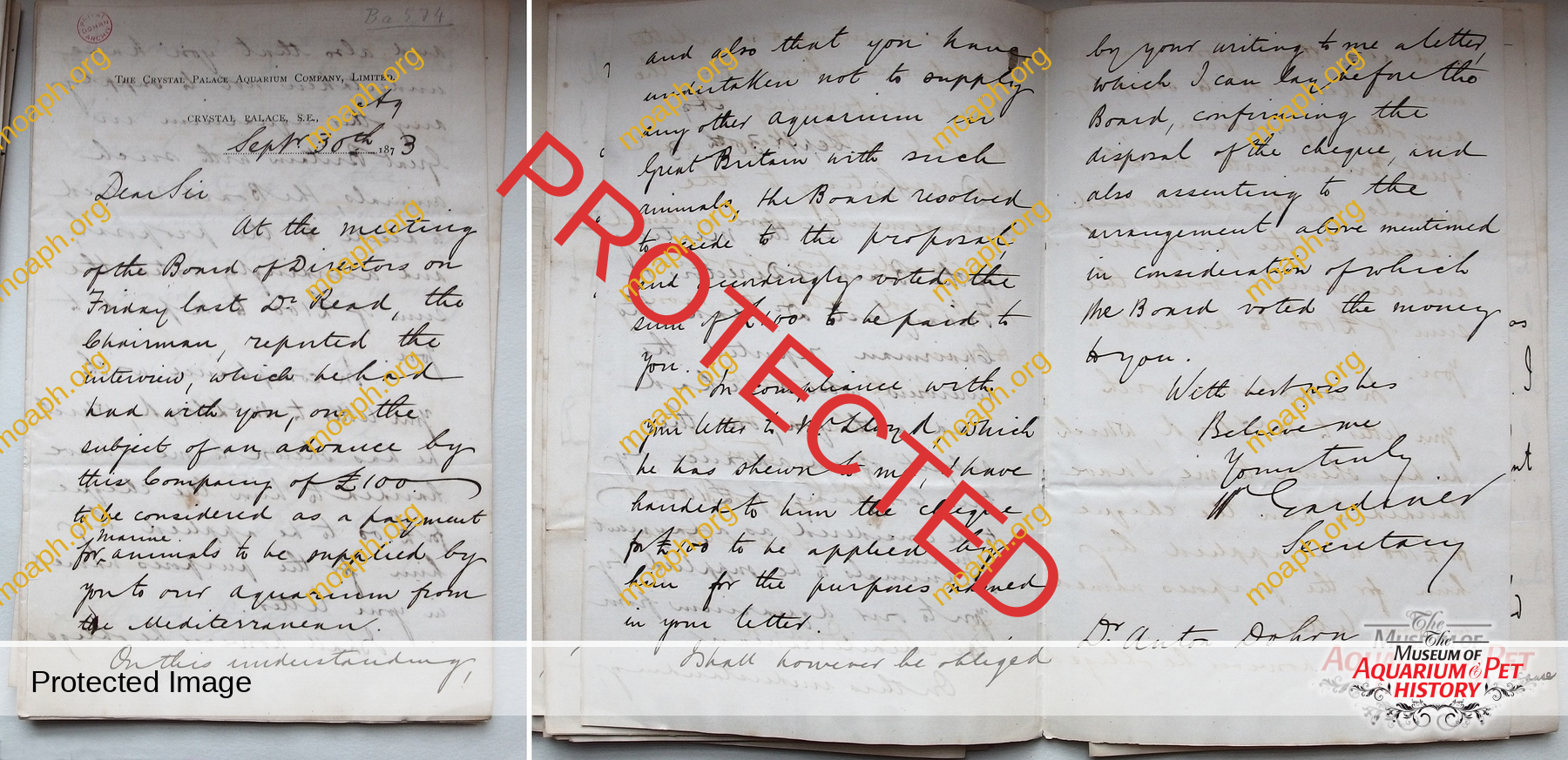
Letter dated September 30, 1873. ©Bayerische Staatsbibliothek.
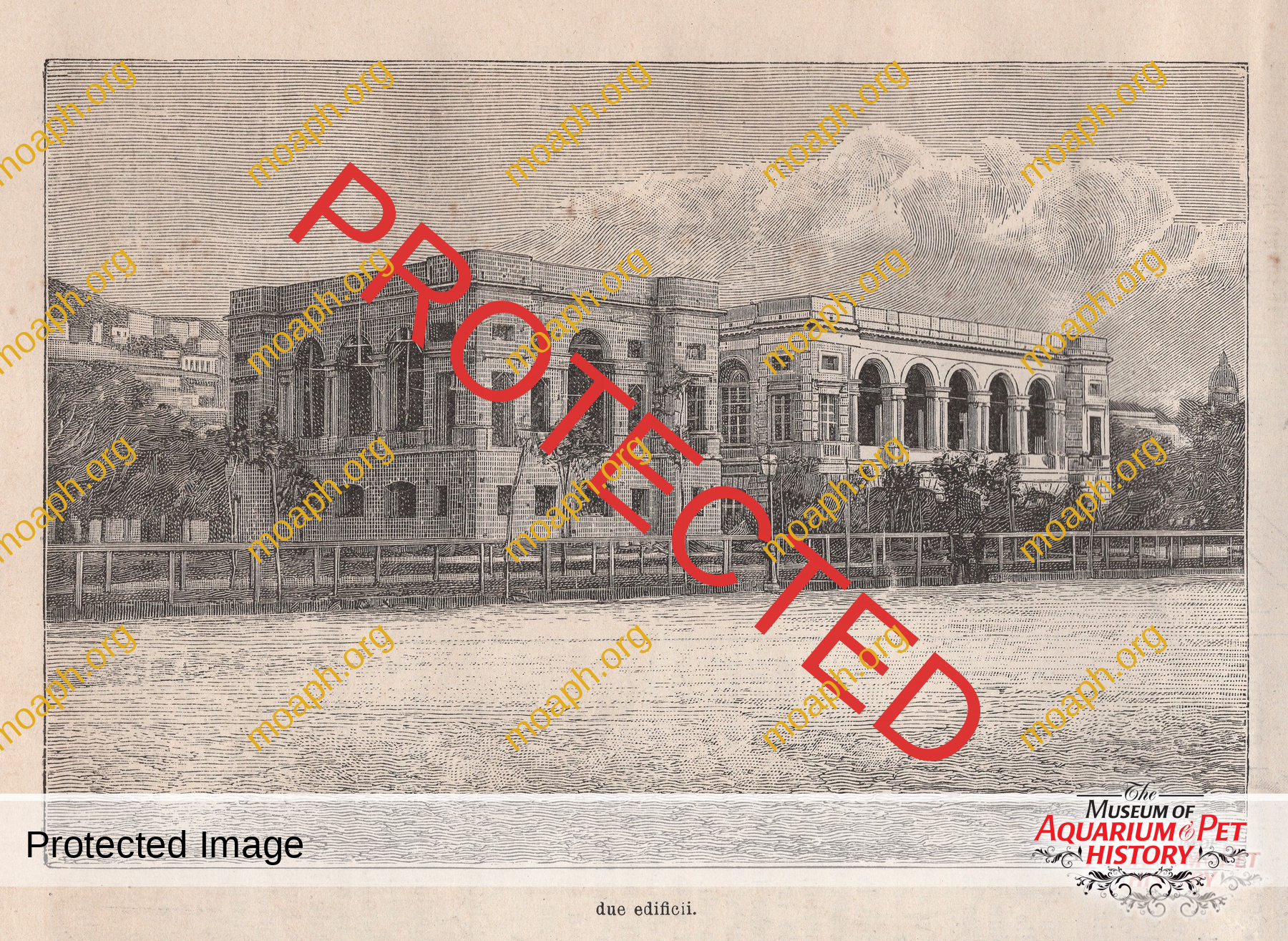
Construction works in progress at the Zoological Station in Naples. Illustration from the newspaper L’Ilustrazione Italiana (Vol. XIII, No.51, 1886).
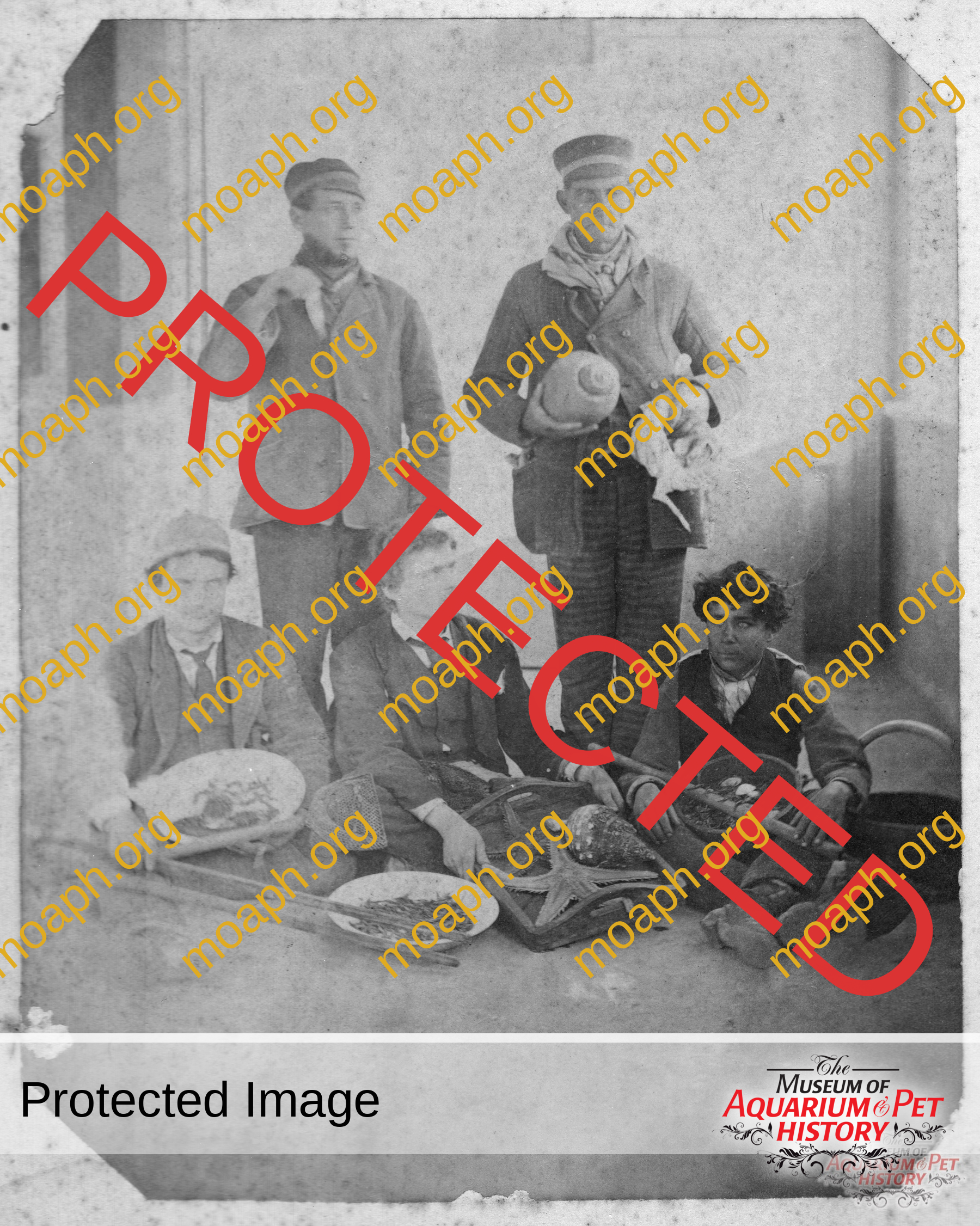
In order to have a constant inflow of live species, Dohrn hired local fishermen on a permanent basis. ©Stazione Zoologica Anton Dohrn, Archivio Storico (ASZN, 9. Armadio 38, Album 24.97).
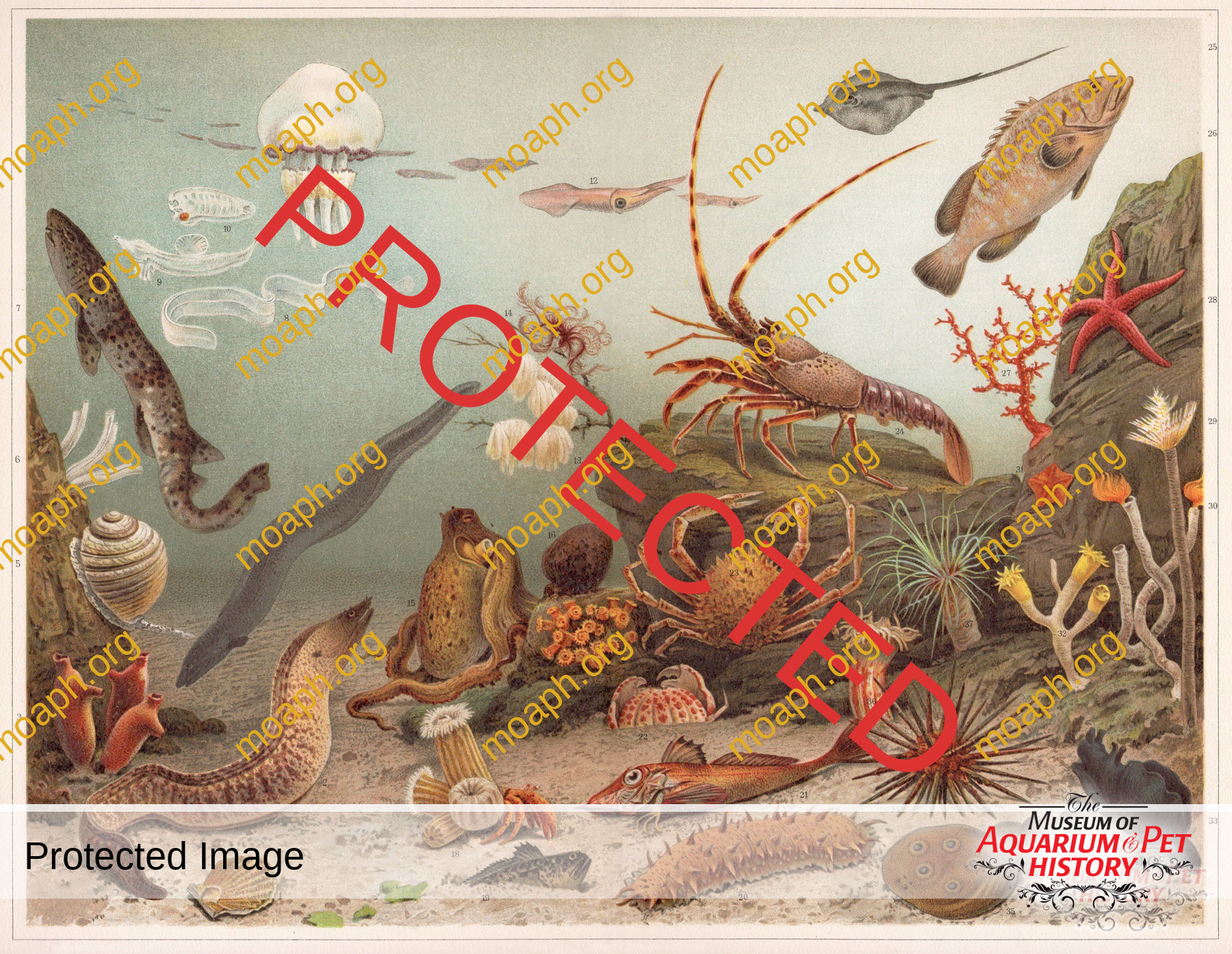
From the encyclopedia Meyers Konversations-Lexikon (6th edition, 1902-1908), a color plate signed Comingio Merculiano (resident artist at the Zoological Station) and depicting an imaginary marine aquarium populated by species of the Mediterranean Sea.
Meanwhile, construction of the Naples aquarium continued despite the frequent delays from the main British suppliers (Goslett for the glass, and Leete, Edwards & Norman for the machinery) and the miscommunication of some measurements on Dohrn’s part. Lloyd always had very little free time and struggled to make ends meet, but despite this he made every effort for Dohrn, basically pro bono.
As the leading professional aquarist in Europe he will be involved, at least as an advisor (sometimes paid, sometimes not), in most of the aquarium projects which will be developed in Great Britain during the 1870s. In terms of design, Lloyd’s trademarks were:
- a system of continuous circulation of water
- the vulcanite pipework which was corrosion-free and didn’t contaminate water as metal pipework did (vulcanite is a hard black insulating rubber produced by vulcanizing natural rubber with large amounts of sulfur)
- huge underground reservoirs (crucial especially for inland/town Aquariums) which kept the continuous circulating system in motion, stabilized the water temperature preventing excessive heating, and clarified the water by killing several suspended spores and microbes in a dark environment.
For the Naples aquarium, which was a seaside facility, Lloyd actually designed an open circulation system in which the seawater:
- was drawn offshore from the gulf of Naples
- was left to decant in a large container
- flowed into 2 large underground reservoirs
- was pumped from the reservoirs into the display tanks
- flowed back down and was discharged into the sea.
The absence of true filters wasn’t a concern. One could say that the aquarium was an extension of the nearby sea. Such a method of circulation will be an immediate success and will be imitated in many other coastal aquariums, including the one in Monte Carlo.
October 4, 1873. [This is the only letter addressed “Dear Dohrn” rather than “Dear Dr Dohrn”. Lloyd will go back to “Dr Dohrn” in all the subsequent letters].
“…All this week I have been so much engaged over your work in London that I have had to do other business at night. Today by the steamer “Justicia” goes Leete and Edwards’s goods. I tried to get the glass and cement ready, but could not. […]
I don’t know how much the glass comes to, but if Goslett’s won’t let it go unless they get all, must try to get some cash. They shall have that £100 and the £30, and any more I may have – Anything to get it to you.
How did you like Dr Read? Don’t you think we are all nice people (gastfrieundliche leute) at the Crystal Palace? (Tired as I am, I must leave a joke.) […]
I want you, when you can, to send through me for publication in “Nature” or some other paper – a little article shewing that our CP Aqm [Crystal Palace Aquarium] system is the best existing, and comparing it to the Brighton system, as not being good – because the people there are decrying ours, and praising theirs. I however, care only for truth. But I acknowledge that for small tanks, where one has for example the small ova etc of animals, there are advantages in air-bubbles…”
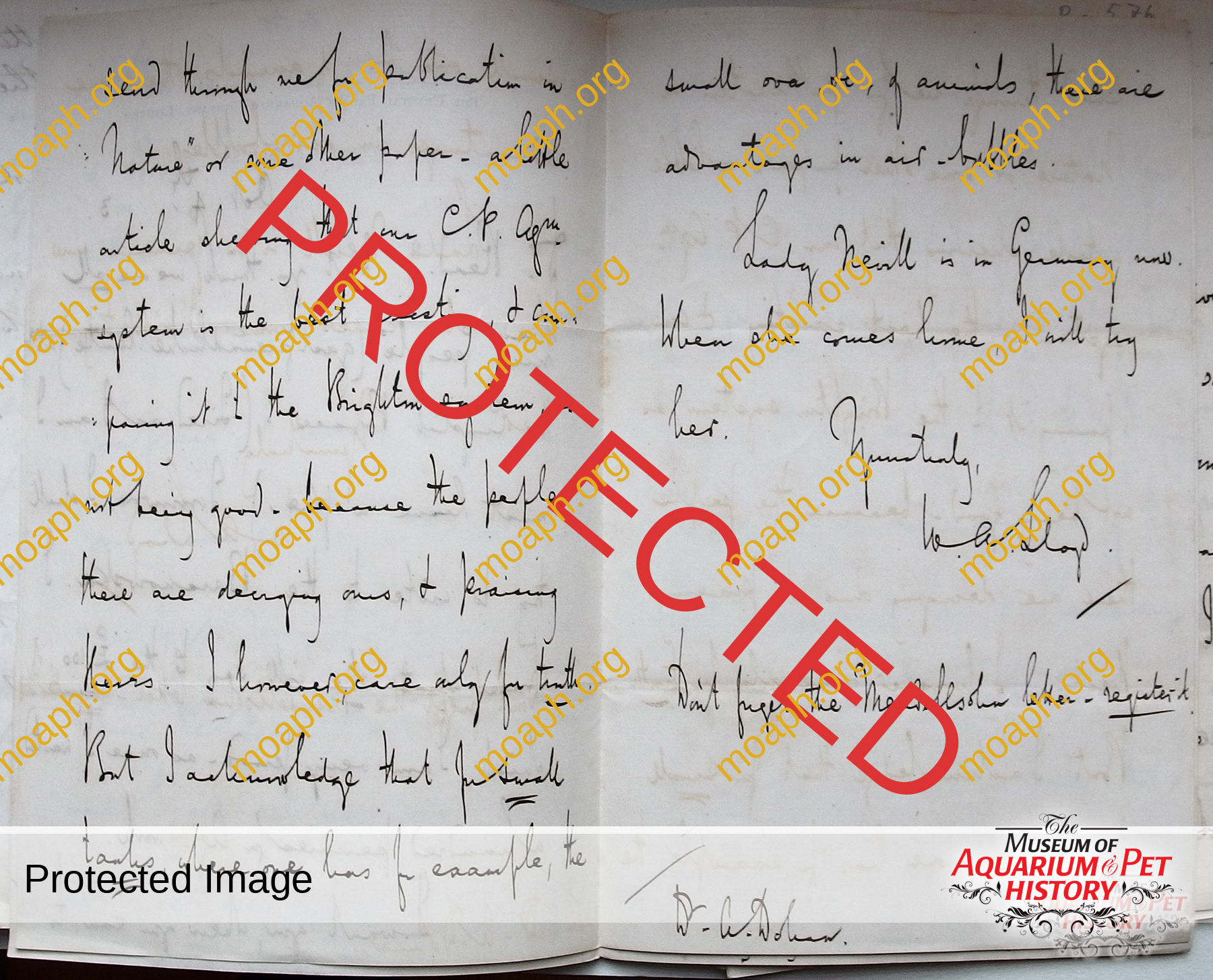
Last two pages of the letter dated October 4, 1873. ©Bayerische Staatsbibliothek.
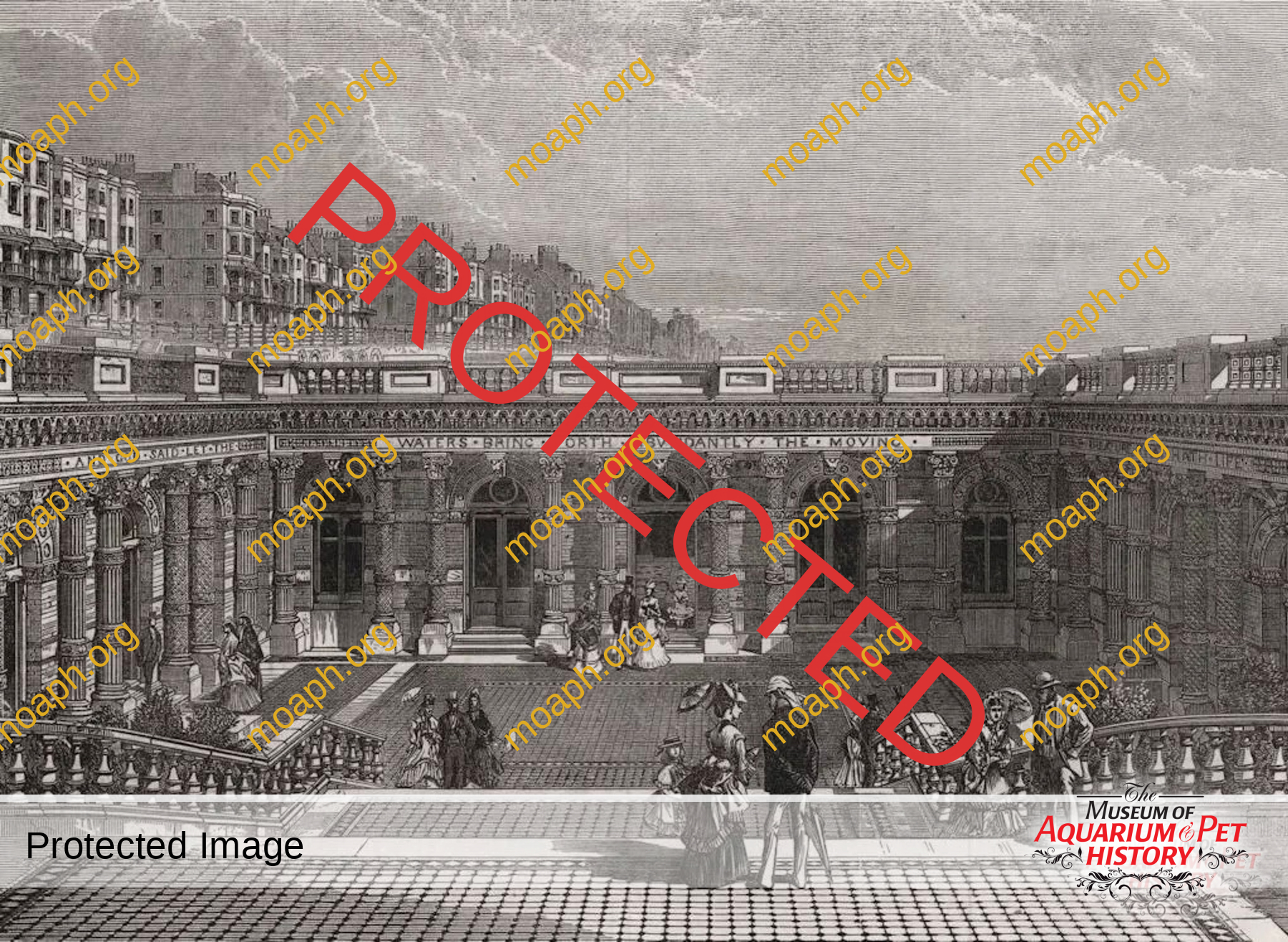
Entrance court to the Brighton aquarium, The Illustrated London News, 1872. The facility was completed in 1872 at a cost of £130,000 and opened to the public on August 10, 1872.
As we have already seen in the first part of this series, Lloyd is consistently critical of Brighton. It must be mentioned, however, that this large entertainment complex opened in 1872 played a key role, together with Crystal Palace, in driving the boom of public aquariums in Great Britain. Its second director was the naturalist and microscopist Henry Lee (1826?-1888), who, distracted by numerous side interests, delegated all the work to William Saville-Kent (1845-1908) from the British Museum. Besides the management’s choice of adding non-aquatic animals to the collection, Lloyd questioned Saville-Kent’s lack of experience as a designer and curator of small or large-scale public aquariums, as well as the effectiveness of his “aerating system” as an alternative to the “circulating system”.
The friction between the two will intensify when their professional paths will cross, like for example at the Great Yarmouth aquarium in 1876.
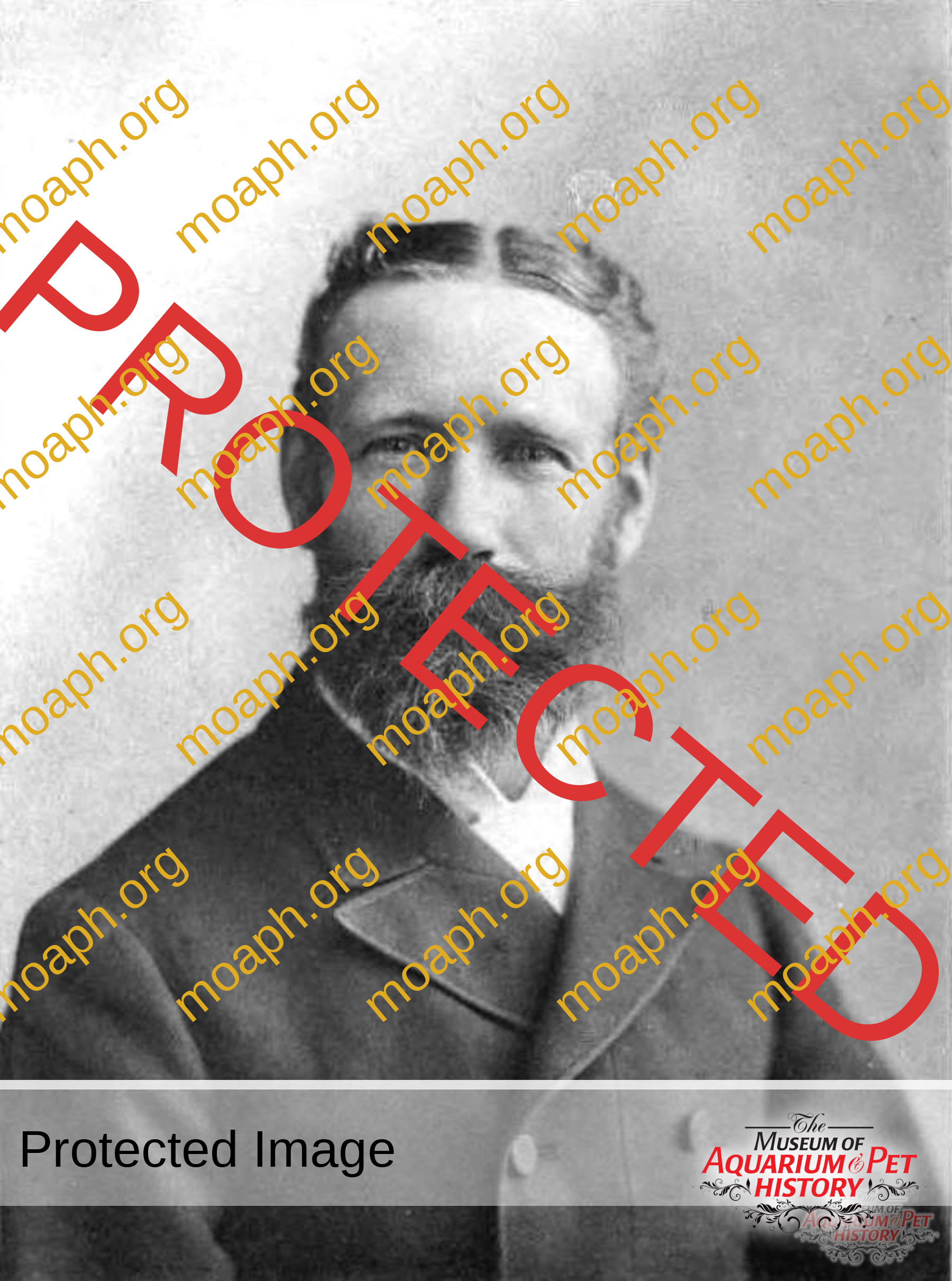
William Saville-Kent (1845-1908).
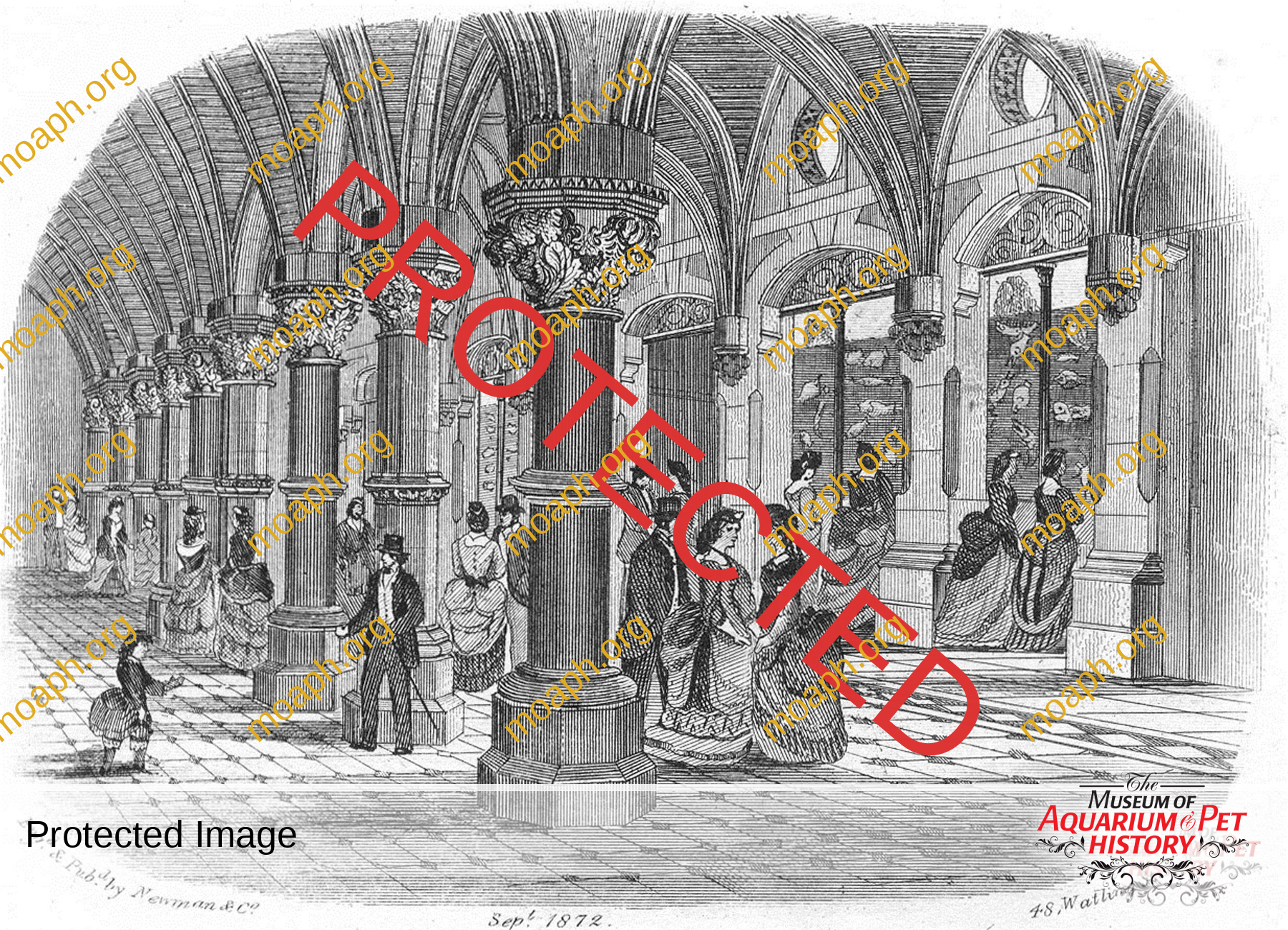
Interior of the Brighton aquarium, 1872.
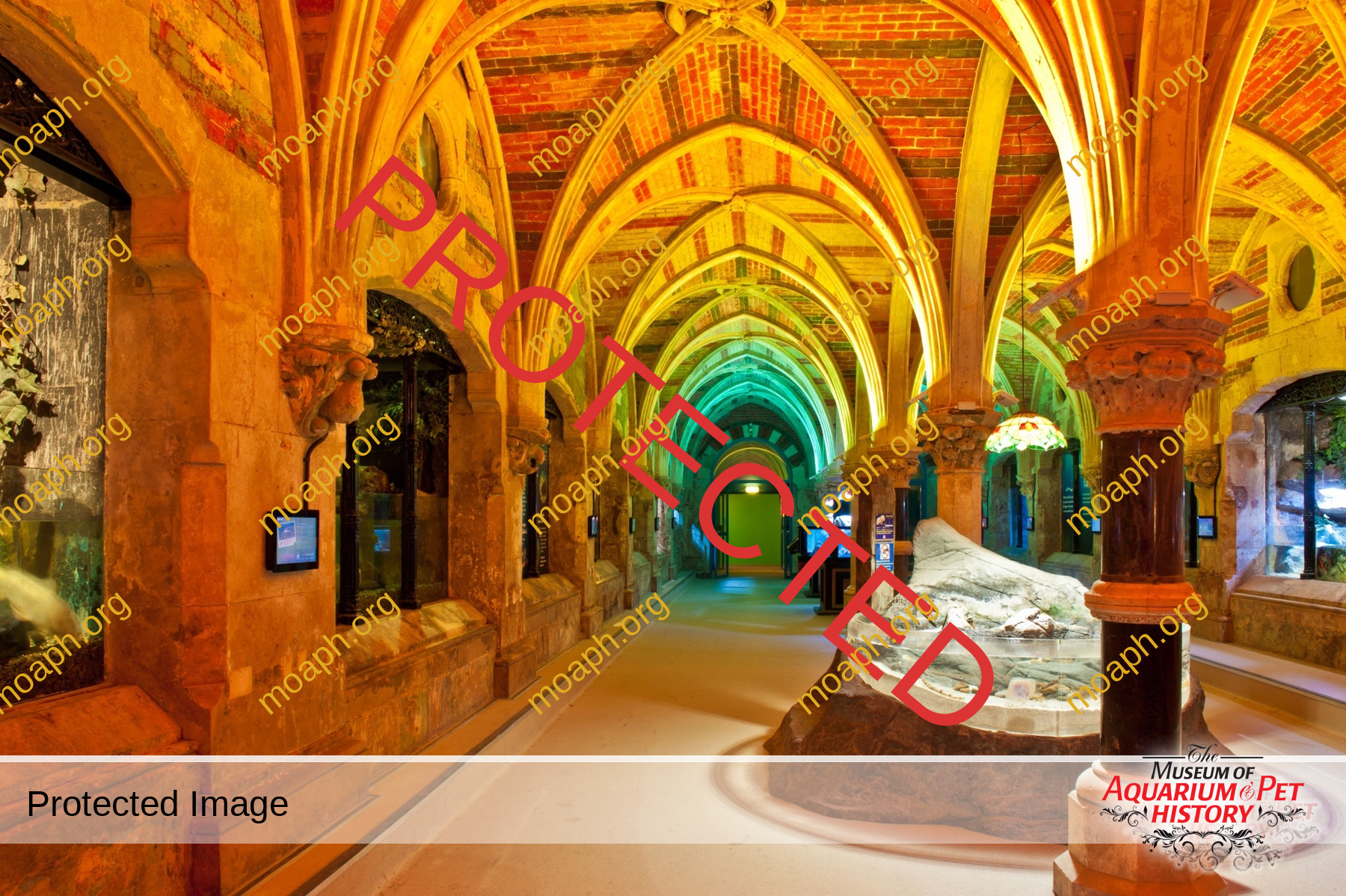
The Brighton aquarium is currently managed by Merlin Entertainment (SEA LIFE) Limited.
Staying for a while on this topic, it’s interesting to quote what the late Albert J. Klee wrote in his digital book Essays on Aquarium Hobby History: “Lloyd’s plan was to keep a large underground, dark reservoir for storage, removal of confervae and other small plants (they die without light), and temperature control purposes. The aggregate contents of the tanks at the Crystal Palace, for example, were only one-fifth of the contents of the reservoir. After circulating throughout the show tanks, the water ran into the reservoir, from which it started again on its circulatory rounds. Should something go wrong, any tank could immediately be emptied into it, and the slight admixture of any turbid water would be unable to significantly affect the condition of the reservoir. The main aeration was produced by the mechanical agitation caused by the circulation of the water and the constant injection of sprays of salt water that entangled air into them, into each tank.
Kent’s plan was to aerate the tanks by jets of air, injected into the water in its simple form; thus the mechanical arrangements were less complicated than those in the Lloyd system. Also, a much smaller storage reservoir was required. The circulation of the sea water in the tanks was carried out individually by means of compressed air, which was supplied to their lower parts. By directly injecting air into the bottom of each tank, it ascended through the entire volume of water, first coming into contact with any organic substances lying at the bottom which was then oxidized. Although Kent referred to Lloyd’s system as the ʽcirculating systemʼ, and to his as the ʽaerating systemʼ, both are circulating, and both are aerating plans.”
November 24, 1873.
“I have just five minutes to write before post, to say that both your letters have come, and goods were put in hand the same day as ordered. I hope you have got the glass and other goods long since sent out. […]
I am so busy and tired that I ought to have two heads and many pairs of hands to think, work and write. All Aqm people from everywhere in Britain and abroad come to me. You remember the Vienna folks, who came to me for advice, and would not take it or pay me anything. They have now come again to me and sent an engineer (a new one) for they are in distress for me to visit them, as they have spent over £4000, and all is a failure, for nothing will live, and all must be re-constructed in the interior. It is most vexatious for people to be so stupid, and waste money, and lose the chances of the Exposition of 1873. I will do all I can for the new man – but send me more money immediately. I am making up my accounts with you and you shall have it at Christmas.”
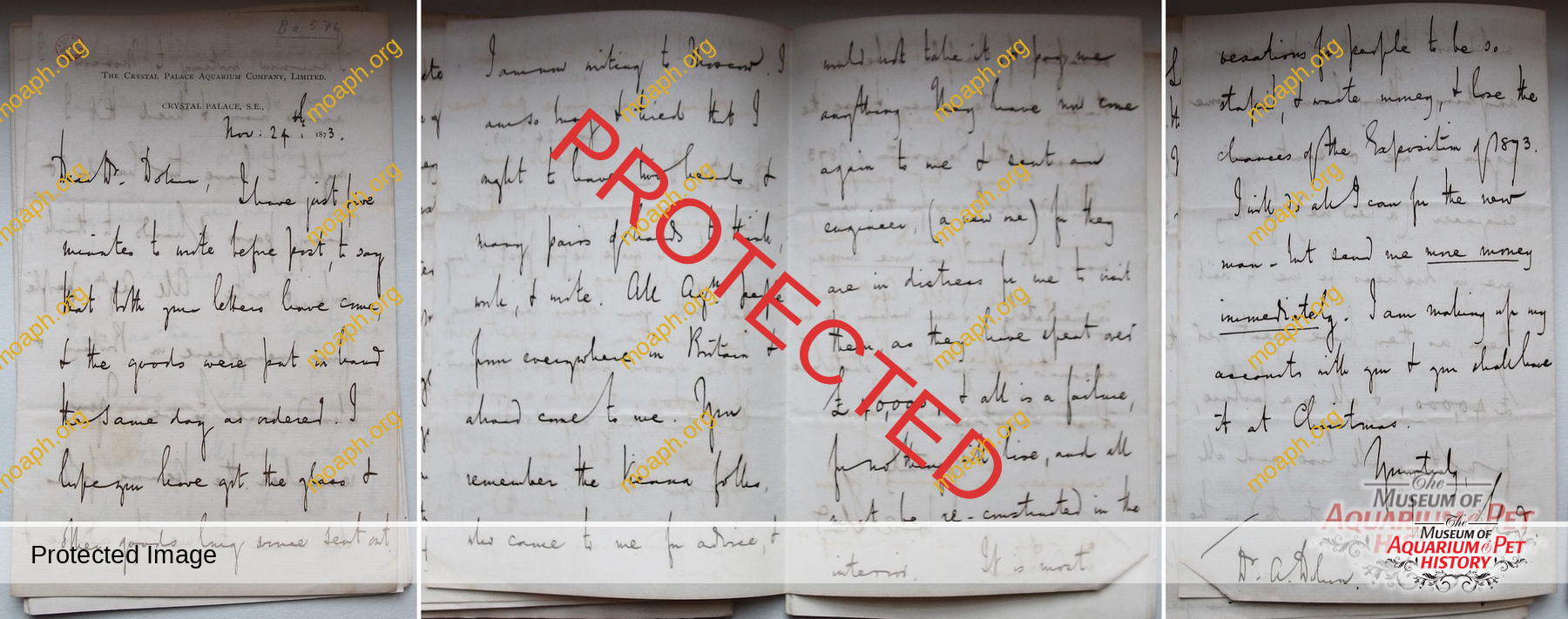
Letter dated November 24, 1873. ©Bayerische Staatsbibliothek.
January 9, 1874.
“I write this at Leete & Edwards’s place where I have been most of the day on your business. I found that you forgot to give the thickness of the last glasses you ordered of Goslett and so, I have had them make this: –
Small pieces 3/8th of an inch thick.
Larger pieces 5/8th of an inch thick.
But I am uneasy about this, so telegraph at once to me to say if those thicknesses will do.
Let me get all right again and next week I will send you a long and orderly letter. I have been much overtired and been troubled with my old complaint – occasional loss of memory. The Doctor has ordered me to go to Brighton tomorrow – Saturday – and stay till Sunday.
Pray forgive any shortcomings of mine – remembering how you have been yourself from the same cause…”
The Naples aquarium will open on January 26, 1874. The first aquatic animals, more than a thousand, were collected from the military harbor of the city and placed into 26 display tanks holding a total amount of 66,000 gallons of seawater. Meanwhile, things seem to be going well at the Crystal Palace. The following letter reveals a Lloyd who is proud of his own work, as it allows him, despite his humble origins and his lack of a higher education, to interact almost daily with prominent men of science and potential benefactors who clearly valued his reputation. In this document, Lloyd writes also about a serious injury he had to his poor head which already suffered occasional losses of memory. One wonders if there might have been a connection between this injury and the purported cerebral hemorrhage that will lead to his death in 1880.
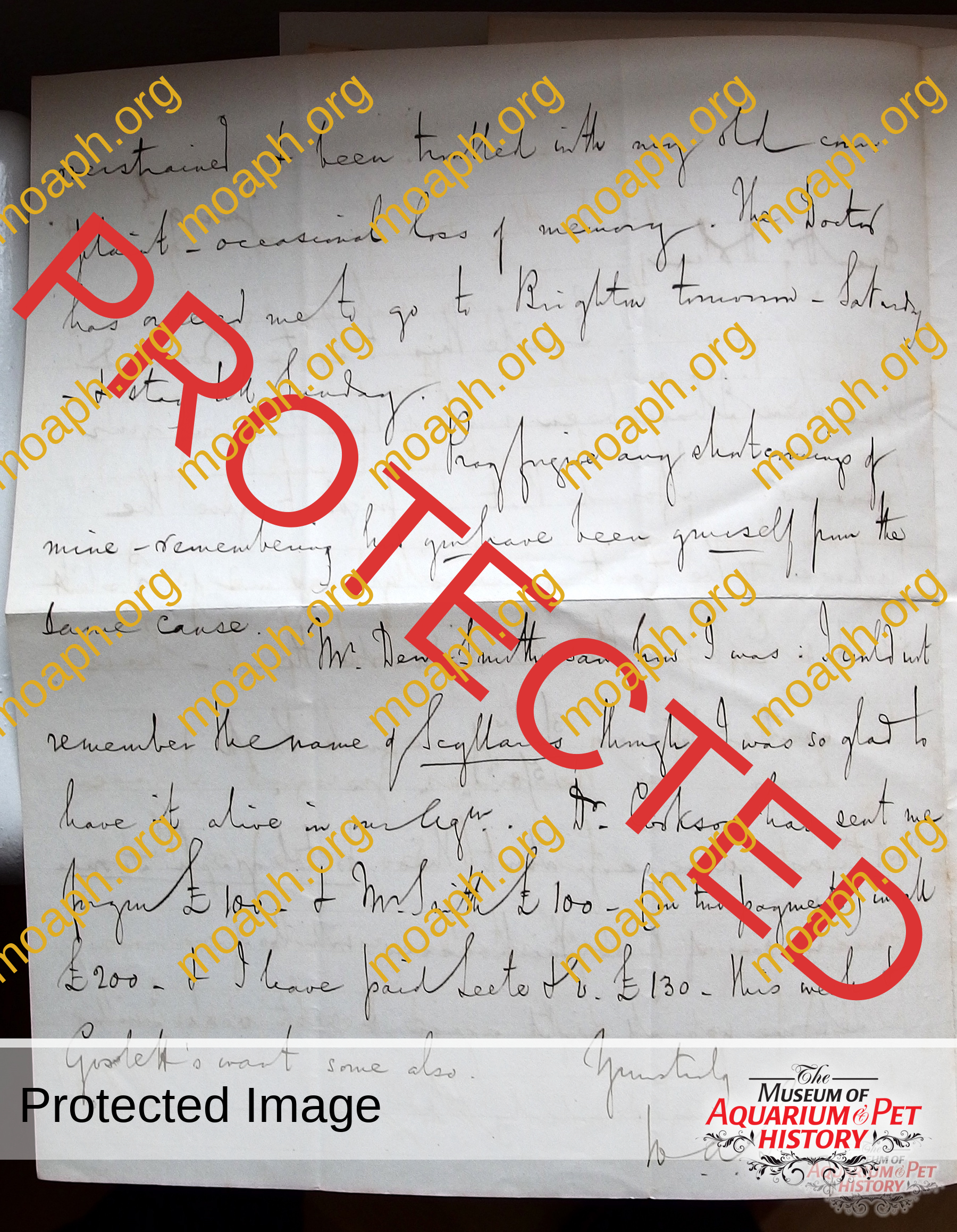
Page 2 of the letter dated January 9, 1874. ©Bayerische Staatsbibliothek.
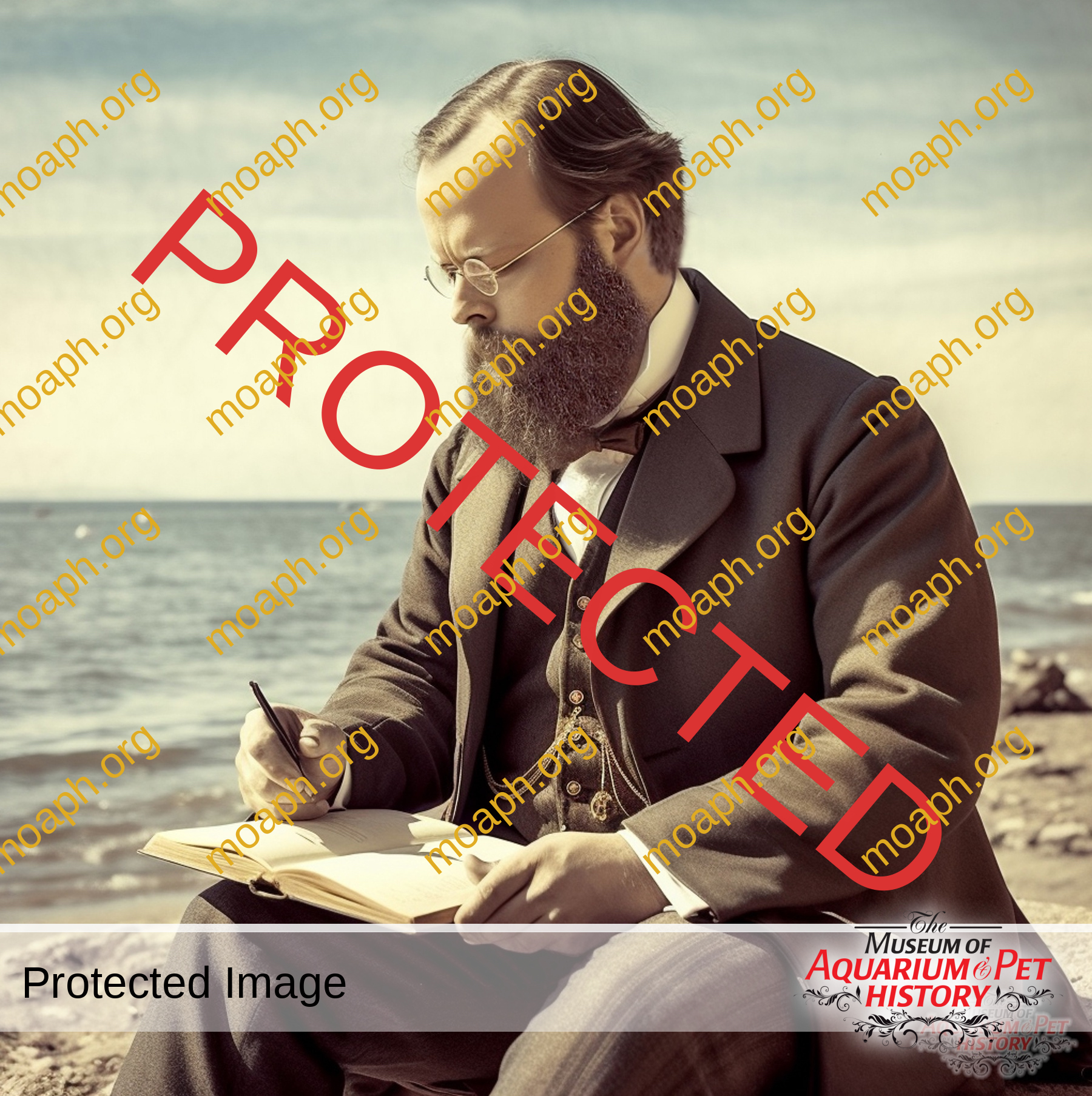
AI-generated image of Anton Dohrn.
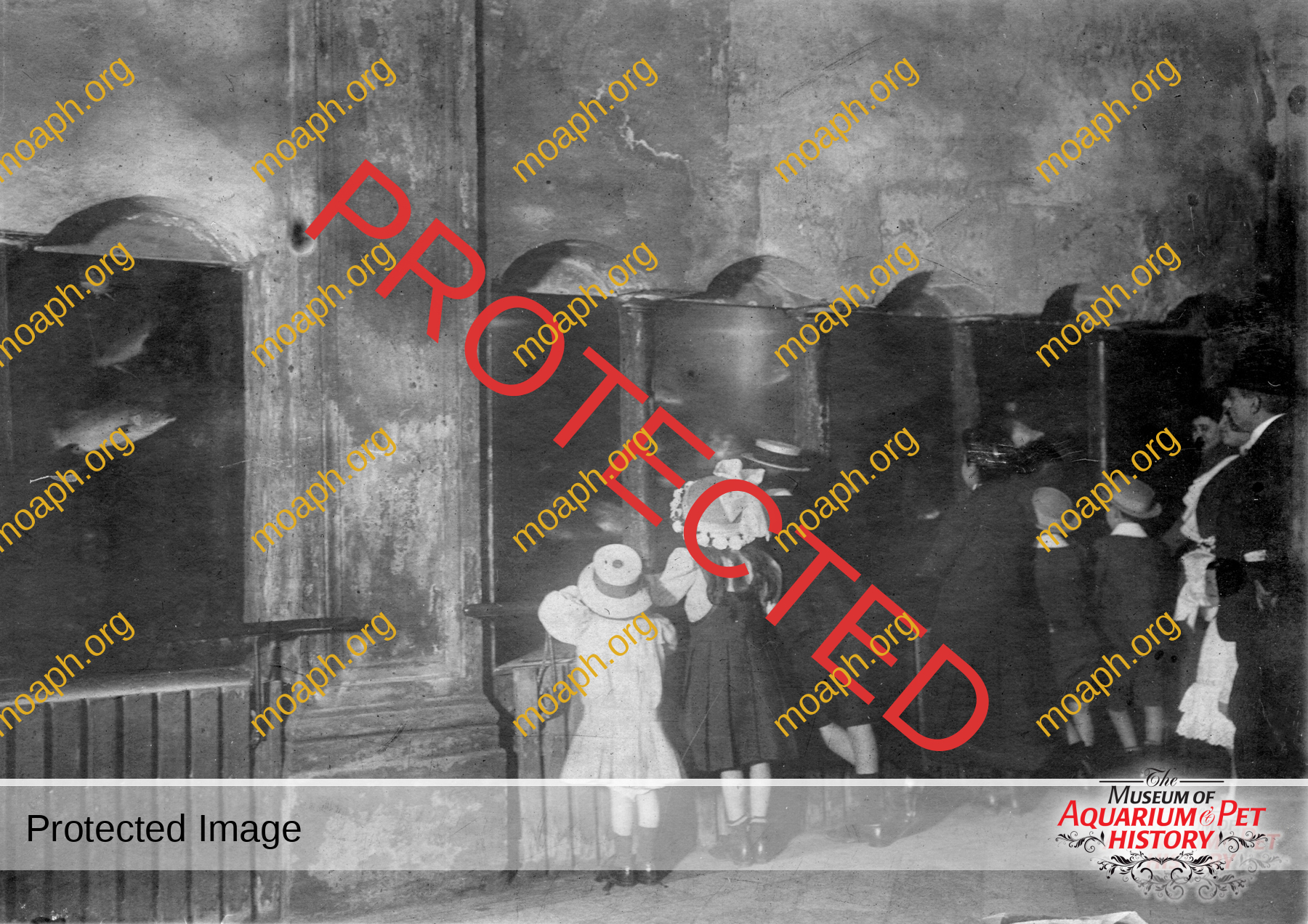
Visitors at the Naples aquarium ©Stazione Zoologica Anton Dohrn, Archivio Storico (ASZN, 1.I.A.1910.R
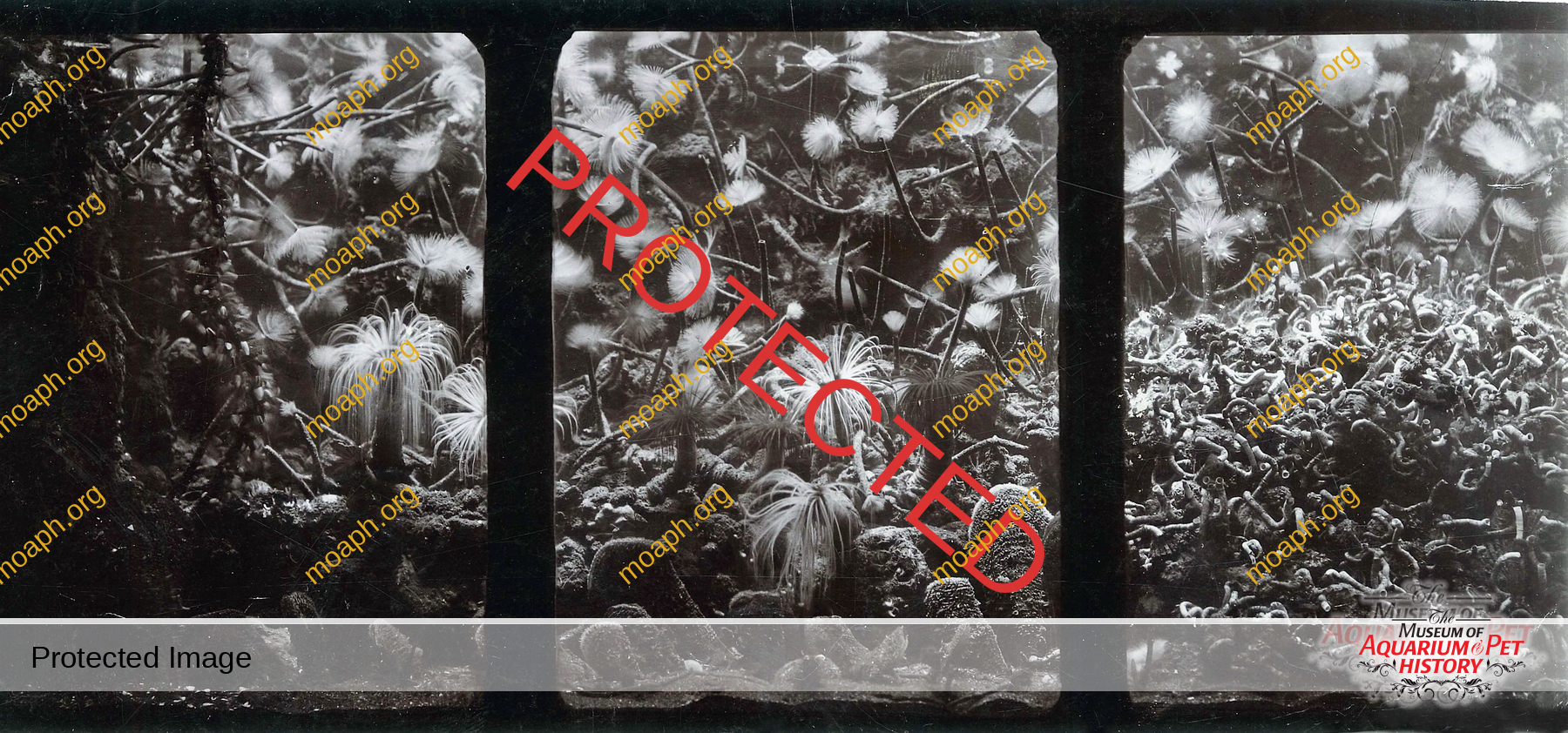
The tanks at the Naples aquarium literally overflowed with marine life. ©Stazione Zoologica Anton Dohrn, Archivio Storico (ASZN, 1.Lb.6.1.24).
May 28, 1874.
“I have today your letter, as well as one of a little time ago, about your account. You may be sure that no unusual cause has been the reason why I have not of late corresponded with you, and I now have to explain that an accident has been the reason, for some time ago I struck my head in a fit of absence of mind by running against some of the ironwork of the CP and did myself much injury, in fact, I had a slight concussion of the brain, and I thought that all my work in this world was ended. By degrees, however, I got over it, but I was urged to rest entirely for a while. I could not do that, however, nor could I say anything about it to the people of the CP as my head is my living, and my employers might think that I was permanently hurt, and was incapable of my post. So I contented myself with coming to the C.P. daily, and of doing as little as possible, instead of as much as possible, and by these means all my writing has got in arrear, your affairs among them. But now be patient with me, and next week I will send you what you want. All the work I think I have now in literary and scientific journals, for May 9th in an article on the SZ [the Zoological Station] named your wants, I have, in an article in the same journal to come out this week, also made mention of them, and have invited subscriptions. […] I am now beginning to have indirect influence with a very rich woman, the Baroness Burdett Coutts, and I think that after a little time, I may ask her. Then a very wealthy young English nobleman, The Marquis of Bute, with £300,000 a year has lately taken a fancy to marine zoology. He is president of the Archaeological and Physical Society of Bute, close to where you have worked in Scotland, near Glasgow, and he has subscribed £1000 and given the land and materials, at Rothesay, the principal town of the Isle of Bute, for an Aquarium, of which I am the advisor and general manager, and another £4000 has been raised by subscription, and we hope the place will be opened in a year. I am doing all I can to please the Marquis, so as to make him my personal friend by my deserving to be so, and then, if my lawful means I can get him to be so much interested in science generally, I doubt not that I can get him to assist you, but I do not wish to ask him, nor to have his name mentioned in connection with such a thing in any way, till we have further advanced, as to be premature in these matters is to quite spoil all.
Are you married yet? If so I send my congratulations. You may be sure that only such a mishap as I have named would have hindered my writing, as I promised, to Frau Doctrin Dohrn but I yet will do so, and I will send her a copy of all I have ever printed on Aquaria, and which I can now get. How long are you staying at Stettin?
I am disappointed at you not telling me much more of your zoological results at Naples. Have you no list – in Latin of course, of the animals you keep? […]
The large mass of Coral you sent as – weight 29 ½ (lbs) – is doing well and is a most splendid object, admired by all our thousands of visitors. I shewed it brilliantly illuminated by gas, at the Soiree of the Royal Society and told its history, and that you had sent it, and Professor Huxley was never tired, all the evening, in taking people to see it. He took Darwin and Hooker, and in fact, he spent two hours in journeying backwards and forwards with groups of people, to admire this group, which all said was the finest object shewn in all the rooms that evening.
This letter is for your wife as well as for you, and tell her if she first sends me a letter, I will all the sooner write to her. Write to me soon yourself, and tell me you forgive my delay. You see my handwriting is slightly altered in its character by my accident, and by my since part out of practice.
I am more careful with your money than with my own!! [Note at the top, sideways]”
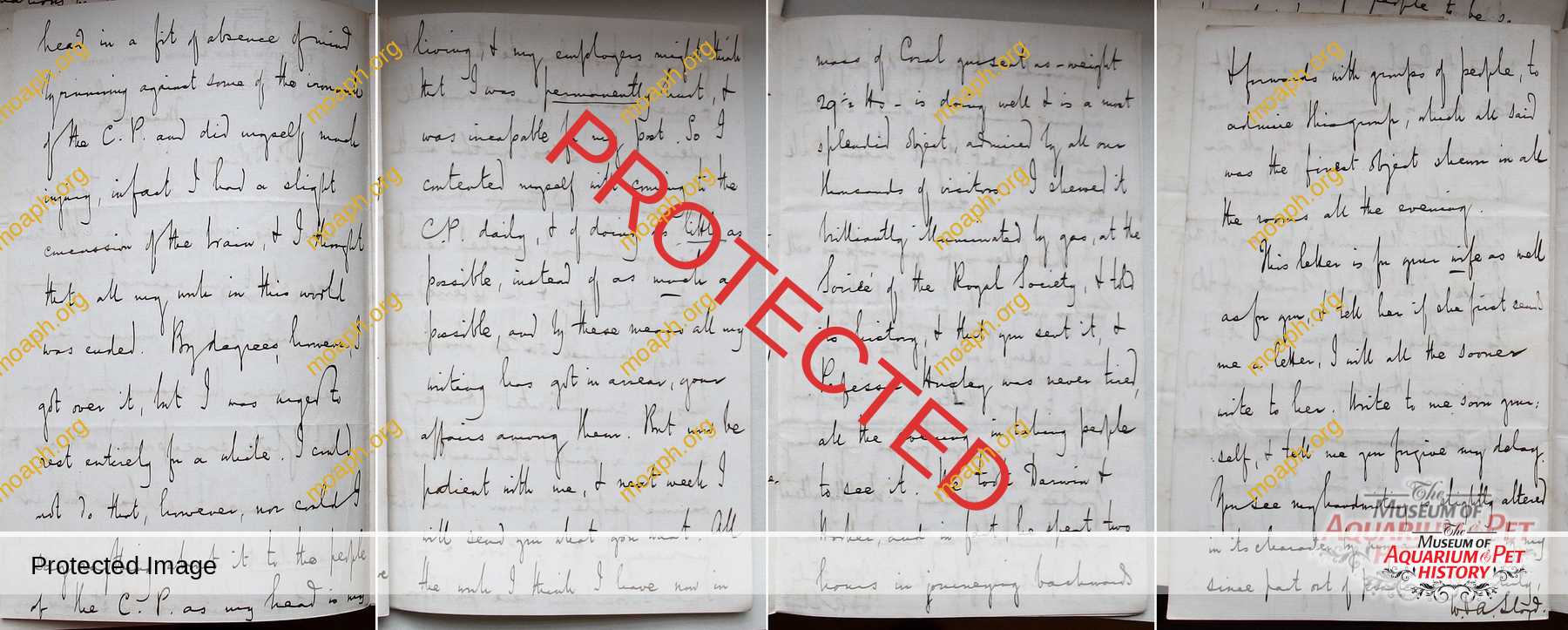
From left to right, pages 3, 4, 9 and 10 of the letter dated May 28, 1874. ©Bayerische Staatsbibliothek.
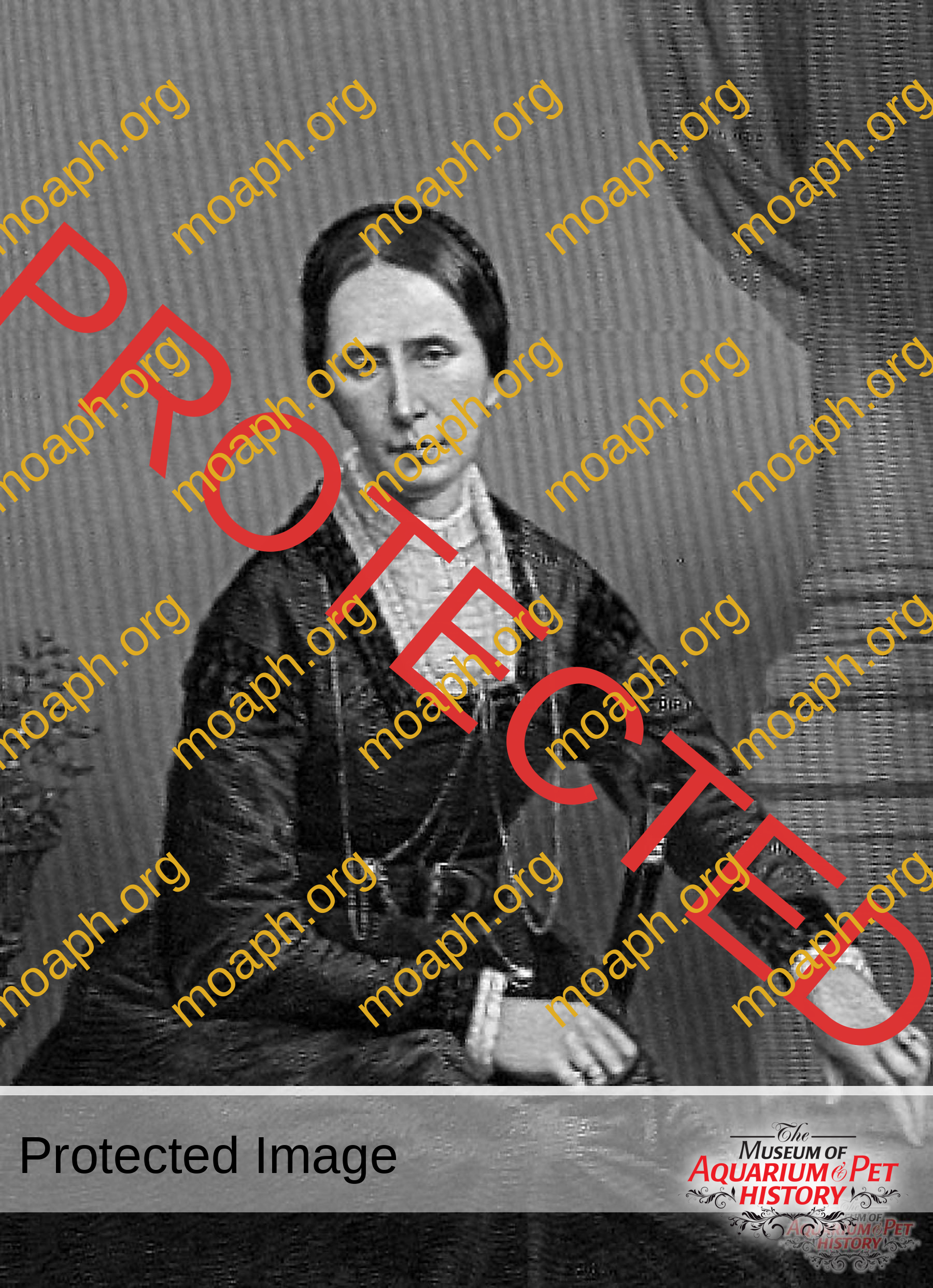
Angela Georgina Burdett-Coutts (1814-1906) was a British philanthropist. In 1837, she became one of the wealthiest women in England when she inherited her grandfather’s fortune following the death of her stepgrandmother, Harriot Beauclerk, Duchess of St Albans.
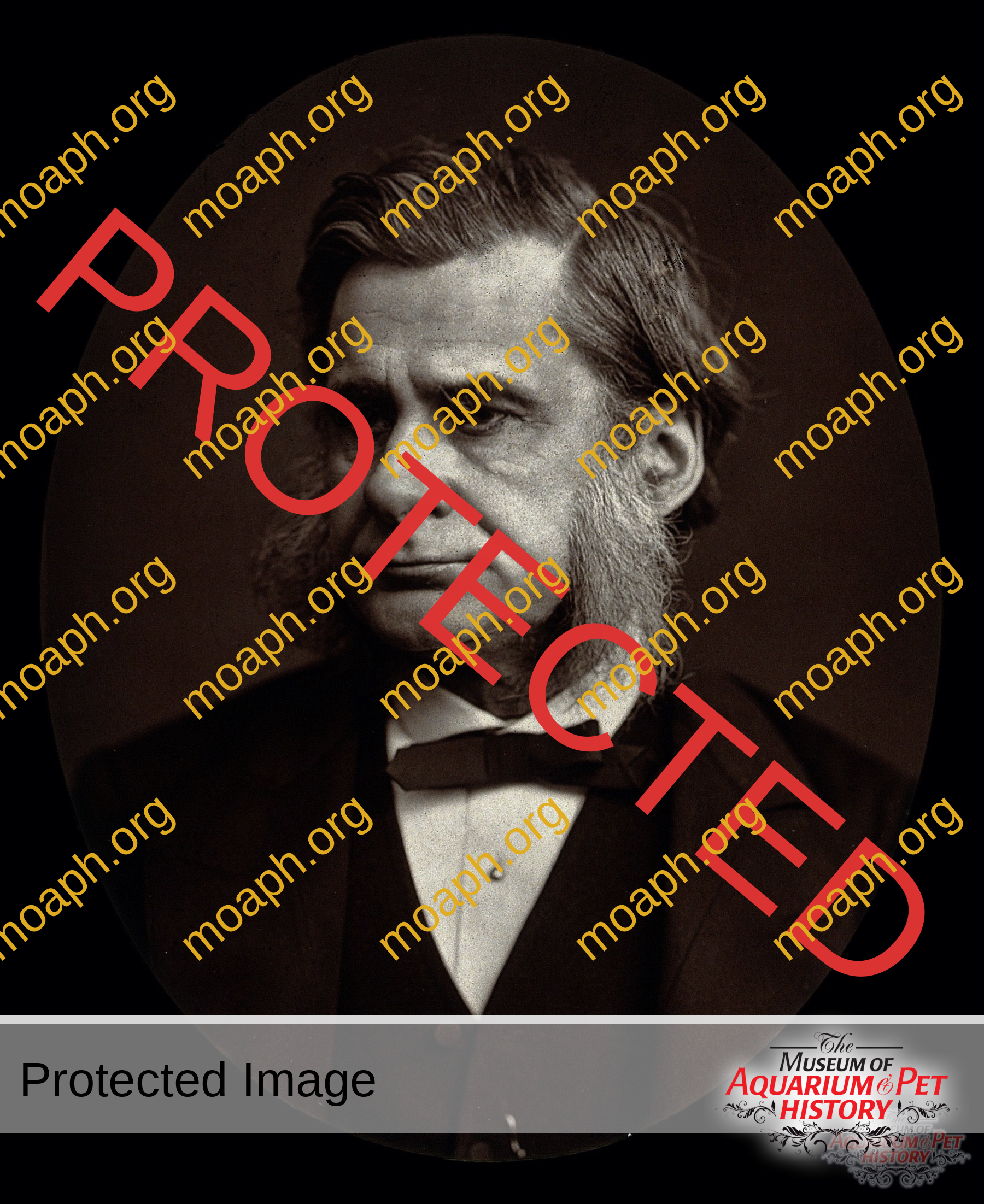
Thomas Henry Huxley (1825-1895) was an English biologist and anthropologist who specialized in comparative anatomy. He has become known as “Darwin’s Bulldog” for his advocacy of Charles Darwin’s theory of evolution.
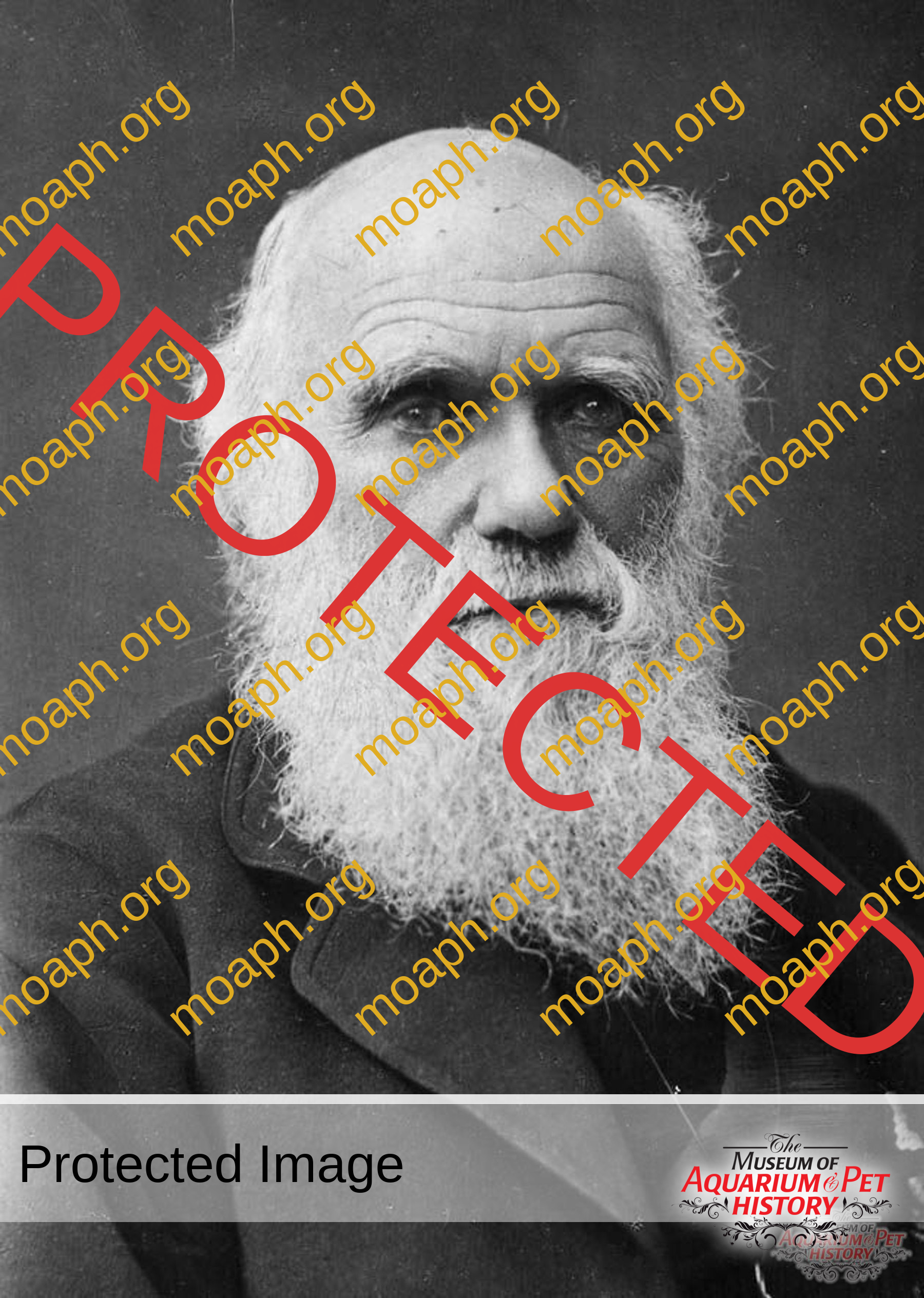
Charles Darwin (1809-1882). Anton Dohrn was a fervent follower of his theories.
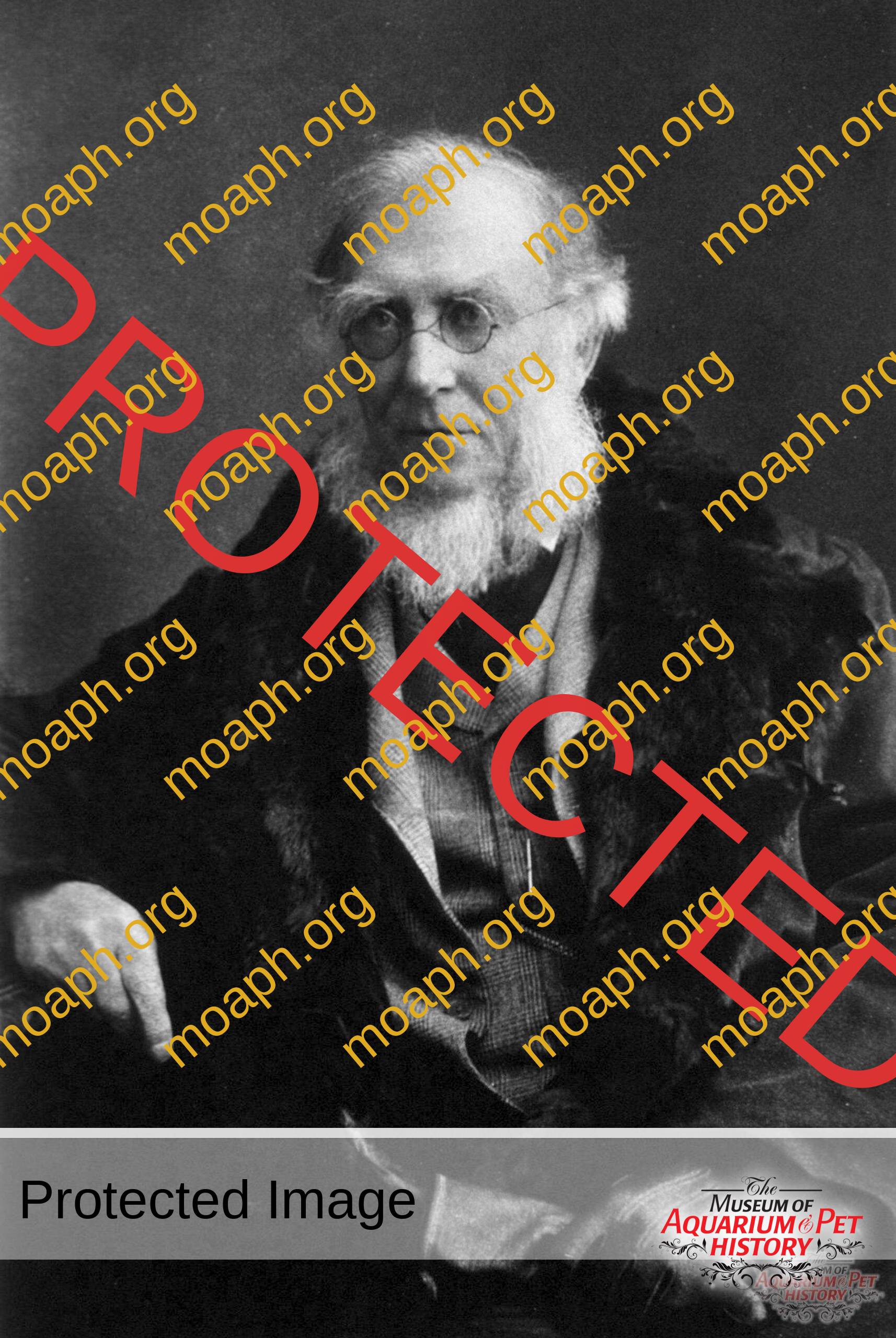
Joseph Dalton Hooker (1817-1911) was a British botanist and explorer. He was a founder of geographical botany and Charles Darwin’s closest friend. For 20 years, he served as director of the Royal Botanical Gardens, Kew.
March 3, 1875.
“I am very sorry indeed that I have been so long without writing to you, but if you but knew how much I have to do and think about in aquarium work in various directions, added to constant illness at home and my own sad accident last summer, you would not be very severe with me.
On the last page of this letter if I have room – or on a separate paper if I have none, I will give you the result of our transactions, promising that very shortly I will forward you a detailed account, with all receipts, etc. […]
I am disappointed about getting from you a more explicit account of your station and its results etc. I want this to incorporate in an account I am now doing for Nature, and all your aquarium work from the beginning of this century to now, in regular chronological order, with a clear exposition of principles, and as your place is the first one established with purely scientific results as its objects, it is most important that I should know about it as fully as possible […]
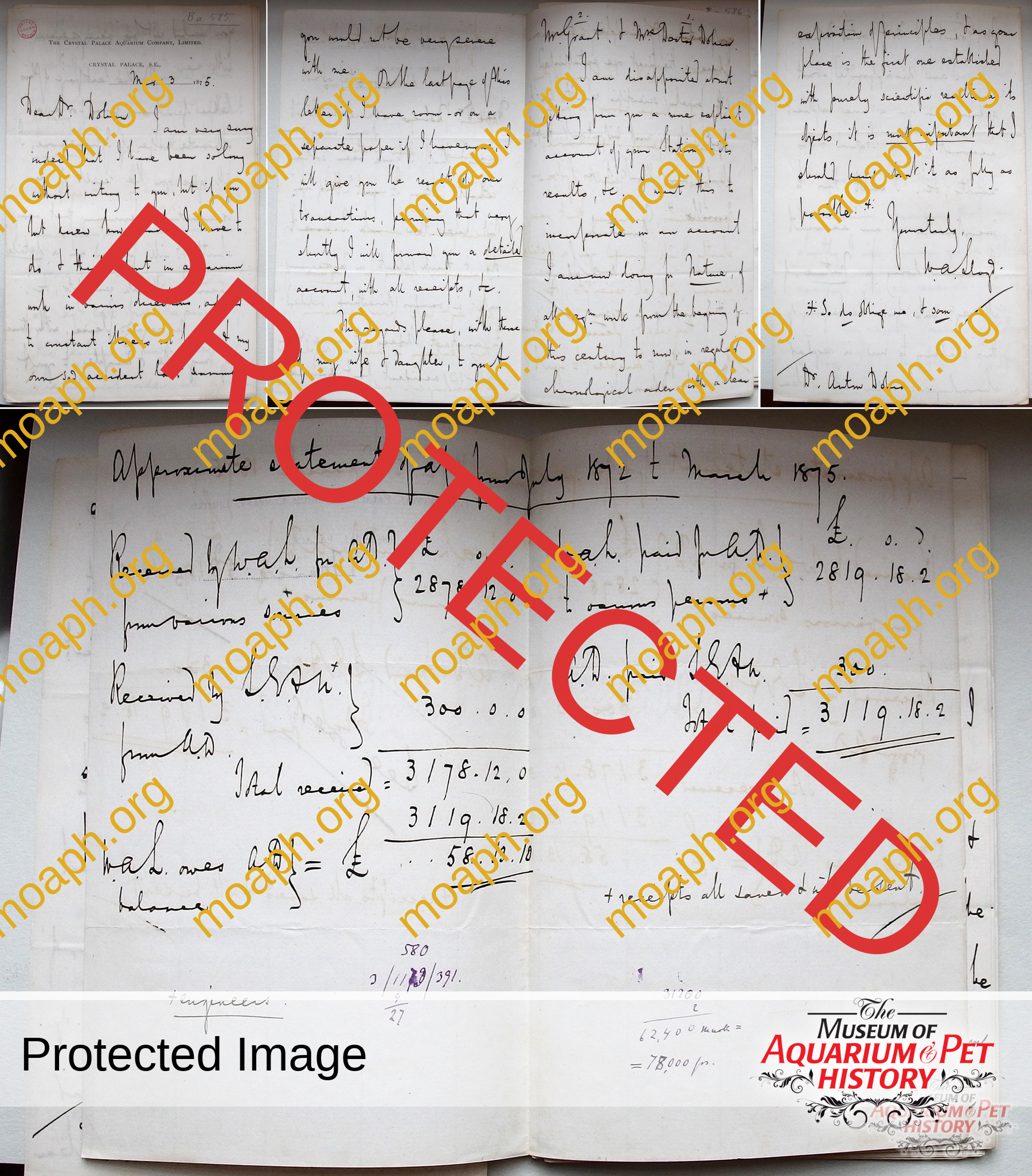
Letter dated March 3, 1875. ©Bayerische Staatsbibliothek. The Victorians used the pound sterling (£), which was divided into 20 shillings (s), each of which was divided into 12 pence (d).
March 16, 1875.
“I received your letter of the 9th of this month, and I now enclose my accounts with you to this day, with bills etc, and I trust they will reach you by the time you name, and that you will be satisfied with them and with me. I am sure I have worked very hard for you, and have had much anxiety on your behalf, in addition to my much other work. Often, when your business has called me away in London, I have sat up late to do my own work. So I am now very glad to bring it all to a conclusion, so far I much regret that at the beginning of your Naples construction you did not have better engineering as I am now certain that much of your glass breaking has arisen from bad foundations, perhaps not originally bad, but made so by a continued leakage of water in consequence of the permeable nature of Portland cement, and indeed of all calcareous cements. It is the same here and at Manchester, Southport, Brighton and elsewhere, so in the Margate Aquarium and Rothesay Aqm and Royal London Aqm all these of which I am officially connected with, we shall line the tanks and reservoirs with asphalt. I am now making experiments with this material, and find it quite harmless in both sea and freshwater aquaria.
You must not imagine that I am getting rich with having to do with the aquaria besides our own at the CP. On the contrary, with the exception of about £80, I have received […] in the last year – all has been going out and none coming in, and in this I am obliged to share in the fortunes of the institutions I am connected with, that is, to wait till they earn money.
Altogether I think I have done much in my humble way for science I have in it worked as hard only to gain a living, as most men in trade do to make a fortune. As you may know, in 1863, I lost all by bankruptcy, and went to Germany [to the Hamburg aquarium, thanks to the help of his friend and patron Richard Owen] almost naked. Then when I had things turned around a little, and was getting on, I had to sell all my home and return to England, and begin again my life. Certainly I now have good prospects, but it is all in the future and not much in the present time.
Aquaria as speculations are now quite the mania in Britain, and it seems as if all the promoters of them were bent on driving me into a lunatic asylum by coming to me, almost daily, for advice and help, but I need not hardly say, very seldom with any offers of pay, much as my time is taken up. Even while writing this, five minutes ago, a printed prospectus came to me for a new one at Yarmouth, and begging my assistance and an article in the local newspaper. I ought to be a sort of writing clock, and be wound up once a week, and go for 24 hours a day! You see how it is, very few naturalists are mechanicians, and very few mechanicians are naturalists so when a man is found to have some knowledge of both things, and of general physics, he gets worked to death, as I am worked, and as I said before, without adequate pay.
The thing, however, seems almost sure – All these public aquaria will create a demand for Mediterranean marine animals, to add to our already rich British marine fauna. If I had at this moment £1000 worth of Naples crustacean, mollusca and fishes, of good dimensions and at reasonable prices, I could sell the whole in one week! And the demand next year, if all goes on as at present, will be doubled. So I want you to devise better means of transporting living aquatic animals than we have had. I do not know if you are aware that it was I that paved the way for your getting a gift of £100 from our Company here. Certainly it was you that went to Dr Read’s house and obtained his permission as chairman, but it was I that the day before, made it favourable by representing the treasures of living marine animals we hoped for from Naples. Yet we have had but very few and at this moment our Italian animals are represented by 1 Calappa [the crab Calappa granulata] and but very few other things in sight. You may conceive how much Mediterranean Aqm animals are valued here when I tell you that a whole column of a weekly newspaper ‘Land and Water’ is this week taken up with two Amphioxus [Branchiostoma lanceolatum] transferred from the Zoological Gardens to the Brighton Aqm and which originally came from here, they having been sent by you. But if I could show a greater number of things and greater variety there it would be a good advertisement for you elsewhere.
I have not forgotten my promise to write a long letter to your wife. My compliments to her and say I will send her as soon as I can, the epistle, and some printed matter by me.
When you and she come to London you must dine at our house.
When you make your speech at the opening of your place and report it in Nature, don’t forget your old and true friend of many years…”
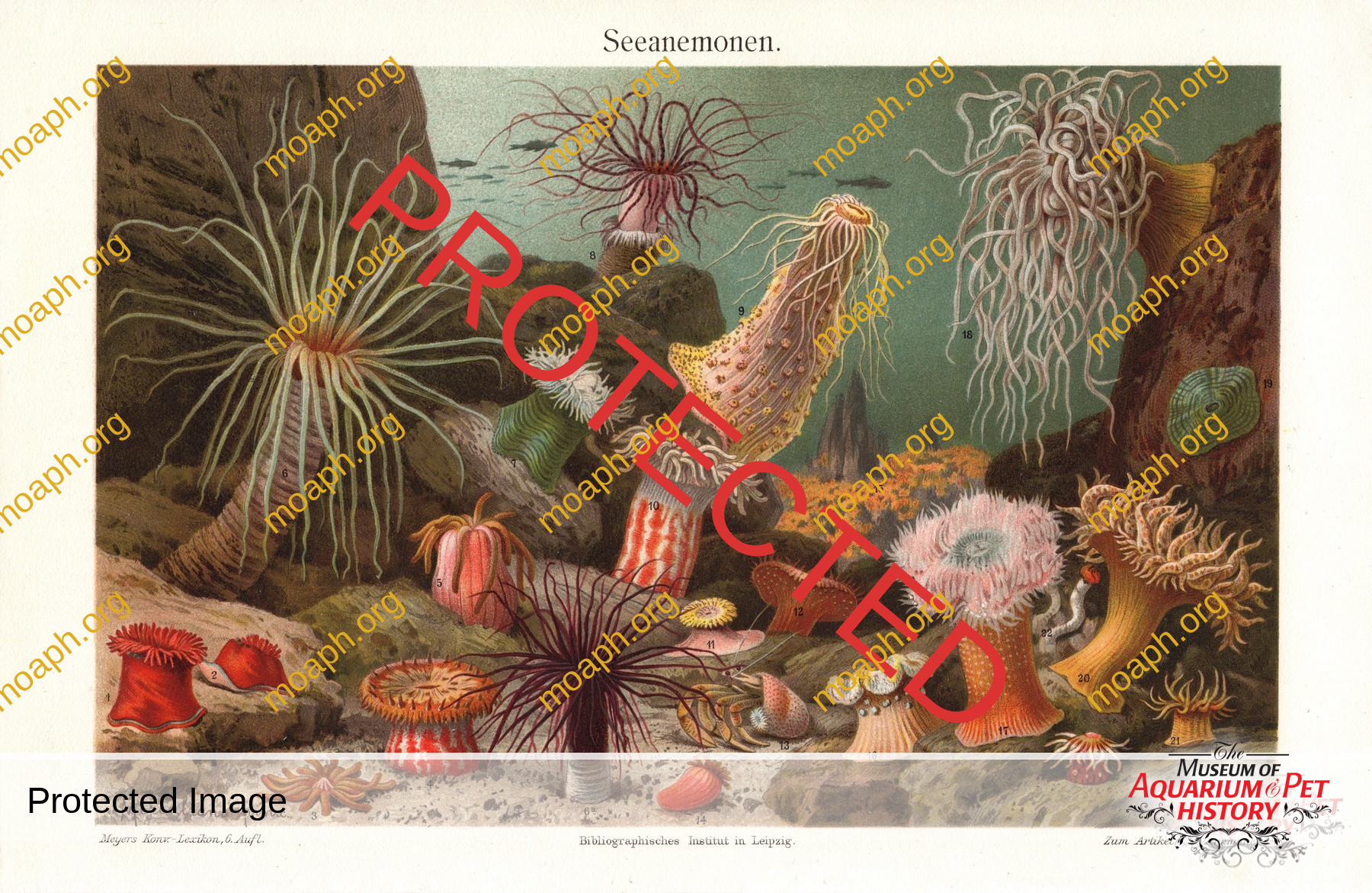
Several public aquariums of the time looked at the Mediterranean Sea as a limitless treasure box whereof Dohrn had the key! Color plate from Meyers Konversations-Lexikon (6th edition, 1902-1908).
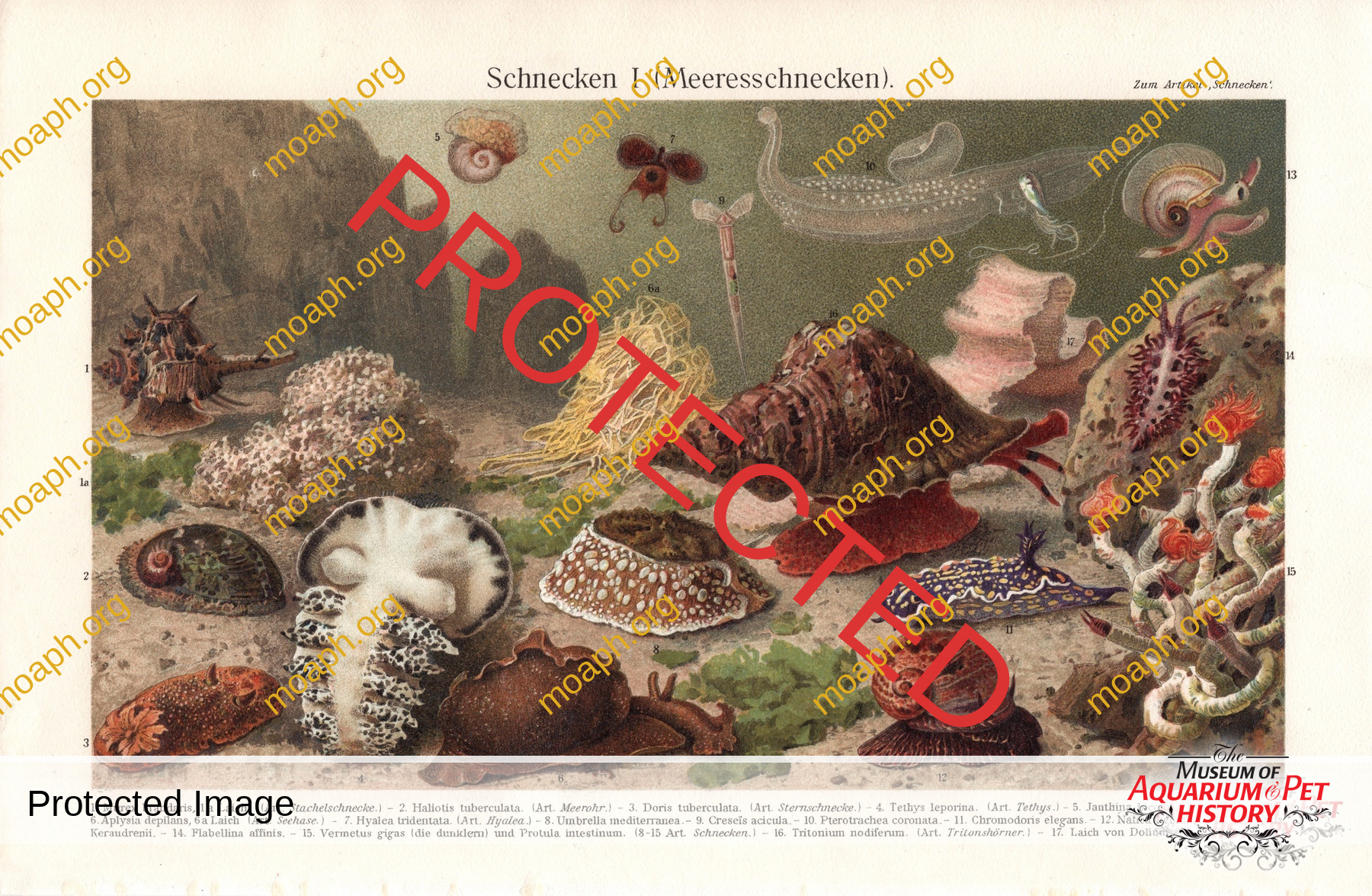
Other wonders of the Mediterranean Sea. Color plate from Meyers Konversations-Lexikon (6th edition, 1902-1908).
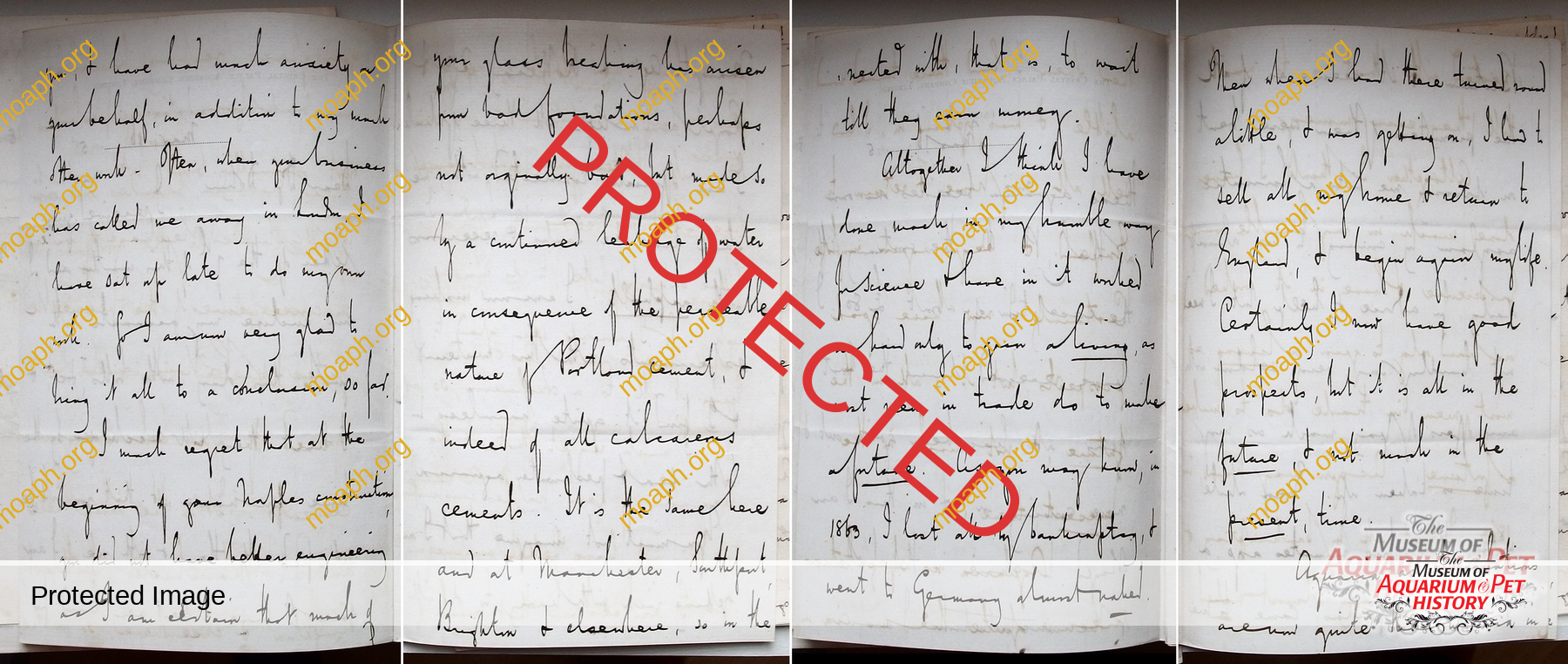
From left to right, pages 2, 3, 5 and 6 of the letter dated March 16, 1875. ©Bayerische Staatsbibliothek.
The Margate aquarium mentioned by Lloyd will never be built. Only half of the needed funds were raised, in fact, and the parent company went bankrupt in December of 1877. Lloyd in the previous letter mentions also the large-scale aquarium opened in Manchester on May 21, 1874. Saville-Kent worked for this short-lived facility as curator and resident naturalist from 1873 till 1876, designing reservoirs (he used to call them “spare cisterns” as well) which could hold a supply of water only equal to that contained in the show tanks.
A few months after the Manchester aquarium inauguration, and precisely on September 16, 1874, another establishment opened in England: the Southport aquarium, a £100,000 project by the Southport Aquarium and Winter Gardens Company. The facility included both marine and freshwater display tanks, had a compressed-air system, and was designed to draw the seawater from the sea. Following the more popular business model of the time in Great Britain, it was conceived to be part of a larger entertainment complex offering a theatre, temporary menageries, an opera house and much more.
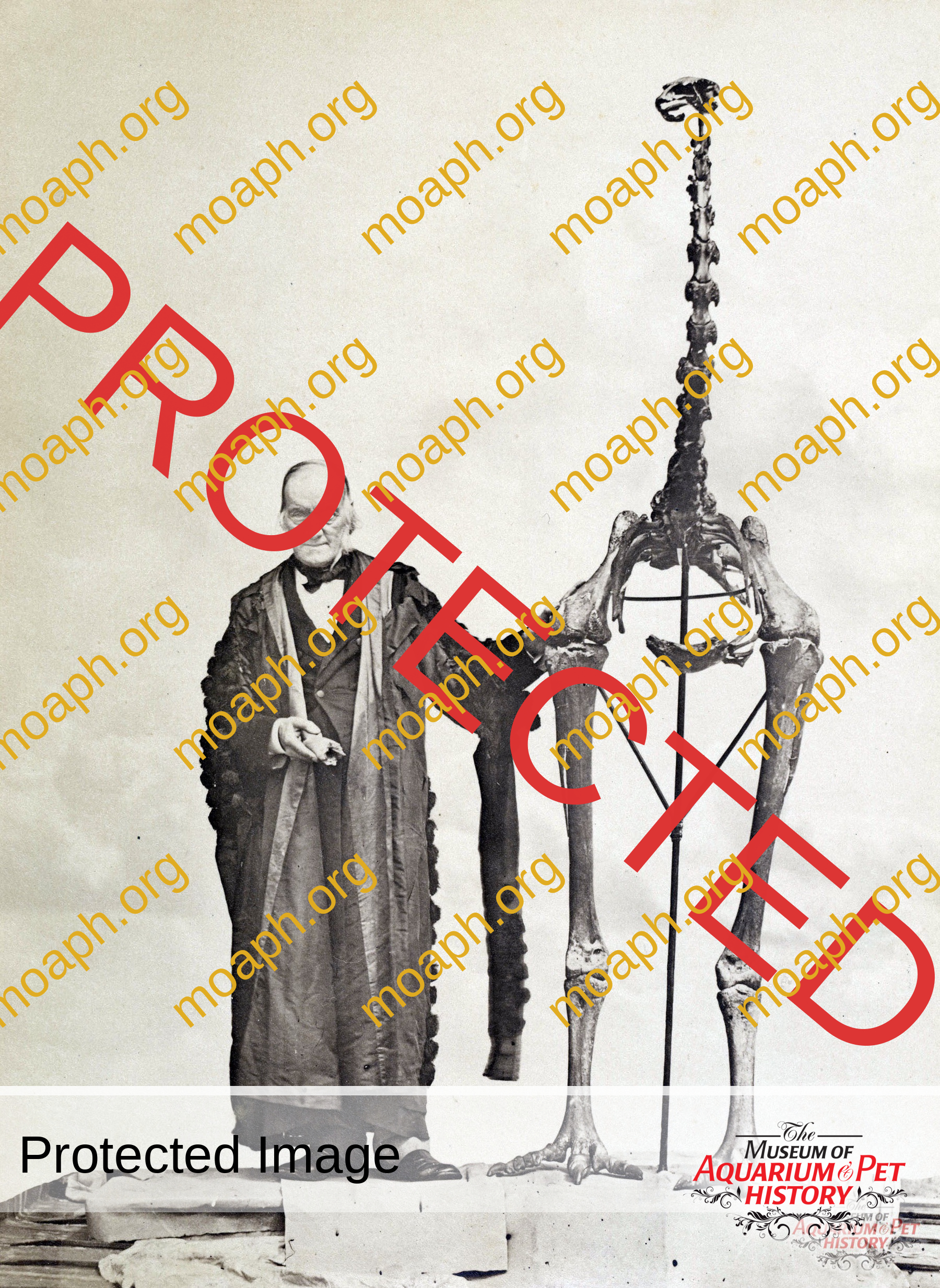
Richard Owen (1804-1892) was an English biologist, comparative anatomist and paleontologist. He is generally considered to have been an outstanding naturalist with a remarkable gift for interpreting fossils.
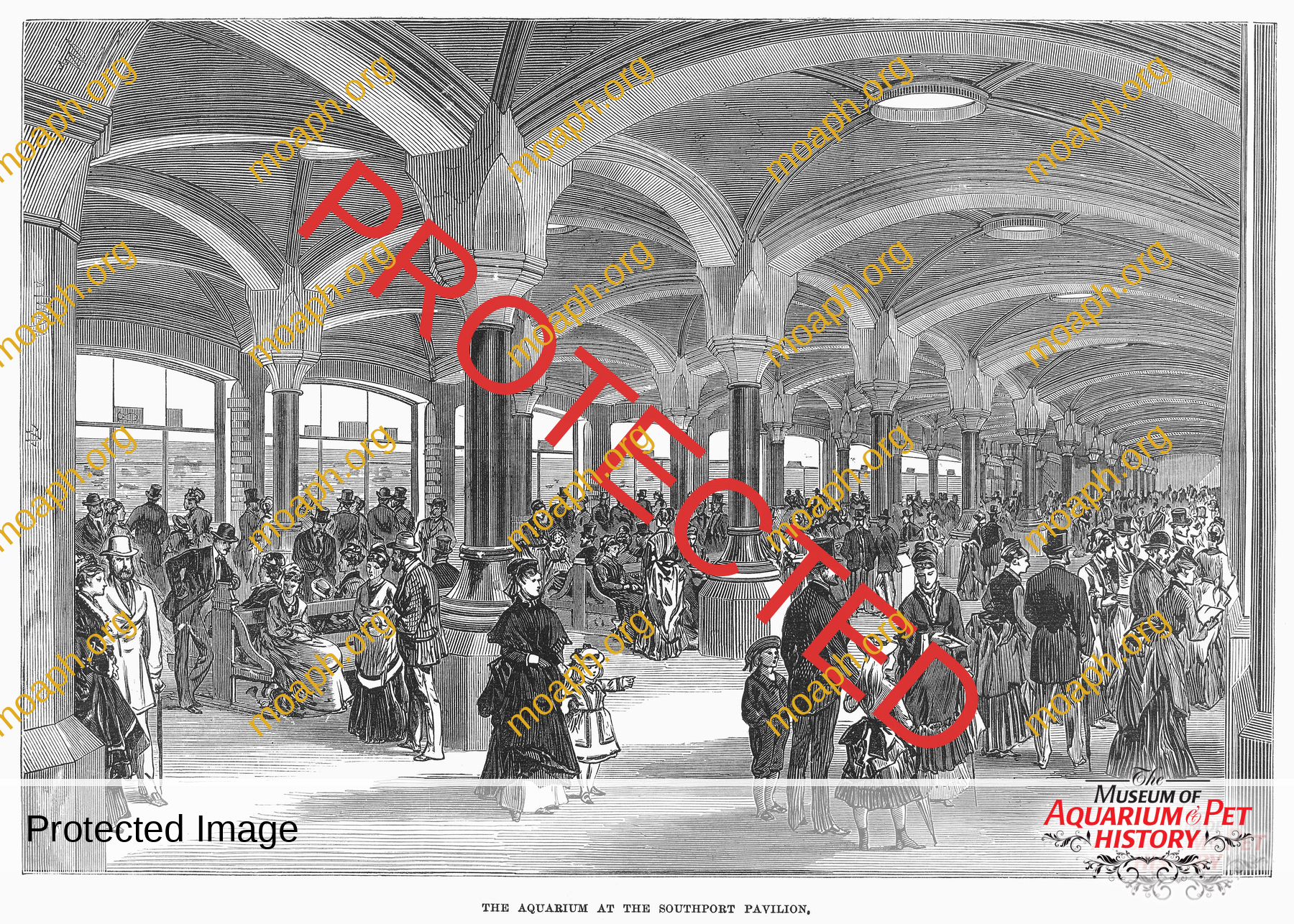
Interior of the Southport aquarium.
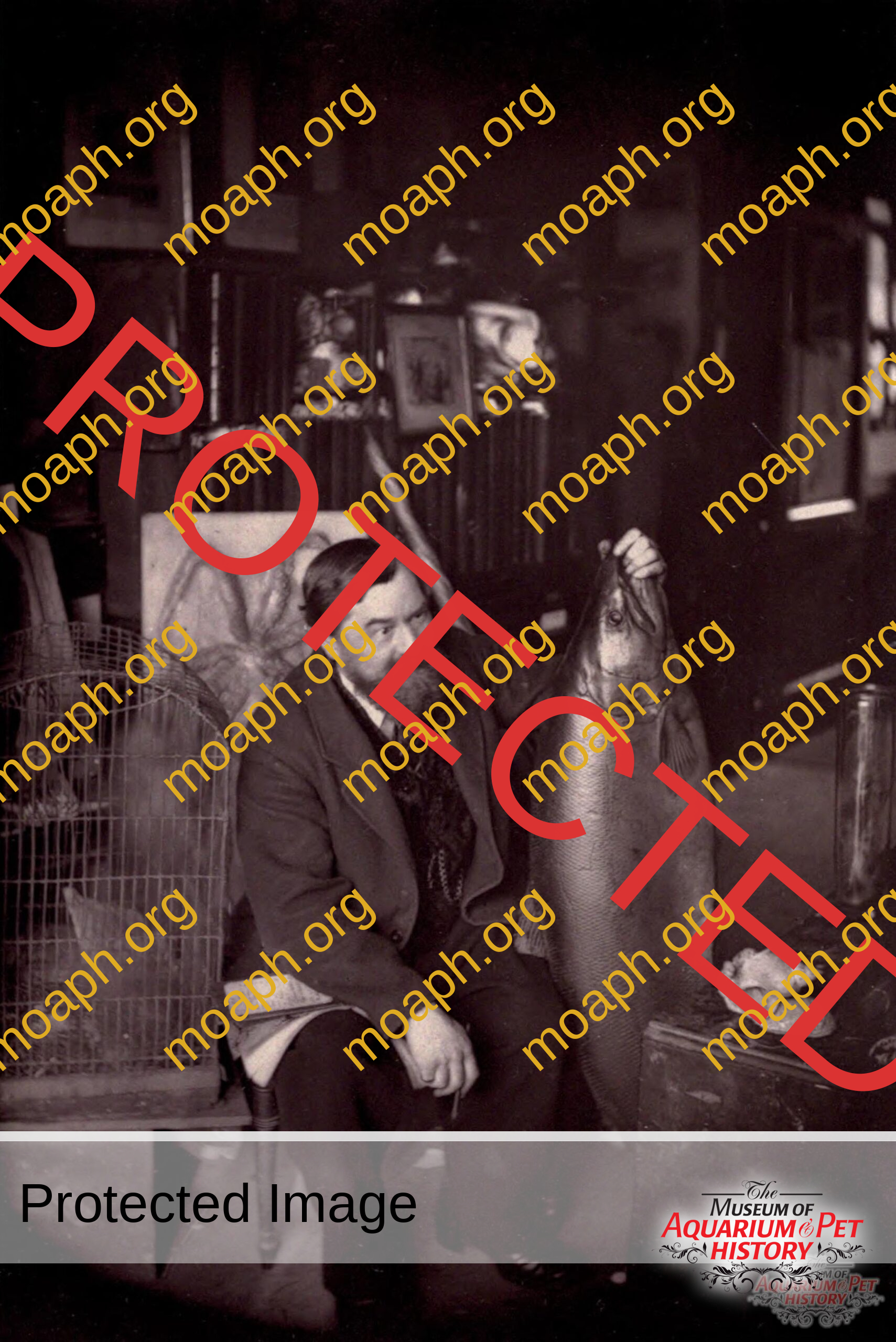
The opening speech at Southport aquarium was given by Francis Trevelyan Buckland (1826-1880), who used the same text of the opening speech he gave at Manchester a few months before! Buckland was an English surgeon, zoologist, popular author and natural historian.
March 29, 1875.
“…I might send you anemones which you already possess. I hope all this is quite clear, and that you will wake up and not let me bother you on this point. I think you want our British edible crab. Is it our Cancer pagurus? See Gosse’s Manual of British Marine Zoology, 2 vols 12mo sent herewith [A Manual of Marine Zoology for the British Isles, 1855-56]. Please use this very useful book, which many German biologists possess, as a text book to quote from whenever you want our British animals. I think you also said you want Limulus polyphemus that I can get from America and its transport is easy. How about the mode of sending which you said you had adopted and which is so much better that that I had in the old times between Hamburg and London? You also said you had something in view between England wanting a collection of British anemones and Corals which I shall be very glad to try to send if you will only do as I have so often asked you, namely to say what species you require, and that is very easy for you to do as you possess Gosse’s Act. Brit [Actinologia Britannica. A history of the British sea-anemones and corals, 1860]: Please try to do this before warm weather sets in. You are aware that when Digan was here, I arranged to send the anemones by him, but he departed without my having again seen him, to my great vexation, as I had made all my arrangements. The mode I proposed forwarding these was to place one (or if small) two, such anemones in one bottle of glass containing 2 ½ lbs weight of water. By being thus forwarded in isolated bottles or jars when the anemones are large, the chances of death on the passage are greatly diminished, but whether the creatures are sent in that way or in any other a large collection would need much more attention than could be expected on board Badcock’s ship or any other vessel. Therefore I propose to send them in charge of Mr Charles Rogers our best and most intelligent collector, only as I cannot send him as a passenger, the Board of Trade not allowing it, I should get him registered as one of the steamer’s crew […] With your permission, I should offer Rogers the sum of £2 a week and his expenses. His address is 18 St Andrews St, Plymouth, and you can yourself write to him if you like. Of course Rogers would bring us Italian things in the vessels in which he would take out British ones. But you will see the importance of your saying what sea anemones you want or do not want […]
But I hear you are so much occupied in Embryology, or the lives of animals before they are born to care so much about Aquarium engineering as I do. Yet you will be obliged to do so if you will make your aquarium pay by supplying other aquaria with animals. As I told you some time ago public aquaria in Britain are springing-up everywhere at about the rate of one a week, and when the time for animals for them arrives, Mediterranean creatures will be much in demand. I believe your arrangement with us is that in consideration of a prepaid grant of money you promised us an exclusive supply of animals. So of course whatever you may send to other aquaria will be through us, and that will not make any difference to you. […] The only chance of causing hiding animals to show themselves is by having several in one tank, so that one or two of them may be out of sight, perhaps. I also am glad of Calappa. Send more of all, please, and do answer my questions, both those I have now put and others previously about your Aqm. […]
[Memorandum]
I shall be able, if you use me well, to get you orders for hundreds of pounds’ worth of animals for the aquaria at Westminster (the Royal) at Margate and at Rothesay. All three are now being built, and will be opened in less than a year!!”
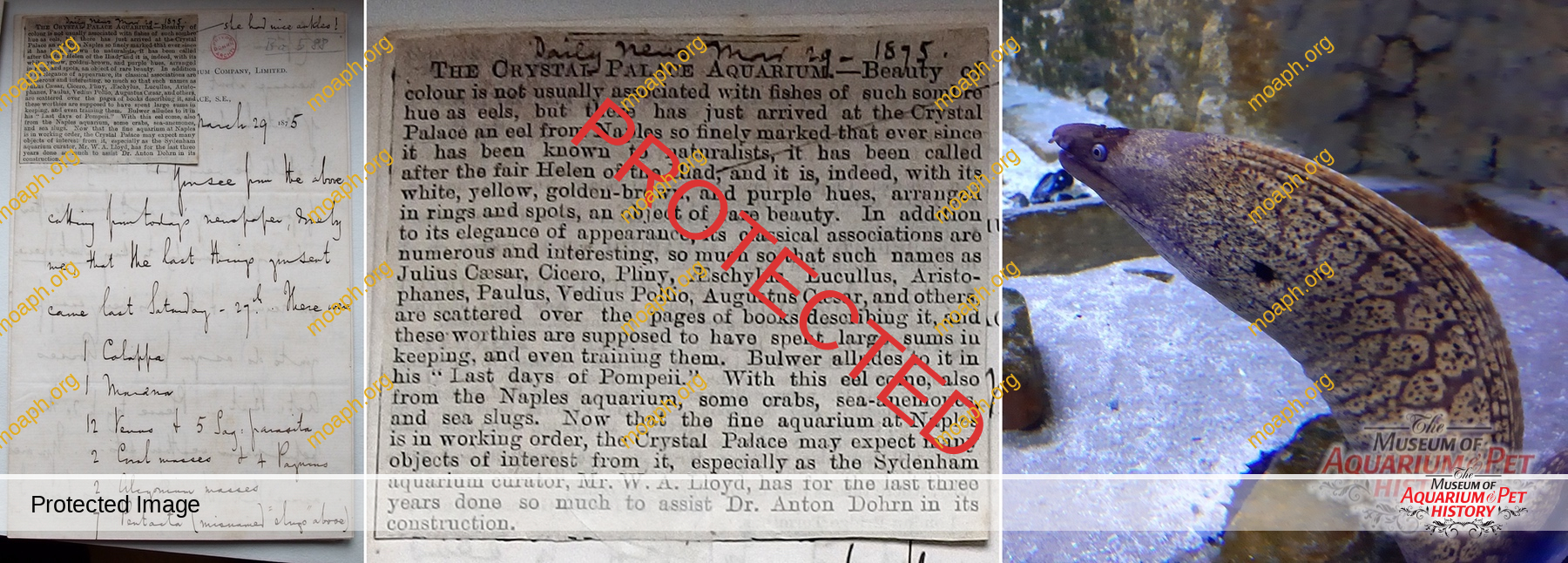
First page of the letter dated March 29, 1875. ©Bayerische Staatsbibliothek. On the right, Muraena helena, a popular aquarium fish of the day.
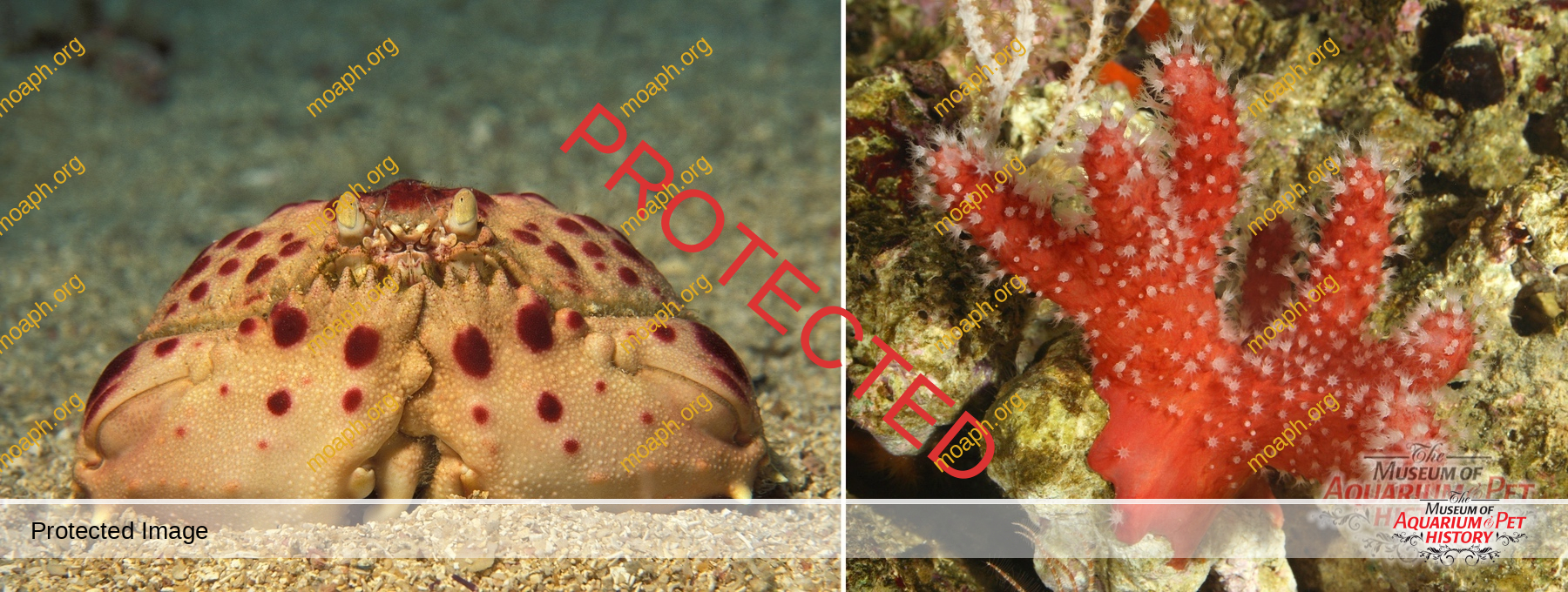
The shamefaced crab Calappa granulata and the soft coral Alcyonium palmatum are both listed in the first page of Lloyd’s letter dated March 29, 1875.
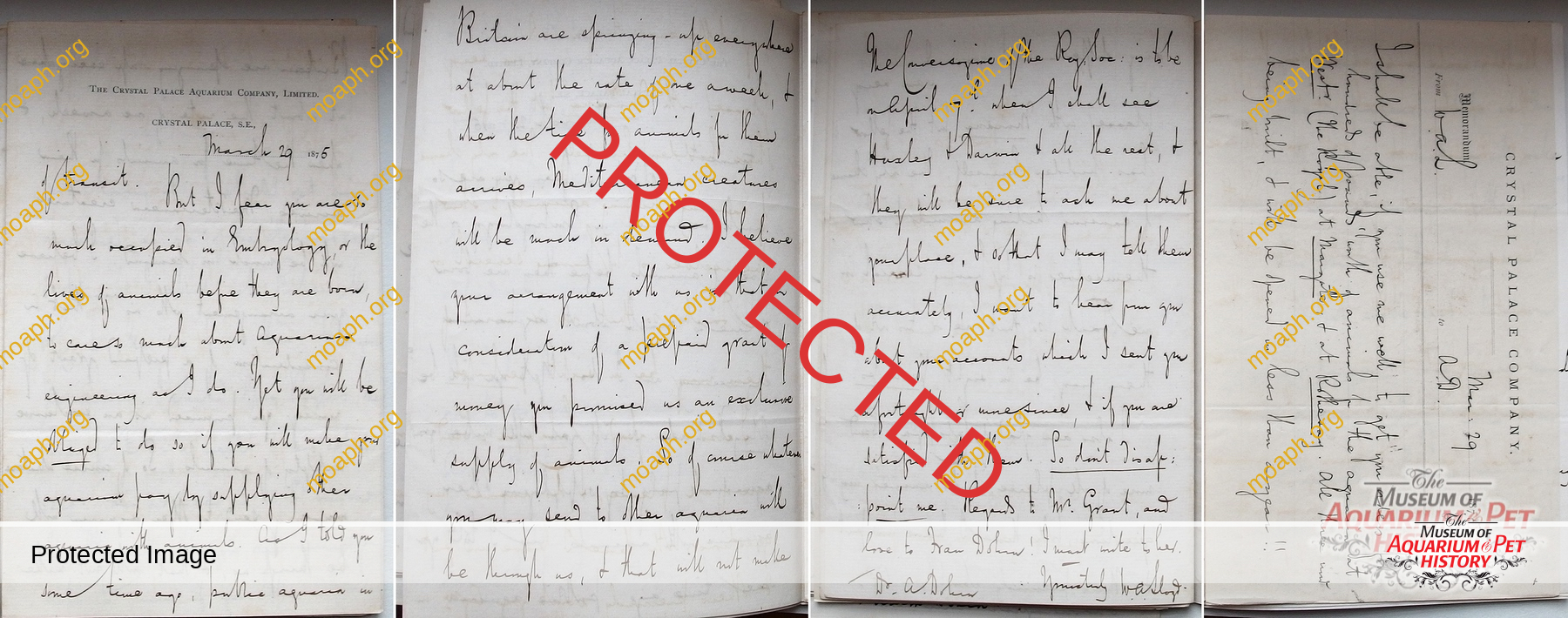
From left to right, pages 9, 10, 12 and 13 of the letter dated March 29, 1875. ©Bayerische Staatsbibliothek.
End of part 2.
Acknowledgements
Thanks to the following parties for their assistance: Andrea Travaglini – Archivio Storico Stazione Zoologica Anton Dohrn, and Maximilian Schreiber – Bayerische Staatsbibliothek.