
William Alford Lloyd: New Unpublished Letters Unveiled – Part 4 – Series Conclusion
With the following sixteen-page letter, our series of articles on Lloyd comes to an end. This final document holds particular importance as it provides a clear summary of the best technologies applied in public aquariums of the late 1870s, while also highlighting the technical errors made in some establishments of that time. Lloyd’s contribution to this field was undoubtedly invaluable in terms of design, as well as construction and maintenance methods. Some of his theories, such as the importance of avoiding water changes in closed systems, are naturally outdated after all this time. Nevertheless, it is largely thanks to him that aquarium science made significant strides during the Victorian era.
October 28, 1877.
“Yesterday I sent you a postcard saying I today would fully answer your letter of Oct 23. I want to do so. As far as can now be told, my introduction of asphalt in aquaria is successful. I call it my introduction, because it is true, but like most other improvements it was at first opposed unreasonably. There are now two great public aquaria asphalted – at Yarmouth and at Westminster, and no ill results seem to have followed to any animals. This is of course negative evidence, but I have not been able to afford the cost of having a complete chemical analysis made of the water long in contact with it. I however, possess many samples of water which would afford a severe test. Some of this water is at the service of you or anyone else, free of cost. Asphalt is being used now in a large aquarium erecting at Tynemouth. But care and patience are needed in using it. Of this has just occurred an example at Westminster where in spite of all my protests it was applied hot to the surface of wet masonry.
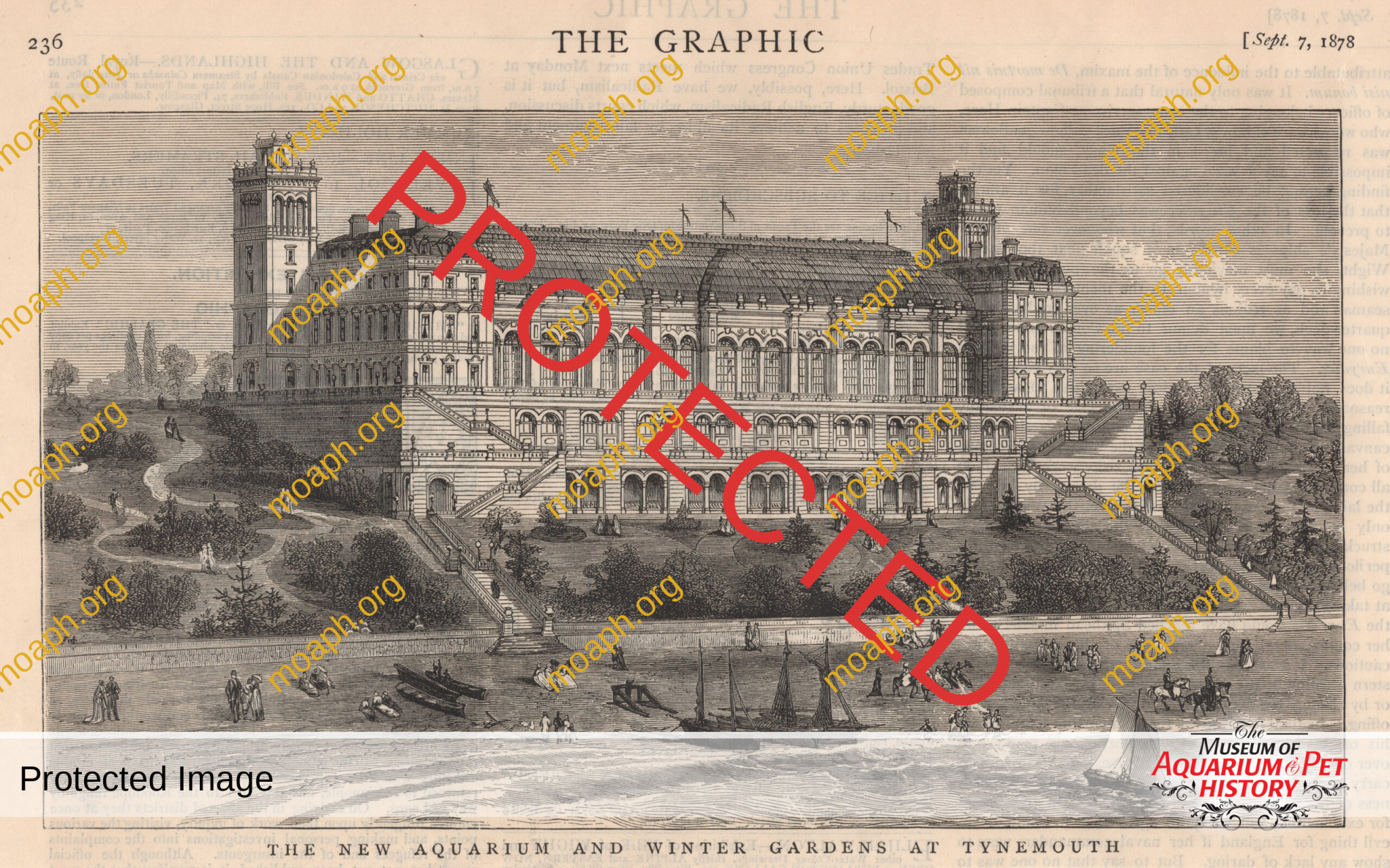
The Tynemouth Aquarium and Winter Garden was a short-lived establishment which failed and was sold at auction in 1880. Illustration from the weekly newspaper The Graphic (September 7, 1878).
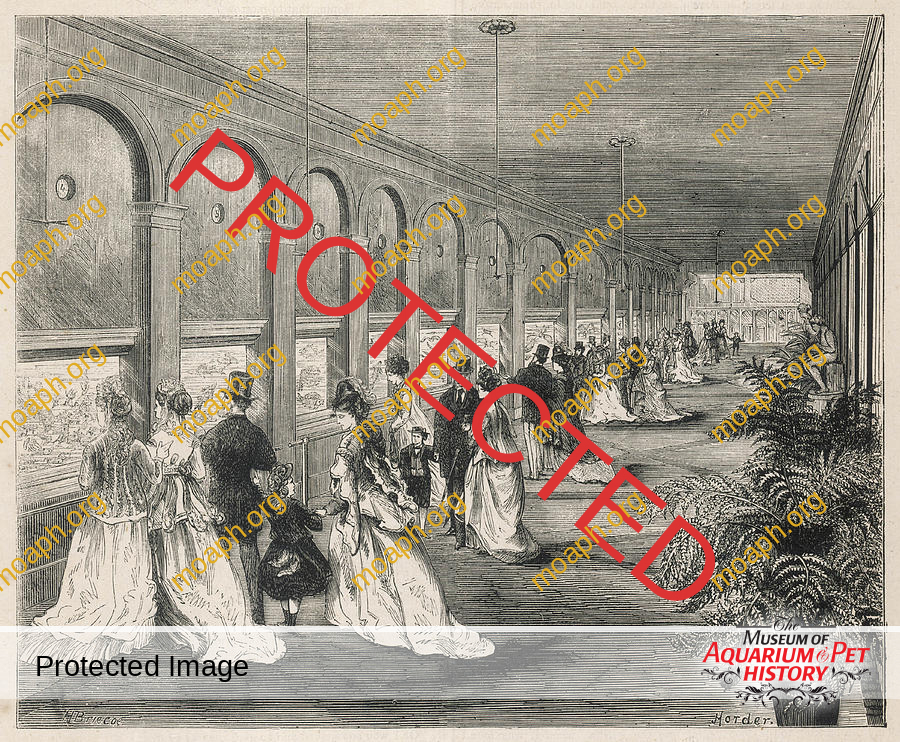
The Crystal Palace Aquarium in 1874.
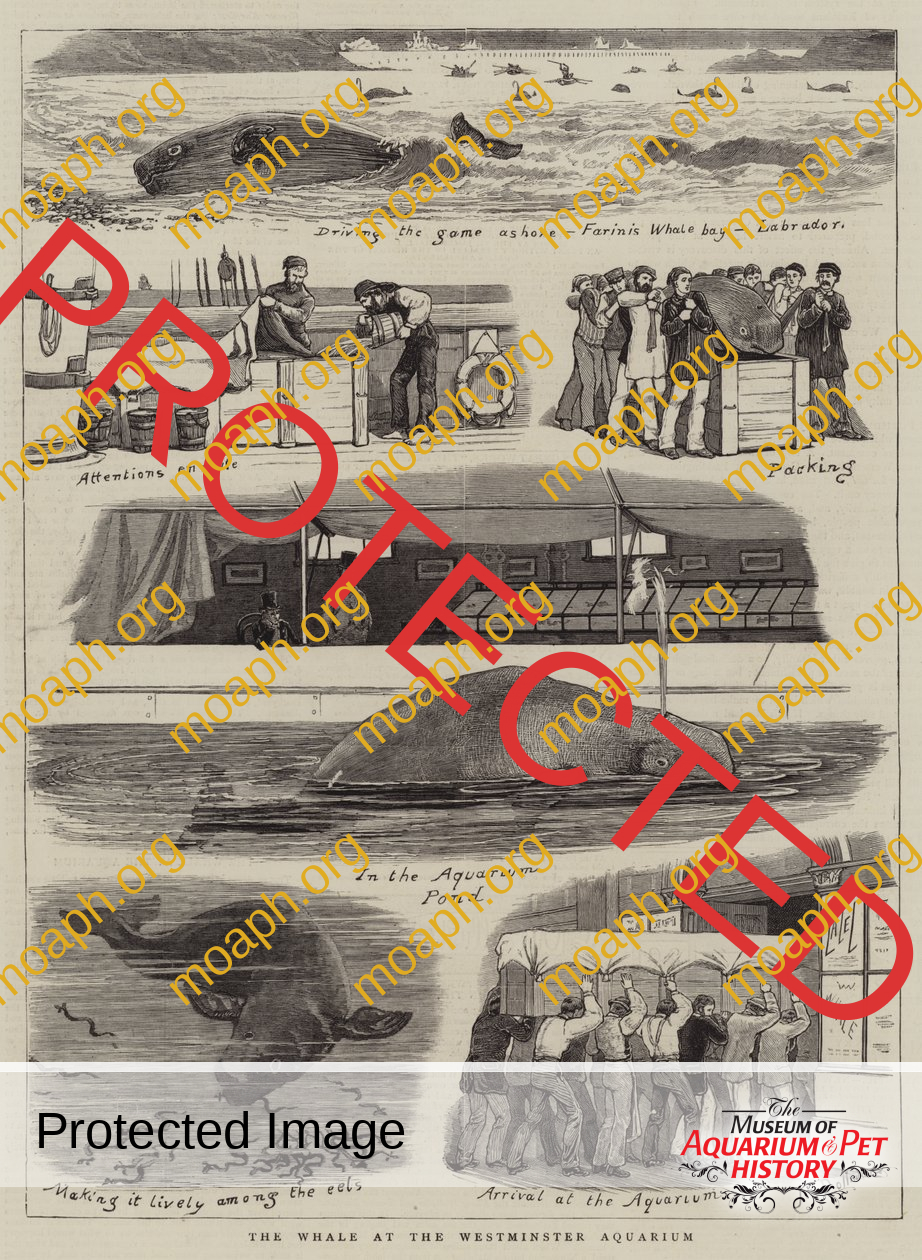
Brief illustrated history of the whale at the Westminster aquarium. The Graphic, 1878.
Of course the hot asphalt at a temperature of 400F (boiling water being 212F) instantly converted the wet into steam, and prevented contact, and the consequence is now that it is falling down in great sheets of 50 and 60 feet long. This is only one of the previous blunders made in that unhappy place. If now I had to make a great aquarium reservoir of masonry, I would, after selecting the best forms so as to contain the most water with the least surface, and laying very good and solid foundations, heat the bricks before building, and while hot and very dry, I would coat their inner edges (which come inside when they are built up) with a quarter of an inch thick of asphalt. The most commercial shape is a cylinder standing on its end, having its vertical height equal to one fourth of its diameter. Then, when all is very dry, I would take-away the mortar or Portland cement between all the joints of the brickwork, and fill it in with hot asphalt. Finally, and again all being warm and dry, I would cover the whole with another quarter of an inch of asphalt applied hot. Of course I would do the same with all show-tanks made of masonry, where the cylindrical form would there be impractical. The cost of asphalt, especially when applied so carefully is sure at first, then any calcareous cement, but the comfort; the saving of glass and the general avoidance of after trouble, cause it to be in the end, far less expensive. The best man for asphalt is Mr Stewart of 90 Cannon St, London E.C. He is honest in all things – word and deed.
Great improvements have been made in fixing glass in aquaria – so much so that insurance companies will now at a very small rate, take all the risks of haulage. This has been done by reverting to the same general principle as that which I adopted in Hamburg and Paris, 15 and 20 years ago – namely to put all glasses in an unyielding frame, avoiding unequal bearings. Only, what I did then on a similar scale with slate, is now better done with cast iron, prepared quite flat. I was led to this by seeing that our smaller tanks here when properly supported on good foundations, never have any broken glass and at Hamburg there are two glasses, each having so large a surface as nearly 40 feet with no intermediate support they having stood well since 1863, whereas the largest unsupported glasses in England measure but 15 feet, superficial (i.e. 5’x3’ = 15’). Only on a large scale I now prefer cast iron as being convenient and cheap. If you care about having full sized drawings of these iron frames – in plan and in section – they will cost you nothing. But I still prefer slate for small tanks. Here our glasses in the larger tanks crack from two causes:- 1. Bad foundations, 2. Frames of various materials with many joints. Thus the base is stone, the uprights are slate and iron, the top is wood – an essentially bad construction. Another quite unexpected wrong thing is in our having porous stone sills for our largest tanks 1 to 18” in which the glasses are let in at their base. Seawater gets to this, and through it, and evaporates on its outside surface. In crystallizing by evaporation the same enormous force is developed as in crystallizing water by freezing, the consequence being that our stone sills are being quickly eroded, in some places at the rate of one inch in a year. I wanted granite, as being non-porous, but it cost more at first, and our people were “penny-wise, and pound foolish”. About glass may I tell you that it in itself is very tough. Thus I fire against some of yours and ours repeatedly, from a Colts pistol a conical leaden projectile “40” diameter and weighing 180 grams at six inches distance, but the lead is made as flat and thin as a shilling, and very hot while the glass is not even marked!
I see no likelihood of any better material being found to supersede vulcanite for aquarium pipes and pumps. Lead, enameled iron, and a preparation of collodion have been recommended, and tried, but they are all as, or more expensive and more unreliable. Lead is heavy and dear, the enamel on iron is apt to crack or chip, collodion is strangely brittle, and glass is treacherous. Gutta Percha decays or shrinks. But I never use vulcanite where the much cheaper earthenware pipes can be employed. Only such earthenware tubes should not be filled, otherwise such joints as can be made in this material will leak. I have tried some pipes of chemical stoneware with screwed joints, and with flanged joints. They will stand pressure very well, but are very expensive. Needless costs should be avoided by not having stopcocks in vulcanite when they can be dispensed with. If I had to do an aqm here over again, I should do it much more economically in all ways, both as to construction and maintenance. For example, to circulate our water 168 hours a week, costs £6, and out of this £5 (very nearly) is wages, being 80 per cent on the whole result, which is enormous, remembering that one horse-power theoretical – means 33,000 pounds weight of anything raised one foot high in one minute. What we now do here is to raise 50,000 pounds weight of water twenty feet high in every hour, whereas, if I had to make the place again, I would raise only 25,000 pounds weight of water two feet high in one hour – and every hour by an engine of but 1/10th of a horse-power, making but a few minutes attention daily, and I would sacrifice nothing we now possess. By using so very small a power, I would get rid of steam which in our case is peculiarly objectionable, because of our bad boiler water, which causes an incrustation in the boilers of an inch thick in a short time and this is a bad conductor, and causes great waste of coals. You may be quite sure of the correctness of my 1/10 h.p. because the theoretical power needed is only 1/50 and I have multiplied by 5 to allow for loss by friction etc. In England we reckon water measure by gallons, each of 10 lbs weight, an 6.25 gallons to one (entire) foot weighing 62lbs.
So to raise 2500 gallons 2 feet high in one hour the formula is thus:
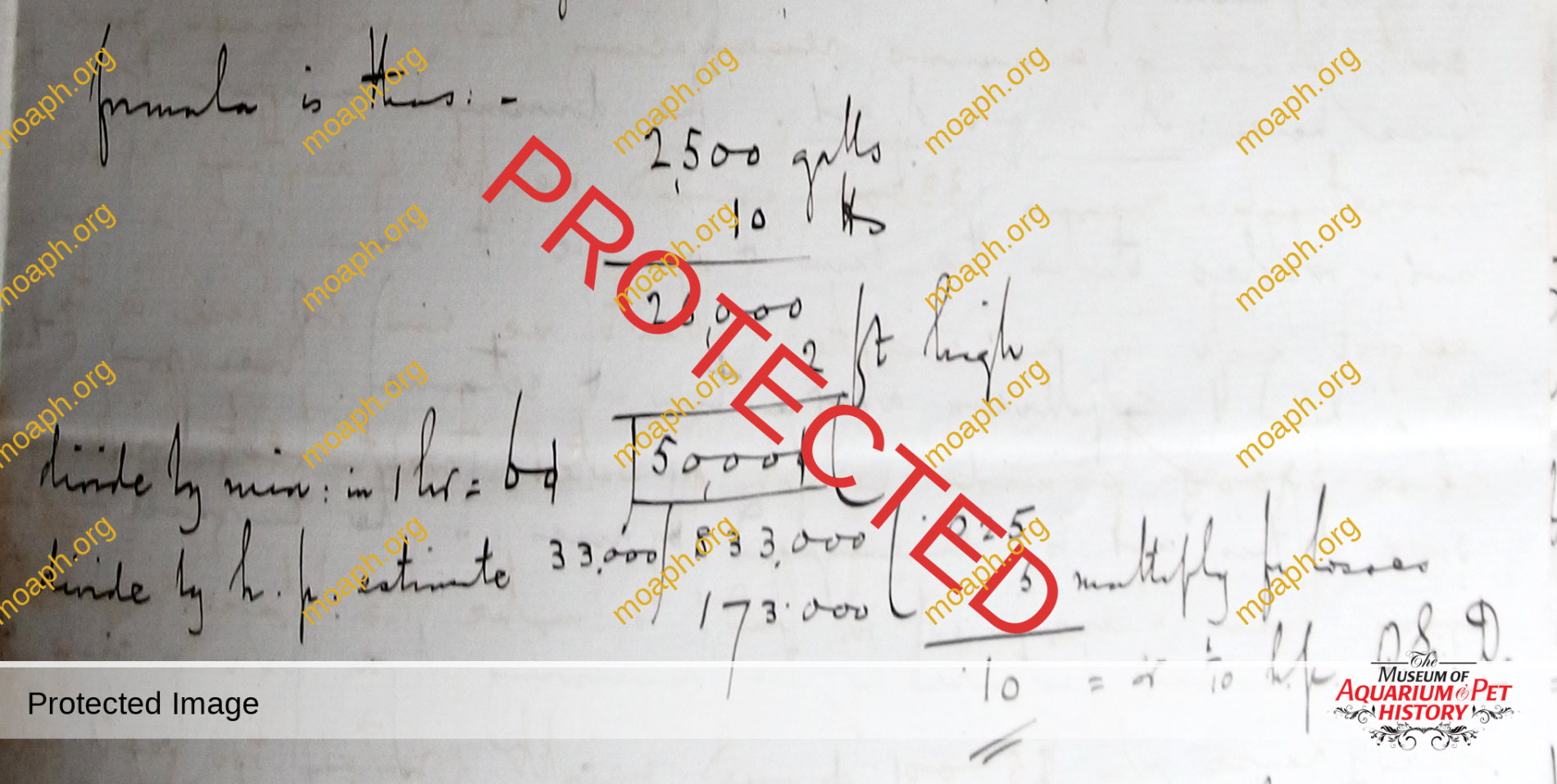
Now I will explain – in the first place we (wrongly) divide our water stream – I let 2,500 galls run (north) and another 2,500 gallons runs south. But if one let run all the way from the north to south – then 2,500 gallons would have done the same work as 5,000 gallons do not. So half would have been saved. Then, instead of having our reservoir below the tanks and then lifting it 20 feet, we would have had an equally cool place in the earth bank by the side of the aquarium to the west. Two feet is quite enough for the fall back, and two feet is also enough force for the water to enter in at, as we have no more than 2 feet now, and we have a great abundance of air bubbles entering the tanks. So you see our and your great waste.
I don’t know if you have in your sand and shingle what we have here: it is full of air. The downward currents to of […] air-bubbles strike the sand and shingle, and some of it is absorbed by a kind of capillary attraction, and retained. Every now and then some of this air is disengaged and rises to the surface, as it does whenever disturbed by the burrowing of a fish or crab. Six thrusts of a thin stick disengages a quart of air by measure. The value of this is very great, because no carbonated or sulphurated hydrogen can form, and our beds of sand and shingle mixed, six inches thick, are as clear everywhere as when we first laid them down, 7 years ago.
Reverting to motor power, I want to tell you that in England, Germany and America, are great efforts now being made to obtain power of a more automatic kind, when small, than steam for a 3 h.p. steam engine to as much in attendant’s wage as a 30 h.p. one.
Consequently, there are now made hot air engines working at very small cost, and also gas engines from 1/4 h.p. to 12 h.p. warranted to work at 1d per h.p. per hour, when ordinary burning gas is 4/- per 1000 cubic feet, and they require hardly any attention, as I know. Till now we have had gas engines on Lenoir’s, Hugon’s and Otto & Langen’s principles. The latter was the best but it made a fearful noise and shook at every strike. They are now greatly improved, however, and there are two – Otto’s Silent Gas Engine and Simms and Humboldt’s noiseless Gas Engine, each being 1 d. per h.p. or at most 1 1/8d. I have seen both at work, and doing heavy work, apparently satisfactorily.
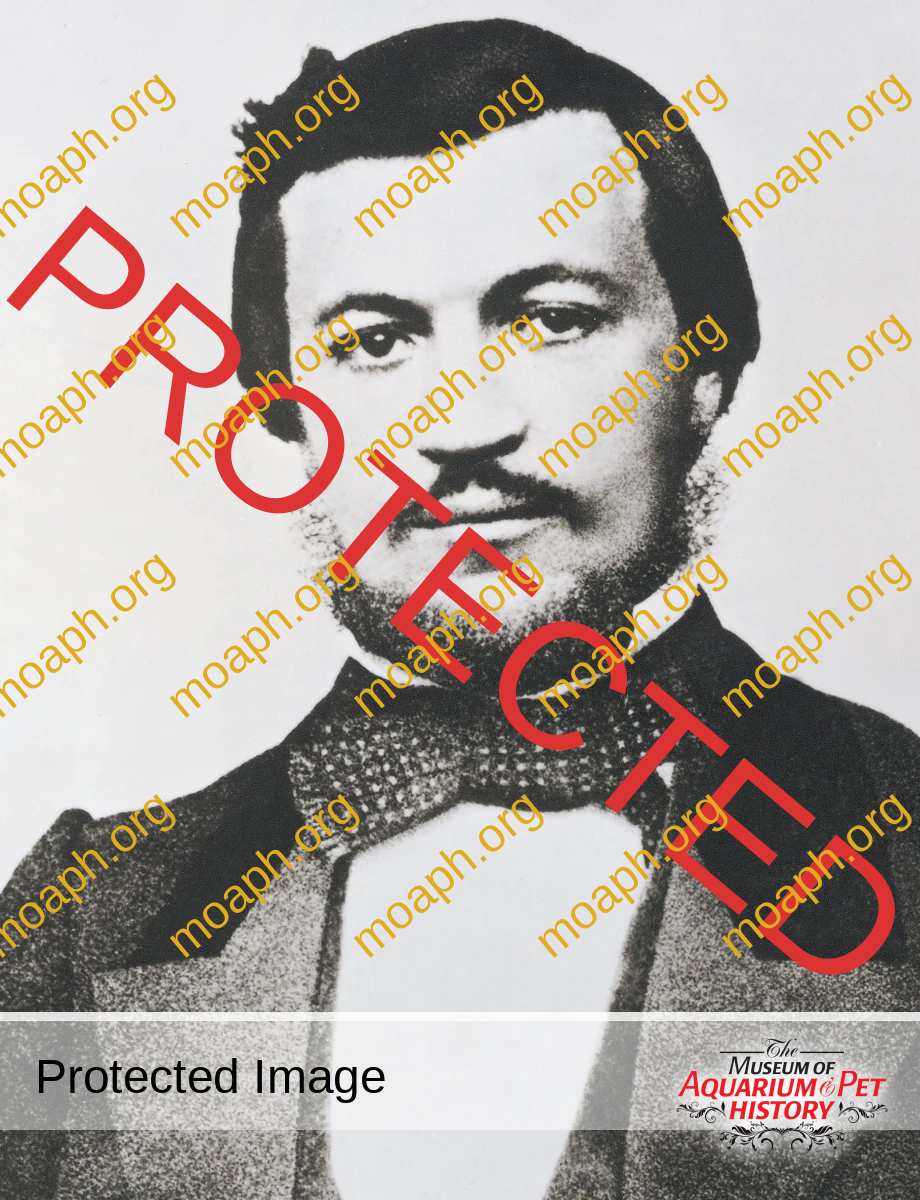
Nicolaus August Otto (1832-1891) was a German engineer who successfully developed the compressed charge internal combustion engine which ran on petroleum gas and led to the modern internal combustion engine. His research to improve the engine invented by the Belgian-French Etienne Lenoire (1822-1900) led him to look for investors. Eventually he found Carl Eugen Langen (1833-1895), whose father was a sugar industrialist. In 1864, they founded NA Otto & Cie, one of the earliest companies focused entirely on the design and production of internal combustion engines.
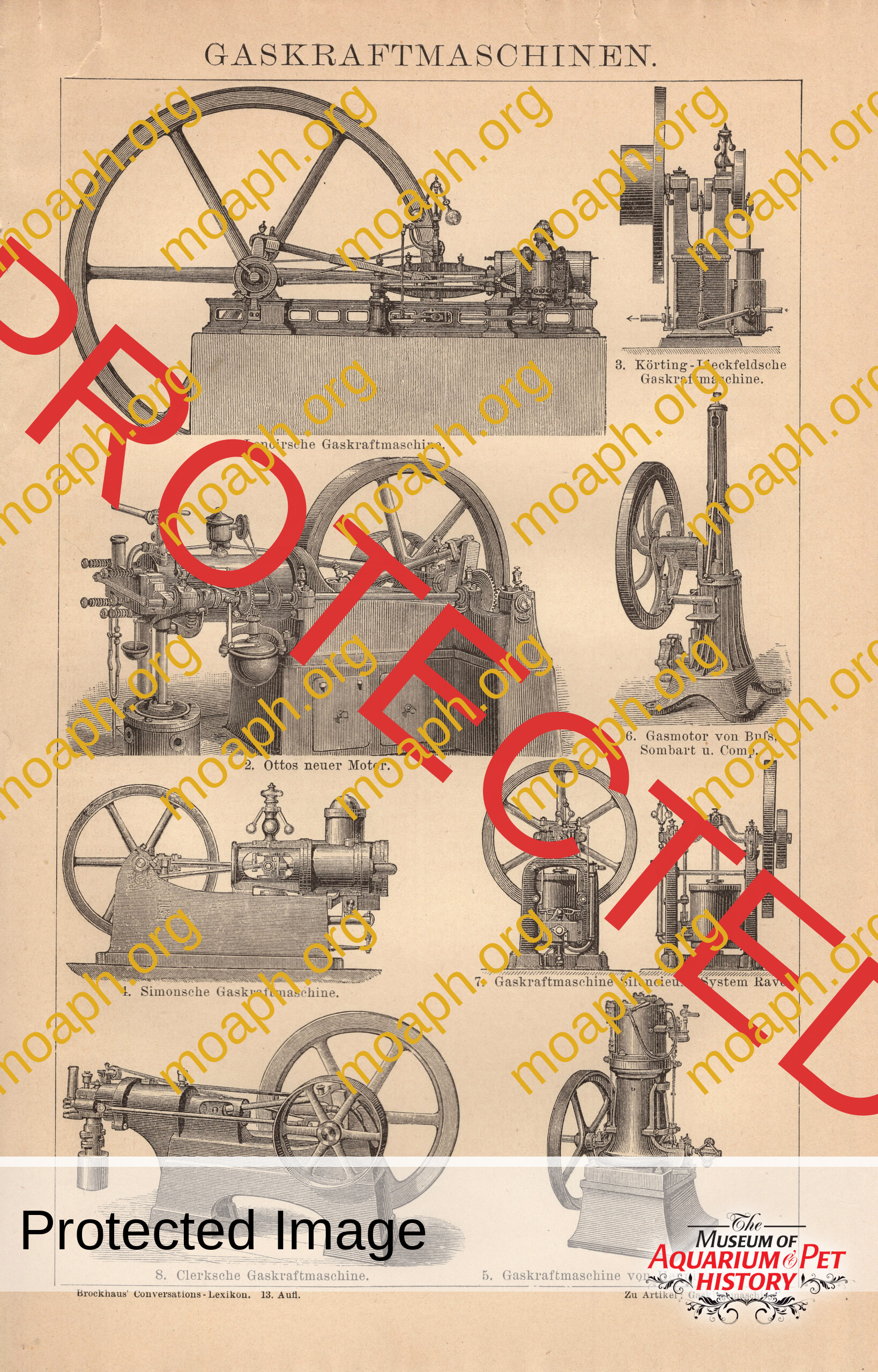
A few examples of gaseous fuel engines from the late nineteenth century.
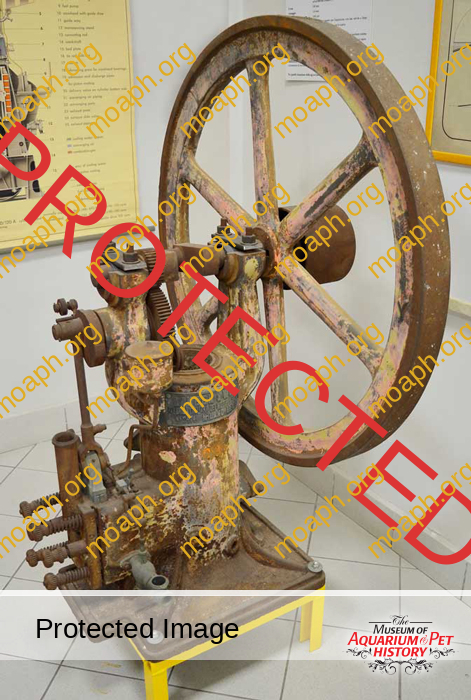
An example of a gaseous fuel engine from the late 1800s (Langen & Wolf Gasmotorenfabrik, Wien). Courtesy of Museum of Engines and Mechanisms, University of Palermo (Italy).
I am told they are used in the Frankfurt and Hamburg Aqms and are intended to supersede steam in the Hamburg one. If I had to do an aqm again here, I should use these engines, or water-power, which we have here in abundance or perhaps I should have both – one to use in case the other was out of order. This new idea of having a reservoir on one side, instead of below, might have been adopted, had I thought of it, at Hamburg, where the aqm is such, and at Paris where much waste ground is behind the Aqm. How are you in that particular? At Brighton and Scarborough the aquaria are both such, and a similar arrangement might have been made, and the water circulated by a very small engine of ¼ h.p. or less. But now at one place are two steam-engines each of 10 h.p. and at the other place two steam engines each of 8 h.p. engaged in only blowing air bubbles which means that 95 per cent of power goes to waste, and the water is never clean and healthy and the animals are comparatively few in number and variety. At Scarborough £12,000 has been spent in doing what you and I would do much better, and easier, with the odd £20,000 looking at the thing biologically. I got your list of animals and I am at last giving English names to all I can.
I fear I can never visit Naples till I am sent there on business at the cost of somebody other than my own. I can less than ever now afford it, because in consequence of our lessened Aqm income here, I have had to give up £200 out of the £400 a year I formerly had, and to lose one half of one’s wages is so serious a thing that I am now compelled to earn the other half by my pen, or by advising aquarium companies, etc, etc. which is very hard work especially as my book has to be written and till I sell it, it brings me nothing. I now never travel on pleasure, and never have any summer holiday, but whenever I am not out, I am, with my dear old cat, hard at work in my underground study in Lower Norwood. I am much obliged for your asking for her. She and my wife and daughter are all quite well, and send their kindest regards to you, and Mrs Dohrn, and little Boguslaw [Dohrn’s firstborn]. And we are much disappointed at your not coming to England – all of you – this summer. Have you any marmalade left? I have been disappointed as to my aqm pupils, of whom I have had three – Carrington, Birchall and Barker. The latter was such a poor devil that I taught him gratis, and got him a situation at £200 a year and a bonus. But he is careless now of me, as nothing more is to be got from me. Carrington and Birchall came for £50 each for six months, but as they had not too much money I voluntarily took only £25 each, letting the other £25 be till they had got their places. I kept them 12 months – not 6 – and got Carrington to Westminster [aquarium] or helped to get him there – at £200 a year, and Birchall to Yarmouth [aquarium] at £200 a year. I then when they had been engaged 6 months asked them to pay each his £25 at 10/- a week, thus spreading it over a year. They promised doing so but never kept their word, and now my lawyer is pursuing them, as I cannot allow them to set me at defiance, much as I dislike law. Carrington is now at Naples, getting animals for the Westminster Aqm. I advise you not to give credit as the Westr Aqm is not in a good state. You see the things which there goes on from this advertisement in the Times of Oct 29th, 1877.
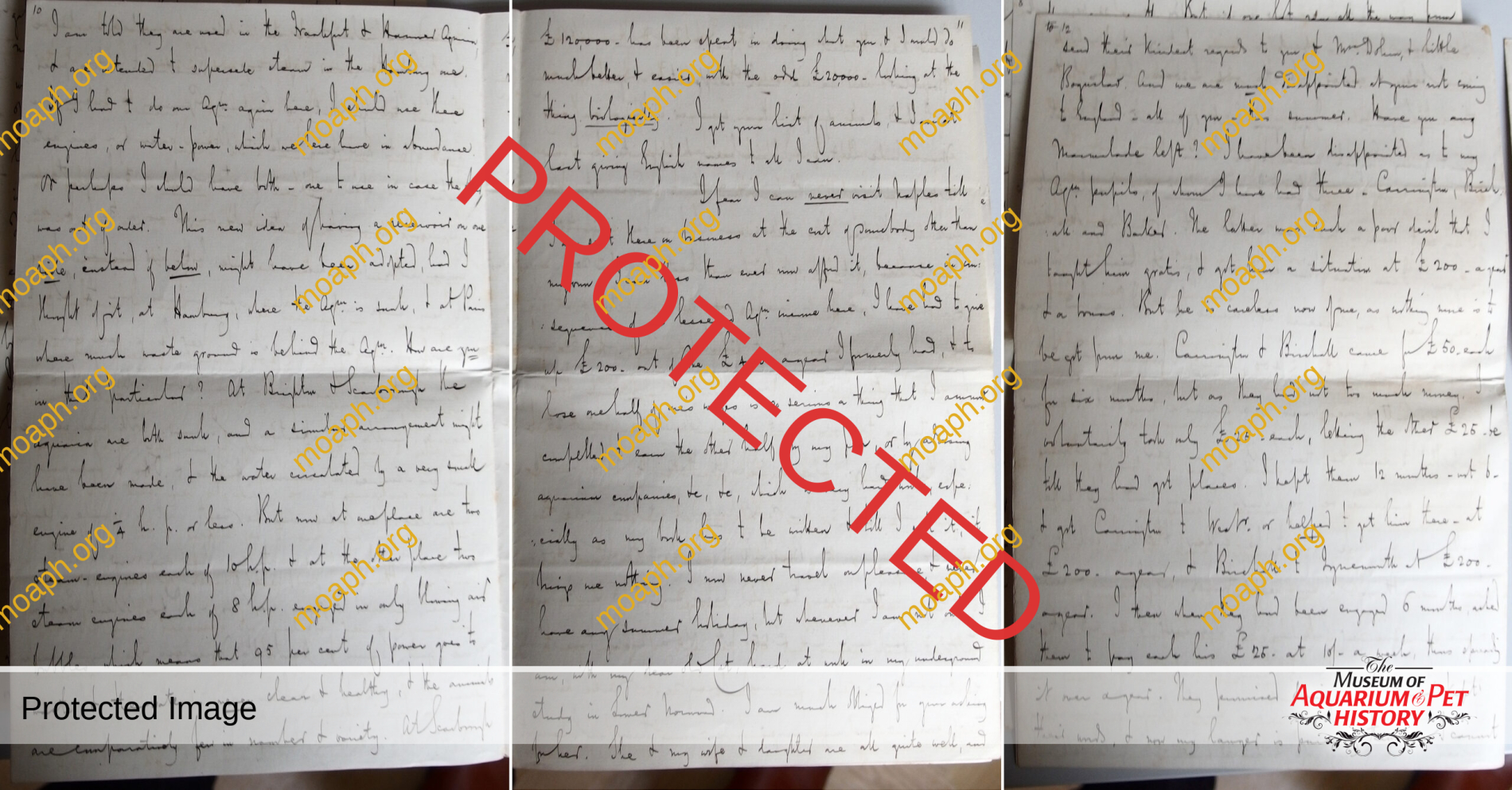
From left to right, pages 10,11, and 12 of the letter dated October 28, 1877. ©Bayerische Staatsbibliothek.
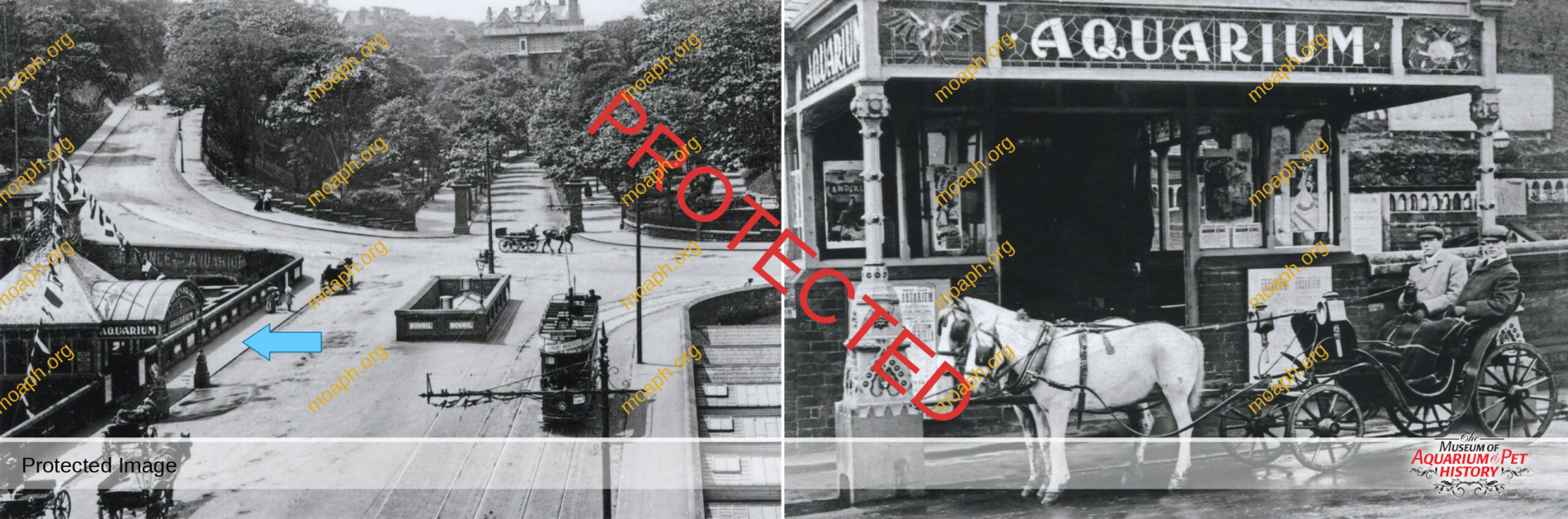
Old postcards showing the entrance to the Scarborough aquarium. Opened in 1877, it was the brainchild of Eugenius Birch (1818-1884), the famous architect, civil engineer and pier builder who a few years earlier designed the Brighton aquarium, including its monumental 110,000-gallon display tank.
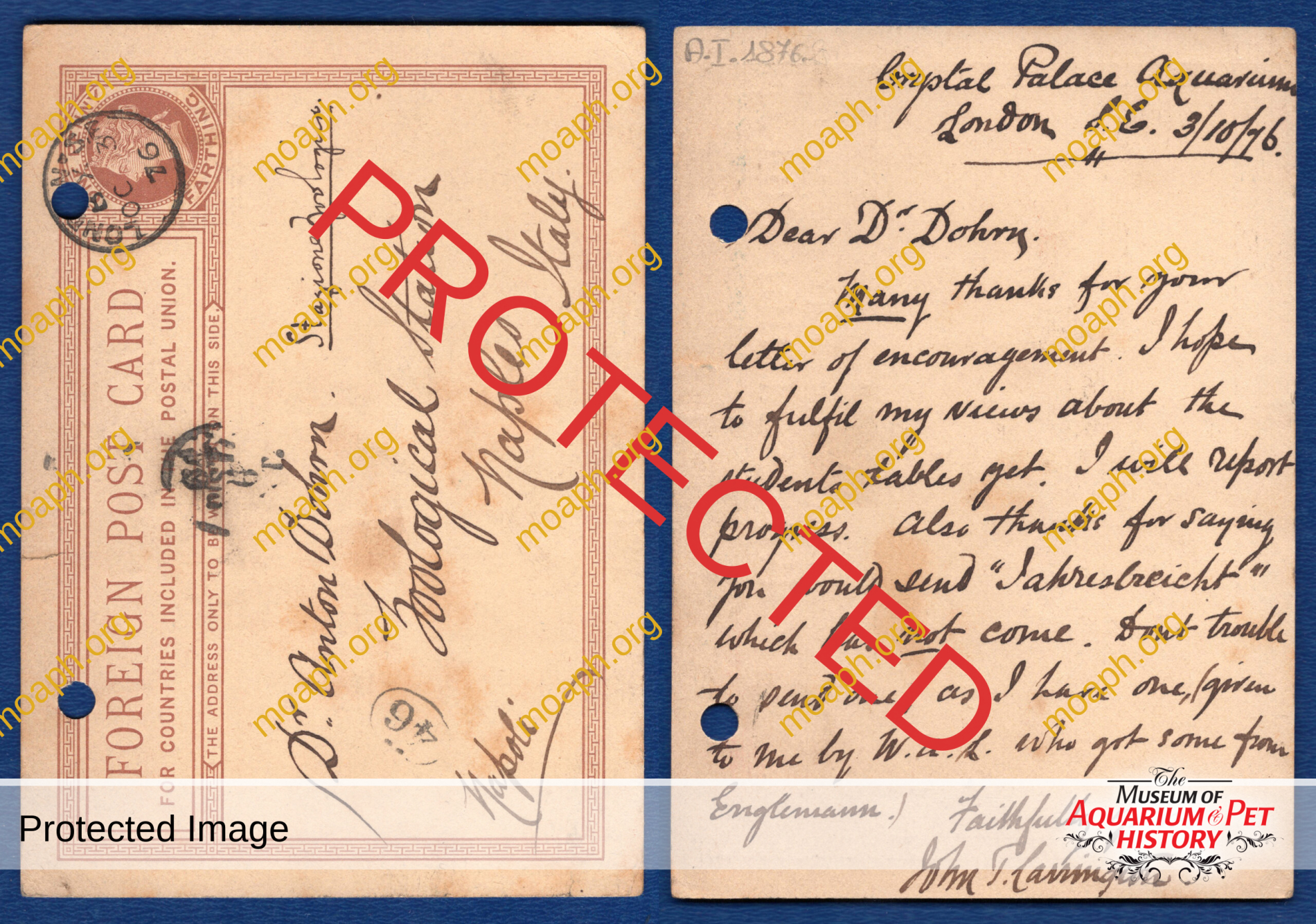
Postcard from John T. Carrington to Anton Dohrn dated October 3, 1876. ©Stazione Zoologica Anton Dohrn, Archivio Storico (ASZN, 1. A.I.1876.C.).
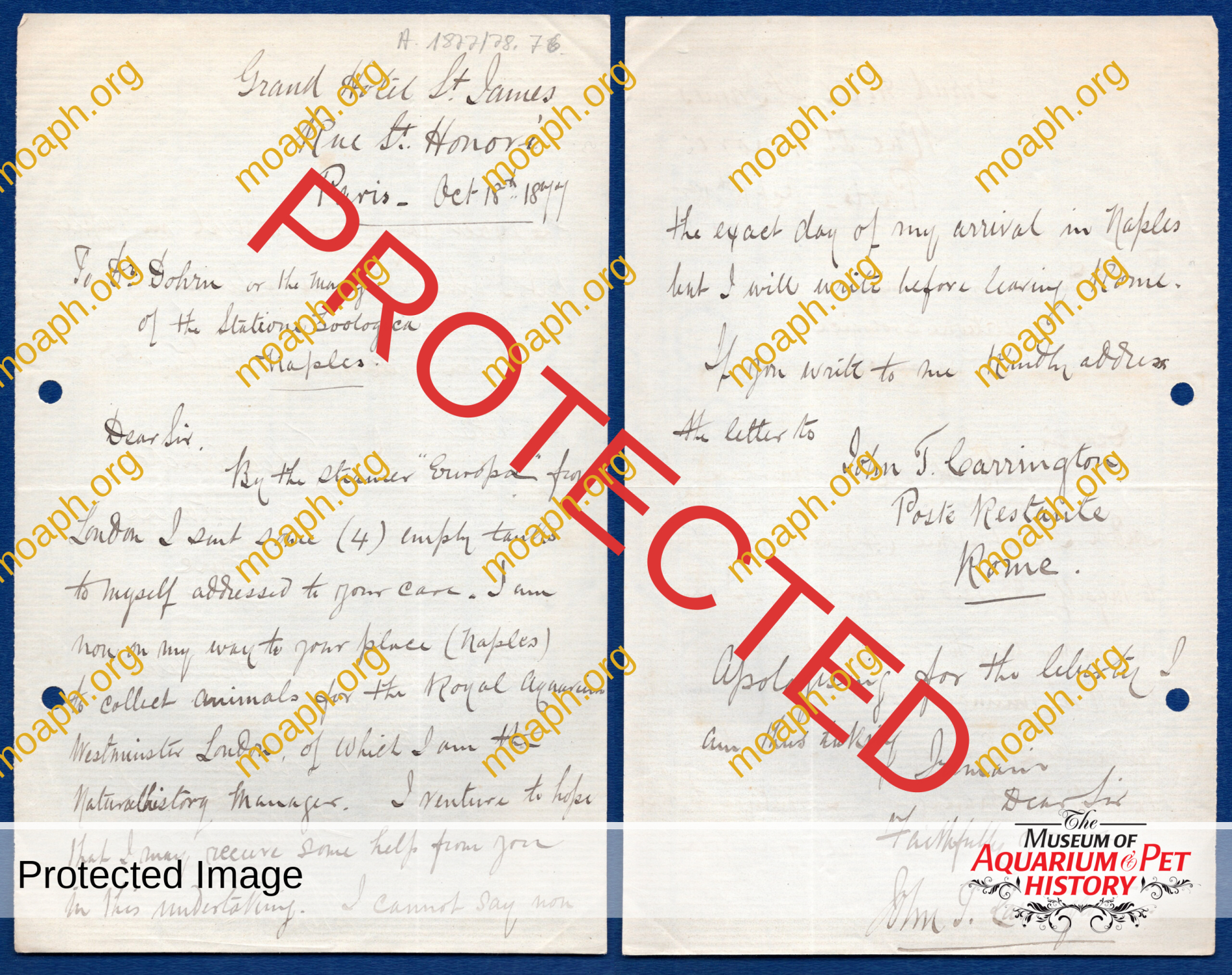
Letter from Carrington to Dohrn dated October 18, 1877. ©Stazione Zoologica Anton Dohrn, Archivio Storico (ASZN, 1. A.I.1877.C.).
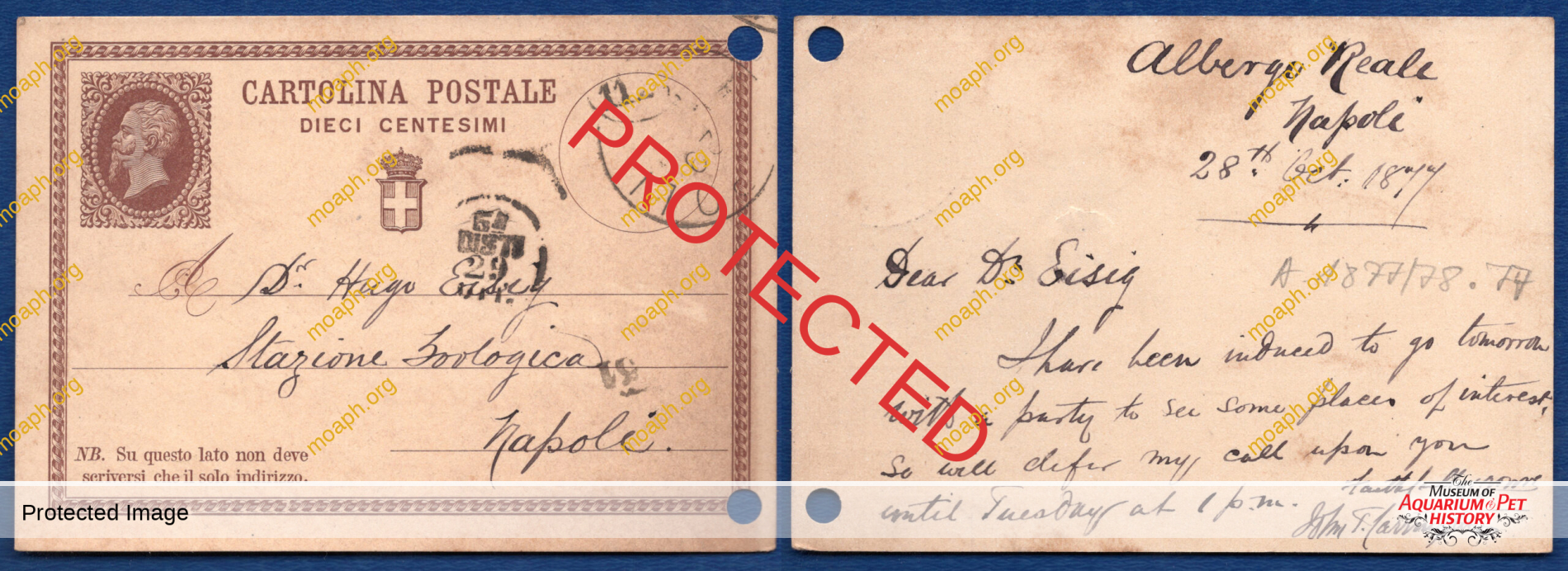
Postcard from Carrington to Hugo Eisig dated October 28, 1877. Eisig (1847-1920) was the deputy director of the Zoological Station. ©Stazione Zoologica Anton Dohrn, Archivio Storico (ASZN, 1. A.I.1877.C.).
And overleaf you will see something said about it by its first chairman, Mr Harry Labouchere. As you know I was the first naturalist there but the Board was so incapable and unreasonable that I tried to leave and was not long before I found a chance of resigning when I declined to do as I was told i.e. completely stock the whole place in six weeks as W.S. Kent offered to do. He began April 1876 and at the end of six months he was more behind than when he began. By December when I was asked to return and refused, he had wasted £1800 in animals which died because he indiscriminately, and in a wholesale manner, placed them in water containing no growing vegn [vegetation] to decompose carbonic acid gas, and the Board tired of him. In March 1877 he did something which caused his instant dismissal. He told many persons that it was through me that he was discharged, and I then in self-defence, told the truth. The he told a lawyer to bring an action against me if I would not faithfully apologise and pay all costs, which I refused doing. The lawyer wrote for many weeks and must have cost Kent several pounds but it cost me nothing I being my own lawyer. At last they stopped me. Then Kent went to the Regents Park Zoo Gardens and made a similar mistake or mess there too, and all were glad to get rid of him. He is now at Jersey, trying to get up a Zool Station such as yours at Naples, with an Aqm combined, in 5000 shares at £1 each, or failing in that, he will do what he can for £3,000. Among other things, he proposes to rear lobsters from the egg in captivity and to sell them at less than regular market prices. Madness! No wholly carnivorous animal known to me can be reared in any captivity, and then sold profitably as human food.

From left to right, pages 13, 14 and 15 of the letter dated October 28, 1877. ©Bayerische Staatsbibliothek.

Henry Du Pré Labouchère (1831-1912) was an English politician, writer, publisher and theatre owner in the Victorian and Edwardian eras. He is now mostly remembered for the Labouchère Amendment, which for the first time criminalised all male homosexual activity in the United Kingdom.
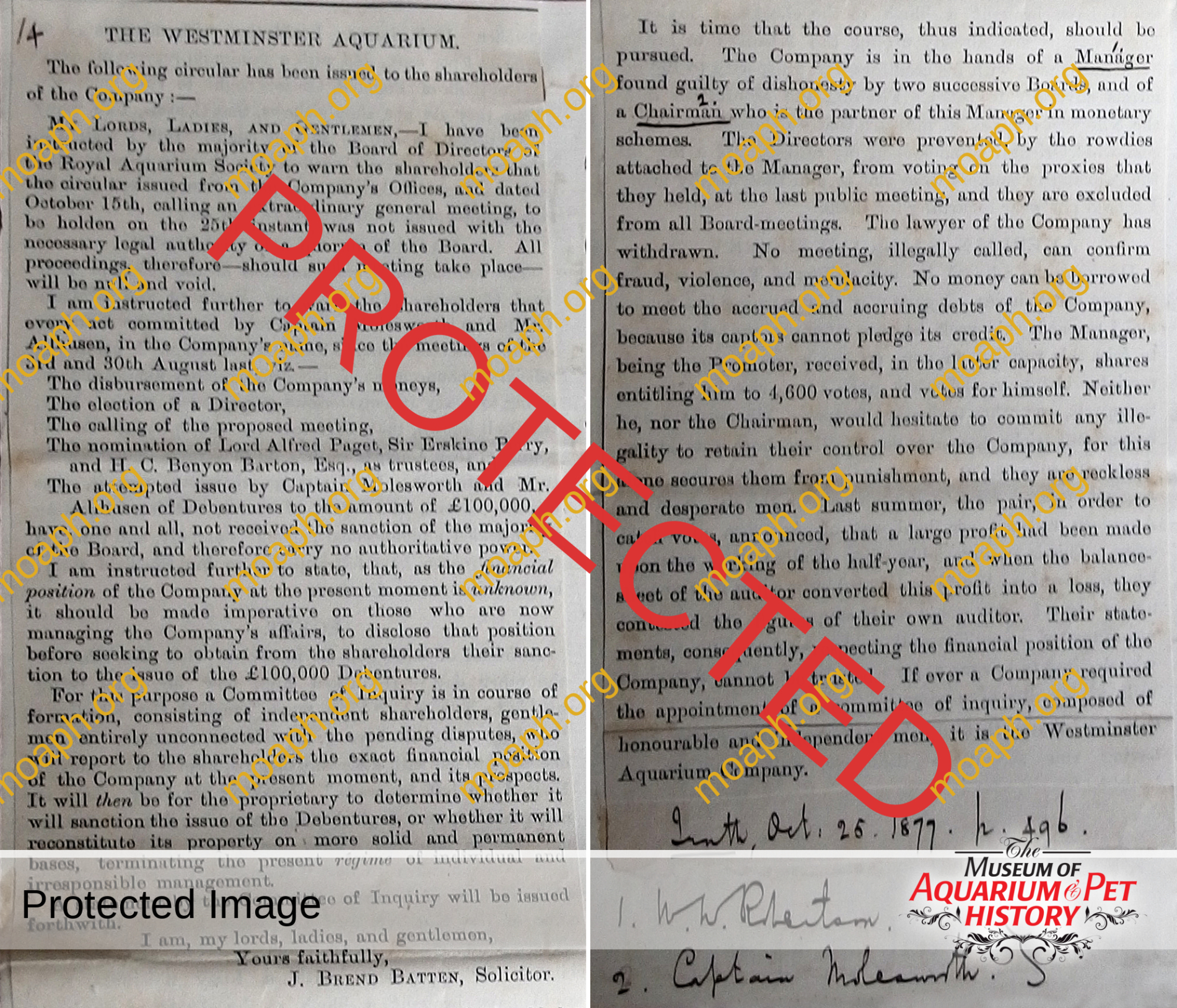
Cuttings attached by Lloyd to page 14 of the letter dated October 28, 1877. ©Bayerische Staatsbibliothek.
You have set me longing about what you say of vegetation growing in your tanks spontaneously. What kinds? Can you grow the higher sorts? As Melanosperms and Chlorosperms, and the less – in organization of the latter? Such, I mean as Ulva, […] etc. Here we only grow Conferva etc. and when it grows too fast, we put in Grey Mullet (Mugil capito) which eat it down and keep all clean. So that by the combined aid of the clean bringing effects of plants; the fish I consume when too redundant; and the […] air sent in; as well as what the sand absorbs, as before named, all these things combined render our tanks perfectly clear, and we never have any need of cleaning manually. But much as I want to [there is a stain on the letter at this point which doesn’t allow to read the text] cultivate and grow the higher marine algae in our Aqm as a gardener cultivates flowers and other plants in a garden or Conservatory. If you succeed in doing this, tell me how and send me by post, samples of what you thus grow.
I omitted saying that owing to our Company having disregarded my continuous protests against an aquarium being badly built while being erected under my care in 1870, the whole of it now needs virtually to be rebuilt. We have therefore this year had to dismantle all the tanks in our north and south room, and rebuild them on proper foundations, at an expense of several hundreds of pounds which we cannot afford, thus I am kept back, and kept poor, for what practically should go into my pocket is expended in rebuilding. Yesterday, Oct 30, I was at the Brighton Aqm: All there is very poor and the water very thick, the appliances for oxygenating dead organic matter being exceedingly inadequate.
I post this Oct 31.”
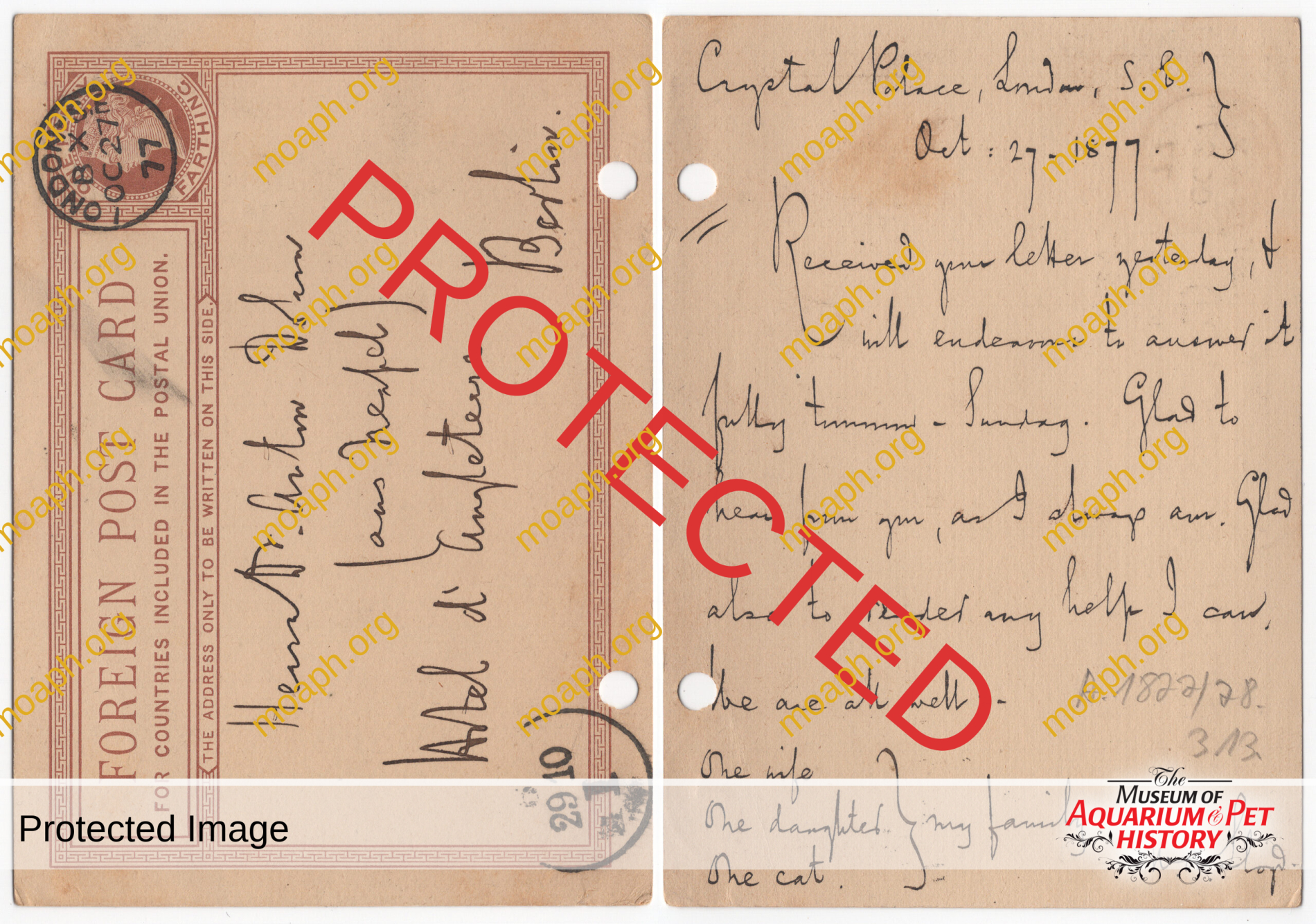
Postcard from Lloyd to Dohrn dated October 27, 1877. Notice, at the end of the short message, how Lloyd considered his cat Mim as a full family member. ©Stazione Zoologica Anton Dohrn, Archivio Storico (ASZN, 1.A.I.1877/78.313).
In an article titled “Who was… William Alford Lloyd” published in 2013 in the digital magazine The Biologist (Vol. 60, No. 1, pp. 24-27), Ray Ingle, a retired taxonomist from the Natural History Museum of London, describes the first professional aquarist in history this way: “Lloyd was the first aquarist to develop the ‘closed systems methods’ for successfully maintaining multiple aquariums and the first to recognize the importance of large settlement reservoirs, aeration, temperature control and filters for achieving water quality. He would not have been aware of detailed biological aspects of the water chemistry of his systems (most of this information became available only during the following century).
However, he recognized the importance of vegetation in the aquarium and tried to culture seaweeds. He was an avid experimenter and intelligent observer, quickly learning from mistakes and, above all, highly capable of visualizing, calculating the requirements of, and successfully designing, large-scale aquatic closed systems.”
To these words, which I fully agree with, I would add that if Lloyd had managed to publish his massive aquarium book, maybe today’s hobbyists would talk about him more often. Sadly, he didn’t have the fortune to live long enough to do it, as well as the financial resources to work less and write more during his prime.
Publishing the content of his letters allowed me to give Lloyd back a voice once again. These old documents reveal so much about the special man he was, not just the aquarist.
Acknowledgements
Thanks to the following parties for their assistance: Andrea Travaglini – Archivio Storico Stazione Zoologica Anton Dohrn, and Maximilian Schreiber – Bayerische Staatsbibliothek.