1859 Memorial to Carlo the Dog – “Carlo is Dead”
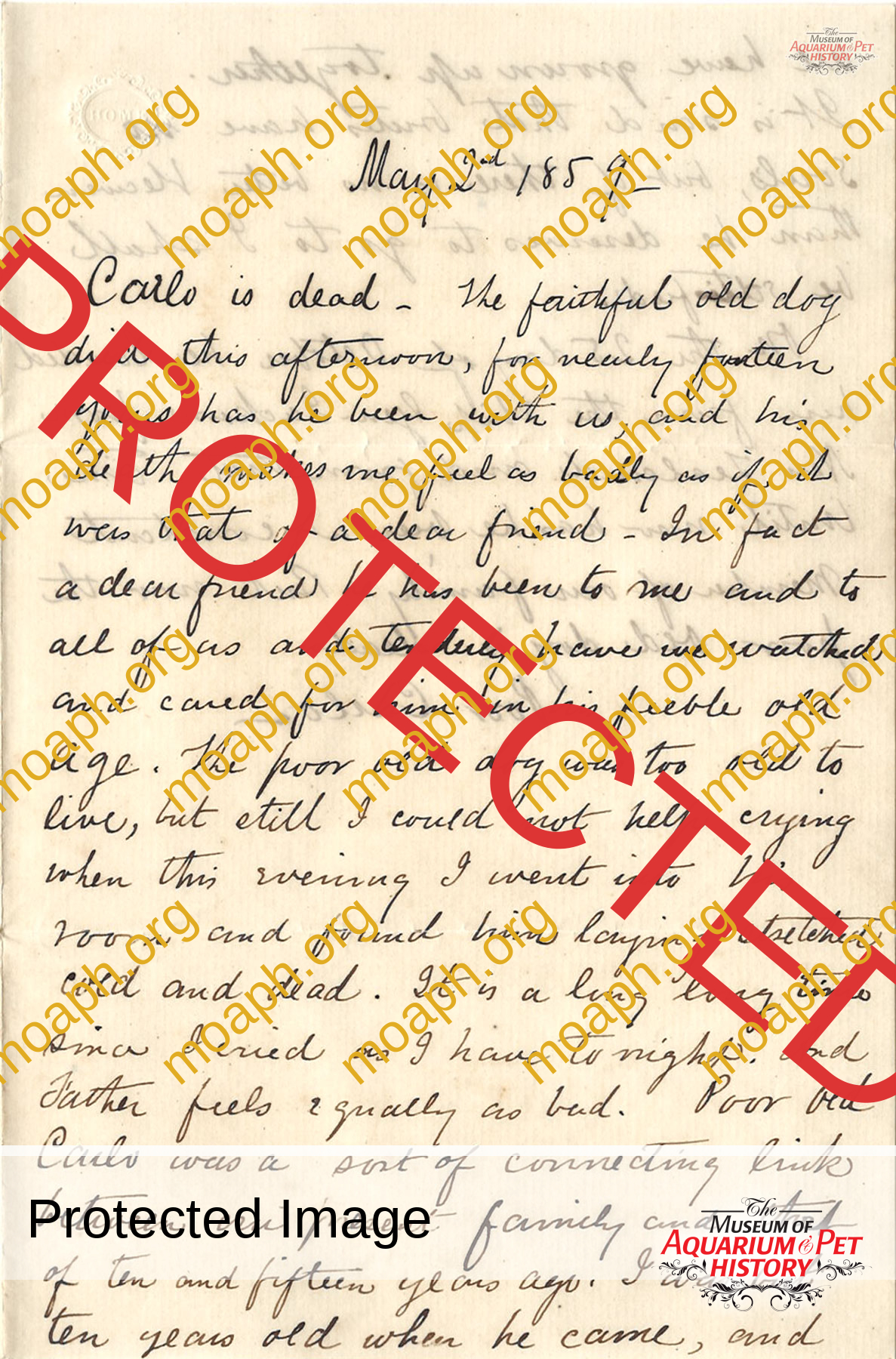
A tender and poignant manuscript note about the life, death, and burial of Carlo the dog. Poor Carlo. Found in a collection of 19th-century letters, this unassuming item has left this cataloguer weak and surprised. So much love and tenderness for a pet in 1859 seems, well, unusual. “Carlo is dead—the faithful old dog died this afternoon. It is a long, long time since I cried as I have tonight.”
Transcription:
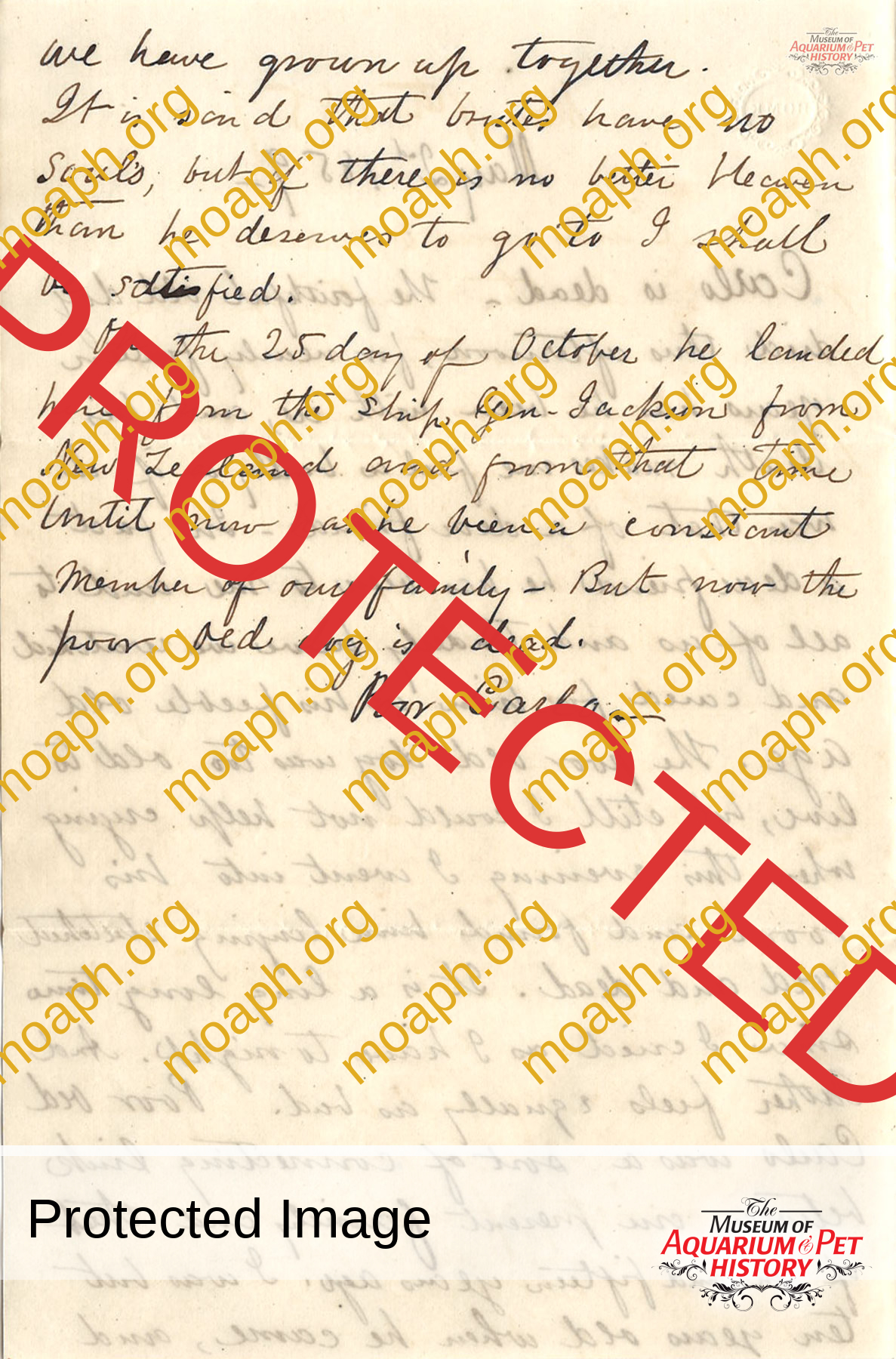
“May 2nd, 1859. Carlo is dead. The faithful old dog died this afternoon, for nearly fourteen years has been with us, and his death makes me feel as badly as if it were that of a dear friend. In fact a dear friend he has been to me and all of us and tenderly have we watched and cared for him in his feeble old age. The poor old dog was too old to live, but still I could not help crying when this evening I went into his room and found him laying stretched cold and dead. It is a long long time since I cried as I have tonight. And Father feels equally as bad. Poor old Carlo was a sort of connecting link between our present family and that of ten and fifteen years ago. I was but ten years old when he came, and we have grown up together. It is said that brutes have no souls, but if there is no better Heaven than he deserves to go to I shall be satisfied. On the 25th day of October he landed here from the ship Gen Jackson from New Zealand and from that time until now has been a constant member of our family. But now the poor old dog is dead. Poor Carlo.’
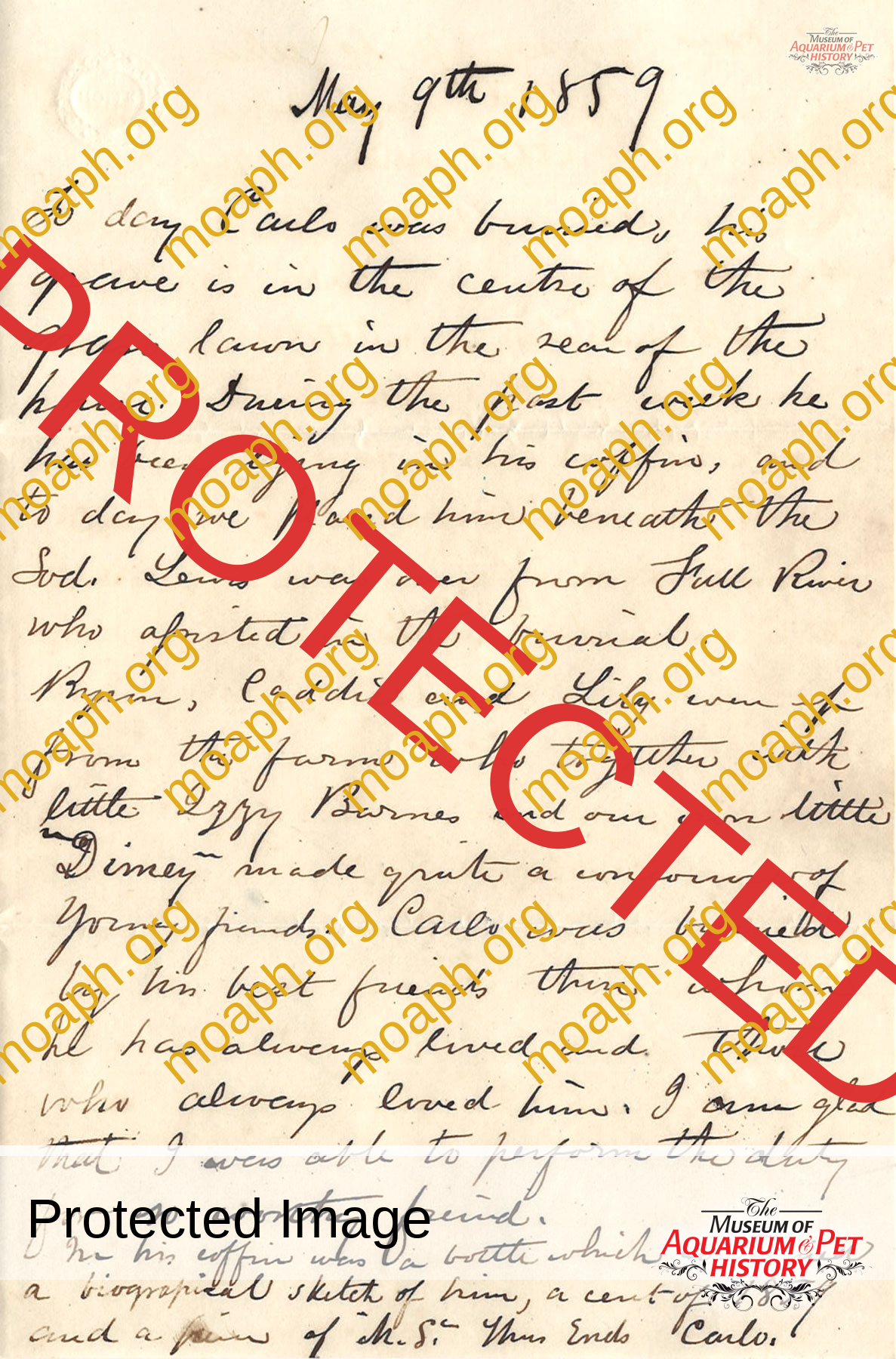
“May 9th 1859. Today Carlo was buried, his grave is in the centre of the grass lawn in the rear of the house. During the past week he has been lying in his coffin, and today we placed him beneath the Sod. Lewis was over from Fall River who assisted in the burial. Byron, Caddie and Lily were up from the farm who together with little Izzy Barnes and our own little ‘Dimey’ made quite a concourse of Young friends. Carlo was buried by his best friends there whom he has always loved and those who always loved him. I am glad that I was able to perform the duty for so worthy friend. In his coffin was a bottle which contained a biographical sketch of him, a cent of 1859 and a [illegible] of ‘M.S.’ Thus Ends Carlo.”
Henry Wight Diman (1835-1884), the son of Rhode Island Governor Byron Diman, writes a wonderful and detailed memorial to his dog Carlo. He expresses his grief and his love for his faithful dog, who was brought from New Zealand to the Diman household in Bristol in 1845 aboard the ship General Jackson. Henry explains that Carlo “was a sort of connecting link” between his childhood family and his present family that included his stepmorther and half-sister Elizabeth. Henry gives a sad description of the proper burial that they gave Carlo a week after his death: His brother Rev. Jeremiah Lewis Diman came from Fall River to officiate; his little sister, nephew, niece, and other children attended the funerl; finally, they placed “a bottle which contained a biographical sketch of him” and an 1859 penny in his coffin. Henry kept journals for much of his life and his journal entries for May 2 and May 9, 1859 reveal that his sister “Dimey” placed fresh flowers in Carlo’s coffin every day and that later Henry “had a marble stone with his name cut upon it…and put over his grave.” For entries in Henry’s journal, see Journal Vol. 3 in the Henry Wight Diman Papers 1842-1884, University of Rhode Island Library, Special Collections and Archives (Mss. Gr. 161).
Henry Wight Diman was born at Bristol, the son of Byron Diman (1795-1865) and his first wife, Abigail Alden Wight (1802-1843). Byron’s second wife was Elizabeth Ann Wood, whom he married in 1855. Byron Diman was a wealthy merchant and shipowner. He served as Lieutenant Governor of Rhode Island 1843-1846 and Governor 1846-1847. Henry attended Brown University 1851-1854 but did not graduate. He served as a State Representative 1858-1862. In 1861 he enlisted in the Union Army and served as a Paymaster. He served as Consul at Oporto, Portugal, 1862-1869 and as Consul at Libson 1870-1882. He died at Libson.
Others mentioned in the manuscript include:
Lewis – Henry’s brother Rev. Jeremiah Lewis Diman (1831-1881), who was pastor of the First Congregational Church at Fall River 1856-1860. He was a noted pastor and university professor. See Memoirs of the Rev. J. Lewis Diman, D.D. (1887).
Byron and Caddie – Byron Diman DeWolfe (1848-) and Clara Anna DeWolfe (1853-), the children of Henry’s sister Clara Anna Diman (1828-) and her husband Algernon Sidney DeWolfe.
Dimey – Henry’s half-sister Elizabeth Diman (1857-).
The “M.S.” in the manuscript refers to the Marble Society, which was organized in 1846 by Henry and his childhood friends. The group met regularly until Henry’s death.
The Byron Diman residence is located at 341 Hope Street in Bristol. The DeWolfe farm was located south of Bristol on Mount Hope Bay. See The Wights (1890).
The ship General Jackson was based at Bristol. It made a whaling voyage to the Pacific, including a stop in New Zealand, January 1842-October 1845. See the Brooklyn Eagle (February 6, 1844).