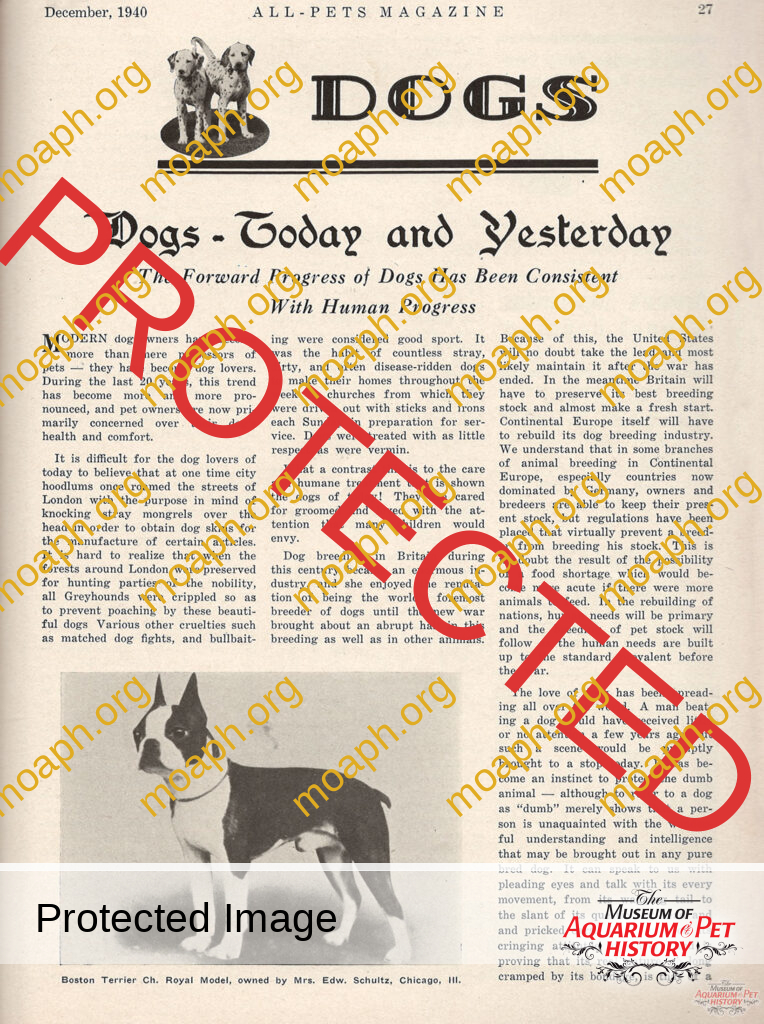
Dogs-Today and Yesterday from All-Pets Magazine, December 1940
The Forward Progress of Dogs Has Been Consistent With Human Progress
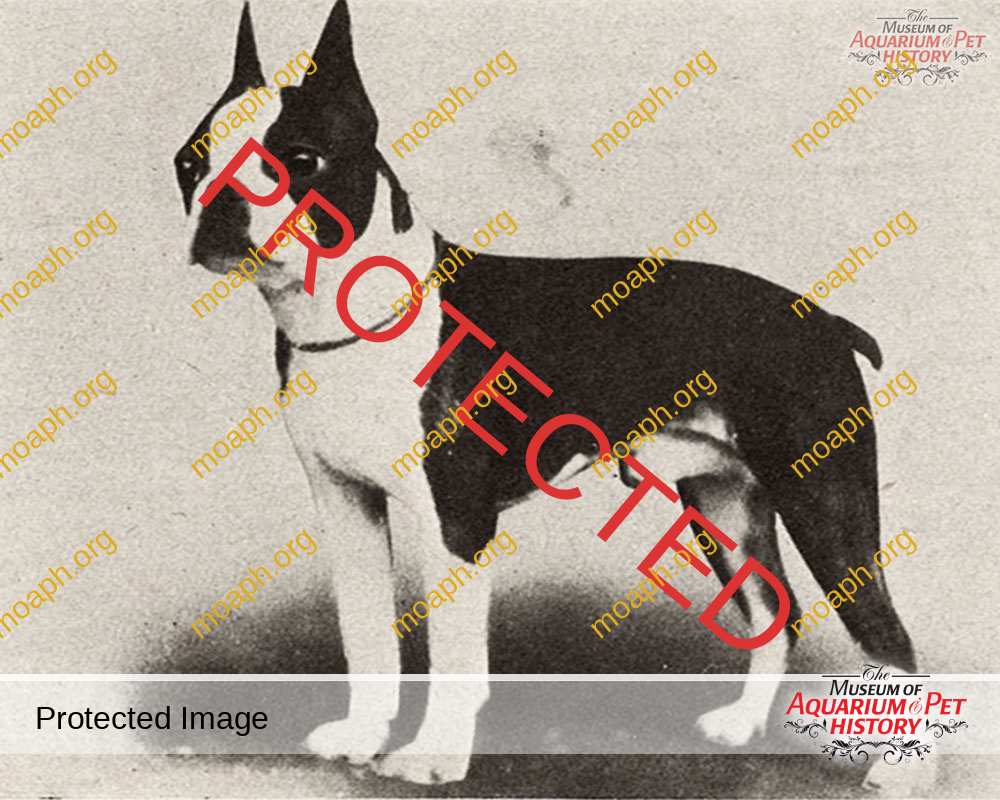
Boston Terrier Ch. Royal Model, owned by Mrs. Edw Schultz, Chicago, III.
Modern dog owners have become more than mere possessors of pets – they have become dog lovers. During the last 20 years, this trend has become more and more pronounced, and pet owners are now primarily concerned over their dog’s health and comfort.
It is difficult for the dog lovers of today to believe that at one-time city hoodlums once roamed the streets of London with the purpose in mind of knocking stray mongrels over the head in order to obtain dog skins for the manufacture of certain articles. It is hard to realize that when the forests around London were preserved for hunting parties of the nobility, all Greyhounds were crippled so as to prevent poaching by these beautiful dogs. Various other cruelties such as matched dog fights, and bullbaiting were considered good sport. It was the habit of countless stray, dirty, and often disease-ridden dogs to make their homes throughout the week in churches from which they were driven out with sticks and irons each Sunday in preparation for service. Dogs were treated with as little respect as were vermin.
What a contrast this is to the care and humane treatment that is shown the dogs of today! They are cared for groomed and loved with the attention that many children would envy.
Dog breeding in Britain during this century became an enormous industry, and she enjoyed the reputation of being the world’s foremost breeder of dogs until the new war brought about an abrupt halt in this breeding as well as in other animals.
Because of this, the United States will no doubt take the lead and most likely maintain it after the war has ended. In the meantime, Britain will have to preserve its best breeding stock and almost make a fresh start. Continental Europe itself will have to rebuild its dog breeding industry. We understand that in some branches of animal breeding in Continental Europe, especially countries now dominated by Germany, owners and breeders are able to keep their present stock, but regulations have been placed that virtually prevent a breeder from breeding his stock This is no doubt the result of the possibility of a food shortage which would become more acute if there were more animals to feed. In the rebuilding of nations, human needs will be primary and the breeding of pets tock will follow as the human needs are built up to the standard prevalent before the war.
The love of dogs has been spreading all over the world. A man beating a dog would have received little or no attention a few years ago, but such a scene would be promptly brought to a stop today. It has become an instinct to protect the dumb animal – although to refer to a dog as “dumb” merely shows that a person is unacquainted with the wonderful understanding and intelligence that may be brought out in any pure-bred dog. It can speak to us with pleading eyes and talk with its every movement, from its wagging tail to the slant of its questioning head and pricked ears. It has cast off its cringing attitude of slavery and is proving that its real nature, so long cramped by its bondage, is that of a good fellow, a pal, as well as a tireless worker.
Some people have maintained that the danger of breeding for show points in preference to utility is an ever-present danger. They state that from way back when primitive man first tamed the wild wolf and taught it to hunt, every type of field dog has had a useful purpose, and it would be intolerable if intelligence, speed, or courage were to be sacrificed for some added symmetry. Field trials are now offered as an encouragement to breed for usefulness rather than “looks.”
Attempts to create new and more useful breeds will no doubt continue for many years to come. As a rule, however, dog experts believe that the vast majority of the species are now firmly established, although some breeds are of comparatively recent origin. It is noteworthy that the Labrador Retriever, which is today the pride of many field trials and considered an ideal retriever of genuine utility value as well as of beauty and grace, was practically unheard of 35 years ago. There are now 109 breeds recognized by the American Kennel Club. Leaders include such popular dogs as the Cocker Spaniel, Boston Terriers, Beagles, Foxterriers, Scottish Terriers, Dachshund, Pekingese, Pomeranians, Chows, Setters Boxers, etc.
It would seem that all man, the master, can do towards improving the dog, his friend, has been achieved. Anyone visiting a dog show can hardly help but feel that practically all dogs benched are close to the official standards as compared with dogs benched 15 or 20 years ago. In those days it would have been a much simpler task to foretell the winners in the various classes than it is now. Judging deliberations by the experts who view dogs in competition from every possible angle are in general agreement – but even then experts can differ. Inconsequential differences often let one dog win over another.
Among the outstanding facts of doggy history, nothing stands out more than the vast improvement in every breed since the first year of this century. Advances that previously occupi3ed generations have been registered almost from show to show, and where actual points in accepted standards have not been changed a great many more exhibits come very much nearer the ideal than ever before.
Year after year new records for number of entries have been established at the smaller shows as well as at the larger ones all over the country However, only a small portion of the pure-bred dogs in America are actually put on the show bench Hundreds of thousands of purebred dogs are owned by dog lovers who have no thought of showing, but nevertheless take pride in possessing good specimens of whatever breed they fancy About the farms of the country one can find Spaniels, Retrievers, Terriers, Working Dogs, etc, that would stand the test of any dog show.
Pure breeding of dogs and their selling isn’t carried on exclusively by the large kennels and those who make a business of it Thousands of dogs change hands in remote cottages and farms and even in urban areas, while few subjects occasion more talk in family circles than the points and prowess of local purebred dogs. However, these dogs are sought-after for their companionship and usefulness rather than for their show qualities. Frequently good prices are paid for these dogs which probably will never see a show bench.
It follows from the above paragraphs that the attention given these thoroughbreds should be only of the best. Hence, we find that everywhere there is more and more demand for the veterinary surgeons. Veterinarians of today have established modern up-to-date sanitary dog hospitals where the best scientific care available is given to dogs. These hospitals frequently maintain ambulances so that little or no delay is necessary in giving dogs immediate treatment in cases of emergency. Advancement in the veterinary profession has made such rapid strides that dogs suffering from rare canine ills can now be treated successfully.
Recently in Boston, Mass., a St. Bernard was stricken with a malady rarely contracted by dogs – septicemia pneumococcus, or blood poisoning by the pneumonia germ. As far as is known, no dog has ever been cured from this disease before However, this difficult case, without precedent, was treated successfully by a veterinary surgeon. The big dog had been wasting away from the mysterious ailment when taken to the veterinarian A month passed in which experiments were made and the dog’s temperature reached to a near-fatal 106 degrees, but hope was never lacking. Finally, a solution was found. It consisted of blood transfusions. As the same type blood had to be used (just as in humans), two pints of blood were taken from the dog’s brother, who was not at all inconvenienced by the transfusion. Before the transfusion, the stricken dog had lost 45 lbs., but after treatment, his recovery was even faster than the ravages of the disease.
Thus, the strides in the profession of breeding, maintaining, promotion, sale, and exhibition of purebred dogs have been forward and consistent. Our present four-legged companions enjoy the bounties of life consistent with good living, and just so long as we humans take pride in offering our dogs the virtues of life attended with peace and goodwill, so shall we always look upon our fellow neighbors, whether they be local, national or international, as brothers in a world that thrives on contentment and companionship.
The Christmas Dog
The dog has a special significance because he immediately attaches himself to his recipient; and in the faithfulness displayed by the dog, there is reflected the fealty of the one who made the gift. In actual practice, the dog often displayed more friendship and loyalty than those who sent them, for there are instances in which dogs sometimes were given to exact political favors and to cement agreements between neighboring kingdoms.
Two New Books
The following books are recommended additions to your library:
Your Dog as a Hobby
By Ackermann and Onstott, published by Harper & Brothers, New York City 179 pages, also illustrations. Price, $2.00
Here two prominent west-coast kennel owners, exhibitors, and judges of fine breeds of dogs of all kinds, give a popular presentation of the important aspects of dog-raising and owning for everyone who wants to understand fully the many problems involved in raising a pet.
Here is valuable guidance for those who want to raise a dog as a companion as well as those interested in breeding fine specimens for exhibition purposes. From both points of view, it discusses expertly: choice of breed, housing, breeding, feeding, doctoring, training, and exhibiting. It also contains a helpful list of all the breeds of dogs indicating their special use
The authors are both dog fanciers of long-standing and wide reputation. They have been engaged for the greater part of their lives in raising pure-bred dogs of all types. Both hold licenses to judge all breeds of dogs. Mr. Ackerman has been President of the Golden Gate Kennel Club of San Francisco since 1910 and has written two successful books on Fox Terriers Mr. Onstott is the author of a. book on genetics as applied to the breeding of dogs and co-author with Mr. Ackermann of a new book entitled: “You Can Judge Dogs”
Dog Training Made Easy
By William Cary Duncan, published by Little, Brown and Co, Boston, Mass. 251 pages, also illustrations Price $2.00
“Dog Training Made Easy” is written for the average dog owner who wants his dog well trained but has no particular interest in making a show dog of his pet. Out of his long experience both as dog expert and writer, Mr. Duncan has written what may well become a classic in its field.
He begins by discussing what breed best fits your purse and personality Then he helps you to select a pup, with tips on the tricks sometimes worked on the cocksure buyer. Mr. Duncan guides you from the time the pup arrives, carsick and bewildered, at his new home, until he is a perfect canine gentleman Such subjects as: The first meal, the matter of bedding, housebreaking, motor manners, the chronic barker, chicken killers, training for simple Obedience Tests—are discussed in easy, friendly fashion and with the authority of Mr. Duncan’s vast experience.
Wm. Cary Duncan is dog editor of Outdoor Life, a director of the American Kennel Club, a well-known breeder of English setters, a judge in leading dog shows, a lifelong dog trainer, and sportsman.
These two new editions are refreshing contributions to canine literature and they do not follow the stale road of doggy writings. They are not hashed-over works but are new in every detail. The authors know something about the field and they tell their readers the important things about dogs in a clear, well-written, and comprehensive manner.