Pet Keeping in 1797 Germany – Chapter 1 Part 2
Written by Kurt Jacobs (who also wrote the seminal work Livebearing Aquarium Fishes). One chapter will be translated from the old German each month.
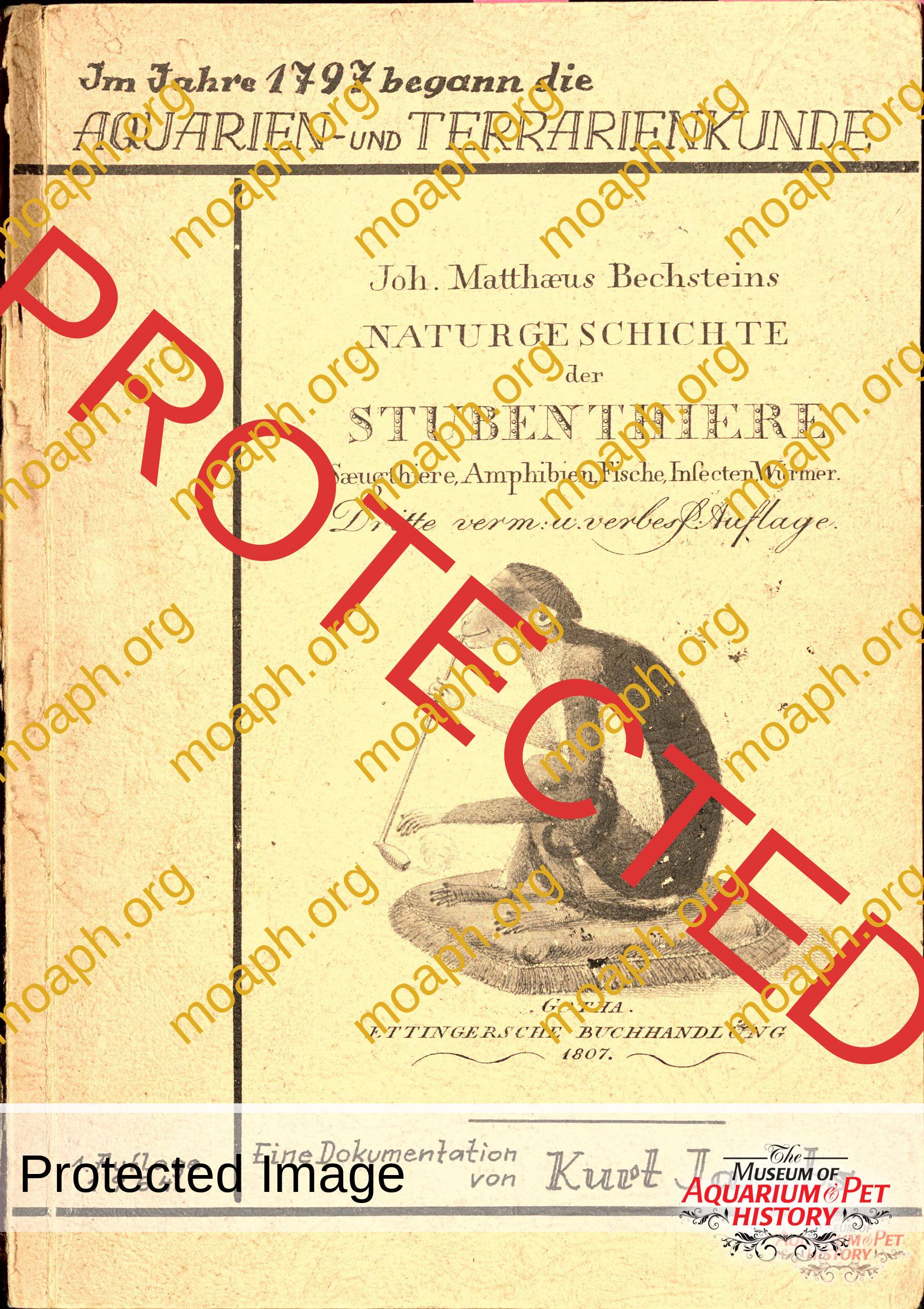
Chapter One: The study of Aquariums and Terrariums begins (in Germany): Johannes Matthaeus Bechsteins: Study of the Nature of house Animals (Mammals, Amphibians, Fish, Insects, and Worms).
Chapter 1 (Part 2): Wiederfand (Found Again)
The First Aquarium Club:
The following years and decades brought further significant advances in the field of fish science. A series of outstanding ichthyological (study of fish) works enriched and deepened their current understanding of the highly specific science.
From 1817-1820, the German researchers Johann Baptist von Spix (1781-1826) and Carl Friedrich Phillip von Martius (1794-1869) undertook a journey to the Amazon River. After Spix’s early death, Martius handed over the rich fish research to the then unknown Jean Rudolphe Louis Agassiz (1807-1873) for him to review. The work, “Selecta Genus et Species Piscium, quae in intere per Brasilliam colleguit J.B. de Spix” (Selected Genera and Species of Fish collected throughout Brazil by J.B de Spix) not only made the author Agassiz immediately world-famous but became the defining ichthyological document of the Amazon for decades to come.
On September 18, 1822, Professor Dr. Lorenz Oken (1779-1851), a nature studies scientist, brought the German scientists to Leipzig for the first major joint conference.
In 1828, the first volume of the large joint work, “Histoire naturelle des poissons” (Natural History of Fish) by the ichthyologists Georges Leopold Chretien Dagobert Cuvier (1769-1832) and Achille Valenciennes (1794-1864) achieved world fame.
In 1841 the English Scholar Dr. H. Wards became famous for his almost hundred liter freshwater aquarium, containing a number of aquatic plants, goldfish and silver fish. His partner Dr. Phil Edwin Lankester (1814-1874), one of the oldest ornamental fish collectors known by name, looked after the three-spined stickleback around 1848, whose tank was planted with Vallisneria. In 1849, the London Zoological Garden held a permanent exhibition of reptiles for the first time.
In addition to scientific research, the aquarium hobby is also making great progress. In Leipzig, the glass companies Fritzsche & Breiter and Robert Syrutscbok became known as the oldest suppliers of glass aquariums. The municipal gardeners who worked in the Friedrich Wilhelms Gardens in Magdeburg, Germany, were probably the ‘first aquatic plant gardeners’ in all of Europe. Otto Gittner in Leipzig goes down in history as the ‘first pet dealer of amateur vivarium’ and the Gerog Schreiber agency in Leipzig became the first supplier of Tuftung stone, which was extremely popular in the early years and decades of the hobby. Setting up aquariums designed to form underwater landscapes became its own hobby and at the same time became an object of home decor.
Phillip Henry Gosse (1810-1888), professor of natural history at the University of Edinburgh, published his aquarium handbook “The Aquarium, or, the Unveiling of the Wonders of the Deep” in London, 1854. Thanks to this magnificent work, which is equipped with many colored copper plates, the term “Aquarium”, coined by Gosse, became very popular. In the same year (1854), the German family magazine, “Die Gartenlaube” (The Gazebo) published their first essay titled, “Der Ocean auf dem Tisch” (The Ocean on the Table), and on page 392 of issue 33 there was a heading called, “Blatter und Bluten” (Leaves and Flowers). It describes the setup and care of a saltwater aquarium, which at the time was thought to have only been known to those in England.
In 1855, in issue 4 of the “Die Gartenlaube” (The Gazebo), on page 56, also under “Blatter und Bluten” (Leaves and Blossoms), there was a second essay again with the title “Der Ocean auf dem Tisch” (The Oceans on the Table). This time, however, only instructions are given for the production of artificial lake water. A third article in issue 28 on page 376 also covers recipes for artificial saltwater. Then, as we continue to read through these old garden arbor vintages, we see the four-page fourth essay “Wie er-und behält man den Ocean auf dem Tische oder das Marine-Aquarium” (How to keep the ocean on the table or the marine aquarium) with detailed explanations in issue 38 (1855) on pages 503-506 describing the installation, furnishing, staffing and maintenance of a proper seawater aquarium.
All of these first essays in the “Gartenlaube” (The Gazebo) are about marine aquariums. Unfortunately, aquariums do not bear any information on the author. However, it is very likely that the editor of the “ Die Gartenlaube” (The Gazebo) Ferdinand Stolle was the author of these works, which were largely influenced by Gosse’s publications. To this day, these essays dedicated to seawater aquaristics were considered journalistic expressions of a hobby that was beginning at the time and was therefore still in its early stages.
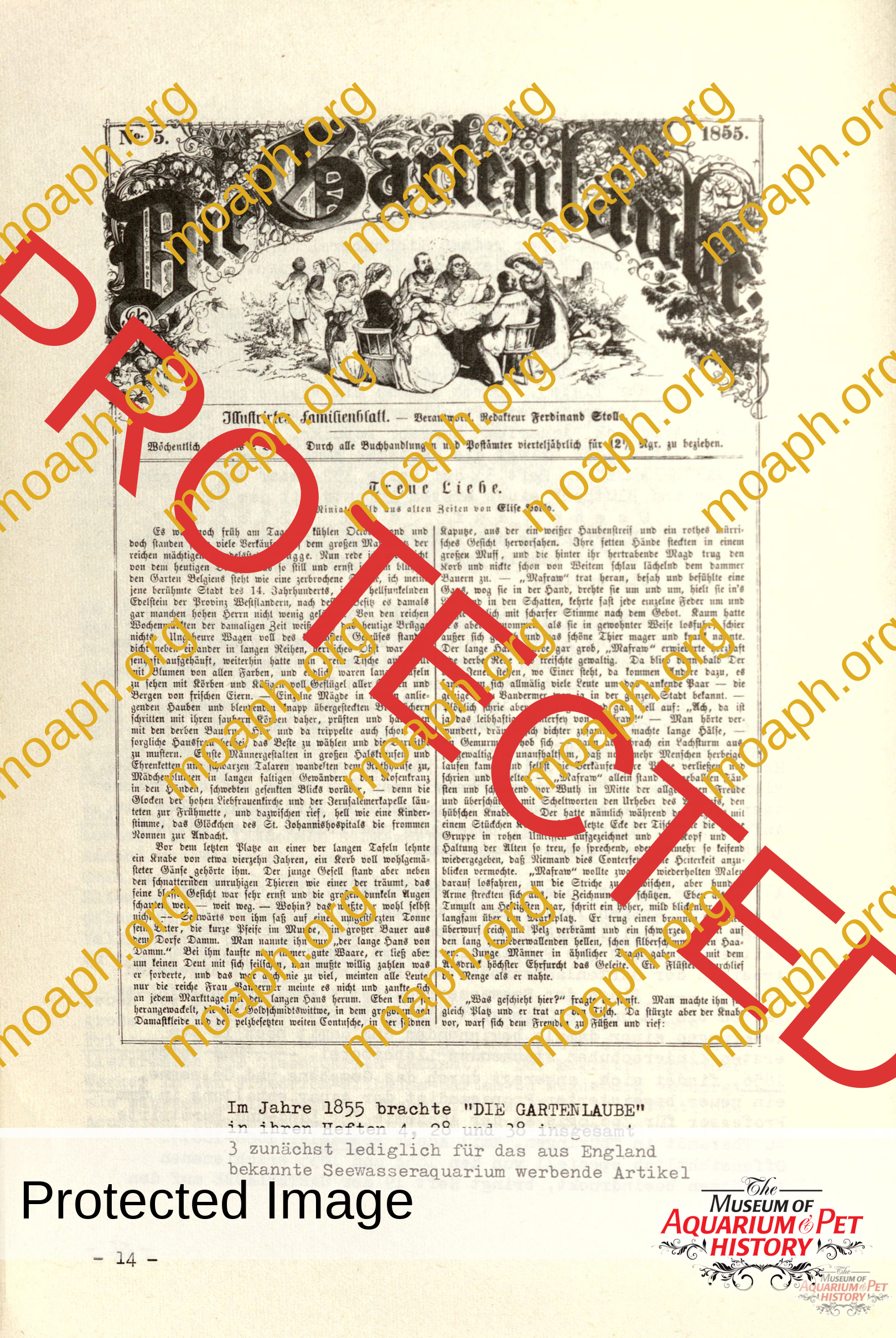
In 1855, the Gartenlaube published a total of 3 articles in its issues 4, 28 and 38, initially only advertising the seawater aquarium, which was well known in England.
By 1856, inspired by what he had seen and read, there was a new enthusiastic advocate for aquarium keeping, the professor of zoology at the Tharandt Academy of Agriculture and Forestry in Thuringia, Emil Rossmassler (1806-1867) with his piece “Der See im Glass” (the Lake behind the Glass).
In contrast to the essays that recently appeared in the Gartenlaube, the idealist Rossmassler advocated the setting up of aquariums exclusively for overserving the flora and fauna of local freshwater inland waters. The octagonal frame aquarium shown with the sides sloping upwards gives the tank a much larger water surface compared to the bottom surface, essentially acting like a magnifying glass as there was more visible surface shown. This was designed and constructed according to the ideas of Profesor Gosse.
Rossmassler’s essay was written out of his enthusiasm for all things scientific and out of the irresistible urge to appeal to the broad public in order to make the aquarium a staple in everyday homes. The family magazine, “Die Gartenlaube” (The Gazebo), of which he was a co-founder, offered him the best platform for his goal. For him, the aquarium is primarily “a friendly room decoration and at the same time an eternally lively source of instructive entertainment by bringing together aquatic plants and aquatic animals in containers that are appropriate for their lives”. The care of fish in the sense of later aquaristics was only unconsciously in his interests.
At the same time another book was published by author E. Schafer in 1856: “Aquarium- Belehrung und Anleitung solche anzulegen und zu unterhalten. Nebst Beschreibung der vorzüglichsten Tiere, Pflanzen, etc, welche sich für dieses “eigen”’ (Instructions on how to create and maintain aquariums. In addition, a description of the most preferred animals, plants, etc., which are suitable for the aquarium).
In the following year, 1857, Hermann Mendelssohn’s publishing house in Leipzig released Rossmasslers book “The Freshwater Aquarium” (Das Susswasser Aquarium). His foreword begins informatively:
“With my enthusiasm for everything that can help lead people to nature, I was happy to fulfill the request of the publisher, who himself is a keen caretaker of his aquarium, to create a booklet about this instructive and beautiful addition to the decoration of our rooms. My public essay on German freshwater aquariums which I published in the 19th volume of “ Die Gartenlaube” (The Gazebo) — like the popular English lake aquarium– resulted in wide adoption of freshwater aquariums here in Germany. At that time I was not yet able to give completely satisfactory instructions on the setting up and maintaining of freshwater aquariums. As a result I was soon inundated with the inquiries and complaints from all across the country, many of which I was unable to resolve”.
Rossmassler, based on his own words about being a novice in the aquarium field, feels called upon, as a natural scientist and teacher to spread awareness on the field of aquarium keeping. Interestingly, he apparently was unaware of his great predecessor Johann Matthäus Bechstein and early vivarium work, most notably his book, “Naturgeschichte von Haus, Säugetieren, Amphibien, Fischen, Insekten und Würmern” (Natural History of House, Mammals, Amphibians, Fish, Insects, and Worms). This confirms the assumption that Rossmassler had a multidisciplinary interest and was only aware of surface level information in the field. His interest in aquariums, essentially, came from his love for nature. The diversity of his previous and subsequent works in the choice of topics affirms this view in a pleasing way.
For the reader of his book, “The Freshwater Aquarium” (Das Susswasser Aquarium) the impression is reinforced that Rossmassler saw himself primarily as a popular scientific writer and natural science journalist from the “Gartenlaube” (The Gazebo), whos was called upon to spread the love of nature to ever wider sections of the population. With such an objective, it seems understandable that in his first chapter, “History of the Freshwater Aquarium.” (Naturgeschichte der Süßwasser Aquarium) he unfortunately says nothing that could really have helped to understand any previous popular scientific writer who may have inspired him. Although we briefly read the names of some of the classical scientists who long ago studied aquatic life, we find no other real historical references.
The second chapter, “Von den Verschiedenen Arten der Aquarien” (On the different types of aquariums) he gives information about several different versions of aquariums that were already common at the time. This therefore proves that there was already an interest for the keeping of aquarium animals that existed long before Rossmassler.
In contrast to today’s rectangular all-glass tanks, the circular goblet aquarium was considered a preferred shape and ideal for creating decorative underwater landscapes. Rossmassler also describes the brick-built aquariums found in greenhouses and garden salons, which are comparable to the concrete basins of modern times.
“Was ist und was soll ein Aquarium?” (What is an Aquarium and what is it supposed to do?) is the title of the 3rd chapter. Rossmassler goes over the content of his essay, “The Lake in the Glass” (Der See im Glass) and begins to subtly move away from the topic of the essay to advocate his belief for improving scientific teaching for young people. Rossmasslers makes it very clear that his passion lies in expanding the aquarium hobby as a whole. He worked his whole life to fulfill this great task throughout his life, and all of his work is best understood from this perspective. The founding of the “Humboldt-Vereine” (Humboldt-Associations) in 1859 is also a confirmation of his ultimate goal, as it shows his desire for the expansion of the hobby**.
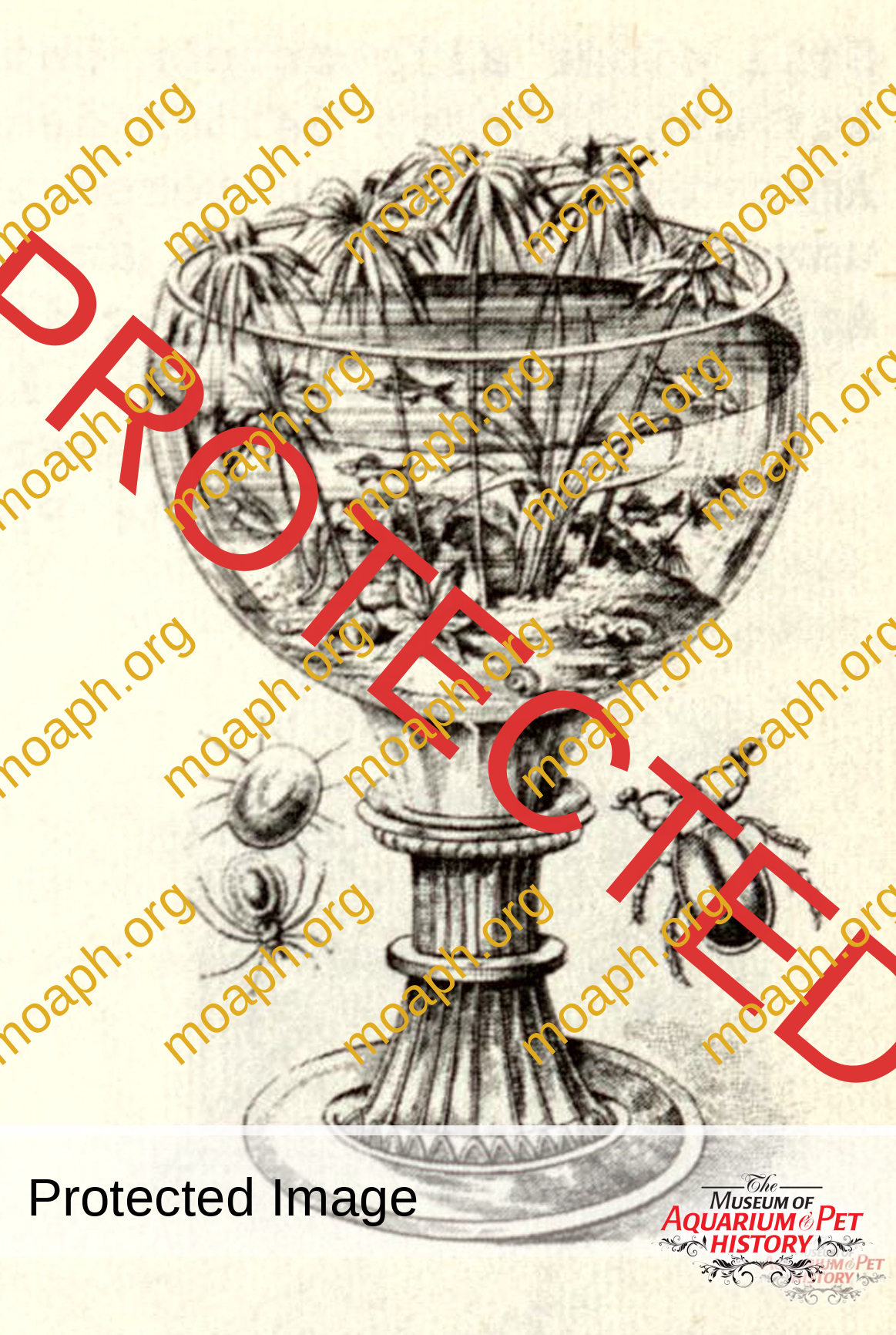
From A.u.G Ortleb “Das Süsswasser Aquarium und Terrarium”, (S.Mode’s Verlag, Berlin 1885)
In the 4th chapter “General Rules for the Aquarium” Rossmassler presents the natural interrelationships in the life of animals and plants and emphasizes the need to create a real biological balance when setting up an aquarium.
Rossmassler is more of a botanist than a zoologist. In chapters 5 to 8, “Die Pflanzen des Aquariums” (The Plants of the Aquarium) he provides a detailed description of all the underwater species known at the time. Even including swamp plants which he covered extensively with 45 pages!
Chapter 9, “Die Thiere des Aquariums” (The Animals of the Aquarium), on the other hand, begins on page 52 with only an 8-line reference to the goldfish. Then the small aquatic infusoria, polyps, insects, spiders, crustaceans, snails, is discussed in more detail on a total of 16 pages (pages 53-68). On Page 69, Rossmassler confesses that he has now been keeping fish in his aquarium for almost two years since August 1855. He mentions the few fish very briefly: the weatherfish, the loach, the stickleback, and the tadpole. Only the names of these fish are mentioned and no other description is given.
This is also where the fundamental difference in animal husbandry in the works of Rossmasler and Bechstein is probably most apparent. With regard to the description of the animals. Bechstein’s work is far closer to the goal of sensible aquarium and terrarium science and today’s modern vivarium than the publications of Rossmassler, who puts botany and small creatures at the forefront of his presentations.
The amphibians were treated in the style of a general conversation. On the last page of the book, Chapter 10 discusses the various containers used as aquariums, their setup, etc. A subsequent section on “Pflege des Aquariums und Fütterung der Tiere” (Caring for the Aquarium and Feeding the Animals) concludes with the words, “I close this chapter, which may seem too short to some of my readers, with the old truth: trying is better than studying!”
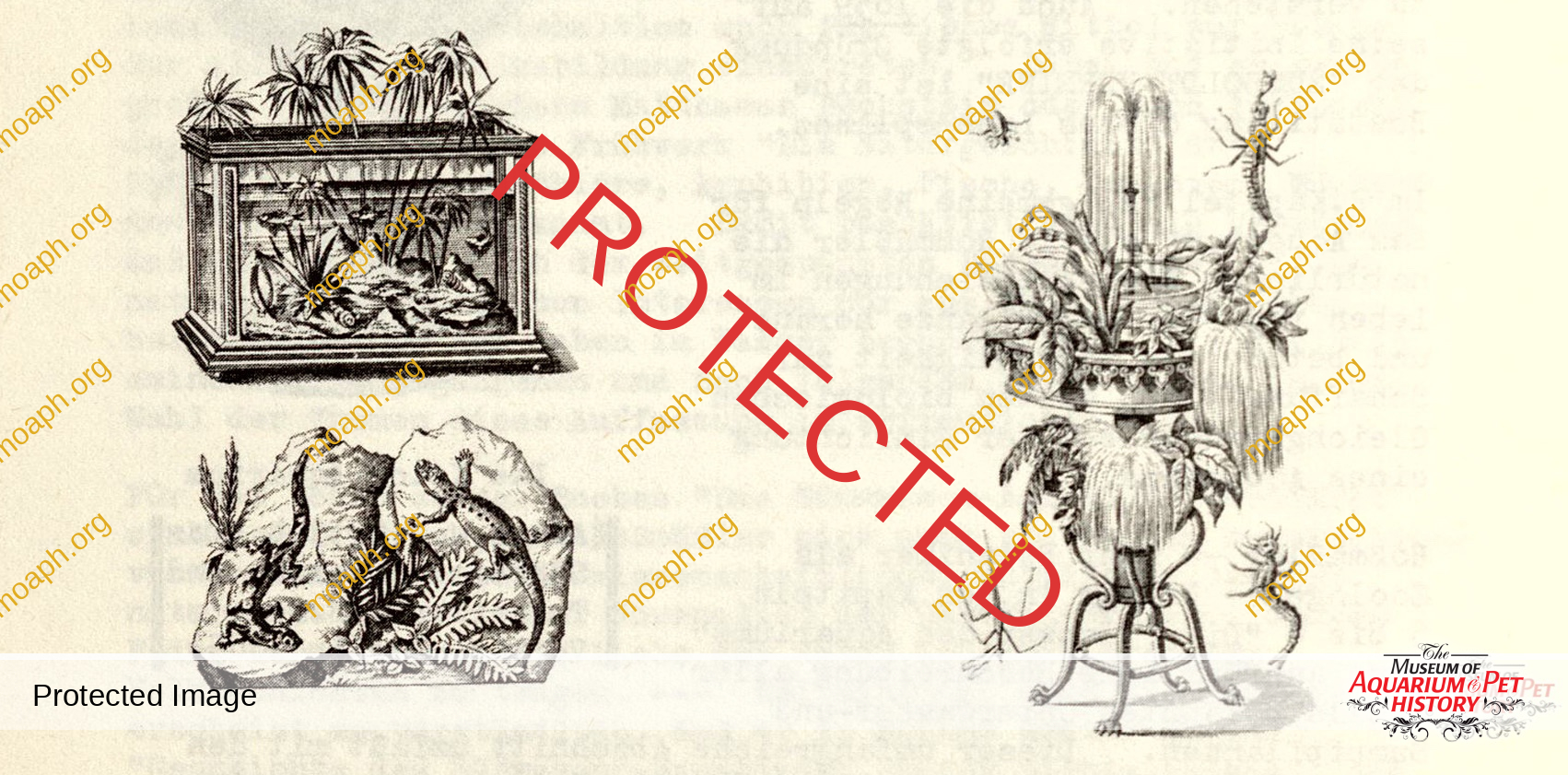
From A.u.G. Ortleb “The Freshwater Aquarium and Terrarium”, (S.Mode’s Verlag, Berlin 1885).
In contrast to Bechstein, who describes fish, amphibians, and reptiles in detail in his “Naturegeschiste der Stubenthiere” (Natural History of House Animals), Rossmassler primarily deals with the flora of aquariums.
Bechstein devotes 28 pages to amphibians and reptiles and 10 pages to fish.
Rossmassler only gives the amphibians 5 pages and the fish just under one page. But he also writes in detail about the flora of the aquarium on 43 pages and about the small creatures on 15 pages.
There are no direct points of contact between the two books. At best, one can assume that the same sources were used for the description of the goldfish. This is what Bechstein says on page 325, “In China, every tank in which they are kept has a feeding tube attached to it, which they use to get the goldfish on the surface”. Rossmassler on the other hand says, “The Chinese also use the tam-tam (feeding tube) to call their goldfish to the feed from all corners of the basin.”
Bechstein is therefore more thorough and precise than Rossmassler when describing the animals. This, on the other hand, additionally presents the flora of the aquarium and the technology that has now developed in aquarium keeping. Even if Bechstein and Rossmassler had been contemporaries, their influence on the development of vivarium would not have overlapped, but would have complemented each other to an excellent degree.
Bechstein was a systematic zoologist, biologist and vivarian. Rossmassler shows himself to be more of a multidisciplinary researcher, nature teacher, botanist and overseer of small animals.
Glorifying posterity chose Emil Adolf Rossmassler as the “father of aquarium science” decades ago and set the beginning of this in 1856, the time of the publication of his Garden Archive essay, “The Lake in the Glass” (Der See im Glass). Despite all gratitude and appreciation for Rossmasslers outstanding general scientific achievements, this view remains critical in today’s historical research, as we know Bechstein’s work was also extremely valuable. Rossmassler was not the father of aquarium sciences. However, this does not take away from the historical significance as the evangelist and aficionado of the study and his love for nature. Rossmassler was a propagandist whose love for nature pushed him to promote the study. We only discredit him for being the founder of science, as Bechstein and others had long researched the study before him.
From the multitude and diversity of his literary work. His aquarium garden arbor attachment and his aquarium book only represent a modest part of the work. His work in this direction is therefore significantly outshone by his overall influence on popular scientific education, which is particularly emphasized by the founding of the “Humboldt-Vereine” (Humboldt Associations). Nonetheless, Rossmassler rightly deserves the honorary title “Germans first natural science teacher”.
New pioneers are making a name for themselves. In 1860 professor Dr. Gustav Jaeger (1832-1917) organized a large public aquarium show in Vienna, consisting of fifteen large pools. Freshwater and marine fish were shown as well as a display of microscopic specimens. In 1868 the same professor Jaeger published his book, “Das Leben ins Wasser und Das Aquarium” (Life in the Water and the Aquarium).
In September 1869, the first public Berlin display aquarium was opened by Alfred Brehm (1829-1884) in Berlin at Unter den Linden corner of Schattenstrasse at a cost of almost 3 million gold marks. In 1873, Brehm founded a display aquarium in Vienna in a building built for the Vienna World Exhibition at a cost of one million gold marks.
Ornamental fish exhibitions often took place in close connection with bird hobby shows. We also see one of the first bird exhibitions organized by the “Aegintha” Berlin association in 1876. The zoo company Gebruder Sasse, Berlin, showed offspring of the MACROPOD for the first time in Germany. In the same year, 1876, Dr. Karl Russ (1833-1899) published the weekly magazine “ISIS” as a newspaper for all scientific enthusiasts. By the 1880’s there was a quickly growing community dedicated to aquarium science.
On July 16, 1877, a display aquarium was opened to the public in the zoological garden of the city of Frankfurt.
For the first time, on May 3, 1882, a handful of aquarium enthusiasts came together to found the “Aquarium zu Gotha” association which was later renamed “Nymphaea”. The first and oldest association in the world made up exclusively of aquarium enthusiasts. He works in the course of his continued cultivation of the hobby in Gotha.
After the publication of Rossmassler’s essay “Der See im Glass” (The Lake in the Glass) in 1856, it took almost a generation before the ‘Aquarium’ Gotha, the first special association, was added as part of the history of aquarium and terrarium enthusiasts. But that is fifteen years after Rossmasslers death.
The “Verein der Aquaristik- und Terrarienfreunde in Berlin” (Association of Aquarium and Terrarium Enthusiasts in Berlin) was founded on September 7, 1888, which then renamed itself, “Triton” on January 16, 1891.“Triton” became a gathering for the energetic men who had come together to create a network for aquarium and terrarium enthusiasts. This network of aquarium and terrarium enthusiasts and the organizations they began to build slowly built international attention as the hobby began to spread beyond Germany and its neighbors. It was this formation of Triton that pushed the hobby internationally.
**Humboldt-Vereine: An organization formed in part by Emil Rossmassler and Alexander von Humboldt and examines the evolution of German society through scientific developments.