Pet Keeping in 1797 Germany – Chapter 2
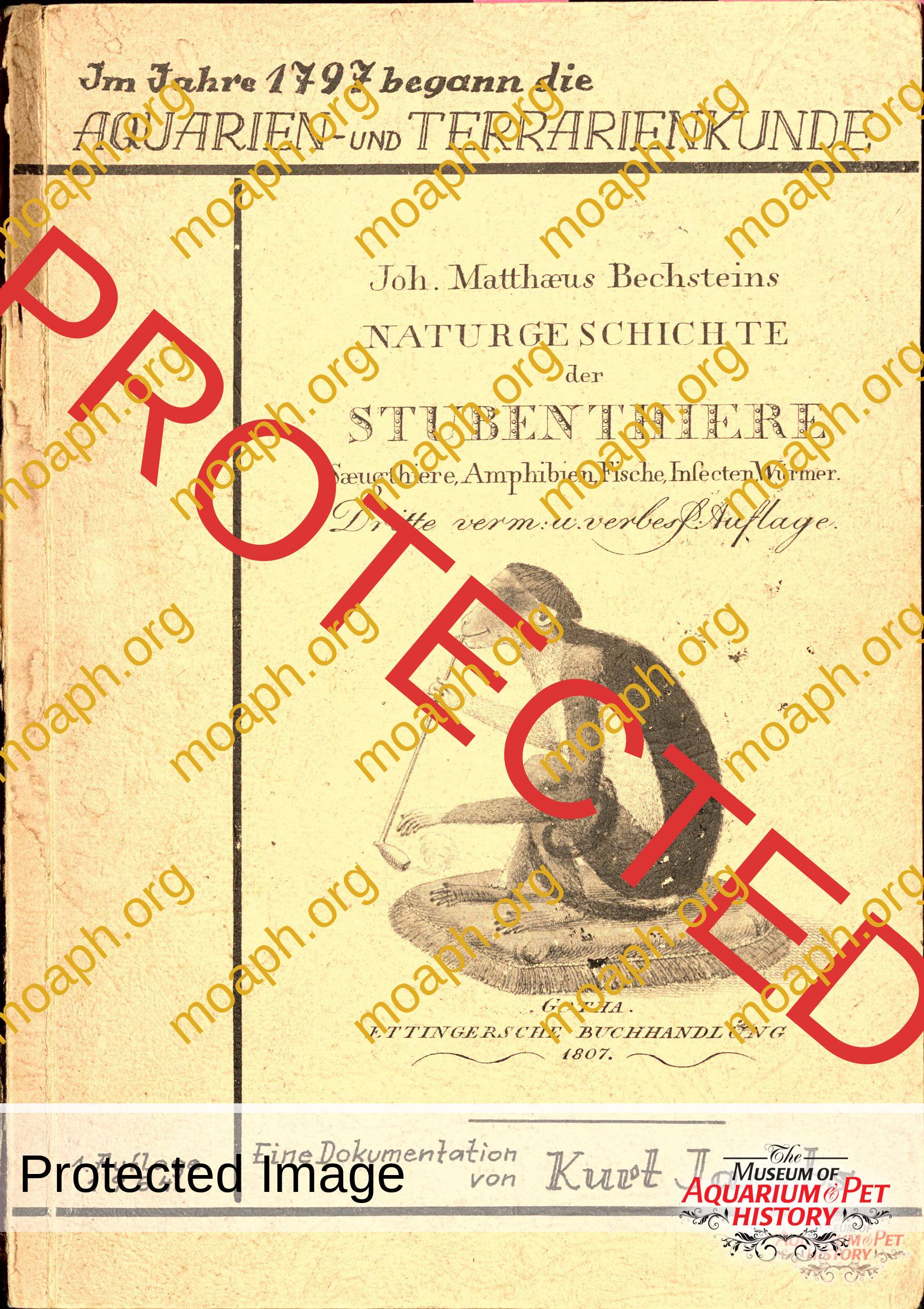
This is a historical book written in 1797 about German pet keeping history, including keeping native fish in captivity. This reprint was privately published and edited by Kurt Jacobs, who wrote the seminal work “Livebearing Aquarium Fishes.”
Each month MOAPH will release one chapter translated into English.
Amphibians: Those that can be kept in the house
*Remember, this was in 1797 Germany!
Introduction
There are also amphibians that hobbyists keep in the house for their pleasure, although there are very few of them compared to birds and mammals. They do not provide pleasure for long and are kept for their rarity and beauty, few show any docility.
In general, the external appearance of amphibians, even the ones with the most beautiful shapes and colors, has something shy and suspicious about them, therefore they are not usually known for being beautiful creatures. But this is usually a fault in education, as careful observations show.
The care of these animals is different both in the wild and at home, since some live on land and others in the water, there is a difference in home care for these creatures. The food of the house amphibians is just as different as their location. But most of them are fed with insects and worms. They don’t chew anything, but make the food slippery with their saliva and then regurgitate it whole into their stomach. They digest slowly and can starve for an extraordinarily long time because they digest very little. The turtles should be able to fast for a year. In general, the vitality of these animals is admirably great, so that some live for a long time, dying very slowly if they are not suffocated, and even parts that have been cut off or almost lost can be replaced, although imperfectly.
A: Crawling Amphibians
1. The common river turtle, mud turtle, green and yellow turtle (European Turtles):
*This book put turtles in the class of “amphibians” and not reptiles in 1797. (Perhaps because most lived in water?)
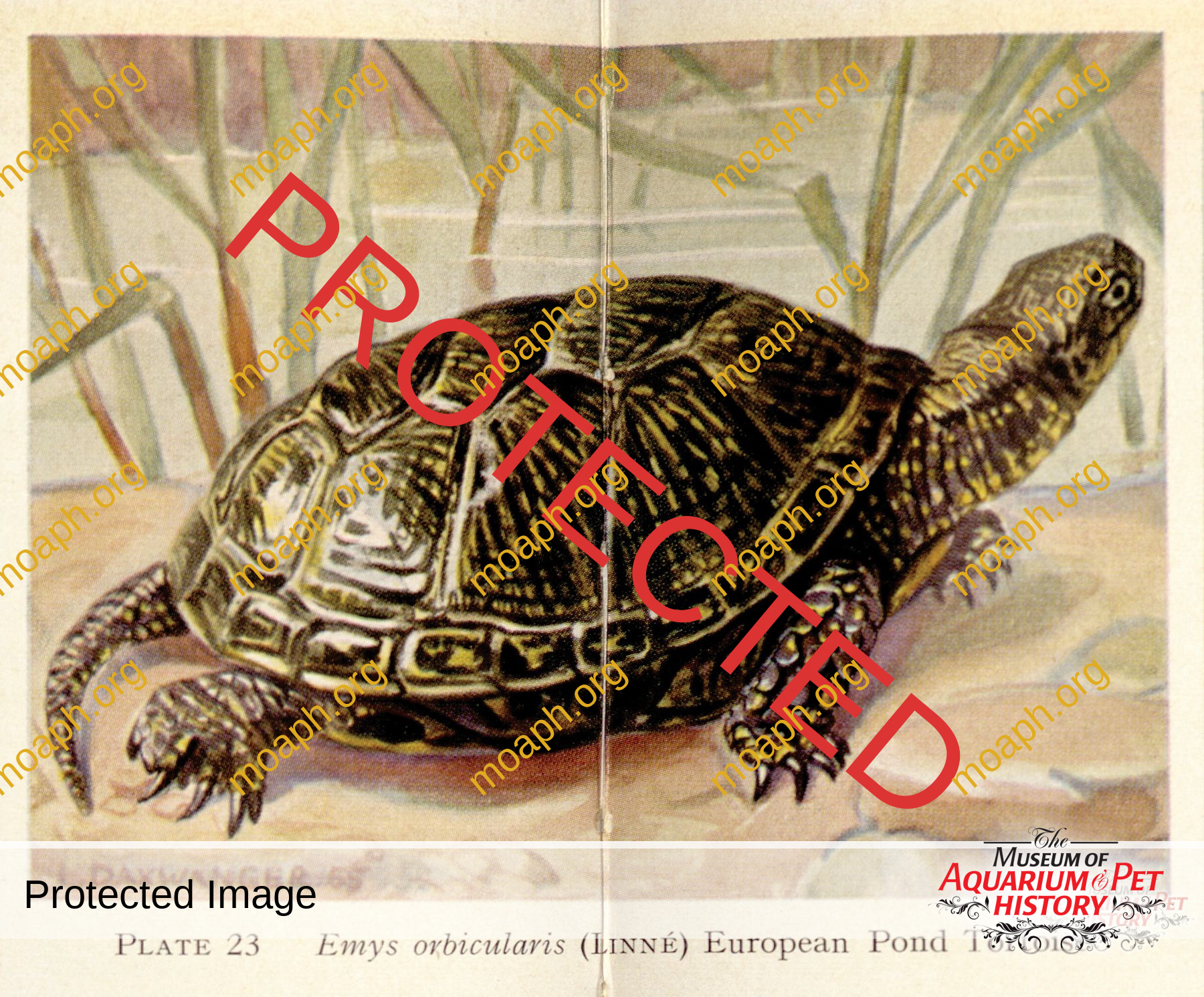
Emys orbicularis (European pond turtle) from Reptiles and Amphibians of Europe, written by Walter Hellmich, and illustrated by Irmgard Daxwanger.
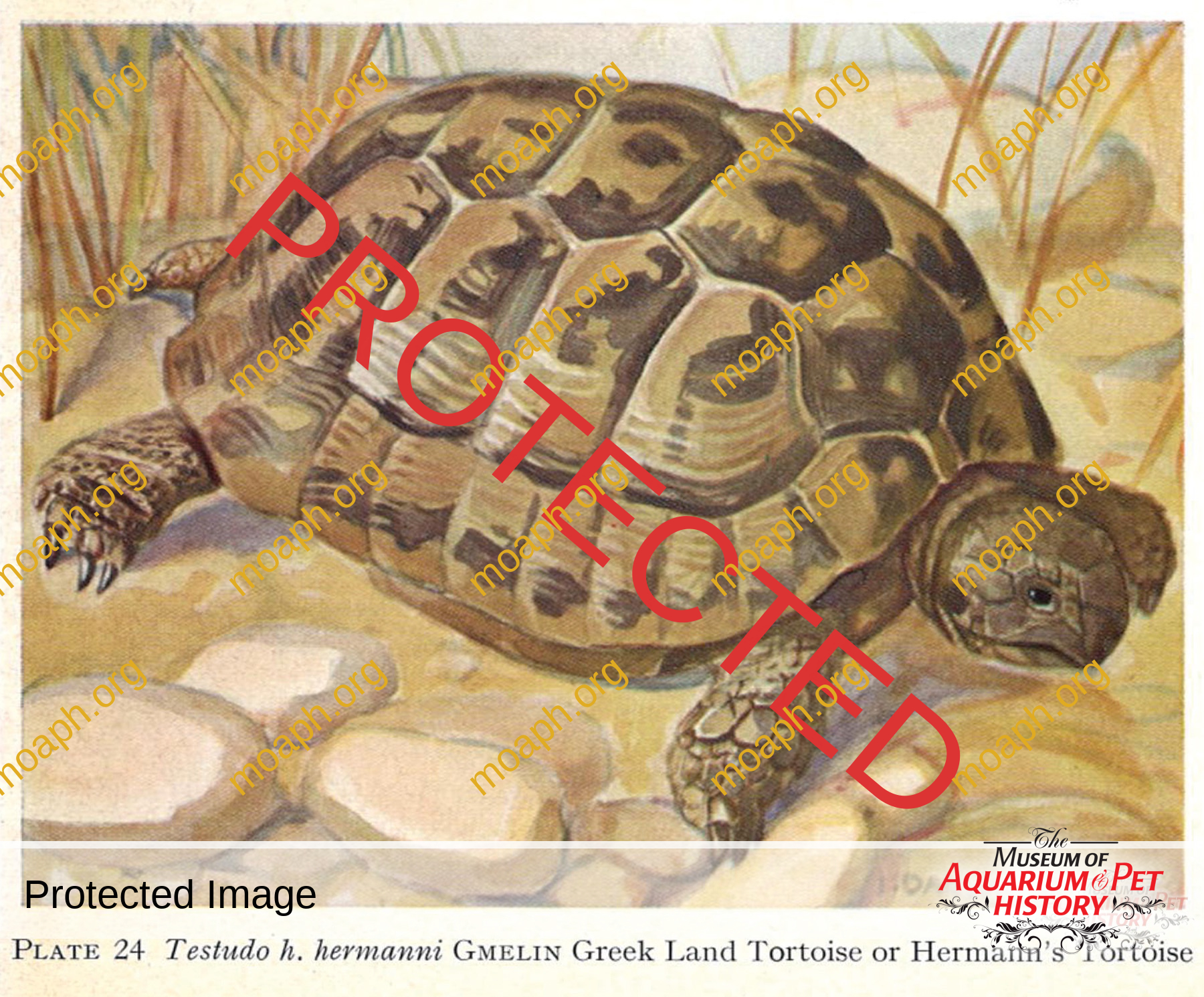
Testudo h. hermanni (Hermann’s tortoise) from Reptiles and Amphibians of Europe, written by Walter Hellmich, and illustrated by Irmgard Daxwanger.
Description:
Several species of turtles, even from the most distant parts of the world, are kept in water tubs. This is mainly done in central and northern Germany.
It grows to about 1 foot long with its head and tail extended. The head is small and, when retracted, is surrounded by black wrinkled skin, which forms, as it were, a cap, the muzzle is pointed, and although the mouth is toothless, the sharp jaws fit and divide its food, the tongue is attached to the lower jaw, the eye star is brown and golden yellow, the tail is relatively long, round, and gradually ends in a point, the feet are webbed, but they have clear toes.
Such turtles are called river turtles in contrast to other families, one of which is called land turtles (with free toes) and the other is given the name sea turtles (with feet similar to flippers).
In addition to the webbed skin on the front feet, our turtles have four hind feet and only two toes, both of which are covered with shiny black scales with yellow dots. They can hide their head and tall under the shield, as it is surrounded by two round shells, the upper one being slightly larger.
It has 13 scales in the back and 25 scales on the edge, but the lower one is flat and divided into 12 fields, the color is black-green or olive-green above with yellow lines or rays, below it is also blackish or dark gray, yellow, or whitish striped. The edge of the shields is smooth and imperforate.
Where They are Kept:
- In the Wild: You will find this turtle in the southern and central parts of Europe. In Germany, you will find it rarely. Like in freshwater in the ground and mud and hibernate in the wintertime.
- In Captivity: Either in a garden in a small pond or in the house inside a tub.
Food:
- In the Wild: Eats water insects, snails, and herbs.
- In Captivity: They can be preserved for a long time with bran, flour, and other kitchen waste.
Reproduction:
She lays hard shell eggs the size of pigeon eggs and digs them inside the earth
How to Catch Them:
They are fished out of the mud in fresh water using a net.
Recommended Properties:
Their movements are so varied and beautiful that these animals should not be counted as only entertaining, but their rarity and the owner’s desire to have something living under their supervision and maintenance makes them very pleasant. You can also muck them up and then use their tasty but difficult-to-digest meat after you’ve feasted your eyes on them. Similar experiments have already been carried out with these animals.
2. The Tree Frog
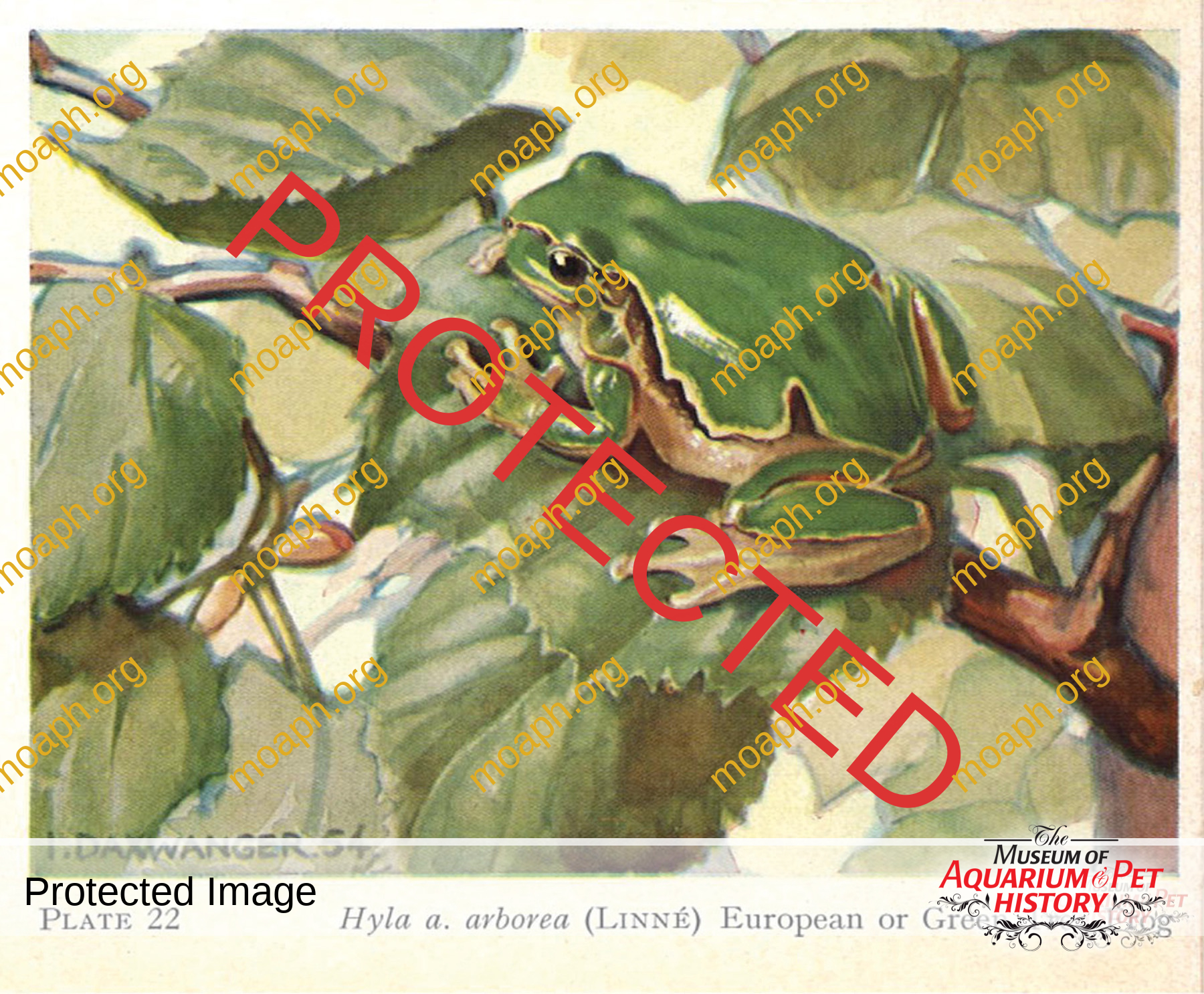
Hyla a. arborea (European Tree Frog) from Reptiles and Amphibians of Europe, written by Walter Hellmich, and illustrated by Irmgard Daxwanger.
Description:
This cute little frog, which is particularly recommended for the rare purity of the skin and its colors and its delicate build, measures about an inch and a half in body length. The upper body is green, the lower body yellowish white, and this is covered with small, raised warts, which are nothing other than glands that contain a caustic moisture: because if you catch a tree frog with your bare hands and touch your eyes without washing (which I have often encountered), the moisture that is expressed will bite you painfully for a long time.
Ideally, this creature has a green color of the body, but when the slimy skin is shed, the amphibian periodically becomes blackish or dark red-gray with white spots, and then yellow-green is distinguished from the lighter one by a light yellow stripe with a brownish edge of the abdomen separated. The males can be recognized by their yellowish throat, which expands into a round bubble when they scream, which is almost as big as their entire body.
Where They are Kept:
- In the Wild: In summer you can find these frogs on bushes, trees, grass, and crops. When the sun shines, they attach themselves to the lower side of the leaves. In autumn, they go into ponds and swamps and mate in them. This lasts until June when they then climb up the trees and bushes again. During this time of the year, you can hear the anxious cries of male frogs in the evening from half an hour from the swamps, where these animals mate in countless numbers. From a distance, it sounds like the rattling of bell sleighs.
- In Captivity: Homecare requires that you put them in the window in water glasses with a little ladder with little holes tied at the top with paper, so that the sun doesn’t shine on them, or you can put them in the clear knitted ones. Wire cages covered with moist turf or grass will also work. Both the water in glasses, as well as the turf and grass in the cages, must be renewed from time to time if these little animals are to be comfortable.
Food:
- In the Wild: Here they snatch flies and other insects from the leaves of trees, bushes, herbs, and grasses with the greatest speed.
- In Captivity: Here they are given a live fly from time to time. But they do not touch the dead easily. They also eat their shedded mucous membrane.
Reproduction:
The mating for these frogs often takes 3 days. The female, like all frog species, lays eggs. These turn into tadpoles, first with no feet, then later they grow feet and at the end, their tail falls off. This process creates a perfect little frog. It stays in the water until it matures and only then does it leave the tadpole and begin to climb trees and shrubs.
Recommended Properties:
Tree frogs can be used as a weather forecaster. He announces the changes in the weather a long time in advance, especially through the loud noise of their calling. He also goes into the water when it is raining or otherwise poor conditions and is restless in it, but when the weather is clear and dry he goes up onto the glass or the ladder. His croaking makes them a bit uncomfortable.
3. The Gray Lizard:
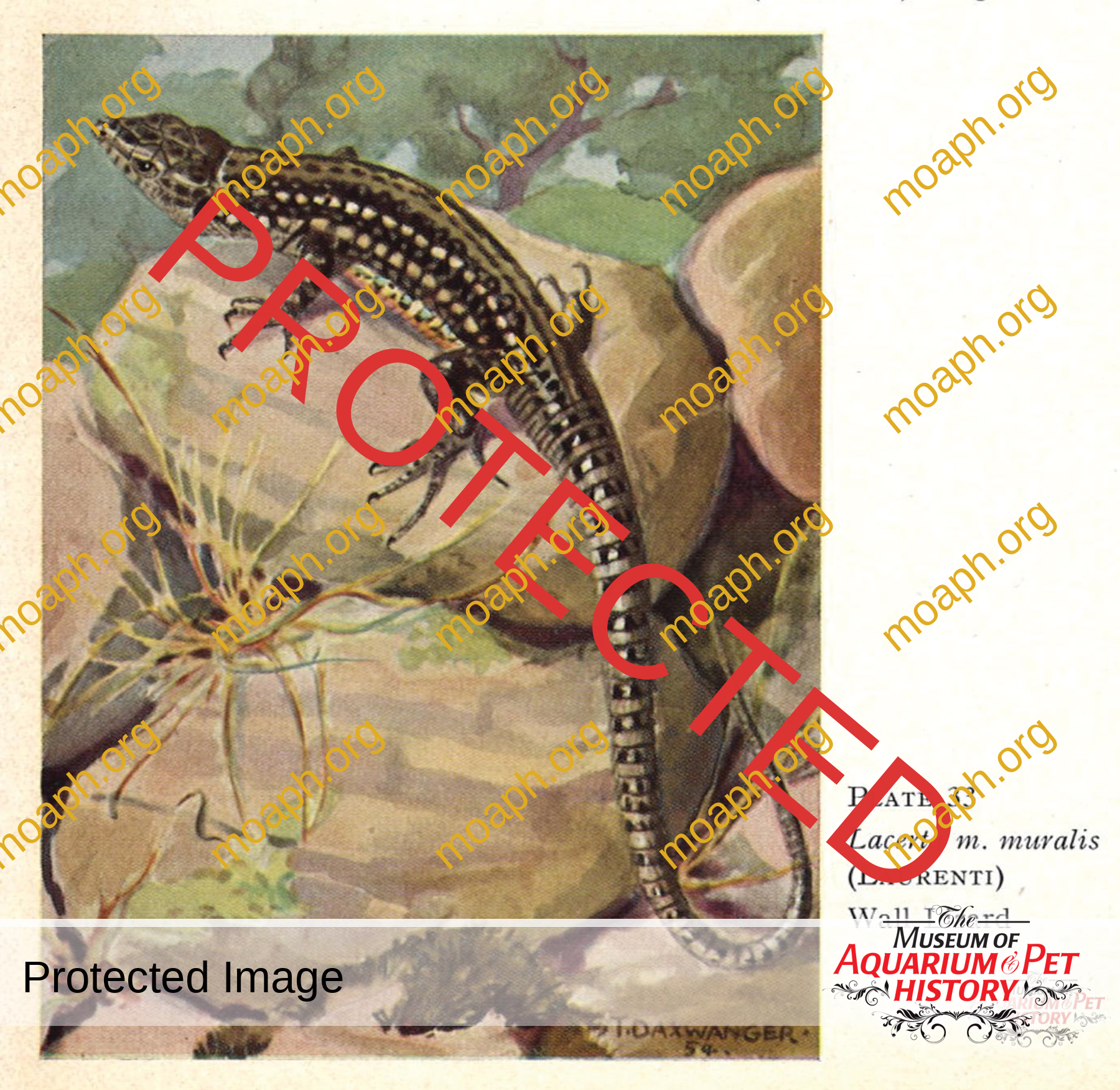
Lacerta m. muralis (wall lizard) from Reptiles and Amphibians of Europe, written by Walter Hellmich, and illustrated by Irmgard Daxwanger.
Description:
The gray lizard is a very well-known, agile, and beautifully drawn animal. It is found to be 5 to 6 inches tall, of which the tail takes up more than half of the body. The head is triangular, the signs on the belly are square, there are a number of calloused warts on the thick legs of the hind feet and the long tail is ringed and sharply scaled.
The male’s head is gray-brown, dark brown domed: the back is reddish-brown with a copper-colored sheen, crossed in the middle with a dark brown stripe spotted with white, and on each side with a similar stripe with white spots; the sides are a beautiful light green with a cold shine and these colors fade to yellowish on the belly. The tail is the color of the back and fades towards yellow-green towards the bottom.
The female is always fatter and the basic color is more reddish-gray, and only turns greenish-yellow or yellowish on the belly. The dark spots are like those of the male.
You have to be careful with these little animals so that you don’t injure their tails, which break off so easily. They also have great reproductive power, for if one cuts it off, a new one, although very imperfect, grows again. The feet are five-toed and have sharp nails.
Where They are Kept:
- In the Wild: These lizards inhabit almost all areas of Europe, including both India and the islands of the South Sea. They stay in forests and in gardens, walls, and rocks that lie in such areas. In summer they look for some cave under a bush, root, or stone, but in winter they go deeper into holes, especially in dense bushes and hedges, where there is a thick cover of leaves and grass above them.
- In Captivity: Here you can either let them run around freely if you put a box for them in a corner, in which you sometimes put a moist lawn, and you are sure that they do not come out the room door. But usually, they are put into a wide sugar jar, and put moss and earth into it.
Food:
- In the Wild: Here they eat flies, grasshoppers and other insects, worms, snails, small frogs, and other small lizards, even their own kind. They often lie in wait for the bees in the sunshine in front of the low trees.
- In Captivity: You can only give them one of the above foods to keep them going for a long time, even if you only give them a fly now and then, they are content because they can go hungry for a very long time. It is known that they sat in a sugar bowl without food for 6 months and were still cheerful. They snatch the insects with their pointed, bilingual tongues. Snuff is poison to them. They get convulsions and die.
Reproduction:
The female lays eight and several dirty white, dull-round eyes that glow in the dark for a while under the stones. The young, which are hatched by the warmth of the sun and contain only one egg in each egg, hatch in August and September and look green for two years and brown colored.
Recommended Properties:
The important thing now is that you get used to the sight of these animals, like all amphibians, you will certainly find them well-behaved and beautiful. Their exceptional liveliness, agility, and overall cheerful appearance are also very advantageous, they also are playful creatures. Therefore the ancients called them the friend of the man. In these animals, one can also admire nature’s great reproductive power, as entire limbs grow back, although imperfectly. It is also worth noting that this harmless little animal has the special ability to reveal the finest and most hidden poison of the animals in this class but dies with convulsion of the whole body if bitten by one.
4. The Green Lizard:
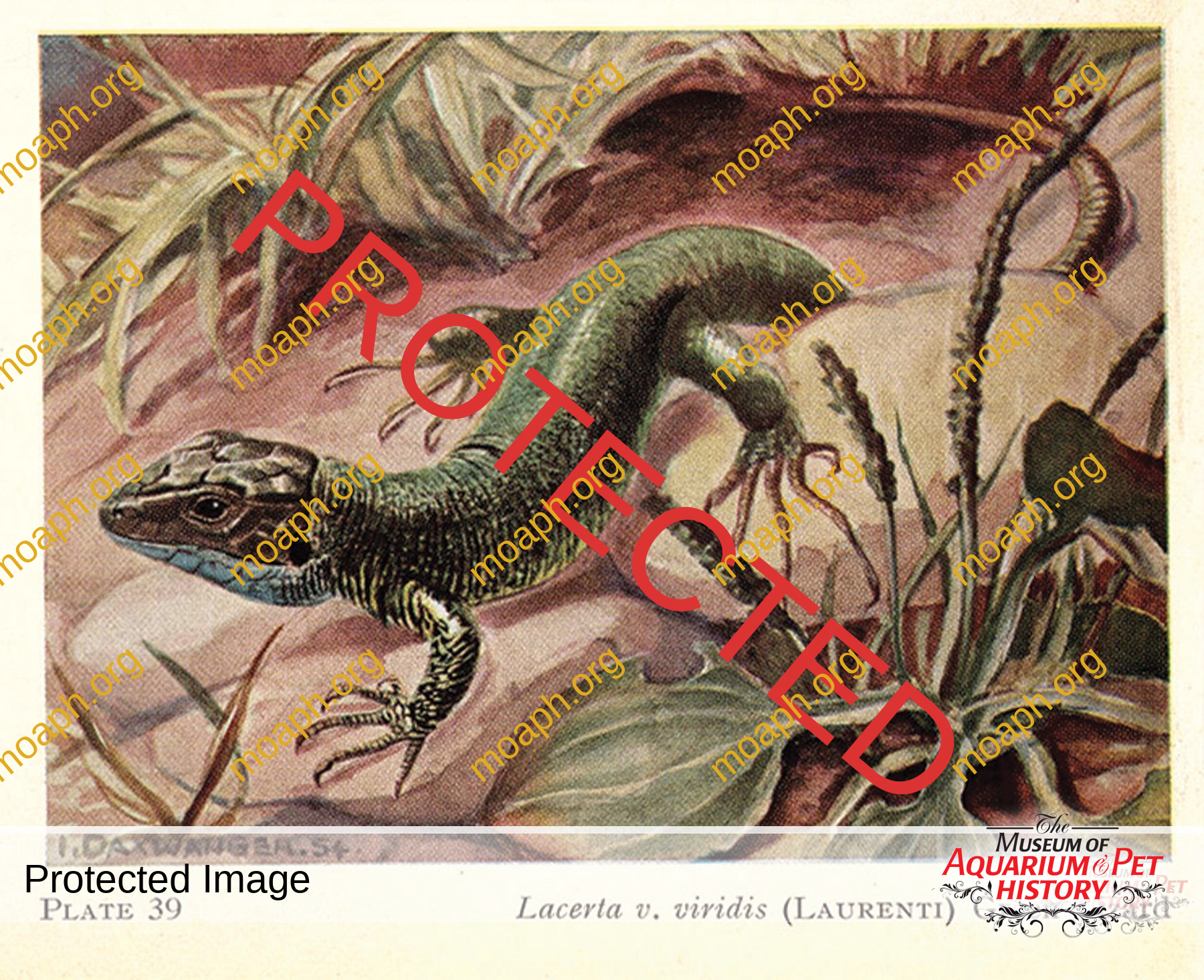
Lacerta v. viridis (green lizard) from Reptiles and Amphibians of Europe, written by Walter Hellmich, and illustrated by Irmgard Daxwanger.
Description:
This lizard is far larger and more beautiful than the previous one, but not as common. She lives in southern Europe, in France, Italy, Switzerland, Swabia, Brandenburg and Bohemia. It is 16-20 inches long, half of which is taken up by the tail. Because of its similar shape and color, it has often been confused with the previous one and falsely considered to be the same kind.
The male head is gray-brown green and yellowish mottled, the upper body is blue-green or verdigris-colored with black, indistinct spots and dots, which are most common towards the head, the lower body is green-yellow on the throat and chest, light yellow on the belly and under the tail.
The female’s head is spotted with greenish gray and reddish gray: the color of the upper body is light grass green with black dots: the abdomen is light yellow.
Strange Features:
In terms of lifestyle, this lizard is almost identical to the previous one. It feeds primarily on insects, flies, and grasshoppers, which it is very adept at catching. She soon becomes tame in the room and learns to play with children. If you put several together, they bite each other violently. They are no more poisonous than the previous species, and it is prejudice that some people say they are.
5. The Swamp Salamander:
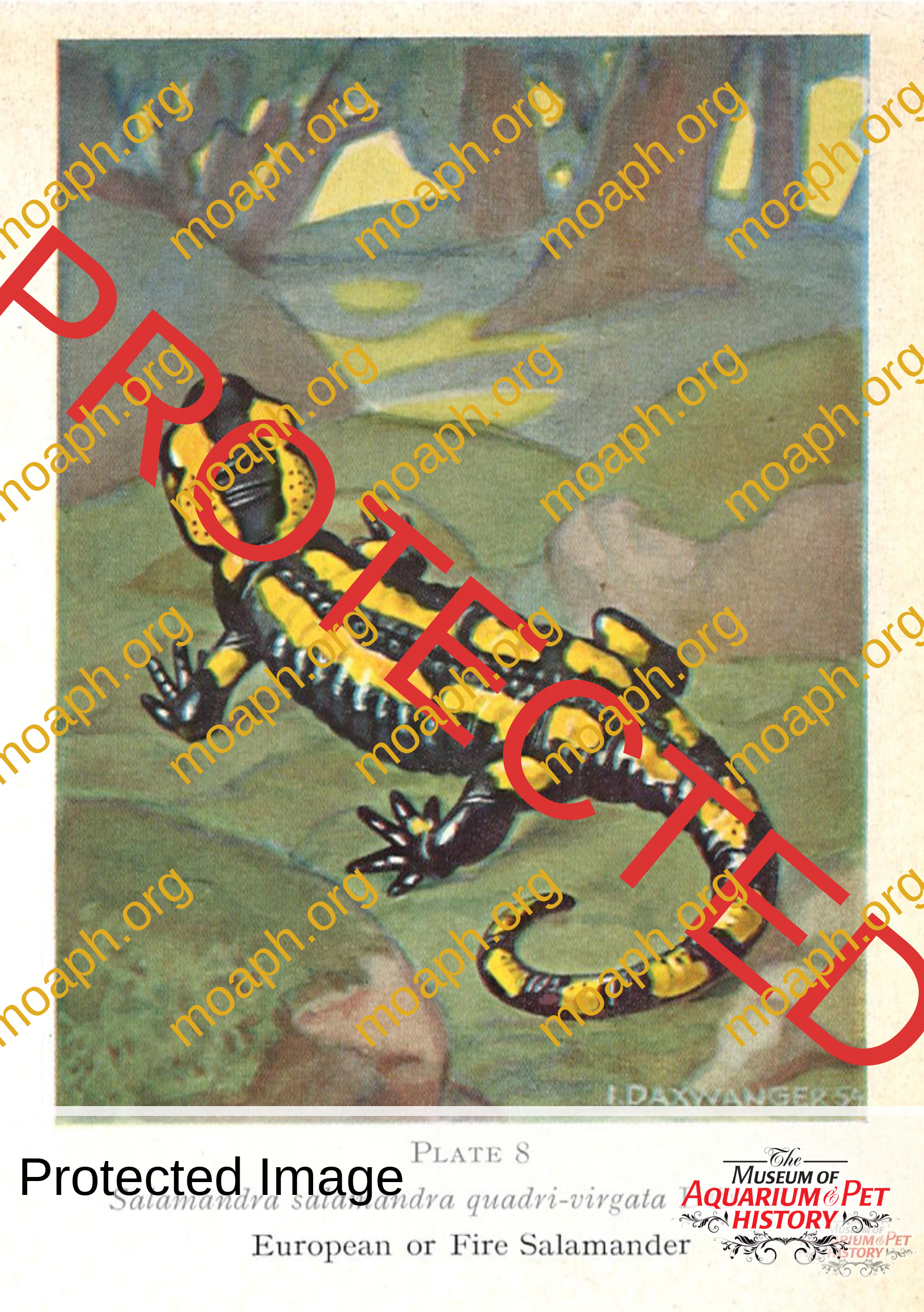
Salamandra salamandra (fire salamander) from Reptiles and Amphibians of Europe, written by Walter Hellmich, and illustrated by Irmgard Daxwanger.
Description:
The following three animals are not recommended for many people, even though they have beautiful markings, but they can easily be kept in a small glass container, which is often filled partly with fresh water, and into which a fly is sometimes thrown for food. One can then notice the reproductive power of these animals, as when one puts them in a large glass vessel, their graceful swings while swimming, and the flattery and caresses that males and females make to each other. Their mode of reproduction and their frequent molting, whereby they remove their mucous membrane from all parts like a shirt, also make them strange in the room to owners.
These animals are usually not well known; I would therefore like to describe them in a little more detail:
Male:
The length from the tip of the mouth to the tail end is 5 inches, and the tail measures almost 2 inches. The head is ½ inch long to the ears; flat at the top, bluntly rounded at the front, inflated at the cheeks; the round nostrils are far apart at the front: the eyes are large, the star is golden yellow, but is broken by a dark brown circle so that it appears to have two rings, the eye bone (eyebrows) is raised: the eyes are closer to the mouth between the eyes and ends on the hind feet: it is serrated in a saw-like manner, the deepest in the middle of the back, the finest at the end and in the neck, between the hind feet you can only feel the seam without skin, only with the tail the raised skin begins again, but is bluntly serrated, this skin floats everywhere and is put on straight away when the animal is not in the water, but looks nice when swimming (it falls off at the last molt when the animal goes out of the water again and in the spring again at the time of copulation)
The front feet have 4 toes with 2 pads and blunt tips, and the rear feet have 5 with the same pads. “Warts” and tips: the forelegs’ top toes are ¾ inch long, and the hind legs are almost 1 inch long. The entire upper body and sides are covered with small raised warts, the lower body has more fine seams and furrows. The upper body is dark olive green, blackish from a distance, with individual faded black spots, the sides are black from the lower jaw onwards, finely dotted with white, the lower body is orange-yellow, on the chest at the anus, and on the sides with large black spots of all over the body, the throat and soles of the feet are light yellow, the former widely, the tip half of the toes are also yellow, banded with black, otherwise the feet are like the upper body, the broad lance-shaped tail is swollen behind the tail. After a yellow spot, it is olive-brown above and below, on the sides of the root dotted with white, almost in the middle on both sides with a blueish white stripe, which becomes almost pure white towards the tip, and which is nice and light in the water, and how transparent it appears.
Female:
The female is almost a third larger, seven and a half inches long, the head somewhat thicker, and swollen, especially at the tip, the whole body thicker and plumper, especially in April and May when the belly contains eyes, the color of the back somewhat lighter, hence the black ones. The abdomen has more beautiful orange-yellow spots showing through and is marked with beautiful broad black spots of all kinds shapes and forms. This yellow color also continues uninterruptedly to the tip of the tail, the serrated dorsal skin is missing, and only the tail has a few flat notches, on the upper lance-shaped one. On its side, you don’t notice the blueish-white central stripe clearly, because it’s actually a diary dark ash gray mixed with the other colors, the bands on top of the toes are not visible everywhere, otherwise everything is the same.
Strange Features:
In April and May the females lay their eggs in the water in stagnant swamps and ponds. These eyes have a hard, jelly-like material that looks like glass, in which lies the white yolk, which is the size of a radish seed. When reproduction is over, the old ones, like the hedge frogs, leave the water again and can then be found in the hedges, bushes, and fields. In October they burrow into the ground in the fields and beds, but also crawl into the land, into hollow tree roots, etc, and stay here in hibernation until the sun lures them out to mate in the spring, where males and females then meet in the still water, fertilization occurs as with the frogs, outside the body by sprinkling the eyes with milky seed moisture.
The food of these animals is flies and all sorts of aquatic insects, and they do not harm the fish fry that they are accused of: they prefer to eat their fry rather than fish. In the spring when fishing in muddy ponds, especially in wooded areas, these animals can be caught in abundance.
6. Medium Water Salamander:
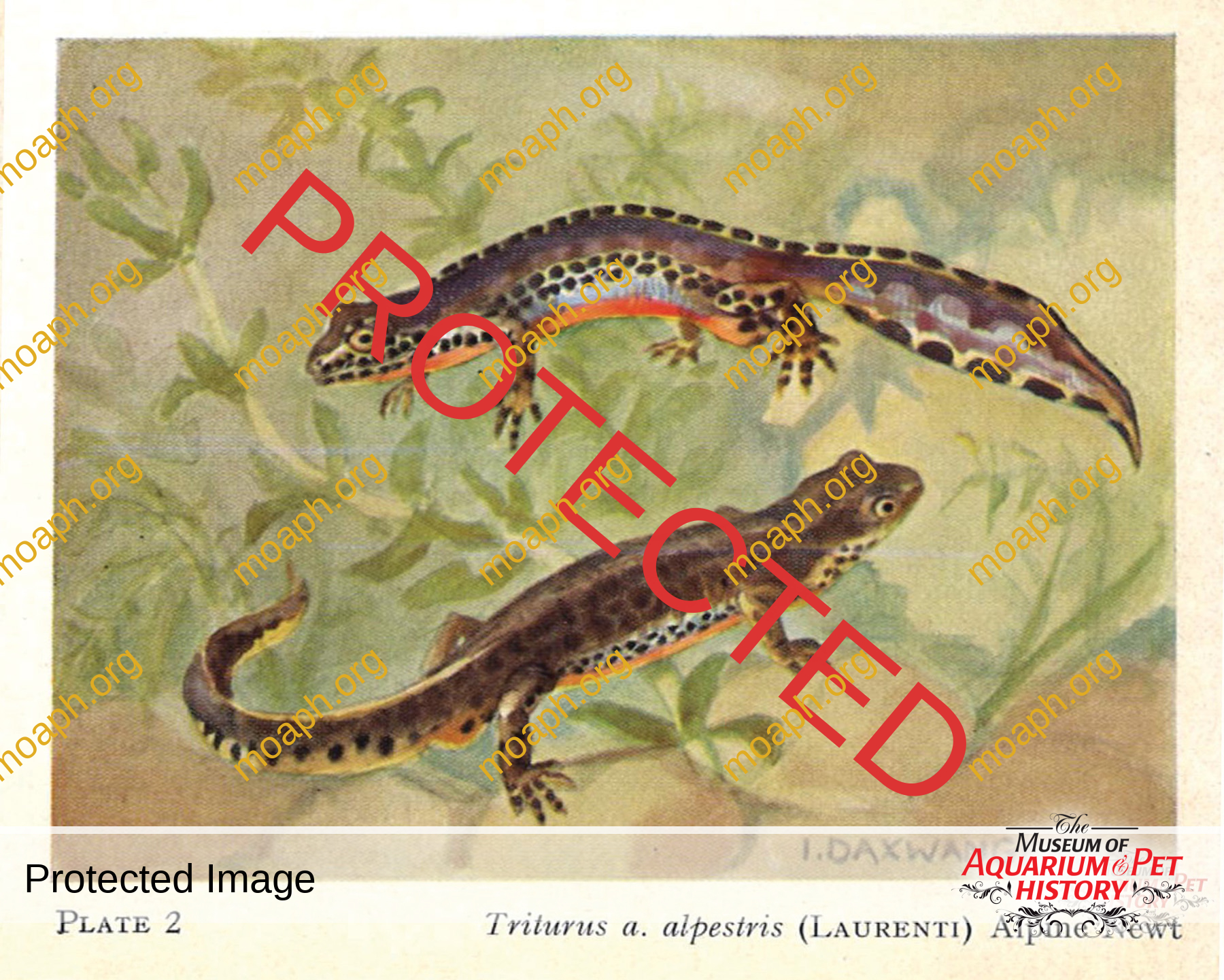
Triturus a. alpestris (alpine newt) from Reptiles and Amphibians of Europe, written by Walter Hellmich, and illustrated by Irmgard Daxwanger.
Description:
It is the most beautiful water salamander, far more beautiful than the previous one, with which it was otherwise probably confused. But it differs very clearly in that it only has a moderately long, broad, and blunt tail, its underbody is a solid orange-red, and it has a light blue stripe with nice black dots on the sides of its body, which is not so obvious on the female, and that all you can see on the male when he is in the water is a low toothless dorsal crest.
Male:
The male is 2 ½ inches, the head is 5mm, and the tail is 1 ½ inches. All parts are relatively thicker than those preceding and following otherwise the shape is the same. The upper abdomen is finely warty, but the abdomen is smooth. The eye star is golden yellow, the tail is very broad and lance-shaped, and the dorsal crest is at most a line high: the four-toed front feet are 16mm long, and the five-toed feet are 18mm. The dorsal crest is black and dotted with white, the upper body is light-colored, and a light sky-blue stripe runs along the sides of the body, which is dotted with many black dots that are in the anal area turn into black spots: these black dots are also noticed around the mouth area and eyes. The legs are grayish-blue with many black dots, dotted with black-yellow like the toes. The abdomen is a solid fire-colored or orange-red color. The tail has in all parts the color of the upper body, only more indistinct.
Female:
The female is only an inch longer and stronger in all parts. The back has a furrow and the tail is narrower. The color of the upper body is iron-gray, with dark spots on the sides, the light blue stripe finely fitted with black, the legs iron-gray above, yellow below, and like the toes, spotted dark brown: the abdomen orange. When these salamanders are out of the water they look blackish or dark brown on the upper body, but if you keep them dry in the spring they have a lighter complexion.
Strange Features:
This salamander can be found in the spring at the end of April and the beginning of May in stagnant water, especially in mountain areas in ponds that contain spring water, also in enclosed open walls and wells. Here you get it and put the male and female in a large sugar glass into which you put some fresh blades of grass. The female then places her eyes on the blades of grass and you can observe the reproduction in the room. These creatures are also very affectionate towards each other, and the male like all species of salamanders, constantly teases his tail and thereby caresses his female.
7. The Pond Salamander:
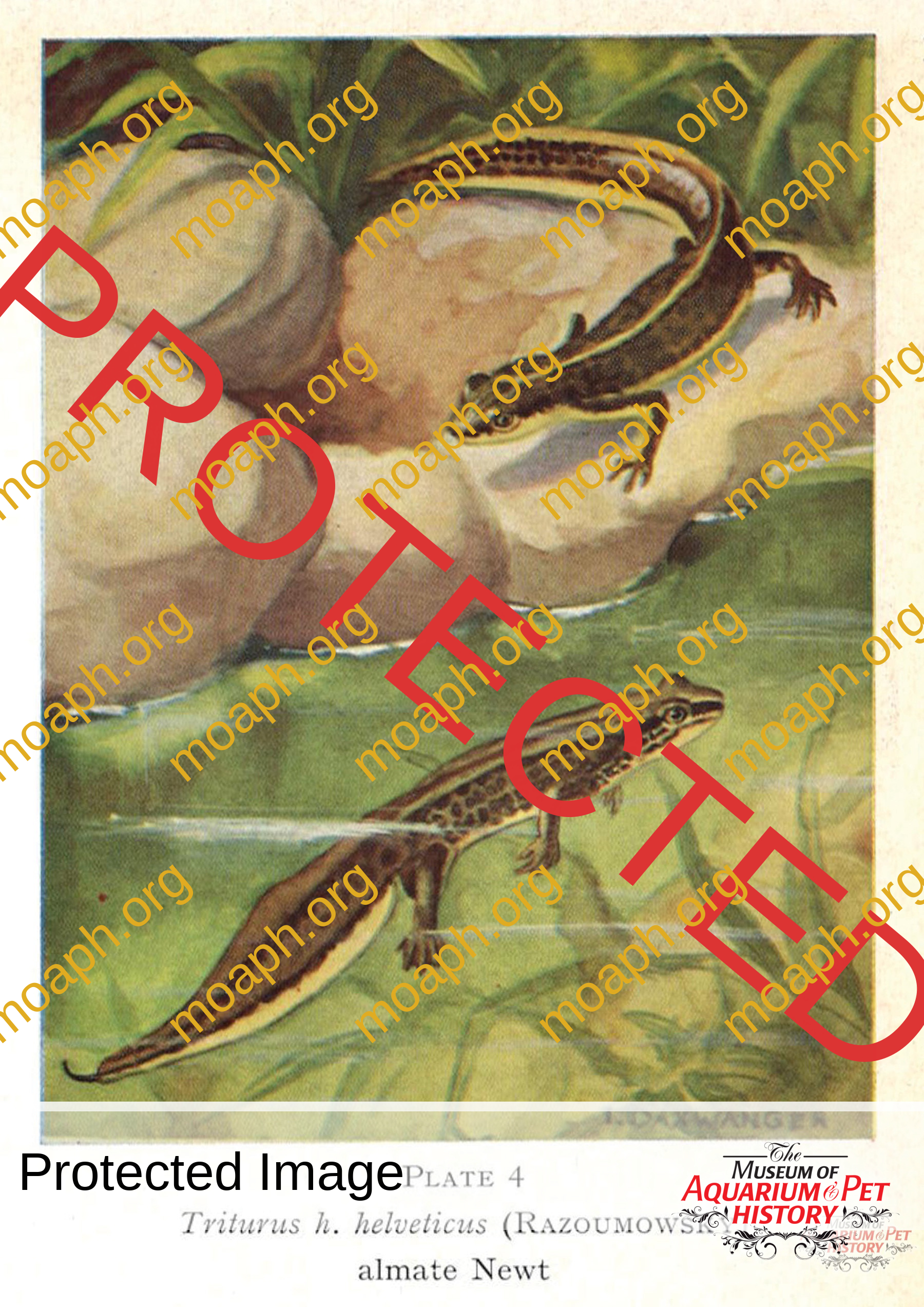
Triturus h. helveticus (almate newt) from Reptiles and Amphibians of Europe, written by Walter Hellmich, and illustrated by Irmgard Daxwanger.
Description:
This is the smallest and thinnest water salamander which is found in very large numbers in all ponds and other stagnant waters. Forest ponds are teeming with them in spring.
Males and females are with each other, which is why the latter has been given the name of a special species under the name earth and garden salamander or common lizard. The length is 2 ½ inches, the body is slim, the head is triangular, the tail is lance-shaped and rounded on the female, the skin is smooth.
Male:
The male has a membrane crest that starts from the neck, runs to the tip of the tail, and is bluntly serrated, it gets higher and higher and is at most in front of the middle of the tail. The upper body is sometimes olive green, olive brown, or greenish gray with large and small black spots in 3 to 4 rows; Six blackish stripes run down the sides of the head to behind the crown; the sides of the abdomen are light yellow, a stripe through the middle of the abdomen is yolk-yellow, a stripe through the middle of the abdomen is yolk-yellow, both covered with round black spots, above the legs are like the back, and below yellowish white, spotted with black as if banded.
Female:
The female is slightly thicker in the abdominal area: the tail is rounded, in the water only with a skin edge at the top and bottom, which makes it somewhat lance-shaped, the upper body is olive green, yellow-gray, green-gray and grayish-yellow, on the sides of the head there are two dark brown stripes, and on both sides of the one runs down the back to the tip of the tail; usually the upper body is sprinkled with darker atoms, which differ little from the ground color: the lower body is white yellow with a light yellow stripe running down above like the upper body and below like the lower body.
Strange Features:
After reproduction, the male loses the skin on his back and both mates leave their larvae in the water and go to land. After rainy weather, you often find them in gardens, especially where it is damp and somewhat gloomy.
In April, with the first warm rain, I often saw many thousands of these animals running out of the forest, several hundred steps from the water, towards the ponds. You must have your own sensation to notice the area of the water. Because when I turned such travelers around and tried to force them to run to the opposite side, they quickly turned around again and finally became angry if I upset them too much.
In spring you can take them out of the water and put them in a sugar glass. The female soon lays eggs and clamps them between a bent blade of grass, to which she attaches the surrounding jelly. Even when unfertilized, the female releases her eggs in May. After 14 days, the fertilized ones become small larvae with fish-like gill feet.
In winter they bury themselves under the leaves and in the ground. When you dig up the beds in water-rich areas you find many who had hidden here over the winter.
These and the previous water salamanders are also fed flies and other small insects. You have to give them fresh water often, otherwise, they will die in the smelly water.
B: Creeping Amphibians
1. The Grass Snake:
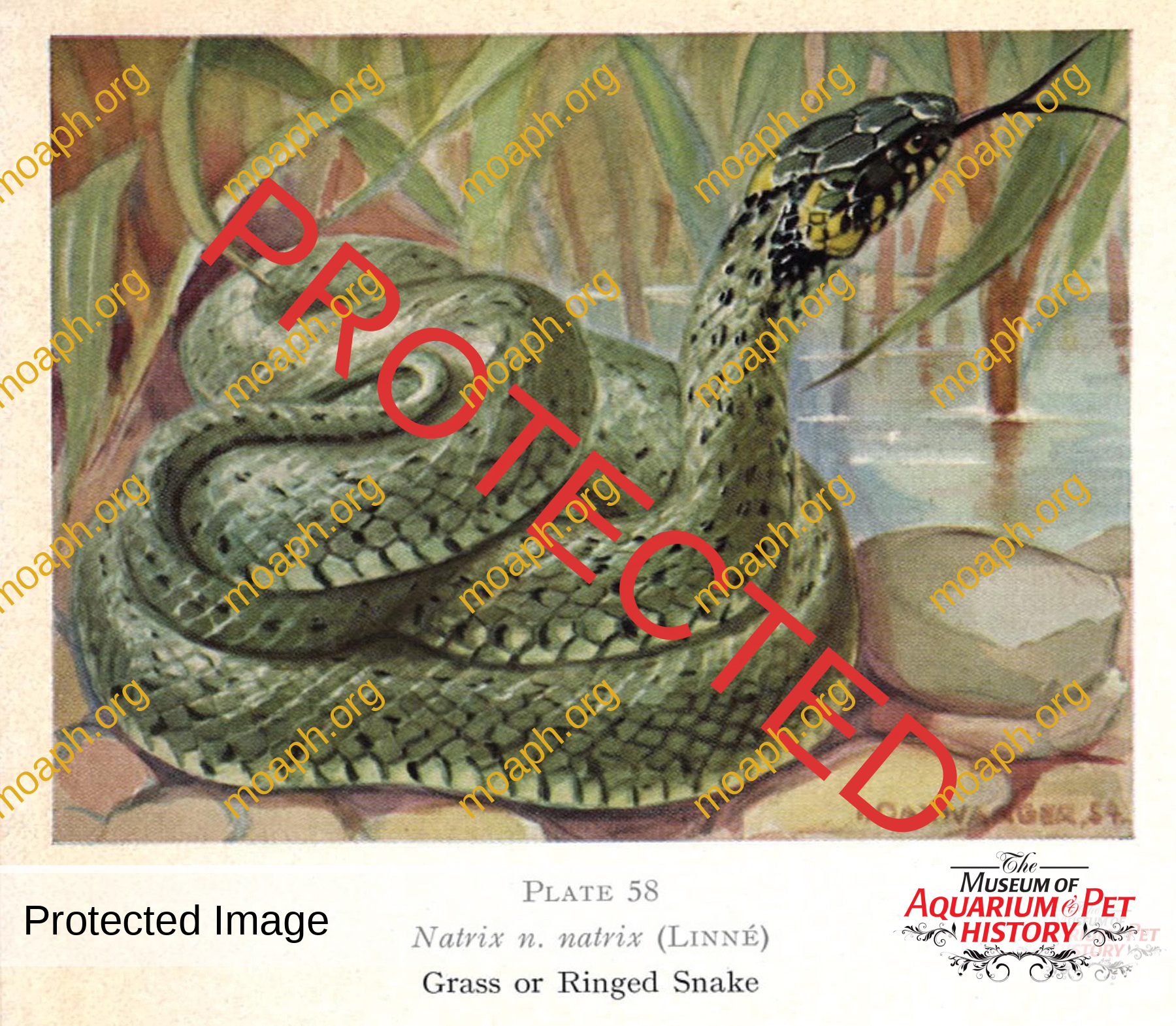
Natrix n. natrix (grass snake) from Reptiles and Amphibians of Europe, written by Walter Hellmich, and illustrated by Irmgard Daxwanger.
Description:
This is the most common domestic species of snake and is quite harmless. That’s why you often see street performers going around with them in their mouths making them do all sorts of tricks pretending that it is a poisonous snake, but that they can banish it so that it doesn’t do any harm. I have encountered them 4 feet long and over. The female is also always larger and fatter than the male. It usually has 170 broad abdominal plates and 60 lower caudal scales, but the number is not exactly accurate. The upper body is green-blue, iron-gray, or rust-gray, mottled white on the sides, and has individual blackish dots, the lower body is black and white on the sides and also under the belly so that it looks black striped. On both sides of the neck, there is a yellow spot in the male and a yellowish-white spot in the female in the form of a collar or neck ring, hence the name.
Where They are Kept:
- In the Wild: In the open they can be found both on the highest mountains and in the deepest valleys, in the forest as well as in the swampiest places. They swim around in the water every day, on the banks of ponds and rivers. Usually, they look for shady places because they like the warmth of the sun, especially when they shed. They also like to stay in stables, cellars, and manure areas.
- In Captivity: They are allowed to move around and a box with wheat seeds is placed in a corner for them to go to sleep in.
Food:
- In the Wild: toads, frogs, lizards, snails, mice, worms, etc, make up their diet, I have often cut open one that had a frog choked down, and the frog would hop away again.
- In Captivity: The grass snake lays its gray-white membranous eggs, which are strung together like pearls, in dung beds, dung heaps, manure sites, in damp places in stables, etc. The male and female smell unpleasant at the time of copulation, some say smelly, but I can’t call it that; it has its own sweet smell. Each egg contains a young one that is as long as a finger when it emerges and looks cute.
Where to Find Them:
You can catch them anywhere, especially when they are young, where they look most beautiful, in dung beds, especially those piles of dung that are raked up in gardens and meadows in the spring. Here you can often find hundreds of them.
Recommended Properties:
Certainly, the most darling little animals can be trained to dance to a stick and a whistle. To play dead such as leaning on their abdomens.
My friend llr. D. Vognetz has bred a grass snake so that it walks up and down the room like a house bird, often sneaks up on him, crawls up his arm, and into his breast. But it doesn’t easily go to anyone other than him. He puts it in his pocket, goes with her in the cart, lets her go, and as soon as he whistles loudly, which sounds similar to the one with which both sexes call each other at mating time, she comes to him and crawls up on him, slips into his pocket and stays there without moving until he takes it out.
This is probably the snake of which Mudam Du Noyer assures that a parliamentary councilor in Dijon made it so tame and so beloved of her that she even gave her breasts as a place to rest. When prompted by a certain sign the snake came quickly to fulfill this enviable request, but just as modestly it moved away again as soon as its mistress gave it the specific signal to leave.
In Sardinia, the young ladies like to raise them and take great pleasure in feeding them. They wrap themselves around the neck and arm in a certain way and lick the saliva from their mouths.
They can starve themselves for long periods, but they can also grow extremely slowly.