Pet Keeping in 1797 Germany – Chapter 5

This is a historical book written in 1797 about German pet keeping history, including keeping native fish in captivity. This reprint was privately published and edited by Kurt Jacobs, who wrote the seminal work “Livebearing Aquarium Fishes.”
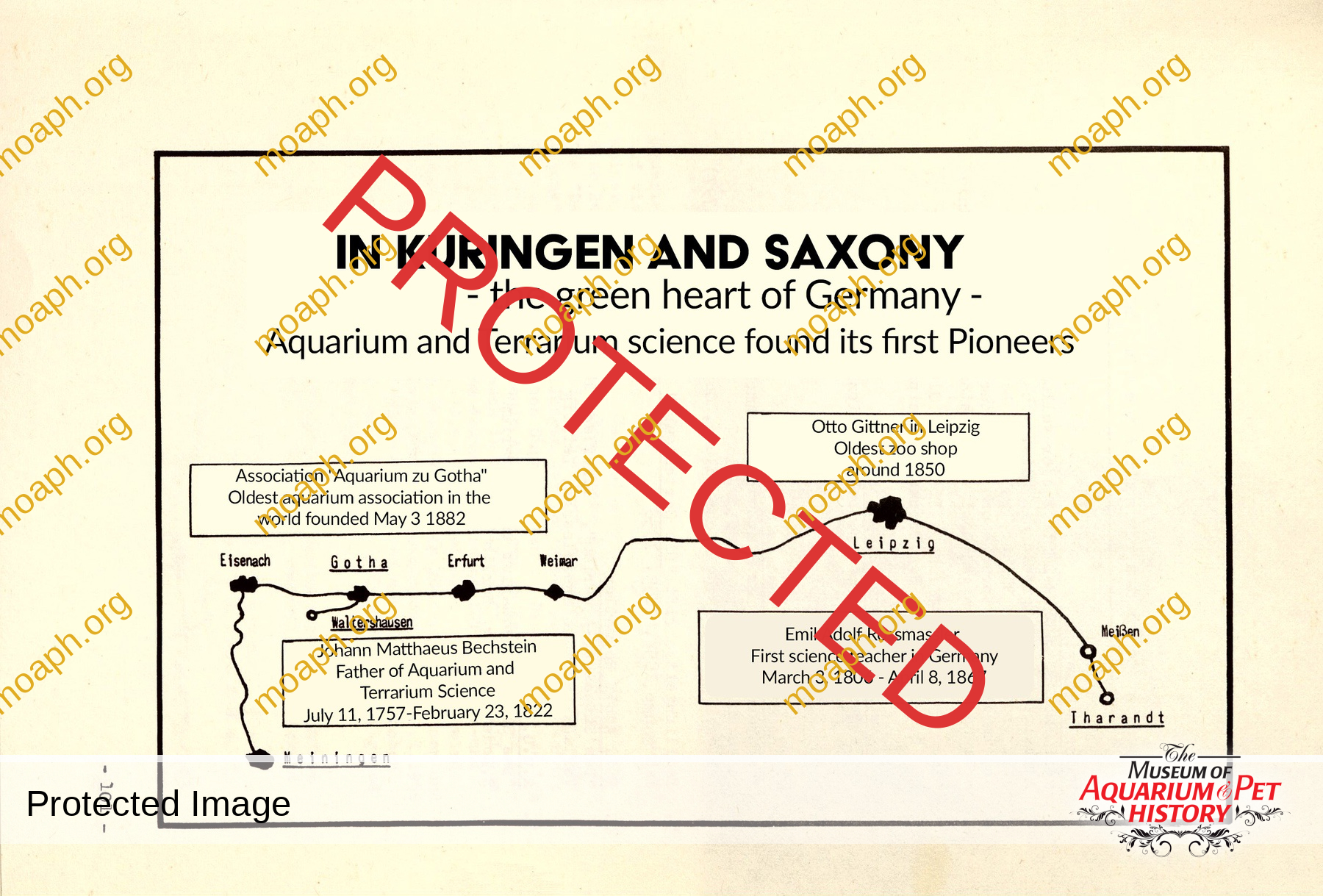
Johann Matthew Bechstein is sometimes called the “father of aquarium and terrarium study.” He was born in 1757 and died in 1822, and during his life he was a pioneer on the front of knowledge in terrariums and aquariums. Closely following in his footsteps was Emil Adolf Rossmassler, who was born in 1806 and died in 1867. Kurt Jacobs wrote this book in 1964, following the origins of terrarium and aquarium science, with a special focus on the lives of these two extraordinary people.
We have hoped to translate this book for several years, but being that it was written in “old-style German,” it was very difficult. MOAPH was fortunate to find our friend Alex, who grew up speaking both German and English in the United States. Alex has translated a small portion of this important book each month.
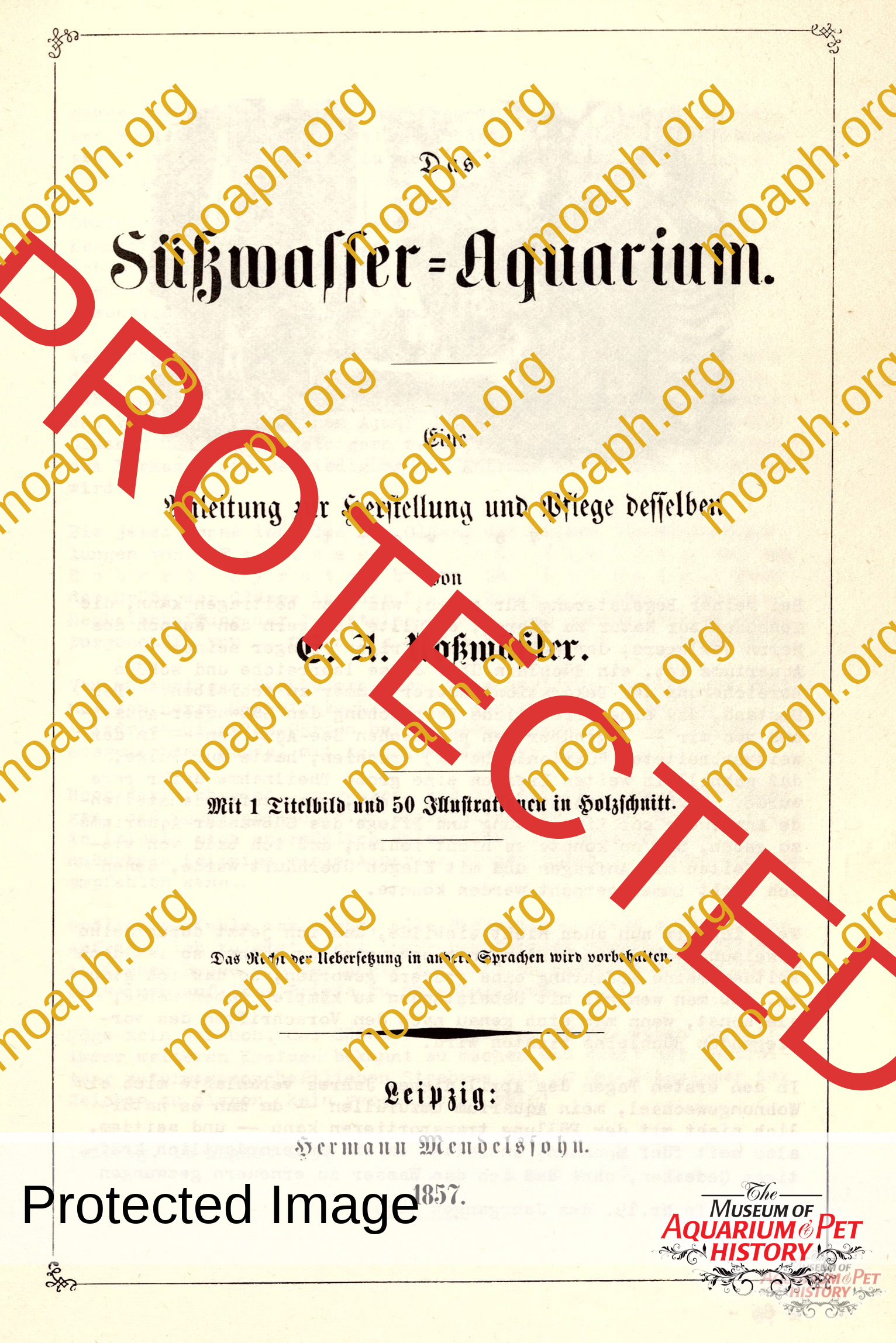
The Freshwater Aquarium
by Emil Adolf Rossmassler
Preface:
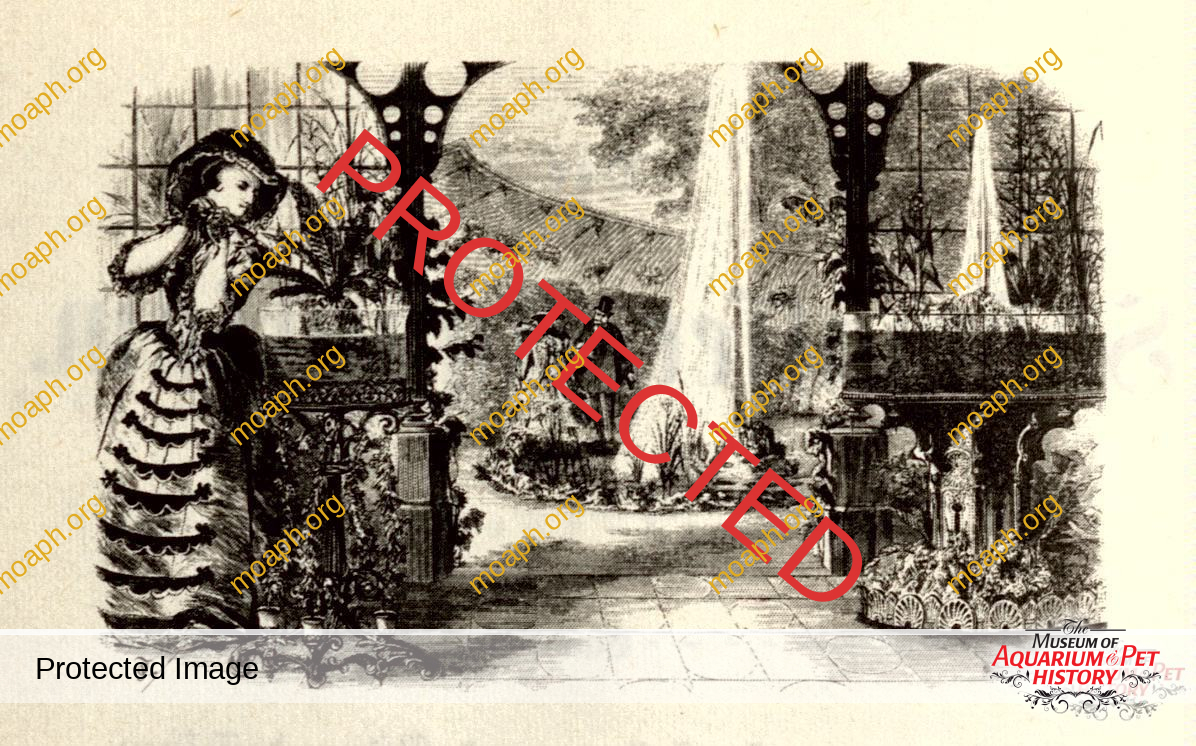
Given my enthusiasm for everything that can help lead people to nature, I was happy to fulfill the wish of the publisher, who himself is a keen keeper of his aquarium, to write a little book about this instructive and beautiful addition to the decoration of our rooms. The fact that a public discussion of my freshwater aquarium – compared to the English sea aquariums – appeared in the widespread ‘Gartenlaube1’ meant that there was quickly a great deal of interest in it. At that time I was not yet able to give completely satisfactory instructions on how to set up and care for the freshwater aquarium, and so it was inevitable that I was soon overwhelmed with inquiries and complaints from many places, which I was not always able to do justice to.
Even if I do not imagine that I can now prevent every failure through my instructions, my experience has become greater since then, so that I believe that you will have less to struggle with than usual if you follow the instructions in this book exactly.
In the first days of April this year, a change of residence left me to refill my aquarium – since of course you can’t transport it with the filling – and since then, five months later, it has developed an extraordinarily strong growth without being forced to empty the water. Several of my friends are in the same favorable situation, so the assertion I sometimes hear that freshwater aquariums cause too much trouble and annoyance is completely without reason.
Although I do not assume that expert naturalists will take advantage of this little book, I am saying here that the freshwater aquarium offers the most desirable opportunity for breeding and observing many beautiful and unique animals and plants.
If only the glassworks and iron foundries were more willing to produce a larger selection of glass and tables! I hope that my hard work will increase the desire for an aquarium and thus the demand for glasses and tables, whereupon the request will then be satisfied according to the law of traffic2.
So far I only know the glass-makers from the two glassware shops of Fritzsche & Breiter and Robert Syrukschok in Leipzig. According to them, the price is 2 ¼ to 5 Thalers. Georg Schreiber’s agency in Leipzig is primarily responsible for the procurement of the tuff stones3.
Of the foreign sellers of finished aquariums, I currently only know Mr. Magistrat Gartner Werker in the Friedrich-Wilhelms-Garten near Magdeburg, who also has an extensive trade in aquarium plants.
I must not forget that from the beginning of my efforts to introduce freshwater aquariums, Mr. Otto Gittner in Leipzig supported me tirelessly and has since set up many aquariums in and outside of Leipzig, for this, I recommend him.
Finally, I ask all those whose written inquiries I have not always been able to answer recently to look for the requested information in this book. I apologize for my silence in response to your letters.
May my attempt to make the nature of the freshwater aquarium known to the ever growing public and thus serve to spread scientific endeavors into the living rooms of the rich not be in vain!
Leipzig, in August 1857
-E.A Rossmassler
1. History of the Freshwater Aquariums
My kind readers should not spend more than a minute laughing at this lofty headline, because I hasten to tell them that my intention is to point out the failures of the naturalists, and therefore myself as well. It took a great power to drive the small, modest freshwater aquarium out of the naturalist’s corner of study, where it had long lain hidden as a gem, and to quickly develop it into the free-market . Who doesn’t know this power: the competitive desire for and preservation of scientific knowledge? Who does not rejoice in this external power, which is called to make our outer life comfortable and to disperse the black clouds of confessional ambivalence as a pleasant thunderstorm and let the deep blue sky of natural knowledge shine over the whole world? Who doesn’t know this power that is called upon to make our external lives comfortable for some, as a benevolent thunderstorm, to gradually divide the black clouds of confessional discord and the deep blue sky of natural knowledge over everyone to let the world shine. It is this power and no other to which we owe the friendly adornment of our rooms and a source of noble enjoyment in the aquarium.
MOAPH: Rossmassler was well known as an author who used flowery language and wrote very metaphorically, therefore when translated to English can be rather difficult to understand. The title, ‘History of Freshwater Aquariums’ is meant to subtly suggest that naturalists and researchers in the field have failed to properly promote and develop aquariums and therefore are the reason they are so unknown to the public. Rossmassler is using this paragraph as a sort of shot to the scientific community for their secrecy and his own failures. In the second half of the paragraph, Rossmassler dives into this ‘power’ which is his never-ending quest to learn as much about aquarium science as he can. He highlights this by saying the ‘rejoice’ he feels when he acquires this new knowledge. The ‘black clouds of confessional ambivalence’ is most-likely referring to the clash between religion and science that existed in Germany during this time. Rossmassler is hopeful in mentioning that he aims to bridge this gap through the metaphor of a ‘benevolent thunderstorm’ that will dispel ignorance and conflict, as thunderstorms in nature can be known to clear harsh conditions.
Men like Swammerdam, Loewenhoek, Reaumur, Schaffer, Trembley, whose names stand on decaying tombstones but in indelible splendor on the tables of science, are the ones we call the first inventors, albeit the unintentional creators of our aquariums.
All true researchers, for whom it is not merely about preserving dried mummies of plants and animals to study their external characteristics, but for whom life is the main focus — all have, since the earliest times of natural inquiry, been captivated by the life to be explored in their immediate vicinity, tethering it to their work tables, in order to be able to eavesdrop on its transformations and manifestations daily and hourly, time and time again. All the pots and flasks and dishes and sockets that had disappeared from the kitchen and pantry, meant to be makeshift storage for holding life, were discovered by the housewife, who had been wrongly blamed for them, in her husbands study room, filled with all sorts of creatures and mysterious water plants.
These are the seeds of creation for our current aquariums. Now they have grown, like the grains of wheat that had rested for thousands of years in the tombs of the pharaohs, the invigorating breath of the natural urge of our days overcame them4.
But no, I don’t want to blame the natural scientists for not developing them earlier, because they weren’t allowed to and couldn’t come sooner until they were in harmony with the times. This is only the case now.
But now my chapter with the pompous heading is already over. Because it would deserve more than the reader’s smile, I now want to take a broader look at who might have had the idea of the aquarium first and who had first developed it.
2. The Different Types of Aquariums
You don’t think it’s an unnecessary quibble if I first justify retaining the Latin word aquarium; because, on the other hand, it is possible to be prudent and educative enough to find a suitable German name here too, which would briefly and succinctly describe the thing in one word in a good and melodious way. ‘Die See im Glass’ (The Lake in the Glass), as I was persuaded to call the aquarium in my previous article in the ‘Gartenlaube’ (Gazebo), has, as I foresaw, not found an entrance for too long. A literal Germanization of the word ‘aquarium’ would be ‘Wasserrei’(Place of Water), which would sound far too much likea coined word of Joachim Heinrich Campe, ‘Bucherei’ (Place of Books) which has not yet managed to drive the foreign word ‘library’ out of Germany. Should ‘Wasserei’ unexpectedly find favor and acceptance, then it will soon become ‘usus’5as well, but ‘usus’ cannot be forced or coerced.
That’s why we leave it at the aquarium. The world’s acceptability lies precisely in the breadth of its meaning and in its novelty and strangeness alongside the novelty of the thing itself. If the world language longed for by every friend of the homeland is to be attainable, it can only come about through natural development, through the merging of the dominant language tribes into one another.
But enough of the erudition!
I refrain from mentioning seawater aquariums in the following because I have no experience of them and because I do not believe that it will ever be possible to produce them other than at great expense deep inland.
But freshwater or, for example, pond aquariums can also be set up in many different ways, at least in terms of their size and the resulting choice of shape and material of the tanks.
The most popular and so far at least almost exclusively in use are the ‘goblet aquariums’, as I will call them for the sake of brevity, which consist of a large, wide, goblet-like glass vessel.
This is followed by the ‘box aquariums’, which are composed of glass panels in a cast-iron rafter system.
The third type is the ‘basin aquarium’. They can only be installed in greenhouses and are formed through a brick-built basin lined with a clay base.
Before we go through these three forms of aquarium and the considerations involved in making them, I would like to say a few general things first.
3. What is an Aquarium and What Does it Do?
Although my article “Der See im Glase” in the widely read ‘Gartenlaube’ seems to have made the aquarium known to everyone far and wide, some readers of this little book may have heard their first news of it in it, and the following lines are mostly written for such readers.
An aquarium is a friendly room decoration and at the same time an ever-living source of educational entertainment, by bringing together aquatic plants and animals to live in harmony with their keepers. What it is meant to do is thus expressed at the same time, and it only needs to be added that it is a not insignificant step on the way to a thorough observation of the nature around us. A means of drawing attention to those aspects of natural life that are usually ignored except by naturalists; a remedy against the childish shyness of ignorance; with which things are avoided that are not only not detestable, but that are also not worthy of being looked at.
What nature hides at the bottom of the ponds and swamps and on their edges, which are inaccessible to those who are afraid of water, remains an eternal secret for most people, with the exception of the fish and crabs that are brought to the lunch table. Apart from our garden flowers and field crops, we usually only know the plant kingdom as a large, green, colorful mass of flowers, and of the animal kingdom, apart from the well-known four-legged and feathered representatives, we only know that which crawls and runs across our paths and — let’s just admit it to ourselves – we know only what is drawn in books than in reality.
The fact that it is like this – and it is like this – is a shame, or at least a deplorable mistake that is less a burden on the individual than on the whole. This is not the place to examine whether an inaccurate and unintentional imitation of knowledge on nature is being taught to our young people, it already is the case.
But to be completely fair, I have to admit that the alleged situation is an injustice or a mistake – both of which are greatly mitigated by the fact that we as a whole, perhaps with only very few exceptions, are still very stupid in the art of teaching young people science. Of course, in order to agree with me on this point, you have to agree with me that knowledge of the nature around us must be the basis of teaching.
If I am perhaps blamed for bringing together things that are not connected here, I can successfully defend myself by saying: I understand the aquarium from its most basic purpose, which will be just as clear to me as it would be to anyone else. I just want to enjoy it.
4. General rules for the aquarium
I should actually talk more about laws, because there are some basic laws of animal and plant life to be observed if you don’t want to lose money and cause frustration.
It is one of the most important and at the same time the most interesting basic laws of nature that there is a striking interrelationship between two basic conditions of animal and plant life. The animal continually takes in oxygen through respiration as an indispensable condition for life and in return releases carbon through exhalation – in the form of which it absorbs carbonic acid and exhales oxygen. So one provides the other with an indispensable need that it can no longer use for life itself, one serves the other.
But the carbonic acid exhaled by the animal is itself a deadly poison, which makes it breathless in the air and the water by the gills. Therefore, it must be ensured that it is removed from the water in the aquarium. This is done by the plants growing in it, for which carbonic acid is a necessary food.
But they [the animals] can only obtain it [oxygen] through the air mixed with the water (known to be a mixture of oxygen and nitrogen). Thus, in the small, stagnant water volume of the aquarium, the supply of air and therefore of available oxygen for the animals is naturally soon exhausted because the absorption of air by the water surface undoubtedly occurs more slowly than the consumption of oxygen by the animals living below it6. Plants that always remain below the surface of the water with their green stems and leaves, or at least float on it, must provide the animals with a constant source of oxygen. On some such aquatic plants, the green parts below the water level are often covered with fine air beads that flow together to form larger ones, which consist of oxygen.
The animals not only make the water unsafe for themselves through the carbon dioxide they exhale, but also through their sputum and through other things such as stripped skin, which rots in the water together with the dead plant parts and thereby also develops carbonic acid, hydrocarbon gas, hydrogen phosphide gas and hydrogen sulfide gas. All types of air that are dangerous to animal life.
From this information, we can easily guess that in the aquarium one should first of all take care to bring animals and the plants that vegetate under the water together in such a relationship that they create prosperous living conditions for each other and keep the harmful substances out.
The greatest danger to the prosperity of an aquarium lies in the ‘spoilage of the water’ due to the rotting of dead animals in it. This ruin sometimes occurs very quickly and is manifested by a clouding of the water, which is then followed very quickly by a foul smell and then the death of all animals.
Another disadvantage is that one has to prevent a high level of ‘heating’ of the water, and yet the access of sunshine is still necessary at least to some extent in order to increase the energy of the plants’ vital activity, which partly occurs in the excretion of oxygen gas, partly based on the absorption of decaying substances.
Therefore, special attention must be paid to the ‘purposeful and dimensional installation of the aquarium’. It is essential to avoid the cold mid-day situation, especially in the months where the sun is already lower at mid-day and still seems very warm. If this age is unavoidable, the aquarium must protrude at least one foot from the window sill and be protected by a blind in hot sunshine. If you find the water warmed by more than 16 R7, you can remedy this either by partially replacing it with fresh well water, or by applying a wet woolen cloth tightly to the entire outer surface of the aquarium, the continued evaporation of which creates cold temperatures. Preservation of moisture is achieved by placing the cloth over the edge of the aquarium into the water, which causes water to continually rise up and down the surface of the cloth.
There must be rollers at the feet of the aquarium table so that, if necessary, it can be rolled from a star that is too hot to another place. That’s why corner rooms with multiple windows receiving sunlight are particularly suitable for setting up the aquarium.
I can’t decide in advance which ‘water’ is appropriate, whether soft or hard, as I have been using only well water for almost two years now and with the best success, very pure and fresh. Some experiences made by others seem to speak against the choice of river or stream water, because in aquariums with such water the lower algae take over in a very annoying way.
Before we move on to some special rules for the aquarium, I will now include a list and a brief description of the plants and animals that are required or at least useful, because we have to know these first before we can start filling in the aquarium.
Author’s note:
Rossmassler begins the actual main part of his book with the chapter 5 on “The Plants of the Aquarium” that follows in the original edition. Pages 8 to 28 contain descriptions of exclusively aquatic plants, while pages 28-52 are dedicated to swamp plants. Rossmassler covers the botany of the aquarium on a total of 45 pages! In this documentation we skip this purely botanical section and continue with chapter 9, “The Animals of the Aquarium”.
– Kurt Jacobs.
9. The Animals of the Aquarium
The Goldfish are the ‘staple’ of this chapter. They are from China and are the first foreign fish introduced to us.
Yet, even if the goldfish (Cyprinus auratus, thus a close relative of our carp, Cyprinus carpio) always maintains its status as a ‘Mandarin’ in its state attire alongside the simple attire of our indigenous fish, the latter remain our compatriots.
But almost every class of animal contributes to enriching our aquariums, for instance, one can even make the ‘water shrewd’ at home if one does not shy away from the trouble of the necessary precautions against escape. I list the animals of the aquarium one by one, starting from the lowest and ending with those which stand highest on the steps of the animal kingdom.
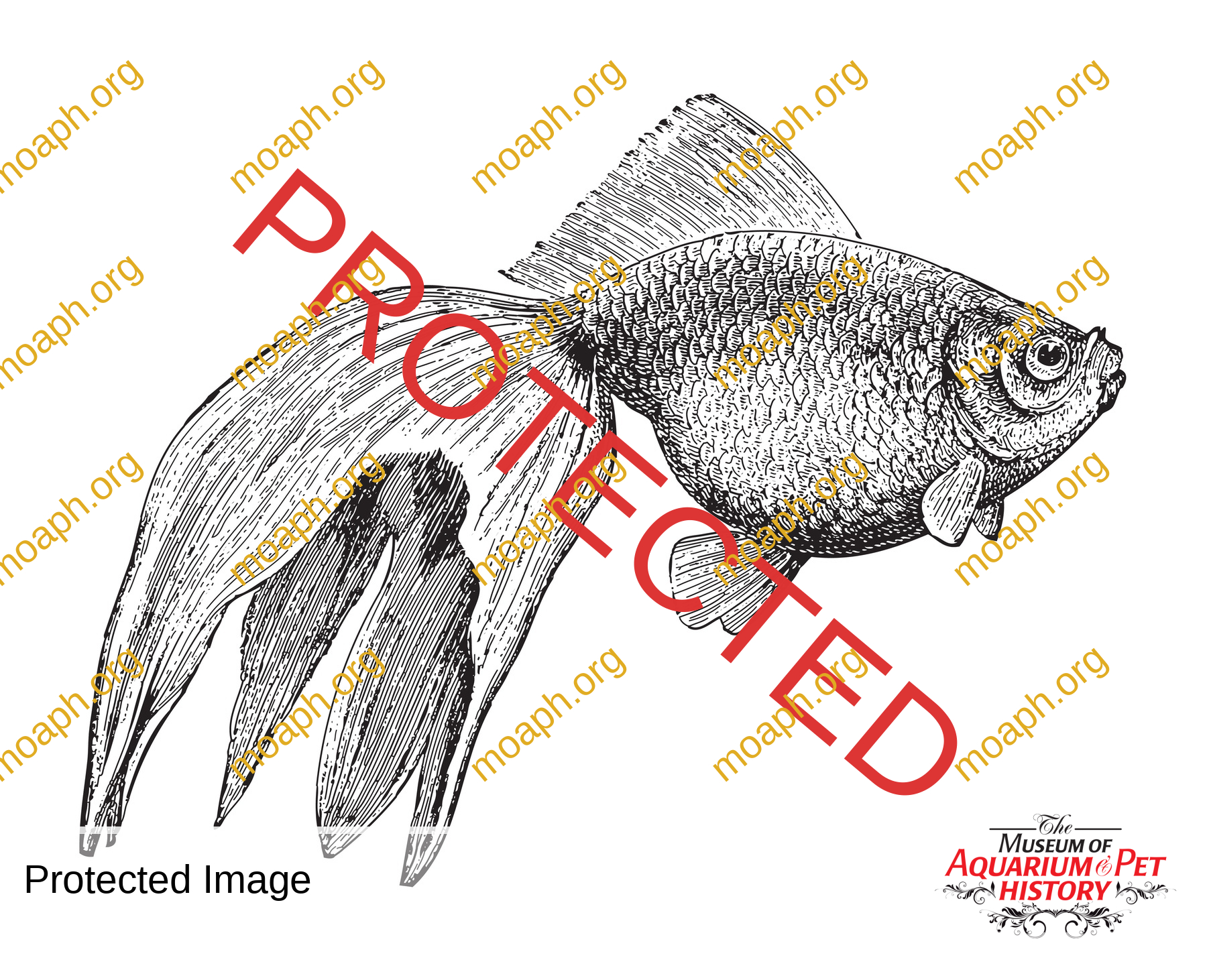
Illustration of a fan-tailed goldfish (Cyprinus auratus).
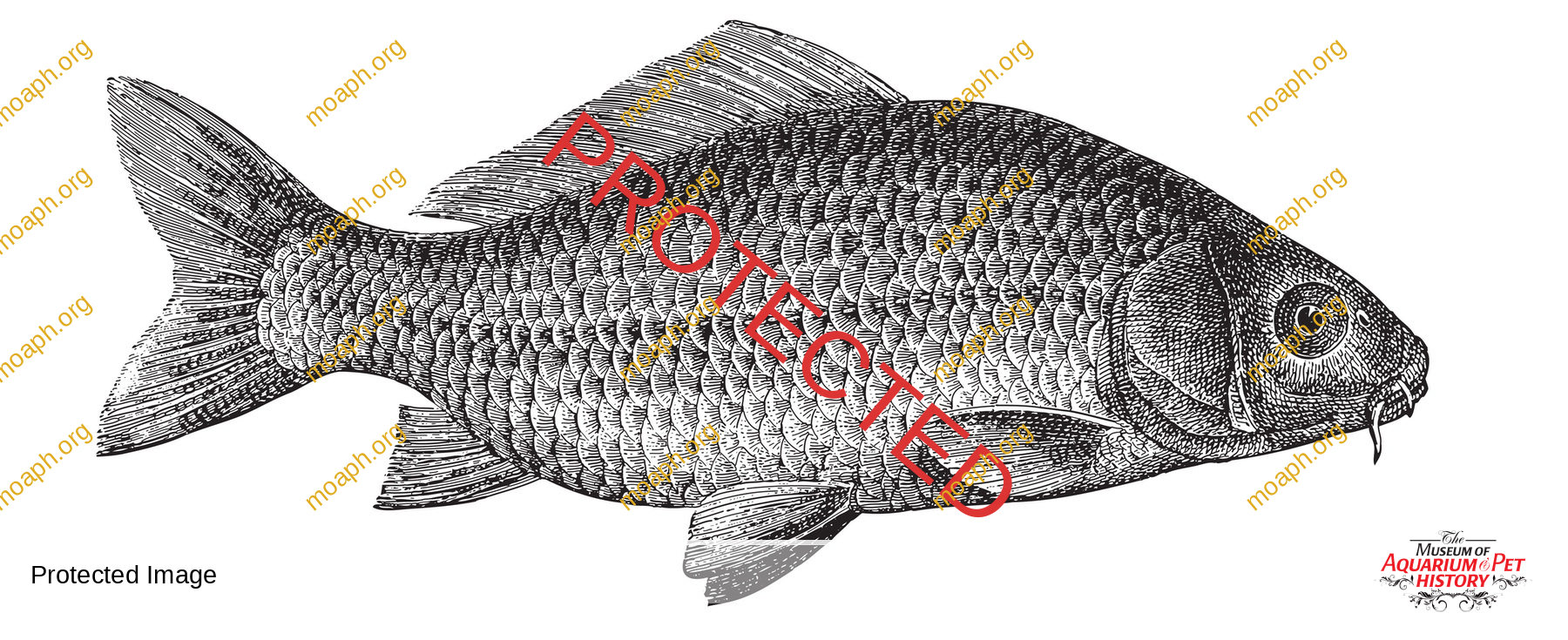
Illustration of a carp (Cyprinus carpio).
Author’s note:
After Rossmaessler began Chapter 9 “The Animals of the Aquarium” on page 52 with the above brief reference to the goldfish, pages 53 to 68 – a total of 16 pages – contain descriptions of the infusoria, polyps, insects, spiders, crustaceans, snails, etc.
Only on page 69 is the following short section on the fish given.
-Kurt Jacobs
VII: The ‘class of fish’ follows the molluscs. I dare refrain from describing and depicting the same extent of this inclusion in the aquarium with the exception of the predatory fish: pike, trout and perch. The German freshwater fish are the worst known of all vertebrates, not only by the people, but also by natural scientists, they are not particularly concerned with the study of fishes, and unfortunately there is still a lack of good illustrations. However, ‘The Weatherfish’ and “The Loach’, Cobitis fossilis and Cobitis barbatula, contribute a lot to enlivening the aquarium with their elegant, snake-like movements. Even our two most adventurous fish genera, the ‘Stichlinge’(gasterosteus), and the ‘Kaulfisch’ (Cottus gobio), are welcome, despite their gill covers which are made up of spines.
Of all the fish species that I have kept in my aquarium for almost two years now, the goldfish (Cyprinus auratus), has been preserved the best, perhaps because it has been in captivity for many generations. I have never had a goldfish die in my aquarium.
When it comes to catching fish in the aquarium and about the safest way to transport them, it would be easiest to get the advice of fishermen, and it would be best to leave it to them to bring in the fish. It is not one of the conveniences to come into conflict with fishermen protecting their commercial rights.
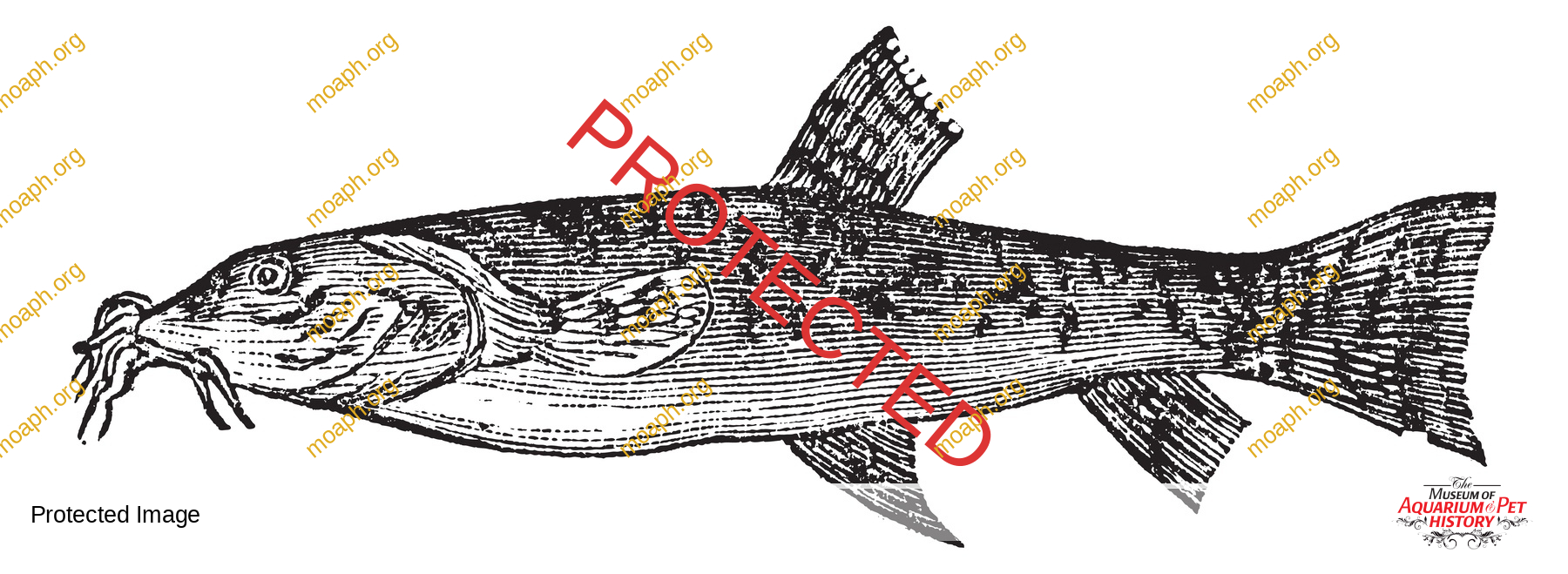
Illustration of a stone loach (Cobitis barbatula).
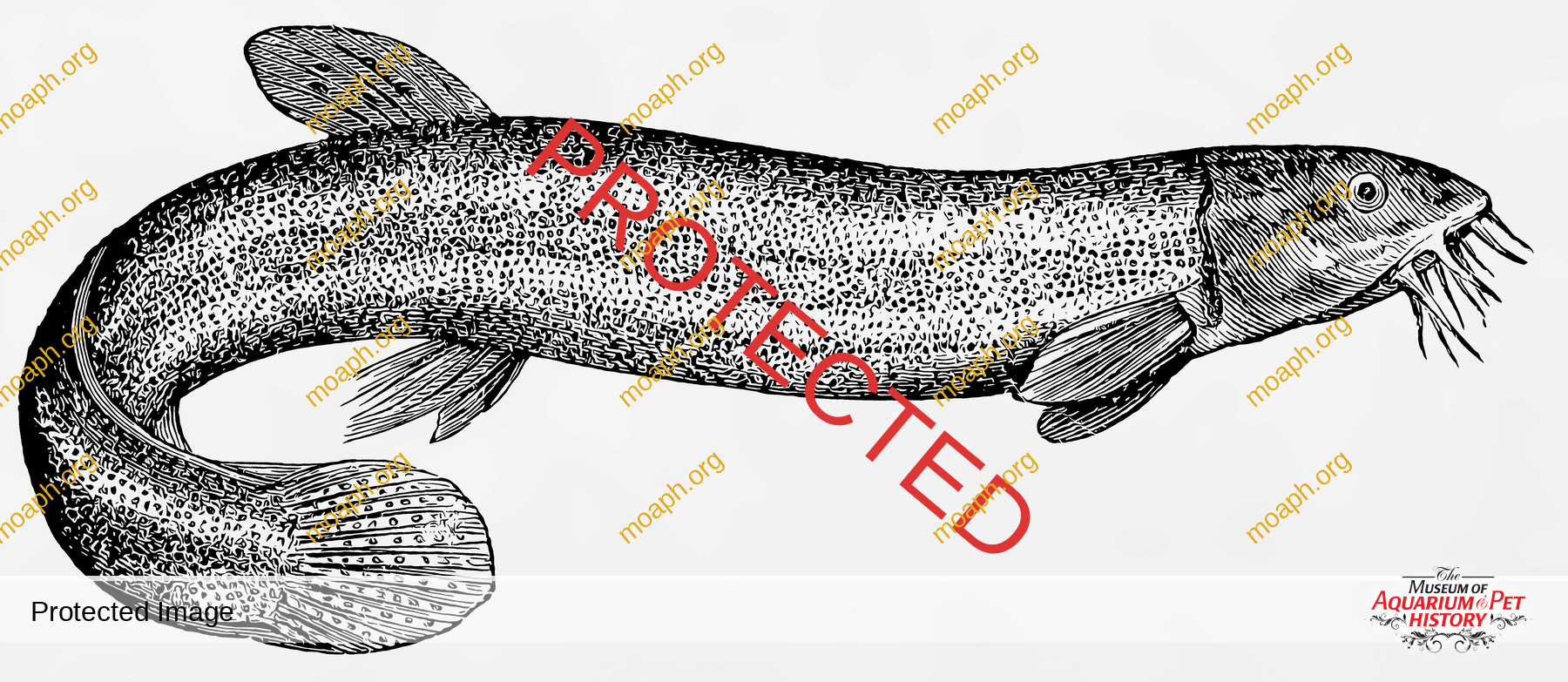
Illustration of a weatherfish (Cobitis fossilis).
VII: The ‘class of fish’ follows the molluscs. I dare refrain from describing and depicting the same extent of this inclusion in the aquarium with the exception of the predatory fish: pike, trout and perch. The German freshwater fish are the worst known of all vertebrates, not only by the people, but also by natural scientists, they are not particularly concerned with the study of fishes, and unfortunately there is still a lack of good illustrations. However, ‘The Weatherfish’ and “The Loach’, Cobitis fossilis and Cobitis barbatula, contribute a lot to enlivening the aquarium with their elegant, snake-like movements. Even our two most adventurous fish genera, the ‘Stichlinge’(gasterosteus), and the ‘Kaulfisch’ (Cottus gobio), are welcome, despite their gill covers which are made up of spines.
Of all the fish species that I have kept in my aquarium for almost two years now, the goldfish (Cyprinus auratus), has been preserved the best, perhaps because it has been in captivity for many generations. I have never had a goldfish die in my aquarium.
When it comes to catching fish in the aquarium and about the safest way to transport them, it would be easiest to get the advice of fishermen, and it would be best to leave it to them to bring in the fish. It is not one of the conveniences to come into conflict with fishermen protecting their commercial rights.
VIII. ‘The Amphibian’ or in German “Die Lurche” do not enjoy our captivity at all. Above all, I have to assure you that, apart from the viper, we in Germany do not have a single poisonous or otherwise dangerous animal from this abhorred class, like people, snakes do not belong in the aquarium at all. Of the four orders of the amphibian class, only the frog-like class comes into consideration; the other three, the lizards, snakes and turtles, are either land or sea animals or are too large for our aquarium.
But the frog-like amphibians are also the most interesting of all, in that they have a case that is not particularly common among vertebrates, namely that some of them, similar to insects, have a kind of metamorphosis, whereby they become, so to speak, a link between the two higher amphibians and fish form. It is well known that, in addition to the overall shape, that besides the entire body structure, specifically the respiratory organs, play a role, which is known and won’t be discussed further here.
Toads and Newts – what horrible names! Yet I consider both to be unavoidable guests of the aquarium. The frogs that you would probably be more willing to put up with are less suitable. Only 3 or at most 4 species come into consideration.
First the ‘Feuerkrote’ or fire toad (Bombinator ignens), the melancholy singer of the swamps. She is a harmless animal. Her unfamiliar sight will soon become apparent. But is it such a great disgrace for people, as the naturalists think, that they are afraid of such an innocent little animal. Let’s become aware of the reason for this shyness so that we can then safely get rid of it. Let us become somewhat aware of the reason for this aversion, in order to then confidently overcome it. Isn’t the proverbial ‘croak of the toad’ something gruesome? Why? Because it is the only natural sound of its kind, as it usually comes from the ‘unclean pool’ (swamp) mostly during ‘nightly hours’ and — the main thing! — because no one sees the animal from which the call originates. I am not saying too much when I claim that out of a hundred city dwellers, not ten have seen a toad. In addition, there are various mysterious interpretations attributed to the croak of the toad.
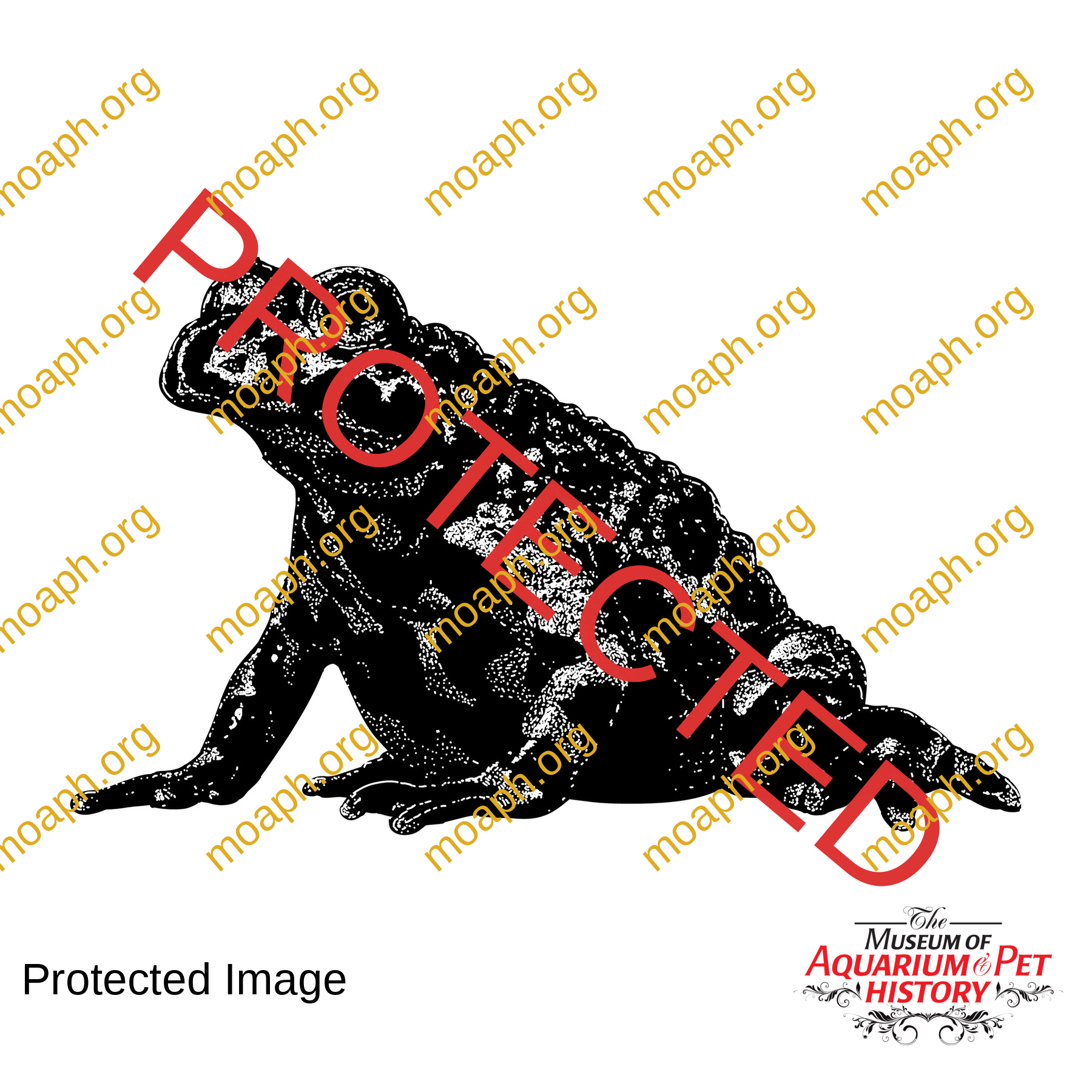
Illustration of a fire belly toad (Bombinator ignens).
“Unk, Unk, Unk, Unk! If only I had taken heed, I wouldn’t have come to the pond!” The croak of the toad translates into a slight tremor of those nerves concerned with the demanding business of faith, among participants and non-participants alike. In many places in Germany the croak has a superstitious power, unknown and adventurous, not entirely without a faint tremble of those nerves which attend to the demanding business of belief. Certainly, everyone laughs immediately afterward at this tremor, but it was still there. And for my part, I would not condemn such shudders if they are guarded by enlightening knowledge. They belong to the enjoyment of nature, and once they have passed through our inner being, trembling, it is like a thunderous air purification, after which the sky-blue of penetrating understanding shines brighter.
MOAPH: The author is reflecting on the mysterious and adventurous nature of the toad’s call, which supposedly causes a slight tremor in those unaccustomed to the sound. The author suggests that while this trembling may be laughed off, it is nonetheless a real and significant experience. The mention of the ‘thunderous air purification’ once again is referencing the power of a thunderstorm to clear the air and quell stormy conditions. This is used as a metaphor to describe that the shudders one experiences from a toad’s croak should not be condemned as evil as they are part of the ‘enjoyment’ of nature.
As I write these words, one of the toads in my aquarium looks at me with respect and full of self-confidence, as if she had understood me and found in my words a salvation for the honor of her misunderstood qualities. Now, if those of my readers, and especially my timid female readers, stood beside me, to whom the toad is still an unknown quantity, instead of shrinking back, they would laugh at the toad’s face, as it peered forth from the dark hollow of the aquarium, old and serious, and, already accustomed to my human face, would calmly remain seated on its green throne of horn leaf vines, even as I moved my hand towards it.
From early spring to June you can easily spawn the larvae (tadpoles) of frogs and toads in ditches and swamps, which must be taken into account for more than one reason. Firstly, they serve as food for the fish and newts, and secondly, those larvae which escape the pursuits afford us the opportunity to learn about the wonderful transformation of these animals. In aquariums, this transformation8 seems to suffer from a disturbance in that it is slowed down, as the front legs become free more slowly and the young animals find it somewhat more difficult to shed their fish tails, perhaps because the confined space does not grant them sufficient freedom of movement.
Two other amphibians from the closest family of frogs and toads, which I highly recommend for the aquarium, are two newts, namely ‘Kamm-Molche’ or the great crested newt (Triton cristatus), and ‘Feuer-Molch’ or the fire newt (Triton igneus); The males of all newt species have a lobed or juicy skin ridge along their back and tail, which the females lack. The ‘Gestreifte Molch’ or the striped newt (Triton taeniatus), are very common in the swamps and muddy ditches in almost all of Europe, but are easy until about July. Then they leave the water and hide in damp places in the ground, in cracks, in walls and crevices. Therefore, in the long run, they only feel comfortable in the aquarium if they have a very large rock that rises above the water level, in whose hiding places they hide in the summer and then usually look pitifully starved, despite the fact that they are close to them in the water food and drink is available. Anyone who calls newts hateful, disgusting, perhaps even terrifying animals: I bet he will find them after a short time, because the elegance of their movements, the beauty of their markings and their harmlessness will force him to do so. In July you can find feather-shaped gills on the outside. However, they are very delicate and therefore difficult to transport.
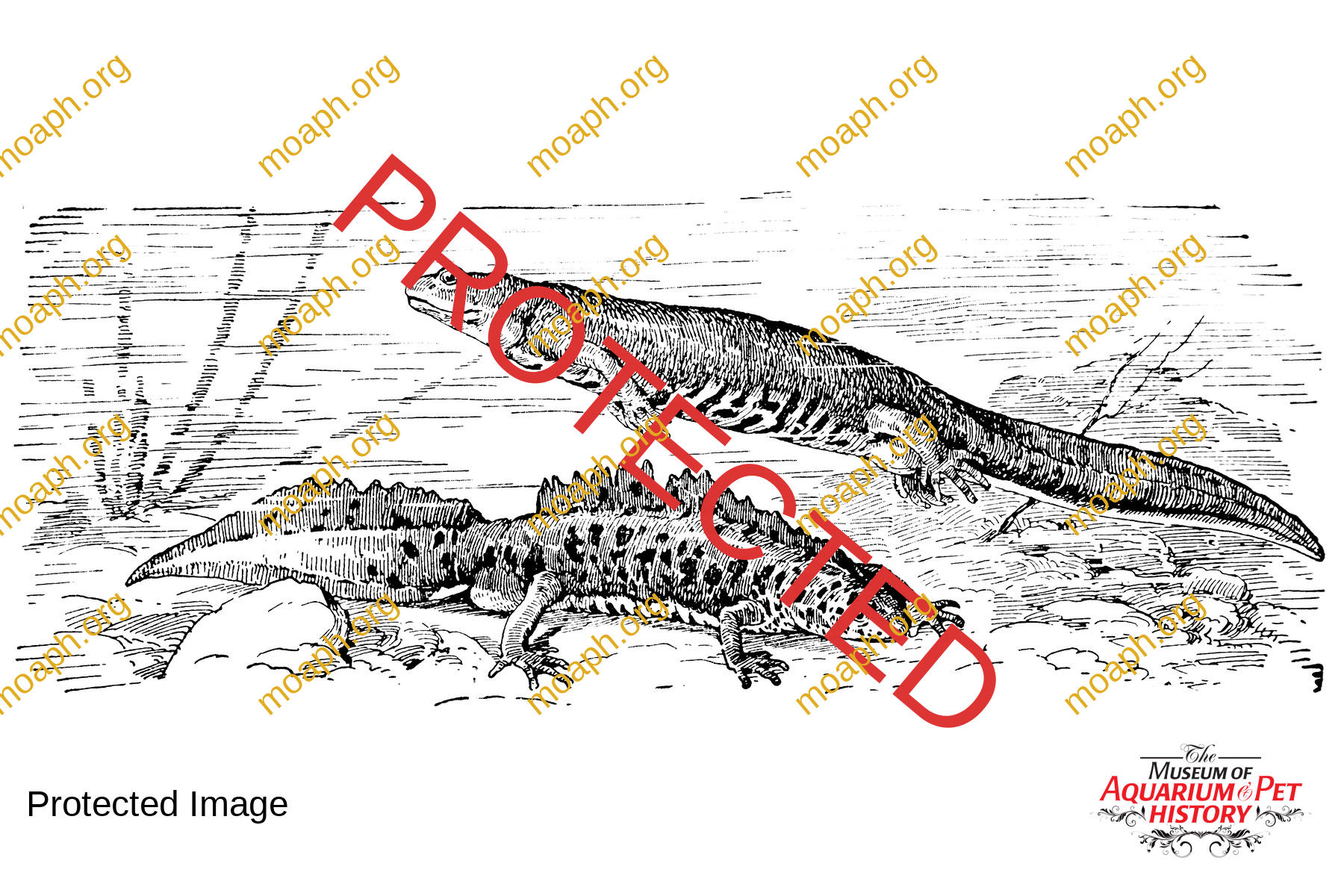
Illustration of a great crested newt (Triton cristatus).
The newts have only a superficial relationship with our lizards, which are strictly tied to the land, and; ‘Wassereidechsen’ or water lizards is therefore a completely inappropriate name for them. The lizards, together with the crocodiles, belong to one of the main orders of the amphibious class, while the newts belong to the frog-like amphibians. These also include the ‘gefleckte salamander’ or the the spotted salamander (Salamandra maculata), which is common in rocky, damp mountain forests and which actually belongs as a silent observer on the top of the aquarium rock, from which it does not easily descend into the water.
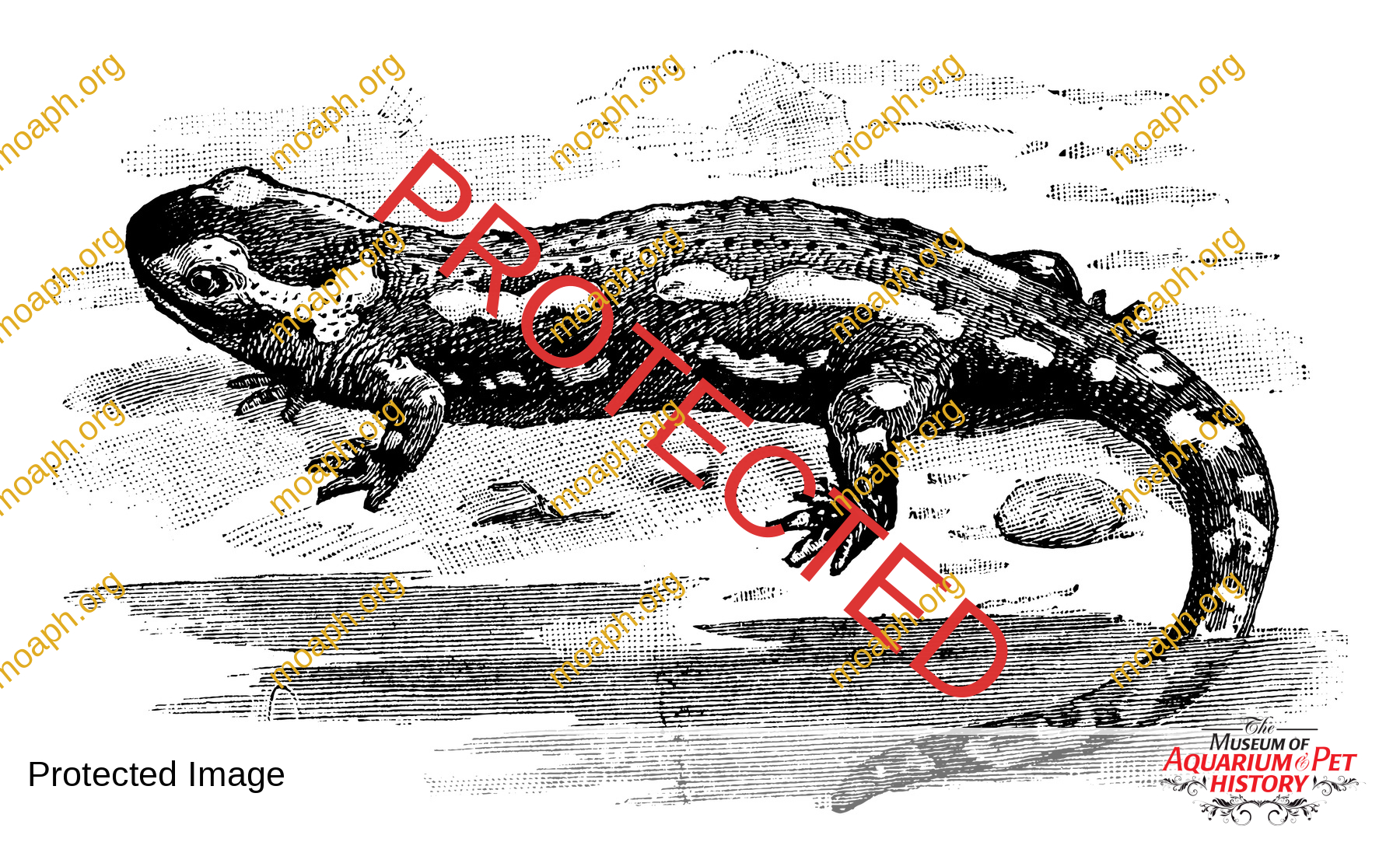
Illustration of a spotted salamander (Salamandra maculata).
The admirers of E.T.A. Hoffmann, who enjoy getting a little ‘creepy’ with his Serapion Brothers, will undoubtedly feel strongly drawn to the salamanders9.”
Finally, the fish and the amphibians have one more remarkable characteristic in common, namely the virtue, which will certainly surprise my readers, of allowing themselves to be tamed. This doesn’t go as far as fetching and jumping, but it does go so far that you get to know your boyfriend or girlfriend and soon lose your fear of them. If you feed these animals at regular times and always listen to the same sound close to the aquarium with a bell or a broken wine glass, they will soon learn to come to this call. The Chinese also use the tam-tam10 to call their goldfish to feed from all corners of the basin.
Here ends the reproduction of the original text from the book by Emil Adolf Rossmassler “The Freshwater Aquarium”
Note from Kurt Jacobs: In addition to the note on page 52, Rossmassler touches on the possibility of keeping native fish again on page 69. This means that in the first edition of his book ‘The Freshwater Aquarium’, published in 1857, the fish are only mentioned on one page! He dedicates it to the amphibians from page 70 to 74 around 5 pages. The last pages 75 to 80 first provide a description in chapter 10 of the various containers used as aquariums, their setup, etc. Then chapter 11 deals with filling the aquariums and gives tips for practice. In chapter 12, ‘Caring for the Aquarium and Feeding the Animals’, Rossmassler writes in conclusion: “I close this chapter, which may seem too short to some of my readers, with the old truth: Trying is better than studying!” Rossmassler was unable to give any further information about keeping fish, as he had only been keeping them in his only aquarium for almost two years. His main interest was in the flora and the lower aquatic animals.
Conclusion:
Long before Bechstein – many decades and centuries ago – fish and possibly also amphibians and reptiles were kept and observed by people. At first there were inquiring minds who sought to understand life in nature. Pure practicality, for example by keeping fish to increase the number of foods suitable for human consumption, also played an important role in ancient times. It was only much later – starting in China – that the first goldfish became an object of decorative design for living spaces and gardens. For the first time, we have to talk about the breeding of real ornamental fish, the value of which was not measured based on their use for human food.
The far eastern goldfish became the first ornamental fish in Europe. His possessions were considered valuable and remained reserved for princely circles for over a century. It was only at the turn of the 17th and 18th centuries that it found acceptance among the more well-off bourgeoisie. Interest in nature began to grow, and soon, native fish were allowed to swim in the previous goldfish tanks.
However, in relation to the private sector, it was initially only possible to speak of the animals being kept. A real knowledge of their peculiarities in care, breeding, and keeping could only come about at the moment when the traditional and newly acquired knowledge was recorded for the first time in Bechstein’s “Natural History of House Animals.”
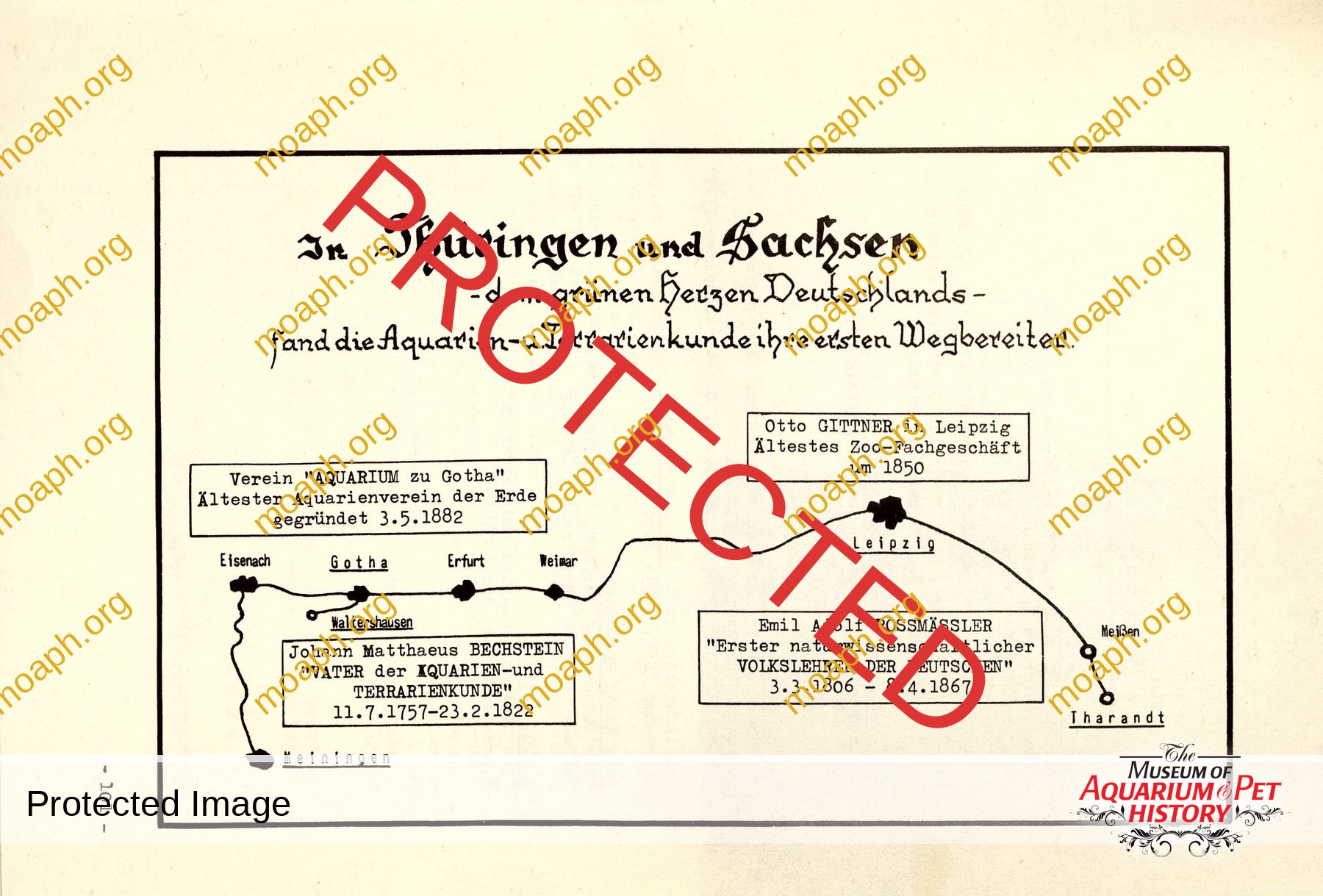
Timeline at end of book. Original is above, and translated copy is below.
REFERENCES
1 In the 19th edition, 1856
2 Supply and demand
3 ‘Tuff’ is a type of rock formed from volcanic ash that has consolidated over time. Tuff stones have various uses in construction and landscaping due to their lightweight and porous nature.
4 The advancement of aquarium science was essentially ‘rejuvenated’, and Rossmassler is continuing the human desire to study life, which existed in ancient civilizations as well.
5 ‘Usus’ a latin word for ‘usage’ in reference to the adoption of foreign words being used in the modernization of the German language.
6 In a small, still body of water like an aquarium, the supply of oxygen becomes depleted relatively quickly because the rate at which the water absorbs air is slower than the rate at which the animals consume oxygen. This imbalance leads to a depletion of oxygen over time, which could potentially be harmful to the animals living in the aquarium.
7 ‘R’ is from the Rankine scale which is an absolute temperature scale like Kelvin. 0 R is equivalent to -459.67 F. This would mean that 16R is about -443.67 F. While the negative values may seem unusual, they are valid in many scientific applications.
8 The ‘transformation’ process is detailed by Rossmassler as being very interesting, but due to the small size of the aquarium can have an effect on the proper development of the larvae.
9 E.T.A Hoffmann (1776-1822) was an author and musical composer. Hoffmann had a literary circle known as the ‘Serapion Brothers’. Rossmassler links the ‘salamanders’ to Hoffman’s ‘creepy’ literary circle to create a sense of mystery or fascination with the supernatural.
10 A type of Chinese percussion instrument.