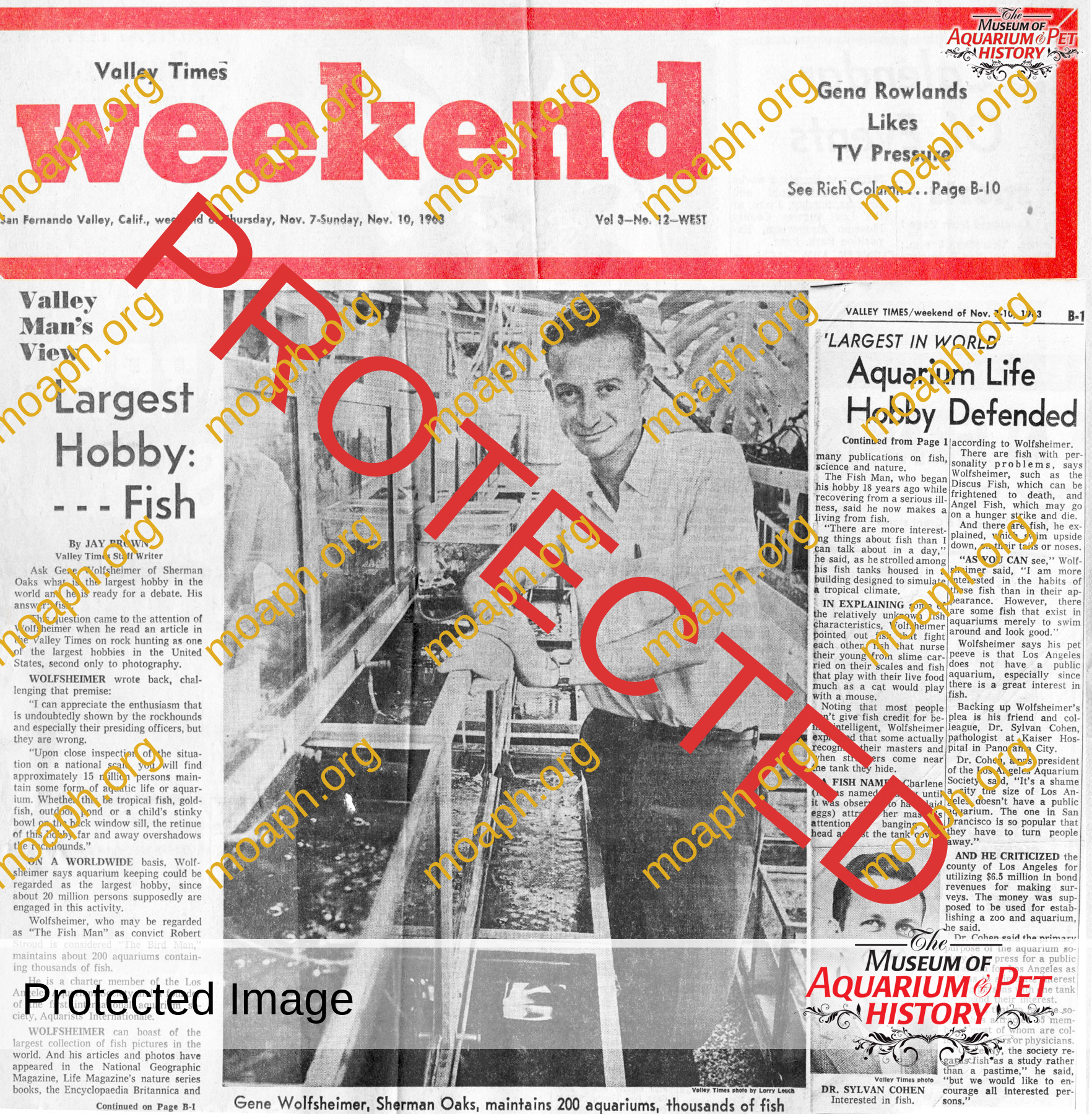
Valley Times Article “Largest Hobby: Fish”
Valley Times Article from November 10, 1963. Features Gene Wolfsheimer of Sherman Oaks, California, who defends fish keeping as the largest hobby.
Article text is transcribed below the image.
Largest Hobby:—Fish
By Jay Brown (Valley Times Staff Writer)
Ask Gene Wolfsheimer of Sharman Oaks what is the largest hobby in the world and he is ready for a debate. His answer: fish.
This question came to the attention of Wolfsheimer when he read an article in the Valley Times on rock hunting as one of the largest hobbies in the United States, second only to photography.
Wolfsheimer wrote back, challenging that premise:
“I can appreciate the enthusiasm that is undoubtedly shown by the rockhounds and especially their presiding officers, but they are wrong.
Upon close inspection of the situation on a national scale, you will find approximately 15 million persons maintain some form of aquatic life or aquarium. Whether this be tropical fish, goldfish, outdoor pond or a child’s stinky bowl on the back window sill, the retinue of this hobby far and away overshadows the rockhounds.”
On a worldwide basis, Wolfhsheimer says aquarium keeping could be regarded as the largest hobby, since about 20 million persons supposedly are engaged in this activity.
Wolfsheimer, who may be regarded as “The Fish Man” as convict Robert Stroud is considered “The Bird Man,” maintains about 200 aquariums containing thousands of fish.
He is a charter member of the Los Angeles Aquarium Society and a founder of the first international aquarium society, Aquarists’ Internationale.
Wolfsheimer can boast of the largest collection of fish pictures in the world. And his articles and photos have appeared in. the National Geographic Magazine, Life Magazine’s nature series books, the Encyclopedia Britannica and many publications on fish, science and nature.
The Fish Man, who began his hobby 18 years ago while recovering from a serious illness, said he now makes a living from fish.
“There are more interesting things about fish than I can talk about in a day,” he said, as he strolled among his fish tanks housed in a building designed to simulate a tropical climate.
In explaining some of the relatively unknown fish characteristics, Wolfsheimer pointed out fish that fight each other, fish that nurse their young from slime carried on their scales and fish that play with their food much as a cat would play with a mouse.
Noting that most people don’t give fish credit for being intelligent, Wolfsheimer explained that some actually recognize their masters and when strangers come near the tank they hide.
A fish named Charlene (it was named Charley until it was observed to have laid eggs) attracts her master’s attention by banging her head against the tank cover, according to Wolfsheimer.
There are fish with personality problems, says Wolfsheimer, such as the Discus Fish, which can be frightened to death, and Angel Fish, which may go on a hunger strike and die.
And there are fish, he explained, which swim upside down, on their tails or noses.
“As you can see,” Wolfsheimer said, “I am more interested in the habits of these fish than in their appearance. However, there are some fish that exist in aquariums merely to swim around and look good.”
Wolfsheimer says his pet peeve is that Los Angeles does not have a public aquarium, especially since there is a great interest in fish.
Backing up Wolfsheimer’s plea is his friend and colleague, Dr. Sylvan Cohen, pathologist at Kaiser Hospital in Panorama City.
Dr. Cohen, a past president of the Los Angeles Aquarium Society, said, “It’s a shame a city the size of Los Angeles doesn’t have a public aquarium. The one in San Francisco is so popular that they have to turn people away.”
And he criticized the county of Los Angeles for utilizing $6.5 million in bond revenues for making surveys. The money was supposed to be used for establishing a zoo and aquarium, he said.
Dr. Cohen said the primary purpose of the aquarium society is to press for a public aquarium for Los Angeles as well as to stimulate interest among persons with one tank to expand their interest.
He said that so far the society has attracted 55 members, most of whom are college professors or physicians.
“Currently, the society regards fish as a study rather than a pastime,” he said, “but we would like to encourage all interested persons.”