Wild and Ferocious Reptiles in the Tower of London

Fig. 1. Tower of London. From Bennett in 1829. Credit: Courtesy of Smithsonian Institution Libraries, Washington, DC.
The Tower of London is best known as a prison where human inmates were subjected to harsh and cruel punishments so it might be surprising that this forbidding venue also served as a repository for wild animals. The Royal Collection of Wild and Ferocious Beasts kept at the Tower of London Menagerie spanned ca. 600 years, beginning in 1245 (Loisel 1912; Keeling 1992; Hahn 2004; Fig. 1). During that time, leopards, lions, tigers, ostriches, wolves, kangaroos, zebras, elephants, polar bears, monkeys, baboons, eagles and other birds of prey, macaws and other psittacines, and a stunning variety of other creatures could be found in the Tower as tourist attractions. Although seemingly not an ideal facility for reptiles with its stone walls and barred dens, at various times over the span of six centuries, the rattlesnake, the Indian boa, the anaconda, and the alligator lived in a large outdoor enclosure surrounded by a moat. All of these reptiles are illustrated in Edward Turner Bennett’s book, “The Tower Menagerie: Comprising the Natural History of the Animals Contained in that Establishment, with Anecdotes of Their Characters and History. Illustrated by Portraits of Each, Taken from Life, by William Harvey, and Engraved on Wood by Branston and Wright” in 1829. Bennett described the difficulties in drawing animals, “The whole of the drawings are from the pencil of MR WILLIAM HARVEY, who, in seizing faithful and characteristics portraits of animals in restless and almost incessant motion, has succeeded in overcoming difficulties which can only be appreciated by those who have attempted similar delineations.”
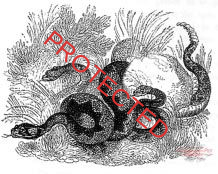
Fig. 2. Over 100 rattlesnakes (Crotalus horridus Linn.) lived in the Tower of London. From Bennett in 1829. Credit: Courtesy of Smithsonian Institution Libraries, Washington, DC.

Fig. 3. Tower python, called Indian Boa (Python Tigris Daud., now Python molurus) by Bennett (1829), laid a clutch of 14–15 eggs which did not hatch. Credit: Courtesy of Smithsonian Institution Libraries, Washington, DC.
Alfred Cops worked at the Exeter ‘Change in the Strand but left this job in 1822 to take charge of the Royal Menagerie at the Tower. Daniel Hahn (2004) described his skills as an animal caretaker, “Cops was a professional zoologist and an expert on animal behavior, a man with extensive training and experience looking after captive animals . . . It was expected that such a man would be able to expand and improve the Menagerie, making it exciting and competitive in a way that it had not been for some years, and at the same time improve the animals’ living conditions sufficiently to satisfy the newly fashionable anticruelty lobbies.”
Given that rattlesnakes may be delicate to keep in captivity, it is amazing that over 100 rattlesnakes (identified Crotalus horridus Linn. by Bennett) survived sea voyages from the New World to be cared for by Cops in the Tower; perhaps their survival is a testament to Cops’ ability (Fig. 2).
Here is Bennett on rattlesnake behavior, “It was long believed, and the notion is still popularly current, that they possessed the power of fascinating their victims, which were thought to be so completely under the influence of their glance as to precipitate themselves of their own accord into the open throat of their enemy; but the truth appears to be that they actually inspire so great a degree of terror that the animals selected for their attacks are commonly rendered incapable of offering such resistance as might otherwise be in their power, or even of attempting to escape from their pursuit.”
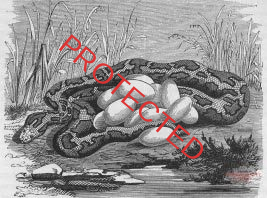
Fig. 4. Indian python (Python molurus) incubating eggs at Menagerie Jardin des Plantes. Illustration reproduced from S. G. Goodrich’s “Johnson’s Natural History, Comprehensive, Scientific, and Popular, Illustrating And Describing The Animal Kingdom With Its Wonders And Curiosities, From Man, Through All The Divisions, Classes, And Orders, To The Animalculae In A Drop of Water; Showing The Habits, Structure, And Classification Of Animals, With Their Relations To Agriculture, Manufactures, Commerce, And The Arts. Volume 2 in 1870.” Credit: Courtesy of Smithsonian Institution Libraries, Washington, DC.
Cops nearly bred the Tower python, called Indian Boa (Python Tigris Daud., now Python molurus) by Bennett (Fig. 3). The python laid a clutch of eggs which did not hatch. Bennett described the event, “ The individual figured at the head of the present article is a female; a fact which was proved by the remarkable circumstance of her producing in May last, after having been more than two years in the Menagerie, a cluster of eggs, fourteen or fifteen in number, none of which, however, were hatched, although the mother evinced the greatest anxiety for their preservation, coiling herself around them in the form of a cone, of which her head formed the summit, and guarding them from external injury with truly maternal solicitude.” This account is certainly one of the first to describe brooding behavior in pythons. Three years later, naturalist Lamarre-Picquot lectured before the Academie de France about the brooding of a Python molurus bivittatus in the Jardin des Plantes in Paris (Fig. 4) and claimed that the female not only coiled around the clutch but produced “noticeable warmth,” a finding expressed again in a note in 1842. This observation was widely criticized as speculative, hazardous, and questionable by members of the Academie, especially Auguste Duméril (1842). The thermogenesis controversy was finally settled over 130 years later when sophisticated temperature and gas exchange recording devices were available. Victor H. Hutchison, Herndon G. Dowling, and Allen Vinegar published two important papers on metabolism, energetics and thermoregulation in brooding female pythons at the New York Zoological Society (Hutchison et al. 1966; Vinegar et al. 1970). The abstract in the first paper reads: “At varying environmental temperatures, measurements of body temperatures and gas exchange of a female Indian python (Python molurus bivittatus) show that during the brooding period this animal can regulate its body temperature by physiological means analogous to those in endotherms. Ambient temperatures below 33°C result in spasmodic contractions of the body musculature with a consequent increase in metabolism and body temperature.”

Fig. 5. The Anaconda, called Python Tigris Var. by Bennett, were likely Ceylonese pythons, Python molurus pimbura. Credit: Courtesy of Smithsonian Institution Libraries, Washington, DC.
The Anaconda, called Python Tigris Var. by Bennett, were likely Ceylonese pythons, Python molurus pimbura (Fig. 5). Cops discovered that captive snakes may have impressive feeding responses when one of his pythons grabbed his hand and threw two coils around his neck while being fed. Bennett told the story, “His own exertions, however, aided by those of the under keepers, at length disengaged him from his perilous situation; but so determined was the attack of the snake that it could not be compelled to relinquish its hold until two of its teeth had been broken off and left in the thumb.”
Coote (2001) speculated that the first American Crocodile, Crocodylus acutus, received by the London Zoological Society in 1831, may have been the Tower “Alligator” (Fig. 6). However, the drawing by William Harvey looks like an American alligator and is called Crocodilus lucius Cuv., an early name for the alligator. Robert Huish’s drawing in 1830 also appears to be an alligator (see Fig. 2 in Herpetological Review 36(3):230). In both illustrations, the alligator’s head is abnormally small.
The Tower collection of animals was presented by the King to the Zoological Society of London in 1831 (Peel 1903:180). Eighteen years later, the London Zoo in Regent’s Park opened the world’s first zoo reptile building (Fig. 7).
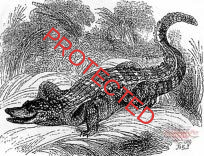
Fig. 6. Tower “Alligator” called Crocodilus lucius Cuv. by Bennett in 1829. Note the abnormally small head. Credit: Courtesy of Smithsonian Institution Libraries, Washington, DC.
Acknowledgments.—Smithsonian National Zoological Park Librarian Alvin Hutchinson, and Leslie Overstreet and Daria Wingreen in the Joseph F. Cullman 3rd Library of Natural History (from the SI Special Collections Department) helped locate historical literature. Judith Block and Jon Coote reviewed early drafts of this manuscript. I thank Kraig Adler for providing the illustration of the reptile building at London Zoo.
This contribution is dedicated to Jon Coote, who has expanded our understanding and appreciation of early herpetocultural practices through his writings.
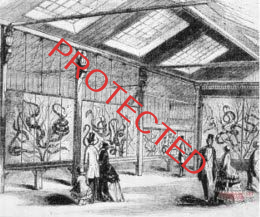
Fig. 7. Description of London Zoo reptile building from The Illustrated London News on 2 June 1849. The beginning of the article reads as follows: “The new reptile house in the Gardens of the Zoological Society in the Regent’s Park will ultimately form one of the most instructive, as it is the most novel and original feature in this delightful institution. The collection already contained in it is so unexpectedly brilliant, considering the small number of reptiles previously exhibited in the Menagerie, that we cannot but anticipate the most important results in the study of this singularly interesting division of the animal kingdom.” Credit: illustration provided by Kraig Adler.
Literature Cited
BENNETT, E. T. 1829. The Tower Menagerie: Comprising the Natural History of the Animals Contained in that Establishment, with Anecdotes of Their Characters and History. Illustrated by Portraits of Each, Taken from Life, by William Harvey, and Engraved on Wood by Branston and Wright. Printed for R. Jennings, London.
COOTE, J. G. 2001. A history of western herpetoculture before the 20th century. In W. E. Becker (ed.), 25th International Herpetological Symposium on Captive Propagation and Husbandry, pp. 19–47. International Herpetological Symposium, Detroit, Michigan.
DUMÉRIL, A. 1842. Sur le développement de la chaleur dans les oeufs des serpents, et sur l’influence attribuée à l’incubation de la mere; par M. Duméril (Concerning the production of heat in the eggs of snakes, and the influence attributed to the incubation of the mother; by M. Duméril). Comptes Rendus Acad. Sci. Paris 14:193–210.
HAHN, D. 2004. The Tower Menagerie. Jeremy P. Tarcher/Penguin, New York.
HUISH, R. 1830. The Wonders of the Animal Kingdom Exhibiting Delineations of the Most Distinguished Wild Animals in the Various Menageries of the Country. Thomas Kelly, London. [description of the alligator housed in the Royal Menagerie of London (pp. 51–52).].
HUTCHISON, V. H., H. G. DOWLING, AND A. VINEGAR. 1966. Thermoregulation in a brooding female Indian python, Python molurus bivittatus. Science 151:694–696.
KEELING, C. H. 1992. A Short History of British Reptile Keeping. Clam Publications, Guilford, UK.
LAMARRE-PICQUOT, P. 1835. L’lnstitut 3: 70. ______. 1842. Troisème mémoire sur l’incubation et autres phénomènes observés chez les ophidiens (Third report on the incubation and other phenomena observed in the snake house). C. R. Acad. Sci. Paris 14:164.
LOISEL, G. 1912. Histoire des ménageries de l’antiquité à nos jours (History of Menageries from Antiquity to Present Times). O. Doin et fils, Paris.
PEEL, C. V. A. 1903. The Zoological Gardens of Europe. Their History and Chief Features. F. E. Robinson & Co., London.
VINEGAR, A., V. H. HUTCHISON, AND H. G. DOWLING. 1970. Metabolism, energetics, and thermoregulation during brooding of snakes of the genus Python (Reptilia, Boidae). Zoologica (New York) 55:19–48.