History of Faux Bois Aquariums
Faux bois aquariums are relics of a time when even utilitarian things such as a fish tank looked like small works of art. Their rustic appearance is very far from the minimalistic design of modern aquariums that we are used to, and this is one of the reasons why they are much sought-after and highly prized by collectors.
Faux bois, which means “false wood” in French, is the art of recreating the look and feel of natural wood using concrete or other shapeable materials onto a metal armature. This style developed in France in the mid-1800s, initially thanks to the early steps taken by the farmer Joseph Louis Lambot (1814-1887) and the gardener Joseph Monier (1823-1906) towards the invention of reinforced concrete.
Officially introduced to the world by Monier during the 1867 Paris Exposition, the metal reinforced concrete received great interest firstly from European builders, as it might be developed and exploited to construct increasingly high buildings, bridges, and many other long-lasting infrastructure. The game changing novelty was well received also by rocailleurs, garden craftsmen skilled in modelling artificial rocks and grottos. Through this new technology, these artists gave free rein to their three-dimensional creativity, and began to create phenomenal faux bois artworks such as benches, tables, chairs, bridges, balconies, fences, railings, gazebos, facades of buildings, and… aquariums!
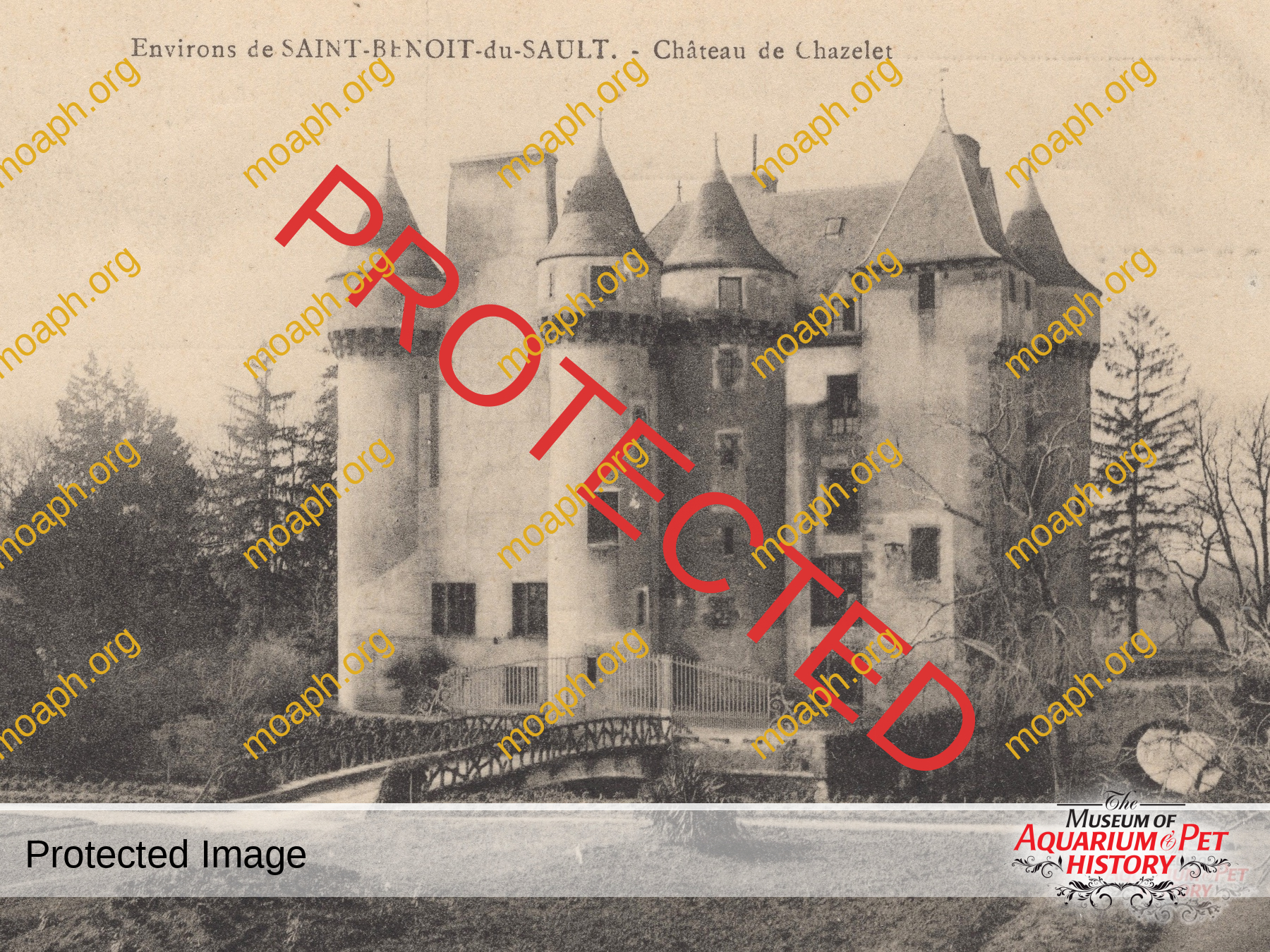
One of the earliest bridges made of reinforced concrete was designed and built by Joseph Monier at the Château de Chazelet, Chazelet, France.
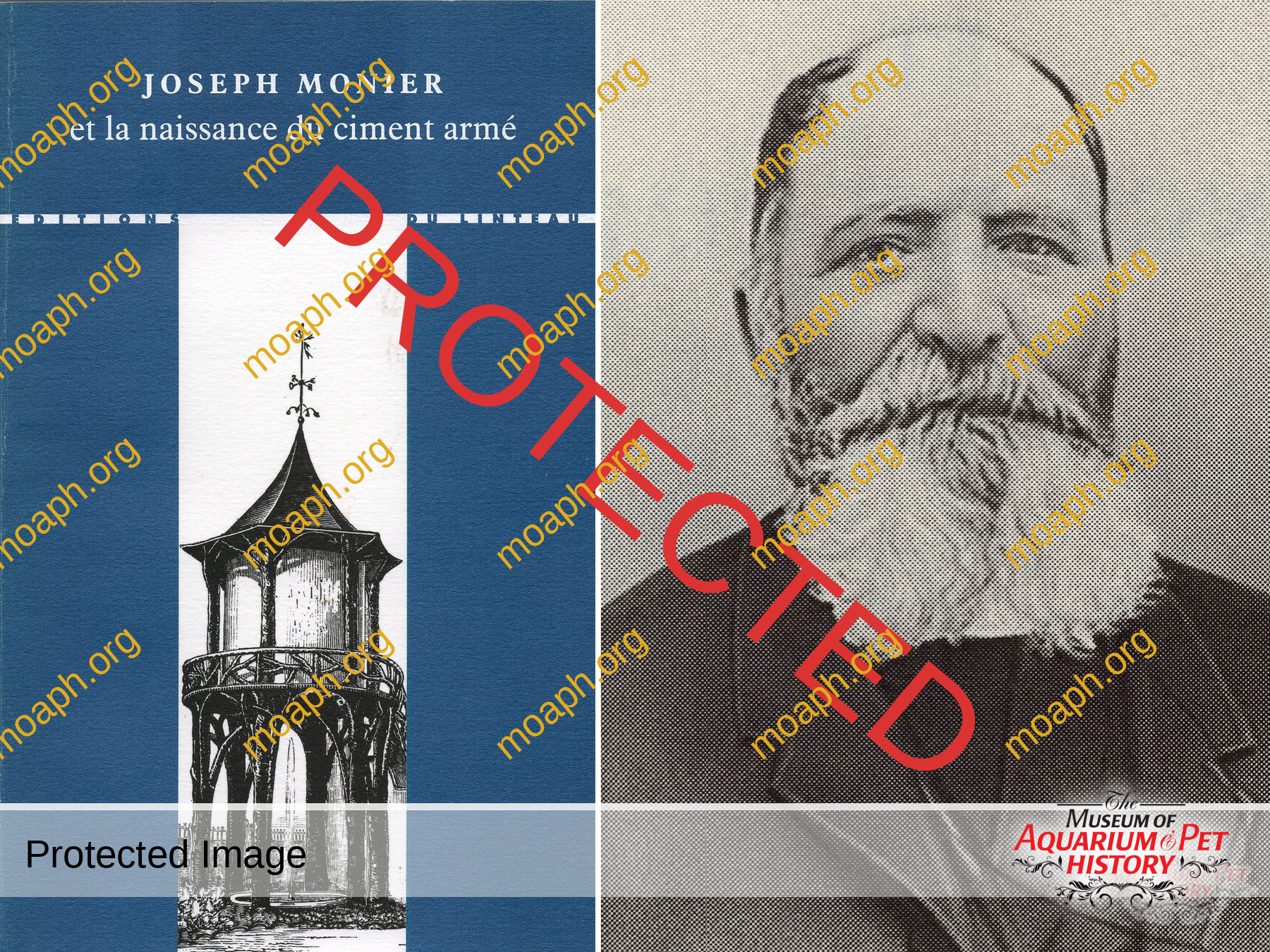
Cover of the book Joseph Monier et la naissance du ciment armé. Édition du Linteau, Paris (2001). On the right, Joseph Monier.
The period from the 1870s through the 1910s was the most productive for rocailleurs, who proudly advertised their business calling themselves rocailleur-paysagiste, cimentier-rocailleur, artiste-rocailleur, rocailleur-artiste en ciment, rustiqueur, or spécialiste-rocailleur. Their functional sculptures for public gardens and private homes became quite popular in France, and to a lesser extent in Belgium, Spain, England and Italy. Some of those structures, especially the French ones, still stand today.
The driving force behind faux bois
At the time, industrialization led to increased urbanization and a shift away from rural living. Faux bois allowed city dwellers to bring a touch of nature into their urban environments, providing a nostalgic connection to the countryside. Following this trend, the French government spent a great deal of money to install faux bois functional and durable sculptures in several parks, making these places a refuge from the noise of overcrowded cities.
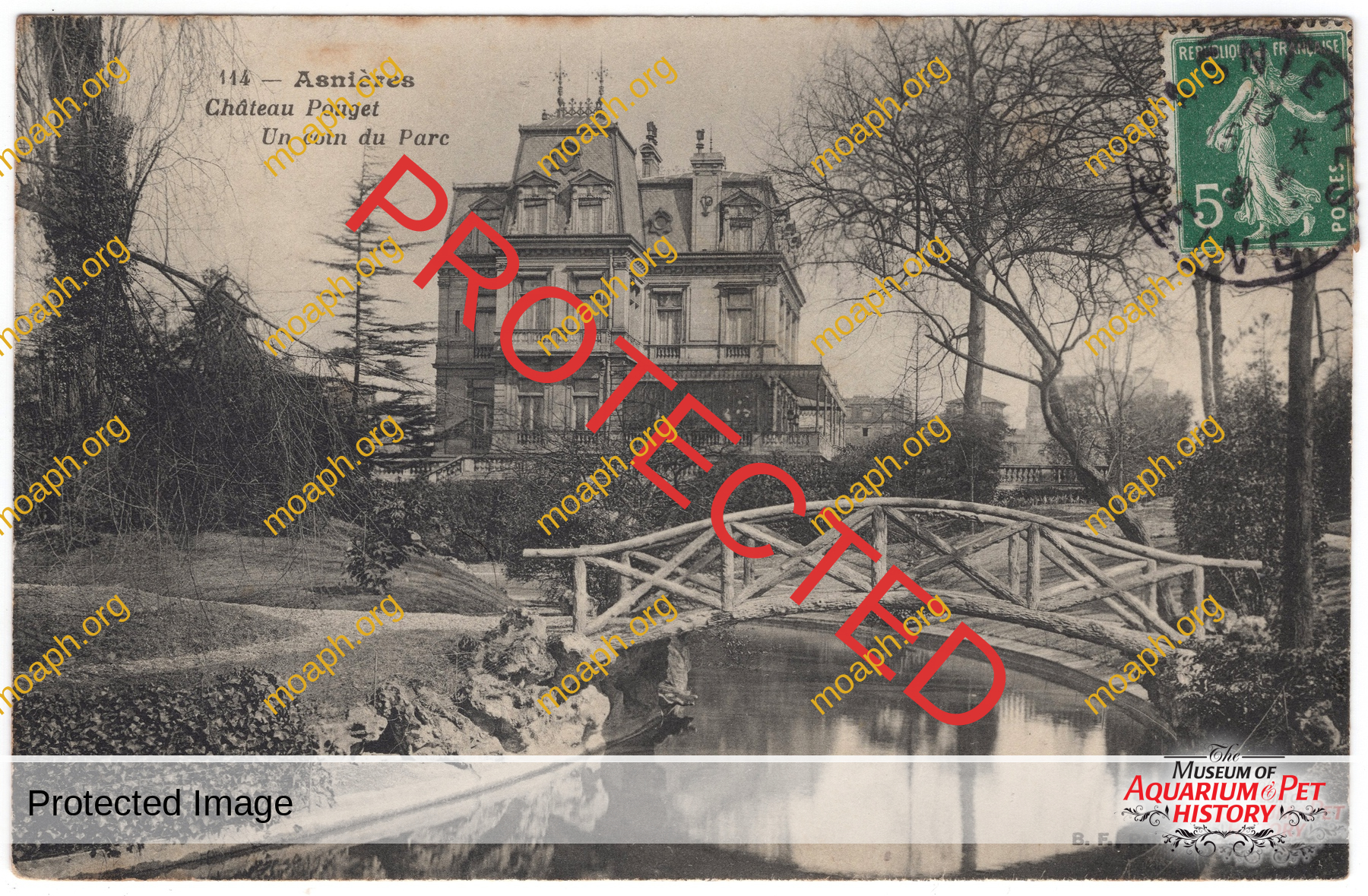
The faux bois footbridge at the Château Pouget in Asnières, France, still stands today.
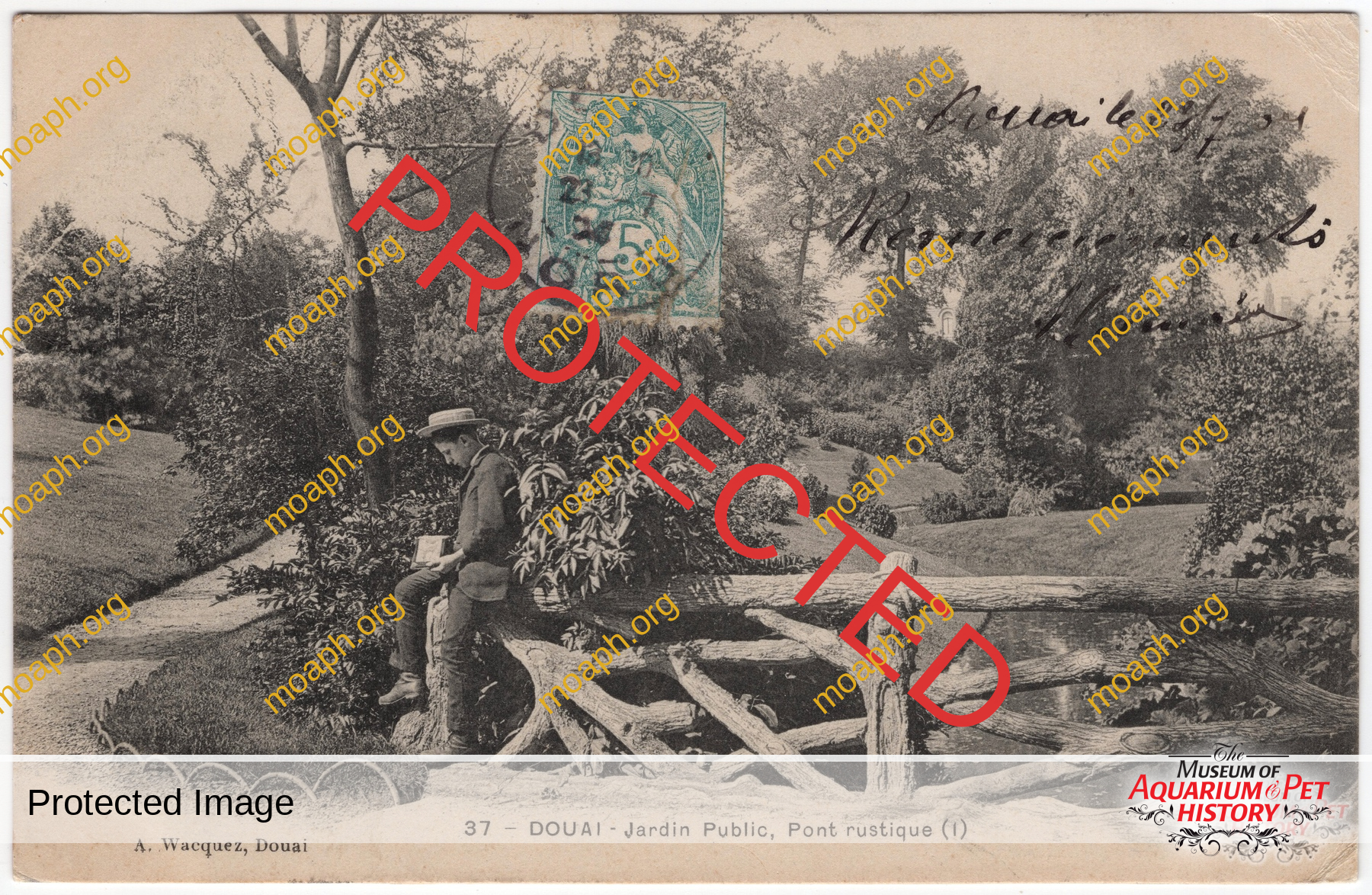
Boy on a faux bois bridge in Douai, France (early 1900s).
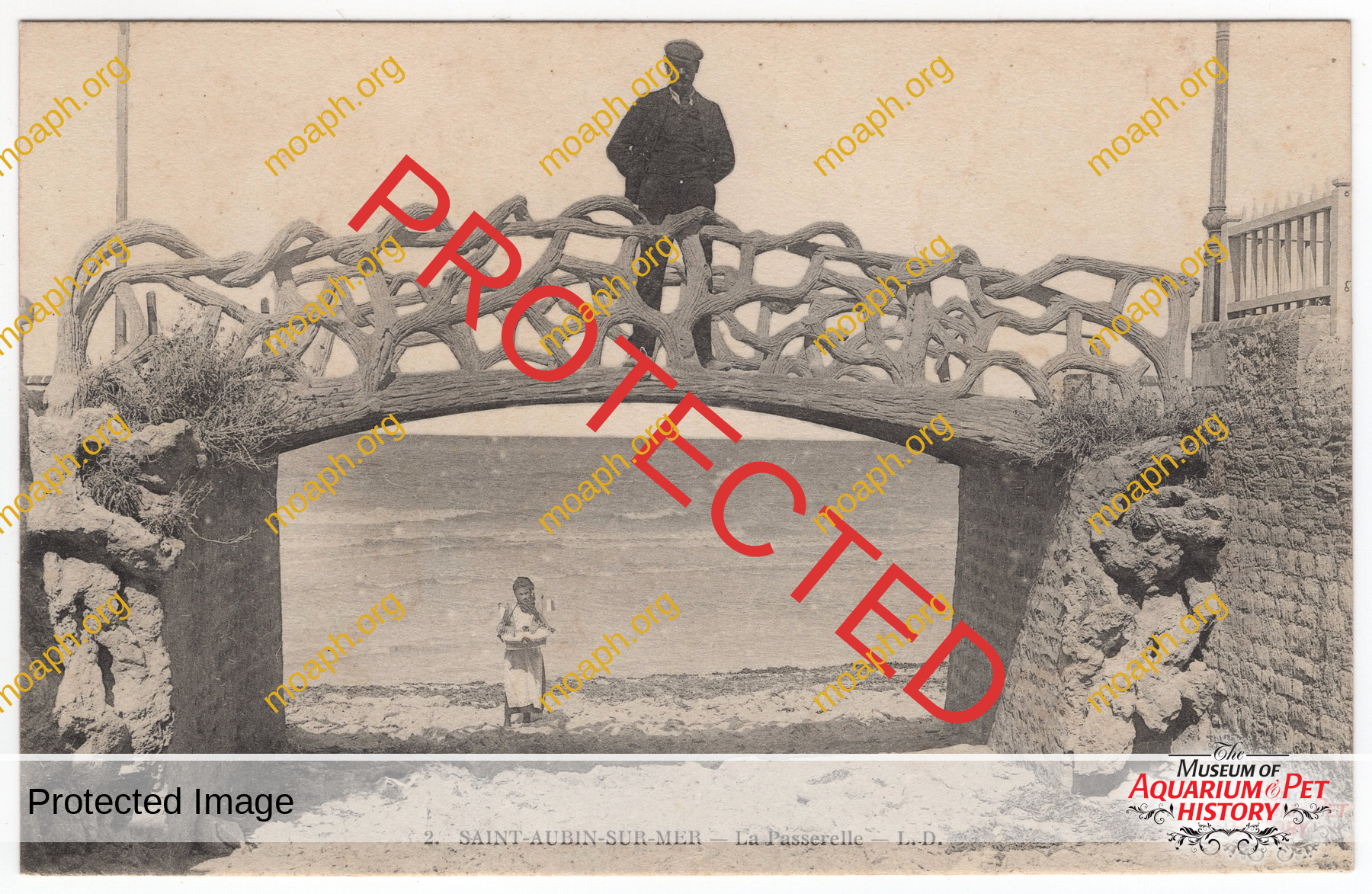
Passerelle (footbridge) on the seaside in Saint-Aubin-sur-Mer, France.
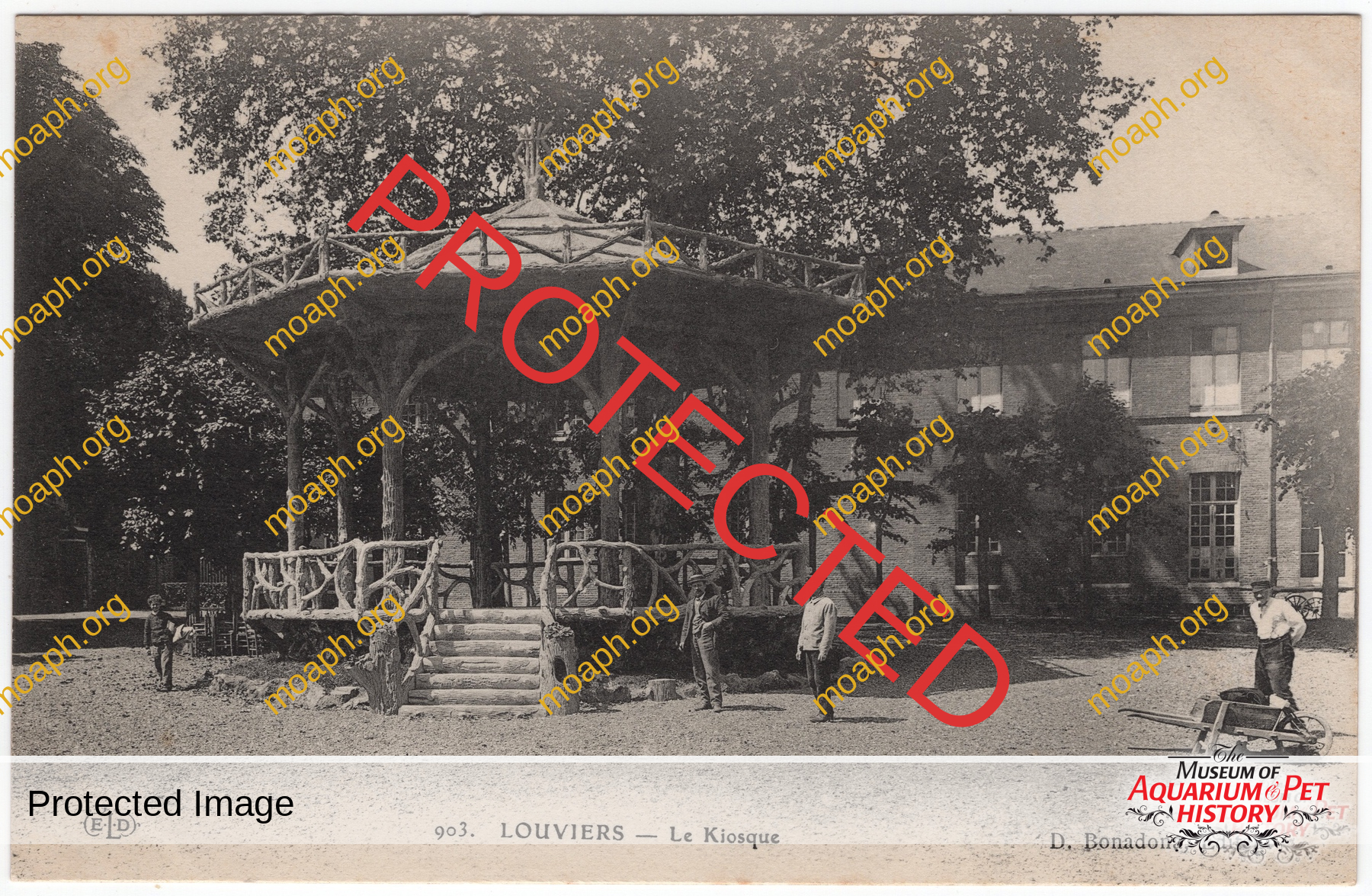
Faux bois music gazebo in Louviers, France, most likely built in the late 1800s.
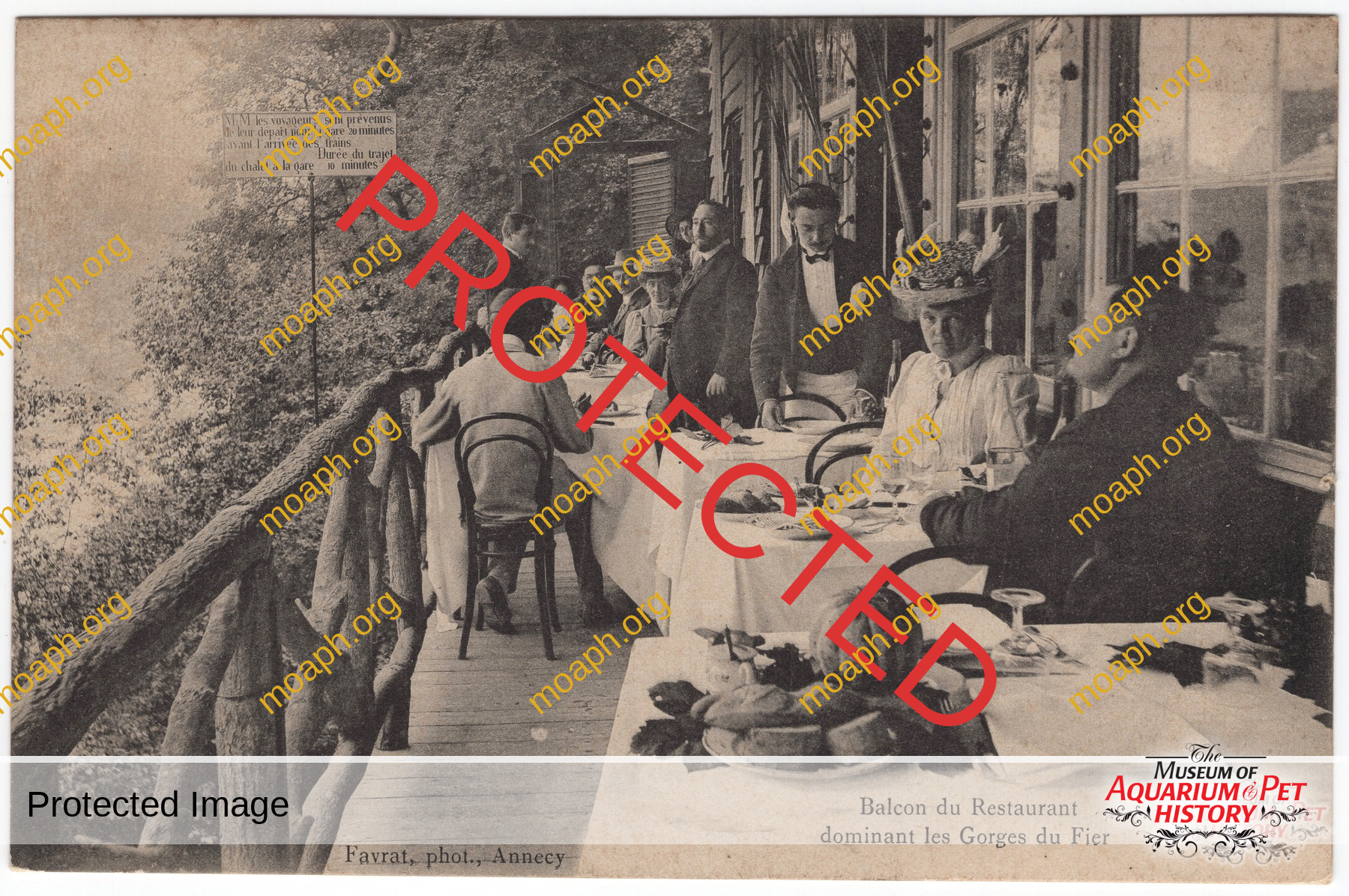
Faux bois railings of a restaurant in Gorges du Fier, Lovagny, France.
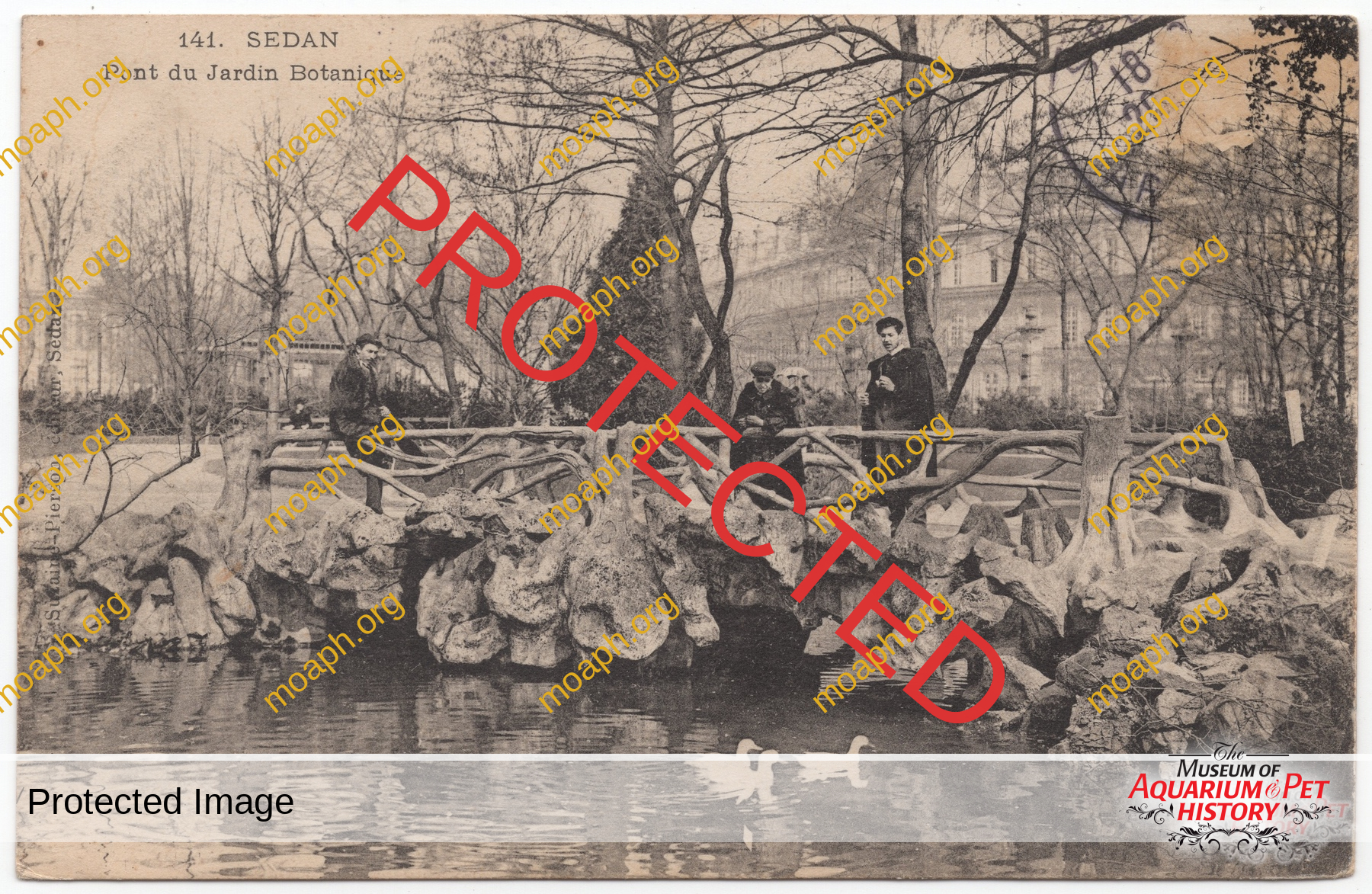
Faux bois bridge at the Jardin Botanique in Sedan, France.
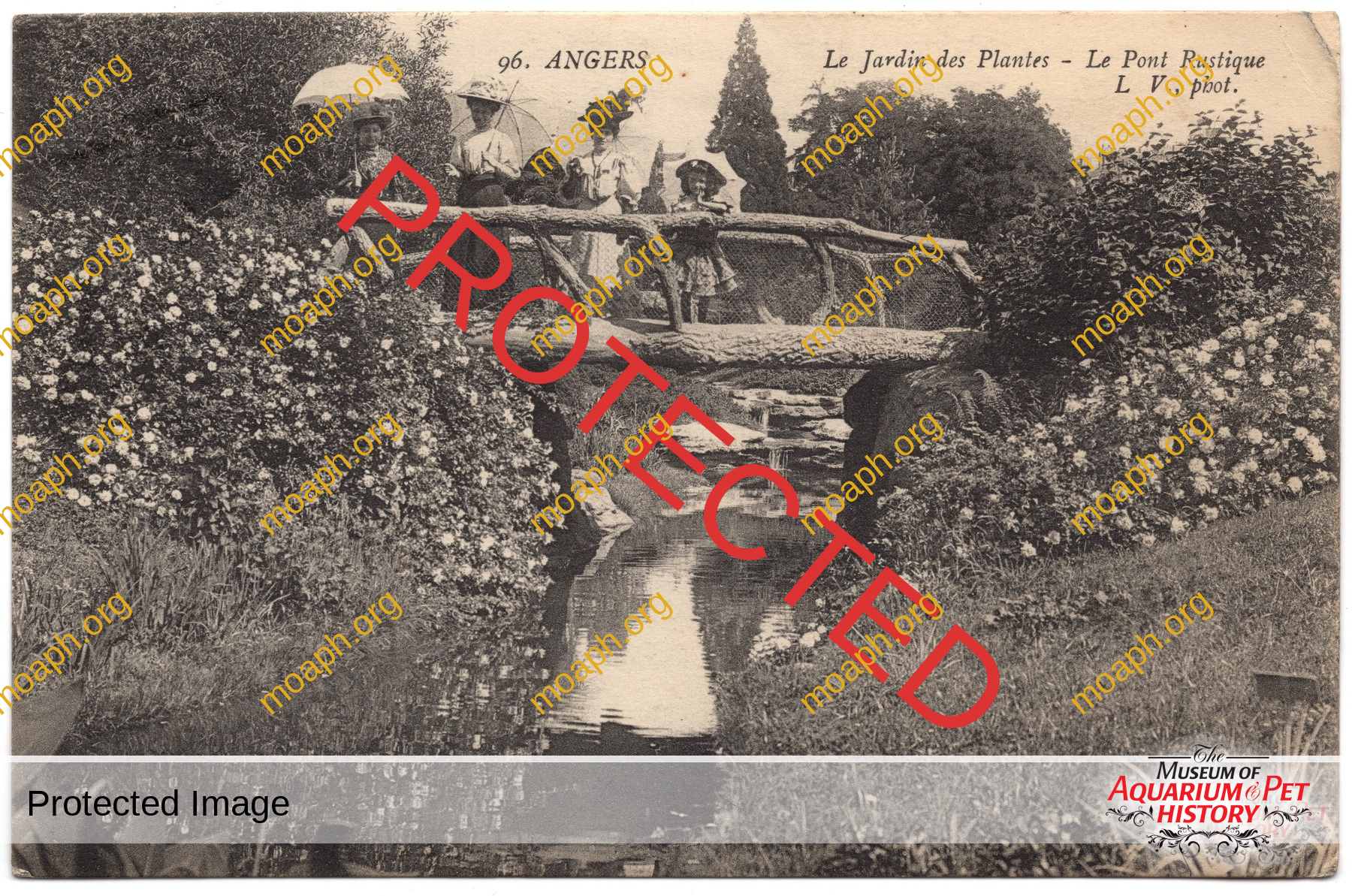
Faux bois footbridge at the Jardin des Plantes in Angers, France.
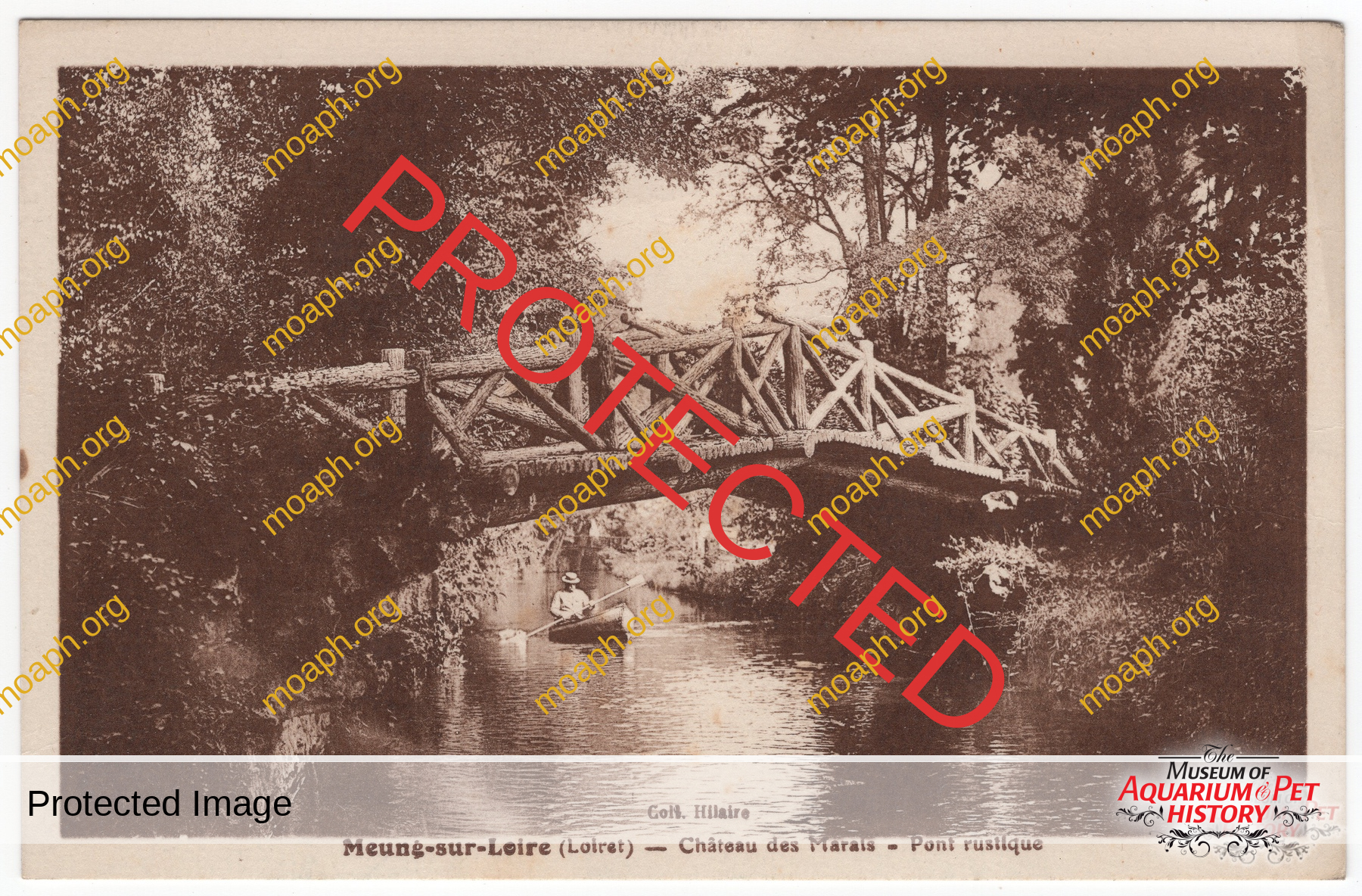
Massive faux bois bridge at Château des Marais in Meung-sur-Loire, France.
During the Belle Époque, the sense of nostalgia and the desire to continue an interaction with the natural world also led wealthy people to buy a second home in the country, and to adorn its garden with faux bois furniture. Moreover, this rustic style complemented other popular design movements such as Art Nouveau, which equally emphasized the beauty of nature and organic shapes.
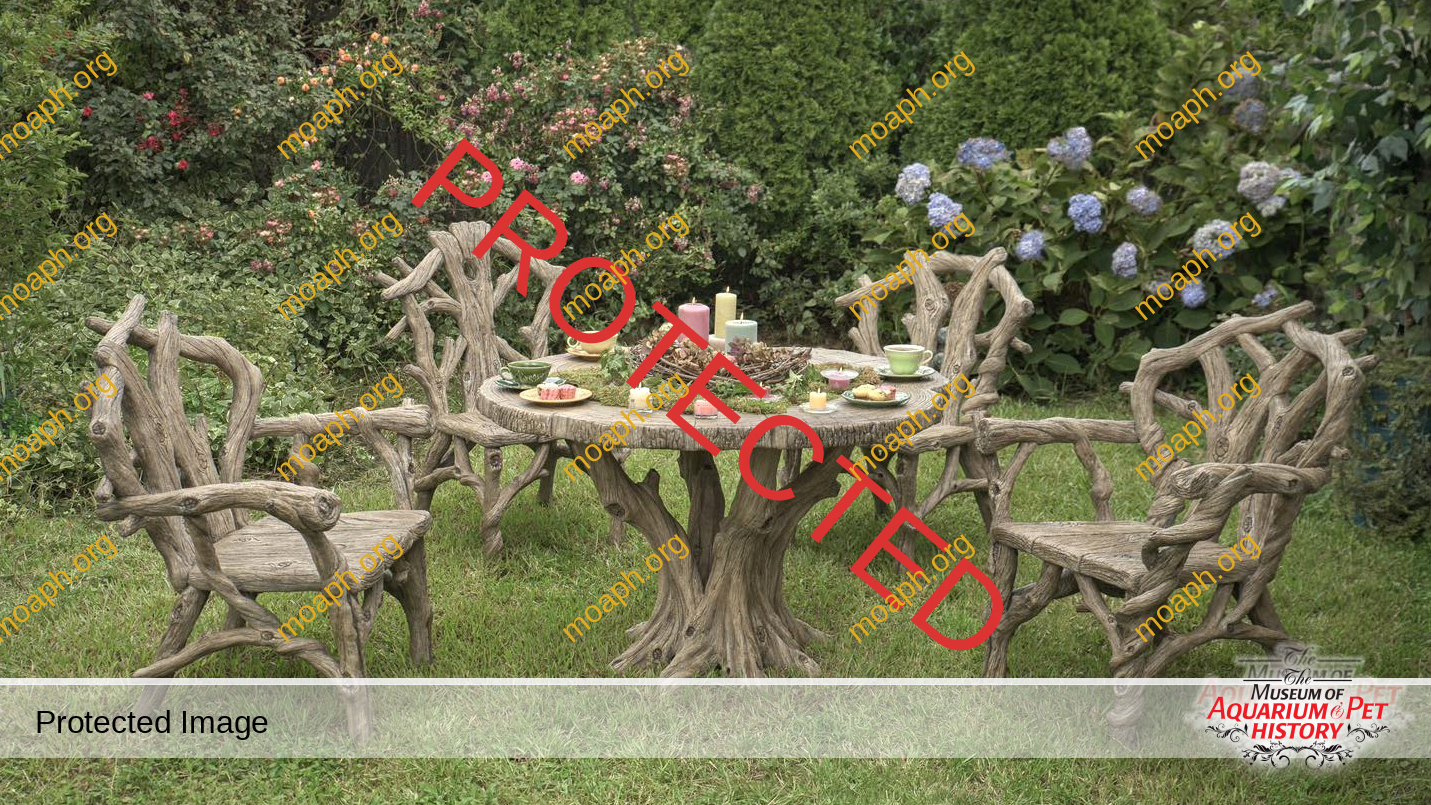
Contemporary concrete faux bois furniture designed and created by the talented American artist Diane Husson. Courtesy of Diane Husson.
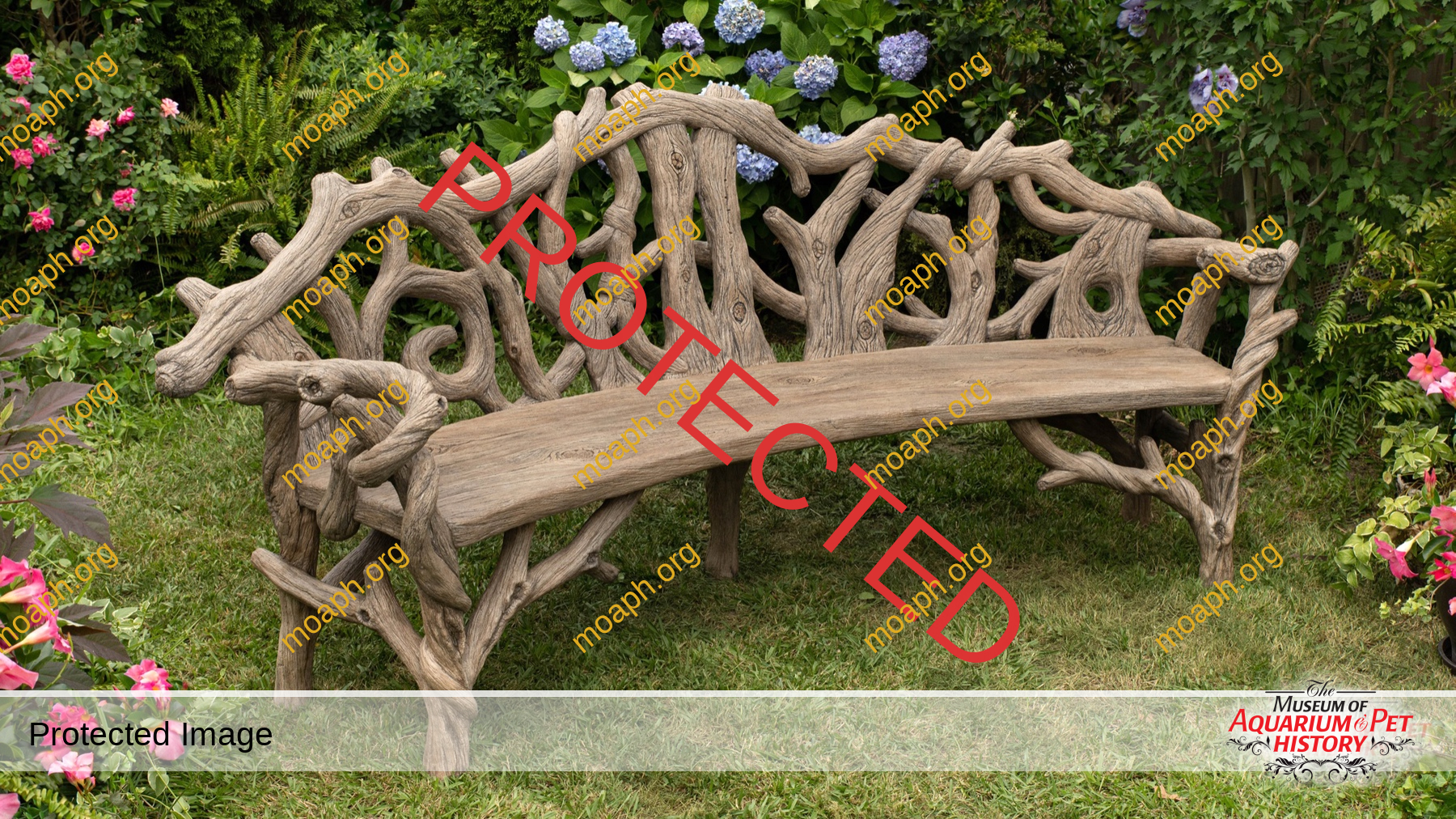
Concrete faux bois bench by Diane Husson. Courtesy of Diane Husson.
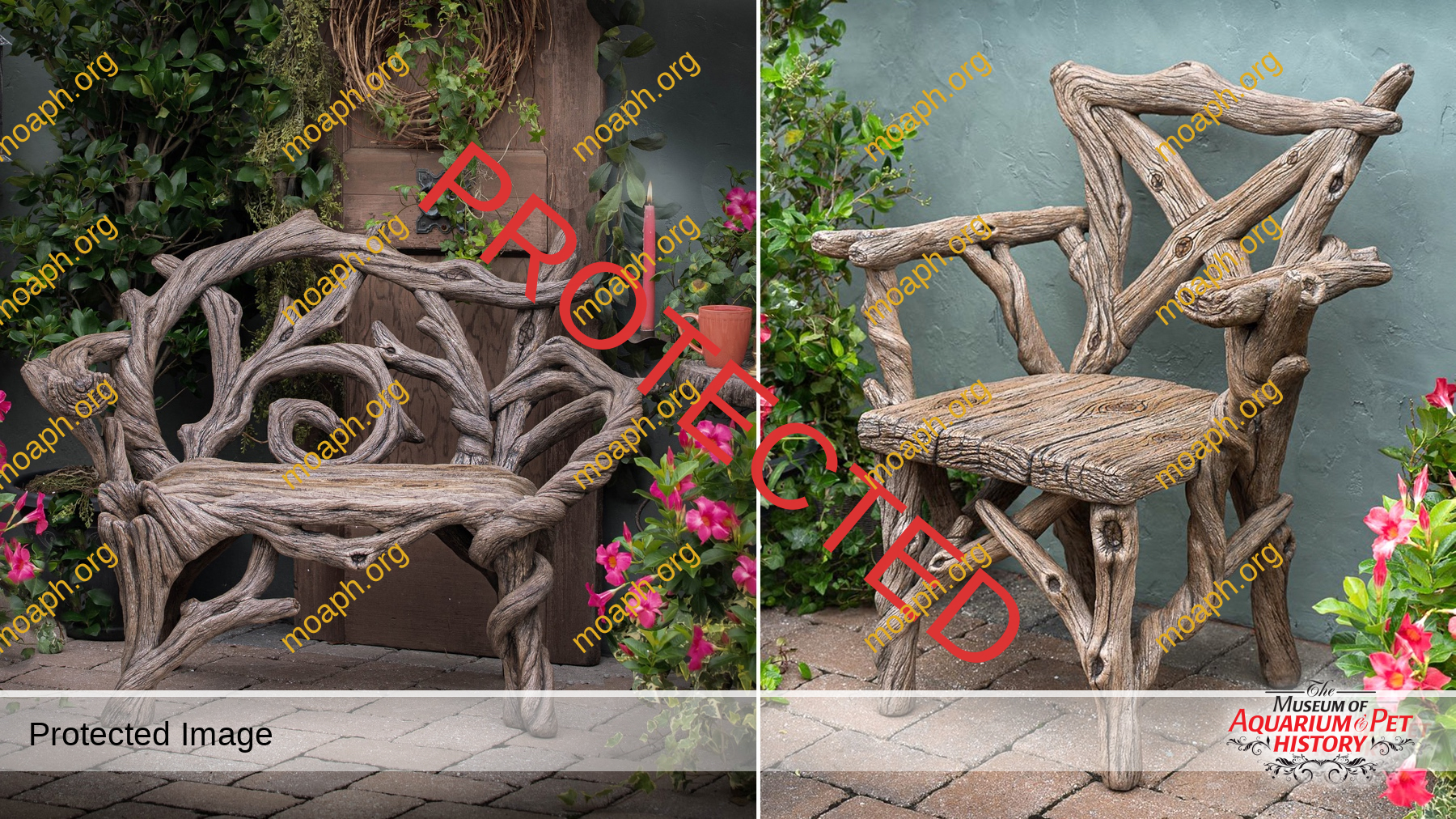
Contemporary artworks for secret gardens and casual homes in the country. Notice the realistic finishes, such as peeling bark and broken branches. Courtesy of Diane Husson.
The horrors of World War I (1914-1918) changed everything in that dreamy society, bringing about the decline of faux bois style, and giving rise to different sources of inspiration for artists. Novelties such as electricity, aircrafts and automobiles revolutionized the everyday life, and led people to look for modern objects for their homes. It was just in those years that the Art Deco movement began to spread.
Aquariums rustiques
Today, faux bois aquariums manufactured in France are rare but not impossible to find. Classic examples of the application of the rustic style in the aquarium industry, they usually have a rectangular shape, a small up to medium size, and an inner metal armature, which was used in the smaller models as well. Their frames are dark brown to black, and usually covered by greenish relief spots made by false moss or plants. Old catalogs confirm two different bottoms for these aquariums rustiques: glass, or sheet metal. Hexagonal models are much more scarce, especially the amazing “gazebo aquarium”, which is equipped with a built-in fountain system driven by a water reservoir hidden inside its hut-shaped roof!
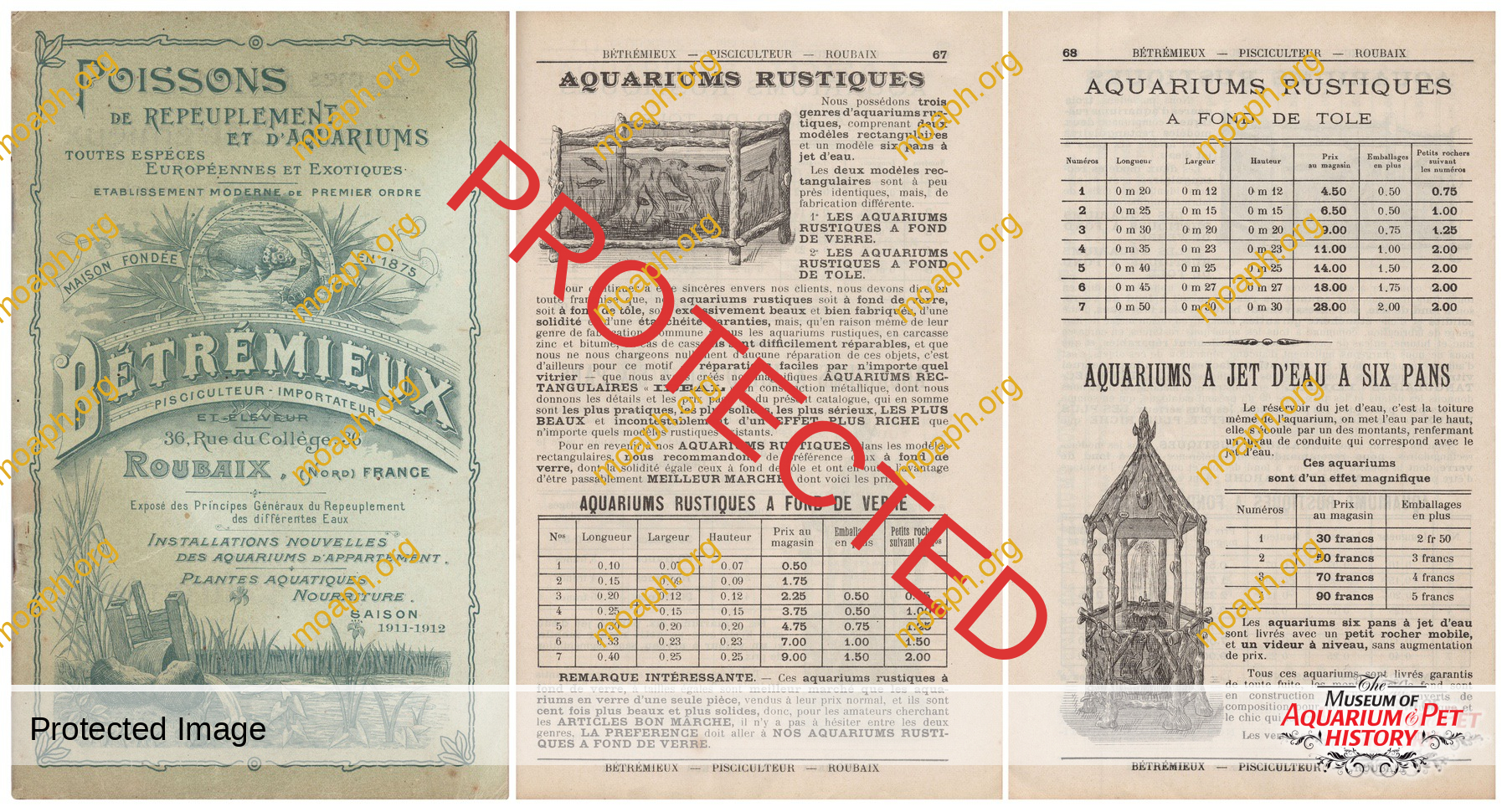
Bétrémieux catalog, 1911-1912. Notice, on the right page, the spectacular gazebo aquarium.
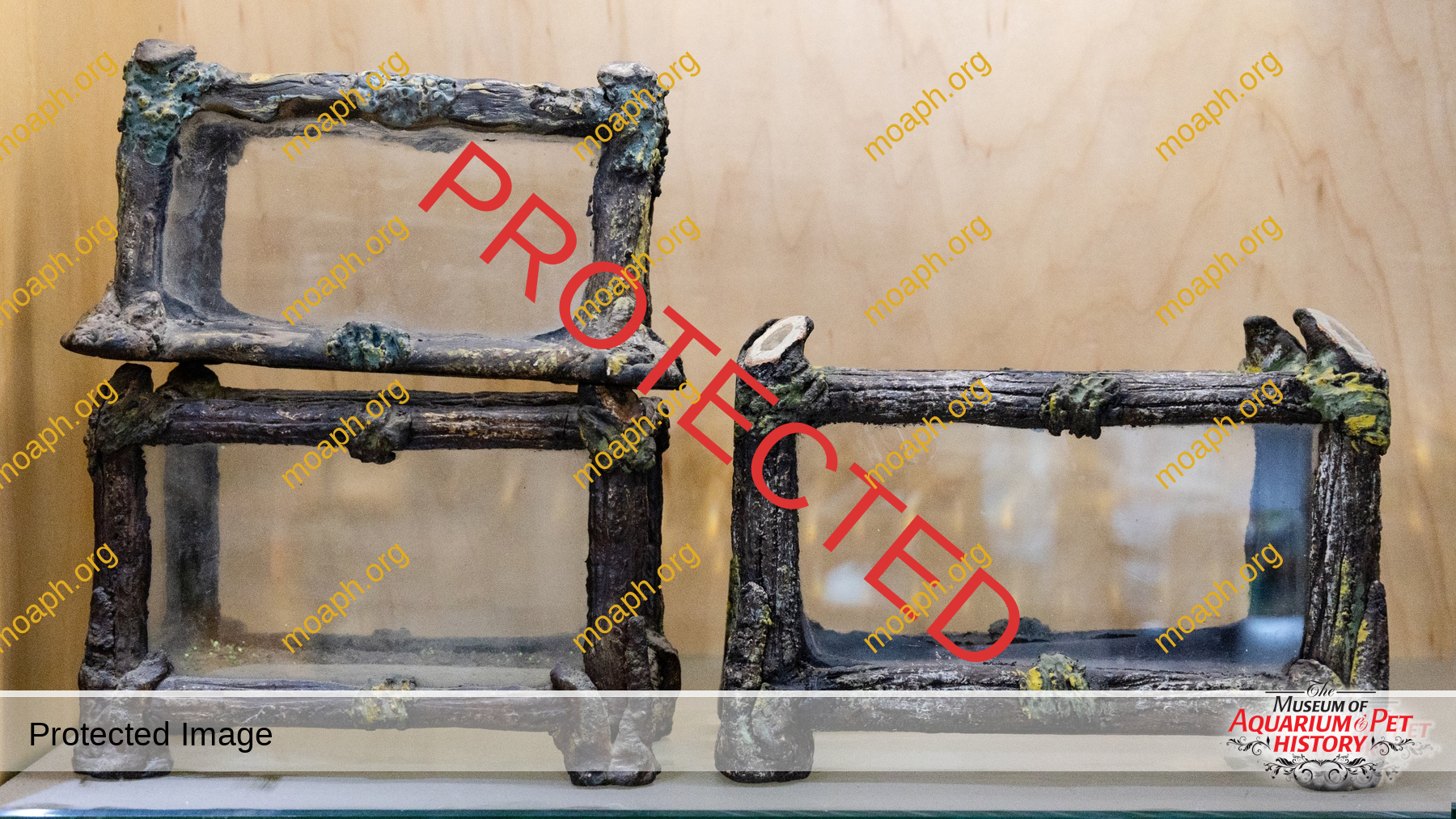
French faux bois aquariums housed at MOAPH.
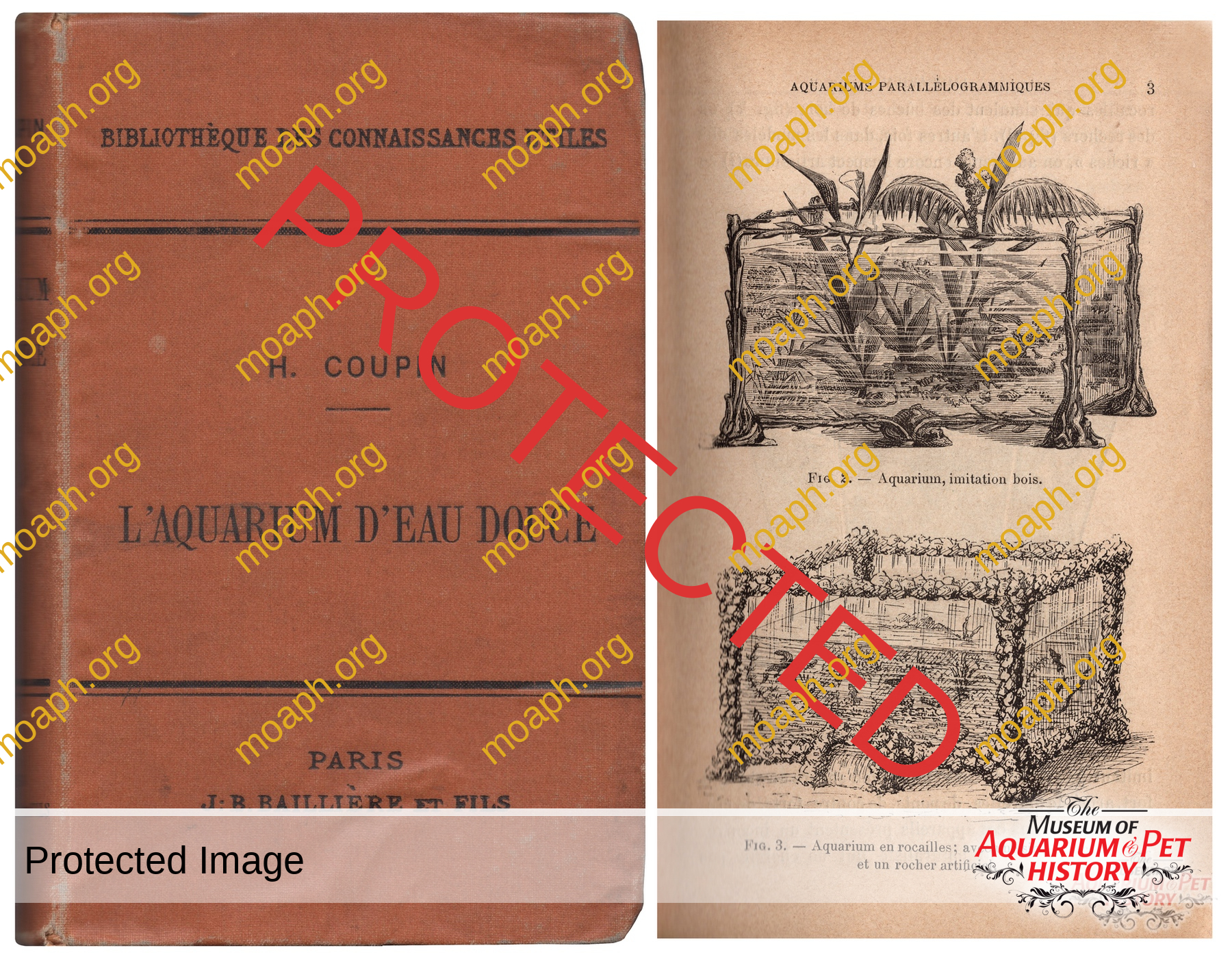
Illustrations of rustic aquariums from the book L’Aquarium d’Eau Deuce by H. Coupin, 1893.
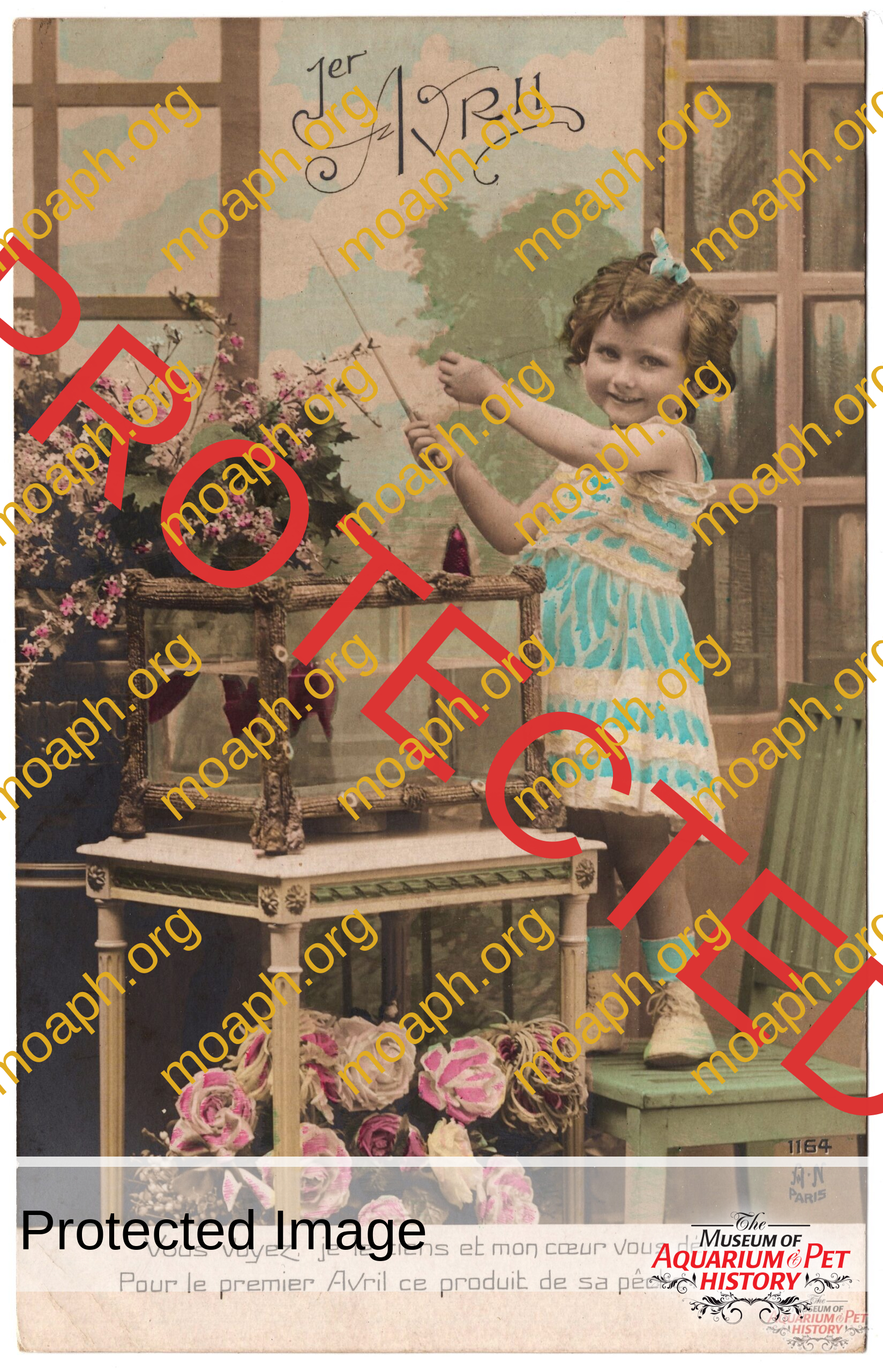
Faux bois aquarium depicted in a French April Fool’s Day picture postcard.
In order to uncover of what material one of my faux bois aquariums from France is made, I asked for the help of a few experts, who after examining the piece all came to the same conclusion: bitumen, probably mixed with small percentages of other materials. Commonly known as “asphalt” in the US, bitumen is an easy to model (once heated) substance which also prevents the aquarium from leaking, and makes the decorative framework waterproof.
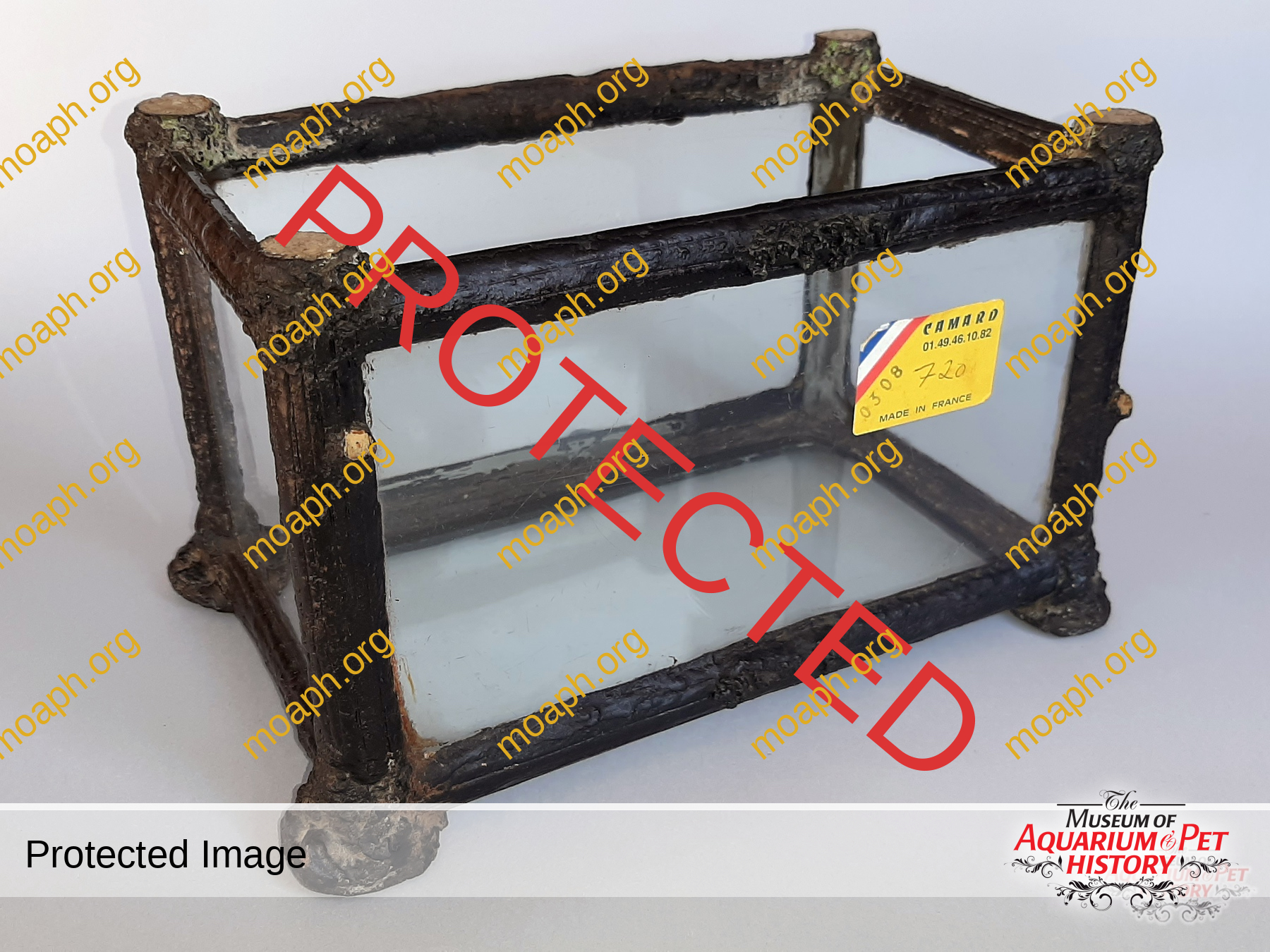
Small faux bois aquarium manufactured in France.
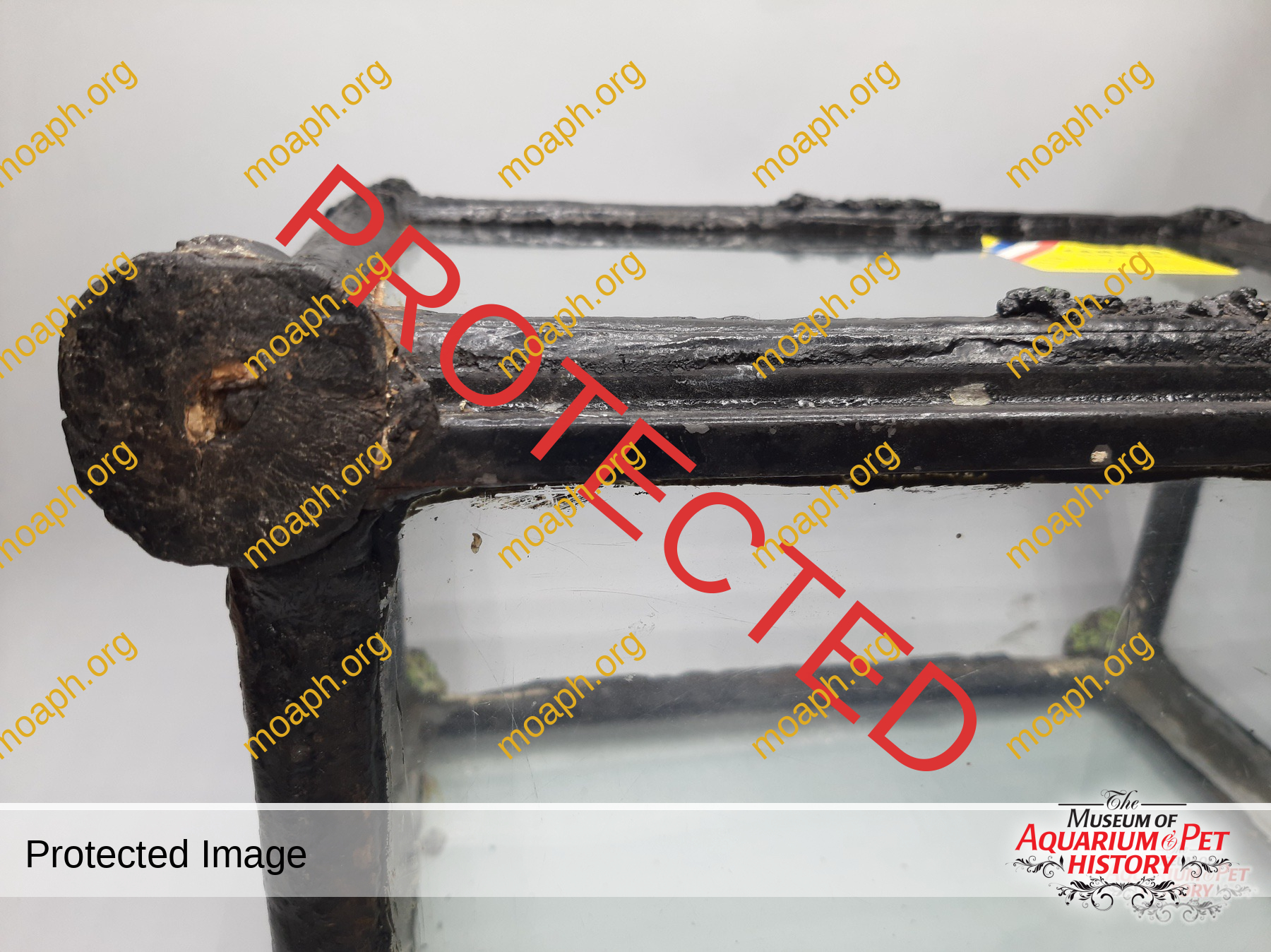
Close-up showing the inner metal frame of a French faux bois aquarium.
That’s why the frame of this aquarium softened and smelled like tar when I tried to heat it up with a torch!
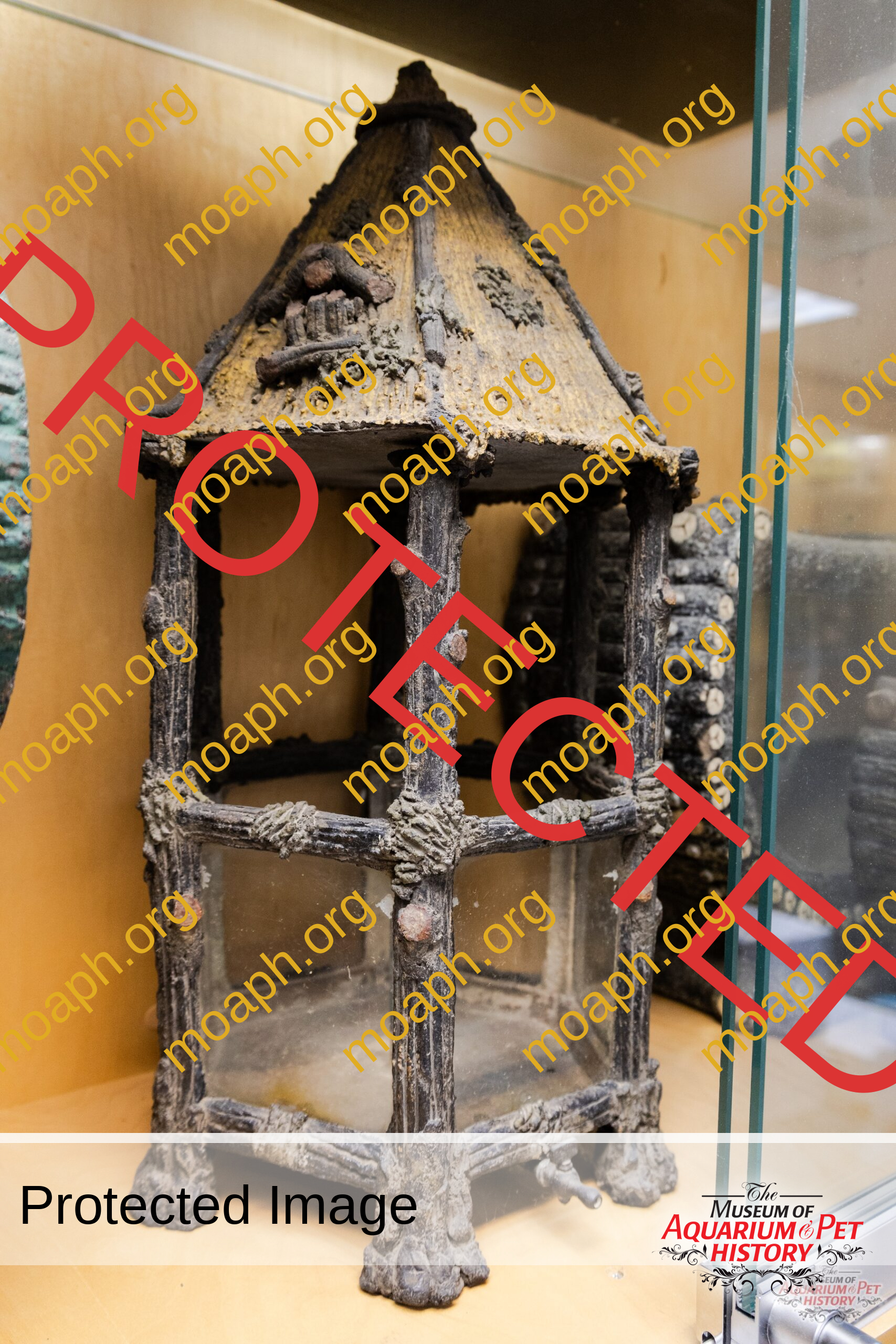
Gazebo aquarium marketed in the late 1920s by The Artistic Aquaria Company (England). This rare piece is preserved at MOAPH.
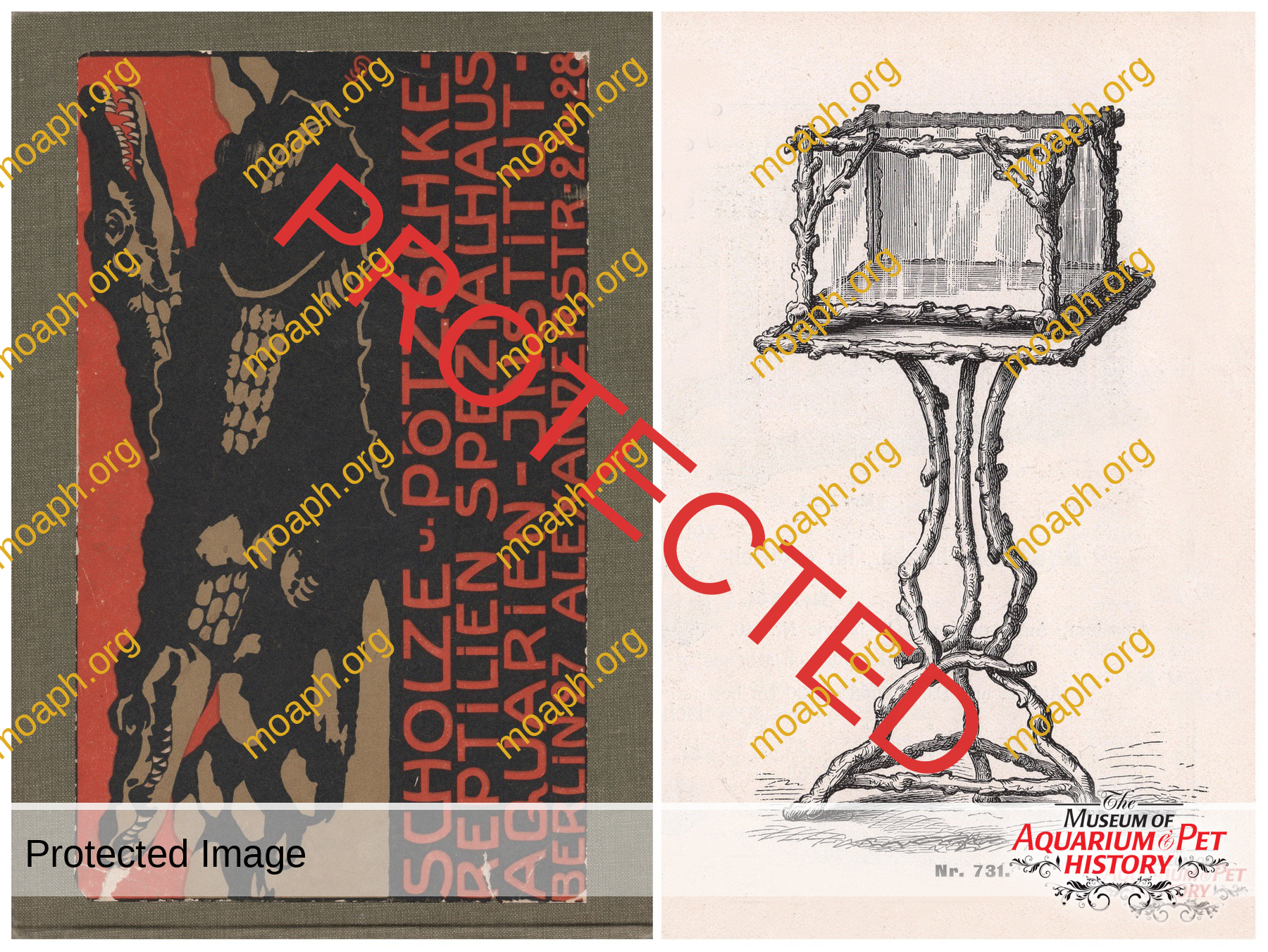
Illustration of a faux bois aquarium with stand from the “crocodile catalog” issued in 1908 by the German company Scholze & Pötzschke.
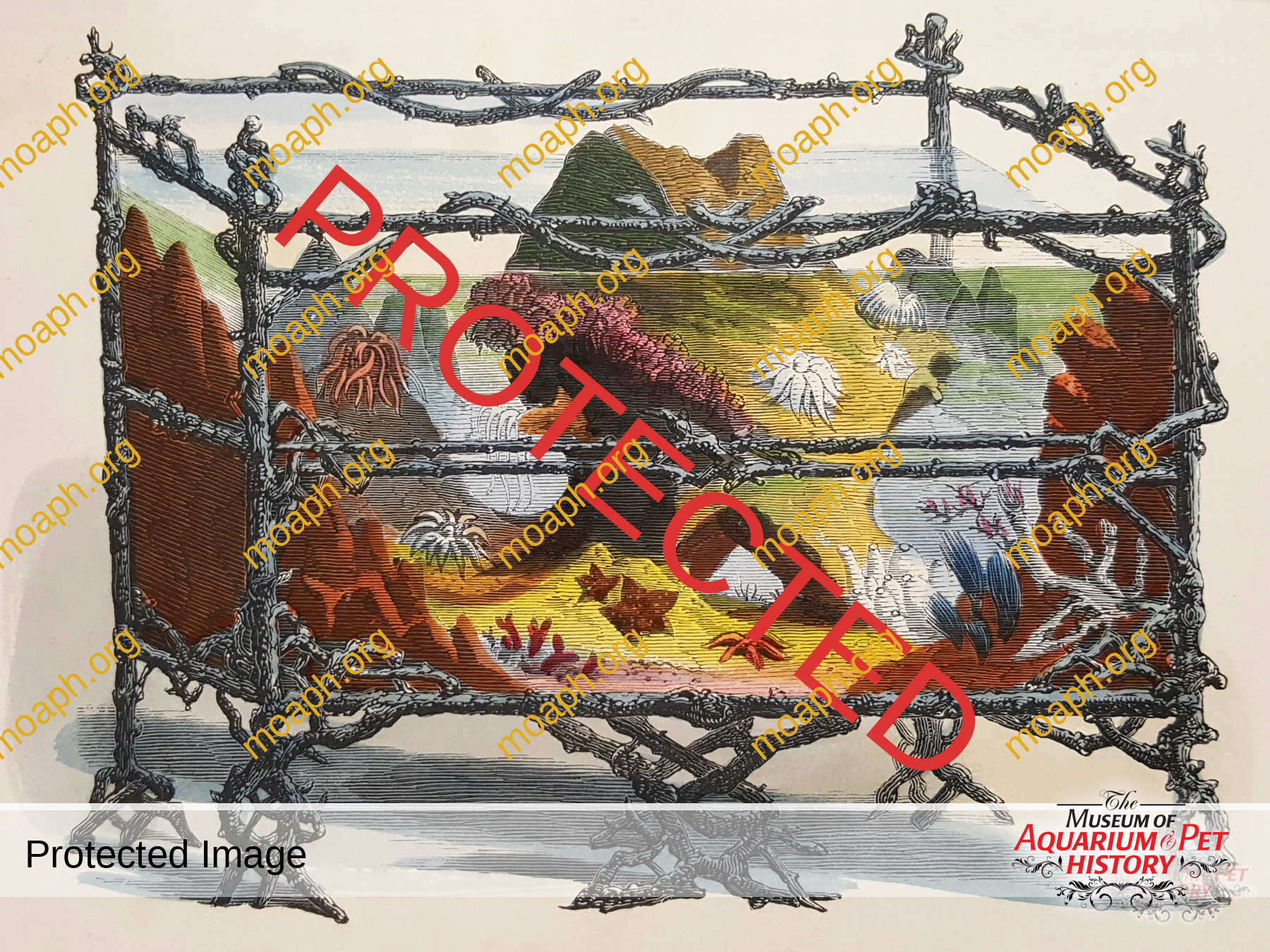
A rustic aquarium design illustrated in H. Noel Humphreys’ 1857 book Ocean Gardens.
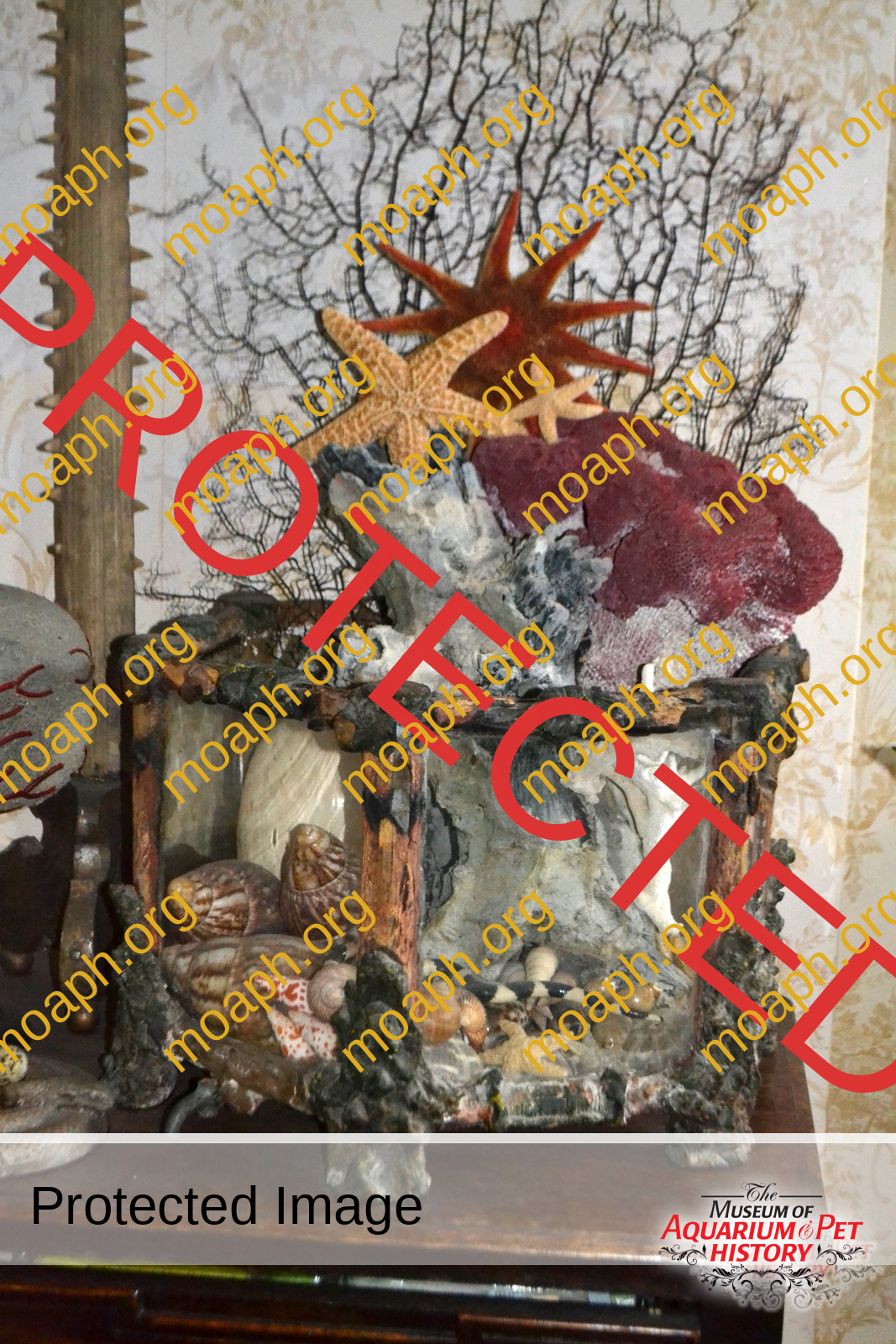
Hexagon faux bois aquarium on display in a cabinet of curiosities. Courtesy of Eckhard Jäger (German collector).
Other collectible and much sought-after faux bois aquariums come from the United States, although concrete-made faux bois didn’t really arrive in this country until the 1920s (one of the early artists was Dionicio Rodríguez), after faux bois as a style had pretty much died out in France and the rest of Europe. These little jewels have been manufactured in Philadelphia, from the mid-1870s, using a material different from concrete. In those years, there were multiple terra cotta works operating in the southeast Pennsylvania region, an area notably rich with clay deposits. They were producing mostly utilitarian objects such as sewer pipes and bricks.
The Cassel brothers
One of those factories, Fair Hill Terra Cotta Works by H. C. Cassel & Bro., from Philadelphia, specialized instead in garden supplies and, uniquely, aquariums. Its founders, Jacob C. Cassel (1849-1919) and Henry C. Cassel (1851-1944), came from a family of farmers in Montgomery County, Pennsylvania, and started the business approximately in 1873. The first location of the company was at 2341 North Seventh Street, in close proximity to Fairhill (or Fair Hill), a neighborhood where countless families of German Catholic immigrants settled during the 1880s-90s.
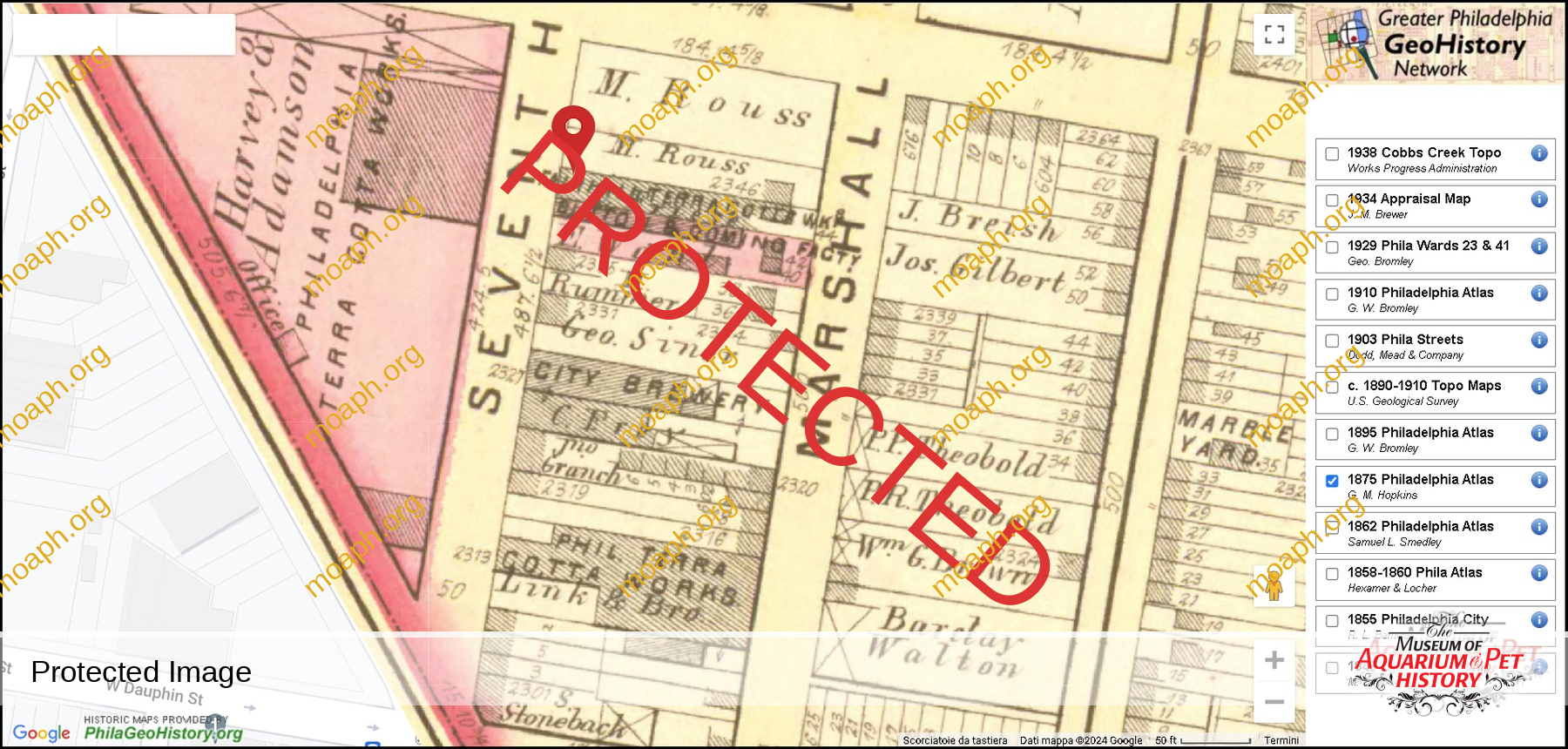
This map from 1875 shows the first location of Fair Hill Terra Cotta Works. Notice that at least two other terra cotta works operated in such a small area. Map source: Greater Philadelphia GeoHistory Network.
Among the early, clever steps the two brothers took to enlarge the business, was the acquisition of all stocks, molds, fixtures and materials that belonged to John Fritz, another Philadelphian manufacturer of terra-cotta wares. Besides, they soon started to promote their products by issuing illustrated wholesale catalogs. Speaking of these, it’s hard to find out how many editions were published. Furthermore, the few copies known at the present are undated. In this article, I will specifically refer to a couple of examples which I carefully studied, calling them “catalog 1” and “catalog 2” respectively: the one available on the Internet Archive, which is probably one of the early editions but not the first one, and the copy preserved at the Winterthur Museum, Garden & Library, which is undoubtedly a later edition.
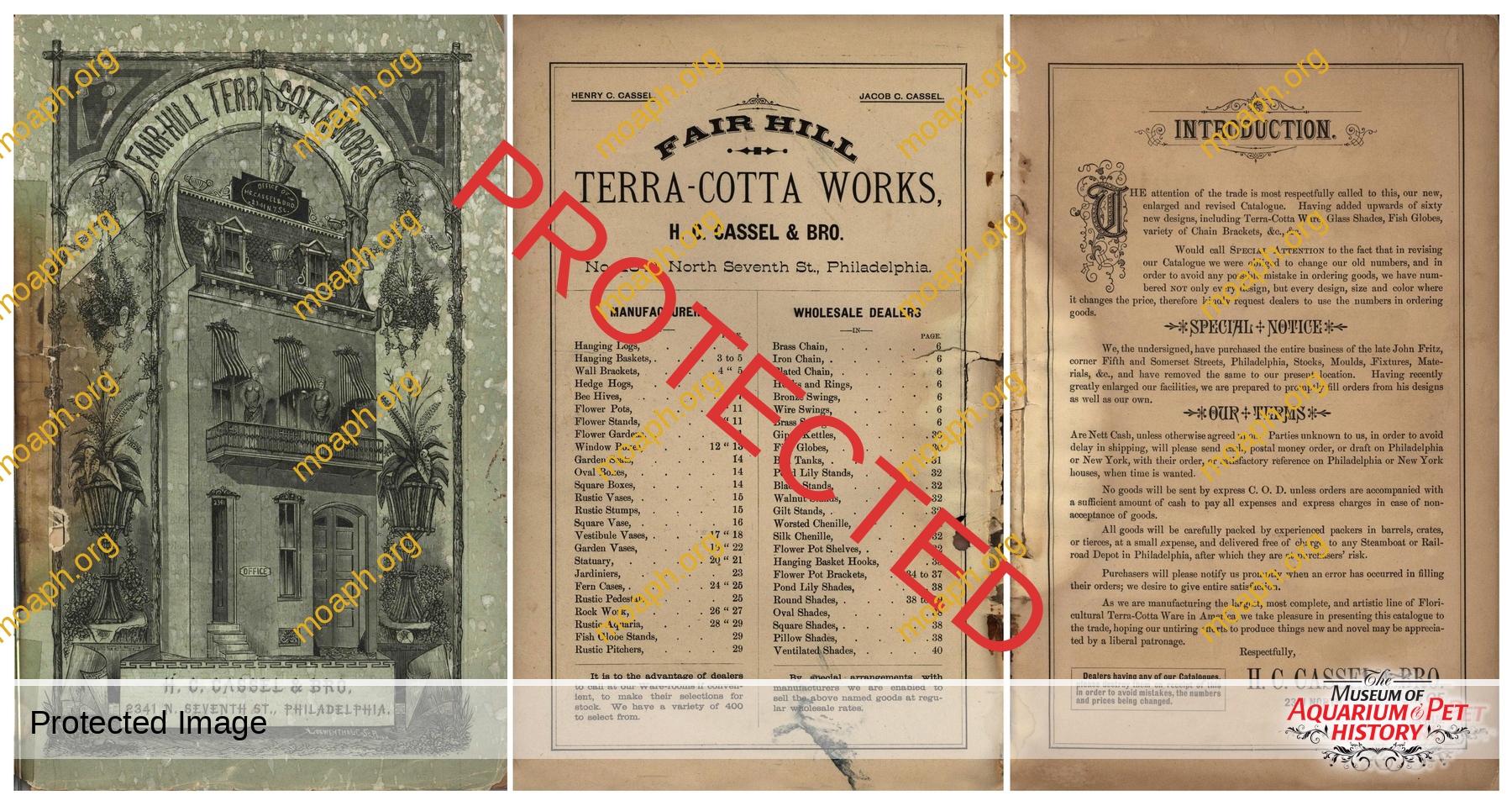
Catalog 1, cover and first 2 pages. Image source: Internet Archive, public domain.
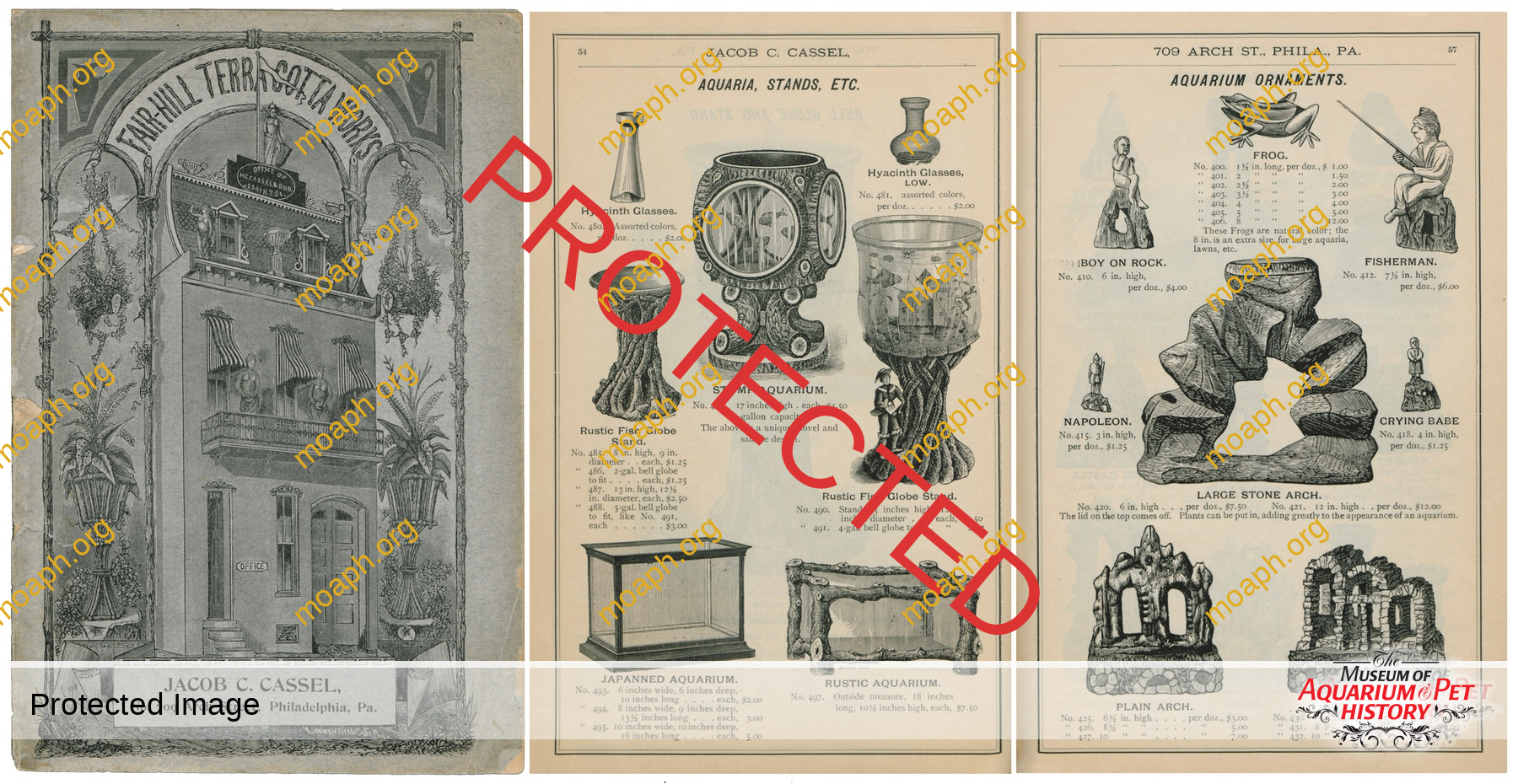
Catalog 2, cover plus pages 54 and 57. This catalog encompasses also a few garden supplies made of actual wood. Courtesy of Winterthur Museum, Garden & Library.
These exceedingly rare catalogs are the “unicorns” of all collectors of aquarium and horticultural trade literature. But, why are they so rare nowadays? Part of the responsibility lies unquestionably with the Cassel brothers themselves, who recommended that their clients destroy the previous catalog once they received the new edition! In catalog 1, for example, the following statement is printed on multiple pages: “Dealers having any of our Catalogues will please destroy them on receipt of this, in order to avoid mistakes; the numbers and prices being changed.”
Different paths?
The full-page illustration on the cover of catalog 1 and 2 was engraved on wood by G. C. Loewenthal, and depicts an elegant building that, as I see it, was not imaginary but really existed back then. Exploring the original site of the Fair Hill Terra Cotta Works with Google Street View, in fact, one can spot a few nearby historical buildings with similar architectural features.
About catalog 2, it’s interesting to note that Henry’s name disappeared from the main trade banner on the bottom of the illustration, while it survived in the small decorative capstone drawn on the roof of the facility. His name soon vanished even from the advertisements published in garden catalogs and garden sections of newspapers. What happened exactly at some point in their history (probably before 1883) is not clear. Doing research on FindaGrave.com, I discovered that his grave is located in California, thus one could speculate that he left the city. The same website, however, suggest that Philadelphia County (or exactly the city of Philadelphia) was the birthplace of all the children he had from his wife Ann from 1874 till 1889. Perhaps, Henry preferred to stay behind the scenes, maybe he was just the “money man”, or he simply took a different path from his brother.
Fair Hill Terra Cotta Works was primarily a garden supplier, but also offered a fascinating array of fish tanks, stands and aquarium decorations, all manufactured in-house. Besides, the factory imported from New York (only on order, I presume) a few spectacular models of cast iron fountain aquariums by the J.W. Fiske Company, an influential firm during the “iron age of aquariums”. Other imported products such as glass fishbowls, iron brackets, and slate bottomed tanks completed the offerings for the fishkeepers of the time.
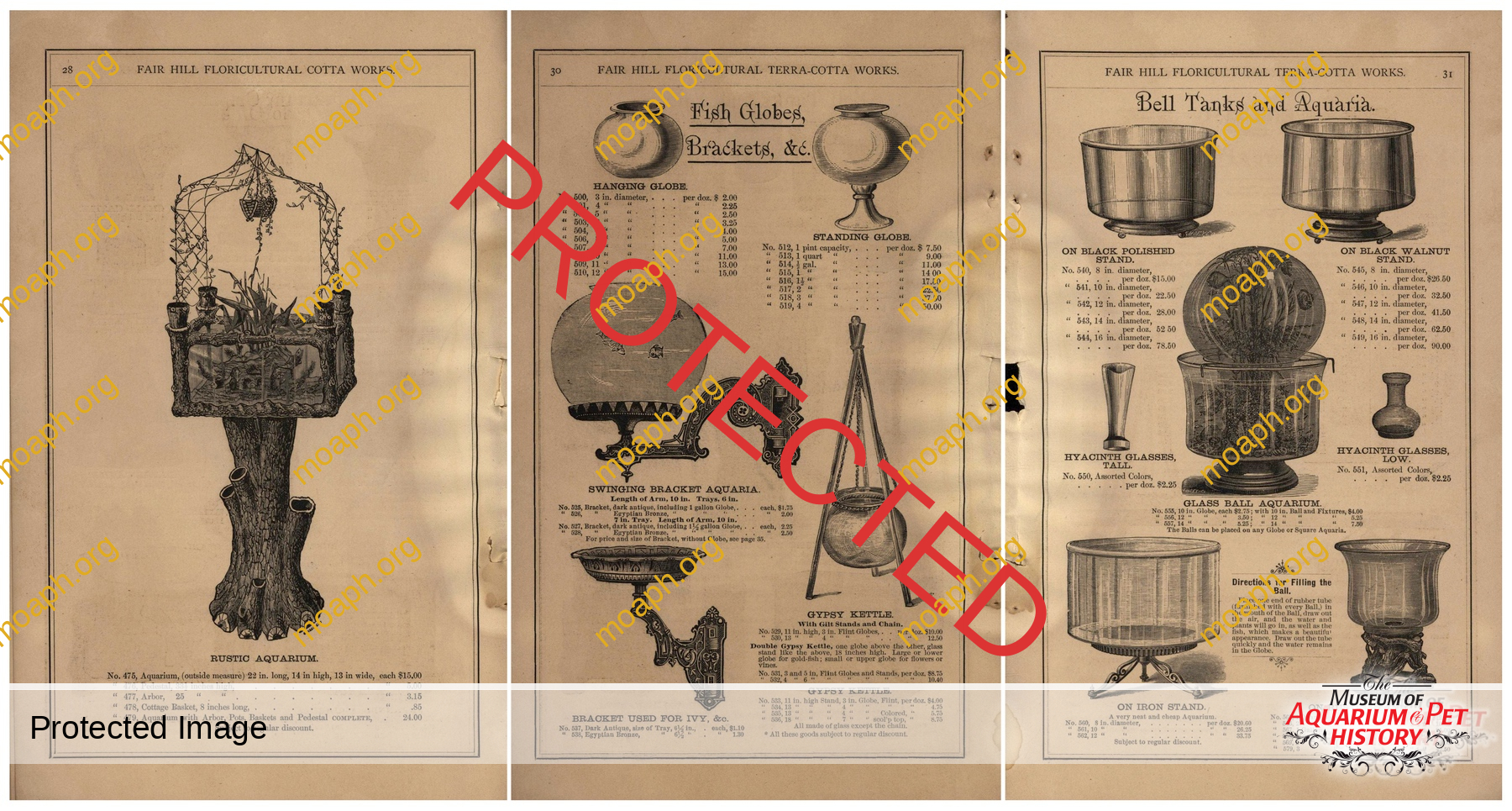
Page 28, 30, and 31 of catalog 1. Image source: Internet Archive, public domain.
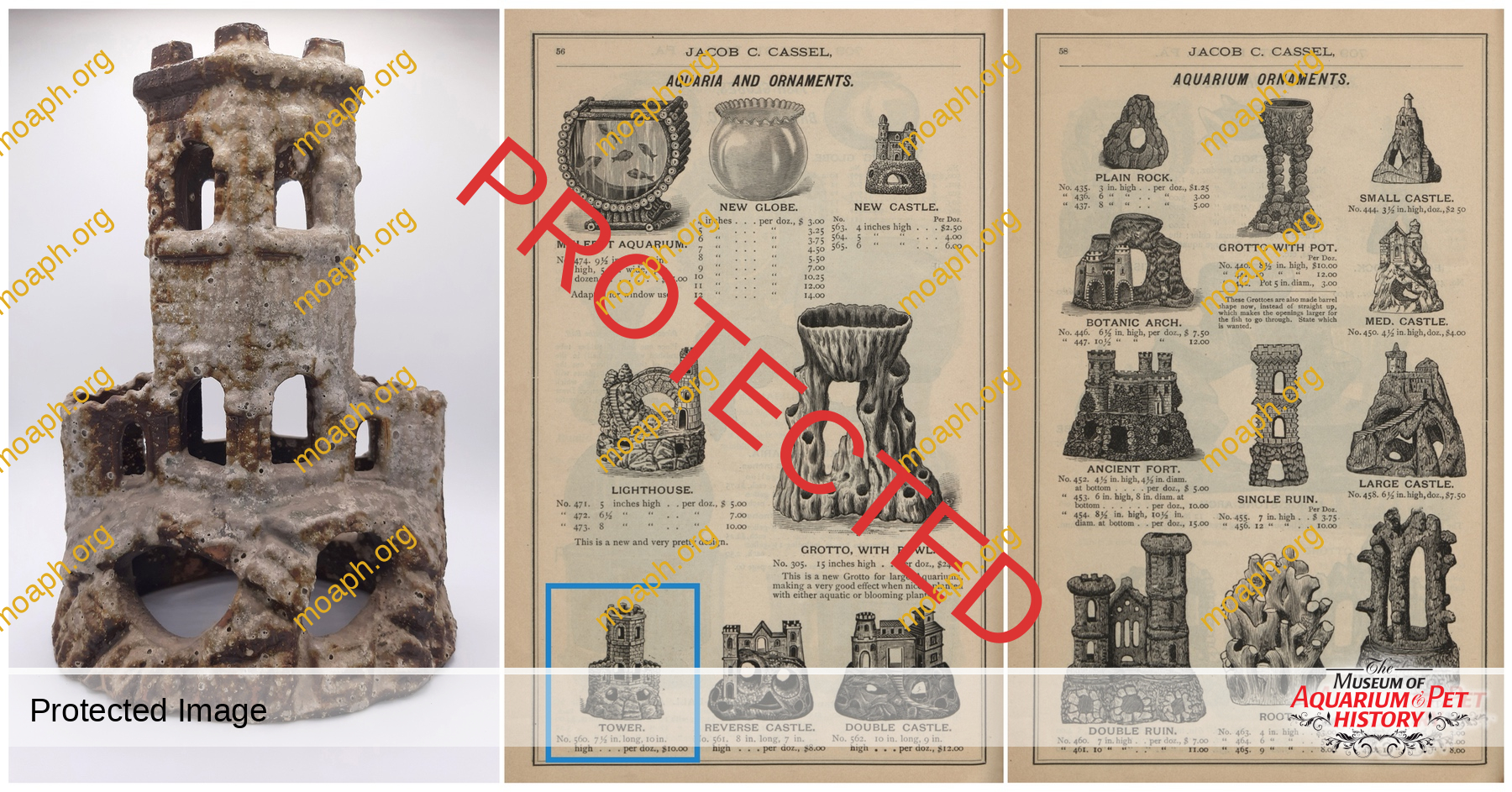
Aquarium ornaments manufactured by Fair Hill Terra Cotta Works (catalog 2). The Tower was one of the biggest pieces. Notice the wholesale prices for dealers. Courtesy of Winterthur Museum, Garden & Library.
Terra cotta meets the American rustic style
The Cassel brothers started to manufacture rustic fish tanks by taking advantage of the same designs, tools and materials from the garden supply production line. A confirmation of this comes from page 12 of both catalogs, where the following statement is printed under the Square Panel Pot and the Large Square Box: “Either the Square Pot or Box will be made into Aquariums to order. We do this by cutting out the sides and inserting glass. Price of Aquarium each, $6.00.”
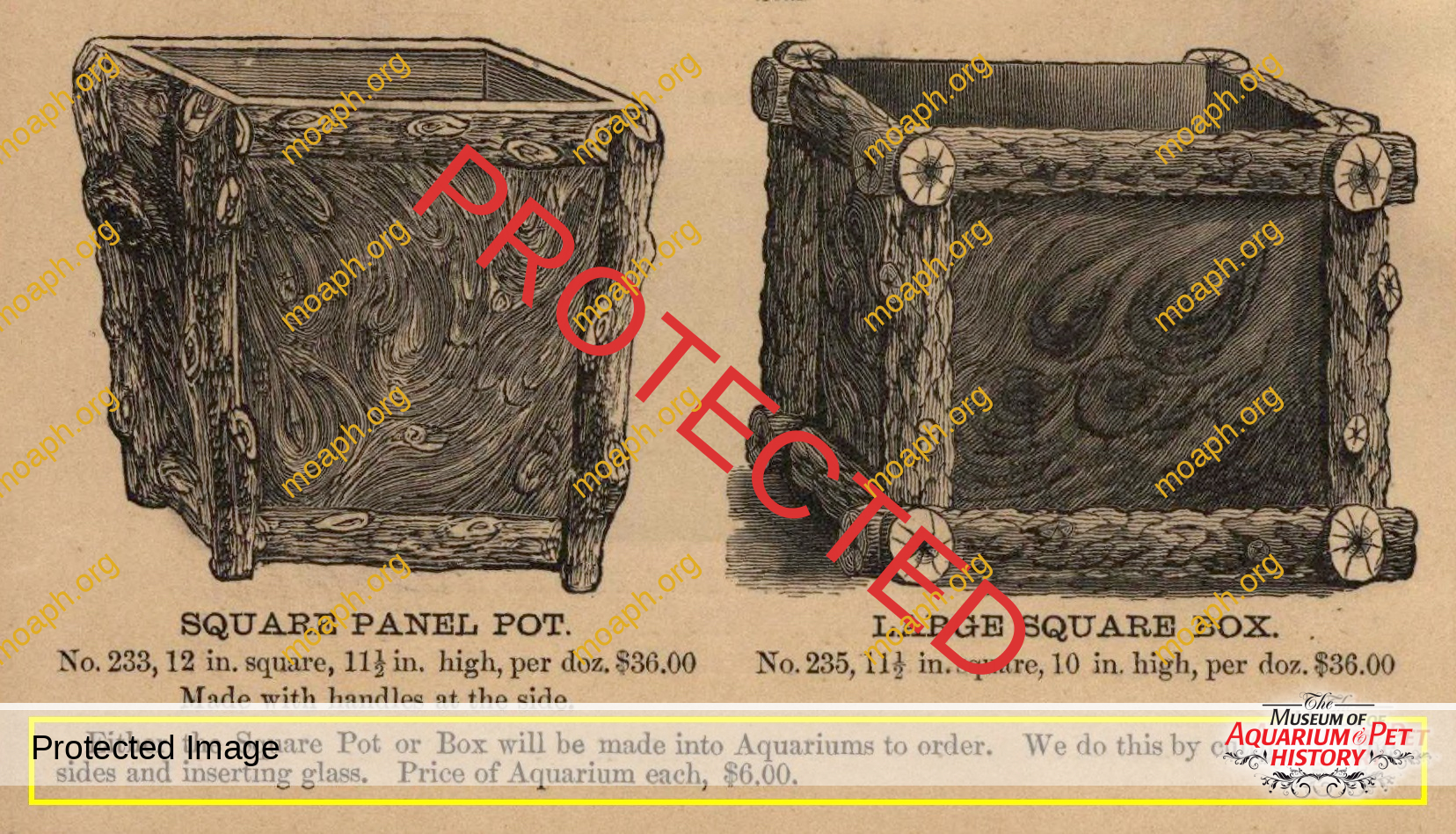
Pag. 14 of catalog 1. Image source: Internet Archive, public domain.
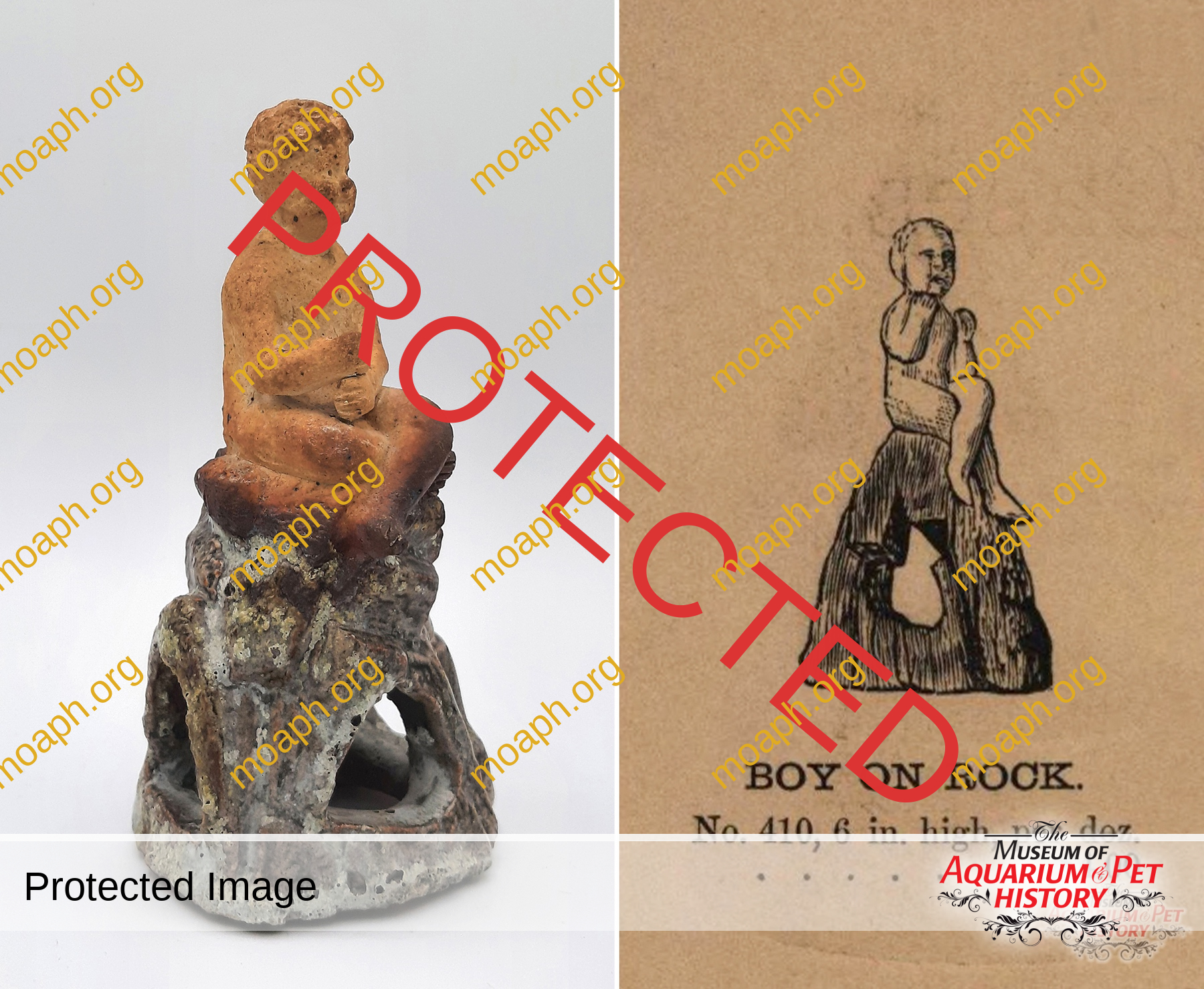
A few ornaments manufactured by Fair Hill Terra Cotta Works, such as the Boy on Rock in this picture, the Fisherman, the Crying Babe, and the Napoleon, are almost impossible to find nowadays.
Behind the design of many of their terra-cotta wares there was certainly the American rustic style, characterized by a heavy use of natural materials such as wood, and dominated by design elements like logs, twigs, branches, roots and stumps. Rustic work and “tree art” were quite popular, and also influenced other terra cotta artists of the time, including the above mentioned John Fritz.
Instead, it’s hard to imagine that the two brothers may have drawn inspiration from French faux bois. After all, those who were rocailleurs practiced their art quite far from Philadelphia. In 1876, however, France joined the huge Centennial International Exhibition which took place in Philadelphia. Thus, one could speculate that Jacob and Henry had the opportunity to see a few concrete faux bois artworks during the event. Hugo Mulertt (1848-1927), a German immigrant known as the “father of the aquarium hobby in America”, attended the exhibition, and won multiple awards thanks to his fancy goldfish. We will talk again about him shortly.
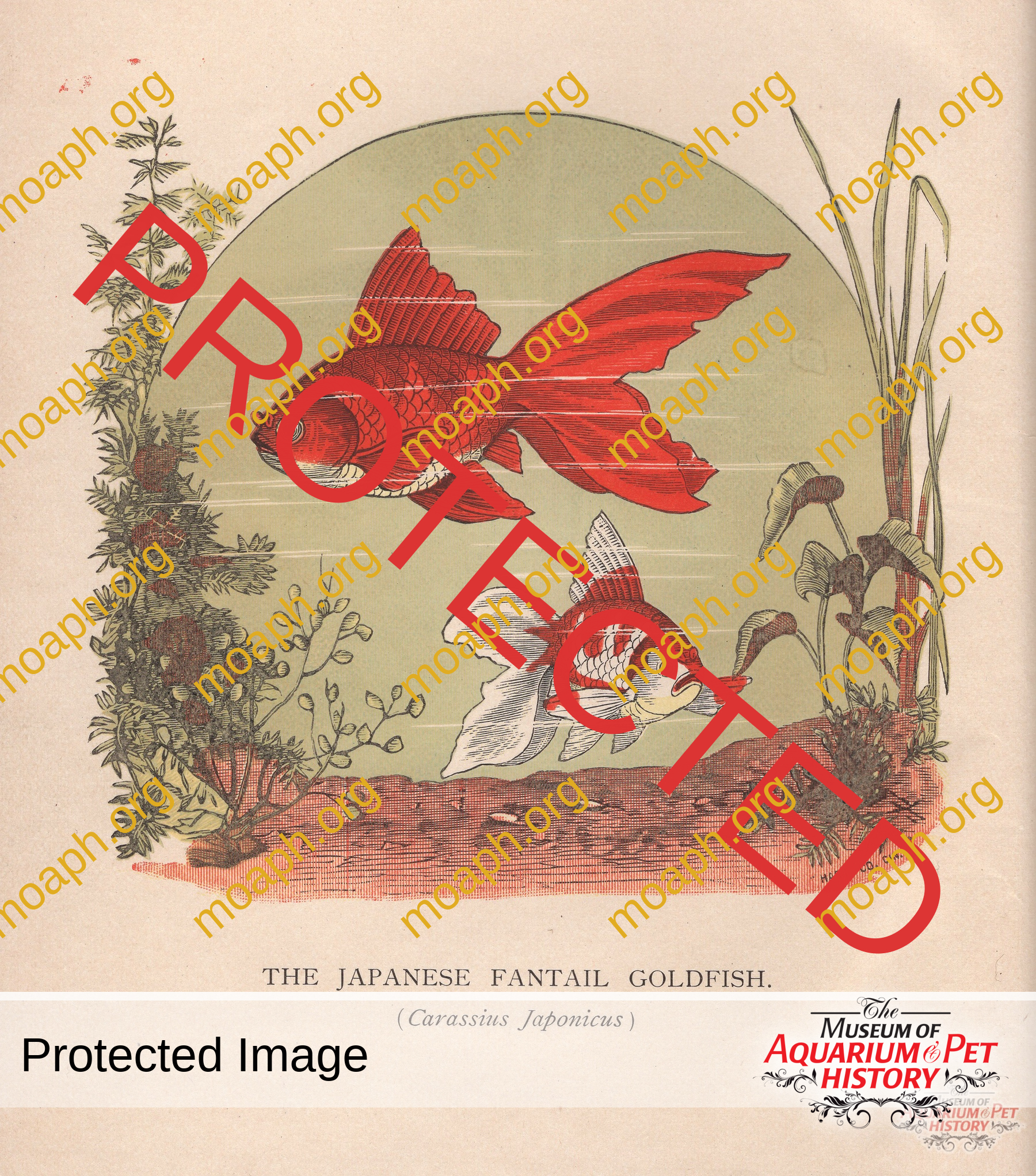
In 1883 Mulertt reported that the yearly volume of goldfish sold in the United States was 2,000,000, with an estimated value of $300,000.
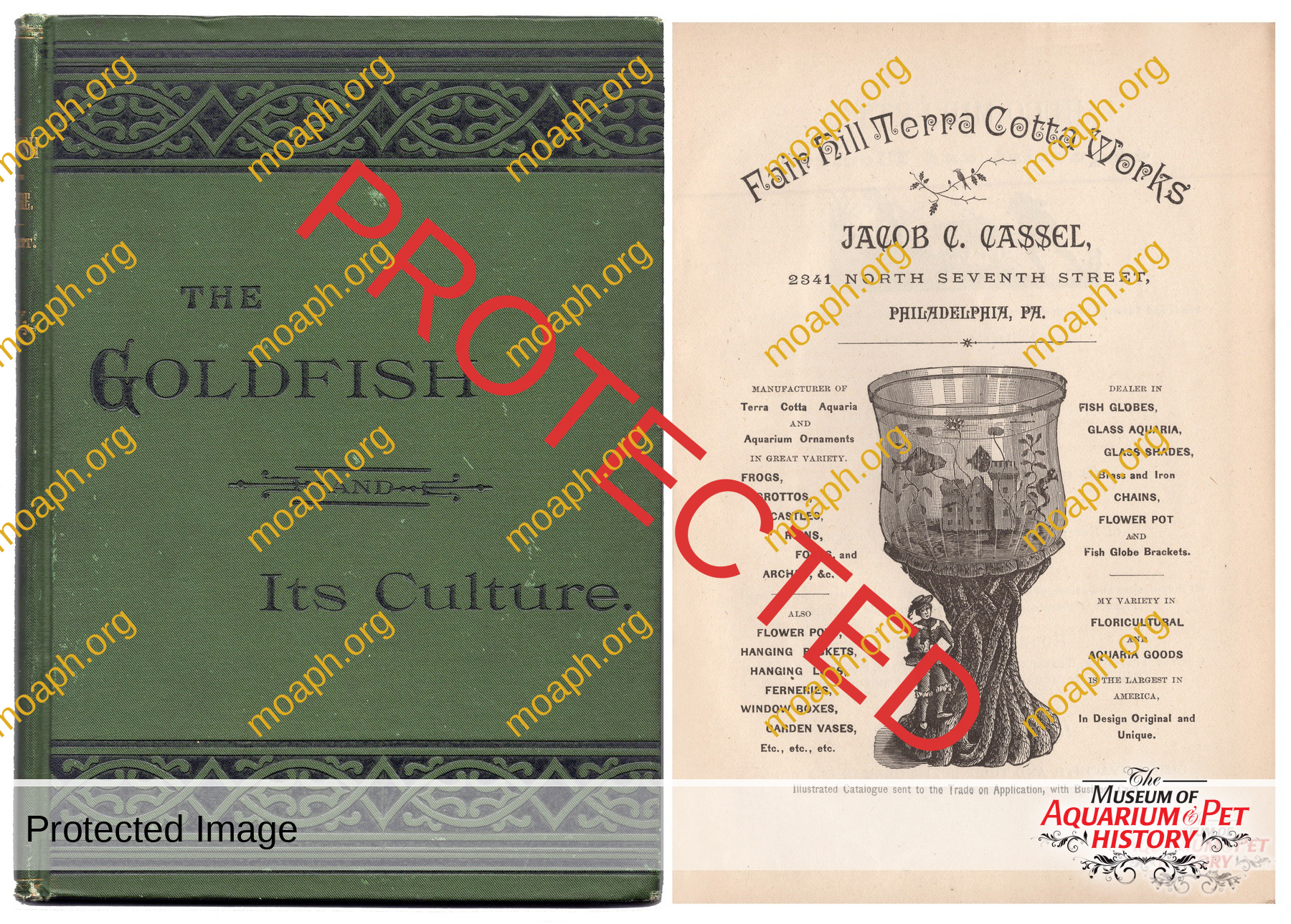
Cassel’s advertisement from the 1883 edition of The Goldfish and its Systematic Culture With a View to Profit by Hugo Mulertt. Notice that there is no trace of Henry’s name on this ad.
The Philadelphia aquarium scene
During the late nineteenth century, the number of amateur hobbyists grew significantly in Philadelphia. Many of them, as in New York, were German immigrants. Despite the initial lack of professional aquarists, and of a public aquarium that might serve also as a gathering spot, they found a way to meet in the center of the city, to share their experiences, and to arrange the early goldfish exhibitions. Jacob Cassel moved office and salesroom right to that area, and specifically to Arch Street, where he always retained a showroom even when at the end of the century he decided to relocate his manufacturing plant to Kennett Square, Pennsylvania.
All this activity soon turned the center of Philadelphia into an active “aquarium district”. This happened also due to the new influential aquarium operations which, by 1910, were established within the three block radius of Arch and 10th streets: William T. Innes, aquarium publisher (Cherry and 10th) who held Cassel in high regard, Cugley and Mellon, fancy fish purveyors (Arch and 12th), and the Philadelphia Aquarium Society (Arch and 13th). As time moved on, the aquarium scene was further powered by other significant firms which were established in the city, such as those operated by Harry P. Peters, William L. Paullin, Franklin Barrett and the General Aquarium Company of America.
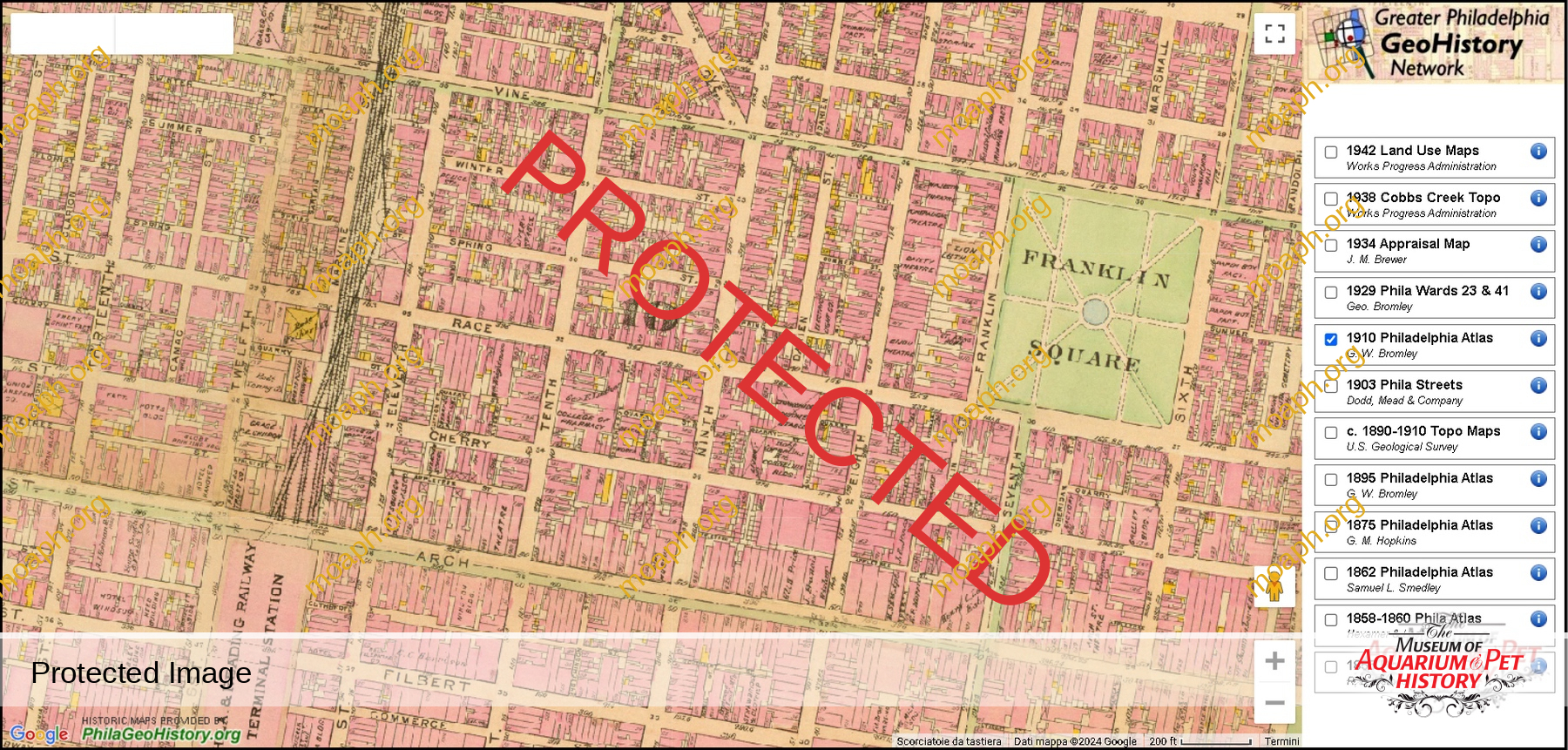
The area of the “aquarium district” in 1910. Map source: Greater Philadelphia GeoHistory Network.
Cassel, who now listed his occupation as “aquarist” instead of “florist”, closely followed the development of this fancy goldfish community, and kept on selling and advertising his rustic tanks and aquarium goods until the last years of his life.
Iconic log aquariums
The most successful and iconic log aquarium produced by Fair Hill Terra Cotta Works was certainly the Mulertt Aquarium, which can be also considered as one of the earliest example of signature product in the aquarium industry. Basically, it was a flat, half-moon shaped faux bois fishbowl “adapted for window use”. Manufactured in two different versions (small and large), and made of an earthenware ceramic like terra cotta, this best-seller owes its name to the aforementioned Hugo Mulertt, who was very popular in Philadelphia.
It’s reasonable to assume that Mulertt lent his name both out of the esteem he had for Cassel as an artist, and to secure favorable prices whenever he purchased goods in bulk from him. It was likely a simple but profitable business agreement.
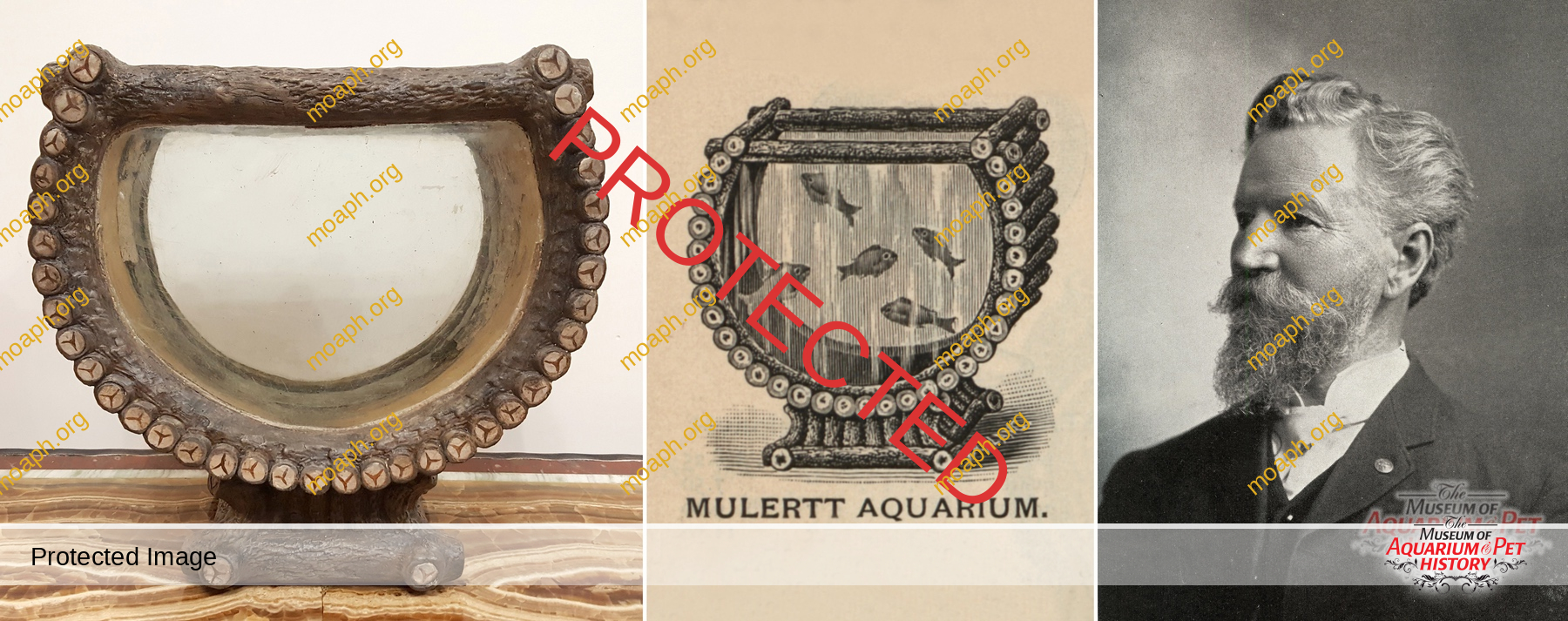
Mulertt Aquarium, large version. On the right, Hugo Mulertt.
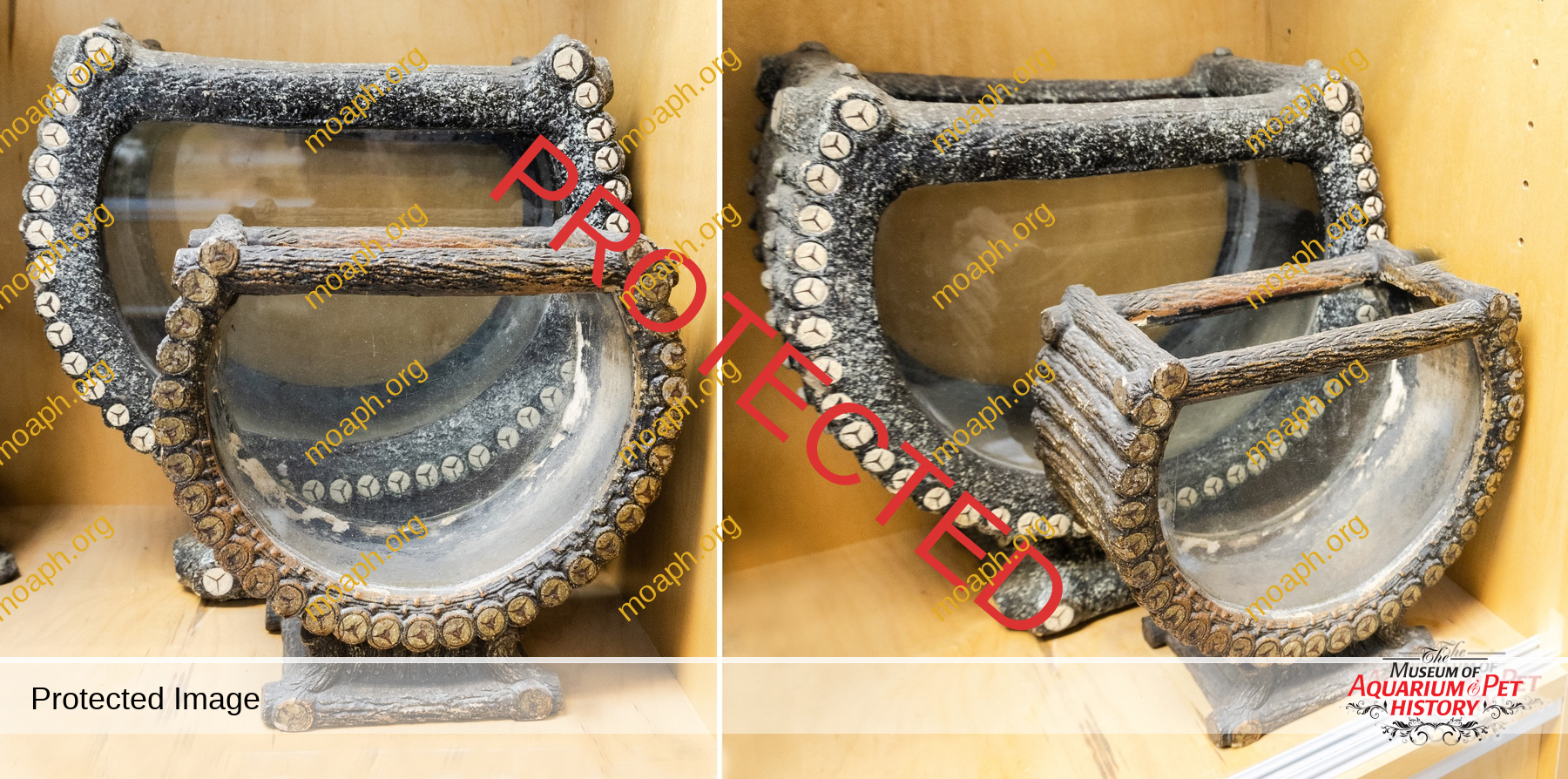
Mulertt aquariums housed at MOAPH. The small version is 9 ½” long, 4 ½” wide, and 8 ½” tall. The large is 13 ½” long, 7” wide, and 12 ¾” tall.
Cassel had a soft spot for this fishbowl, and used its illustration in many aquarium-themed advertisements. The talented artist who made its engraving, together with many others for catalogs 1 and 2, was Albert Blanc (1850-1928), a famous engraver and electrotyper who specialized in horticultural trade catalogs.
The Mulertt Aquarium didn’t have an inner metal frame like the faux bois aquariums from France. The earthenware was simply poured into a design mold, dried, fired and painted. It’s interesting to note that Cassel used the same mold to produce the Mulertt Vase, which had faux bois side panels replacing the glass viewing portals.
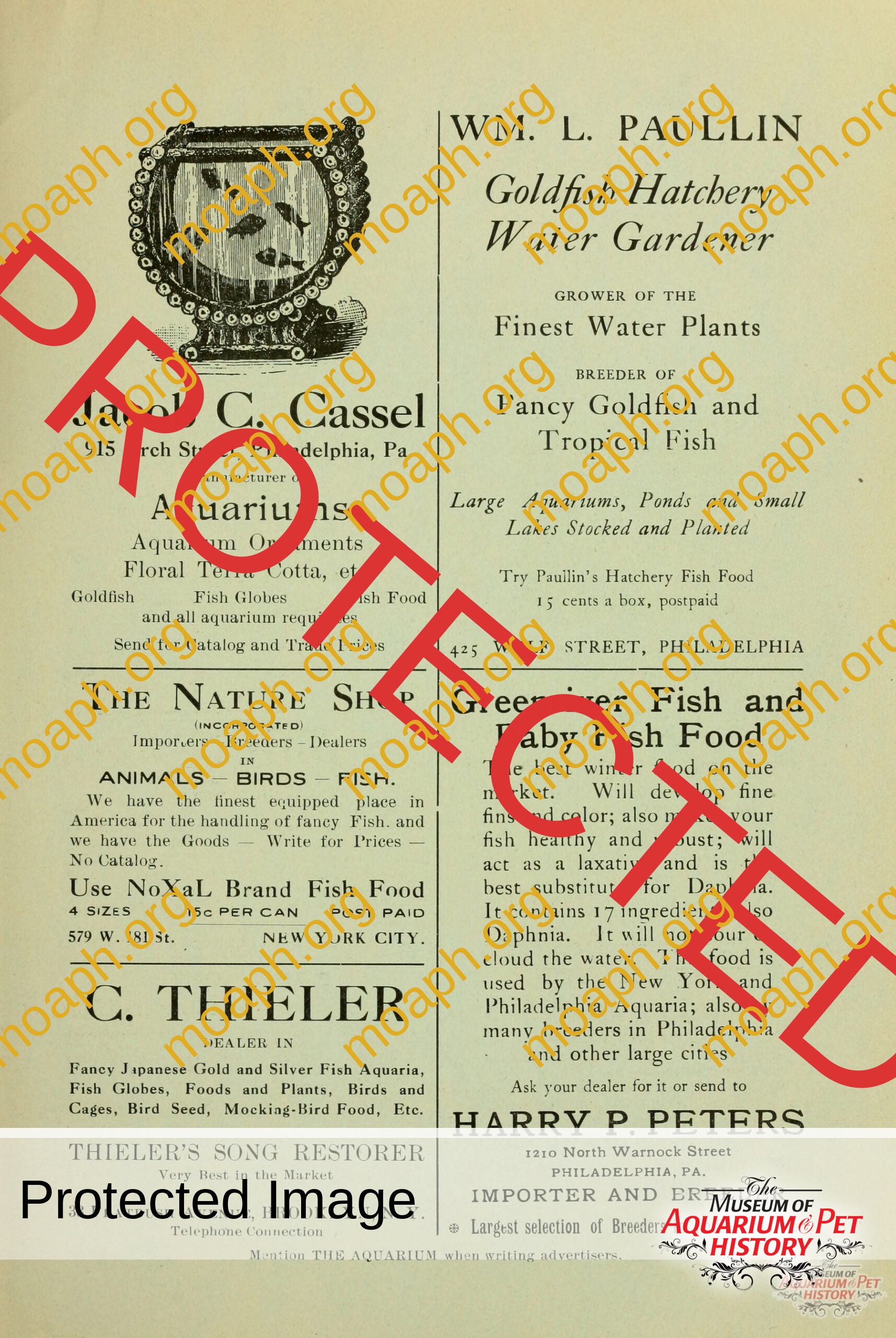
Jacob Cassel’s advertisement published in the magazine The Aquarium, Vol. II No. 1 (The Aquarium Societies of the Cities of Brooklyn, Chicago, New York, and Philadelphia, 1913). On the same page, other ads by aquarium operations based at Philadelphia and New York.
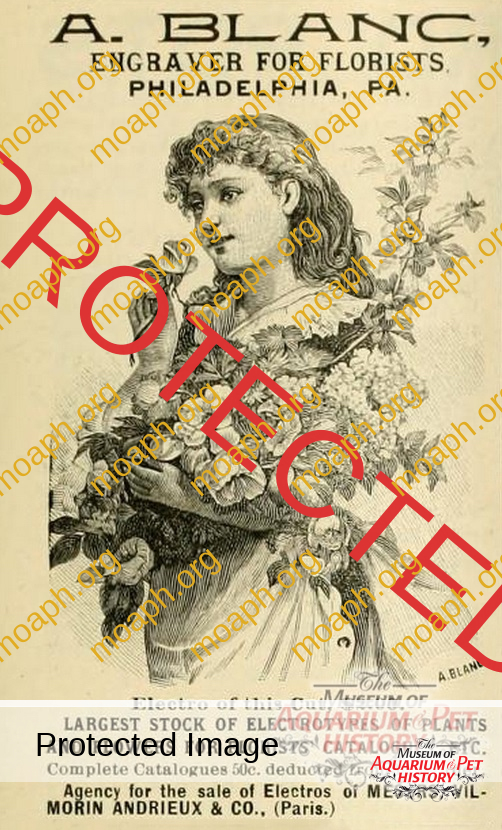
Albert Blanc produced thousands of illustrations for horticultural catalogs. This advertisement was published on the 1889-90 volume V of The American Florist.
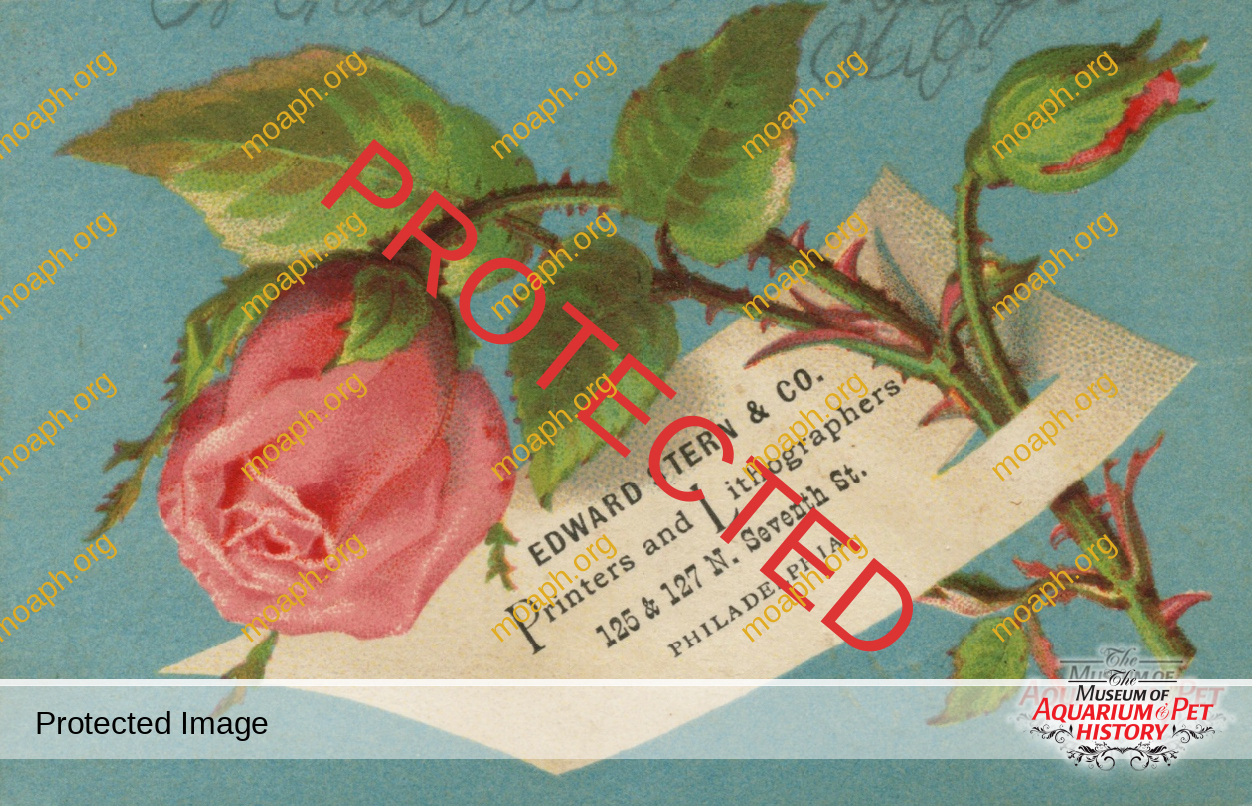
Catalog 1 was printed by Edward Stern & Co., a printing and lithography establishment formed in 1871 by the brothers Edward and Simon Adler Stern. The company printed chromolithographed cards, bookmarks, and calendars, and published books, pamphlets, catalogs and journals. Image credit: Library Company of Philadelphia.
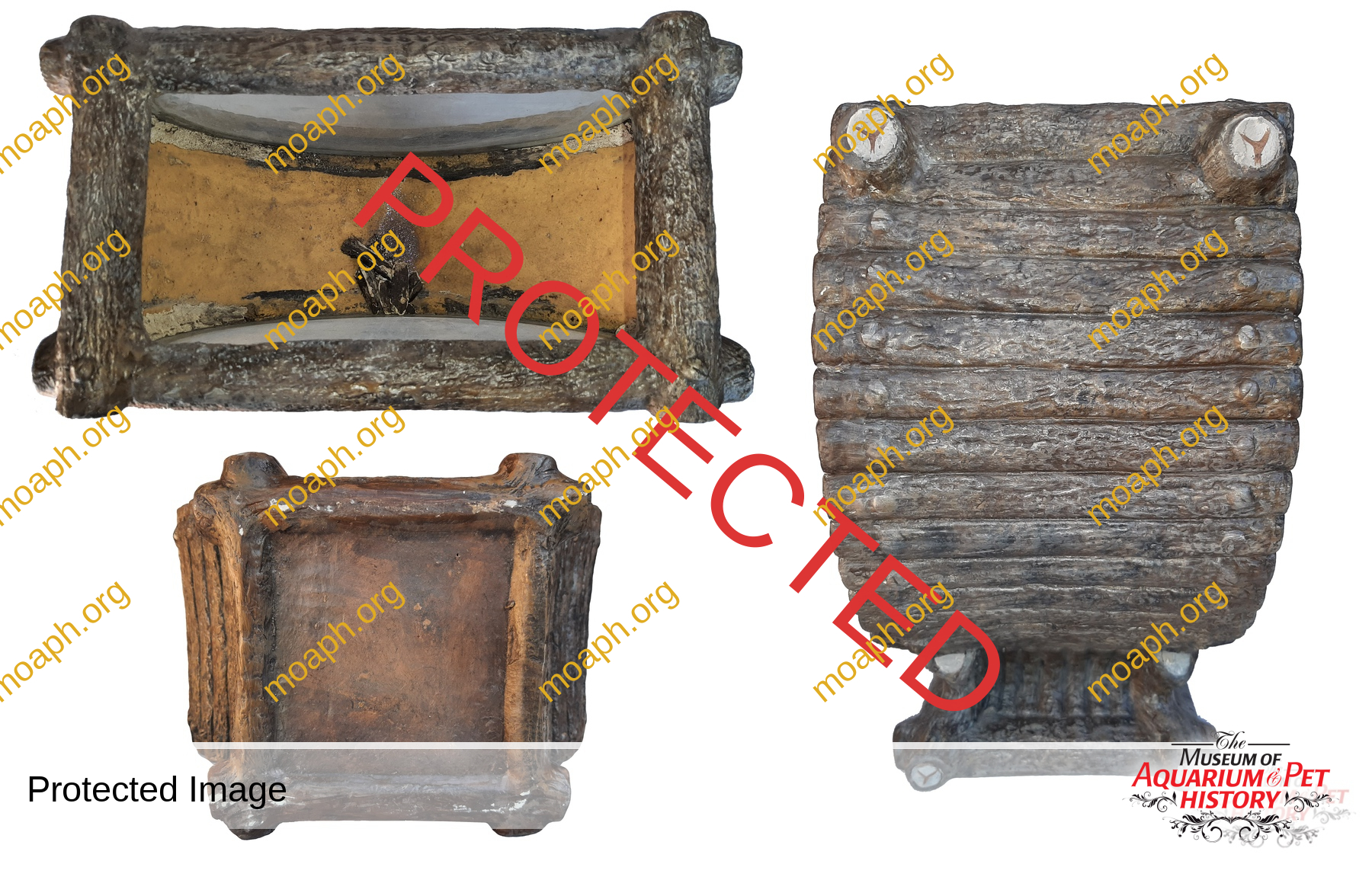
Different views of the Mulertt Aquarium.
Another eye-catching terra-cotta fishbowl was the Stump Aquarium, also known as the porthole fishbowl, whose design preceded the Mulertt Aquarium. It’s an odd piece, tremendously heavy, and hard to find in good condition. The Rustic Aquarium model, instead, was a little bit closer to the design of French faux bois aquariums, starting from the classic rectangular shape.
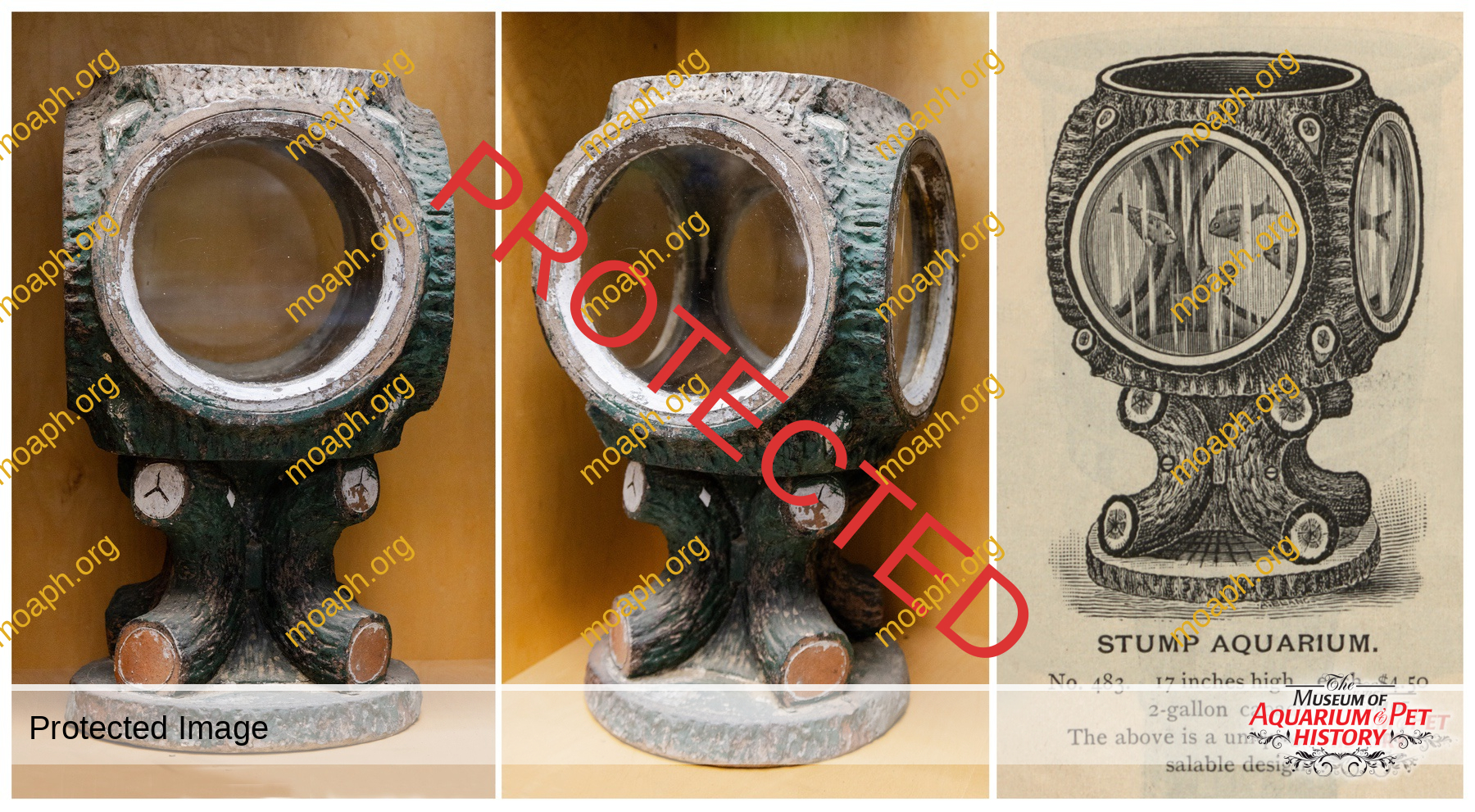
Stump Aquarium preserved at MOAPH.
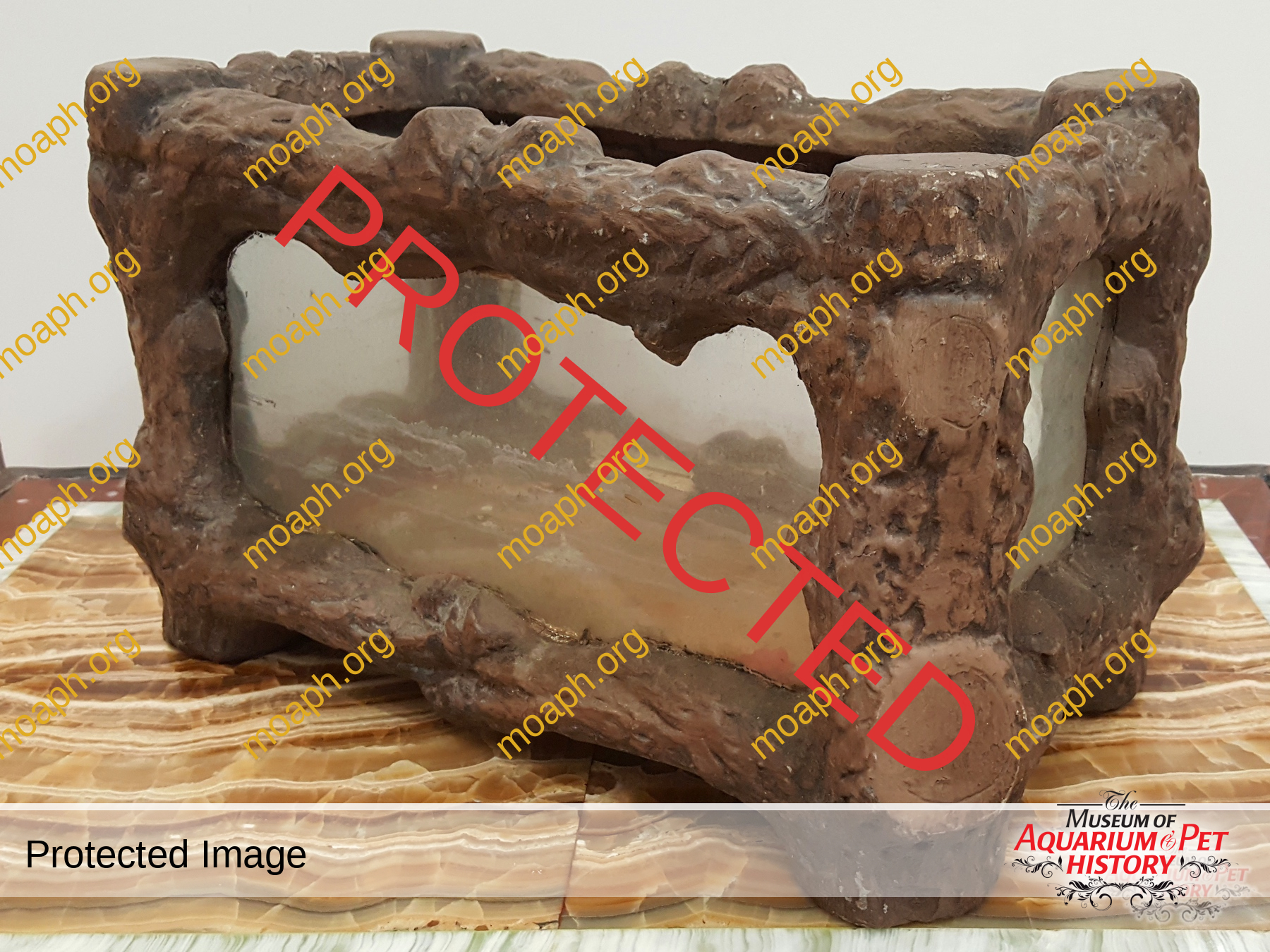
American rustic aquarium waiting to be restored.
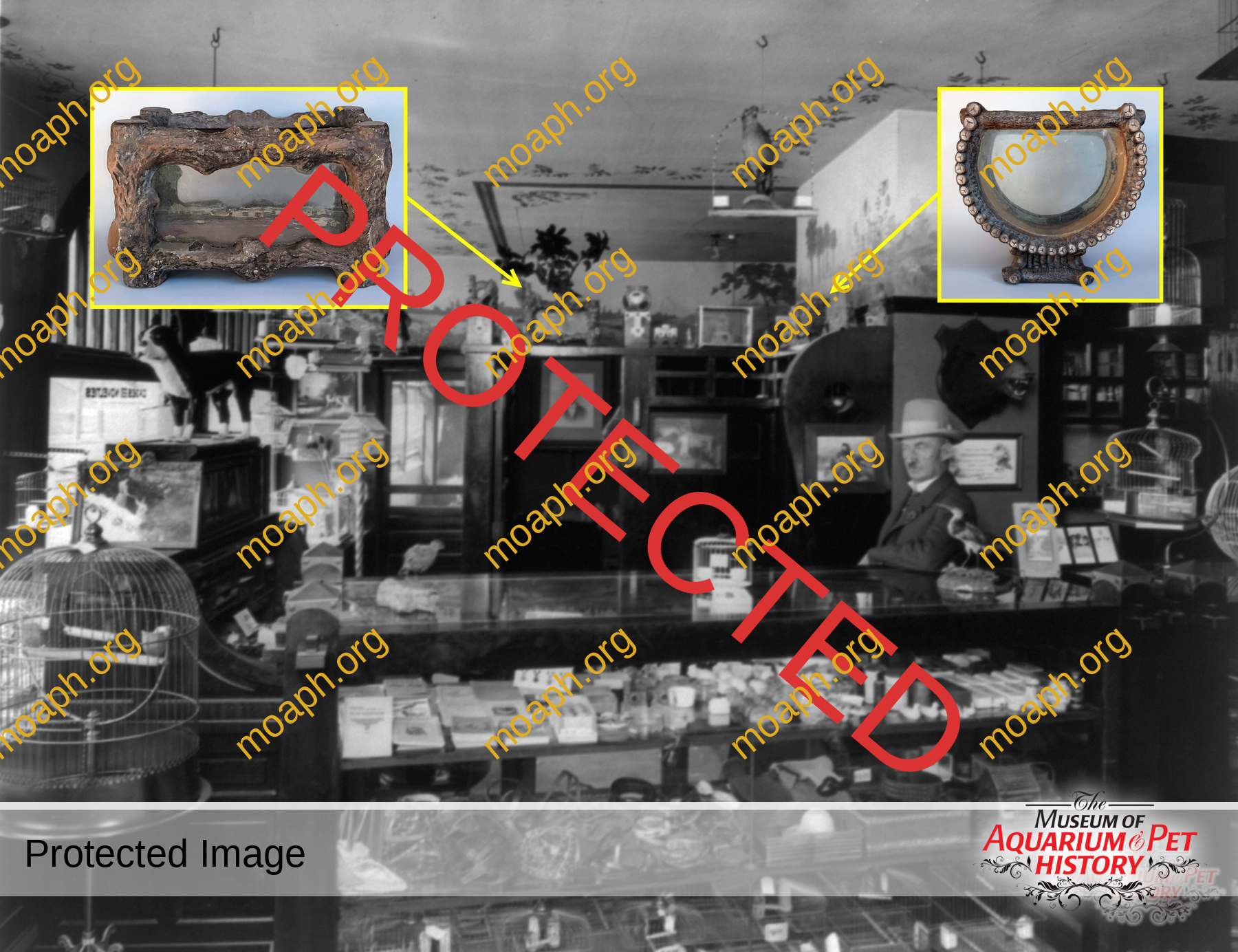
This 1916 photograph of the pet shop Grider’s Birdland, in Los Angeles, is an interesting visual time capsule. Photo by S. M. Grinder.
Reading page 59 of catalog 2, I found out that Cassel even sold “water or aquatic” plants, and aquarium fish! The livestock was another way to meet the needs of the city’s community of amateur aquarists. On the back cover of the same catalog, he also provided a few practical hints on goldfish and aquarium management. The following is an excerpt from it: “Fish, like human beings, are often killed by kindness in overfeeding them. They may be treated to choice dainties in limited quantities, occasionally; but the only absolutely safe diet that we can recommend is the prepared fish food, which ought to be given once a day, regularly, and in such quantities only that the fish consume at once.”
End of Cassel’s journey
On September 16, 1916, a terrible fire destroyed Cassel’s manufacturing plant at Kennet Square. Everything inside this three-story brick building burned, including almost certainly all the molds. Three years after this catastrophic event, Jacob C. Cassel died. Since he had no children, his artistic heritage vanished into obscurity.
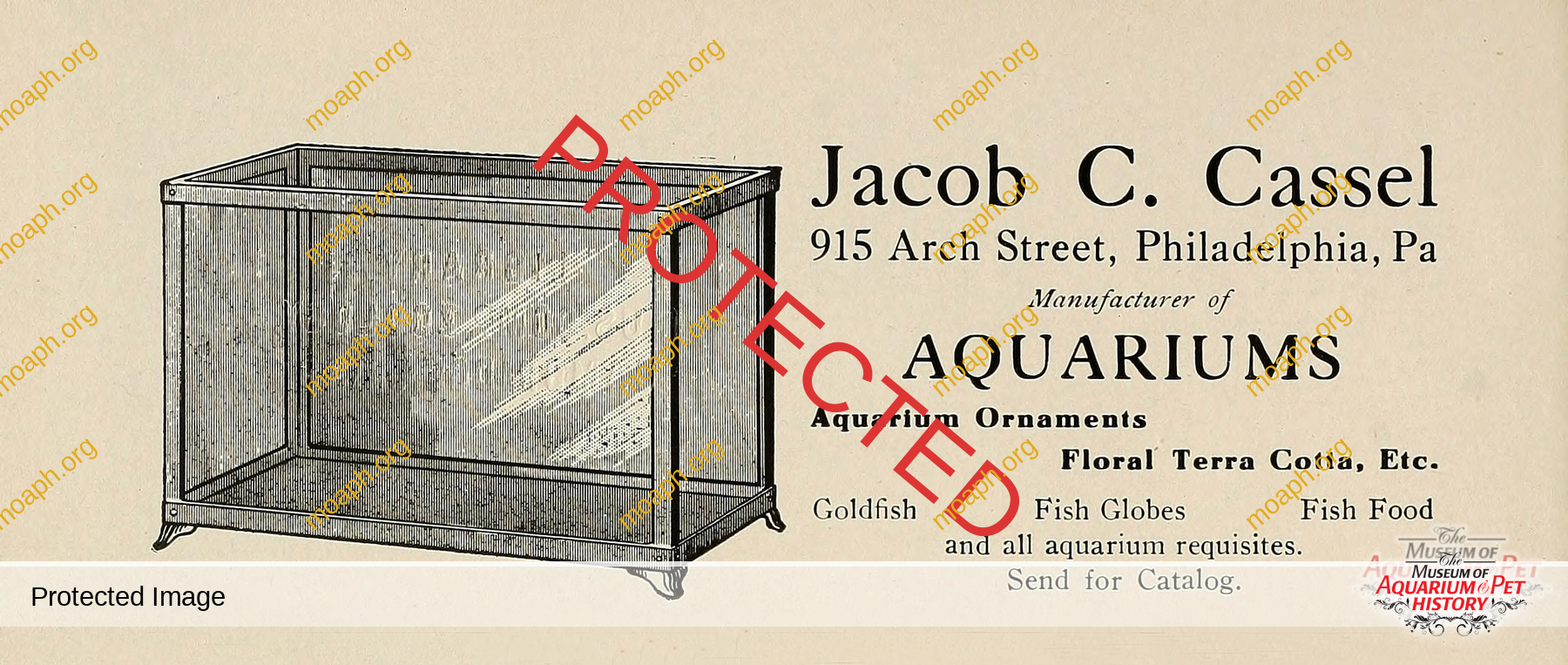
Jacob Cassel also advertised his aquarium products in Aquatic Life, an extremely influential magazine that appeared on the American aquarium scene in September 1915. It was published by Joseph E. Bausman, a well-known Philadelphia aquarist, and edited by William A. Poyser, the former editor of the short-lived The Aquarium.
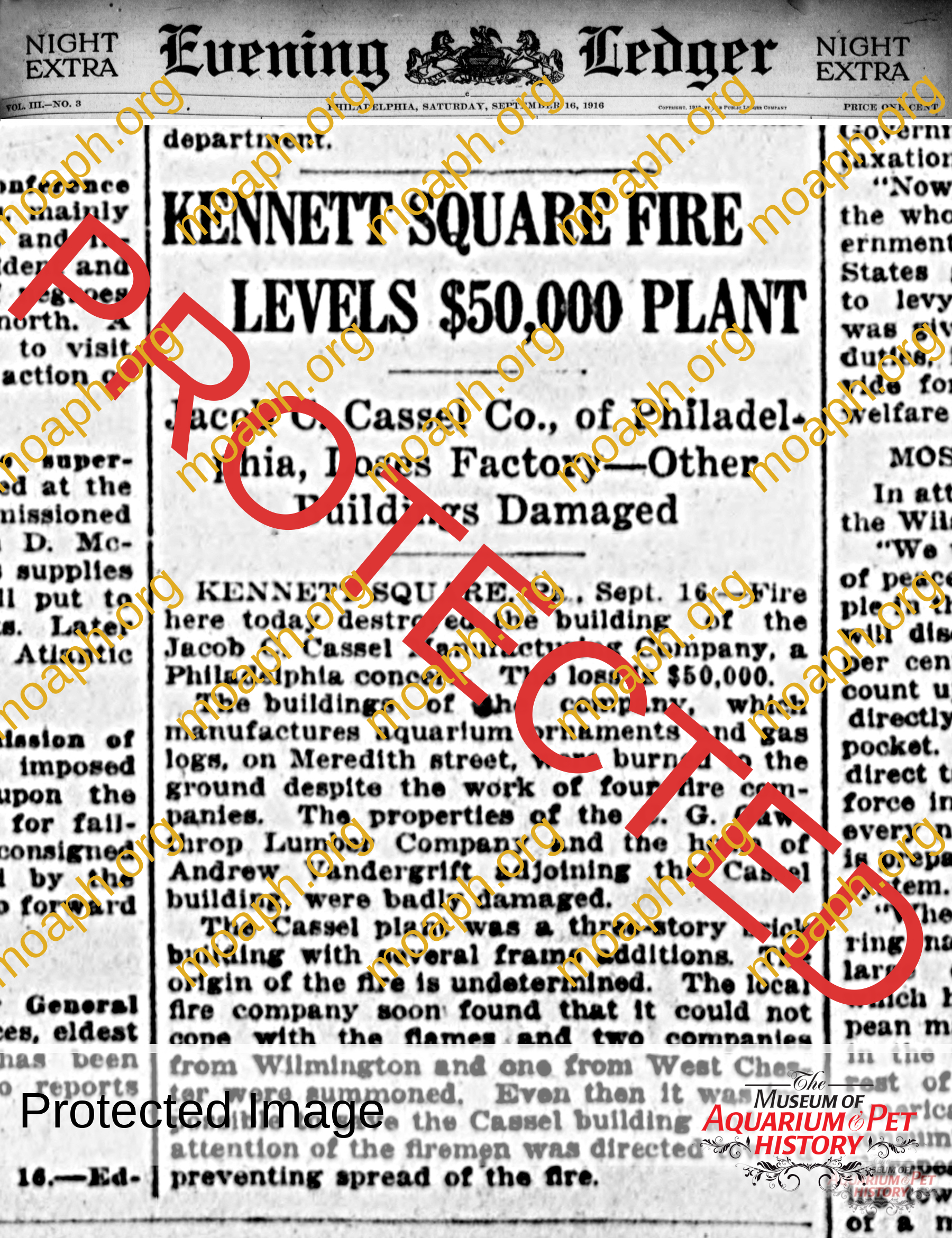
With this short article dated September 16, 1916, the Philadelphia based newspaper Evening Public Ledger (Night Extra) reported on the fire which destroyed Cassel’s production plant at Kennet Square, Pennsylvania.
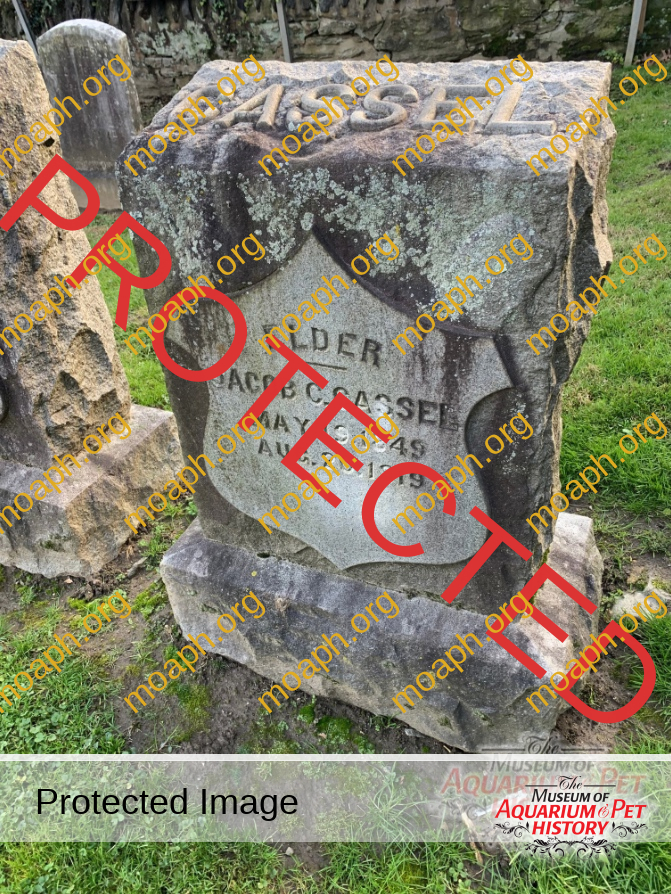
Jacob Cassel’s grave in Germantown Brethren Cemetery (6611 Germantown Ave, Philadelphia, PA). Courtesy of Kristin Howard (Cassel’s distant cousin).
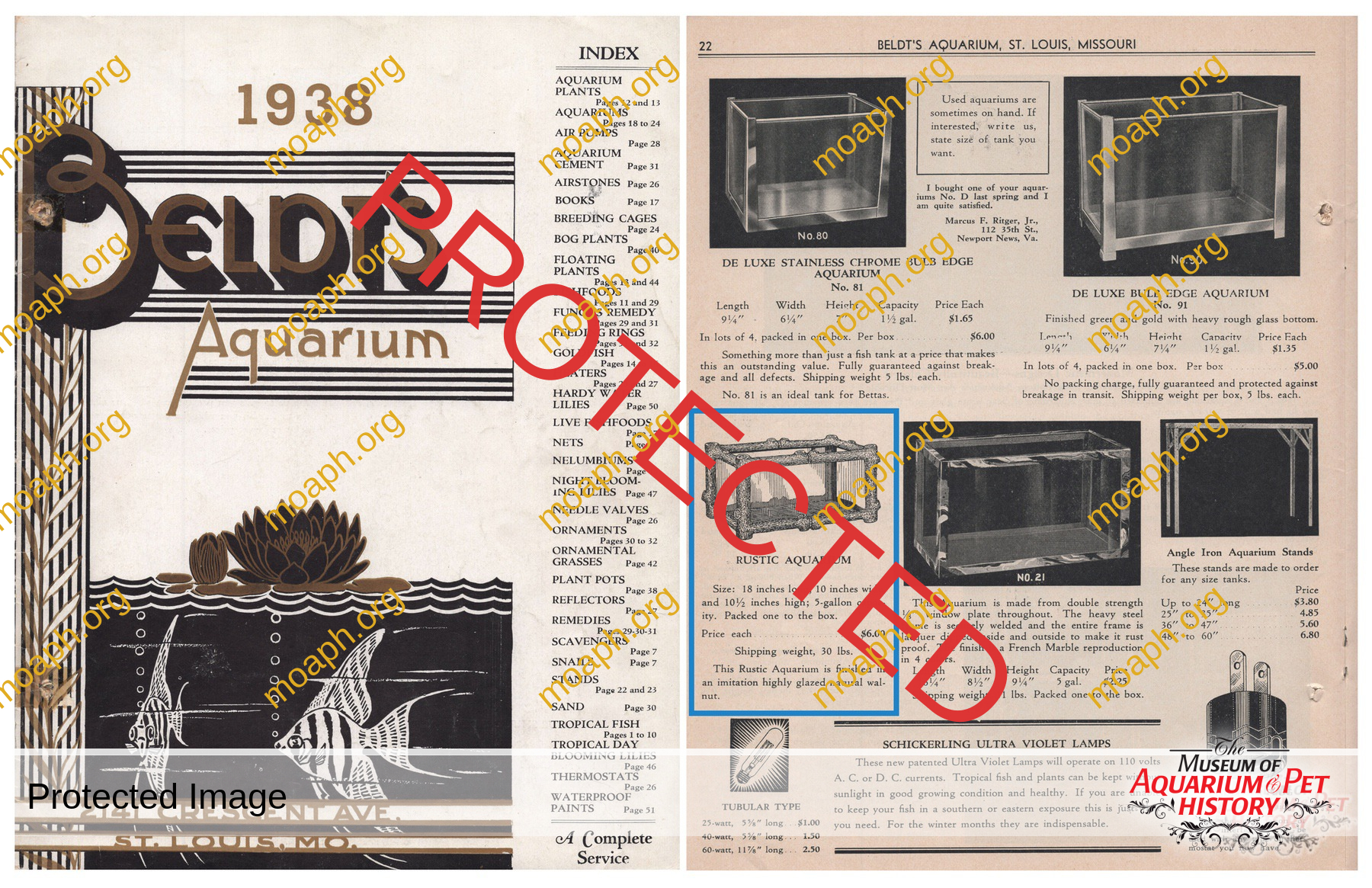
Beldt’s 1938 catalog.
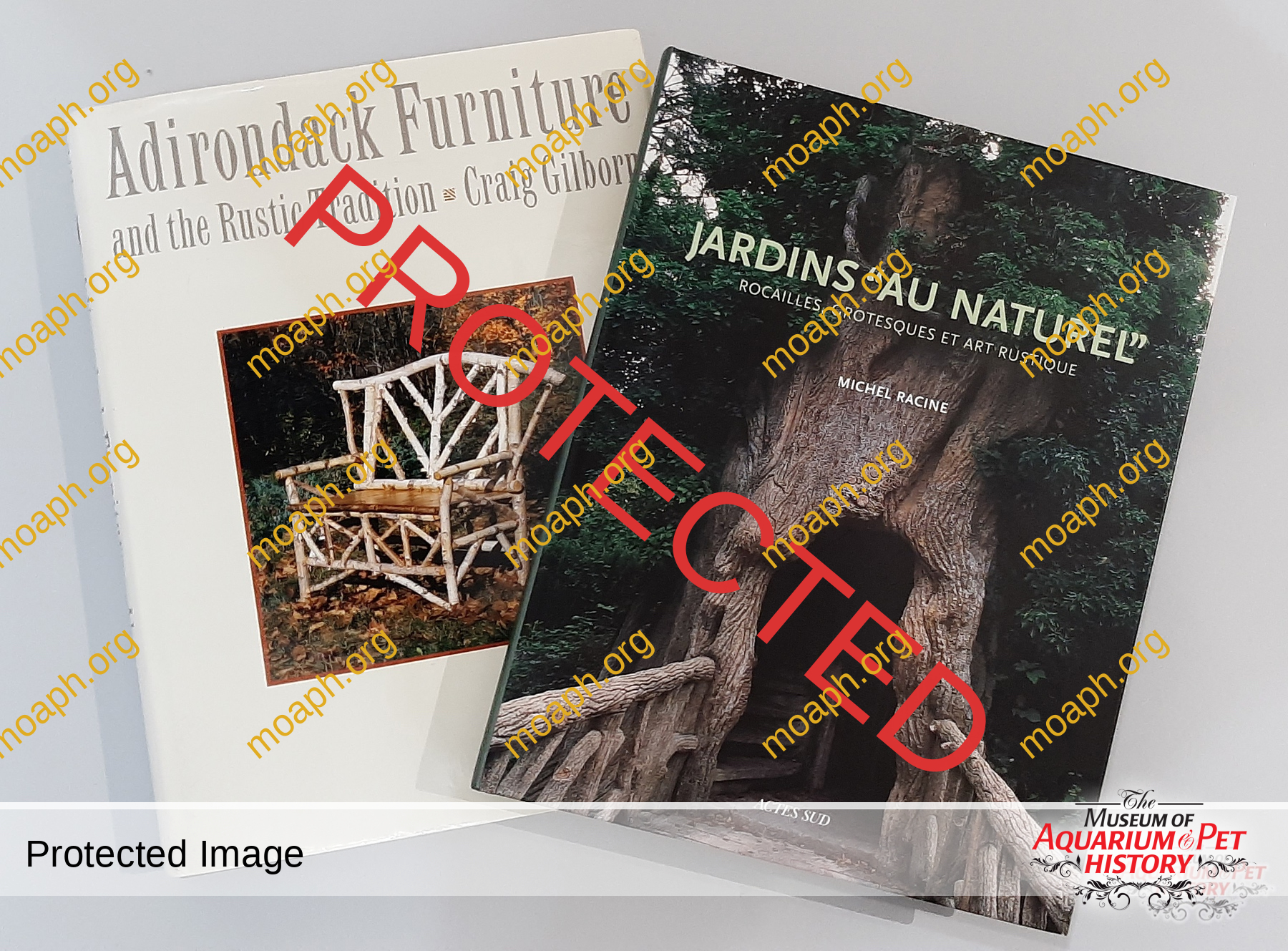
Interesting reads to get into the “rustic mood”!
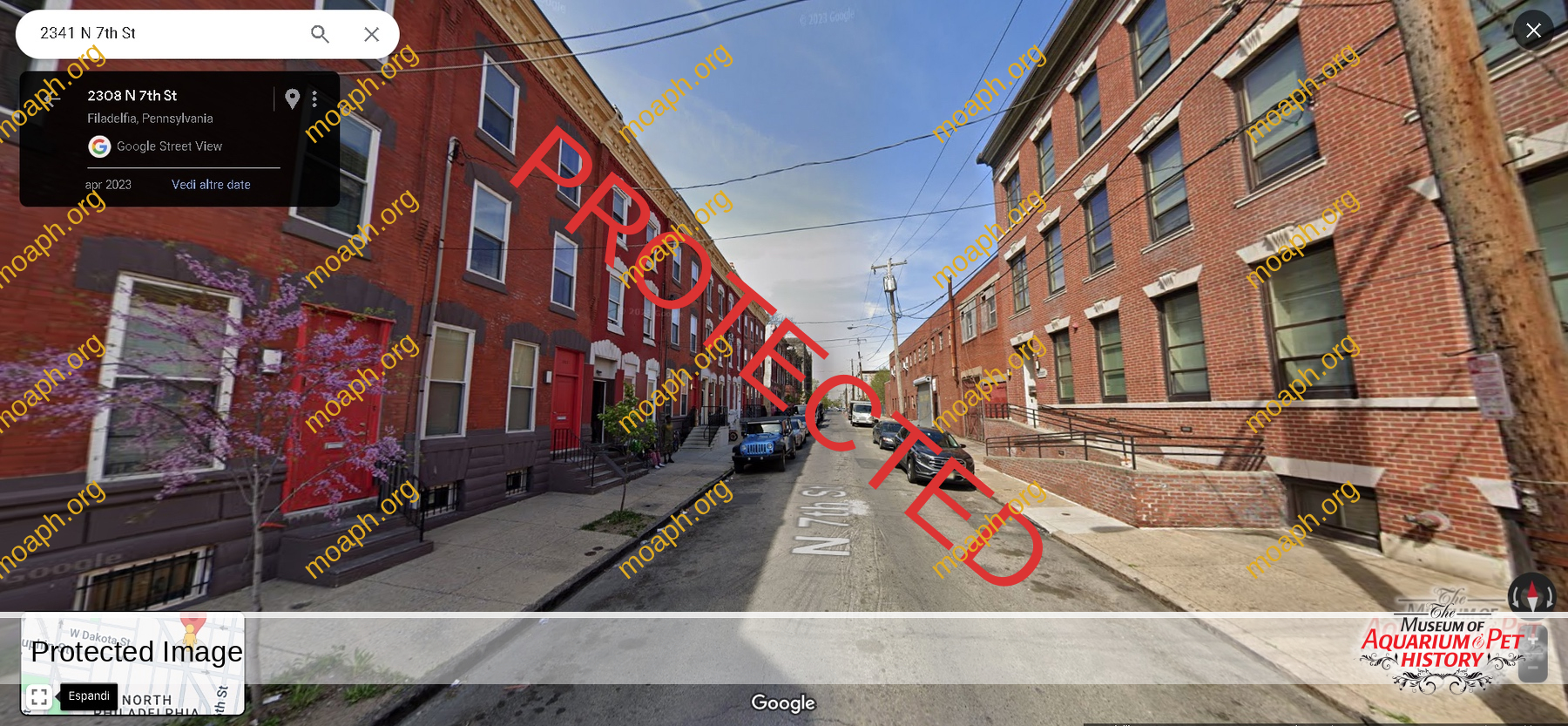
Philadelphia, North Seventh Street. The rowhouses on the left are located in front of the original site where the Terra Cotta Fair Hill Works stood in the mid-1870s. Image source: Google Street View.
This wasn’t, however, the end of the rustic style in the American aquarium industry. Although new trends in art and aquarium design were already spreading, log aquariums survived for a while. Beldt’s Aquarium, for example, still advertised a model of rustic aquarium in the late 1930s, unfortunately without specifying the manufacturer. The latter is an interesting topic, to me at least, which will require further investigation.
ACKNOWLEDGEMENTS
Thanks very much to the following parties for their assistance with this article: Gary Bagnall, Joseph Ferdenzi, Diane Husson, and Lee Finley.