Chapter 14: Fine People Fine Animals – Wilde Tiere Frei Haus (Wild Animals/Free Delivery)
Translated by Alex Haro
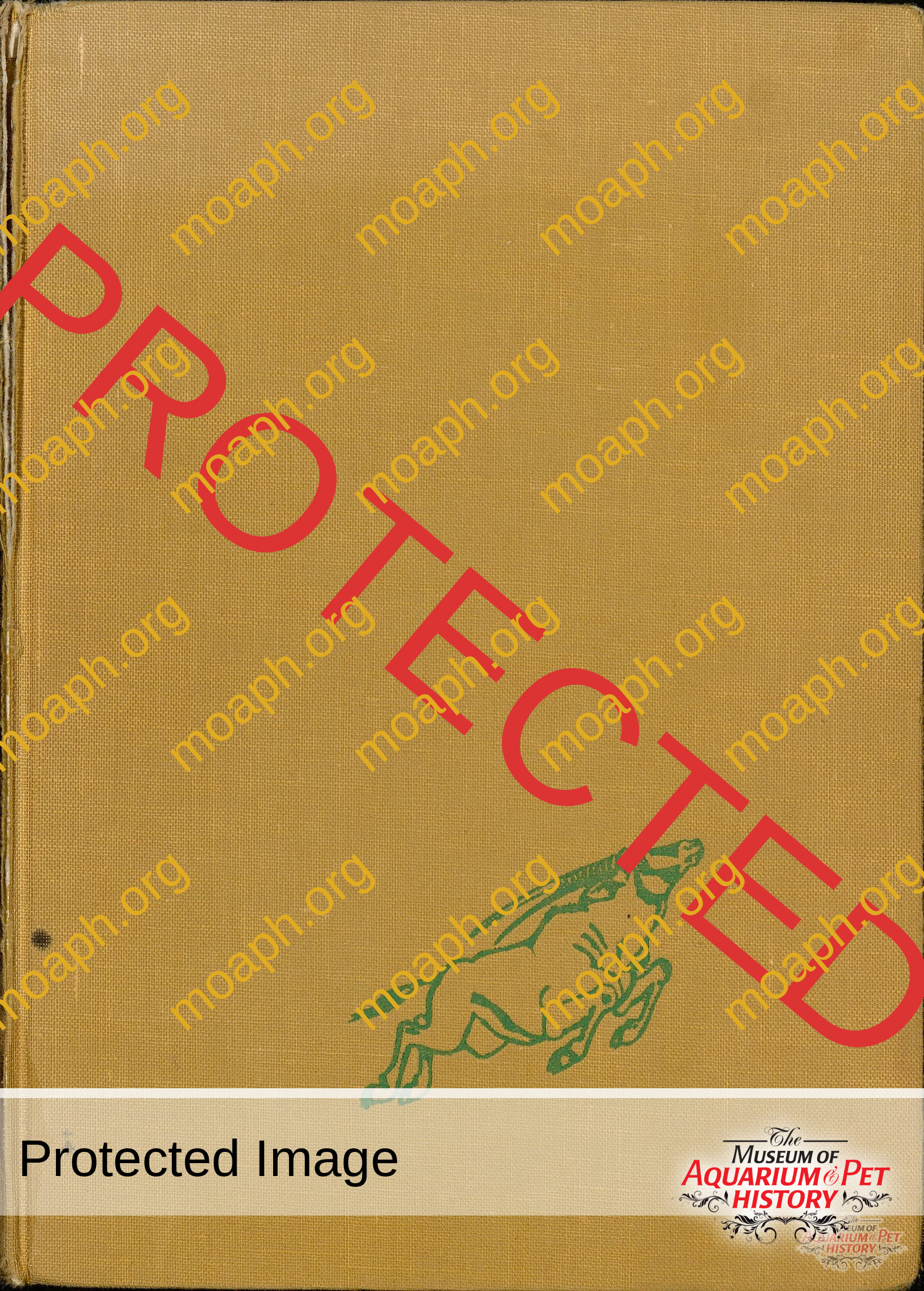
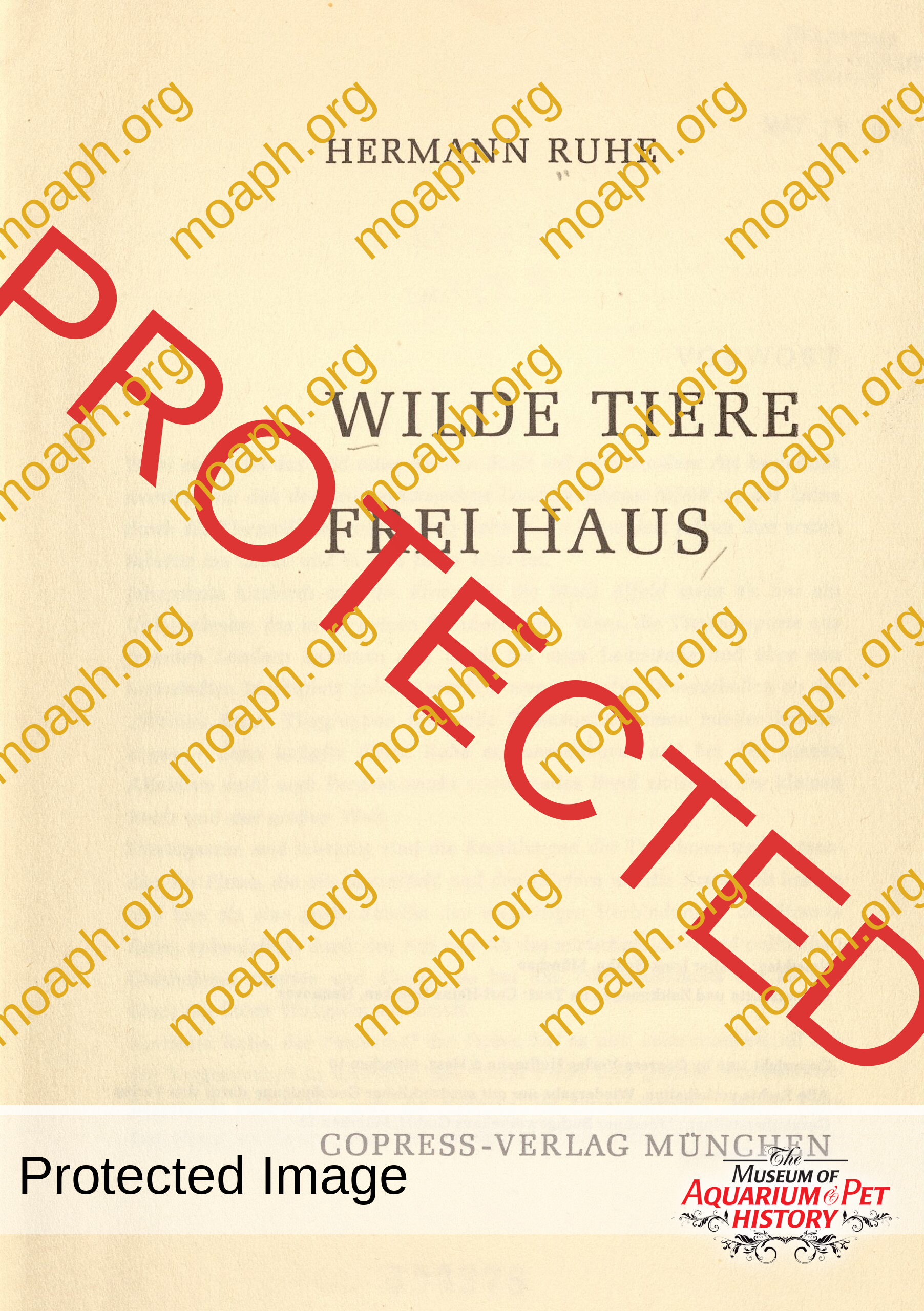
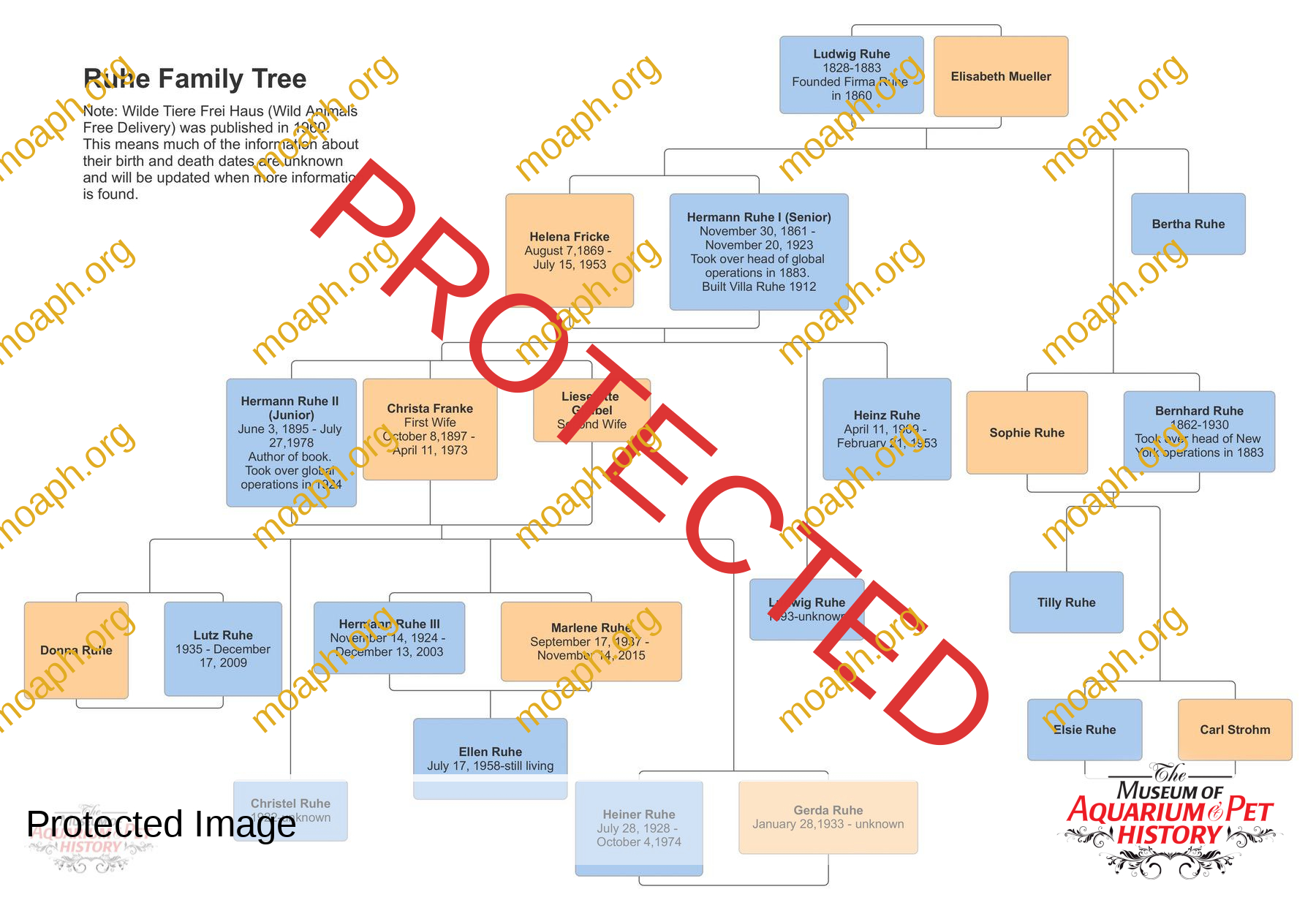
Starting in September 2024, the Museum of Aquarium and Pet History (MOAPH) started releasing a chapter a month on the translated autobiography Wilde Tiere Frei Haus (Wild Animals Free Delivery) by Hermann Ruhe.
Firma Ruhe (the Ruhe Company) was the name of an animal trading company based in Alfeld, Germany from 1860 until its official closure in 1993. During this time, they were world renowned for their importation and exportation of exotic animals and birds from all across the globe, even supplying many zoos as well as circuses. Having survived both world wars, Firma Ruhe continued to dominate the world of animal trading until the mid-20th century and is a testament to true determination and leadership.
Wilde Tiere Frei Haus (Wild Animals Free Delivery) also documents the plethora of adventures, failures and successes endured by all those a part of Firma Ruhe. Through Hermann Ruhe’s great storytelling, we are able to visualize and understand the world from the perspective of animal collectors navigating through some of the most difficult situations, often not knowing whether or not they would ever return home. His recollections provide a vivid portrayal of the challenges and triumphs faced by the company, and give readers a glimpse into the world of animal trading.
The Zoo Park in Cros de Cagnes also proved to be a real gem on the Riviera for our customers. Large French circuses including the Amar brothers and Alfred Court even trained their animals there. We had set up strong cages, allowing work from early morning until dusk. Alfred Court, one of the best animal trainers of his time, managed to create a rare beautiful act within a few months in Cros de Cagnes – consisting of 12 Bengal tigers. These tigers were almost all mature and not previously trained animals. A year before, Alfred Court had bought from me in Alfeld a mixed group of leopards, pumas, and hyenas, trained; also in a few months. He had bought the animals from me and used the big riding hall for assembling this peculiar act, bearing all costs for food, light, maintenance, etc. He rested in Cros de Cagnes under similar conditions.
Fortunately, in the “Jardin Zoologique,” none of the many predatory animals ever escaped. Only once did a young hyena manage to. All searches in my garden and the surrounding area were in vain. Soon alarming news arrived at Basilwesky’s: here a chicken had disappeared, then a whole chicken coop had been ravaged… Basilwesky made the mistake of paying for the slaughtered chickens immediately! Promptly rabbits, geese, ducks, and more chickens fell victim to the destructive fury of our bloodthirsty hyena. Basilwesky became suspicious due to the sheer number of reports: Even a hyena with an extraordinary appetite could not have digested such amounts!
Finally, the hyena was found again: in the zoo! It lay between a couple of old transport crates and had been dead for days. The poor animal had never left our acclimatization park.
Our main season on the Riviera was during the winter months, and since most animals were sold in the spring and new ones arrived only in the winter, the garden was closed in June and July each year. We used these two months for new construction, and Basilewsky found time to accompany me on one or two trips.
In early spring, zoo directors arrived in Cros de Cagnes to select what they needed. Dr. Priemel from Frankfurt, Dr. Gebbing from Leipzig, Professor Brandes from Dresden, Director Wendnagel from Basel, Dr. Steinmetz from Berlin, Professor Urbain and Mr. Hertel from Paris, Director Bean from Chicago, Heinz Heck from Munich’s Hellabrunn Zoo, Ludwig Heck, and many others were among our visitors. Dr. Lutz Heck, who often undertook research trips to Africa and frequently traveled through Marseille, also made one or two visits to Cros de Cagnes almost every year.
At the same time, a lively trade in park and ornamental birds and various tame animals to private collectors developed in Cros de Cagnes. Along the Riviera, between Menton and Cannes, there were magnificent estates that the average tourist knew little about at the time. These well-maintained gardens with their tall palm trees, bamboo groves, cacti, and lush vegetation belonged to wealthy individuals. It was not easy for Basilewsky to establish contact with the owners of these splendid properties.
However, when the Duke of Bath Baron Rothschild, Mr. Vanderbilt, and Lady Gould, along with a few other prominent villa owners, purchased exotic birds, cranes, flamingos, and ornamental ducks for their parks; they paid exorbitant prices, often competing with each other.
The Duke of Bath1 even set up a very charming little zoo, for which he was quite passionate for some time. But one day, he chose a new hobby and returned all the valuable animals to the zoo.
MOAPH1: The ‘Duke of Bath’ or the Marquess of Bath is an English noble term for a member of the British aristocracy.
One lady only wanted blue birds, and Mrs. E. Rothschild loved only birds of a pink hue: flamingos, ibises, cockatoos. One late afternoon, she saw a pair of black-necked swans swimming on the pond in the zoo at Cros de Cagnes, which, in the twilight, looked as if they had no heads. Immediately, Madame Rothschild bought this attraction.
At that same hour, they had to be taken to their villa on Cap Ferrat, where an evening party was taking place. Besides various ornamental birds, small cheetahs, sun bears, and similar animals that one could keep in the house or near the house, were sold. The Sun bears were particularly kept on yachts in the open sea. What these lovable bears managed aboard luxury ships amused everyone. At the same time, the breeding of budgerigars was a good business. Blue specimens were still a rarity, and strangely, it was the Japanese who had a great fondness for them. The Emperor of Japan owned a few blue budgerigars, and hence all his subjects wanted to own them too. Japanese collectors were sent to Europe despite the high travel costs and paid any price to get these birds.
The sale of animals to enthusiasts provided some balance to the irregularly fluctuating income from the entrance fees of our zoo in Cros de Cagnes. The constantly changing array of animals was such an attraction at the zoo that the audience became so spoiled that they stayed away in the absence of ‘sensations’. The local press published delightful animal photographs and amusing articles. The city administration of Nice was very friendly-minded, especially since the zoo was a major attraction for visitors from all over the coast, and the city of Nice didn’t spend a dime as it was run as a private venture.
In Cannes, various ornamental birds loaned by us graced the park in front of the casino, and in Nice, the mayor provided us with the city center for our advertising efforts. Basilwesky did what he could to utilize these advertising opportunities. For example, he set up a pond where flamingos stayed for a week, which was then swapped overnight with pelicans, crowned cranes, black swans or colorful ducks. This provided frequent morning surprises for the city’s residents and visitors. In front of the Monte Carlo casino, a few macaws and loud lorikeets entertained tourists with their loud chatter, simultaneously luring them to the gambling tables. During the carnival, for film shoots, and other events on the Riviera, animals were also loaned out. Even the good old elephant cow Rosie participated in many festivities. Sometimes Basilewsky arranged for her to block the main thoroughfare of the zoo right on the main road, so the whole car traffic was stopped by her huge body. No police intervention could move this brave animal from its spot, but a quiet word from its keeper prompted Rosie to immediately rise.
To achieve an exotic spectacle, even a camel was demanded for a gala event at the Negresco hotel, where a giant glass wall was simply erected, and the saying went: “It’s not easy to get a camel into heaven, but it’s paradise here for a camel.” We had laid out a ‘Golden Book’ in Cros de Cagnes containing precious signatures: Queen Margherita of Italy, kings from Sweden, Denmark, Yugoslavia, and Nepal, the Prince of Monaco, Maharajas and princes, artists like H. Bordeaux, John Knittel, Th. Oppenheim, L. Verdun, Igor Stravinsky, actors like Charlie Chaplin, Douglas Fairbanks, Emil Jannings, Henri Bauer, Cecil Sorel, Mistinguett, Sascha Guitry, and many others.
Basilwesky experienced immense joy in the growth and flourishing of his work, starting under great difficulties years ago, managing countless tasks with such sovereignty that I never had to worry about our zoo in Cros de Cagnes. In the autumn and winter of 1930/31, I began focusing my special attention on collecting animals with which something special was happening, but nothing was ever one hundred percent certain. The “Severin’s austerity method”2 created during this time resulted in great unemployment and therefore faced severe social concerns, many German cities faced severe restrictions.
MOAPH2: German Government spending was cut by about 15% during the final years of the Weimar Republic before the Nazi Party took control of Germany.
Cities that had too high of budgets and could not balance them were forced to make ‘luxury cutbacks’ such as downsizing or even closing zoos. In Hannover, close to the major city of Alfeld, the city leaders considered whether to close the zoo completely. That was something the people of Hannover really did not want. I was invited to join the discussions. Although I had made considerable animal deliveries to the zoo between 1924/25 and recorded good visitor numbers in subsequent years, it now suffered from a general crisis. I had been following this development for months and had made my decision when called upon for advice; my plan was already set, and the necessary animals were already procured. The City of Hannover agreed when I proposed to take over the zoo’s management. I anticipated taking over the Hannover Zoo—if we could equip it with a large stock of animals from all over the world—would certainly attract increased numbers of visitors, but securing a trial year first, before presenting a calculation that could form the basis for a guarantee contract, if a long-term agreement was to be made. This arrangement would help both the city and myself. Hannover would not need to spend huge sums annually on animal purchases. Moreover, it’s a well-known fact that a private firm can run a zoo more economically than a state run enterprise.
I also found the agreement to be a great help during the years of economic boom. The place on the Weisse Erde (White Earth)—often receiving multiple transports from different parts of the world simultaneously—was no longer sufficient, as a glance at my animal stock list from 1930 clearly shows. Regarding the number of animals, the numbers before the comma indicate the males, and those after the comma indicate the females:
L. Ruhe Alfeld-Leine
IMPORT-EXPORT EXOTIC ANIMALS & BIRDS
LARGEST CANARY BIRD EXPORT HOUSE
A. B. C. CODE 5TH EDITION
RUDOLF MOSSE CODE
*Note: One US dollar was worth around 4 Marks during this time
ANIMAL STOCK LIST 1930:
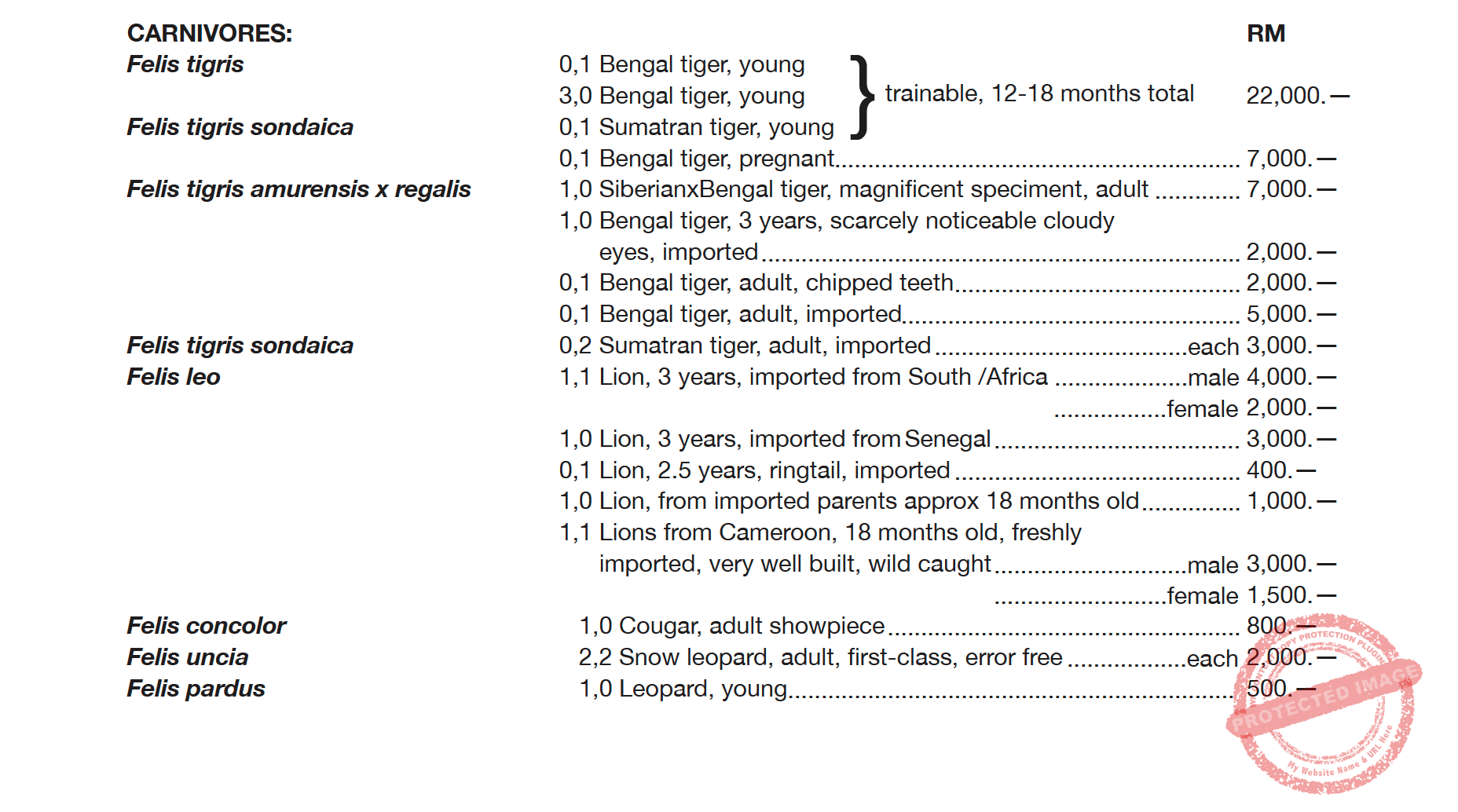
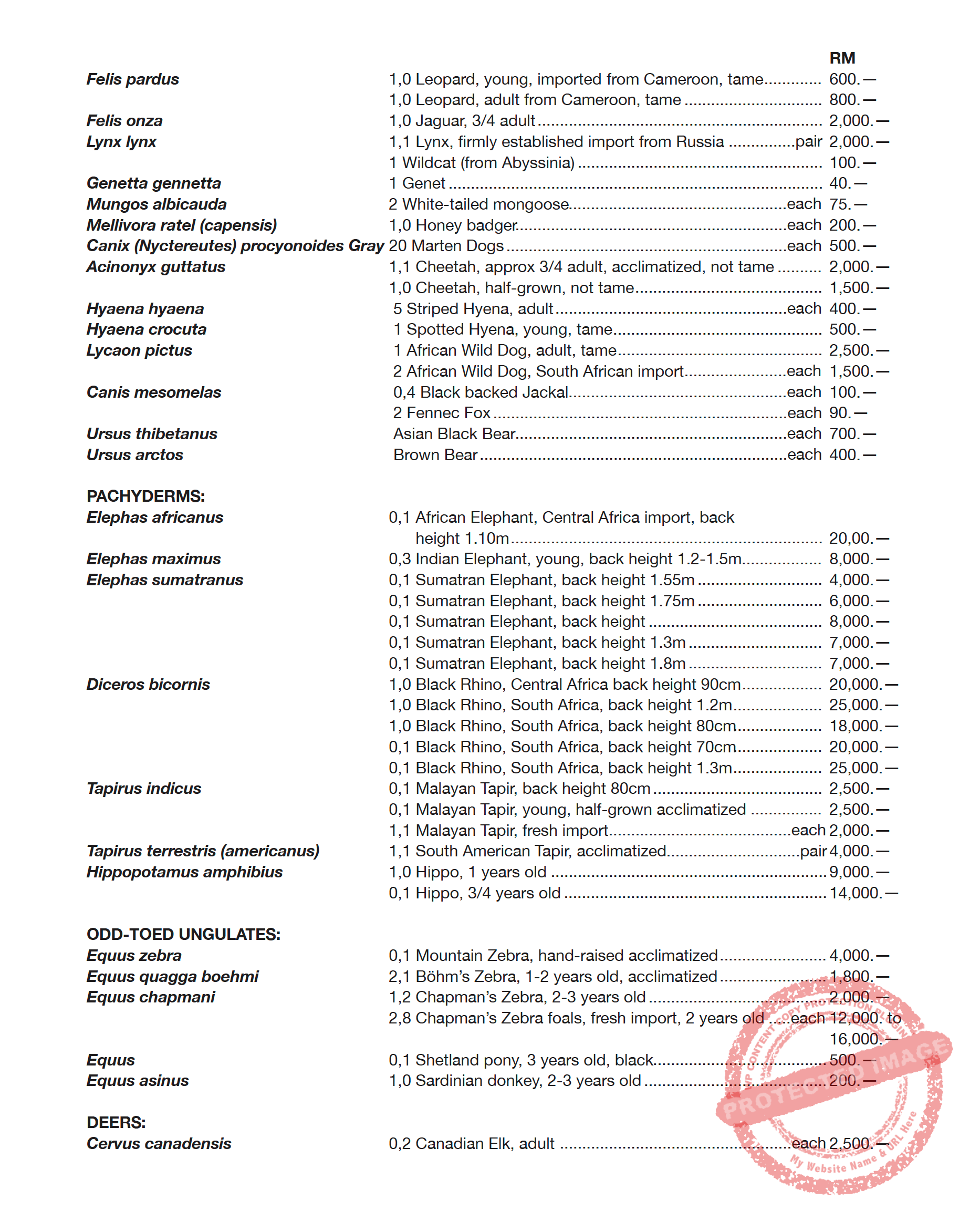
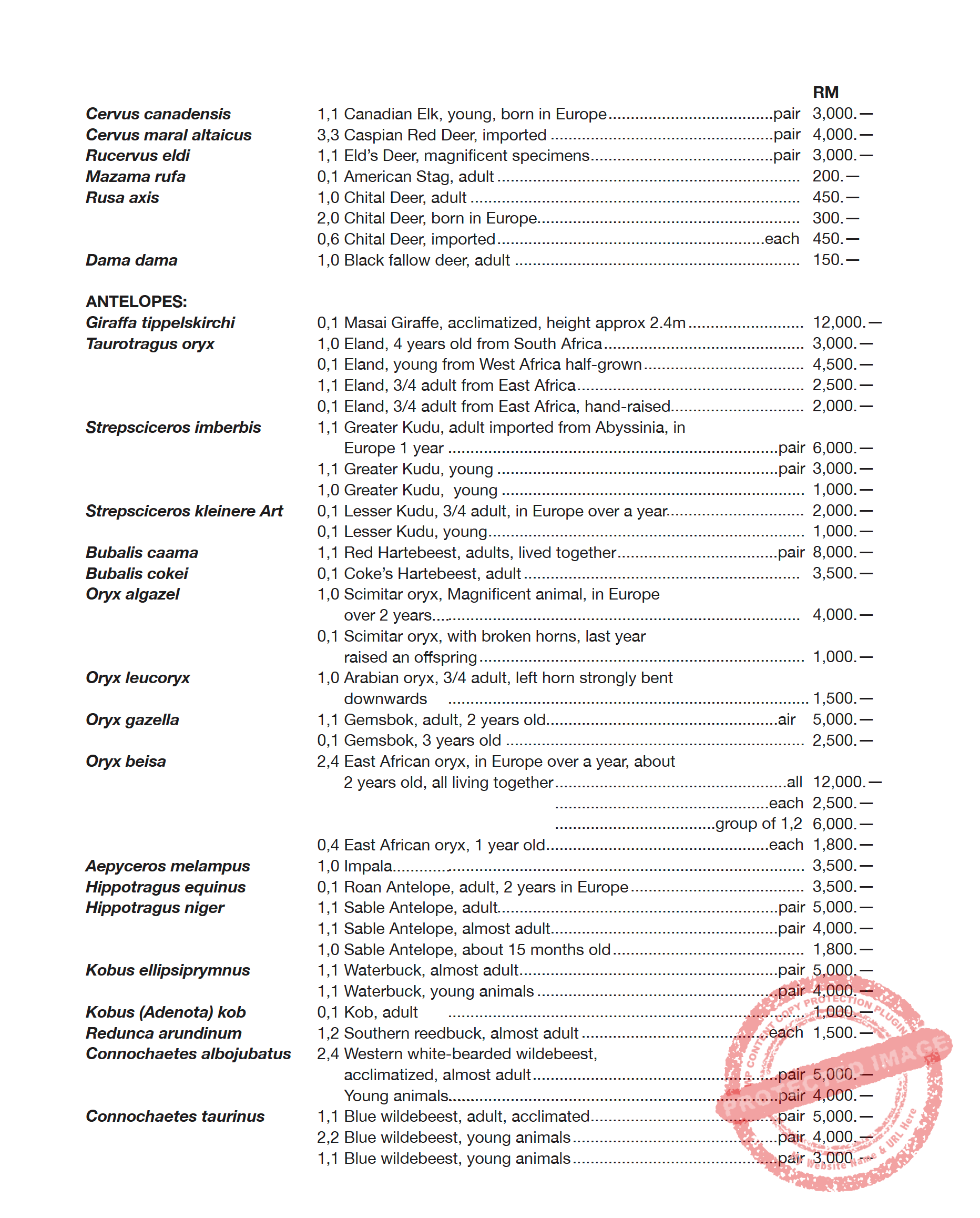
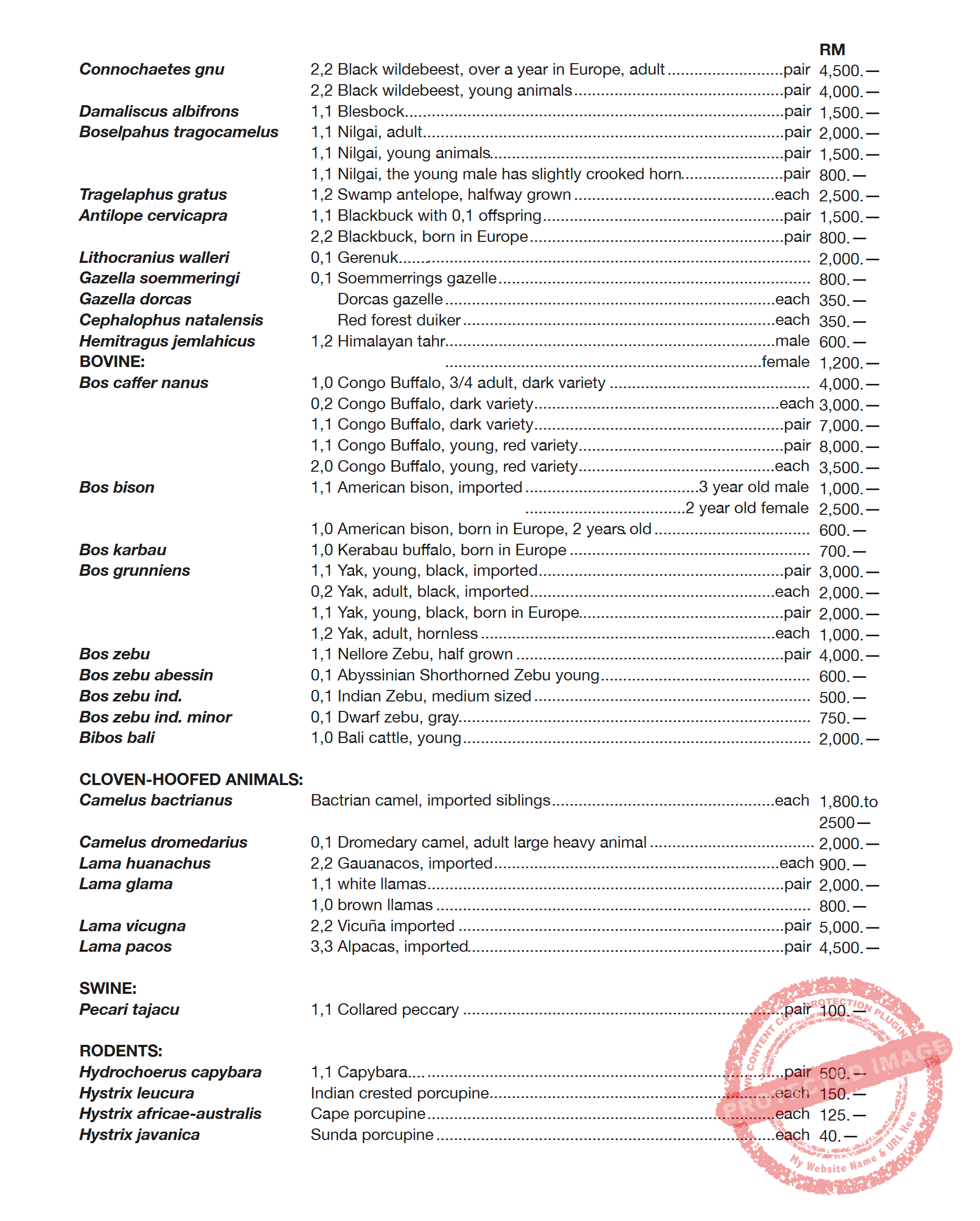
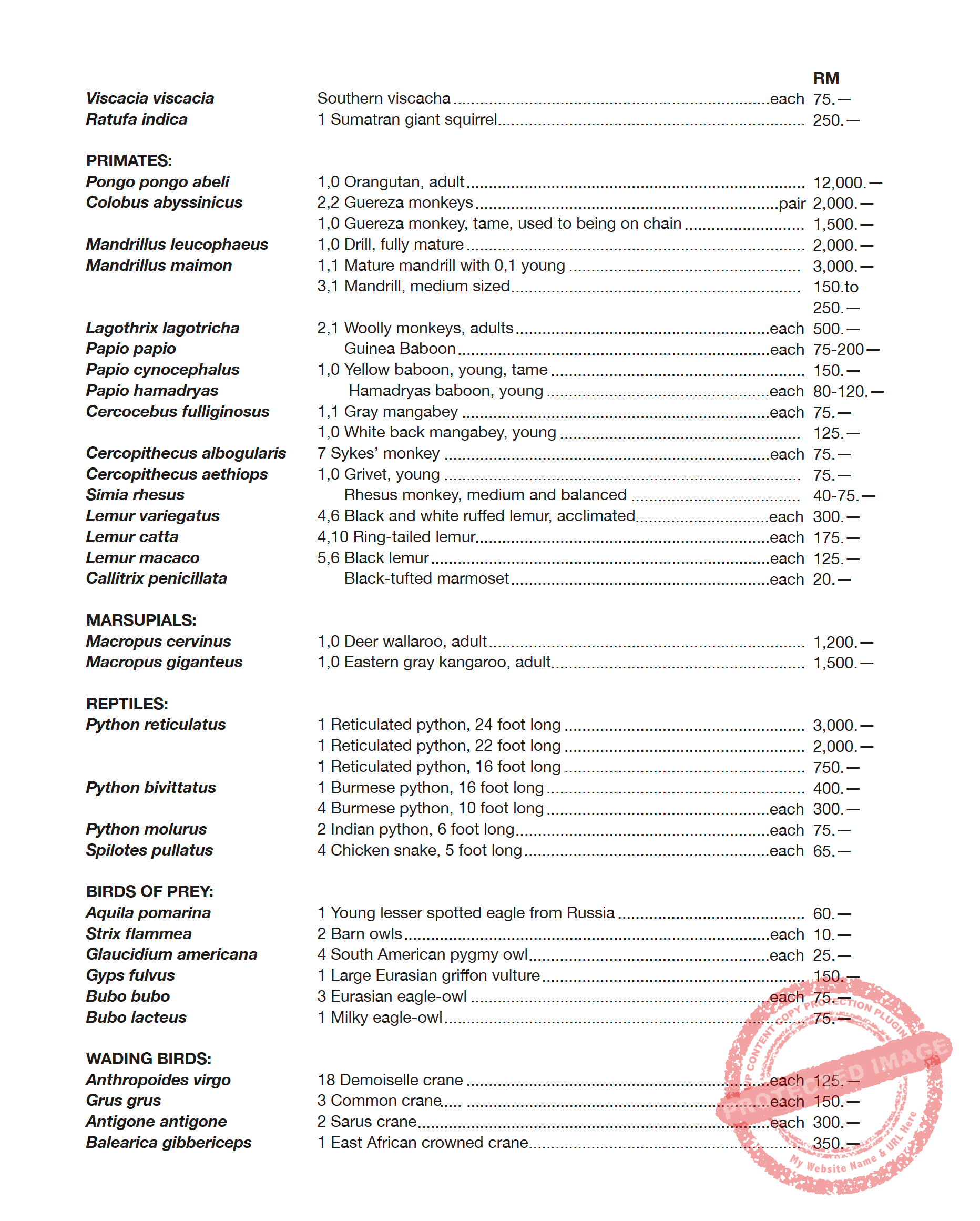
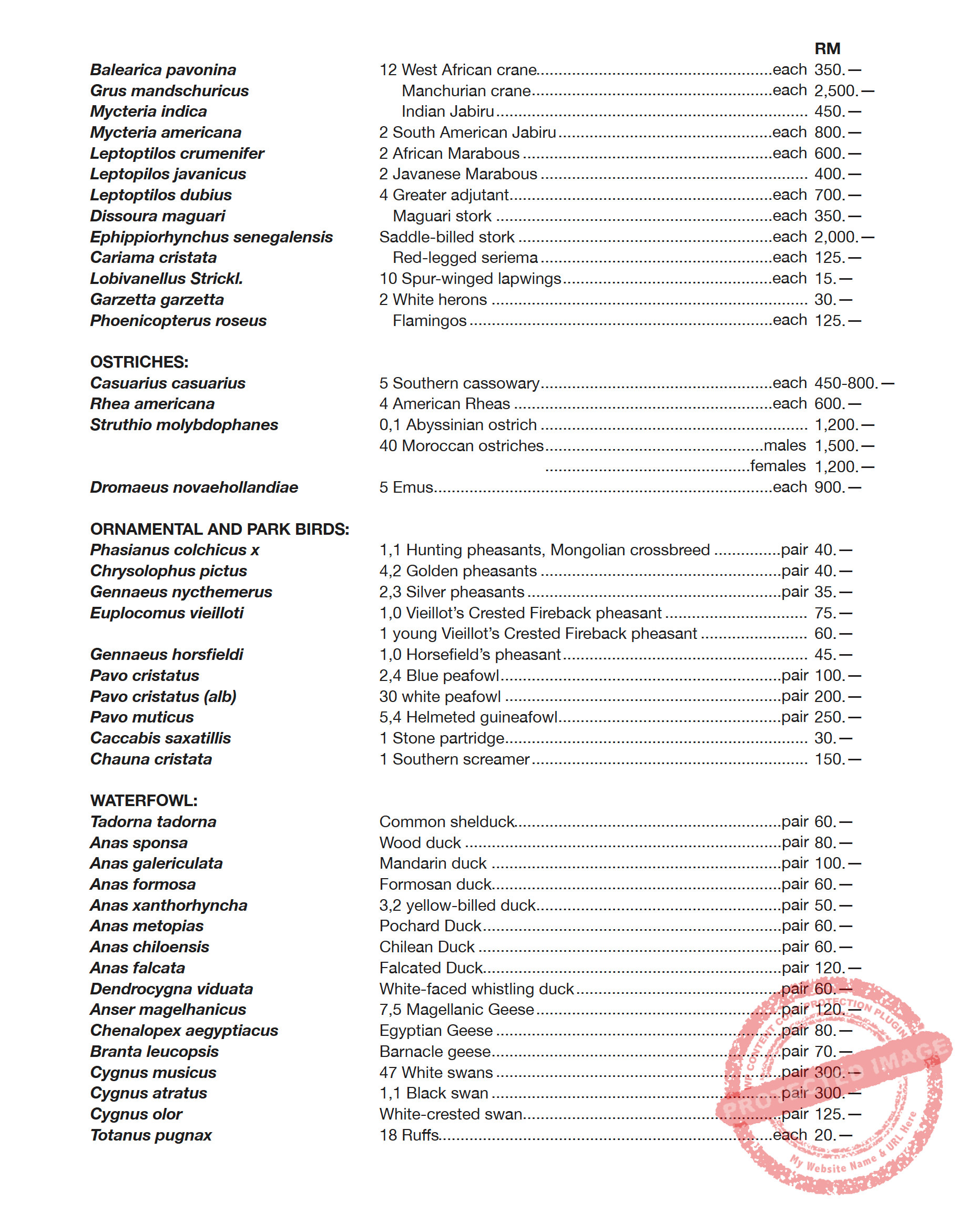
Given this extensive list, it’s understandable that the addition of the Alfeld Zoo near the major city was ideal for my company. Once the trial year in Hannover had begun, I made the surprising discovery that my customers, although they had less time, preferred to come to Alfeld due to its wider selection and more original stock—probably more accustomed and therefore calmer than the zoo-bred ones. The idea that these animals were being transferred from distant countries to Alfeld before being taken to other places seemed to suggest a more authentic and untamed temperament, as if they were ‘zoo-fresh’ and thus more relaxed.
However, the solution to keeping a variety of animals in Hannover and simultaneously displaying them to the public proved beneficial. The business overran the space on occasion due to the vast land at the Weisse Erde (White Earth), and the built-in breeding capabilities proved effective due to the relatively dense population nearby. I automatically took over the management of the zoo’s office in Hannover, setting up an office and a residence there, as it was necessary to be frequently present.
Although it took a lot of effort, it was indeed possible to make the Hannover Zoo an attractive spot for city visitors in a relatively short time. We frequently swapped animals and quickly replenished sold stocks.
Understandably, the zoo became a paradise especially for children. The daily revenues soared, and after the trial year ended, a long-term contract with the city of Hannover was concluded. Carl Eiffert, a long-time animal trader, became the inspector and later the supervisor of the Zoological Garden.
Additionally, I could now interact directly with the general public more frequently. The presence of especially beautiful animals often led visitors to ask the keepers if these magnificent animals were acquired from Hagenbeck—indicative of their high quality.
The old firm of Ruhe was unknown to the public, even though we represented the largest animal trading company in the world during those years. No wonder my old animal keepers from Alfeld were sometimes overwhelmed by this unexpected ‘educational luck’ that fell into the public’s lap, providing them with firsthand experiences of diverse creatures.
Here, as the ‘landlord,’ I also had the opportunity to observe the unique behaviors and reactions of the visitors, adding a layer of personal engagement to my role at the zoo.
The immense delight that a good stock of animals in a zoo can evoke in children is magical. I must admit, I too found joy in seeing how much interest people took in beautiful animals, as the visiting public often came from other circles than those who frequented Cros de Cagnes, which otherwise bored them if not all three days brought new sensations. However, the audience wasn’t always a source of joy for us; they sometimes caused us distress with their many visits. Thus, animals also suffered considerable damage through senseless and excessive feeding. Eventually, we felt compelled to intervene. We posted signs in visible areas of the zoo, instructing not to feed the animals, particularly emphasizing the harm of feeding sweets to them.
It was commonly understood that feeding sweets to animals could lead anyone to deduce the harmful outcomes—animals didn’t need much besides their regular diet, and especially not items like chocolate or other sweets. It was therefore better not to provide such things at all. It was known that even unripe and sour fruits could be harmful. An evening’s oversight of closing led to serious damage at the zoo—vegetables like cabbage and similar robust foods were given, which later caused severe digestion problems for the animals. They were then moved for observation into the inner cages where their drinking troughs were located. The thirstiest animals drank water—and soon they had a terrible colic3!
MOAPH3: Colic in animals refers to stomach issues
It even happened that carnivores were thrown rotten bread and seals were given tennis balls—disasters if a seal, in its innocence, swallowed one and needed urgent help, but by then, the damage was usually irreparable. We couldn’t forbid visitors to everything; we had to allow them some liberties, but it was also made known what types of food were permissible for each species. Many visitors understood that it was in the best interest of their favorite animals to follow the feeding instructions, which minimally reduced the damages we regularly faced.
Despite these efforts, visiting a vet was necessary not only when an animal showed signs of illness but also to continuously monitor even the healthy ones for the slightest signs of emerging diseases. Like children, animals frequently had small ailments that needed attention so they wouldn’t develop into serious illnesses. Given that the veterinary college was nearby, we could always count on the support of professors and their best students, who would intervene preventively or assist robustly in emergencies.
In 1931, the unfortunate foreign exchange control, which necessitated massive government intervention in finances, came into effect—a real ordeal, in a world, from which recovery seemed like eternal Sisyphean labor. The paperwork wars that we suddenly had to wade through were pitiful. Before any foreign exchange approval was granted by the authorities in Hildesheim, Braunschweig, and Berlin, weeks, sometimes more than six weeks, would pass before permissions were granted! During this time, the most appealing offers slipped through my fingers. In the animal business, payments were usually made in cash, sometimes upon receipt of the animals through bank credit—as soon as they arrived. But now, an invaluable offer had to be funded, not with my ready cash, but without foreign exchange approval! By the time the paperwork was in order, the animals had long passed into foreign hands.
My company itself was a significant source of foreign currency, solely through the canary bird trade with the USA, which brought in pure dollars. But this did not help much. For weeks, one had to stall and improvise before vital business dealings were allotted foreign exchange. Although a setback, it didn’t last long. Eventually, ways and means were found to continue business at the usual pace. We overcame the endless waiting times for permissions by securing ‘stock’ foreign exchange permissions, thus making up for the lost weeks eventually.
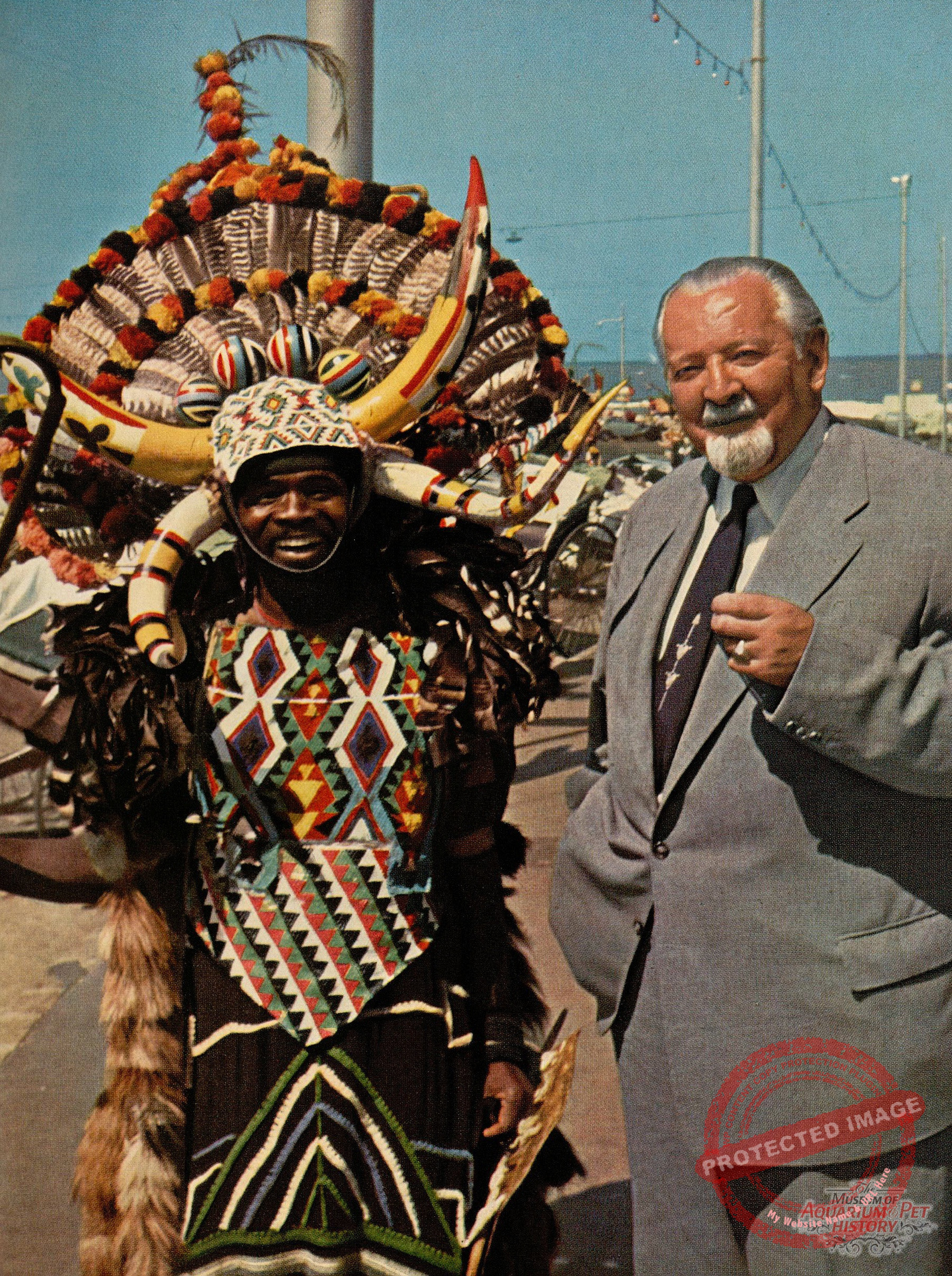
Hermann Ruhe with a rickshaw driver in the South African city of Durban.
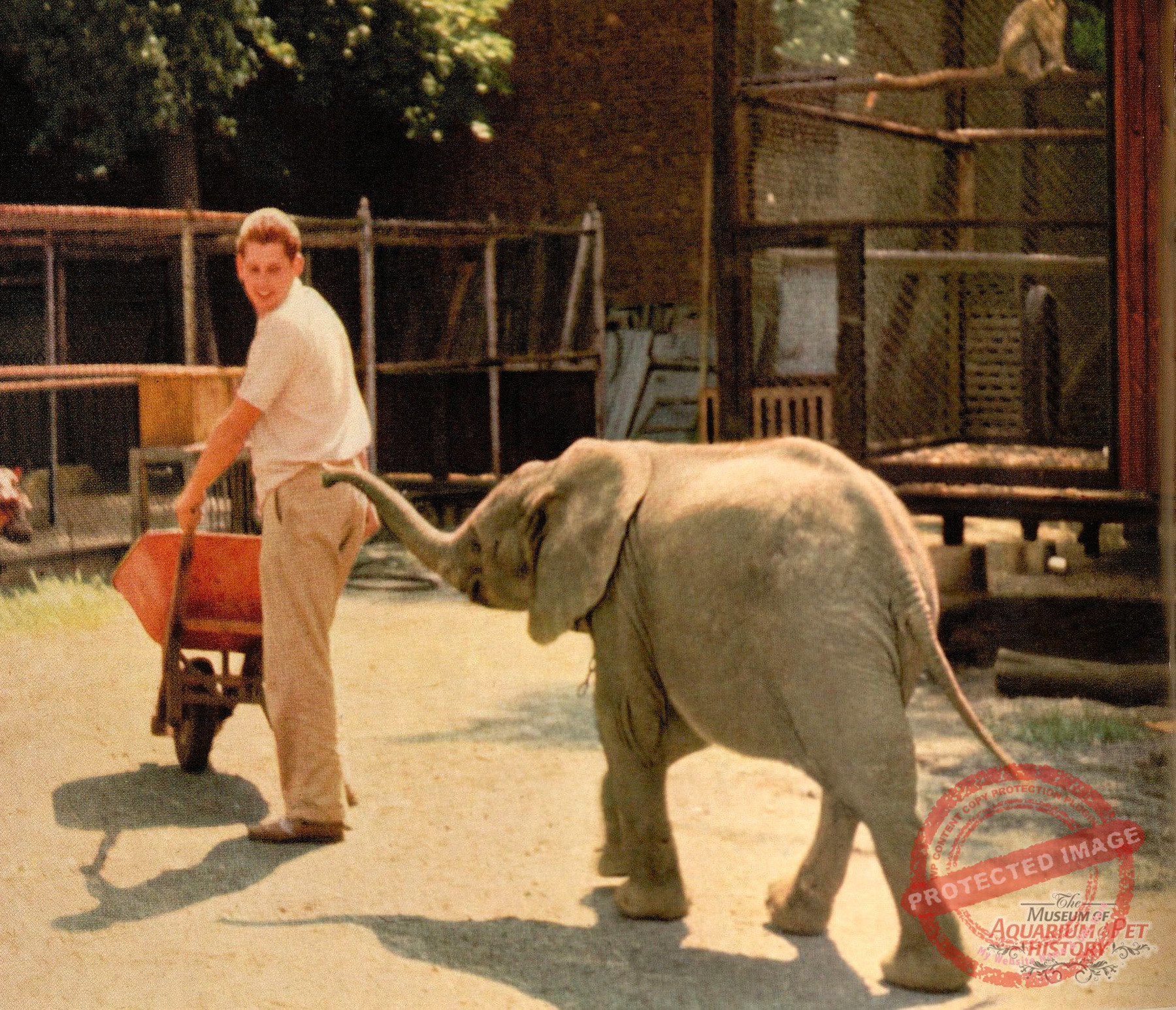
Lutz Ruhe, the youngest son of the author, on the American ‘farm’, followed by a young African elephant that had already become very tame.