Antique Parlor Fountains
A Quick Overview for Future Collectors
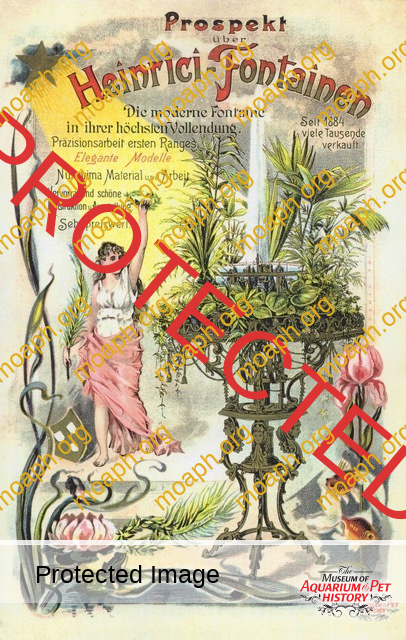
1901 Heinrici catalog, a Holy Grail for collectors.
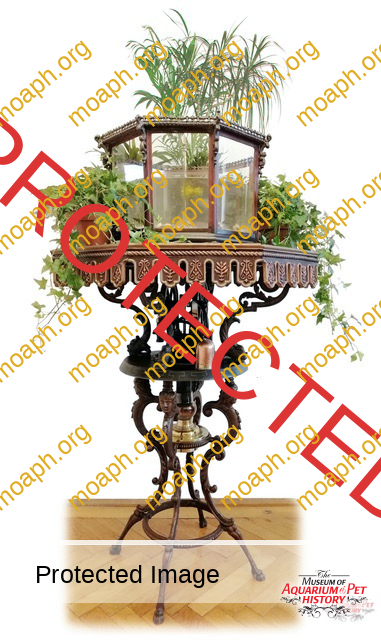
One of the author’s parlor fountains. It still works quite well.
Among the most beautiful and sought aquariums from the period between the early 1880s and the beginning of the First World War, there were without a doubt the German-made parlor fountains driven by hot air engines. The first company to understand the potential of this product, which became very trendy in the upper-class living rooms of important cities such as Vienna and Berlin, was Raab of Zeitz (Saxony). Optician and precision mechanic, Hubertus Raab (1853-1922) started producing hot air engines and parlor fountains in the early 1880s, eventually reaching the pinnacle of success around 1900.
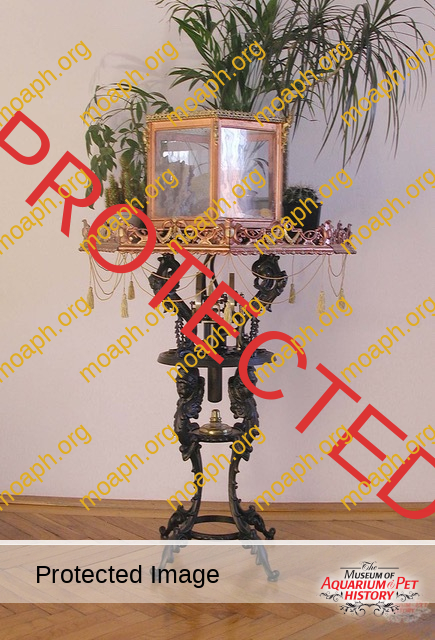
Heinrici model No. XI. This design combination of stand and planter had no correspondence in Raab’s models.
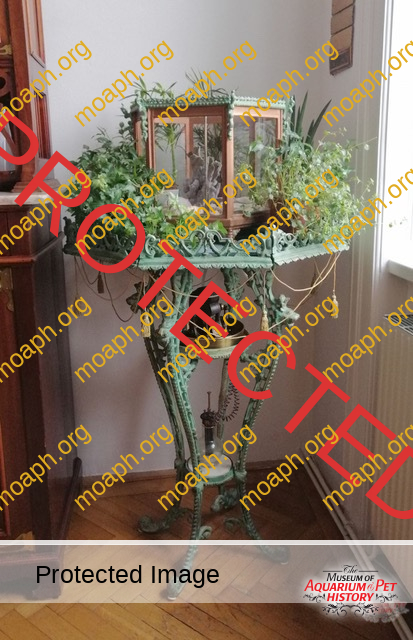
Heinrici model No. IIIA.
One of his first business partners was Louis Heinrici (1847-1930), an optician and master mechanic who started to manufacture small hot air engines in 1876, working in modest locations rented in Zwickau (Saxony). Heinrici sold Raab’s fountains for a while until he inaugurated his mechanical workshop in 1884 and started his own production, becoming in a few years the world’s leading company in the area of hot air engines and parlor fountains. A success story due to reliable products and forward-looking business strategies such as focusing heavily on advertising (the oldest known ad dates back to 1885), multilingual commercial documentation and catalogs with breathtaking chromolithographs. Heinrici also developed a vast network of sales agents, wholesalers and retailers that made his products bestsellers in many other countries including Austria, Belgium, England, France, Italy, Russia and Sweden.
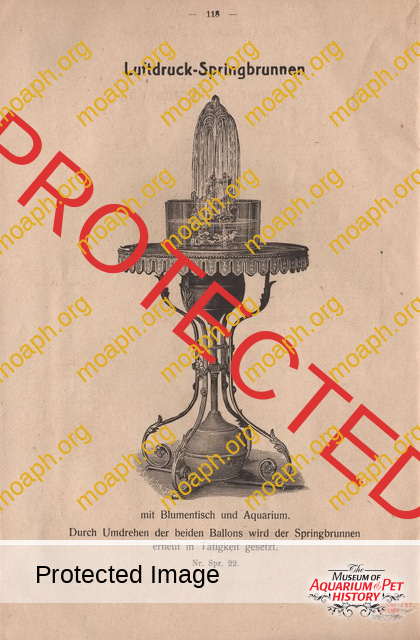
Parlor fountains equipped with Heron’s hydraulic device were cheaper models.
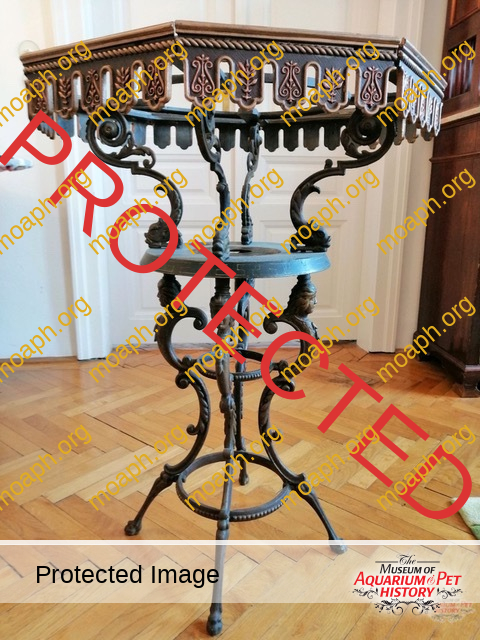
Starting from this pattern you can build either a Heinrici model No. I or a Raab model No. 1, it depends on the motor/fish tank combo you will choose.
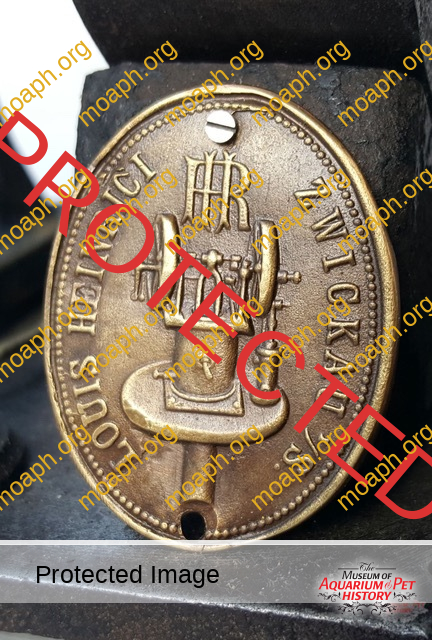
Heinrici nameplate.
Designed for wealthy customers (the price range in the Heinrici catalog from 1901 was 75-120 marks ($20-$30), which in today’s currency, would be $1300-$2200. These fountains are very difficult to find nowadays, much less in original condition. Even rarer are the air pressure fountains equipped with Heron’s hydraulic device, which had to be operated manually by overturning from time to time the gravity balls (also known as “water bellows”) mounted in the center of the stand.
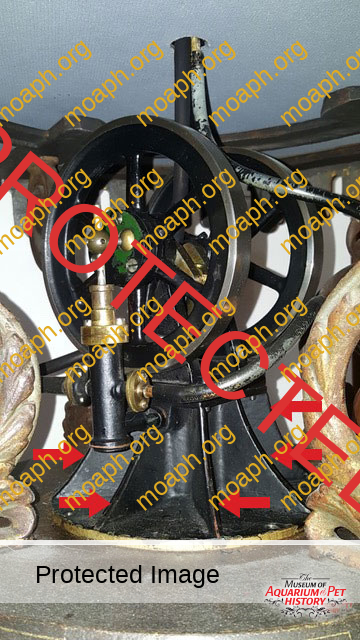
Raab air-cooled two-cylinder pumping engine. Note the big “cooling fins”, a Raab’s motors signature detail.
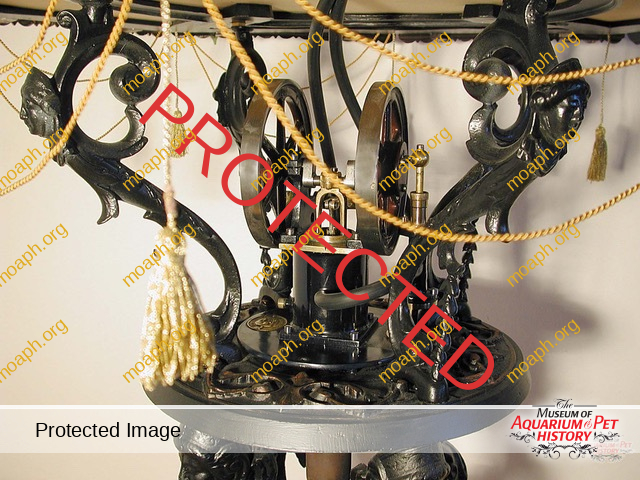
Heinrici water-cooled single-cylinder pumping engine.
If you are about to add a parlor fountain to your collection, the following information could be especially helpful to estimate the value and condition of the very few pieces that, after passing the ravages of two world wars, have survived to the present day.
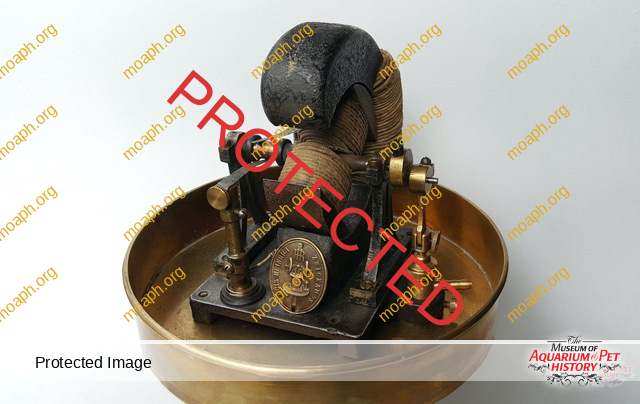
Heinrici electric motor designed for the model No. IIIA.
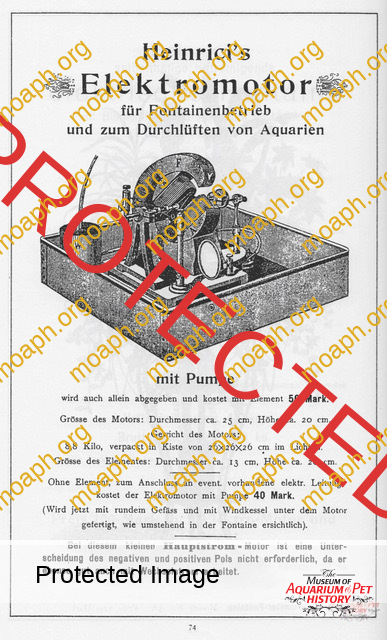
The author’s long-time search to find the super rare and enigmatic Heinrici electric motor started from this image.
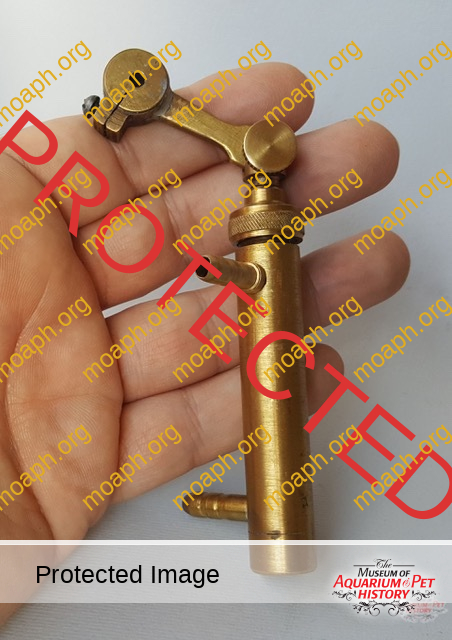
The Heinrici electric motor was equipped with a very small and elegant water pump.
A parlor fountain is made up of 4 main parts: stand, planter with support frame and finely crafted edge (something like a low fence), hot air engine, and fish tank. Much of its economic value depends on its mechanical heart, the hot air engine. Therefore, it is crucial for collectors to broaden their knowledge of these motors, a subject that, let us say at once, is extensive and full of technical details.
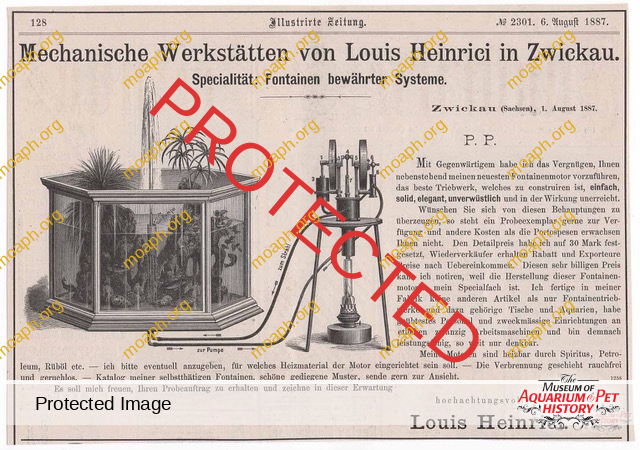
Heinrici’s ad from 1887.
Before the full-scale spread of electricity, hot air engines were an ideal tool for obtaining a source of power and a long-time action, both in the commercial field (where steam engines were already common) and in private homes. Easy to use, reliable although not very powerful, “quite” silent, safe, undemanding in terms of lubrication and maintenance, they were employed to operate fans (Raab himself began to produce them in the early 1900s), advertising installations, toys, turntables for Christmas trees, agitators and shakers for laboratories, hospitals and for the chemical industry. If applied to a dynamo, they could even generate electricity!
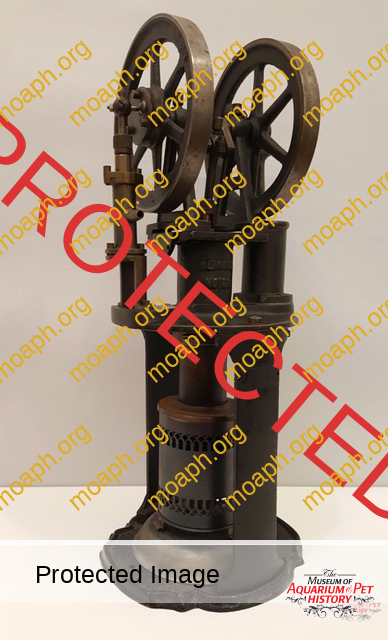
Heinrici air-cooled two-cylinder pumping engine.
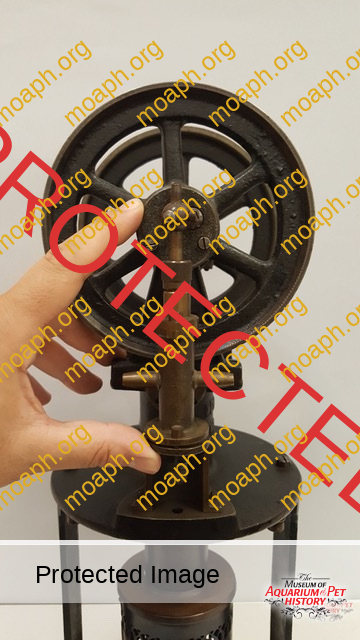
A classic example of water pump for two-cylinder hot air engines.
Once equipped with a water pump, hot air engines found further uses, including those in fishkeeping, both for parlor fountains and tabletop aquariums to drive fountain jets, waterfalls or simply to recirculate water.
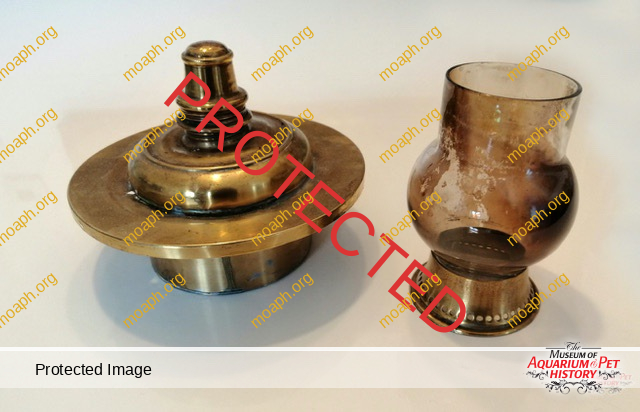
Fuel tank, burner and glass flame guard.
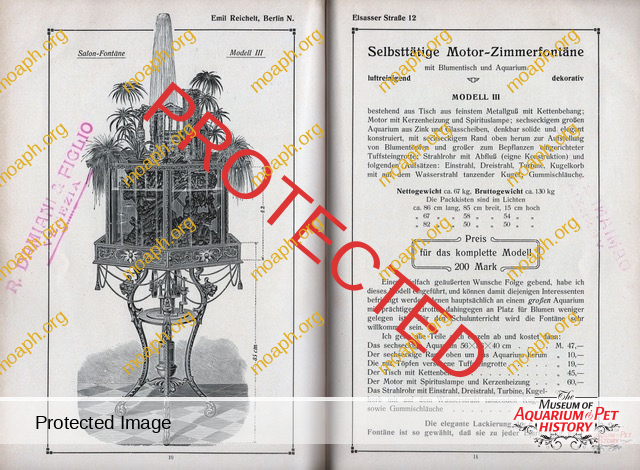
Emil Reichelt catalog (Berlin, 1909-1910 edition). The stamp belonged to one of the early Italian importers of parlor fountains. Note also the giant decoration made of tuffstone.
Hundreds of different hot air engine models made by large companies and smaller manufacturers such as Paul Lochmann (1848-1928) were sold in the past. A few of these old motors are still available in today’s specialized market. Collectors, of course, look for pieces in original condition and still working. Everything I know about hot air engines and parlor fountains I learned from the interesting and monumental e-books written by Gerd Maier, one of the world’s leading experts on these devices and their history. I can only highly recommend reading them since they will help you to buy consciously.
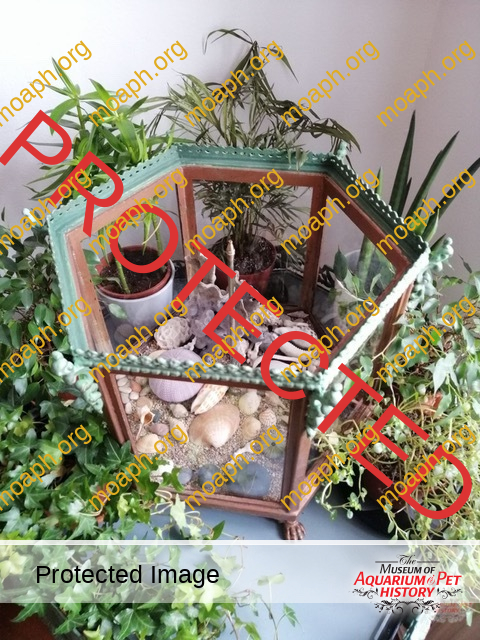
Heinrici model No. IIIA, planter and fish tank.
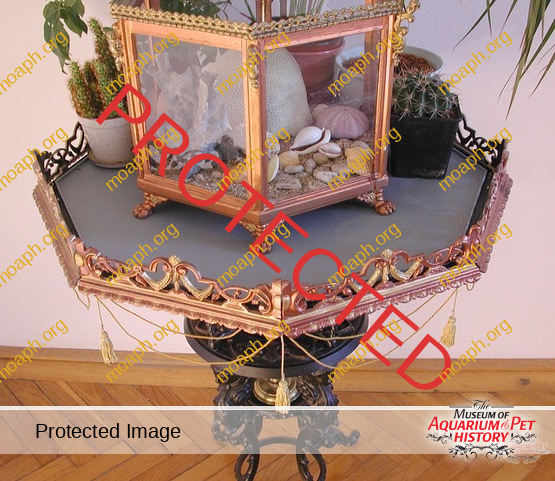
Heinrici model No. XI, planter and fish tank.
About hot air engines mounted on the parlor fountains available nowadays, the first thing to consider is that, most of the time, you cannot know if their engine is the same that initially left the factory together with the rest of the fountain. Finding a motor of the same model or similar technical features would already be a success. The illustrated catalogs of manufacturers and retailers can certainly help us, at least to understand if the fountain we would like to buy was originally equipped with a water-cooled single-cylinder engine or with an air-cooled double-cylinder engine. The early generations of Heinrici fountains, for example, had water-cooled single-cylinder pumping engines, a type of motor that is also remembered as one of the early heaters for aquariums (unfortunately not adjustable). The water, in fact, passing continuously through the “water jacket” heated up before flowing back to the fish tank.
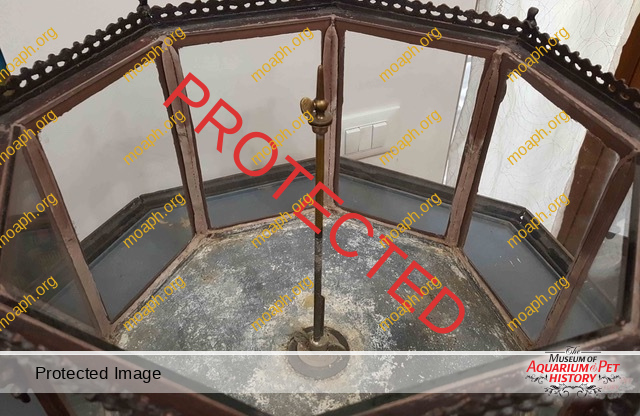
Heinrici-style octagonal fish tank with a standard water jet.
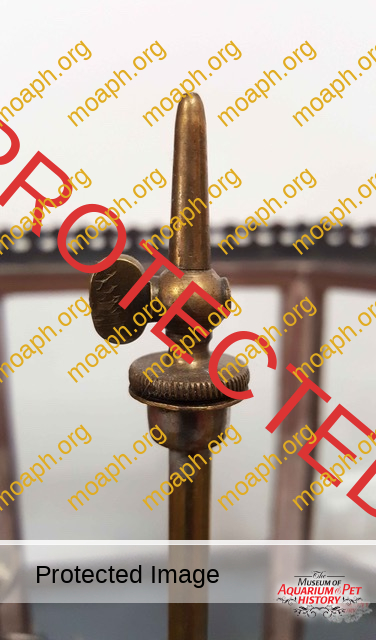
Water jet closeup.
Now let’s talk about the stands. They were made of cast iron, usually with four legs and without any trademark or model number or manufacture date engraved in the metal. You can find some in original condition with the right patina and others repainted (often in the wrong way), and they are the classic starting point for a restoration project. The planters with their ornate edges are instead harder to find, and the same can be said about the metalworkers able to reproduce copies. On the subject of stands and planters, it is important to notice that Raab and Heinrici for some of their fountain models shared identical designs, keeping them unchanged for many years. In the case of these similar parlor fountains, therefore, the manufacturer’s name and model number are conventionally assigned relying on the engine manufacturer’s name and on the shape of the fish tank. Regarding the fish tanks we can state, with the inevitable exceptions, that Heinrici preferred octagonal and hexagonal tanks with zinc frame, Raab on the other hand all-glass rounded aquariums.
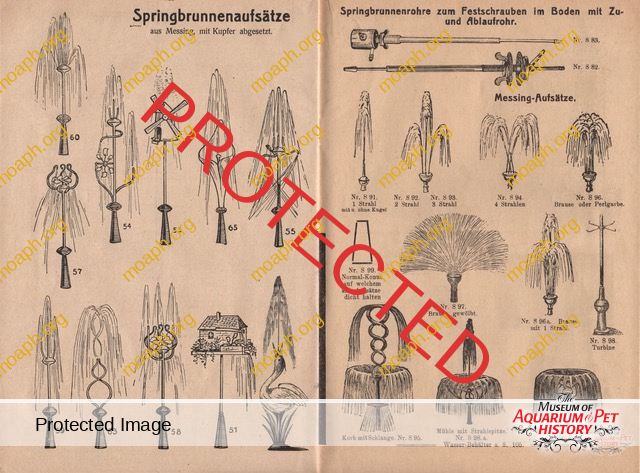
A. Glaschker of Leipzig offered a wide range of water jets in those years.
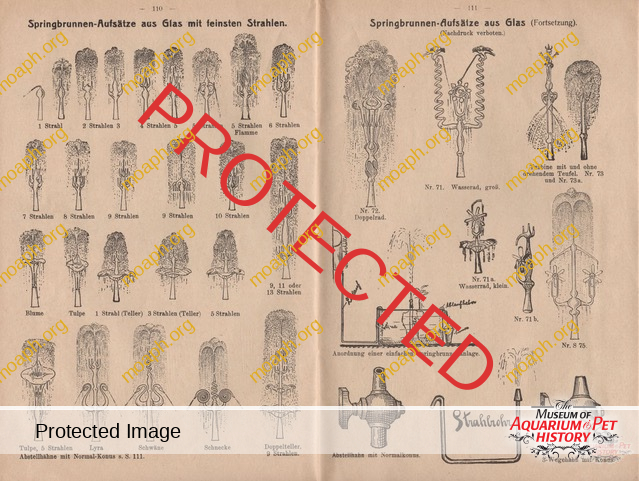
Glass water jets.
But where to look for these awesome aquariums nowadays? I succeeded by investigating the collectors’ community of hot air engines and small steam engines, much more than by asking to antique aquarium collectors. Germany and Austria are the countries where I found my parlor fountains and my motors, and this is where I still focus my research. The United States, on the other hand, is not the best market for such aquariums, since only a limited number of pieces were imported in those days.
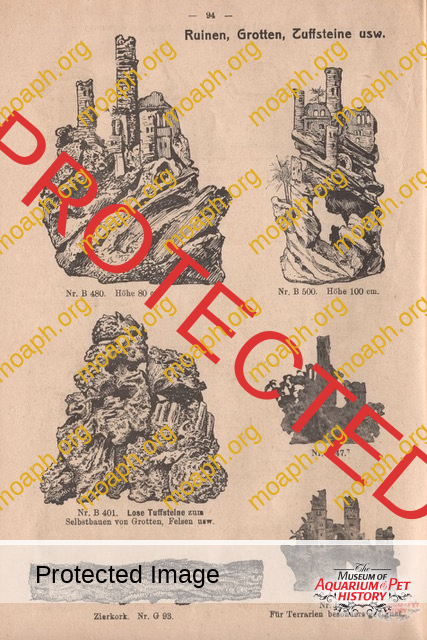
Grottos and castles made of tuffstone were a must-have decoration for parlor fountains.
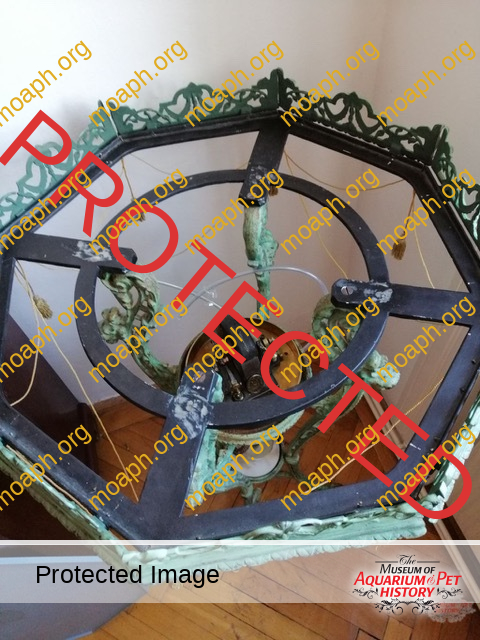
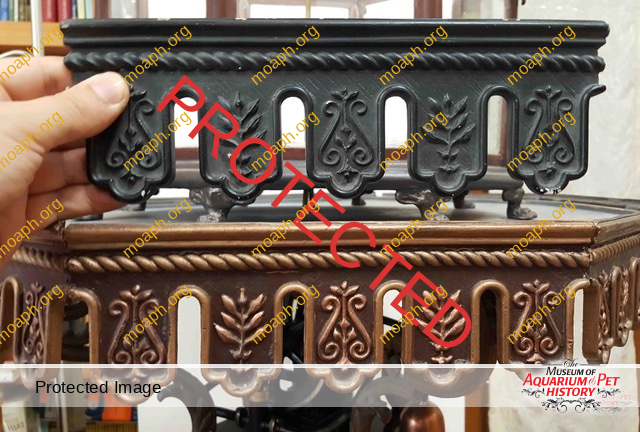
Detail of a replacement support frame for a planter.
Two years ago, precisely because of a top collector of old motors, I bought a rare fountain that I have been looking for a long time, the legendary Heinrici No. IIIA, one of the most innovative fountains ever manufactured by the company from Zwickau. What was so special about it? It wasn’t equipped with a hot air engine, since it left the factory together with an electric pumping motor designed to be powered by… a battery! From a historical perspective, it is interesting to notice how Heinrici advertised this motor trying firstly to convince his customers to overcome the widespread distrust towards electricity, something then unknown that soon afterwards would change the world.