The Early History of Western Herpetoculture, Up to the Year 1900-Part 3
If you missed part 1 and part 2 of this article, you can read them at the links below.
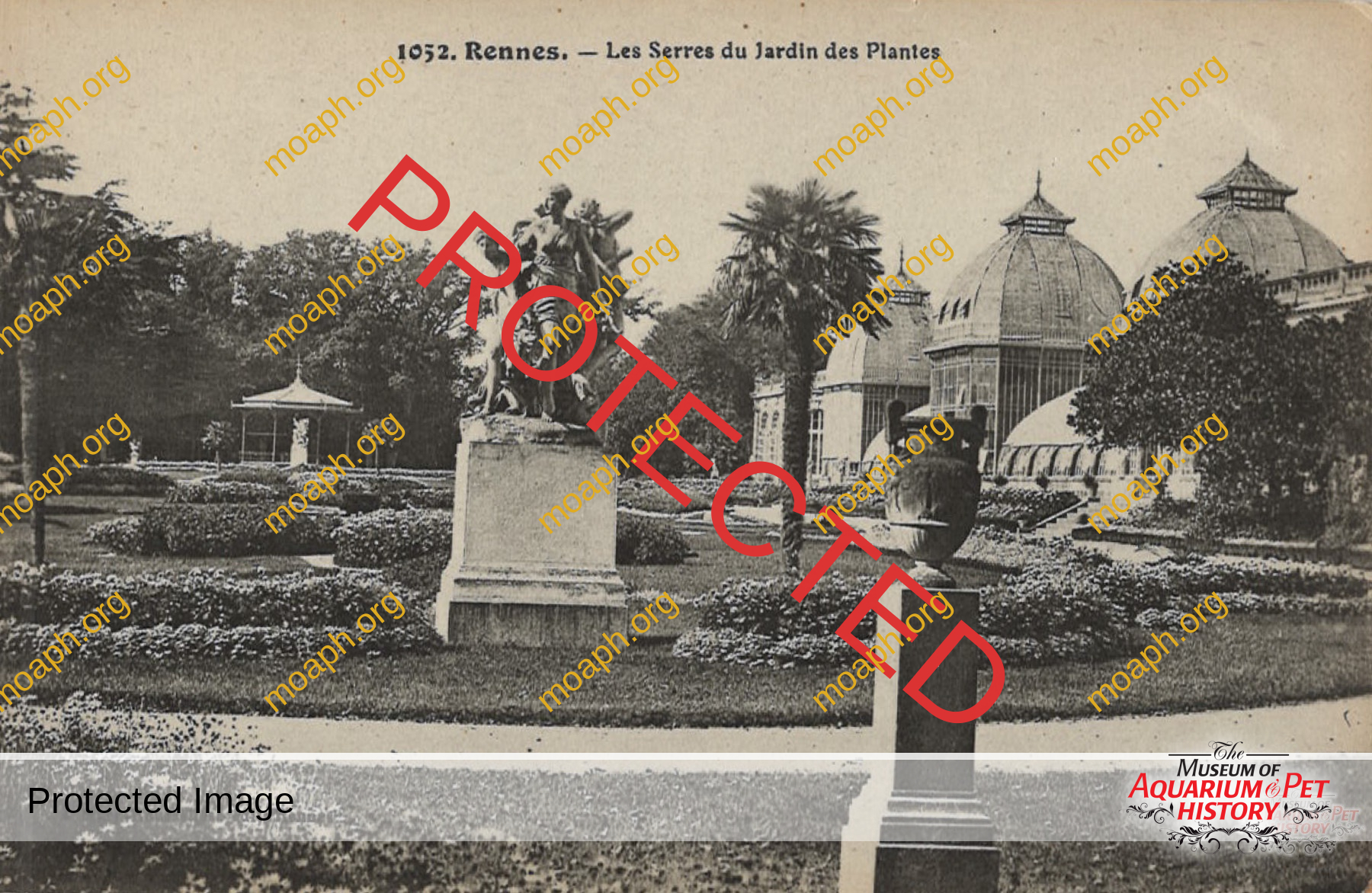
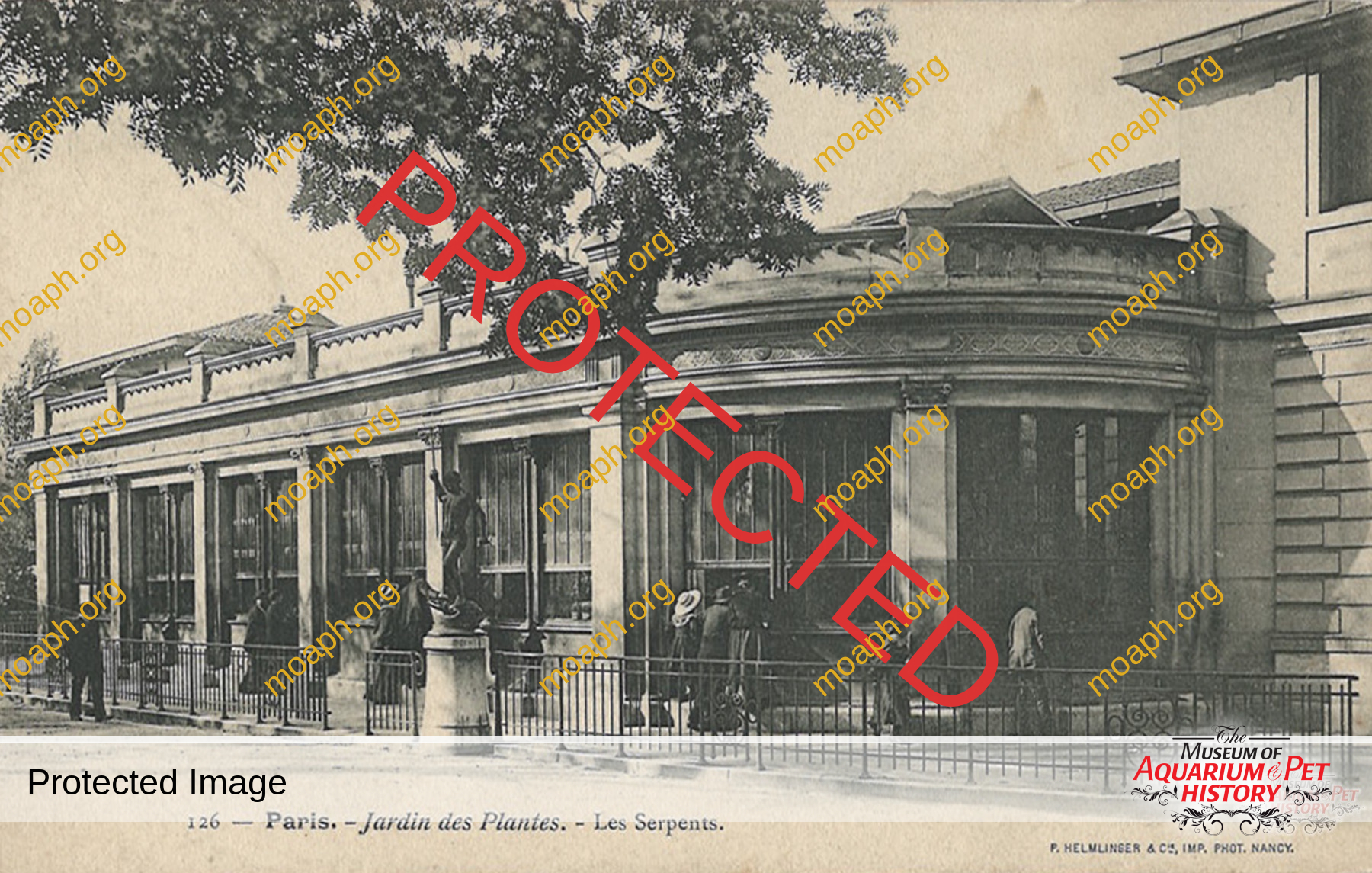
During the French Revolution in June 1793, Europe’s first classical zoological park, the Jardin des Plantes of the Muséum National D’ Histoire Naturelle, was established in the Quartier Latin in Paris with animals from the former royal collection and was free of charge to the visiting public. The museum’s predecessor was the Jardin de Roi, the garden of the king, renamed during the Revolution as the Jardin des Plantes. Here more than 6,000 species of living plants were established, but few live animals. What animals there were had previously been kept at the estate, at Montbard, of a man called Buffon, who is today immortalized by having the street outside the Muséum named after him, Rue Buffon. He established his place in the history of zoology by publishing his Histoire Naturelle. The volumes of this devoted to reptiles and fish were written by his colleague Bernard-Germain-Etienne de Lacépède, who was considered the natural successor to Buffont and expected to succeed to one of the two newly established chairs at the new Muséum National D’ Histoire Naturelle. Unfortunately, Lacépède was of noble birth and was forced to flee from Paris in 1793. It is interesting to speculate how he might have progressed the captive care of reptiles if he had been able to stay in Paris.
It was in this zoo in Paris that the first evidence of pythons incubating their eggs was discovered. On the 6th of May 1841, a female Burmese Python laid a clutch of 15 eggs three months after an observed mating. She arranged these eggs into a cone shape and coiled around them for the next 56 days, only leaving them for two days in total during this period. Her temperature between her coils was regularly taken and observed to always be higher than the surrounding air in her den. During the incubation, she ate nothing and eventually succeeded in hatching 8 of her eggs successfully. She was fed raw meat, which she accepted before and after the incubation, a fasting period of four months. The 8 hatchlings shed their skins at 10 days of age, after which all successfully constricted and fed on live sparrows.
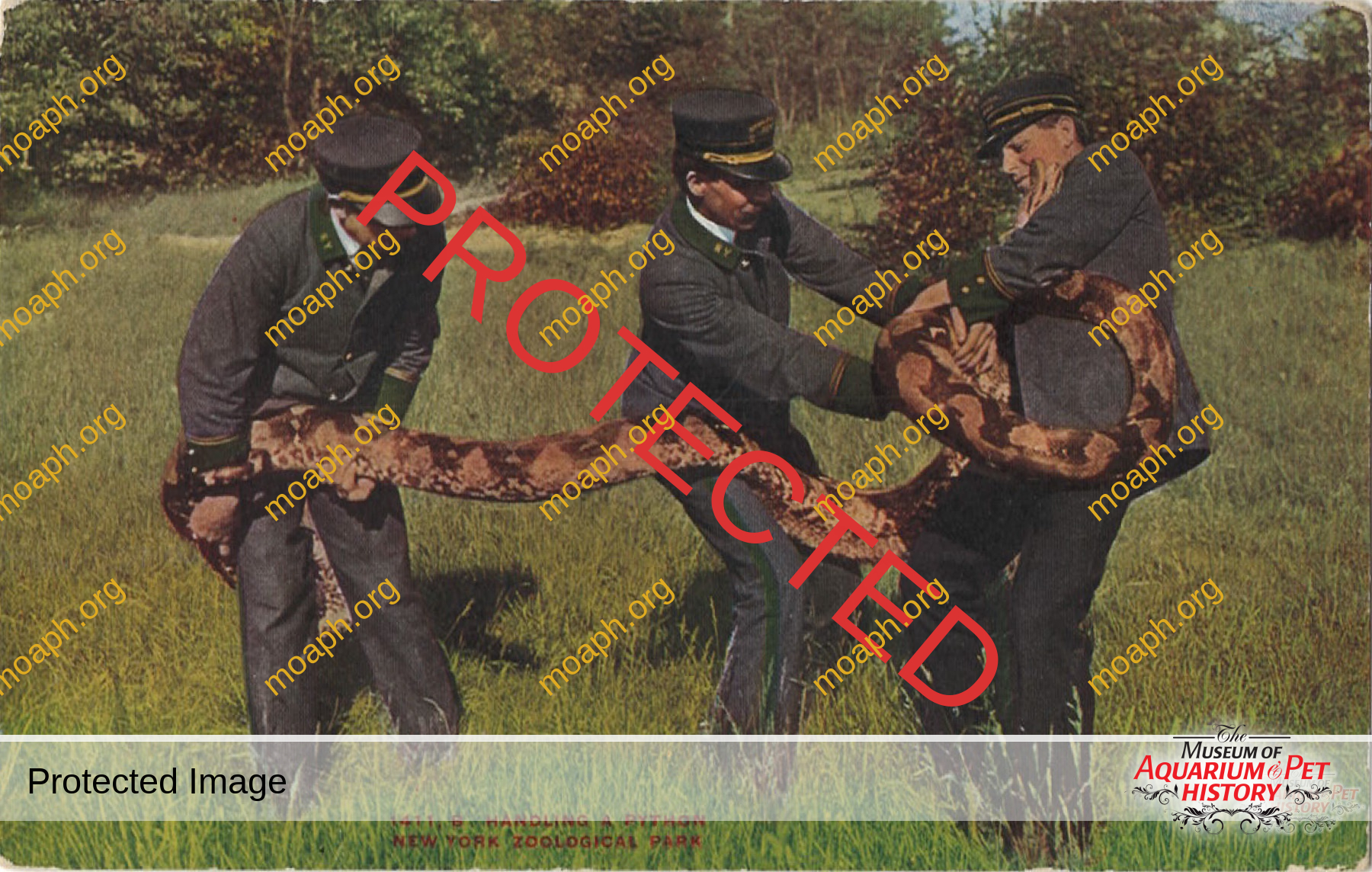
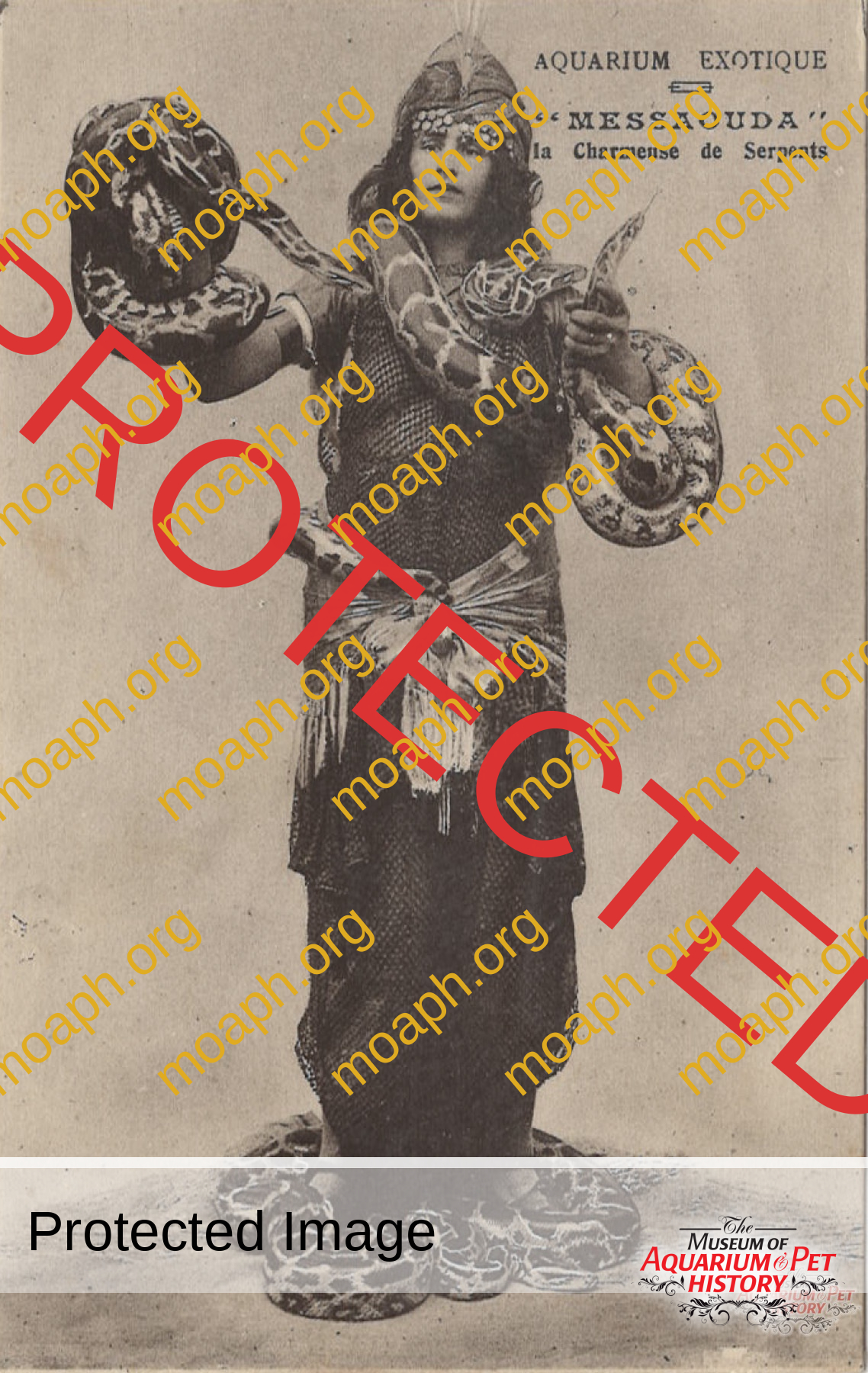
A less successful confirmation of a python’s incubation of its eggs was at the London Zoo in 1862. A female African Python, Python sebae, laid upwards of 100 eggs and tried to incubate them for seven weeks. During this time, she was continually disturbed by the cleaning of her den, feeding the male housed with her, the overflow of her water tank, the shedding of her skin on day 53, and the insertion of a thermometer between her coils at frequent intervals. The majority of her eggs were later determined to have been fertile. Temperatures taken on the body surface of both the male and the female and within the den produced the following results in degrees Fahrenheit:
This pair of African Pythons were set up on a bed of moss each and covered over with a blanket. The male showed no interest in the female’s efforts despite the fact that she was very aggressive towards all disturbances. The use of blankets to try to keep these snakes warm would have helped the female to lose less heat less quickly, though the background temperature to her den, we now know, was woefully inadequate. We must remember that this was long before access to electrical heating and control.
Today the Jardin de Plantes is interesting to visit purely from a historical perspective as it has two separate buildings devoted to reptiles. The most interesting dates from the Victorian era, whilst the ‘new’ one looks as if it was constructed in the 1930s. The Victorian building still retains and uses the original ornate-legged, glass-fronted, and accessed mahogany, reptile cases, and marble-walled crocodile pits. To see the reptile cages here is to step back in time and view the first dawning of modern herpetoculture.
Historical Tortoises
It is probable that the European land tortoises were the first reptiles that the British ventured to keep in confinement and treat as pets. In fact, the earliest pet reptile recorded in England is a European Tortoise from 1601, as described below. Their popularity increased to such an extent that by the 17th and 18th centuries, they were being imported into England in the thousands and were relatively inexpensive. One dealer in London in 1850 headed his advert with the announcement “10,000 Tortoises”. Incidentally, the term “Tortoise” comes from the twisted appearance of their front legs and is derived from the French word for twisted tortis.
William Laud purchased a Spur-Thighed Tortoise, Testudo graeca, in 1625. In keeping with his position as Bishop of London, he at first kept the tortoise at the Palace of Fulham. Eight years later, he succeeded to the top clerical position in England as the Archbishop of Canterbury. So the tortoise moved with him to Lambeth Palace, across the river Thames from the Houses of Parliament. Here the tortoise lived for another incredible 120 years. In 1753 its long life was literally cut short when an under-gardener accidentally cut off its head. The shell of this earliest English pet reptile was preserved and is still kept today in the library at Lambeth Palace. Its original owner, Archbishop William Laud, fared no better, as he supported King Charles I in his belief in the divine right of Kings. This put him on the losing side in the subsequent Civil War of 1642, leading to his trial for treason and a sentence to death in 1645. He was imprisoned in the Tower of London, close to the famous Tower menagerie described previously, before his execution by beheading; the same fate that befell his pet tortoise 108 years later.
An even earlier clerical tortoise, or more likely succession of tortoises, was the pet of a succession of seven Bishops of Peterborough in England recorded from as early as 1601 until the death of the last in 1821, a period of 220 years. This data is from a document belonging to the archives of Peterborough cathedral called the Bishop’s Barn. The last of these pet tortoises was recorded in 1818 to eat endive, green peas and leeks, be partial to oranges, but to reject asparagus, parsley, and spinach. In the early part of the year, its preference was for the yellow flowers of dandelions and lettuce. From the end of June onwards, it looked for fruit, including currants, raspberries, pears, plums, apples, peaches, and nectarines; the riper, the better, but it refused cherries. It was particularly fond of strawberries, for which its shell was perforated, in order to attach it to a tree to limit its ravages among the strawberry borders. Also fond of gooseberries, it refused any root vegetables, including carrot and turnip, as well as all animal food. It was never observed to drink and would shake leaves dry if wet. From the beginning of each October to the end of September, it would dig itself into a particular part of the garden at a steep angle. The depth that it dug was apparently significant with the severity of the forthcoming winter, up to a maximum depth of two feet. It would refuse all food a month before its hibernation, and on its emergence around the end of April, it would not accept food for another two weeks. This tortoise was recorded as weighing 13.5 pounds, which raises speculation as to its exact species being probably too heavy for the European species, except perhaps a very large Marginated Tortoise, Testudo marginata. It was recorded as being able to move with apparent ease, though pressed by a weight of 18 stone (252 lb.).
The most famous early pet tortoise in England is the one called Timothy. It was kept and closely observed and recorded by Gilbert White, a village curate, and described in his book “The Natural History of Selbourne.” This tortoise was originally purchased for half a crown (15 cents) by his |Aunt, a certain Mrs. Snooke, who bought it from a sailor in Chichester, Sussex, in 1740. He assured her that it came from Virginia and was born in 1734. It was actually a Greek tortoise, Testudo graeca, of large size and, therefore, probably originating from the coast of Algeria. It came into the possession of Gilbert White following the death of his Aunt, Mrs. Snooke, in 1780. She had left it to her nephew in her will. It was March at the time, and he had to dig it out of its winter hibernaculum, to which it expressed its displeasure by hissing at him. To transport it home, he packed it in a box full of soil. It was then carried the eighty miles to his home in a series of horse-drawn poste chaises. The rough journey unsettled it sufficiently for it to walk twice down to the bottom of his garden when released before re-burying itself in some loose leaf mould.
The last detailed account of Timothy by White was entitled, “More particulars respecting the old family tortoise”:-
“Because we call this creature an abject reptile, we are too apt to undervalue his abilities and depreciate his powers of instinct. Yet he is, as Mr. Pope says of his lord.
“Much too wise to walk into a well, and has so much discernment as to not fall down a haha (a sunken fence or ditch used in garden design to provide an unimpeded view, but prevent livestock entering the garden), but to stop and withdraw from the brink with the readiest of precaution.”
“Though he loves warm weather, he avoids hot sun; because of his thick shell, when once heated, would, as the poet says of solid armor, scald with safety. He, therefore, spends the more sultry hours under the umbrella of a large cabbage leaf or amidst the waving forest of an asparagus bed. But as he avoids the heat in summer, so in the decline of the year, he improves the faint autumnal beams by getting within the reflection of a fruit wall; and, though he never has read that planes inclining to the horizon receive a greater share of warmth, he inclines his shell, by tilting it against the wall, to collect and admit every feeble ray.
Pitiable seems the condition of this poor embarrassed reptile, to be cased in a suit of ponderous armour, which he cannot lay aside; to be imprisoned, as it were, within his own shell, must preclude, we should suppose, all activity and disposition for enterprise. Yet there is a season of the year (usually the beginning of June) when his exertions are remarkable. He then walks on tiptoe, and is stirring by five in the morning, and, traversing the garden, examines every wicket and interstice in the fences, through which he will escape if possible; and often has eluded the care of the gardener, and wandered to some distant field. The motives that impel him to undertake these rambles seem to be of the amorous kind: his fancy then becomes intent on sexual attachments, which transport him beyond his usual gravity, and induce him to forget for a time his ordinary solemn deportment.”
Mrs. Snooke also had two North American Box Turtles, as described in a note by White in 1774. She kept their shells following their deaths in “a room over the Hall.”
White examined his tortoise Timothy’s droppings, recorded what it ate, weighed it regularly (average 6.5 pounds), tested its hearing and if it could swim, and generally did a pretty good job of looking after it until his death on the 15th of June 1793. Timothy followed his master in death the following Spring at an estimated age of 60. His carapace was preserved and became the property of White’s great-niece, a Mrs. Christopher, in 1836. She presented it to the British Museum (Natural History) in April 1853.
Perhaps the oldest living European Tortoise in the UK today, also called Timothy, but established as being a female in 1926, is one living at the sixty-roomed Powderham Castle. This is situated above the estuary of the river Exe, in Devon, and has been home to the Earls of Devon since 1325. This tortoise weighs about 11 lb. and is described as 5 in. tall. The current Earl, the 18th, is Lord Hugh Rupert Courtenay, whose ancestors fought at the battles of Crecy and Agincourt, provided three Latin Emperors of Constantinople during the 13th century, and included one who was a founder member of the Knights of the Garter in 1384. The Courtenay family was welcomed to England by King Henry II in 1147. This followed Renaud de Courtenay’s quarrel with King Louis VII of France after they had both recently returned from a Crusade to the Holy Land.

This tortoise was originally found on board a captured Portuguese pirate ship in 1854. The pirate ship was captured by Captain John Guy Courtenay Everard of Her Majesty’s Ship (HMS) Queen, a relative of the 10th Earl of Devon. The Portuguese pirate ship was captured in the Mediterranean, and ‘Timothy,’ thought to be very young, perhaps only hatched around 1850, was apparently part of the cargo. She served as the Captain’s ship mascot throughout the Crimean War and remained on board during the British and French bombardment of the Russian naval base at Sevastopol in 1855.
Following the end of the Crimean War, Captain Everard and Timothy transferred first to HMS Princess Charlotte and subsequently to HMS Nankin. On these two ships, they both saw service in the East Indies and China Sea. This included the occupation of Peking by the British and French forces in 1860.
On returning to England in 1890, Timothy was left at Southampton whilst his master sailed on to Antarctica. Two years later, the tortoise found a home with the Captain’s family at their home in Honiton, Devon. She lived there for the next 22 years before being finally relocated to Powderham Castle in 1914.
Still alive in 2001, this tortoise is believed to be at least 148 years old. Her rescuer Captain Everard died in 1931 at the very respectable age of 101 but failed to outlive her. Eight Earls of Devon have cared for this Tortoise, which even exceeds the seven Bishops of Peterborough’s tortoise-keeping efforts. This venerable old tortoise has never been kept indoors and is hibernated each winter in a deep layer of Wisteria leaves. All attempts to mate her with a suitable male have failed.
An unusual building called the “Tortoise House” was built between 1820 and 1830. It is located in the southwest corner of the grounds of Wotton House in Surrey. This is the home of the Evelyn family, which has what is thought to be the first Italian garden in England, created by the 17th-century diarist John Evelyn. The family always maintained an extensive menagerie of exotic animals. This menagerie is also recorded as one of the first to ever successfully breed chameleons, though there are no details as to which species it was.
The building, built by either George Evelyn or his son William John, has a tall, black and white, marbled floored Ionic portico of four bays on the ground floor, with niches on which fragments of statuary still remain. This surrounds a central courtyard with a deep pool, fed by one of the tributaries of the nearby Tillingborne river. An open upper floor once supported a wooden pedimented ‘summer house,’ from which visitors would take tea and watch the terrapins swimming in the deep pool below. The building was reminiscent of a Chinese Tea House and is believed to be the first-ever dedicated building for reptile use known. Sadly this building is now in a ruinous state and is unlikely to ever be restored.
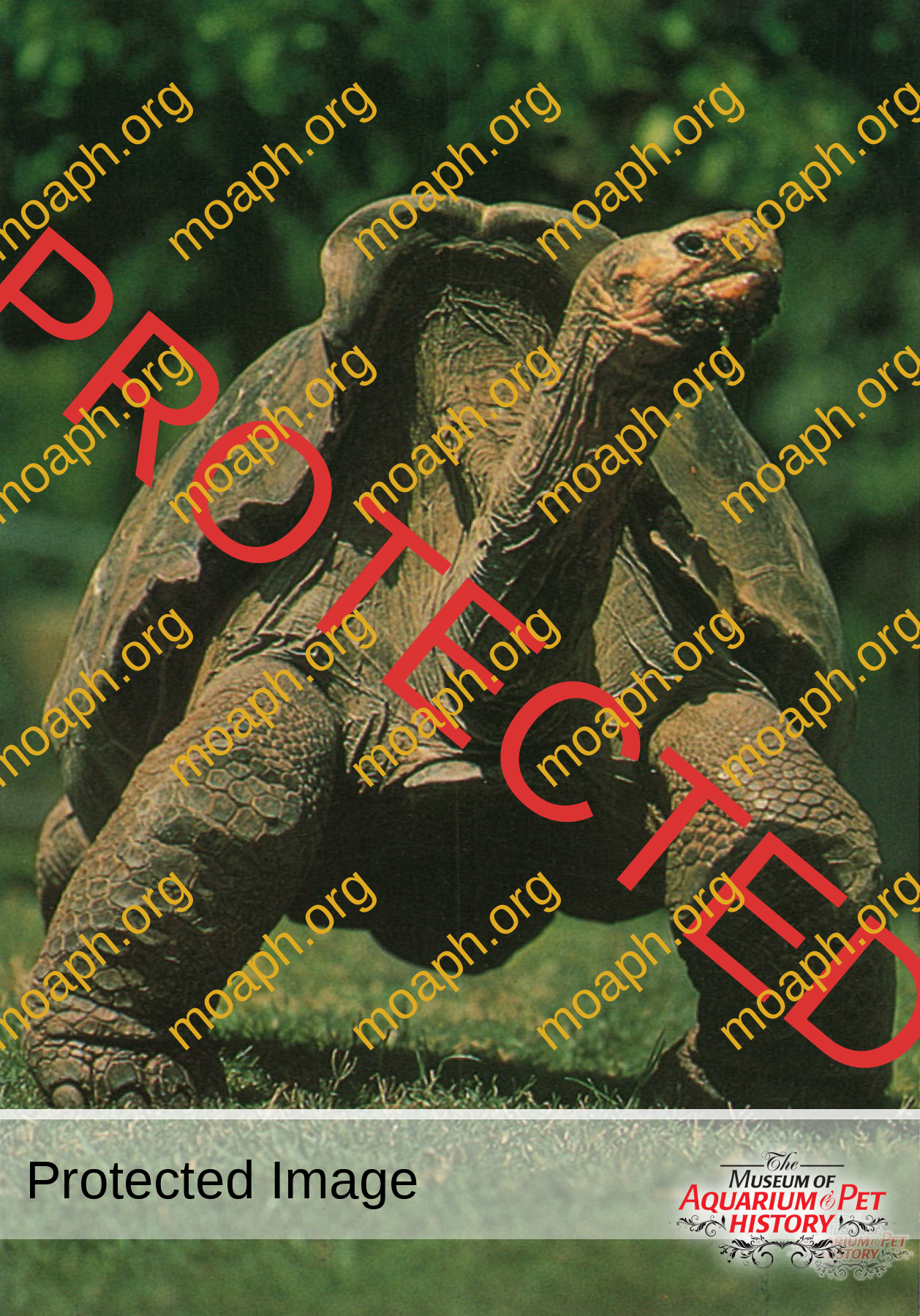
Galapagos tortoises are known to live to a great age if properly cared for. The most interesting one alive at the time of this writing is a female Santa Cruz tortoise, Chelonidis nigra porteri, called Harriet, kept at the Queensland Reptile Park, Beerwah, near the Sunshine Coast of Queensland, Australia, first described by her pet name in 1870. This tortoise was collected, with two others, by Charles Darwin on 17th August 1835 on the Galapagos island, then called Charles Island (now Islas Santa Maria or Floreana), and taken back with him on his ship, the Beagle to England, arriving in 1836. This island was where the colony’s main settlement and prison were established. As a result, tortoises from a number of different islands were kept there, and, as noted by Darwin, the three tortoises were probably of different subspecies. Captain Fitzroy of the Beagle recorded these tortoises as being eleven inches long in 1835, which would indicate a hatching date sometime in 1830.
The First Lieutenant of Darwin’s ship, under Captain FitzRoy, was John Clements Wickham, who himself later became captain of the Beagle. Wickham subsequently became First Government Resident of Moreton Bay in Australia on his retirement from the navy in 1841. He brought with him to Australia three of these Galapagos tortoises, even though he himself had never been to Galapagos. They were kept at his residence, Newstead House, Brisbane. These young tortoises had been previously left in Wickham’s care in England by Darwin himself. Wickham subsequently left Australia for France in about 1860, at which time the three tortoises were presented to the Brisbane Botanical Gardens.
Of the three tortoises, one subsequently died in 1893 in the Great Flood of Brisbane, when the city was deluged under a depth of up to twenty feet of water. The two survivors, now known as Harriet and Tom, are recalled to have been at the Gardens in 1922 by a then young man of twenty, called Ed Loveday, of Mareeba. Tom died in 1929. He was preserved in spirit at the Queensland Museum but not cataloged until 1941, and even then wrongly, as an Aldabran tortoise. Rediscovered in 1995, ‘he’ was found to be a female southern San Cristobel tortoise, Chelonidis nigra cathamensis, a form now known to be extinct. Since Tom’s death, Harriet has not had the company of any other Galapagos tortoise.
In 1932 Dr. David Fleay saw Harriet and determined to try to purchase her for his Fleay’s Fauna Sanctuary. It was a further twenty years before his offer of purchase was accepted. Harriet’s last move was to Australia Zoo, Beerwah, Queensland, in 1987. It was here in 1997 that she was DNA tested and identified both as a Santa Cruz tortoise, Chelonidis nigra porteri, and being at least two generations removed from any other known living specimen.
In her 168th year, Harriet was approximately five feet wide over the curve, with a weight of nearly 400 lb. She has not grown significantly since 1936 but is still believed to be one of the largest Galapagos tortoises in captivity, and surely the only one currently surviving who has traveled halfway around the world twice and survived the Great Brisbane Flood.
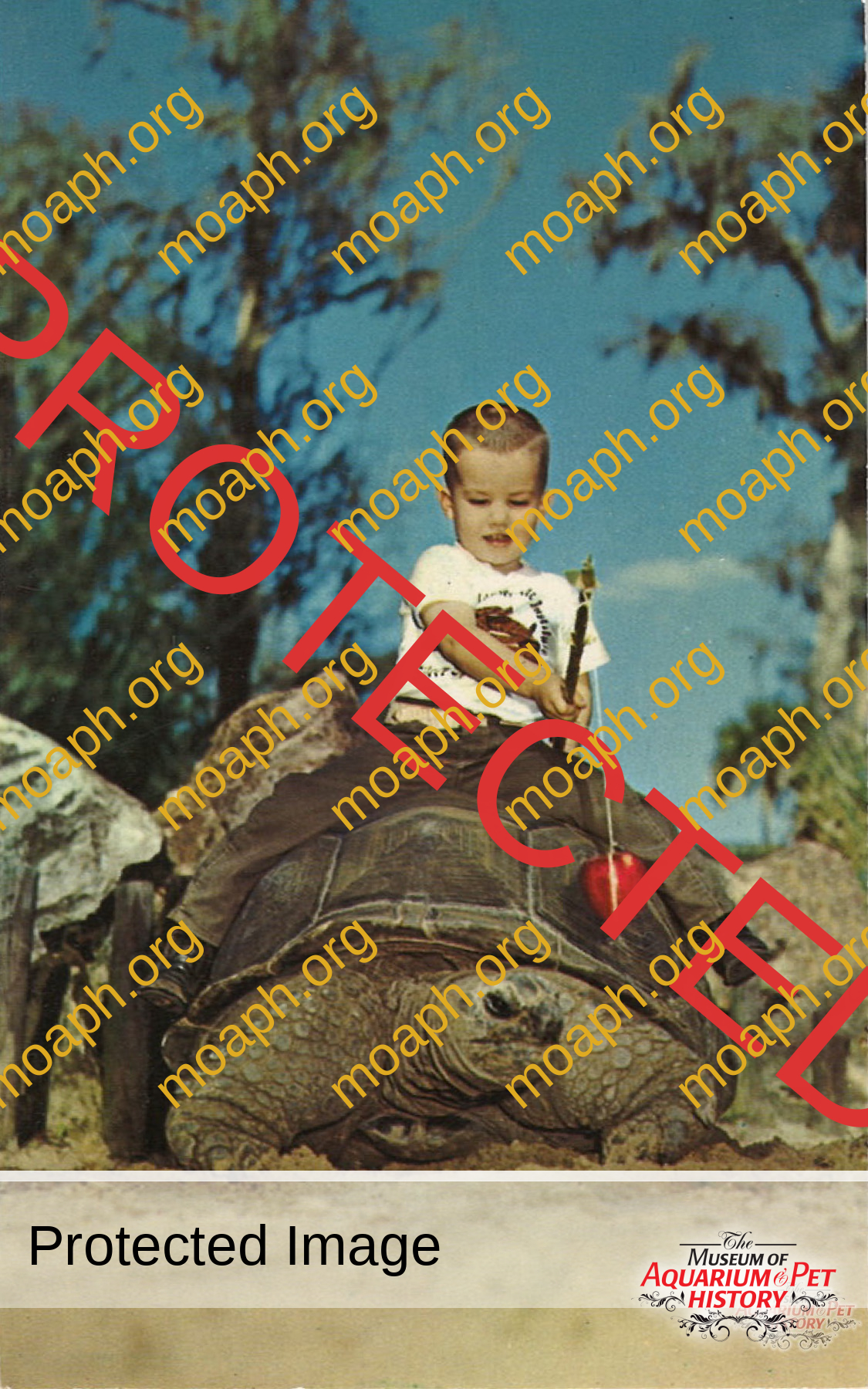
Dr. Gunther, in 1875, described in the July issue of Nature a pair of Aldabran Land tortoises, which had been deposited in the London Zoological Gardens. The male weighed 800 lb.; its carapace in a straight line measuring, in length, 5 ft. 5 in., and in breadth, 5 ft. 9 in.; and the circumference of the shell was 8 ft. 1 in. This tortoise, a male, was known to have been in the Seychelles for about 70 years. When it died, some ten years after its arrival in England, it was still growing. It is probably the largest tortoise ever scientifically documented, though not the heaviest. A male Galapagos Santa Cruz tortoise, Chelonoidis nigra porteri, currently holds the record for being the heaviest. This tortoise, called Goliath, has lived at the Life Fellowship Bird Sanctuary in Florida since 1960. In 1996 he weighed nearly 850 lb. His straight-line length of nearly 4 ft. 6 in. is, however, nearly a foot less than Dr. Gunther’s tortoise.
Dr. Gunther’s data is interesting because the largest tortoise is generally considered to be the male specimen, now mounted in the British Museum of Natural History (Tring 184), which is of the Seychelles species Dipsochelys hololissa. It had previously lived on Egmont Island, in the Chagos archipelago, in the middle of the Indian Ocean. It was probably transported there, from the Seychelles, by the ship ‘Heure du Berger’ in 1771. Lord Walter Rothchild presented this specimen to the London Zoological Gardens in 1897. It had a straight-line carapace length of 4 ft. 7 in. and weighed 560 lb., though it was considered to be in poor condition. This enormous tortoise lived at the Zoo until its death two years later in 1899. It is generally thought to be the largest specimen of this species known. It exceeds even the 4 ft. 5 in. straight-line carapace length of another Aldabran tortoise, believed to have been taken to Sri Lanka in 1797. This particular animal was recorded as still alive at Hirimbura, Garstin Hill, Galle, Sri Lanka, in 1910.
It is improbable, based on its huge size, that Dr. Gunther’s tortoise was of the Aldabran species, Dipsochelys dussumieri. It is, therefore, fascinating to speculate as to what species it actually belonged to. At least until the end of the 18th century, giant tortoises were known to exist on many of the Seychelles islands and to be of both huge size and closely related to the Aldabran species. Long thought to be extinct, two species continue to survive, including a domed species, Dipsochelys hololissa, and a saddle-backed species Dipsochelys arnoldi. I would like to believe that Dr. Gunther’s huge tortoise was one of these.
The re-discovery of these two species of Seychelles giant tortoise is one of the reptile success stories of the 1990s. Believed hunted to extinction by the 1840’s recent DNA analysis has confirmed that a number of captive giant tortoises, previously regarded as Aldabran, are, in fact, survivors of these two distinct species. Hotels and individuals actually on the Seychelles islands kept most of these captives. Since 1997 efforts have been made to collect them together at the Seychelles Giant Tortoise Protection Trust based on Silhouette island and run by the Nature Protection Trust of the Seychelles.
In 1998 the first Seychelles tortoise was discovered outside of the Seychelles. The first Dipsochelys hololissa discovered was a large male called Darwin, housed with a female Aldabran at the Blackpool Zoo in England. Darwin was purchased from an animal dealer in the 1970s, but his actual origin is unknown. The first Arnold’s tortoise, Dipsochelys arnoldi, a male called Hugo, was found at the Dresden Zoo in Germany. He, too, had been purchased from an animal dealer on 28th July 1971, but his previous history is also unknown.
The oldest verifiable tortoise is probably that referred to as Marion’s tortoise. In 1766 the Chevalier Marion du Fresne gave it, along with four others, to the French Governor in Mauritius. Marion had organized an expedition to explore the then little-known Seychelles islands. This Seychelles expedition was the first to document details of the natural history of the islands and collected a number of tortoises, primarily as a food supply. The five presented to the Governor were an unusual form of Aldabran tortoise, Dipsochelys dussumieri sumeirei. They are believed to have been collected on the return journey to Mauritius from the Farquhar islands by Captain Lampériaire on his ship ‘La Curieuse.’
In 1810 when the British captured Mauritius from the French, the tortoises were all still alive and living at the artillery barracks. Shortly before 9th July 1833, one was presented to the London Zoo by Lieutenant-General Sir Charles Colville but died soon after arrival. This specimen was a male that was reported to weigh 285 lb. A few years later, a second tortoise from the original five was sent to the Zoo but also died after a short period.
Of the three remaining tortoises, one disappeared from the record without a trace, and the surviving two attracted the attention of the great Giant tortoise collector Lord Walter Rothchild around 1900. Believing them to be the sole survivors of the Mascarene giant tortoise, Cylindraspis indica, he was disappointed on receiving one of them when it became clear that it was Dipsochelys dussumieri sumeirei.
Rothchild’s attempts to purchase the last surviving Marion’s tortoise were unsuccessful. In 1908 this tortoise became blind and finally fell off the ramparts of the barracks to its death in 1918. Thus it had lived on Mauritius for 152 years and was presumably of adult size when collected in 1766.
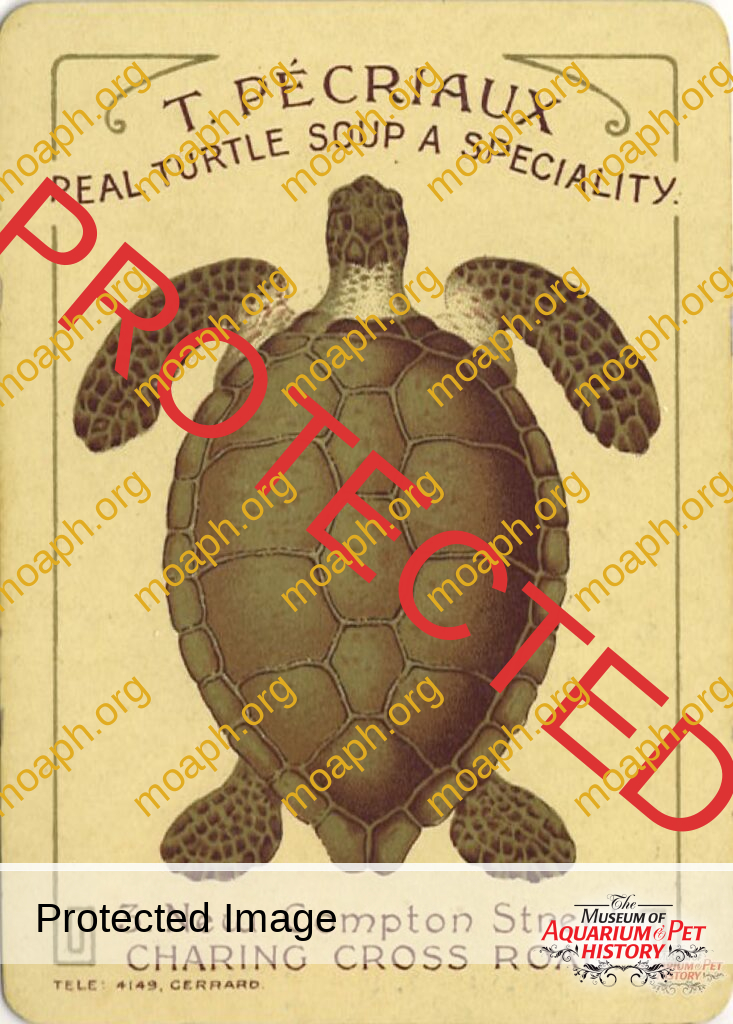
Hawksbill Turtles occasionally are found around the coast of Britain. One was taken in the river Severn in the southwest of the country in 1770. Dr. Turton records that it was placed in his father’s fish ponds, where it lived until winter. This is perhaps the earliest record of a sea turtle being kept in captivity.
The earliest record of reptiles on public display in the USA is perhaps that of a menagerie in New York in 1781. This was described as consisting of reptiles, birds, and quadrupeds. Eight years later, another exhibited a crocodile, snakes, and lizards, as well as a tiger, orang-utan, sloth, baboon, and buffalo. The traveling American reptile menagerie of the Englishman Cops from 1835 has been previously discussed. It was not until July 1st, 1874, that the first American zoo opened in the then cultural capital of the republic, Philadelphia, with 212 animals on display, including 8 reptiles. By 1890 the Baltimore Zoo could boast the exhibition of a single alligator, with the opening of the first dedicated alligator farm in St. Augustine, Florida, still three years away, in 1893. In 1896 an aquarium was opened in New York, in what had originally been built as a fort in 1807. This aquarium collection was given to the New York Zoological Society in 1902 and was described as having a good selection of amphibians and aquatic reptiles, in addition to fish and aquatic mammals.
In 1828 in his book “The Tower Menagerie,” Mr. E. F. Bennett, Assistant Secretary to the newly formed Zoological Society of London, confirmed the great increase in interest in the natural world resulting from both improved wealth and civilization as a result of the British industrial revolution. He wrote, “But as civilisation advanced and the progress of society favoured the development of the mind, when those who were no longer compelled by necessity to labour for their daily bread found leisure to look abroad with expanded views upon the wonders of creation, the animal kingdom created new attractions and awakened ideas which had before laid dormant. What was at first a mere sentiment of curiosity became a love of science; known objects were explained with more minute attention, and whatever was rare or novel was no longer regarded with a stupid stare of astonishment and an exaggerated expression of wonder but became an object of careful investigation and philosophic meditation.”
Today, with our advanced civilization and society, we have a duty to these early pioneers to continue to change the attitudes of the public towards reptiles and amphibians and continue to publish the results of our own careful investigations and philosophic meditations.
Further Reading Resources
The list of references used in the above text would, to many, be of little use as the publications are invariably long out of print and subsequently difficult to consult even within specialist and library collections. However, two recently published books contain a wealth of relevant historical data and are listed below.
Hoage, R. J. and W. A. Deiss 1996, New Worlds, New Animals, from Menagerie to Zoological Park in the Nineteenth Century (ISBN 0-8018-5373-7), published by The John Hopkins University Press, Baltomore & London
Kisling V.N. 2001, Zoo and Aquarium History (ISBN 0-8493-2100-X), published by CRC Press, Baton Rouge, London, New York, Washington D.C.