
Victorian Trade Cards and the Pet Trade, an Initial Overview

Printed advertising of businesses has over its long history taken on many forms and it is a continually evolving process. Some forms of this have been long lasting (e.g., in magazines), but others, for a variety of reasons, have had a shorter life span.
First, a couple of quick definitions in relation to the cards are in order. The first of these is “Victorian”: this relates to the reign of Queen Victoria in the U.K. The so-called era began with her ascension to the Throne in 1837 and ended with her death in 1901. The second definition regards to the word “Trade.” This is not in the sense of swapping but refers to trade in the business sense of the word. Victorian trade cards were basically an advertising platform from a particular period, or era. In this brief piece I shall deal with businesses in the U.S., but these can still maintain use of the word Victorian in that it was in many ways a worldwide phenomenon and the terminology is generally accepted as a definable period of time.
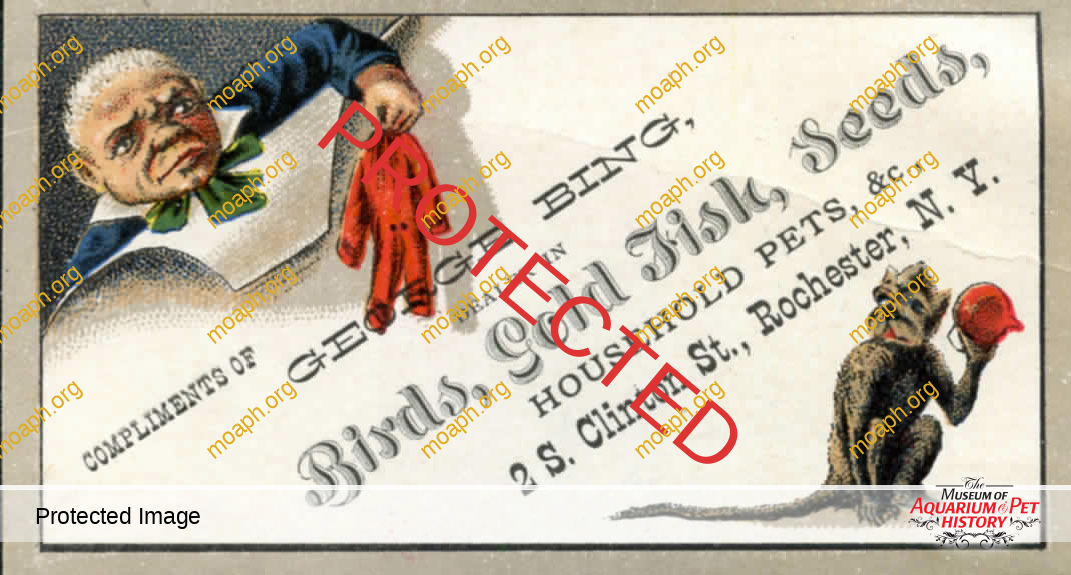
Bing Rochester – Front
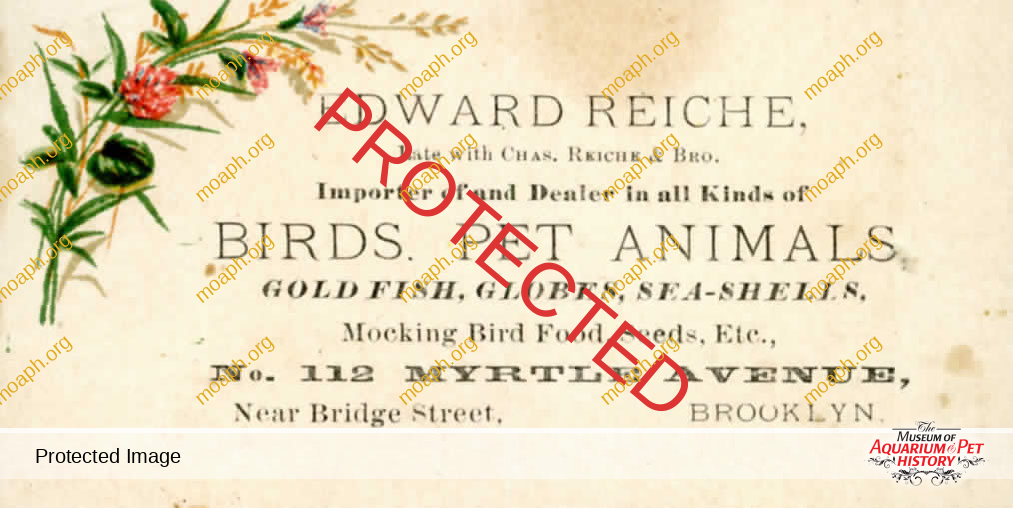
Reiche – Front
The use of the advertising card date back to at least the early part of the 1700’s and these were generally in black and white format. As time moved on, at much later dates’ colors were sometimes added. In the U.S. the main introduction of the trade card started in 1876 at the Centennial Exposition in Philadelphia Pennsylvania. A great number of the cards handed out there were of the black and white variety (see the 1876 dated card for The Mott Iron Works herein) but it was noticed that color cards (known as chromolithographs but commonly called just chromos) had a very high degree of popularity. Their beautiful appearances coupled with advances in color printing which made them available to businesses at very reasonable prices moved them quickly to a primary format for advertising in business of all types. Russ Mascieri (in Cheadle and Mascieri, 1996), a historian of these little beauties, has noted that one printer of the cards could provide 10,000 of them imprinted with a dealer’s name and address for the sum of $20.00. These cards, again according to the same source, quickly “…ruled the day…” in advertising from around 1876 to 1900. Literally tens of millions of these cards with an unbelievable variety of illustrations were produced for any business that you can think of. Most were stock images that could be counter printed with the merchant’s information (on the front or on the usually plain back), but specific to a business images were also available for ordering. Such cards were passed out by merchants at their places of business, while others were passed out free on the streets by hired men or young boys. Besides helping merchants with business these beautiful cards also helped to create another trend – the scrapbooking craze. Color illustrations were not widespread among the American public and the available amount of these cards were widely collected in scrapbooks. These are now treasured items of strong historical value to those interested in the history of business of the time. Many were also collected based on themes. I personally collect such cards based on images (and information) of goldfish and aquaria. And, of course, within this limited area cards dealing with pet dealers handling such products find a nice home in my collection. Many dealers would use stock images which fit nicely with their product and adapted them to their use. Others could, and did, fall back on popular images (sweet children, pastoral scenes, flowers, etc.) to convey their business information.
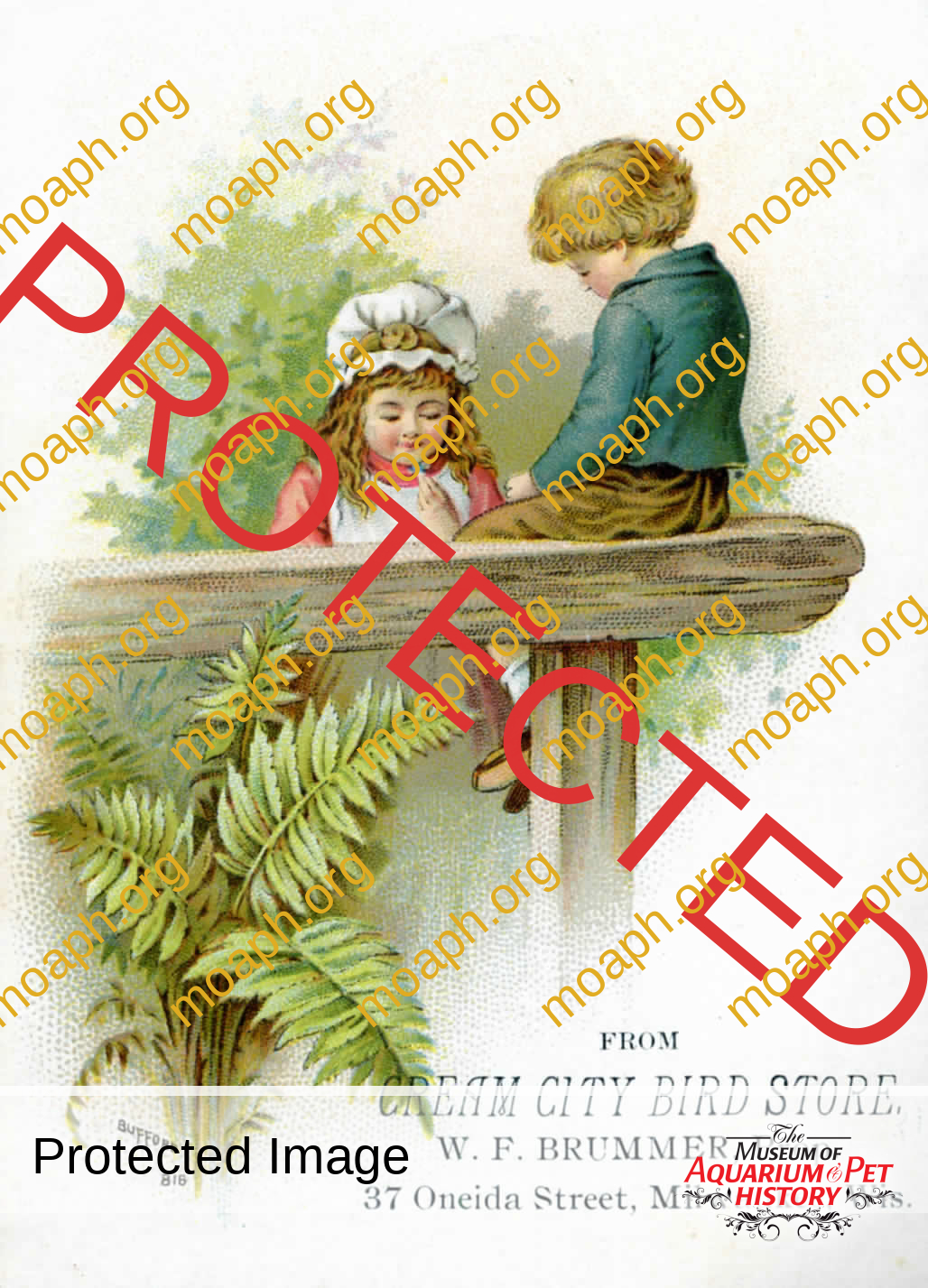
Cream City Bird Store – Front

Cream City Bird Store – Back
Following the text is a sampling of pet shop trade cards. Space does not allow for any comprehensive coverage of these but try to look at them as they would have been initially gazed upon as interesting ads most often set in a beautiful setting. A great many such cards are difficult to date, and these require further investigation. Some cards such as those of Broom and Murphy do have a copyright date of 1881 as a starting place. The Kaemper card, from 1891, is an easy one in that he regularly passed out cards containing a calendar. And of course, there is the above-mentioned Mott card of 1876. The Mott card is not from a pet dealer but from one of the two major makers of fancy aquaria (J. W. Fiske is the other manufacturer, and I have yet to see a trade card from this firm…something to look forward to). Only two types of aquaria are listed on the card among many other products, but this is an important little piece of the history that this card carries with it.
Kaempfer – Front
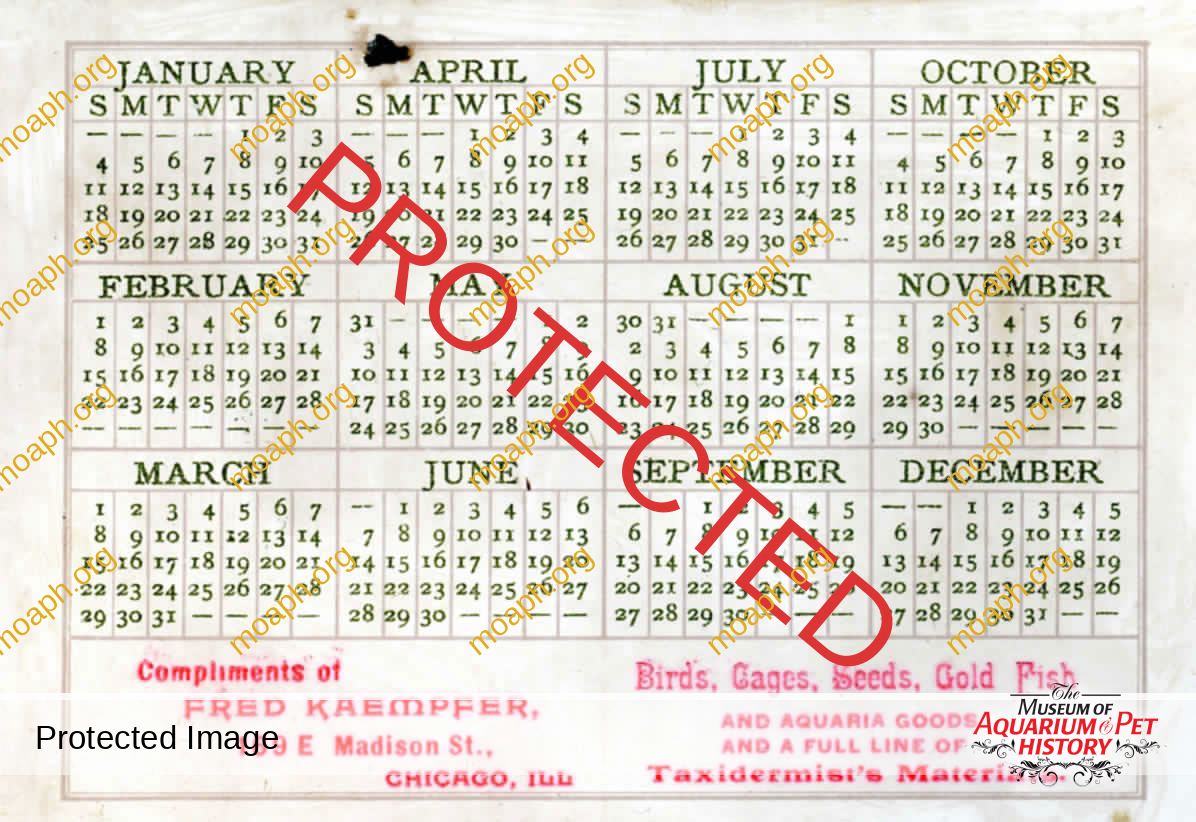
Kaempfer – Back
Many of the cards come from among uncountable stock images. A good example of this is the card for the Philadelphia Bird And Cage Company. What better picture for this company is a beautiful bird among thistle buds? Obviously, a nice choice. But this is a stock image and I have a card with the same image that seeks to get the customer interested in Dr. Morse’s Syrup of Yellow Dock Root. This is one of those 19th Century “medicines” that might seem, from the ad, to cure most things that ill you. (Note: WEBMD lists and discusses this substance!).
Metropolitan Bird Store – Front
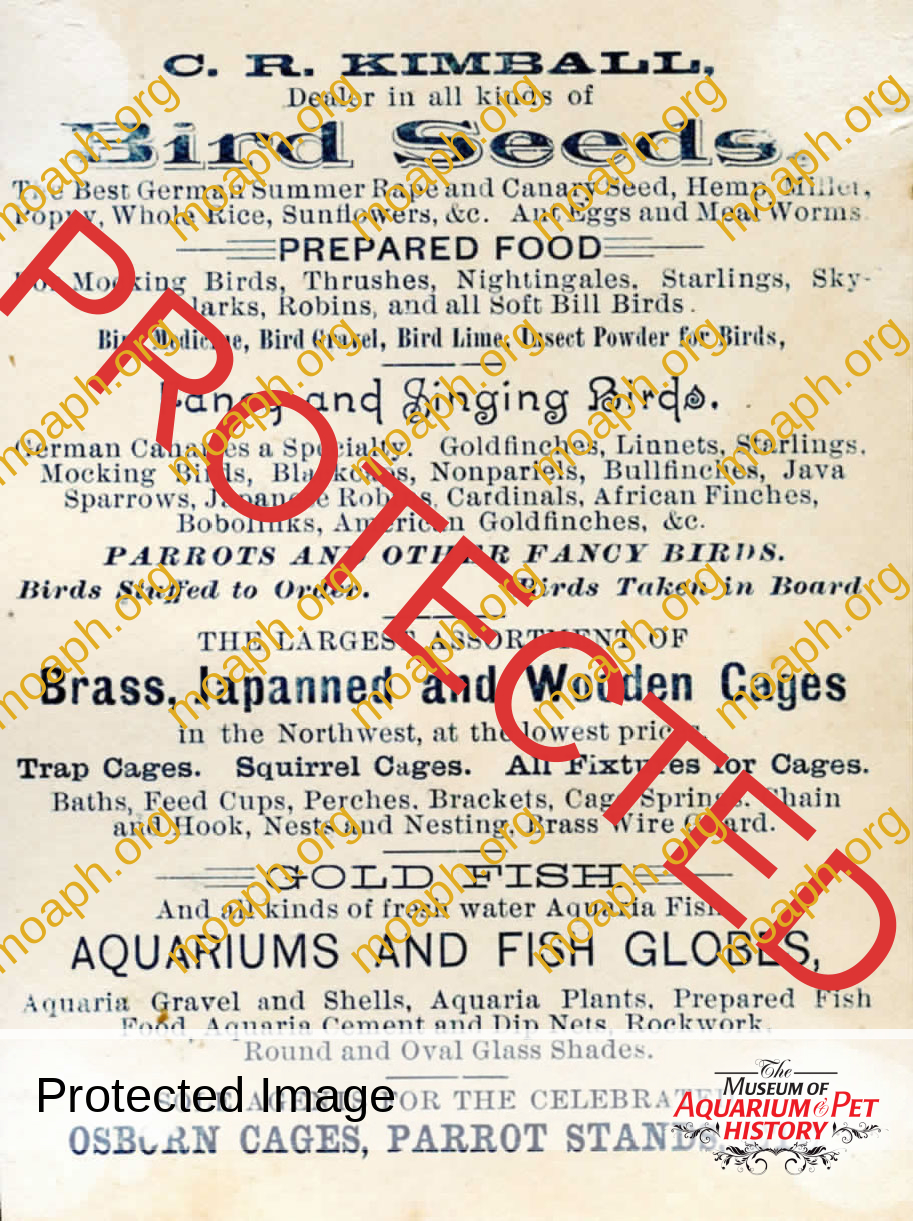
Metropolitan Bird Store – Back
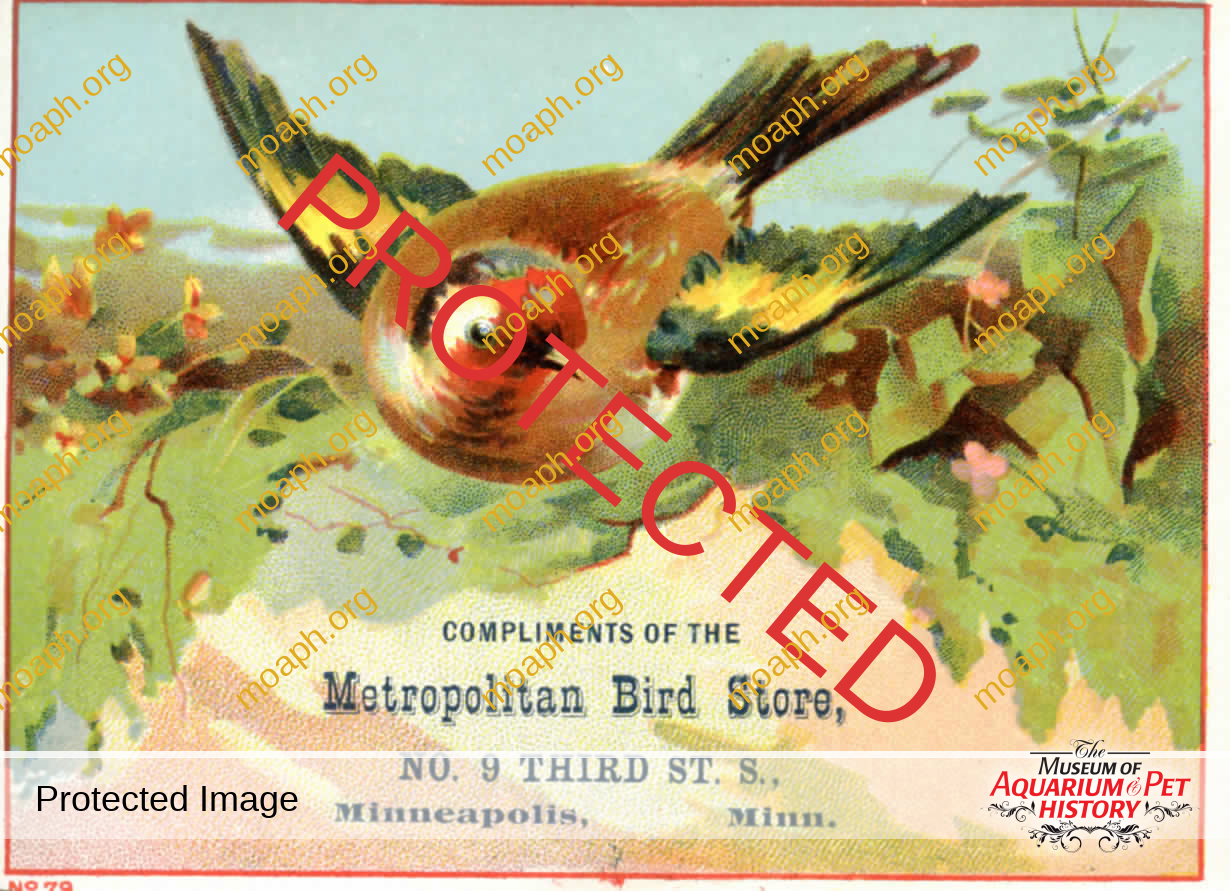
Thomas Broom had cards showing birds that fit nicely with his business goals, but another card of his (not shown) was illustrated with a pastoral scene of Pennsylvania Dutch Country which would have looked nice to Philadelphia city dwellers. Children were also a common image on trade cards as seen on the Cream City Bird Store. On this latter card the reverse side does then list a wide variety of the store’s stock and products. I will note here on this card I am amused that the owner uses the term “aquarias”, thus creating a double plural of sorts. For the amount of information provided, the card from the Metropolitan Bird Store is surely a winner. In both livestock and support products this card provides a very good view of the holdings of a pet store of the later part of the nineteenth century.
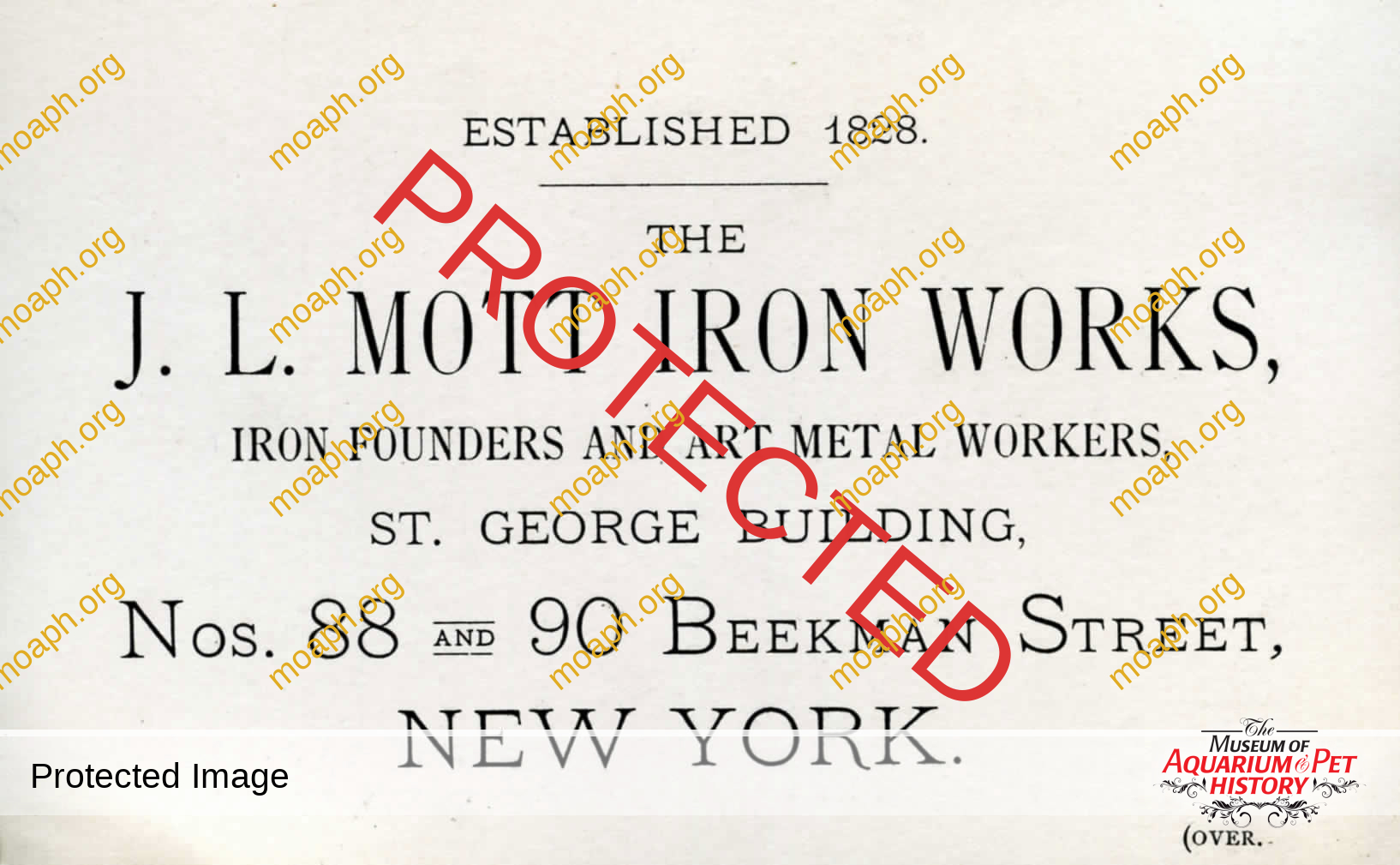
Mott Card – Front
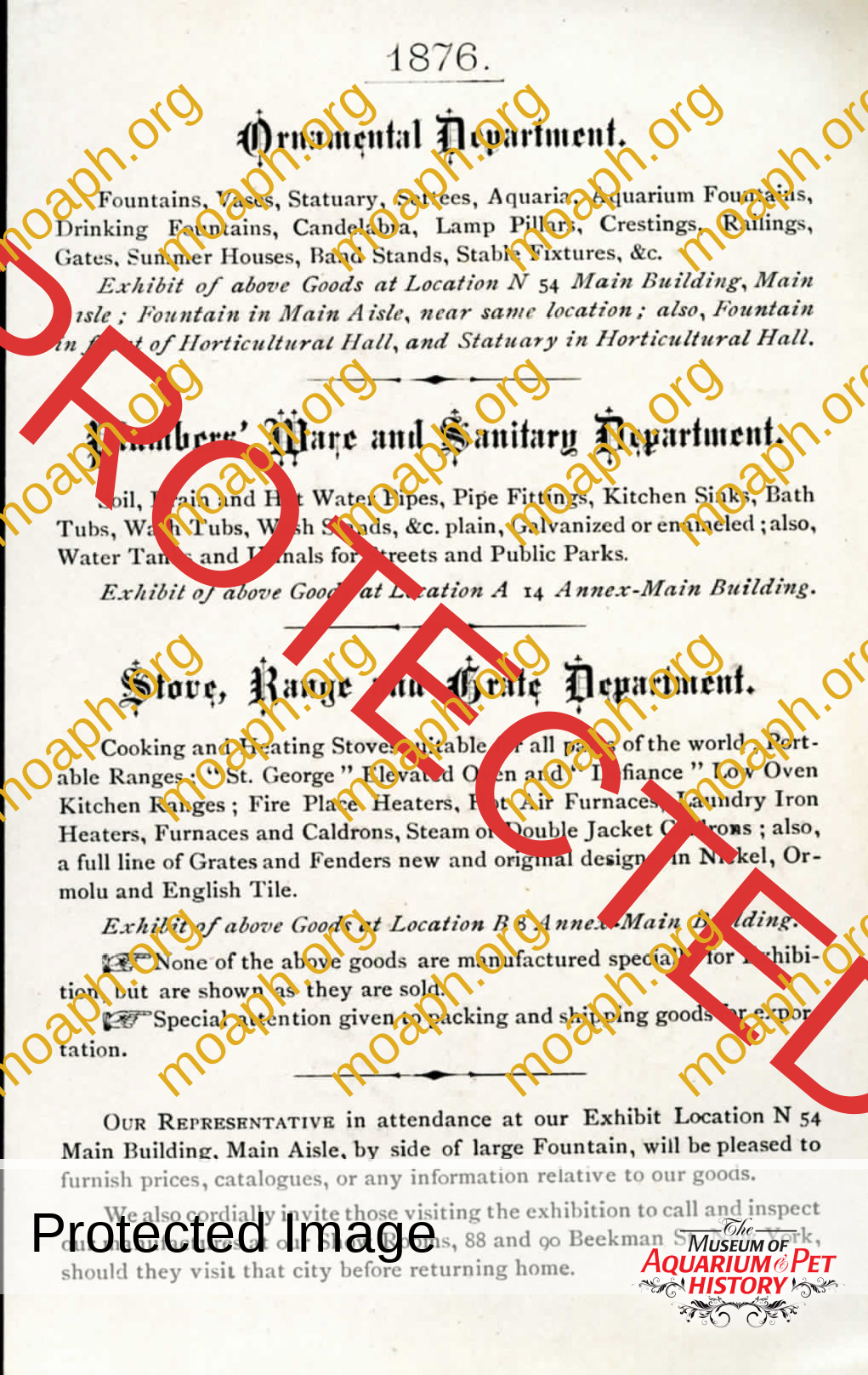
Mott Card – Back
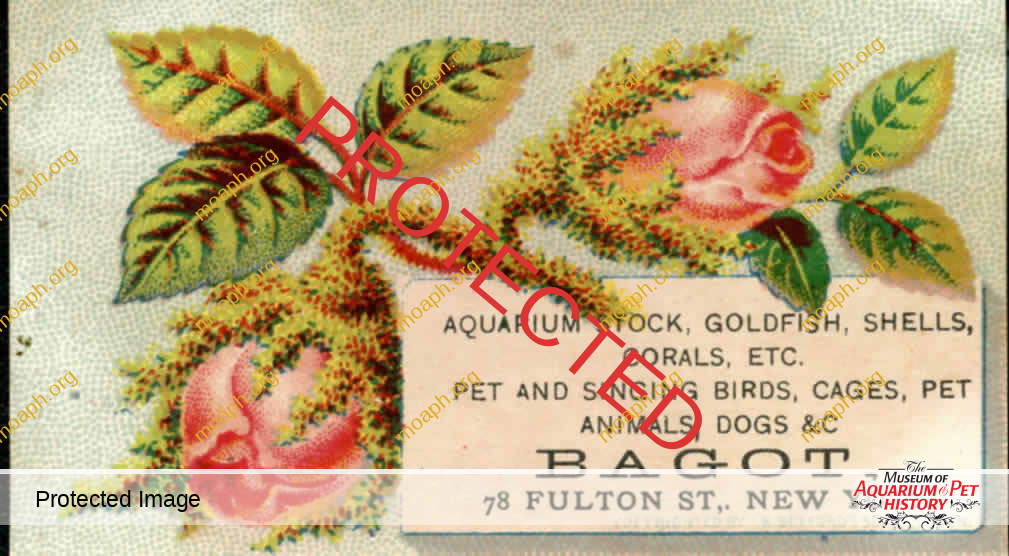
Some cards of potential interest, especially to aquarists, are the following: Those of [J.] Bagot who was well appreciated among early aquarists; Edward Reiche, of the Reiche family, who along with Charles Reiche (and his brother) was involved in the New York Aquarium which opened in 1876 with W. C. Coup as the upfront partner. The Reiche family were in the animal import business prior to the aquarium opening, during its operation and were back in it full time when the aquarium unfortunately succumbed. And finally, the card for Hugo Mulertt must be considered a classic. Mulertt, has been called by aquarium historian Al Klee, the “Father of the Aquarium Hobby in America” and this is more than enough to make his business card a prime bit of aquarium history.
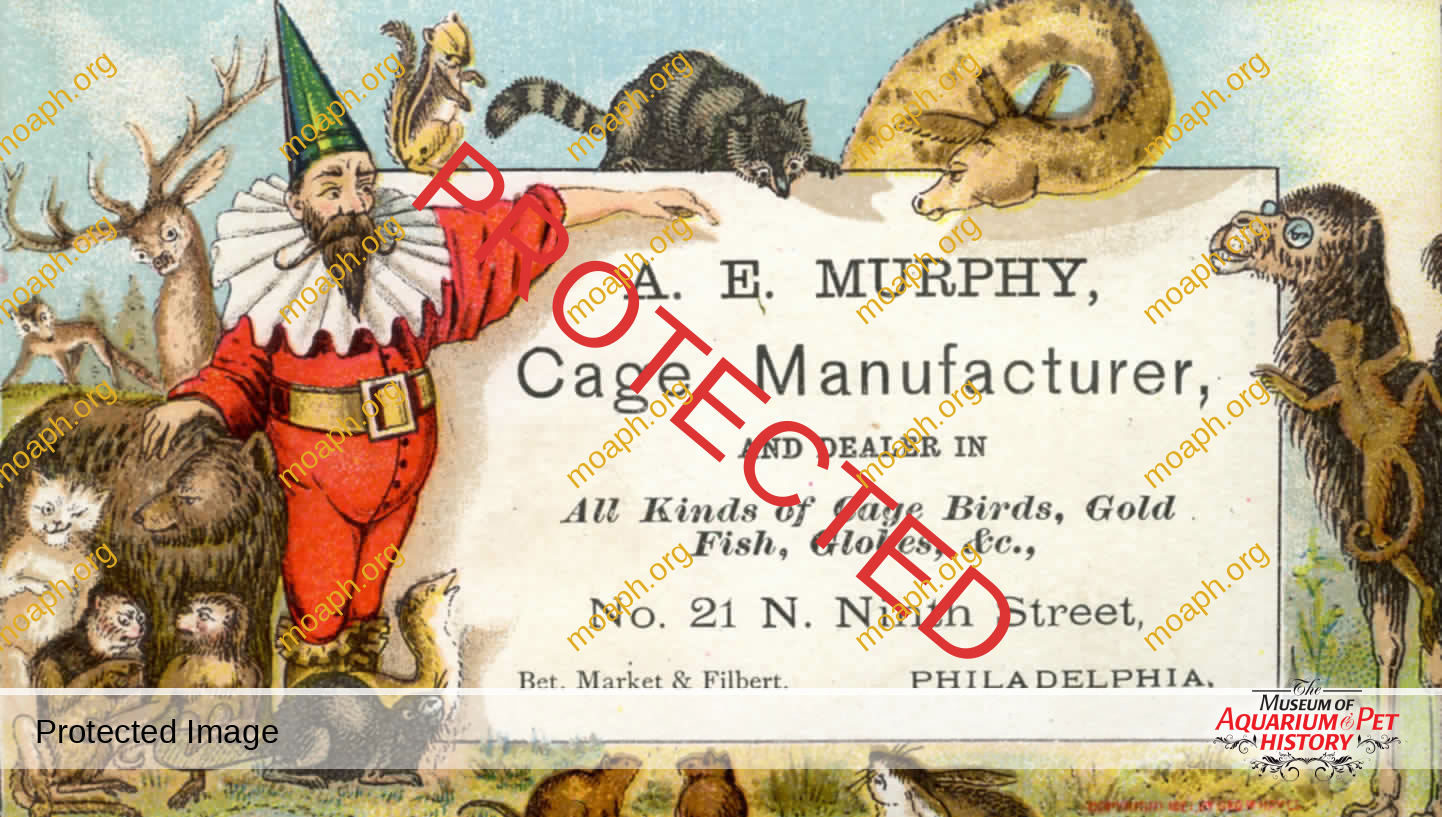
Murphy Philadelphia No Counter Stamp – Front
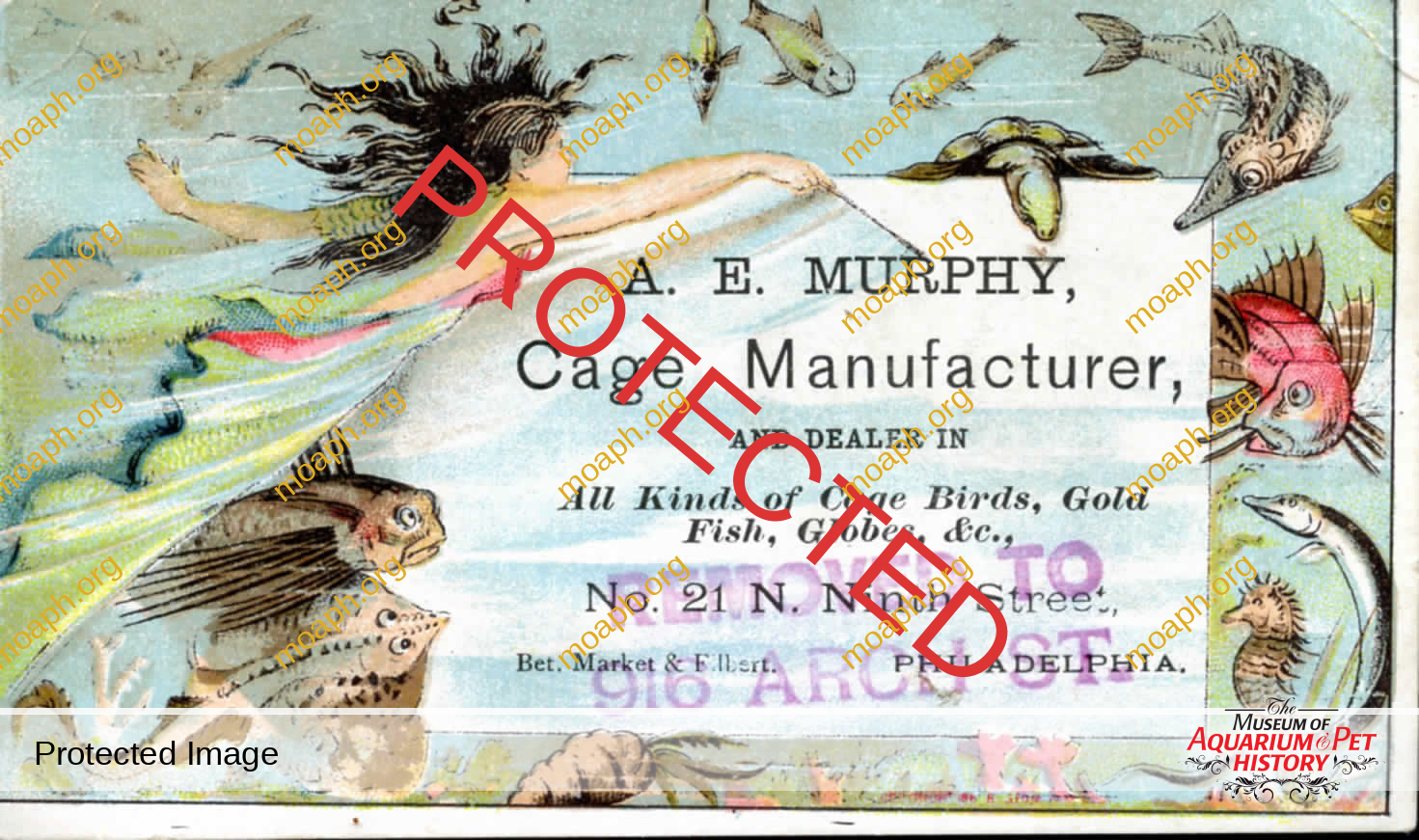
Murphy Philadelphia Counter Stamp – Front
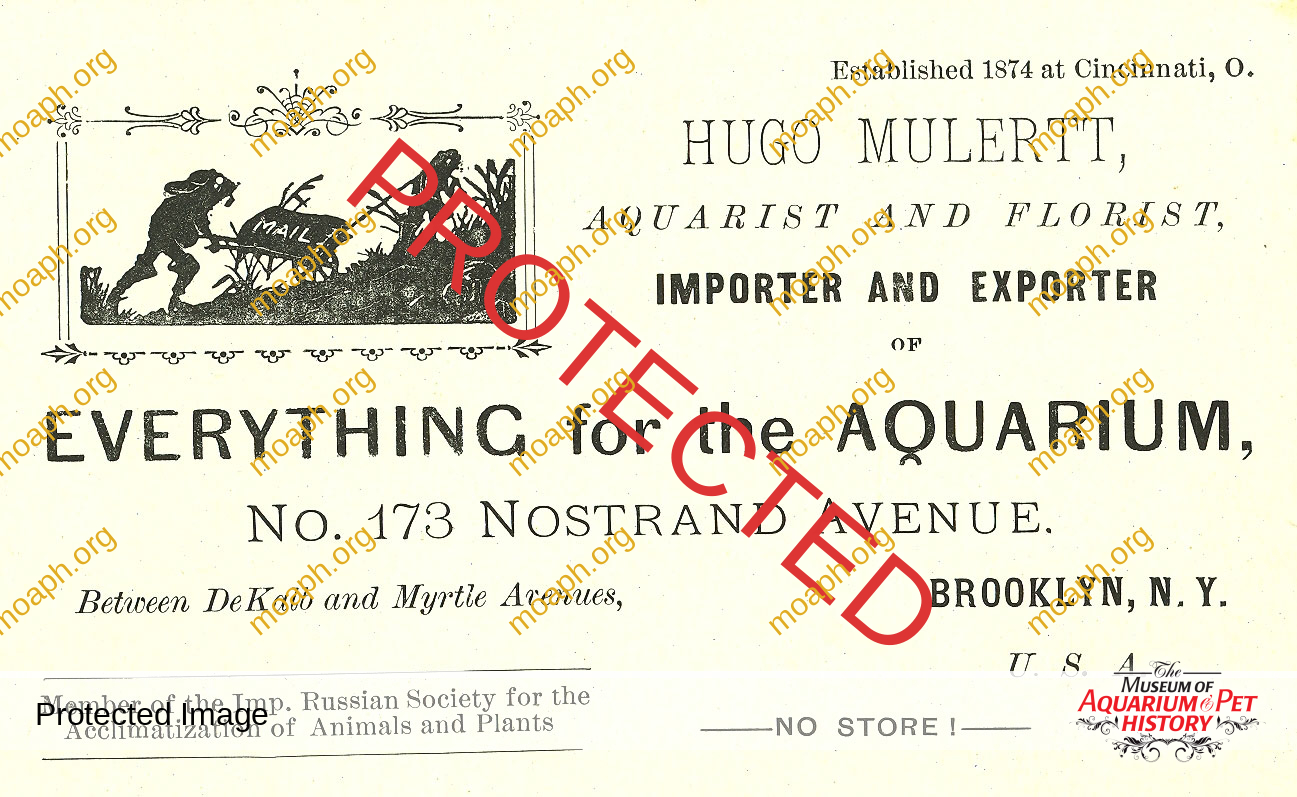
Mulertt – Front

Philadelphia Bird and Cage Company – Front
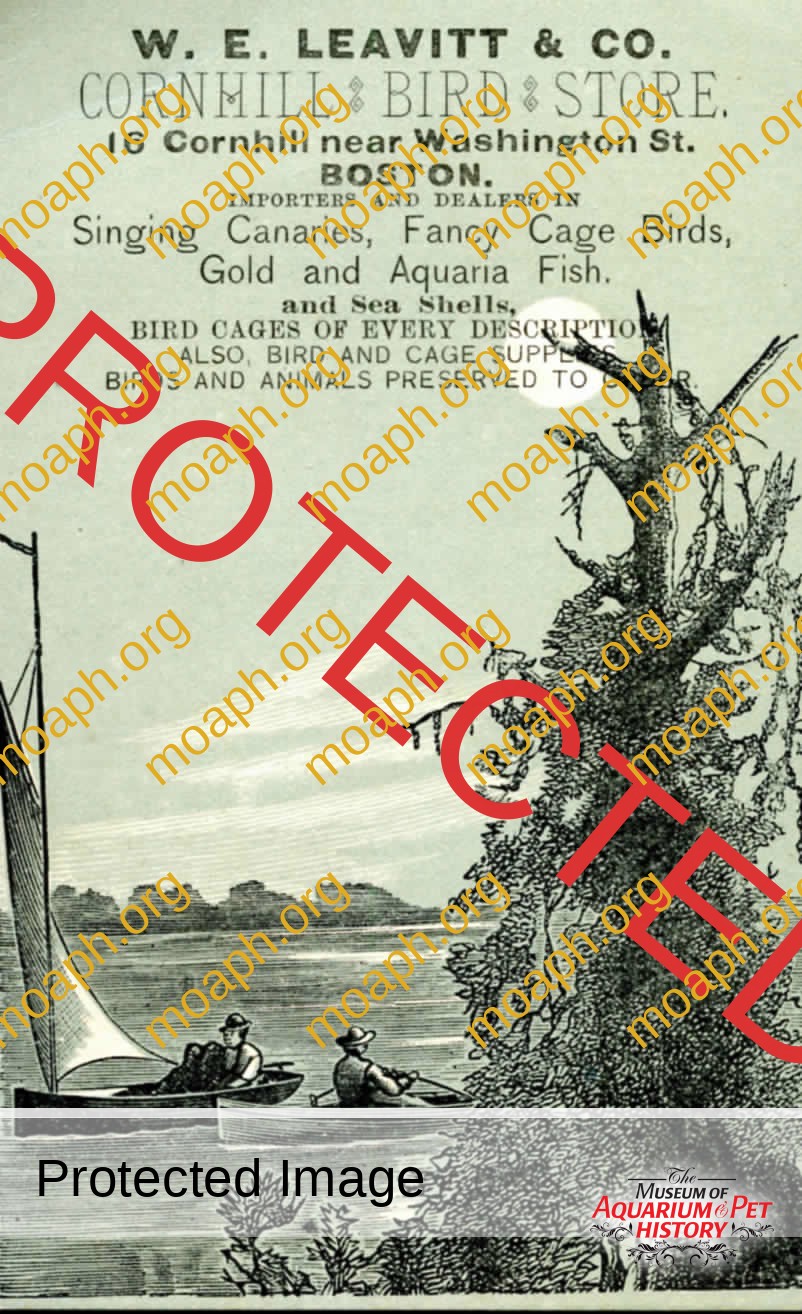
Cornhill Bird Store – Front
Suggested Reading
- Cheadle, Dave & R. Mascieri. 1996. Victorian Trade Cards. Collector Books. 223 pp.
- Garvey, Ellen G. 1996. The Adman in the Parlor. Oxford University Press. 230 pp.
- Jay, Robert. 1987. The Trade Card in Nineteenth-Century America. University of Missouri Press. 112 pp.