Portrait of a Herpetologist as an Older Man – Part 5: Monitor Lizards and the Leader of Them All, the Komodo Dragon
From the Bulletin of the Chicago Herpetological Society
James B. Murphy
3100 Connecticut Ave NW, #431
Washington, DC 20008
Portions of this article have appeared elsewhere [see Murphy and Walsh (2006); Murphy et al. (2019)]
The public sees the Komodo dragon, with its awesome morphology and unsettling feeding behaviors, as a combination of crocodilian, lizard, and dinosaur — a creature that mercilessly tracks and devours its prey. This amalgamation of fear, respect, and adoration has driven the research machine for many years.
– Kurt Auffenberg and Walter Auffenberg (2002)
Since I got my first living Nile monitor (about 30 years ago) and became acquainted with his life habits in the terrarium, the monitor lizards have fascinated me all the time, these “proudest, best-proportioned, mightiest, and most intelligent” lizards as [Franz] Werner strikingly called them.
– Robert Mertens (1942)
Modern comparative methods allow the examination of the probable course of evolution in a lineage of lizards (family Varanidae, genus Varanus). Within this genus, body mass varies by nearly a full five orders of magnitude. The fossil record and present geographical distribution suggest that varanids arose over 65 million yr ago in Laurasia and subsequently dispersed to Africa and Australia. Two major lineages have undergone extensive adaptive radiation within Australia: one evolved dwarfism (subgenus Odatria, pygmy monitors), whereas the other Australian lineage (subgenus Varanus) remained large, and several of its members evolved gigantism.
– Eric R. Pianka (1995)
Introduction
In 1926, the first living Komodo dragons (Varanus komodoensis), known as “oras” in Indonesia, were placed on exhibit in New York’s Bronx Zoo (Figure 1) and the Amsterdam Zoo (Figure 2), but the effort to display them in New York was less than satisfactory. W. Douglas Burden (1927) painted this gloomy picture, “After watching these great carnivores in the wilderness of romantic Komodo, it was painful to see the broken-spirited beasts that barely had strength to drag themselves from one end of their cage to the other. Surely, it is not all a matter of diet and a change of climate. Perhaps, as in the case of many mammals, Varanus komodoensis, in order to survive, demands the freedom of his rugged mountains.” In 1934, a dragon on display at the Smithsonian’s National Zoological Park (NZP) lived only two years after capture by the Griswold-Harkness expedition. Five dragons were exhibited at NZP over a 40-year span, the average longevity being five years and the maximum being 12 years (Figures 3 and 4). Because the largest specimens were generally wild-caught, dragons at other North American and European zoos fared poorly as well (see Flower, 1937; Jones, 1965; Rookmaaker, 1975), no doubt due to the fact that adult animals often have difficulty adjusting to captivity.
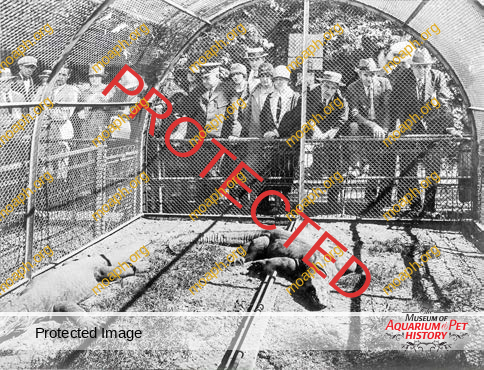
Figure 1. Komodo dragon exhibit at the Bronx Zoo (Wildlife Conservation Society). Undated photograph (possibly early 1930s.), courtesy of Wildlife Conservation Society.
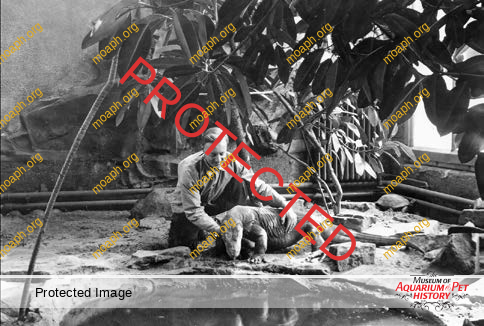
Figure 2. Komodo dragon with keeper at Natura Artis Magistra in Amsterdam, photographed between 1926 and 1931. Komodo dragons were added to the collection in 1926. Five years later, 12 eggs were laid in a hole and protected by the female. Note tortoise in back right corner of exhibit. Photograph provided by Eugène Bruins, Natura Artis Magistra Archives.
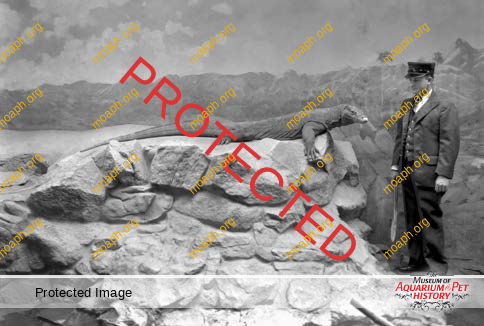
Figure 3. Keeper Roy Jennier next to “Xomo,” the first Komodo dragon at Smithsonian National Zoological Park. This lizard was collected by the Griswold-Harkness expedition in 1934, cost $780 at that time, and lived two years. Hot water pipes in rockwork provided heat. This image was duplicated in color on a postcard for sale. Photograph provided by Smithsonian National Zoological Park Photo Archives.
Rookmaaker (1975) reported that his grandfather had captured 12 dragons in 1927, using 200 men to surround a dragon which was “snared by means of a noose attached to a stick.” One went to the Amsterdam Zoo, one to Rotterdam Zoo, one to Berlin Aquarium, two to Surabaya Zoo, and two to London Zoo. Five died before reaching their destination. The Amsterdam specimen is pictured with a rope muzzle around its head. Dragons rarely lived beyond five years in captivity, and most did not survive the first few months. Zoo visitors were excited about viewing these huge, carnivorous lizards so collecting expeditions to Komodo were mounted to secure specimens for display until World War II brought collecting to an end for many years.
I was able to see this varanid in the wild while teaching a course in Jakarta, Indonesia, for the Smithsonian’s Zoo Biology Training Course, developed by Chris Wemmer and Charlie Pickett. On Komodo Island, Bill Zeigler from Brookfield Zoo and I watched males bipedally combat, and we saw courtship and copulation. The rangers demonstrated running speed by tying a goat haunch to a rope, and running nearly full speed with a lizard following nearly as fast. To demonstrate agility, the bait was hung from a tree about eight feet above a group of mostly female dragons, about six feet or less in length. The dragons repeatedly jumped to retrieve it, but the effort was unsuccessful.
At the time the Indonesian government put on feeding demonstrations, using freshly killed goats, several times a week. Tourists were stationed on a bluff above. Twenty lizards, ranging in size from subadults to large adults, were imprinted to the lower space, with the largest ones forming a close circle in front and the small ones darting in to grab scraps. We watched a ranger throw a very large goat into the middle of the circle and I timed the scenario from when the goat hit the ground until I could no longer see the tiniest bit of goat — seven minutes! This story has a very unhappy ending. The rangers decided to permanently discontinue these feedings, but the largest dragons stayed, waiting for goats from the sky, and starved to death, according to Quentin Bloxam (pers. comm.).
On Rinca Island, I heard a deer distress call, and after 15 minutes a large dragon slowly crossed the dirt path, presumably tracking the deer, and ignoring me completely. A subadult lizard about three feet long foraged for prey by directing its rapidly flicking tongue under mostly flat rocks with spaces beneath Those places were thoroughly checked by the animal for over two hours but prey was not available.
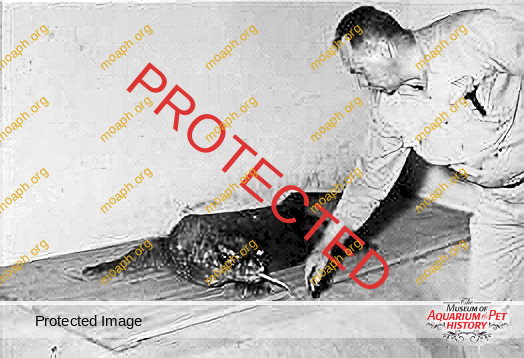
Figure 4. Supervisor of reptiles Jack DePrato and dragon named Kalana at Smithsonian National Zoological Park in late 1960s. Photograph provided by Smithsonian National Zoological Park Photo Archives.
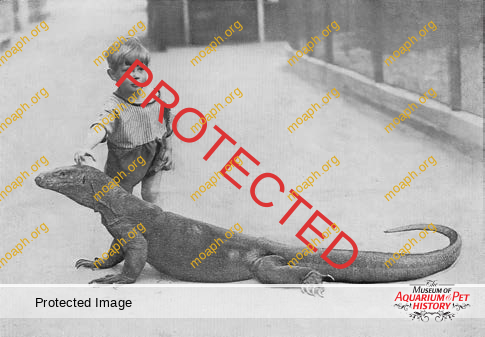
Figure 5. Sumbawa standing next to a two-year-old child. Photograph by F. W. Wood is from Joan Procter’s article “Dragons That Are Alive To-day” (Procter, 1928–1929). Photograph provided by Kraig Adler.
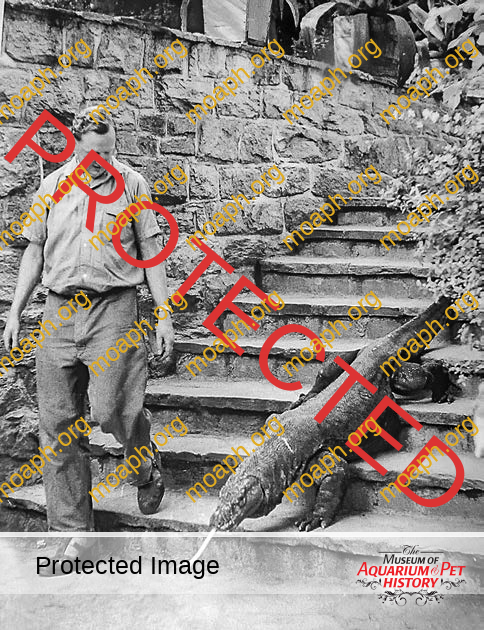
Figure 6. A Komodo dragon at Frankfurt Zoo in Germany during the early 1960s, with keeper Albert Schick. Photograph provided by Hans-Dieter Philippen and Gerard Visser.
At the London Zoo, there were several intriguing reports on dragon behavior that seemed to contradict the belief that dragons were always dangerous to man and were delicate captives. Hill (1946) mentioned a dragon at the zoo pushing a shovel over the stones in his cage,“and the more noise he can make with it, the more it seems to please him.” Curator of reptiles Joan Beauchamp Procter (1928) wrote: “The dragon, whose name is Sumbawa, walked around a very long table, and without paying attention to the audience ate a large fowl, several eggs, and a pigeon from her hand, allowing itself to be scratched and patted even when swallowing the fowl with enormous gulps, treatment which even dogs will not always permit” and “She [at death proved to be a male] would tear a pig to pieces but can be trusted with children.” Sumbawa was the host at children’s tea parties starting only a few weeks after arrival at the Zoo and was perfectly tame with all the guests. Procter (1928–1929) included a photograph of a two-year-old child standing next to Sumbawa (Figure 5) and examined dragon behavior, “The question of the ferocity of these lizards is, perhaps, the most misunderstood of all. All the lizards of the genus Varanus are savage, predatory, and highly strung, and they use their teeth, claws and slashing tails with great effect, as I have personal cause to know. At the Zoo we consider any large monitor more dangerous to deal with than a crocodile twice its size. But, allowing for this, V. komodoensis is the gentlest, most intelligent, and most tractable of them all. This is comparing them with specimens only half their weight ; species such as niloticus, albigularis, bengalensis, salvator, nebulosus, varius, and so on. It is quite true that they are very nervous, and also that they could no doubt kill one if they wished, or give a terrible bite when taking food from the hand greedily, but there is no vice in them.”
Sumbawa accompanied Procter on strolls through the Zoo during her inspections, “investigating everything which might be of interest.” The lizard responded to the voice of its keeper or curator, but disliked having its tympanum touched.
In 1942, curator Gustav Lederer described the habits of a tame dragon named Bübchen, which lived at the Frankfurt Zoo between 1927 and 1944 (Figure 6). It was taken on long walks through the zoo by the director. The dragon was in excellent health up to its death from an Allied bombing raid, in which the Aquarium was demolished, thus living 16 years, 8 months and 21 days. Some reptiles can recognize their keeper and are able to distinguish him from other persons. At Frankfurt, the dragon knew the veterinarian after the second treatment and could no longer be persuaded to leave its hiding place once the vet appeared. The lizard even recognized the operating table and fled from it (Lederer, 1931). Keeper Albert Schick allowed zoo visitors to interact with a dragon outdoors at the Frankfurt am Main Zoo (Figure 7). At Berlin Zoo, dragon Moritz was tame and followed its keeper like a dog (Figure 8).
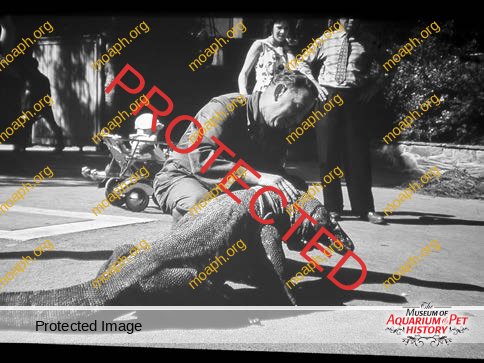
Figure 7. An adult Komodo dragon was allowed to walk among zoo visitors with keeper Albert Schick at Frankfurt Zoo. When the lizard arrived at the zoo in 1958, it measured 2½ meters. Photograph by R. Faust, provided by Christian Schmidt.
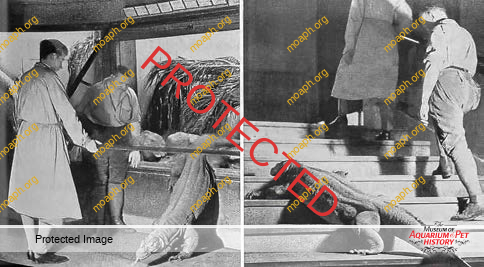
Figure 8. Moritz was an adult male Komodo dragon at Zoo-Aquarium Berlin. Two dragons from Rinca arrived at the zoo in 1927; Moritz lived until 1944. The other dragon named Max died shortly after arrival. Moritz is climbing out of its terrarium and following its keeper like a dog. Photograph provided by Archive Zoo-Aquarium Berlin.
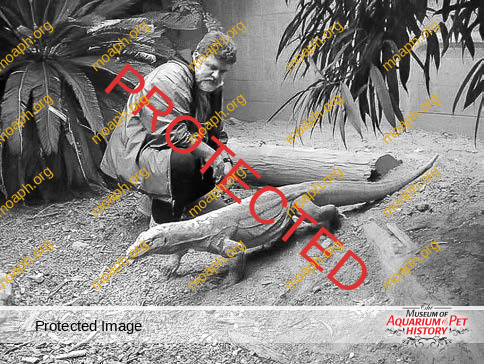
Figure 9. Kraken with keeper Trooper Walsh during one of the experimental trials to study play behavior at Smithsonian National Zoological Park in 1999.
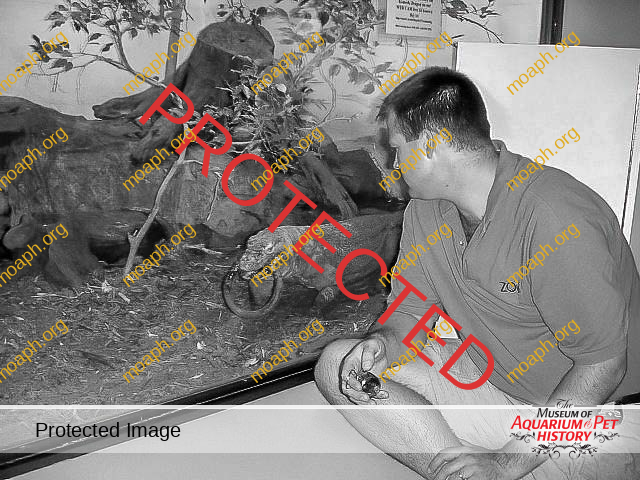
Figure 10. Keeper Rob Lewis records Kraken’s behaviors during experimental trials at Smithsonian National Zoological Park in 1999. Photograph by Trooper Walsh.
Not all dragons are placid toward humans. Walter Auffenberg (1995, pers. comm.) told me about a large dragon tracking his children during his study on Komodo. The dragon’s tail drag was superimposed over his children’s footprints and Walter interpreted this as a potential predatory episode. Later, the dragon entered his tent, tore apart articles of clothing, and carried off a soiled handkerchief. Of the 55 hatchlings produced by the NZP female between 1992–1995, at least two were aggressive toward humans at hatching and remained so through adulthood.
Until recent decades, captive dragons had not been thoroughly investigated, due to lack of success in maintaining viable populations. At NZP several years ago, keeper Trooper Walsh asked me if I’d ever seen a dragon play. I was highly skeptical as this behavior is rarely mentioned in the literature. At the NZP in 1995, Kraken was a young female dragon, approximately 2½ meters in total length, that had hatched at the zoo three years earlier. Kraken often exhibited play-like behavior — removing a handkerchief or notebook from keeper Trooper Walsh’s pocket, scraping his shoes with its forearm, playing tug of war with a plastic cup, interacting with him by using empty cardboard boxes, as well as pieces of cloth and scarves. Kraken stood on its hind legs, directed tongue flicks to Walsh’s face, rested its head on his shoulder, and closed its eyes. Kraken carried Frisbees, shoes, plastic toy action figures for children, and other objects around in its mouth but made no attempt to swallow them (Figures 9–12). The lizard stuck its head into a plastic bucket, raised its anterior trunk so that the container covered its head and walked around the exhibit. The dragon placed its snout inside a shoe, lifted it off the substrate and moved throughout the cage. When Walsh whistled, Kraken turned its head toward the source of the sound. Kraken could discriminate between prey and non-prey; it would gently take a rat offered with tongs and never showed an inclination to bite Walsh. Kraken regularly turned its head to follow the flight patterns of birds flying overhead. See Burghardt et al. (2002) for an initial behavioral inventory and quantitative analysis of the trials with Kraken.
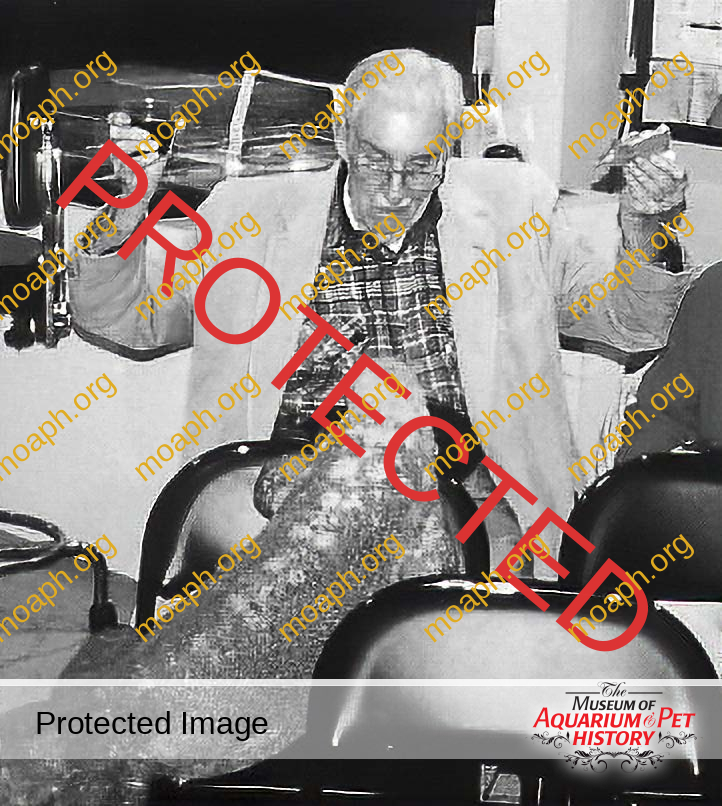
Figure 11. Kraken begs pizza from a familiar volunteer at Smithsonian National Zoological Park in 1998. Photograph by Trooper Walsh.
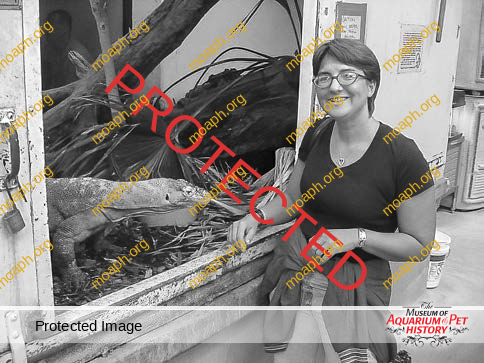
Figure 12. Kraken investigates an unfamiliar visitor at Smithsonian National Zoological Park in 1998. Photograph by Trooper Walsh.
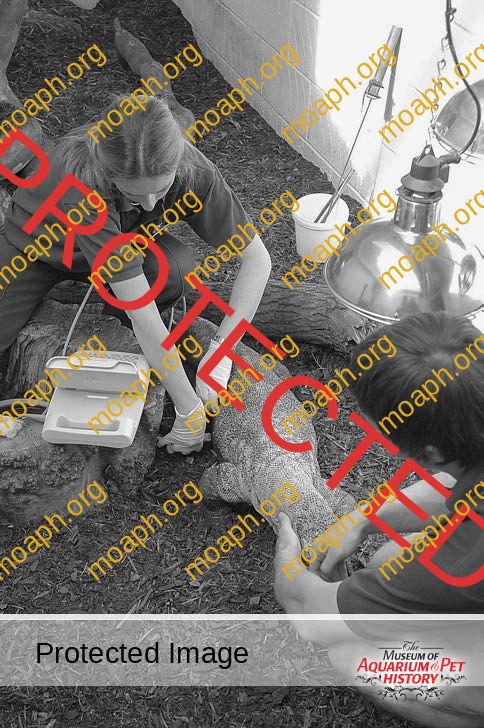
Figure 13. Ultrasonography of a dragon at London Zoo in 2005. Photograph provided by Richard Gibson, London Zoological Society.

Figure 14. A large male dragon named Raja in a restraint box for target training at London Zoo in 2005. Photograph provided by Richard Gibson, London Zoological Society.
Several zoos have done research on their Komodo dragons. At the Dallas Zoo, curator Ruston Hartdegen and associates discovered that a dragon could discriminate between its permanent keeper, another reptile keeper who had less contact with the dragon, and a keeper from another animal department. The dragon was calm with the familiar caretaker, nervous around the less-familiar reptile keeper, and displayed defensive behavior to the keeper from another animal department (R. Hartdegen, pers. comm.). Kraken at NZP exhibited the same responses toward familiar and unfamiliar persons.
At London Zoo in 2005, the staff utilized ultrasonography on dragons to determine sex and assess reproductive condition (Figure 13). In 2005, a large male named Raja was given target training (Figure 14). He was trained to associate a target on a stick with a food reward. The target was moved into and out of the restraint crate so that the dragon became comfortable entering this restricted space, which facilitates moving him. This was an interesting example of operant conditioning that used food as the initial cue; then the reward frequency was gradually reduced, using a clicker (sound producing device) as a bridge between the reward and the target (R. Gibson, pers. comm.).
A dragon named No-Name at Pittsburgh Zoo would come when called “NO” by the staff (Figure 15). Also at the Pittsburgh Zoo, a study was initiated to test a dragon’s spatial memory by examining whether dragons use proximal (near-by) or distal (far away) visual cues to remember the location of a food reward hidden in the lizard’s exhibit. Preliminary results support the hypothesis that a dragon used proximal cues to remember the location of the food and additional experiments are underway to determine if a dragon can use distal cues in other circumstances (H. Ellerbrock, pers. comm.).
Another surprising finding was that dragons are parthenogenic (Watts et al., 2006). Two females — at Chester Zoo and London Zoo — produced offspring without male fertilization. Genetic fingerprinting identified parthenogenetic offspring produced by the lizards. “This reproductive plasticity indicates that female Komodo dragons may switch between asexual and sexual reproduction, depending on the availability of a mate — a finding that has implications for the breeding of this threatened species in captivity. Most zoos keep only females, with males being moved between zoos for mating, but perhaps they should be kept together to avoid triggering parthenogenesis and thereby decreasing genetic diversity.”
Fry et al. (2009) published a paper from which I quote here: “Our multidisciplinary analyses paint a portrait of a complex and sophisticated tooth/venom combined-arsenal killing apparatus in V. komodoensis and its extinct close relative V. priscus.
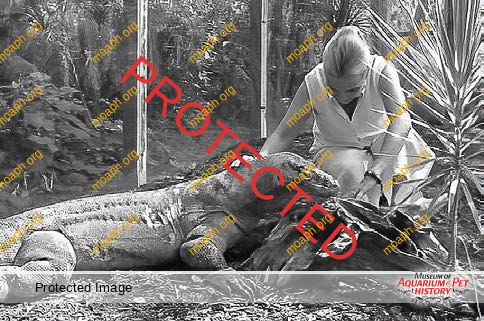
Figure 15. Dolly Ellerbrock and a dragon named No-Name at Pittsburgh Zoo. This enormous male dragon was called “No” by the staff and would come to them when called. No-Name hatched at Smithsonian National Zoological Park in 1993 and died in 2012. At death he measured approximately 3 meters in total length and weighed ca. 100 kilograms. Photograph by Herb Ellerbrock, Pittsburgh Zoo.
Thus, despite a relatively weak skull and low bite force, we suggest that the combination of highly and very specifically optimized cranial and dental architecture, together with a capacity to deliver a range of powerful toxins, minimizes prey contact time and allows this versatile predator to access a wide range of prey including large taxa. These results indicate that V. priscus was the largest venomous animal to have ever lived.” Some researchers urge caution until additional evidence is forthcoming that dragons are venomous (see Weinstein et al., 2012; Weinstein et al., 2013).
In summary, Komodo Dragons will prove to be interesting subjects for future behavioral studies. What I have presented here is mostly anecdotal but systematic studies to further examine the causes for these unexpected responses by dragons toward humans will be fruitful.
Also, we might ask why humans are motivated to interact with dragons and why are these lizards often personalized? It seems as though large reptiles in zoos, especially dragons, are often given pet names but this rarely occurs with smaller ones. Retired NZP curator Dale Marcellini offered an interesting observation — perhaps the size and shape of dragons (and other reptiles such as crocodilians) which are somewhat similar to humans may be the main reason that humans pay more attention to these large reptiles and, as a consequence, may well initiate interactions with them. In an attempt to dominate all animals, some humans may specifically focus attention on large, possibly dangerous reptiles even when there are potential risks. In other cases, humans motivated to understand why reptiles operate the way they do may concentrate on dragons and other gargantuan reptiles. Detailed comparative studies with small reptiles and humans would be enlightening.
In my experience working with living reptiles for nearly 60 years, no other species has interacted with humans like Komodo dragons — these lizards are something special. Noted varanid biologist Eric R. Pianka put it this way: “Varanid lizards differ from other lizards in several ways. They have more aerobic capacity and greater metabolic scope, most varanids range over larger areas, and they are much more intelligent than other lizards. If you doubt this, go to a zoo that has a Komodo dragon, make eye contact, and look into its eyes. You will be impressed with the way it looks back at you!” (Pianka, 2002).
Acknowledgments
I dedicate this contribution to Gerard Visser, Curator of Fishes and Reptiles at the Rotterdam Zoo in the Netherlands. He is Co-Chair of the European Amphibian and Reptile Taxon Advisory Group and EEP-coordinator for Komodo Dragons. Gerard has had a positive impact throughout his professional life on studying and conserving dragons. I also acknowledge Trooper Walsh for his sustained effort to follow the history of these lizards in the AZA studbook.
For various courtesies, I thank Kraig Adler, Eugène Bruins, the late Jessie Cohen, Falk Dathe, Dolly Ellerbrock, Herb Ellerbrock, Richard Gibson, Ruston Hartdegen, Lucian Heichler, Jennifer S. Holland, Bill Holmstrom, the late Marvin Jones, Jürgen Lange, Julie Maher, Jim Pether, Hans-Dieter Philippen, Christian Schmidt, Courtney Shaw, Frank Slavens, Brint Spencer, David Steele, Trooper Walsh, and Gerard Visser. Kraig Adler, Judith Block, Judith Bryja, Ruston Hartdegen, Bill Lamar, Dale Marcellini, Gerard Visser, and Judy White reviewed an early draft. I have had fruitful discussions about the unique interactions between dragons and humans with the late John Arnett, Kurt Auffenberg, the late Walter Auffenberg, Gordon Burghardt, Vince Burke, the late David Chiszar, Claudio Ciofi, Colomba de La Panouse, the late Dennis King, Rob Lewis, Dale Marcellini, Eric Pianka, and John Romano.
Marvin L. Jones, retired registrar at the San Diego Zoo, died after suffering a massive heart attack on 4 April 2006. I consulted Marvin regularly about the history of dragons in zoos and aquariums during preparation of several manuscripts, our last conversation occurring two days before his death. His knowledge of zoo history was encyclopedic and he was always willing to share his knowledge with his colleagues. He is still missed.
Judith Block and Bill Lamar reviewed this manuscript and made helpful suggestions for improvement.
Literature Cited
Auffenberg, W. 1981. The behavioral ecology of the Komodo monitor. Gainesville: University Presses of Florida.
Auffenberg, K., and W. Auffenberg. 2002. Introduction. The past to now. Pp. 1-19. In: J. B. Murphy, C. Ciofi, C. de La Panouse and T. Walsh, editors, Komodo dragons: Biology and conservation. Washington, D.C.: Smithsonian Institution Press.
Burden, W. D. 1927. Dragon lizards of Komodo. New York: G. P. Putnam’s Sons.
Burghardt, G. M., D. Chiszar, J. B. Murphy, J. Romano Jr., T. Walsh and J. Manrod. 2002. Behavioral complexity, behavioral development, and play. Pp. 77-117. In: J. B. Murphy, C. Ciofi, C. de La Panouse and T. Walsh, editors, Komodo dragons: Biology and conservation. Washington, D.C.: Smithsonian Institution Press.
Flower, S. S. 1937. Further notes on the duration of life in animals. III. Reptiles. Proceedings of the Zoological Society of London (series A) 107(1):1-39.
Fry, B. G., S.Wroe, W. Teeuwisse, M. J. P. van Osch, K. Moreno, J. Ingle, C. McHenry et al. 2009. A central role for venom in predation by Varanus komodoensis (Komodo Dragon) and the extinct giant Varanus (Megalania) priscus. Proceedings of the National Academy of Sciences 106(22):8969-8974.
Hill, C. 1946. Playtime at the zoo. Zoo-Life 1:24-26.
Jones, M. L. 1965. The Komodo dragon. Chronological list of the Komodo dragon lizard (Varanus komodoensis) exhibited outside Indonesia 1926–1964. International Zoo News (July) 12(3):92-93.
Lederer, G. 1931. Erkennen wechselwarme Tiere ihren Pfleger? Wochenschrift für Aquarien- und Terrarienkunde 28:636-638.
————. 1942. Der Drachenwaran (Varanus komodoensis Ouwens). Der Zoologische Garten Leipzig (Neue Folge) 14(5/6):227-244.
Mertens, R. 1942. Die Familie der Warane (Varanidae). Erster Teil: Allgemeines. Abhandlungen der Senckenbergischen Naturforschenden Gesellschaft 462:1-116.
Murphy, J. B., R. W. Mendyk, K. L. Miller and L. Augustine. 2019. Tales of monitor lizard tails and other perspectives. Herpetological Review 50(1):178-201.
Murphy, J. B., and T. Walsh. 2006. Dragons and humans. Herpetological Review 37(3):269-275.
Ouwens, P. A. 1912. On a large Varanus species from the island of Komodo. Bulletin du Jardin botanique de Buitenzorg 2(6):1-3.
Pianka, E. R. 2002. Foreword. Pp. xi-xii. In: J. B. Murphy, C. Ciofi, C. de La Panouse and T. Walsh, editors, Komodo dragons: Biology and conservation. Washington, D.C.: Smithsonian Institution Press.
Procter, J. B. 1928. On a living Komodo dragon Varanus komodoensis Ouwens, exhibited at the Scientific Meeting, Oct. 23, 1928. Proceedings of the Zoological Society of London 98(4):1017-1019.
Procter, J. B. 1928–1929. Dragons that are alive today. Pp. 32-41. London: Waverly Book Company. In: J. A. Hammerton, editor, Wonders of animal life. Volume 1.
Rookmaaker, L. C. 1975. The history of some Komodo dragons (Varanus komodoensis) captured on Rintja in 1927. Zoologische Mededelingen 49(6):65-71.
Watts, P. C., K. R. Buley, S. Sanderson, W. Boardman, C. Ciofi and R. Gibson. 2006. Parthenogenesis in Komodo dragons. Nature 444(7122):1021-1022.
Weinstein, S. A., D. E. Keyler and J. White. 2012. Replies to Fry et al. (Toxicon 2012, 60/4, 434–448). Part A. Analyses of squamate reptile oral glands and their products: A call for caution in formal assignment of terminology designating biological function. Toxicon 60(5):954-963.
Weinstein, S. A., J. White, D. E. Keyler and K. V. Kardong. 2013. Response to Jackson et al. (2012). Toxicon 64:116-127.
Additional Varanid Literature
Anonymous. 1939. Bataviasche Planten- en Dierentuin 1864-1939 [Batavian Botanical and Zoological Gardens 1864-1939]. Batavia [= Jakarta]: Het Kasteel van Aemstel. [published by the Batavian Zoo & Botanical Gardens on the occasion of its 75th year.]
Bergh, W. Van Den. 1959. Notre Société possède à nouveau des Varans de Komodo. Zoo (Antwerp) 24, Part 3:75-78.
Burden, W. D. 1928. Results of the Douglas Burden expedition to the island of Komodo. V. Observations on the habits and distribution of Varanus komodoensis Ouwens. American Museum Novitates 316:1-10.
Carpenter, C. C., J. C. Gillingham, J. B. Murphy and L. A. Mitchell. 1976. A further analysis of the combat ritual of the pygmy mulga monitor, Varanus gilleni (Reptilia: Varanidae). Herpetologica 32(1):35-40.
Chiszar, D., J. B. Murphy and H. M. Smith. 1993. In search of zoo-academic collaborations: A research agenda for the 1990’s.Herpetologica 49(4):488-500.
Chiszar, D., W. T. Tomlinson, H. M. Smith, J. B. Murphy and C. W. Radcliffe. 1993. Behavioural consequences of husbandrymanipulations: Indicators of arousal, quiescence and environmental awareness. Pp. 186-204. In: C. Warwick, F. L. Frye and J. B. Murphy, editors, Health and welfare of captive reptiles. London: Chapman and Hall.
Horn, H-G. 2004. Keeping monitors in captivity: A biological, technical, and legislative problem. Pp. 556-570. In: E. R. Pianka, D. R. King and R. A. King, editors, Varanoid lizards of the world. Bloomington: Indiana University Press.
Horn, H-G., and G. J. Visser. 1989. Review of reproduction of monitor lizards Varanus spp. in captivity. International Zoo Yearbook 28:140-150.
Horn, H-G. and G. J. Visser. 1997. Review of reproduction of monitor lizards Varanus spp. in captivity II. International Zoo Yearbook 35:227-246.
Hutchins, M., J. B. Murphy and N. Schlager (editors). 2003. Grzimek’s animal life encyclopedia, second edition. Volume 7, Reptiles. Farmington Hills, Michigan: Gale Group.
King, D. R., E. R. Pianka and B. Green. 2002. Biology, ecology, and evolution. Pp. 23-41. In: J. B. Murphy, C. Ciofi, C. de La Panouse and T. Walsh, editors, Komodo dragons: Biology and conservation. Washington, D.C.: Smithsonian Institution Press.
Klingelhöffer, W. 1957. Terrarienkunde 3. Teil: Echsen. Stuttgart, Germany: Alfred Kernen Verlag.
Lange, J. 1989. Observations on the Komodo monitors Varanus komodoensis in the Zoo-Aquarium Berlin. International Zoo Yearbook 28:151-153.
Mendyk, R. W. 2012. Reproduction of varanid lizards (Reptilia: Squamata: Varanidae) at the Bronx Zoo. Zoo Biology 31(3):374-389.
Mendyk, R. W, A. L. Newton and M. Baumer. 2012. A retrospective study of mortality in varanid lizards (Reptilia: Squamata: Varanidae) at the Bronx Zoo: Implications for husbandry and reproductive management in zoos. Zoo Biology 32(2):152-162.
Merchant, M., D. Henry, R. Falconi, B. Muscher and J. Bryja. 2012. Characterization of serum complement activity in serum of the Komodo dragon (Varanus komodoensis). Advances in Biological Chemistry 2(4):353-359.
Mertens, R. 1930. Die Amphibien und Reptilien der Inseln Bali, Lombok, Sumbawa und Flores. Abhandlungen der Senckenbergische naturforschende Gesellschaft 42(3):115-344.
Mitchell, L. A. 1990. Reproduction of Gould’s monitors (Varanus gouldii) at the Dallas Zoo. Bulletin of the Chicago Herpetological Society 25(1):8-9.
Mitchell, P. C. 1929. Centenary history of the Zoological Society of London. London: Zoological Society of London.
Morris, P. J., and A. C. Alberts. 1996. Determination of sex in white-throated monitors (Varanus albigularis), Gila monsters (Heloderma suspectum), and beaded lizards (H. horridum) using two-dimensional ultrasound imaging. Journal of Zoo and Wildlife Medicine 27(3):371-377.
Murphy, J. B. 1969. Notes on iguanids and varanids in a mixed exhibit at Dallas Zoo. International Zoo Yearbook 9:39-41.
————. 1971. Notes on the care of the ridge-tailed monitor Varanus acanthurus brachyurus at the Dallas Zoo. International Zoo Yearbook 11:230-231.
————. 1998. Reptile writings: Auffenberg monitor books. Reptiles Magazine 6(4):44-45.
————. 2007. Herpetological history of the zoo and aquarium world. Malabar, Florida: Krieger Publishing Co.
————. 2015. Studies on lizards and tuataras in zoos and aquariums. Part I — Introduction, history, families Iguanidae, Agamidae, Chamaeleonidae, and Infraorder Gekkota. Herpetological Review 46(3):464-482.
————. 2015. Studies on lizards and tuataras in zoos and aquariums. Part II — Families Teiidae, Lacertidae, Bipedidae, Amphisbaenidae, Scincidae, Cordylidae, Xantusiidae, Anguidae, Helodermatidae, Varanidae, Lanthanotidae, Shinisauridae, Xenosauridae, and Sphenodontidae. Herpetological Review 46(4):672-685.
Murphy, J. B., and W. E. Lamoreaux. 1978. Threatening behavior in Mertens’ water monitor Varanus mertensi (Sauria: Varanidae). Herpetologica 34(2):202-205.
Murphy, J. B., and L. A. Mitchell. 1974. Ritualized combat behavior of the pygmy mulga monitor lizard, Varanus gilleni, (Sauria: Varanidae). Herpetologica 30(1):90-97.
Murphy, J. B., C. Ciofi, C. de La Panouse and T. Walsh (editors). 2002. Komodo dragons. Biology and conservation. Washington, D.C.: Smithsonian Institution Press.
Nijboer, J., H. Van Brug, M. A. Tryfonidou and J. P. T. M. van Leeuwen. 2003. UV-B vitamin D3 metabolism in juvenile Komodo dragons (Varanus komodoensis). Pp. 233-246. In: A. Fidget, M. Clauss, U. Gansloßer, J-M Hatt and J. Nijboer, editors, Zoo animal nutrition II. Fürth, Germany: Filander Verlag.
Pether, J., and G. Visser. 2007. The first breeding of Komodo dragons as a result of the European Endangered Species Breeding Programme (E. E. P.). Pp. 430-440. In: H.-G. Horn, W. Böhme and U. Krebs, editors, Advances in monitor research III. Mertensiella 16.
Radcliffe, C.W., and J. B. Murphy. 1983. future investigation. International Zoo Yearbook 23:163-166. Precopulatory and related behaviours in captive crotalids and other reptiles: Suggestions for
Sachs, W. B. 1927. Neues und zusammengefaßtes von Riesenwaran der Komodo-Inseln, Varanus komodoensis Ouwens. Blätter fur Aquarien und Terrarienkunde (Stuttgart) 38(22):450-456.
Sunter, G. 2008. Management and reproduction of the Komodo dragon Varanus komodoensis Ouwens 1912 at ZSL London Zoo. International Zoo Yearbook 42:172-182.
Velensky P. 2007. Rozmnožení Varana Komodského (Varanus komodoensis) v Zoo Praha. Herpetologické Informace 6(1):21.
Viloteau, N. 1992. Les dragons de Komodo. Paris: Arthaud.
Visser, G., S. Bijhold and J. van der Koore. 2009. A third captive generation of Komodo Dragons (Varanus komodoensis) at Rotterdam Zoo, The Netherlands. Biawak 3(2):57-60.
Walsh, T., D. Chiszar, E. Wikramanayake, H. M. Smith and J. B. Murphy. 1999. The thermal biology of captive and free ranging wild Komodo dragons, Varanus komodoensis (Reptilia: Sauria: Varanidae). Pp. 239-246. In: H.-G. Horne and W. Böhme, editors, Advances in monitor research II. Mertensiella 11.
Walsh, T., R. Rosscoe and G. F. Birchard. 1993. Dragon tales: The history, husbandry, and breeding of Komodo monitors at the National
Zoological Park. The Vivarium 4(6):23-26.
Walsh, T., R. Rosscoe and J. B. Murphy. 1998. 21st century conservation of the Komodo dragon. Reptile & Amphibian Magazine 55:48-55.
Wickramanayake, E. D., W. Ridwan and D. Marcellini. 1999. The thermal ecology of free-ranging Komodo dragons, Varanus komodoensis, on Komodo Island, Indonesia. Pp. 157-166. In: H.-G. Horn and W. Böhme, editors, Advances in monitor research II. Mertensiella 11.
Wiechmann R. 2012. Observations on parthenogenesis in monitor lizards. Biawak 6(1):11-21.
Zoological Society of London. 1976. Golden days. Historical photographs of the London Zoo. London: Gerald Duckworth & Co.