Animal Trade, Aquarium Technology, and the Time After the End of the GDR
With this article, I conclude the series on the organized aquaristics of my hometown Gotha. Since it is meant to focus on the pet trade, let me begin with a recollection of what I wrote in the first part of the series about my childhood impression of Gotha’s only pet shop at the time. In general, imports of aquarium and terrarium animals were extremely rare due to the scarcity of foreign currency in the GDR. In the 1960s, a few animals could still be imported in small numbers. There were only a handful of enthusiasts among pet shop owners who spent considerable sums on imported parrots, baby crocodiles, various other reptiles, exotic catfish, and impressive brackish-water fish. One of them was Wolfgang Kestner, born in 1924 in Fröttstedt near Gotha. On May 25, 1965, he took over the business previously known as Zoo Böhlke on Gutenbergstraße in Gotha.
For me as a schoolboy, Kestner’s pet shop was a little paradise. I described my feelings in the first part, but even as I write these lines now, I can once again smell the aniseed-scented bird sand and the scent of the small marmosets, Callithrix jacchus, a memory I will likely never lose and which I associate with my most beautiful childhood moments. Kestner kept in his small shop almost as many animals that he declared not for sale as he did animals available for purchase. This shows how deeply he had taken these creatures to heart. And there was no other pet shop anywhere nearby that had such a wide range of special animals. He also maintained good relationships with breeders. In the Harz town of Wernigerode lived Gerhard Kugenbuch, one of the best newt and salamander breeders of the time—still nearly unmatched today in the number of his captive-bred, especially rare and difficult-to-keep caudates. From him, Kestner acquired several rarities bred in captivity, including fire salamanders, Aneides aeneus, and several fire-bellied newt species of the genus Cynops. Soon afterward, he moved his shop into the neighboring building, gaining significantly more space.
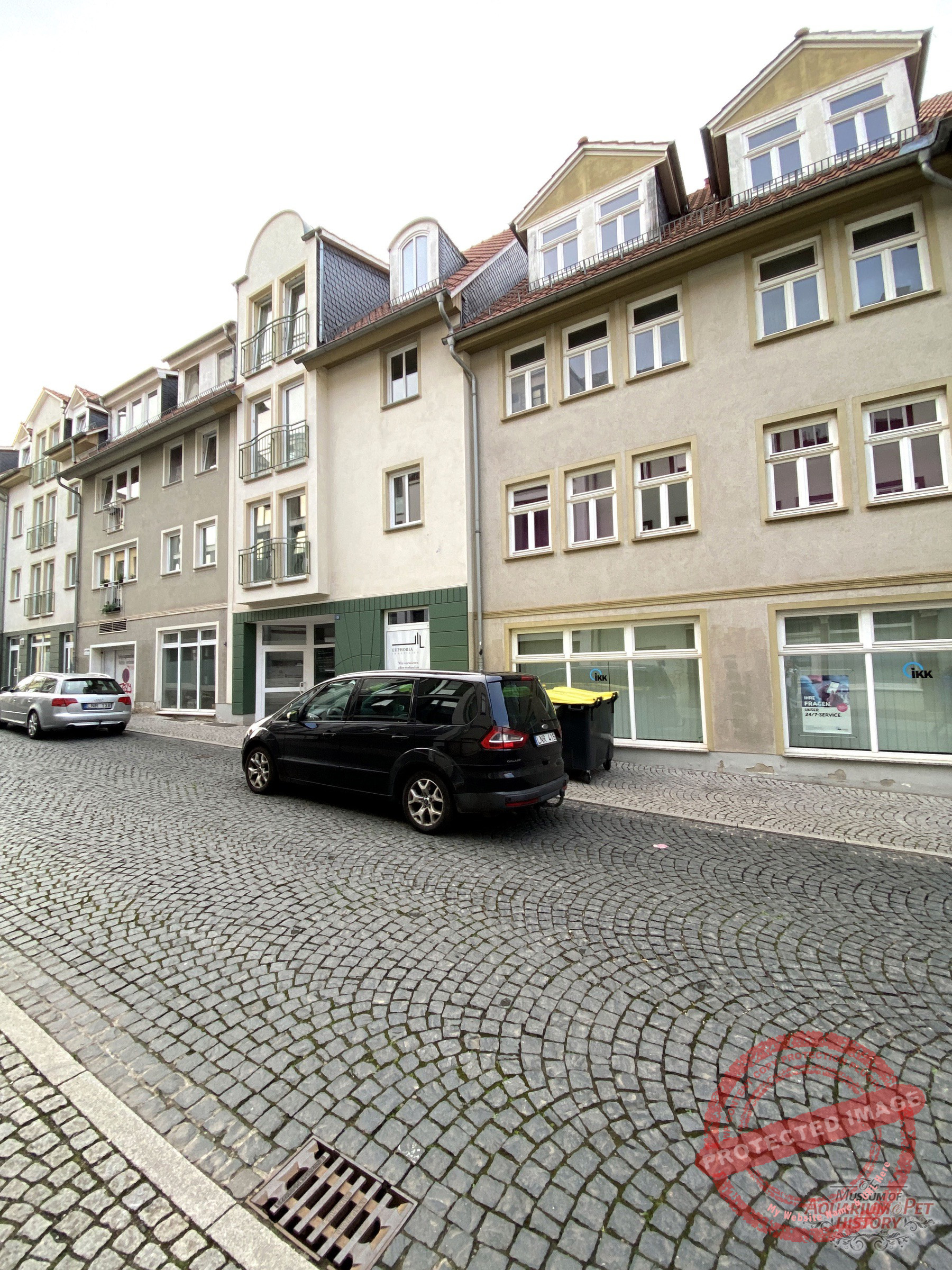
In this building on Gutenbergstraße in Gotha, the pet shop Zoo Kestner was located.
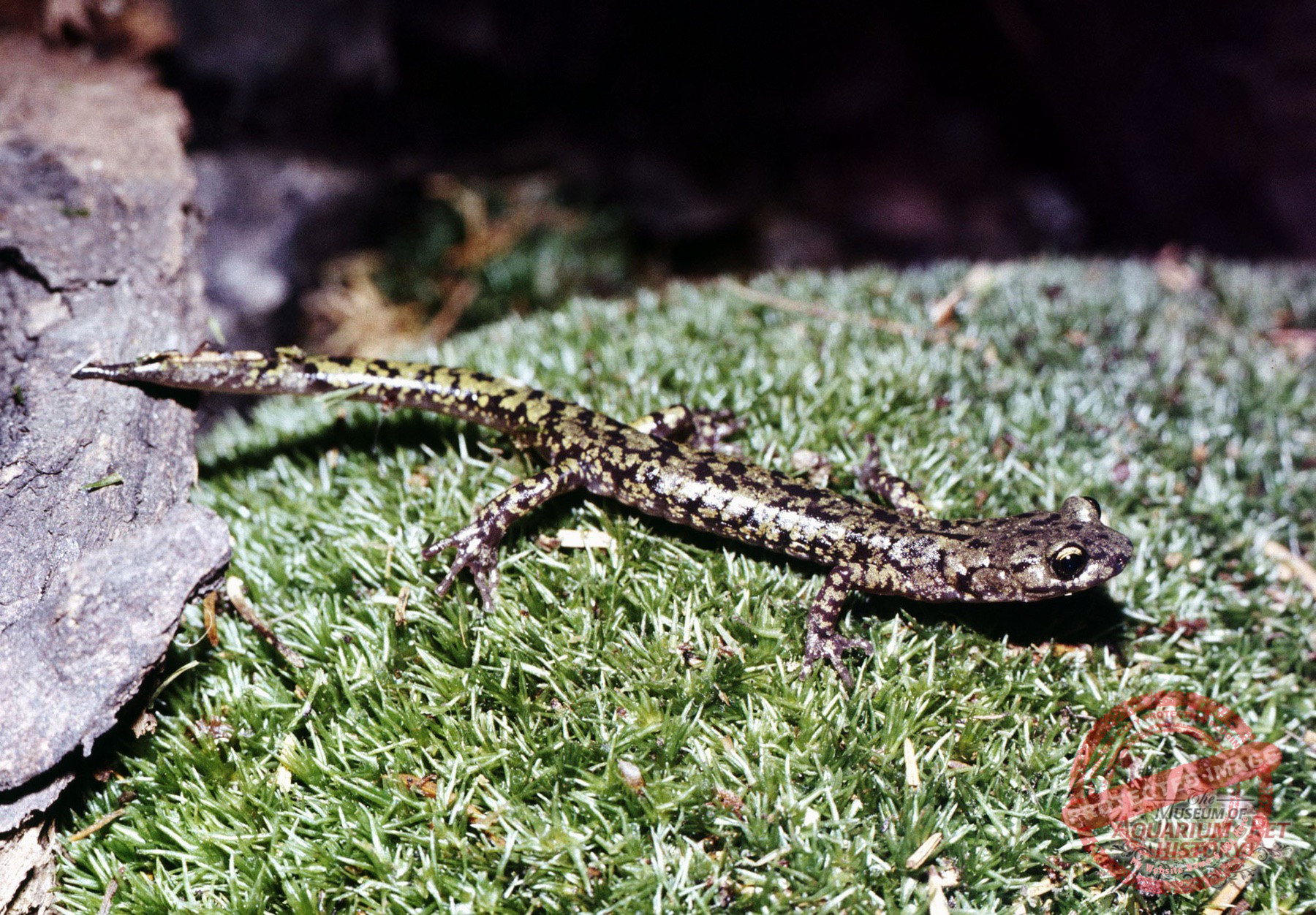
Fire salamander, Aneides aeneus, bred by Gerhard Kugenbuch.
Kugenbuch and Kestner, like many of the best breeders and animal keepers of the time, were introverted people. They did not take part in club life. Because of this, Wolfgang Kestner did not receive the offspring bred by members of the Gotha aquarium club. These were sold at the club’s fish exchanges or to the Berlin-based wholesale company Zoologica. Kurt Koch, who still worked as an independent breeder, had little contact with the aquarium club. He sold only what he himself had bred in his aquariums. Yet the Gotha aquarists remained very skilled breeders, so that fish exchanges and the Zoologica wholesale trade were not sufficient to sell all juvenile fish. One of them, Friedhelm Amberger—who had already played an active role in rebuilding the old open-air aquarium after the war—wanted to become self-employed in business. This was not easy due to the many formalities and restrictions in the GDR. Nevertheless, he succeeded by taking over, on January 1, 1967, a previously existing but never truly significant pet shop from its former owner Paul Wettwer and reopening it at a different location.
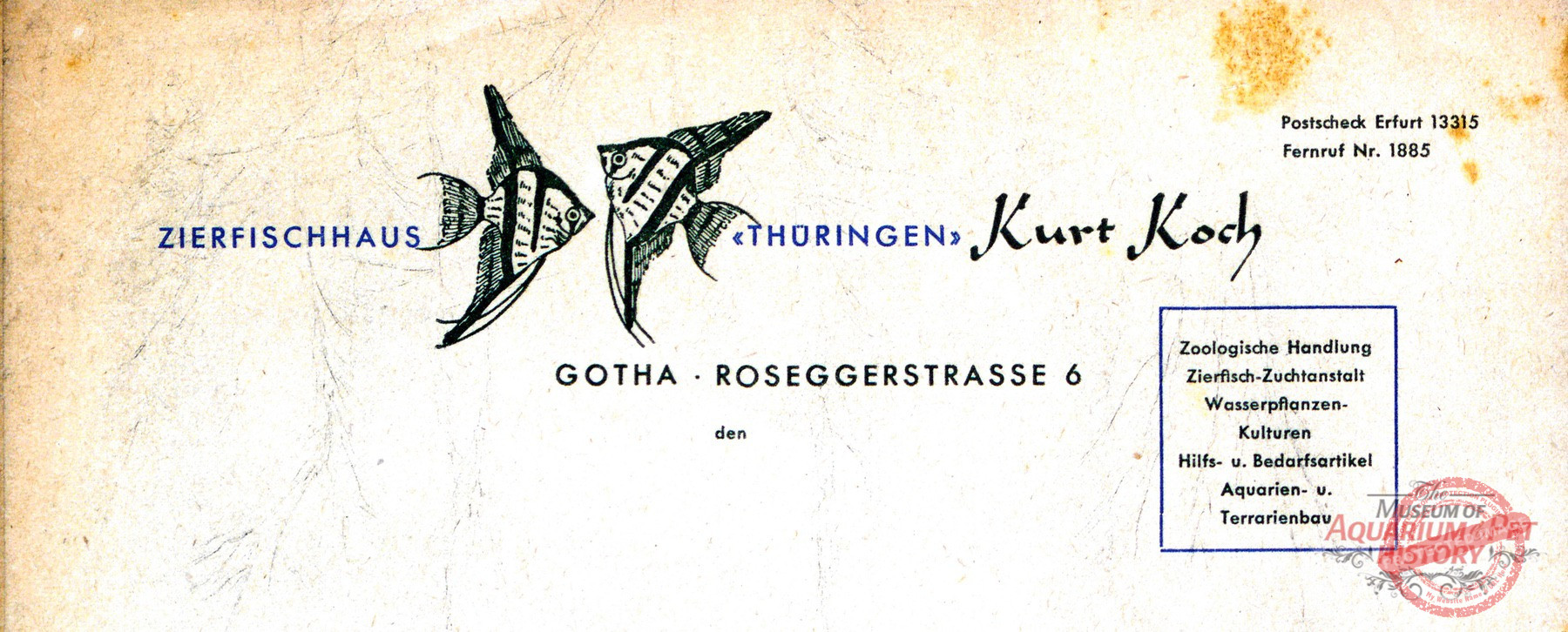
Letterhead of the ornamental fish house “Zierfischhaus Thüringen Kurt Koch”.
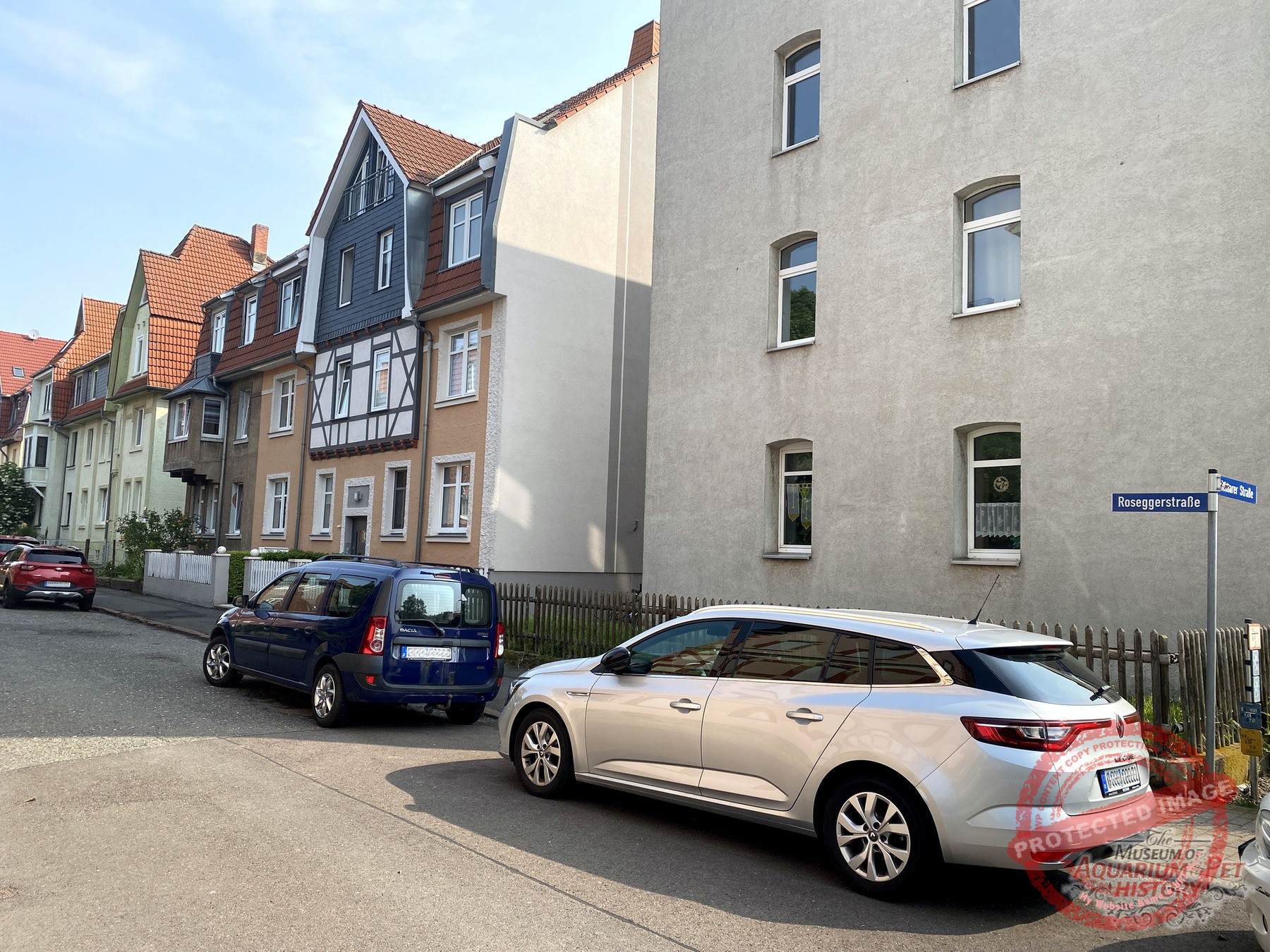
Kurt Koch operated his fish-breeding facility at Roseggerstraße 6.
Amberger was a loud, energetic man, constantly busy with something. He, his wife, and his nearly grown children were always present in his pet shop, which specialized exclusively in the sale of aquarium fish and fish food. As a club member, he received the offspring of the Gotha aquarists and thus had a solid standard assortment. His shop was located on Querstraße, about a three-minute walk from Kestner’s shop on Gutenbergstraße. The two competed for customers and took it personally when people switched from one shop to the other to check whether the fish were better or the prices lower elsewhere. In this way, once again, competition raised the level, the range, and the pricing quality. And both made a living; the introverts went to the calm Kestner, while the more talkative and sociable customers found their place at Amberger’s. I visited both and was sometimes met with angry words for it, but I always said that I was interested in the animals and the hobby, not in the shop owners—and for that, both maintained a solid standard.
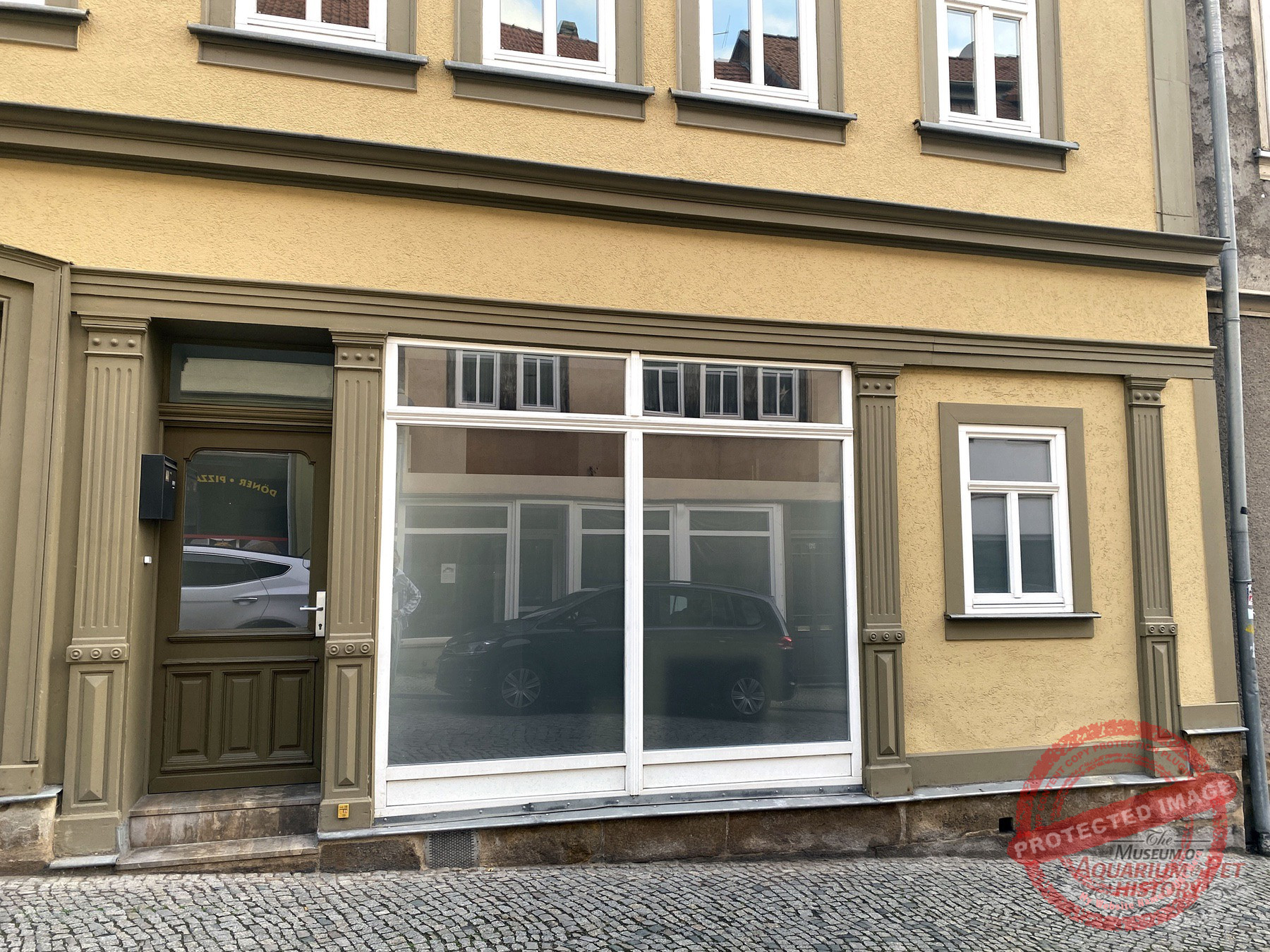
In this building on Querstraße in Gotha, the aquarium shop Amberger was located.
When I now write about aquarium technology in the GDR period, I must first make a few general remarks. The socialist economy was never strong, because neither raw materials nor sufficient international contacts were available. What factories had in terms of machines and tools was mostly left over from the pre-war period, often only hastily repaired or makeshiftly patched. In a way, it was similar to what one sees in Cuba today. Technologically, time seemed to have stood still. The same was true for aquarists and terrarium keepers. Many kept their heaters, air pumps, and lamps in use for many years, carefully maintaining and repairing them, simply because there was no other option.
In the 1970s and 1980s, most of these devices and tools were already old and worn out. People had to help themselves. Citizens of the GDR were considered world champions of improvisation. We could create astonishing things from the most primitive scraps. Here is one example: in our aquarium club, we needed a pump with a simple internal filter for a setup with multiple tanks. One member had an old record player, another a lightly running bicycle crank mechanism with pedals. Both were connected with a rubber belt; the record player motor drove the crank via the belt. The moving pedals operated two pressure cylinders like the connecting rods of a steam engine, compressing air. But what about the filter itself? Following the model of foam internal filters already common in the Western world, we built something similar. Fortunately, we had some old pipes that could be connected to reach the aquariums. But the foam? One member worked on a construction site where insulation material had just been delivered. He brought scraps of it. But how could these pieces be attached to the pipes? Someone came up with the idea of soaking the foam in water and freezing it. Once frozen, it could be drilled precisely to match the diameter of the pipes. This resulted in a self-built aeration system with filter sponges for a series of aquariums.
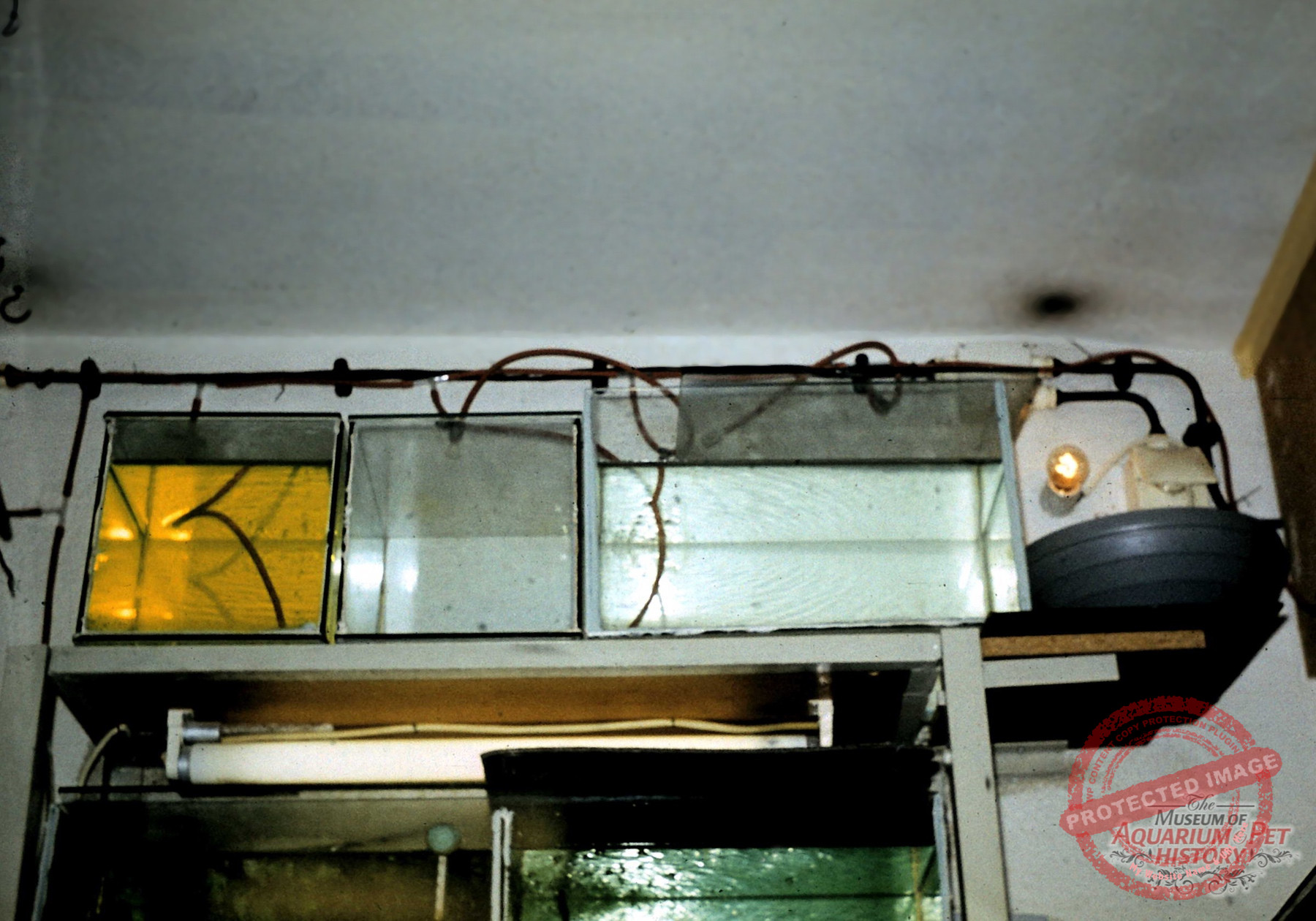
Self-built breeding and holding systems were typical of the GDR era.
A similar spirit applied to the keeping of live food, its breeding, and its collection. Sometimes I think that many of those inventive aquarists would be successful engineers today. Of course, not everything worked smoothly, and accidents did occur, especially in experiments such as an underwater lamp. A slim light bulb was placed inside a glass tube and lowered into the aquarium behind a decorative root. However, the bulb became too hot, the glass tube shattered, and a short circuit shut everything down. Still, it was worth trying.
Many aquarists still used the ceramic or metal heating cones widely used in the 1920s. They were placed beneath the aquarium, which usually stood on a steel frame. They were heated with oil or spirit flames. In later years, gas or early electric heating elements were used. Heat rose upward and warmed the tank. Of course, the heat distribution through the bottom glass was uneven. It was also difficult to control temperature precisely by adjusting the flame size. Sometimes overheating occurred; in the worst case, the bottom glass cracked due to localized heat stress. From the late 1960s onward, simple heating rods became available. They consisted of a glass tube containing a heating wire embedded in sand and sealed at the top with a rubber plug. From the pre-war period, some still used L-shaped metal heaters known for occasionally becoming immersion heaters due to short circuits, sometimes bringing the aquarium water close to boiling. Skilled hobbyists installed relays in front of the heater to stabilize temperature control. Even aquarium lighting at the time was very basic and would not pass any modern safety inspection. In a roof-shaped aluminum housing, one or two slender light bulbs were exposed without protection. If water splashed onto them, they burned out.
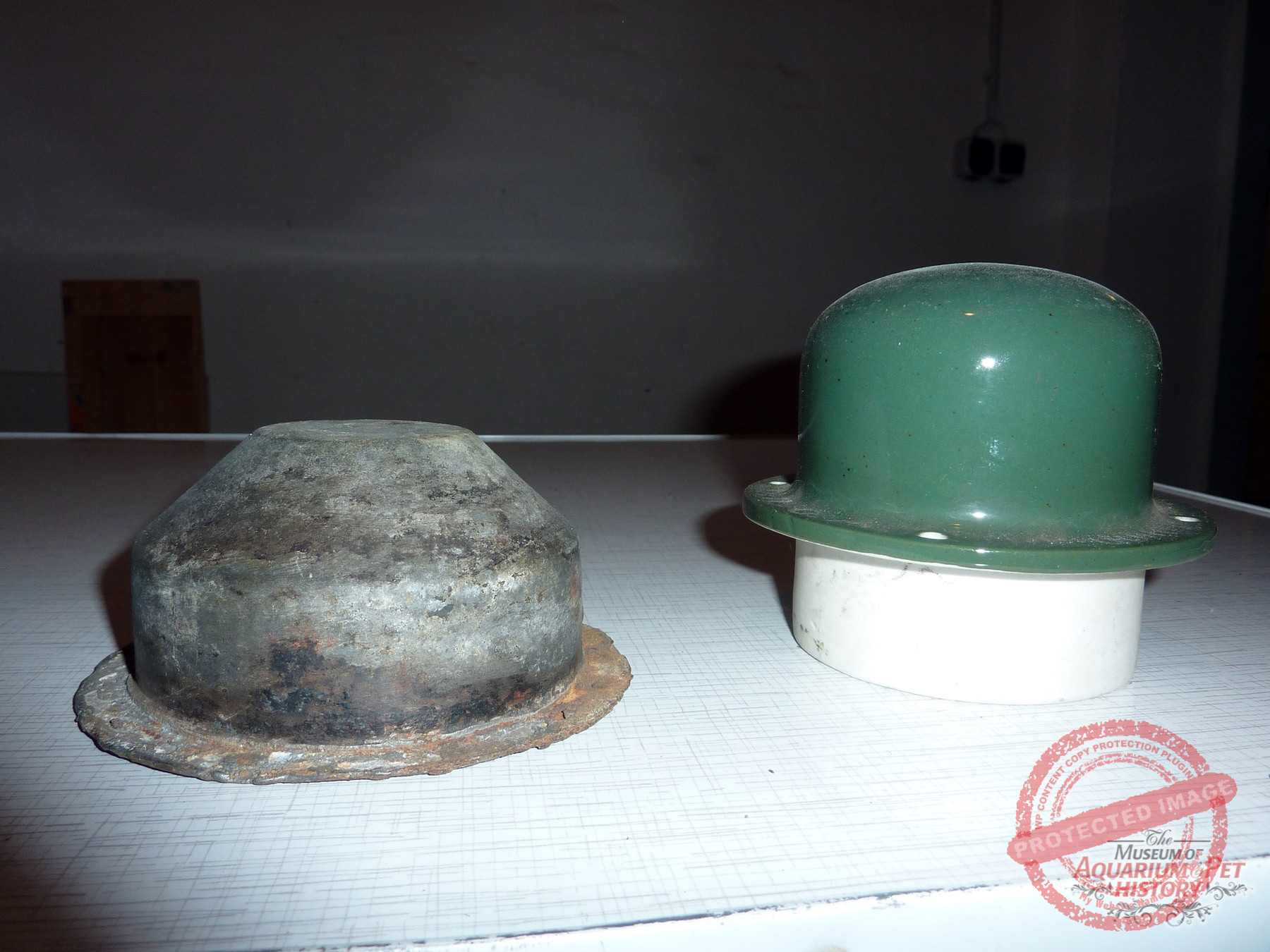
Heating cones positioned beneath the aquarium.
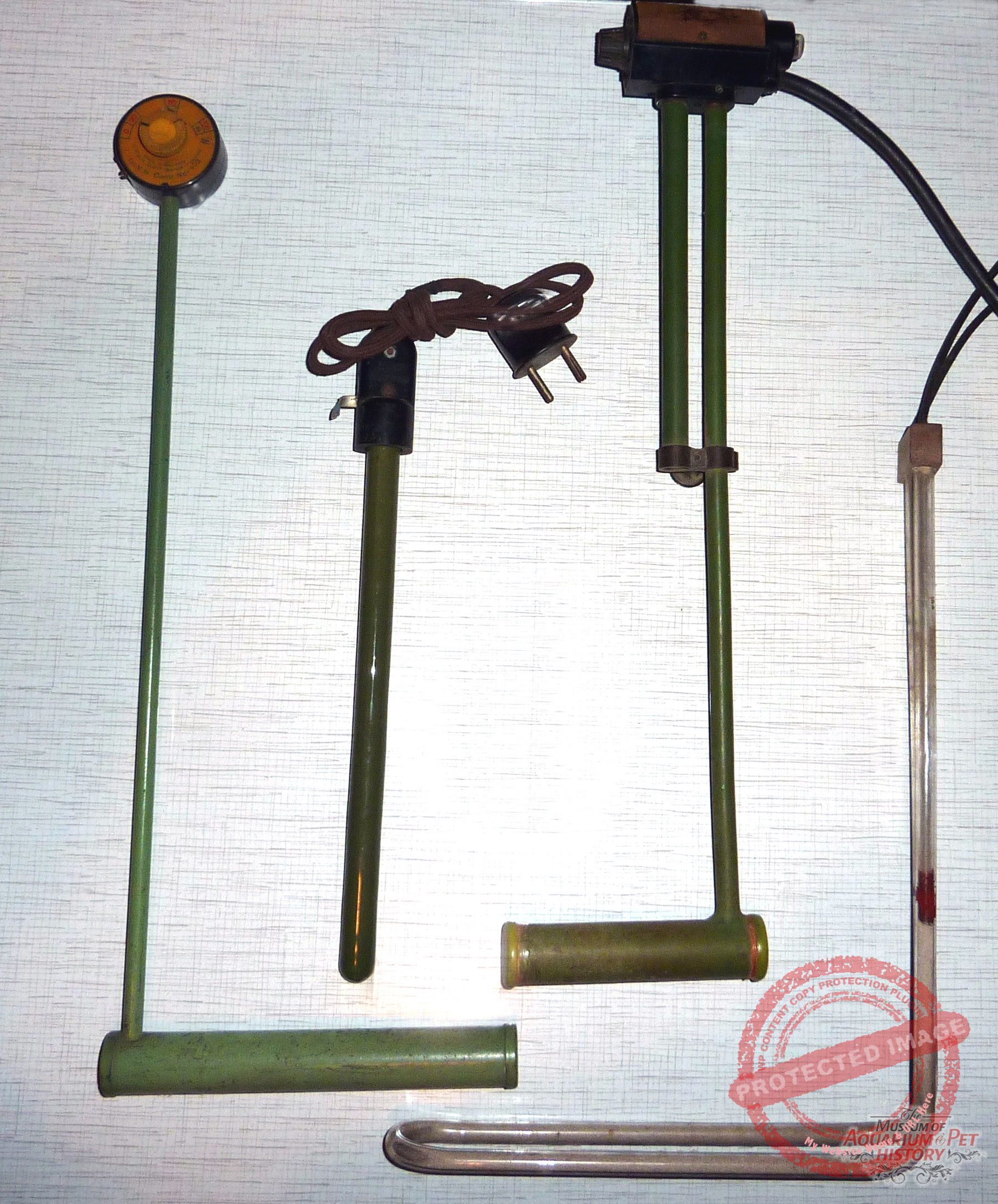
Early aquarium heaters that operated exclusively on 110-volt direct current.
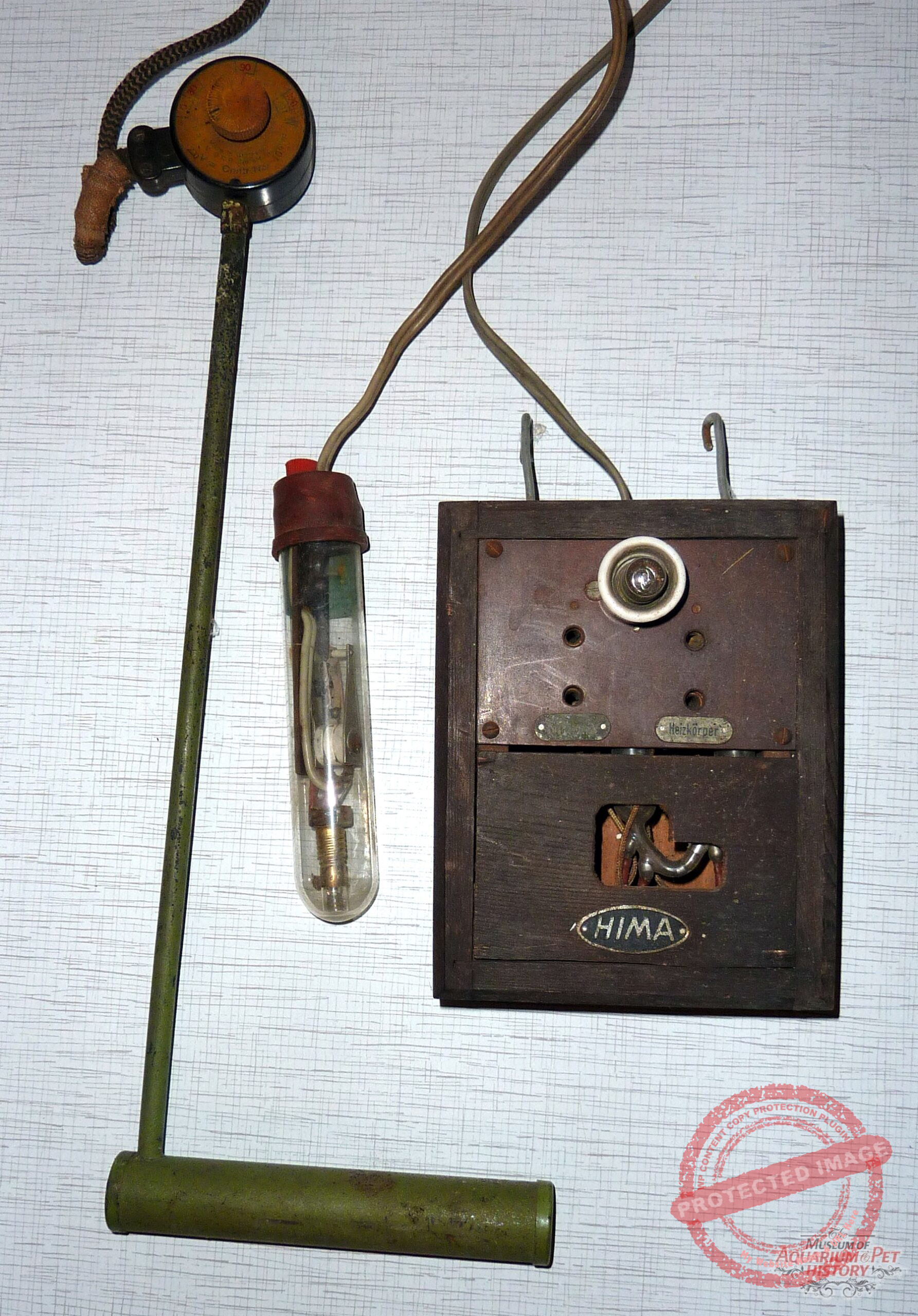
110-volt DC heater with relay.
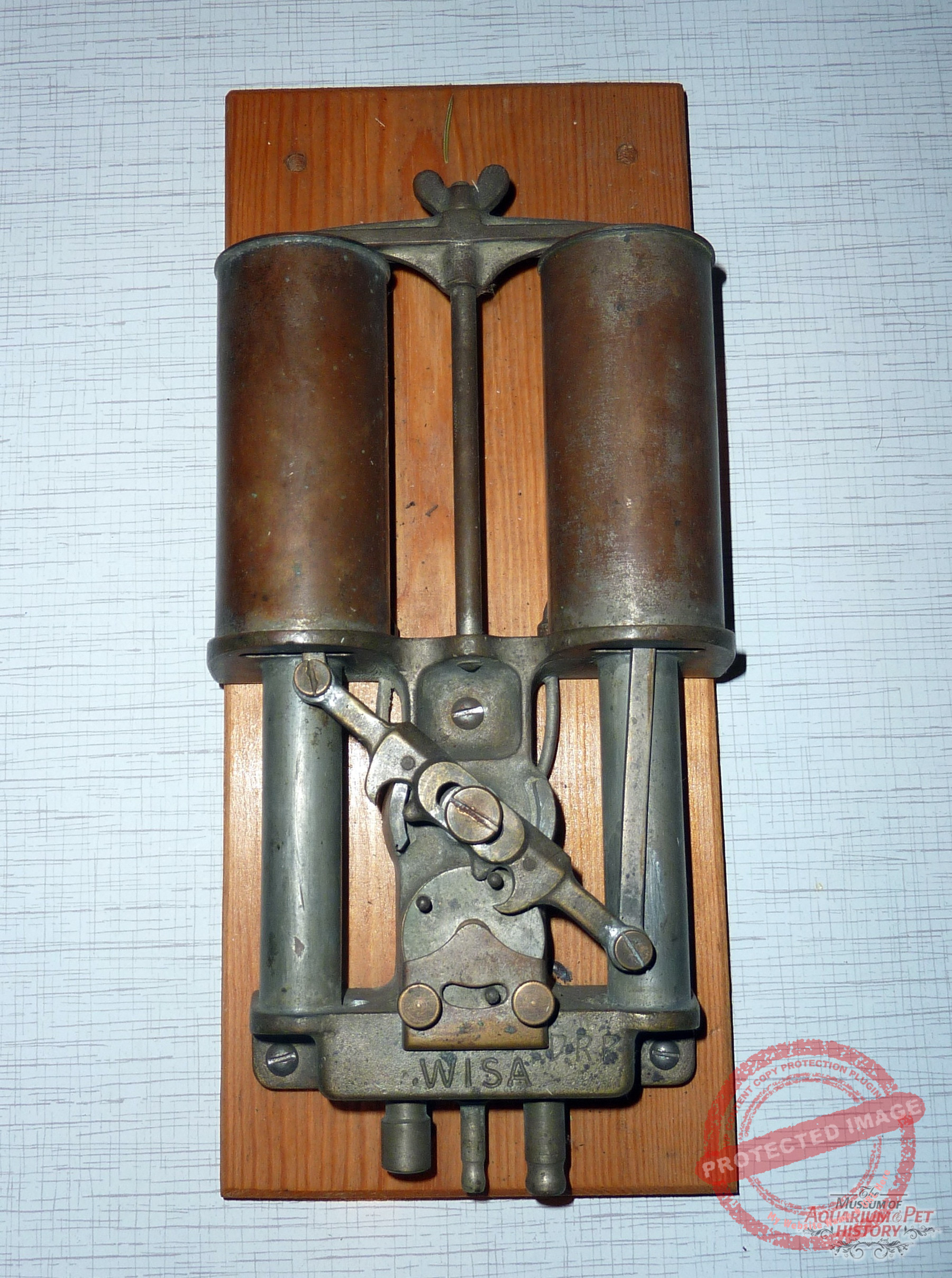
German-made air pump from the 1920s.
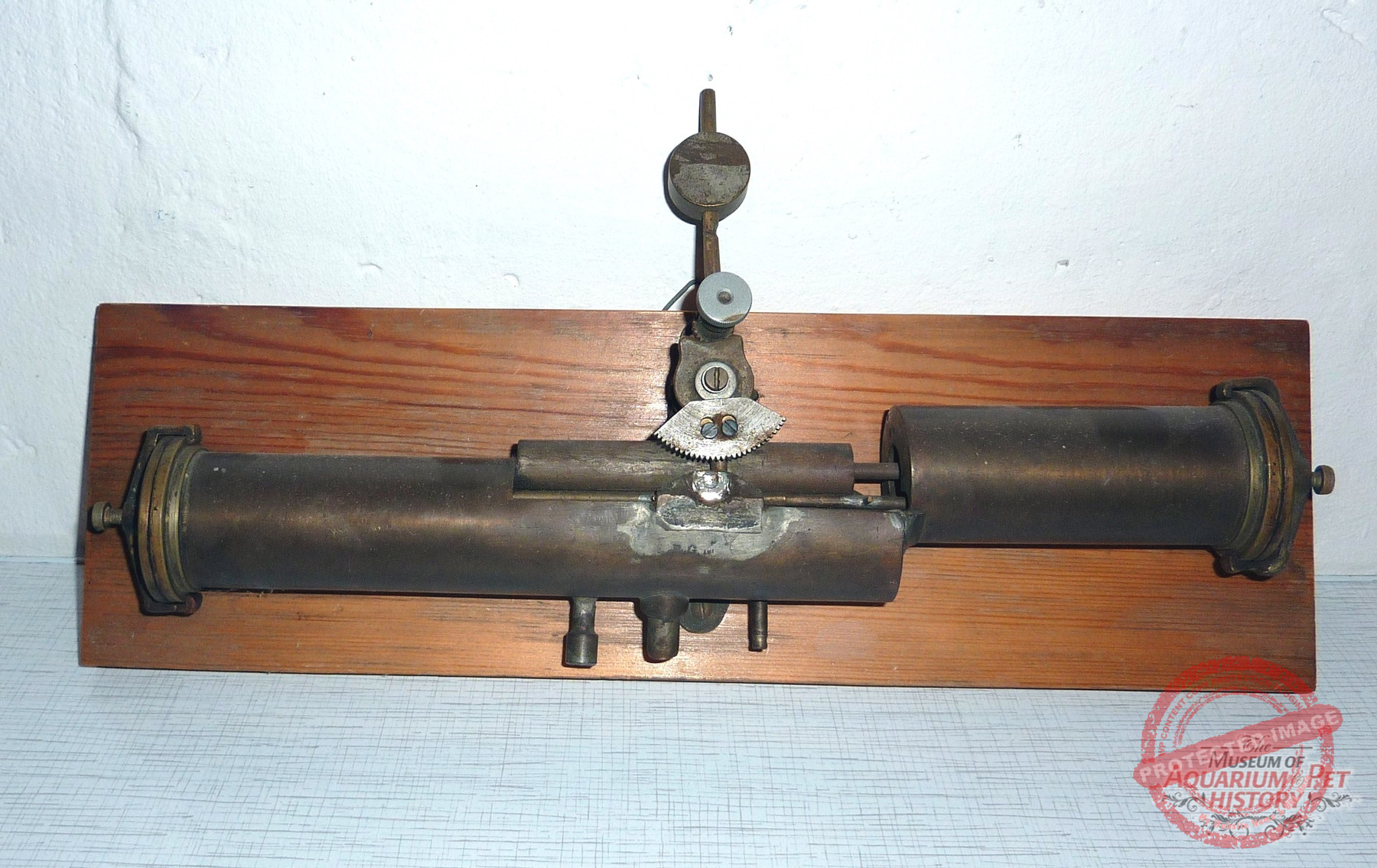
German-made air pump from the 1920s.
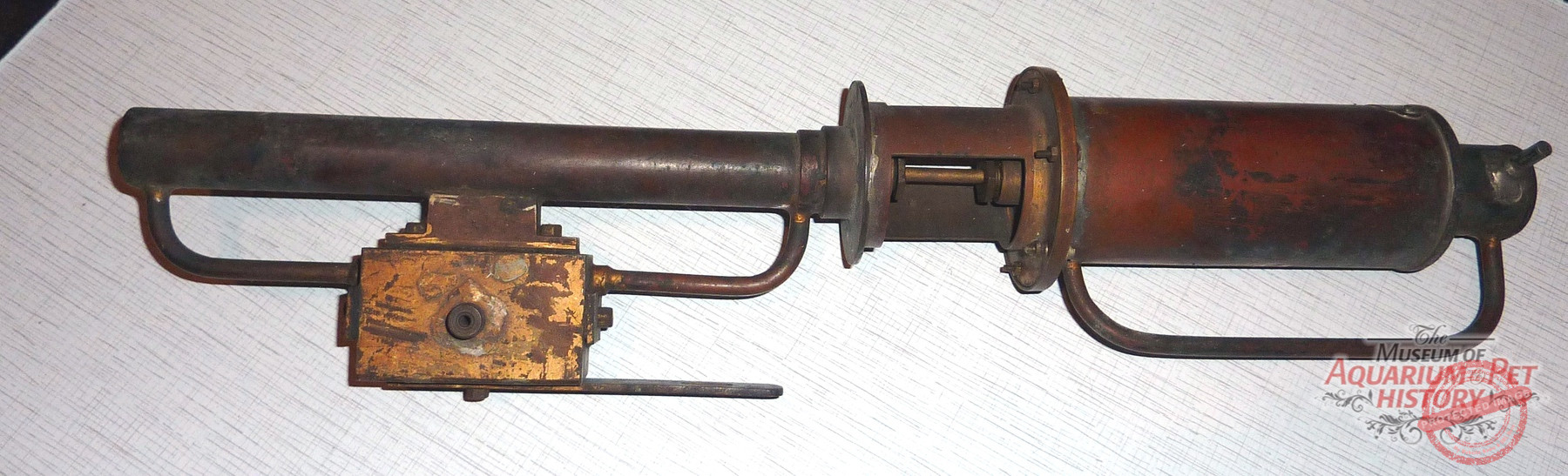
German-made air pump from the 1920s.
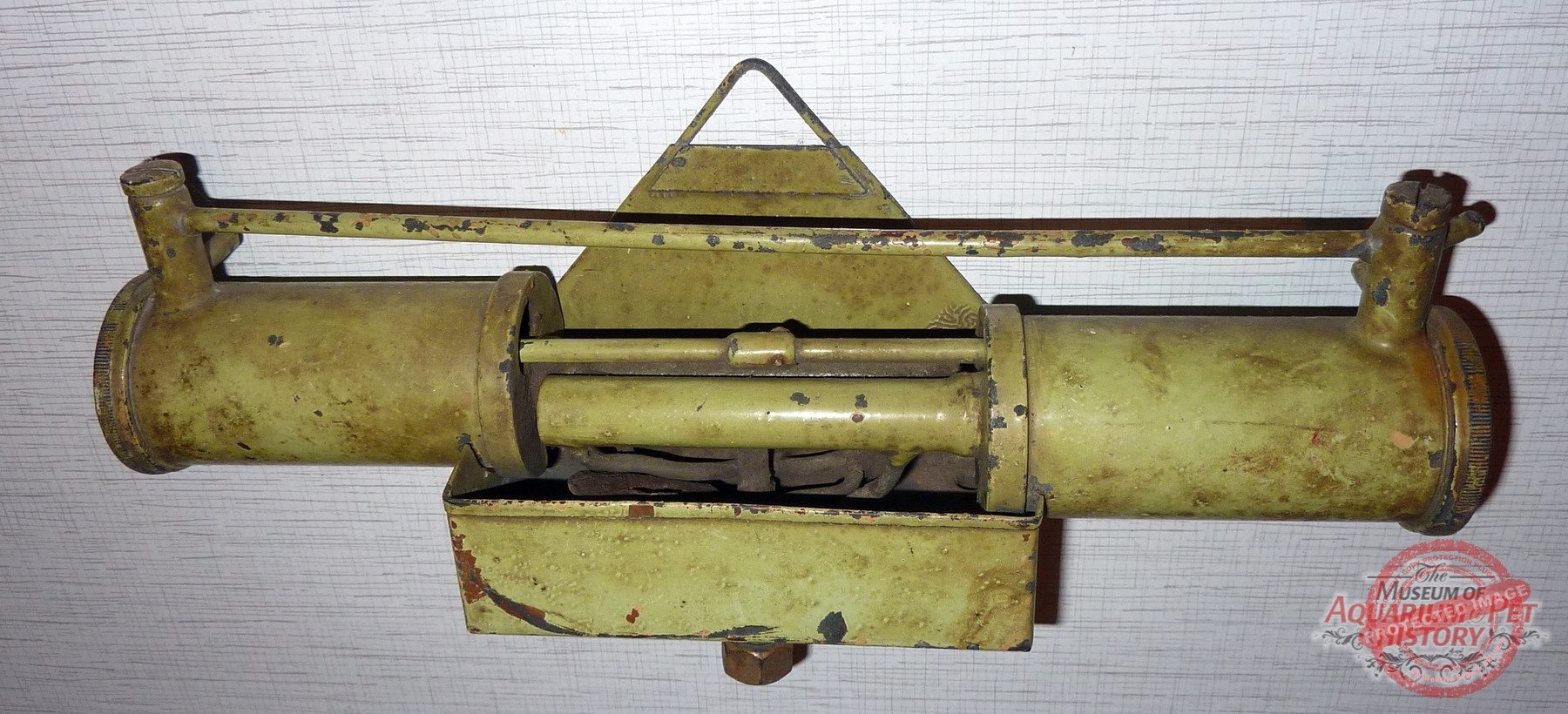
German-made air pump from the 1920s.
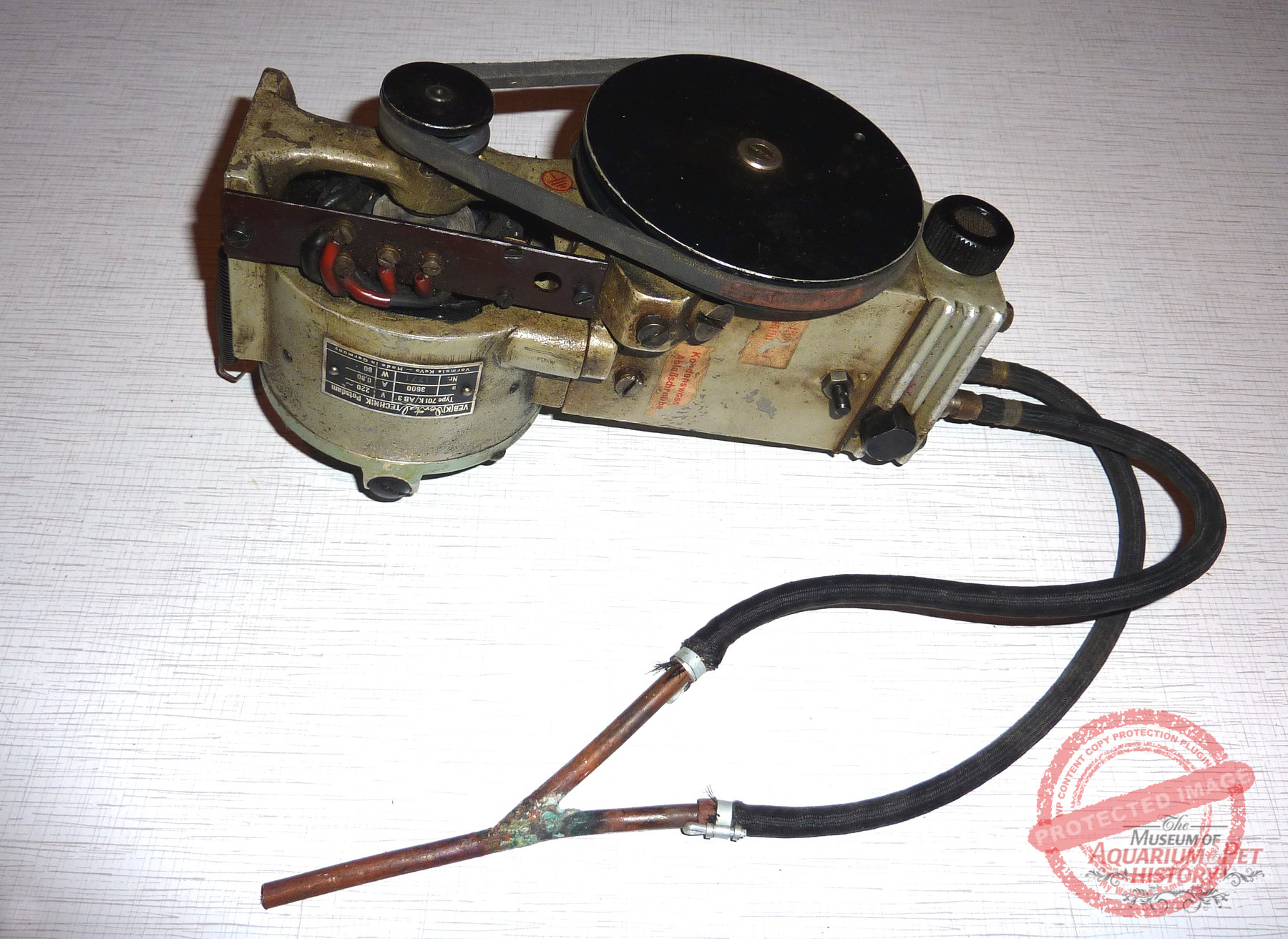
Membrane pump from the first half of the last century.
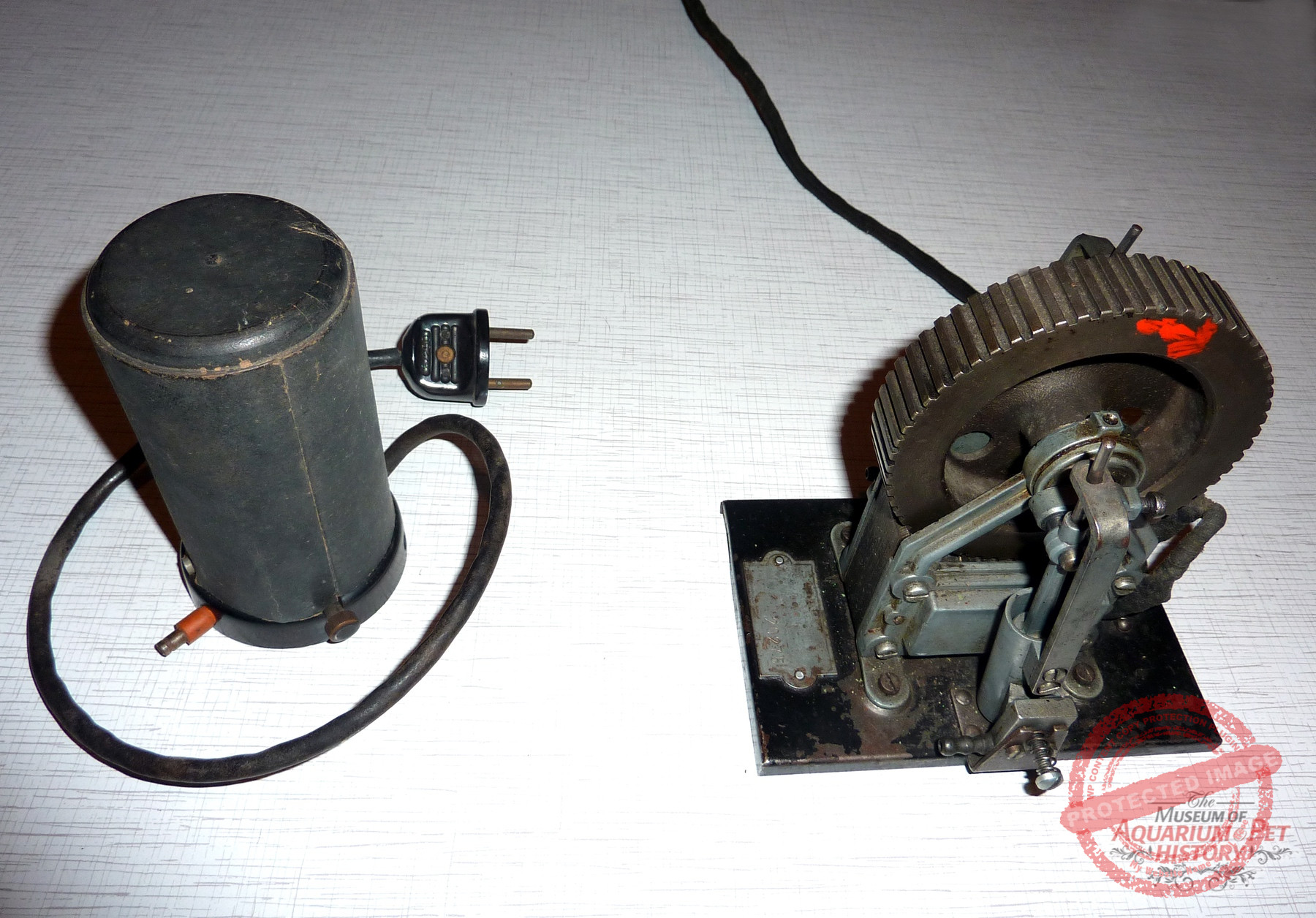
220-volt electric pumps used in aquaristics.
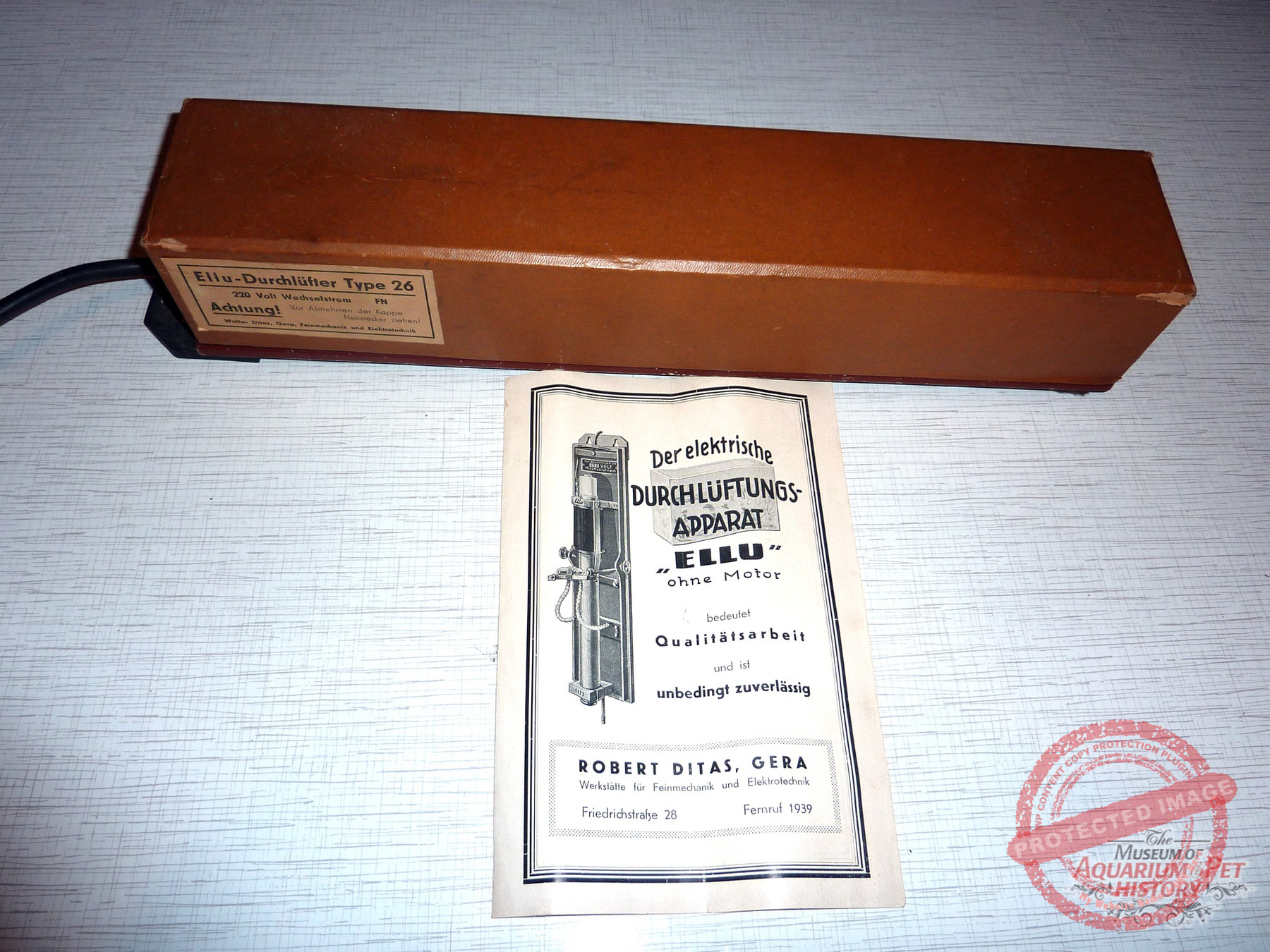
Ellu aeration device.
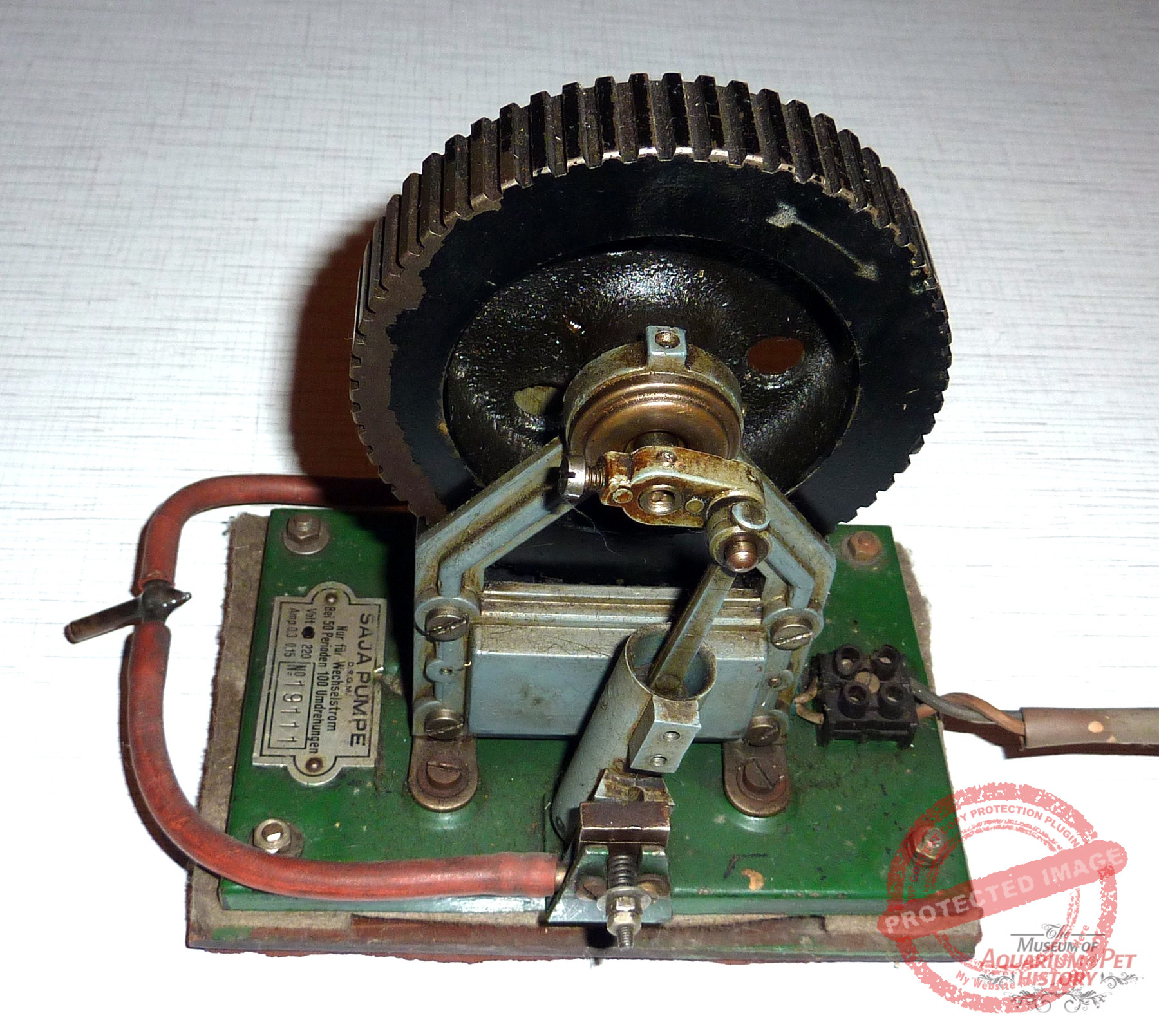
220-volt electric pumps used in aquaristics.
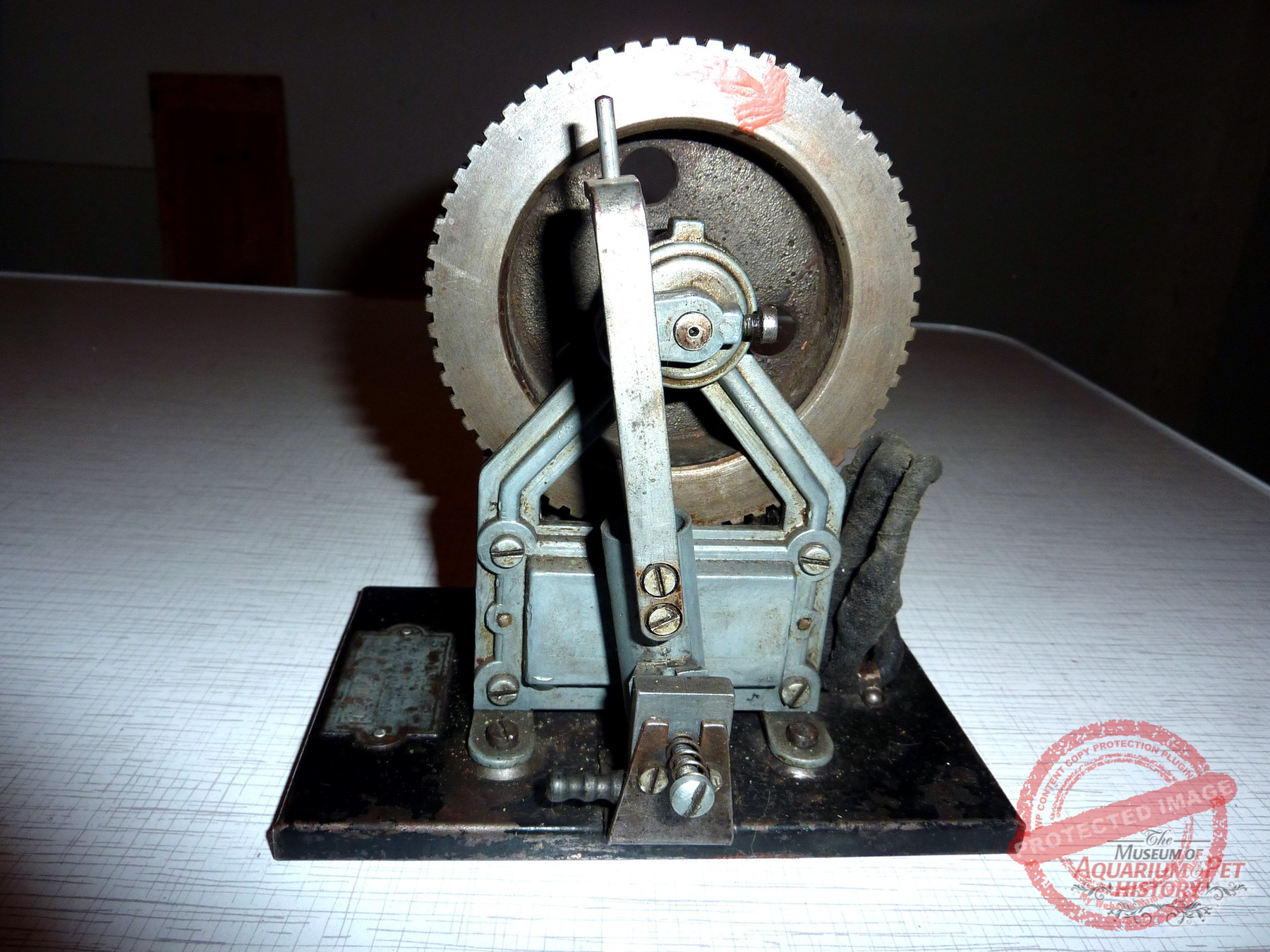
220-volt electric pumps used in aquaristics.
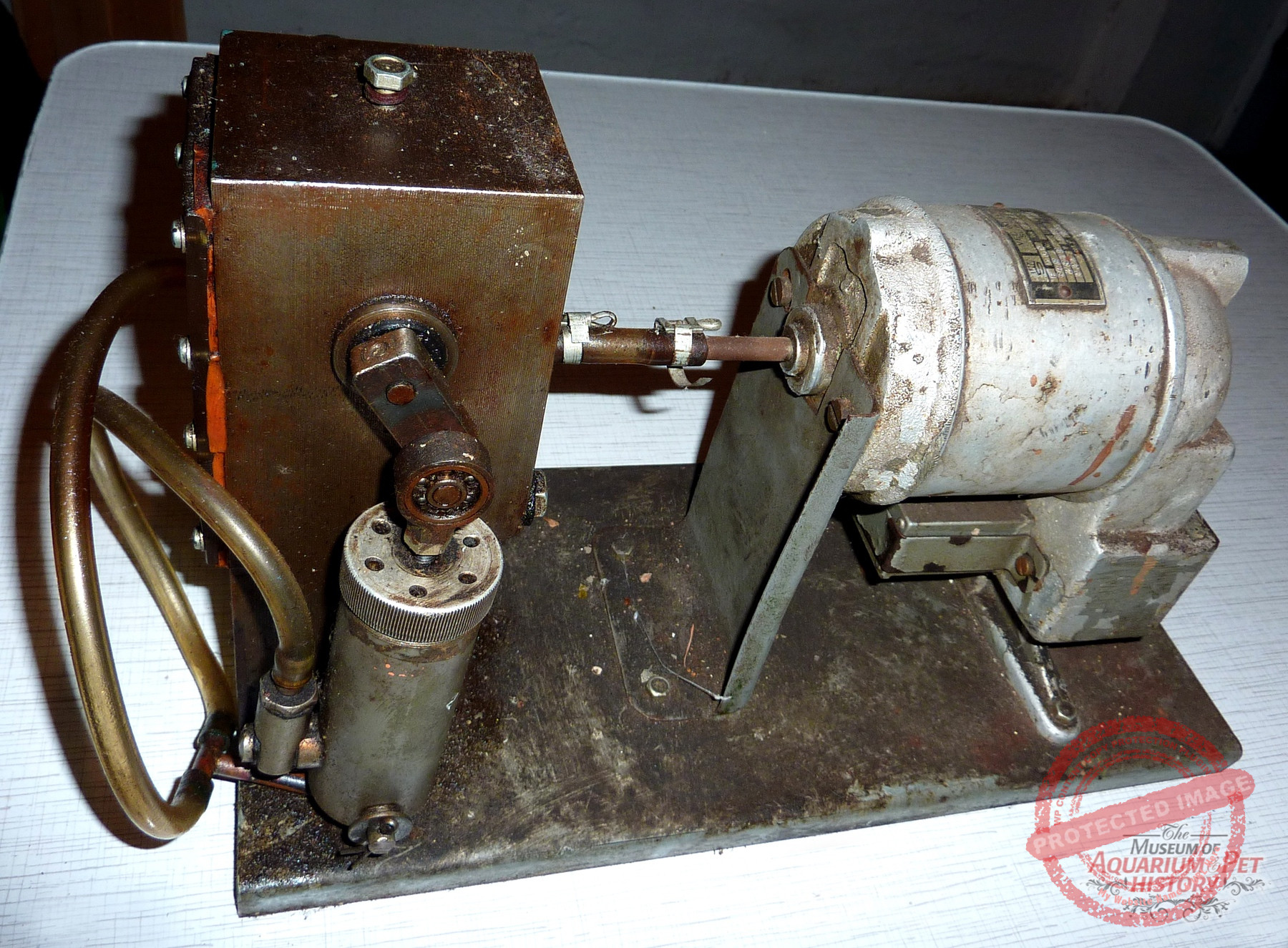
220-volt electric pumps used in aquaristics.
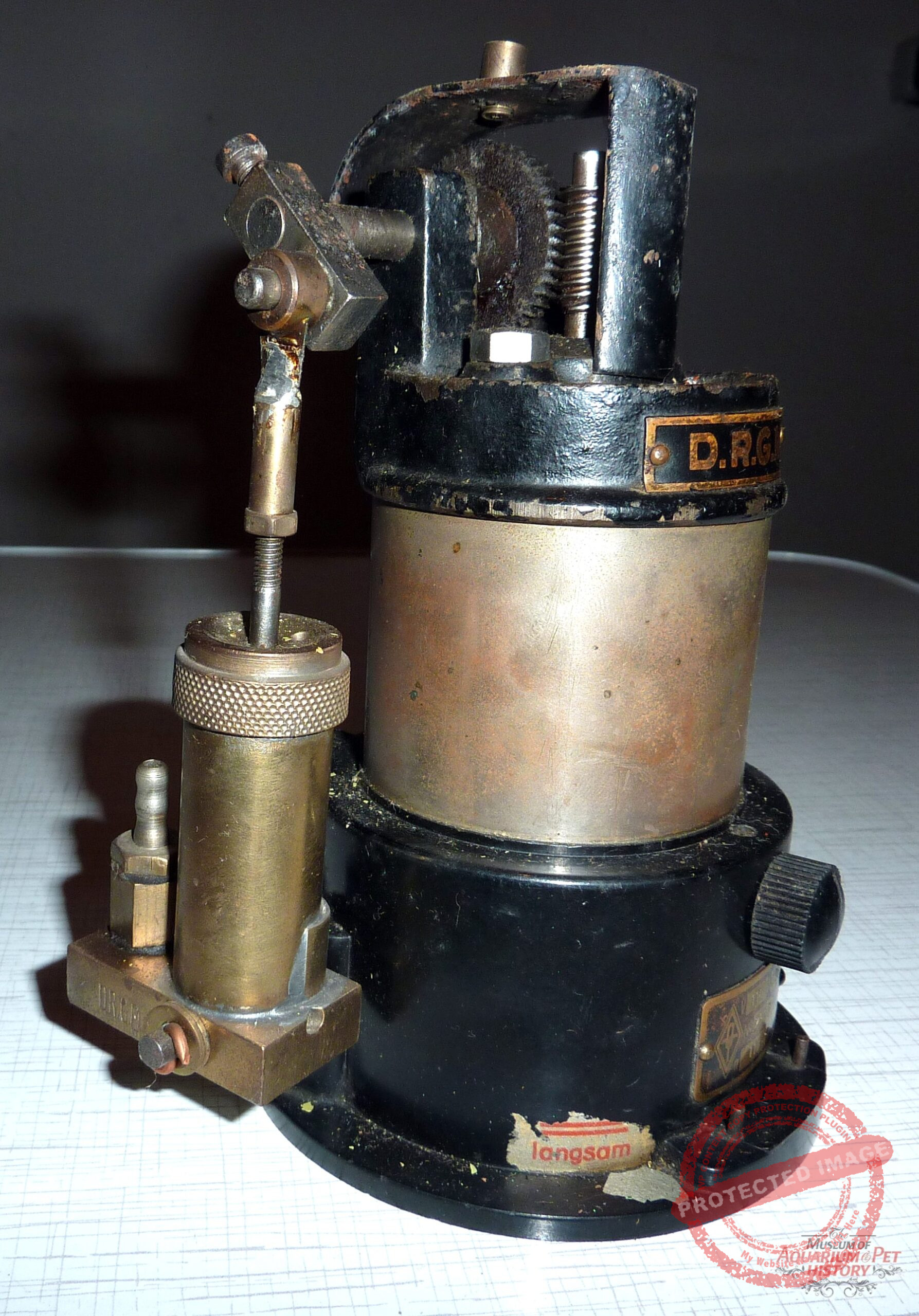
220-volt electric pumps used in aquaristics.
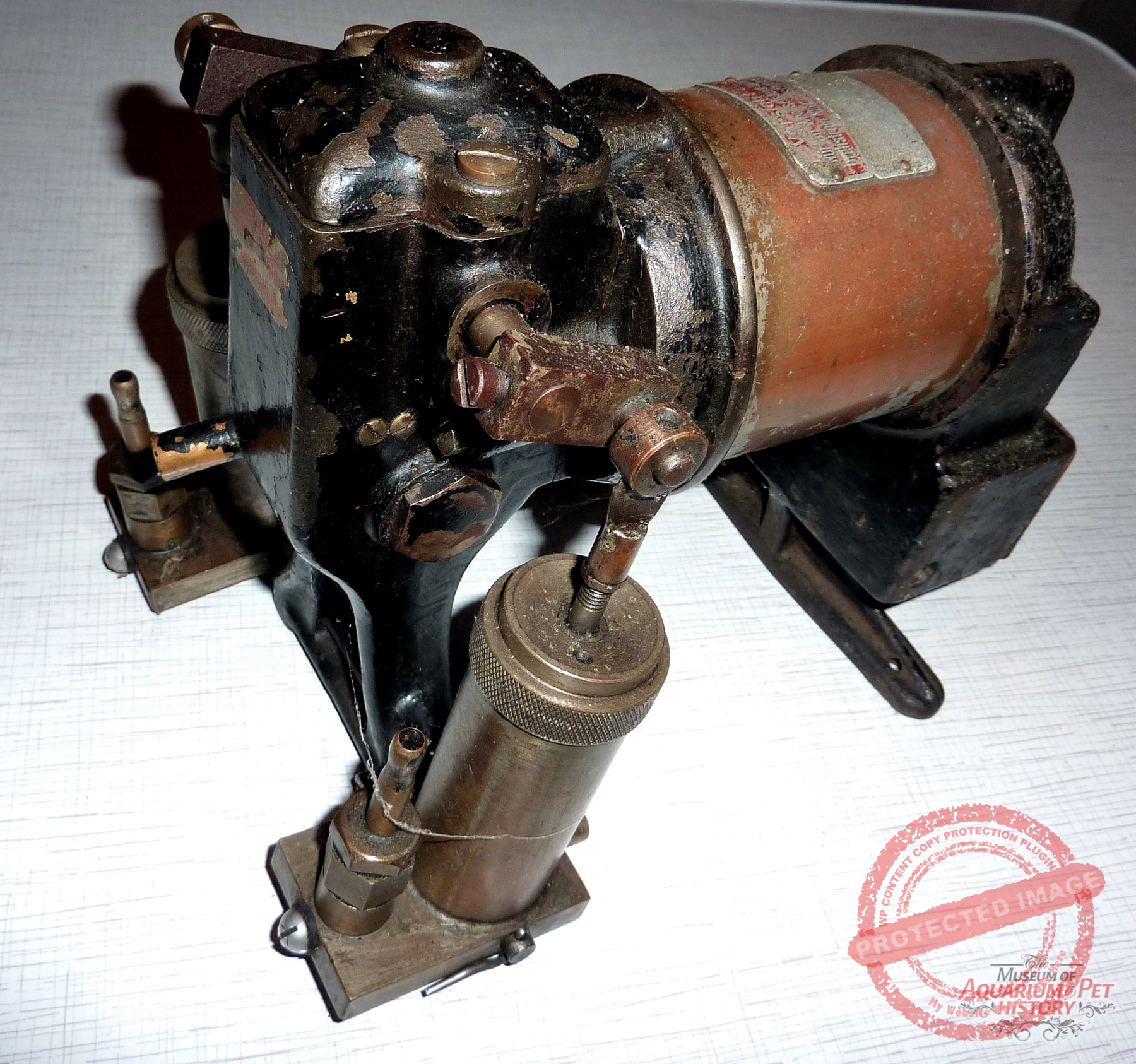
220-volt electric pumps used in aquaristics.
The company AKA meanwhile offered complete heating systems with contact thermometers and thermal relays, as well as membrane air pumps and piston pumps capable of moving water, enabling self-built external filter systems. For most aquarists, this technology was difficult to access. Therefore, they used various industrial water pumps and adapted them to their homemade filters. Once again, it was a Thuringian engineer in Roda near Ilmenau who applied his technical knowledge to the hobby and eventually turned it into a business idea. Dr. A. Eggert founded the company HIMA and produced Neptun membrane pumps for aquarium aeration, submersible heaters, and temperature regulators for GDR aquarists. I bought countless of these products at Zoo Kestner and used them in my own aquariums. The problem with these membrane pumps was that no durable material for the membranes was available in the GDR. As a result, as performance declined, the pumps began to sound like jackhammers after half a year—unbearable in the long run. So replacements had to be purchased—a thriving business for Dr. Eggert, who of course was well aware of the limited lifespan of his products. The Taifun air pumps produced at the old pump factory in Taucha near Leipzig, in operation since 1905, were no better.
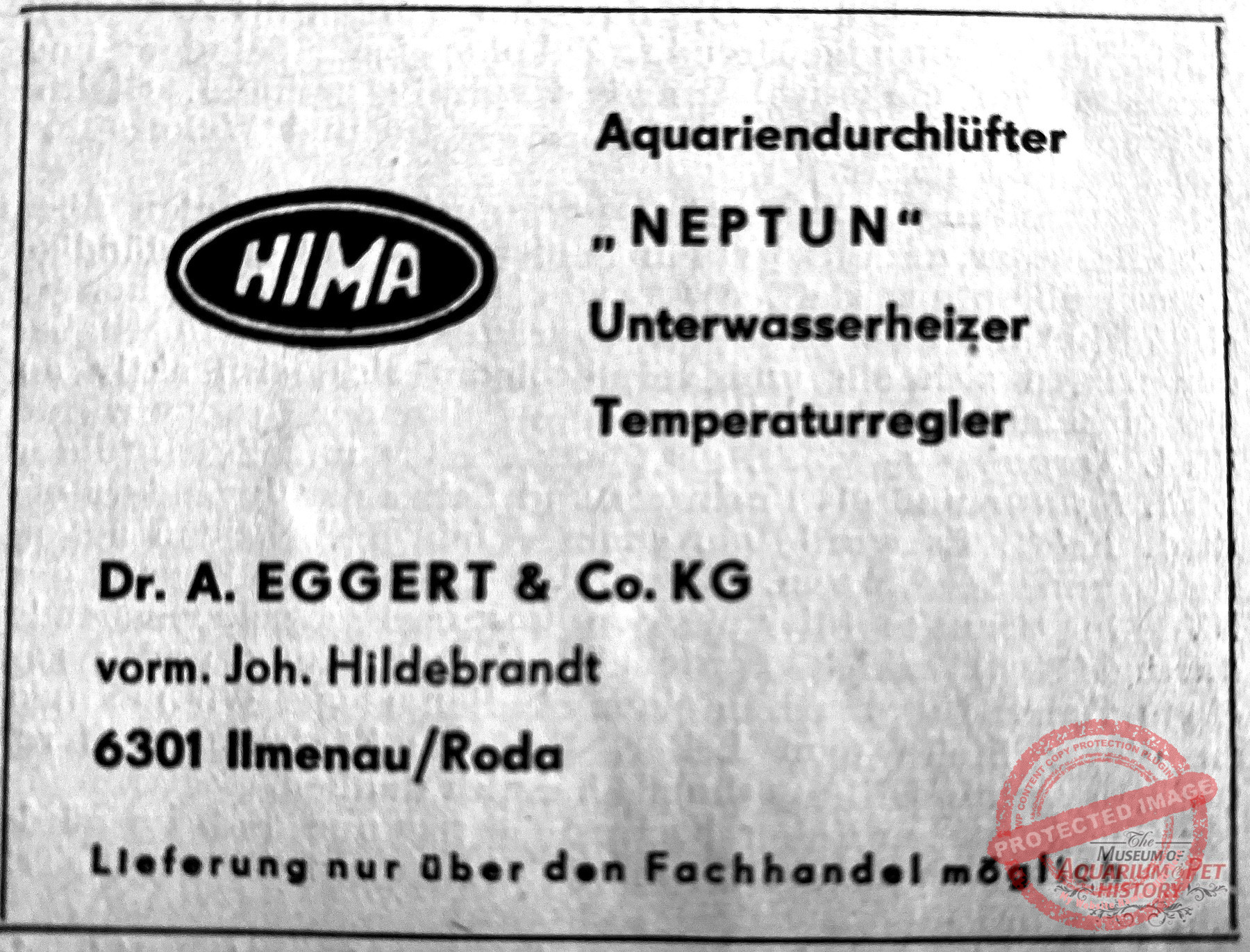
Advertisement for an “Aquarium Aerator NEPTUN Submersible Heater” by Dr. A. Eggert in the GDR journal Aquarien Terrarien.
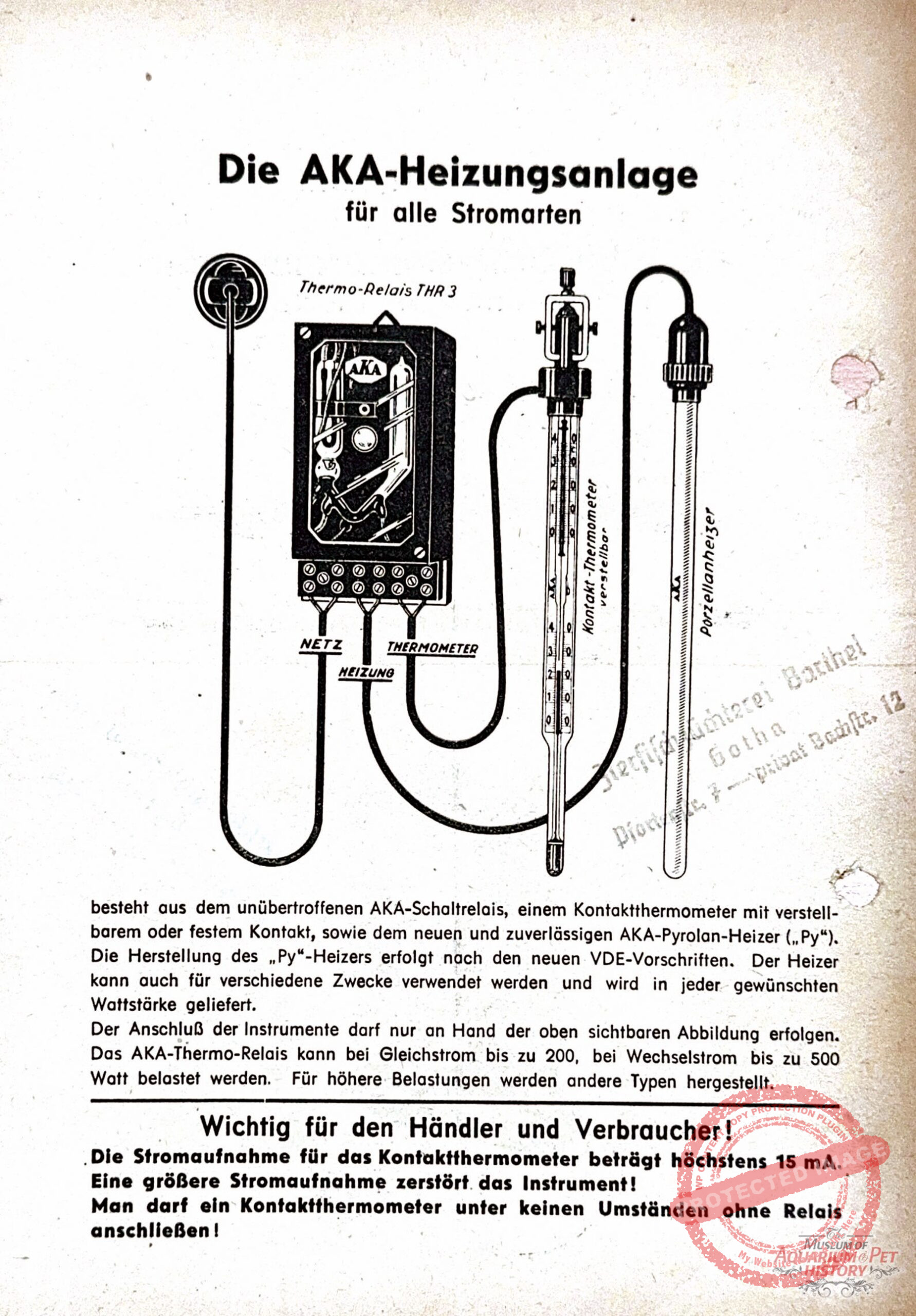
Description of the AKA heating system.
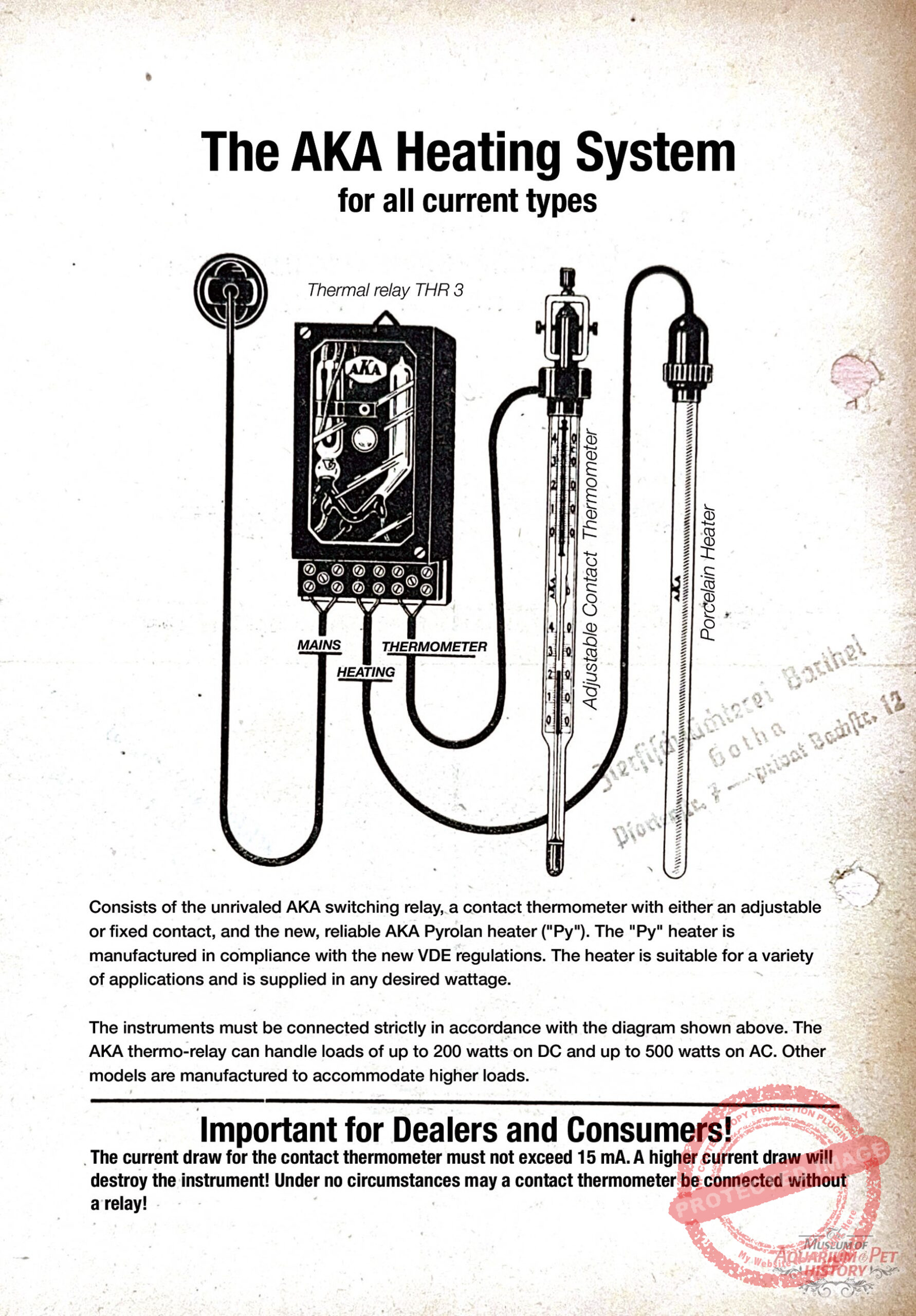
Description of the AKA heating system translated using notegpt.io
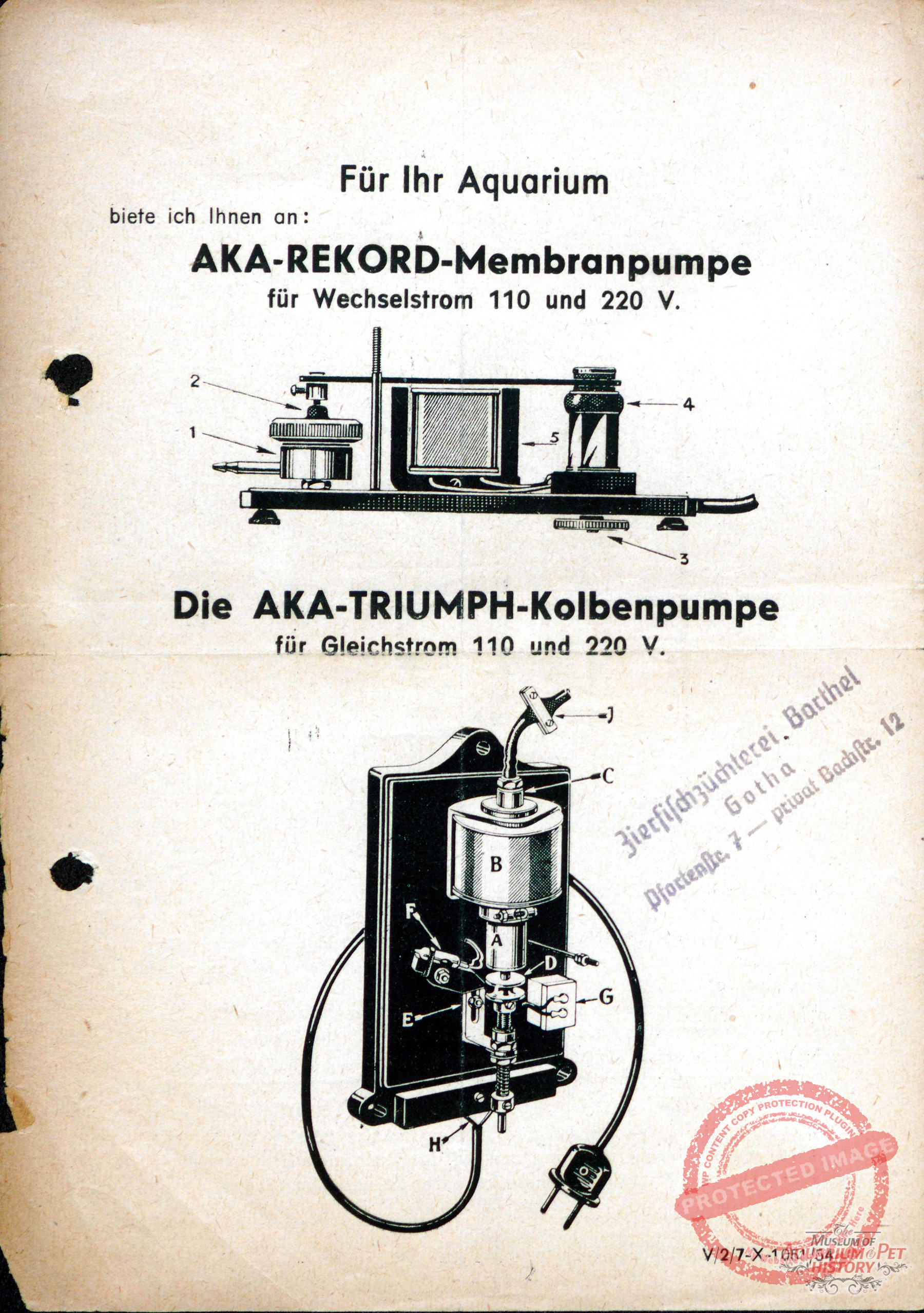
Cover of the accompanying brochure for the AKA-REKORD membrane pump and the AKA-TRIUMPH piston pump.
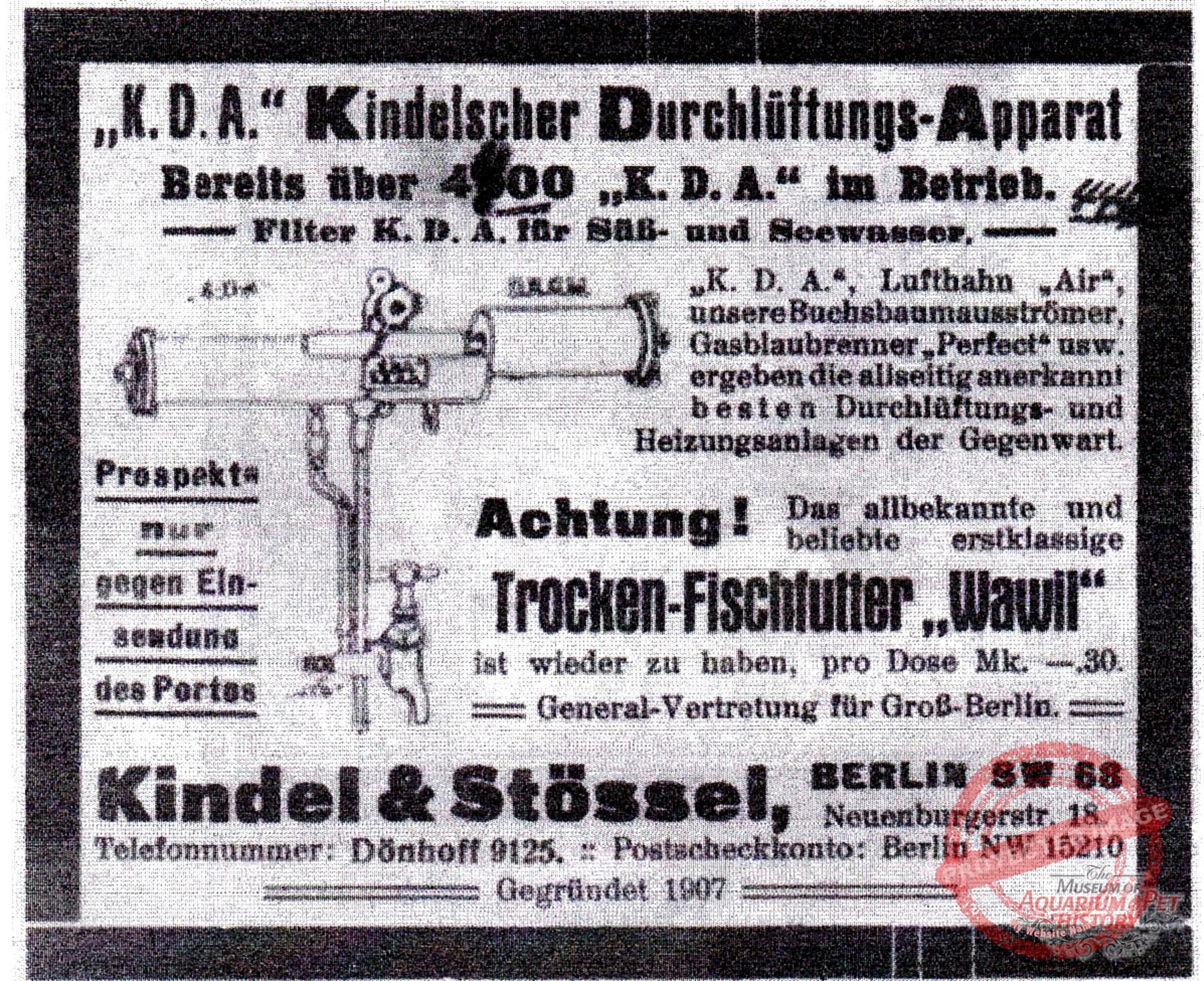
Advertisement for the Kindel aeration device.
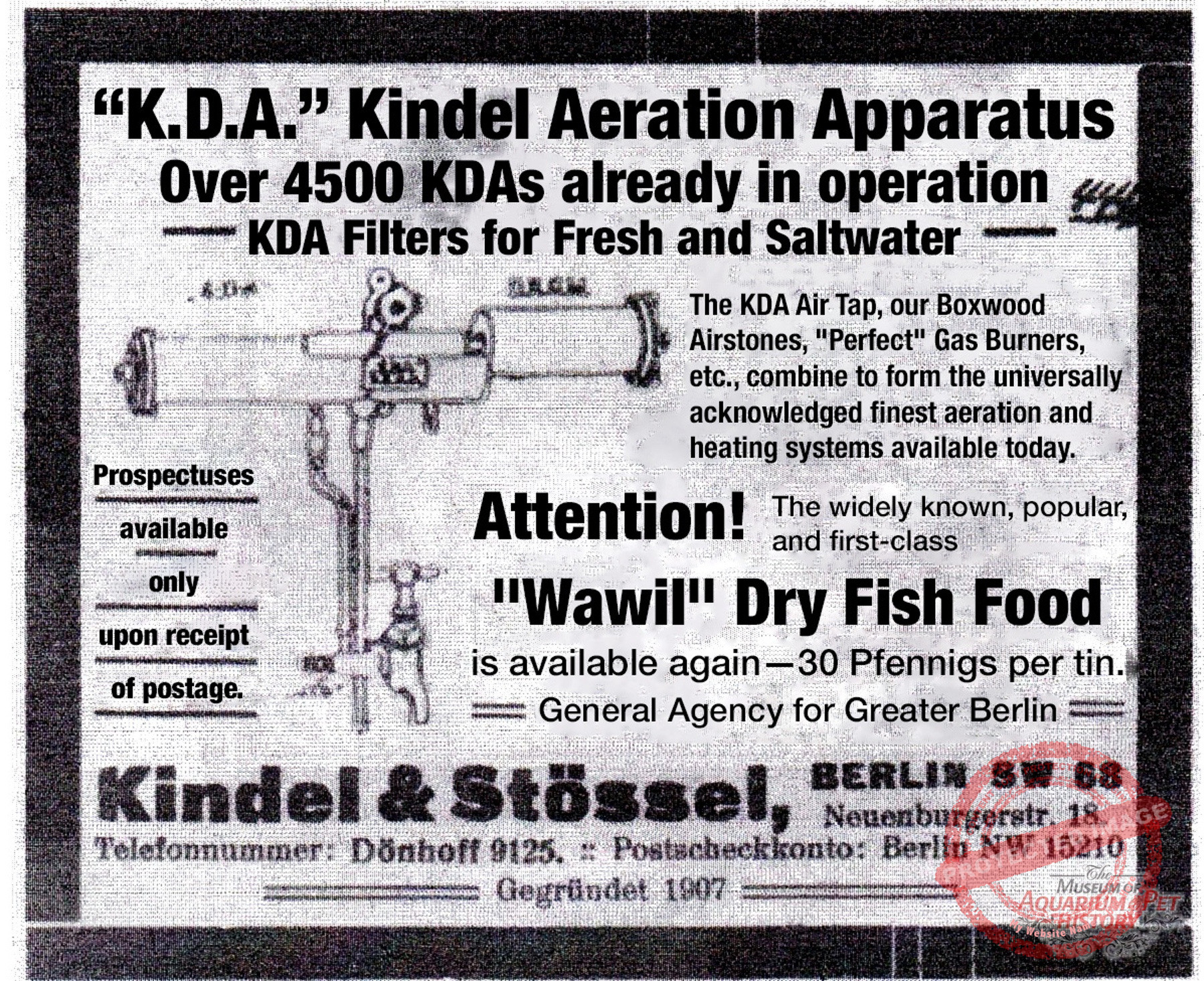
Advertisement for the Kindel aeration device translated using notegpt.io
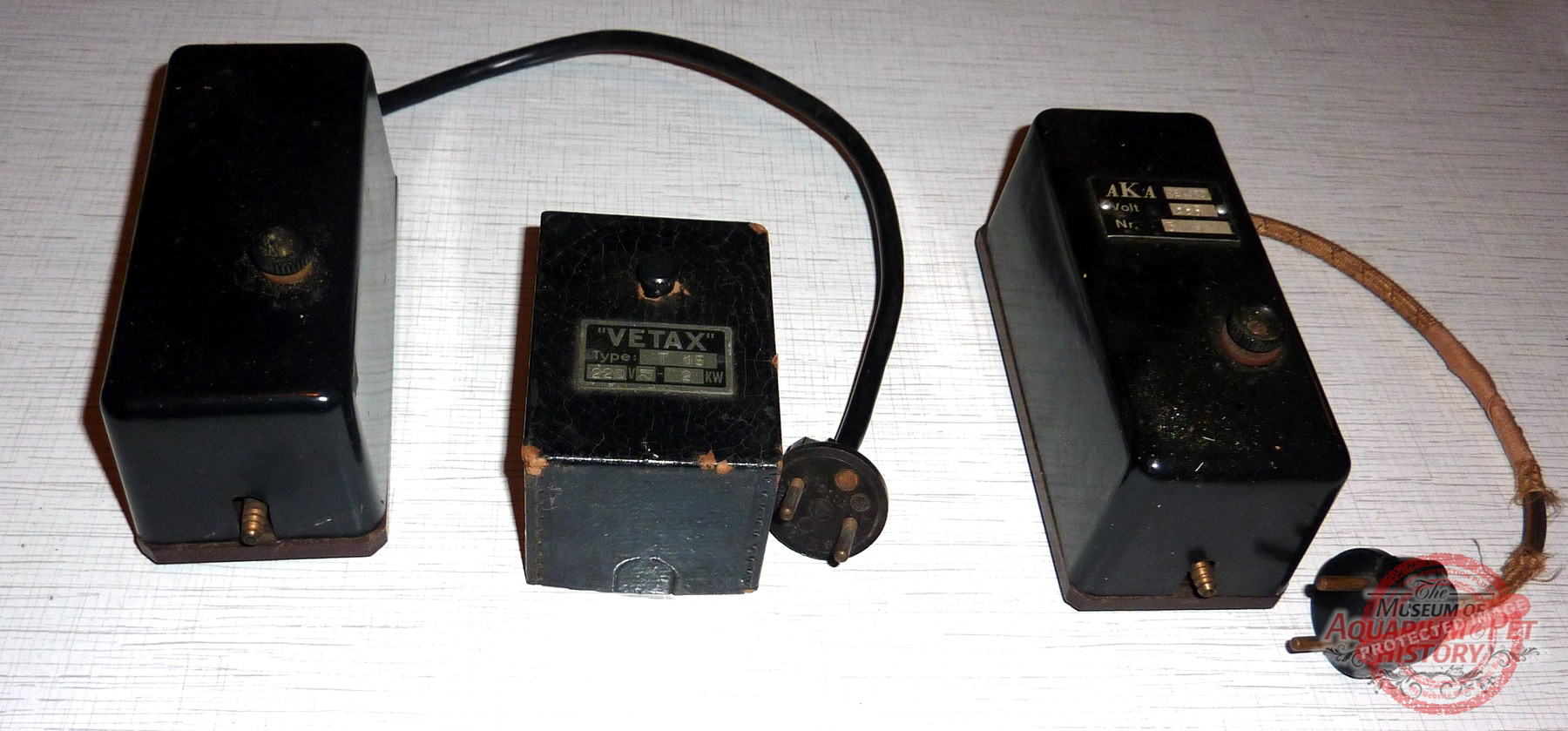
Membrane pumps from various manufacturers.
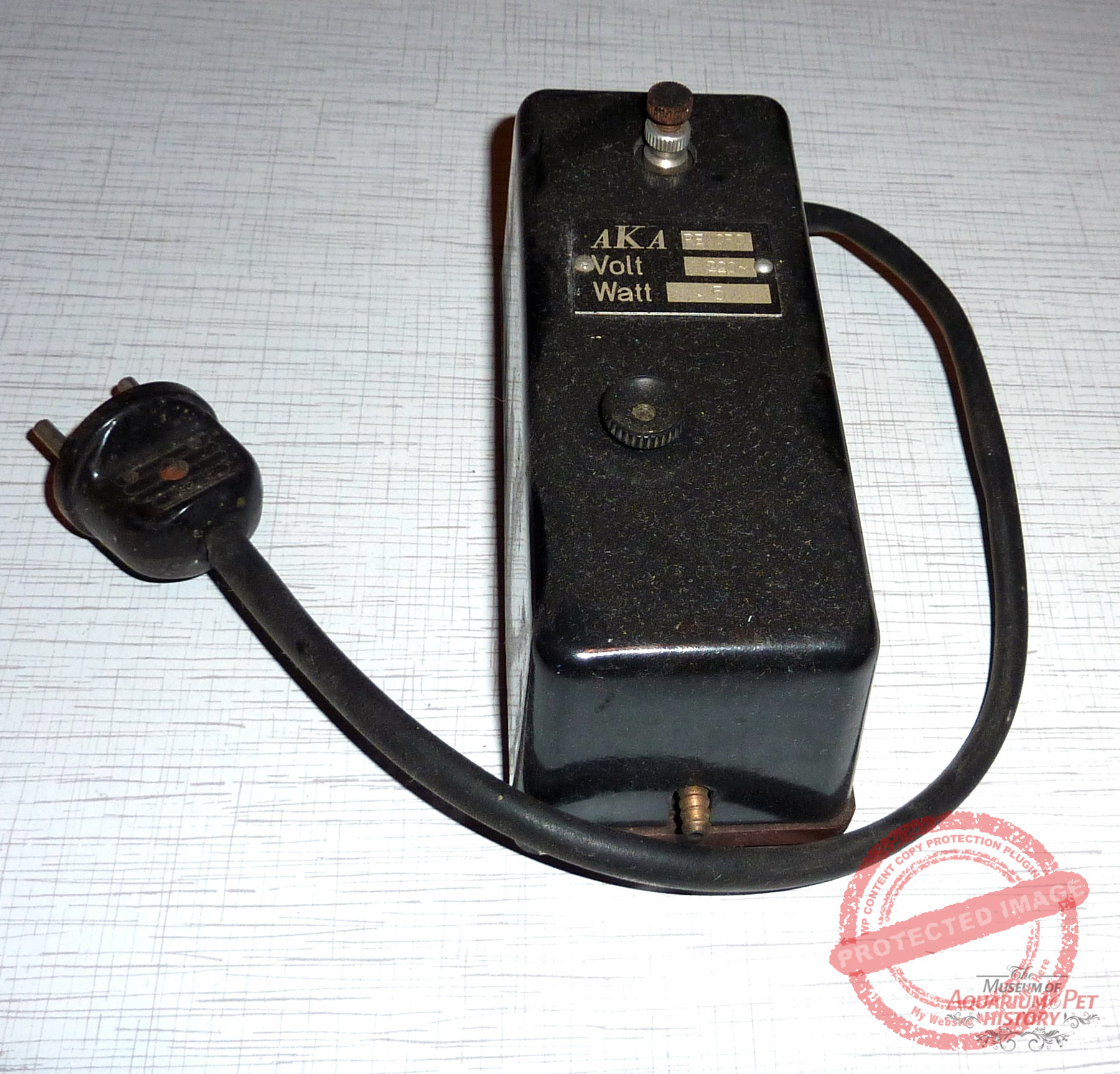
AKA membrane pump.
Finally, a few words about the aquariums themselves. Until the late 1970s, iron-framed tanks dominated in the GDR. They were extremely heavy, rusted quickly, and repeatedly leaked. That would not have been so bad, since skilled aquarists could have resealed them with new aquarium cement. But this cement was scarce. We had a term for such goods: “Bückware,” meaning “bend-down merchandise,” because the shop assistant would, after making sure the preferred customer was alone, bend down behind the counter to retrieve the hidden, rare, and highly desired goods. Aquarium cement was such an item. In its absence, everyone tried alternatives. I had a persistent leak at the front right corner of my largest framed tank. Because of the lack of proper cement, I used window putty, which was intended for sealing glass to wood, not iron frames, and only adhered slightly to the existing seam. I had to repair it repeatedly until a fist-sized lump of putty formed a wart-like deformity on the tank. Only gradually, from the mid-1970s onward, did silicone-bonded aquariums become available—at considerable cost.
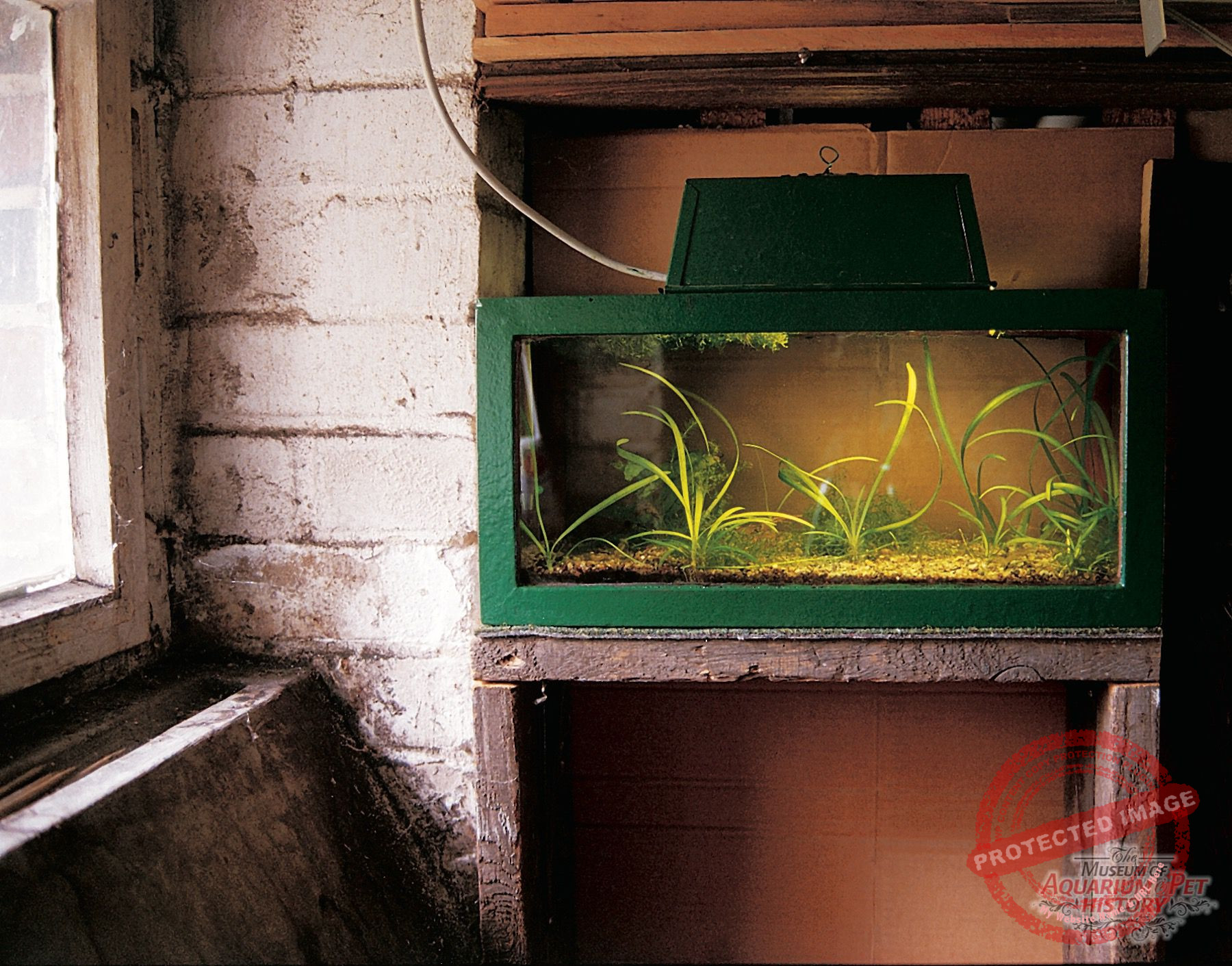
Typical framed aquarium with a simple lighting unit.
How did the Gotha aquarium club experience the end of the GDR? At first, the freedom to travel, the introduction of the Deutsche Mark (instead of the worthless GDR mark), and finally the possibility of contact with West German aquarium clubs were a long-awaited liberation from old restrictions, shortages, and the inbreeding-like reproduction of stock caused by isolation. But soon, the Gotha aquarists, like many other East German clubs, felt the arrogance of their western counterparts and especially of the VDA (Association of German Aquarium and Terrarium Societies), who did not take their new (old) members seriously. Membership had been suspended during the 40 years of the GDR. Yet it soon became clear that the East German hobbyists were far more well-read, technically demanding, successful in breeding, and superior in practical matters. This was a result of scarcity: one could only survive by being better, by outsmarting the restrictions and shortages. This did not please the aloof western club officials, who behaved dismissively and unfairly toward the East German aquarium and terrarium clubs. For the Gotha club, Jan Frank wrote a letter on June 15, 1994 to the director of the VDA, clearly stating the reasons for Gotha’s withdrawal.
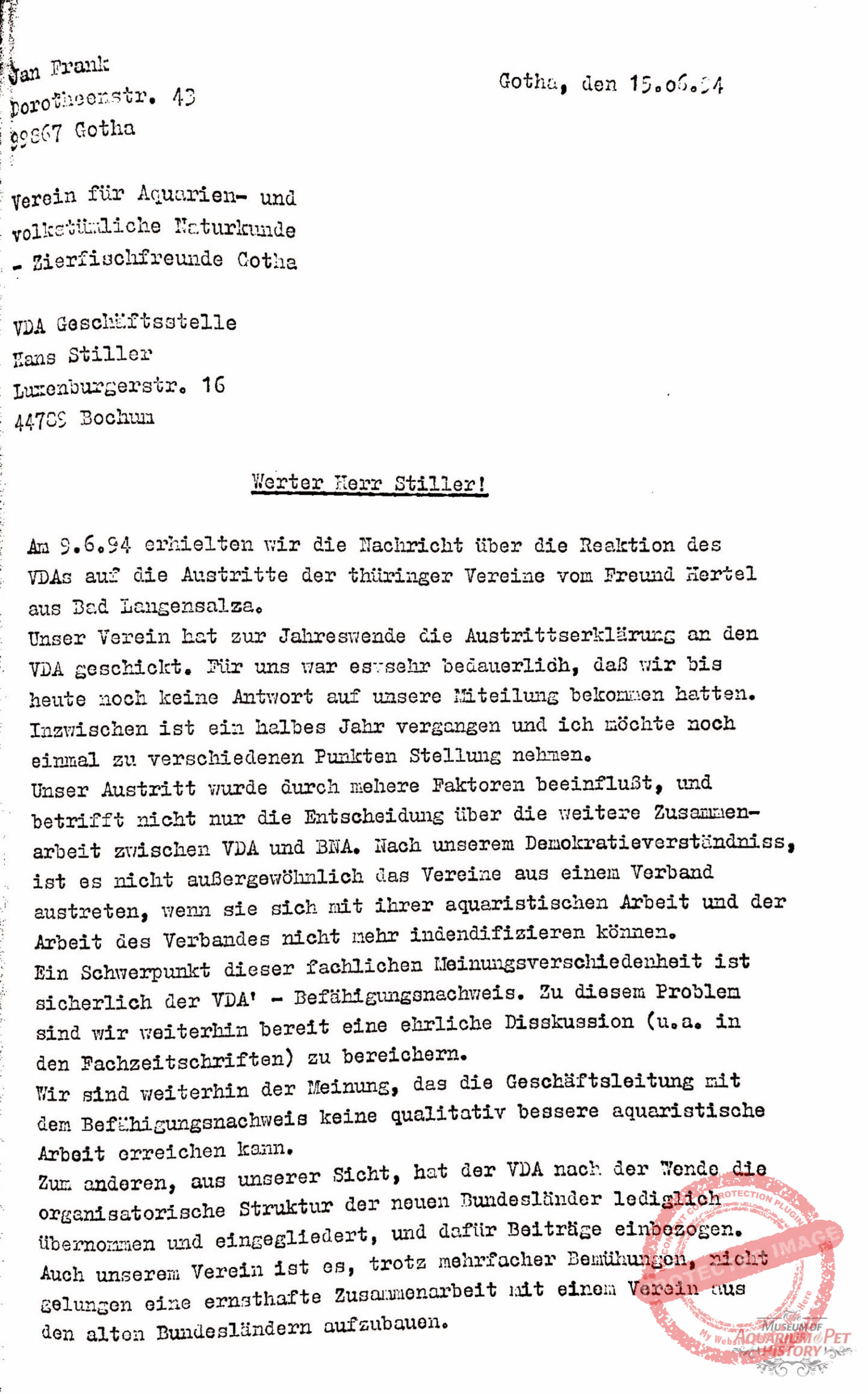
Letter announcing the Gotha aquarium club’s resignation from the VDA, first page.
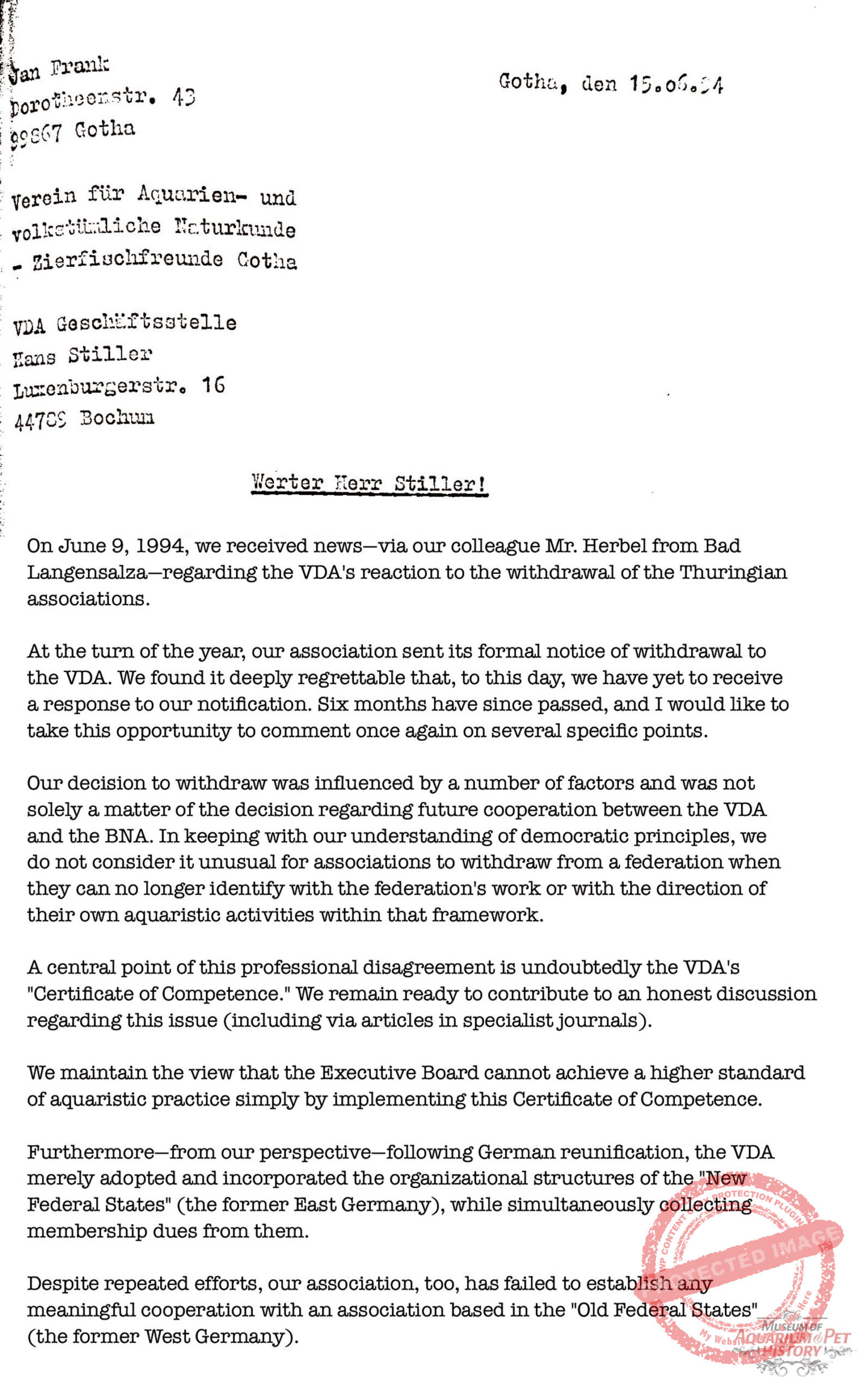
Letter announcing the Gotha aquarium club’s resignation from the VDA, first page, translated using notegpt.io.
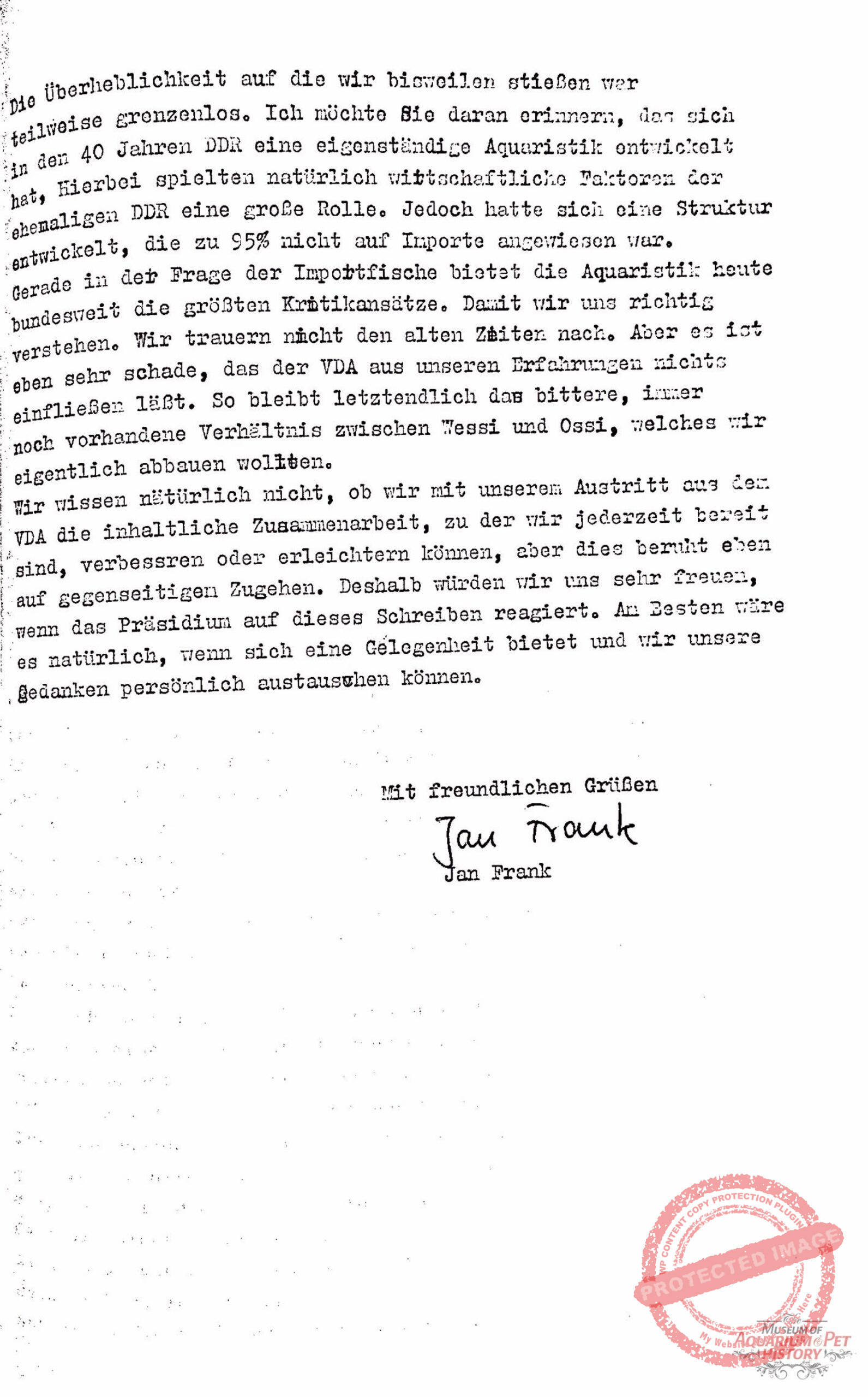
Letter announcing the Gotha aquarium club’s resignation from the VDA, second page.
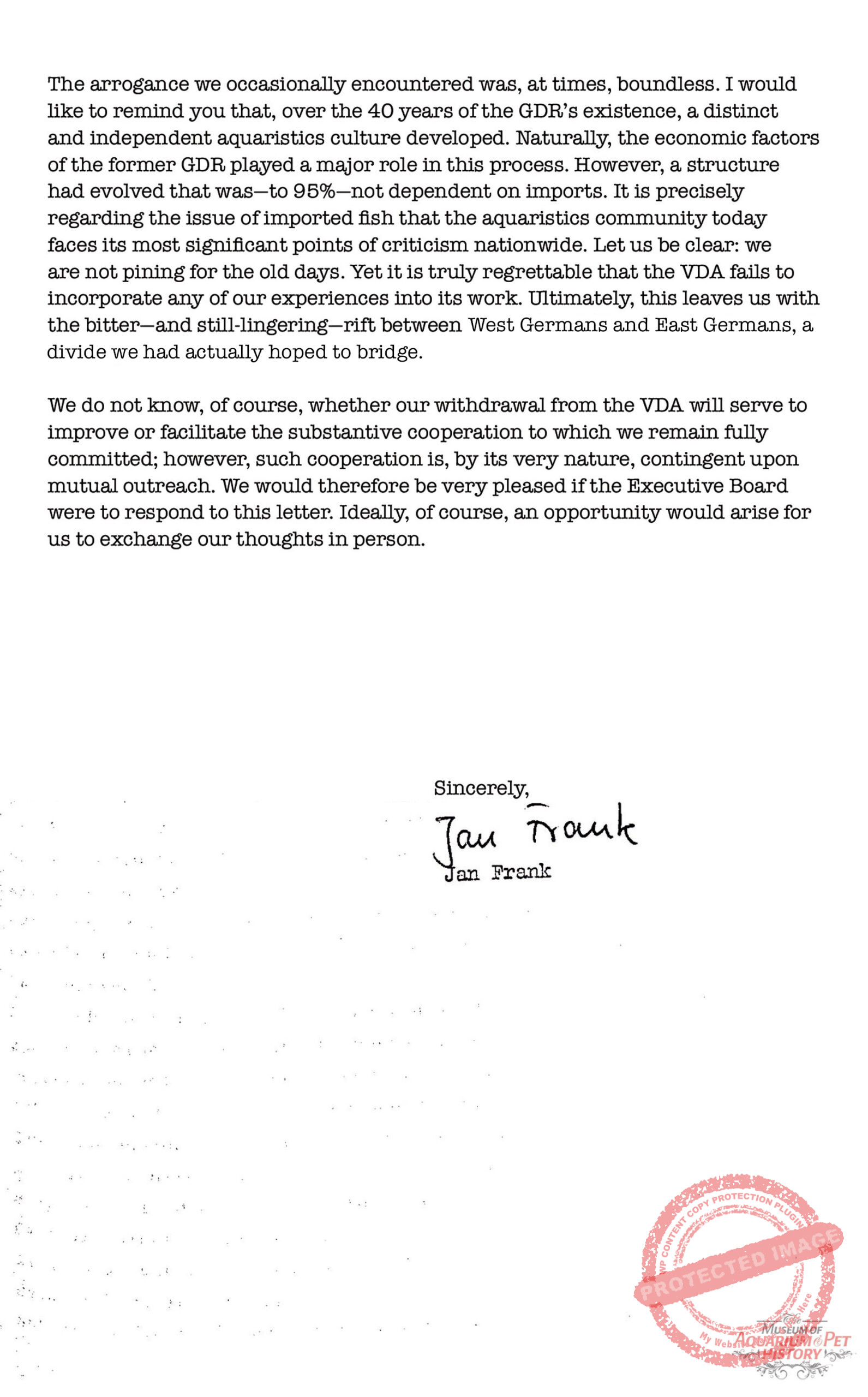
Letter announcing the Gotha aquarium club’s resignation from the VDA, second page, translated using notegpt.io.
In the 1990s, the oldest open-air aquarium once again fell into disrepair. Newspaper articles from that time report on this. Then aquarists came together who cleared it out and rebuilt it, this time together with Sven Hübner and his family, who leased the former club building—which had in the meantime also been used as a café—and converted it into the restaurant “Aquarium.” More recently, further modernization has been undertaken by him. In 2001, I published a photo report on the old Gotha aquarium in my “Aquaristik-Fachmagazin” together with my mother and her sister. Regional newspapers also repeatedly honored Gotha’s aquaristic tradition on various anniversaries.
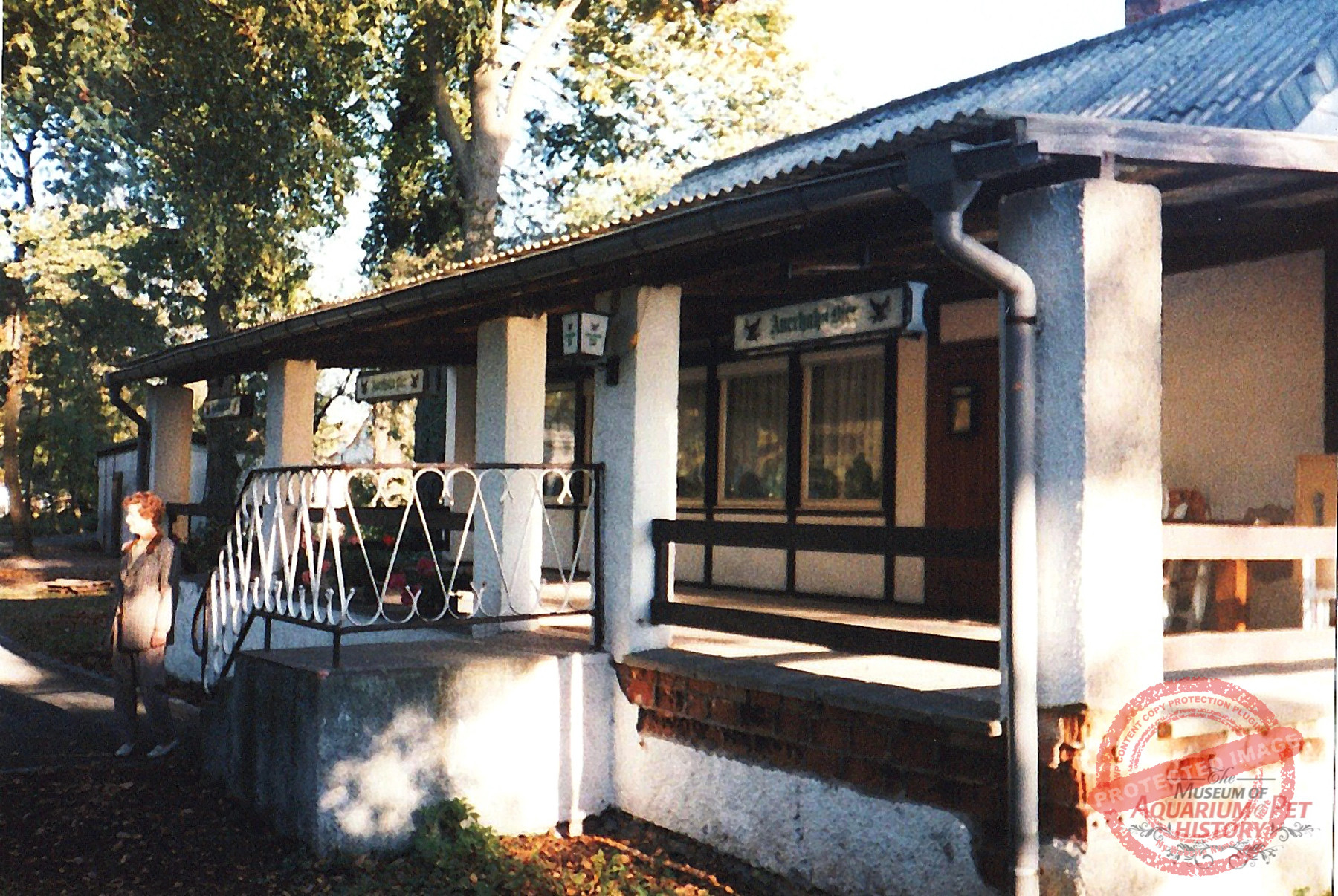
Restaurant “Aquarium” at the time of its founding.
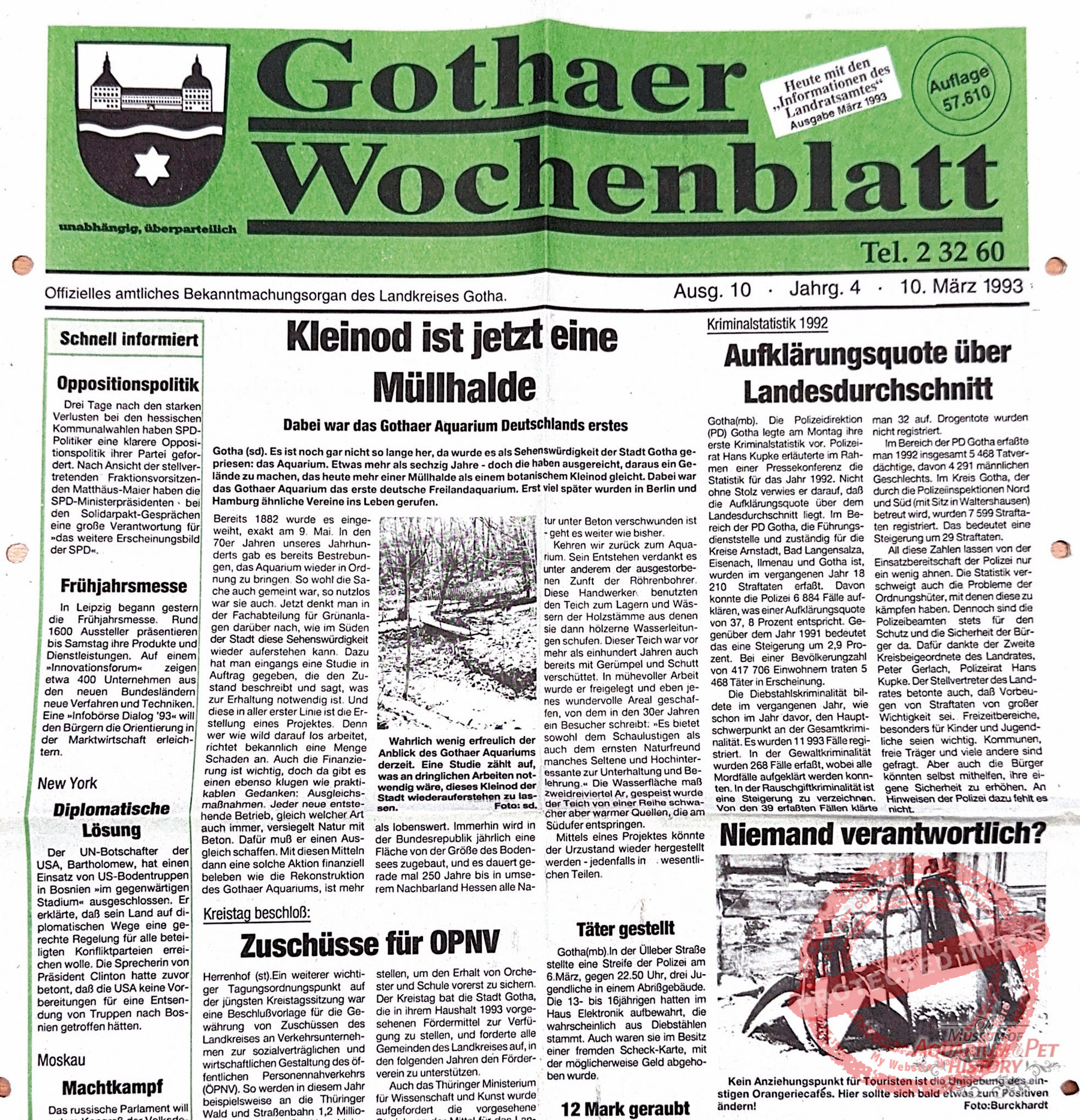
Article on the poor condition of the aquarium from the Gotha Weekly Newspaper, March 10, 1993.
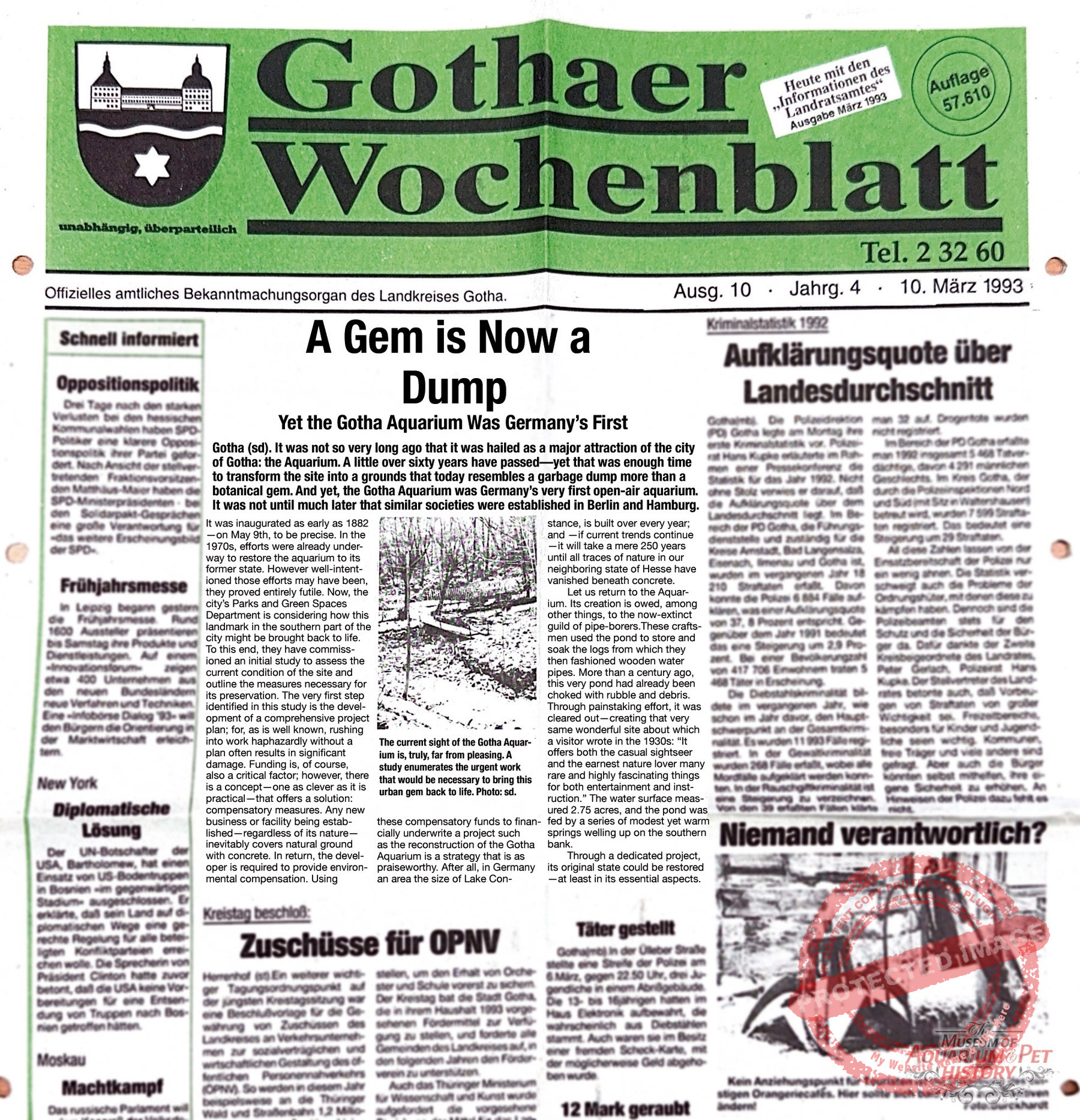
Article on the poor condition of the aquarium from the Gotha Weekly Newspaper, March 10, 1993, translated using notegpt.io.
The local wildlife park on the former Danio grounds has been converted into a small zoo, which barely still reveals that it once was a beautiful park with natural ponds. These have been filled in and replaced by installations that no longer resemble the naturalistic Danio-era design. Across Europe, zoos increasingly follow a standardized design language that unfortunately obscures individual character. However, precisely at the site of the old aquarium building, there is now a newly constructed facility—apparently built on its original foundations—with well-maintained aquariums and terrariums.
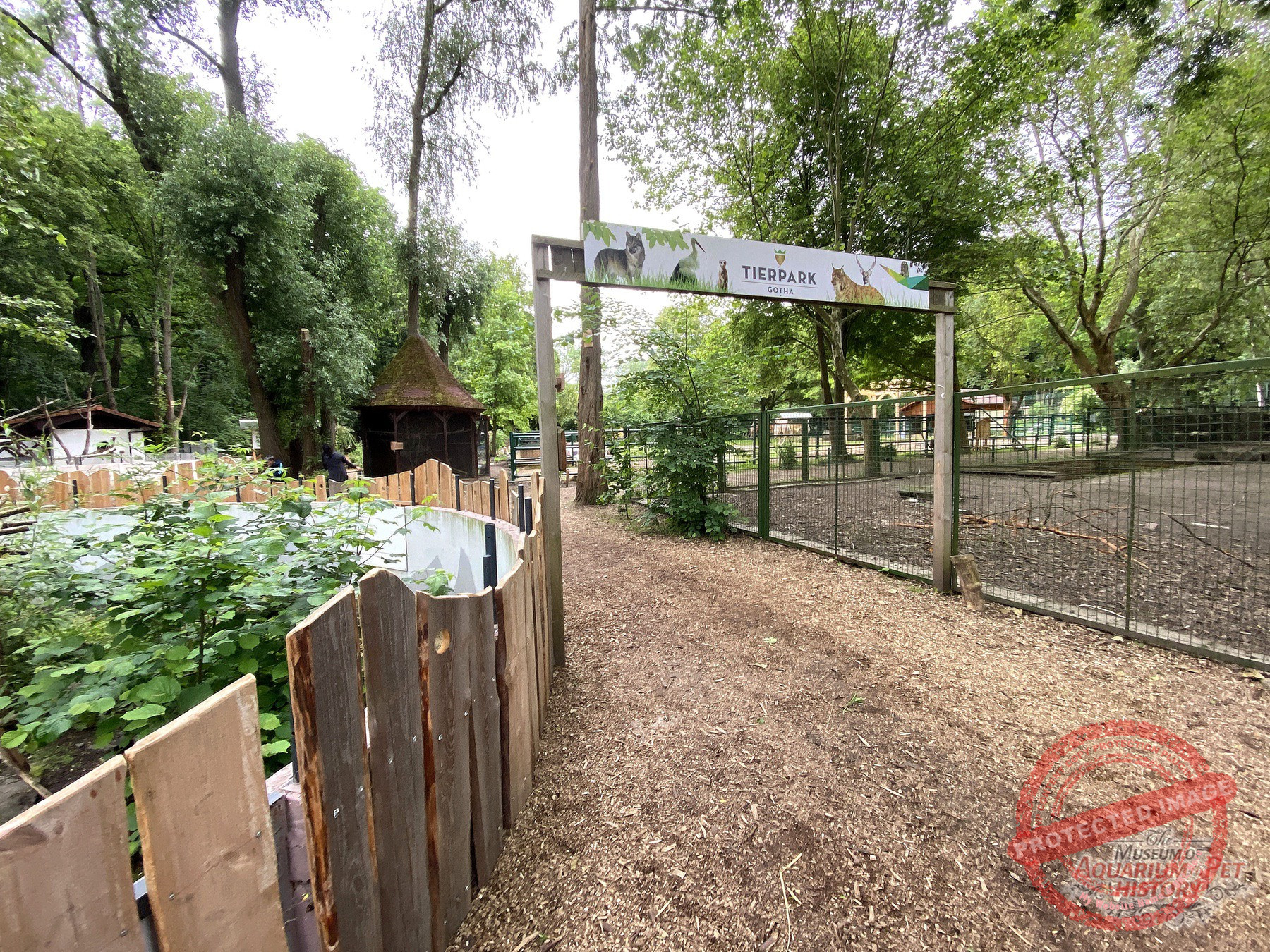
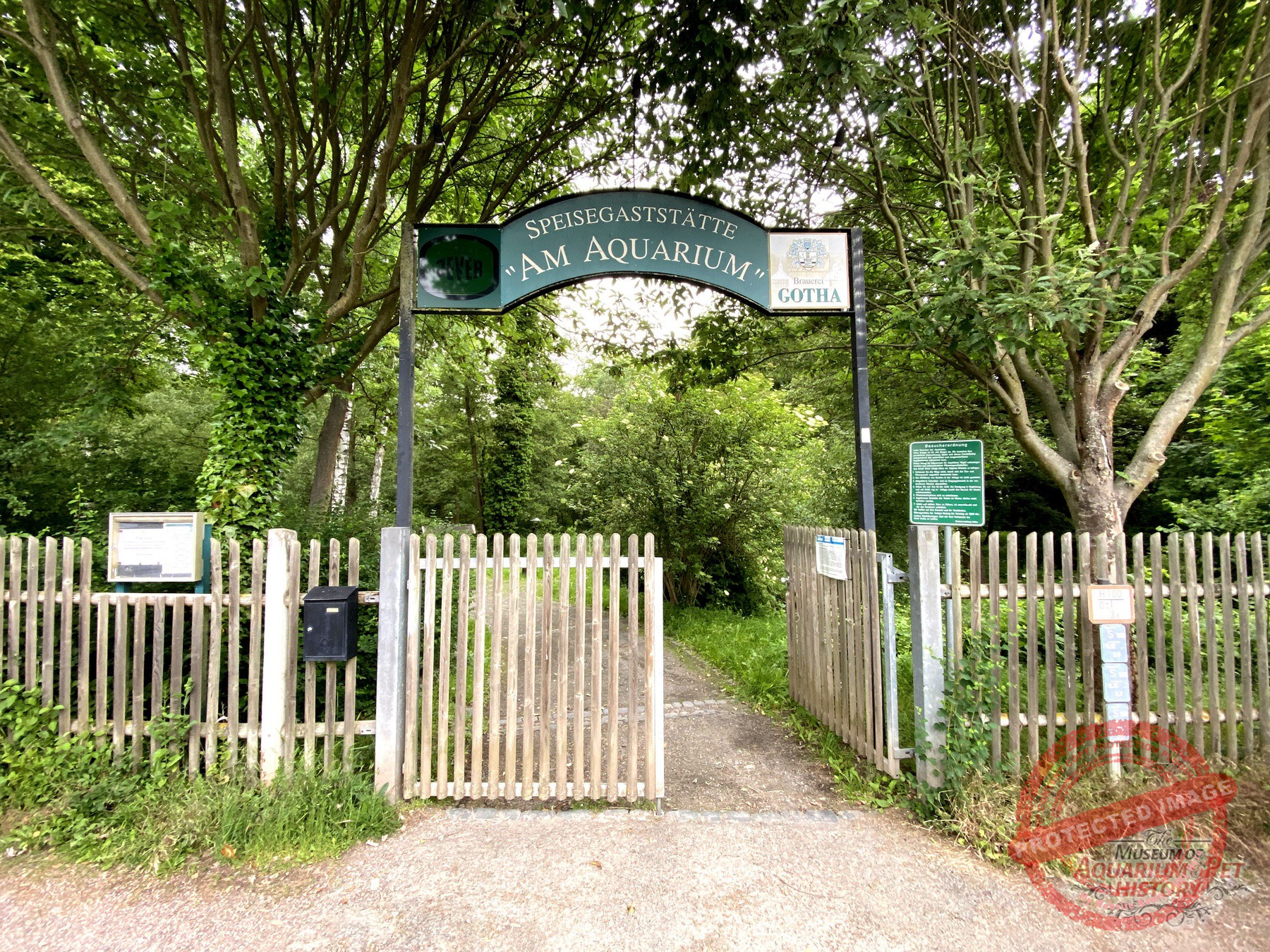
Entrance to Gotha’s zoo on the former Danio site today.
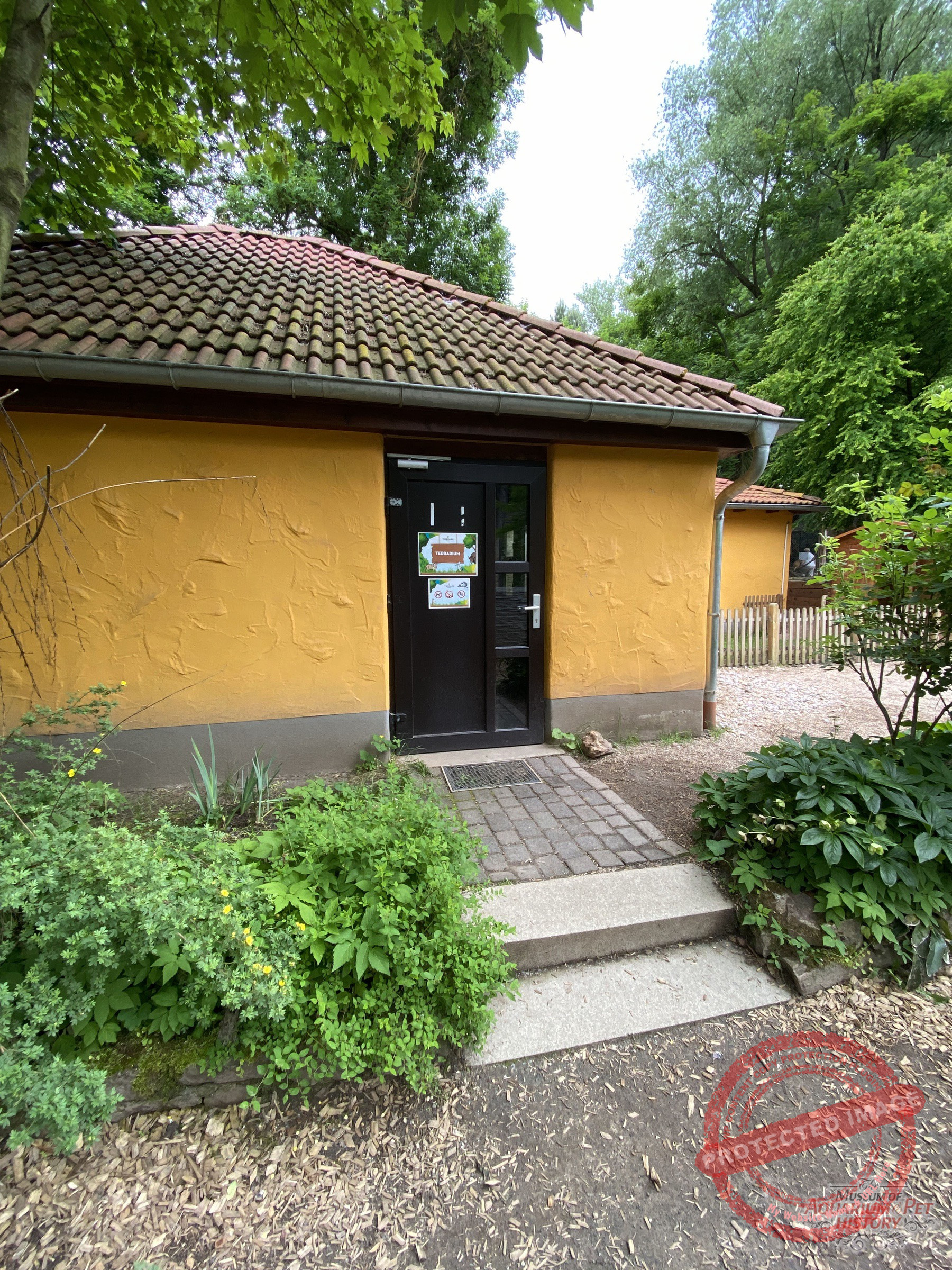
A new aquarium building has been constructed on the site of the former Danio aquarium house.
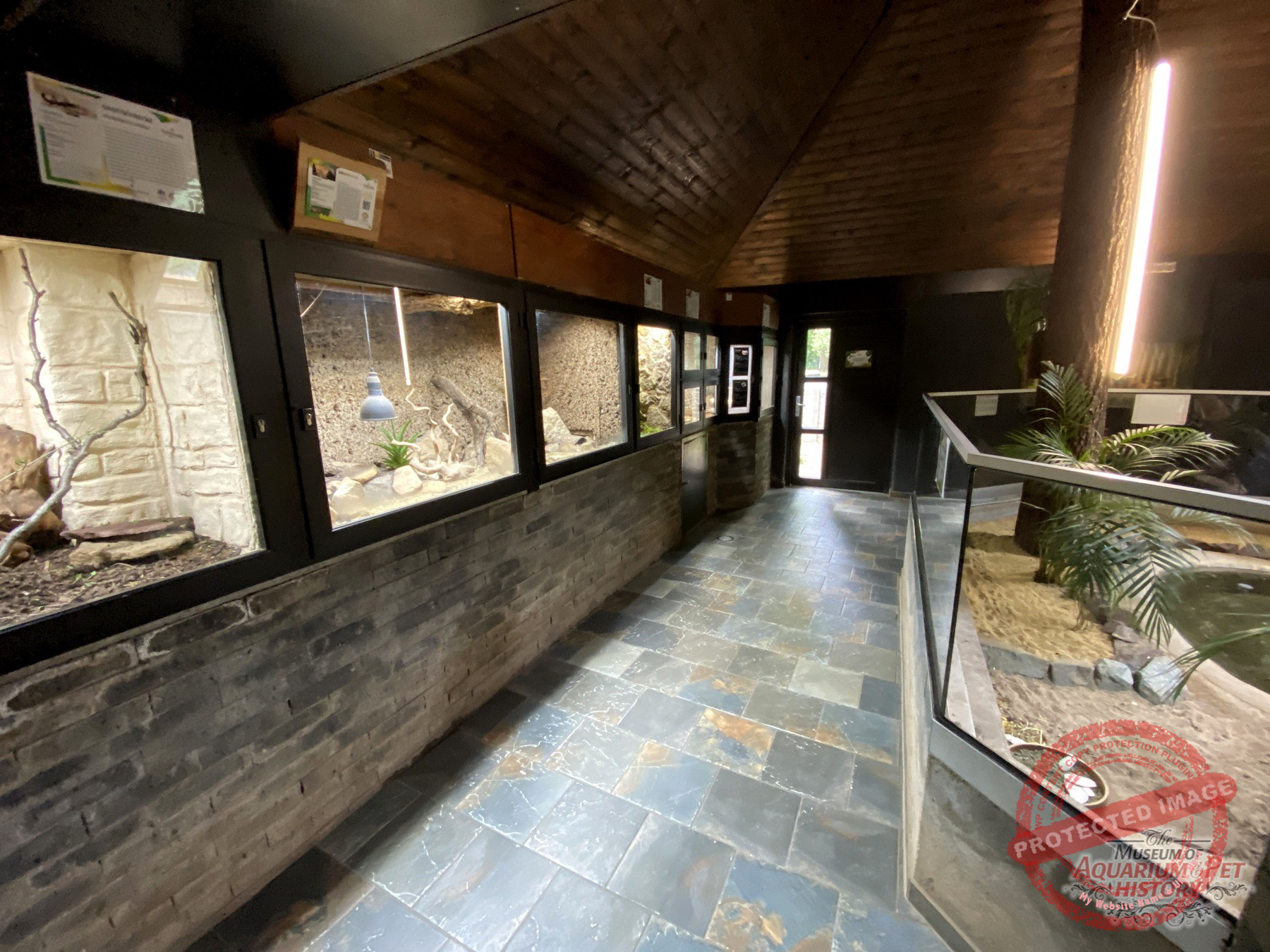
The aquariums and terrariums are attractively designed and modernly equipped.
Finally, in 2022, city officials together with local heritage enthusiasts and conservationists decided to convert the site of the aquarium into a protected biotope for wetland animals and plants. The aquarium club, which continues to meet in the restaurant “Aquarium,” welcomes this stewardship by the city. The members are now elderly and urgently need younger reinforcements. Uwe Heustock is the current chairman and guards the relics of the founding era like a treasure. Given the ups and downs in the now 144-year history of the Gotha club, one may expect that a renewal will soon come again—with new impulses, ideas, and goals, always grounded in the knowledge-based broad field of aquaristics and vivaristics.
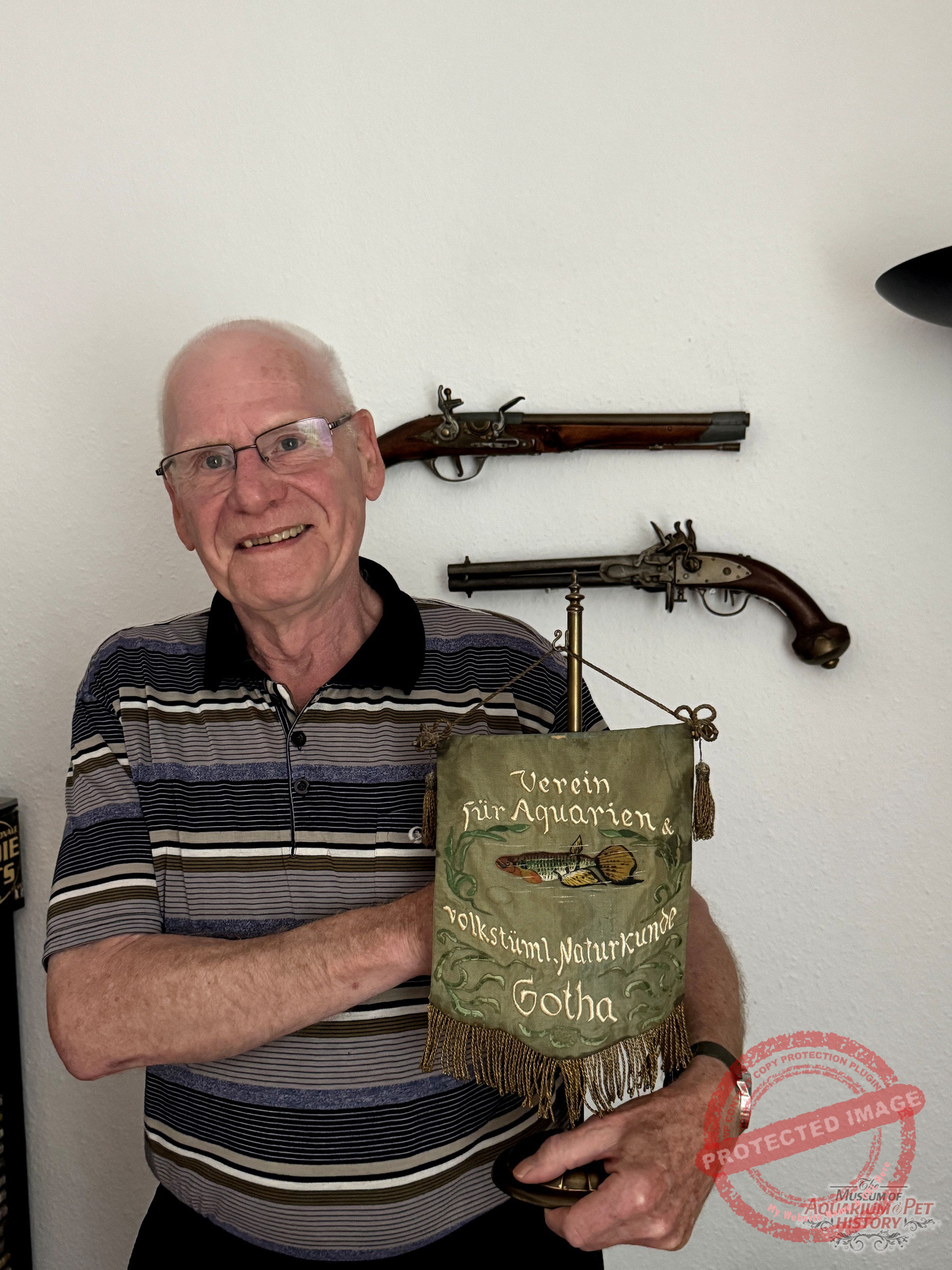
Uwe Heustock is the current chairman of the Gotha aquarium club and preserves the remaining historical artifacts, here shown with the VDA pennant.
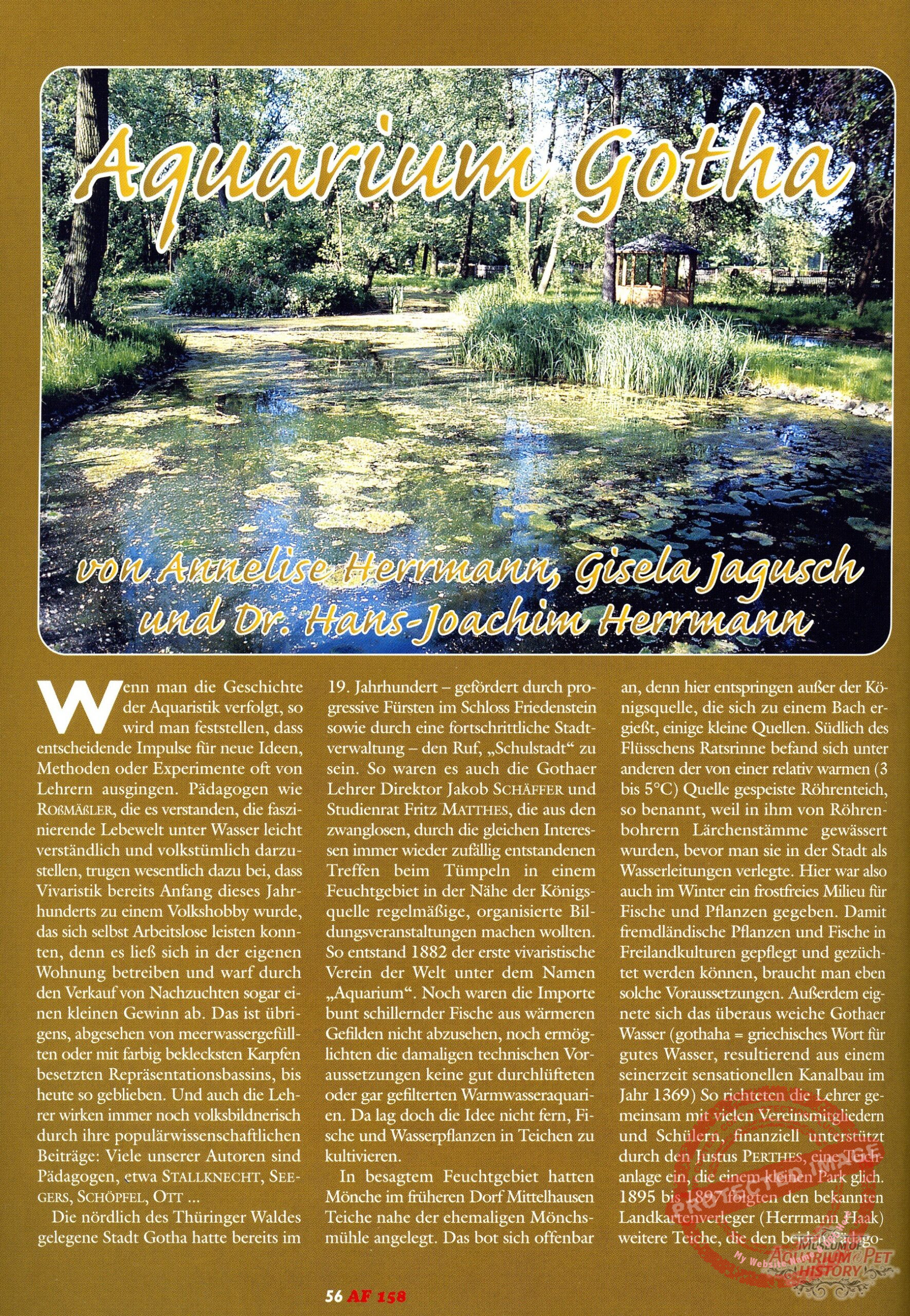
Article in the April/May issue of Aquaristik-Fachmagazin (2001), first page.
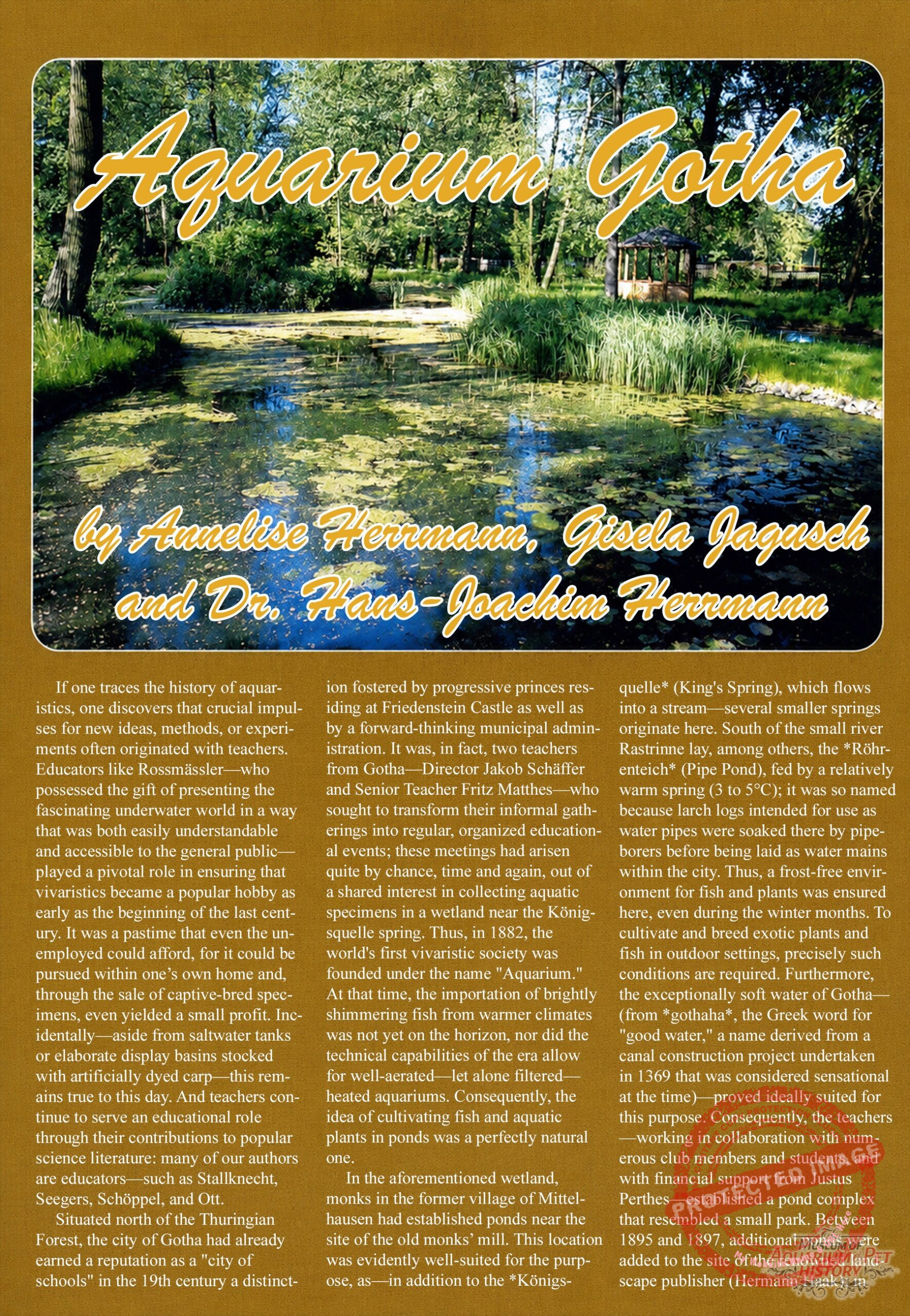
Article in the April/May issue of Aquaristik-Fachmagazin (2001), first page translated using notegpt.io.
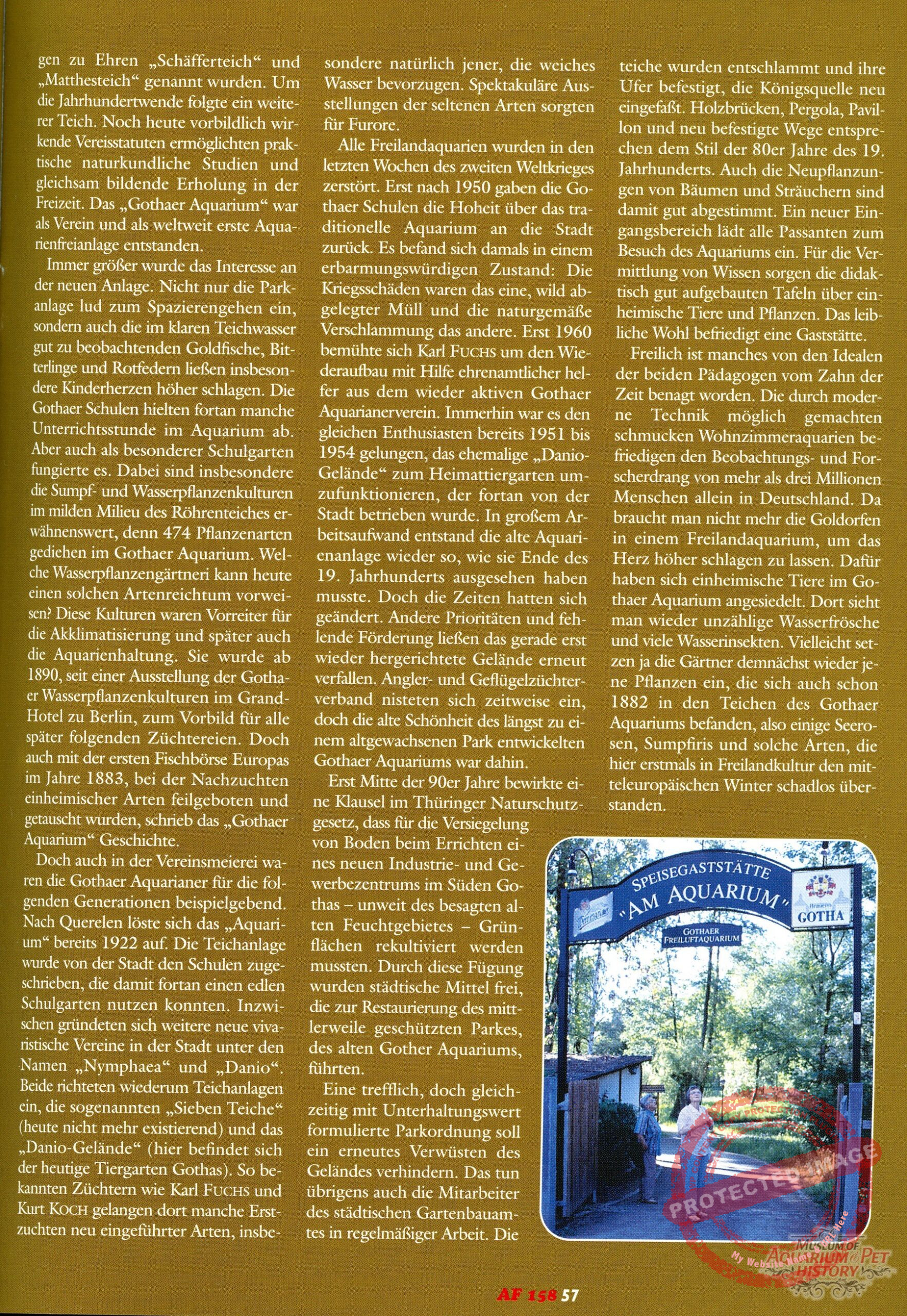
Article in the April/May issue of Aquaristik-Fachmagazin (2001), second page.
Article in the April/May issue of Aquaristik-Fachmagazin (2001), second page translated using notegpt.io.
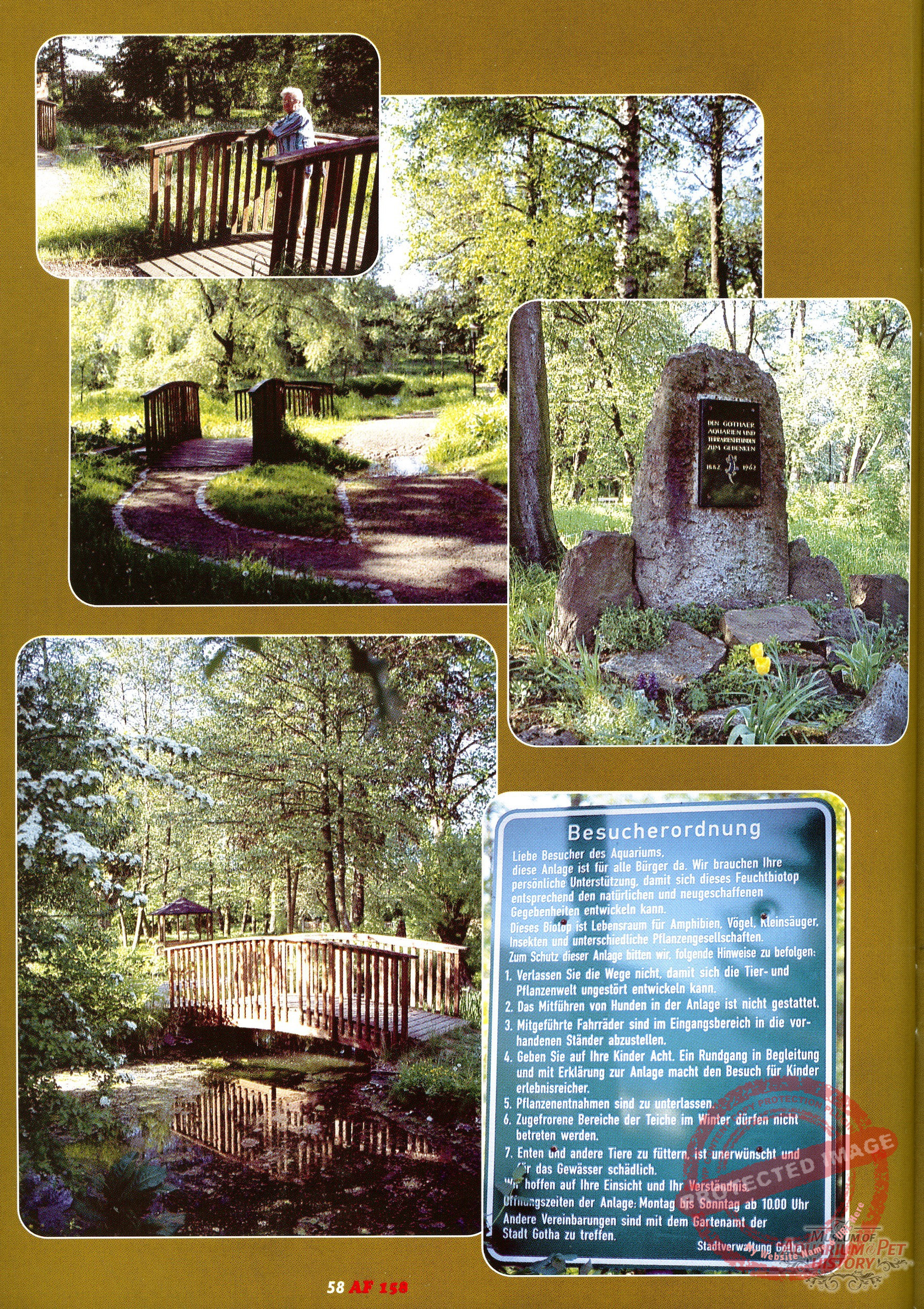
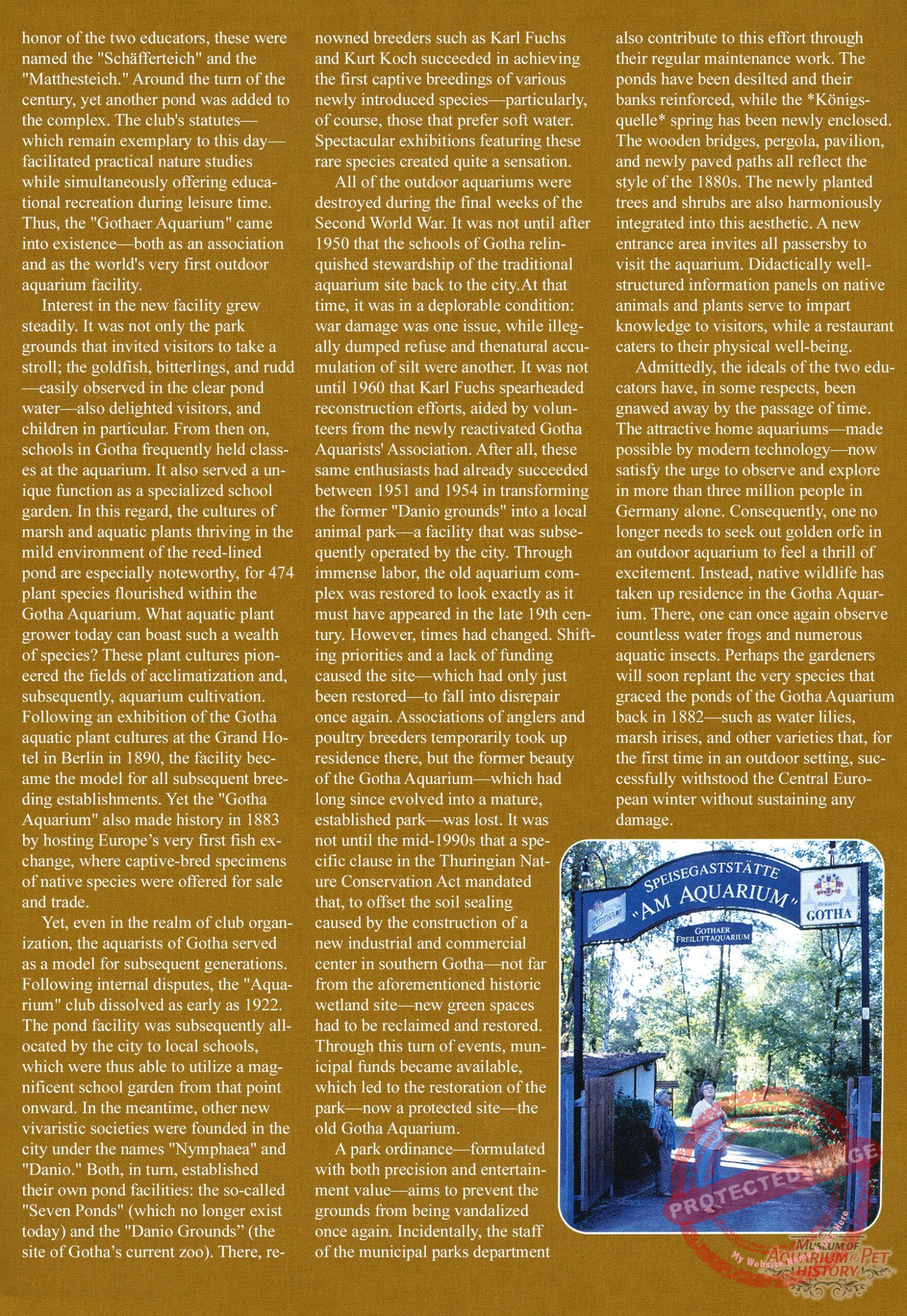
Article in the April/May issue of Aquaristik-Fachmagazin (2001), third page. The photo translates: Visitor Regulations Dear Visitors to the Aquarium, This facility is here for the enjoyment of all citizens. We require your personal support to ensure that this wetland habitat can develop in harmony with both its natural and newly created conditions.
This habitat serves as a home for amphibians, birds, small mammals, insects, and various plant communities. To help protect this facility, we kindly ask that you observe the following guidelines:
1. Please remain on the designated paths so that the local flora and fauna may develop undisturbed.
2. Bringing dogs into the facility is not permitted.
3. Bicycles must be parked in the racks provided in the entrance area.
4. Please keep a watchful eye on your children. A guided tour—accompanied by explanations of the facility—will make the visit a more enriching experience for children.
5. The removal of plants is strictly prohibited.
6. During the winter months, walking on frozen areas of the ponds is strictly forbidden.
7. Feeding ducks or other animals is discouraged and is harmful to the water ecosystem. We appreciate your cooperation and understanding.
Facility Opening Hours: Monday through Sunday, starting at 10:00 AM. Any alternative arrangements must be made through the City of Gotha Parks Department. City Administration of Gotha
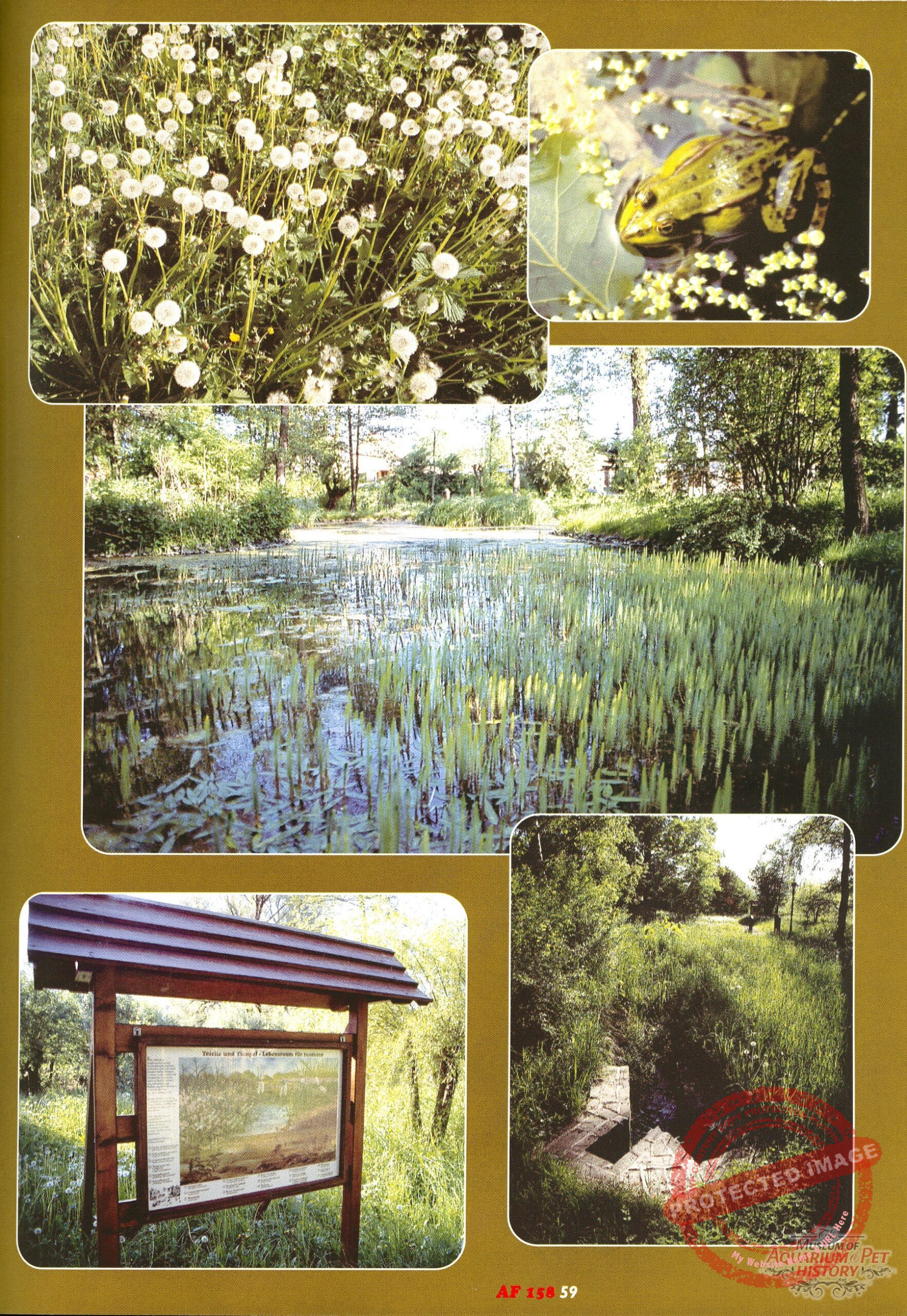
Article in the April/May issue of Aquaristik-Fachmagazin (2001), fourth page.
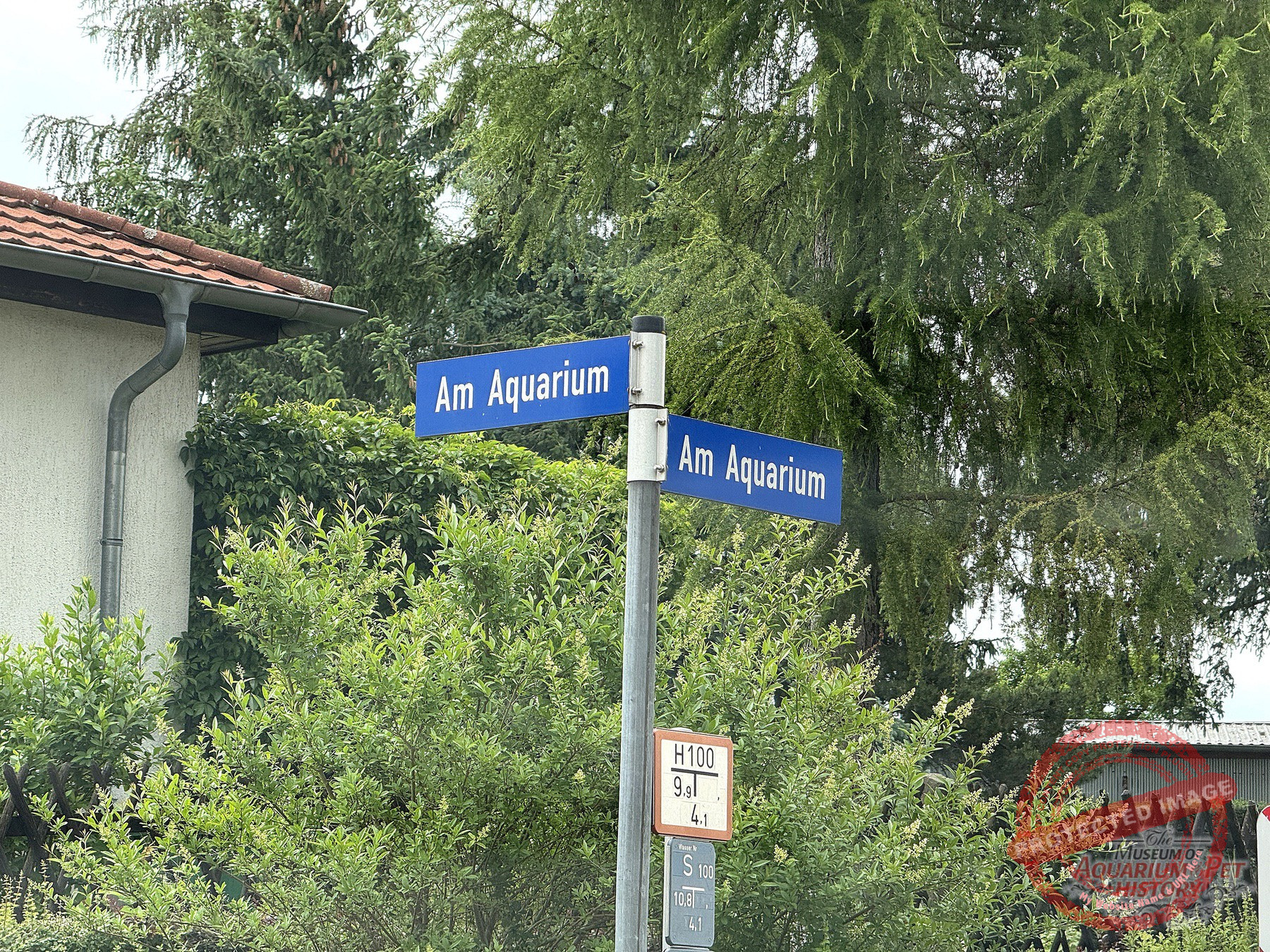
The street on which the aquarium is located is named “Am Aquarium.”

From it branches off the street “An den sieben Teichen,” recalling the former outdoor facility.
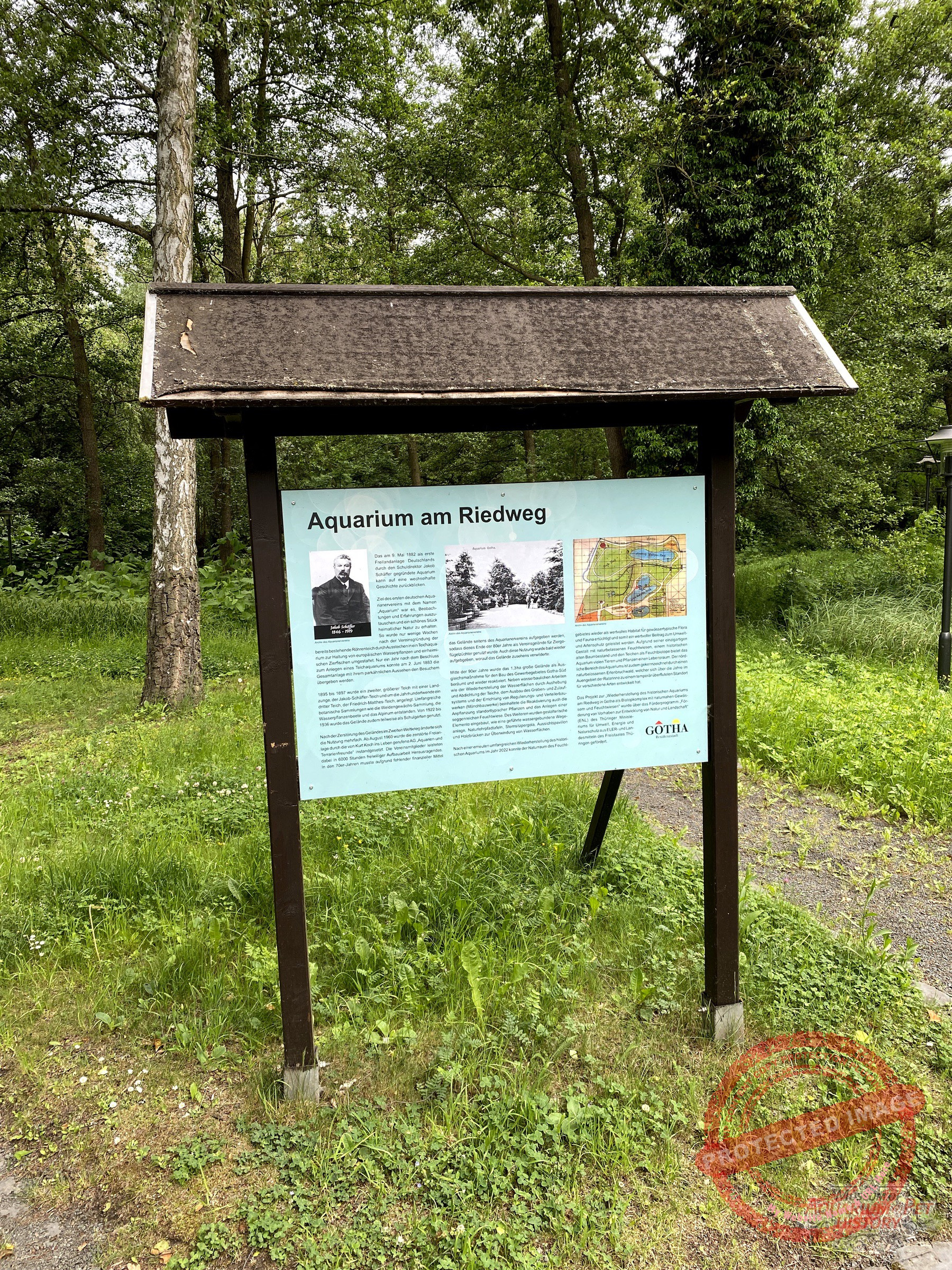
Plaque at the entrance of the aquarium outlining its history.

Memorial stone in the aquarium as it appears today.
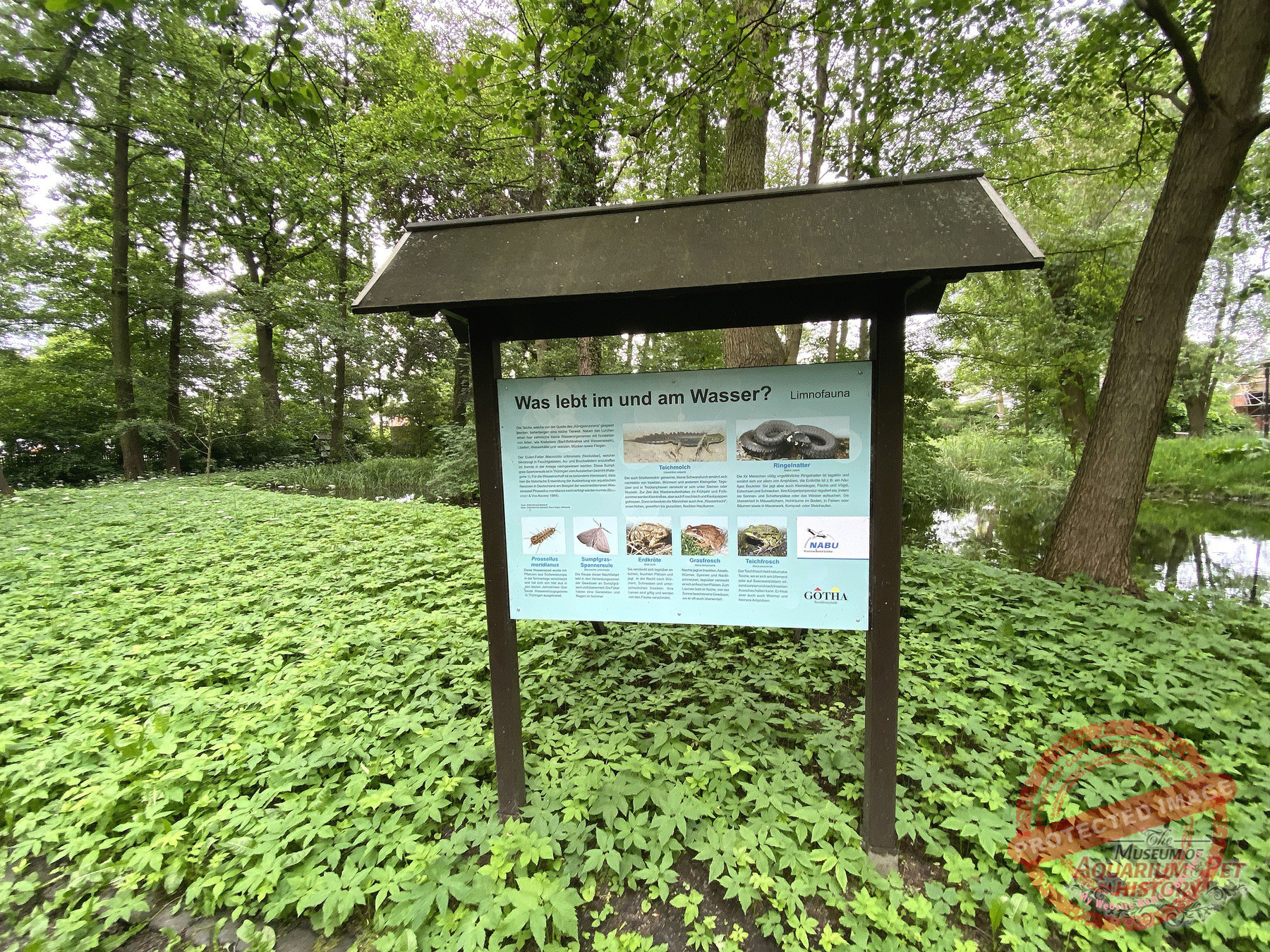
Information boards about the wetland inhabitants are placed throughout the grounds.