Survive, Rescue, Preserve – Keeping Aquariums and Terrariums in the Twelve Years of Fascism (The Aquarium Hobby during Hitler’s Reign 1933-1945 in Gotha)
Although I am about to describe the darkest years of German history — and with them the darkest years for the aquarists and terrarists of Germany, and especially of Gotha — I would like to begin with something affirmative, something that connects directly to the previous part of this series. In the first half of the 1930s, the outdoor vivarium truly gathered momentum. Across many German cities, associations established and maintained open-air facilities1, as well as small greenhouse complexes. Most of these installations were open to the public. They brought joy not only to those who operated them, but also satisfied the thirst for knowledge of many interested visitors — particularly young people.
Author’s Note1: Open-air facilities were hobbyist-operated outdoor enclosures for their animals, which were nevertheless open to the public.
Thus Karl Baake of Magdeburg wrote in 1933 in the Wochenschrift für Aquarien- und Terrarienkunde: “In the outdoor movement of our associations for aquarium and terrarium science, a transformation has recently taken place. Whereas only a few years ago Freianlagen2 were generally understood merely as feeding ponds that had been created or leased in order to provide members — especially in large cities — with reliable and convenient access to the necessary food for their fish, one now increasingly proceeds to transform these feeding ponds into true Freianlagen. The grounds are expanded through the lease or purchase of adjoining property, or entirely new land at the edge of the city is acquired. The whole is then landscaped horticulturally, and new ponds for display purposes are created. Through the work of the associations, there emerges something akin to a small botanical and zoological garden, in which often rare native plants find a place of cultivation and numerous small creatures of the immediate homeland are preserved. The entire installation is not intended solely for members, but is made accessible to the public. The value of such a facility — particularly for schools, but also for adults who possess a sense and understanding for the living beings of nature — can scarcely be overestimated. Here, the associations render a substantial contribution to popular scientific education and make broad circles of the population more receptive to the practical nature conservation than all legislative provisions of the state…” It is evident that Gotha, with its three outdoor open-air facilities, had assumed an important exemplary role.
Author’s Note2: Freianlagen were open-air facilities but small and mostly filled with cold blooded animals.
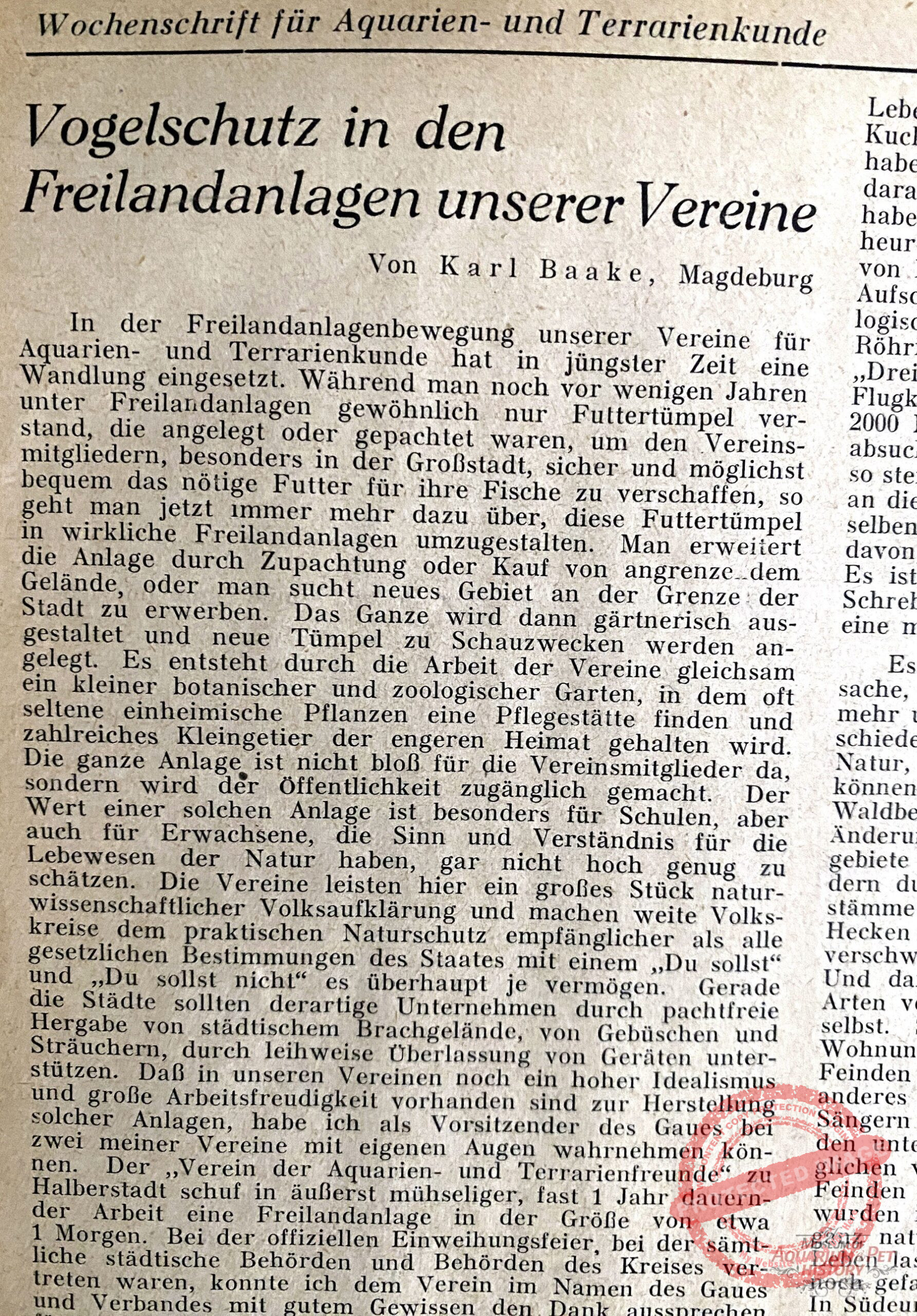
Karl Baake’s 1933 article in the Wochenschrift on German open-air facilities and their birdlife.
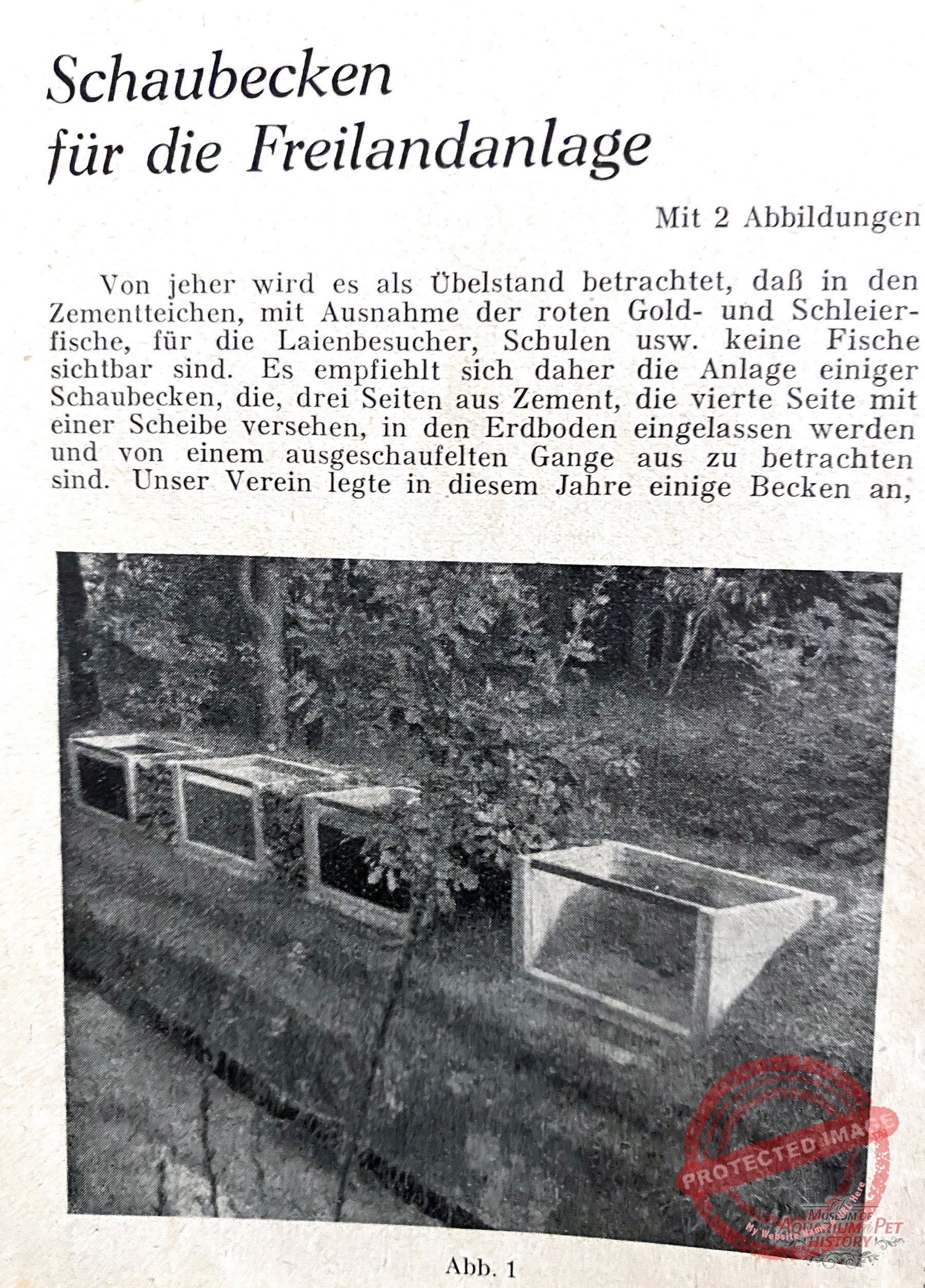
A 1933 contribution in the Wochenschrift titled “Schaubecken fur die Freilandanlage” (Display tank for the outdoor facility) describing the outdoor installation in Forst (Lausitz).
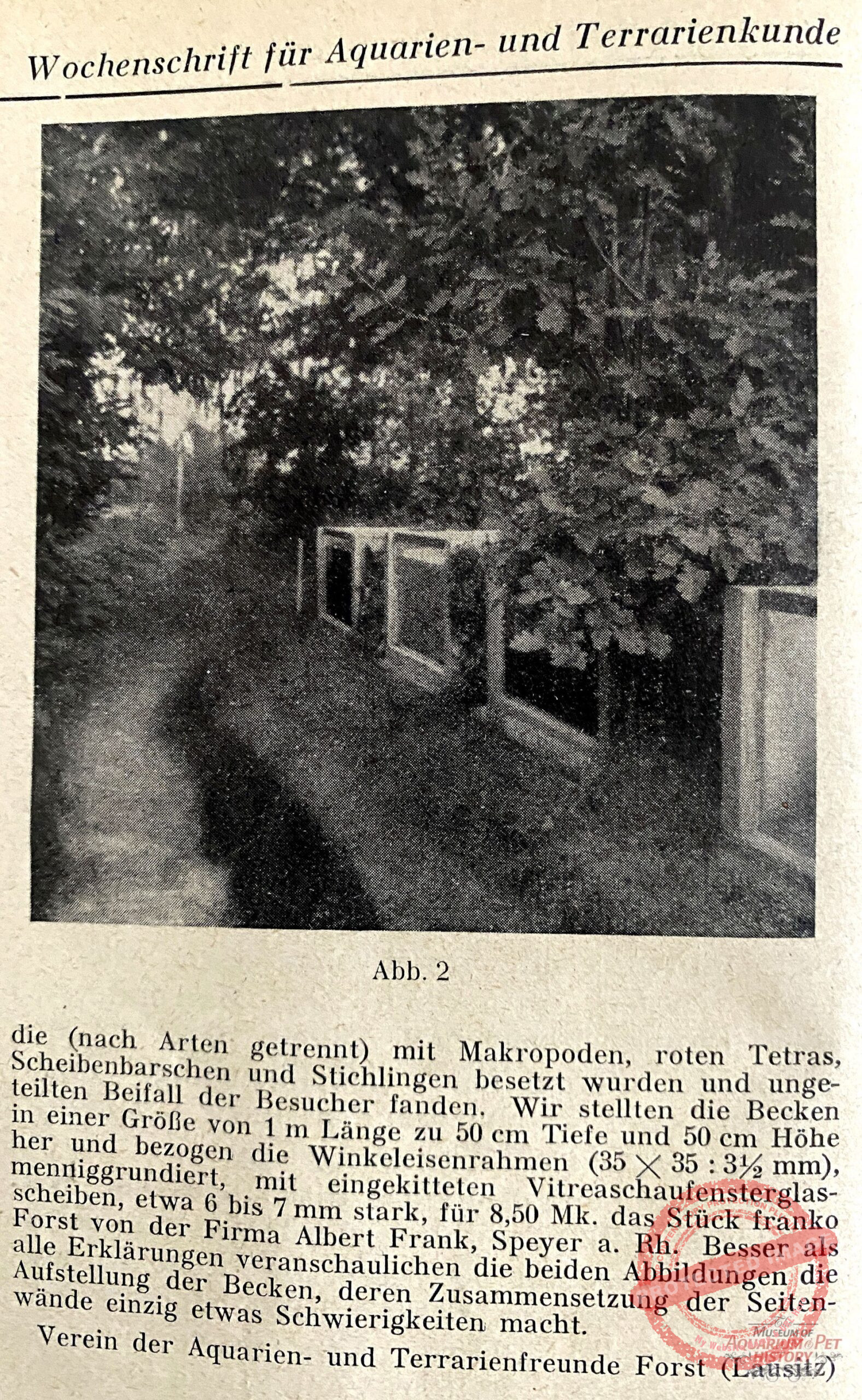
This article documents the concrete aquariums with steel-frame viewing panes typical of that era. The text describes tanks stocked with macropods, red tetras, discus fish, and sticklebacks. The tanks were 1 m (39 inches) length to 50 cm (19.5 inch) depth and 50 cm (19.5 inch) height and obtained angle iron frames (35 x 35: 312 mm), primed with red lead, with puttied display window panes made of plate glass, about 6 to 7 mm thick.
In the issues of the Wochenschrift from 1930 to 1933, one finds numerous contributions from various cities and regions of Germany describing newly established or upgraded Freianlagen. The Verein der Aquarien- und Terrarienfreunde in Forst (Lausitz), for example, presented concrete display aquariums newly integrated into its Freianlage for paradise fishes, red tetras, Blackbanded Sunfishes, and sticklebacks. The viewing panes were set into angle-iron frames — a method borrowed from the classic steel-frame aquarium construction of that era. Goldfish and their veil varieties, however, were presented — here as in most Freianlagen — in concrete ponds, in keeping with their original selective breeding, which visually favored the top view. The Gotha aquarium hobbyists, with their Danio grounds, had created what most resembled a small zoological garden. In 1933 the facility was adapted to the Einheitsziel prescribed by the political leadership of the NSDAP3, bearing at its entrance the sign: “Durch Einigkeit zum Ziel” – Through Unity to the Goal. What that goal might be, each person could decide for themselves. This sign can be understood as a metaphor for nearly all the activities of aquarists and terrarists that were kept as neutral and apolitical as possible — activities that outwardly conformed to Nazi terminology in order not to be extinguished, while inwardly continuing to indulge their natural-scientific interests.
Author’s Note3: NSDAP stands for Nationalsozialistische Partei Deutschlands (National Socialist German Workers’ Party), which was referred to as the Nazi Party for short.
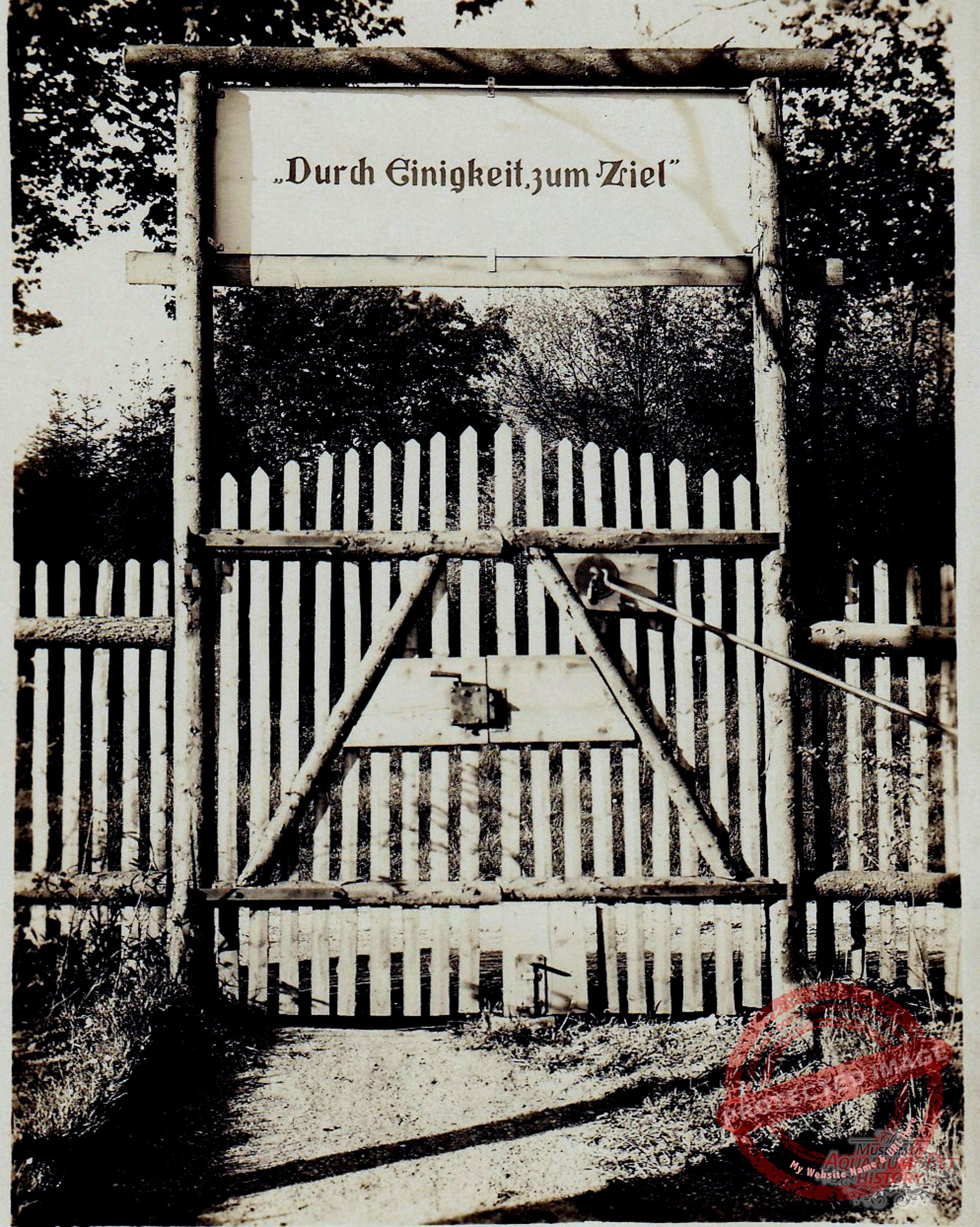
At the very entrance to the Danio open-air facility in Gotha stood the slogan that rendered Gleichschaltung4 visible to all who passed through its gate: “Durch Einigkeit zum Ziel” — Through Unity to the Goal.
Author’s Note4: Gleichschaltung means “bringing into line” or “synchronization” and was a commonly used to describe the Nazification of Germany.
In order to better understand the way the fascist leadership dealt with biological subjects, I would like to widen the lens and consider their broader view of people who concerned themselves with animals and plants. While scientists such as the behavioral biologist and later Nobel Prize laureate Konrad Lorenz, or the then leading fisheries biologist Wilhelm Schäperclaus, were promoted — to the extent that hobbyists were called upon in association journals to provide their captive-bred fish free of charge for research and thereby serve the scientific leadership of the Vaterland5— others were not merely suppressed, but annihilated. Entire branches of animal physiology, along with many medical and pharmacological experiments, were criminalized by the Tierschutzgesetz6 issued on November 24, 1933 — remarkably early after the seizure of power by the NSDAP. Following its official enactment on February 2, 1934, and later intensified by additional ministerial decrees, this led to the persecution of scientists and laboratory assistants accused of animal cruelty and sent to Konzentrationslager7.
Author’s Note5: Vaterland means Fatherland
Author’s Note6: Tierschutzgesetz were animal welfare laws
Author’s Note7: Konzentrationslager were concentration camps
What lay behind these fascist views? It was the racial theory of the Nazis, which not only elevated the so-called Aryan race above all other human beings in the world, but also ranked most animals above the “inferior human races and groups” — Jews, Gypsies, Negroes, homosexuals, and Communists, in the terminology of the Third Reich. For the Nazis, it was essential to elevate animals legally above those people. What unspeakable consequences and horrific practices this produced I will address in a separate article comparing the Nazi treatment of humans and animals. From my personal perspective, one of the most troubling consequences of such entirely unscientific and inhumane doctrines — consequences that extend into our own present — are movements of vegetarians and vegans (Hitler, Himmler, Goebbels, and many other Nazi leaders were vegetarians; they could not bear to see or eat animals, though they could do so with human beings, replacing animals in physiological and pharmacological experiments with so-called inferior humans), as well as the equally misanthropic movement of animal rights activists, including criminally acting organizations such as PETA.
I also know — from my own lifetime in the DDR — the attempts to channel and control the vivaristic hobby. Political opposition was suspected everywhere. It had already been so in the Nazi era, only differently. The NSDAP had no use for religions, nor for liberal models of life such as those that, especially in the 1968 movement of the previous century, advanced into the center of society with alternative music, unconventional relationships, and a peaceful libertarian mindset. The conservative family image was the only accepted model of living. Housewives — naturally not employed, or at best only briefly in the armaments industry at the outbreak of war — were to care for the offspring whom the Führer intended to deploy as cannon fodder in the future. What, then, could have been more obvious than to integrate the aquaristic and terraristic hobby into this pseudo-idyll of German family life?
In January 1934, the Thuringian edition of the magazine Mitteldeutsche Hausfrau published an article entitled: “Natur im Heim. Ein Kapitel über Aquarien und wie man sie anlegt” (Nature in the home. A chapter about aquariums and how to set them up.) Was this already a “wink with the fence post” for the later war years? Were housewives to familiarize themselves with aquaristic subjects in the event that the husband had to go to the front? The practice of the 1940s confirmed this assumption in painful fashion. At the same time, love of homeland was cultivated. Germany does not possess landscapes as spectacular as Australia, East Africa, South China, or North America. But because the Aryan race was deemed the most valuable, its habitat, by logical extension, also had to be the finest and most beautiful. Thus emerged a Heimatkult that produced many excesses, driven above all by the Reichsminister and Reichsforstmeister Hermann Göring, one of the most powerful Nazis under Hitler.
He was a passionate hunter in the old Germanic style. For this reason, he wished to have large wild cattle species that had been exterminated or nearly extinguished in previous years bred back into existence. He commissioned the Berlin zoo director Lutz Heck to recreate the aurochs, Bos primigenius, through selective breeding from primitive domestic cattle. In the territory around Bialowieza, conquered after the outbreak of war and today divided between Poland and Belarus, he intended to resettle not only the still wild European bison, Bison bonasus, but also the newly bred aurochs. And the dutiful German citizens were to familiarize themselves with the native fauna so that they might take pride in it. Thus the zoologist Ludwig Zukowsky — who had been director of the Berlin Zoo before the Nazi period and, after the war, was installed for several years by the DDR leadership as zoo director in Leipzig and even awarded a professorship — was commissioned to write a popular work, in keeping with the new concept of homeland, about the animal world of Germany. He titled it “Aus Wald und Flur” (From Forest to Field). Beginning in 1938, it was produced in enormous print runs — but not sold. Every smoker received it free of charge upon purchasing a specified number of cigarette packs from their tobacco dealer. With each new pack came a color photograph of an animal that had to be pasted into a designated place in the book. My grandfather was a smoker at the time. Smoking and collecting, he diligently completed several volumes of these books with their colored plates. Göring’s plan worked. Millions of German families became interested in, and well-read about, the nature of their homeland.
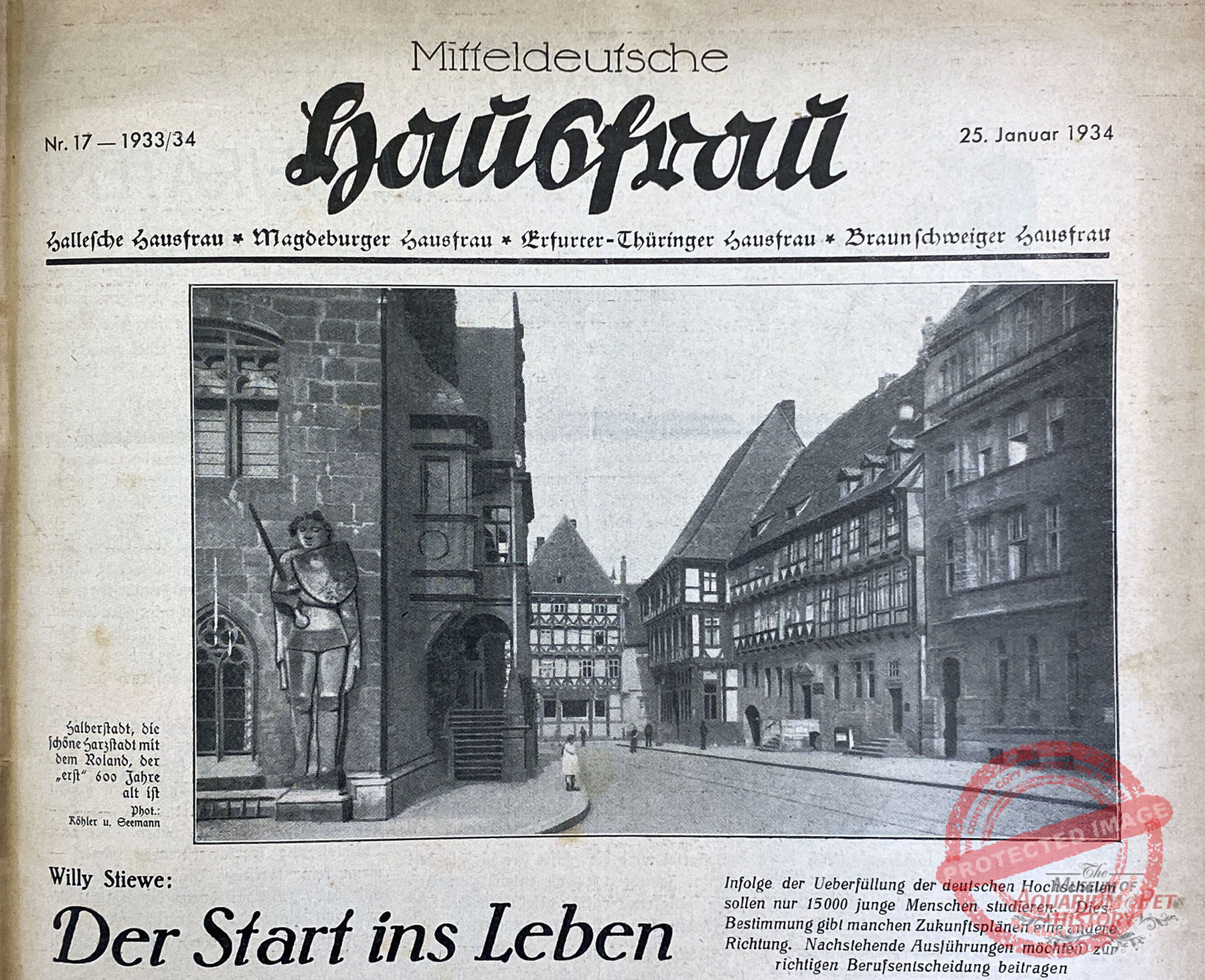
The magazine Mitteldeutsche Hausfrau (Central German Housewife) likewise published vivaristic articles.
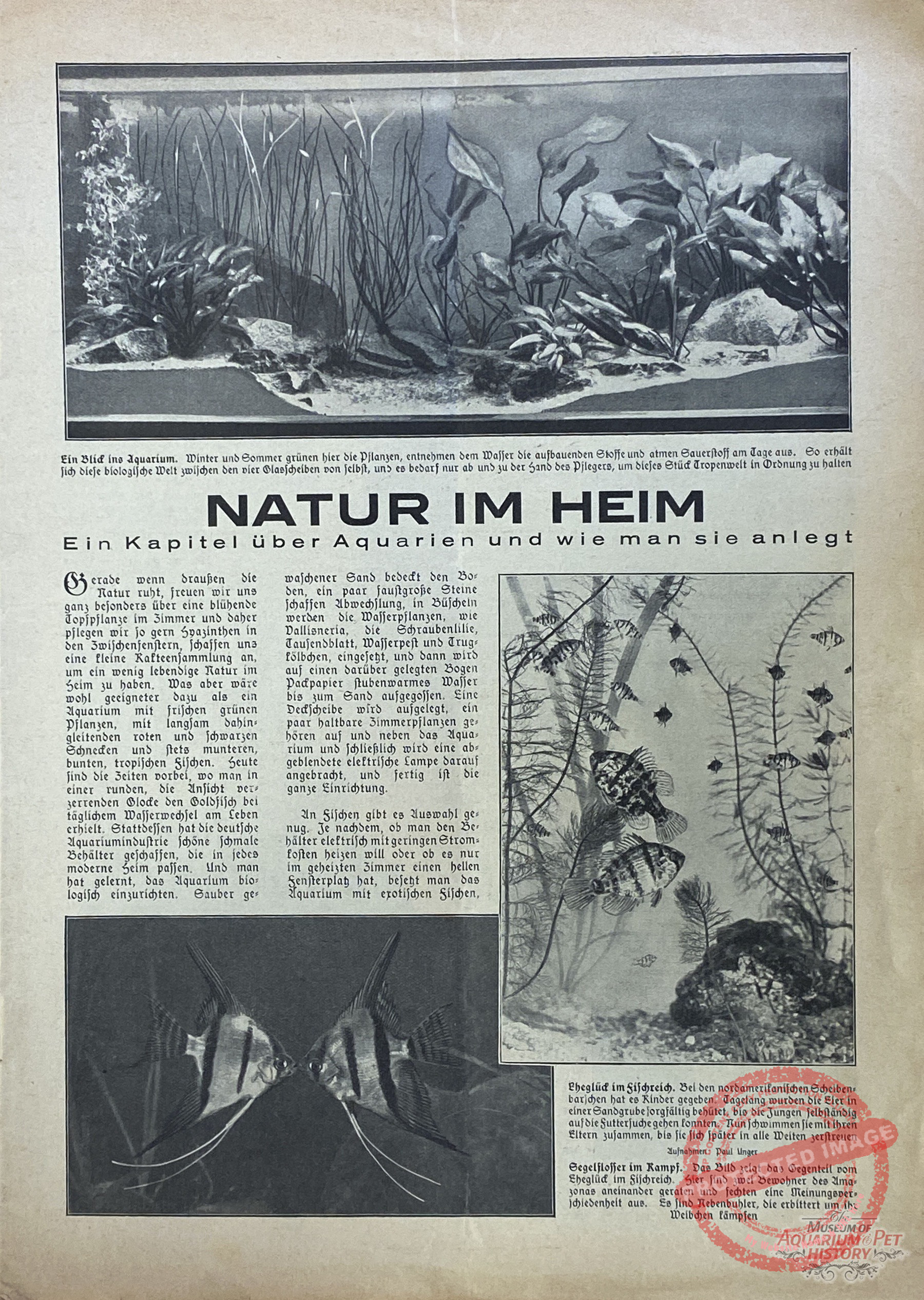
Housewives were given detailed instruction in the installation and proper care of aquariums.
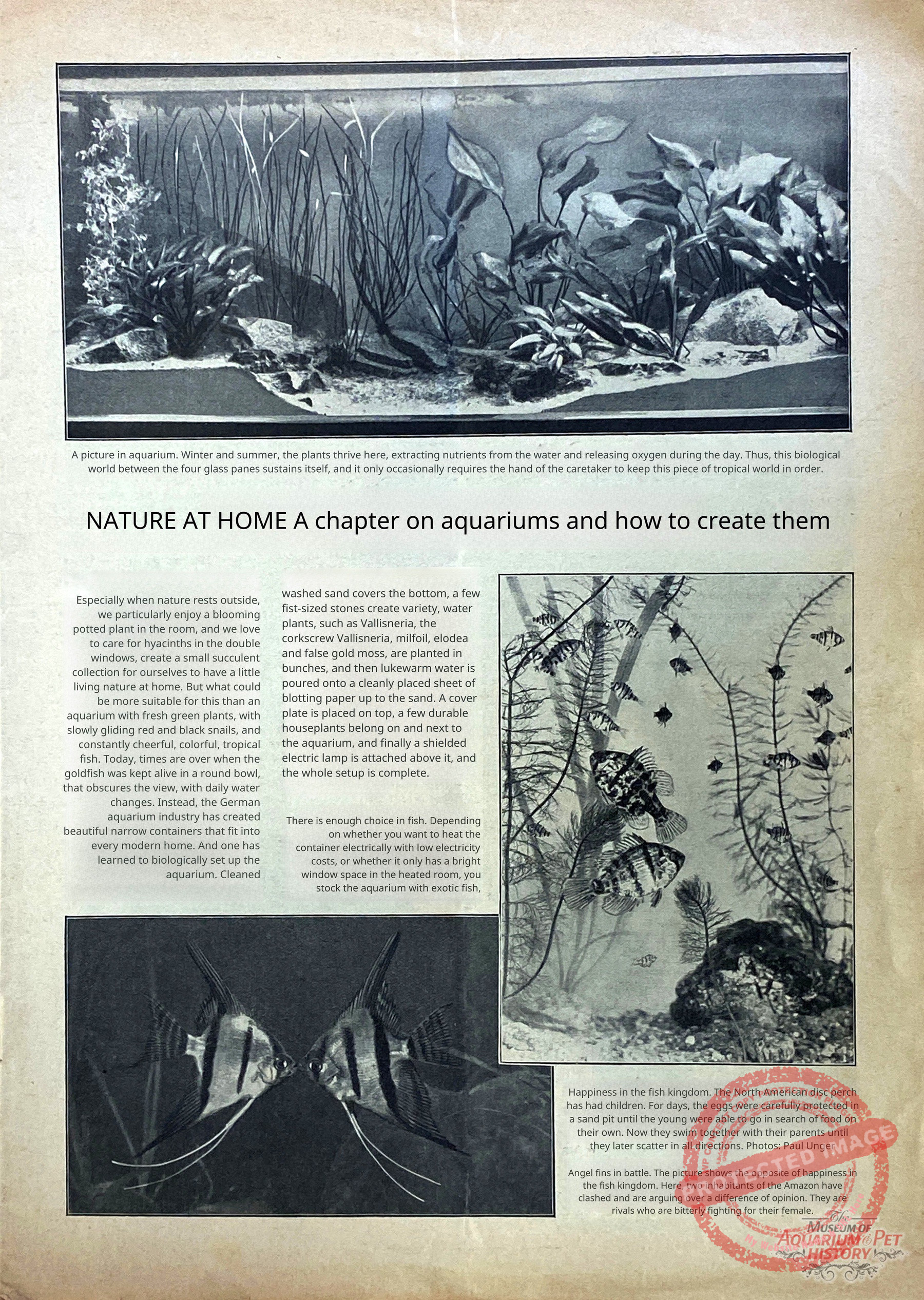
Same article about installation and proper care of aquariums translated into English using notegpt.io.
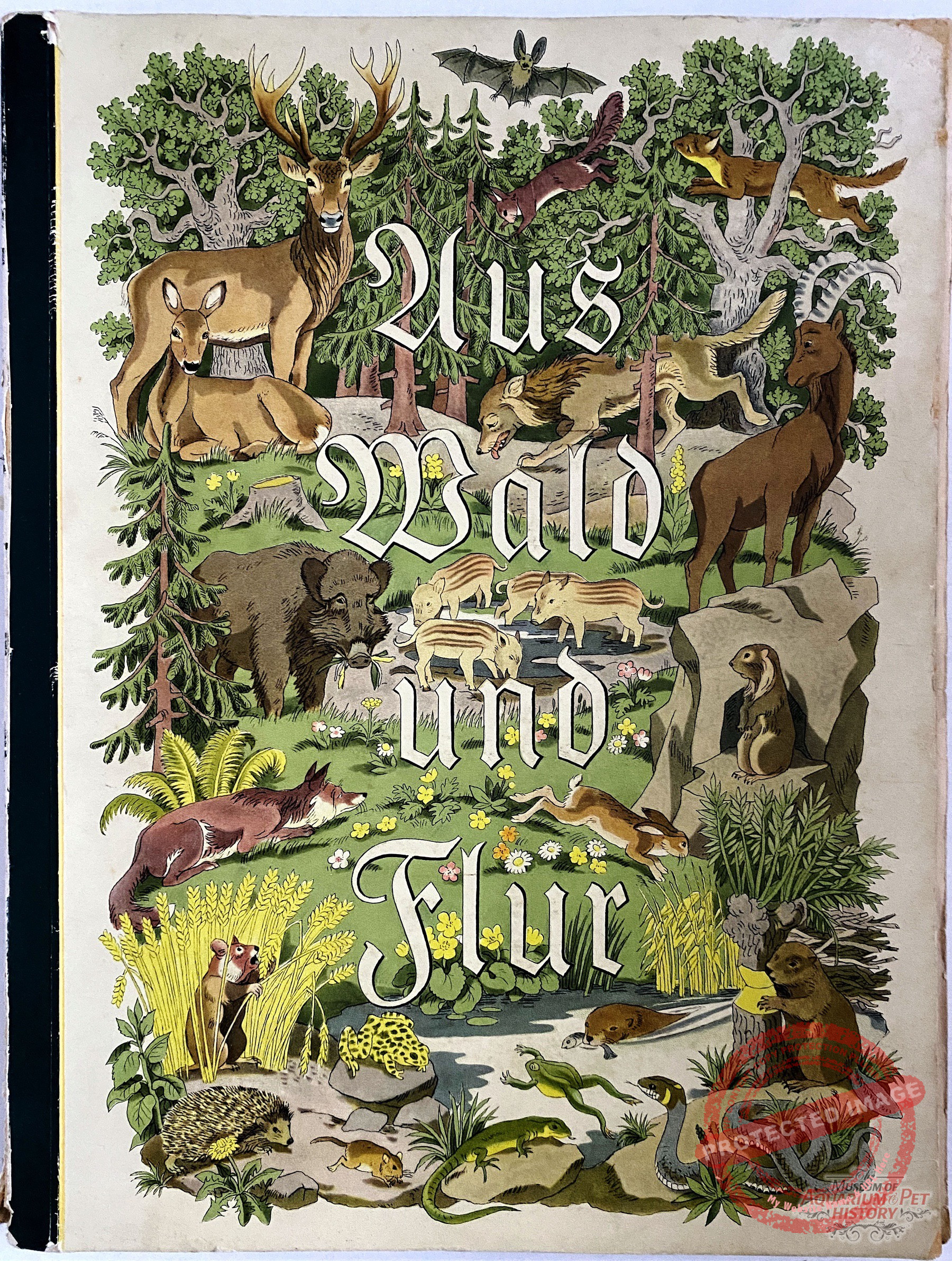
The book Aus Wald und Flur (From Forest and Field), like many other volumes glorifying the native homeland, was not sold in shops but financed through the sale of cigarettes.
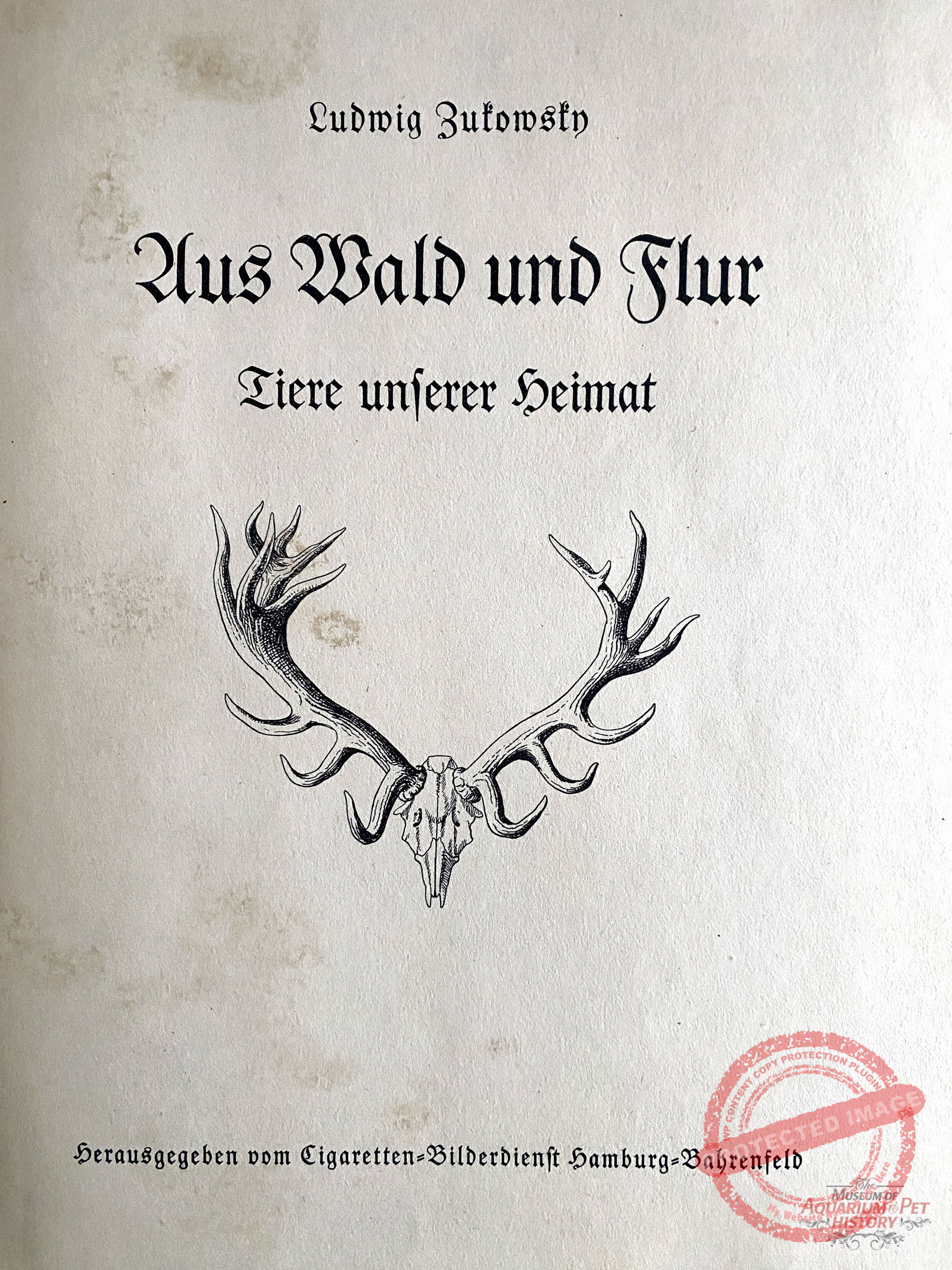
The text of this book was written by the former Berlin Zoo director Ludwig Zukowsky. The text on this page says: “From Forest and Field, Animals of Our Homeland – Published by the Cigaretten-Bilderdienft Hamburg-Bahrenfeld”
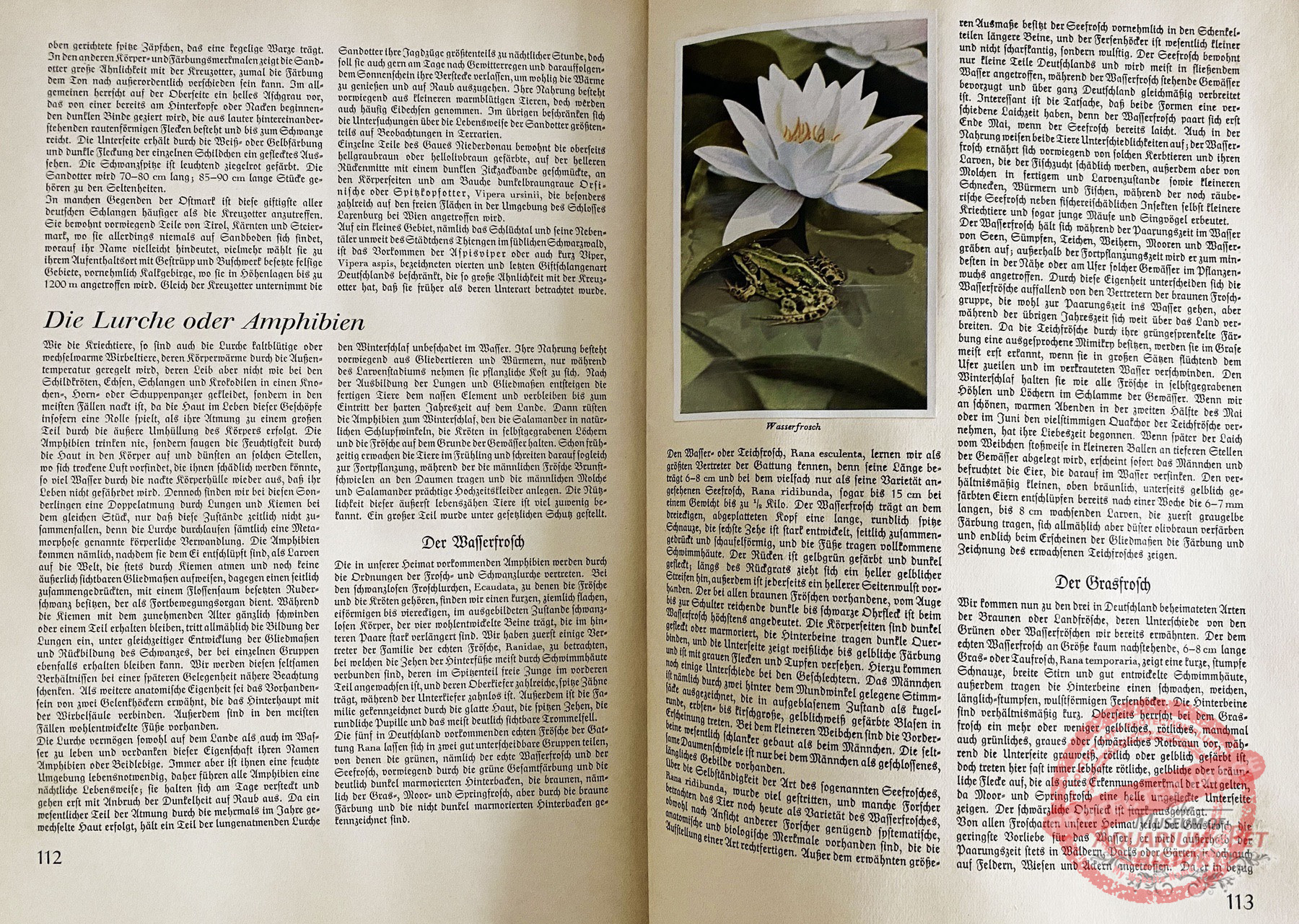
Particularly remarkable for the time are the carefully produced chapters on amphibians and reptiles, illustrated with hand-colored photographs.
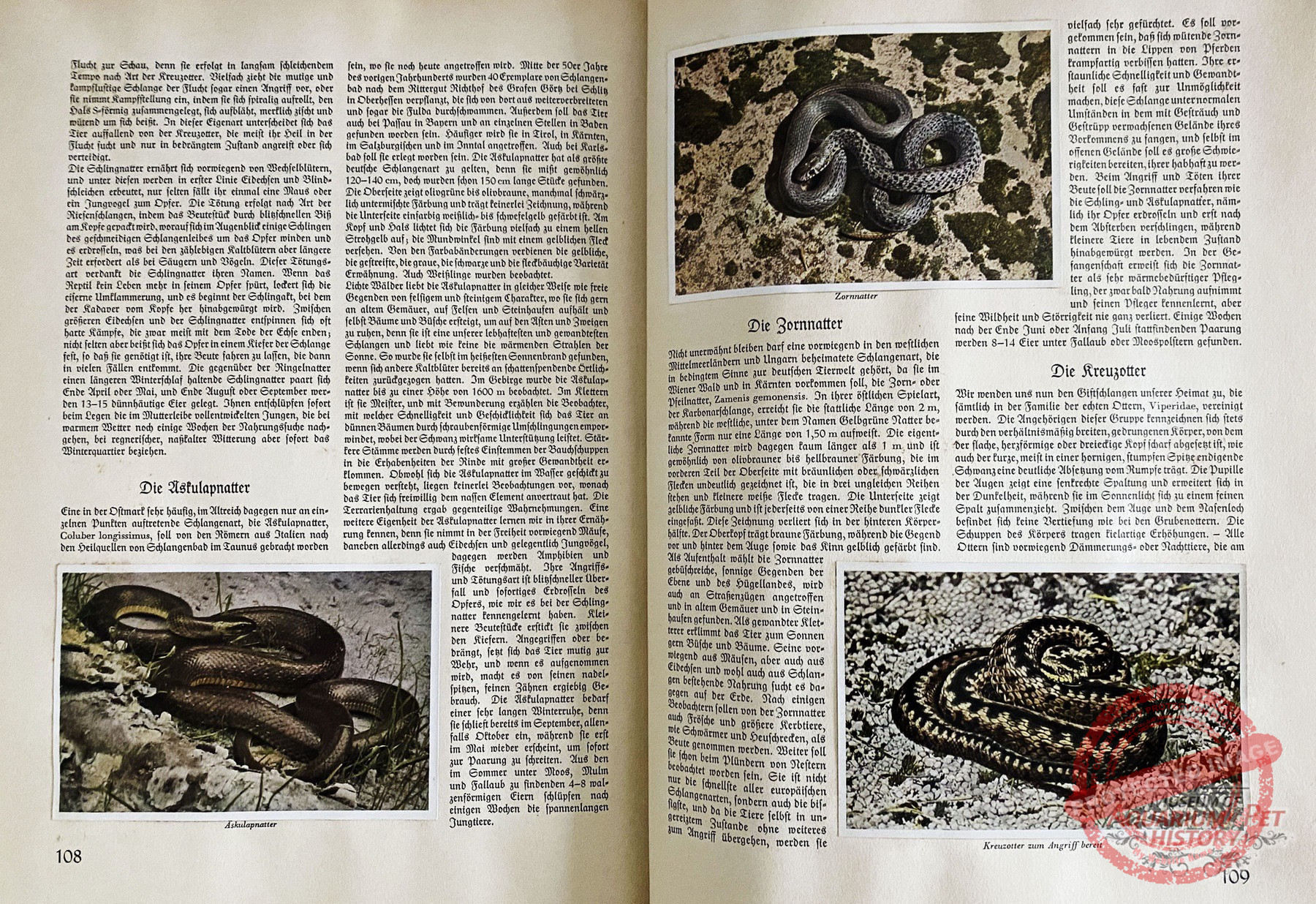
With each cigarette purchase, buyers received additional photographs to paste meticulously into the designated spaces within the volume.
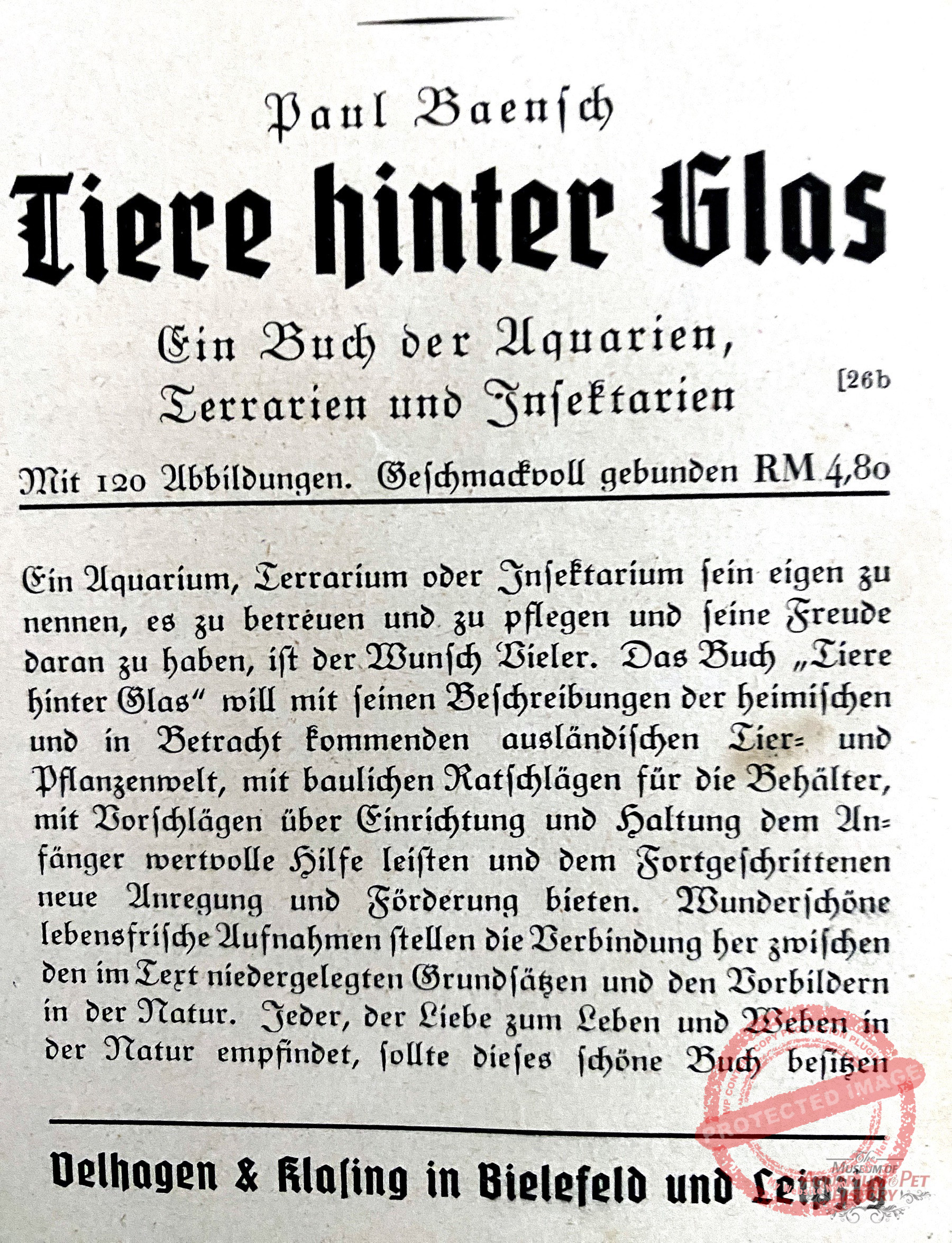
In 1938, the father of the later founder of the Tetra works, Paul Baensch, published his book Tiere hinter Glas (Animals Behind Glass)
Same book intro translated into English using notegpt.io.
It was a matter with two sides. One might have rejoiced at such widespread enthusiasm for subjects drawn from nature and biology. Yet professional standards were often carelessly trimmed back. In the years leading up to the outbreak of the Second World War, a great deal was published — some serious, some scarcely usable. The father of the later founder of the Tetra-Werke Paul Baensch published in 1938 his aquarium book “Tiere hinter Glas,” (Animals Behind Glass) which dealt with aquariums, terrariums, and insectariums. Alongside the long-established vivaristic journals Blätter and Wochenschrift, there were also the Zeitschrift für Aquarien- und Terrarienvereine, the Nachrichten für Aquarien- und Terrarienvereine, and Das Aquarium, and Die Fachzeitschrift des Naturfreundes. Looking at the years from 1933 to early 1944 — after which almost no publications appeared due to the war — one can trace the development of the hobby. But one must know how to read between the lines. I learned that in the DDR, and I now attempt to apply those interpretive skills to the vivaristic publications of those years in an exemplary analytical and evaluative manner.
During the first year (1933) under NSDAP leadership, it became evident that a gradual “cleansing” of leadership positions within the associations took place — not only with the consent, but with the very practical support of the umbrella organization V.D.A., which at that time still bore (as it does again today) the name Verband deutscher Vereine für Aquarien- und Terrarienkunde. In the final December 1933 issue of the Wochenschrift, it still appeared under that name. At the same time, new so-called Gauführer were appointed to chair the regional groups (formerly and again today VDA-Bezirke), while the previous leaders were removed under explanations such as “he had to resign his office due to professional overwork.” Many of the dismissed chairmen were of Jewish descent or critical of the regime. Simultaneously, the sale of captive-bred aquarium fish was examined from a tax-law perspective and finely regulated — which naturally brought restrictions for hobby breeders. Already in the first January issue of the Wochenschrift, the umbrella organization appeared under the new name “Reichsverband.” The unification of language, even down to nomenclature, progressed steadily. In 1938, all remaining umbrella organizations in Germany were integrated into the “Reichsbund Deutscher Vereine für Aquarien- und Terrarienkunde” and thus brought into Gleichschaltung. Membership numbers grew through the territories annexed to the German Reich by means of threat and coercion — Austria and Czechoslovakia. The staunchly party-conforming chairman (from 1938 onward, the term “Führer” was avoided again, since one did not wish to equate such a mundane occupation with household animals ideologically with SS leaders or “the” Führer himself) of the Reichsbund announced in the Wochenschrift in 1938, following the annexation, the “Anschluss des Sudetengaues,” thereby using for hobbyists the same terminology employed by the Nazi leadership for entire territories. He concluded with a hearty: “Heil Hitler! Dr. Kramer, Reichsbundleiter.”
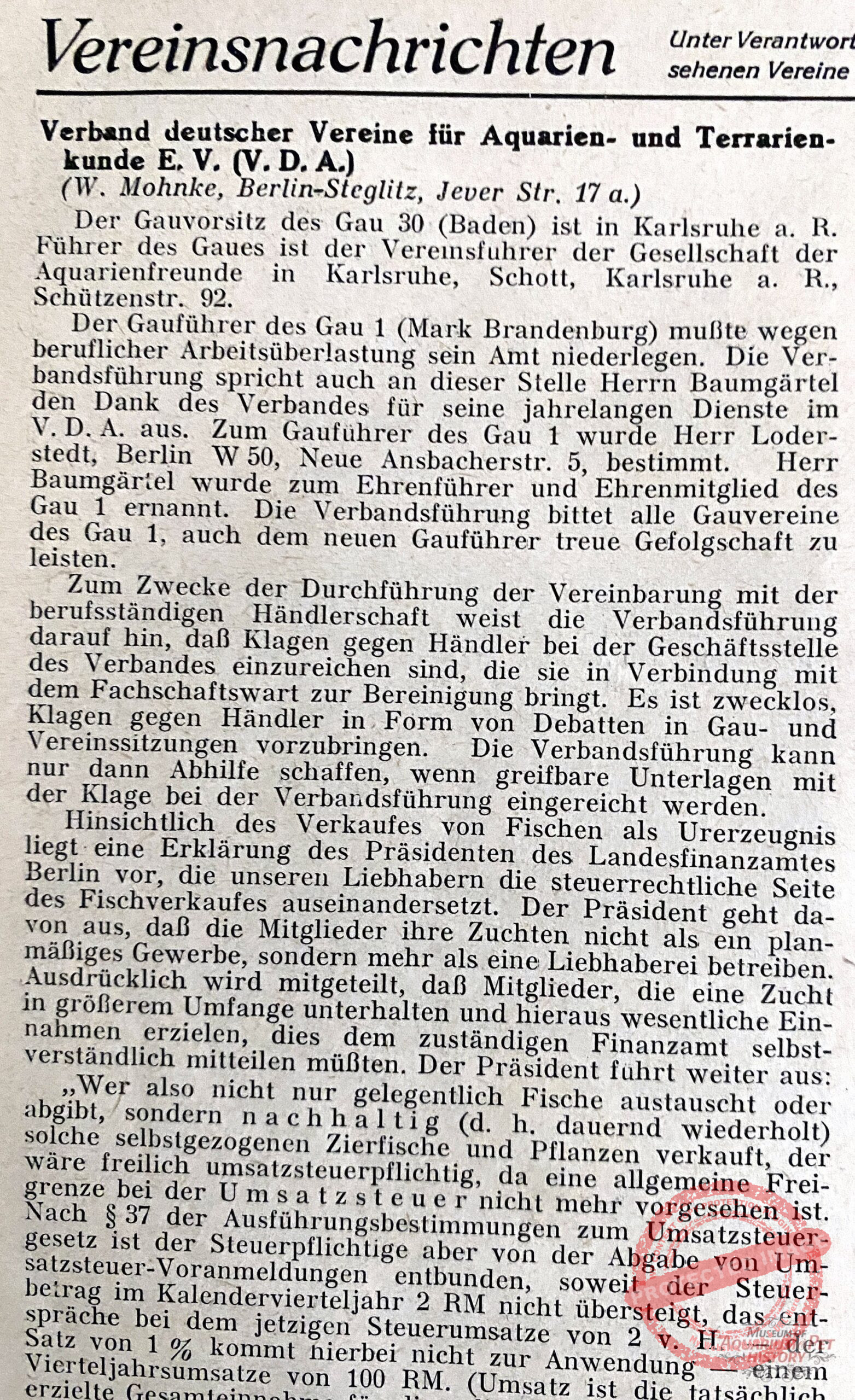
In December 1933 — here shown in an excerpt from the Wochenschrift — the VDA was still called Verband deutscher Vereine für Aquarien- und Terrarienkunde, although it was already being announced that numerous former regional chairmen had been replaced by new leaders loyal to the regime.
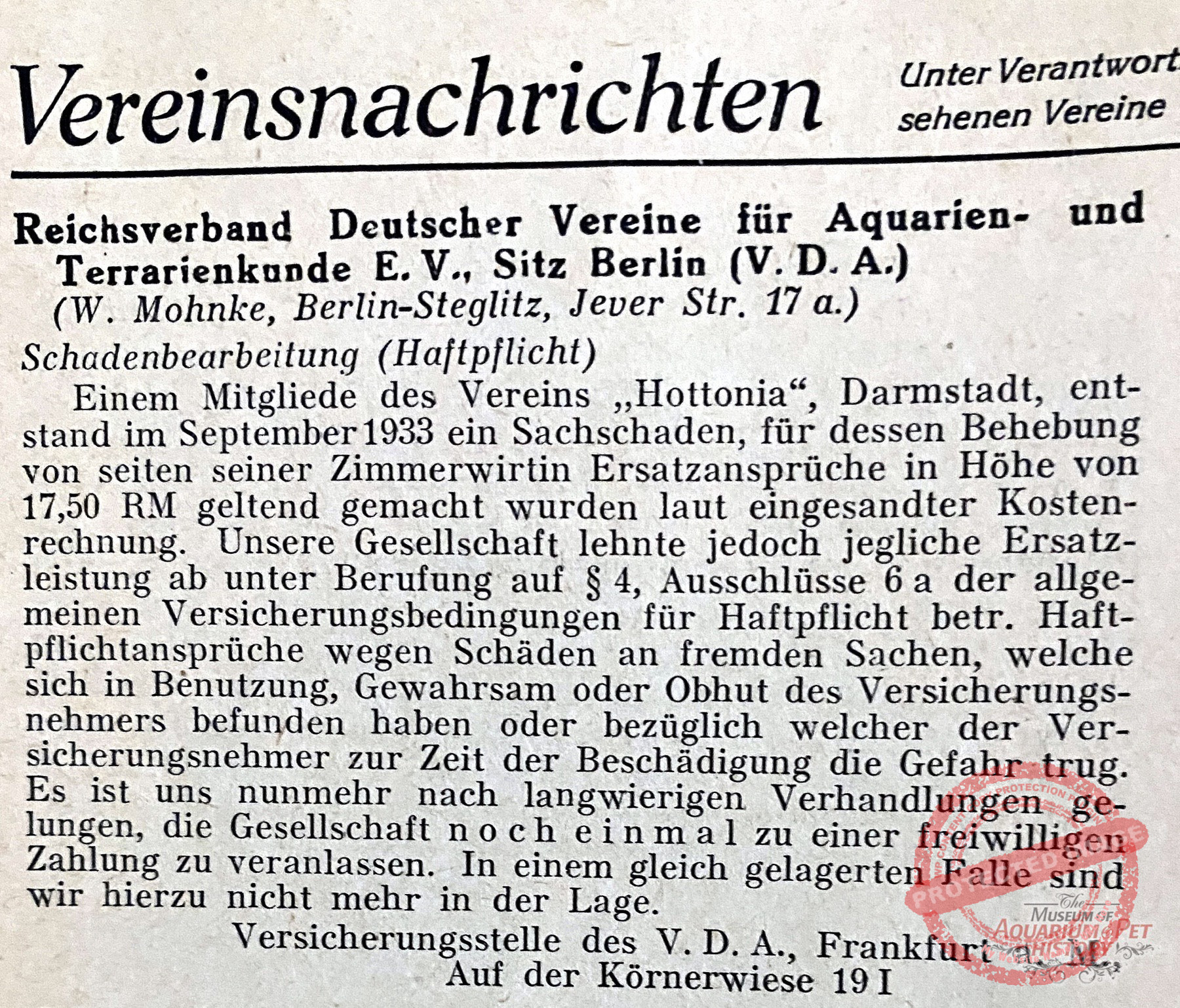
In the first January 1934 issue of the Wochenschrift, the umbrella organization was already styled “Reichsverband.”
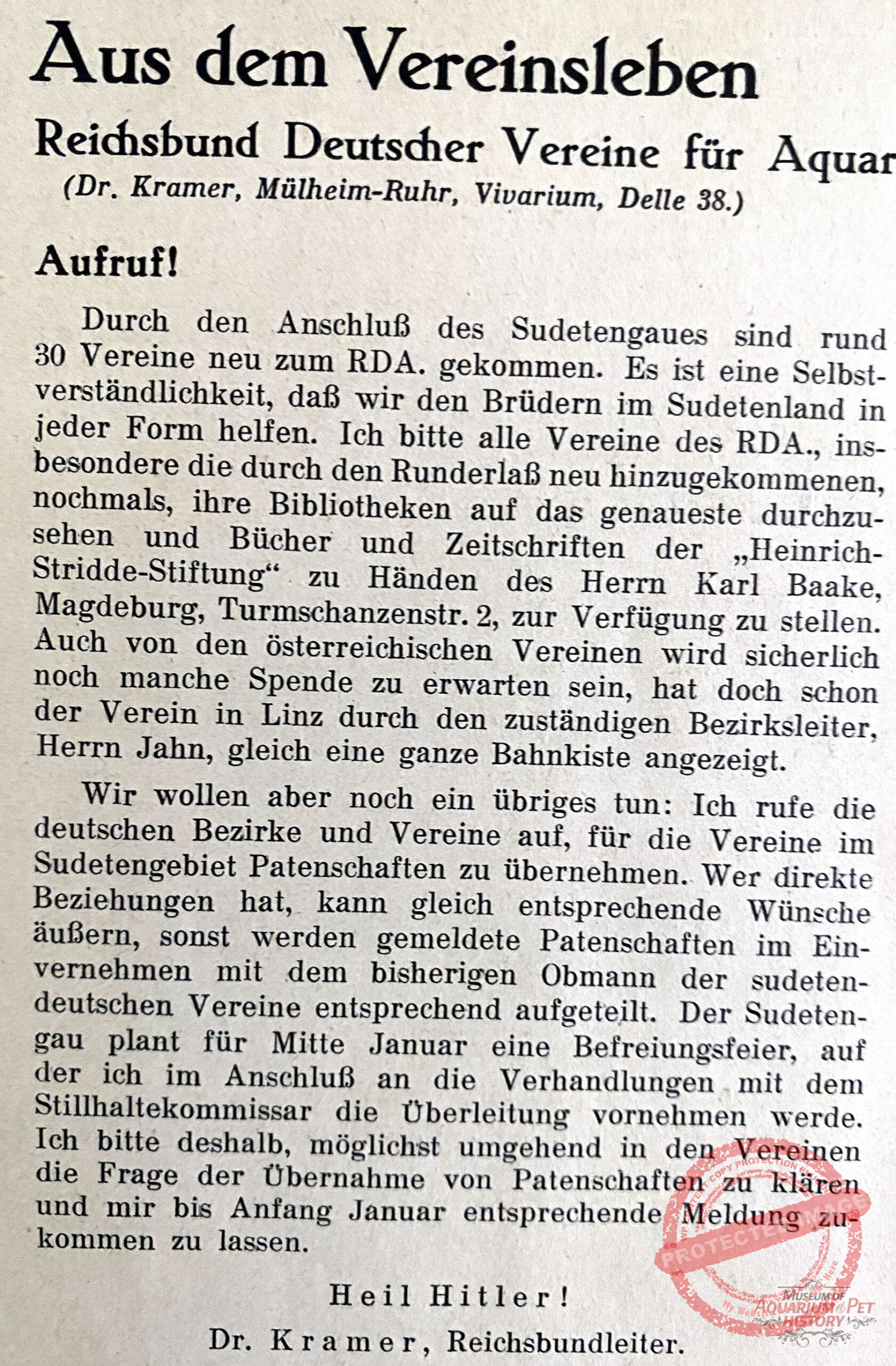
The club news section of the Wochenschrift documents the imperial expansionism of the Nazi regime: Dr. Kramer, now head of the organization renamed “Reichsbund,” welcomes thirty new associations from the Sudetengau annexed to Germany.
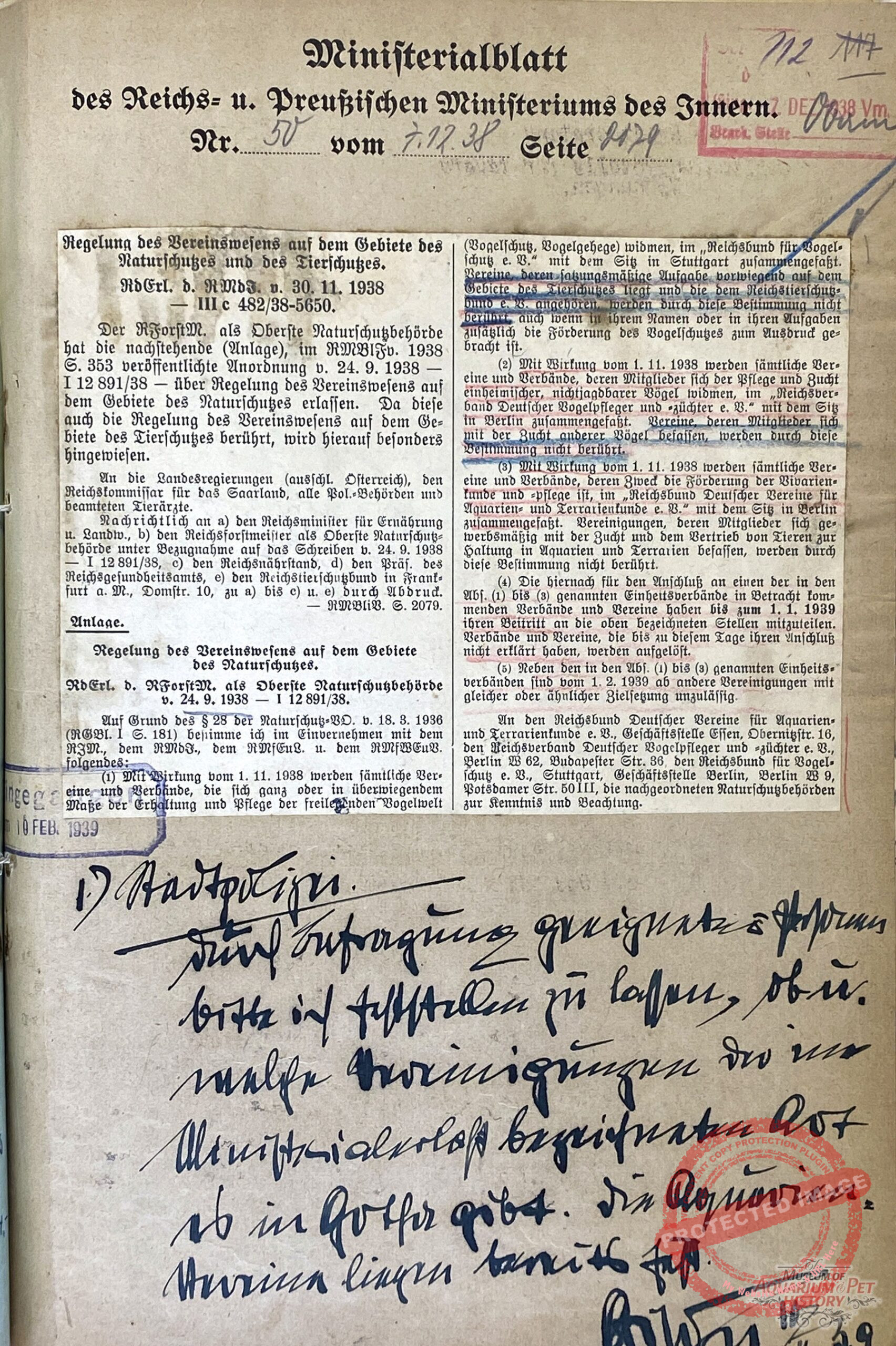
Ministerial Gazette of the Reich and Prussian Ministry of the Interior, dated December 7, 1938, regulating associations in the fields of nature and animal protection. It states: “Associations and clubs eligible for affiliation with one of the unified federations must declare their accession by January 1, 1939. Those that fail to do so by that date will be dissolved.”
The process of Gleichschaltung was completed before the outbreak of war on September 1, 1939. The distinguished long-time editor of Wochenschrift and Blätter, Dr. Willy Wolterstorff, had celebrated his 75th birthday on June 16, still before the war began. For him, as a scientist who refused to conform (none of his articles or short editorial notes ever include “Heil Hitler!”), all the aforementioned changes were dreadful. He largely withdrew from club life and restricted himself to professional correspondence. From the fourth quarter of 1939 onward, the impact of the war on the hobby was increasingly documented. What had already been prepared through the housewives’ magazine at the time now came to pass: many men were drafted to the front. In the final 1939 issue of Wochenschrift, the holiday greetings read: “To all readers, contributors, and friends of the ‘W,’ especially those at the front, the publisher and editorial staff of the ‘W’ and the ‘Bl’ extend their best wishes for the New Year.” Among the advertisements, for example, Heinrich Stolz, importer and exporter of tropical fish in Potsdam, announced that due to his conscription, no railway shipments abroad would be possible for the time being.
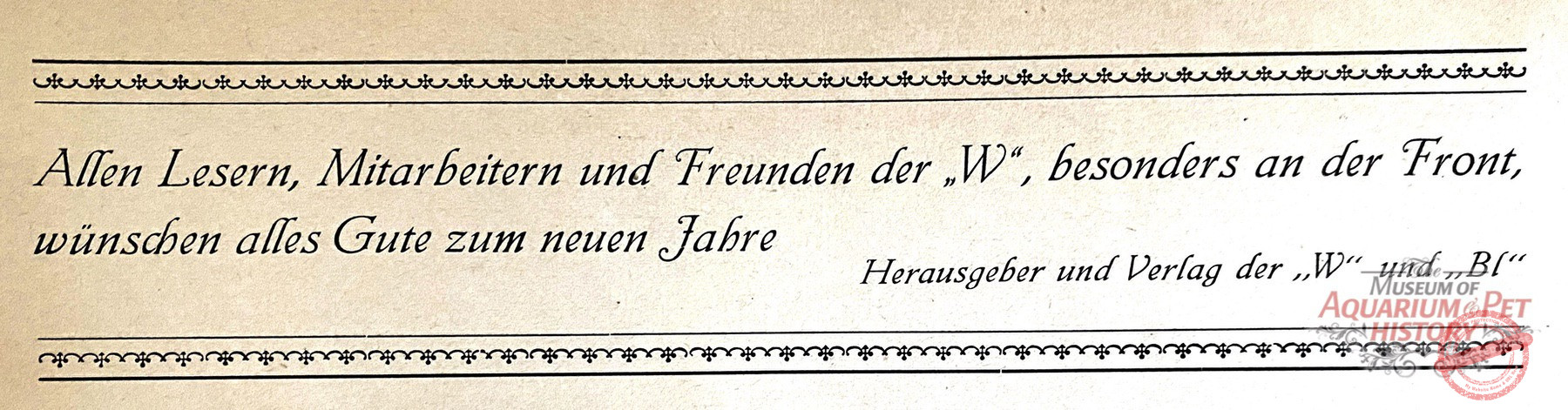
Christmas greetings published in December of the first year of war, 1939, in the Wochenschrift: “To all readers, contributors, and friends of the ‘W,’ especially those at the front, the publisher and editorial staff of the ‘W’ and the ‘Bl’ extend their best wishes for the New Year.”
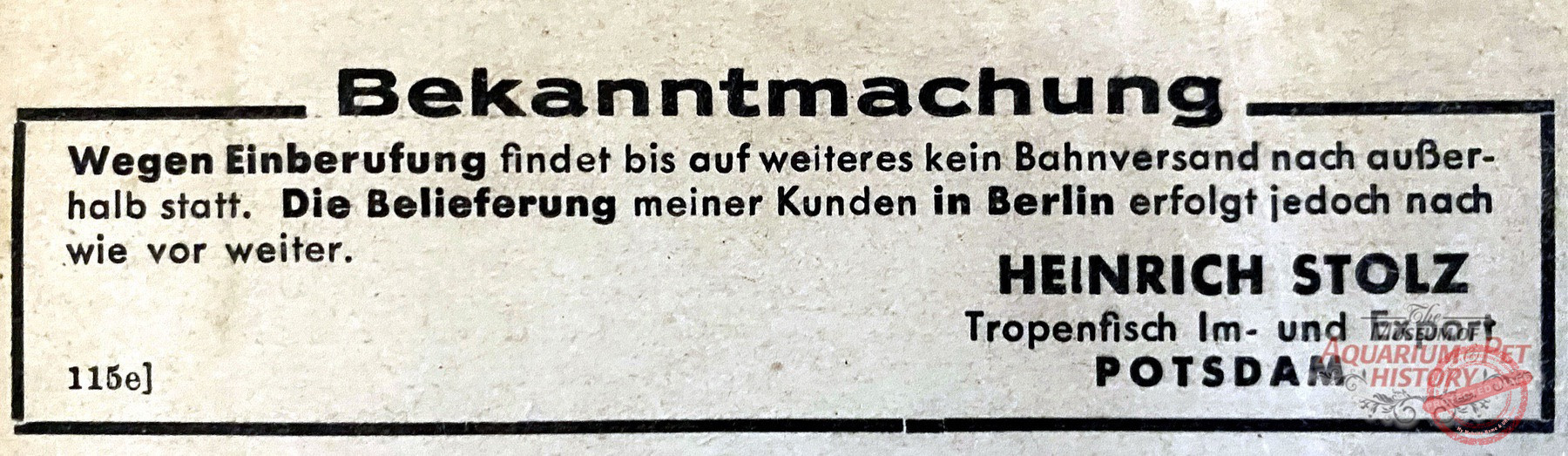
An advertisement from the final 1933 issue of the Wochenschrift in which Heinrich Stolz, then a prominent importer and exporter of aquarium fish in Potsdam, announces his conscription into the Wehrmacht and the resulting suspension of animal shipments. The text says “Announcement: Due to conscription, there will be no further shipping by rail to destinations outside the area until further notice. However, deliveries will continue to be made to my customers in Berlin as before. – Heinrich Stolz (Tropical Fish Import and Export POTSDAM”
Particularly striking is the Wochenschrift article “Unsere Vivarienliebhaberei in der Kriegszeit” (“Our Vivaristic Hobby in Wartime”) by Erich Henzelmann at the end of 1939, which, in a form adapted to Nazi language, reflects how people in hobby clubs felt and thought (my comments and interpretations in parentheses): “Even though, given the magnitude of current events, our fine study of aquariums and terrariums may seem almost (but not entirely) insignificant, we nature lovers (a well-chosen word, borrowed from Göring’s homeland cult) still want and need not entirely to give up our hobby. This applies to almost all those left at home (Jews and prisoners could no longer participate), and this is also demanded of our comrades fighting at the front. Recently, our old club friend, Reserve Lieutenant Hoja, wounded in Poland, wrote to us, as if speaking for all front comrades, the following: ‘Do not give everything away. You at home have the task of ensuring that we warriors can start again later.’ These words spoke to my soul, for it is the absolute duty of the homeland (here meaning citizens who cultishly identify with the homeland) to step in and help. One day this war will also end, and then the German person shall again be able, after the battles and hardships, to peacefully enjoy his own slice of nature at home (again, home and nature in Göring’s sense). We Germans are, without being sentimental, creatures connected to nature in body and soul (as if this were a unique characteristic of Germans).” Using ideologically adjusted language (so the article could be published and not fall victim to censorship), the author urges that everything should be done to maintain the species in aquariums through breeding, and to ensure that despite shortages, not all aquariums are shut down or sold. In fact, many older aquarists, who were not drafted, made sure of this. Several species of aquarium fish survived through multiple generations even after the war.
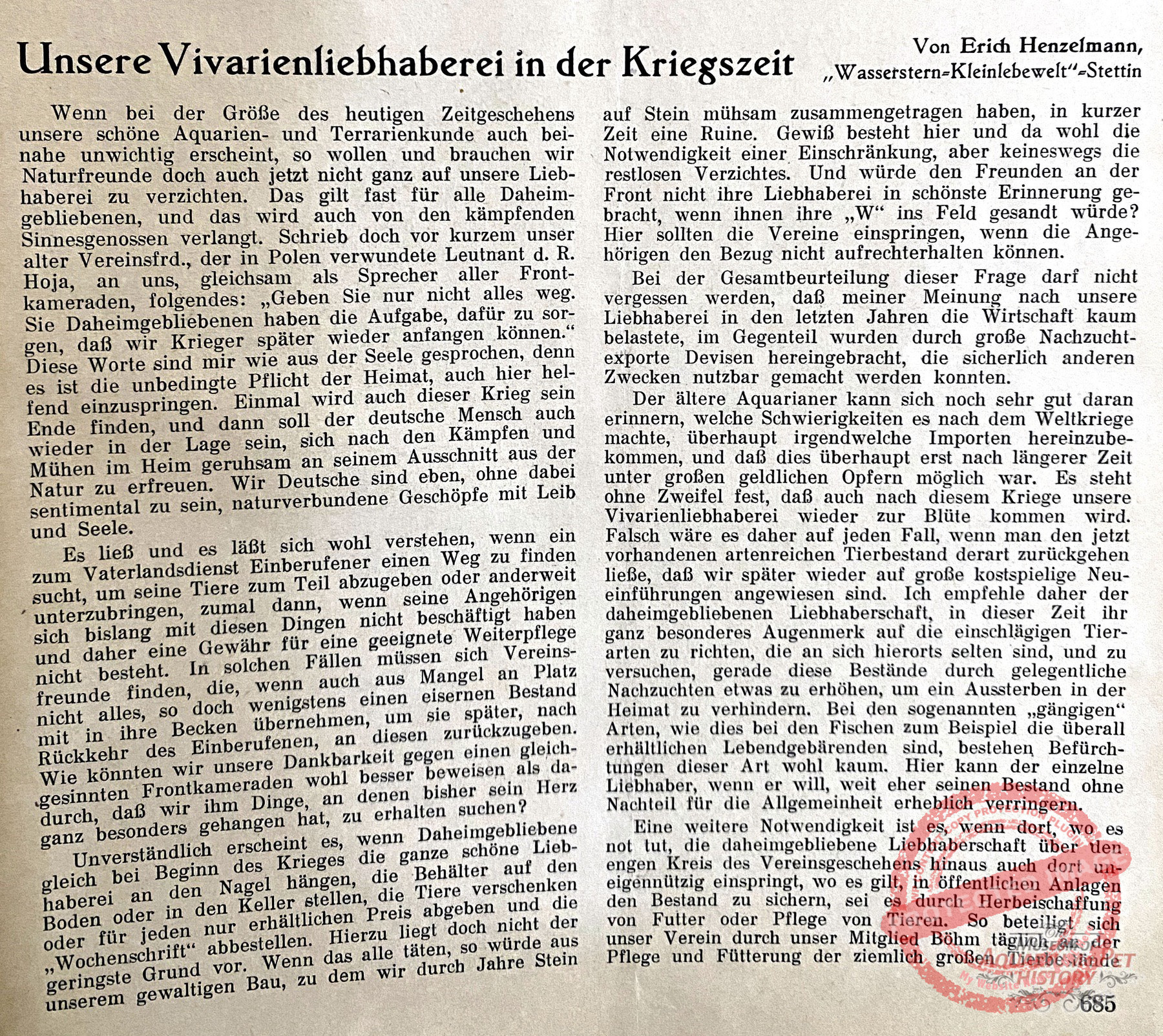
The Wochenschrift article “Unsere Vivarienliebhaberei in der Kriegszeit” — Our Vivaristic Hobby in Wartime — by Erich Henzelmann, published in late 1939.
Same article by Erich Henzelmann translated into English using notegpt.io.
By the third and fourth years of the war, the tide had turned against the German Wehrmacht: German troops increasingly became losers and had to retreat gradually, especially during the Russian campaign. Many soldiers lost their lives at the front, and bombing raids on Germany began. The population experienced firsthand what war truly meant. Göring got “cold feet”; he did not want the public to become aware of depleted club funds, massive losses of members to death at the front, and complaints about the lack of equipment and materials for the hobby. Therefore, he decreed that all publications be reviewed and ideologically trimmed before release. His vassal, Reichsbund leader Dr. Kramer, not only asked members to comply but instructed them in a military style. Correspondence between aquarium associations and vivaristic journals was no longer allowed directly, only through the Reichsbund leader, who ideologically sanitized everything. Göring’s decree was supplemented and tightened several times in 1942. Nevertheless, some manuscripts reached the Wochenschrift editorial office and were published—for example, instructions on how to build an aquarium aeration system in the absence of industrially manufactured pumps. This mutual aid among aquarists—animal exchanges, taking care of others’ stocks, and helping maintain friends’ aquariums—could not be prevented. At the end of 1942, Reichsbund leader Kramer claimed these unavoidable activities as his own initiative, demanding them from all members in the name of homeland loyalty to Germany.
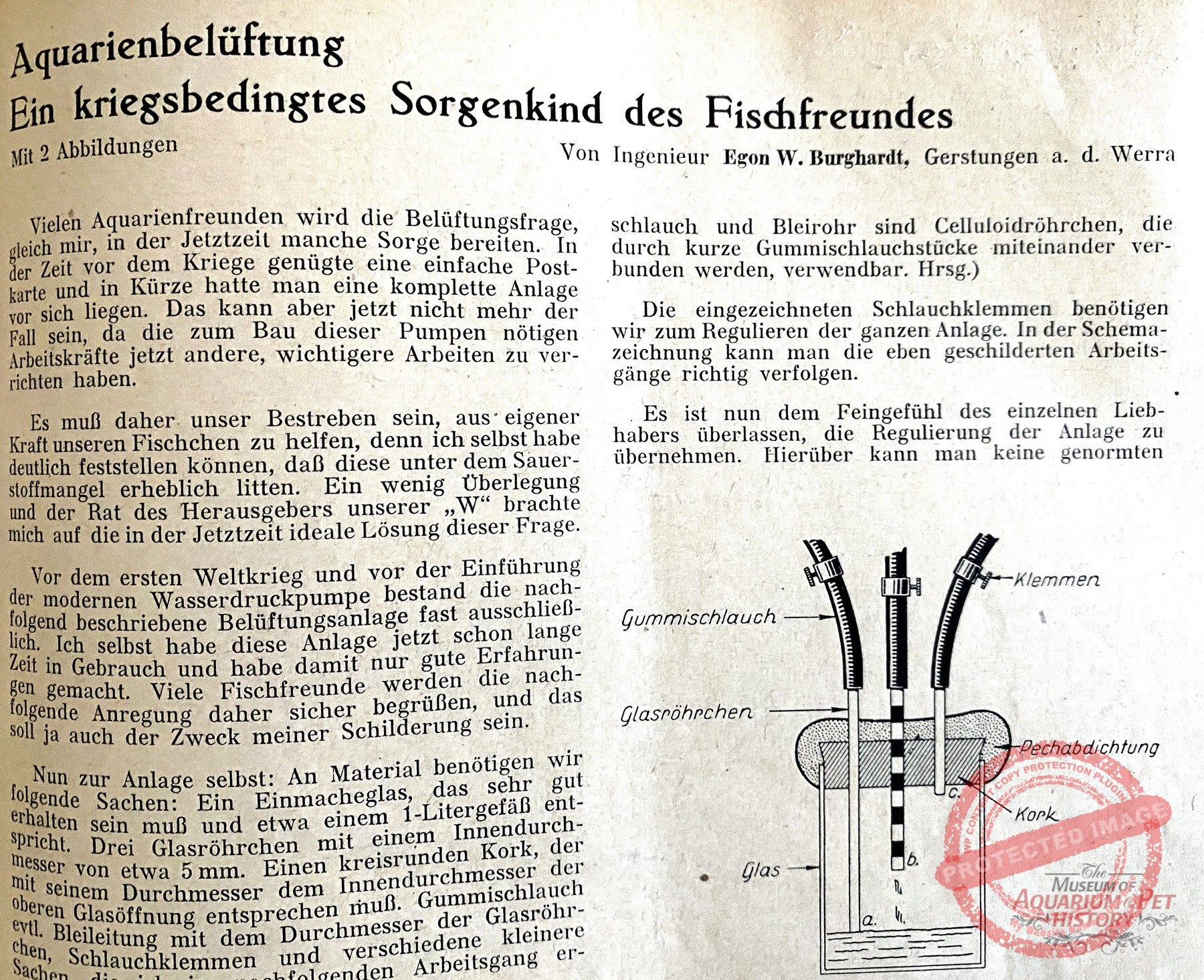
A Wochenschrift article providing instructions for constructing an air pump at a time when industrial production had been entirely redirected toward armaments.
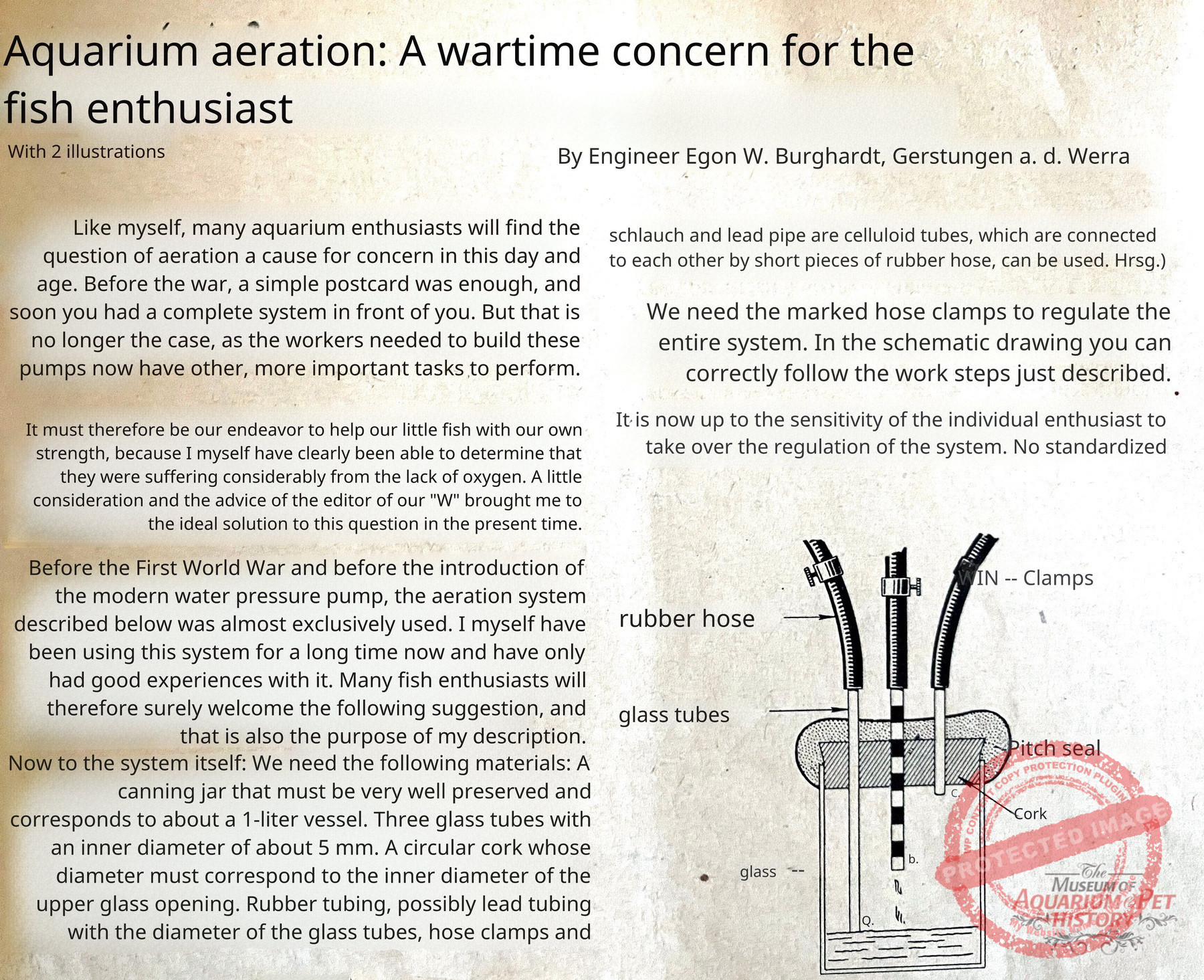
Same article about air pump construction translated into English using notegpt.io.
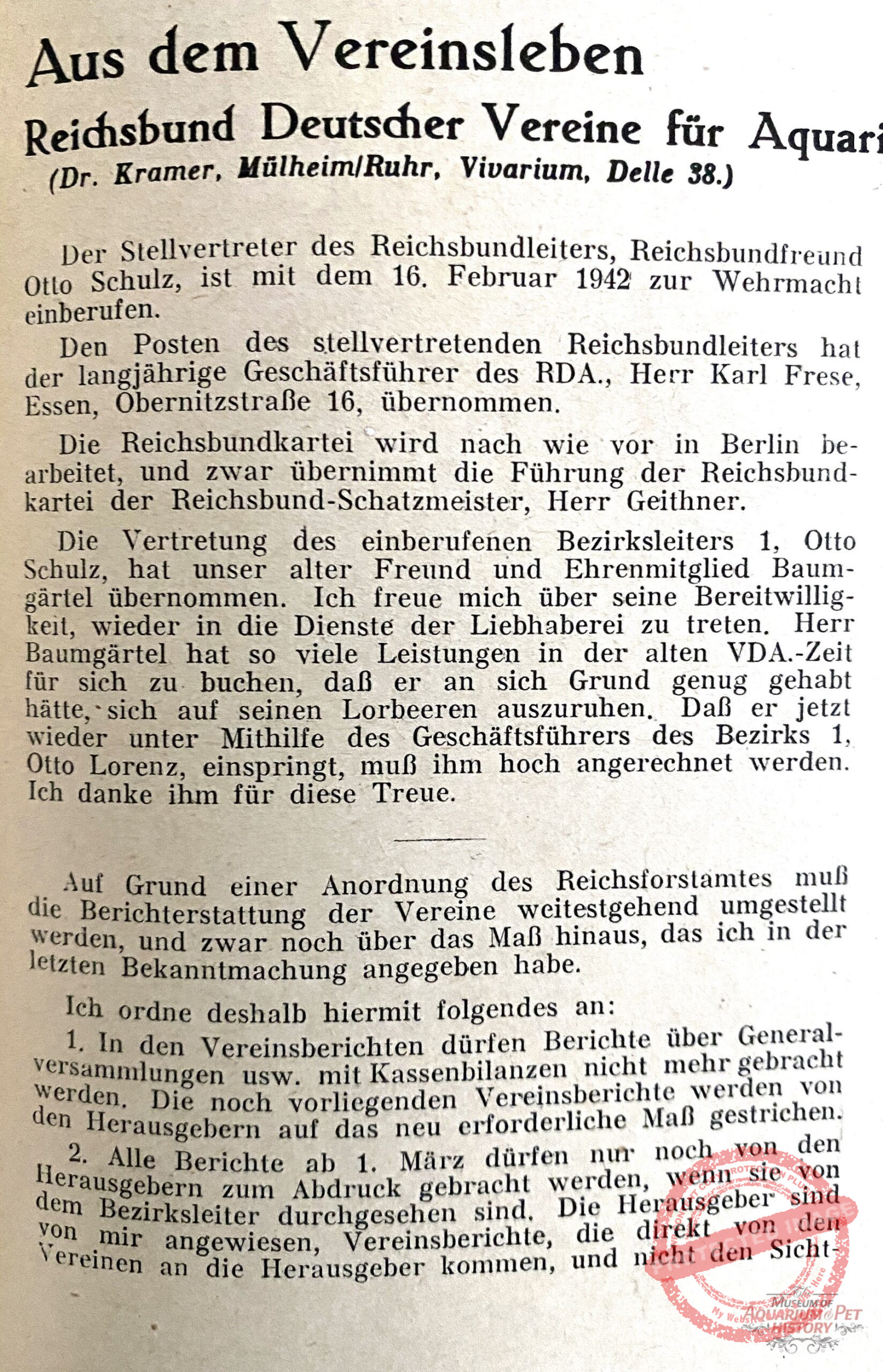
The leadership ranks of the Reichsbund of aquarists and terrarists grow visibly thinner as more members are drafted to the front; this is announced here, followed by Kramer’s directive to regional heads that he will henceforth serve as censor for all publications and that every manuscript must be submitted to him.
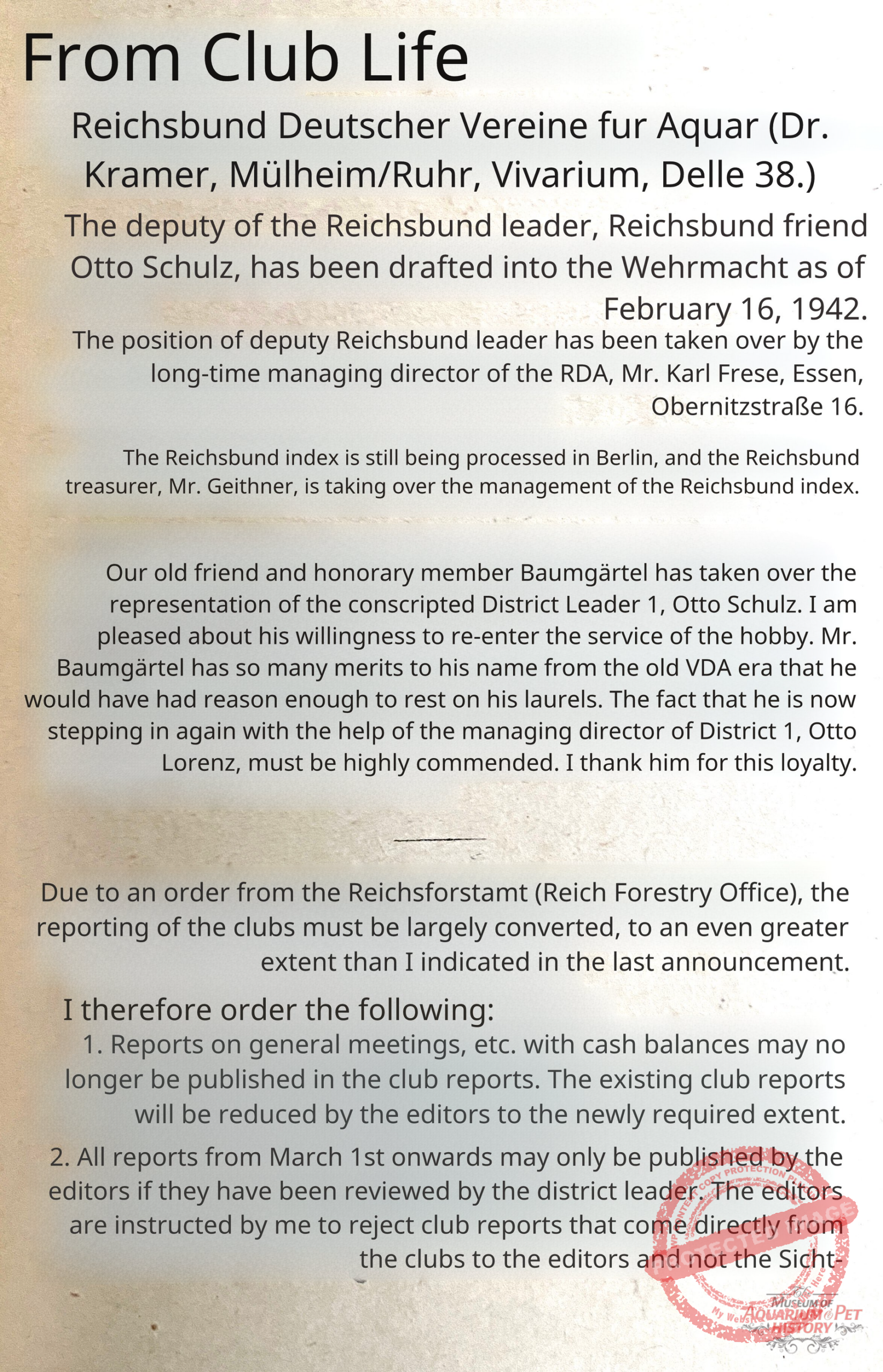
Same article by Dr. Kramer translated into English using notegpt.io.
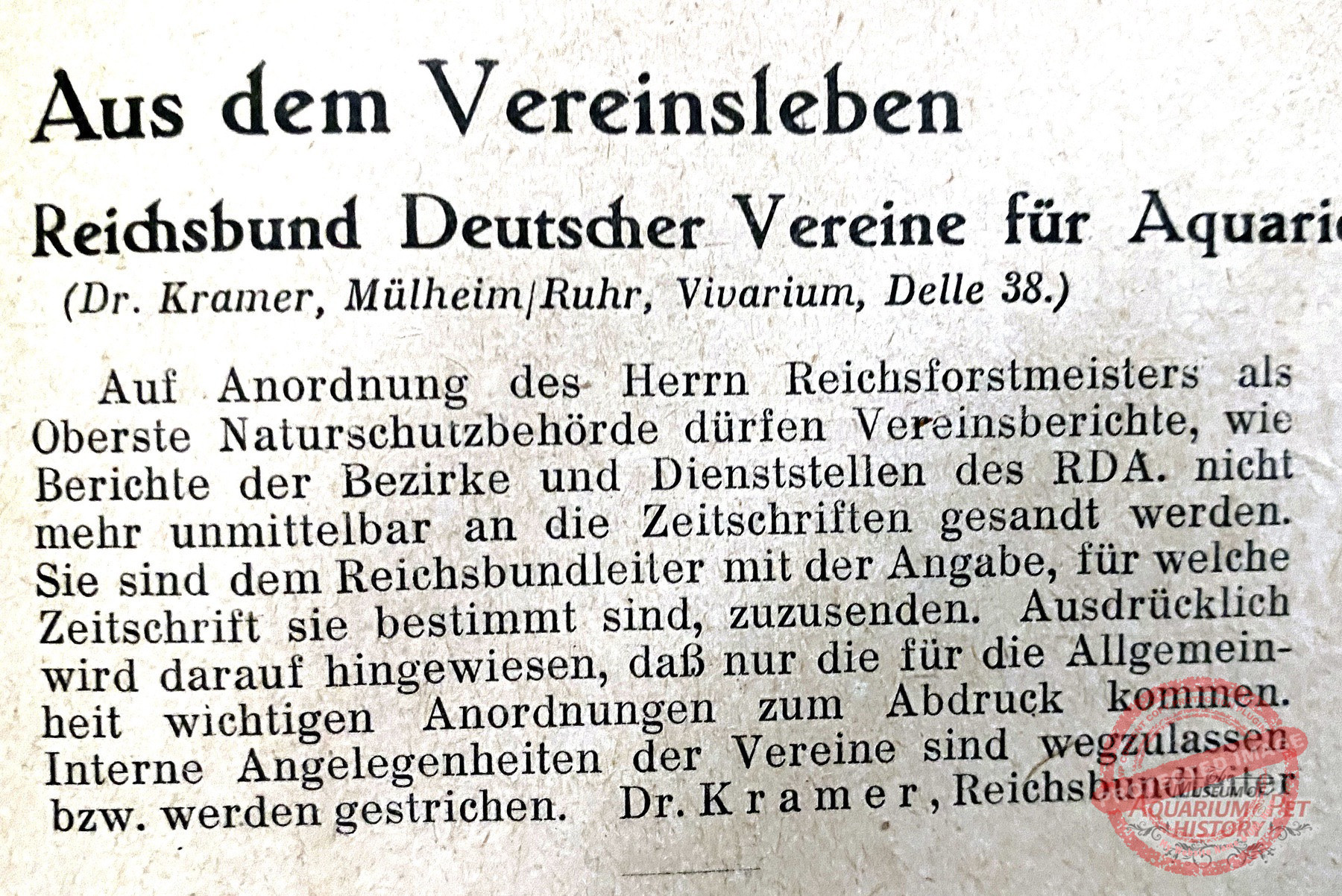
Shortly thereafter, even stricter censorship is demanded by Hermann Göring in his capacity as Reich Minister.
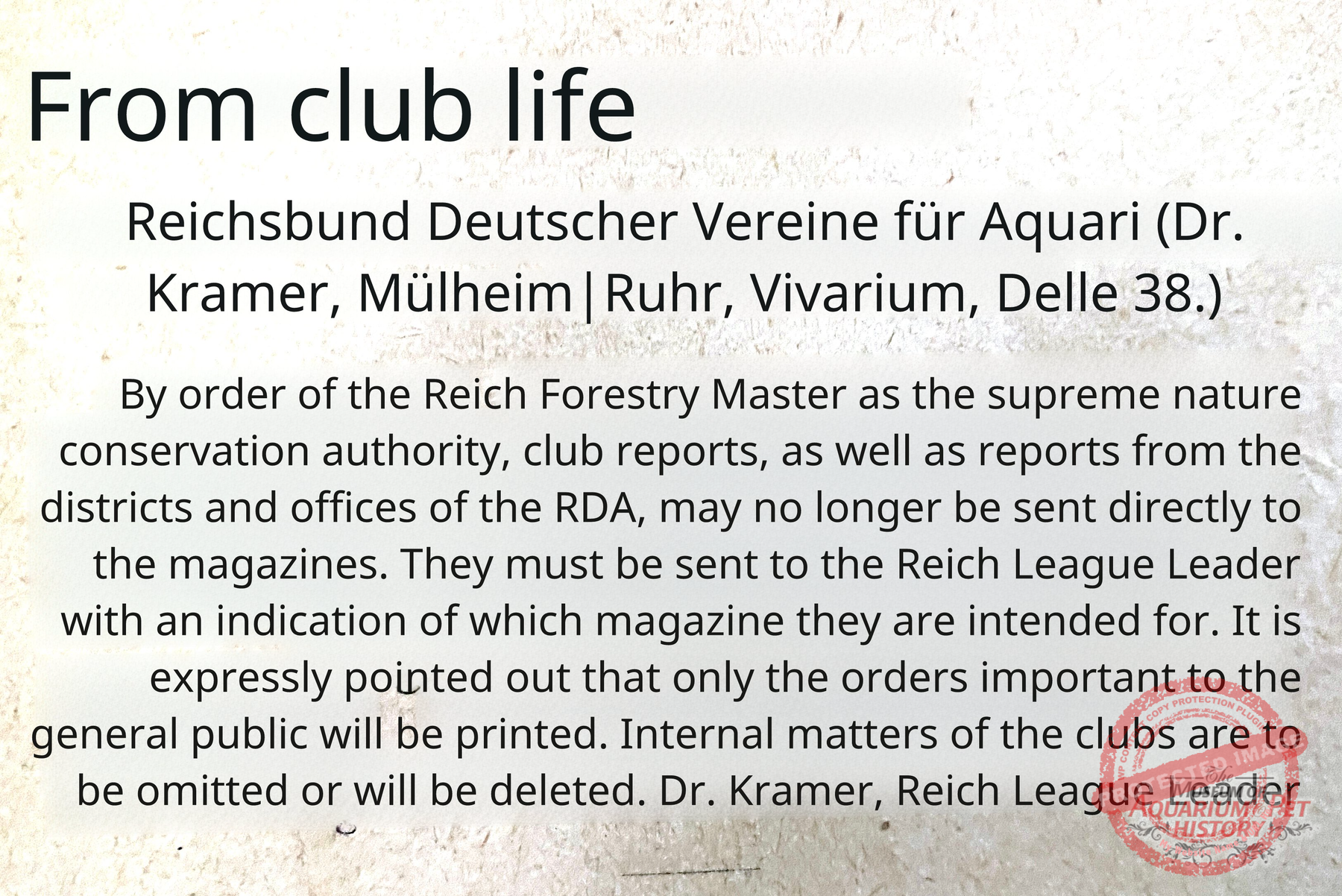
Same article by Dr. Kramer translated into English using notegpt.io.
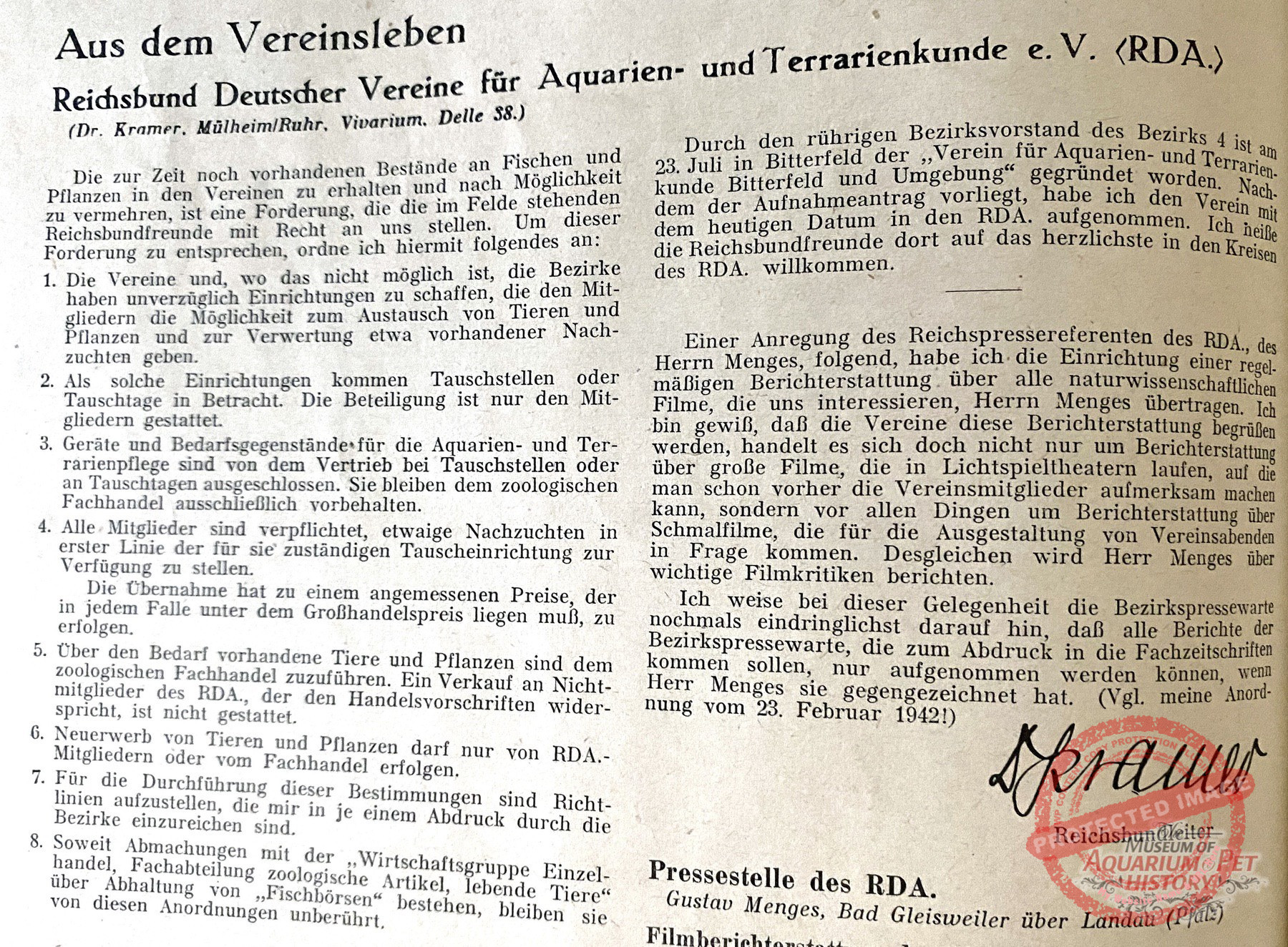
Kramer ultimately appropriates the members’ mutual-aid initiatives during the difficult war years and publishes them as his own directive.
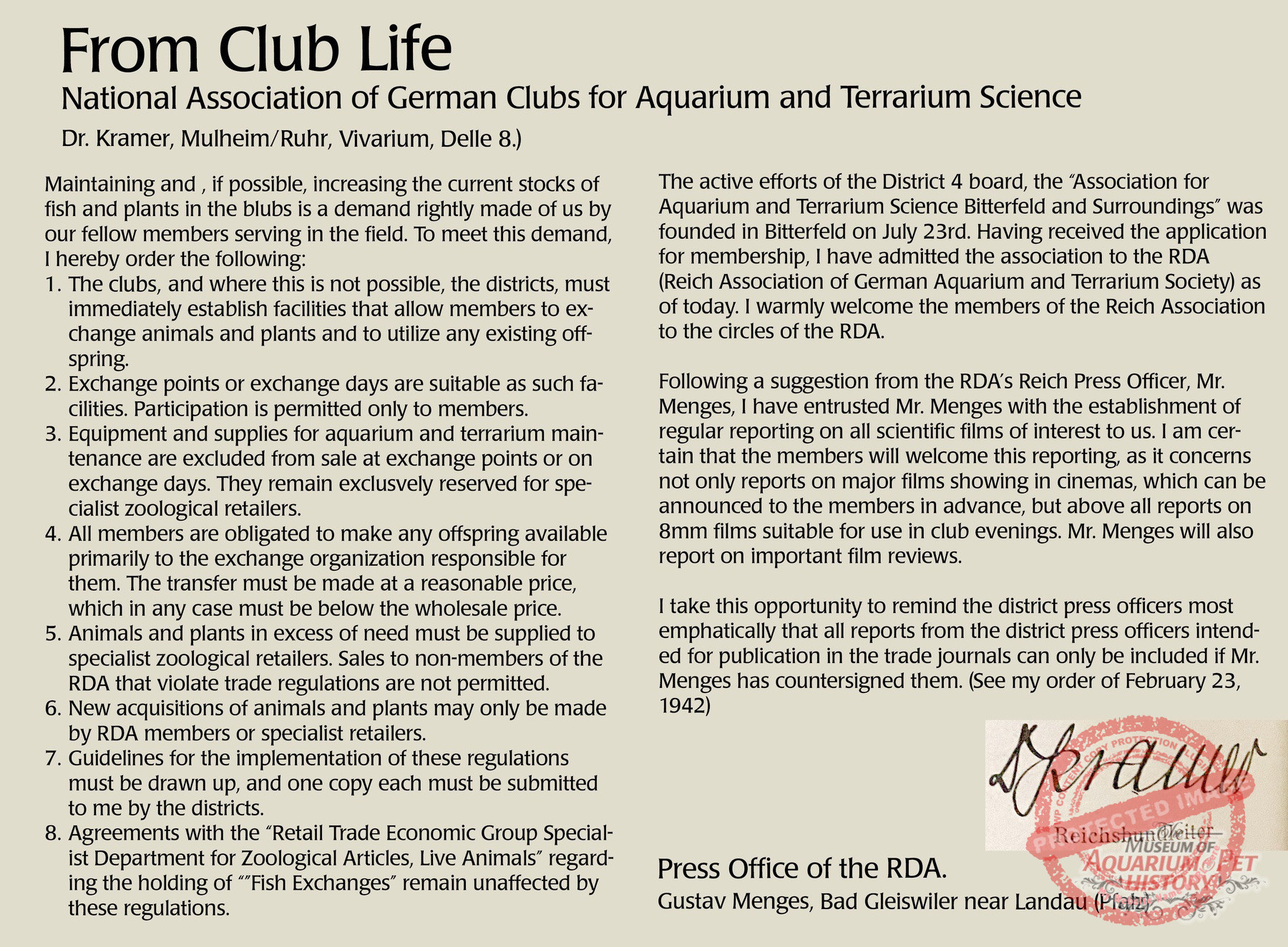
Same article by Dr. Kramer translated into English using notegpt.io.
Reich Forestry Director Göring was likely pleased that some soldiers sent to the Eastern Front, who were also club members, reported as long as possible on the natural features of the territories conquered for Germany. These articles (all in the Wochenschrift) read differently than travel reports from foreign countries. Every sentence carried the thought: “This is now mine, Germany is vast.” In nearly every 1942 issue of the Wochenschrift, such reports appear. For example, Hendrik Stefan Gayda wrote about “Herpetological Observations from the Kuban,” a river in the northern Sea of Azov: “During the all-consuming life at the front, there were joyful days when it was possible to pursue the subtle hunting of creeping creatures.” The war-driven hunting of humans, however, was evidently not so subtle. Dr. G. Friesen described “Pond studies in northern Russia” in a neutral, scientific tone. In contrast, O. Streck in “Observations on amphibians and reptiles during my stay in northwestern Russia in 1942” proudly describes what was later partly declared German homeland:
“Even 1000 kilometers deep into Russia. In our beautiful Germany we have experienced quite cold winters, but not down to 52° below zero. Snow meters high, lakes and rivers frozen meters thick. And yet spring must also come here!” For many, it never did. The Russian winter of 1942/43 was the death blow to German aggression in the East and claimed the lives of many German soldiers. A letter to Dr. Willy Wolterstorff titled “From the War File of the Editor” reads: “In the East, February 1942… I have now been in ‘Stalin’s Paradise’ for seven months, which in winter is even more desolate. … Much has already been written in newspapers about the people of the Soviet Union, so everyone can form an impression of their existence. I would like to tell you something about the animals.” It sounds bitter, partly sarcastic, and the writer, against better knowledge, lacks the courage to tell the truth about the people. Reading the aquarium and terrarium journals of those years, one can, despite censorship, learn about the mental state, the difficult situation, and the hardships of people, often about matters far beyond the hobby. In times of crisis, niche media like the Wochenschrift became relatively lightly censored outlets for nonconformists.
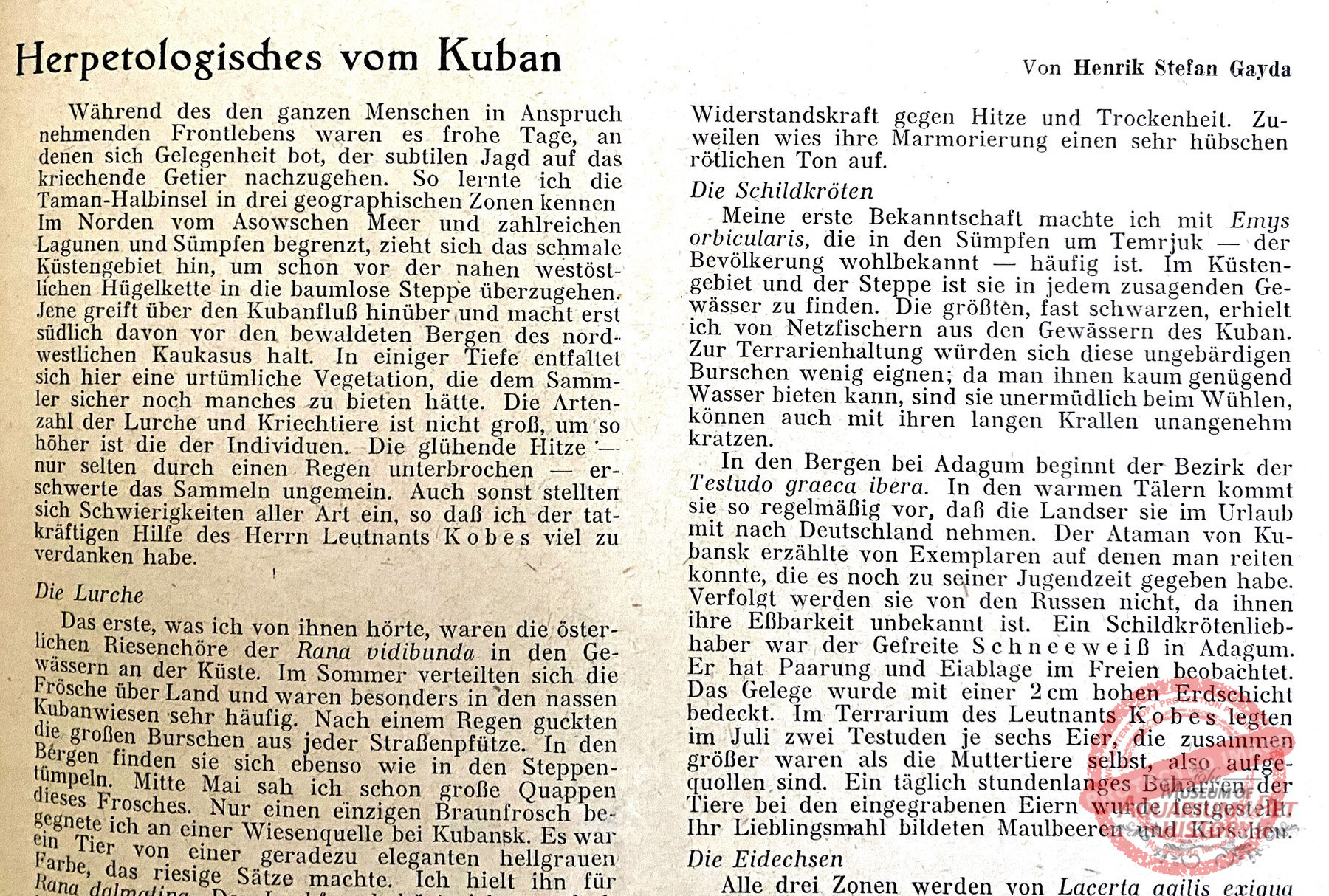
A 1942 Wochenschrift article on the Kuban region, written during the campaign against the Soviet Union.
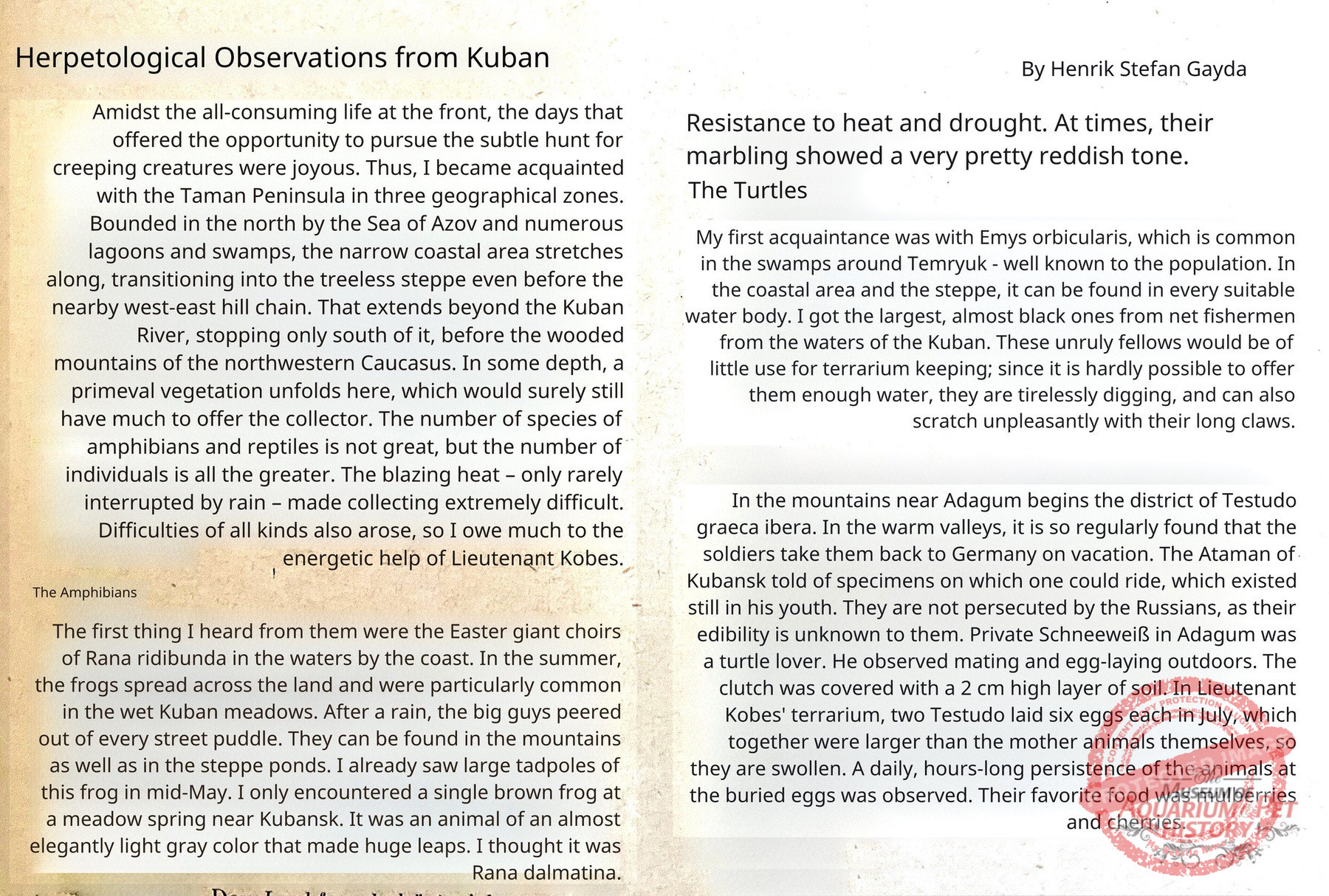
Same 1942 Wochenschrift article as previous page translated into English using notegpt.io.
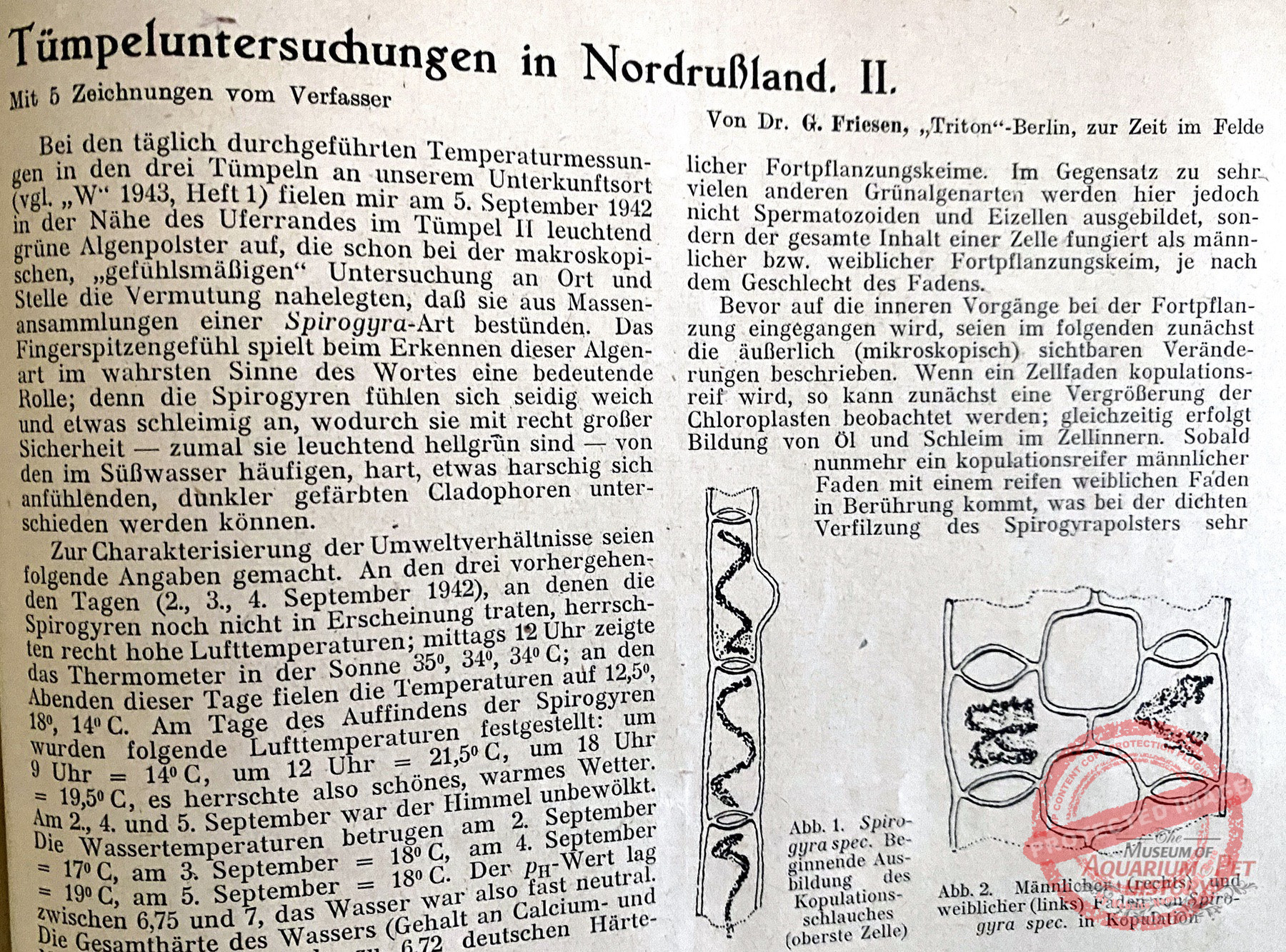
Neutral and scientific in tone is Dr. G. Friesen’s 1942 contribution on pond organisms in northern Russia, submitted from the Eastern Front.
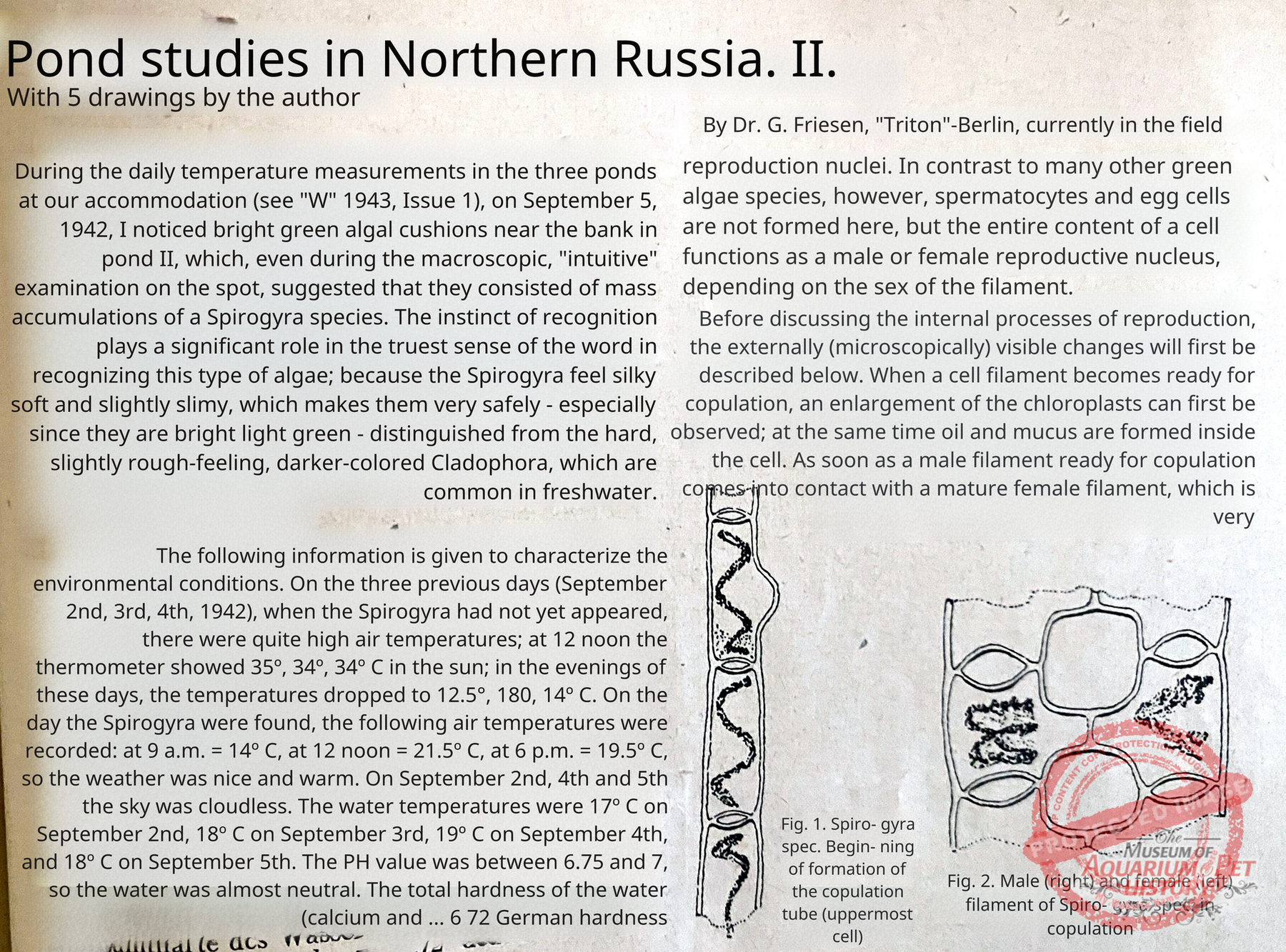
Same 1942 article by Dr. G. Friesen as previous page translated into English using notegpt.io.
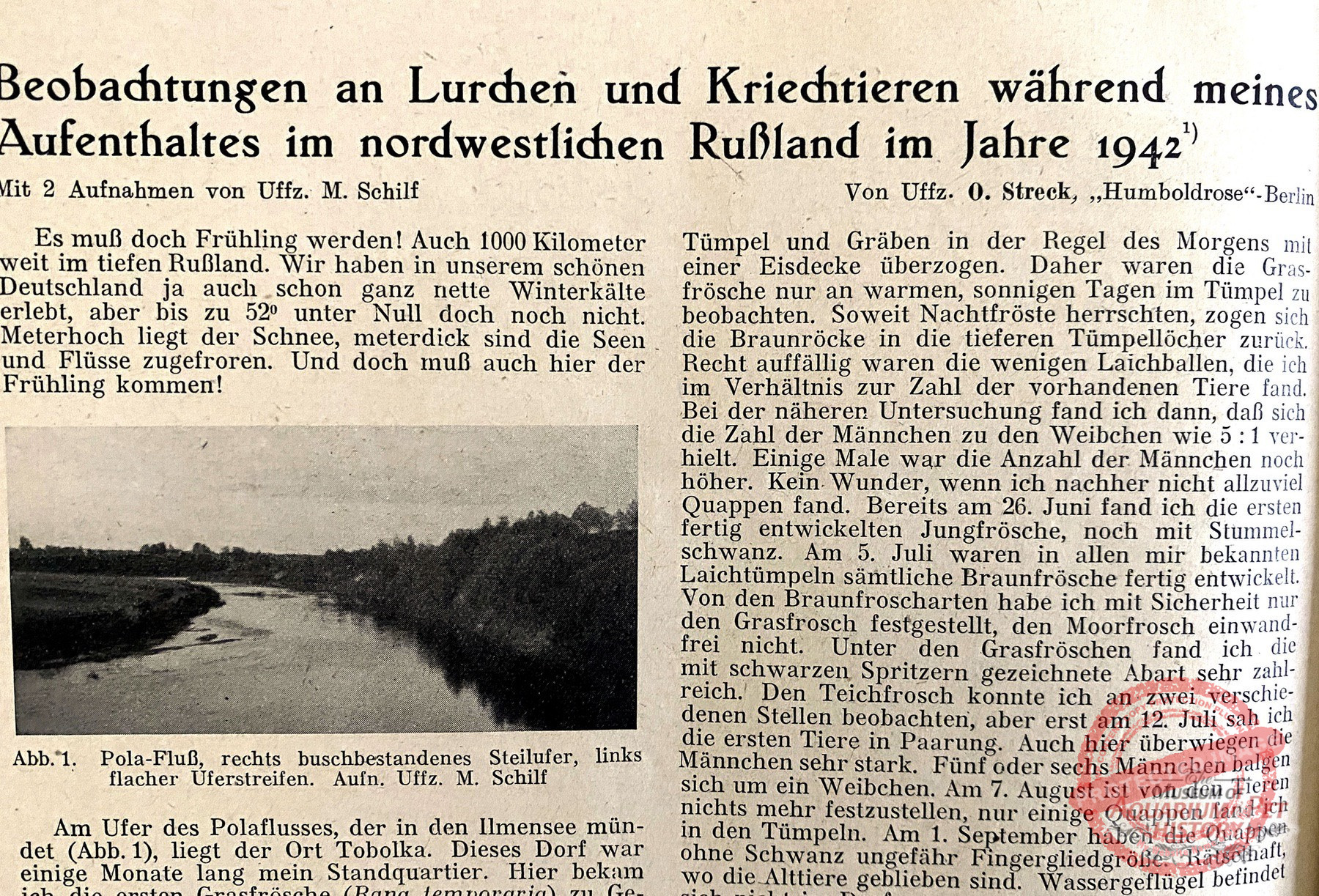
A mid-1942 Wochenschrift article from the front describing amphibians and reptiles in northwestern Russia.
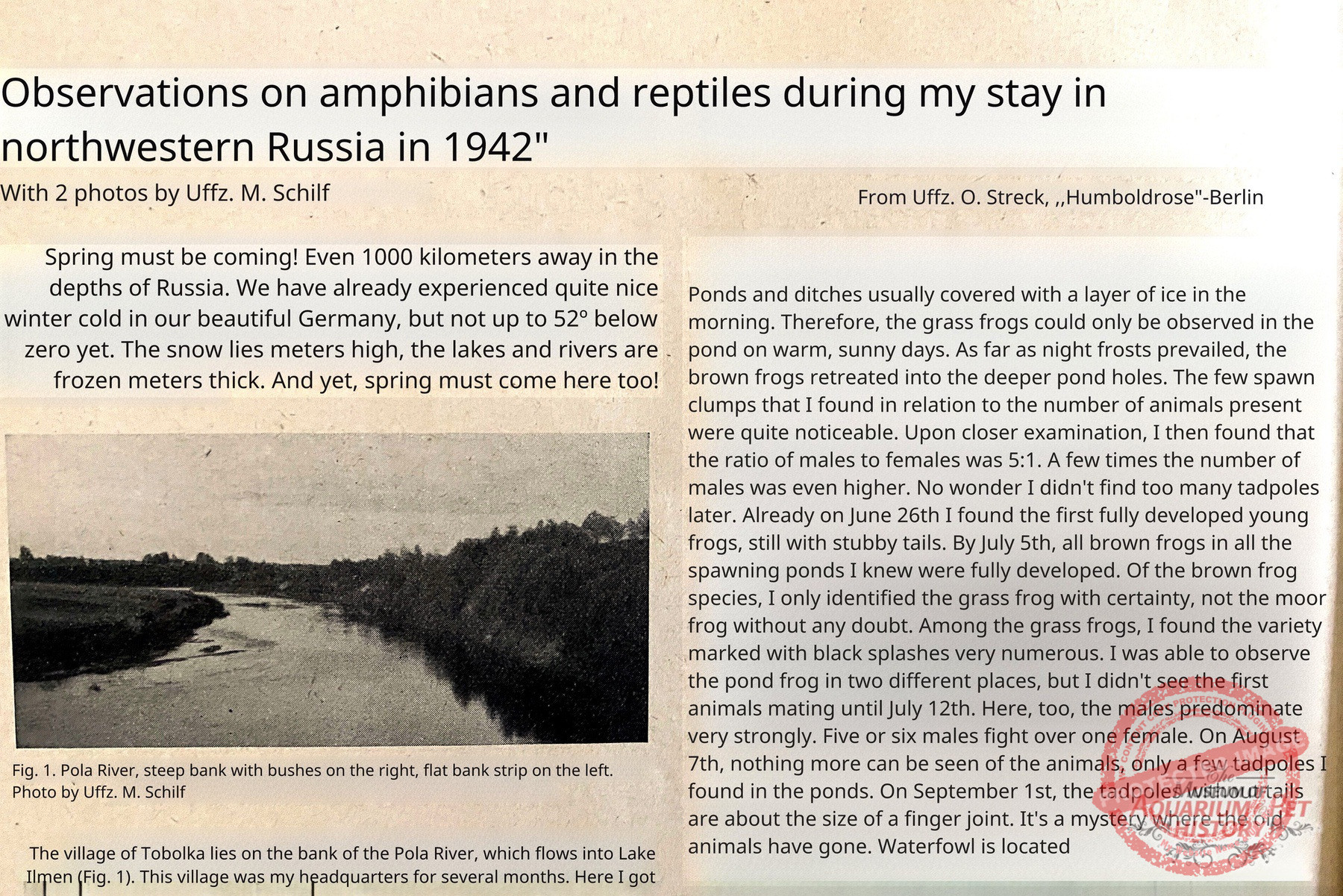
Same 1942 Wochenschrift article about Russian reptiles and amphibians translated into English using notegpt.io.
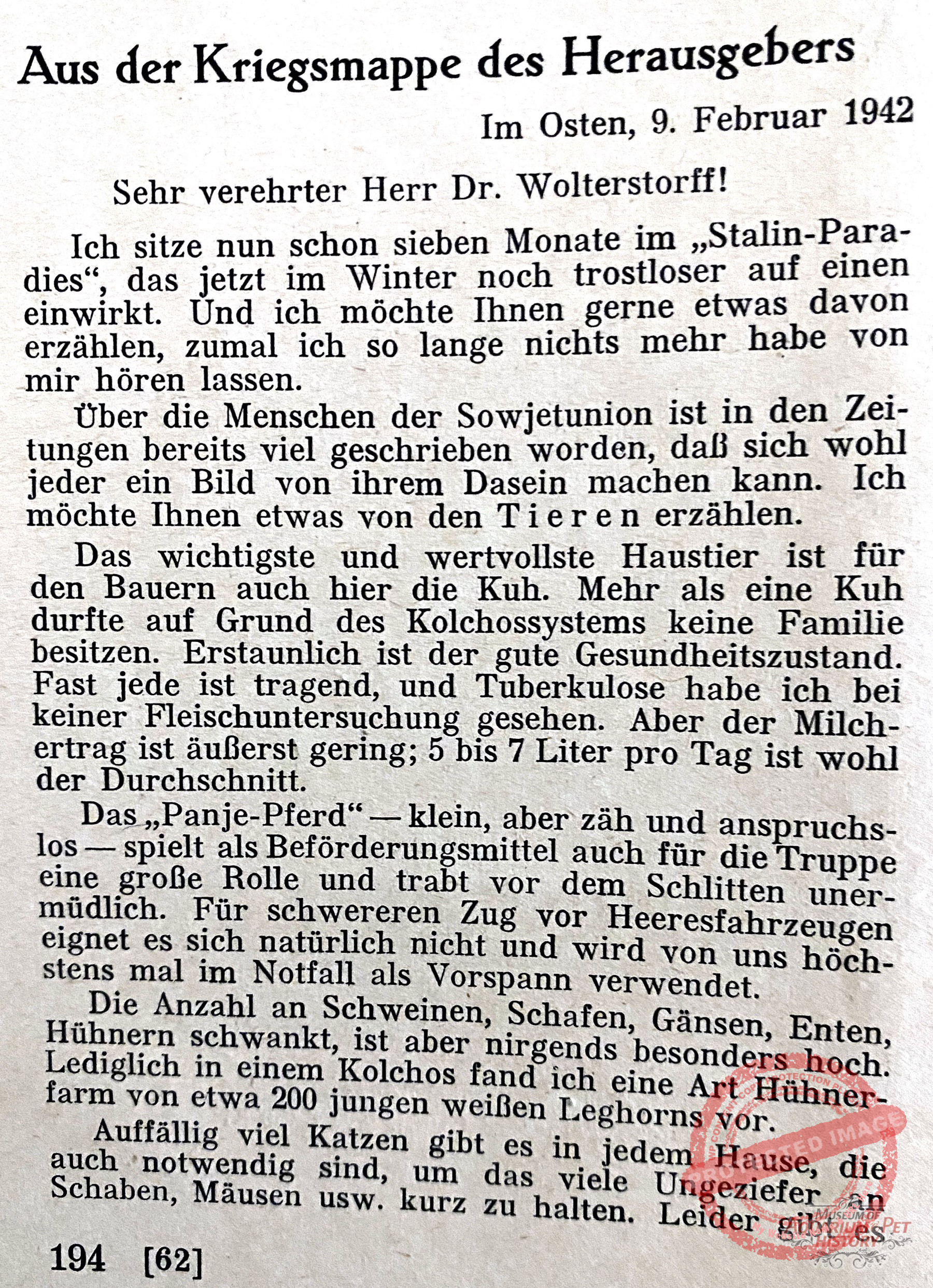
This 1942 letter to Wochenschrift editor Dr. Willy Wolterstorff reveals the fears and anxieties of an aquarist struggling to survive the severe Russian winter without adequate equipment.
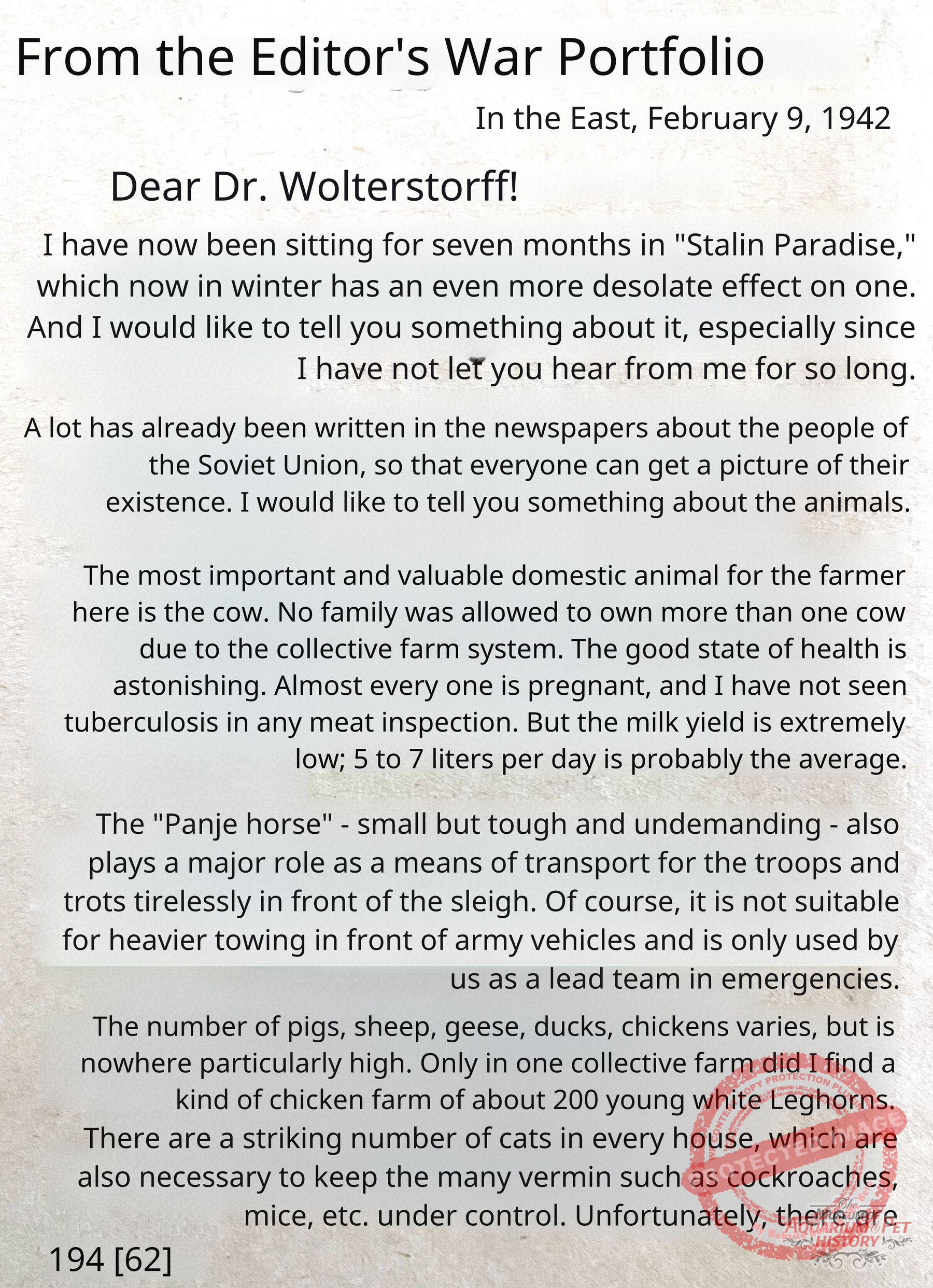
Same letter to the editor translated into English using notegpt.io.
The active Gotha club members tried, more or less, to continue their hobby, although political interference frightened many. Their ranks were thinned by conscription. The least political were members of the Danio club. Mostly simple workers, they had little regard for NSDAP politics. They rarely met for club evenings, instead using the Danio grounds and the small house for occasional gatherings. Economic hardship eventually meant that, after their last official meeting on June 14, 1941, they only met sporadically on a private basis until the end of the war. Another reason was that the Reichsbund had ordered forced unification of Gotha clubs, which no one in Gotha wanted. They preferred to meet secretly and unofficially. Until 1934, Kurt Koch had been the Gau leader responsible for Gau 10 (Thuringia), as seen in the club notes in the Nachrichtenblatt für Aquarien- und Terrarienvereine, the official publication of the Federation of German Vivarists, which was later merged into the Reichsbund through Gleichschaltung with other umbrella associations.
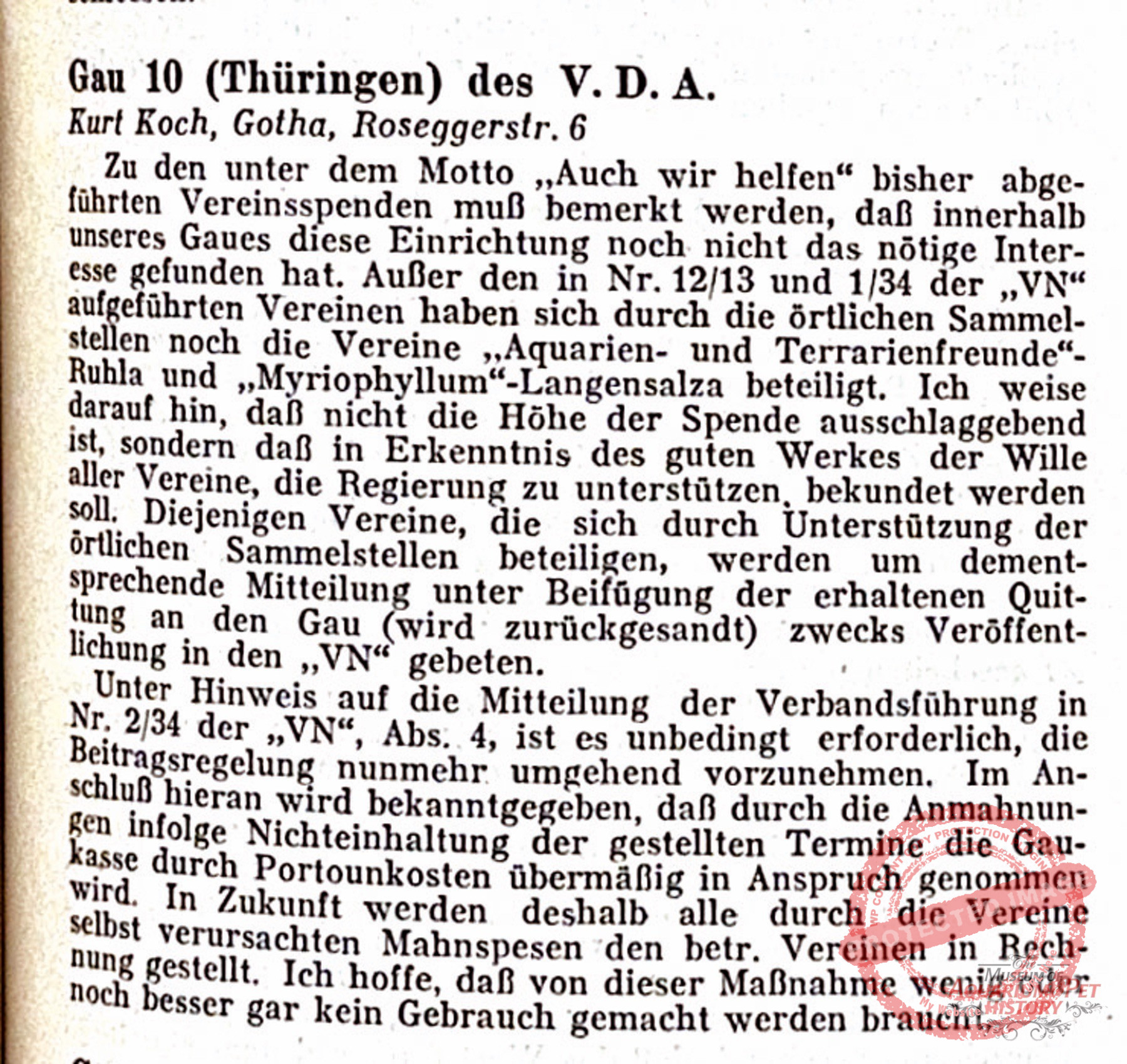
A club notice by Kurt Koch; notably, the designation “VDA” is still used here, whereas the Wochenschrift had already adopted “Reichsverband” in 1934.
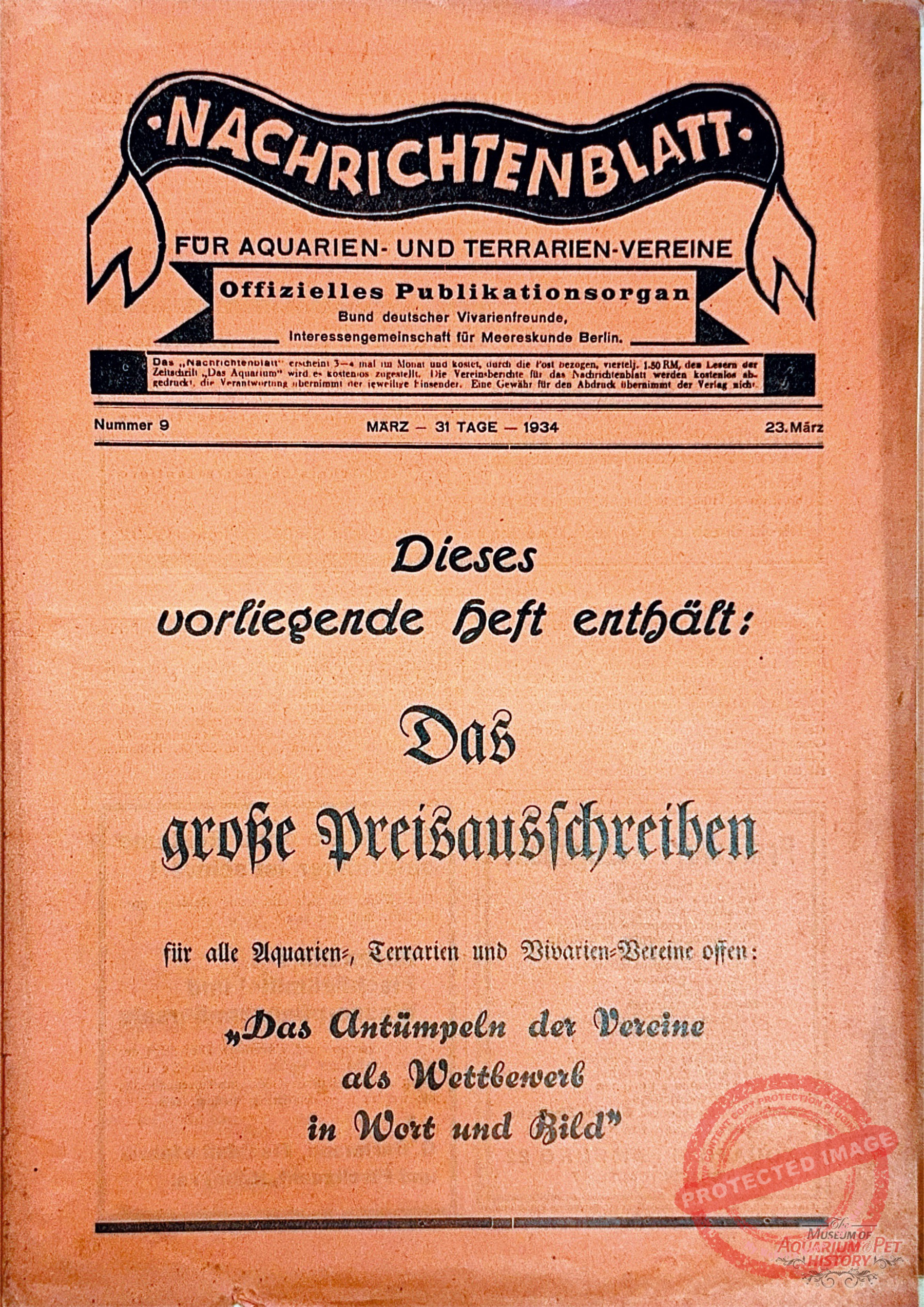
In the Nachrichtenblatt für Aquarien- und Terrarien-Vereine (Newsletter for Aquarium and Terrarium Clubs), Kurt Koch published both club news in his role as Gau leader for Thuringia and technical articles.
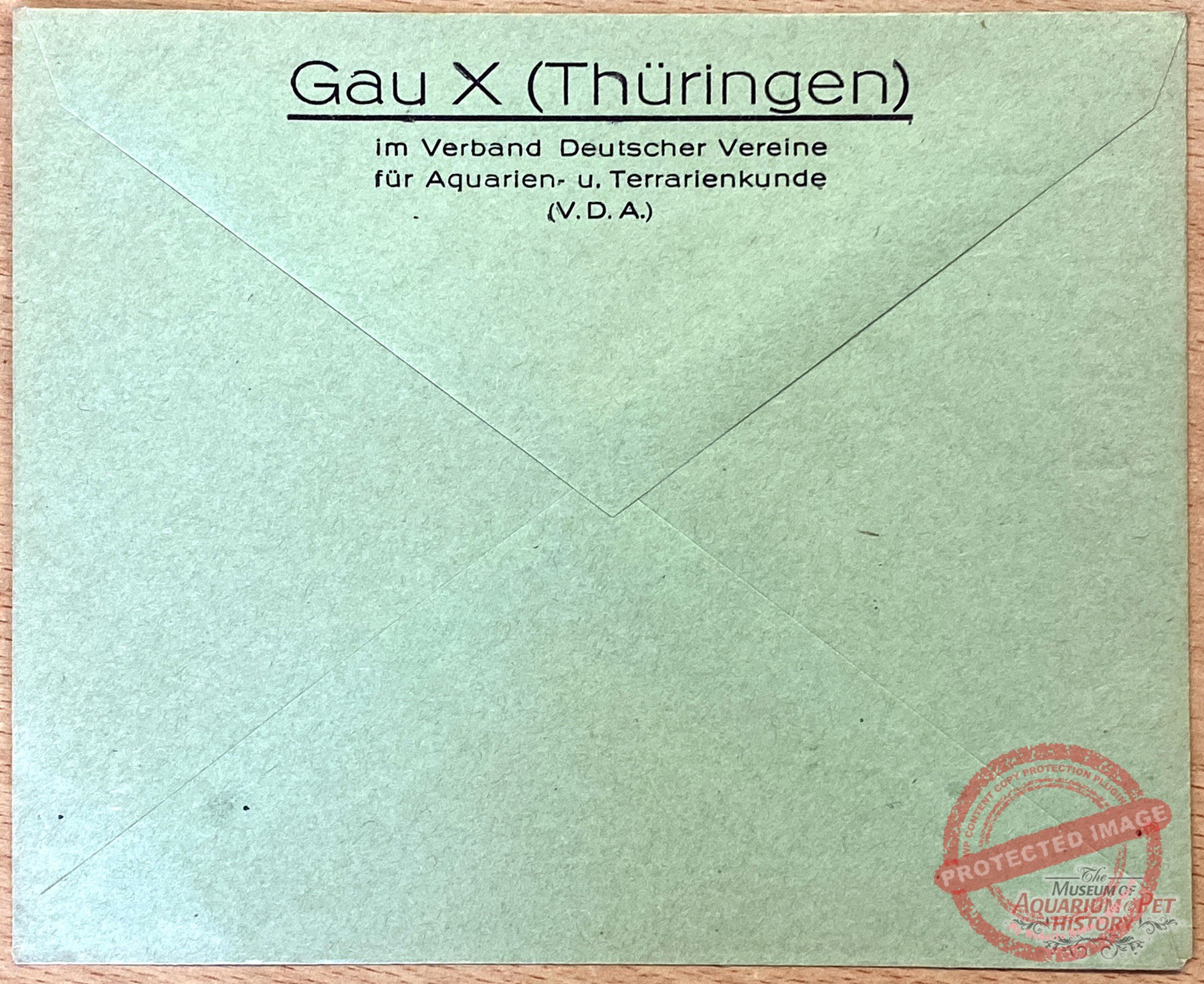
The printed return address on the envelope of Gau 10 (Thuringia) continued to employ the old designation.
During the Third Reich, Kurt Koch increasingly focused on private breeding activities, which also provided his income. He had registered his ornamental fish breeding as a business at Roseggerstraße 6 in Gotha and sold fish almost like a pet shop. As a member of a Reichsbund-organized club, he would not have been allowed to do this. Apparently, for this reason, he gradually let his Gotha club fall dormant. He also certainly did not want forced unification with his previous clubs, Nymphaea and Danio. In the autumn of 1934, he published a remarkably detailed breeding report on Neon Tetra (Paracheirodon innesi) in the Wochenschrift, showing successful reproduction in Gotha’s soft water. His apparently unpublished handwritten manuscript, Für ältere Liebhaber (“For Older Enthusiasts”), likely dates from this period.
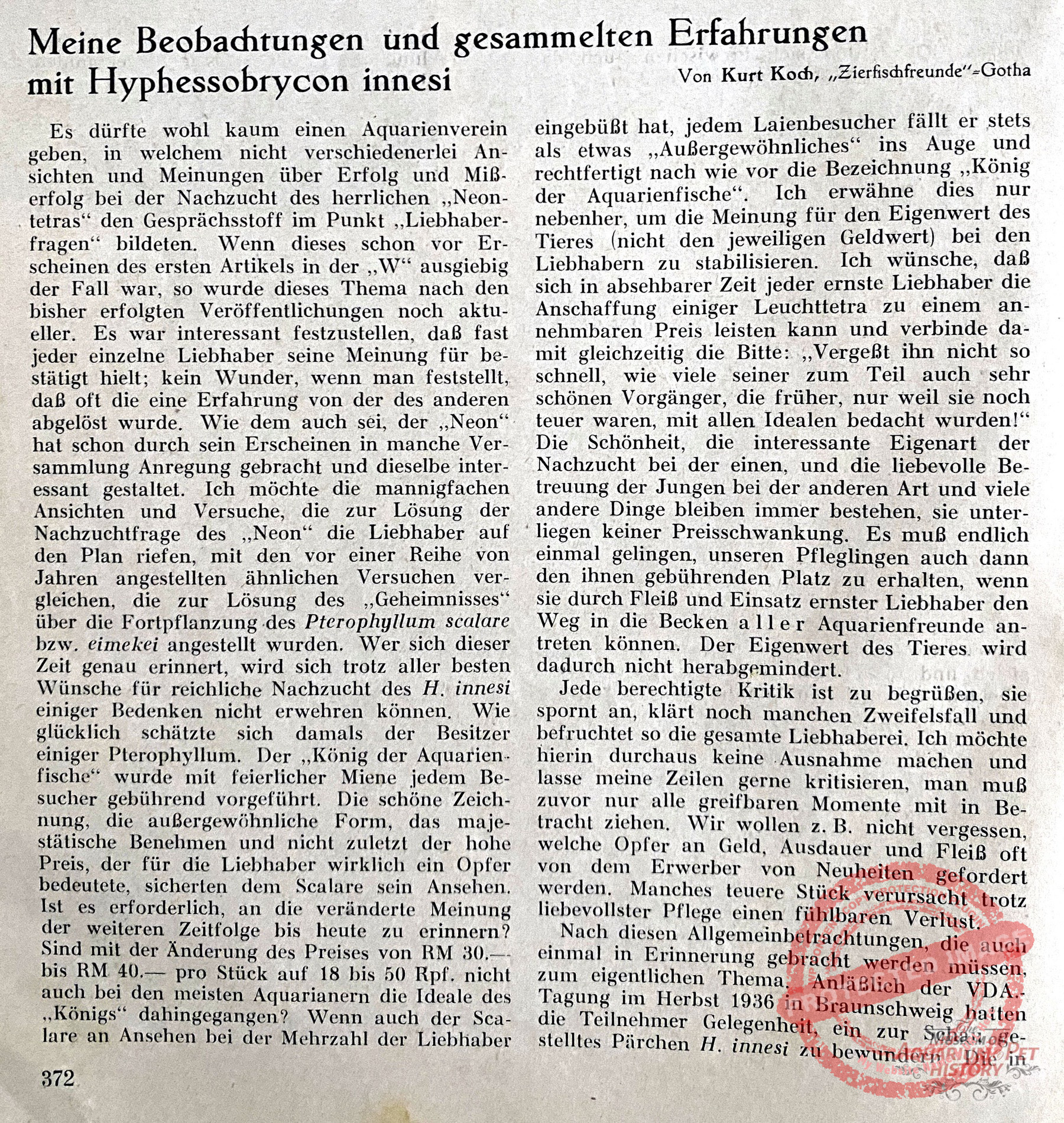
Kurt Koch’s 1934 article on the successful breeding of the Neon Tetra (Paracheirodon innesi) in Gotha’s soft water.
First page of Kurt Koch’s Tetra article translated into English using notegpt.io.
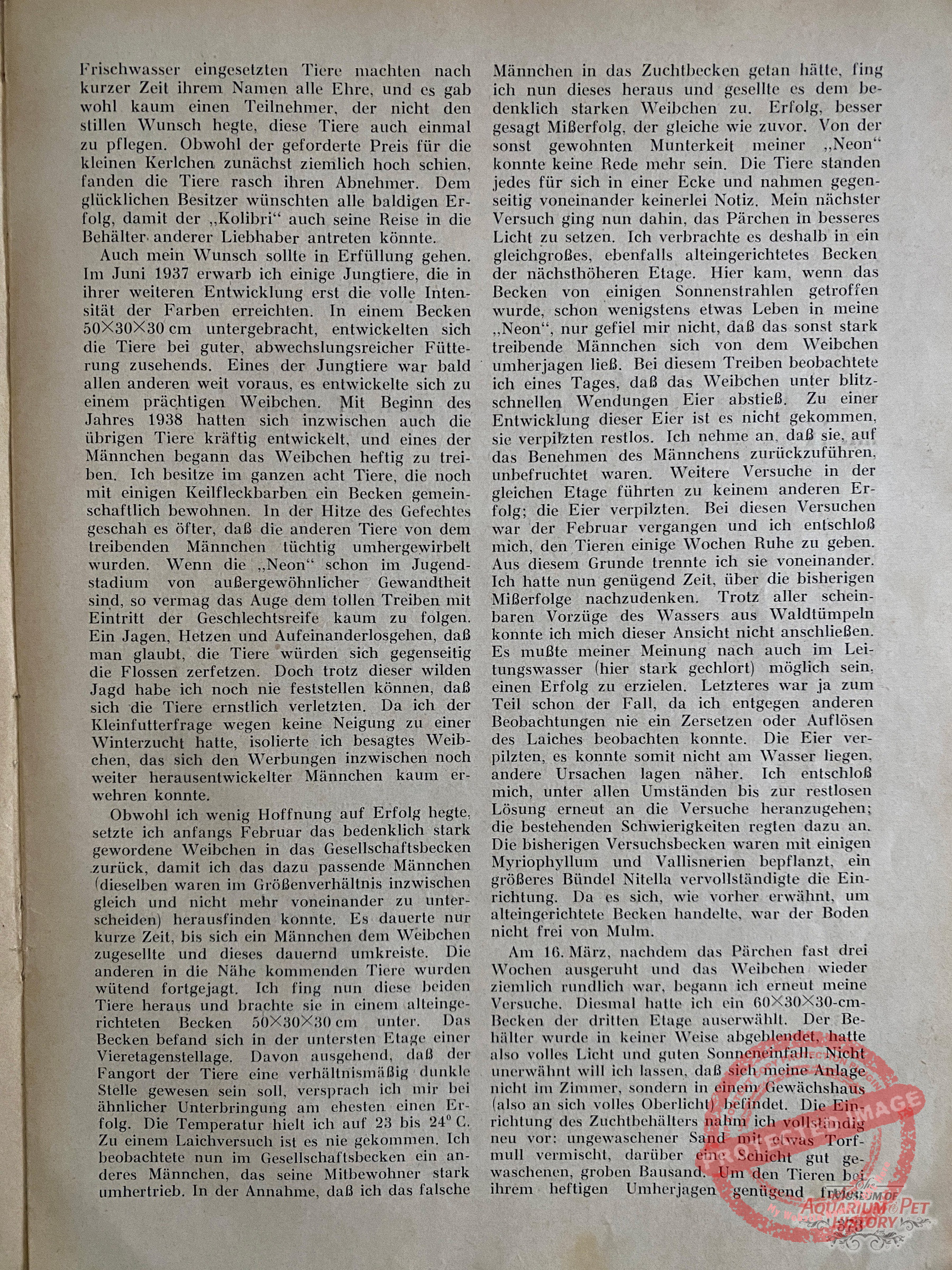
Page 2 of Kurt Koch’s article on breeding Tetras.
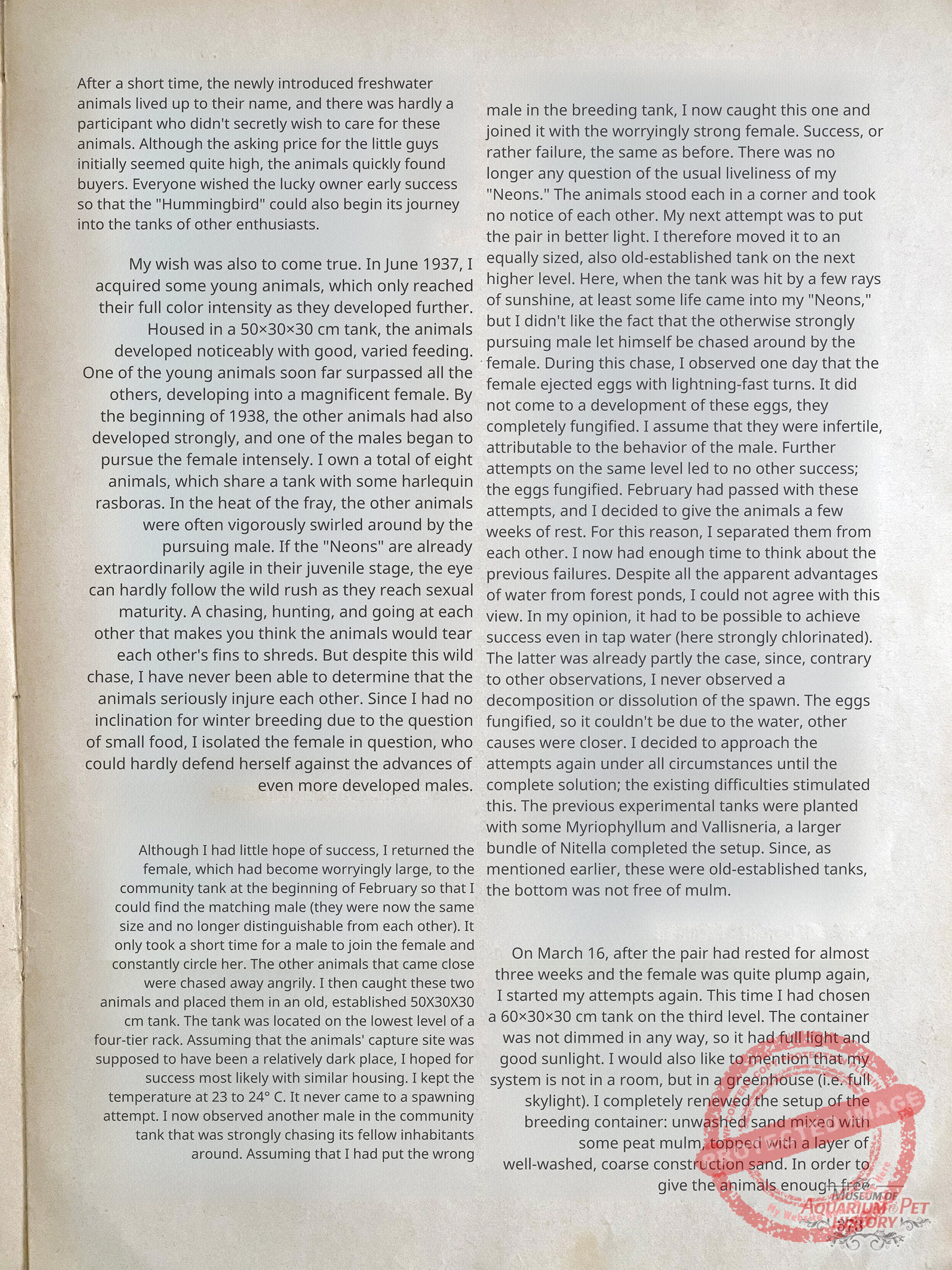
Page 2 of Kurt Koch’s tetra article translated into English using notegpt.io.
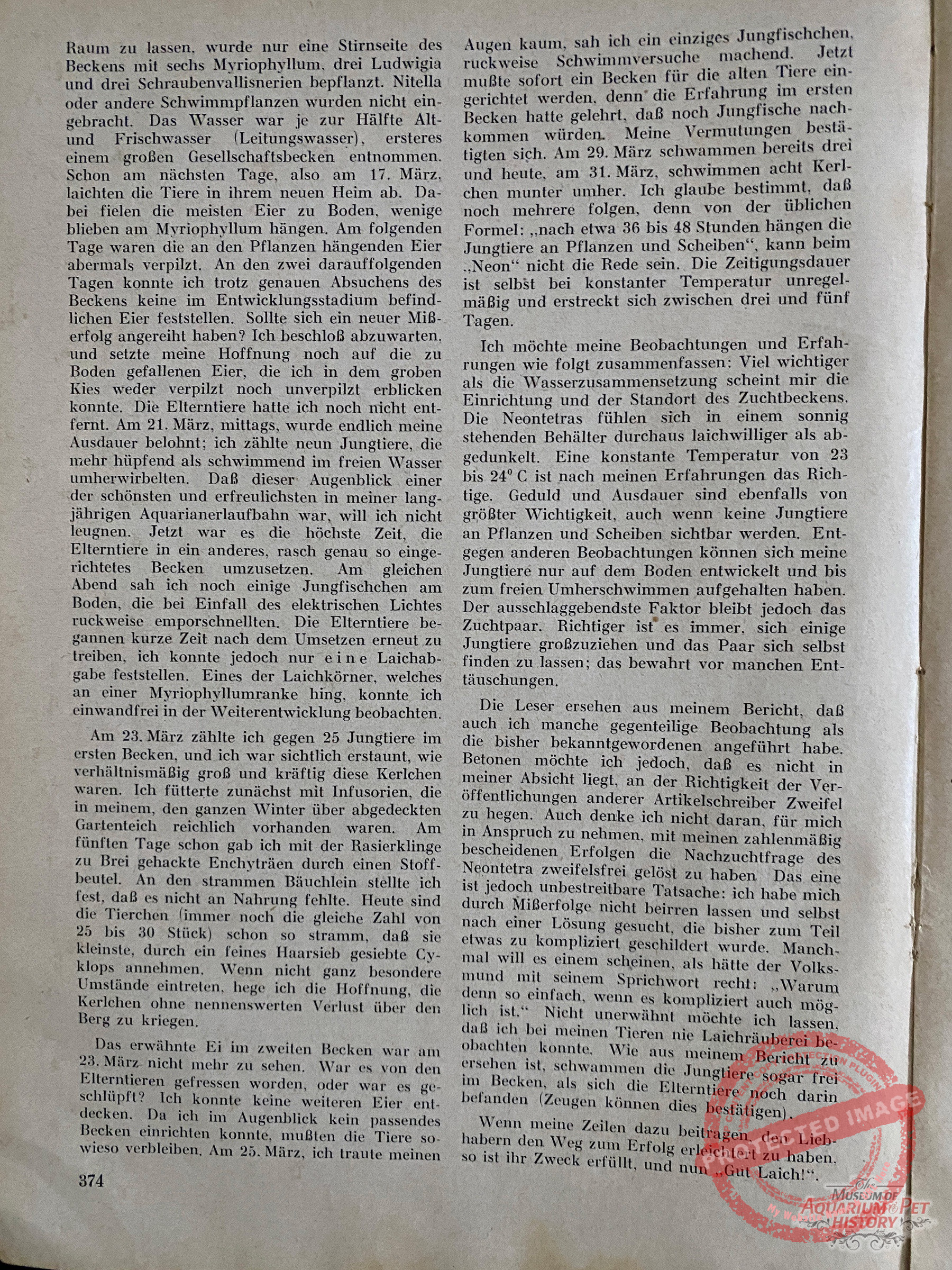
Page 3 of Kurt Koch’s article on breeding Tetras.
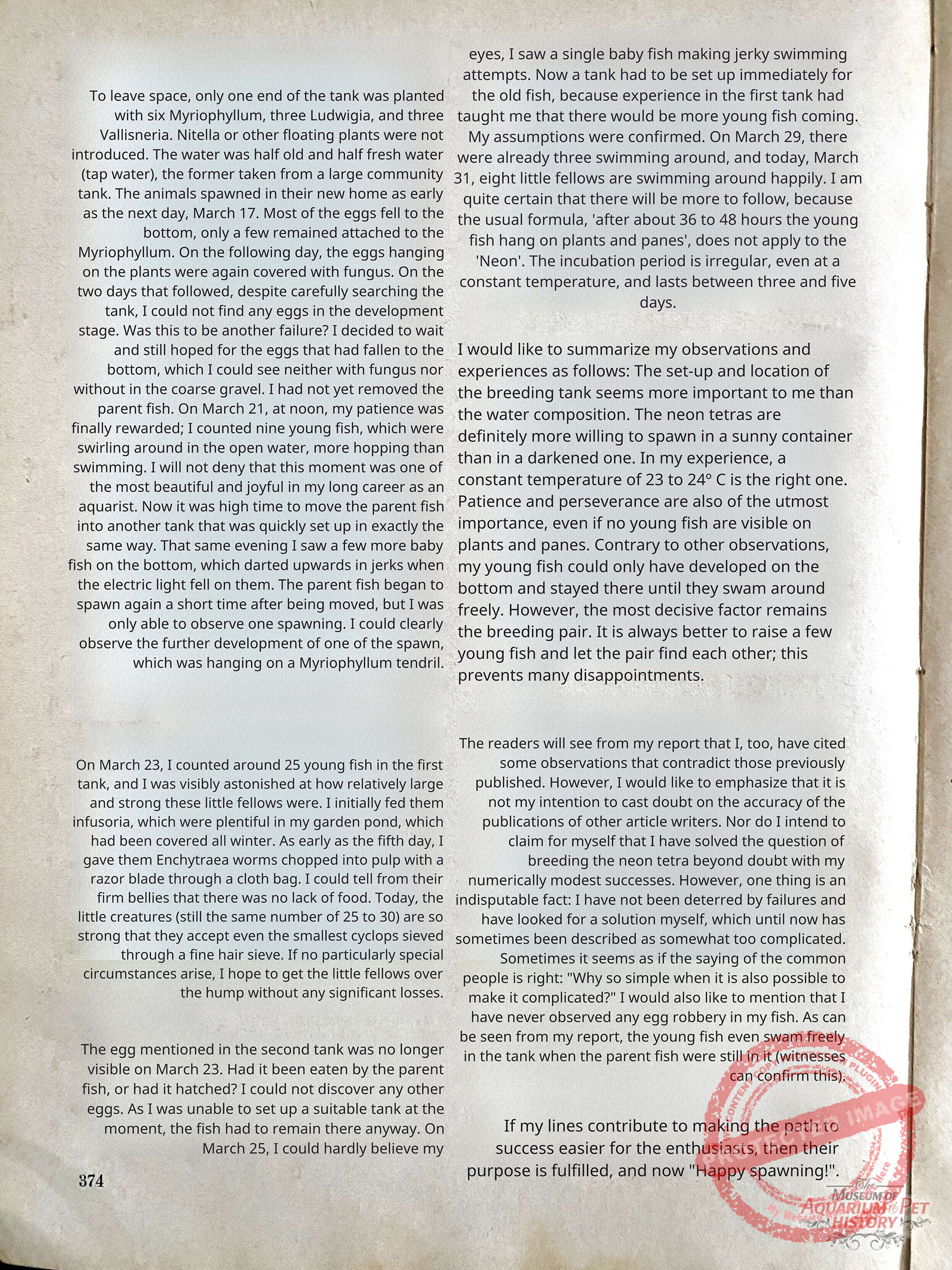
Page 3 of Kurt Koch’s tetra article translated into English using notegpt.io.
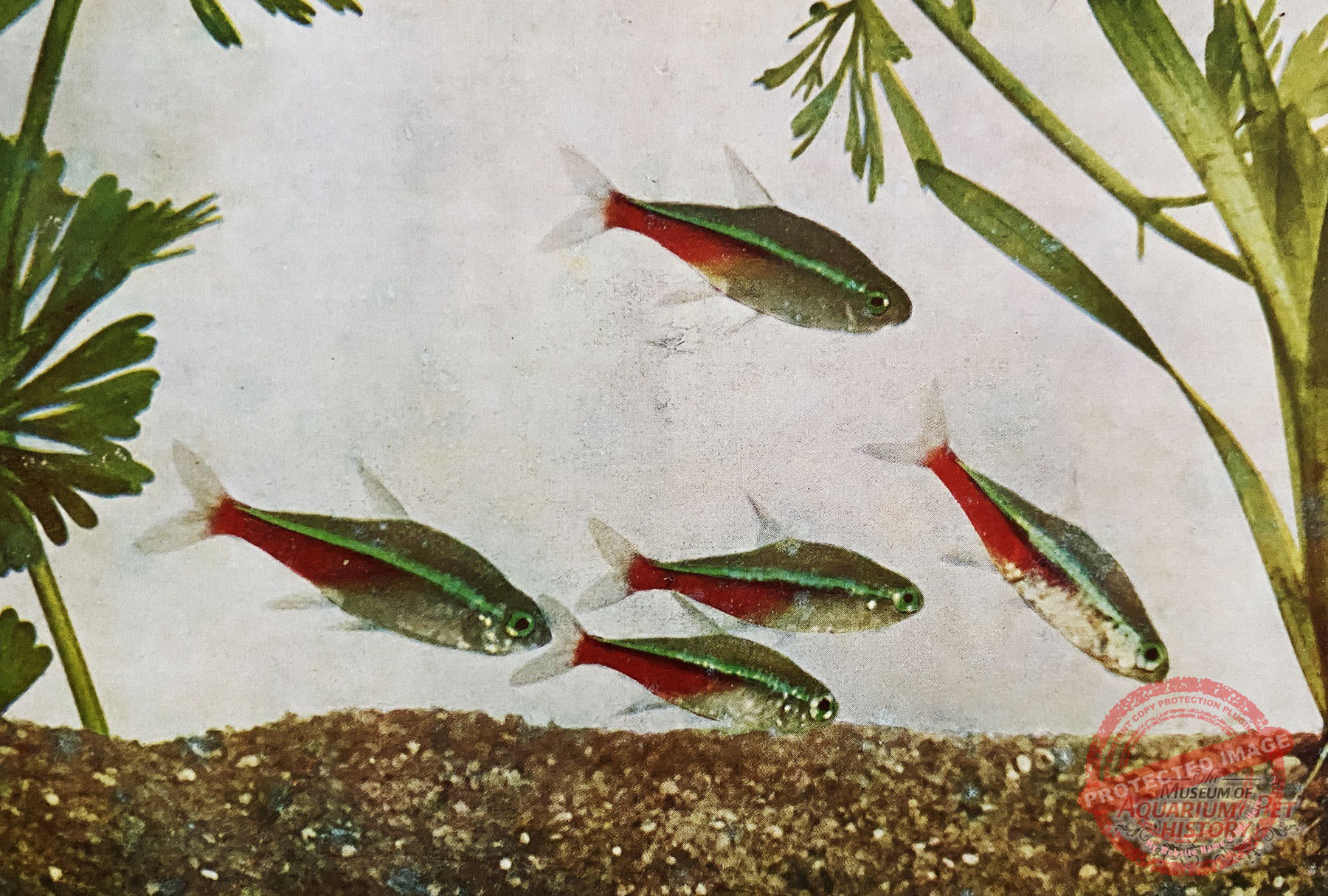
A color photograph of Paracheirodon innesi on the inside title page of the 1939 Wochenschrift volume.
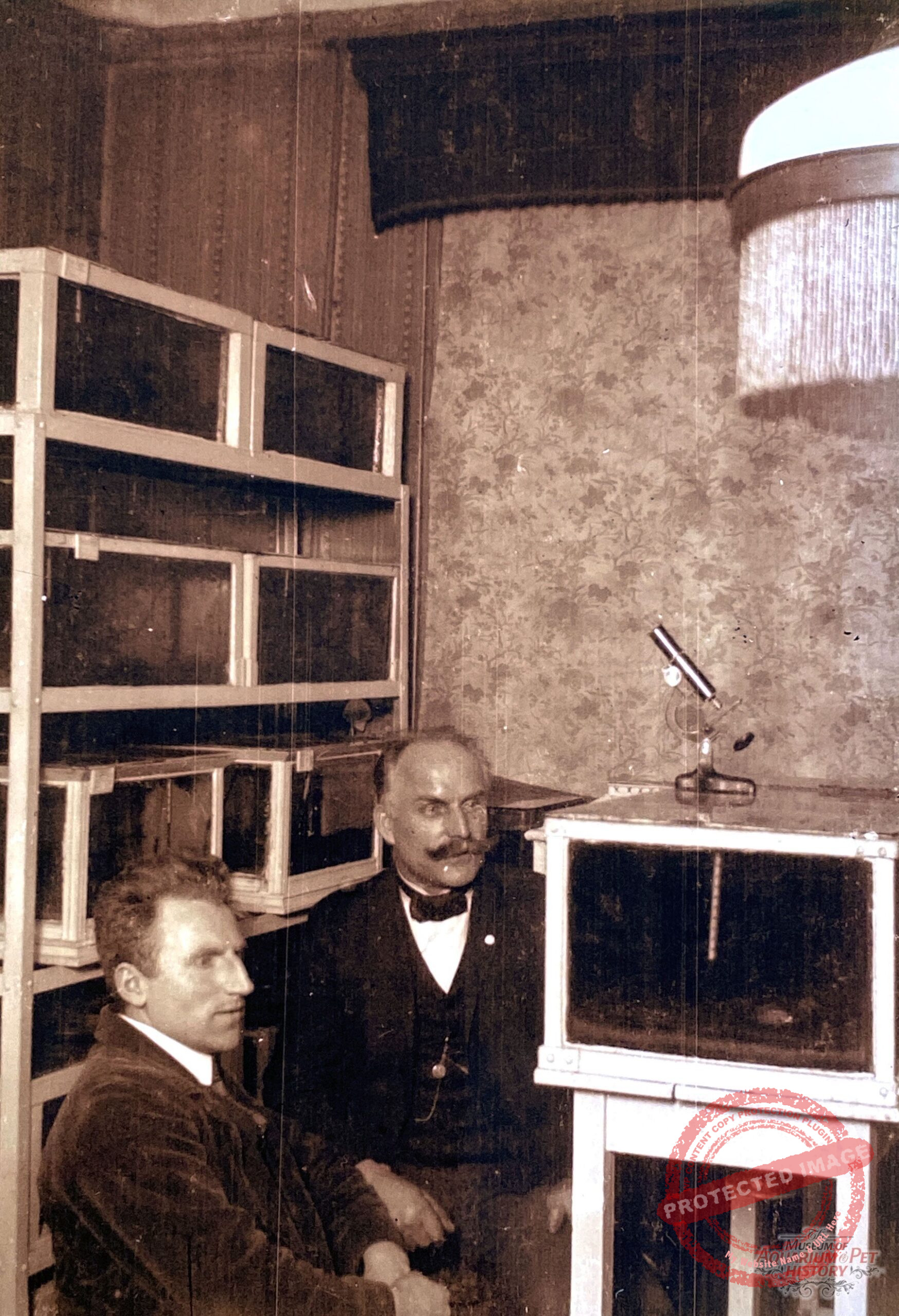
Charly Fuchs (left) with another Nymphaea member standing before their home aquariums.
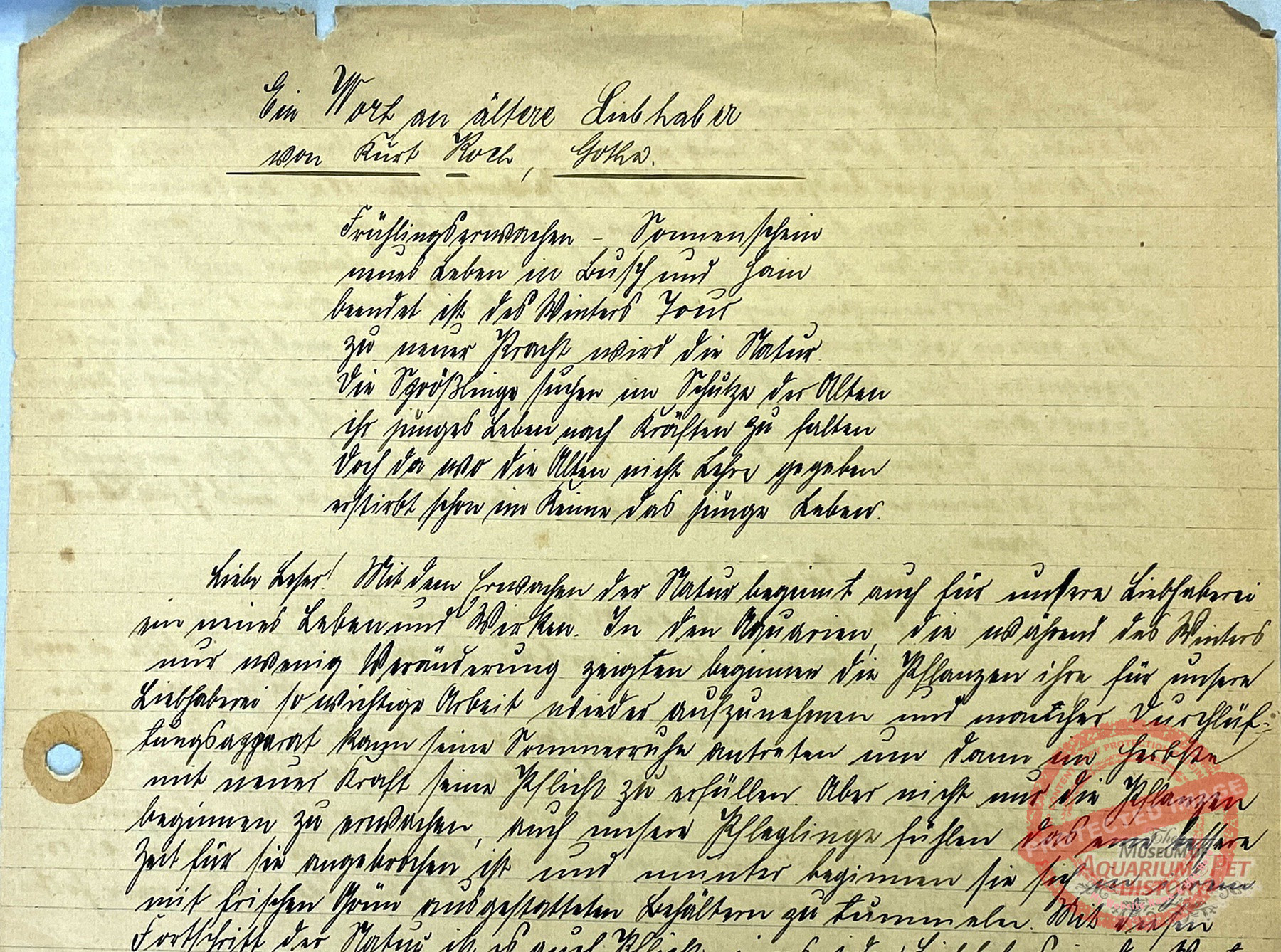
Kurt Koch’s handwritten manuscript, “Ein Wort an ältere Liebhaber” — A Word to Older Enthusiasts. According to perplexity.ai, this letter approximately says:“Spring outings. Always fresh must be life and being,
[the] blood flows so young and fine;
thus our comfort renews the world at night.
The memories lie in the past;for the old
young life is still delightful to fill.
But whoever does not respect the old in life
already loses within himself the young life.
Easter begins again; especially spring also begins for our hobby of finding a place in new works of life. In the homes that do not yet show warm and cozy furnishings, the plants then begin to take up our hobby in earnest work for themselves and to spend many a spring day enjoying their delights, which then becomes a joy in the garden with a shrub. But it is not only the plants that must be made at home; our spring must also feel itself, and the best time for this is … and then they begin to clothe themselves in beautiful fresh green…”
Some recovery of the Nymphaea club occurred from 1936. The war had not yet begun, and the remaining members tried to adapt to supervision and Gleichschaltung. My great-uncle Charly Fuchs took the lead in keeping the aquaristic hobby alive through club activities. Some problems had led to internal discussions. In 1930, the Gotha savings bank had granted a 1,300 Reichsmark loan for building the clubhouse, backed primarily by Chairman Ludwig Kitzenberg. A 1935 reminder demanded 1,270 Reichsmark. Through an installment proposal of 100 Reichsmark per year, the loan was to be repaid. Members increasingly tried to maintain the open-air facility at the Seven Ponds through their own work, while also repaying the bank loan through donations and contributions. Although Kitzenberg was still officially listed as chairman in documents, Charly Fuchs handled most practical matters and correspondence. His address (Riedweg 33—opposite the first open-air facility) always appeared in Wochenschrift club notices after Kitzenberg’s (Schäferstraße 24, near my Gotha residence at Schäferstraße 53).
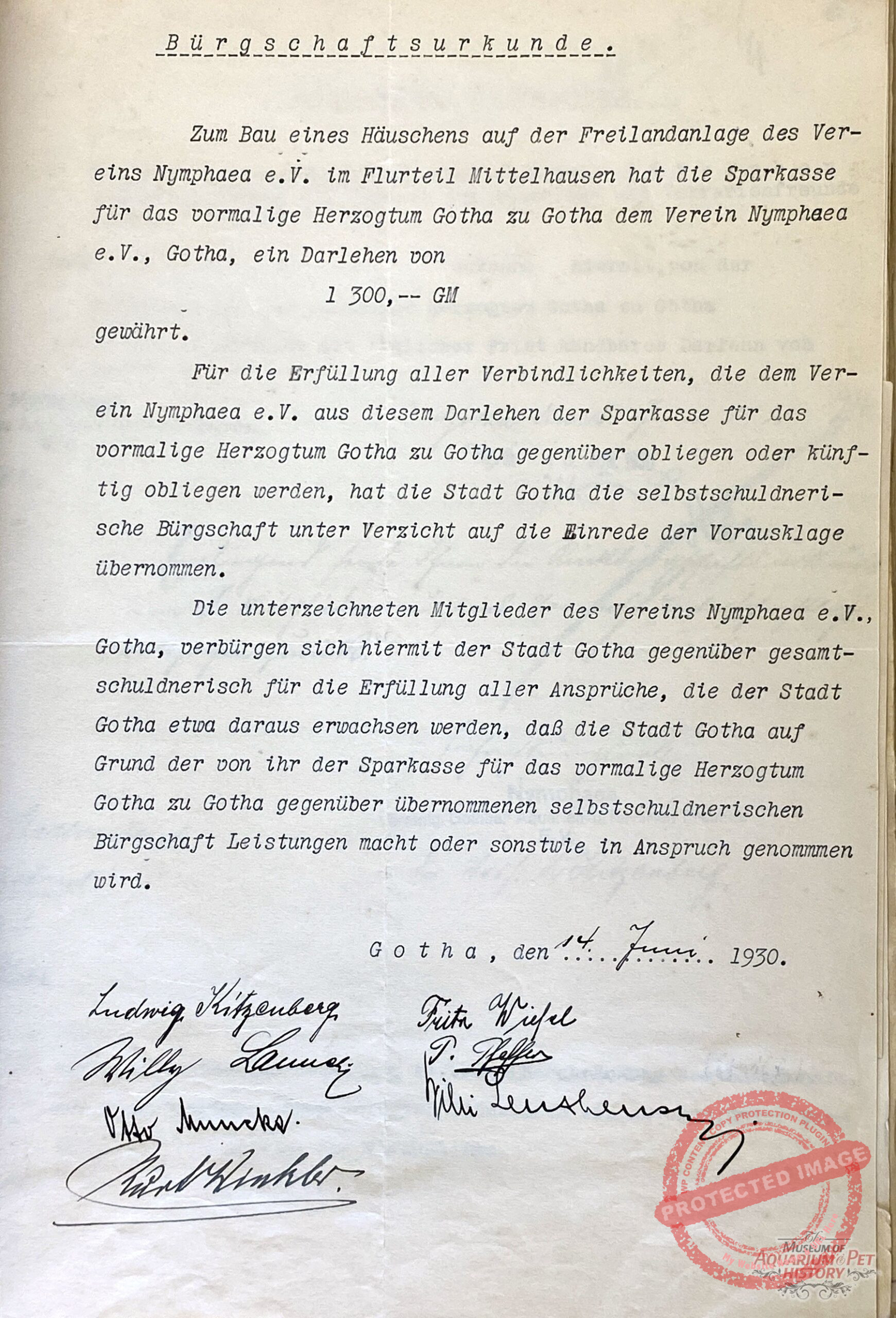
Surety provided by several Nymphaea club members for a 1930 loan from the Gotha savings bank to finance construction of the clubhouse.
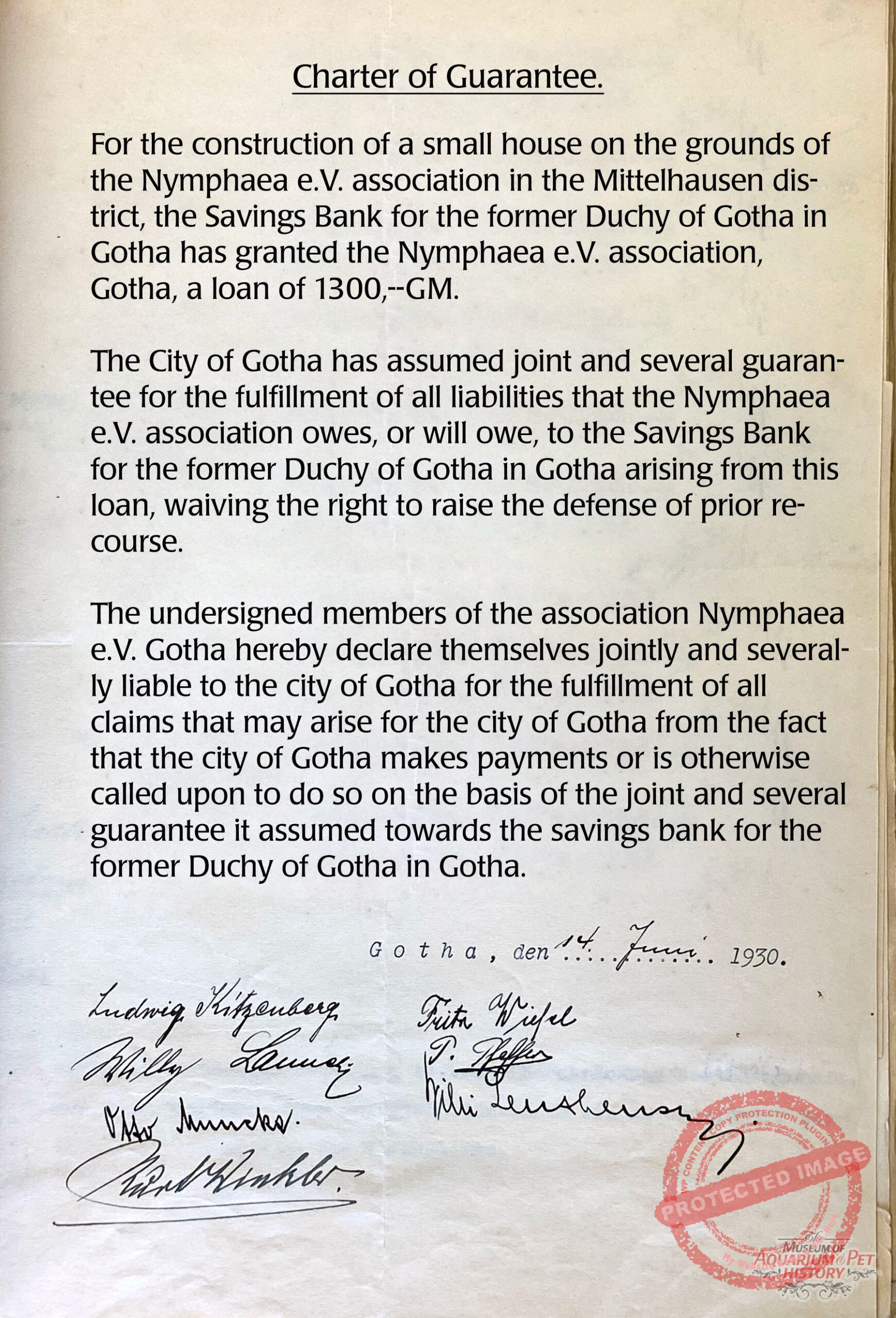
Same document translated into English using notegpt.io.
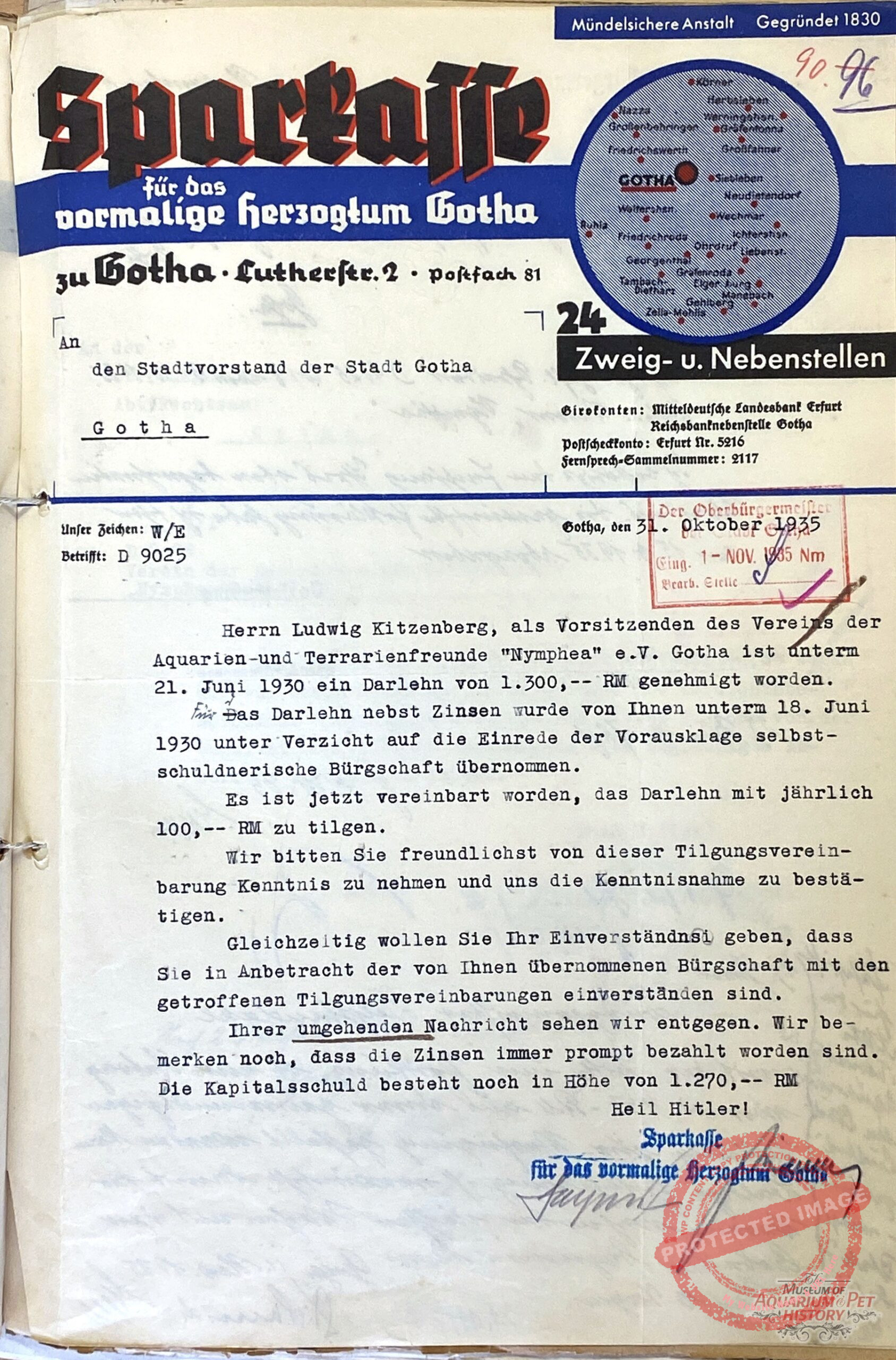
A 1935 deferral notice from the Gotha savings bank concerning that same loan.
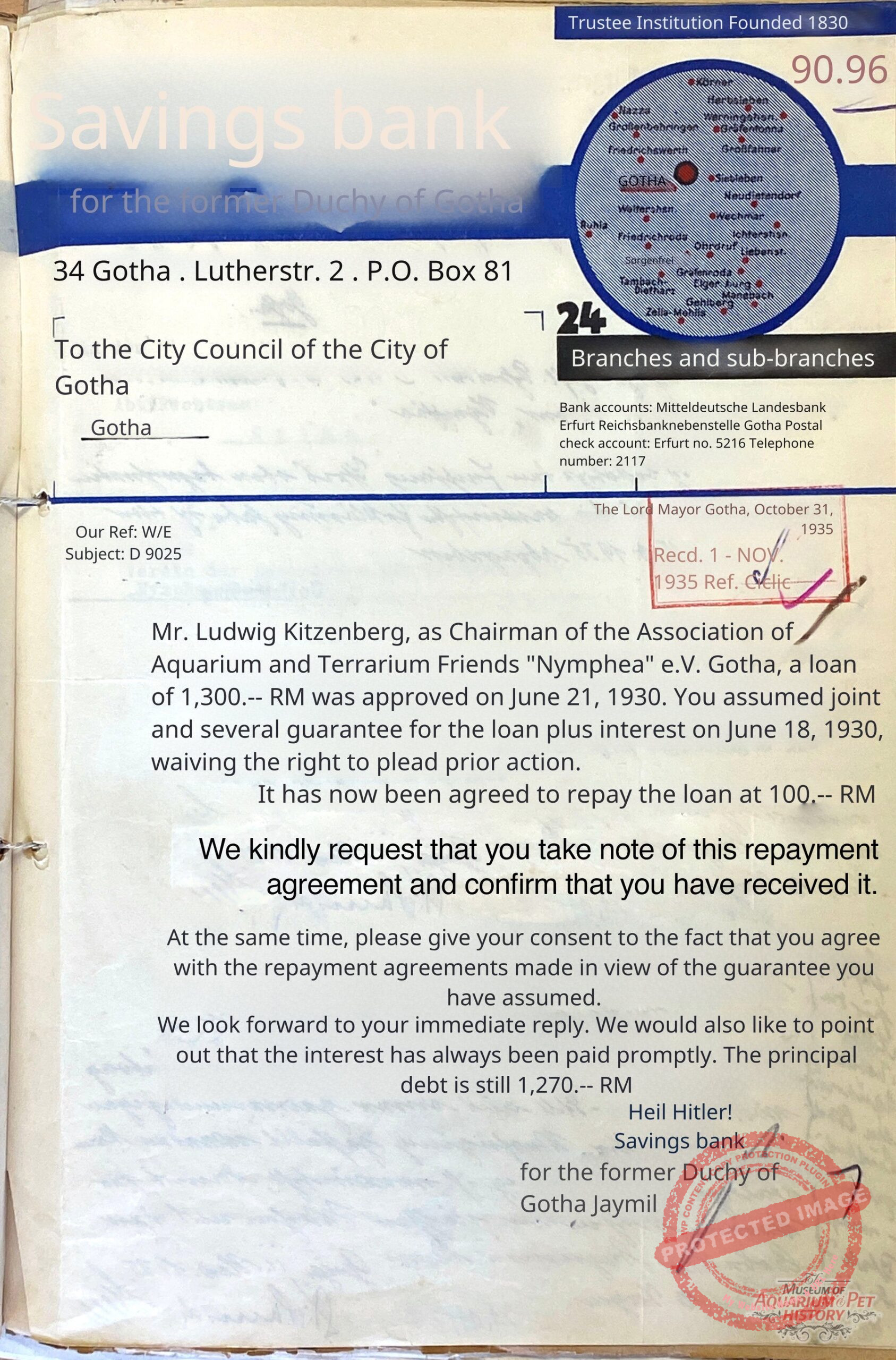
Same document translated into English using notegpt.io.
1939 marked the silver anniversary of the Nymphaea club. For the 25th anniversary, various Thüringen newspapers published articles, and Wochenschrift printed congratulations. A detailed, well-written article by Charly Fuchs appeared in Das Aquarium. Die Fachzeitschrift des Naturfreundes recounts the history under the title “Germany’s Oldest Open-Air Facility” since 1882. At the turn of 1938, he addressed supporters of the club with a greeting letter, warm and friendly in tone, which contrasted sharply with his “Heil Hitler!” signature. Fuchs acted opportunistically to solicit donations for the club, indifferent to the political statements and actions of the fascists, but recognizing the need to survive, especially when corresponding on behalf of a club. Once WWII began and the Nymphaea outdoor facility suffered due to insufficient manpower, Fuchs attempted to settle outstanding debts with the savings bank by proposing that the land and clubhouse be transferred to the nearby Settlers’ Association, which was interested in acquiring it and would take over the bank debts. Neither Fuchs nor other sources provided further information, presumably due to the war, and ultimately the conflict produced a different outcome. The goal of Nymphaea members, especially Fuchs, was to regain the original, debt-free oldest open-air facility from school administration control.
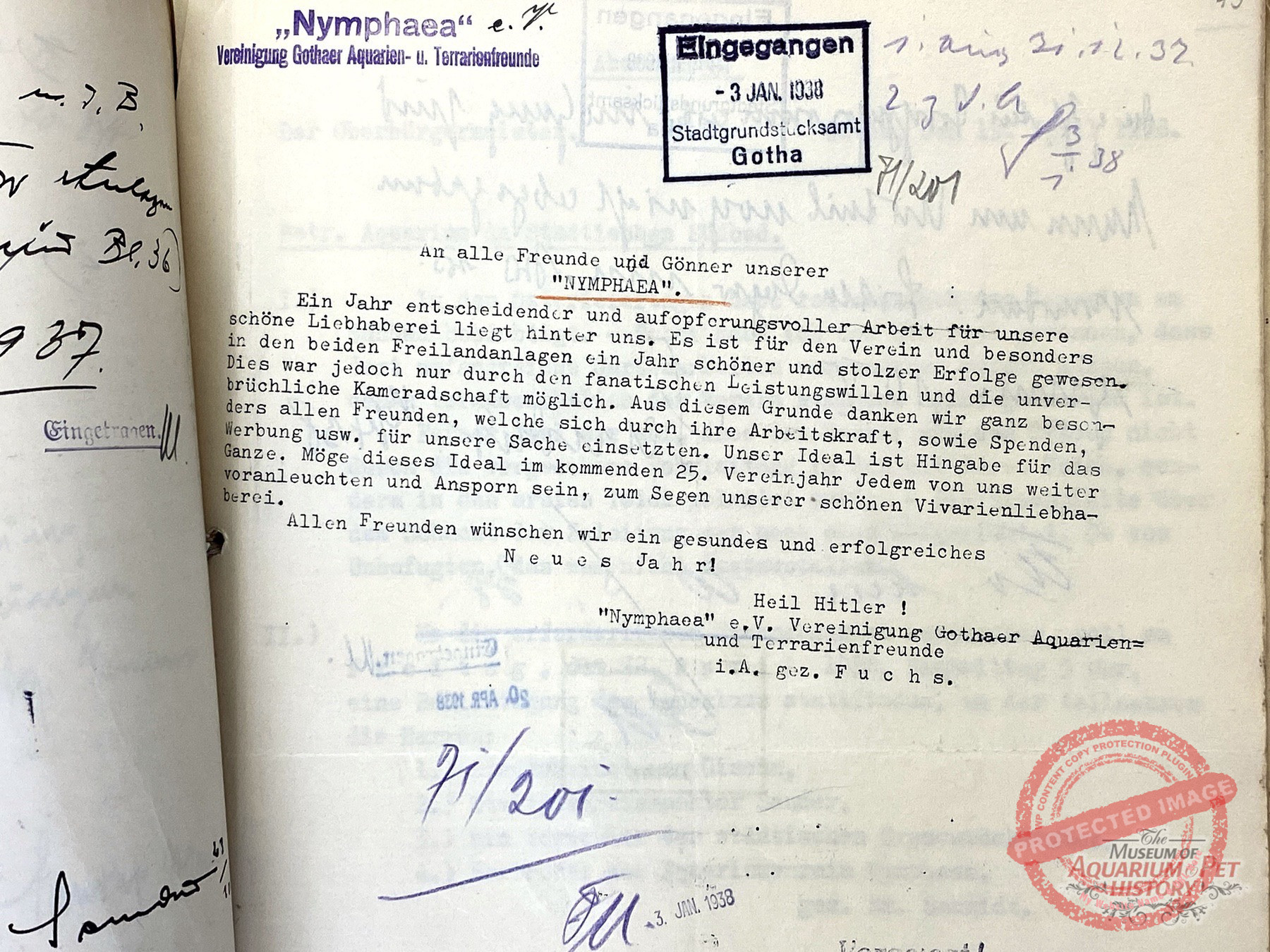
A New Year’s letter from Charly Fuchs at the turn of 1938 to the members of Nymphaea and to the municipal authorities of Gotha, therefore signed with “Heil Hitler!” The text says:
“To all our friends and patrons of our ‘nymphaea’:
A year of decisive and selfless work for our beautiful hobby lies behind us. It has been a year of beautiful and proud successes for the association, especially in the two outdoor facilities. However, this was only possible through the fanatical will to achieve and the unwavering camaraderie. For this reason, we would like to thank all friends in particular who have contributed their labor, donations, advertising, etc. to our cause. Our ideal is dedication to the whole. May this ideal continue to illuminate and inspire each of us in the coming 25th year of the association, for the benefit of our beautiful vivarium hobby.
We wish all friends a healthy and successful year!”
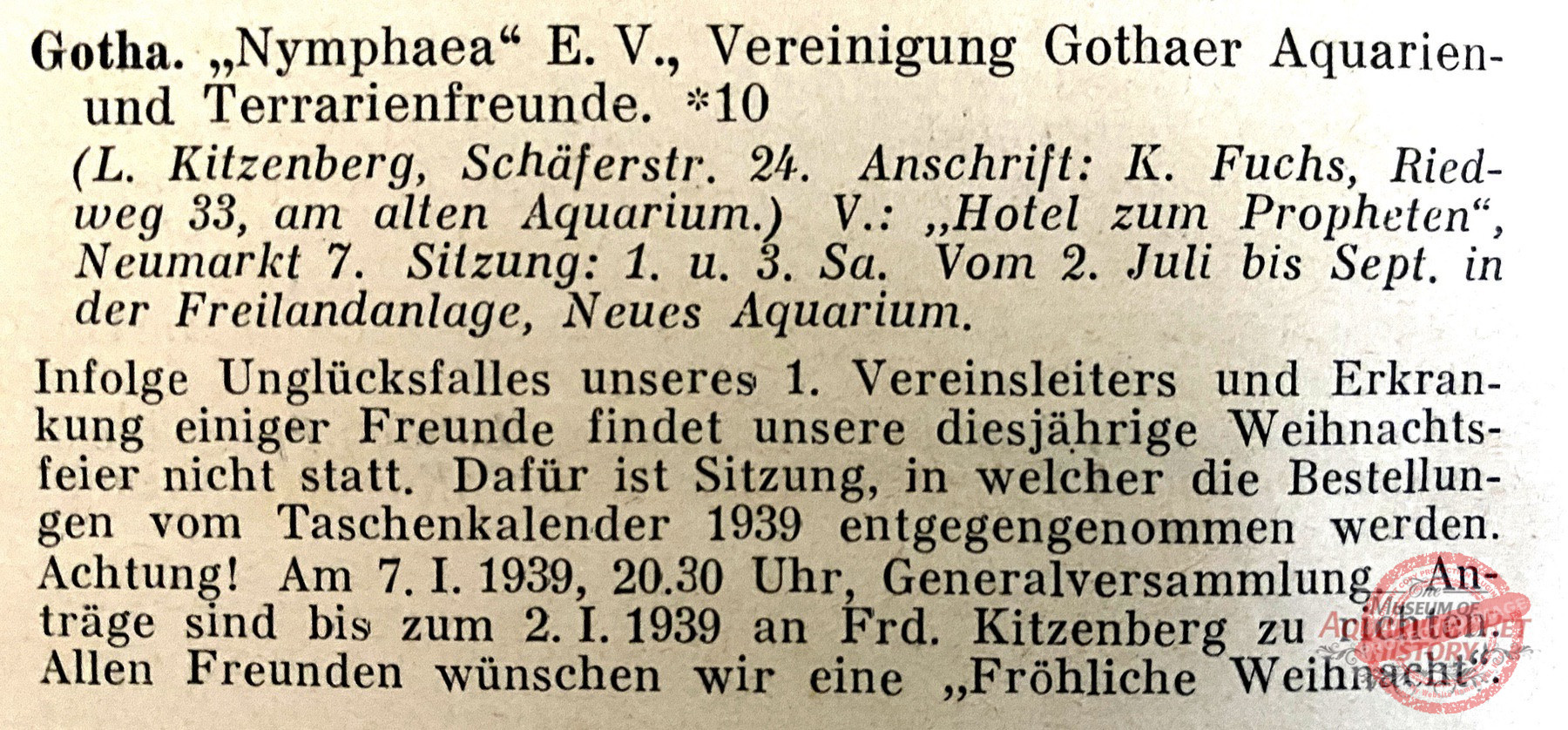
After an accident incapacitated Nymphaea chairman Kitzenberg in 1938, Fuchs assumed primary responsibility for organizing the club’s jubilee celebrations; this is noted in the Wochenschrift. The text says:
“Due to the unfortunate accident of our chairman and the illness of some members, our Christmas party this year will not take place. Instead, there will be a meeting to take orders for the 1939 pocket calendar. Attention! General Meeting on January 7th, 1939, at 8:30 p.m. Motions must be submitted to Mr. Kitzenberg by January 2nd, 1939. We wish all our members a Merry Christmas.”
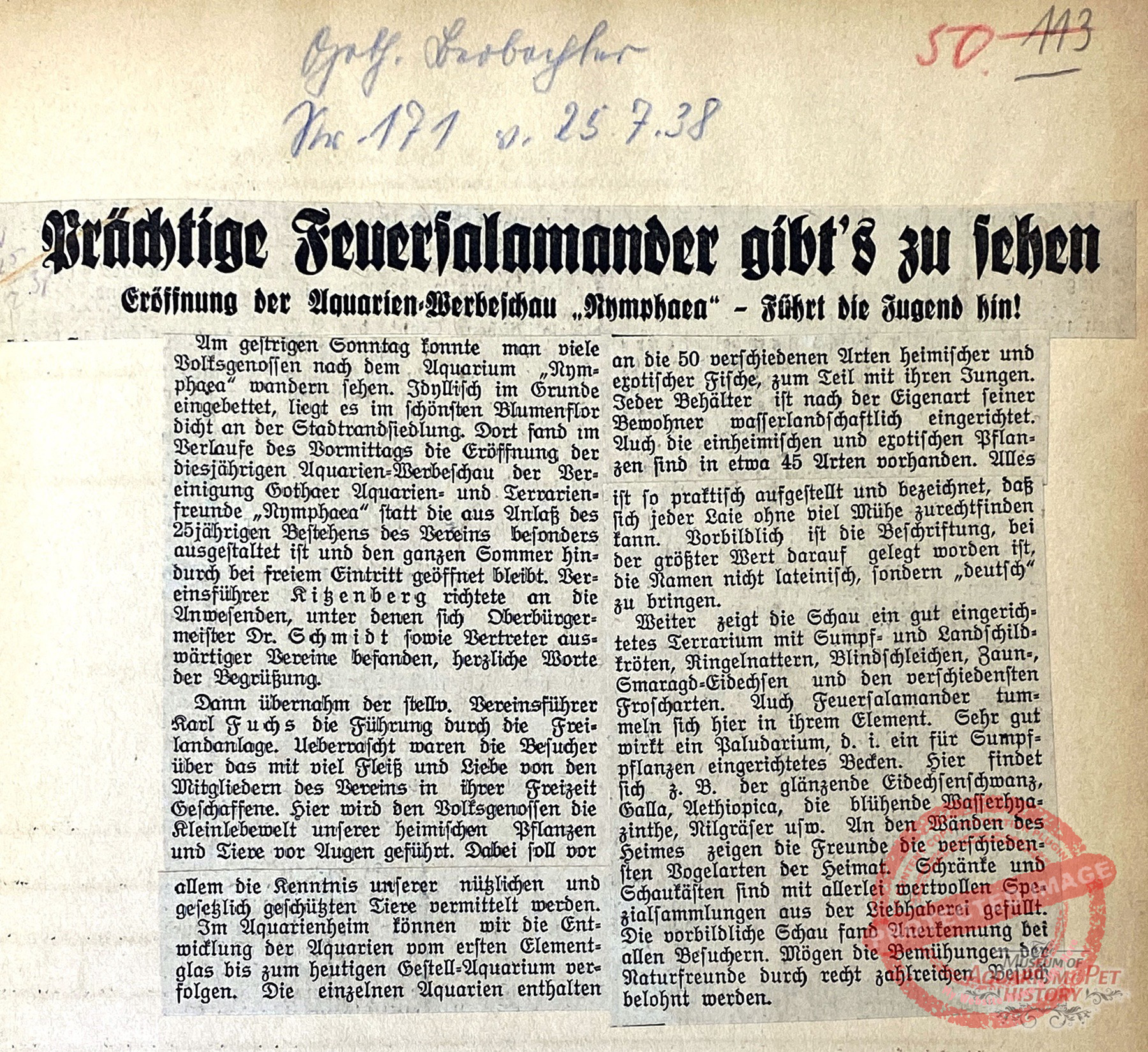
On July 25, 1938, the Gotha regional newspaper reported on the jubilee festivities. The headline translates roughly to “Magnificent fire salamanders can be seen at the opening of the “Nymphaea” Aquarium Exhibition – Bring the youth!”
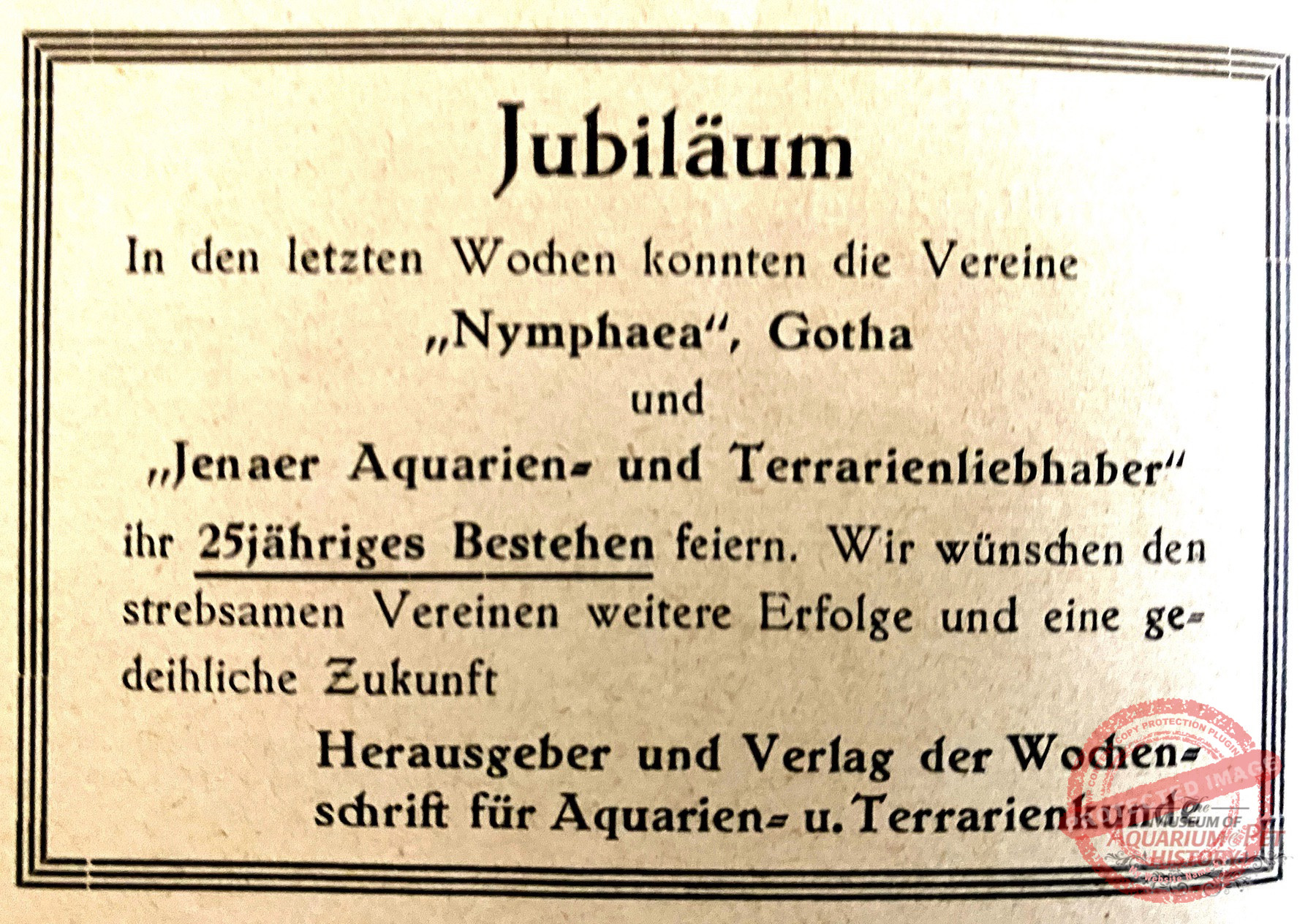
In 1938, the Wochenschrift likewise published its congratulations to the Gotha Nymphaea club on its twenty-fifth anniversary — without acknowledging the far longer and more complex history of Gotha aquaristics.
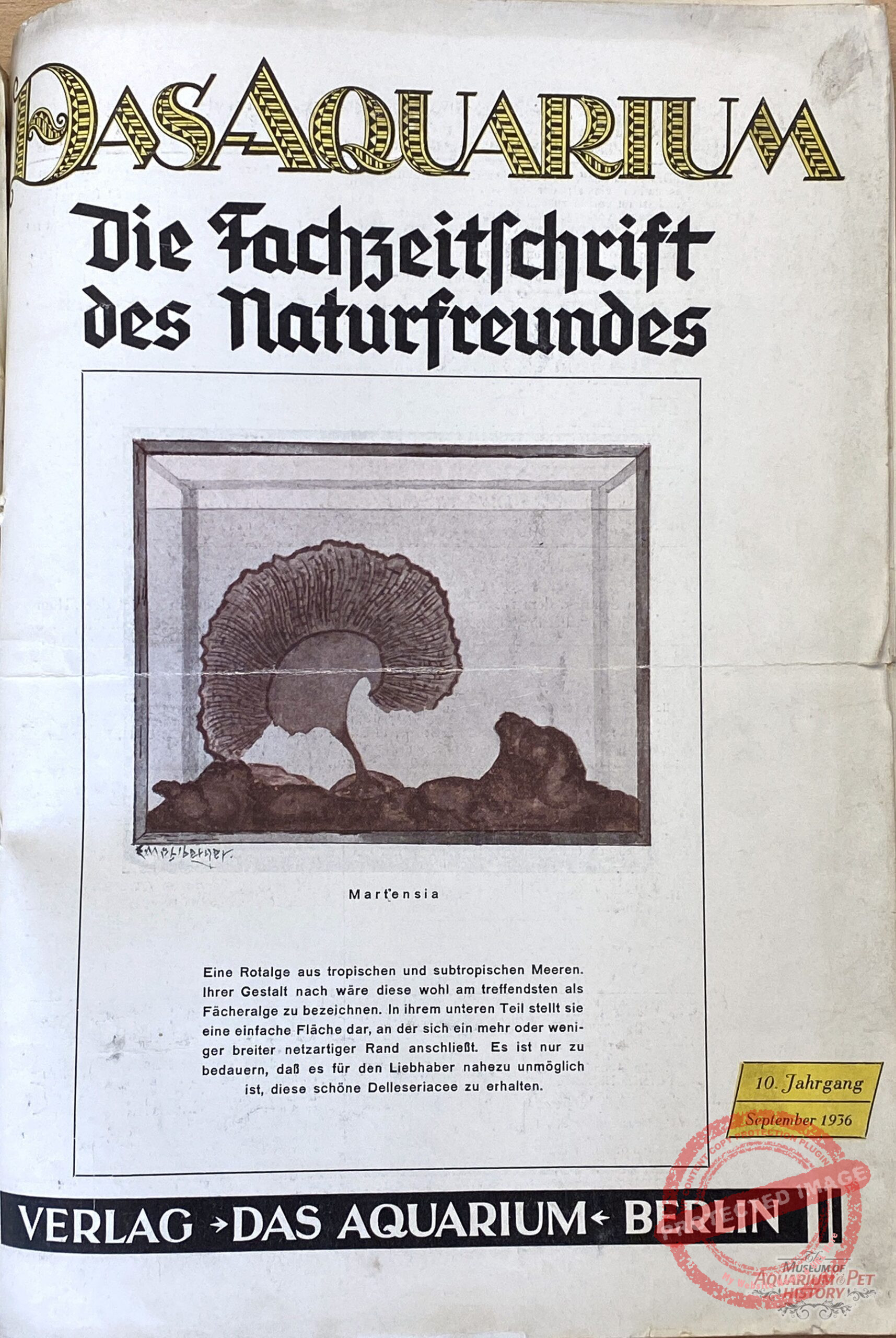
Title page of the journal Das Aquarium. Die Fachzeitschrift des Naturfreundes, in which Charly Fuchs, on the occasion of the twenty-fifth anniversary of the Nymphaea club, recounts in a richly illustrated article the full and much longer history of Gotha aquaristics and all its associations.
The title says: “The Aquarium – The Journal of the Nature Enthusiast”
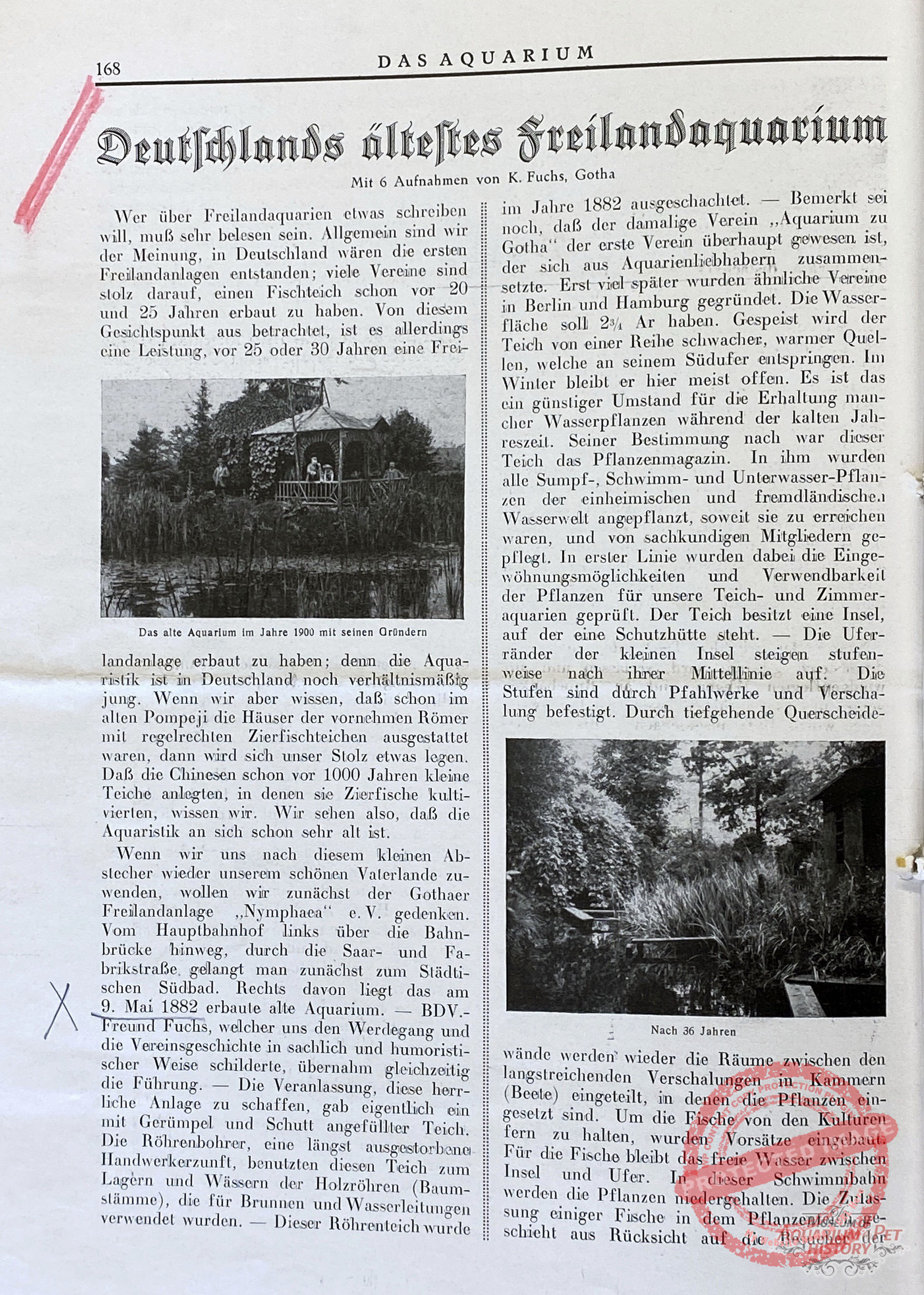
Page one of the article.
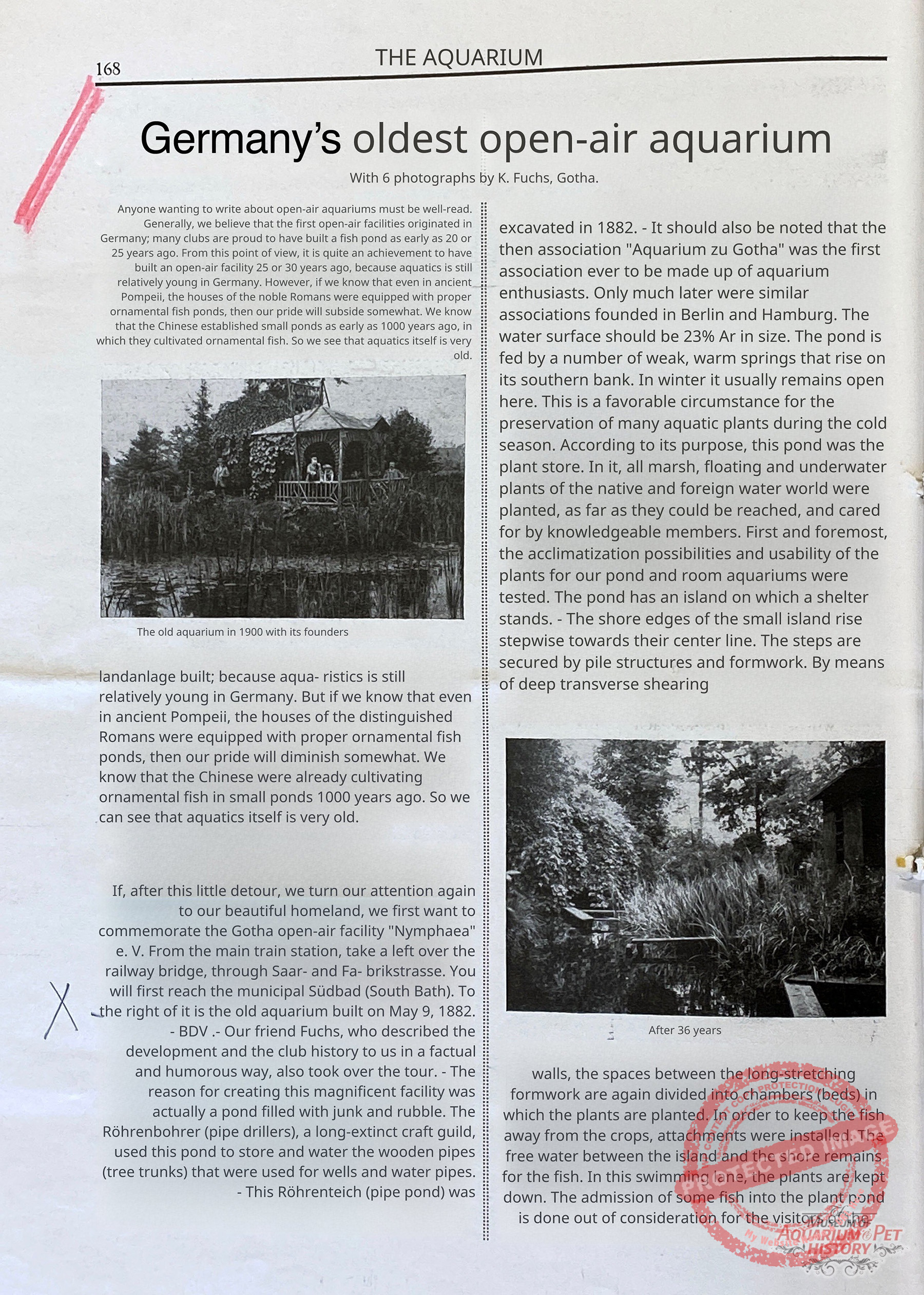
Page one of Das Aquarium article translated into English using notegpt.io.
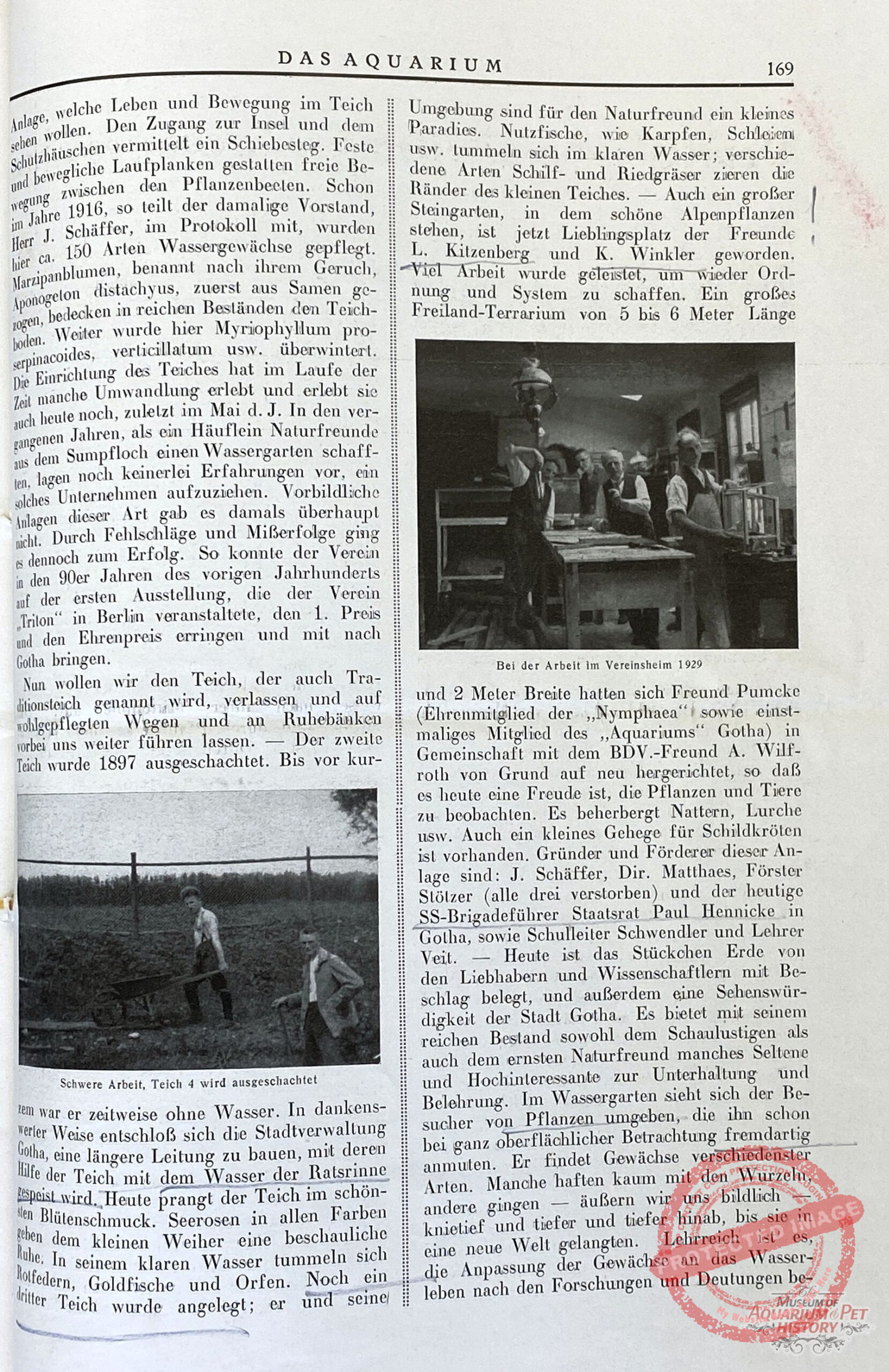
Page two of the article.
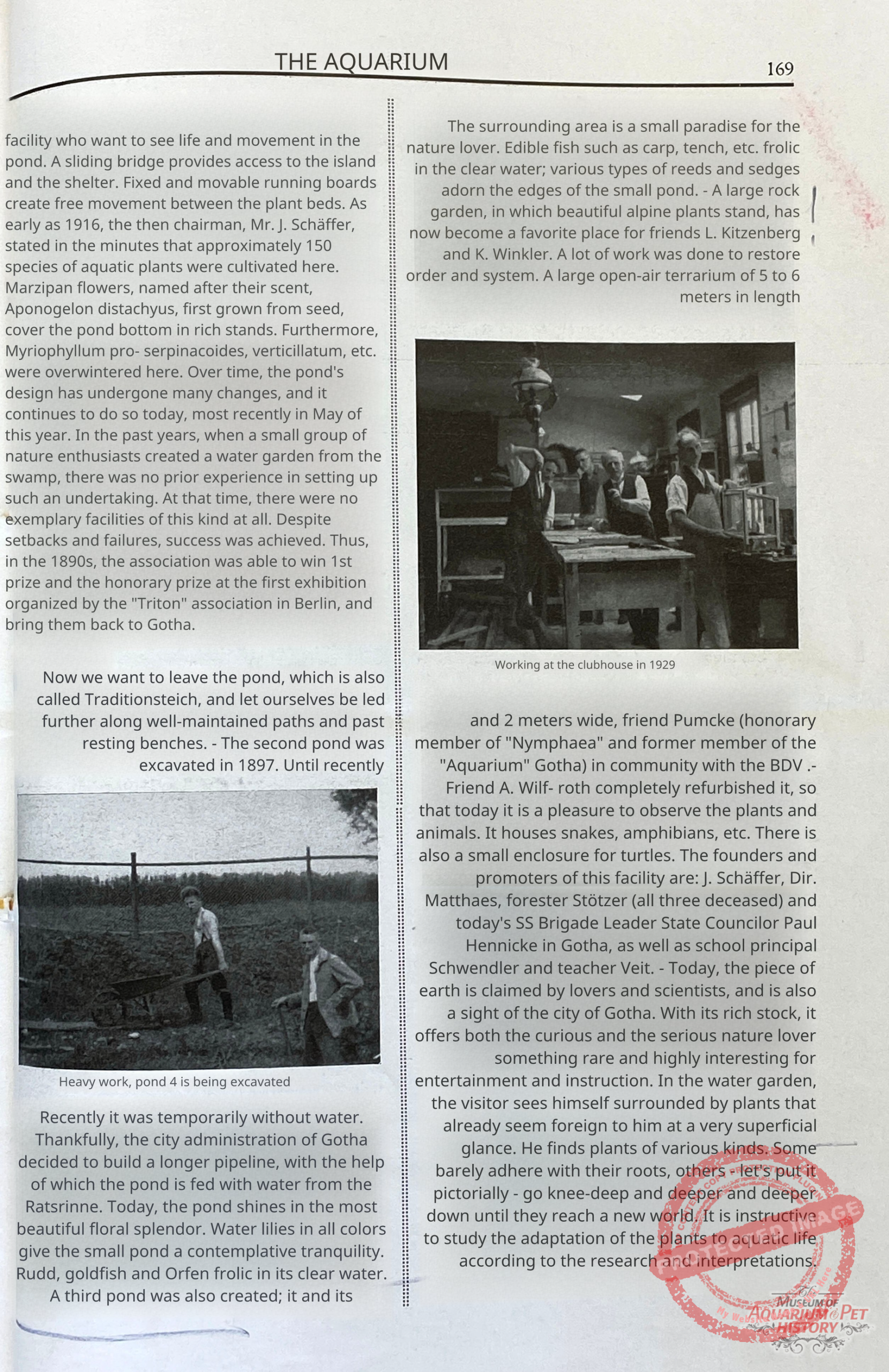
Page two of Das Aquarium translated into English using notegpt.io.
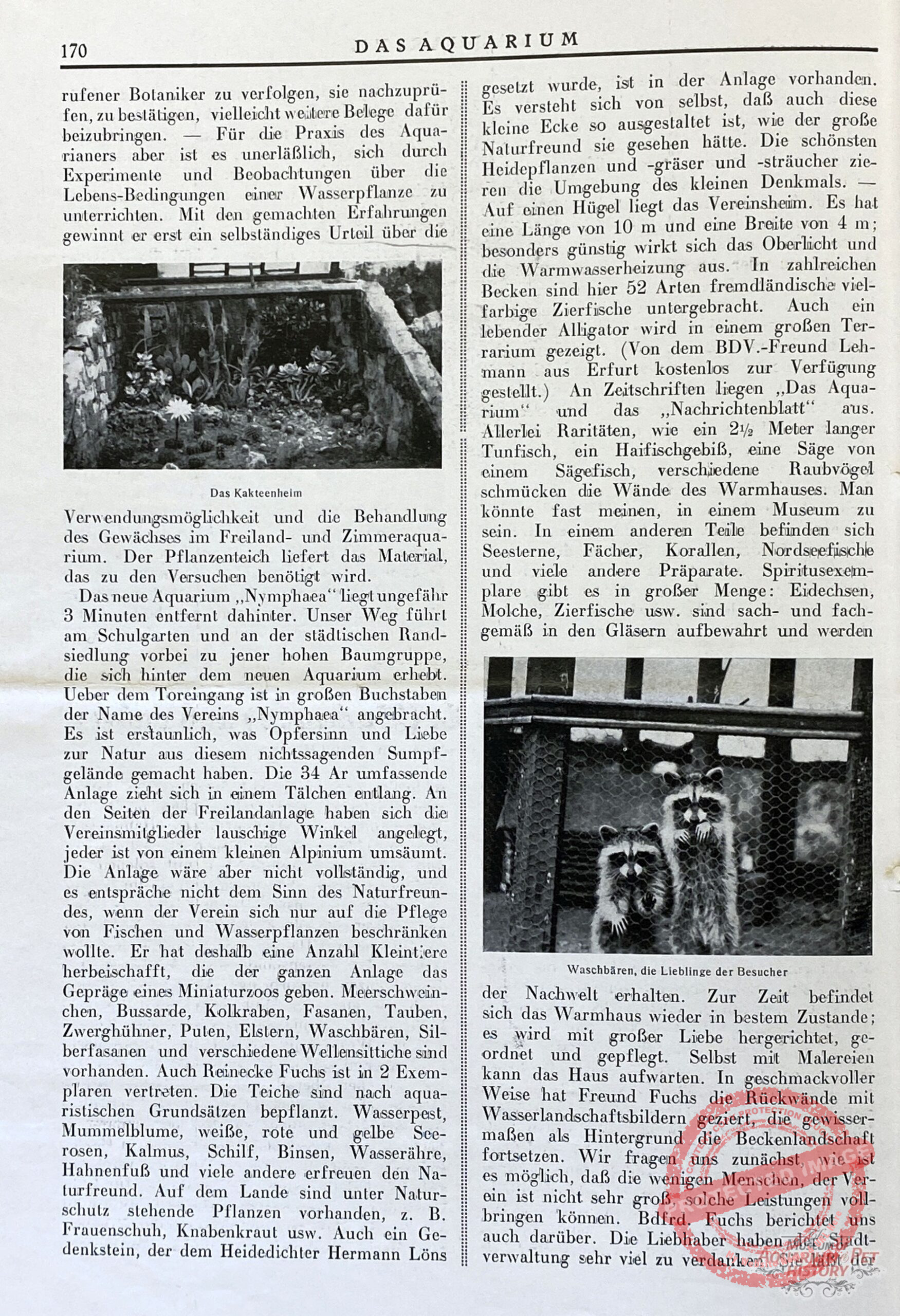
Page three of the article.
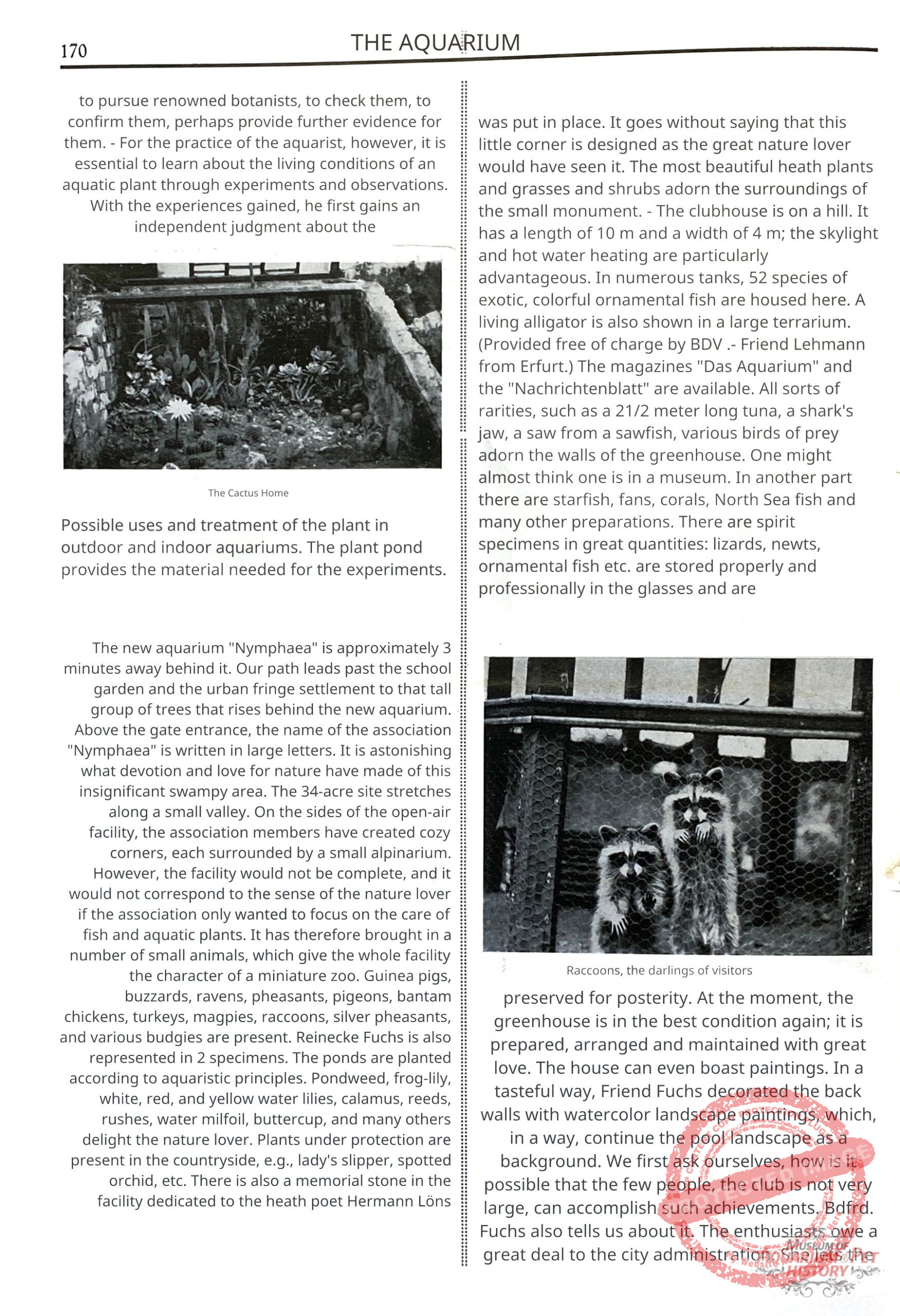
Page three of Das Aquarium translated into English using notegpt.io.
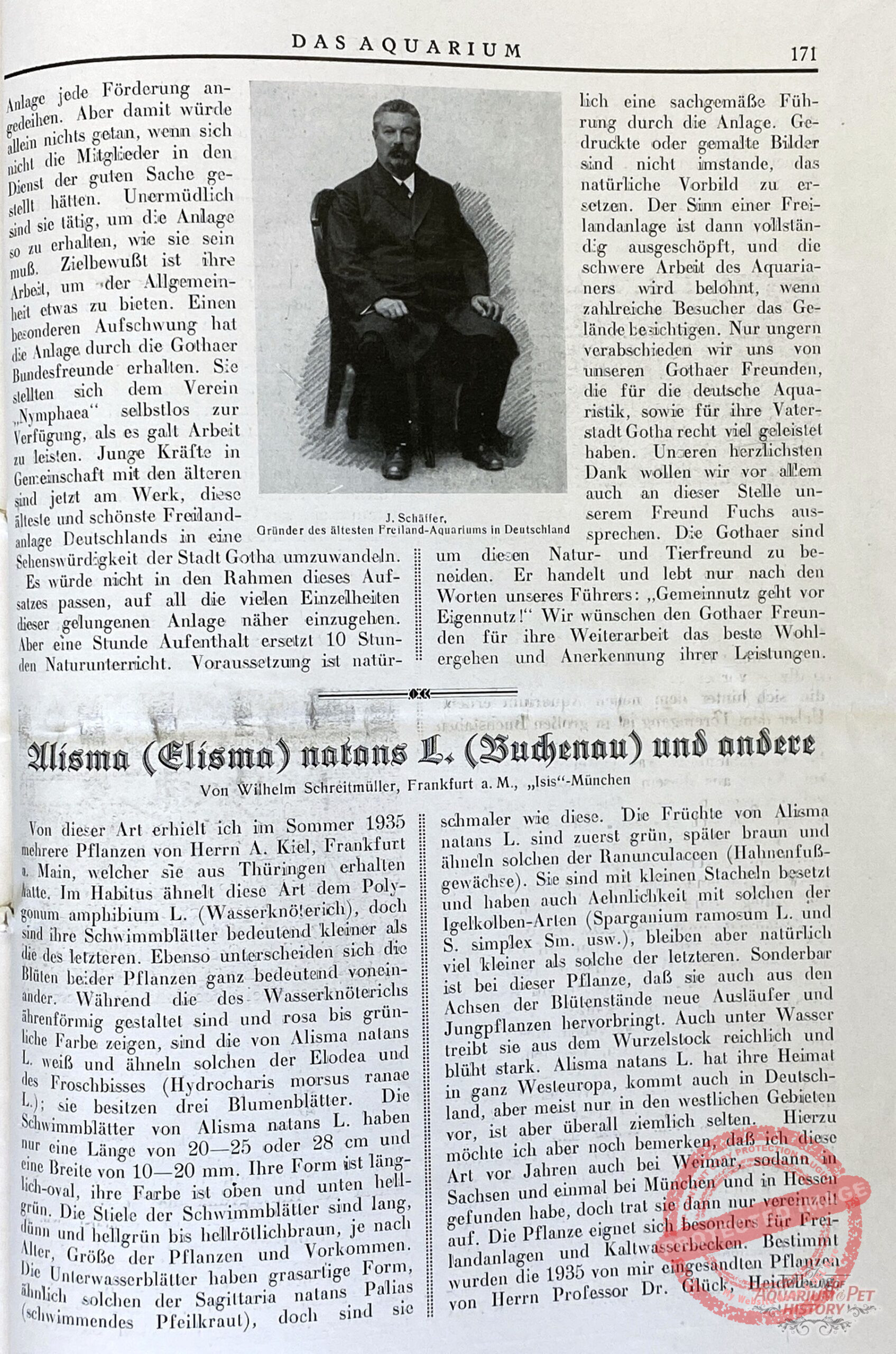
Page four of the article.
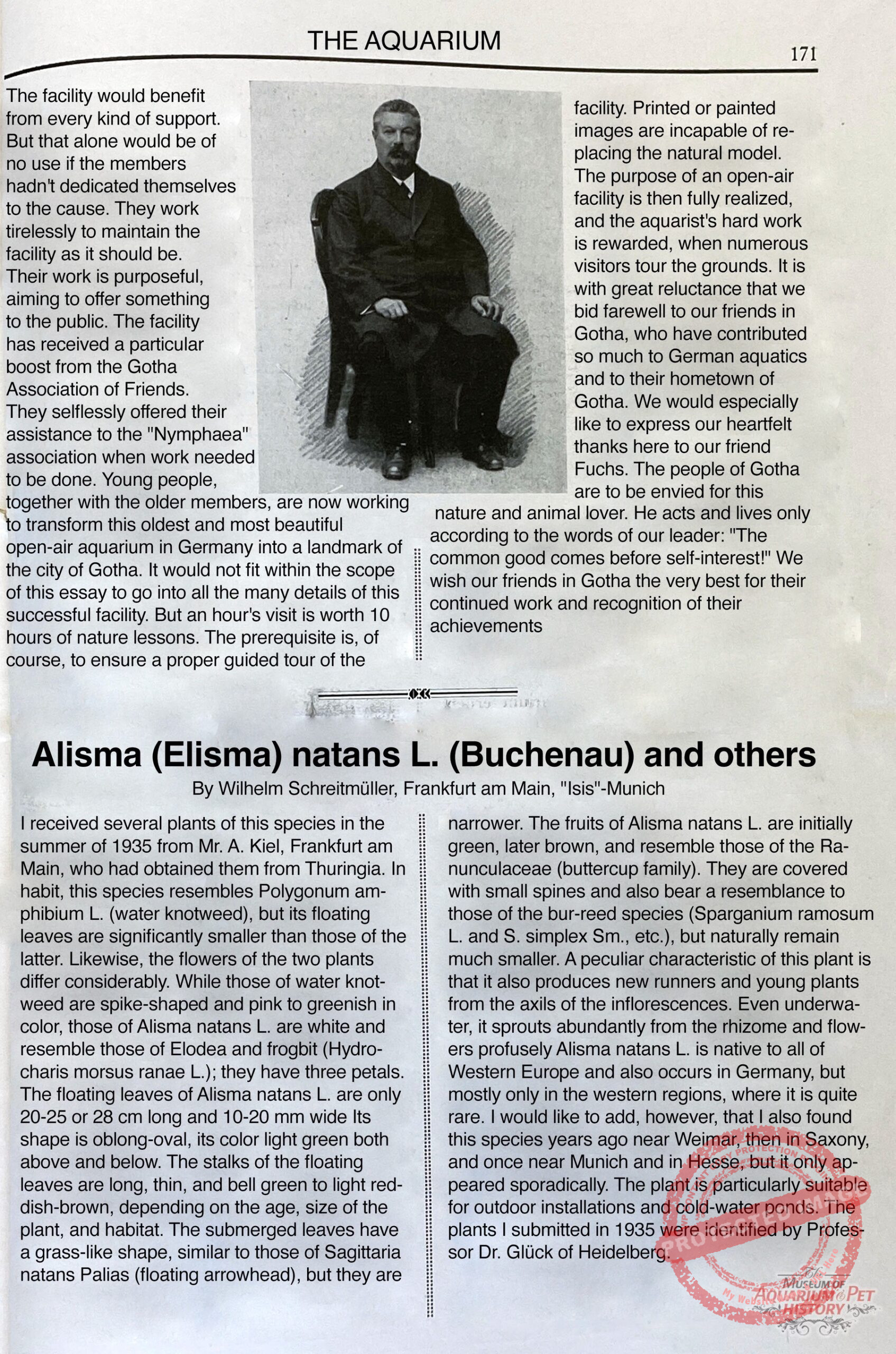
Page four of Das Aquarium translated into English using notegpt.io.
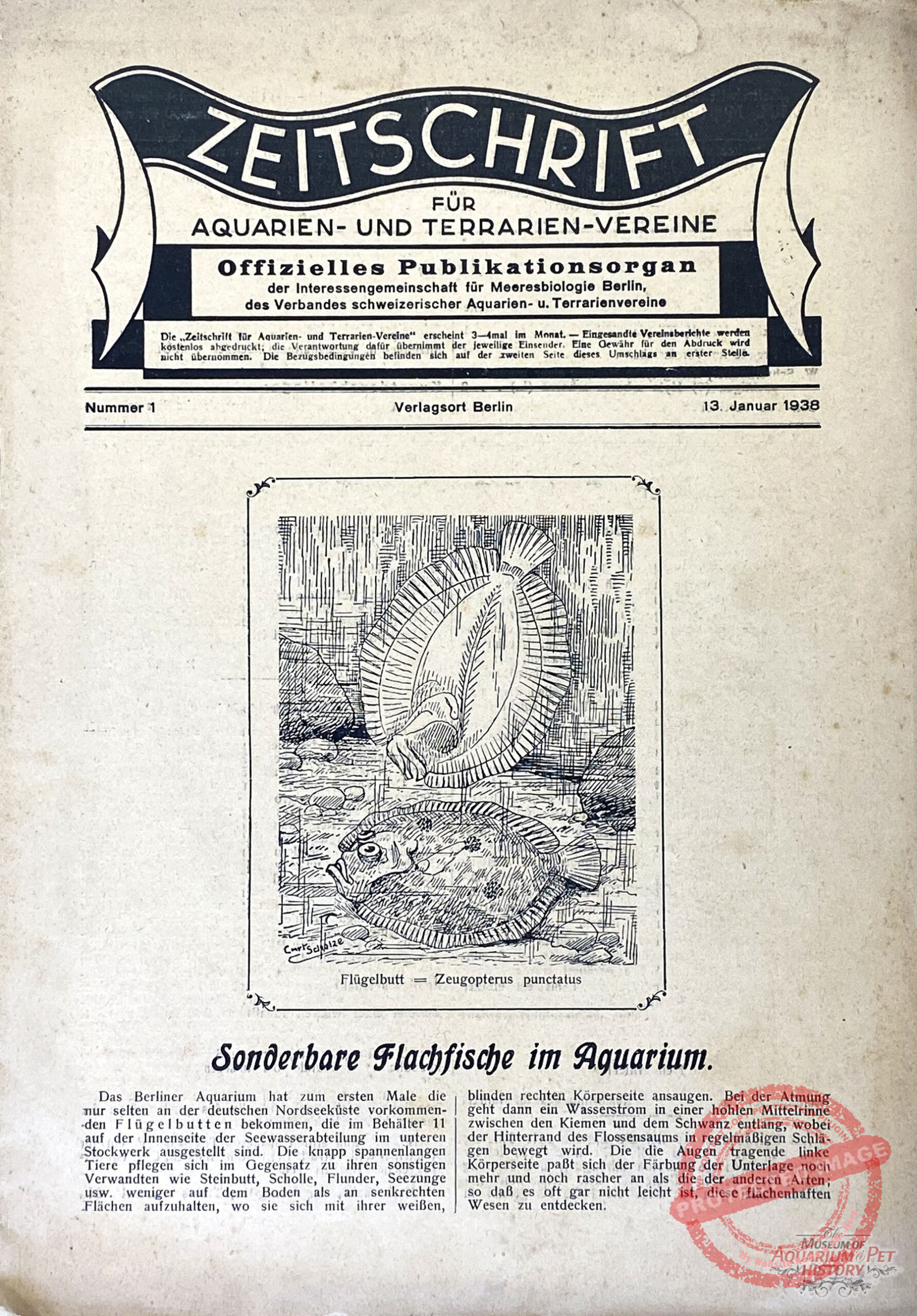
In addition to the jubilee publications, the journal Zeitschrift für Aquarien- und Terrarien-Vereine also reported in 1938 on the broader activities of the Nymphaea club.
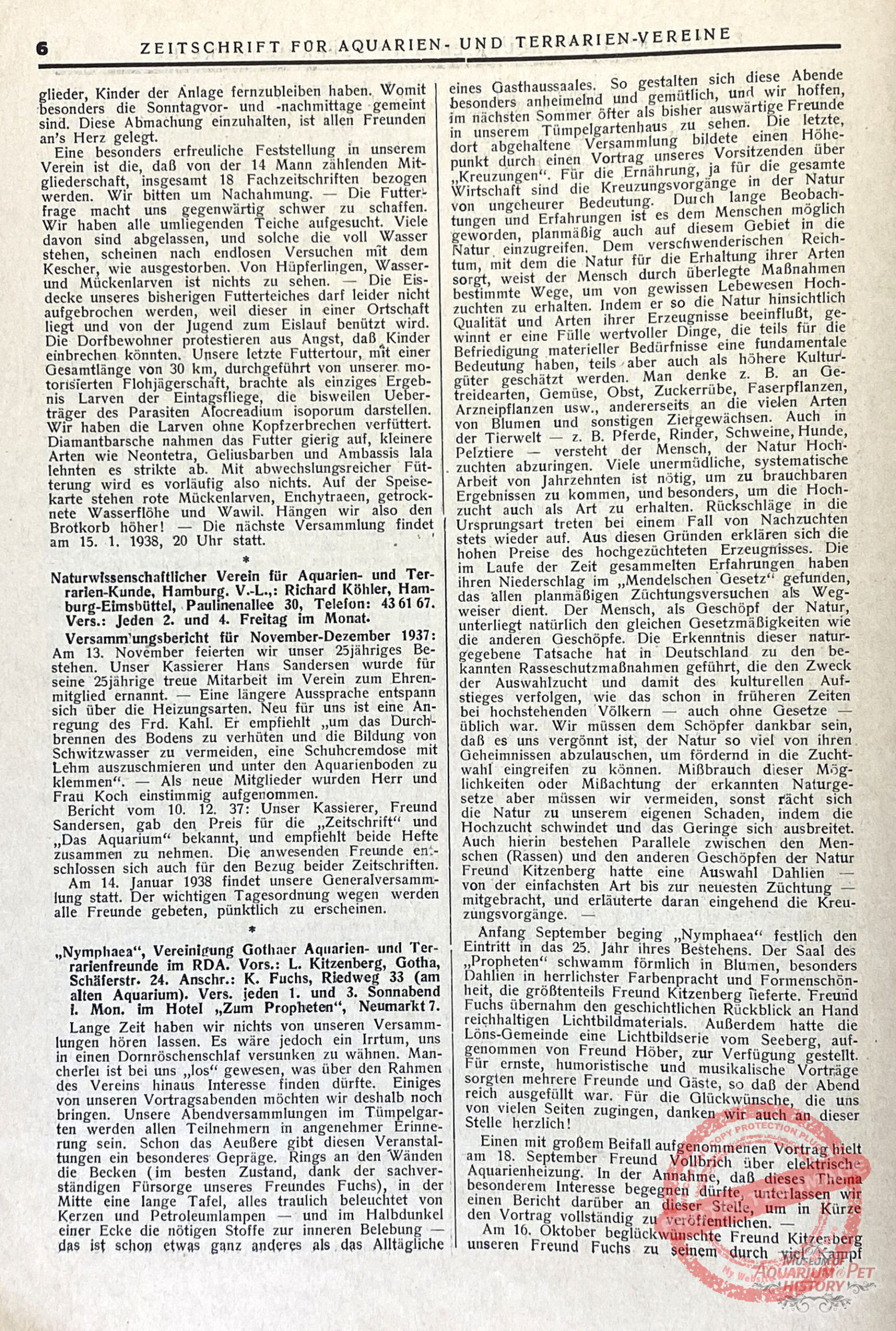
The first page of one of the last detailed activity reports issued by the Nymphaea club before the outbreak of war.
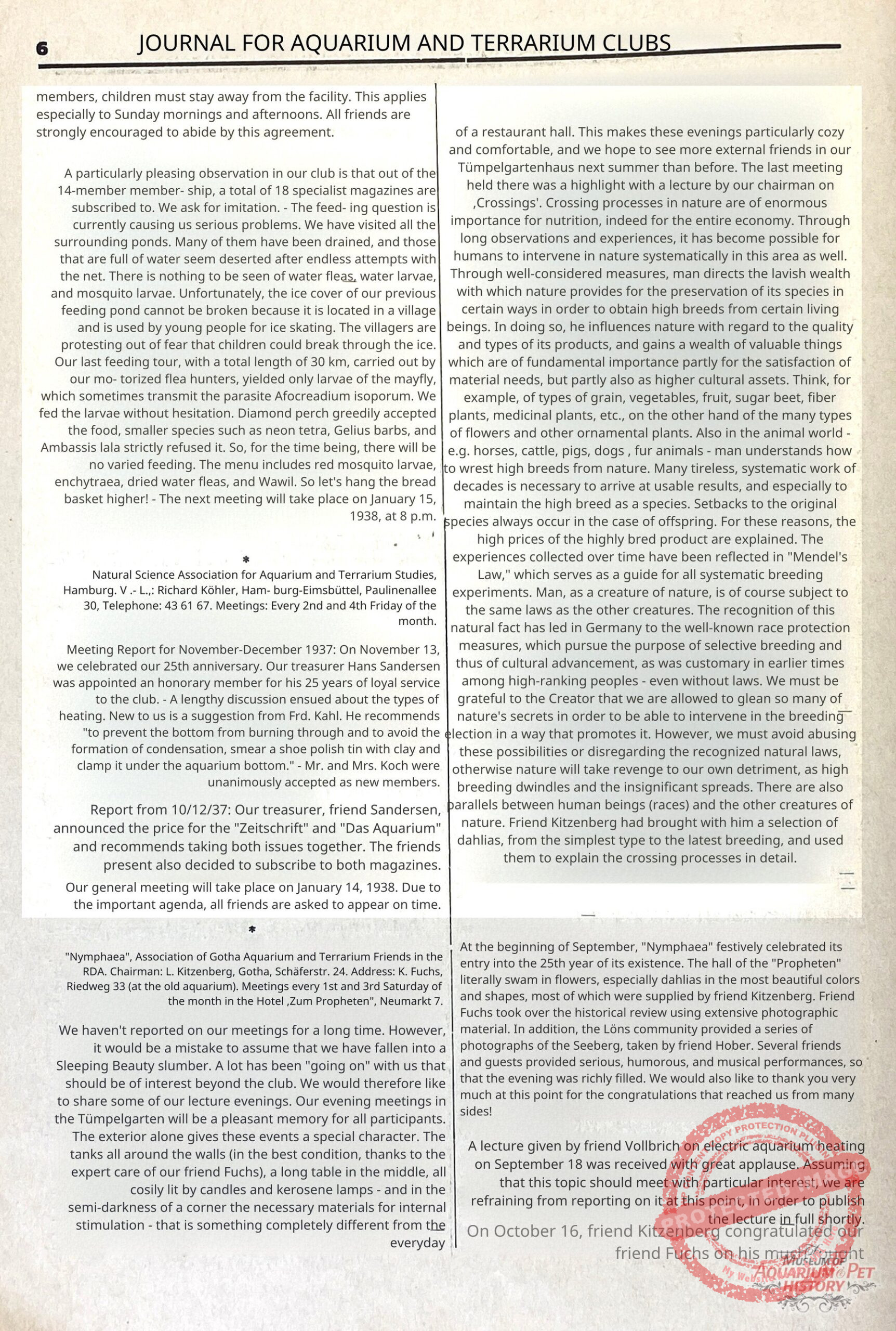
First page of the report translated into English using notegpt.io.
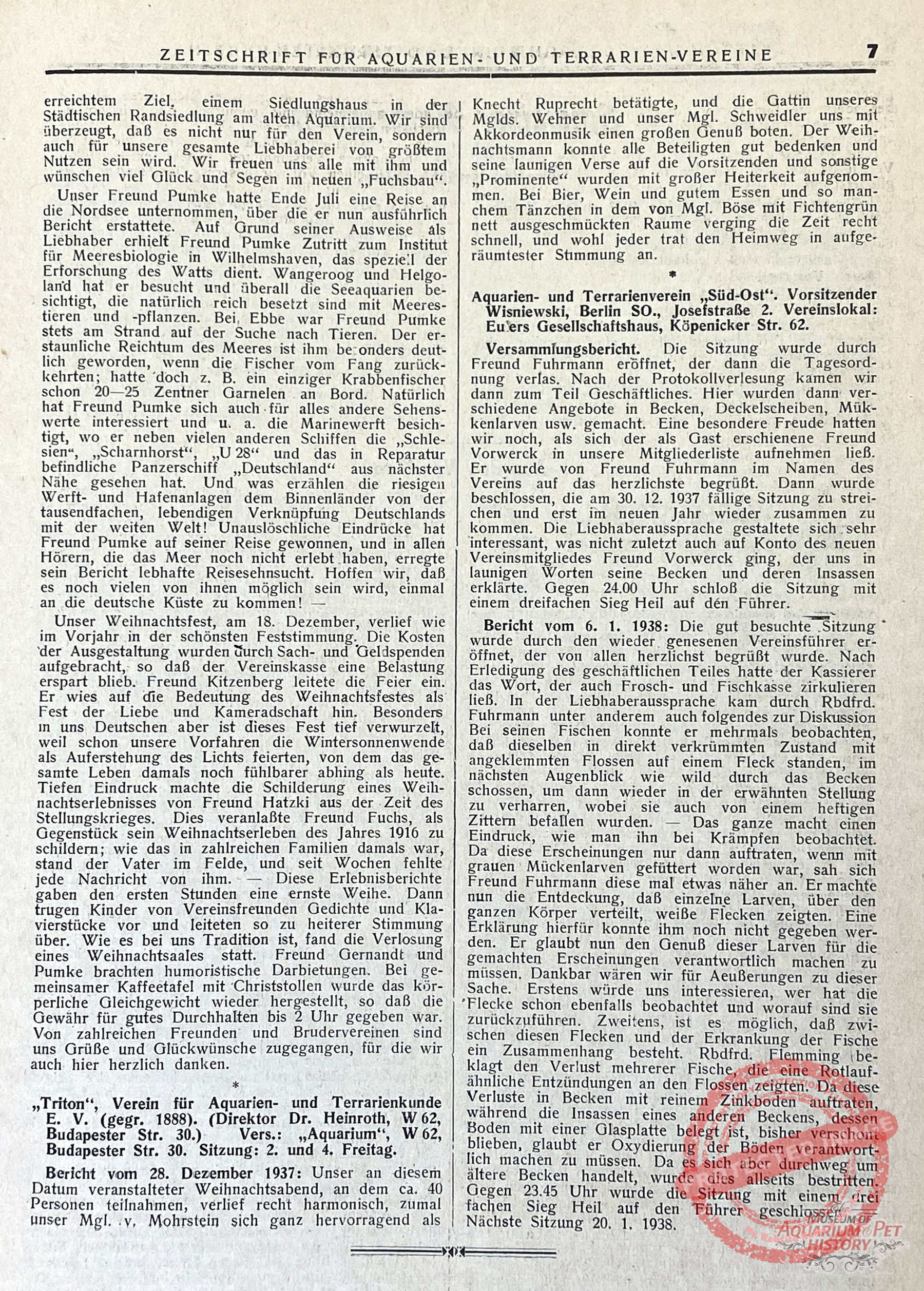
The second page of that report.
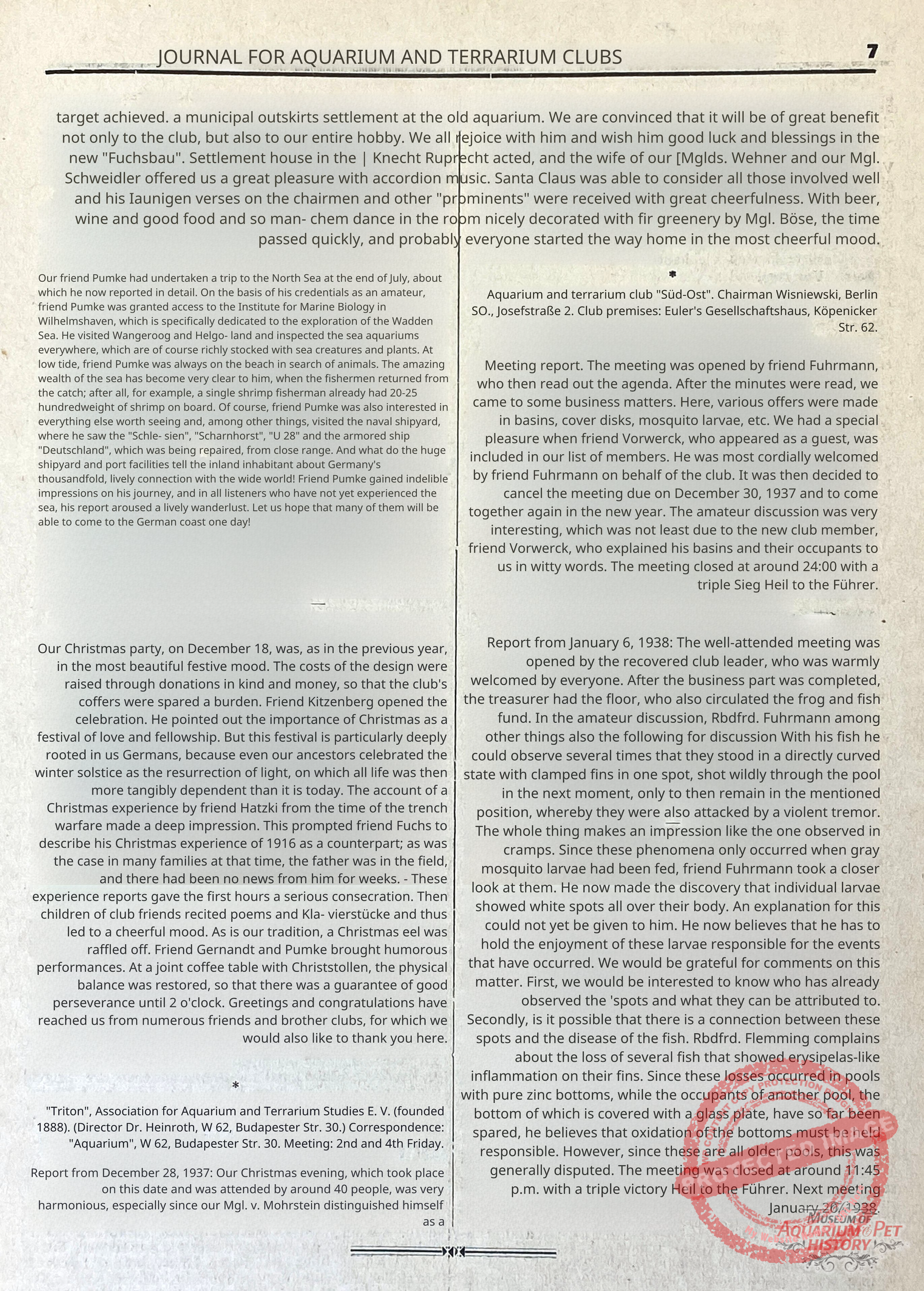
Second page of the report translated into English using notegpt.io.
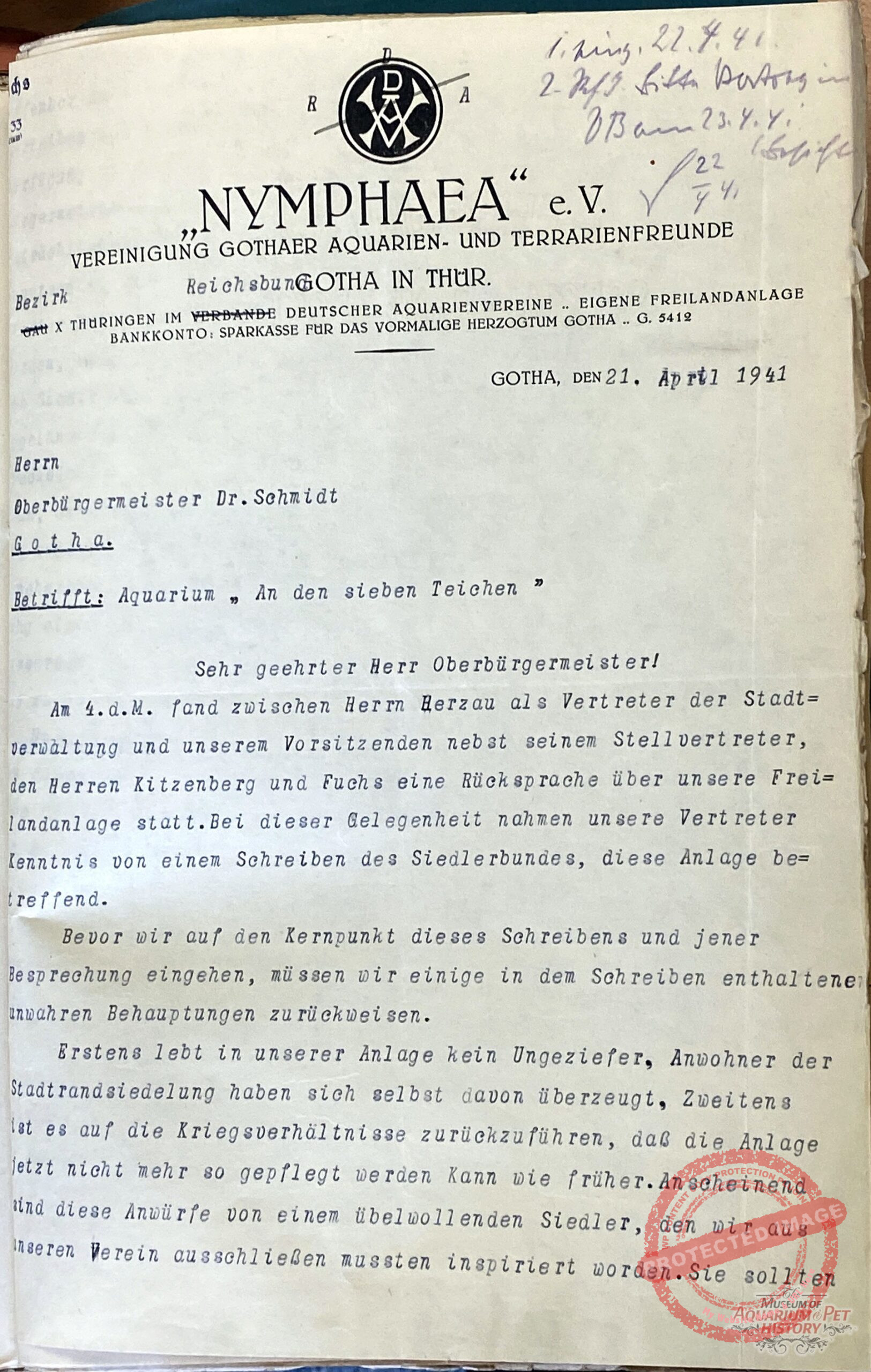
In 1942, under increasing wartime strain, the Nymphaea club sought to relinquish its open-air facility and transfer it to the neighboring settlers’ association in order to free itself from debt to the Gotha savings bank; Charly Fuchs addressed Mayor Dr. Schmidt of Gotha in this matter.
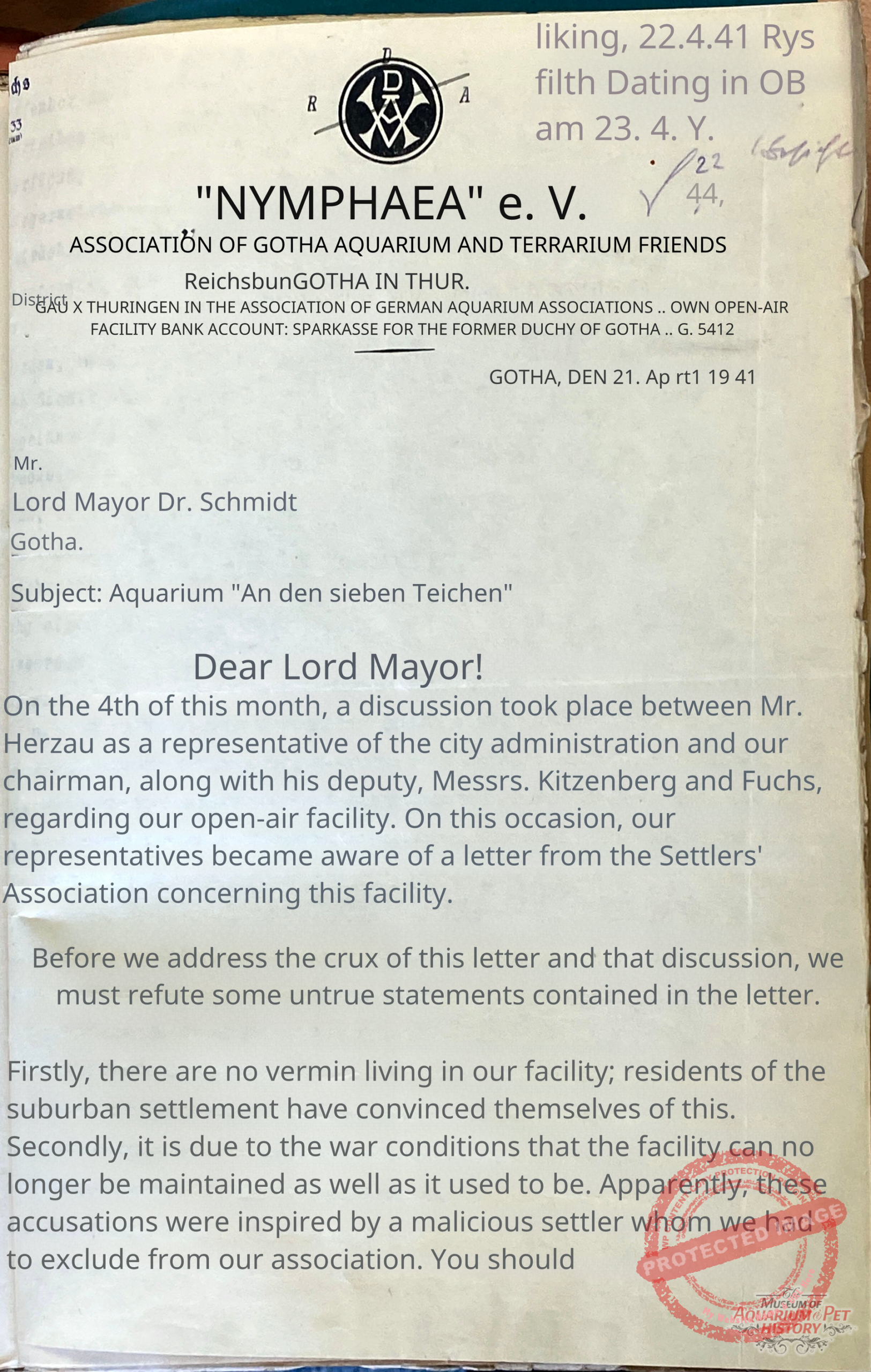
First page of the same letter translated into English using notegpt.io.
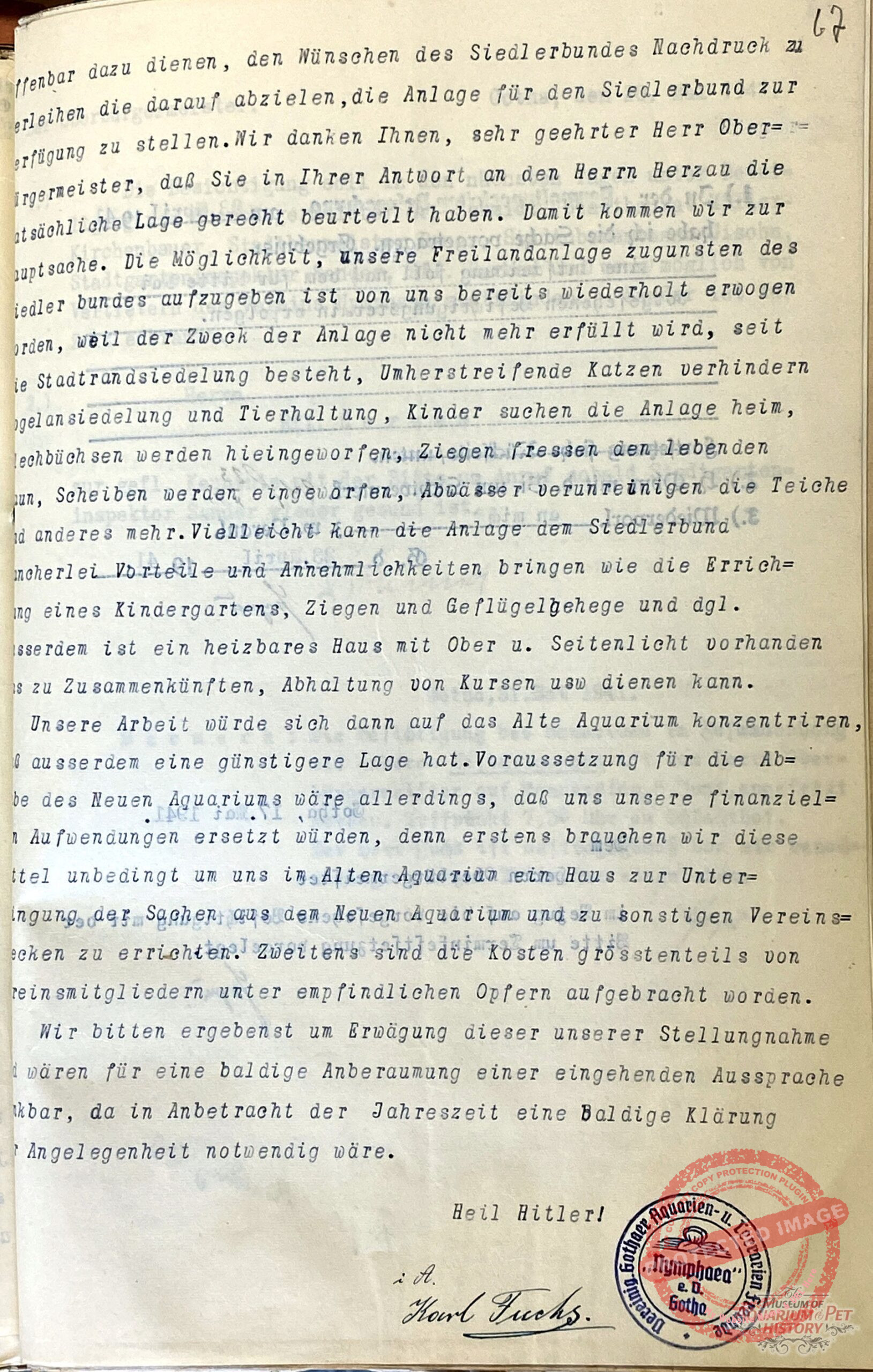
The second page of this official letter.
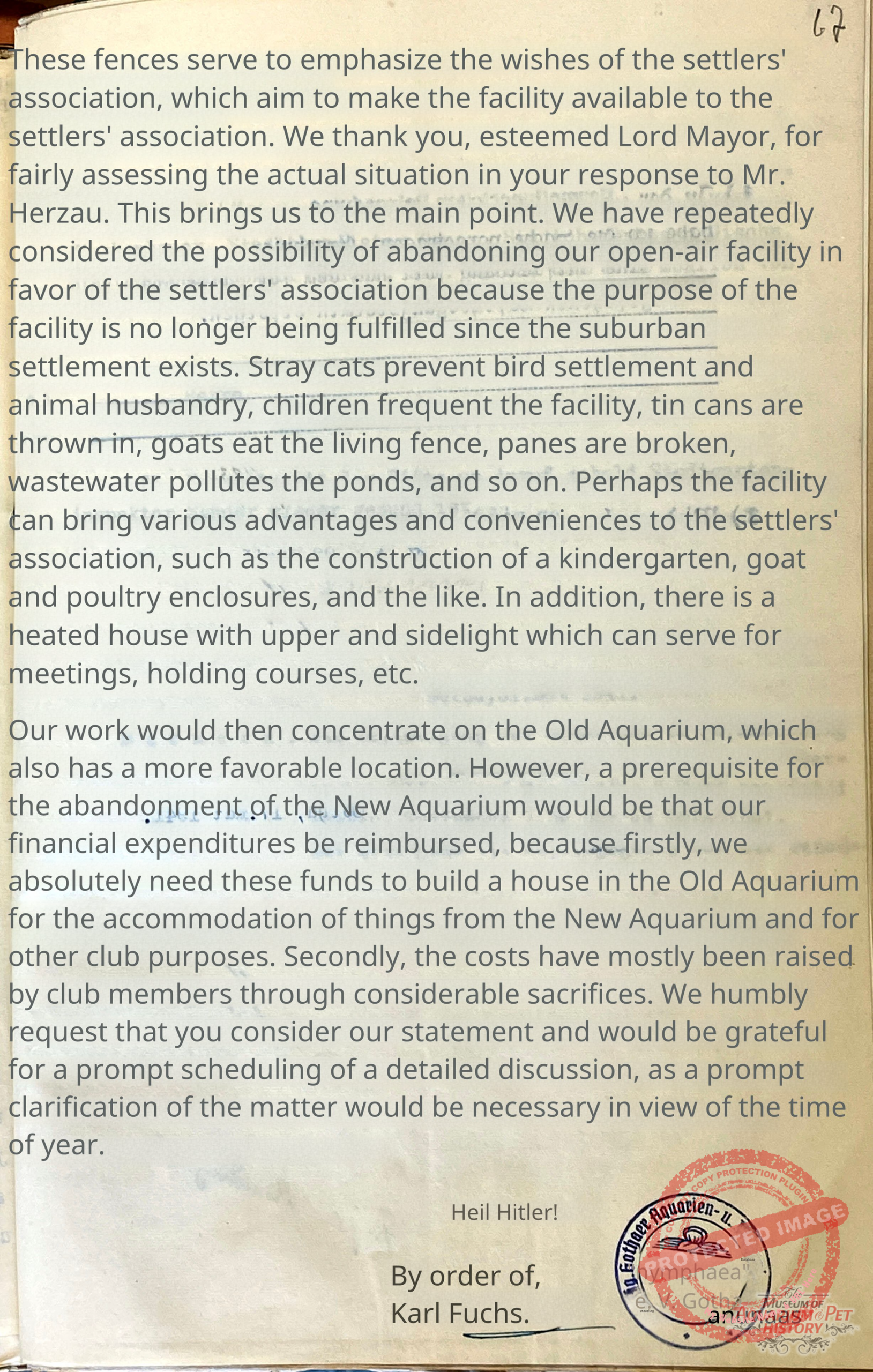
Second page of the same letter translated into English using notegpt.io.
Even at the start of 1944, Gotha Nymphaea members reported in the Wochenschrift on the regularly held monthly meetings of the previous year, despite dire circumstances. Much of the discussion focused on wartime conditions: “Correspondence with our front comrades was in the hands of our comrade Fuchs, who also maintained the installations to the best of his ability.” Charly Fuchs had devoted himself to minimizing wartime damage for absent aquarists. The article also noted that recreational facilities were considered essential to the war effort, and thus club activities were tolerated. However, soon all cultural institutions in Germany were closed, and many journals and newspapers ceased publication, including those concerning the hobby. War had brutalized the population. A January 19, 1944, article in the Thüringer Gauzeitung lamented vandalism that destroyed many installations on the Nymphaea grounds, but also reported positives: despite the chaos, the Nymphaea members maintained 75 species of water and marsh plants, 62 fish species, 10 terrarium species, and 12 marine species.
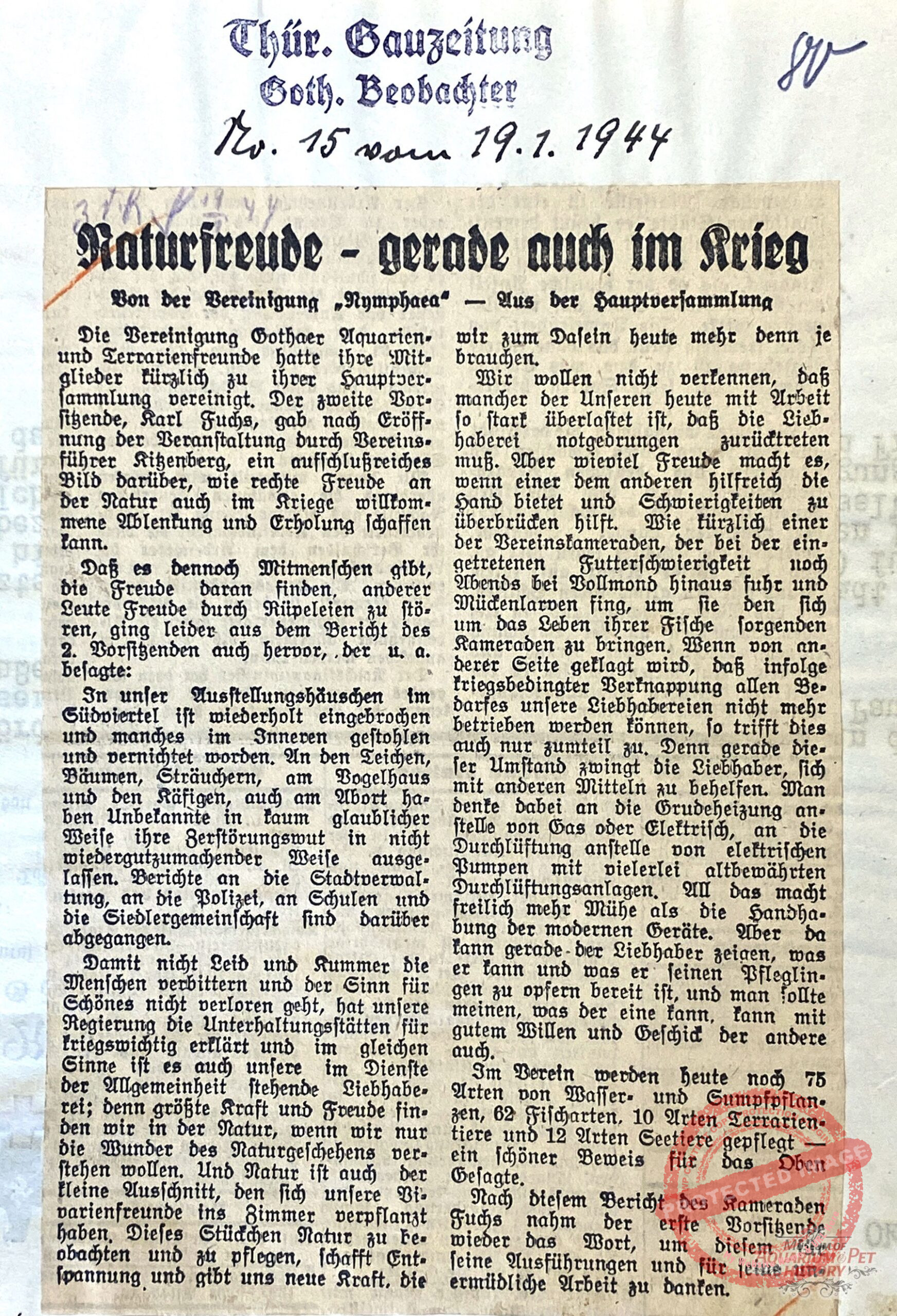
On January 19, 1944, the Thuringian Gau newspaper published an article on the Nymphaea club and its open-air installation, which at that time was still declared essential to the war effort and therefore temporarily preserved.
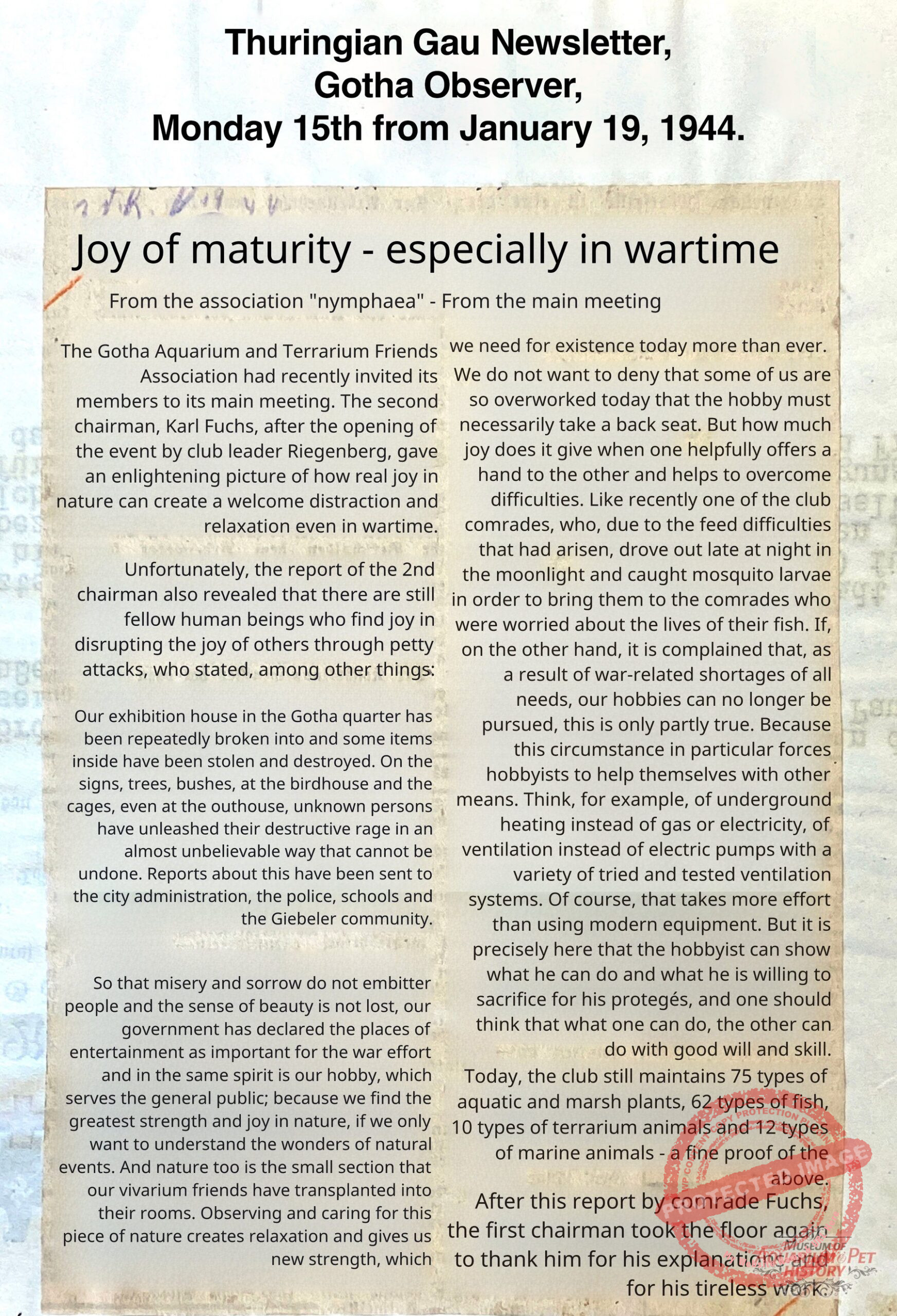
Same Thuringian Gau newspaper article translated into English using notegpt.io.
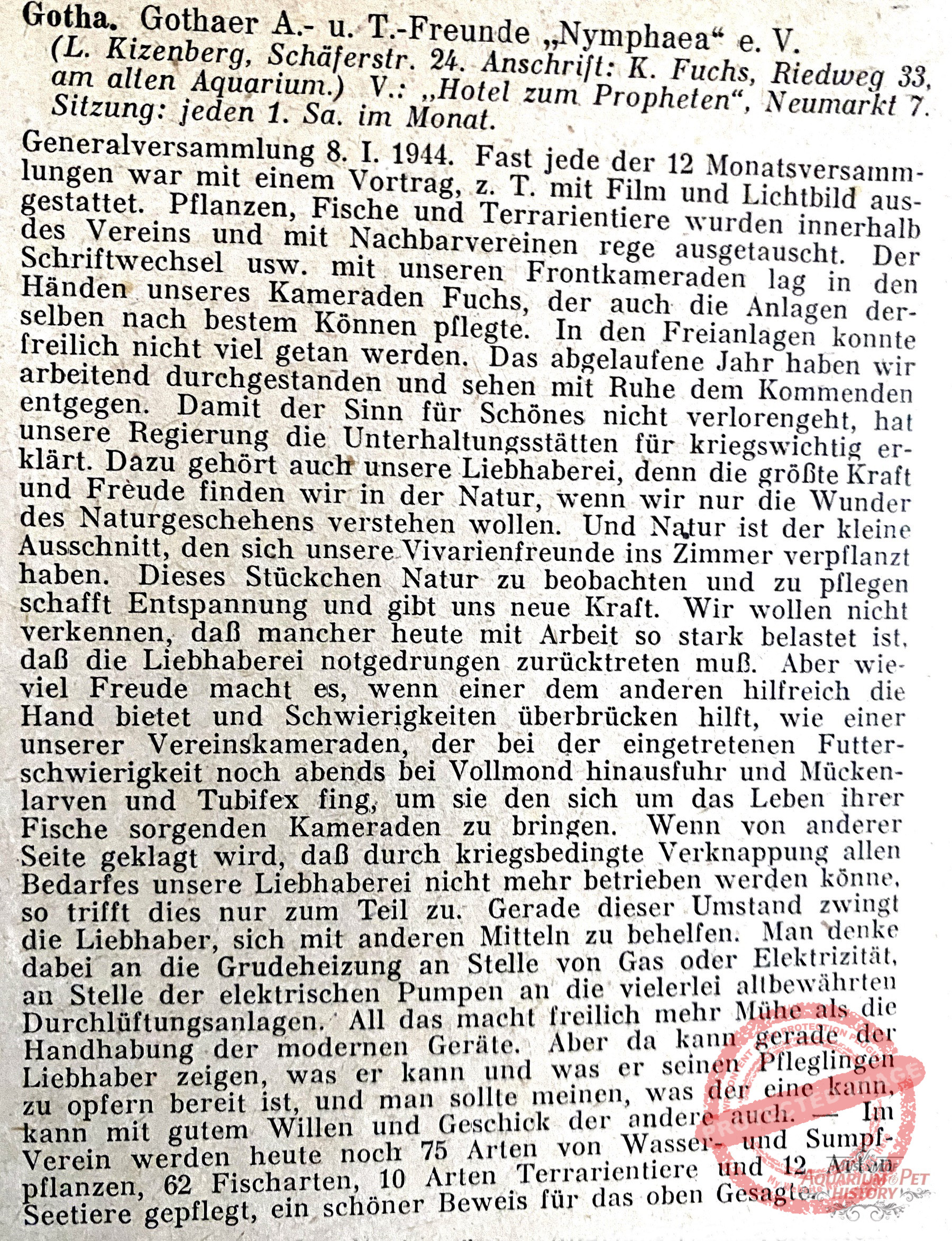
In early 1944, the Wochenschrift once again printed a report from the Gotha Nymphaea club describing, in moving language, the mutual assistance in maintaining aquariums and their inhabitants — highlighting Charly Fuchs as a figure of self-sacrificing dedication.
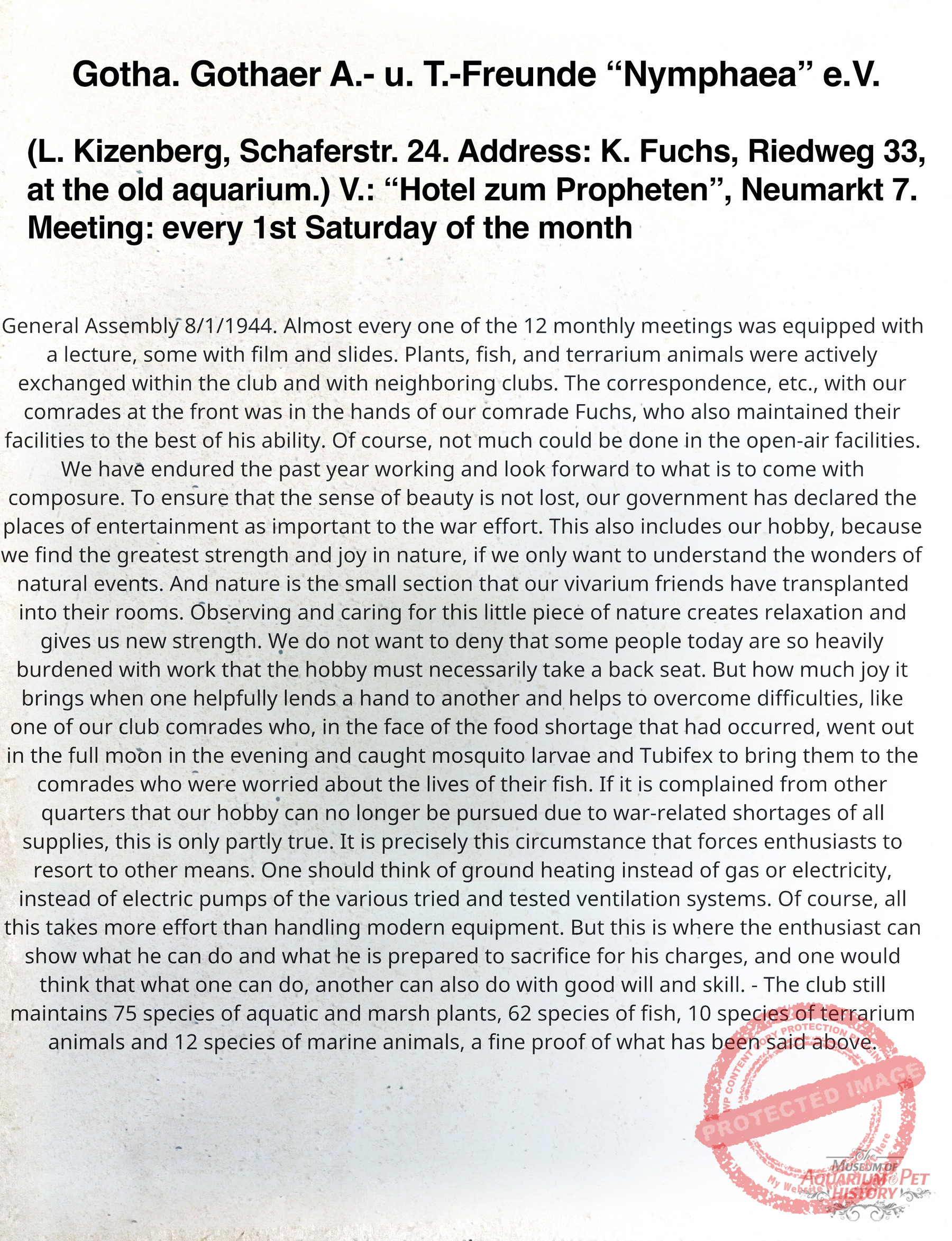
Same 1944 Wochenschrift report translated into English using notegpt.io.
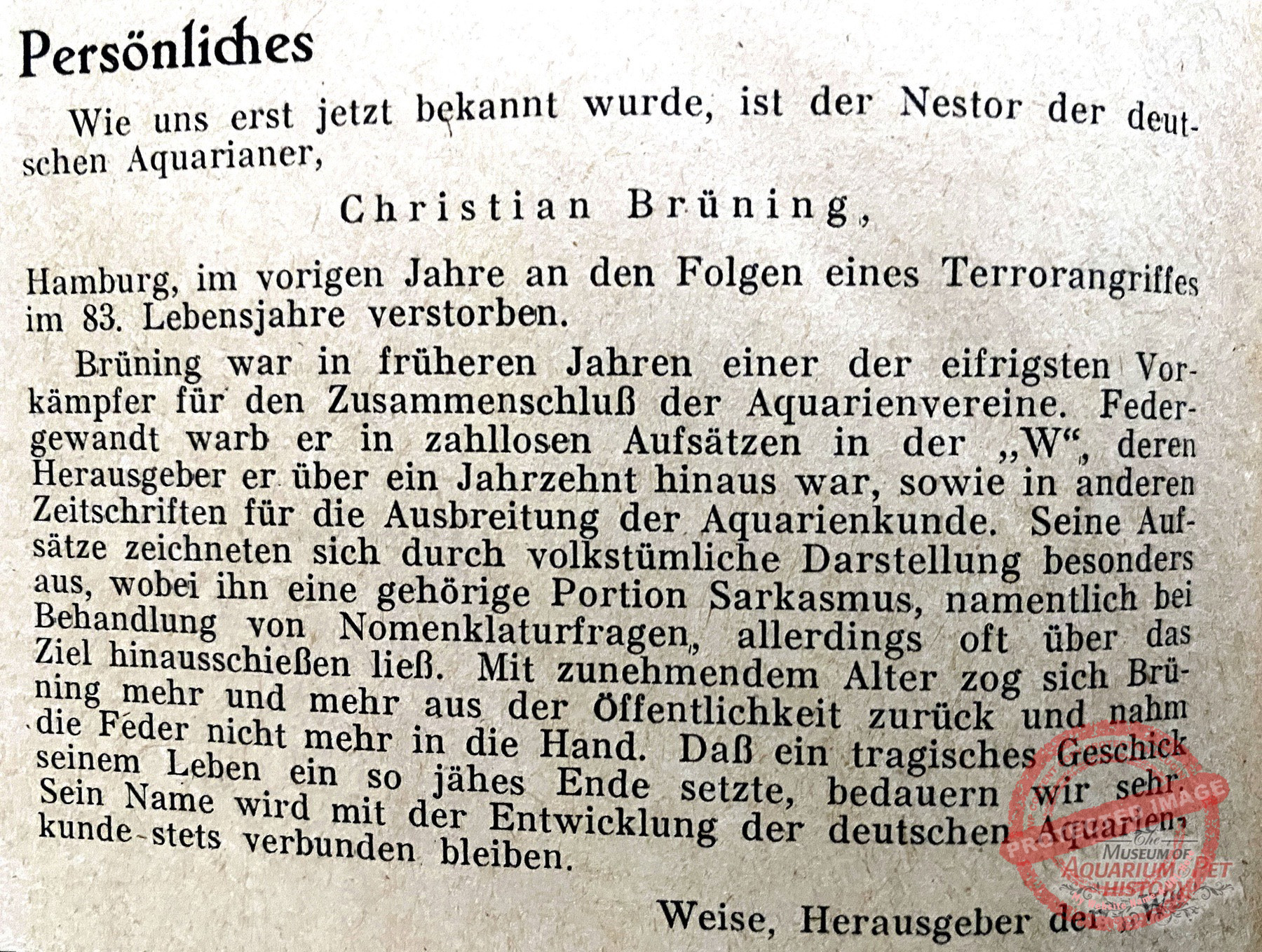
By 1943, death notices appear ever more frequently in the Wochenschrift; among them that of the doyen of German aquarists and former editor of the journal, Christian Brüning, who perished in Hamburg during a bombing raid at the age of eighty-three.
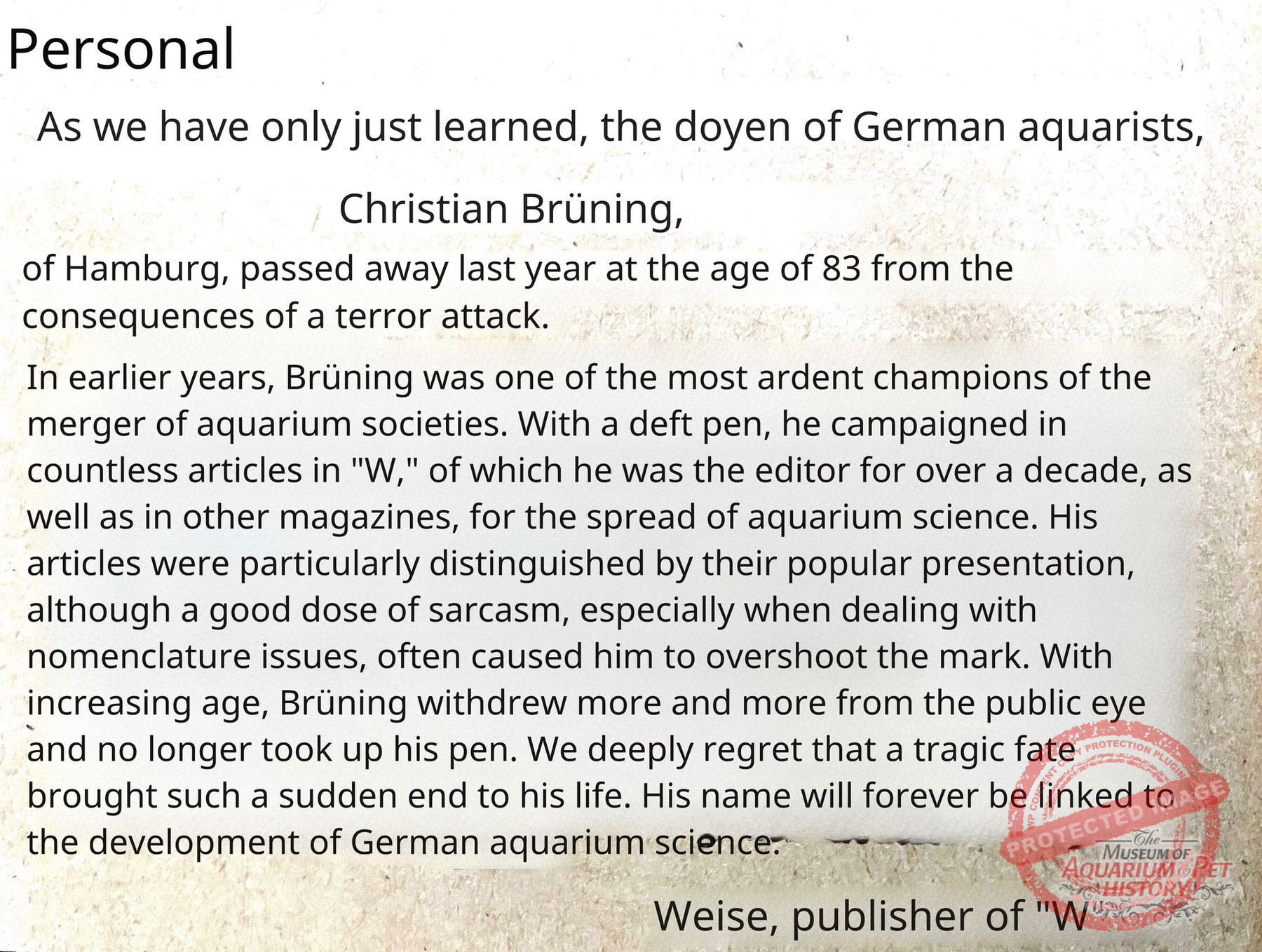
Same 1943 Wochenschrift article translated into English using notegpt.io.
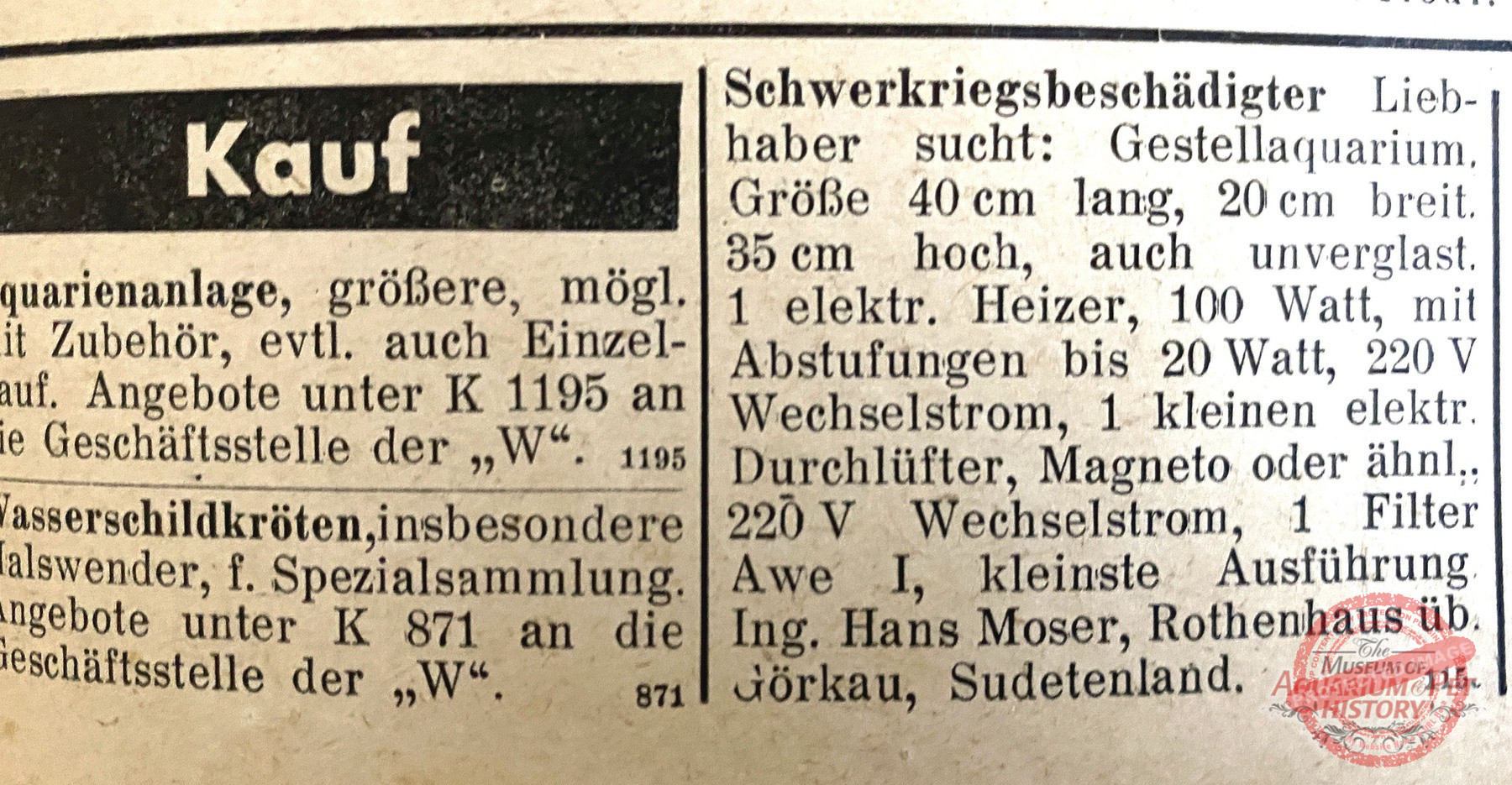
In 1944, some severely wounded soldiers had returned and attempted to resume aquaristics. An advertisement in the Wochenschrift from Hans Moser of the Sudetenland (today again part of the Czech Republic) reads: “Severely war-disabled enthusiast seeks: framed aquarium, 40cm long (16 inches), 20 cm wide (8 inches), 35 cm high (14 cm), even without glass; one electric heater, 100 watts…”
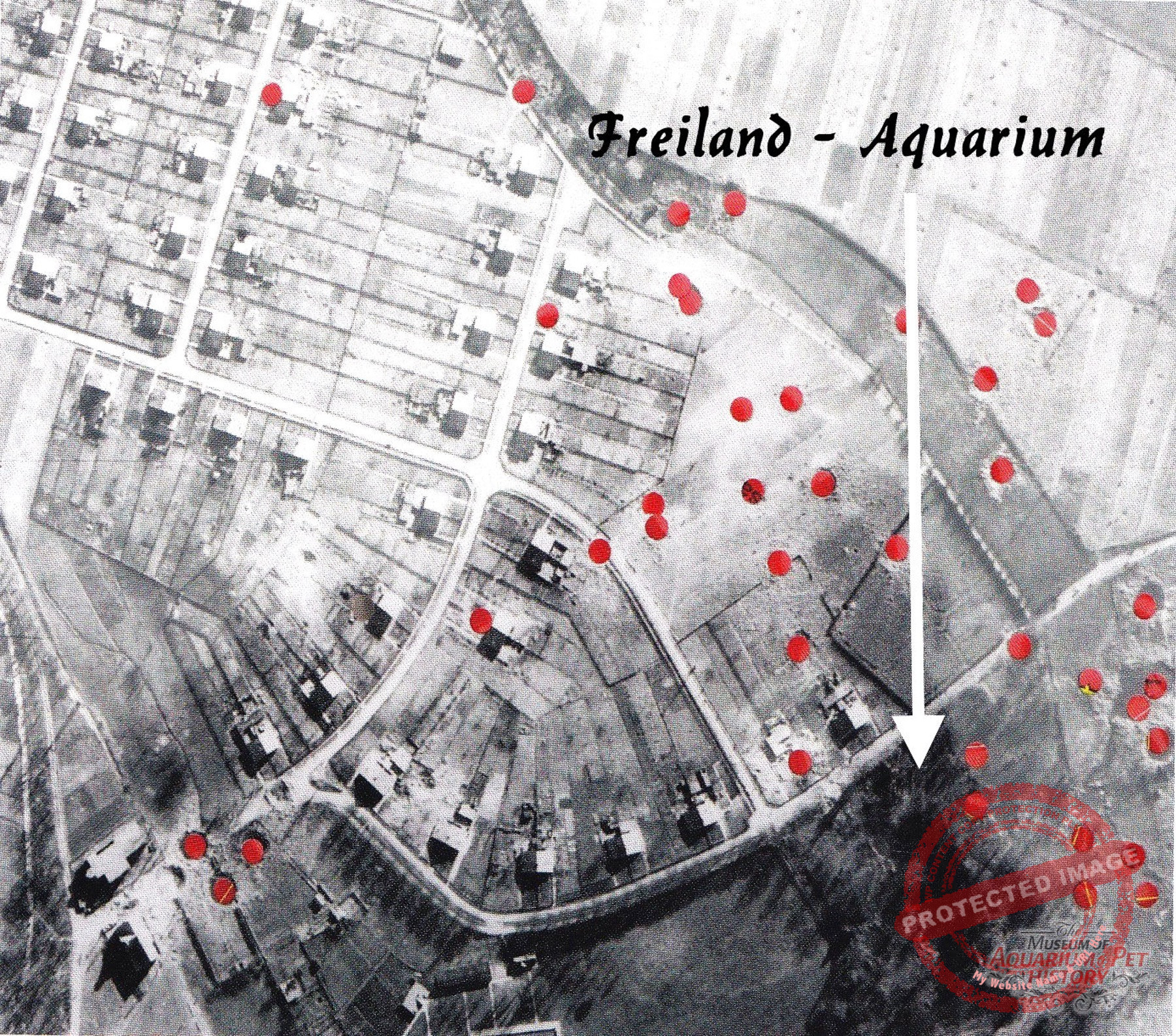
The Gotha aquarists had managed to survive the dark years and war with the injuries sustained. Then came April 6, 1945. As in many parts of Germany, Allied air raids by Britain and the USA caused extreme destruction in the final days of the war. My grandfather, who had lost a leg on the French front in WWI and could no longer work in his profession, was leaving work at the Gotha main station command post and walked through the nearby Gotha Park to go home. A Luftmine hit a gasoline-filled tank car at the freight station. The car flew through the air on fire directly toward the command post. My grandfather recounted his miraculous survival. He gave me details of the destruction around the station. The aim was to disrupt the main transport connection between Berlin and Frankfurt/Main. During the attack, 180 travelers died in the station and trains, and 270 people in surrounding houses and offices. The misfortune of the Gotha aquarium clubs was that all open-air facilities were very close to the main station. The bombs reached all of them, and all were destroyed beyond recognition.
As if the vivaristic hobby were a metaphor reflecting broader societal events, the fate of Gotha’s beautiful open-air facilities illustrates the scale of human and cultural destruction. It did not matter where the bombs came from or who fired the guns. Families mourned their dead without asking who was responsible. At the end of the terrible war and the most horrific dictatorship ever, everyone understood that the Nazis, with their extreme, anti-human, authoritarian, and aggressive policies, were responsible for over 80 million deaths in Europe alone. Reich Forestry Director Göring was tried at Nuremberg, found guilty of war crimes, and sentenced to death. His terrible actions produced a vile legacy that continues to operate today and unfortunately gains support. The events also demonstrate that even an apolitical hobby cannot remain isolated from the currents of history. Eventually, one must take a stance. The Gotha aquarists had labored, suffered, and learned. After tending to their wounds, they began to rebuild—their hobby, two open-air facilities, and one club. The Nazis could not unify them by force; the history they endured did. More on this in the next installment of this article series.
Acknowledgments: I thank my family (Charly Fuchs), friends and colleagues in Gotha, especially Uwe Heustock, current chairman of the Gotha Aquarium Club, and the staff of the Gotha City Archive, Dr. Julia Beez and Dorett Sagner, for allowing me to view, scan, and photograph their documents, and for sharing many photos, information, and surviving original objects.
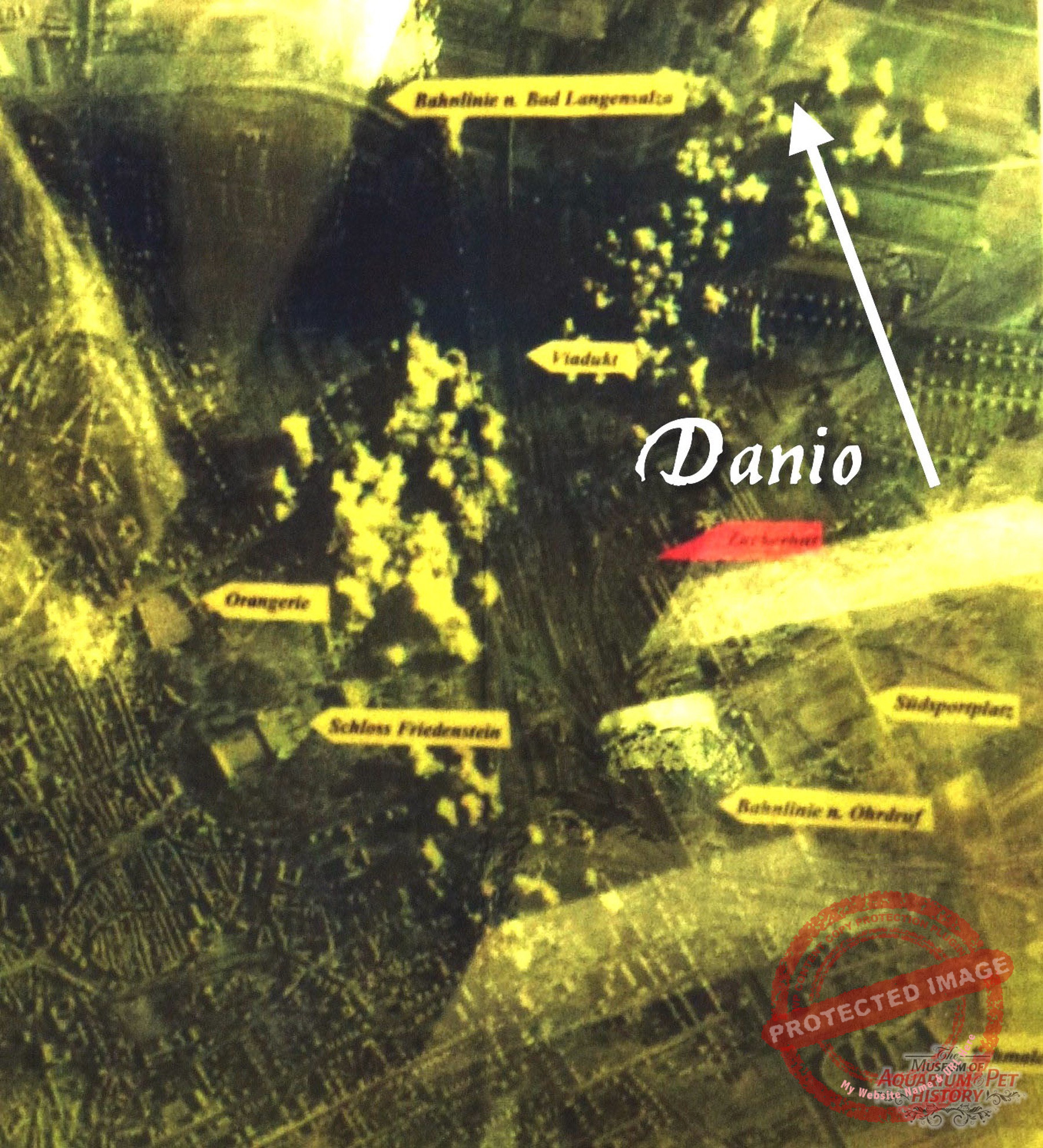
Bomb craters visible on April 6, 1945, on the Danio grounds southeast of Gotha’s main railway station.